



Abstract
This study examines what workers do when their supervisor is not responsive to their voice. Based on mobilization theory and theories on organizational dissent, the authors hypothesize alternatives for workers expressing discontent when their initial complaints are ignored or punished by their supervisor under various co-worker support conditions. The hypotheses are tested using a large-N dataset while applying a vignette design. The findings show that workers are less likely to (repeat) voice within the organization and more likely to seek help outside the organization when a supervisor threatens to punish future voice endeavours. Co-workers’ supportive and participative responses to voice increase the likelihood that workers keep their voice within the organization and have mixed effects on the likelihood that workers seek support elsewhere.
Introduction
The reduction in the number of collective expressions of labour voice, such as strikes, long seemed to indicate that labour conflicts no longer exist. A popular idea in Industrial Relations (IR) research is that employee and employer relations have matured into a peaceful and rational partnership in which worker protests are no longer necessary (Addison and Teixeira, 2019; Godard, 2011). However, recent IR studies have found no empirical confirmation of ‘matured employment relations’ (Drinkwater and Ingram, 2005; Godard, 2011; Tuckman, 2010). On the contrary, the decline in collective labour protests is associated with an increase in political strikes (Gall, 2013), an increase in the expression of individual voice and a rising concern about increasing levels of anti-organizational and antisocial behaviours (such as lateness, deliberate errors, petty theft, fraud, leaking confidential information and harassment) (Forth et al., 2008; Hebdon, 2005; Hebdon and Stern, 1998; Marsden, 2013). These findings suggest an alternative hypothesis: collective and overt conflicts, such as traditional strikes, have been replaced by new forms of conflict, such as mass political action or (hidden) forms of resistance, e.g. sabotage, pilfering, or idleness (Edwards et al., 1995; Lawrence and Robinson, 2007; Sprouse, 1992). This ‘substitution’ hypothesis (Hebdon, 2005; Scheuer, 2006) proposes that legal restrictions on strikes have forced labour to use its voice in other ways, such as by taking individual court actions, other forms of workplace action (work stoppages, work to the rule, etc.) or anti-organizational behaviour or voicing in the political arena.
This logic of substitution is also suggested by Organizational Behaviour (OB) studies. OB focuses on the effects of organizational-level institutions on the articulation of individual employees’ discontent. The theoretical framework used in this vast body of organizational research is an adaptation of Hirschman’s exit, voice and loyalty model (Hirschman, 1970). Since 1970, the majority of research into exit, voice and loyalty supports the IR hypothesis, that conflict and discontent do not disappear when the opportunities for articulating discontent are restricted. OB studies find strong empirical indications that restricting people’s opportunities to articulate discontent leads them to seek an alternative outlet for their discontent (Bingham, 2004; Brewster et al., 2007; Budd and Colvin, 2008; Colvin, 2004). Both research traditions thus acknowledge that institutional suppression of voice will lead to other expressions of discontent. However, their analytical focus remains limited to (1) the aggregated level of macro-level expressions of workplace conflict, primarily strikes, and/or (2) responses to formal institutional restrictions to voice. Our study investigates how employees respond to the suppression of individual voice. It contributes to the literature in four innovative ways.
First, our study develops and tests a micro-level theory of the conditions under which workers substitute expressions of voice after their initial expression of voice is restricted. The idea that if traditional channels for voicing discontent fail, then discontented workers have no other option than to remain silent or ‘to choose an alternative outlet’ for their discontent thus far finds primarily empirical support on the aggregate level of, e.g., strike activity. Although these macro-level trends may be caused by the suggested method displacement, alternative causes cannot be ruled out. For example, the reduction in overt strikes may be caused by deindustrialization – shifting employment to less strike prone economic sectors – de-unionization – decreasing union power – and globalization – decreasing employment protection and making strikes riskier (Jansen et al., 2017; Vandaele, 2011). Thus, the current empirical status of the substitution thesis is uncertain. In addition, Hebdon and Noh (2013) argue that we still lack a theory that helps to unravel ‘the complex interactions between the various expressions of workplace conflict’ (p. 27). The present study contributes to the progress of such a theory by explicating and testing the implicit micro-level assumptions underlying the thesis, that is, that workers choose alternative outlets for their discontent when one outlet is closed. The present study examines the conditions under which employees seek alternative outlets for their discontent when their initial articulation of discontent is ignored or suppressed. We study when employees cease to express discontent, rearticulate their voice with their supervisor, or seek alternative ways to voice their discontent, namely, to the works council, the union, the press or (local) politicians.
Second, we argue that the formal institutional restrictions on expressing discontent studied by IR and OB are just the tip of the iceberg. Both IR and OB theory have pursued a rich and impressive line of research into the effects of various national-level, formal institutions (such as the law and centralized labour negotiations) and organizational-level institutions (such as unions and management-led voice mechanisms) on workers’ voice. In addition to IR and OB scholars’ concern for national- and organization-level institutional restrictions – in particular, legal restrictions on strikes – we argue that the most common forms of worker voice suppression take place in the direct social interactions between management and workers (Sluiter et al., 2020). The present study examines the effects of day-to-day workplace experiences with expressions of discontent. This is not to say that formal institutions do not matter. On the contrary, social contexts may reinforce national- and organization-level restrictions, such as through social norms (when social norms coincide with a particular institutional restriction on voice); social contexts may also ignore or even counter institutional restrictions when such restrictions contradict the norms of the social context. Thus, institutional conditions shape the (legal) space for the (collective) voice (March and Olson, 2005; Scott, 1995). The theory presented in our study therefore focuses on the suppression of voice in the social context of the workplace, in which voice may be embraced and supported by the supervisor, but also may be ignored or retaliated against, shutting down the most common direct channel for expressing dissent.
The third innovation of our study is its focus on the role of co-workers as one of the focal conditions. We argue that co-workers determine the social costs and benefits of individual behaviour to a large extent. Moreover, co-workers are highly important to the success of voicing complaints. Joint strategies in addressing issues at work are less easily ignored and are likely to increase the validity of the complaint and the pressure on management.
Finally, we use an innovative empirical approach to address the research problem. The vignette method, in which respondents respond to hypothetical situations, enables us to obtain systematic insights into their intentional responses to suppression in varying social situations. The respondents respond to a hypothetical situation at work in which they expressed discontent to their supervisor, i.e. a complaint about not being paid for a few months. We vary the response of the supervisor (ignored the complaint or threatened to retaliate against the complainant) and the behaviour of co-workers (participative, supportive or suppressive responses). The respondents are asked to score the likelihood of several responses, including quitting all efforts, repeating their voice to the supervisor, voicing to the works council and union, and contacting the press or a (local) politician.
The research question of the present study is ‘To what extent do the responses of (the supervisor and) co-workers affect the voice outlets workers choose when their initial complaints were unsuccessful?’ Using insights from mobilization theory and theories on organizational dissent, we derive hypotheses regarding which outlets workers choose to express discontent when their initial complaints are ignored or retaliated against by their supervisor, under varying conditions of co-worker support. Our study contributes to the current research by introducing a new theoretical element to the study of voice restriction: that of the responses of co-workers. Moreover, it studies the more common day-to-day instances of voice and suppression, which allows for an innovative inspection of the micro-level mechanisms behind the substitution hypothesis. Finally, its unique empirical approach allows for a systematic inspection of the micro-level mechanism behind the notion of conflict displacement. We collected and use an original dataset of 22,797 observations and 7,599 respondents (Akkerman et al., 2017). We conclude with a discussion of our findings seeking to understand the consequences of the erosion of labour market institutions, such as the right to strike, trade unions and the increase in precarious work.
Theory
We build our theoretical ideas on Exit, Voice, Loyalty models, first proposed by Hirschman (1970) and later expanded by others (Farrell, 1983). According to these models employees have four options to deal with discontent. First, workers can leave their job, and the organization they work for (Exit). Another option is to express their discontent, either as an individual, e.g. talk to their supervisor, or collectively, such as engaging in industrial action (Voice). Hirschman proposed that the less loyal were more likely to exit the organization, while those who were loyal were more willing to invest in voice, or not invest at all and do nothing and wait for the situation to improve (Silence) (Hirschman, 1970: 38; Kolarska and Aldrich, 1980). Finally, the discontented worker can neglect the duties of the job, or even sabotage the organization, thus engaging in deviant behaviour as a response to discontent, labelled Neglect (Rusbult et al., 1988). We build on the idea of voice, and theorize on when this voice is (still) expressed within the organization, and under what conditions workers take their discontent outside the organization and seek the support of external actors.
Voicing discontent
A common way to express a problem or discontent for workers is to take the matter up with their supervisor during team meetings, personal communications such as face-to-face conversation or work email, etc. Supervisors may respond in various ways to workers complaining about a work-related matter (Kassing, 2009). Some may help to resolve the issue or eliminate the dissent, while other responses, such as ignoring, silencing or punishment, may effectively close this common outlet for dissent. A worker who feels ignored or punished for their complaints basically has four options: (1) abandon the effort to resolve the issue, (2) repeat the complaint to the supervisor, (3) voice it to other actors in the organization (other supervisors, such as the supervisor’s supervisor or the works council), or (4) seek the attention of external actors (such as the union, the press or a political actor). In what follows, we theorize on how both supervisor and co-worker responses to voice affect individual workers’ choices to stop voicing, rearticulate their voice, or find different outlets for their voice.
Supervisor response
It is likely that suppression changes the preference for the type and the target of voice because it alters the perception of the (social) costs and (expected) benefits of voicing problems (Opp and Roehl, 1990). Being ignored or punished for voicing complaints is a disappointing experience for an individual that negatively affects his/her trust in the effectiveness of voice and the responsiveness of the supervisor, and also perhaps in one’s personal efficacy (Liang et al., 2012). Moreover, being punished for complaining is not only disappointing but probably also informs one about the risks of the future voicing of complaints to a supervisor, such as losing one’s job or harming one’s career prospects. Thus, a supervisor’s response to voice may shift workers’ preferences for complaining with the supervisor towards other outlets, or they may even stop attempting to voice the issue. We distinguish two types of suppressive responses that may change workers’ preferences for voice: ignore voice or (threaten to) punish the worker for (re)articulating discontent. Both will lower the benefits of rearticulating discontent because they signal the supervisors’ inability or unwillingness to resolve the issue. In addition, the threat to punish workers for rearticulating their discontent will also raise the costs of doing so. We therefore hypothesize the following:
Supervisor threats to punish voice decrease the probability that workers rearticulate dissent compared to the supervisor ignoring it (H1).
The role of co-workers
It is difficult to predict what route workers whose voice is met by suppressive responses by their supervisor will take. We argue that one of the factors that influence this choice is the reaction of co-workers. It is not unlikely that co-workers are or become aware of a worker voicing a complaint and the supervisor’s response to it. A worker’s social context is important in the worker’s decision to express discontent (Born et al., 2013, 2016). Mobilization scholars find that the social context of a protester can impact an individual or a group’s response to the repressive tactics of states. Suppression may induce at least two mechanisms that change the (expected) rewards and costs of voice. First, suppression or being ignored may induce informal positive reactions and sympathy within the social environment of the protester. Positive reactions in the social environment of protesters raise the social rewards of protesting and motivate protesters to continue and intensify their protest (DeNardo, 1985). It is therefore likely that the alterations to the (social) costs and benefits of a protest change the preferences for the type and the target of voice. In the context of work, positive responses are likely when employees’ voice creates positive externalities for other employees, such as when employees’ voice intends to improve conditions for others as well. Thus, their positive response to suppression increases the social reward of a protest and stimulates the worker to persevere or repeat his or her complaint.
However, support from co-workers for articulating dissent at work is not a given: co-workers may not want to support or join a protesting co-worker because, e.g., the issue is not affecting his or her personal work situation and solidarity is low. Others perceive it not to be worthwhile to speak up about the issue or fear joining the protest or even showing support for their co-workers (Akkerman et al., 2013; Thommes et al., 2014). Lacking the support of co-workers is not even the worst scenario for an employee expressing dissent. Especially when initial attempts to voice complaints were unsuccessful or met with retaliation by the supervisor, workers may find themselves in a difficult situation since suppression may generate negative responses towards the protester from co-workers (Opp and Roehl, 1990). This happens, for instance, when the employee’s voice creates serious externalities for other employees, e.g. when it endangers co-workers’ employment or when employees are collectively penalized (Coleman, 1990; Heckathorn, 1990; Pauksztat et al., 2011). Therefore, co-workers may disapprove of the voicing of grievances by a co-worker because of the (anticipated) suppression of it and/or the consequences of any issues resolved by the voice. Ultimately, co-workers, even those previously involved in the expression of voice, may become suppressors themselves. The suppressive responses of co-workers increase the social cost of continuing the articulation of dissent, which may urge the protesting employee to cease his or her voice.
Research into mobilization for protest shows that suppression increases discontent when it gives rise to new grievances, which may attract previously uninvolved aggrieved actors. Studies of the effect of state repression on mass mobilization observe that suppression leads to new grievances and emotions, especially when the suppression is considered illegitimate (Gurr, 1970; Oberschall, 1973). The Maple Spring protest prompted by the May 2012 Quebec law against student protests demonstrates these dynamics. The law, passed to curb student protests against budget cuts, provoked protests by the general public, which considered the law to violate their fundamental democratic rights. These new grievances aggravated the protesters’ discontent and attracted new protesters (Lukacs, 2012). Co-workers’ participation is crucial for the effectiveness of any (collective) voice within an organization. The suppressive behaviour of a supervisor may spark feelings of unfairness in co-workers, which incites support – due to raising the social benefits of the protest – or even the participation of co-workers previously not engaged in the protest. The latter raises not only the social benefits of the protest but also the effectiveness of expressing dissent. We therefore hypothesize the following:
Co-worker support and co-workers joining the protest decrease the probability that workers stop voicing their dissent, compared to co-worker suppression (H2).
Co-worker support and co-workers joining the protest increase the probability of the rearticulation of voice, compared to co-worker suppression (H3).
Both mechanisms point to the importance of the support of others. The decision to stop voice or repeat it is probably highly dependent on the responses of co-workers. Their support is crucial for the perceived short- and long-term social costs of voice within an organization (Thommes et al., 2015). Moreover, unsupportive responses from one’s supervisor and/or co-workers for one’s voice likely change an individual’s preferences for alternative forms of voice too (Hardin, 1982). In the next section, we explore the effects of suppression and the support of co-workers on the attractiveness of taking one’s voice to an alternative outlet both within and outside the organization.
Seeking alternative outlets
Another strategy for an employee whose voice is suppressed by his/her supervisor is to target their voice elsewhere and try to involve previously uninvolved actors. A recent example is that of the Portuguese workers who were hired via an international subcontractor to work on a large infrastructural project in the Netherlands. Large amounts were deducted from their wages for exorbitant housing costs and obscure services. Their complaints were met with threats and further ignored by the subcontractor. Eventually, the workers contacted a journalist from a regional newspaper who brought the workers’ situation to the attention of the public and members of the Dutch parliament (De Gelderlander, 2015; Zembla, 2015). Another example of a successful attempt to voice through the media is illustrated in the New York Times documentary on the bad working conditions in a China-based iPhone factory (Kessel and Bishop, 2012). Gamson (1995) describes how the media contribute to obtaining support from previously uninvolved actors, such as the general public, by placing an ‘injustice frame’ on the case. Portraying the employer as greedy or negligent may lead to resentment in public opinion, leading to sanctions, such as the call for a consumer boycott in the iPhone case (Harris, 2012). More common actors that may be approached to seek support are the works council and the union. Employees may anticipate that the fear of reputational damage could pressure the employer to resolve the grievances or, as in the case of the Portuguese workers, the government to take legal action. Thus, seeking the help of outsiders may be a useful strategy.
Rothschild and Miethe (1999) in their study on the motivation of whistleblowers find that the decision to voice externally is highly influenced, if not determined, by the response of the organization to the initial internal whistleblowing. In particular, threats and retaliation by the management appeared to be ‘catalysts of . . . the transformation of the concerned employee into a “persistent resister”’ (Rothschild and Miethe, 1999: 119; see also Kassing, 2009: 430). From this, we expect that supervisors’ attempts to stop voice endeavours may actually increase the likelihood that workers seek the help of previously uninvolved actors. Hence, we hypothesize the following:
Supervisor threats to punish voice increase the probability that workers take their voice to other outlets compared to the supervisor ignoring it (H4).
However, the chances of being heard and receiving the right frame to provoke indignation are uncertain. The media or politicians may not be interested in the problems of individual workers. Moreover, this strategy results in high, irreversible reputation losses for both the worker and the organization, leading to irreparable working relations between the employer, co-workers and the protesting worker. Therefore, seeking support from outsiders seems to be an uncertain strategy, which may increase the effectiveness of the protest and may lead to social support from others, but also may not do so. In addition, it is also a strategy that is likely to come at a high (social) cost for the protester within the organization where he/she works (Kassing, 2011; Rothschild and Miethe, 1999; Stewart, 1980). Thus, taking dissent to previously uninvolved actors is a ‘last resort’ strategy that is only chosen when an employee cannot increase the effectiveness of their voice within the organization by involving co-workers and has nothing left to lose in terms of social costs. We expect that when their supervisor suppresses them and their co-workers suppress them as well, employees find themselves in a situation in which they have no other choice but to seek alternative outlets for voice.
Co-worker suppression increases the probability that workers take their voice to other outlets compared to co-workers supporting or joining the protest (H5).
The study
Data
We use the Work and Politics 2017 survey (Akkerman et al., 2017) to test our hypotheses. This tailor-made survey is specifically designed to gather information about experiences, (intentional) behaviour and attitudes related to voicing discontent and the responses of supervisors and co-workers to voice at work. Insights from previous research (Bernhardt et al., 2009; Cortina and Magley, 2003; Miceli and Near, 1989), input from experts, and a pilot study were used to develop the questionnaire. The target population were members of the Dutch labour market aged from 15 to 67 years, including working people and unemployed people looking for work. The fieldwork was carried out by Kantar Public, using the TNS NIPObase panel. This is a Dutch panel which contains over 235,000 members from 145,000 households in the Netherlands. Panel members are recruited through random sampling, which means that every member of society has a chance to be selected for the panel. This circumvents the common problem of self-selection onto online panels.
From the panel, 11,942 participants were drawn based on a sample stratified by age, region and education. The interviews were held from July to September 2017 using Computer-Assisted Web Interviewing (CAWI). The average time for filling out the questionnaire was 20 minutes. The respondents received a small remuneration, in the form of vouchers, for participating in the survey. From the 11,942 panel members who were invited to participate, 7,599 respondents completed the questionnaire, yielding a response rate of 64%. The data are representative of the Dutch labour force aged 15–67 years in terms of gender, age and region (Kantar Public, 2017).
Vignette design
For this study, we used the vignette design of the Work and Politics 2017 study. In a vignette study, participants respond to hypothetical situations. Typically, multiple hypothetical situations are presented to each respondent, and these situations differ among several dimensions. By systematically varying these dimensions in the hypothetical situations, one obtains insights into the effects of these dimensions on the intentional behaviour of respondents (Jasso and Opp, 1997; Rooks et al., 2000). The vignette method has also been used in previous studies of intentional voice behaviour in a workplace setting (Harlos, 2010).
In the Work and Politics 2017 survey, we first asked respondents to imagine that they worked in an organization where the following situation occurred. We then presented three vignettes to each respondent. These vignettes described a hypothetical situation about a work-related conflict that has not been resolved despite previous voice attempts. Hence, the worker is in a situation where voice to the supervisor has been proven to be unsuccessful. We then randomly varied the responses of the supervisor (two dimensions, varying between ignoring past complaints and actively trying to prevent future endeavours to voice) and co-workers (three dimensions, varying between threatening to punish, supporting future voice endeavours and participating in future voice endeavours). We excluded the possibility that a specific combination of responses was presented to a respondent twice. This leads to a universe of (2*3=) six vignettes. The vignettes read as follows:
Your employer has not fully paid you and your co-workers in the past six months. You have voiced this issue several times to your employer. Your employer
After each vignette, respondents were asked how likely it was that they would respond in each of the following ways:
(a) I would let it rest [Stop voice]
(b) I would voice the issue again to my supervisor [Rearticulate voice]
(c) I would voice the issue to the works council [Voice to works council]
(d) I would voice the issue to someone from the union [Voice to union]
(e) I would take the issue to the press [Voice to press]
(f) I would take the issue to a (local) politician [Voice to politician].
The answer categories for each response ranged from (1) extremely unlikely to (5) extremely likely. These responses serve as the dependent variables in this study. Note that we have formulated hypotheses about the effects of supervisor and co-worker responses on stopping voice, rearticulating voice and taking voice to other outlets. In this study, we examine voice to the works council, the union, the press and politicians as alternative voice outlets.
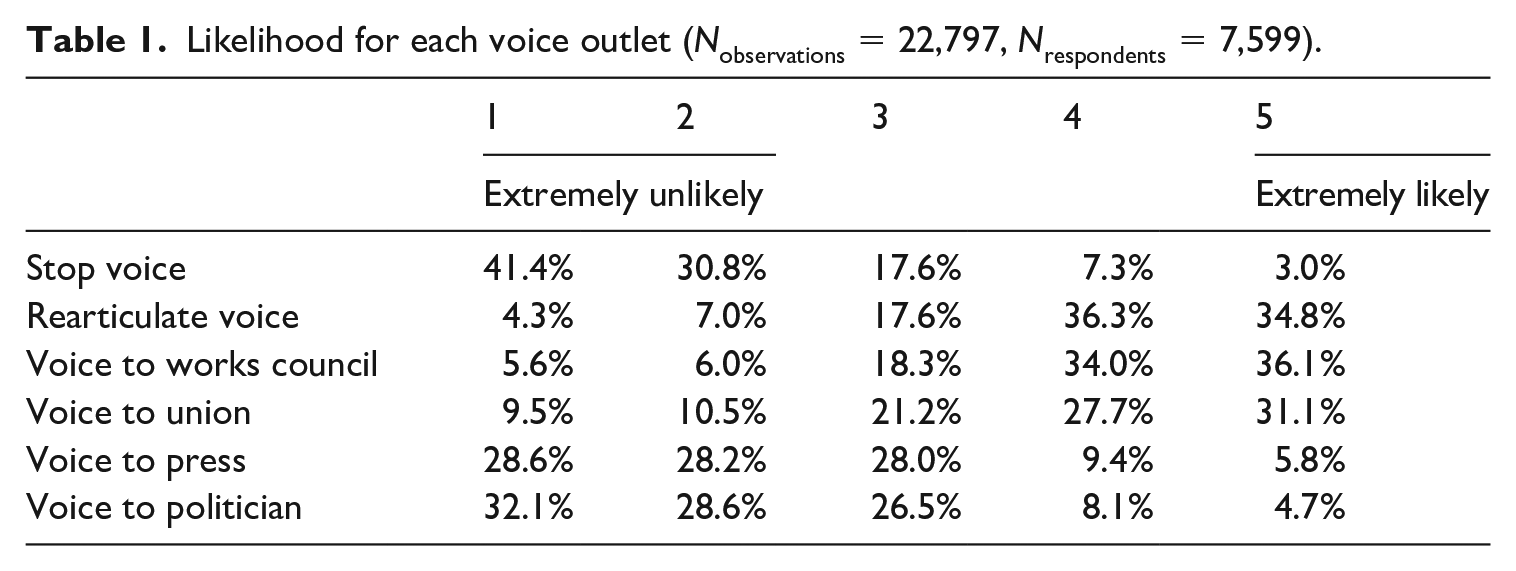
Table 1 presents an overview of the likelihood that respondents would respond in these ways. The table shows that almost 75% of the respondents indicated that they would not stop voicing (i.e. a score of 1 or 2 on this variable), and an overwhelming majority (approximately 70%) indicated that they would rearticulate the voice to the supervisor (i.e. 4 or 5 on this variable), voice to the works council or voice to the union. More than half of the respondents said that they were not likely to turn to the press or a politician (i.e. a score of 1 or 2 on these variables).
Likelihood for each voice outlet (Nobservations = 22,797, Nrespondents = 7,599).
We add dummy variables to measure the response of the supervisor (Ignore/Punish) and the responses of the co-worker (Co-worker suppression/Co-worker support/ Co-worker joining the protest). Table 2 presents the descriptive statistics for the dependent variables, the vignette characteristics and the individual characteristics. We present the Pearson correlation matrix in Table 2. Here, we see that stop voicing is negatively related to all other voice outlets except to voicing to a politician, to which it is unrelated. We also see that the correlation between voicing to the press and to a (local) politician is very high with a Pearson correlation of 0.809. Further, we see that the supervisor response (ignore and punish) is not correlated with co-worker responses (suppression, support, and joining the protest), and the vignette characteristics are not correlated with the respondents’ individual characteristics. These results indicate that the vignette characteristics were indeed randomly distributed.
Descriptive statistics and bivariate correlations (Nobservations = 22,797, Nrespondents = 7,599).
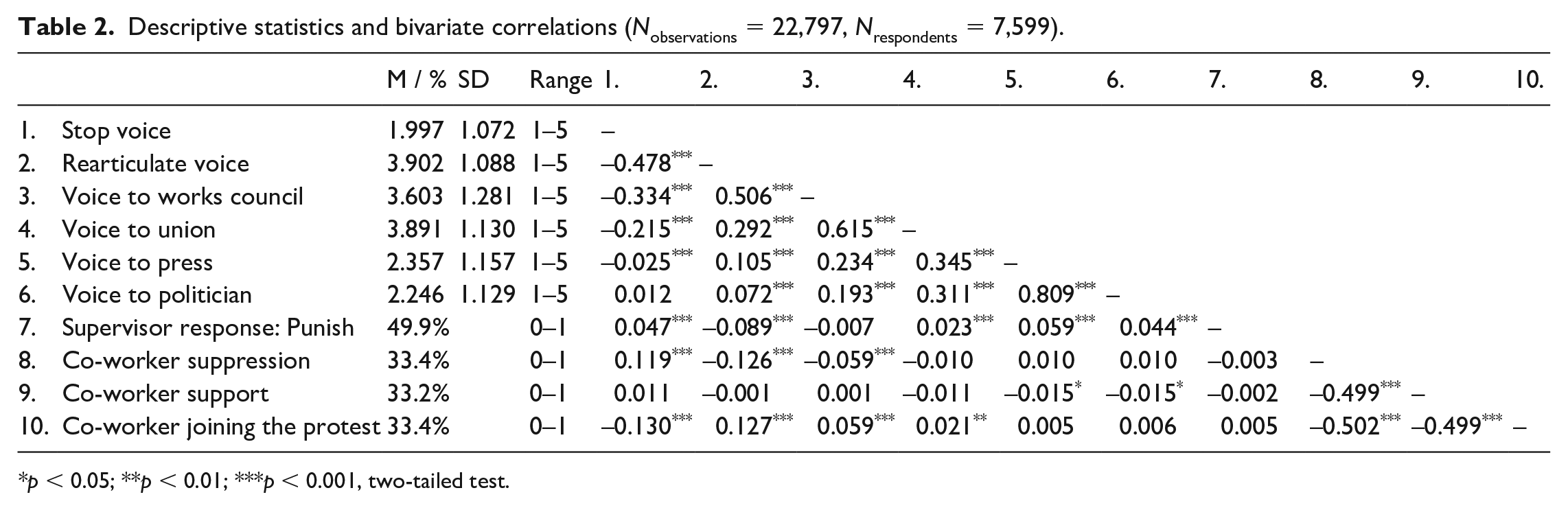
p < 0.05; **p < 0.01; ***p < 0.001, two-tailed test.
Methods
Since each respondent answered the vignette question three times, we have three observations for each dependent variable per respondent. To analyse these data, we constructed a dataset in a long format, where each row in the dataset is at the observation level, and we have three rows for each respondent. In so doing, our dataset has a hierarchical structure with observations nested in respondents. Ultimately, our data contain information on approximately 22,797 observations and 7,599 respondents.
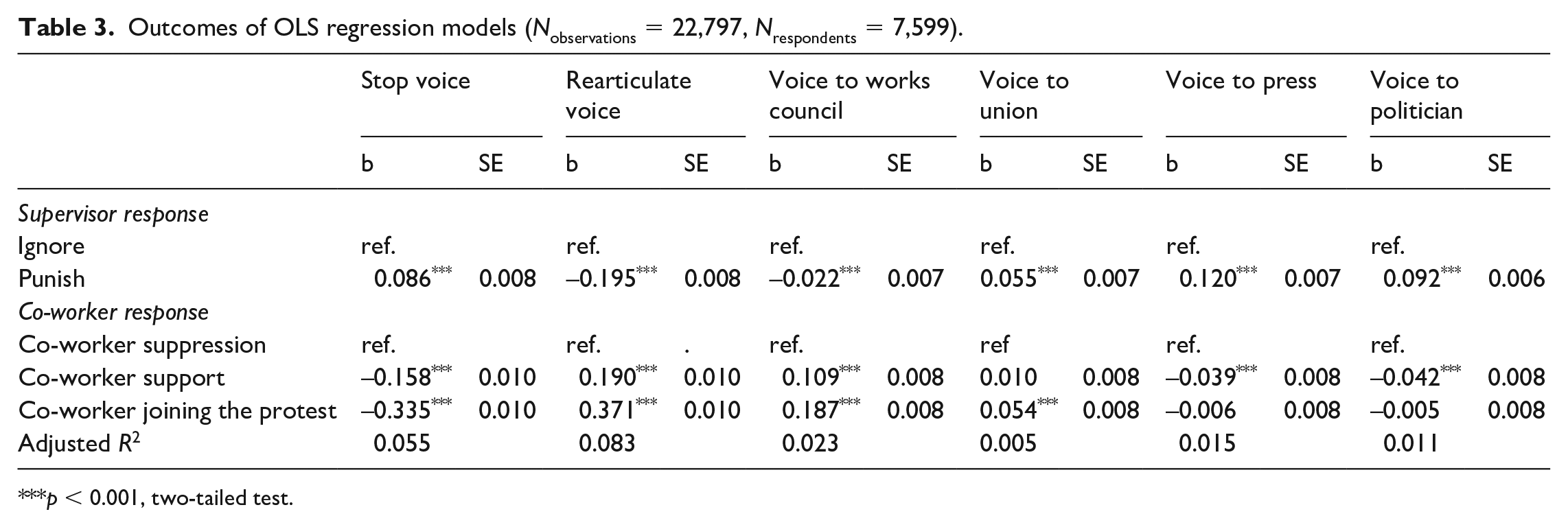
To account for this nested structure, we run fixed effects OLS regression models by demeaning the variables in our models, i.e. for each variable in our models, we subtracted the mean score of the respondent to this variable. In doing so, we keep all respondent-specific characteristics constant, which allows us to focus on the vignette-specific characteristics. 1 We present the outcomes of the regression analyses in Table 3. 2 These six models present the effects of the vignette attributes, i.e. supervisor response and co-worker response, on the six voice outlets.
Outcomes of OLS regression models (Nobservations = 22,797, Nrespondents = 7,599).
***p < 0.001, two-tailed test.
Results
The role of the supervisor
We start with the discussion of the role of the supervisor on the likelihood of choosing one of the six voice outlets. First, we see that workers are more likely to drop the issue (b = 0.086, p < 0.001) when their supervisor threatens to punish future voice compared to the supervisor ignoring the initial voice. Thus, on average, the likelihood to drop the issue, measured on a scale from 1 to 5, is 0.086 higher when faced with threats of punishment by the supervisor. Next, we expected that when the supervisor threatens to punish anyone who rearticulates the voice, compared to the supervisor ignoring the initial voice, the costs for future voice increase and the expected benefits of voice decrease. Hence, we hypothesized that workers would be less inclined to rearticulate their voice to their supervisor when their supervisor threatened to punish subsequent voice compared to workers whose supervisor ignored the initial voice (H1). Indeed, the findings in the second model of Table 3 show that compared to voice being ignored by the supervisor, threatening to punish future voice decreases the likelihood that workers rearticulate their dissent to the supervisor (b = –0.195, p < 0.001). On a scale from 1 to 5, people score 0.195 lower when the supervisor threatens to punish future voice. We thus find support for the first hypothesis.
We also hypothesized that when supervisors threaten to punish voice, compared to ignoring the voice, workers would be more inclined to seek support elsewhere (H4). This is not the case for voicing to the works council. Here, we see that workers are less likely to opt for the other voice outlet within the organization, the works council (b = –0.022, p < 0.001), refuting Hypothesis 4. However, while reaching statistical significance, the effect is small: the difference between the two supervisor responses is merely 0.022 on a scale from 1 to 5.
So far, our findings seem to indicate that the punishment of future voice attempts by the supervisor makes workers less likely to continue voicing their dissent within the organization. Interestingly, this is not the case for the voice outlets outside the organization: when faced with threats of punishment, workers indicate that they are more likely to voice to the union (b = 0.055, p < 0.001), the press (b = 0.120, p < 0.001) or a politician (b = 0.092, p < 0.001), supporting Hypothesis 4. Hence, when the voice outlets at work are blocked, this does not necessarily mean that workers cease to express their voice, but it increases the (relative) attractiveness of voice outlets outside the organization.
The role of co-workers
We continue with the discussion of the role of the co-workers on the likelihood of each voice outlet. Note that the role of the co-workers is a categorical variable with three categories: co-worker suppression, co-worker support and co-workers joining the protest. In Table 3, co-worker suppression serves as the reference category. Hence, we present the effects of co-worker support and co-workers joining the protest compared to co-worker suppression. Because this does not tell us whether the effects of co-worker support and co-workers joining the protest significantly deviate from each other, we also ran the analyses with co-worker support and co-workers joining the protest as reference categories. The outcomes of these analyses are presented in Appendix C available online.
We hypothesized that compared to co-worker suppression, co-worker support and co-workers joining the protest would decrease the likelihood that workers stop voicing their dissent (Hypothesis 2). The first model (Stop voice) in Table 3 indeed shows that the likelihood of letting the issue rest is the highest when co-workers suppress voice. This likelihood is significantly smaller when co-workers support voice (b = –0.158, p < 0.001) and even smaller when co-workers join the protest (b = –0.335, p < 0.001). Hence, the likelihood of stopping voice, measured on a 5-point scale, is 0.335 points lower when co-workers join the protest, and 0.158 points lower when co-workers support voice, compared to co-worker suppression. These findings are thus in line with Hypothesis 2. Additional analyses (see Appendix C online) show that the differences between co-worker support and co-worker joining the protest are also statistically significant. Hence, not only do we find that co-worker support and co-workers joining the protest decrease the likelihood that workers stop voicing their dissent, we also find that co-workers joining the protest leads to a stronger decrease in the likelihood of letting it rest compared to co-workers’ support.
Mirroring these hypotheses, we also expected that co-workers supporting and joining the protest would increase the likelihood that people rearticulate their dissent to their supervisor (Hypothesis 3). In the second panel in Appendix C, titled ‘Rearticulate voice’, we find empirical support for this hypothesis: compared to co-worker suppression, workers are more likely to rearticulate their voice to their supervisor when they are supported by their co-workers (b = 0.190, p < 0.001) or when co-workers join the protest (b = 0.371, p < 0.001). By and large, these are similar in terms of effect sizes to the co-worker responses effects in the previous model. Again, we see that the differences between each comparison is significant, indicating that compared to co-worker support, workers are more likely to voice again when co-workers actually join the protest (see Appendix C online).
The fifth hypothesis stated that co-worker suppression increases the probability that workers take their voice to other outlets (i.e. other than the supervisor) compared to co-workers supporting or co-workers joining the protest. Here, we consider four alternative voice outlets: the works council, the union, the press and a (local) politician. On a 5-point scale, workers are in general 0.109 points more likely to voice to the works council when co-workers support future voice endeavours and 0.187 points more likely when co-workers also join the protest. Hence, this finding is the exact opposite of what we expected in Hypothesis 5: it is not that workers turn to the works council when they are on their own, but rather they do so when they stand together with their co-workers.
We also need to refute the fifth hypothesis when we turn to voicing to the union. Here, we find that co-worker support alone is not enough to increase the likelihood of voicing to the union. We see that co-workers joining the protest increases the likelihood of voicing to the union (Voice to union model, b = 0.054, p < 0.001). This finding seems to support the role of labour unions as outlets for the collective voice of workers, and workers may therefore associate unions with the representation of the collective interests of workers. Note, however, that the effect is rather small: on average, the difference between co-worker suppression and co-workers joining the protests is only 0.054 on a 5-point scale.
The fifth model in Table 3 tells us that workers who receive support from their co-workers are less likely to voice to the press than workers who have experienced suppression from their co-workers (b = –0.039, p < 0.001). The results for workers that experienced co-worker suppression and workers with co-workers joining the protest do not significantly deviate from each other. Thus, Hypothesis 5 is rejected when we examine voice to press as an outlet of discontent. Although workers are indeed more inclined to take their voice to alternative outlets when they experience co-worker suppression rather than co-worker support, we did not find differences between co-worker suppression and co-workers joining the protest. Furthermore, although the finding that co-worker suppression significantly increases the likelihood of voicing to the press when compared to co-worker support is in line with Hypothesis 5, this effect is small: the difference in the likelihoods of voicing to the press between the two co-worker responses is merely 0.039 on a 5-point scale.
Next, we examine the regression of voice to a politician. Here, the effects of co-worker responses are remarkably similar to those of voicing to the press. Compared to co-worker suppression, co-worker support slightly but significantly decreases the probability of voicing to a politician (b = –0.042, p < 0.001) while the effect of co-workers joining the protest does not significantly deviate from the co-worker suppression effect (b = –0.005, ns). Further, the effect of co-worker support also significantly deviates from the effect of co-workers joining the protest with co-worker support decreasing the likelihood of voicing to a politician (b = –0.036, p < 0.001). Hence, similar to the findings regarding voicing to the press, these findings also refute the fifth hypothesis.
Overall, we find no support for Hypothesis 5. Workers do not seek help from other actors when they are on their own. Rather, the role of co-workers varies between voice outlets: works councils become more likely when co-workers support or join the protest while unions become more likely when co-workers join the protest. Regarding voicing to the press and to a politician, we see that workers tend to take their voice to these outlets when they are on their own or backed by other co-workers who join in the protest, although the effect sizes are rather small.
Conclusion and discussion
This study examined the outlets for their discontent that workers choose when supervisors attempt to close one outlet. Insights from IR studies and OB studies suggest that workers seek alternative voice outlets when one voice outlet is obstructed. While previous studies indeed hint at a mechanism of substitution, empirical tests are mainly at the macro level and focus on institutional restrictions to voice. In this study, we build a micro-level theoretical framework to scrutinize the effects of restrictions – raised by one’s supervisor and co-workers – to worker voice, i.e. voicing to one’s supervisor, on several voice outlets: ceasing to express discontent, rearticulating the voice to the supervisor, and voicing to the works council, the union, the (local) press or a (local) politician.
Based on mobilization theory and theories on organizational dissent, we hypothesized that co-worker responses influence the perception of the social costs and the expected benefits of voicing discontent. The suppressive responses of co-workers increase the social costs and reduce the expected benefits of voice, which makes workers more likely to stop their voice endeavours and less likely to rearticulate their voice to their supervisor. In addition, alternative voice outlets such as the works council within the organization and outlets outside the organization such as the union, the press or (local) politicians may also become more attractive under these conditions since workers may feel like there are no options left.
Empirically, we used a vignette method to conduct our analyses. Using tailor-made vignette scenarios in a large-N survey among members of the Dutch labour force, we were able to isolate the effects of the behaviours of co-workers and supervisor on the preferences for specific voice outlets. We analysed whether workers cease to express discontent, rearticulate their voice, or seek alternative ways to voice their discontent when the initial articulation of discontent to one’s supervisor has not resolved the issue. We thereby focus on the roles of the supervisor and of co-workers and scrutinize whether the likelihood for voice outlets is affected by the extent to which the supervisor retaliates against future voice endeavours and whether co-workers retaliate, support, or participate in future voice attempts.
The pattern that emerges from our findings is that both the supervisor and co-workers play important roles in shaping the willingness to let the issue rest or to repeat the voice to the supervisor. When examining the voice outlets within the organization, our results indicate that threatening to punish subordinates may be a successful method for supervisors: workers are indeed more likely to cease their voice altogether and not only are they less likely to rearticulate their voice to the supervisor, they are also less likely to seek the help of others within the organization (i.e. the works council). However, we also found that when the voice within the organization is ignored, people seek support from outside the organization: workers are more likely to voice to the union, to the press or to a politician. This shows that suppression of voice at work potentially has drastic consequences when workers indeed are able to gain the attention of outsiders.
With regard to the role of co-workers, we found that the more involved co-workers are in future voice endeavours, and, hence, the lower the (social) costs and the higher the expected benefits of voice, the more likely someone is to rearticulate the voice or to voice to the works council, and the less willing someone is to discontinue their voice. Co-workers supporting or joining future endeavours may thus increase the anticipated success of voice, and reduce the social costs of voice. However, the role of co-workers does not seem to have much effect on the willingness to take one’s voice outside the organization. If anything, it appears as a last resort for those who are on their own or backed up by others joining the protest.
By applying a quasi-experimental design, we find empirical support for the idea that restrictions to voice will not make discontent disappear, but rather the restrictions will be circumvented using other ways to express voice. Thus, we find micro-level support for the mechanisms suggested by the substitution hypothesis (Hebdon, 2005; Scheuer, 2006). In light of these findings, the recent and ongoing containment of employees’ voice 3 should prelude an upsurge of alternative forms of expression of workers’ dissent, such as political strikes (Gall, 2013), legal action and, where strong unions are available, union action. However, as our research shows, the use of alternative ways to express discontent is highly dependent on co-workers’ support. In the absence of worker solidarity, workers may feel discouraged to try alternative targets to attempt to improve their work conditions.
Finally, we highlight several points that should be considered when interpreting our findings. We used a vignette design, where respondents had to imagine that a situation at work occurred, and they were then asked to indicate how they thought they would behave in the situation, offering a limited set of options. Of course, in doing so, we measure intentional behaviour rather than actual behaviour. We therefore recommend studying actual micro-level experiences with voice suppression to further investigate the extent to which voice outlets are substituted.
Additionally, it may be that the hypothetical situations described in the vignette are more difficult to imagine for some people than others. For instance, workplace situations may be harder to imagine for long-term unemployed people. Similarly, the issue described – not being fully paid for six months – may be almost unimaginable to some. Although we did try to overcome these issues by stratifying the analyses by employment status and experiences with a similar issue as robustness checks, 4 we encourage researchers to examine the effects of individual traits and experiences on the preferences for specific voice outlets.
Finally, our study’s Dutch context may have affected its outcomes, limiting its external validity. Cultural norms that differ between countries, for instance on (in)formal hierarchy in organizations and the interactions with (workplace) authorities, seem important conditions determining voice (Huang et al., 2005; Kaufman, 2015: 23). In addition (formal) national and organizational-level institutions and the working thereof, probably also matter for which channels workers chose for the (re)articulation of discontent (Kaufman, 2015: 25). Comparative research is thus necessary to determine how, e.g., the presence of strong unions and (perceived) effectiveness of employment protection, works councils or arbitration boards might influence the path workers take in expressing their grievances.
Supplemental Material
sj-pdf-1-eid-10.1177_0143831X211030330 – Supplemental material for Let’s take it outside: Seeking alternative targets for expressing dissent at work when voice is suppressed
Supplemental material, sj-pdf-1-eid-10.1177_0143831X211030330 for Let’s take it outside: Seeking alternative targets for expressing dissent at work when voice is suppressed by Agnes Akkerman, Roderick Sluiter and Katerina Manevska in Economic and Industrial Democracy
Footnotes
Declaration of conflicting interests
The authors declared no potential conflicts of interest with respect to the research, authorship, and/or publication of this article.
Funding
The authors disclosed receipt of the following financial support for the research, authorship, and/or publication of this article: This work was supported by the Netherlands Organization for Scientific Research (grant number 453-15-001).
Supplemental material
Supplemental material for this article is available online.
Notes
Author biographies
 ). She recently published in American Journal of Cultural Sociology, Political Psychology and Socio-Economic Review.
References
Supplementary Material
Please find the following supplemental material available below.
For Open Access articles published under a Creative Commons License, all supplemental material carries the same license as the article it is associated with.
For non-Open Access articles published, all supplemental material carries a non-exclusive license, and permission requests for re-use of supplemental material or any part of supplemental material shall be sent directly to the copyright owner as specified in the copyright notice associated with the article.
