



Abstract
This article explores the logics, persistence and evolution of perspectives on the Chinese labour regime in Africa. Studies find that Chinese firms’ labour practices engender abuse via casualisation of labour, low remuneration, and a general lack of adherence to occupational safety. Contrarian studies however demonstrate variations among Chinese firms’ labour practices as mediated by the labour dynamics of host countries, labour specificities and industrial capitalism dynamics. The article concludes by questioning the ‘talent gap’ dynamic in Africa in relation to Chinese firms’ managerial hiring practices and calls for an engaged scholarship on how Chinese investment in Africa’s human resource base is altering the ‘talent gap’ phenomenon.
Introduction
In recent times, an important development within the broad globalisation trend has been the active role played by Chinese firms which are looking for market opportunities around the world (Deng, 2012). Within this context Africa, with its ever-growing consumer market and low labour costs, has caught the eye of China and has emerged as a new frontier for investment opportunities by Chinese companies. Thanks to the recent acceleration, Chinese companies have grown from a few hundreds to over 10,000 across the African continent (Sun et al., 2017). The diversity of Chinese companies is considerable, ranging from major multi-million dollar state-owned enterprises (SOEs) to small and medium size enterprises or businesses run by individual entrepreneurs (Alden and Davies, 2006; Alden et al., 2008; McNamee, 2012). Some of these Chinese investors appear to have been substantially integrated into the African business community with more embedded positions built up over the years (Alden et al., 2008; Brautigam et al., 2018; Kamoche and Siebers, 2015).
Such rapid expansion of Chinese firms in the African markets has drawn the academic literature to explore this new important phenomenon and write about its development and its impact on the African economy and its prospects. The phenomenon however, in some quarters, has ‘been met with a cacophony of criticisms with exploitative Chinese labour practices as one of the more durable refrains, and a fixture of negative discourses about China’s role in Africa’ (Rounds and Huang, 2017: 8). So far, although research on the China–Africa labour perspective has been on the ascendancy, with empirical studies providing useful and varied insights, the findings remain fragmented and disconnected. Much of the journalistic reporting still focuses on talk about substandard working conditions (Mbamalu, 2018) and whether Chinese firms in Africa localise the workforce (Sautman and Yan, 2015).
It is thus imperative to synthesise the diverse empirical findings towards a more integrated understanding of the Afro-Sino labour relationship. The main objective of this article is to provide a qualitative meta-analysis examination of the theoretical and empirical development of Chinese labour practices in Africa, aimed at developing a more nuanced approach towards the assessment of the impact of Chinese investments on the labour market, especially in relation to employment dynamics and management strategies. Specifically, we seek to highlight the underlying factors that influence the Chinese labour regimes in Africa by discussing specific features of the Afro-Sino labour literature as well as limitations of existing research to stimulate further research.
In this regard, our findings suggest that variables such as country context (both China and host countries), sector specificities and firm attributes, and global industrial capitalism mechanisms contribute to shaping the labour practices of Chinese firms in Africa. In addition, we find that although Chinese firms have a high localisation rate of labour, top-level management positions remain the preserve of the Chinese – engendering an employment generation and management participation gap. Does the ‘talent gap’ in Africa explain the difference in the management position phenomenon? If so, further studies are needed that more carefully examine how the increasing Chinese investment in Africa’s human resource base is altering the ‘talent gap’ dynamics.
Chinese labour regime in Africa: The underpinning logics
One of the most contentious issues in China–Africa relations is the poor labour practices of Chinese firms operating in Africa. Why do Chinese firms appear to be the ‘worse’ employers (HRW, 2011)? According to some analysts, the reasons are not far-fetched. The labour practices of Chinese firms constitute a reflection and externalisation of China’s own labour developments at home (Jiang, 2009). The Chinese government over the years has followed an industrialisation programme principally built on traditional economic development models of heavy industrialisation, labour- and capital-intensive manufacturing industries, export-led growth, and low labour costs (Jiang, 2009). By treading such a development trajectory, China’s phenomenal economic growth rates have come with heavy price tags on wages and workers’ welfare (Jiang, 2009; Leong, 2009). In the rush for industrialisation and profits, Chinese enterprises are not well versed in work safety procedures; China’s civil society is weak and its political reforms lag (Jiang, 2009). In addition, the Chinese state suppresses labour’s power by forbidding independent unions and providing no legal or constitutional protection of the right to strike (Qi and Pringle, 2019). Amid such weaknesses, Chinese businesses have become severely limited in their ability to function in a manner that is responsive to labour concerns, labour union demands and transparency requirements in their operations (Jiang, 2009; Leong, 2009). This is what some analysts refer to as ‘Chinese exceptionalism’ (i.e. Chinese employers are exceptionally bad, with labour practices of Chinese firms being worse; see Oya, 2019). A particularity of this ‘exceptionalism’ is that a large proportion of Chinese firms located in many parts of Africa operate a low-wage system similar to experiences in parts of China (Baah and Jauch, 2009; HRW, 2011).
While the internal labour dynamics in China are important to understanding the operations of Chinese overseas companies, they alone offer inadequate insights into the logics of Chinese business operations. Variations among Chinese employment practices in Africa indicate that variables such as the internal labour dynamics of host countries (local regulations), sector specificities and firm attributes, and global industrial capitalism mechanisms contribute in shaping the labour practices of Chinese firms in Africa (Fei, 2020b). Thus, there is no consensus around the dominance of a particular labour regime of Chinese enterprises in Africa. The rest of the study primarily employs this logical framework as shown in Figure 1 to examine the literature concerning Chinese business operations in Africa.
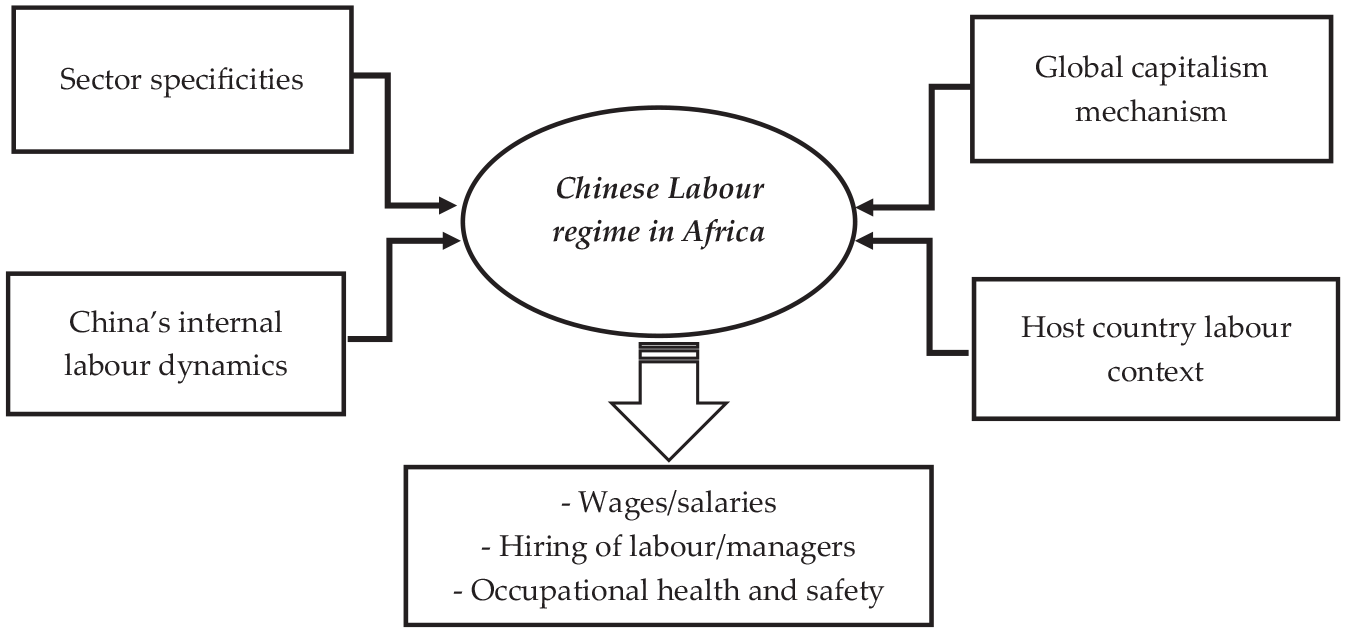
Unpacking the Chinese labour regime in Africa.
Methodology
This study is premised on a qualitative meta-analysis framework. The search for literature chiefly focused on identifying the existing peer-reviewed ‘Chinese-labour-focused’ literature on Africa. A two-pronged approach was opted for: a database-driven approach and a snowball search. For the initial search, Google Scholar and Scopus were consulted guided by the following inclusion/exclusion criteria.
Time
Admittedly, a comprehensive study into Chinese labour practices in Africa is a mammoth assignment requiring resources and space beyond what is currently available. This study is therefore restricted to examining the Afro-Sino labour relationship within the framework of recent Chinese investments in Africa. Here we opted for the period 2000–2020. This is because after a relaxation in China–Africa relations, the year 2000 marked a watershed period in the strengthening of Afro-Sino relations beginning with the formal Sino-African conferences through the Forum for China–Africa Cooperation (FOCAC) (Taylor, 2011).
Language
To reflect the boundaries of this review and also to be consistent with previous mainstream review articles (see for example Deng, 2012; Ofosu et al., 2020), we principally focused on peer-reviewed English-language journal articles. Thus, we acknowledge our review may have missed some salient and important works published in Chinese or other languages.
To ensure comprehensive coverage of the literature, we began with a keyword search using two main electronic databases: Google Scholar and Scopus as indicated earlier. We screened the works initially on title and abstract before reading the full text for inclusion/exclusion. The keywords include ‘China’ ‘Africa’ ‘Chinese firms’ ‘China Africa labour’ ‘China Africa employment’. However, our preliminary readings revealed that some major works appeared not to be published in peer-reviewed journals. We therefore expanded the search through the snowballing technique to capture books, NGO publications and online media reports. Overall, our review captures 33 peer-reviewed articles on the China–Africa labour discourse. Key reports that heavily influenced this study are those by the Human Rights Watch (HRW), African Labour Research Network (ALRN) and Rights and Accountability in Development (RAID).
Broadly, the literature can be grouped into two categories. The first of these is what can be referred to as the ‘Chinese-labour-abusers’ literature. This is mostly the reports by international organisations and other advocacy organisations. Evidence from this strand of work primarily connects the Chinese employer/s to labour ‘abuse’ specifically in relation to occupational and health safety, wages and benefits, and labour hiring practices. This literature has, in turn, generated a second group of works (contrarian studies) whose primary purpose is to seek to highlight the fallacy of the ‘Chinese-labour-abusers’ narrative. In the paragraphs that follow, we synthesise the data from the studies identified by our methodological search. In this vein, synthesis is defined as the act of organising the existing literature and developing connections (Jesson et al., 2011) in order to develop constructive advancements.
Chinese labour regime in Africa: Evidence of abuse
As indicated earlier, internal labour conditions in China are fraught with labour abuse. The extent to which such working conditions may be exported into other foreign countries has been a cause for concern, especially in Africa where labour challenges remain formidable, manifested in weak labour institutional regimes and high unemployment. Some analysts claim that Chinese firms in Africa tend to be labour abusers. Findings from three major studies highlight these claims. Prominent among them is Chinese Investment in Africa: A Labour Perspective (implemented by the African Labour Research Network – ALRN), which contains 10 country case studies conducted by institutions linked to trade unions across Africa. The study generally concludes that ‘although working conditions at Chinese companies in Africa differ across countries and sectors, there are some common trends such as tense labour relations, hostile attitudes by Chinese employers towards trade unions, violations of workers’ rights, poor working conditions and unfair labour practices’ (p. 13). Specifically, some of the labour abuses at Chinese firms highlighted by the study include compulsory overtime working without pay, and casualisation of labour for a continuous period of more than six months in Ghana (Baah and Jauch, 2009), lack of toilet facilities at work sites in Botswana (Kalusopa, 2009) and Zimbabwe (Chakanya and Muchichwa, 2009), low wages in Zambia (Muneku, 2009) and Namibia (Jauch and Sakaria, 2009). In Malawi, for example, a number of workers at Chinese manufacturing companies had to work long periods without protective gear (Chinguwo, 2009). Similar labour breaches, including no sick leave, and no maternity pay, are observed in South Africa (Guliwe et al., 2009), Nigeria (Atomre et al., 2009), Angola (Emmanuel, 2009) and Kenya (Masta, 2009). Elsewhere, labour rights abuses perpetrated by Chinese companies operating in the mining sector in the Katanga Province of the DRC are reported by the organisation Rights and Accountability in Development (RAID) (Goethals et al., 2009).
As a sequel to the aforementioned works, a study implemented by Human Rights Watch (HRW) titled You’ll be Fired if You Refuse also details human rights abuses at four Chinese-run mining companies in Zambia. Drawing on extensive interviews with mine workers from four Chinese-owned copper operations, the study concludes that Zambians ‘suffer from abusive employment conditions that fail to meet domestic and international standards and fall short of practices among the copper mining industry elsewhere in Zambia’ (p. 1), corroborating the findings by ALRN and RAID. The findings from these studies have fuelled pessimistic narratives in some academic circles and especially in the media about exploitation facing African workers in Chinese-owned firms in Africa (Yan and Sautman, 2013). However, generalisations of Chinese labour practices in Africa based on findings from these studies are problematic, noting in particular that studies have comprehensively addressed the methodological and empirical problems associated with the HRW report in particular (see Sautman and Yan, 2011, 2012; Yan and Sautman, 2013). We however explore some other methodological and contextual limitations to contextualise the discussions in this study and shed more light on the China–Africa labour discourse.
Methodological and contextual limitations
Dominant narratives suggesting that Chinese employers are the ‘worst’, based solely on evidence from the above cited studies, are sometimes presented within limited contexts. A key factor rendering the generalisation of the findings problematic is that the high rate of casualisation of labour reported in the studies could be attributed to the dominance in their sample of labour-intensive firms, especially construction and mining firms. The construction labour regime, due to the short-term nature of projects, and the extractive sector labour regime, due to the depletable nature of resources, are generally characterised by widespread informalisation of labour relations through complex subcontracting chains (see for example Cooke et al., 2018; Rounds and Huang, 2017). In the manufacturing and services sector where permanency of labour is the norm, Chinese companies have been seen to offer full-time, permanent contracts to their local employees (Bashir, 2015). Thus sector-level features matter in the analysis of labour relations – a fact largely overlooked by the abovementioned studies. Moreover, although the casualisation of labour in the mining sector was a major part of the employment policy of Chinese mining firms, for example, in Zambia, these firms were not the first culprits. In the face of dwindling economic fortunes and stiff competition, companies adopt flexibility of employment following the capitalist logic of accumulation and this is not unique to Chinese companies (Brooks, 2010; Lee, 2009). In addition, others have argued that the casualisation of labour should be understood in the broader context of labour market deregulation and privatisation in the wake of structural adjustment reforms. After several years of structural adjustment – with its concomitant hiatus on recruitment of labour into the public sector – most African countries have experienced mass informalisation and casualisation of labour (Lee, 2009). Thus, the casual labour conditions found in some firms more generally reflect the reforms and crisis in the African labour sector than the nationality of foreign firms (Lee, 2009).
Concerning remuneration of workers, others have shown that where wages are lower than comparators, there are different reasons, such as low initial profitability after important capital investments (e.g. mines in Zambia) (Lee, 2009; Tang, 2016). In addition, Oya and Schaefer (2019) provide evidence from Angola to prove that lower wages may actually not mean lower living wages. They show that reflecting Chinese labour practices at home, Chinese employers tend to adopt the ‘dormitory labour regime’ where accommodation and food, which serve as a form of ‘social wage’, are usually provided for workers at work sites (Fei, 2020a). The manifest aim here is to curtail labour absenteeism and to ensure labour control and discipline. The latent function, however, is that some basic living expenses are paid by Chinese employers and this may contribute to lower monthly cash wages for some workers employed in Chinese firms. In analysing wage differentials between workers of Chinese firms and non-Chinese firms therefore, it ought to be noted that the latter may sometimes have comparatively high wages in absolute terms, but their earnings are usually vulnerable to the vagaries of high rent and food costs which may mean lower living wages in relative terms (Oya and Schaefer, 2019). However, most studies covering Chinese employment practices in Africa fail to factor in the ‘dormitory labour regime’ variable. For example, due to the difficulty in finding accommodation at Bui town, SinoHydro Corporation Ltd operated the ‘dormitory labour regime’ during the construction of the Bui Dam hydro project in Ghana. However, although the ALRN study mentions that this Chinese firm was the only construction firm providing free housing to its workers among the companies covered in the study, the ‘social wage’ impact of this system goes unnoticed in the wage differential analysis.
In comparing Chinese firms to other firms, studies ought to acknowledge that the Chinese are relative ‘newcomers’ in the African industrial space. They may thus experience ‘the newcomer’ syndrome spawning poor labour recruitment practices and working conditions. The comparators, i.e. local firms and other foreign firms, have usually had long tenure and consolidated positions in the same industrial space. Generally, the studies by ALRN, RAID and HRW all failed to account for and properly integrate this variable in their analysis.
Our own view is that most of the labour breaches witnessed in Chinese companies as reported by ALRN, RAID and HRW were because of the low rate of local employees in management positions. The lack of local content in the decision-making processes of the firms leads to asymmetry of information, thus alienating management (mostly Chinese) from the rank and file of the company (mostly locals). Obviously, this can be overcome via the localisation of management. This approach would ensure effective local worker management systems by reducing, for example, some of the socio-cultural bottlenecks, and language barriers that spawn labour conflicts. The Chinese investments in Africa’s human resource base could be the panacea. We touch on this in a later section. Before that we deem it necessary to note that other factors also speak to the real and perceived ‘tensions’ observed in the operations of Chinese firms in Africa. We explore these factors in the following sections.
Differential socio-cultural and managerial ideologies
A strand of literature has noted that some of the workplace tensions, sometimes highlighted in reports of abuse, are the manifestation of variations in socio-cultural practices, management ethos and work ethics between Chinese investors and African employees (Giese, 2013; Lee, 2009; Men, 2014; Nyambegera et al., 2016; Tang and Eom, 2019). The Chinese are usually accustomed to long working hours and hard work, as expressed elsewhere: ‘The Chinese know how to work. It is in their culture to work. . . . They work from early morning until the evening and even on a Sunday’ (Jauch and Sakaria, 2009: 213). They are also accustomed to the ‘three D jobs’ (dangerous, dirty and difficult) (Leong, 2009). The ‘eating bitterness’ (suffer now, gain later) metaphor characterising Chinese culture, however, seems to be an anathema to African workers, who are often already burdened with low remuneration and high dependency rates.
Socio-cultural differences and the management ethics of Chinese workers engender racial stereotyping (Kamoche and Siebers, 2015) where the Chinese consider African workers as ‘backward’ and ‘lazy’ in their work ethic, while Africans consider the Chinese as ‘cruel’ in their management practices (see Brooks, 2010; Lee, 2009). But is the work ethic culturally determined? Tang and Eom (2019) deviate from the socio-cultural perspectives often cited as underpinning the work ethic. They argue that different manners of production in industrial capitalist societies, characterised by a unique perception of ‘time’, create a sense of work ethic different from that of pre-capitalist economies. The ‘harsh’ management and ‘hardworking’ style of Chinese employees thus do not necessarily reflect a particular cultural trait but are related to the work cultures of the high-pressure industrial capitalism that has developed in parts of Asia (Tang and Eom, 2019). This industrial work style often conflicts with local, traditional work attitudes when Chinese investors arrive in Africa. Gradually, however, a convergence between these different types of work ethic is developing as industrial capitalism spreads (Tang and Eom, 2019).
Variegated labour practices
Flowing from the previous section that highlighted methodological and contextual difficulties associated with the ‘Chinese labour abuse literature’ other accounts from the extant literature on the China–Africa relations show that the labour picture is more nuanced and diverse. These accounts, in large part, dispel the myth of Chinese ‘exceptionalism’, while enforcing the argument that there exists no single labour regime in China (Oya, 2019). Exemplifying a broad diversity among Chinese investors in terms of wages, findings in Ethiopia indicate that median wages in Chinese firms (US$2296) were higher than in domestic firms (US$1380) (Bashir, 2015; Tran, 2014). Huang and Ren (2013) did not find any significant difference between the salaries of employees of Chinese firms and their competitors; in some industries, the salaries of employees of Chinese firms were higher than those of its competitors. Exhibiting good Chinese employment cum labour practices, China International Water and Electrical Corporation aptly satisfied the casual labour and working hours requirement in Ghana (Baah and Jauch, 2009: 110). Obversely, Nairda Construction Limited, an Israeli owned construction firm, was found to be in gross defiance of labour laws and regulations (Atomre et al., 2009: 357).
Concerning occupational and health safety, Oya and Schaefer (2019) report that in Angola and Ethiopia, despite the worse performance of Chinese firms across a range of indicators of health and safety, overall, the incidence of any kind of work-related injury or health problem was rather higher in non-Chinese firms. Accounts indicate that many workers in Ghana and Nigeria who feel negatively affected by the actions of their Chinese employers often emphasise that the Chinese presence is not the sole cause of their problems and do not necessarily engage in specifically ‘anti-Chinese’ agitation (Lampert and Mohan, 2014). General issues of local governance and regulation are consistently highlighted as the most pressing concerns. Indeed, rather than Chinese migrants or foreigners per se, it is overwhelmingly the internal labour regulation policies of the state that is the target of resentment (Lampert and Mohan, 2014).
Many instances of ‘conviviality’ between Chinese employers and African employees exist (Lampert and Mohan, 2014; Mohan, 2013; Mohan and Lampert, 2013). Stories about the issue of Chinese prison labour in Africa have however been discredited by the available evidence (Brautigam, 2009; Corkin et al., 2008; Yan and Sautman, 2012). In the China–Africa labour discourse, the allegation remains a ‘ghost chasing’ expedition (Yan and Sautman, 2012). Flowing from the analysis of the literature so far, we conclude that the labour practices of Chinese firms differ across sectors, across countries, and across individual firms. The reportedly exploitative labour regimes (usually in the construction and mining sectors) fail to mask the existence of other regimes where employment outcomes are different and better. Therefore, an undifferentiated ‘good’ or ‘bad’ Chinese employer narrative which feeds into Chinese ‘exceptionalism’ is untenable. Equally importantly, in seeking to assess the employment conditions of Chinese companies the institutional frameworks within countries should be foregrounded.
Employment generation
There exist negative perceptions about the contribution of Chinese companies in Africa to employment generation. It is widely asserted that Chinese firms tend to import Chinese workers instead of hiring local people. Contrary to these assertions, however, Chinese enterprises in Africa have been known to contribute significantly to job creation and local employment (Pigato and Tang, 2015). A selection of this compelling evidence is presented in Tables 1 and 2.
Data on localisation rate of labour in Chinese investment in Africa (individual firms/projects).
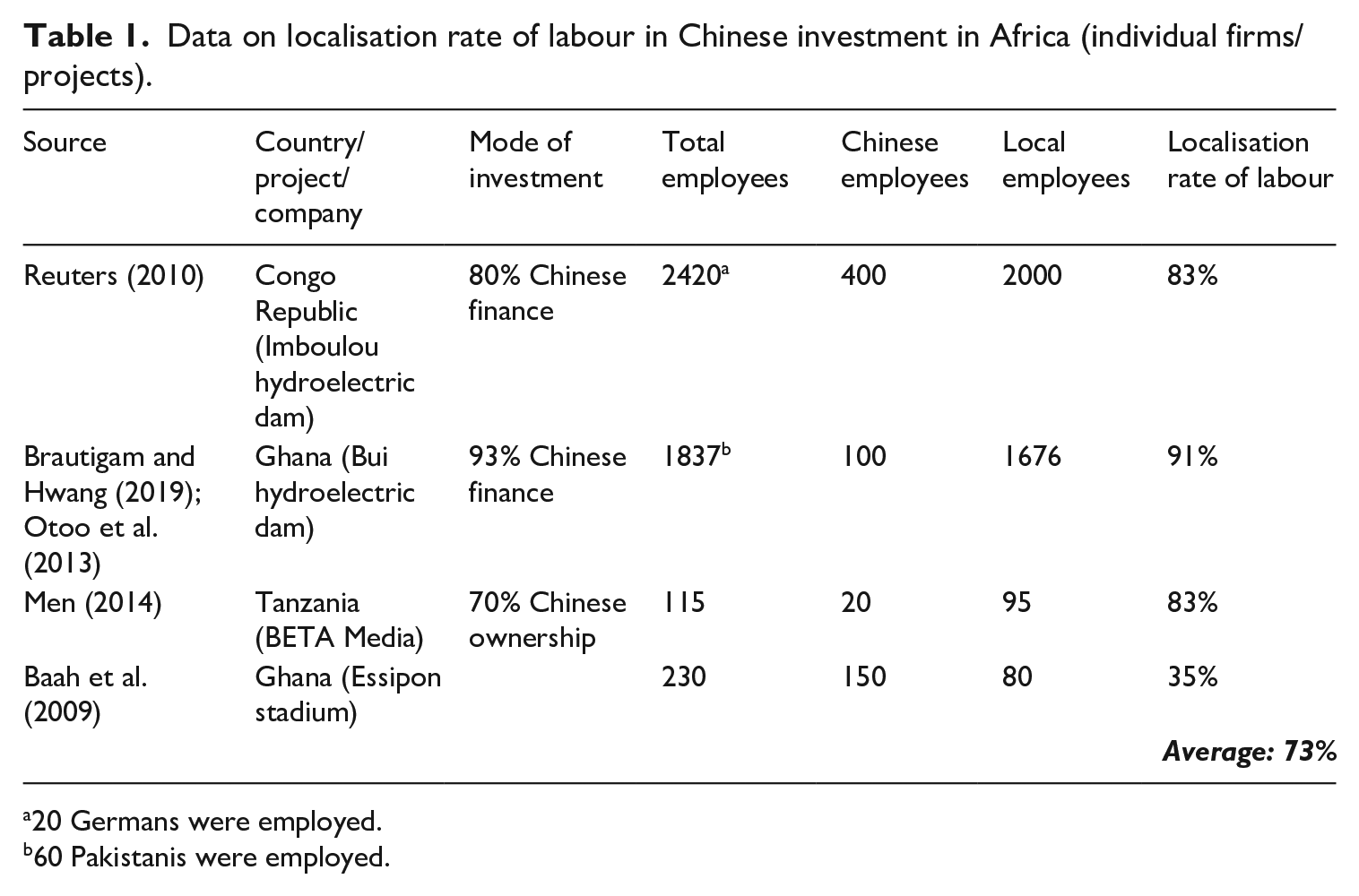
20 Germans were employed.
60 Pakistanis were employed.
Data on localisation rate of labour in Chinese investments in Africa (cluster of firms).
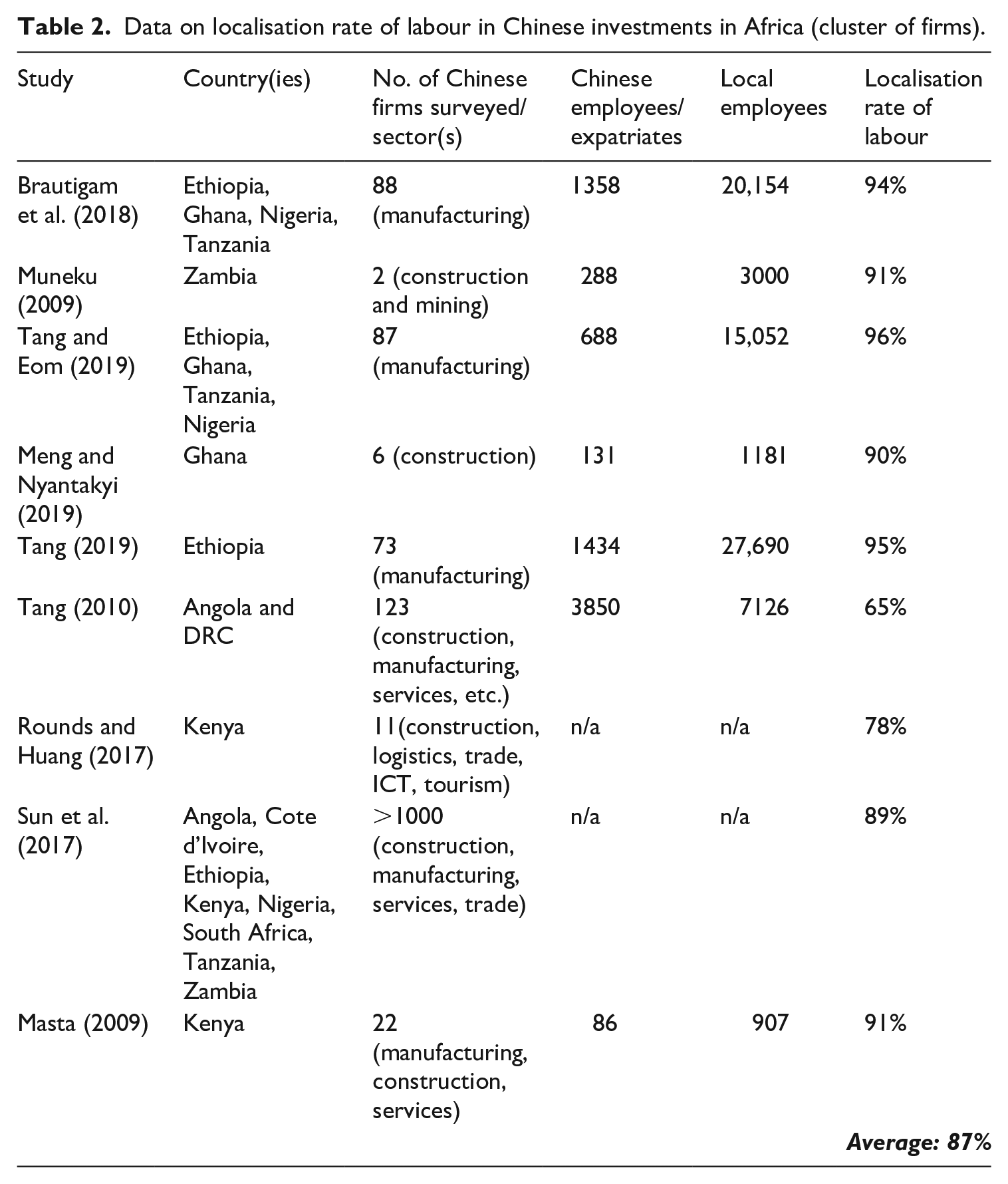
Based on the data in Tables 1 and 2, this study estimates that large and medium-scale Chinese companies – those with an average workforce of not less than 100 – have a localisation rate of labour of above 80% in Africa. In analysing the employment generation pattern however, it is relevant to go beyond the concept of China as a monolithic bloc and differentiate between the operations of the Chinese government, private Chinese companies and individual entrepreneurs in Africa. These three major sets of actors cannot be generalised as just having the one behaviour pattern (Jiang, 2009). Differences in Chinese capital should also be distinguished (Lee, 2009). Whereas the Chinese government usually engages with African governments for political and economically strategic reasons including natural resource security (Taylor, 2006), the private Chinese businesses, which constitute about 90% of all Chinese businesses in Africa, enter the African market to seek business and entrepreneurial opportunities (Sun et al., 2017). However the major private enterprises usually enter the developing markets through the undertaking of Chinese government-sponsored projects, endorsing research in arguing that governmental relations play a prime role in the market entry strategies of Chinese private companies (Fei, 2020b).
The different business entities however usually exhibit two major employment patterns which are usually regulated by the host government labour legislation, and bilateral framework agreements which prescribe numerical targets for categories of staff to be employed by foreign firms (Tang, 2010). The first pattern of employment is the ‘bulldozer’ pattern where a large phalanx of Chinese labour is shipped to Africa to undertake a project or to be employed in Chinese firms; the second is the ‘locomotive’ pattern where Chinese firms seek to establish close links between Chinese and local people in order to integrate the Chinese company into the local industrial space (Tang, 2010). The companies usually pursue long-term profits by establishing synergic growth together with Africans. Employing factors such as capital and technology, this locomotive model usually contributes to large-scale local development including training, direct and indirect employment (Tang, 2010).
According to Tang (2010), the bulldozer pattern is usually manifested in public projects sponsored by government agreements, where the enterprises are mostly concerned with keeping to schedules because of the limited time within which projects are to be completed. These projects are usually one-time and short-term (less than three years), e.g. the Essipon Stadium project in Ghana where the number of Chinese employees outnumbered local employees, as can be seen in Table 1. Such situations are however usually manifested in post-conflict countries where the imperative of rapid post-war infrastructure reconstruction and the political expediency of Chinese-financed and -built projects mean much less attention to job creation (Oya, 2019). Such labour situations are however sometimes advantageous to these countries because the chronic lack of qualified personnel to undertake vast reconstruction necessitates the importation of large foreign labour to speed up infrastructure construction to improve living conditions and provide a solid basis for further development (Oya and Schaefer, 2019; Tang, 2010). In such situations, as in the post-conflict era in Angola, the ratio of Chinese employees did sometimes exceed 40% (Tang, 2010). However, the ratio of Chinese employees attached to projects sharply reduces as Chinese companies grow and projects get completed. Available data indicate that the number of Chinese workers in Africa keeps declining (CARI, 2019). Recent statistics indicate that even in Angola the localisation rate of labour is sharply rising (Oya and Schaefer, 2019).
The operations of private Chinese companies and individual entrepreneurs demonstrate the locomotive model, where Chinese capital infiltrates the labour market to create synergies with local Africans creating direct and indirect employment opportunities (Tang, 2010). These companies, entering the market in line with the logic of globalisation and profit maximisation, do not usually engage in the bulldozer pattern because it is economically unwise for them to do so (see e.g. Fei, 2020b: 7). Further, Tang (2010) demonstrates that the growth of business usually corresponds with a high localisation of labour; correspondingly, the localisation of management and technical positions also progresses with the growth of the company. Thus, from the discussions so far, we summarise the factors that influence localisation as follows: (1) government legislation and framework agreements, (2) the availability of the required experts in the host country, (3) the economic interests of the firm and (4) the duration of operation of the firm in the host country.
Based on these factors, we estimate that as more Chinese enterprises get adapted to Africa’s industrial context, the localisation rate of labour is likely to increase, with some Chinese companies attaining complete localisation in the next decade. This estimation is premised on findings of recent reports that China overtook the US and UK as the number one destination for Anglophone African students (Breeze and Moore, 2017). Cultural exchanges and scholarships for African students to study in China have multiplied. According to Breeze and Moore (2017), since the mid-2000s, China has set scholarship targets to assist Africans seeking to study in China, with the pledge to provide 30,000 scholarships to African students by 2018; although data on these pledges remain scant, recent estimates suggest that the scholarship target is close to being realised. Owing partly to this scholarship support, the African student body in China has grown 26-fold, from just under 2000 in 2003 to almost 50,000 in 2015 (Breeze and Moore, 2017). Equally striking is the rapid growth in self-financing students, which increased from almost nil in 1989 to over 26,000 in 2013; cumulatively about 95,000 self-financing African students have studied in China in this period (Bashir, 2015). In addition, the Chinese government has made substantial investments in Africa’s human resource development through long- and short-term training of Africans in China, and Confucius Institutes. Other investments include the 20+20 scheme for higher education cooperation between 20 Chinese universities or vocational colleges and 20 African counterparts (King, 2014). This implies that many young African students have had more recent opportunities to develop knowledge and skills. They have also had the opportunity to learn Mandarin, to overcome the difficulty in communicating with Chinese companies. These ‘Chinese-trained African-experts’ are therefore likely to replace the Chinese ‘experts’ who are deemed expensive to hire.
Before concluding this section however, it is important to ask: how does the localisation rate of labour for Chinese enterprises compare with other foreign and local enterprises? Although studies in this regard are rare, statistics from two recent studies provide important clues. In Kenya, the rate of localisation between Chinese and American firms was observed to be not significantly different (78 and 82% respectively) (Rounds and Huang, 2017). Similar empirical observations of localisation rates of labour were made in Ghana – 90% for Chinese firms, 93% for other foreign-owned firms, and, surprisingly, 85% for locally-owned enterprises (Meng and Nyantakyi, 2019). This last statistic, however, was skewed by one local firm, which had hired 20% of its employees from foreign countries to construct a technically complex building (Meng and Nyantakyi, 2019). This observation hints that the importation of expert labour to help complete projects is not exclusive to Chinese firms. In a related development, however, the patterns of employment manifest that the skilled and top-level management positions are mainly occupied by Chinese nationals – a situation often considered exploitative. This issue is germane to this study; thus, we look at it in the following sections.
The ‘Chinanisation of management’
As indicated earlier, the level of local workforce in Chinese enterprises is very high. However, the general trend seems to be the localisation of mainly low-skilled and semi-skilled positions and the ‘Chinanisation’ of highly skilled and top-level management positions. With no variations between SOEs and private firms, the labour landscape is replete with instances of Chinese nationals mainly occupying top-level positions in most Chinese firms. This phenomenon has been widely observed across the African industrial landscape (see Akorsu and Cooke, 2011; Fei, 2020a; Guliwe et al., 2009; Kernen and Lam, 2014; Lefkowitz, 2017; Muneku, 2009; Njerekai et al., 2018; Sun et al., 2017; Warmerdam and van Dijk, 2013).
Some major explanations for the Chinanisation of highly skilled and top-level management positions can be deduced from the literature. The first explanation is grounded in the ‘newcomer’ argument (as earlier indicated, Chinese firms, compared to other foreign companies, are virtually new in Africa). According to Tang (2010, 2016) the high rate of Chinese employees, and by extension Chinese managers, is beneficial to the firms, especially at the initial phases of operation. This is because Chinese workers are more familiar with the ‘companies’ organisation and process’. They can put the enterprises into operation quickly, especially for urgent projects. Second, Chinese technicians are required to install and test the machinery, as most equipment is imported from China. Third, experienced Chinese workers can also tutor their local colleagues on the job. Other analysis indicates that the phenomenon is because of a ‘talent gap’ in Africa, especially concerning the construction sector. Huang and Chen (2016) state: ‘To be fair, on most construction sites in Africa, the majority of the labour force turns out to be local. But since infrastructure construction is labour-intensive and there is a chronic shortage of skilled labour in the local market, it is not surprising that many construction workers are sent from China’ (p. 10). In Angola, for example, Corkin (2012) finds an interesting situation. The study reports that the acutely inadequate supply of skilled local labour has resulted in a situation where the scant skilled labour has become ‘artificially’ expensive. Thus, Chinese companies use Chinese nationals in higher management positions due to the artificially inflated price of Angolan skilled labour. To some extent, the low-local managerial position phenomenon is also a manifestation of the language barrier.
However, Meng and Nyantakyi (2019) document a counter observation to the assertion by Huang and Chen (2016). In Ghana, their study empirically observed that, on average, the share of skilled employees hired locally by Chinese-owned construction enterprises (86%) and that of other foreign-owned enterprises (91%) were both, intriguingly, higher than that of locally owned enterprises (78%). However, the study finds that whereas, on average, the share of supervisors hired locally by Chinese-owned enterprises was higher (57%) than that of other foreign-owned enterprises (35%), both were significantly lower than that of locally owned enterprises (78%), giving credence to the fact that top management level positions are usually occupied by other foreign personnel.
At this point, it is imperative to ask: are foreign enterprises from other emerging and developed countries different from Chinese enterprises in terms of the phenomenon of underrepresentation of local hires in supervisory and top-level management positions? The empirical evidence is limited in this regard. However, Rounds and Huang (2017) provide some data from Kenya to show that the Chinese are not ‘so different’ and that at American firms, even companies that are predominantly Kenyan, executive roles and strategic decision-making tend to be still concentrated in the hands of the North American employees. Thus, taken together, we reiterate that in a typical large or medium-scale Chinese firm in Africa one would likely find limited localisation of employment in the managerial ranks. This feeds into the proposition by Jackson (2014) that Chinese firms contribute to local labour markets in taking up excess labour mainly by employing unskilled African labour. This shows a discrepancy between employment generation and management participation with the negative implication being low local middle-class and taxable incomes, as well as low local input in Chinese companies’ economic activities (Warmerdam and van Dijk, 2013).
But could the explanatory variable undergirding this phenomenon really be the ‘talent gap’ as expressed by both Chinese and American firm managers in Kenya in the study by Rounds and Huang (2017)? Here, we hold the view, theoretically though, that the low-wage regime mostly operated by Chinese employees could be the defining variable, on the part of the Chinese, in failing to attract the ‘best African talents’ to occupy certain positions. Nevertheless, we urge scholars and policy makers to empirically scrutinise the phenomenon in the context of China becoming a top educational destination for many African students as indicated earlier. How are the ‘Chinese-trained African-experts’ bridging the ‘talent gap’, and at what rate are Chinese employers absorbing them to replace the Chinese ‘experts’ who are deemed expensive to hire? These are questions additional research can help answer. In addition, other research and policy issues are worth exploring. We highlight them in the next section.
Discussion and conclusion
This study set out to attempt to pull together the existing, fragmented literature and case studies on Chinese investment and the labour relationship in Africa into a more comprehensive picture. This task is important for the main reason that a timely analysis of the extant knowledge helps to ‘bust the myths’ (Hirono and Suzuki, 2014) about Chinese firms’ ‘negative’ labour practices in Africa which continue to find traction in most public discourses on Afro-Sino relations. The task is also important in the sense that unpacking the nuanced accounts of Afro-Sino labour relations would help Africans and the Chinese move on to more reality-based employment issues (Sautman and Yan, 2015). In connection with these reality-based issues, our study makes these findings:
Chinese employment practices engender labour breaches in Africa. However, variations in Chinese employment practices exist. These variations are largely influenced by sector specificities, host country regulations and institutions, and the global neoliberal capitalist reforms.
Management practices and work ethic are largely influenced by industrial capitalism dynamics, and not merely by socio-cultural factors.
Chinese firms have a high localisation rate of labour. However highly skilled and top-level management positions are usually occupied by Chinese nationals.
Chinese investment in Africa’s human resource base has the potential to produce African experts who are likely to replace Chinese experts in the highly skilled and top management positions.
Consequently, very important policy and research lessons can be learned from the discussions in this study. First and as earlier indicated, scholars must begin to examine how Chinese companies are recruiting African talent to occupy top managerial-level positions. However, as indicated throughout this study, management and labour practices of the Chinese entrepreneurs in Africa are also encapsulated in global capitalist dynamics. The scholarly examination therefore can begin by theorising and foregrounding the low-wage regime usually operated by Chinese employers through the lens of accumulation strategies which have long been viewed as the inevitable consequence of capitalist growth models. However, on the policy level, we urge African governments to follow the lead of the Ethiopian government to tighten control over work visa issuance for foreign nationals in order to promote local employment in certain job categories (see Fei, 2020b: 7).
Secondly, available evidence suggests that the strength of labour legislation and institutions plays a significant role in variations in working conditions (see e.g. Baccaro et al., 2019; Gajewska, 2013). In Ghana, for example, the active involvement of the Ghana Labour Union in the Bui Dam labour quagmire significantly altered the labour landscape, with beneficial consequences, for the Ghanaian workers involved in the project (see Baah and Jauch, 2009; also Otoo et al., 2013). Huang and Ren (2013) provide evidence to show that South Africa’s effective labour legislation and powerful labour unions ensured that the employment quality of Chinese enterprises met the host country’s legal requirements. In effect, African agency is important in shaping the management practices of Chinese managers, and the labour dynamics (Xing et al., 2016). Thus, African governments, through the recruitment of qualified personnel and the provision of funding, should strengthen the operational capacity of trade unions with the aim to enable the African trade union movement to participate meaningfully in the debate regarding the activities of the Chinese government and businesses on the African continent (Baah and Jauch, 2009).
Thirdly, the literature suggests that casualisation of labour and labour conflicts are prevalent in labour-intensive sectors, especially the construction sector. Meanwhile recent estimates indicate that by the end of 2016, the construction sector had attracted US$11.3 billion of China’s direct investment in Africa, representing the largest share of China’s FDI stock on the continent (Meng and Nyantakyi, 2019: 7). It is likely that this figure would not change significantly considering the large infrastructure gap that still exists in many parts of Africa. This however has implications for policy and research. It suggests that efforts to improve labour relations, at Chinese firms, and other firms in general, by governmental institutions and other civil society organisations must be carefully tailored to the construction sector. The high propensity for labour conflicts to emerge from the construction industry suggests that for researchers seeking to investigate the labour practices of Chinese firms in Africa, it will be extremely important to control for industry (Rounds and Huang, 2017).
Furthermore, to help address the labour issues, it is helpful to turn to one of the leading African labour unionists, Herbert Jauch. Here, Jauch (2011) posits, among others, that to help address the China–African labour conundrum, trade unions should consider the use of supplementary strategies including setting national minimum wages and basic conditions of employment, enforceable by trade unions and labour inspectors alike. He also advocates for other very practical steps, aimed at bridging the language gap, including Mandarin courses for African union organisers to recruit Chinese workers into local trade unions; and further recommends the translation of African labour laws and regulations into Mandarin. It is however helpful to acknowledge that bridging the language gap goes both ways. Therefore, African labour unions and the Chinese government should also urge Chinese employees and employers to learn the official as well as the local languages of the various African countries in which they operate.
Also, although the Chinanisation of management is needful at various stages of operation, it stands to reason that the high localisation rate of labour should correspond with a high localisation of management ceteris paribus. This is because local workers can better be trained, supervised and managed by local managers, in the sense that local workers are able to communicate with each other more effectively and convey information more precisely (Tang, 2016). Also, local managers are usually well versed in the dynamics of the local market and business culture. In connection with this, we posit that Chinese firms and African governments must begin to incorporate local managers in the decision-making processes by utilising the expertise of the numerous Africans who have had recent opportunities to benefit from the Chinese investments in human resource development. This will go a long way in reducing the management and communication gaps that inevitably spawn labour frictions. In addition, we agree with Nyambegera et al. (2016) that in order to decrease labour tensions and increase employee job satisfaction, Chinese firms operating in Africa should more carefully integrate African cultures in managing human resource activities like hiring, promoting and rewarding.
In sum, Chinese employment relations in Africa are diverse and evolving rapidly. Simple classifications therefore usually fail to capture the multi-dimensional nature of the reality. Scholars and policy makers interested in strengthening Afro-Sino labour relations must therefore be interested in the nuanced picture comprising a combination of factors including but not limited to sector specificities, local contexts and firm attributes, and neoliberal capitalists’ reforms that help explain the working conditions of Chinese firms in Africa.
Footnotes
Declaration of conflicting interests
The authors declared no potential conflicts of interest with respect to the research, authorship, and/or publication of this article.
Funding
The authors received no financial support for the research, authorship, and/or publication of this article.
