



Abstract
This article investigates processes of gender pay audits in five municipalities in Sweden in order to understand the reasons why gender pay audits in general do not level out men’s and women’s salaries in the way they are intended to. The results show how gender pay audits became a bureaucratic process to fulfil a legal requirement, and how they were decoupled from core organizational practices and salary policies. This decoupling was furthered by the realization that the result of gender pay audits would imply a need for large structural changes in pay policies, for which there were no financial means. Consequently, decoupling was found to be a major reason why gender pay audits are ineffective in coming to terms with gender pay gaps.
Introduction
Differences in men’s and women’s salaries, the gender pay gap, is a persistent problem. To address this problem, normally a gender pay audit is required. A gender pay audit implies comparing men’s and women’s salaries, to learn where measures are needed to narrow the gap. Gender pay audits can be required by law, or they can be organizational initiatives. In Sweden, legislation stipulates that employers need to perform yearly pay audits in order to discover, remedy and prevent unfair gender differences in pay and in other terms of employment. The audits have to compare both men and women who do similar work, and men and women who do work of equal value; and the employer needs to cooperate with trades unions in this. Exactly how the pay audit should be performed or how actors should be involved is not regulated (SFS 2008:567).
Evaluations by Swedish governmental bodies of the effects of gender pay audits have found, however, that these are not an efficient tool for addressing gender pay gaps. Employers generally claim that gender pay audits are often untenably time-consuming exercises, and the Swedish National Audit Office also finds that the method is cumbersome and that it is difficult for employers to correctly assign salary differences to gender (Riksrevisionen, 2019). Also, employers’ interest in and practices of gender pay audits vary and hence the quality and result of the audits. It is common that employers argue for the justification of gender salary differences (Kumlin, 2016). Even international research finds gender pay audits quite ineffective (Acker, 1989; Figart, 2000; Rubery, 2019; Wright, 2011). Nevertheless, in the Nordic countries, employers need to report on gender pay differences among their staff, either to a governmental body or to employees’ representatives, although the detailed requirements and the possible sanctions for unjustified gender pay gaps vary between countries. The requirements for gender pay audits have even been tightened in several Nordic countries during the 2010s (Koskinen Sandberg, 2016; LOV-2019-06-21-57, 2020; Måwe, 2019; Olafsdottir, 2018). Furthermore, gender pay audits, based on job evaluations, are recommended by the European Commission as well as by the International Labour Organization (Koskinen Sandberg, 2017). Explaining this apparent disparity between ends and means, Saari (2015) points to the symbolic function of gender pay audits, whereby legislation creates an image of striving for gender equality, while not placing responsibility on anyone to come to terms with gendered salaries beyond mapping the situation.
While both research and general pay statistics show that pay audits do not bridge gender pay gaps effectively, there is a research gap in relation to why this is the case, and what actually happens in gender pay audits. In this article, therefore, we focus on the organizational level, and the processes of gender pay audits, to seek to understand the reasons why they do not level out men’s and women’s salaries in the way they are expected to. These findings at the organizational level, we argue, contribute to understanding the problem of achieving gender parity in salaries at the societal level.
The article is based on studies of the practices of conducting gender pay audits in five Swedish municipalities. In the following sections, the analytical concept of decoupling is presented in relation to gender equality work, followed by descriptions of previous research on gender pay audits. We then present the methodology, research context and findings of this study, before a concluding discussion.
Decoupling: Gender equality in policy and practice
The concept of decoupling allows for analyses of how legally imposed requirements land as formal policies in organizations without impacting their everyday practices. Hence, it is useful in studying why legal requirements aiming to change organizational practices do not produce the expected results, such as in the case of gender pay audits.
The seminal works by DiMaggio and Powell (1983) and Meyer and Rowan (1977) suggested that organizations incorporate certain policies simply to increase their legitimacy in relation to the external environment. Rules and laws are examples of influential external pressures that organizations need to conform to and, by adopting formal policies in respect to those rules and laws, organizations not only avoid sanctions but also secure their legitimacy (DiMaggio and Powell, 1983). It is in that context that organizational studies have discussed how gaps between policies and practices are created and maintained in organizations in terms of decoupling (Meyer and Rowan, 1977). By ceremonially adopting policies, and decoupling them from organizational practices, organizations can maintain their internal flexibility and buffer external pressures to change (Austen and Kapias, 2016).
Bromley and Powell (2012) discuss two kinds of decoupling. On the one hand, policies can be decoupled from practice through non-implementation. On the other hand, where polices actually are implemented in practice, another type of decoupling can occur: that between means and ends. For example, in the context of this article, an organizational structure can be set up, and activities can be introduced to monitor a specific measure for gender equality, but the rest of the organization can still remain untouched. The relationship of the programme as implemented to its intended goal can therefore be highly uncertain or negligible (cf. Graafland and Smid, 2019).
Decoupling may be particularly applicable as a theoretical lens for studying gender equality measures in the Nordic countries, where gender equality has been considered a norm for decades (cf. Eriksson-Zetterquist and Renemark, 2011). In such societies, having gender equality policies lends organizations legitimacy, even if these policies do not affect organizational practices. An organizational myth of gender equality is made possible: the gender equality policy holds up the image of a gender-equal organization, even while the organization and its practices may well be characterized by gender inequalities.
For many years, until changes in the Discrimination Act in 2017, Swedish employers were required to produce a gender equality plan, a type of gender equality policy. In this context, decoupling has frequently been shown in studies of gender equality work in organizations: the legally imposed policy documents were only adopted ceremonially but not implemented in organizational practices (Amundsdotter et al., 2015; Pincus, 2002; Sundin and Göranson, 2006). Gender equality policies constantly risk becoming separate documents that do not have an impact on other organizational processes, and the responsibility for implementing these policies is often vague in organizations (Keisu, 2012).
Several Swedish governmental initiatives have since the middle of the 1990s been targeting gender equality in public sector organizations. Even though these initiatives are not framed as outright legal requirements, they have had a governing function and have triggered responses in public organizations as these have been ‘forced’ to participate in the initiatives. Also in this context, decoupling of gender equality goals and policies from practices has been found (Lindholm, 2012). Eriksson-Zetterquist and Renemark (2011) analysed an initiative led by the Swedish government to increase the number of women in top managerial positions. They found that this initiative seemed to gain acceptance as a policy issue, but that the result was weaker when assessed in terms of changed and sustainable organizational practices to increase the number of women managers.
Wittbom (2009) studied the implementation of gender mainstreaming in two Swedish governmental agencies, finding that the model of management by objectives contributed to the entrance of formal gender equality goals. Gender equality was not integrated in organizational practices, however, and hence did not change these. Wittbom refers to Bacchi (1999) in concluding that the problem formulations at the macro level never became relevant in the practices of the organizational micro level.
In another study in the Swedish context, Alnebratt and Rönnblom (2016) examined how political intentions of change became reduced to bureaucratic procedures and a mechanistic use of tools in an organization, such that the means and ends concerning gender equality became decoupled. They relate the uptake of gender mainstreaming as an aspect of good governance to the neoliberal context, and found that, in that context, gender mainstreaming is stripped of its transformative power, to result in audits, checklists and statistics (Rönnblom, 2011; Wittman, 2010). In short, working for gender equality becomes a goal in itself (Keisu and Carbin, 2014).
Research on gender pay audits
In her books The Politics of Affirmative Action (1996) and Women, Policy and Politics (1999), Carol Bacchi scrutinizes, among other things, policies to come to terms with gender pay gaps. According to her, ‘the politics of class and class-based organizations, in particular unions and employers, limits the space accorded to “women” and determines how “women” gets taken up in policy debates’ (1996: 118). Another direct criticism of gender pay audits, which can be found in Bacchi (1999), is that they blame individual employers for the problem of the gender pay gap, even though unequal salaries are an indicator of larger societal gender inequality. Bacchi (1996) uses Sweden as a special case to show how a welfare state committed to equality failed to promote equality between women and men by mitigating problems and allocating equality issues to employer and trades unions, both of which were dominated by men. Her data go as far as 1995, but Svenaeus (2017) finds that those roots of catering to the interests of employers and trades unions, to keep salary developments in their hands, still hamper comprehensive reforms to achieve gender pay equity.
Saari (2013) concludes that neither employers nor trades union representatives are particularly interested in levelling gender differences in pay in Finland. Trades unions each represent different work areas and different levels of the occupational hierarchy, and negotiate salaries for their respective members. This hampers the possibility of evaluating which jobs have equal value and, consequently, should have a similar pay level, if they are not in the domain of the same union. Koskinen Sandberg (2016) analyses the drafting of the new regulations for pay audits in Finland, and shows how it is an arena for bargaining between employers, unions and government representatives, where the promotion of equal pay is not the main objective.
To be able to pay ‘equal pay for work of equal value’, the ‘value’ of the work needs to be defined. This is done by a job evaluation scheme. Basic international standards stated by the ILO (Oelz et al., 2013) include the four aspects of knowledge and skills, responsibility, effort required and working conditions, where knowledge and skills are the most important. Figart (2000) offers an historical account of the origin of job evaluation systems, which is to be found in categorizing male workers so that they could be rewarded accordingly. From there, these systems have been moved to serve another cause: wage equality between men and women. With this history in mind, scholars have discussed how all four aspects in job evaluation systems (and their derivations) are gendered (Alksnis et al., 2008; Alnebratt and Rönnblom, 2016; Cedersund and Kullberg, 1996), and that the tool does not match the problem of coming to terms with gender unequal pay (Koskinen Sandberg, 2017), but can actually reproduce pay differences based on stereotypical assumptions.
Joan Acker (1989), in her seminal work on a process of creating a job evaluation system to come to terms with gender pay gaps, found that the process did not counteract gender stereotypes about the worth of women’s and men’s jobs, but that these stereotypes were made an inherent part of the system. For example, she described futile efforts to get recognition for women’s skills, especially interpersonal skills. It was impossible for such skills to get high evaluation points in the system. Had they been recognized and rewarded accordingly, it would have meant major changes in job hierarchies and in the salary policies of the employer. By these means, the task of addressing unequal salaries was kept within limits that would not challenge the basic gender order in the organization. Koskinen Sandberg (2017) found that work evaluation systems do not promote equality in financial rewards, not only because they may be biased in themselves, but also because, even if officially adopted, they are not used in the daily organizational practice. Even though Koskinen Sandberg does not use the concept of decoupling, her study shows how seemingly neutral job evaluation systems equip organizations with an internal image of legitimacy. The understanding of the whole organization as gendered, which is necessary for any gender mainstreaming measure to succeed (Benschop and Verloo, 2006), is normally not actualized in pay audit processes which concentrate solely on salary policies.
In sum, previous research has pointed at various challenges which are inherent in trying to close gender pay gaps by conducting gender pay audits. The challenges seem to persist regardless of models of labour market institutions and systems of wage negotiation. As a gender equality measure, a gender pay audit faces difficulties in actually changing compensation practices in organizations. Instead, it risks being a ceremonial or bureaucratic exercise. Job evaluation systems often suffer from gender bias, and since job evaluation is a crucial part of gender pay audits, this aggravates the possibilities of just comparisons between men and women. There remains, however, a dearth of empirical knowledge about gender pay audit practices in organizations, and what happens in the process. That is why we investigate how organizations take on the task of conducting a gender pay audit: Which people are involved, how do they go about doing the audit and what are their views on the task and its results?
Methodology
The study was conducted within municipalities. This sector was deemed suitable for several reasons. The sector employs about one quarter of all Swedish employees (SCB, 2020). As public employers, municipalities comply more fully with the requirements of gender pay audits than the private sector. This implies that gender pay audits are ordinary processes in municipalities and that municipalities have both experience of and routines for conducting them. Municipalities are also large employers with highly diversified operations; hence they have both large and several different groups of employees, the majority of whom are women. In addition, they are multifunctional and face multiple and sometimes conflicting considerations and goals. These conditions (see further the Research context section below) make it particularly interesting to study processes of gender pay audits in this type of public organization.
Initially, several municipalities in two Swedish regions were contacted by phone, in order to gather information on how gender pay audits were carried out in this kind of organization. It turned out that practices varied widely among the municipalities. Different actors were involved in the different municipalities, and they used different digital tools to support the work. Some municipalities based the gender pay audit on previous job evaluations, while some conducted both job evaluations and salary mappings during the gender pay audit process. In all the municipalities, however, the HR department was the main responsible body. Five of the contacted municipalities (hereafter referred to as municipality 1–5) were interested in taking part in the next step of the study. Their active interest to participate in the study should be noted, as this is a kind of self-selection. It implies that these municipalities were more reflective about this task than most. While they cannot represent the ‘average’ municipality, this reflexivity most likely equipped us with a richer material than ‘average’ municipalities would have done.
Our approach was to follow each municipality’s gender pay audit process during 2017–2018, using qualitative methodology in order to gain a deeper understanding. Since the municipalities conducted the pay audits in different ways and allowed us access to different degrees, this approach led to differences in both the type and the amount of empirical material available to us (see Table 1). Broadly, our collected data could be categorized into three levels: the most comprehensive data came from municipalities 1 and 4, where we followed the processes through several meetings over several months; the data from municipalities 2 and 5 were at a more intermediate level, in that we followed fewer meetings but had long discussions/interviews; the data for municipality 3, meanwhile, were the least rich, in that they consisted only of interviews held at one point in time, and then just a few contacts and workshop participation. In municipalities 1, 2 and 4 we were allowed to follow meetings where different stakeholders (HR staff, managers, consultants, trades union representatives) interacted. Meetings in municipality 2 did not include trades union representatives, on the basis that these were not actively involved in the process. Municipality 5 was small and the HR manager basically did the gender pay audit by herself, without involvement from the trade unions. Consequently, only she was interviewed. In municipality 3, we started by interviewing the HR representatives about their process, which had been disrupted. The aim of following the process to the end could not be realized, as it did not really take off again during the observation period. Municipality 3 was still included in the study, however, because the interviews were rich in content and gave important insights as to what can go wrong in a gender pay audit process.
Presentation of municipalities and empirical material in the article.
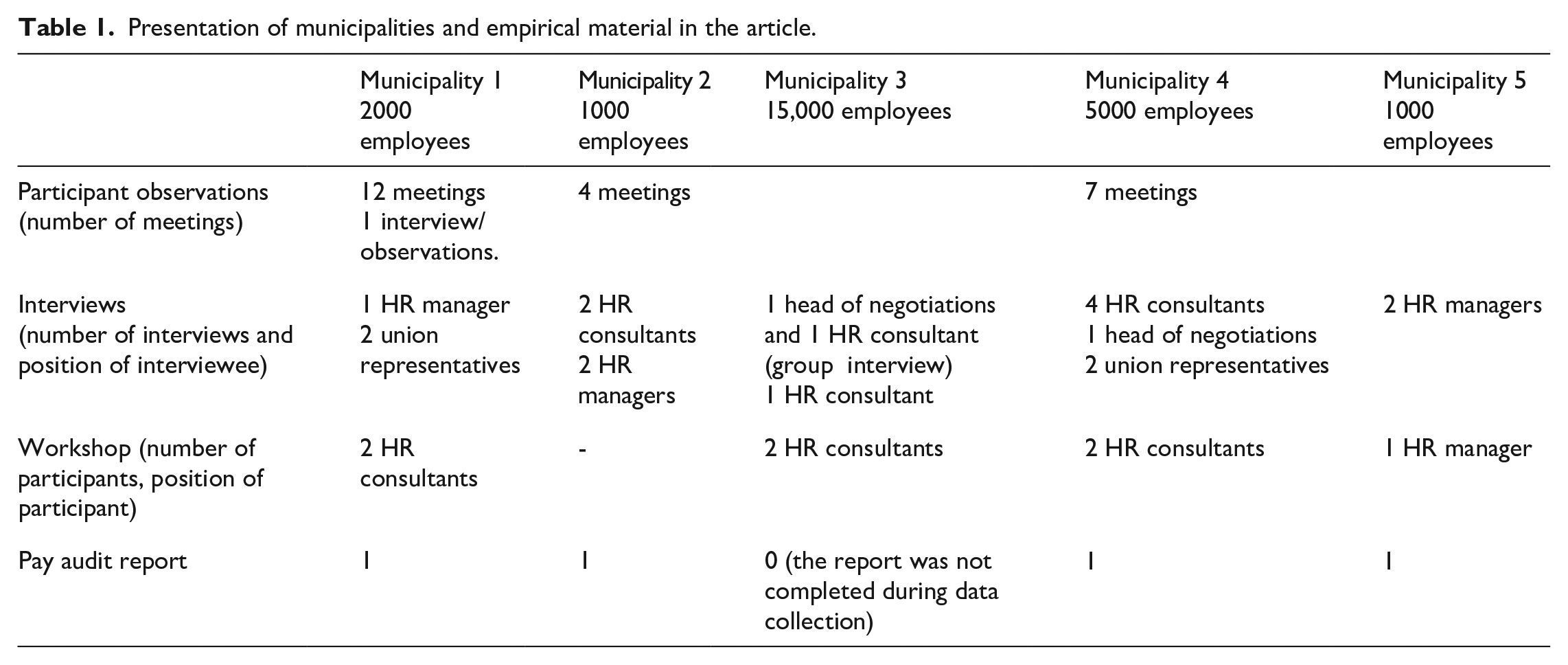
Four trades unions representatives were interviewed: two in municipality 4, where unions had been thoroughly engaged in the process, and two in municipality 1, where they were less engaged but still felt that they could have the level of engagement they wanted.
Additional empirical material was collected in a workshop where both researchers met with seven HR representatives from four of the municipalities. The resulting gender pay audit reports also form part of the material.
The two authors divided the municipalities between them, both to facilitate blending into the environment, and to maximize the opportunity to gain a thorough understanding of each process. The meetings that were observed varied in time, from one hour up to a full working day of eight hours. All meetings focused on gender pay audits, sometimes including job evaluation. Examples of agendas for the meetings were coordination and check-up among HR professionals; hands-on processing of the pay audit by HR professionals and, sometimes, trades union representatives; job evaluation performed by HR professionals and sometimes also by consultants, managers and union representatives; and meetings to analyse the outcome of the gender pay audits that included either HR professionals only, or HR professionals and union representatives together.
Notes from observations were written during each meeting, and these notes were edited directly after the meeting. Our approach was to write down as much as possible. After each observation, we also wrote reflexive comments about the observed meeting. The notes varied in length, from 3 to 20 pages. The same procedure was applied to the four-hour workshop, where we took turns in taking notes. The interviews took place in the interviewees’ offices, in adjacent meeting rooms or by phone, and lasted 45 to 90 minutes. An interview guide was used that included both general and specific questions on the interviewee’s role in the organization and in the process of the gender pay audit, and their views on gender equal pay and gender pay audits. The interviews were recorded, with a few exceptions, and then transcribed verbatim. Extensive notes were taken during the telephone interviews that were not recorded.
In the analysis phase, both authors analysed material from all municipalities. Both the notes from meetings and the interview transcripts were coded and analysed using qualitative content analysis. The total number of codes was 50, of which some 20 were relevant for this article. These codes dealt with the process itself (such as ‘time’, ‘systems’, ‘consultants’, ‘action plan’), the stakeholders (such as ‘unions’, ‘managers’) and the discourse around the pay audit (such as ‘pay gaps’, ‘justified’, ‘effect’). One of the authors did the coding. The codes were reviewed jointly to see which aspects of the pay audit were well grounded in our data. Since the gender pay audit process has a relatively fixed chronological order, the analysis was then undertaken on each phase of the process separately. In order to reach a common understanding of the findings, the authors worked alternately individually with the codes and the analysis, and jointly with frequent discussions on both detailed and an overarching analysis. It was also in this analysis phase that decoupling became a usable concept to understand what was found in the data.
Research context
The practices of gender pay audits in organizations are intersected and impacted by numerous contextual conditions on the national, sectoral and organizational levels. A number of conditions deemed of particular importance to provide a backdrop to this article are selected and described in this section: the Swedish gendered labour market and pay gap, characteristics of the municipal sector in Sweden, and municipal wage formation.
While the employment rate in the Swedish labour market is nearly the same for men (84%) and women (80%), the labour market is gender segregated. In the municipal sector the overall proportion of women among employees is 79% (SKR, 2020), but the gender distribution varies within the different areas of operations. The national gender pay gap in Sweden is 10.7% and if adjusted to differences in education, employment sector, occupation, age and part-time work, a so-called unexplained gender pay gap of 4.4% remains (SCB, 2019). The municipal sector has the smallest gender pay gap, 2.8%, in comparison with governmental and private sectors (Medlingsinstitutet, 2018). Women work part-time more often than men, and therefore the total gender income gap is 20% across the working age population (SCB, 2019).
The Swedish municipal sector consists of 290 municipalities. These vary considerably in size: the smallest municipality has around 325 employees, the largest around 43,000 employees (SKR, 2020). Municipalities are politically governed, and all have the same regulated responsibilities in diverse areas such as social care (care for the elderly, disabled, social services for individuals and families), schooling, community planning, environment and health protection, waste disposal and sewers, housing, emergency services and libraries. Municipalities are divided into boards governing the different areas of operations. Each of these normally has a central administration, and divisions and units with sometimes up to three levels of management. The working conditions of municipal managers vary even in the same municipality, and so do their operational budgets and the number and competence profiles of their group of employees (Albinsson and Arnesson, 2018). The HR function is organized in various ways in different municipalities, either as part of the central administration, or devolved to the decentralized units. Such organizational arrangements influence the position of the central HR staff vis-a-vis managers, as well as their knowledge of the work the employees actually do.
Wage determination in municipalities is formed in relation to wage formation at the national level. The labour market parties have the primary responsibility for regulating wages and other terms of employment in the Swedish labour market. Employer organizations and trades unions negotiate and sign collective agreements that create the framework for salary policies and individual salary negotiations at national and organizational levels. Even in the public sector, salaries are individually determined, and negotiations happen both between employees and managers (in particular when starting a job) and between unions and employer representatives (managers and HR, in particular when salaries are revised). Hence, the salary-setting process has several stakeholders, all of whom can be seen as responsible for potential gender pay gaps. Politicians decide on the overall budget of the organization, and also the budgets for each of the areas of operation, thus setting the overall framework for salary costs. They also decide on the overall salary policy of the organization. Managers are responsible for the individual salary setting when they employ people and in yearly salary revisions. They may have more or less articulated and compelling criteria and guidelines for the local salary structure to follow, set by the central HR administration, but can often act quite independently. Trades unions are entitled to have opinions on salaries for newly-employed individuals, and, most importantly, they are the counterparts of the employer in the yearly salary revisions, where salary rises are finalized. Finally, the employees themselves need to have negotiation skills to motivate good starting salaries and salary rises.
In municipalities, the gender pay audit is normally a task for the central HR division. In conducting the audit they deal with a situation which has been created by the interaction of a number of different stakeholders.
Findings: Processes of gender pay audit
In the following section the findings are presented in relation to the chronological order of the gender pay audit: phases of the process based on observations and the participants’ reflections on the phases.
Preparation – decisions on procedure and groupings of job titles
When starting the process of a gender pay audit in a given municipality, some decisions had to be made on how it was actually going to be carried out. These included decisions on different actors and their roles in the process. In all the municipalities, the HR department was the main actor in the gender pay audit. Decisions on other actors’ roles were not always self-evident: Our problem is to know how much we should involve managers, union representatives, and at the same time we most often have a salary review or salary revision going on, and it’s quite hectic. And this is kind of an assignment by the side, something we have to do; all parties say that this is hugely important, but nobody really goes in for it to the full. (HR manager, municipality 2)
Union representatives were actively involved in the gender pay audit in one municipality, but were primarily recipients of information in the other municipalities. Managers were involved to a varying degree in all municipalities, from taking an active part in job evaluation to merely answering specific questions about their wage setting. The HR representatives described the managers as often being a problematic group in job evaluations, in that they wanted to increase the salaries of their subordinates by describing their work as particularly qualified. HR representatives described the unions in more positive terms, as having an overview of the occupational and salary structure, as well as knowledge of the different work tasks. Gender pay audits can be a forum for union–management partnership (Rolfsen, 2011), as they are conducted at an overarching strategic level, and the potential conflicts are not between employers and employees, but between different groups of employees.
In this phase, some of the municipalities also needed to decide whether to buy consulting services and/or access to one of the digital tools on the market designed for gender pay audits. The municipalities of this study used digital tools to varying extents. One municipality used a free resource, a digital tool previously made available by the Equality Ombudsman, while another municipality prepared a job evaluation using a ‘copy-paste’ of a job evaluation of another municipality found online. Three municipalities used licensed tools for their gender pay audits, and also involved consultants to different extents. The HR professionals – both the ones that decided on support from consulting firms and those who decided not to involve consultants – concluded that digital systems and consulting services were really expensive.
An essential part of the initial phase of the process was to divide all job titles (and hence employees) into occupational groups that do similar work. Sometimes this was easy – all cleaners or all cooks were seen as doing similar work. Often, however, it was more complicated; for example when deciding which teachers or administrators did similar work. In practice, this involved a tedious and time-consuming task of going through personnel files and grouping people. The diverse responsibilities of Swedish municipalities were reflected in the number and range of job titles: the largest municipality in our sample had 960 unique job titles. The different consulting firms, meanwhile, recommended establishing around 100–120 groups of job titles for municipalities in order to make the pay audit both reasonably fair and doable. The grouping of job titles required an initial analysis of which employees actually did similar work. It also entailed correcting often a fair number of errors in the personnel files, and this administration and tidying of the files became an activity in itself, decoupled from the actual gender pay audit and the mapping of gender differences in salaries (cf. Austen and Kapias, 2016; Bromley and Powell, 2012).
Hence, in this phase the gender pay audit was created as a process in itself, engaging stakeholders in certain roles and interactions, which were additional to other interactions between them. It also included possibly buying specific software to carry out the process, and evaluating the organizational competence to perform this particular process apart from other HR tasks. This may have led to the contracting of specific expertise from outside the organization. The problem of making salaries gender equal thus risked vanishing into the background while the problems of setting up an orderly process were foregrounded. The process invited the participants to see the trees but not the forest (cf. Rönnblom, 2011).
Job evaluation
What was conceived as the start of the auditing itself was evaluating the value of work of each of the employee groups that had been created. The legislation requires that this is determined in terms of qualifications, effort, responsibility and working conditions in each job. In practice, this means comprehensive analyses where each job is given a number of points, according to the level of proficiency required in each aspect, and the sum of these points is calculated and compared across groups. It is reasonable to expect that, in a gender-segregated labour market, women’s and men’s work are to some extent evaluated differently (Koskinen Sandberg, 2017).
Several digital systems on the market (three of them used by municipalities in this study) provide ready-made evaluations of the most frequent municipal jobs. Even when the HR staff did the job evaluation from scratch, the systems dictated which aspects should be evaluated and the range of scores these aspects could have. Even if some of the systems try to account for the value of female-dominated jobs, for example by putting more weight on the kind of social strains that are common in caring occupations, they are still to a large degree based on traditional gendered ideas of what makes work qualified or strenuous. Notwithstanding, most of the HR staff followed the steps prescribed by the system and regarded it as a gender-neutral tool: Q: And when you see the result and see which groups are compared with each other, do you have a feeling that ‘yeah, it works as it should, those groups do actually do work of equal value’? A: No, I haven’t made any such assessment, I have trusted it. The job evaluation we have done, I have done, I haven’t reflected on whether it works or not, but I have just worked on the supposition that it does, the result we got. (HR specialist, municipality 4)
Some HR staff had reflected on the possible gender bias in job evaluations, however. In municipality 2, HR staff and managers initially performed a job evaluation together. The head of the municipality, at the level above the HR function, was not satisfied with the result, nevertheless. Subsequently, there was a change in HR managers and the new HR manager invited a consultant to perform the job evaluation anew. Coming from a consultant, the evaluation could be expected to have greater legitimacy. The outcome was to not disturb the established order, the result had to be reasonable: We have done a job evaluation and this consultant had so much knowledge about how some types of jobs are evaluated in different municipalities. So we did a new job evaluation. . . . And then we went through all the points and this consultant helped me, ‘look here, can this be reasonable’. Everything that seemed completely unreasonable, there we have made some adjustments. For she was so knowledgeable and she could see that, ‘oh, this one is usually above that one’ and so on. It may be right, it may be wrong, but a job evaluation is a job evaluation, it’s something subjective. (HR manager, municipality 2)
As exemplified above, while some participants did not reflect on the issue of objectivity and neutrality, others admitted that job evaluation could be a subjective activity. The consultants and sellers of the digital systems asserted firmly that when evaluating each job and its requirements, with the help of the digital system they provided, the results would be objective. Whether the participants doing the evaluation believed in that neutrality or not, they did not have much choice. Trying to do the work properly – i.e. really finding out about and evaluating the work tasks of all employees – would have taken an unrealistic amount of time.
Both consultants and HR staff often mentioned that it could be tempting – especially for managers, they said – to discuss individuals and their performance instead of evaluating the requirements of the jobs per se. Nonetheless, they had learnt that this was not acceptable, because it would impair the neutrality of the evaluation. They were expected to evaluate ‘empty jobs’ which supposedly had no gender. As feminist researchers (Acker, 1990; Bacchi, 1999) have observed, however, it is difficult to achieve gender neutrality in job evaluations exactly because there are no ‘empty jobs’. In fact, all jobs are implicitly gendered, and the evaluation of jobs and occupations is made through a lens of gendered cultural values, in organizations that usually have a gendered distribution of work.
In one municipality, the largest unions were part of the job evaluation process, in another the HR manager made it clear that job evaluation is the employer’s responsibility, and that unions only needed to get engaged when salaries were discussed. In the remaining municipalities, unions were involved to different degrees. This depended partly on the overall relationship between the municipality and the unions, partly on how much time the job evaluation phase was allowed to take, and partly on how the work was organized – for example, using a consultant’s knowledge easily excluded the local knowledge of managers and unions. Developing a job evaluation for a whole municipality includes a great number of comparisons between different occupational groups, and for the unions it would be difficult to help build that overall system, unless they wanted to devote a lot of time to it. Generally, they were happy with the evaluations that the HR staff had undertaken.
Comparing women’s and men’s salaries – salary mapping
After the phase of performing a job evaluation of all employee groups doing similar work, the phase of salary mapping started. For this, salary data needed to be exported from the employer’s system to the digital tool being used. The digital systems on the market that support both job evaluation and salary mapping compile plotter diagrams that visualize individual salaries of men and women in each occupational group. These diagrams indicate which comparisons need to be made and where the gaps are. The main task of the HR staff thus became one of analysing and explaining the gaps, with the help of input from wage-setting managers.
There are three types of analyses that, according to the law, have to be made in the salary mapping: (1) A comparison of men’s and women’s salaries in each group doing similar work, and if a gender salary gap is found to the detriment of women, an analysis of the reasons for this. (2) A comparison of female- and male-dominated groups of employees with approximately the same grade point sum in the job evaluation (jobs of equal value), and, again, an analysis of the reasons for any instances where a female-dominated group has a lower salary level than a male-dominated one. (3) A comparison between female-dominated groups with lower pay but a higher job evaluation than male-dominated groups (the opposite is not required, however).
In the municipalities this was interpreted as a requirement for a zero, or close to zero, difference between women’s and men’s average salaries, and consequently even small differences were analysed.
Inequalities between individuals
The salary mapping started by looking at one occupational group at a time, to see if there were unjustified salary gaps internally in them. In some cases, the managers were told to adjust skewed salaries for individual women. The only individuals discussed, however, were ones considerably above or below the salary mean when looking at the diagram of the group. Those who might deserve to be above the mean, but were not, would go undetected. The practical problem in this phase, therefore, was one of seeing what needed to be done to achieve a gender balanced diagram, rather than discussing which women or men were unduly disadvantaged or advantaged.
Most often, however, the individual gender salary gaps that were found were not seen as in need of measures, but were explained as having nothing to do with gender. Since the salary setting is individual, individual reasons for men’s higher salaries were brought forward. Performance, market value and experience (often equated with age) were the main explanations. While such explanations could be adequate in single cases, taken together they motivated a gender pay gap and mirrored an organization where men’s positions were more crucial than women’s. Generally, if a male employee had negotiated a high salary when he took on the job, this continued to be high, since there is normally an annual percentage increment in the salary for everybody.
The fact that male employees had higher salaries when starting a job was normally not questioned, and if it was, it was motivated by ‘the market’. Municipalities have generally been regarded as low-paying employers in areas where there has been competition from the private sector. These areas have predominantly been male dominated, while the female-dominated occupations have not had such an alternative labour market for comparison. Thinking in terms of the market, therefore, i.e. having to pay male employees higher wages so as to be able to recruit and retain them, has come to be seen as a necessity. A change seems to be under way, in that female-dominated professions, such as teaching and social work, now increasingly also have a private market, and in some instances this was acknowledged. Generally, however, the ‘market salary’ concept was one connected to men.
Even if there were sometimes tensions, HR staff usually accepted the explanations that the wage-setting managers proffered for salary differences. Since they did not know the salaried employees personally, it could be difficult to find counter-arguments in the individual cases. The managers appeared to be aware of the requirements of gender-equal salaries, but had to balance it with other considerations, not least securing needed competence (Albinsson and Arnesson, 2018). The awareness of gender equality legislation differed between managers, however, as commented on by some HR staff in ironic or laconic comments, in the interviews as well as in the workshop: . . . for it is, like, a totally unique competence that nobody in the municipality has ever had, and the one who has this competence works in a private company, and there they have a totally different salary level, they are not that bothered about men having higher salaries, or, they have very different resources. [ironically] And then we need to buy him here and then we just have to, he asks for a high salary and he is totally unique, and so we just have to have him. And then, the school wants to employ some kind of school strategist, and he employs two middle-aged men, with completely crazy salaries, because they are totally unique. . . . And you don’t need to do a gender pay audit to find those things. And a gender pay audit doesn’t help you to address them, either. (HR manager, municipality 5)
Unions, meanwhile, were generally proponents of comparisons between individuals, as correcting individual salaries means that some individuals’ salaries are raised, which coincides with union interests.
Inequalities between groups
After the relatively easy and straightforward phase of looking at salary differences between men and women doing similar work, the auditors turned to comparing occupational groups that had received a similar job evaluation. The systems also connect the job evaluation with salary data to show salary differences between groups. Comparing groups was a more complicated issue, not least because remedying salary gaps between groups is more costly than remedying salary gaps between individuals. Most municipalities live on very tight budgets, i.e. there is not much room to remedy gender salary gaps that might be revealed by the mapping. This is exacerbated by the fact that municipalities are female-dominated organizations. This means that many results from the salary mapping that would imply rises for female-dominated groups would be extremely costly, as explained by this HR specialist: The result was not really revolutionary. You can say, we have three occupations that are wrong. It’s engineers, technicians and, well, some other group. It doesn’t really give you that much. . . . I think that it really does not give you a basis to adjust anything, because we cannot raise, if you compare three engineers with four hundred other people, you can’t make that skewed balance right by raising the four hundred other people. It’s nothing you can do. So that’s why it’s a little like. . . Much ado about quite little. (HR manager, municipality 5)
Managers could be made responsible for low salary levels of individual women but when it came to differences between groups of women and men, managers of female-dominated groups could only try to argue that their groups should have better salaries. In a gendered organization, of which gendered salary structures were a part (Albinsson and Arnesson, 2018; Forsberg Kankkunen, 2009), these managers’ argumentations became quite pallid.
For the union representatives, meanwhile, the gender pay audit was largely a process separate from the yearly salary negotiations, even if those yearly negotiations could sometimes take account of gender disparities revealed in the audit. Generally, union representatives were well aware of the impossibility of raising the salaries of large female groups. All unions have a common interest in pushing back at the employers when negotiating salary rises for all their members, and all represent both men and women, but they differ in respect to the salary ranges of their members. As Koskinen Sandberg (2017) indicates, compensating low female salaries by, for example, holding back high salaries of men belonging to another union is not a strategy the unions would forward.
Report and action plan
The last phase of the gender pay audit consisted of compiling and presenting the analysis of gender pay gaps and the suggested measures to redress them. In the municipalities, the gender pay audit report was discussed with, or more often presented to, union representatives. The union representatives were normally satisfied with the report, regardless of whether they had taken part in the process or not. After the unions had seen and commented on the report it was presented to politicians, who are responsible for the budget and, thus, ultimately for the salary levels.
The presentation of the pay audit report to the politicians could take on the form of a ceremonial handover. In one of the municipalities, the HR manager was proud to announce that when she presented the report at a meeting of the municipal executive board, she received a standing ovation. That positive feedback, however, was focused on the mere fact that the gender pay audit had been performed; the politicians did not have any specific comments on the actual contents of the report.
Both the reports and the action plans focused on current gender salary gaps. The time-consuming bureaucratic routine, conscientiously performed, to record and explain salary differences between men and women, and the resulting action plan, did not entail reflections on how the salaries may have mirrored more deep-lying gender equality problems that would need attention if salaries overall were to become gender equal in the long term (cf. Benschop and Verloo, 2006).
The mandated approach to achieve exact pay parity in different employee groups was demotivating in that gender-equal salaries became a moving target (O’Reilly et al., 2015), which obviously could never be reached: The gender difference in pay has become worse, and that makes it so complicated. . . . We had a group among teachers, and we had a salary difference, we have all those teachers in one group for similar work. We found out that women got paid less, and in the salary review they got 2% instead of 1.6%, or something like that, that the others got. And statistics work the way that you have to give the money to precisely the right individuals to improve it, you can’t just. . . if you don’t have really a lot of money. It’s enough that a couple of the men with low salaries quit, and they employ a new man, experienced or not, but with a higher salary, and one of the women with a bit higher salary also quits and two new women are employed. And so the improvement made by the extra money was gone. . . . It’s not so easy to have a statistical measure as your goal. (HR specialist, municipality 4)
For all stakeholders, it was quite obvious that solving the persistent problems arising between highly paid male groups and low paid female groups would require a different financial and competitive situation altogether. It was pointed out that the fact that the female-dominated groups of social workers and teachers had got salary rises was not due to gender pay audits, but to the market situation of these professions: after some years of shortage, the municipalities had realized that even these female-dominated groups had an external market and that their salaries therefore had to be raised.
Discussion
Findings in summary. . .
The findings showed that the initial phase of the pay audit was primarily focused on administrating files and grouping job titles, without a focus on how to reach the overarching goal of gender equal salaries. In all cases, HR became the ‘owner’ of the process, which implies that other stakeholders in local wage formation were not highly involved. Those municipalities that performed a job evaluation used existing systems available in the market, most often without scrutinizing the potential gender bias in the systems themselves. In the salary mapping phase, although some unjust salaries for individual women were found and corrected, the analysis of pay differences most often focused on justifying men’s higher salaries with reference to their high performance and market value. Outside the formal report, some of the HR staff would observe that the salaries of the large groups of female employees should be raised, but that this was not possible in practice. The gender structure and culture of the organization as a whole could not be altered by the gender pay audit alone. When the pay audit report was presented to politicians, they generally accepted the results, as they were already compromised, meaning that the report did not require large shifts in organizational processes or reward schemes. Generally, the HR staff found the gender pay audit process to be time-consuming.
. . .Understood by decoupling. . .
We now turn to the theory of decoupling (Austen and Kapias, 2016; Bromley and Powell, 2012; Meyer and Rowan, 1977) to discuss the findings.
According to decoupling theory, if organizations, in answering to external requirements, base their policies on a conceptual framework which is not prevalent in the organization, the policies will represent something foreign and will be decoupled from the organizational logic and organizational core processes. In our case, for example, work of equal value is a concept which is not integrated with other salary policies, where the concept of market forces is central. Consequently, the work with pay audits that has to use the concept of equal value is decoupled from the concrete salary policies of the organization.
When the state tries to come to terms with economic inequality, a requirement of gender pay audits in the Discrimination Act is a solution that can be operationalized into defined processes and governed by demanding certain documents, the pay audit reports. Within the organizations, however, neither the work involved in producing, nor the results of, the pay audit report were experienced as a solution to a problem, because such a problem did not exist in the discourses in the organization, where the policy was to be implemented. Consequently, the policy became decoupled from the organizational practices and quite ineffectual.
In making demands on single employers, the Discrimination Act does not take the gendered labour market structure into account. The main problem in the municipalities concerns finding the right competence at the right cost in the gender-segregated labour market where men’s qualifications are (perceived as) more expensive to buy. The low salaries of women’s jobs are generally seen as a given, and employees, as well as employers, compare a woman’s salary with other women’s salaries, a man’s salary with other men’s (Alksnis et al., 2008). It is only in the gender pay audit that they are to be compared with each other. In this particular process, therefore, employers have to go against the grain of their normal salary setting practices, which are motivated by their perception of the market supply of qualified workers. This largely necessitates decoupling gender pay audits from the employer’s overall employment and salary policies, and thus robs them of their potentially transformative power (cf. Wittbom, 2009).
The decoupling of gender pay audits from the overall policies of the organization could, paradoxically, be a disadvantage for gender equality work. The particular conceptual framework of gender pay audits, as constructed in the Discrimination Act, has therefore resulted in a narrow definition of the issue and left crucial aspects unattended. An important starting point in this respect was framing the issue as women’s salaries being low in comparison to men’s: the issue was only about salaries, and the problem was about women’s low salaries, not men’s high salaries. When the diagrams showed women’s salaries to be lower in comparison to men’s, several aspects were made invisible. Most notably, the gendered work organization, with its distribution of work as the basis for unequal salaries was not part of the discussion. Also, when the discussion focused on women as disadvantaged, men’s financial privileges moved out of focus. In those instances where men’s higher salaries were discussed, arguments like competence, performance and market demand were used to motivate them, thus attaching those concepts to men.
Gender pay audits, when decoupled from other organizational processes, might also be a disadvantage for gender equality work because of the time and effort put into them (Keisu and Carbin, 2014; Riksrevisionen, 2019). In the Discrimination Act, which requires employers to undertake ‘active measures’, gender pay audits are the only measure explicitly required. Hence, even those HR specialists who are engaged in gender equality work and who see that the pay audit may not be the most effective way to promote gender equality, are nonetheless bound to use their time for the defined process. In addition, gender pay audits may make other gender equality work seem superfluous: for organizations where gender equality work is not particularly high on the agenda, performing the gender pay audit procedure contributes, at least internally, to the impression of a gender-equal employer (cf. Keisu, 2012). The gender pay audit report describes a situation, frozen in time, where gender salary differences are seen and explained, without connecting them to other gendering processes in the organization. If the time and effort that is spent on the gender pay audit were to be used on other measures, such as breaking down gendered segregations of tasks, and facilitating women’s career advancement, the effects, even in regard to pay, might be larger (cf. Alnebratt and Rönnblom, 2016).
Comparing the salaries of female- and male-dominated groups with the aid of the digital systems also did not provide many new insights to the HR staff in the municipalities. They already knew the problems, but they could not do much about them. While the central HR staff do the gender salary mapping and are also responsible for formulating an action plan to remedy the salary gaps, it is beyond their power, or the power of any single actor, or even the municipality as a whole, to achieve what is presented as the ultimate aim of the mapping exercise: to eliminate the gender pay gap. Hence, there are strong incentives for all stakeholders to arrive at the conclusion that gender pay gaps, at least at a group level, do not exist, by explaining differences in pay as being legitimate. In relation to the national Equality Ombudsman, which is the body receiving the audit reports, the municipality needs to present a report that is good enough not to cause the Ombudsman to demand any additional work. Internally, the HR specialists have an interest in assuring the politicians that gender equal pay is managed adequately in the administration; the managers have an interest in assuring the HR that they do pay gender-equal salaries; the unions have an interest in showing that they are gender equal in their bargaining; and the politicians have an interest in believing that whatever gender pay gaps there may be, they can be handled in the framework of the current budget. No stakeholder has an interest in challenging a report, which suggests only very small adjustments.
At this point we again wish to point out that the findings emanate from empirical studies of gender pay audits in five Swedish municipalities. Direct generalizations to other types of organizations or national contexts should therefore be made with caution. Drawing on previous research and with the use of theoretical concepts, analytical generalizations are, however, possible.
. . . Reaching the conclusion
What we have seen is an instance of gender equality work being decoupled from organizational core processes. We argue that gender pay audits were decoupled both from the salary policies of the municipalities, and from other gender equality work that may have been going on in the municipalities. We also argue, both that this decoupling was caused by the realization that gender pay audits would not be able to do what they were supposed to do, and that this decoupling caused pay audits to be ineffective in coming to terms with gendered salaries.
Gender pay audits are expected to counteract employers’ assumed discrimination of women in their salary policies and practices, which allegedly leads to economic inequality between women and men. Yet those audits use a considerable amount of resources, while not actually solving the problem, either at the organizational or the national level. For employers, the governmental solution turns into a demand to explain and justify salary differences that do exist between groups of men and women doing work of equal value for the same employer, rather than counteracting them.
Overall, the legal demand for gender pay audits neglects such core issues as the gender-segregated labour market, and other inequalities in organizations. Consequently, gender pay audits, conducted according to the current legal requirements by single employers, are not the answer to the problem of economic inequalities.
Footnotes
Declaration of conflicting interests
The authors declared no potential conflicts of interest with respect to the research, authorship, and/or publication of this article.
Funding
This study was financed by Forte, grant 2016-00516.
