




Abstract
The gender pay gap (GPG) has come to symbolise persistent inequalities women face at work. In response, governments are increasingly adopting regulation that requires employers to disclose gendered differences in pay, although often without compelling employers to address these pay gaps. An important question therefore arises over the role and capacity of non-state actors operating as regulatory intermediaries to hold employers accountable for closing GPGs. We use Australia as a case study, where a recent government-led review of the Workplace Gender Equality Act 2012 provides insight into intermediaries’ perspectives on GPG disclosure regulation. Drawing on 121 submissions to this legislative review as well as 14 in-depth qualitative interviews, we provide novel insights to identify the cast of regulatory intermediaries, their means of influence and, importantly, the legislative features that enable them to influence employer action to close the GPG.
Keywords
Workplace gender inequality remains a pervasive issue in developed economies, including Australia (Foley and Cooper, 2021; OECD, 2023a). Gender pay gaps (GPGs) represent a manifestation of these inequities and serve as a focal point for understanding broader systemic challenges and opportunities for fostering inclusive and equitable environments (Macdonald and Charlesworth, 2021; Rubery and Koukiadaki, 2016). Extensive literature documents the complexity of regulating gender pay inequality, and the need for a wide range of legislative and policy interventions (Cooper and Parker, 2012; Ressia, 2024; Rubery and Hebson, 2018; Whitehouse and Smith, 2020). As part of a suite of legislation to address gender inequality in the labour market, governments are increasingly adopting GPG disclosure regulation to help close organisation-level GPGs (OECD, 2023b; Cowper-Coles et al., 2021; Glennie et al., 2021).
While disclosure legislation varies across countries, a common requirement is that employers report aggregated gender pay statistics to government, employees and/or other external stakeholders (hereafter referred to as “disclosure”). GPG disclosure regulation, and gender equality reporting more generally, has historically been ‘soft’, with no requirement for employers to take corrective action to rectify inequality or close GPGs (Allen, 2016; Cowper-Coles et al., 2021; Ainsworth et al., 2010). Although the European Union Pay Transparency Directive 2023 being implemented across European Union (EU) countries is expanding mandatory corrective action, non-EU countries such as the United Kingdom (UK) and Australia continue to mandate GPG disclosure alone. Disclosure-based regulatory models rely on non-state actors to influence and exert pressure on employers to reduce GPGs (Glennie et al., 2021). It is therefore vital to understand how disclosure regulation can be designed in a way that empowers such actors with the necessary tools to hold employers to account.
Industrial relations (IR) research has traditionally focused on trade unions, employers and the state as key actors shaping work and employment dynamics (Tapia et al., 2015). However, socio-economic changes such as globalisation, digitalisation, and labour market liberalisation have expanded the range of actors involved in IR. Non-traditional actors—such as NGOs, advocacy groups, and professional associations—address governance gaps and advocate for marginalised or precarious workers, often tackling issues overlooked by traditional IR frameworks (Doellgast et al., 2021; Boumans, 2022). Despite this, only limited research has examined how these actors engage with GPG disclosure regulation or influence employer behaviour on the GPG.
To examine this broader cast of actors in the context of mandatory GPG disclosure we adopt Abbott, Levi-Faur and Snidal's (2017) regulatory-intermediary-target (RIT) framework, which emphasises intermediaries as bridges between regulators and targets to facilitate regulatory outcomes. Regulatory intermediaries are “any actor that acts directly or indirectly in conjunction with a regulator to affect the behaviour of a target” (Abbott et al., 2017: 19). Examples include trade unions, investors, consumers, peak and membership bodies, subject matter experts, and more. Orchestration—a key concept in the RIT framework—refers to the state mobilising intermediaries to achieve governance objectives through indirect means (Abbott et al., 2017). This approach is particularly relevant in neoliberal contexts, where governance increasingly relies on a diverse constellation of non-state actors (Thomas and Turnbull, 2021; Hardy, 2011). Emerging research highlights the importance of intermediaries in disclosure-based policies, such as Australia's modern slavery legislation, and underscores the need for states to enable these actors to enhance accountability and improve outcomes for workers (Harris and Nolan, 2022). The RIT framework specifically allows us to categorise different types of intermediaries, analyse their means of influence in the regulatory process, and assess the effectiveness of GPG regulation from their perspectives. We thus offer a novel lens that foregrounds the role of non-state actors in animating GPG disclosure regimes.
We utilise a recent review of Australia's Workplace Gender Equality Act 2012 (Cth) (hereafter referred to as the WGE Act 2012) to examine what legislative features are sought by regulatory intermediaries to help them influence employer behaviour.
1
To advance knowledge of how regulatory intermediaries are shaping IR (Harris and Nolan, 2022), we address two research questions:
Who are the intermediary actors in GPG disclosure regimes and what are their means of influence? What legislative features enable regulatory intermediaries to influence employer action on the GPG?
Our study contributes to the literature in two main ways. First, we contribute to emerging research on regulatory intermediaries in IR (Harris and Nolan, 2022; Ilsøe and Söderqvist, 2023) through a novel application of the RIT framework to GPG disclosure regulation. By examining the legislative features identified by these actors as necessary to perform their intermediary roles, we develop a better understanding of the regulatory parameters required for enabling intermediary action. While studies have revealed particular intermediary characteristics or market structure as important considerations (Abbott et al., 2017; Kourula et al., 2019), we find that specific legislative features also have the potential to facilitate intermediary action and impact. These features relate both to the information disclosed (e.g., organisation-level GPGs) and to regulatory governance (e.g., monitoring and enforcement by regulator). Understanding the legislative features that enable intermediary action is essential for informing the development of more effective disclosure-based approaches and policies.
Second, we provide novel insights into the range of actors—including but not limited to trade unions—that can influence employers on workplace policy and regulation (Ellicott, 2022; Alcalde-González et al., 2024; Healy et al., 2020). We find that a wide variety of actors, ranging from individual activists and charities to peak bodies and institutional investors, seek to influence the design of GPG disclosure legislation through public submissions directed at policy makers. In addition to targeting legislative reform, these actors can also engage with employers either directly (for example, trade unions and investors) or indirectly through advocacy, education and information sharing. Given the diminishing power of trade unions and declining number of employees covered by collective bargaining (OECD, 2023c), there is an urgent need to better understand the broader cast of regulatory intermediaries shaping the dynamics of IR (Doellgast et al., 2021; Tapia et al., 2015).
Gender pay gap regulation
The complex and multifaceted causes of the GPG make it challenging to address with regulation, as it stems from deep-rooted societal norms and systemic inequalities in both the workplace and broader economy (González et al., 2022; Groshen, 1991). Contributing factors include occupational segregation, limited access to leadership positions, and unpaid care responsibilities that disrupt women's careers, perpetuating wage disparities (Budig and England, 2001; Biggerstaff et al., 2024; Cortis et al., 2023; Jefferson and Austen, 2015). To tackle these issues, governments utilise a range of legislative and policy instruments, including anti-discrimination laws, industrial regulations mandating equal pay for work of equal value, access to flexible work and parental leave, and protections against sexual harassment, as well as pay transparency and GPG disclosure legislation (Chapman, 2021).
Equal pay laws, introduced in most high-income countries in the 1960s and 1970s, were a pivotal step in directly addressing gender pay disparities (Smith and Whitehouse, 2020; Parker and Donnelly, 2020). Contemporary equal pay laws grant employees the right to equal pay for work of equal value, but in practice they have often been narrowly applied to identical work while overlooking occupational segregation and gender-biased valuations of different jobs (Rubery and Grimshaw, 2015). In response, a broader range of legislative provisions have been introduced to address additional factors contributing to gender pay disparities.
In Australia, workplace gender equality legislation primarily resides in the Fair Work Act 2009 (Cth), which prohibits discrimination based on sex, gender identity, carer's responsibilities, pregnancy, or experiencing family violence; bans pay secrecy; and authorises the regulator (the Fair Work Commission) to issue equal remuneration orders. The Model Work Health and Safety Act 2023 (Cth) and the Sex Discrimination Act 1984 (Cth) also contain provisions for protection against sexual harassment and, in the case of the latter, sex discrimination. Despite this range of legislative provisions, GPGs remain, highlighting the need for continuing innovation in regulatory approaches.
One such approach is mandatory disclosure, which has gained traction globally as a tool to address GPGs by increasing transparency and accountability. Mandatory GPG disclosure regulations require employers to report their aggregate GPG statistics. This exposes organisations to increased scrutiny from stakeholders including employees, customers, and investors (Sharkey et al., 2022; Maoret et al., 2024). GPG disclosure legislation is now in place—or soon will be—in most developed economies. However, disclosure requirements vary across countries with respect to the data reported, who has access to the information, the minimum employee threshold (with small employers typically exempt), and even who calculates GPGs (see surveys of reporting regimes in OECD, 2023b; Cowper-Coles et al., 2021). 2
In Australia, mandatory disclosure legislation was first introduced through the Affirmative Action Act 1986 to promote equal opportunity and eliminate discrimination. While subsequent legislative iterations have softened the intent (Gaze, 2014), they have also enabled cross-organisational comparison through the standardisation of reporting (Smith and Hayes, 2015). Today, GPG disclosure is mandated under the WGE Act 2012, the provisions of which are outlined below in the Section Gender pay gap disclosure legislation in Australia.
The effectiveness of GPG disclosure regulation has been studied across various contexts, and outcomes vary by country. Studies suggest that mandatory disclosure or pay transparency can lead to a decrease in the GPG in comparable jobs (Bennedsen et al., 2023), often by curbing male wage growth (Bennedsen et al., 2023; Blundell et al., forthcoming; Bennedsen et al., 2022). In the UK, organisation-level GPGs have been publicly disclosed since 2018, and organisations with larger initial disparities experienced substantial narrowing over time. This progress was largely driven by additional scrutiny, reputational pressures and inter-organisational comparisons, which motivated underperforming firms to improve (Jones and Kaya, 2022; Blundell, 2021; Blundell et al., forthcoming). Conversely, in Germany, where transparency policies rely on employees requesting pay data and negotiating for higher wages, Brütt and Yuan (2022) find no causal evidence that the regulation affects the GPG. These inconsistent outcomes highlight the need to better understand the barriers and enablers that shape the success of disclosure regulation. While the important role of non-state actors is evident in the context of pay transparency, the composition of these actors and their means of influence within IR remain poorly understood, particularly in relation to mandatory GPG disclosure.
The expanding cast of actors in IR
Traditionally, IR research has focused on trade unions, employers and the state as the primary actors shaping the rules and dynamics of work and employment. While these actors remain critical, IR scholars have recognised the “growing complexity of actors” in the governance of IR (Doellgast et al., 2021: 563) highlighting the need to understand the emergence and role of non-traditional or ‘new’ IR actors (Doellgast et al., 2021). These include non-governmental organisations (NGOs), community-based organisations, advocacy groups, and professional associations. The rise of non-traditional actors is closely tied to socio-economic transformations that have reshaped labour markets globally. Globalisation has expanded transnational supply chains, increased reliance on informal and subcontracted labour and weakened traditional IR institutions (Doellgast et al., 2021; Walters et al., 2024). This fragmentation has created regulatory gaps that non-traditional actors seek to fill. Digitalisation has accelerated these changes by introducing new forms of work, such as platform-mediated gig work, which challenges traditional employment relationships and complicates regulatory oversight (Baber, 2024). The rise of non-traditional actors has also been driven by labour market liberalisation and the evolving role of the state in governing work and employment. The liberalisation of IR is a key feature of contemporary capitalism in most democratic capitalist countries (Howell, 2021). This neo-liberal approach emphasises pro-market policies, competition for labour, and individual responsibility for negotiating employment conditions as union power diminishes (Boumans, 2022). Such socio-economic shifts and neo-liberal trends have elevated the role of non-traditional actors in the governance of work.
The roles of non-traditional actors in IR are diverse and context-specific. For instance, Ellicott (2022) highlights how anti-domestic violence advocates, union members and researchers collaboratively influenced the development of workplace domestic violence policies in Australia. Similarly, Pulcher et al. (2022) reveal how employer associations played a key role in promoting lesbian, gay, and bisexual-inclusive practices in Italian companies, underscoring the regulatory influence of non-traditional actors within organisational contexts. Additionally, Healy et al. (2020) suggest that consumers can exert pressure on gig economy platforms, indirectly shaping working conditions in a sector characterised by flexible yet precarious labour arrangements. Unlike trade unions, which primarily engage in collective bargaining within formal employment settings, non-traditional actors often focus on advocating for marginalised or precarious groups of workers (Tapia et al., 2015). Their efforts target employers and/or public policymakers to address labour issues that might fall outside the traditional scope of IR frameworks, thereby filling critical gaps in representation and governance (Tapia et al., 2015; Doellgast et al., 2021; Fine, 2017).
To better understand the complexity of these actors, the RIT framework of Abbott et al. (2017) provides a valuable theoretical lens. Rather than focusing solely on the regulator (R) and target (T) of the regulation, the RIT framework emphasises the role of regulatory intermediaries (I) who influence the regulatory target in conjunction with the state (Abbott et al., 2017). An important aspect of this framework is the process of orchestration, where the state “enlists and supports intermediary actors to address target actors in pursuit of governance goals” (Abbott et al., 2015: 4). Orchestration is a ‘soft’ or indirect form of governance where the state has no direct control over intermediaries but seeks to mobilise them to achieve governance goals (Thomas and Turnbull, 2021). This is particularly relevant where liberalisation has led to increased reliance on a diverse range of actors to govern the employment relationship. (Thomas and Turnbull, 2021).
An emerging stream of IR research draws on the RIT framework and highlights the importance of enabling intermediaries in the pursuit of policy goals. Harris and Nolan (2022) examine Australia's modern slavery legislation, which requires entities to disclose how they address modern slavery. They argue that enforcement should extend beyond market actors (that is, consumers and investors) to enable a broader range of intermediaries. Similarly, Walters et al. (2024) draw on regulation theory to examine health and safety in global supply chains, emphasizing the need to better orchestrate regulatory intermediaries to improve worker outcomes. This research underscores the growing role of intermediaries in IR governance, yet there has been limited research to understand their perspectives and the ways in which the state can shape, and further enable, their involvement. This is particularly important with disclosure-based policy tools that leverage transparency and rely on non-state actors to enhance accountability (Harris and Nolan, 2022). The empirical analysis presented in this paper highlights the views of regulatory intermediaries concerned with the GPG and offers insights into how the state can devise policy approaches to better orchestrate the efforts of a range of interested actors.
Gender pay gap disclosure legislation in Australia
Building on the discussion of GPG regulation and the role of intermediaries, we now provide an overview of Australia's legislative framework for GPG disclosure. The Workplace Gender Equality Act 2012 (hereafter the WGE Act 2012) remains the foundation of this framework, establishing mandatory reporting requirements for employers to promote transparency and accountability in workplace gender equality. In response to the 2021 government review 3 (hereafter “the Review”), the WGE Act 2012 was amended through the Workplace Gender Equality Amendment (Closing the Gender Pay Gap) Act 2023, which strengthened employer reporting obligations and increased transparency measures to accelerate progress in closing the GPG.
The WGE Act 2012 governs GPG disclosure for non-public sector employers (private companies and not-for-profit organisations) with 100 or more employees, requiring them to report annually to the Workplace Gender Equality Agency (WGEA). WGEA, a statutory agency responsible for promoting and improving gender equality in Australian workplaces, collects data across six gender equality indicators, including gender composition, remuneration, and workforce policies. 4 In turn, WGEA produces Industry Benchmark Reports, providing reporting entities with a comparative assessment of their gender equality performance within their sector.
Before the reforms, WGEA publicly disclosed employer reports and aggregated industry-level results for comparison, but organisation-level gender pay gaps were not publicly available. The WGE Act 2012 set minimum gender equality standards but did not require employers to take action beyond reporting. Organisations with 500 or more employees were expected to have at least one formal policy or strategy supporting gender equality, such as in recruitment, promotion, or performance management. However, there was no obligation to implement concrete measures to improve gender equality outcomes. Non-compliant employers can be named in Parliament and on the WGEA website and can be ineligible for certain government contracts or supports.
In 2023, following the Review, the Workplace Gender Equality Amendment (Closing the Gender Pay Gap) Act 2023 amended the WGE Act 2012. 5 The reforms to the WGE Act 2012 strengthened transparency and employer obligations. A key reform was the public disclosure of organisation-level GPGs for private sector and not-for-profit employers starting in 2024, with Commonwealth public sector employer data set to follow in 2025. Previously, only industry-level GPGs were publicly available, limiting scrutiny at the individual employer level. Since 2023 employers have also been required to share their WGEA Executive Summary and Industry Benchmark Report with their Board, ensuring greater accountability at the senior leadership level.
The other major reforms relate to the expansion of reporting obligations, with employers now expected to provide additional information on employees, including age, primary workplace location, and remuneration details for CEOs, heads of business, and casual managers. Additionally, reporting on sexual harassment and sex discrimination is now mandatory. Finally, employers with 500 or more employees are also now required to have a policy or strategy in place for each of the six gender equality indicators (previously it was only one indicator), reinforcing the expectation that large organisations take active measures to address gender inequality.
Importantly, while these reforms improve transparency, Australia continues to pursue a regulatory approach that does not mandate corrective action or hold employers accountable to the regulator for GPG outcomes. As a result, intermediaries continue to play a critical role in influencing employers to actively address and reduce their GPGs. This role is particularly important given that WGEA lacks the authority to enforce compliance or require employers to close gender pay gaps (Chapman, 2021). In the absence of strong regulatory enforcement, intermediaries can help to strengthen accountability and support efforts to close gender pay gaps.
Method
We used a qualitative research design to explore the role of regulatory intermediaries in GPG disclosure, given the limited prior research in this area (Eisenhardt & Graebner, 2007). To address our two research questions, we draw on in-depth interviews as well as content analysis of written submissions to a legislative review of the WGE Act 2012.
Interviews
To gain nuanced insights into GPG disclosure regulation in Australia we interviewed 14 regulatory intermediaries, including trade unions, a journalist, academics with subject matter enterprise, an investment fund manager, and representatives of peak and membership bodies for diversity and inclusion. Participants were identified through desktop research and selected based on their sustained national profile in workplace gender equality commentary. The interviews were conducted prior to the Review and represented a diverse range of intermediaries, enabling the study to capture a variety of intermediary roles and means of influence.
Interviews were semi-structured and conducted online via video using Zoom between March and June 2021. Questions explored how the intermediary engaged with the regulatory process of the WGE Act 2012 and disclosed data, what legislative features influenced their engagement and the strengths and weaknesses of the current legislation, and areas for improvement. Zoom transcripts were analysed using lines-of-argument synthesis, a method that synthesises both the line and the component parts of each argument (Sattar et al., 2021).
The interview data revealed several legislative features that intermediaries viewed as important additions to the WGE Act 2012, the absence of which created barriers to their ability to facilitate progress on reducing the GPG. These features were grouped into themes that represent the key enabling conditions for intermediaries within the RIT framework to assist with closing the GPG. The resultant themes were then used in the analysis of written submissions to the Review, as outlined below. While this categorisation occurred before the release of the Review consultation paper, each theme was addressed within the consultation questions, enabling us to extensively examine all themes using this broader sample.
Public submissions to the review
We analysed 121 written submissions by intermediaries to the Review. As part of the Review, the Department of Prime Minister and Cabinet (PMC) released a Consultation Paper in October 2021 seeking written input on ten questions (see Appendix 1) from any interested organisation or individual. Submissions were publicly available on the PMC website, and submitters could elect to be anonymous or have their name attributed to the submission.
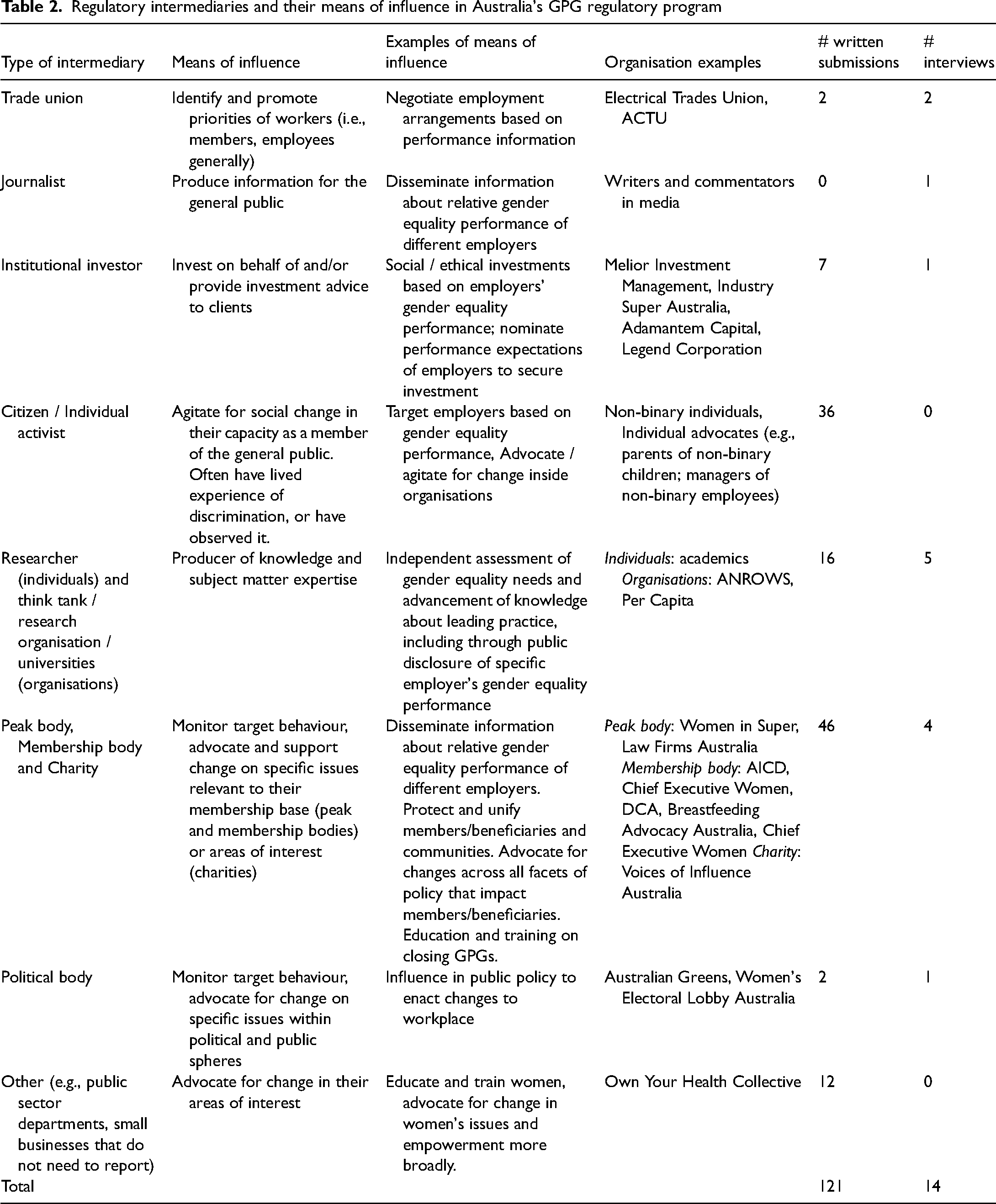
To understand the types of regulatory intermediaries and their means of influence, we first categorised each submission according to the definitions in the RIT framework (see Table 1 in Findings). We then mapped each intermediary into broad intermediary “types” which assisted with inferring their means of influence (see Table 2 in Findings). The type of intermediary was usually obvious from the submission and included categories such as academic, institutional investor, and peak body. Where the intermediary type and/or means of influence were not immediately apparent, we further investigated the submitting organisation's purpose on their website. For example, membership bodies such as Chief Executive Women can represent their members’ views to the regulator (and other stakeholders), and educate and empower their members to make meaningful change.
RIT actors - submissions to the review of the WGE act 2012*
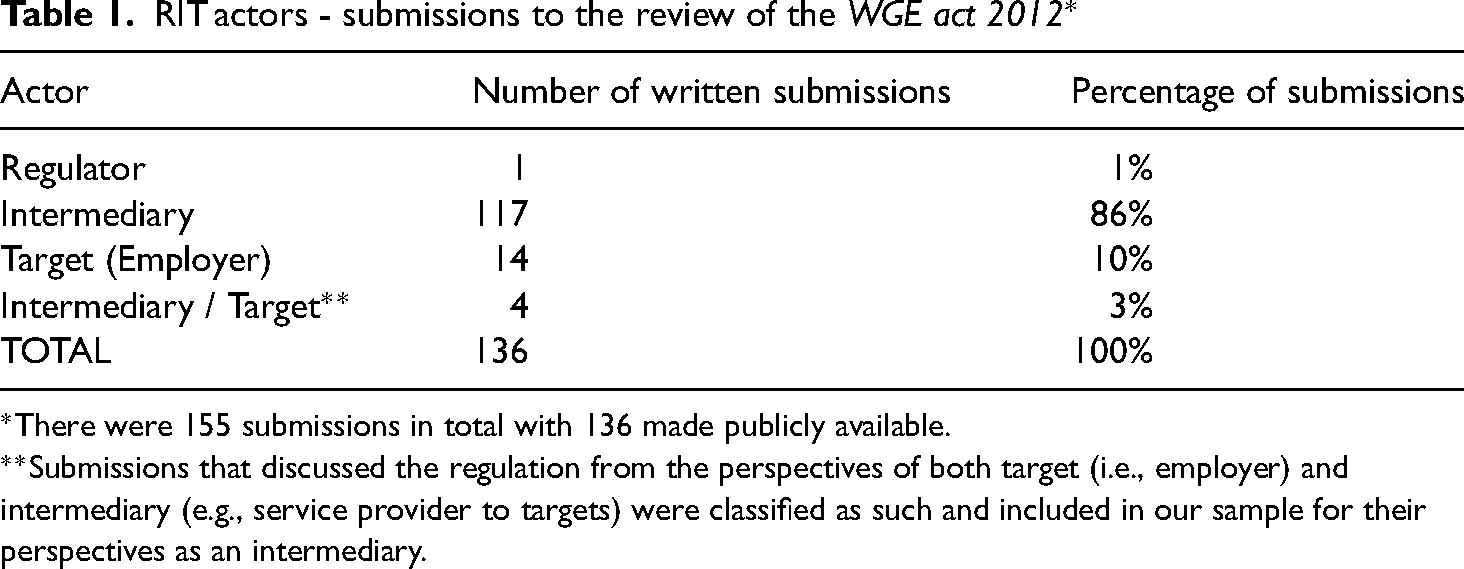
*There were 155 submissions in total with 136 made publicly available.
**Submissions that discussed the regulation from the perspectives of both target (i.e., employer) and intermediary (e.g., service provider to targets) were classified as such and included in our sample for their perspectives as an intermediary.
Regulatory intermediaries and their means of influence in Australia's GPG regulatory program
Data integration
To support the validation of key themes from the qualitative interview data we undertook a data integration process to assess the degree to which public submission responses reflected the themes identified in the interviews. This process involved assessing the position of each submission against each of the key interview themes; for example, a theme from the interviews was the need for improved GPG transparency, so each submission was analysed for content relevant to this theme. If greater pay transparency was addressed and endorsed in the submission, it was coded as supporting this theme. Conversely, if greater pay transparency was addressed but not endorsed in the submission, it was coded as not supporting this theme.
Findings
Overview of intermediaries and themes
The analysis of both the interviews and written submissions to the Review highlighted intermediaries’ strong interest in how GPG disclosure is regulated. The composition of respondents to the written review provides a preliminary indication, with intermediaries comprising the majority (89%) of submissions. Table 1 provides an overview of submissions for each actor in the RIT framework.
Table 2 identifies the “means of influence” of various types of intermediaries that were included in our study. The means of influence describes how intermediaries believed they could assist with reducing the GPG. We note that, while identification of these means helps to understand potential mechanisms for intermediaries to enable change, individual intermediaries will have differing levels of influence within the regulatory environment.
Our analysis of the interview data identified four broad areas for improvement in Australian GPG disclosure regulation: 1) improved transparency through public disclosure of individual employers’ GPGs, 2) increased coverage of the workforce, 3) employer accountability for actions and outcomes, and 4) fit-for-purpose enforcement mechanisms.
The written submissions provided strong support for each of these themes, although not all were ultimately adopted by government in the 2023 legislative reforms, as shown in Table 3. While there were some differences in the response rates to each question by intermediary type (likely reflecting their area of expertise), where they did respond to a question their responses demonstrated consistency across types with respect to these legislative features. We therefore discuss their views in general ‘intermediary’ terms.
Legislative features identified to better achieve regulatory objectives: from support in submissions to ultimate outcome in legislative reforms
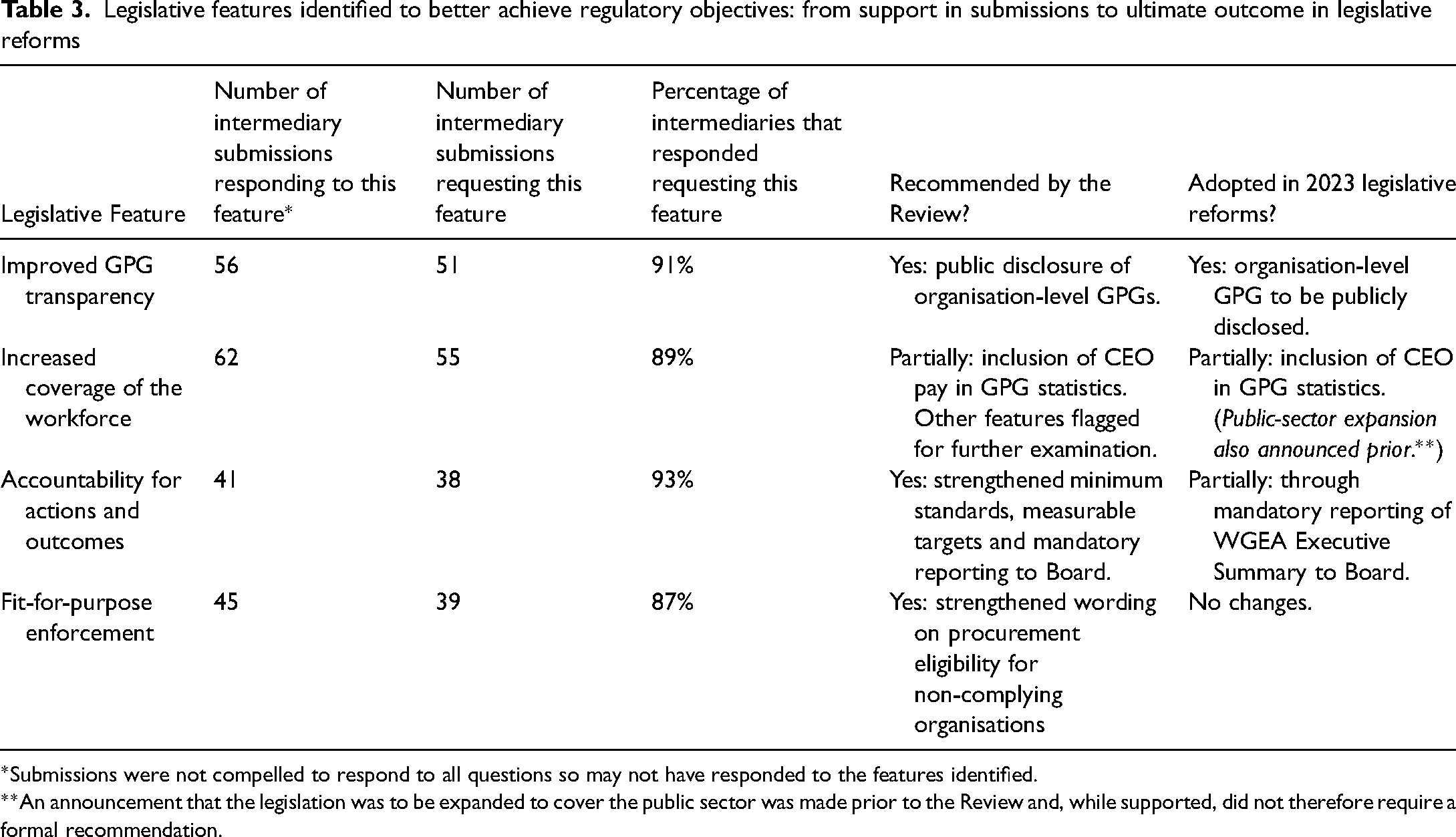
*Submissions were not compelled to respond to all questions so may not have responded to the features identified.
**An announcement that the legislation was to be expanded to cover the public sector was made prior to the Review and, while supported, did not therefore require a formal recommendation.
Intermediaries believed that incorporating these features into holistic regulatory reforms would better enable them to monitor performance, provide guidance to employers, assist the regulator in ensuring accountability and impose consequences on poorly performing organisations. A recurring point across all themes was the importance of public information disclosure to provide intermediaries with enhanced visibility of employer actions and outcomes. As outlined in the Improved transparency finding below, visibility via information disclosure is crucial for intermediaries to exert their means of influence (Table 2) and ultimately assist the regulator in closing the GPG. As summarised by one of the interviewees, “if [the means of change] is market based, we need greater transparency” (advocacy group representative). The rest of this section presents findings from interviews and submissions related to each legislative feature identified by intermediaries.
Improved transparency
The major criticism expressed by interviewees about transparency was the absence of publicly available organisation-level GPGs. At the time of the Review, only industry and national-level GPGs could be disclosed publicly, which provided limited value for intermediaries aiming to drive changes in employer behaviour. The absence of organisation-level GPGs in the dataset was seen as a significant barrier to intermediaries monitoring performance over time. This is particularly pertinent given that the WGE Act 2012 empowers the regulator to collect and produce data on performance, but not to actively monitor organisations regarding actions and outcomes. Publicly releasing these data would improve transparency and strengthen intermediaries’ ability to pressure poorly performing organisations to address their GPGs.
One example of intermediaries’ means of influence emerged in interviews with respect to gender-focused ethical investments for superannuation. An interviewee described a gender-based investment movement in the United States and UK, where publicly available GPG data are used to guide investments towards companies demonstrating progress in gender equality outcomes. Although the Australian investing landscape was described as embryonic in this field, it is well positioned to drive change through the prevalence of superannuation funds, which are increasingly moving towards socially responsible investment principles including gender (Mees and Smith, 2019). As explained by the CEO of a superannuation fund interviewed, “Superannuation funds in Australia own about half of the Australian Stock Exchange, so as a collective, we are the most important investors in Australia, which means that we can advocate on a whole lot of issues [including gender equality].” “It's much harder to prove that you’re making change, that there's actually been an impact of the work. And of course the pay equity gap is the result of all the other things that you’re doing to create more gender-equal workplaces. It's almost like it's the ultimate, ultimate measure.”
The publication of organisation-level GPGs received overwhelming support within the written submissions. 91 per cent of the submissions that responded to the related consultation question supported this level of transparency (Table 3), with similar sentiments expressed to those in the interviews. This support ultimately had a significant impact, with the public disclosure of organisation-level GPGs a key recommendation of the Review and implemented in the legislative reforms.
Increased reach
Further, our analysis revealed three key issues related to the reach of the WGE Act 2012. These were the inclusion of public-sector reporting, 6 changes to employer-size thresholds for reporting and the omission of some groups of employees in the GPG statistics.
Interviewees were supportive of expanded regulatory reach in general, especially through inclusion of the public sector. When discussing the potential to lower the employer size threshold, many highlighted the benefits of a more inclusive, and therefore accurate, calculation of the GPG in tracking aggregate performance at industry, sector and national levels. As one academic explained:
“It's such a shame that it's an unrepresentative sample, in that we are just getting large, private-sector organisations, which is quite a skewed view for many issues. If they could change the legislation to broaden that [it] could make the data a lot more useful.”
Analysis of written submissions also revealed strong support for increasing the reach of the regulation, with 89 per cent of respondents supporting this feature (Table 3). Although the inclusion of public-sector reporting had already been announced at the time of submissions, respondents who acknowledged the expansion overwhelmingly agreed with the decision. Submissions also echoed interviewees’ comments regarding the employer-size threshold. Irrespective of the reporting burden, intermediaries believed they needed extensive coverage of the workforce to gain a better understanding of the issues within their spheres of influence. Additionally, the Review posed a specific question about using single-touch-payroll systems for data collection, which could significantly mitigate concerns about increased reporting burdens for smaller organisations. Respondents viewed this potential approach favourably.
The omission of certain employees and other workers from reported statistics was also raised as a particular issue in some submissions. At the time of the Review, WGEA publicly disclosed two key GPG statistics: the average GPG at the industry level, which is calculated from organisation-level total remuneration data collected as part of the reporting requirements, as well as a national headline GPG statistic based on Australian Bureau of Statistics (ABS) data. The ABS statistic covers full-time employees only and excludes part-time and casual employees. Respondents were concerned that this statistic omits some of the most disadvantaged women, including those who work in precarious part-time and casual roles. WGEA's statistics do include part-time and casual employees (by annualising their remuneration) but, at the time of the Review, omits organisations in the public-sector and those with less than 100 employees. Moreover, the regulations did not require organisations to report CEO remuneration data or data for workers not classified as employees, such as partners and contractors. The exclusion of CEO and partner remuneration data can significantly skew reported GPGs, given the under-representation of women at the most senior organisational levels. Ultimately, improved reach through these mechanisms was seen to provide a more comprehensive measure of pay gap performance for a broader range of organisations and would thereby enable intermediaries to better target highly unequal employers.
The Review did not recommend changes relating to all these issues, noting that a reduction in the size threshold would not be advisable without streamlining of reporting obligations and data collection processes. It did, however, recommend an extension of coverage to the CEO and flagged the potential inclusion of partners in the calculation of GPGs as worthy of further examination. Ultimately, the 2023 legislative reforms included a requirement for CEO remuneration to be included in the calculation of the GPGs of organisations.
Accountability for actions and outcomes
While interviewees acknowledged the important contribution of the WGE Act 2012 in providing evidence of gender inequalities (albeit at the aggregate level), they also reported that such evidence has not been enough to substantially change either attitudes or practices. As one journalist observed: “Gathering that information and putting those research reports out is very useful. No question about it. But if we are relying on that to have a wholesale shift in thinking, and more action around things like the GPG, I think that it would have happened by now. And it hasn't.”
Interviewees also emphasised that requirements for corrective action need to be supported by effective mechanisms to ensure accountability for outcomes, including to the regulator. While mandating corrective action sits within the purview of Government, interviewees highlighted the potential for intermediaries to reinforce employer accountability by exerting their respective means of influence (Table 2). For example, advocacy bodies argued that investors, suppliers and customers have significant influence over organisations, including the power to withhold funds if there is no action or progress being made.
In terms of practical measures, interviewees suggested that employers should be required to publicly report action plans articulating how they intend to reduce their GPGs, along with outcomes that can be monitored. As explained by a gender equality advocate, “More often than not, there are no measures in place to monitor how [action plans are] going, to report on that to anybody, or for there to be accountability. If you really were wanting to be accountable, I think you would have to have reporting to senior management, to the governing body … and to employees.” “They're all doing different things but that's good actually. They've got all these different organisations. So one thing that [our organisation] does is … create a place for connecting all those different people and their insights.”
The submissions provided further support for the key issues raised by interviewees about the action-gap and accountability; 93 per cent of respondents supported mandating corrective action or the implementation of action plans at the very least (Table 3). The submissions also corroborated the potential for certain types of intermediaries to provide guidance to employers in executing action plans, should such requirements be imposed, particularly those with a membership base whom they are set up to assist.
The Review did acknowledge the action-gap and recommended strengthening the current minimum standards to require larger (500 + employees) employers to commit to, achieve, and report to WGEA on measurable targets. It also recommended that employers be required to share the Executive Summary and Industry Benchmark reports provided by WGEA with their Board. The 2023 legislative reforms only adopted the second recommendation on Board reporting and did not strengthen the existing requirements with respect to the action-gap.
Fit-for-purpose enforcement mechanisms
In Australia, WGEA monitors employer compliance with reporting obligations through a ‘naming and shaming’ strategy, publishing an annual list of non-complying entities. As a form of sanction, the WGE Act 2012 empowers the Federal Government to withhold eligibility for government supports or contracts. Despite demonstrated inconsistency in enacting this available sanction (Crowe, 2021), there have been high compliance rates observed by international standards (98% in 2019–20, Department of the Prime Minister and Cabinet, 2021). Although some interviewees raised concerns over compliance slippage in recent years, considering the historically high compliance rates, the general consensus was that the WGE Act 2012 enforcement mechanisms were appropriate for the existing legislation.
A recurring theme in interviews, however, was that the enforcement mechanisms must be fit-for-purpose. That is, the impact of high compliance and the need for credible enforcement mechanisms were only as strong as the requirements themselves. Compliance with the WGE Act 2012 does not require employers to correct gender inequalities or reduce GPGs, meaning failure to take corrective action is not a breach and carries no penalties. As noted by an academic interviewed in this study, “we don’t have any kind of targets and stretches to really push change.” This low legislative bar makes compliance relatively easy.
As outlined above, interviewees advocated for stronger employer accountability through action- and outcome-based requirements. At the time of the interviews and Review, intermediaries expressed concern that existing enforcement mechanisms were inadequate and stronger tools such as sanctions and penalties might be necessary. As one academic stated: “[The legislation] has the machinery there to actually be a stronger system, it just has never been used that way”. The following quote from an Australian journalist is illustrative of the general sentiment, “I think the problem is it's inconsistent; so we’ll have pockets of progress, but sometimes you need to have something that's just a mandatory regime with some real accountability, and penalties. Otherwise, [employers] can just get away with not doing it.” “In the private sector the discipline there is really: ‘what are people going to think about us if we don't do it. And if people can't find out whether we do it or not, then it's not going to affect their opinion.’”
The Review acknowledged all these issues and recommended that the wording be strengthened in the legislation to highlight that employers must comply with the legislation to be eligible for government grants and procurements. However, it did not recommend any other significant changes to the existing enforcement mechanisms, instead suggesting that they be reconsidered if any stronger requirements in the legislation lead to a fall in compliance rates. The recommendation for strengthened wording around eligibility was not adopted in the 2023 reforms.
Other findings
Two additional findings emerged that did not fit the criteria for formal themes (see Method section) but are nonetheless relevant to the broader regulatory regime. The first pertains to the establishment and activities of WGEA, which was seen as a pivotal component of Australia's legislation. Intermediaries strongly supported WGEA's role, particularly in translating data, disseminating information, and supporting employers to address GPGs. A well-resourced regulator was viewed as both a symbolic demonstration of government commitment to gender equality and a practical enabler, offering intermediaries easier access to actionable insights. Interviewees emphasised that adequate funding for this body is crucial to maintaining its effectiveness. The second finding involves the inclusion of intersectionality in the regulatory framework. While recognised as an important issue, there was no consensus on how to address it effectively.
Discussion
Our study comes at a time when an increasing number of governments are introducing and reforming GPG regulation to address persistent workplace gender inequality (OECD, 2023b; Cowper-Coles et al., 2021). Given the limited political appetite, especially in non-EU countries, to impose penalties on employers who do not act to close GPGs, enabling intermediaries to contribute to achieving regulatory goals represents a critical pathway for change. Our study highlights the role of intermediaries within the context of GPG disclosure regulation. In doing so, we make several contributions.
First, we present a view of GPG disclosure regulation from the perspective of regulatory intermediaries (Abbott et al., 2017). The features of GPG disclosure regulation vary significantly across countries, and our findings enhance understanding of the legislative features that can drive progress toward gender pay equality. By analysing regulatory intermediaries’ perspectives of GPG disclosure regulation in Australia, we find that intermediaries are enabled by regulation that requires employers to publicly disclose meaningful organisation-level data, including details of actions taken to address inequalities, and that is supported by fit-for-purpose enforcement mechanisms. In particular, the requirement for publicly disclosed action plans enhances intermediaries’ ability to act as both watchdogs (Kourula et al., 2019) ensuring employer accountability, and capacity-builders (Abbott et al., 2017), helping organisations implement meaningful change. The transparency ensures that pay audits, action plans and reports do not become bureaucratic artefacts decoupled from organisational reality (Salminen-Karlsson and Fogelberg Eriksson, 2022) but rather, active policy instruments that stakeholders can leverage in supporting employers to reduce GPGs (European Commission et al., 2017).
Intermediaries can use their monitoring function to reinforce compliance through mechanisms such as public scrutiny and market-based sanctions, akin to ‘naming and shaming’ strategies that have proven effective in regulatory enforcement (Erp et al., 2011; Okafor, 2023). Enhanced transparency could also assist to identify unintended consequences of the legislation, such as GPG reductions that do not translate into broader wage increases for women. For example, decreases in the GPG may result from lower male wages or solely through the appointment of a female CEO, rather than meaningful improvements in pay equity across the workforce (Bennedsen et al., 2023). By demonstrating how disclosure-based regulation enables intermediaries to take on a more active role in both compliance and norm-setting, our findings extend Abbott et al.'s (2017) RIT framework, illustrating how regulatory design can orchestrate intermediaries to assist with reducing GPGs.
Second, our findings contribute to a growing evidence-base that shows the interest and potential influence of a range of intermediaries in addressing workplace gender inequality (Ellicott, 2022; Alcalde-González et al., 2024; Maoret et al., 2024). We map a variety of intermediary types and their means of influence in the GPG regulatory context, demonstrating that many actors beyond trade unions play an active role. Our study identifies investors, journalists, advocacy groups, subject matter experts, peak and membership bodies, and academics as intermediaries with the potential to shape GPG disclosure regulation. We find that, regardless of their specific type, intermediaries share broadly similar views on legislative features that would enable progress toward gender equality. Our findings illuminate the wider cast of actors, beyond only trade unions, involved in shaping the dynamics of IR (Doellgast et al. 2021; Tapia et al., 2015).
Third, our findings provide a unique application of the RIT model to examine GPG disclosure regulation. This adds to the growing literature on regulatory intermediaries in a variety of regulatory contexts including policing (Cheng and Qu, 2022), sex work (Euchner, 2022), technology (Giannoumis, 2018), food safety (Lytton, 2017), modern slavery (Harris and Nolan, 2022), and pharmaceuticals and medical devices (Maggetti et al., 2017). Previous RIT research has focused on the nature of the relationship between the regulator and intermediaries (Maggetti et al., 2017; Cheng and Qu, 2022), types of intermediaries (Brès et al., 2019), and value-conflicts between regulation and intermediaries (Ciornei et al., 2023). Our study adds a new perspective to this literature by detailing how intermediaries can be enabled to support regulatory objectives by focusing attention on the features of the legislation itself.
We hope this study encourages further research into the role of intermediaries in GPG regulatory outcomes. A limitation of our analysis is the inability to assess the relative influence of different intermediary groups on legislative reforms and the politics of the regulatory environment. While we show how intermediaries engage with the GPG regulatory setting and influence reforms, understanding their comparative impact and role in reducing the GPG requires further study. Future research could examine the politics of regulatory processes, focusing on how intermediaries advocate, negotiate, and shape outcomes (Short, 2021). As the public release of organisation-level GPGs continues, studies could explore how intermediaries drive change, mitigate unintended consequences, and influence employers. Furthermore, it would be fruitful to explore the dynamics between such actors in the IR system and how they might work together to create positive change at work.
Footnotes
Acknowledgements
The authors would like to thank participants at the University of New South Wales Business School 2023 Organisation and Society Symposium for constructive feedback on an earlier version of the manuscript.
Declaration of conflicting interests
The authors declared no potential conflicts of interest with respect to the research, authorship, and/or publication of this article.
Funding
The authors disclosed receipt of the following financial support for the research, authorship and/or publication of this article: Some of this research was financially supported by the United Nations Foundation and Global Institute for Women's Leadership (GIWL) at the Australian National University.

Notes
Biographical notes
Appendix
Ten questions from the Workplace Gender Equality Act 2012 Review Consultation, October 2021.
Are the functions and powers of WGEA appropriate for promoting and improving gender equality in the workplace? How effective is WGEA in achieving its functions to promote and improve gender equality in the workplace including by enabling relevant employers to report on the gender equality indicators, developing benchmarks and reports, undertaking research, education and leading practice programs and contributing to the public discussion on gender equality? What is your experience of what works to improve gender equality in your workplace? How do you currently engage with WGEA and use the reporting process and their resources to improve gender equality? What changes, if any, would you like to see in the areas of future focus for WGEA to further promote and improve gender equality over the next ten years? Should the coverage of the Workplace Gender Equality Act be further changed? Specifically, should the definition of ‘relevant employer’ be expanded? If so, would additional considerations need to be factored in for new reporting employers? Are the gender equality indicators (GEIs) in the Workplace Gender Equality Act, and the data collected with respect to the GEIs, appropriate to promote and improve gender equality? How could they be improved? In addition to gender, should WGEA collect other data on diversity and inclusion criteria on a mandatory basis? If yes, please specify criteria (eg cultural and linguistic diversity, disability, age, location of primary workplace). If not, why not? How could data be better collected and/or used by WGEA to promote and improve gender equality? Should there be some form of pay transparency – should remuneration data in some form be public? Are there changes that could be made to the Workplace Gender Equality Act that would help reduce the regulatory burden on relevant employers while continuing to enable WGEA to promote and improve gender equality? Should other data sources, such as Single Touch Payroll data, be used by WGEA instead of employers providing the same data to two Government agencies? Could the minimum standards be expanded to improve the way they drive practical gender equality outcomes in workplaces? What would employers need to do to implement these changes in their workplace? Should Minimum Standards apply to all reporting employers, not just those with 500 or more employees? Are the compliance mechanisms in the Workplace Gender Equality Act, and consequences for non-compliance, effective to promote and improve gender equality? If not, how could they be improved? Are there any other matters you want to comment on in relation to the Workplace Gender Equality Act and improving and promoting gender equality in the workplace in Australia?