



Abstract
This article considers the debate about the process of liberalisation of industrial relations from an ideational institutional perspective. While the gradual liberalisation of industrial relations has increased employer discretion, the role of employers’ organisations in this process is unclear. The case study is the Netherlands, a neo-corporatist country described as stable and robust but where institutional outcomes have undergone major shifts. To understand how this happened, the author analysed 40 years of collective bargaining policy using an ideational approach. The article argues that Dutch organised employers had the confidence that the strength of their ideas was enough to gradually but surely change industrial relations within the existing neo-corporatist framework by redefining the role of the firm, the state and the employee in the economy. The article also shows that since the early 2010s Dutch organised employers have changed their strategy leading to further de-collectivisation of industrial relations.
Keywords
Introduction
We are currently witnessing the process of liberalisation of industrial relations in most democratic capitalist countries (Baccaro and Howell, 2017; Streeck, 2014). The transformation of trade unions, globalisation and technological advances have traditionally been considered drivers of change. Over the past two decades, however, researchers have studied and debated the role of employers and their organisations in the liberalisation of the political economy and industrial relations (Hall and Soskice, 2001; Korpi, 2006; Martin and Swank, 2004; Paster, 2014, 2015; Thelen, 2014), with scholars falling largely into two camps (Bulfone and Afonso, 2019). On the one hand, there are the ‘liberalisers’, who stress the active role of employers in dismantling the welfare state, arguing that their inherent opposition is due to their economic position (Baccaro and Howell, 2017; Emmenegger, 2019; Streeck, 2014). On the other, there are the ‘coordinationists’, the Varieties of Capitalism scholars being their most emblematic representatives, who argue that employers will defend – and have crafted – the institutions of the coordinated or liberal market economy because they depend on and have built their relationships around these institutions. Both positions have also been nuanced. Kinderman (2017), for instance, shows how the strategy of German employers organisations (EOs) is ‘more complex than blanket opposition and an all-out assault on non-liberal institutions’ since they actively support think thanks discrediting the welfare state but nevertheless continue to engage in collective bargaining (p. 591). Bulfone and Afonso (2019) show that EOs defend centralised bargaining and the extension of collective agreements as a protective shield, especially in countries with a large contingent of small firms. What is clear is that changes in the composition of the (global) economy and the labour market challenge the organisational basis of EOs, their role vis-a-vis their constituency and the services they provide (Demougin et al., 2019; Ibsen and Navrbjerg, 2019; Paster, 2014). Whether and how these changes have influenced the ideas, and thus practice, of organised employers in their collective bargaining policy is less clear.
This article builds upon the work of the so-called liberalisers, but examines the role of EOs in the transformation of industrial relations from an ideational institutionalist perspective. Baccaro and Howell’s notion that the liberalisation of industrial relations, operationalised as ‘an expansion of [employers’] discretion at the firm level, unless constrained from doing so by the power of trade unions or the state’, is the point of departure (2017: 178). They, and others, convincingly describe the institutional changes and transfiguration of power relations that have led to these processes of change, but pay little attention to what employers wanted from this. Ideas, norms and values are often not regarded as possible underlying motivations for choices, actions or strategies (Hauptmeier and Heery, 2014).
Incorporating ideas and discourse into the analysis of the functioning of institutions and the actors involved, along with such common variables as production modes, skills, coalitions and power relations, gives us a better understanding of the role of EOs in the process of liberalisation of industrial relations. This article therefore explores how organised employers in the Netherlands have developed their policy ideas and discourses on industrial relations and whether and how their understanding of issues changed between 1976 and 2019. Ideas are here conceptualised as policy solutions and frames that ‘constrain the cognitive and normative range of solutions that policy makers are likely to consider, and constitute symbols and concepts that enable actors to construct frames with which to legitimize their policy proposals’ (Campbell, 1998: 398). Discourse is an interactive process of transmitting ideas in which text, context, structure and agency are all important (Schmidt, 2008). I further consider how these developments can be understood as a process of liberalisation of industrial relations driven by organised employers.
This analysis contributes in several ways to our understanding of the process of institutional erosion and liberalisation of industrial relations. First, the conclusion of Baccaro and Howell that organised employers have continuously pushed to liberalise labour market institutions is supported. Second, because of the strength and persuasiveness of the ideas and discourse of organised employers, they were able to use the neo-corporatist institutions to realise slow but incremental change (Streeck and Thelen, 2005). Contrary to their equals elsewhere there was no need to engage in open fights or to partly dismantle the corporatist framework (Thelen, 2014). When trade unions became more militant in their discourse and practices in the late 2010s they instantly carved out ideological space for themselves to withdraw from collective bargaining. The third contribution is that the analysis shows that it is especially the ideological reframing of the role and identity of the firm, the employee and the state that has been instrumental in this transformational process. A limitation of focusing on the ideational development, however, is that the analytical question of whether ideology is an independent force or just conveys what happens economically is not answered.
The Netherlands is taken as a least-likely case study and is interesting for at least two reasons. First, even though the trade union movement has insufficient power resources to force employers to engage in collective bargaining, the majority of employers continue supporting and advancing collective bargaining in this traditionally neo-corporatist country. Second, although most scholars describe the Dutch system of industrial relations as stable and robust, its outcomes have changed dramatically over time.
The first and second section of the article introduce the analytical framework, the third section elaborates on Dutch EOs, and the fourth on the data and methodology used. The fifth section presents the results and the final section describes the conclusions and discussion.
Discursive approach to industrial relations
This article uses a discursive approach to assess the role of EOs in the transformation of Dutch labour market institutions by virtue of their ideational development. This does not imply that interests and institutions do not matter; it explains how ideas frame problems, solutions and interests (McLaughlin and Wright, 2018).
Scholars of industrial relations have long debated the causes, mechanisms and effects of changes in the political economies of democratic capitalist countries by focusing on institutional change (McLaughlin and Wright, 2018). The value of such approaches is that they explain changes, continuities or disruptions in institutions and reveal the effects on actors and outcomes. They are, however, constrained in presupposing a clear, rational and ‘right’ understanding of actors’ interests and, consequently, behaviour and ideas based on these interests (Hauptmeier and Vidal, 2014; Hay, 2002). But how can one understand and act in the world without prior ideas about that world? Another constraint is that these theories often provide only a limited number of possible explanations for changes in actors’ behaviour or preferences (McLaughlin and Wright, 2018). The varieties of capitalism literature for instance has been criticised for recognising mainly external shocks and unexpected events as possible explanations of change (McLaughlin and Wright, 2018). Also Baccaro and Howell, who do argue that discourse and ideas are used by employers to advance position and who adapt a contextual understanding of preference formation, do not really incorporate it into their analytical framework.
Scholars using an ideational approach look at the effects of ideas and offer causal explanations for institutional change (Béland, 2009; Schmidt, 2008). In this view, ideas shape how actors understand the world and guide their behaviour (Béland and Cox, 2011; Blyth, 2002). The struggle between different actors over ideas and discourse is essential in the policy-making process and deeply political, because actors use these as instruments in struggles, to (re)structure policy-making processes, to (re)define problems, to (de)legitimise solutions or to limit the number of options within policy-making and institutions (Hall, 1993). Hauptmeier (2012) suggests that national institutions are shaped by the ideas that firm-level actors hold and Hauptmeier and Heery (2014) show that ideas on the design of the employment relation become more permanent once they are embedded within formal institutions. In that sense, ideas have transformative power for actors and for institutions.
Neoliberalism in industrial relations
Neoliberalism is characterised by a pro-market approach to organising societies and heightened competition between firms, states and individuals (Streeck, 2014). Processes of deregulation, individualisation, decentralisation and de-collectivisation of industrial relations led to the ‘transformation from discretion-limiting to discretion-enhancing behaviour’ of employers within labour market institutions (Baccaro and Howell, 2017: 19; Howell, 2019). This contrasts with the Fordist, postwar era in which the state and neo-corporatist bodies acted to limit the discretion of employers in the employment relationship. This change was partly induced by employers who were open to experimenting and who engaged in political activism out of dissatisfaction with an industrial relations regime that favoured workers too much, at a time of political (weakening unions, changing governments) and economic (rising inflation and unemployment) upheaval (Baccaro and Howell, 2017). The recasting of the state to ‘encase markets’ and bring them beyond the reach of democratic accountability to protect private property (Slobodian, 2018) has also led to a formal increase of discretion that is not always used or desired by employers (Bulfone and Afonso, 2019).
One of the results, or – according to Dardot and Laval (2014) – motivations, of the neoliberal transformation is the establishment of new social relations. In the context of industrial relations, a ‘new employee’ was constructed: an (enterprising) individual who strives for self-fulfilment in her or his work and sees work as an essential component on the road to self-realisation (Miller and Rose, 1995). This image presents a stark contrast to the Fordist worker, regarded as a means of production; whereas the decentralised decision-making, non-scripted customer contacts, flexible working hours and functions associated with neoliberalism respond to the desire for individualism. For Baccaro and Howell (2017), the main outcome of the liberalisation of industrial relations is that employers have more power to determine wages, working time and other employment terms but also to control personnel management and work organisation, and who and when to hire and fire. This was realised by ‘deregulation on the part of the state, decentralisation and individualisation of bargaining, and decollectivisation of class organisations’ (Howell, 2019: 460). In the next paragraphs, I elaborate upon these four processes of liberalisation as the main drivers of change.
Deregulation refers to the adaptation or abolishment by the state of regulations or by social partners within collective agreements, both with the objective to increase entrepreneurial freedom. Deregulation of the labour market includes the abolishment or adaptation of laws governing hiring and firing, wage setting and working time, the phasing out of the instrument extending collective agreements, and exemptions from labour law or national/sectoral agreements (Esping-Andersen and Regini, 2000). Deregulation of collective agreements involves reducing the number, strictness and scope of arrangements within the agreement.
Decentralisation of bargaining refers to a shift from higher to lower levels of collective bargaining to restore the market’s allocation function by allowing wage competition, lowering overall labour costs and thus improving firms’ competitiveness and creating employment (Calmfors, 1993; Traxler, 1995). Policy ideas on decentralisation include the withdrawal of the state from wage formation processes and the promotion of firm-level bargaining, with or without trade unions. The difference with deregulation is that decentralisation only refers to matters laid down in collective agreements and that the objective is not primarily to relax or get rid of rules, but to set them at a lower level.
The individualisation of terms of employment involves rearranging employment terms from a collective, group-specific level to an individual level. Examples include abolishing wage scales, job classification and seniority systems in favour of results-based remuneration, self-scheduling, differentiation in work schedules and working times. Individualisation is also associated with the ideational construction of ‘the new employee’.
The fourth and last process is de-collectivisation, which entails that class organisations – mainly unions – lose instruments allowing them to negotiate and organise their constituencies (Baccaro and Howell, 2017). Trade unions are seen as improper labour cartels and detrimental to economic growth (Slobodian, 2018), and their reach must hence be limited. De-collectivisation can be an independent process or the outcome of other processes. Examples include restrictions on the right to strike, weaker collective bargaining frameworks, or limiting a trade union’s right to engage with workers.
While the pace of these processes and their specific outcomes differ between countries, the overall trend is the same in all democratic capitalist economies, namely an increase in employer discretion (Baccaro and Howell, 2017). They can also be detected in the Netherlands to a greater or lesser extent. The withdrawal of the state from the wage formation process in the 1980s, decentralised collective bargaining for state employees in the 1990s, and the process of organised decentralisation from the mid-1990s onwards, with higher-level actors granting negotiating powers to lower-level ones, are examples of decentralisation (Hellema and Van Lith, 2020; Ibsen and Keune, 2018). Labour market deregulation occurred both through legislation and in collective agreements, leading to the individualisation of terms of employment that began in the 1980s and has continued (Kluijtmans and van der Heijden, 2011; Nagelkerke and Wilthagen, 2000). De-collectivisation can also be observed, with the trade union movement losing a considerable number of members since the mid-1970s, ‘yellow unions’ becoming more prominent, works councils gaining power, and the legally embedded advisory role of the bipartite Social and Economic Council deteriorating.
Dutch employers’ organisations
Employers’ organisations as special interest organisations represent labour market and product interests of firms (Brandl and Lehr, 2019), and are attributed three roles: as actors in industrial relations, as political actor and as service provider (Demougin et al., 2019). All these roles are performed by one or more of the three Dutch peak EOs. The largest and oldest employers’ organisation, VNO-NCW, is export-oriented, and focuses on big business and lobbying the government – which was also the reason for its foundation in 1899. MKB-Nederland organises small and medium-sized enterprises and engages in both lobby and service provision. Neither is directly involved in collective bargaining. The third peak organisation is the General Employers’ Association, AWVN. It specialises in services relating to collective bargaining, legal services, HRM advice and training. AWVN has revolved from a separate EO to its current role as the outsourced collective bargaining department of VNO-NCW.
In the 1970s seven peak EOs coexisted in the Netherlands. They worked together in an informal but influential network, the Board of Directors for Labour Affairs (RBA). Due to mergers, industrial changes and secularisation, only three are left today. In the 2000s, VNO-NCW, MKB-NL and AWVN merged their boards and their paid staff. A full merger was abandoned because of differences over the needs of multinationals and small and medium-sized employers in their lobby activities.
Dutch employer organisation density is estimated to be above 80% (Brandl and Lehr, 2019) and consists largely of big employers (TNO, 2020). Individual employers can join one or more peak organisation, but most often are affiliated through one of the hundreds of sector-level branch organisations. Many are members of one or more of the peak EOs and operate as such at sector level by engaging in collective bargaining, lobbying, mutual support and service provision, or a combination.
The renewed interest in EOs, which focuses mainly on shifts in identities and strategies, has revealed that in several countries these organisations changed from acting as an industrial relations actor to a service provider or lobby organisation (Brandl and Lehr, 2019; Demougin et al., 2019; Ibsen and Navrbjerg, 2019; Sheldon et al., 2016). On the basis of the little research that has been carried out on Dutch EOs, it seems that this process did not occur here and that they are still quite robust – although there are some signs of decay. Since the mid-1990s the internal coordination of collective bargaining has loosened due to less solidarity, and some see a slow deterioration of the authority of the peak organisations over its members while others assert that ‘branch organisations . . . have to put more and more effort into maintaining support for . . . the extension of collective agreements’ (Verhoeff, 2016: 239; see also De Beer and Keune, 2018).
The Netherlands has a strong neo-corporatist tradition. Both VNO-NCW and MKB-NL are represented in the tri- and bipartite bodies. Even though the industrial relations institutional framework has remained mostly intact, the relationship vis-a-vis the state and the role of the state in IR did change. In 1982, the colour of the government changed from centre-left to centre-right to date. Since, the labour market and the welfare state have been deregulated and decentralised (Nagelkerke and Wilthagen, 2000; Visser, 2016). Together with financial deregulation, trade liberalisation and the retreat of the state from the wage formation process in 1982 competition between firms was both facilitated and forced upon employers.
Case selection, data and methodology
The Netherlands serves as a good least-likely case because it allows us to examine how an intact neo-corporatist institutional environment produces different outcomes. In a sense, the process of gradual transformation conceals the ‘major recasting of the system of capitalism as we know it’ (Streeck and Thelen, 2005). In the Netherlands, collective bargaining coverage remained stable for decades (showing a recent downward trend), with a continuing practice of social pact formation and an intact and even stronger legal framework surrounding collective bargaining agreements, including the extension instrument (Rojer, 2002). At the same time, however, the four processes of liberalisation described are also present.
A key factor in understanding this tension between stability and transformation lies in the evolving relationship between employers, trade unions and the state. Scholars tend to infer changes in the balance of power from outcomes, but rarely question or study what employers really want and how they present this and aim to achieve it. Dutch employers offer a good study case for understanding these issues because, unlike in Germany, Sweden and the UK, Dutch EOs did not openly change their behaviour (Thelen, 2014; Visser, 2016).
To understand the role of employers in this process of transformation, I used as primary sources the annual collective bargaining policy documents on terms of employment published between 1976 and 2019 by VNO-NCW and/or AWVN. MKB-NL joined as co-author on the documents in 2007. These documents serve as an instruction sheet for members’ collective negotiations with trade unions. To date, these policy documents have been under-researched as a source of information about employers’ ideas and policies. The documents were collected from a wide variety of sources. The database constructed for this study contains 39 of the 43 documents published between 1976 and 2019, with full annual policy documents for 32 of these years and other documents, such as board minutes, for seven of these years. Annual policy documents or equivalents for 1978, 1981, 1986 and 1999 are missing.
The documents reflect the world views of organised employers. They portray both abstract ideas about the needs of firms to prosper and their practical elaboration in terms of governance. As such they are well suited to analyse changes in ideas and policy positions. The documents are considered discursive texts; they are instrumental in realising the agenda of organised employers and thus communicate not only towards their own members, but also to other actors, like trade unions.
The analysis follows Bacchi’s Foucauldian approach of focusing on problematisation (Bacchi, 2009, 2012), conceptualised as a critical assessment of how an issue or practice is shaped as a problem without aiming to uncover ‘truth’. Its main premise is that ‘what we say we want to do about something indicates what we think needs to change and hence how we constitute the “problem”’ (Bacchi, 2012: 4). Collective bargaining in a neo-corporatist institutional framework involves two essentially antagonistic actors. It demands that both parties develop some sort of common understanding of the outside world and the validity of proposed solutions. Understanding how issues are problematised and to what end helps clarify the basic assumptions of, in this case, organised employers and the direction and purpose of the proposed change.
I conducted the analysis in two phases. The first consisted of a detailed policy analysis focusing on the problem definition and proposed solutions in the documents. The second consisted of applying these results to the four processes of liberalisation. The documents were coded using MaxQDA. 1
Analysis: The ideational development of Dutch employers’ organisations
The analysis of over 40 years of collective bargaining policy shows that Dutch organised employers redefined the role of the firm, the state and the employee in the economy in their public discourse, which allowed them to develop a coherent set of ideas aimed at the liberalisation of industrial relations.
A broad periodisation of the ideational development of Dutch EOs can be characterised as follows (see Figure 1): during the first long decade, running from 1976 to 1989, organised employers were forced to respond to trade union demands and actively brought up new ideas and discourses and sharpened their thinking on the reorganisation of the labour market and the usage of labour within the production process. In the second period, from 1990 to 2003, employers were on the offensive and came to a position to harvest and deepen their collective bargaining policy by building upon their previously developed ideas. In the third period, starting from 2004, the EOs developed few new ideas on decentralisation and deregulation, but deepened their individualisation agenda and actively propagated de-collectivisation for the first time in over 40 years.
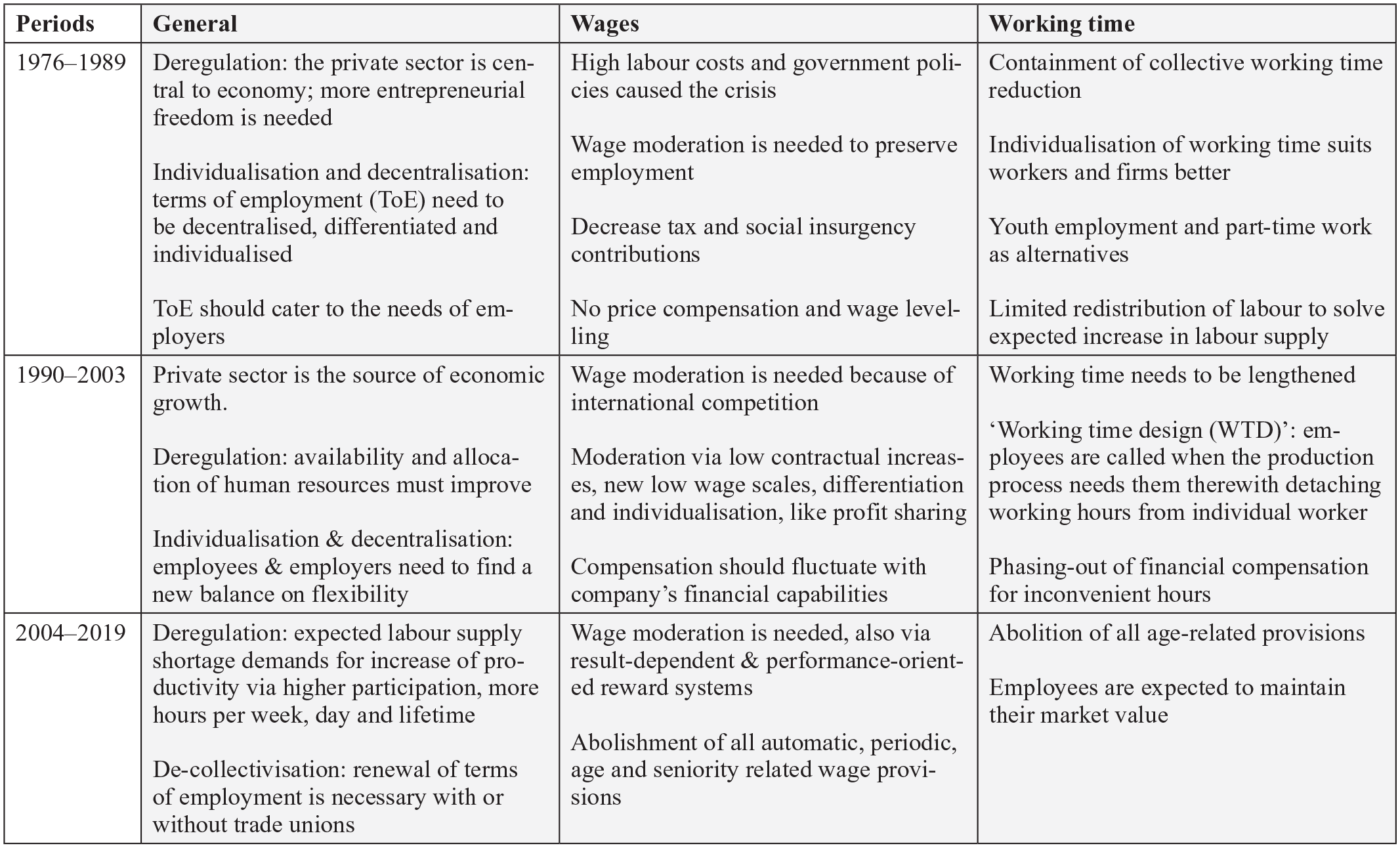
Summary of the ideational development of organised Dutch employers on wages and working time.
Deregulation
The core idea expounded by organised employers in the whole period under study, but which particularly in the first period was put forward with vigour, was that the private sector is the only source of economic growth and prosperity. Dutch employers in the mid-1970 operated in a highly organised institutional setting with ‘radicalised’ trade unions and a centre-left government applying Keynesian economic policies. Employers believed that the Dutch economy faced several problems: a private sector so constrained by government that it was unable to function and compete internationally; the steep and excessive cost of labour, which endangered private-sector profit margins and resulted in replacement instead of expansion investment; an ever-expanding government sector that consumed most economic growth; and a lack of entrepreneurial incentive caused by an imbalance between active and inactive people (RBAa).
While the employers’ analysis did not differ all that much from those made in governmental circles and elsewhere (Van Doorn, 1978), their solutions did. Whereas policymakers mainly discussed solutions within a Keynesian economic framework, such as income levelling to stimulate economic growth, boosting the collectively subsidised non-profit sector, questioning the policy of full employment and legally enforcing productive investments (Van Doorn, 1978; WRR, 1977), employers argued for ‘a radical change in the policies on terms of employment’ (RBAc) and wanted a policy that ‘once again mobilises capital in the market sector’ (RBAe). To achieve this, they offered ‘new perspectives, not just for businesses, but for all sections of Dutch society. Because only a private sector that can compete internationally can offer enough employment and finance important collective services’ (RBAc), adding: ‘If this does not happen, a return to more balanced social-economic relations is out of the question’ (RBAc). That same year, 1976, nine CEOs published an open letter in a national newspaper sharing their concern that government policy was ‘too occupied with questions of distribution and neglected questions of production’ (NRC, 1976).
One of the consequences of putting the private sector front and centre as creators of prosperity was that the role of the government changed: a good government was supposed to facilitate free enterprise instead of curtailing it. Organised employers generally turned against the government in this era and developed a discourse mobilising against the state: ‘Less unemployment and lower inflation are important to everybody. Our prosperity depends on firms. Some of our problems are international and out of our control, but the main issue is internal and involves our government: it has consumed almost all our growth. Because wages continue to increase as well, the revenues of firms and entrepreneurs have lagged behind. The only solution is to re-balance revenue growth in such a manner that profitability is restored’ (RBAa). Their discourse was that the government must back off, deregulate the labour market and let private initiative breathe. Only then would Dutch businesses become more competitive, a prerequisite for their role as creators of prosperity. The novelty and importance of this idea were highlighted in a speech by the president of the AWV (the AWVN’s predecessor) several weeks after the conclusion of the emblematic Wassenaar Agreement between employers and employees in 1982, often considered as the starting point of decades of labour cost moderation: ‘The most important thing is that in the [Wassenaar Agreement], the trade union has recognised that strengthening the competitiveness of companies and restoring their profitability are essential for a structural improvement in employment’ (AWVa).
These ideas were transformed into policy positions arguing in favour of labour market deregulation in the first period and shifting their attention to deregulation of collective agreements in the course of the 1990s.
In the 1970s, organised employers focused their lobby in relation to labour market deregulation to the decoupling of the legal minimum wage from the contractual wage development and the lowering of the collective burden for employers and employees – both would have a wage moderating effect (RBAd, RBAb). From the 1980s onwards, deregulation to facilitate part-time and other non-standard contracts, and flexible working hours and to enable flexible remuneration schemes became focus points in their deregulation discourse (RBAe, AWVa). The arguments and the appeal to government remained the same: ‘Improving efficiency, strengthening the Netherlands’ competitiveness and smaller government are essential for [stimulating economic growth]. Government must make an extra effort, certainly regarding deregulation’ (VNOe). The agenda of organised employers and government began to coincide when from 1982 onwards, a centre-right government came to power which pursued a long-term agenda of privatisation, deregulation and austerity. Especially, the deregulation of the Working Time Act in 1996 and 2007 were considered triumphs.
In the course of the second period the attention of Dutch employers shifted to deregulating collective agreements: ‘[There are] more strict standards in collective agreements than necessary . . . . These are primarily the product of “solidified distrust” and much less of “adult labour relations” . . . . [R]eal social innovation can only be achieved when substantial deregulation takes place’ (VNOc). During these first years, the call to deregulate collective agreements is justified using a discourse of increasing labour productivity by increasing the deployability of employees (VNOn, VNOm, VNOl). Later, the call to deregulate is accompanied by a discourse on the necessity to ‘modernise’, organise ‘flexibility’ within the collective agreement (VNOr), be ‘plain and simple’ (VNOs) and ‘more transparent’ (VNOt) to be able to be innovative and agile. Policy proposals included the abolishment of the automatic wage indexation and existing working-time arrangements like abolishing shift differentials, limiting the number of leave days and other time-related costs like the phasing-out of age-related provisions (VNOj, VNOl, VNOk).
Decentralisation of bargaining
Employers were increasingly guided by the fundamental notion that wages were just an expense and, as such, collectively agreed wages needed to be as low as possible. The consequences for their collective bargaining policy were twofold: first, the underlying principle shifted from wages, linked to employees and their income, to labour costs, associated with the financial scope of business; and second, terms of employment were decoupled from macro-economic objectives, described as: ‘[t]he re-recognition of the firm as the natural centre of the economy, resulting in decentralisation: the micro-level leads the macro- and meso-level instead of the reverse’ (VNOd, 1987).
These notions of ideational decentralisation led Dutch employers to change their positions on bargaining in three areas.
In the first period, the long decade from 1976 to 1989, Dutch EOs focused on two changes. First was their wish to limit their responsibility for macro-economic income policies, more specifically by distancing themselves from their (perceived) responsibility for the growth in employee purchasing power. After the Second World War, wage bargaining in the Netherlands had developed into a highly centralised affair in which the state played an authoritative role. Macro-economic income policies were implemented in centrally agreed percentage increases in contract wages, for example. In the 1970s organised employers argued that restoring business profitability was the only way to stop the inflationary spiral and preserve employment, and one way to do so was to moderate labour costs. As they wrote in 1976: ‘Growth in the purchasing power of employees can no longer be guaranteed unilaterally by employers’ (RBAb). Trade unions had to align their purchasing power objectives with the financial scope of the private sector or turn to the government for help, e.g. by lowering the collective burden of businesses, they wrote that same year. In 1980, they repeated their view: ‘Maintaining purchasing power is certainly not an unimportant topic of conversation for employers, but it is not an objective as such’ (AWVg). In 1985, they devoted a whole page of their eight-page policy paper to explaining why ‘divergent development of profit margins’ was important in collective bargaining in relation to policies curbing inflation and ‘not the rise in the cost of living that citizens experience’ (VNOe). In 1991, their tone grew more defensive: ‘Responsibility for income policy should not be shifted to employers’. They would not accept any compensations in collective agreements: ‘The starting point for employers is and remains that such effects should not be passed on to the company’ (VNOu). In a sense, they flipped the system: they wanted to decide on the financial leeway available for labour cost increases, instead of government and trade unions deciding on desired purchasing power increases – which they would then be obliged to deliver.
The second change also occurred in the first period and concerned employers’ position on state involvement in wage formation. In the 1970s and before, Dutch employers were committed to central negotiations with the government on terms of employment, most notably wages. In 1978, for instance, they wrote: ‘[N]one of the parties concerned can bear the responsibility for dealing with the immense task of restoring our businesses, employment and public services on its own. Concerted action is required’ (RBAa). By 1980–1981, however, employers had changed their tune about the need for concerted action and government control over the wage formation process. In November 1982, in the social pact known as the Wassenaar Agreement, both trade unions and employers ‘urgently appeal to the government to make it possible for the parties involved to negotiate collective agreements . . . in liberty’ (Stichting van de Arbeid, 1982). Only weeks earlier, employers’ organisation AWV referred to this as the ‘privatisation of terms of employment’ (AWVc) that was hoped for but will probably never be realised. From then on, organised employers proclaimed that government intervention should be limited to creating favourable socio-economic conditions: ‘Policies on terms of employment are the responsibility of the business community’ and must take shape through ‘free collective bargaining between employers (organisations) and labour unions, unhindered by direct or indirect government interference’ (VNOe). The Wassenaar Agreement not only reintroduced labour cost moderation but also marked the withdrawal of the state from the wage formation process. This stimulated the decoupling of macro-economic policies from terms of employment, similar to the effect achieved by flipping the question of labour costs and purchasing power. Organised employers aimed to shift the main focus of policy from terms of employment as an instrument for achieving macro-economic objectives to terms of employment as an instrument for responding to the needs of a particular firm or industry.
The third change concerns the call for ‘decentralised, differentiated and individualised policy on terms of employment’ (AWVc) at firm level. The idea was that decentralisation of bargaining made more wage and working-time differentiation possible by introducing market forces, which would establish new equilibria based on the needs and possibilities of firms. This argument had already been present since the late 1970s, but gained traction especially in the second period, running from 1989 till the early 2000s. By referring to societal processes of individualisation and differentiation of employee preferences, organised employers argued for increasing possibilities of tailor-made solutions on company level catering for both employers and employees, either within multi-level collective agreements or through new single-employer agreements. In 1993 and again in 1997, organised employers and employees concluded social pacts in the Labour Foundation committing them to accelerating decentralisation towards customised provisions at the firm level, continuing labour cost moderation and increasing labour participation (AWVNa, VNOf, 1994). This led to the development of alternatives to sector-level wage increases that could be implemented within firms, such as one-off benefits, profit-sharing and flexible remuneration schemes (AWVd).
EOs did not develop any new problematisation or discourses regarding the decentralisation of bargaining in the 2000s and 2010s, but continued to argue along the same lines.
Individualisation of terms of employment
Policy ideas and positions concerning individualisation of terms of employment first arose in the late 1970s and 1980s as a way for employers to circumvent trade union demands; they ultimately ended up as a technique for cost reduction in an environment very much open to the proclaimed necessity of labour cost moderation and of making individual workers responsible for their own market value. The fundamental idea advanced by employers is that wages depended on profits, and not on bargaining strength or marginal productivity; they were not a fixed cost, but needed to fluctuate with profits. Employers argued that this responded to the firm-level demand to increase competitiveness, feeding into society’s need for economic growth and the individual workers’ need to balance work and private life. It could be achieved by reducing overall costs, moderating wages to free up money for individual incentives, and giving employers more opportunities to deploy personnel when needed within the firm.
Individualisation of terms of employment was initially proposed as a crisis measure in discussions on collective working-time reduction. In the 1970s, trade unions successfully re-purposed their campaign for a shorter working week into a response to the employment crisis. As we saw, the government’s solutions were geared towards creating public employment. Employers were on the defensive; they did not create employment, and were apprehensive about the private sector being marginalised by the growth of public sector jobs (RBAb, RBAa). Nevertheless, they were willing to discuss the conditions under which a redistribution of employment might occur, partly because it was then thought that a population boom would make jobs scarce.
Only a few years later, organised employers started to reframe the redistribution of employment from a collective to an individual level and promoting part-time work. In 1978, they wrote: ‘The likelihood of circumventing the adverse effect of working-time measures on employment appears to be greater when they are less collective in nature and the balance of benefits and burdens is placed on the individual. . . . In this context, consideration could be given to promoting part-time work. Taking into account the increasing participation of women . . . and the resulting demand for jobs, the removal or reduction of certain legal barriers should be considered’ (RBAa). This refocusing of working-time redistribution from a collective solution to an individual effort had to be realised via the practice of deregulation of the labour market and the collective agreement as is shown above.
In the years thereafter, employers pushed part-time work as a modern and more employer- and employee-friendly alternative to the union-advocated policy of collective working-time reduction. The Wassenaar Agreement cited part-time work explicitly as an instrument of employment redistribution.
In relation to working time, employers used in this first period the afore-mentioned discourse to push new ideas on remuneration as well. Although they introduced individualisation of wages as far back as the late 1970s, it really started with the government’s withdrawal from the wage formation process in 1982, creating room for a decentralised and later an individualised wage policy. Trade unions, however, stuck to formulating an annual ‘wage demand’ – very much against employers’ wishes (VNOh), which left employers wondering how to differentiate wages such that firms could circumvent a sector-wide labour cost increase. They turned to: ‘Flexibility is the solution to many problems we are facing. It will decrease labour costs. Companies will be willing to invest in human capital again’ (VNOe) from the 1980s onwards. The promotion of the use of flexible wage elements awarded at the individual level and based on the profitability of the company and therefore subject to annual review was the operative answer. This was part of a discourse that as labour costs depended on the profitability of the company they should therefore change annually and, moreover, had to be earned before they could be spent: ‘Wage increases should not be permanent but one-off only, definitely no price compensation and any increases should preferably be tied to company results’ (VNOe).
In the second period, starting in 1989, employers’ discourse changed in relation to working time: part-time work was no longer promoted as a redistributive instrument, but together with temp work and other flexible contracts as a means to optimise the production process in firms in response to global shifts in demand, stressing that it permitted workers, especially women, to combine work and family life. Stimulated by the relaxation of the Working Time Act in 1996 more advanced instruments were introduced, such as working-time design and ‘hour banks’, which allowed employers and employees to more or less voluntarily move hours between slow and busy periods (AWVf).
The renewal in the policy ideas on wages in these years was that remuneration was tied to the individual worker’s results instead of (only) to company results. Profit-sharing systems and the like were turned into result-dependent and performance-related reward schemes, facilitated by the 1994 Vermeend-Vreugdenhil Act that fiscally stimulated saving and profit-sharing schemes. Another objective was to phase out all automatic periodic wage increases (VNOj). The corresponding discourse was that this would increase employee involvement and participation, but additionally it was important that ‘employees must start seeing result-dependent remuneration as necessary for maintaining competitiveness and preserving employment. That is why it is important to raise awareness about the purpose of profit-sharing; it is not a nice bonus on top of the normal salary, but represents an altogether different approach to remuneration’ (VNOj).
In the third period, two ideational changes occurred in relation to the individualisation of terms of employment. The first is that organised employers started to push for productivity increases per employee in fear of expected labour market shortages. Next to more general policy proposals like lengthening the working week, day and life by pushing for fewer days off, a higher retirement age and a longer contractual working week, they also began to propagate broken and on-call shifts, facilitating working from home, and the remuneration of predefined tasks, which entailed a further adjustment of working conditions at individual level (VNOl, VNOm, VNOn).
The second adaptation in the ideas development of organised employers in this period is the responsibilisation of workers for their own market value, i.e. their employability or the extent to which workers were able to marketise themselves via vocational training and education and accepting less good terms of employment to limit competitive disadvantages in the labour market (VNOr). In 2018, organised employers wrote: ‘It is important for employees to take responsibility for their own employability precisely because they are less likely to remain in one and the same position and organisation their entire working lives’ (VNOo). The idea of making workers responsible for their own employability was one step beyond the individualisation of terms of employment; employers conceptually negated their responsibility for sustaining the employment relationship.
De-collectivisation of class organisations
De-collectivisation, i.e. the loss by class organisations of instruments to negotiate collectively and to organise their constituencies, is not an objective as such in organised employers’ policy discourse and proposals. In the documents under study, EOs do not push to de-collectivise the collective bargaining system. Even so, decentralisation and individualisation lead ‘naturally’ to a debate about the necessity of other forms of representation that are often beyond the trade unions’ sphere of influence, in works councils, middle management or surveys. The paradox is that employers used the collective framework to individualise and decentralise, and that those processes then raised questions about the very same framework. We see this best in their readiness to publicly question the usefulness and representativeness of trade unions within the collective bargaining process in the annual documents published since 2013 – not coincidentally, the same year in which the bipartite Labour Foundation issued a joint advisory report on how trade union representativeness can and should be improved. Also, the biggest trade union, FNV, engaged in ‘organising’ as a union revitalising strategy in these years, i.e. a more confrontational practice and discourse in parts of their work.
Since de-collectivisation is not a direct aim of Dutch employers, but a logical consequence of other policies pursued, no form of de-collectivisation can be identified in the first period running till the late 1980s, when elements of its collective bargaining policy were included in legislation and collective agreements (De Beer and Keune, 2018; Nagelkerke and Wilthagen, 2000).
In the second period, the main de-collectivisation issues concerned the notion of ‘changing labour relations’ (VNOf), meaning that the individualisation of terms of employment, the focus on the firm and the decentralisation of collective bargaining had altered the relationship between employers and employees. In their policy discourse, employers emphasised the mutual wish of both employees and employers for more customisation and differentiation of terms of employment and the central role the firm played in realising these changes. New ways to be represented in the firm needed to be introduced: ‘Who acts as a consultation partner for the entrepreneur in implementing the customisation?’ (VNOi).
The social pacts A New Course (1993) and Agenda 2002 (1997) identify works councils – and not trade unions – as the body best placed for this purpose, and the introduction of stronger legal underpinnings (1998) confirmed this direction. Dutch unions have a weak presence in the workplace as a consequence of the post-Second World War compromise that gave ‘management’s right to manage and an undertaking to refrain from union activity in the firm’ and unions a voice on all other levels of economic decision making (Visser, 1995: 89–90). Employers were, despite the explicitly defined role of works councils, concerned that they would use the pacts ‘to manifest themselves more generally at company level for their members’, going on to argue that their presence should only serve to improve communication and information dissemination (VNOk): ‘The intention of this kind of union work is not to establish new and separate consultation channels between the entrepreneur and trade union reps alongside the existing ones, such as the works council on the one hand and collective bargaining on the other’ (VNOi).
The second issue became visible in the third period and concerns a rather radical shift in organised employers’ attitude towards trade unions. In early 2010s, organised employers started pushing to increase support among employers and employees for collective agreements – a new issue. Their motives can be traced to related Parliamentary debates, the crisis that had hit the biggest trade union federation in the late 2000s–early 2010s, their turn towards organising as a revitalising strategy and the joint report on ‘the necessity to broadening the support base for collective agreements’ produced within the Labour Foundation in 2013 (VNOp, VNOq). A discrepancy between employees and trade unions was suggested, not articulated, that required employers to act to include all employees in decision-making processes on terms of employment. They argued that more differentiation and customisation (i.e. ‘modernisation’) were needed to maintain support among employers (VNOp) and all employees – and not only trade union members – needed to be consulted for the same reasons (VNOo). The accompanying discourse was that only the modernisation of collective agreements would help the business community to remain internationally competitive and agile. Trade unions were the main problem; they needed to ‘show willingness to support modernisation to increase support among employers for collective agreements’ (VNOq). This line of argument led in 2015 to the statement that ‘the collective agreement is a means for employers, not a goal. If it appears to be impossible to renew terms of employment with unions, chances are large employers will continue this process without them’ (VNOr), and, in 2016, to a proposal ‘to renew the process of the formation of terms of employment by formulating a vision of the future of the company or industry with actors, independently of the collective bargaining process’ (VNOs). These statements about goals versus means and with or without unions allowed organised employers to carve out a new space in which they could decide with whom to implement their agenda.
Discussion and conclusions
The analysis of the development of collective bargaining policy of Dutch EOs between 1976 and 2019 contributes in three ways to increase our understanding of the role of employers’ organisations in the liberalisation of industrial relations in a stable and robust neo-corporatist country. First, the conclusion of Baccaro and Howell that organised employers have continuously pushed to liberalise labour market institutions is supported. Dutch organised employers continuously and increasingly pushed to decentralise, deregulate, individualise and the last couple of years also to de-collectivise wages, working-time arrangements and collective bargaining since the mid-1970s. The analysis shows that indeed the content of their ideas interacted with and were influenced by the changing political environment and legal possibilities, as Hay (2002) asserts. But what also becomes clear is the deep ideological conviction of the Dutch organised employers of the importance of their agenda, which is continually deepened in a coherent, fairly straightforward manner throughout the whole period under study. This becomes particularly clear in their commitment to labour cost moderation. Whether the economy was in crisis, recovering or booming, they always identified it as the main instrument. In the early 2010s, however, their tone changed in relation to wages; they apparently felt the need to defend their claim that labour cost moderation was (still) necessary, while at the same time wanted to prove that it was not their fault that the purchasing power of large groups of workers lagged behind, but the government’s – a similar statement as in the mid-1970s.
Second, because of the strength and persuasiveness of their ideas and discourse, organised employers were able to use the neo-corporatist institutions to realise slow but incremental change (Streeck and Thelen, 2005; Visser, 2016) in their desired direction. Large parts of their liberalising agenda have been adopted in social pacts. Contrary to their equals in either the UK and the USA or in Germany, there was no need to engage in open fights or to partly dismantle the corporatist framework (Paster et al., 2020; Thelen, 2014). And contrary to Portugal (Távora, 2019) where changes in the legal framework enabled the introduction of wage restraint and a working-time flexibility framework without concluding collective agreements, Dutch EOs were able to realise significant parts of their agenda in collective agreements (De Beer and Keune, 2018; Tijdens, 2002). When trade unions became more militant in their discourse and part of their practices in the early 2010s and started questioning the state of affairs of industrial relations, organised employers instantly changed their tone by carving out ideological space for themselves to withdraw from collective bargaining. For the first time in more than 40 years of neo-corporatist industrial relations, employers openly started questioning the legitimacy of trade unions and appealed to other negotiating partners.
The third contribution is that this analysis shows that especially the ideological reframing of the role and identity of the firm, the state and the employee has been instrumental in this transformational process. The ideological shift from demand- to supply-side economics that put the private sector in the economic front and centre in the early 1980s provided the basis for gradual but radical changes in the understanding and organisation of work and the employment relationship. Organised employers pushed three ideas: (1) firms are the primary source of prosperity; (2) the private sector solves unemployment; and (3) wages must be earned before they are spent. These ideas prompted them to redefine the role of the firm, the state and the employee in the economy. The firm became the central organising principle of the economy in their policies, with macro- and micro-economic policies, including collective bargaining, having to cater for the needs of individual businesses. This led to the decoupling of terms of employment from macro-economic policies, and paved the way for collective bargaining to focus solely on the needs of the firm and, consequently, for working time and wages to be differentiated and individualised, an instrumental factor in enhancing employer discretion to stipulate terms of employment. The role of the government was reduced to facilitating the business community (Slobodian, 2018). Employees suffered the same fate in a sense, with their relationship to employers changing. In the policy thinking of Dutch employers, a process of responsibilisation made them accountable both for the firm’s output and for their own market value. In effect, the idea of the private sector as the only viable actor for realising economic growth was ‘weaponised’ (Blyth, 2002), effectively limiting the credibility of other avenues for organising the economy.
The article shows that adding ideational concepts to the analysis allows us to apprehend the dynamics of institutional change better than a sole focus on interests or preferences (McLaughlin and Wright, 2018).
Despite the consistency and continuity, the ideas of organised employers did develop over time, becoming more sophisticated and more detailed based on their achievements and their members’ experiences, and in response to a changing political and legal environment and the shifting balance of power with trade unions. Three periods can be distinguished.
In the first long decade, running from 1976 to 1989, organised employers were forced to respond to trade union demands and developed ideas to minimise the effects of negative bargaining results while increasingly extending an agenda similar to the emerging supply-side ideology. Predominantly, discourses and ideas on deregulation of the labour market and the collective agreement, and decentralisation of bargaining were developed.
In the second period, from approximately 1990 to 2003, employers went on the offensive: policy documents cited the adaptation of rules and regulations in their interests, pacts by neo-corporatist bodies on rearranging terms of employment at individual and firm level, and government support for their central role in the economy, giving them leeway to extend their ideas and proposals further. Employers searched for ways to expand their flexibility within existing frameworks (Baccaro and Howell, 2017; Demougin et al., 2019) and an extensive number of ideas on individualising terms of employment were added to their agenda, which was also supported by the intent to deregulate the collective agreement itself that started around the turn of the century. A process of coordinated decentralisation (Traxler, 1995) was initiated by social pacts in this period as well.
In the third period, starting from 2004, Dutch organised employers developed few new ideas on decentralisation of the labour market, but continued with their efforts to deregulate the collective agreement and deepen their agenda on individualisation and actively began to propagate a discourse of de-collectivisation. One could say that employers used the collective framework to individualise and decentralise, and that those processes then gave them leeway to question that very same framework by disputing the usefulness of trade unions in industrial relations.
As mentioned before, one of the limitations is that the question whether ideology is an independent force or only conveys economic developments is not answered. Another limitation is that employers often referred in their annual documents to the social pacts of the bipartite Labour Foundation to legitimise their policy ideas. Further research might focus on how trade unions articulated these ideas and discourses. It may be that employers and trade unions, as social partners, were more than willing to agree on overarching ideals concerning the design of the labour relation but differed on the implementation in collective agreements. It may also be that trade unions and EOs genuinely shared and developed these ideas together for several decades.
Footnotes
Declaration of conflicting interests
The author declared no potential conflicts of interest with respect to the research, authorship, and/or publication of this article.
Funding
The author disclosed receipt of the following financial support for the research for this article: This research received funding from Instituut Gak.

Notes
Author biography
Primary sources
Documents from the International Institute of Social History in Amsterdam
RBA is the Board of Directors for Labour Affairs:
RBAa: Course to Recovery, 09-1978.
RBAb: Collective bargaining policy, 24-11-1976.
RBAc: Perspective ‘80, 24 May 1976.
RBAd: Collective bargaining policy, 16-10-1975.
RBAe: Restoration of Balance, 1981.
AWV is the General Employers’ Association:
AWVa: Minutes Executive Committee meeting, 13-12-1982.
AWVb: Draft annual report, 22-02-1995.
AWVc: Minutes of the Executive Committee meeting, 24-10-1982.
AWVd: Board of Directors, 23-11-1994.
AWVe: Collective agreement evaluation 1994.
AWVf: Collective agreement evaluation 1996.
AWVg: Note on collective bargaining policy 1980, 12-12-1979.
Documents from the AWVN in The Hague:
AWVNa: 1998.
Annual document on collective bargaining published by VNO-NCW in partnership with AWVN and (from 2006) MKB-NL found at the Royal Library in The Hague:
VNOa: 12-1997.
VNOb: 12-2006.
VNOc: 01-2008.
VNOd: 01-1987.
VNOe: 7-12-1984.
VNOf: 11-1994.
VNOg: 2019.
VNOh: 1990.
VNOi: 2002.
VNOj: 12-1997.
VNOk: 11-1999.
VNOl: 12-2005.
VNOm: 12-2004.
VNOn: 12-2003.
VNOo: 2018.
VNOp: 12-2012.
VNOq: 12-2013.
VNOr: 12-2014.
VNOs: 11-01-2016.
VNOt: 2017.
VNOu: 26-11-1991.