




Abstract
This article argues for the need to reconsider the changing nature of in-work poverty (IWP). In doing so, the authors present evidence not included in current debates or statistics, of people working in more than one job, yet still experiencing IWP. Using the dynamic theory of poverty and a qualitative approach, the authors identify various structural constraints that sustain cycles of IWP. This highlights the multidimensionalities of poverty, incorporating the temporalities, types and depths of IWP. The evidence demonstrates how poverty is experienced and individualised and also how it is created and sustained through paid work, rather than being challenged by it.
Keywords
Introduction
In 2018, a Joseph Rowntree Foundation Report (JRF) on UK poverty (JRF, 2018) demonstrated how ‘In-work poverty is higher than at any time in the last 20 years’. Concerns relating to the extent of poverty per se in the UK were also highlighted by the UN Rapporteur on Human Rights (Alston, 2018). Yet, the UK government continues to maintain that employment is the best route out of poverty. In contrast, statistics of UK poverty do not equate with these claims, and there is also a passive disregard of the considerable changes to the labour market and world of work over the last decade that have contributed to a rise of in-work poverty (IWP).
The global financial crisis of 2007–2009 has had significant and long-lasting implications for work and employment. Since the crisis, the UK labour market has experienced significant transformations leading to a fall in full-time job creation (TUC, 2014) and a rise in insecure employment contracts. Rubery et al. (2018) argue that such precarious work is ‘the new norm’ encompassing insufficient hours, short-term contracts, dependent self-employment, and typically, low pay.
Those who engage in low-paid employment, but are struggling financially, are traditionally viewed as ‘unequivocally deserving’ (Toynbee, 2003: 234). Yet, Shildrick et al. (2012) state that poverty and insecurity are defining features of the working lives for many. Indeed, there are a number of researchers who refer to low-paid workers having to work in more than one job in order to survive (see Garthwaite, 2016: Ch. 5; Rubery et al., 2018; Toynbee, 2003: Ch. 14). However, to date this has not been examined in any critical depth. Hence the initial aim of this article is to critically examine to what extent indicators of poverty can be identified in workers engaging in low-paid multiple employment. This will help us to understand a second objective of this article, which is to identify the causes, effects and consequences of being in in-work poverty despite having multiple jobs.
There has been a growing awareness of the rise of in-work poverty in statistical data, academic work and policy areas. IWP has been correlated with low-paid work, household earnings, issues with labour market institutions and dual earner support arrangements. Yet there appears to be no clear, single measurement of what constitutes IWP and the same argument applies to measurements of ‘poverty’ itself, with measurements generally informed by statistical data. Whilst we acknowledge the importance of statistics of IWP as they tell us the extent of the situation, they do not tell us about the causes, manifold effects and consequences of the lived experiences of IWP.
We argue these are important contributions to our understanding of IWP and we need to build on this with a view to appreciating the complexities and contradictions that emerge from the real lived experience of being in multiple employment, yet still in IWP. We suggest that only by listening to first-hand accounts of people living in this situation can we enable their experiences to be more deeply understood, as currently the ‘voices’ and experiences of people living in IWP are lost in the statistics. In order to consider this, we use poverty dynamics research to help us understand how and why people enter into and out of poverty at different times of their life/work cycle. Using this framework also allows for the use of temporal dynamics of poverty to help us understand how poverty is differentiated by type and depth of severity at different times either during a person’s life cycle or a period during their life. The strengths of this are that it allows us to discover how people analyse their own experience; what they identify as having created it; what strategies they develop to survive; and what perceptions they use to explain their situation. We therefore begin our discussion with an exploration of using poverty dynamics research and the importance of using a temporal perspective in the study of poverty.
Poverty dynamics research and its use of temporalities
The dynamic theory of poverty was first expounded by Rowntree (1901) in recognition that poverty was not a one-dimensional and unchanging condition and that people undergo diverse levels of poverty that may change over time. Such an approach to measuring poverty is arguably useful as it reveals people’s experiences of how and why their circumstances and levels of poverty are subject to change. Such measurements also offer the opportunity to understand temporal dynamics of poverty that provide insights into how poverty is differentiated by type and depth of severity at different times either during a person’s life cycle or a period during their life. Therefore, poverty dynamics research is significant as it considers the
In 2007, Smith and Middleton conducted a systematic literature review on UK poverty dynamics research to understand the implications for governmental policy on poverty – not only in relation to the reduction and eradication of poverty and disadvantage, but to also highlight gaps in the evidence that might be filled by future research initiatives. However then, and still today, the progress of genuinely dynamic approaches to the study of poverty in the UK remains limited and mostly confined to single quantitative point-in-time studies since the introduction of the British Household Panel Survey in 1991. There are several problems with such types of measurement. Firstly, they tend to be confined to a finite range of variables with predetermined questions and therefore lack the fluidity and depth of ‘bottom up’ qualitative perspectives. Secondly, the notion offered by point-in-time studies is of a population differentiated between ‘the poor’ and ‘the non-poor’ as in two relatively separate entities – what is important here is that distinctions are not made in terms of type, severity or length of poverty (Smith and Middleton, 2007). Thirdly, the most common poverty measurement is based on relative income or changes in work and income – i.e. people entering poverty due to losing work and becoming unemployed. However, this staid focus on increased relative income through finding employment as the solution to poverty is problematic, as discussed in depth in the section that follows.
Prior to engaging in that discussion, it is important to note here that our argument for using poverty dynamics as a theoretical framework is that it enables researchers to: consider diverse forms and experiences of poverty; reveal how and why people move in and out of poverty; consider different types and severities of poverty at differing times of an individual’s life; understand why individuals may leave poverty but then return to experience recurrent episodes of poverty; and see how people can experience poverty over a period of time rather than at any one moment in time. What is extremely useful in using a poverty dynamics framework is that we will gain a deeper understanding of the causes, effects and consequences of the type, severity and temporal diversities of poverty through real lived experiences of poverty.
The rise and context of low-pay and in-work poverty in the UK
There has been a growing awareness of an increase of people in work yet also classed as being in poverty (Armstrong, 2017; JRF, 2018; Lansley and Mack, 2015) – often referred to as experiencing ‘in-work poverty’. The Institute for Fiscal Studies introduced the phrase ‘the new poor’ in 2016 to describe the exorbitant rise of people working and in poverty, including previously secure middle-class families (Joyce, 2018), and claims that ‘In-work poverty has become one of the most important challenges we face’ (Armstrong, 2017: 14). The Joseph Rowntree Foundation’s most recent report on poverty in the UK (JRF, 2020) demonstrates that 57% of people in poverty are in a working family, a rise from 10% to 13% of workers in 20 years.
Many correlate IWP with low-paid work, though this relationship is actually more complex (see Bennett, 2014; Marx and Nolan, 2012). Bennett (2018) argues that most low-paid workers in IWP are not counted as living in poverty because many live in households with additional earners. A central issue here is that IWP is largely measured where the total of a working household’s net income is not enough to meet their needs (Hick and Lanau, 2017). As Bennett (2018) further notes, those living in a single earner household actually face a higher risk of IWP, with almost six out of 10 households experiencing this. Marx and Nolan (2012: 23) add that IWP patterns are influenced not only by income, but a variety of complex factors. Overall then, measurements of IWP lack an agreed definition as to who is classed as being IWP, or how we measure IWP – this has resulted in what are arguably unrealistic figures of IWP in the UK.
Yet, the UK government’s ‘make work pay’ mantra lauds record levels of employment (pre-Covid-19) and the introduction of a National ‘Living’ Wage (NLW), whilst the Taylor Review praises job creation through a ‘vibrant, flexible labour market’ (2017: 47). However, the UN Special Rapporteur on Poverty emphasises that employment is not ‘the cure-all for poverty’ (Alston, 2018: 17); rather it raises new dilemmas and challenges. Indeed, there remain deep-rooted structural issues around low pay, precarity and the aftermath of the financial crisis.
The global financial crisis of 2007–2009 has had significant and long-lasting implications for work and employment. Over the last four decades the UK labour market has become increasingly polarised, with those at lower levels experiencing low pay, job instability and precarity as a direct result of neoliberalism and labour market deregulation (Standing, 2011). Research by the TUC (2014) reveals that only 1 in 40 jobs created since the crisis are full-time, and a more recent study by Clarke and Cominetti (2019) reports that two-thirds of new jobs are zero hours contracts (ZHCs), agency work or self-employment. These trends have generally accelerated in the aftermath of the financial crisis, with the growth of involuntary part-time and temporary work, with risks to growing in-work poverty (Heyes and Lewis, 2014). Rubery et al. (2018) note how such precarious working is becoming the ‘new norm’, which is emblematic in the growth of subcontracted work, ZHCs and dependent self-employment. Baines and Cunningham (2020) also draw attention to the waves of austerity measures with organisational restructuring initiatives involving wage freezes, job losses, cuts to services and outsourcing across the public sector and the third sector. In terms of the drivers of precarisation, Alberti et al. (2018) identify the role of the state together with managerial strategies with senior managers driving explicit forms of precarisation by imposing particular contracts of employment, such as ZHCs, temporary agency work and subcontracting (Forde and Slater, 2016). All of these factors directly relating to structural changes to work and employment in the UK clearly suggest negative financial effects on low-paid workers and low-income families. Yet these are not the only factors that have negatively affected low-income families during this period.
Firstly, low-income families have been affected by the increased cost of essential goods and services, as well as rising housing costs (JRF, 2018). The JRF point out how changes to welfare benefits and tax credits for working-age families are further reducing the finances of many of those on low incomes (JRF, 2018) who typically have no savings. It must also be acknowledged that such concerns will likely be intensified with the welfare reforms introduced through Universal Credit (UC). Cheetham et al.’s (2019) study of the impact of UC shows how the aims to simplify the welfare benefits system and move people into work are not being met. The report demonstrates how people claiming UC are being forced into debt, rent arrears and extreme hardship, with serious consequences for their health and well-being. It should be noted that UC had not been introduced at the time of our data collection; however, we acknowledge that the roll out of UC could result in further increases of poverty in the UK, which will add further complexities to its already problematic definition, measurement and dimensions.
Defining, measuring and mapping dimensions of poverty
There is a vast debate on what is meant by being ‘in poverty’, which is too substantial to include in this article but too important to neglect per se. There is a general consensus that those most at risk of poverty in the UK are children, older people, workless households, lone parents, disabled people and people in ill health. There are also growing concerns around a rise of (a) income poverty, which is not necessarily related to being on a low income, but rather refers to households who are below 60% of the median income; (b) fuel poverty, being households who have above-average energy costs, and paying those costs would push them below the official poverty line (BEIS, 2018); and (c) food poverty – being the inability to afford, or to have access to, food to make up a healthy diet. Indeed, the UK has experienced a dramatic rise in the use of foodbanks providing emergency food to people in need. The Trussell Trust (2020) states that in 2018/2019, 1.6 million food supplies were provided to people in crisis, 600,000 more than in 2015/2016. Furthermore, this figure does not include the many other people using alternative, independent local foodbanks across the country, as is the case with some of the people in our study.
As our respondents were all in employment, this article will use the JRF’s definition of ‘in-work poverty’ which is based on when a person’s resources are not enough to meet their basic needs, including participating in society (see 2014: 11). More recently, the JRF added a new measurement to their definition – ‘destitution’ (Armstrong, 2017: 5–6; Goulden, 2018), which now sits with other thresholds measuring the ‘depth’ of poverty including ‘real’, ‘near’ ‘persistent’, ‘recurrent’ and ‘occasional’ poverty.
The study
Based on a qualitative research strategy, the study centred on the regions of Yorkshire and the North-East of England, because at the inception of the study both were in the top three regions for underemployment (ONS, 2012), together with over 20% of workers paid below the Real Living Wage (RLW) (Lawton and Pennycook, 2013). In terms of the sampling frame, our major focus was specifically on workers with more than one legitimate job who are paid below the RLW. The central intention of our research approach was to critically examine the working experiences and lived realities of low-paid multiple employment, and to use the ‘voices’ of the accounts of individuals as a common group to give prominence to the words, interpretations and experiences of the respondents. We recognised at the outset of this research that the workers we needed to speak to constitute a ‘hard to reach’ group (see also Smith and McBride, 2019). In particular, as these workers have multiple jobs, with different employers, in varying locations, this creates complex daily lives. Consequently, one of our first challenges was to identify potential participants willing to take part in the study. Hence, we needed to think creatively and reach out to a number of organisations we felt would be interested in the research project and be able to facilitate research access.
Partnerships with a range of organisations were developed and an ‘Advisory Group’ (AG) established with key actors from trade unions, community groups and poverty organisations. Through the AG, the project was advertised widely and the research team also met with ‘lay stakeholders’, who provided unique insights on accessing hard to reach populations (see Kaiser et al., 2017). They offered useful advice on the use of ‘down to earth’ language for recruitment materials, posters and flyers. For example, we were advised to shorten the information on posters for some venues, change the ‘overly academic’ language in some of the posters and to remove our official titles of ‘Dr’ from flyers, so that we presented a more person-centred identity in certain locations. This resulted in six different versions of the recruitment posters briefly asking: ‘Do you, or anyone you know have more than one job and paid below the “real” living wage? If so, we need your help.’ A brief explanation of the research was provided together with the names and contact details of the researchers on the bottom of the flyer with the criterion ethics advice that ‘What you tell us will be reported anonymously and we guarantee confidentiality for anyone who takes part.’ Full ethical approval for the study was granted by both of the researchers’ academic institutions.
Through partnership with the AGs we attended 10 union meetings with seven different unions explaining our research aims, handing out flyers and asking people to contact us. An unemployment centre in the North-East posted 1000 flyers in doors around North Tyneside with their own distributions. Some advertised the project on their social media pages. We maintained regular contact with all of these organisations, which led to a continuous snowballing effect. Therefore, we began to draw a purposive and convenience sample and, in some instances, it led to what is referred to as ‘respondent-driven recruitment’ (Bonevski et al., 2014) whereby some participants handed out flyers in their own workplaces.
Arranging and scheduling research interviews was challenging, due to the complex daily schedules of these workers. Therefore, the location and timing was important and interviews were conducted in cafes, our offices, private library rooms and spaces facilitated by some AG organisations. A project information sheet was provided to the participants with a consent form. The team also offered a £20 supermarket voucher to all interviewees as recompense for taking time out of their busy schedules to participate in the study.
Between June 2015 and May 2017, we conducted 50 semi-structured interviews with low-paid workers in multiple employment, along with nine trade union representatives and two foodbank organisers. Table 1 includes details of the workers interviewed, including their age, gender, ethnicity, educational qualifications, the number and types of jobs, together with their dependants and caring responsibilities. Whilst the majority of the workers interviewed were women and primarily White British, neither gender nor ethnicity was our central focus of concern at the outset of this project. Rather the research explicitly focused on the common working experiences and work–life complexities of low-paid workers who need to have multiple jobs in order to attempt to make ends meet. It should be noted that all respondents’ names are pseudonyms.
Profile of worker research participants.
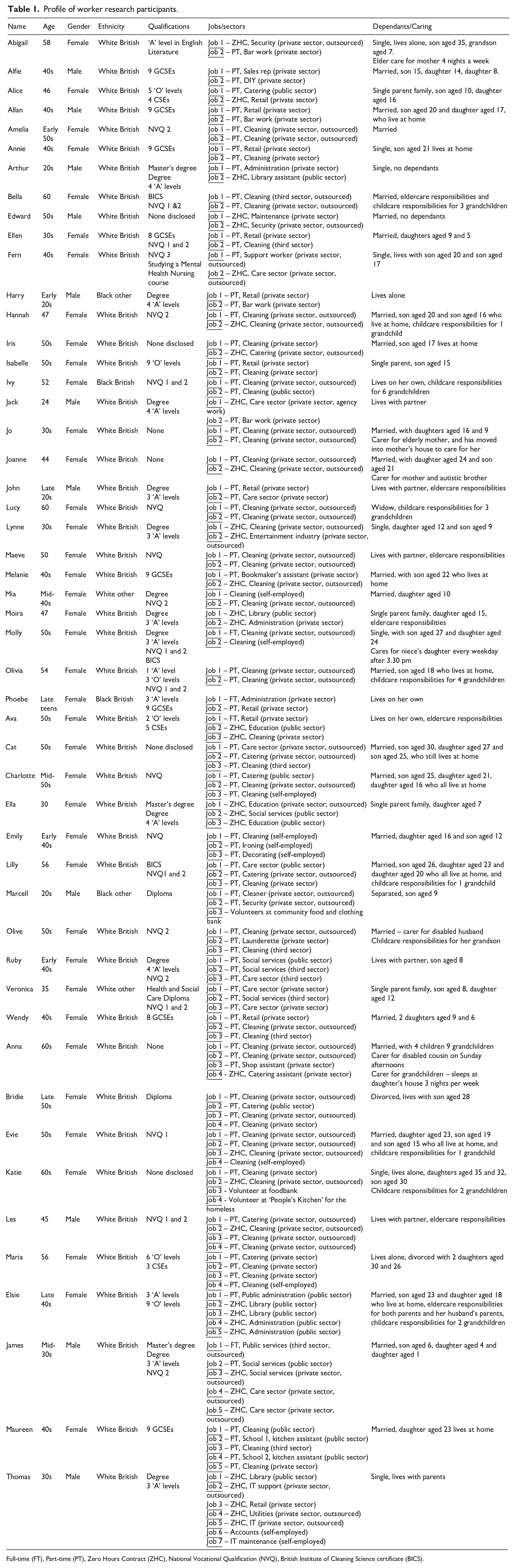
Full-time (FT), Part-time (PT), Zero Hours Contract (ZHC), National Vocational Qualification (NVQ), British Institute of Cleaning Science certificate (BICS).
The collated data are rich and in-depth, revealing the meanings and perceptions of low-paid multiple employment. Our detailed interviews with the workers focused on the experience of work, issues around low pay, the reasons for engaging in multiple employment and work–life challenges (see McBride and Smith, 2018). We did not ask if anyone believed they were in poverty, although we noted this coming out of the interviews as we progressed and this was again drawn out as an important category when we began data analysis. This involved close reading and re-reading of the interview transcripts and fragmentation of data into specific categories, one of which was the identification of people who were in IWP. This category is the major focus of this particular article and the narrative that follows is presented around a series of themes of IWP drawn out of analysis of the participants’ experiences.
This article therefore qualitatively examines the work and life experiences of individuals in an attempt to understand how and why they are living in IWP despite having an income, being in employment, and even more so, having multiple jobs. We argue that the poverty dynamics theoretical framework is the most useful as it will help us to more fully consider life changes, causes and effects of poverty and multiple employment. It is important to also have a temporal perspective in studies of poverty for, rather than exploring the extent/amount of poverty, we need to understand what creates the poverty we are studying. Furthermore, it is considered important to use a subjective experience of IWP, for it is argued that only by listening to first-hand accounts of people living through IWP can these experiences be more deeply understood. Indeed, even through hearing a variety of short phrases and specific words within the narratives, we identified elements of poverty that would otherwise be ignored, and these are discussed below.
The forgotten workers
Although there are Labour Force Survey and British Household Panel Survey data on those with second jobs, this is limited to two jobs and details of industries, roles, incomes and hours worked (Atherton et al., 2016; ONS, 2019). Moreover, the Annual Survey of Hours and Earnings by the Office for National Statistics (ONS) at the time of the research does not publish any data on those with multiple jobs. Yet, our research clearly indicates that some workers need to have more than one job in order to attempt to make a living. Therefore, as workers in legitimate multiple employment are largely absent from academic and policy coverage, we use the term ‘The Forgotten Workers’.
As Table 1 illustrates, the workers we interviewed are employed in cleaning, catering, bar work, the care sector, security, social services, education, retail, DIY, public services, administration, the entertainment industry, utilities and IT services. These occupations span the private, public and third sectors, but a number of public sector jobs have been recently outsourced due to austerity cuts. In terms of employment contracts, these combine full-time (FT), part-time (PT), agency, temporary, seasonal, casual and zero hours contracts. We expected to interview workers with two or three jobs, but were surprised to contact a number with four, five and even seven different jobs. Moreover, many of these workers held decent qualifications: 15 had ‘A’ levels, 12 gained degree qualifications and three even held master’s degrees. Yet these people were employed in jobs marked by low pay, insufficient working hours and precarity – and more so, in more than one of this type of job. Overall, we found that all of the workers interviewed had multiple jobs because they were ‘struggling to make ends meet’.
Yet a key question here is whether ‘struggling to make ends meet’ constitutes an indicator of poverty. We never directly asked anyone if they believed they were in poverty as mentioned earlier; however, some respondents self-defined themselves as being in poverty, using phrases such as: I can’t afford it. I use the foodbank just a little bit to help me out. Towards the end of the month, it’s desperate. We’re struggling. I’m just trying to make ends meet. I’m just having to survive. You have to stretch it out. I do these two jobs to make ends meet. I work to keep my head above water. At the end of the month I’m on the bones of my arse. I have to do two jobs to survive. It’s all about getting enough money to live. I work 2 jobs to try and get by. Struggling financially to pay the bills and have nothing left over. Money dictates my life. Stretched financially. I have 4 jobs to keep things going and have a roof over our head. I’m skint.
Arguably these short quotes from different individual sources do demonstrate indicators of poverty, although they appear to vary in terms of the ‘depth’ of language – e.g. from using the foodbank ‘a little to help out’ to being ‘stretched’ to being ‘desperate’. These are significant as they demonstrate varying ways in which people identify with poverty. There is evidence of more of this style of language from almost all of our respondents, demonstrating the struggles and financial hardships these workers and their families faced. As we had analysed our data through thematic analysis, we grouped the empirical evidence around a combination of key themes we identified as important to this article’s key arguments.
Bearing in mind our research questions: To what extent can indicators of poverty be identified in workers engaging in low-paid multiple employment? and What are the causes, effects and consequences of being in in-work poverty, despite having multiple jobs? we have structured our empirical data as follows. Firstly, we consider the empirical data in relation to Low pay, austerity and the National Living Wage. We felt that here, it was important to contextualise this research with the rising numbers of low-paid workers, the aftermath of the financial crisis and the implementation of the Conservative government’s NLW. Due to the cuts in the wake of this financial crisis, as discussed in earlier sections, there have been increases in both income and food poverty and many of our respondents also experienced this, therefore we include a section entitled Living in debt and foodbank use to exemplify the real lived experiences of people working in multiple jobs and still struggling with income and food poverty. We end the empirical section with a section entitled Temporal dimensions of housing poverty, family poverty, household goods and fuel poverty in which we bring together other significant elements drawn out of our analysis that helped to answer our specific research question ‘To what extent can indicators of poverty be identified in workers engaging in low-paid multiple employment?’ This section exemplifies issues we discovered relating to housing poverty, family poverty, household goods and fuel poverty – all indicators of poverty and therefore very significant to our research questions.
Low pay, austerity and the National Living Wage
In 2008 the UK experienced the most severe economic crisis since the 1930s (Baines and Cunningham, 2020). As this section will demonstrate, this directly impacted on the workers we interviewed with pressures on reducing costs and the outsourcing of work.
As a direct result of severe austerity cuts to Local Authority budgets many of the workers in this study had their employment outsourced to private and third sector contractors. Of the 50 workers we interviewed, 32 had their jobs outsourced and 17 had more than one job outsourced – see Table 1. For example, Les had four different low-paid jobs, all of which had been outsourced. James had five different jobs, four of which were subcontracted. Indeed, for many, this was a regular occurrence, with some workers having their employment transferred up to four times in six years. Furthermore, every time these workers were TUPE
1
transferred, the new private sector contractors focused specifically on cost reduction and profit maximisation strategies. A senior trade union official we interviewed stated that austerity cuts were used as ‘a green light’ by certain subcontractors to erode terms and conditions of employment. Moreover, this directly led to some workers we interviewed having to take additional jobs in order to attempt to earn a living: The pay is not great, the annual income [from my main job] is £16,200 a year. In comparison to the council workers who are doing the same role as me, I’ve heard they’re getting £23K. It’s because my job was outsourced, so it’s a significant loss in what I’m earning. If it wasn’t for that, I wouldn’t have to do all of these other jobs . . . I could come home and just relax. (James, 5 jobs – FT public services, PT social services on an evening, ZHC social services, and 2 ZHC care sector jobs)
In the case above there had also been redundancies, with staff numbers being halved, and this was not an isolated incident. Often the work was outsourced to the cheapest bidder, with the introduction of a two-tier workforce with inferior terms and conditions and ZHCs. For instance, of the outsourced jobs, 34 were part-time hours and 19 were ZHCs. As TUPE transfers are not time-protected there was also evidence of cuts to overtime pay rates, sick pay and in some instances holidays were reduced from 35 to 20 days/annum. Indeed, for others, outsourcing actually resulted in cuts in hours, hence pay, for some of the lowest paid precarious workers: What with the cutbacks . . . there’s no job safe days these days is there? If the council was still our employer, and they had a different government in, then I’d say our jobs would’ve been safe. But since they’ve changed the government [to a majority Conservative administration], and this [private sector] contractor has taken over, the jobs aren’t safe. If the jobs were safe, how come they have cut the hours? (Maeve, 2 jobs – both PT cleaning)
We also discovered that many employees had their working hours cut by their employer to ‘compensate’ for the annual rise of the NLW – as one of our interviewees put it, ‘giving with one hand and taking even more with the other’. Further evidence of this was highlighted by many of our respondents: I was contracted for 33 hours, but, from 1st April they’re going down to 18 ½ hours a week. It is worrying. At the minute, what I earn from my main job isn’t enough to pay the mortgage and bills. Plus, I’ve got two children living at home. (Ava, 3 jobs – FT retail, ZHC education, ZHC cleaning) The National Living Wage makes no fucking difference! We were earning £7.00 an hour before, now we’re earning £7.20. I worked it out – £25 a month my wages went up. It doesn’t pay your gas bill or your leccy bill. In reality, all the company is trying to do is cut hours. (Isabelle, 2 jobs – PT retail and PT cleaning)
What is interesting here – as well as an irony – is that this presents a temporal dimension of IWP. For these respondents were actually anticipating an annual reduction in wages, ironically due to an increase in the NLW, therefore needing to calculate their future finances as decreasing rather than increasing. A major issue is that the National Minimum Wage (Amendment) Regulations 2017 may include provisions designed to protect workers from unfair deductions from their wages (p. 3), but do not include any provisions for the protection of working hours. Furthermore, when, in April 2016 the ‘new’ NLW was introduced, this caused general confusion between this rate and that of the ‘Real’ Foundation Living Wage. Some of the workers we interviewed were not aware of the difference between the National Minimum Wage (NMW), the National Living Wage (NLW) and the Foundation (Real) Living Wage (RLW). In the quote below one of the workers we interviewed questioned the very phrase ‘living wage’: The minimum wage, that’s what I call it [the NLW]. If it was a living wage, we wouldn’t be doing other jobs, do you know what I mean? (Molly, 2 jobs – FT cleaning and self-employed cleaner)
Indeed, all of the trade union representatives interviewed felt that the introduction of the government’s NLW was a ‘cynical ploy’ to take momentum away from the RLW campaign and it also made it more difficult for unions to organise around issues of low pay. Many representatives we interviewed also found that there was pressure from certain employers to make cuts due to the implementation of the NLW: We have found that there have been employers who ask, ‘But what extra can we expect now that we have brought the government’s National Living Wage in? This is a significant increase for us. What efficiencies can we look at on the contract?’ And it’s not just small companies. They really do expect that, because their base cost has gone up. (GMB union official)
The evidence in this section highlights the need for structural analyses of poverty. Using the poverty dynamics research theoretical frame helps to explore poverty in relation to temporal structural changes. In doing so, it further exemplifies how structural changes, in different ways, generate poverty, and in particular here, how the state, through austerity drives and wage regulation, can create poverty. Indeed, as a consequence of these cuts, some respondents were forced to seek advice to help with their finances and debt.
Living in debt and foodbank use
The extent of foodbank use is now unprecedented in the UK (Garthwaite, 2016; The Trussell Trust, 2020). Moreover, we argue that this is an emerging and distinctive feature of what Rubery et al. (2018) term ‘the new norm’ of precarious work and that the rise in numbers using foodbanks is very concerning. Lansley and Mack (2015) report that many of those in ‘deprivation poverty’ and using foodbanks are also working. Indeed, trade union representatives we interviewed from USDAW, GMB and TUC also mentioned that some of their members needed to use foodbanks and were acutely aware of rising in-work poverty: The use of foodbanks is huge. I do some work at one of the foodbanks in Bradford and they are seeing 1,000 people a month. It’s not the fact that they are not working, it’s that they have got less work. They’re not starving all the time, but they are running out of money on Thursday and Friday, and they need a bag of food to get them through. (TUC official)
For our respondents, despite working in multiple jobs, many were still struggling financially, some were in debt and many were turning to foodbanks and other forms of voluntary help.
A number of our respondents were receiving support and advice concerning accumulated debts: When I split up from my husband I was left with a lot of debt. I got into a right rut with fuel bills and rent. (Fern, 2 jobs – PT support worker and ZHC care worker)
Fern informed us that she had been introduced to ‘Step Change’ – a charitable debt help organisation – through the foodbank she was using: I use the foodbank as well. I haven’t been of late as much, but I’m going to go today and get a voucher. I use it as and when I need it.
Garthwaite (2016: 51–52) states that debt and financial pressures are significant contributory factors to rising foodbank use. Other workers we interviewed had also received help from Step Change, as Abigail discusses: The Step Change charity deal with all my income and they take it into what you call a monthly account, so that means that they pay my debt collectors, like the bank, my credit card, my overdraft, my loan and my rent arrears. So, all this comes to now about £6500. And every single thing, bus fares, food, TV licence, water, electric, gas, medicines and pocket money, clothing money . . . – they reckon all that up and then whatever you’re left with, say if I’m left with about £60, then they will probably take so much of that and that would pay my four debtors. (Abigail, 2 jobs – ZHC security and PT bar work)
Clearly, this demonstrates how Abigail is left with very little to survive and as a consequence, she was also using a foodbank periodically – demonstrating temporalities in life cycles of poverty. Respondents are also arguably facing significant financial challenges due to variable working hours and employment precarity. Yet what is also interesting here is, as Fern’s story indicates, and again highlighting a temporal dimension, how poverty comes into people’s lives in situations of vulnerability and how vulnerability in one section of life affects another: Towards the end of the month, it’s desperate. I used to use People’s Kitchen as well, you can get hot meals, you can get a shower, you can get clothes, you can get toiletries. I haven’t used that for a while, but they used to be open on a Tuesday, Thursday and Friday. (Fern, 2 jobs – PT support worker and ZHC care worker)
People’s Kitchen is a voluntary organisation based in the City of Newcastle, effectively established to feed, clothe and aid in the cleanliness of primarily those who are homeless. Fern admitted to using their facilities and help on occasion, but interestingly she never once claimed to be ‘in poverty’. Yet surely, needing to use these particular facilities would suggest that she had experienced ‘deep’ or even ‘deprivational’ poverty – and this is despite working in more than one job.
This was fortunately a temporary situation for Fern, but draws out the significance of using temporal perspectives in studies of poverty. For here, we can see how there can be variations in depths and cycles of poverty during a person’s life. We also found this with other respondents who said they relied on foodbanks, to ‘help them out’ when they felt they had reached levels of desperation, or deprivation, despite working in multiple jobs. For example, Marcell talked of ‘stacking food’ that is not perishable so that he can try to ‘manage’ low-paid multiple employment and limited working hours: I have been surviving through foodbanks. Bread, fruit, apples, oranges. It’s very good. With some of the food you can stack it, because they give you rice, beans, pasta that stores well. (Marcell, 3 jobs – PT cleaner, PT security and volunteers at a community centre)
Prior to using the foodbank, Marcell told us that he had been ‘surviving on noodles’. He used the word ‘surviving’ on several occasions demonstrating ‘deep’ or ‘deprivational’ poverty: They [the council] give you a house and you want to have a sofa to sit on, a bed to sleep in – you have to make sacrifices to pay for these things. So, I was buying packs of noodles and I was just eating them as I had no money. But I was mentally prepared, because I knew I had to go through that in order to achieve what I wanted. At the beginning it was hard, I was just eating noodles, noodles, noodles – for five months.
For those who used foodbanks, most of our respondents did not want anyone to know that they needed this help: I don’t go to the foodbank every week. I mean, I know it’s on record. Yes, but I don’t tell anybody that I go. I mean, it’s only now and again, it just helps me out a little bit. I’m not ashamed but I wouldn’t like to tell my friends I go there, do you know what I mean? (Fern, 2 jobs – PT support worker and ZHC care worker) I just go like, once a month, or once every three weeks. It’s just, like, to help me out just that tiny little bit. I don’t dare tell anybody I go to the foodbank. (Abigail, 2 jobs – ZHC security and PT bar work)
Other workers spoke of their reluctance to go to a foodbank, despite struggling to survive and experiencing ‘deprivational’ poverty: My partner won’t let us go to a foodbank because she is too proud, but I’m amazed we survive. Thankfully we’ve got a really big freezer, so occasionally we go to Iceland or Jack Fultons or something. But we really struggle to survive. (Jack, 2 jobs – ZHC care worker and PT bar work)
In this instance, Jack was over £1,500 in debt but still did not seek help from the local foodbank.
What is important to note here is that there is a tangible sense of shame and frustration in that these workers had multiple jobs but were truly struggling to survive from week to week. It also demonstrates a continuity of structural poverty as during the month, people, with more than one job, struggle to make ends meet and in the end are forced to go to the foodbank. The fact that three of the workers quoted here worked zero hours and insecure contracts indicates the vulnerabilities around non-guaranteed hours and, therefore, earnings. Yet many of our respondents are individualising their position and blaming themselves. There is clearly a paradox here, for it speaks to the hegemonic idea that poverty is something people are responsible for themselves and it is not something linked to work. This is even more observable in the evidence we offer in the following section.
Temporal dimensions of housing poverty, family poverty, household goods and fuel poverty
As previously mentioned, we cannot categorically state that all of our respondents were experiencing IWP as we did not directly ask this question, nor would many want to label themselves as being ‘in poverty’. However, some of the interviews did indeed indicate that many were experiencing forms and differing depths of poverty whilst working in more than one job, whether this be real, near, persistent, occasional or recurrent. What follows are first-hand accounts of the experiences of some of our interviewees and how they make sense of IWP and precarity. They are powerful testimonies that reveal varying indicators of poverty. For example, Anna is in her 60s and has four different jobs spanning six days a week, but is so poor that she currently lives in a caravan: If I didn’t do all these jobs I wouldn’t be able to live. I wouldn’t be able to survive. I live in a caravan now. (Anna, 4 jobs – PT shop assistant, 2 PT cleaning jobs and ZHC catering)
To add to this already appalling revelation is that she cares for her disabled cousin every Sunday afternoon (her one day off work) and also sleeps at her daughter’s house three nights a week to help care for her grandchildren whilst her daughter works. Using the poverty dynamics framework as a lens to consider this reality reveals the very complex dynamics of experiencing IWP and having to juggle low pay, multiple jobs and limited time with caring responsibilities. Regrettably, we discovered more such evidence from other participants.
Alfie is in his 40s and married with a 15-year-old son and two daughters, aged 14 and 8. He provided the testimony below that highlights the insecurity of contemporary employment, where what was once viewed as a safe and stable job was snatched away. He articulates the shock and frustration of losing his securely paid full-time job, having his house repossessed, struggling to pay bills, feed and clothe the family, whilst holding down two part-time, low-paid jobs: I was the only breadwinner in my house because my wife was suffering from depression. We went through a tough time when I lost my [full-time] job and I got made redundant, we lost our house and everything . . . That’s how bad it is. Look, £10 these jeans were. That’s all I’ve spent on myself for about nine months. It would be nice every now and then to say, ‘We’ll go out for something to eat.’ We haven’t been out for at least two or three years. We simply can’t afford it. Even if I went into McDonalds, it would cost us £30. That’s £30 that we could spend on something else. The kids know that we’re struggling to pay the internet bill and bits and pieces, but it shouldn’t be their worry. That’s our worry. I just want to have a good job, where we don’t have to struggle and we can go out and do things. Rather than robbing Peter to pay Paul. That’s what it’s like. I haven’t got enough to do this, haven’t got enough to do that. It’s like constantly playing chess, especially with the kids, you’ve got to be two moves ahead of them all the time. (Alfie, 2 jobs – PT sales rep and PT DIY)
As earlier testimonies demonstrated, we see how poverty comes into people’s lives in situations of vulnerability and how vulnerability in one section of life affects another and then perpetuates itself. Again this evidence draws out how and why circumstances and levels of poverty are subject to change, as well as how complex and dynamic cycles and levels of poverty are in reality. Another important point to draw out here, as Alfie stated: You can imagine how embarrassing it was for me. I was going in ASDA on the weekend with the kids and there’s people coming up to me, ‘Oh are you alright, Alfie, how are you doing? What are you doing now?’ And I felt so ashamed and so embarrassed . . .
As in Jack’s testimony earlier, there is real sense of shame here as well as the notion that poverty is something that people are responsible for themselves. Also, as drawn out above, many appeared to equate their situation with the word ‘surviving’, and we have further evidence of this.
Maureen told us that despite having five part-time jobs with limited hours, she needed them all ‘just to survive’ yet still needed to use a Credit Union to buy a much needed family washing machine. Others were also struggling with low-paid multiple jobs and needing essential household goods to keep a family running. Again this evidence demonstrates evidence of poverty, but in these cases can be classed as ‘destitution’ (Goulden, 2018). What is again evident is a continuation of structural poverty where people are struggling to makes ends meet and forced to use Credit Unions to help them out financially. Temporalities in the waves and cycles of continuous struggle with poverty were also evident from our interview with Bridie, who here discusses the dilemmas of IWP, constantly struggling to make ends meet and facing challenges of basic necessities, such as heating, a bed, a fridge freezer and carpets: My boiler has gone. We haven’t had a boiler for over a year, but I’ve got a power shower. We haven’t got heating either but my son has got a little heater in his bedroom, and he puts that on a bit and then turns it off. And, then his friend stayed with us for a while because he hadn’t got anywhere to live and he brought this long radiator. I just put that on when I get a bit cold or to dry over the clothes. But, sometimes if I’ve got a big wash, like in the winter, I take my stuff up to the club [where she cleans] and put it in the dryer. Or I might wash it up there and put it in the dryer. But my son has been desperate for a new bed. His whole mattress had gone and it was sinking in. Well, I couldn’t afford that. I was trying to save up to get him this bed. But now I need a new fridge freezer because it was leaking underneath and it was making all the house smelly and the carpet that was at the bottom of the stairs, it was all sodden. Now, we’ve got to get a new carpet. (Bridie, 4 jobs – all PT cleaning)
Bridie was not the only respondent to explain to us how they needed to use the washing machine and dryer at work for their own personal washing. Another respondent also lived for some time without a fridge or freezer, and it is clear that owning such an item would have helped keep food fresh, or frozen, and stockpile food to save on finances. Another participant would take her TV into her workplace so that she could watch her favourite evening soap operas after her work shift as she was struggling to pay her electricity bills at home. Others also used their workplaces’ perks to ‘help them out’: for instance Ava explained how she used to get a free breakfast at work and how this helped to feed her, but it made huge impact on her when it was removed by her employer as she mentioned in her interview: They used to have a canteen but took that away. They put microwaves and toasters in for us instead. You’d get free jam, butter and bread . . . and then, about a year ago, they took the jam away. Then a couple of weeks ago, they’ve taken the bread away. So the toasters are still there now, but you have to bring your own food . . . it was better when you got free bread and jam, but . . . Food? Who needs food? I don’t buy clothes. I don’t buy shoes. I haven’t had a holiday for thirteen years. In fact, if I can, I take annual leave so I can work somewhere else. I don’t take holiday to actually go on holiday. I live to work and you should work to live. My life is dictated by how much money I need to make to cover everything for the month. That dictates my life. (Ava, 3 jobs – FT retail, ZHC education and ZHC cleaning)
This quote reveals distinctive levels of poverty as she cannot afford the basics, such as food, clothes or a standard UK holiday. Indeed, Ava even uses annual leave from her main retail job to acquire additional hours and supplement her already poor financial situation. She claims to be ‘living to work not working to live’ and this again raises pertinent questions over the UK government’s mantra of ‘making work pay’, as low-paid workers are still experiencing in-work poverty and arguably in these cases ‘destitution’. This evidence again draws out the notion that poverty is something people are responsible for themselves and something that is not linked to work. This also related to many other of our respondents. For instance, Ivy, a cleaner with two part-time jobs, explained how she sometimes found it difficult, both financially and emotionally, to buy birthday gifts for her grown-up children and six grandchildren: I do struggle, but they know Mummy’s poor, so they understand.
Here, as is evident, Ivy acknowledges being ‘poor’ but states clearly that ‘they know Mummy’s poor’ – putting the responsibility onto herself, not her situation. Akin to Ivy, Ava and Maria also stated: I feel like I’m in poverty. I don’t do much outside of work other than survive. (Ava) At the minute I’m just having to survive. It sounds very melodramatic, but that’s how it feels, that I am just surviving. (Maria)
It is pertinent to reflect that at the outset of this article, we asked the research question of whether we would be able to identify indicators of poverty in workers engaging in low-paid multiple employment. Without doubt, the answer to this question must be a resounding yes. However, it is not as straightforward as a simple ‘yes’, for we have demonstrated in this article that there are many complexities and dynamics in the realities of contemporary IWP. This has been demonstrated through considering the effects and consequences of being in IWP, which was the second question for this article to consider. Our conclusion draws out what we believe to be the main causes of these people’s situations.
Conclusion
This article provides new empirical data to add to debates on the efficacy of using poverty dynamics research to investigate in-work poverty. We argue that using the dynamic theory of poverty (introduced by Rowntree in 1901) and further developed recently by Smith and Middleton (2007) to investigate our data helped us to understand the shifting cycles of IWP at various times in a person’s life. Using this framework also allowed for further understanding of the temporal dynamics of poverty and how poverty is differentiated by both type, for example food, income and fuel poverty (BEIS, 2018; The Trussell Trust, 2020), and depth of severity, for example ‘real’, ‘near’, ‘persistent’, ‘recurrent’ ‘occasional’, ‘deep’ and ‘deprivation’ (Armstrong, 2017; Goulden, 2018; Shildrick et al., 2012) at different times and/or combinations either during a person’s life cycle or a period during their life. This is significant for it enables us to consider the multidimensional character of poverty, rather than a one-dimensional ‘snap-shot’ of the number of low-income households through current point-in-time studies. It supports other debates that argue that, for the majority of people who experience poverty, this is not a fixed, unchanging status and their situation can change over time (Shildrick et al., 2012; Smith and Middleton, 2007). Our article therefore demonstrates the importance of having a temporal perspective in studies of poverty.
Empirically, it adds a further significant contribution in critically examining in-depth the experiences and work–life challenges of those who are low-paid and have multiple jobs, yet still struggling financially and experiencing IWP. Such evidence is not included in current debates or statistics, and our deep empirical material helped to draw out various structural constraints that maintain the need for multiple employment and also sustain a cycle of IWP for some people. Using the poverty dynamics framework to consider this reality reveals the very complex dynamics of experiencing IWP and having to juggle low-pay, multiple jobs and limited time with caring responsibilities. It also highlights, in some cases, inherent contradictions that exist within it. A major issue is that these multiple jobs approaches are not a solution to avoiding poverty but actually help to conceal the problem, albeit not obviously. All of the participants in our study claimed that they needed to have more than one job in order to attempt to make ends meet, and therefore were clearly experiencing income poverty but at different levels, depths and temporal dimensions. Low wages were clearly a key factor – many of our respondents were paid the government market-led statutory NLW and we highlighted problems with these regulations with some employers reducing employees’ hours to accommodate for its annual increase, leaving many worse off. This is essentially allowing for a cut in wages – for people already struggling on what they earn. Indeed, this was found to be a constraint for many of our respondents in terms of sustaining a cycle of hardship and, therefore, IWP. Consequently, our findings also demonstrate how paid work and regulations surrounding low-paid work are helping to reproduce inequalities and, ironically, encourage poverty.
A further structural constraint in terms of upholding a cycle of financial hardship and IWP for many of our respondents was the ongoing impact of state-led austerity policies (see also Baines and Cunningham, 2020). Many of the workers in this study had their employment outsourced which resulted in having cuts to working hours or wage freezes, hence, essentially a cut in wages. Another constraint is the fact that many of our respondents were working in precarious employment contracts and/or poor quality jobs with a lack of opportunity to attain decently paid and secure work (see also Alberti et al., 2018). Not even qualifications are a route out of being in low-paid employment, insecure work and poverty, as this research also highlights a critical mismatch between what some employees have to offer the labour market, in terms of good academic qualifications, and the quality of jobs being created that are marked by low pay, insufficient working hours and precarity. Other authors also note the increase in the creation of ‘new jobs’ with insecure contracts and how precarious work has become the ‘new norm’ (Clarke and Cominetti, 2019; Rubery et al., 2018). This type of paid work is arguably encouraging poverty rather than ‘making work pay’. Yet this is essentially concealed through passive acceptance and tends to be internalised by these workers as the ‘norm’.
Indeed, using poverty dynamics research and a qualitative approach, we discovered a ‘routinisation of poverty’ that is becoming so internalised to these people that it may be concealing the extent of in-work poverty. Further, we found various structural constraints that also maintained the need for multiple employment and sustained a cycle of IWP for some people. Ironically, through an unexpected set of external bodies. Access to services, such as foodbanks, credit unions, debt charities, together with perks in jobs and multiple jobs sustain these people through poverty in our study. They are all survival coping strategies, but they also help to reinforce the concealment of the causes of IWP.
What is important from our analysis is that these conditions are directly related to precarious work, variable and zero hours employment and, therefore, irregular and unpredictable earnings – see Table 1. However, many of our respondents are individualising their position and blaming themselves for their situation. For some, poverty entered into their lives in situations of vulnerability for which they individualise the circumstances onto themselves. There is clearly a paradox here, for it speaks to the hegemonic idea that poverty is something people are responsible for themselves and it is not something linked to employment. In contrast, and in conclusion, our findings show how in-work poverty is being created and sustained through paid work, rather than being challenged by it.
Footnotes
Acknowledgements
Many thanks to the Editor in Chief, Jan Ottosson, and the two anonymous referees for their helpful and insightful comments on earlier versions of this article. We are also indebted to Miguel Martinez Lucio for his useful comments on an earlier draft of this paper. We are grateful to all of the workers, union representatives and managers who gave up their valuable time to take part in this research project.
Declaration of conflicting interests
The authors declared no potential conflicts of interest with respect to the research, authorship, and/or publication of this article.
Funding
The authors received no financial support for the research, authorship, and/or publication of this article.
