




Abstract
The scope and structure of multiple jobholding and its consequences for multiple jobholders are changing in many Western economies. Only limited quantitative empirical knowledge is currently available on the changing features of multiple jobholding and whether the economic vulnerability of multiple jobholders has been changing over time. In this article we focus on the position and trends of multiple jobholders compared with single jobholders in Europe. We study this in terms of working hours, workers’ desire to work more hours, and in-work poverty. To that end, we analyse data since the early 2000s from the EU Labour Force Survey and from the EU Statistics on Income and Living Conditions. Our findings show that multiple jobholding is a significant and increasing labour market phenomenon in many advanced economies, with changing characteristics, for example in terms of gender distribution and combinations of contracts. In-work poverty is relatively high among non-standard workers, but the findings do not indicate a deteriorating trend effect. In-work poverty seems to be on the rise among people who are single, for both single jobholders and multiple jobholders.
Introduction
The changes taking place in labour markets today in many advanced economies are accompanied by changing employment patterns. The recent so-called ‘renaissance of self-employment’, the emergence of ‘click-working’ in the gig economy and an increase in the prevalence of a wide range of non-standard employment relations have been accompanied by an increase in what has been called ‘hybrid’, ‘plural’ or ‘multiple’ forms of employment. In various countries there is a clear trend towards such pluriactivity or multiple jobholding, but so far little is known about its structure and economic consequences. Whereas for some workers two (or more) jobs may indeed represent more than one in the sense, for example, that they enrich their work experience or offer them a substantially higher income, for others two (or more) jobs may in fact amount to less than one decent job, because they are still unable to work sufficient hours or they have problems making ends meet. This is related to two opposing assessments of the recent evolution of labour.
On the one hand, changing product and labour markets, diffusion of information technology and participatory management strategies – among other things – may lead to job enrichment and mutual improvements for both workers and employers (Greenan et al., 2013; Handel, 2005). This view is related to post-Fordist theory and the mutual-gain literature, which argues that new systems have improved the quality of work, for instance in terms of intrinsic rewards (such as job challenge and autonomy), working conditions (such as decreased physical workload) and material rewards (such as wages). In contrast, the more critical Neo-Fordist view argues that any (limited) gains that may have accrued to workers are outweighed by increased effort requirements and insecurity. Recent changes in labour markets and work organisation have led to greater work pressure, and for many workers material conditions (such as pay and job security) have deteriorated (Greenan et al., 2013; Handel, 2005; Kalleberg, 2009). Previous comparative historical studies have shown mixed results regarding various dimensions of work quality (for example, Clark, 2005; Handel, 2005; Brown et al., 2008; Olsen et al., 2010), but consistent deteriorating trends have been found in the areas of work intensity and physical and emotional strain (Brown et al., 2008; Clark, 2005; Greenan et al., 2013; Lopes et al., 2014).
In this context, multiple jobholding has received relatively little attention to date. It has been viewed, on the one hand, as something that disadvantaged workers engage in as a means of tackling their financial problems and potentially are forced into by labour market constraints. On the other hand, to some workers – for example, what have been called new ‘free’ workers (Guest et al., 2006; Panos et al., 2014) multiple jobholding may offer variety and act as a conduit for further career progression. Is multiple jobholding more prevalent among particular (groups of) individuals or occupational groups? And do multiple jobholders enjoy similar (and adequate) employment terms to those of single jobholders, or are they more vulnerable? We compare multiple jobholders to single jobholders and address the following questions: (ii) what is the pattern of multiple jobholding and how has it evolved over time; (ii) how have working hours and the desire to work more hours changed over time for multiple jobholders and for single jobholders; and (iii) how have at-risk-of-poverty rates and their determinants changed over time?
Multiple jobholding is an important issue for unions, for a number of reasons. First of all, if workers hold multiple jobs for negative reasons, for example, because they cannot work sufficient hours or earn enough money in their first job, this may be an issue for collective bargaining in the relevant industries. Unions may demand that part-time workers have the right to work more hours or may demand higher hourly wages. Secondly, combining two jobs, even if chosen for positive reasons, may raise problems with regard to social insurance entitlements, pensions and other secondary terms of employment. If these entitlements are not strictly proportional to the number of hours worked, but apply only if one works a minimum number of hours, multiple jobholders may have fewer entitlements than single jobholders who work the same number of hours. Therefore, multiple jobholding may encourage unions to demand the abolition of thresholds for the entitlement to particular perquisites. Finally, multiple jobholders may be harder to organise than single jobholders because they usually work at different locations during the week and may not be present if a union meeting takes place.
This article is structured as follows. The next section briefly reviews earlier research findings on the prevalence of and trends in multiple jobholding across countries over time and discusses general measurement problems, followed by a section presenting some theoretical perspectives. Next, an introduction to the methodology employed in the study is provided. After that, we present the results. The final section presents the main conclusions and discusses the outcomes.
Scope and trends of multiple jobholding
Multiple jobholders represent a significant and growing proportion of the labour force in a number of advanced economies. In Europe, on average 4 per cent of the workforce – approximately 9 million people – reported working in more than one job in 2018 (Eurostat, 2019). In various eastern and southern European countries, multiple jobholders represent up to 2 per cent of the workforce, while in various Nordic and other European countries multiple jobholders make up 7 to 8 per cent. Other studies report an estimated size of about 5 to 6 per cent of the US and Australian working populations (for example, Kimmel and Smith Conway, 2001; Partridge, 2002; Bamberry and Campbell, 2012; Campion et al., 2020). Official labour force statistical bureaus use survey instruments capturing multiple jobholding in the week prior to the survey (the reference week). Given that multiple jobholding is often short-term (Kimmel and Smith Conway, 2001; see also Conen and Stein, 2021), the percentage of workers working multiple jobs at some time over the course of a full year, or at some time in their working lives, is substantially greater. Moreover, given that individuals may not perceive (irregular) odd jobs or short-term projects as a second ‘job or business’, and that many second jobs are not formalised (or reported as income on tax forms), these formal statistics are likely to be a further underestimate (Conen, 2020; Sliter and Boyd, 2014). The recent focus on the ‘gig economy’ and platform work has provoked a further debate on the prevalence of multiple jobholding related to short-term work, and the extent to which such activities are adequately measured with current labour force statistics (Campion et al., 2020; Sliter and Boyd, 2014). Survey questions with different wordings, time frames or answer categories indeed lead to substantially higher estimates of multiple jobholding in advanced economies. Proportions of around 10 per cent are not uncommon, ranging up to 35 per cent of the working population (for example, Panos et al., 2014; Sliter and Boyd, 2014; Campion et al., 2020; Conen, 2020).
These different types of measurements also have implications for the determination of trends over time. Whereas official labour force statistics in advanced economies tend to show more or less (structural) stability or only moderately increasing trends of multiple jobholding over the past few decades, other data sources indicate clear increasing trends of multiple jobholding in many advanced economies (for example, Panos et al., 2014; Sliter and Boyd, 2014; Campion et al., 2020; Conen, 2020). Some countries (such as Germany, Luxembourg, Finland and the Netherlands) report an increase in multiple jobholding regardless of the type of data, whereas in more ‘formal’ statistics eastern and southern European countries in particular report decreasing trends (Conen, 2020).
Theoretical perspectives
The economic literature on multiple jobholding typically has focused on the ‘hours constraint motive’ (Panos et al., 2014; Wu et al., 2009) as a motive for holding more than one job, suggesting that ‘an individual’s willingness to take more than one job depends on whether they can work enough hours at their prevailing primary wage rate to satisfy their income goals. Therefore, individuals take a second job in addition to their main job because their employers do not, for various reasons, offer enough hours in the main job’ (Wu et al., 2009: 2751–2752). Whether multiple jobholding subsequently translates into higher (total) earnings than if the first job had been a full-time job depends on the earnings from the various jobs.
There are different strands in the literature concerning the nature, causes and trends of contemporary multiple jobholding. According to one strand, recent changes in labour markets and work organisation are considered to have created greater work pressure, fragmentation of work and a deterioration of material conditions (such as pay and job security) for many workers (Greenan et al., 2013; Handel, 2005; Kalleberg, 2009). Within this framework, multiple jobholding could be linked to the ‘precarious work’ literature, and an increasing share of workers may be doing an extra job as a means of tackling financial constraints (induced ‘or pushed’ by, for instance, low-wage full-time work or involuntary part-time work). Multiple jobholding would thus increasingly become a survival strategy for low-income households.
Another body of work takes a different perspective, suggesting that workers in the new economy are increasingly able to assert control over their working lives. The so-called ‘free worker’ is increasingly able to choose their position in the labour market, and determine where, for whom and how they are active (Guest et al., 2006). This positive outlook is also related to the literature concerned with the ‘boundaryless’ career and career self-management (King, 2004; Sullivan, 1999). Within this framework, changes in multiple jobholding are linked to heterogeneous motives and multiple jobholding is contributing positively to and enriching workers’ CVs. From this perspective, combining two or more jobs may be a way to realise more variety and diversity in work experience and enhance career development (Greenan et al., 2013; Handel, 2005).
The preceding discussion suggests contrasting hypotheses about changes in the scope and structure of multiple jobholding and related consequences in terms of earnings since the early 2000s. Note, however, that our research design can provide only suggestive evidence on the mechanisms driving changes. We hypothesise, under the ‘survival explanation’, that multiple jobholders (compared with those conventionally employed in a single job) increasingly report working fewer hours, have an increased desire to work more hours and face increased poverty risks. In other words, multiple jobholding is increasingly precarious in nature. By contrast, under the ‘free worker explanation’, this hypothesis would not hold.
Divergent developments?
Is multiple jobholding more prevalent among particular (groups of) individuals or occupational groups, and has this been changing over time? Furthermore, have working hours and the desire to work more hours, as well as at-risk-of-poverty rates diverged over time for different groups? To explain the changing nature of multiple and single jobholding in Europe, first we focus explicitly on differences in terms of gender and household composition. With regard to gender, it is well documented that men and women generally exhibit dissimilar labour market characteristics and behaviour. Furthermore, women seem more likely to engage in multiple jobholding in times of economic distress or because of family responsibilities (Amuédo-Dorantes and Kimmel, 2009). Household composition is also likely to play a role in multiple jobholding. Particularly for persons who are single or widowed, divorced or legally separated, doing an extra job may meet a need for extra income.
Secondly, we consider the effects of type of employment contract in the main job. Other research (for example, Broughton et al., 2016; Piasna et al., 2021; Conen, 2020) shows that workers, including multiple jobholders, with a non-standard employment relationship in their main job more often have to accept lower job quality in terms of basic or extrinsic functions, such as income and (in)security of work. This may also add to the probability that individuals in non-standard employment relations have stronger incentives to engage in multiple jobholding.
Method
Data
We used the data from the EU Labour Force Survey (LFS) from 2002 and 2017 to address the first and second research questions, and to analyse (changes in) the structure and characteristics of multiple jobholding and single jobholding. The 2017 LFS wave provided the most recent available data at the time of writing, and comparing the waves of 2017 and 2002 gives a 15-year interval with comparable variables and similar countries (EU-27). In our empirical analyses we use a sample of individuals in paid employment, aged 18–59 years at the time of the interview. The total number of individuals in the sample is 2.2 million, of whom 88,480 are multiple jobholders.
The second research question will be answered using data from the EU Statistics on Income and Living Conditions (EU-SILC) from 2006 and 2016 on income adequacy at the household level. EU-SILC is a cross-sectional and longitudinal sample survey, coordinated by Eurostat, based on data from the European Union Member States. EU-SILC uses a large set of standardised questions in all participating countries and provides comparable data at the personal and household levels. EU-SILC was established, among other things, to provide data on structural indicators of social cohesion, including poverty indicators (relative income method and subjective poverty). As such, EU-SILC is the primary survey of interest for comparative analyses of in-work poverty in Europe. The EU-SILC 2016 wave provided the most recent available data at the start of writing, and comparing the waves of 2016 and 2006 gives a 10-year interval with comparable variables and similar countries (EU-24); a longer interval was not possible. Again, we use a sample of individuals in paid employment, aged 18–59 years at the time of the interview. The total number of individuals in this sample is 387,000, of whom 17,132 are multiple jobholders.
In EU-SILC, longitudinal data concerning individual-level changes over time are observed periodically over a maximum of four years; for LFS this time frame is shorter. Because the focus in this study is on long-term trends, and given that the longitudinal sample surveys cover only shorter periods (and 10- or 15-year intervals are thus not feasible in longitudinal format), we use pooled cross-sectional samples from both surveys.
Measures
Working hours – How many hours do single jobholders and multiple jobholders work in their main and other job(s)? And do they wish to work more hours? Analyses of working hours are based on the LFS questions hwactual 1 (number of hours actually worked during the reference week in the main job) and hwactua2 (number of hours actually worked during the reference week in the second job). Analyses of whether workers wish to work more hours is based on the LFS question wishmore (wish to work usually more than the current number of hours).
Poverty rate
Explanatory variables – In the analyses we distinguished between employees holding a permanent contract (‘Person has a permanent job or work contract of unlimited duration’), employees with a temporary contract (‘Person has temporary job/work contract of limited duration’) and self-employed workers (professional status: self-employed with and without employees). Furthermore, a number of socio-demographic and work characteristics were included, such as gender, household composition (‘married’, ‘single’ or ‘widowed, divorced or legally separated’), weekly working hours (in the models it is specified whether this refers to total working hours, or working hours in the main job), educational attainment level (International Standard Classification of Education [ISCED]), and a quadratic specification for the worker’s age, sector and country.
Results
Characteristics of multiple jobholders: a changing landscape?
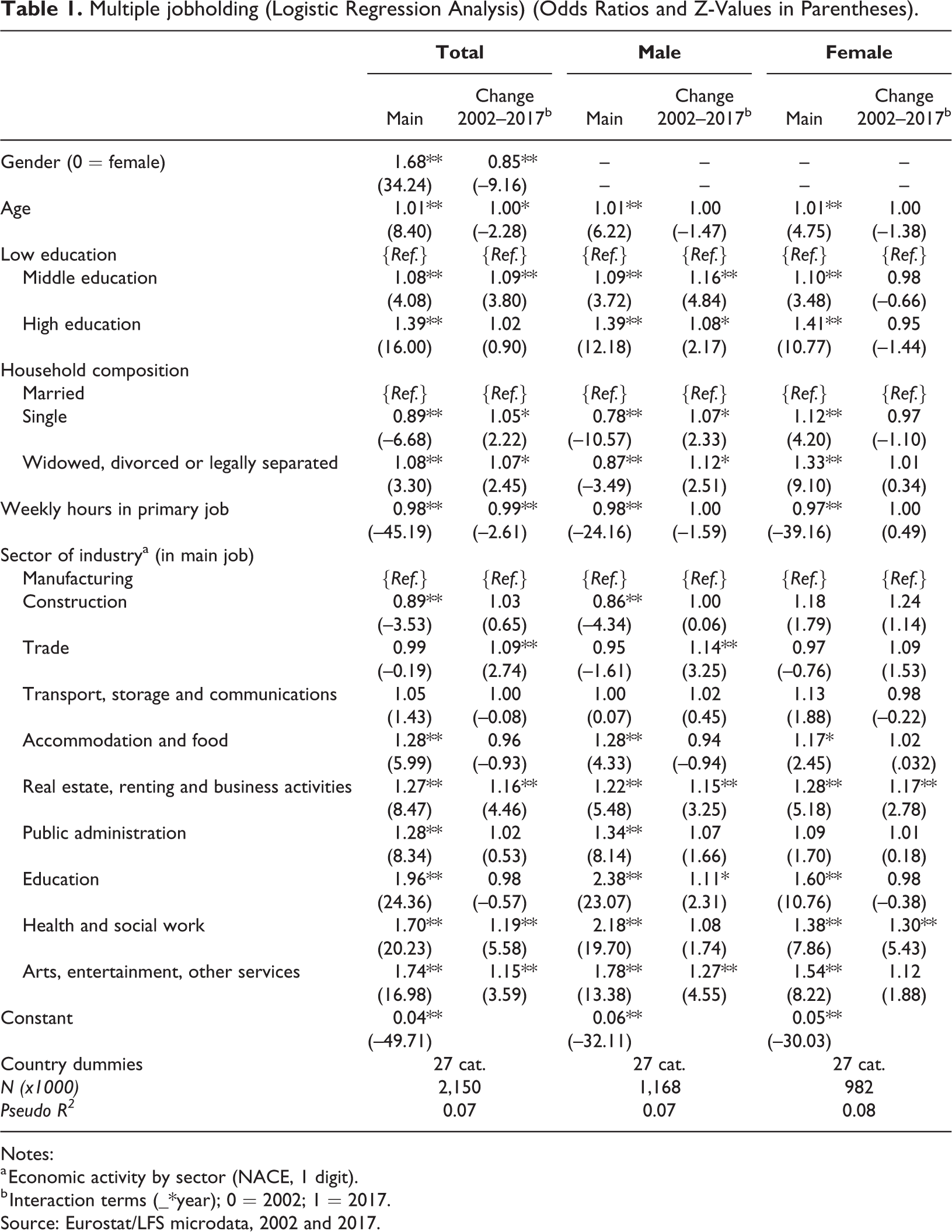
As a first step, we analyse the characteristics of individuals engaging in multiple jobholding. This is done by applying pooled cross-section–time series analysis. The table reports the estimated logit coefficients, followed by their standard error in parentheses. In the first column main effects are reported, and in the second column interaction terms with year (year is a dummy variable, taking ‘0’ for 2002 and ‘1’ for 2017), showing whether the effects of various characteristics have changed over time.
Table 1 shows that the gender distribution has changed markedly among multiple jobholders; multiple jobholding growth was particularly high among women. 2 Furthermore, the share of highly educated workers among multiple jobholders is considerably larger than among single jobholders, and this divide in terms of educational attainment remained intact between 2002 and 2017. This suggests that in general multiple jobholders do not seem to have a weaker labour market position than single jobholders. Multiple jobholders are, compared with single jobholders, less often single and more often widowed, divorced or legally separated. The share of single and widowed, divorced or separated multiple jobholders, however, has increased more than among single jobholders. In 2002, multiple jobholders worked, on average, fewer hours than single jobholders in their main job, and the number of actual weekly hours of work in the main job decreased relatively strongly among multiple jobholders. Compared with single jobholding, multiple jobholding is particularly prevalent in ‘education’, ‘arts, entertainment and other services’ and ‘health and social work’. The last two sectors and ‘real estate, renting and business activities’ were among the highest growth sectors for multiple jobholding, whereas the relative importance of ‘education’ for multiple jobholding has declined compared with 2002.
Multiple jobholding (Logistic Regression Analysis) (Odds Ratios and Z-Values in Parentheses).
Notes:
a Economic activity by sector (NACE, 1 digit).
b Interaction terms (_*year); 0 = 2002; 1 = 2017.
Source: Eurostat/LFS microdata, 2002 and 2017.
If we compare male and female multiple jobholders, we find some notable similarities and differences. First, the educational structure and average ages, as well as changes therein, are largely similar for males and females. An important difference concerns household composition: whereas men are relatively often married or cohabiting, female multiple jobholders are relatively often single or ‘widowed, divorced or legally separated’. Another substantial difference is between the number of hours in the main job (male multiple jobholders, generally speaking, work full-time in their main job, on average 39 hours a week, whereas females work on average 29 hours a week), but the number of hours in the main job for both sexes is lower than among single jobholders.
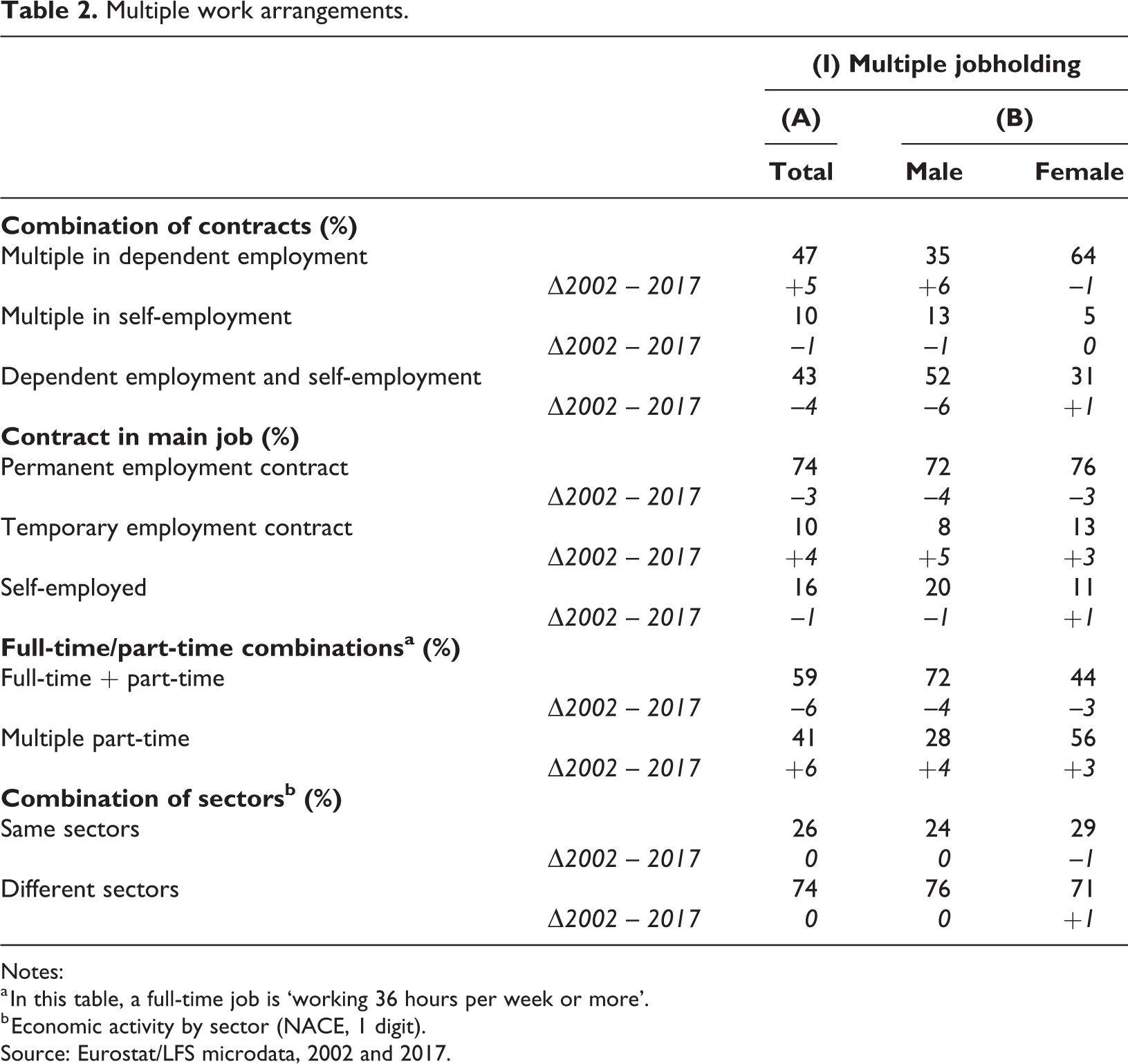
Table 2 gives more details on the types of employment relations characterising multiple jobholders. Jobs held by multiple jobholders most commonly consist of multiple jobs as an employee and the combination of two dependent jobs has become more important since 2002. In 2017, 52 per cent of workers combined multiple jobs in paid employment (47+5=52 per cent) and 39 per cent combined dependent employment and self-employment activities (43–4=39 per cent). Only one in every 10 multiple jobholders combines various types of self-employment. Whereas women usually combine two jobs in dependent employment, a relatively high share of men combine dependent and self-employment.
Multiple work arrangements.
Notes:
a In this table, a full-time job is ‘working 36 hours per week or more’.
b Economic activity by sector (NACE, 1 digit).
Source: Eurostat/LFS microdata, 2002 and 2017.
In 2017, 71 per cent of multiple jobholders had a permanent contract in the main job, 14 per cent had a temporary contract and 15 per cent were self-employed. Whereas a large majority of male multiple jobholders combine a full-time with a part-time job, a majority of female multiple jobholders have two part-time jobs. The combination of two part-time jobs became more prevalent in the 15 years between 2002 and 2017. Finally, three-quarters of multiple jobholders work in two different sectors (NACE 1 digit).
Working hours and desire to work more
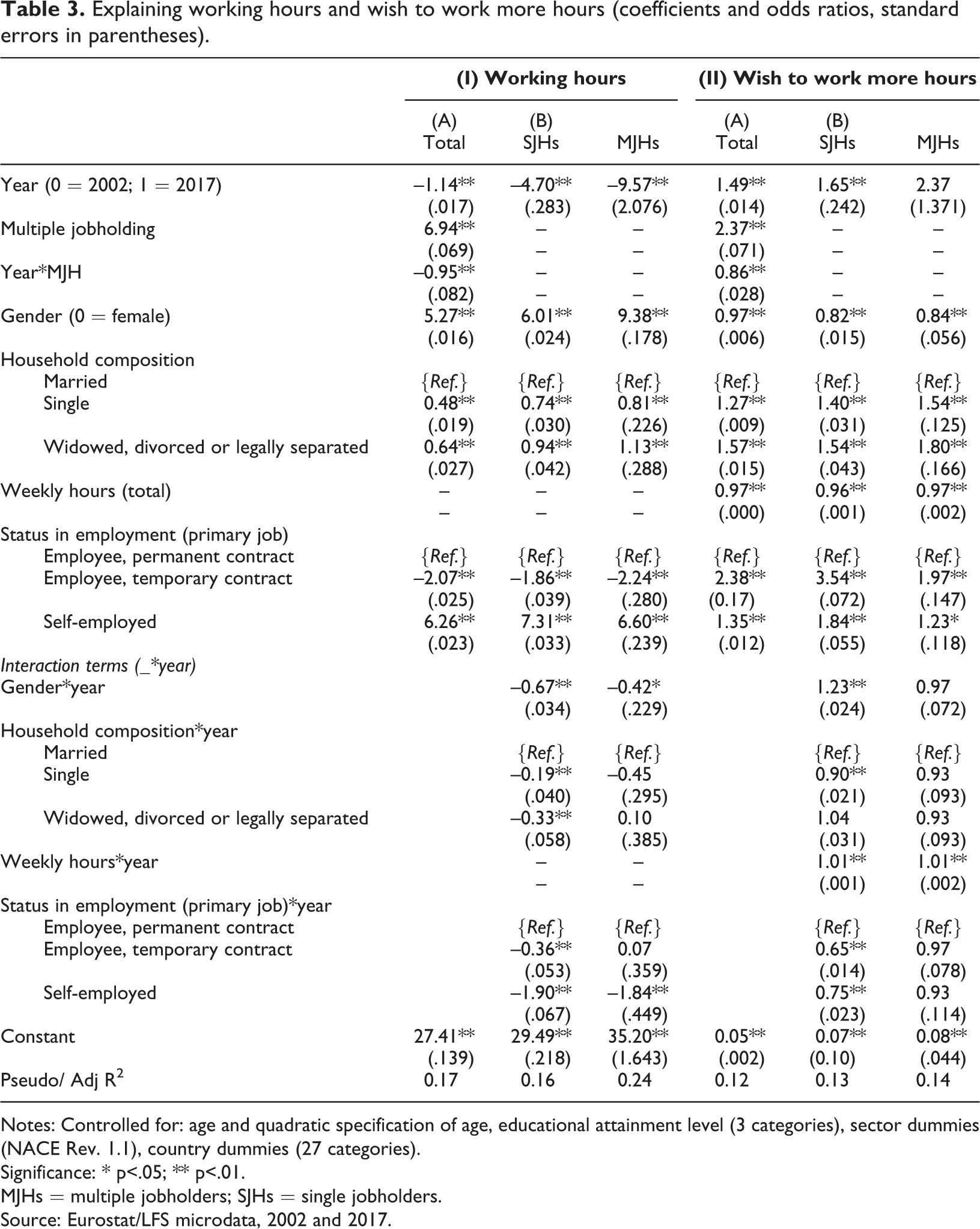
In Table 3 we analyse – by way of a pooled cross-section–time series analysis – what characteristics explain the number of hours that multiple jobholders work and whether they wish to work more hours. In model A we analyse all workers simultaneously and test whether being a multiple jobholder affects the total number of working hours and the wish to work more. In model B we analyse single jobholders and multiple jobholders separately, to examine whether their working hours and wishes are explained by different factors. The interaction terms with year show whether the effects of various characteristics have changed over time. In these models, year is a dummy variable, taking ‘0’ for 2002 and ‘1’ for 2017.
Explaining working hours and wish to work more hours (coefficients and odds ratios, standard errors in parentheses).
Notes: Controlled for: age and quadratic specification of age, educational attainment level (3 categories), sector dummies (NACE Rev. 1.1), country dummies (27 categories).
Significance: * p<.05; ** p<.01.
MJHs = multiple jobholders; SJHs = single jobholders.
Source: Eurostat/LFS microdata, 2002 and 2017.
Model A in the left-hand panel of Table 3 shows that in 2002 multiple jobholders worked, on average, seven hours a week more than single jobholders with the same characteristics. This difference has decreased over time, however, as the negative interaction term with ‘years’ shows. Model B shows that the working hours of multiple jobholders are much more strongly influenced by gender than the working hours of single jobholders. Whereas male single jobholders work, on average, six hours more than female single jobholders, the difference is almost 10 hours for multiple jobholders. Model B furthermore shows that, between 2002 and 2017, the gender differences in working hours tended to decrease, both for single jobholders and multiple jobholders. Particularly workers who are self-employed in the main job saw a decrease in working hours.
The right-hand panel of Table 3 shows the results of several logistic regressions of the wish to work more hours. Multiple jobholders more often wish to work more hours than single jobholders (model A), although this difference has decreased over time. Female, low educated (not shown) and single or widowed, divorced or legally separated workers more often prefer to work more hours than male, higher educated and married workers. Not surprisingly, the more hours a person works currently, the smaller are the odds that they wish to work more hours. Workers working on temporary contracts and self-employed more often prefer to work more hours than workers on a permanent contract in the primary job. If we analyse single jobholders and multiple jobholders separately (model B), it turns out that among multiple jobholders women more frequently wish to work more hours than among single jobholders. This is also true for those who are single, widowed, divorced or legally separated in contrast to married workers. Model B furthermore shows that in 2002 the gender difference regarding the wish to work more hours was equal for single jobholders and multiple jobholders (odds ratios of 0.82 and -.84, respectively), but that for single jobholders this difference largely disappeared in 2017 (odds ratio of 1.23 compared with 2002), whereas for multiple jobholders it remained stable (odds ratio not significantly different from 1). Put differently, female multiple jobholders consistently wanted to work more hours than male multiple jobholders, whereas among single jobholders the gender difference narrowed. The differences between single and married workers have narrowed over time.
Developments in terms of economic vulnerability
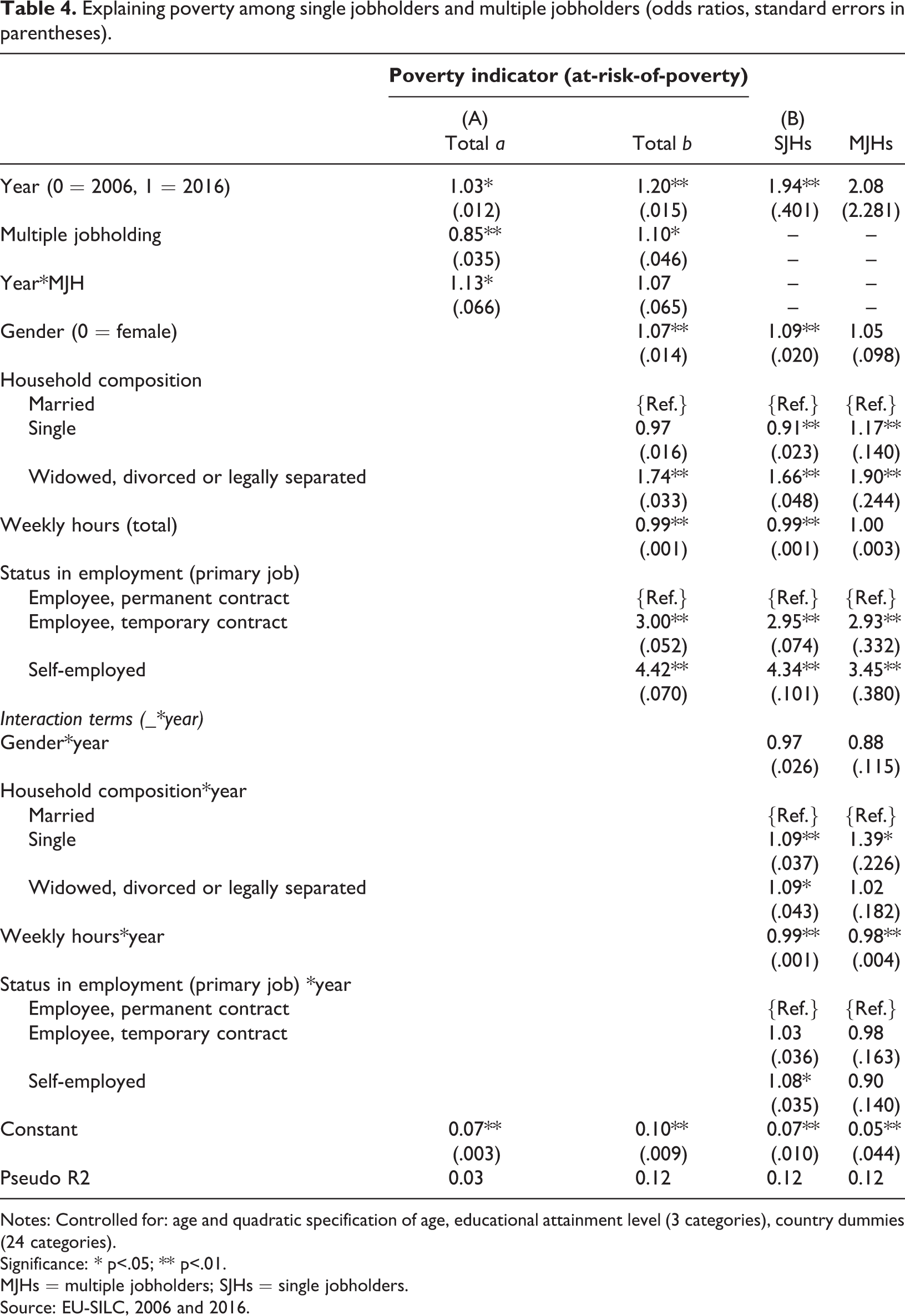
In the previous section we analysed potential driving forces behind multiple jobholding, such as rationing of the number of working hours in the main job. In this section we discuss one potential consequence of multiple jobholding, namely the economic vulnerability of multiple jobholders compared with single jobholders. We focus on one indicator for vulnerability, namely the at-risk-of-poverty (AROP) rate. The at-risk-of-poverty rate is defined by Eurostat as an equivalent disposable household income below 60 per cent of the median income in a country. Model A in Table 4 shows that, if we do not control for other factors (Total a), multiple jobholding lowers the risk of poverty. For multiple jobholders the odds of being poor were 0.85 of the odds of single jobholders in 2006. Because the interaction term with the calendar year is larger than 1, however, the difference between multiple jobholders and single jobholders has narrowed over time. 3 If, however, we take account of the differences between single jobholders and multiple jobholders (Total b) we find that the at-risk-of-poverty rate is a little higher for multiple jobholders than for similar single jobholders (model B), and that this difference is stable over time. The at-risk-of-poverty rate is significantly higher for male workers, for the low educated (not shown), for widowed, divorced and separated persons, and especially for workers with a temporary contract and for the self-employed.
Explaining poverty among single jobholders and multiple jobholders (odds ratios, standard errors in parentheses).
Notes: Controlled for: age and quadratic specification of age, educational attainment level (3 categories), country dummies (24 categories).
Significance: * p<.05; ** p<.01.
MJHs = multiple jobholders; SJHs = single jobholders.
Source: EU-SILC, 2006 and 2016.
In model B we analyse the at-risk-of-poverty rate for single jobholders and multiple jobholders separately. In general, the findings indicate little difference in the factors that affect the at-risk-of-poverty rate for single jobholders and multiple jobholders, although not all effects for multiple jobholders are statistically significant (which may be related to the smaller sample size). Noticeable is that there is no difference in the at-risk-of-poverty rate between male and female multiple jobholders, and that both single and widowed, divorced or legally separated multiple jobholders in contrast to married workers relatively often find themselves at risk of poverty. The interaction terms with the year 2016 indicate that gender differences in the at-risk-of-poverty rate have not changed substantially over time for either single jobholders or multiple jobholders. The differences between married workers and single persons have increased over time, both for single jobholders and multiple jobholders.
Conclusions and discussion
Is multiple jobholding a luxury or a necessity? Do workers choose to accept a second job to enrich their experiences? Or is it because they cannot make ends meet on the limited number of hours and low earnings in their first job? There are also workers in precarious (household) situations who take up extra work out of necessity (Dickey et al., 2011; Wu et al., 2009). By contrast, some multiple jobholders have high-quality jobs (such as software developers or academics) and do not take up second jobs from financial motives. In a number of countries there is a clear trend towards increased multiple jobholding, but thus far little is known about its structure and economic consequences. Are some groups of multiple jobholders increasing in contrast to others? And is this related to contemporary labour market developments? In this study we analyse changes and stability in the scope, structure and nature of single jobholders and multiple jobholders, and address the questions (i) whether and how multiple jobholding has changed in terms of individual and occupational features, and (ii) whether and how multiple jobholders’ economic vulnerability has changed over time.
It is clear from the findings that multiple jobholding is a significant phenomenon that is on the rise in a number of developed economies. The nature of multiple jobholding is also changing: for example, the share of female multiple jobholders is increasing, as is the proportion of highly educated persons who combine two part-time jobs in dependent employment (instead of combining dependent and self-employment activities). Indeed, if we do not control for other factors, the average risk of poverty among multiple jobholders is lower than among single jobholders. This suggests that multiple jobholders tend to be in a relatively self-sufficient position.
On the other hand, there are also indicators that specific groups of multiple jobholders are in a less favourable situation and experience increased economic vulnerability over time. In particular, female multiple jobholders often work relatively few hours in their first job and would prefer to work more hours. Moreover, compared with single jobholders, female multiple jobholders seem more often at risk of poverty. Multiple jobholders as a group traditionally consist of relatively many single and widowed, divorced or legally separated workers, working relatively many hours but wishing to work more. Differences in at-risk-of-poverty rates between married and single workers seem to have increased over time, both for single jobholders and multiple jobholders. Whereas for some, two or more jobs are indeed more than one, in the sense that it enriches their work experiences, for others two jobs are actually less than one good job, because they still would prefer to work more hours and they have problems making ends meet.
The challenge for trade unions is to examine further which industries and among which groups multiple jobholders tend to be precarious and are therefore in need of better protection. In these industries unions could try to negotiate either an increase in the minimum number of hours that workers are employed or the introduction of an individual right to extend the number of hours that one is employed. Alternatively, unions could demand higher hourly wages, especially at the lower end of the earnings distribution. More generally, unions should investigate whether the prevailing terms of employment are not detrimental to multiple jobholders, for example because they include thresholds regarding the number of hours.
The data used in this study rely on survey instruments capturing multiple jobholding in the week prior to the survey, namely the reference week. As already noted, given that multiple jobholding is often short-term (Kimmel and Smith Conway, 2001; see also Conen and Stein, 2021), the percentage of workers working multiple jobs at some time over the course of a full year, or at some time in their working lives, is substantially greater. Moreover, given that people may not perceive (irregular) odd jobs or short-term projects as a second ‘job or business’, and that many second jobs are not formalised (or reported as sources of income on tax forms), these formal statistics are likely to be underestimates (Conen 2020; Sliter and Boyd, 2014). Survey questions with different wordings, time frames or answer categories are not only likely to lead to substantially higher estimates of multiple jobholding in advanced economies (for example, Panos et al., 2014; Sliter and Boyd, 2014; Campion et al., 2020; Conen, 2020), but it also seems likely that current sources may particularly underestimate the more ‘precarious’ forms of multiple jobholding. In other words, participation may be selective in the sense that particularly people in formal and long-term projects are registered as multiple jobholders. Future (survey) research would benefit from improving data sources and paying attention to (new) forms of short-term and potentially more ‘informal’ varieties of multiple jobholding, for instance by reformulating or adding questions on additional (odd) jobs (measuring the scope of multiple jobholding more adequately), or by using new digitised forms of data collection, while still combining them with adequate measures of income adequacy and economic vulnerability.
Footnotes
Acknowledgements
This study is based on data from Eurostat, Labour Force Surveys 2002–2017 and European Union Statistics on Income and Living Conditions 2006–2016. The responsibility for all conclusions drawn from the data lies entirely with the authors.
Funding
This research was financially supported by the Hans-Böckler-Stiftung through the grant ‘Hybridisation of Work: Structure and Dynamics’.