




Abstract
Drawing on survey findings, in this article the authors examine levels of public support in New Zealand for a union default. The key findings are that support is high (59%), that support is principally predicted by a belief in the default’s effectiveness for improving employees’ lives, and that this belief mediates a number of other predictors, such as union membership, non-union by choice, political party, household income, gender and age. There are strong grounds for believing this would translate into actual support for a union default and a consequent rise in union membership. These findings are contextualised with regard to Australia, Britain, Canada and the United States, where the authors draw out the implications for public policy and how a union default could be operationalised in the countries under study.
Introduction
Over the last 20 years, union membership has continued to fall in the liberal market economies of Australia, Britain, Canada, New Zealand and the United States. Nevertheless, evidence in these countries also suggests that the public still favours unions, thinks them necessary, and believes they are a force for ‘good’. It is starkly apparent that these levels of public support have not translated into membership gains. We believe that, in the now dominant deregulated and decentralised systems of industrial relations, this is primarily the result of union recognition (or certification) procedures not accurately reflecting, indeed giving expression to, such public preferences. In the context of a fundamental asymmetry of power between capital and labour, recognition procedures are often instituted by more progressive governing political parties to provide unions with a means to establish collective bargaining and representation rights. Without recognition, the value of union membership is difficult to realise. With recognition, it can be realised and, potentially, enhanced and embedded. There are three first-order reasons that explain why union recognition procedures do not accurately reflect public preferences when constituted as worker preferences in their workplaces. First, these procedures make it difficult to solicit workers’ preferences through organising drives, because workers must be approached individually, often outside working hours, and encouraged to join the union or sign cards, entailing high transaction costs for both workers and unions. High staff turnover accentuates this challenge. Moreover, the procedures often have multiple, complex and lengthy qualifying requirements, so that the right to recognition is not synonymous with the right to bargain. When acquired, the procedural right to bargain often fails to translate into substantive bargaining outcomes, given the latitude employers have for ‘stonewalling’ and ‘surface bargaining’. Second, hostile employer behaviour often coerces workers into refraining from exercising any preference they have for joining and supporting a union (for a summary of the situations in Australia, Britain and the US, see Gall and Dundon, 2013). Employer behaviour may range from unfair labour practices, such as threatened and actual dismissals, to social ostracism for spurning management’s unitarist workplace culture (see, for example, Gall, 2004, 2010, 2021; Logan, 2006, 2013; Moody, 2013). Third, such union recognition procedures are often predicated upon what has been referred to as a ‘tyranny of majoritarianism’, whereby collective labour rights are denied until more than 50% of a given bargaining unit expresses support, typically via a vote. In the process, the legitimacy of substantial minority support, as a basis for commanding rights to represent and bargain, is excluded (Adams, 1993; Bogg, 2009; Harcourt et al., 2020). Though none of these reasons is entirely new or recent, we believe that a tipping point has been reached whereby enfeebled unions in these decentralised, deregulated, and thus increasingly asymmetrical, systems of industrial relations can no longer benefit from existing recognition provisions in a way they might have several decades ago.
Such recognition procedures are universally based upon a non-union default setting in employment law (Bales, 2017; Sachs, 2010; Weiler, 1990). Thus, workers are defaulted to non-union status, irrespective of whether they have chosen this. They then have to take the positive, proactive step to seek and gain membership. We propose a union default should be adopted instead, at least in and under certain conditions, which would automatically enrol workers in a union but subsequently allow the opting out from membership. We believe a union default would better enable workers to freely exercise their right to join a union, providing a positive alignment between their preferences and actions, with the result being that they are able to avail themselves of union representation. A union default, thus, simultaneously and effectively guarantees the right to associate and the right not to associate, unlike the non-union default alternative.
The introduction of a union default requires legal (statutory, constitutional) underpinning to become both operational and effective. 1 Introducing a union default in a mature democracy requires evident public support for the legitimacy of this legal change, as much as it does to give a supportive governing political party the mandate and power to enact it. Moreover, public support would also help realise the underlying aims of the union default by effectively limiting the numbers of workers who would exercise their right to opt out, with the consequence that unions would, all other things being equal, become stronger and, on that basis, more able to combat social inequalities in and outside of the workplace.
Therefore, this study assesses public attitudes towards a union default as a proposed change to industrial relations frameworks. It does so in New Zealand because of the juxtaposition of previous compulsory union membership (amongst other features of a coordinated market economy), the subsequent deregulation of labour markets and employment relations (under conservative governments) to create a liberal market economy, and then their partial re-regulation with the prospect of further re-regulation (under social democratic governments). Our study finds nearly 60% support for a union default, suggesting the proposal has significant political traction. 2 Positive perceptions of the effectiveness of the default, in improving the lives of workers, is the key determinant to respondents’ support. Moreover, as a novel contribution to studying public support for defaults, our research shows positive perceptions of union default effectiveness mediate relationships between other independent variables such as political party affiliation and support for the default. In examining such a default, we follow Sunstein et al.’s (2018) injunction to study defaults which augment democratic practice and participation.
We start by examining levels of support for unions before considering defaults in general and as applied to employment, in order to begin considering the proposal for a union default in terms of its viability. Next, we consider research on public support for defaults before presenting our results. Following from this, we discuss and then examine their implications. This leads us to set out how a union default could work in practice.
Public support for unions
By the end of the 2010s, union densities had sunk to new lows in Australia (14%), Britain (23%), Canada (28%), New Zealand (17%) and the US (10%). With the exception of the US, densities had been higher than 40% in the 1980s. Commonly, data for these countries in the 1980s and 1990s showed that unions were viewed less favourably and as (negatively perceived) having too much power than they are now in the new millennium. Here we examine available data 3 on public attitudes towards unions on indices of approval, effectiveness and trust. In general, these data indicate positive and improving attitudes towards unions as well as rising acknowledgement that unions have (detrimentally) weakened.
In the Australian Election Survey (2019), agreement with the statement ‘Unions have too much power’ fell from 48% to 42% for 2001 to 2019 (Cameron and McAllister, 2019). Essential Vision 4 polling in the 2010s found indications of support for unions by asking ‘How important are unions for Australian working people today?’ (mid-50s to low 60s percentages), ‘Overall, would workers be better off or worse off if unions in Australia were stronger?’ (high 30s rising to mid-40s for ‘better off’ and 30% falling to mid-20s for ‘worse off’) as well as relatively low levels of trust in unions (ranging from low 20s to high 30s). In Britain, Ipsos-MORI polled people on whether ‘unions have too much power in Britain today’ (only a third agreed), whether ‘unions are essential to protect workers’ interests’ (three quarters agreed) and whether ‘most unions are controlled by extremists and militants’ (only a quarter agreed). 5 Unfortunately, it did not ask these questions consistently in the 2010s. Similar questions in the British Social Attitudes survey in the 2000s (see, for example, Bryson, 2007) indicated considerable numbers see unions as having too little power and unions being necessary to protect workers’ interests. Between 2003 and 2010, annual questions on the numbers believing unions ‘do their job well’ ranged from 63% to 71%. In Canada, Leger polling on five occasions between 2001 and 2013 indicated declining but still majority support for ‘unions are still as relevant today as they have ever been’. 6 The New Zealand Election Study (Humpage, 2015: 98; NZES, 2014, 2017) every three years between 2002 and 2017 reported that agreement (‘strongly’/‘somewhat’) with the statements ‘Unions are necessary to protect workers’ and ‘Unions have too much power’ rose from high 50s to high 60s percentages for the former and remained around the 20–30% range for the latter. In the US, Gallup (2019) annual polling 7 since 2001 found public support for unions measured by approval ratings, other than for the period 2009–2012, was 50–100% higher than disapproval ratings when respondents were asked: ‘Do you approve or disapprove of labor unions?’ Moreover, a recent survey by Kochan et al. (2019: 20) found the desire for unionisation among non-union workers had increased from around a third in 1995 to nearly half in 2017. Gallup also polled the same samples on a number of other questions which help contextualise these data: only around 20–30% of respondents had a ‘great deal’/‘quite a lot’ of ‘confidence’ in unions; 40–50% thought unions would ‘get weaker in future years’; and only 30–40% would like to see unions have ‘more influence’. Moreover, there were snapshot indications of high levels of opposition to compulsory union membership when questions were asked about ‘right to work’ laws. 8 These other data suggest substantial proportions – including critically some of those who approve of unions – have concerns about the effectiveness of unions. And, the World Values Survey 9 for 2005 and 2011 shows low levels of confidence in unions in Australia, Britain, Canada, New Zealand and the US (at around the quarter mark). This concern, we believe, is more about strength to represent than about corruption (criminal, financial, political) which undermines the legitimacy of representation.
Studies of defaults: Extent, influences and effect
Many academic disciplines, such as finance, marketing, medicine and law, have embraced the studying of defaults (see Jachimowicz et al., 2018, for a meta-analysis). Understanding how, why and when defaults affect individual behaviour now informs public policy debate in many areas (Reisch and Sunstein, 2016). Yet, the study of defaults has been slow to develop in the field of industrial relations (for an exception, see Harcourt et al., 2015). The importance of defaults is recognised, but rarely investigated or examined, in labour law (for exceptions, see Harcourt et al., 2019; Sachs, 2010; Weiler, 1990). Yet, as the sections below show, defaults are pervasive and important, having potentially major impacts upon the employment relationship. Their existence should be made more apparent and alternatives to status quo defaults debated and considered. One such default, central to industrial relations, is the non-union default. Selection of this default has profound implications for, first, union membership, as a direct consequence, and, second, for the distribution of income, as an indirect consequence of union membership (Harcourt et al., 2019).
Defaults are essential and pervasive
Defaults are not peculiar, rare or marginal. Rather, they are endemic and important to modern life (Sunstein, 2013, 2015a). When making decisions is time-consuming, difficult, costly and/or tedious, there are always individuals who cannot or will not make a choice in any given situation (Sunstein, 2015b). If individuals fail to choose, for whatever reason, a default is necessary to determine what happens when they do not. Defaults are, therefore, inevitable to many decision-making situations. As long as individuals are not forced to choose, defaults are necessary (Sunstein, 2015b). In this sense, defaults are an essential part of free choice, including the freedom not to choose at all, rather than the antithesis of it (Sunstein, 2015b).
Defaults are present in an enormous range of products and activities from cell phones and computers to rental car agreements and insurance policies (Sunstein, 2013). The employment relationship in common law jurisdictions is suffused with defaults (Sunstein, 2018). For instance, all of the various employer and employee common-law duties, including employees’ duties of fidelity and obedience, are default terms in the employment contract (Weiler, 1990). For the dismissal of non-union, private-sector employees, employment-at-will is the legal default in the US (Issacharoff, 1996).
Defaults can reflect different values and beliefs
Defaults are normally devised by default-setters (or choice architects) (Thaler and Sunstein, 2008), which, depending on context, could be a corporation, court or regulatory body. Defaults can, therefore, reflect any of a wide variety of values, beliefs and aims. They can be progressive and pro-social, in the sense of promoting the public good, as with, for example, organ donation, green electricity use, healthy eating and retirement saving. Thaler and Sunstein (2008) advocate such pro-social defaults as part of a new regulatory approach called ‘libertarian paternalism’, which is paternalistic in promoting the public good (e.g. organ donation) but libertarian in preserving freedom of choice. 10 Nevertheless, defaults are not solely, or even principally, a modern regulatory tool favoured by political centrists to promote progressive causes, though this is often implicitly assumed (see, for example, Rebonato, 2012). They can be regressive, authoritarian, anti-democratic and/or traditional. The most important contractual default in the employment relationship is the employee’s duty to obey and the corresponding right of management to manage, also known as managerial prerogative (Harcourt et al., 2015). Hence, terms and conditions of employment not specified explicitly and clearly in the contract or established by statute are the unilateral right of the employer to decide (Harcourt et al., 2015). Thus, by default, the employment relationship is essentially and formally an autocracy, albeit one circumscribed by legal rules. It is also a relationship where one party, the employer, has little incentive or reason to freeze terms and conditions in advance via a contract, because the default right to manage affords managers relatively free rein to unilaterally set and re-set terms and conditions essentially ‘as they go’ (Harcourt et al., 2015).
Defaults should be rendered visible and contestable
Although individuals are normally aware that a given default is a choice option, they often do not understand its function as a default (Sunstein, 2018). Defaults are largely indiscernible as defaults. For instance, the decision to join or not join a union involves a rarely acknowledged and little understood default: an employee does not deliberately choose to be non-union; the worker is defaulted to this status until explicitly opting to join a union (Harcourt et al., 2019; Weiler, 1990). However, none of this means that public policy defaults are natural or immutable: they can be politically contested and potentially changed (Schlag, 2010). Hitherto invisible defaults can be exposed and the public’s views of these defaults and their potential alternatives ascertained. For example, the selection of a union/non-union default is ultimately a political choice. In principle, the non-union default could be reversed, at least in certain conditions, so that workers are initially automatically enrolled in a union, with a subsequent right to opt out (see Harcourt et al., 2019).
Choice of default matters
Which option is specified in the default in any given choice situation matters because of the so-called default effect – defaults are not neutral. Empirical evidence of the default effect across many fields, including law, shows designating a particular option as the default normally greatly increases the likelihood of its selection (Jachimowicz et al., 2018). Defaults are ‘sticky’ in the sense that whatever is specified a priori as the default normally ends up as the option a great many or even most people choose. Thus, replacing the non-union with a union default, at least in some conditions, could substantially increase union membership (Harcourt et al., 2019). Research suggests four different avenues via which this might occur (Harcourt et al., 2019). First, a union default would make it faster and cheaper to join a union, even in an already unionised workplace. With automatic enrolment as a union member, a worker would not have to expend any time or resources to seek out the union or even fill out a form to join. Transaction costs are essentially zero. Second, the inertia that typically occurs when workers avoid making a decision, as when, for example, it is too mentally taxing to choose, favours staying with the default status quo. Thus, any worker unsure of whether to join the union would be defaulted to membership rather than non-membership. Third, a union default would help to establish union membership as a new social norm, one officially endorsed by the state. A union default would send a strong message to all parties, including employers, that it is legitimate and even desirable for employees to be union members. Fourth, a union default would establish union membership as the new reference point for determining ‘gains’ and ‘losses’ associated with moving from the default to another option, wherein losses are ordinarily weighted twice as heavily by the human mind as comparable gains. As a result, the ‘losses’ produced by opting out of membership are likely to appear much more significant than the ‘gains’ of opting in (Harcourt et al., 2019). The first of the above is a traditional rational choice explanation, focused on the costs and benefits of decisions. The second, third and fourth are from behavioural economics, and emphasise the bounded rationality of the human mind (Harcourt et al., 2019).
Research on public support for defaults
We now turn to reviewing the literature as it pertains to potential public support for a union default. In doing so, we utilise the small, but rapidly growing, body of work on public support for so-called nudges, of which defaults are one. A nudge is ‘any aspect of the choice architecture that alters people’s behaviour in a predictable way without forbidding any options or significantly changing their incentives’ (Thaler and Sunstein, 2008: 6). A nudge does not involve any form of incentive for changing behaviour/shifting options (Sunstein, 2018). Nor does it involve a ban or mandate that would prevent the exercise of choice (Sunstein, 2018). Thaler and Sunstein (2008) popularised the term ‘nudge’ to describe pro-social behavioural policy interventions, including defaults.
Previous research has identified a number of factors associated with public support for nudges. Some are especially germane to this study. These include the perceived effectiveness of the default, preference alignment with the default, political party support, household income, gender and age.
Perceived effectiveness of the default
Perceived effectiveness of a given default is a strong determinant of public support for it (Bang et al., 2018; Junghans et al., 2015; Reisch and Sunstein, 2016). To illustrate, if respondents believe default organ donation at death will save lives, they are more likely to support organ donation as the default (e.g. in the absence of the individual’s explicit consent). Greater information about effectiveness increases public support for non-educative nudges, such as defaults, especially in relation to educative nudges, such as warnings about cancer on cigarette packets (Davidai and Shafir, 2020; Sunstein, 2016b). Personal experience of default effectiveness also increases public support: acceptability is higher ex-post after implementation than ex-ante in a hypothetical scenario (Bang et al., 2018; Diepeveen et al., 2013). Furthermore, if individuals believe that a nudge (default) is beneficial to, or in the interests of, most people, they are more likely to favour it (Junghans et al., 2015; Reisch and Sunstein, 2016). Correspondingly, if they trust that the choice architect is motivated to improve the welfare of the many rather than the few, they are more likely to support a given nudge (or default) (Bang et al., 2018; Junghans et al., 2015; Osman et al., 2018; Reisch and Sunstein, 2016; Sunstein, 2016a; Sunstein et al., 2018).
It follows that positive (negative) views of union default effectiveness are likely to predict support for (opposition to) it. For instance, someone who believes a union default would improve employees’ lives is more likely to support the default. On the other hand, someone who believes a union default would worsen employees’ lives is more likely to not support the default.
Preference alignment with the default
Tannenbaum et al. (2017) found preferences for the policy underlying specific defaults were a strong predictor of public approval for various defaults. Thus, if respondents thought that ‘safe sex’ educational programmes for the young were a great idea, they were much more likely to back automatic enrolment in such programmes. Other studies have also found agreement with the aims of a particular nudge is typically an important determinant of public approval (Junghans et al., 2015; Reisch and Sunstein, 2016).
If preferences are important, the exercise of those preferences in actually making a choice should be an even stronger predictor of which option is favoured for the default. To illustrate, the prior selection of a green electricity company as a provider should better predict support for a green electricity default than a general (and possibly unexercised) preference for green, over grey, electricity. The effect of exercised preference on default support, specifically, has not been statistically tested. However, studies show individuals are more likely to support nudges, more generally, when their exercised preferences already align with the purposes of such interventions. For instance, non-smokers are more likely than smokers to favour nudges to discourage smoking – e.g. cancer warnings on cigarette packets (Diepeveen et al., 2013).
The empirical literature for Festinger’s (1957) theory of cognitive dissonance shows individuals align their thoughts with their actions, and vice versa, to avoid feeling either immoral and/or foolish. Thus, to minimise any cognitive dissonance, individuals who have already chosen to become union members (action) would likely think a union default is a good idea (thought). In contrast, individuals who have remained non-union by choice in a unionised workplace (action) would likely think a union default is not a good idea (thought). It is important to note that non-union workers in non-union workplaces are non-union by default rather than choice, and so have not exercised a preference for or against membership. 11 They are typically beyond unions’ organising reach and so have not had the opportunity to join or not join (Haynes et al., 2006).
Political party affiliation
Studies of public support for nudges initially construed them as state interventions promoting broader public purposes but also limiting individual choice (Sunstein, 2016a). Thus, those on the political left were expected to support nudges as tools to improve the common good while those on the political right were expected to oppose or be less supportive of them, for manipulating people’s preferences and obstructing their choices (Sunstein, 2016a). Earlier empirical research verified these suppositions (Hagman et al., 2015). However, most nudges 12 still garnered widespread support across all groups and were considerably more popular than mandates (Sunstein, 2016a). For example, in a US study, conservatives were generally less likely to favour a range of pro-social nudges from cancer warnings on cigarette packets to automatic pension plan enrolment (Jung and Mellers, 2016).
Tannenbaum et al. (2017) repudiated the idea that nudge support per se is a simple left/right political dichotomy. Their US research showed clear evidence of what they termed a partisan nudge bias. Liberals and conservatives were much more likely to support a default aligned to their policy preferences and oppose one not so aligned. For instance, liberals were more likely to favour defaults involving ‘a safe sex’ educational programme for school kids and ‘food stamps’ for the poor. Conservatives were more likely to favour defaults involving ‘tax breaks’ for income from capital gains and an ‘intelligent design’ educational programme for school kids. Similarly, in one study of six European countries, a default to a green energy provider was more positively received by Green Party voters (Reisch and Sunstein, 2016).
Unions have traditionally allied to, and been supported by, left-of-centre political parties. In contrast, right-of-centre political parties have opposed unions and supported, and been supported by, business. Therefore, left-of-centre voters who support a labour, social democratic, or similar party (e.g. Green, Democrat) are expected to favour a union default. Right-of-centre voters who support a conservative or similar party (e.g. Christian Democrat, Republican) are expected to oppose a union default or, at least, be less supportive.
It is important to note both conservatives and liberals expressed concerns about ethics, coercion and manipulation regarding defaults, but only occasionally, and principally when the default specified an underlying policy that was opposed (Tannenbaum et al., 2017). Similarly, Junghans et al. (2015) found few interviewees had anxieties about manipulation via various health nudges. When anxieties did arise, they generally reflected a fear of being deceived, or forced, into making a choice that was strongly disliked. Nevertheless, research suggests that nudges (and defaults) are better accepted by the public if they are transparent and, thus, considered unlikely to coerce or deceive (Bang et al., 2018; Felsen et al., 2013; Osman et al., 2018, Yan and Yates, 2019). Likewise, defaults, in particular, are more favourably received when the ‘opt-out’ is low in cost (Yan and Yates, 2019). Thus, public acceptance is generally higher when the nudge (default) preserves or even enhances autonomous choice (Felsen et al., 2013).
Income
In a study pertaining to four European nations, higher incomes were associated with higher support for 15 nudges (Loibl et al., 2018). One reason for this greater support, consistent with earlier aforementioned arguments, is that the exercised preferences of higher earners are more likely in harmony with the goals of these pro-social nudges. For instance, richer individuals are less likely to smoke and are, therefore, more favourable to nudges to stop smoking. Similarly, they are more likely to have healthy eating habits and are, therefore, more favourable to nudges promoting the consumption of healthy foods. In the employment context, high-income individuals might believe they already have the power to control and/or influence their economic situations, and so unions are either unnecessary or, if they are business owners, even a potential threat to their success. Conversely, low-income individuals might believe they are powerless to influence their economic destinies, except in unison with others working through a union. Consequently, we would expect support for the default to fall as income rises.
Gender
Research shows a higher percentage of women than men support nudges, including defaults (Diepeveen et al., 2013; Loibl et al., 2018; Reisch and Sunstein, 2016). In addition, other studies (Jung and Mellers, 2016; Sunstein et al., 2018) found empathy is associated with higher levels of support for nudges (e.g. organ donation, healthier eating habits). Reisch and Sunstein (2016) argued women’s higher levels of empathy (e.g. concern for others’ welfare) could explain why they are more likely to support pro-social nudges.
Unions have traditionally defended and advanced the collective interests of ordinary workers, improving the lot of the poor relative to the rich and the powerless relative to the powerful. Evidence suggests unions do raise wages (Farber et al., 2018), especially for low-earners (Card, 2001), and compress the income distribution overall (Jaumotte and Buitron, 2015). If women care more than men do about the welfare of others, particularly the disadvantaged, they might be expected to have more favourable opinions of unions and the default, as a means to facilitate membership recruitment and increase unions’ resources and influence.
Age
Few studies have examined what effect, if any, age has on public support for nudges. The limited evidence suggests age has no influence on public support: older and younger workers are equally predisposed to favour nudges (Sunstein et al., 2018). However, some might argue a union default would be less supported by younger than older workers as union membership is skewed towards older workers. Why? It is commonly believed younger workers are more individualistic and self-centred and, therefore, less interested in collectivism. Conversely, older workers are believed to be more pro-union as a result of experience of past social democratic regimes where unions were more important. If unions were inherently less appealing to the young, we would expect them to be potentially less positive about the default. Nevertheless, research suggests younger workers favour membership as much, and possibly more, than older workers (Haynes et al., 2005). Low and declining membership for this group reflects decreased opportunities to join rather than a shift in preferences. An increasing share of these workers work for non-union employers beyond the reach of union organising (Haynes et al., 2005). Hence, age is not anticipated to be linked to support for a default. Approval rates are likely to be similar for young and old alike.
Research methods
Sample
The data were obtained via a digital survey administered by international research firm Qualtrics, in 2019. 13 A random sample of 1600 New Zealanders accepted an invitation to participate in the study. Work permit holders, visitors to New Zealand and individuals younger than 18 were all disqualified from any involvement. Some respondents consented to participate but did not complete the survey. Allowing for these, 1471 respondents completed the survey.
Variables
From the survey questions, dependent and independent variables described below were derived. The dependent variable is the dichotomous variable: ‘Support for the union default’. If respondents agreed with the statement: ‘I support automatic union enrolment in the workplace’, the variable was coded ‘1’, and, if respondents disagreed, ‘0’. 14 The effectiveness of the default is assessed with the dichotomous variable, the ‘Union default would improve employee lives’. It is coded ‘1’ if respondents agreed and ‘0’ if they disagreed.
‘Union member’ is a dichotomous variable, coded ‘1’ when respondents indicated they were members. ‘Non-union by choice’ is also a dichotomous variable, coded ‘1’ when respondents indicated they were not members, and there is a union present at their workplace they could have joined. Respondents who fell into any other category (e.g. employed in a non-union workplace, self-employed, unemployed, not in the workforce) were coded ‘0’ for both of these variables.
‘National party’ was included as a dichotomous variable, where ‘1’ indicates respondents voted for that party in the 2017 election and ‘0’ indicates they voted for another party, did not vote at all, or preferred not to reveal which party they had voted for. Among the main parties, only a majority of respondents who voted for the politically right National Party opposed the default. A similar majority of respondents (e.g. 60%+) who voted for the Labour, Green and New Zealand First parties in the centre-left government supported the default. 15
Household income is a potentially sensitive topic. So, respondents were asked to indicate which one of several income ranges listed in the survey best described their total household income. When these data were examined, they exhibited a clear and distinctive pattern. Whatever the income range, a consistently higher and similar percentage of households earning less than $70,000 supported a default (e.g. higher than 60%), 16 as compared to all household income ranges above $70,000 (e.g. lower than 60%). Thus, ‘Household income below $70,000’ is a dichotomous variable, where ‘1’ indicates respondents reported household incomes below $70,000, and ‘0’ indicates either household income above that level or household income was not disclosed. ‘Female’ is a dichotomous variable, where ‘1’ indicates female gender and ‘0’ indicates male or other/neither gender. ‘Age’ is a ratio variable, which indicates respondents’ age in number of years.
Data analysis
This study uses binomial logit from the MPlus statistical programme to simultaneously estimate two maximum likelihood models. The first model computes the direct effects of the various independent variables, including the ‘Union default would improve employee lives’ variable, on the odds of whether the respondent supports (or does not support) the default. The second model computes the indirect effects of the independent variables on the odds of the respondents’ ‘Support for the union default’, mediated first via the ‘Union default would improve employee lives’ variable. Each binomial logit model has the following form: log (probability (event)/probability (no event)) = β1X1 + β2X2 + . . . + βnXn
With the first model, ‘event’ means respondents support the default (coded ‘1’), and ‘no event’ means respondents do not support the default (coded ‘0’). With the second model, ‘event’ means respondents agree the default would improve employees’ lives (coded ‘1’), and ‘no event’ means respondents disagree that the default would improve employees’ lives (coded ‘0’). The probability of the ‘event’ divided by the probability of ‘no event’ represents an odds ratio. For the first model, this is the odds of supporting the default versus not doing so. For the second model, this is the odds of agreeing the default would improve employees’ lives versus disagreeing with the same statement. The log of each odds ratio is predicted by the independent variables. The coefficient estimates, or βs, in each model show the expected change in the log odds for each independent variable.
Results
Table 1 shows support for the default across various groups. Overall, 59% of respondents favoured introducing a default. Majority support is common across the groups surveyed. Support is particularly high when respondents believe unions to be effective. More than 91% who believe unions improve employee lives approve of the default. Support for and opposition to the default are clearly distinguished via the exercise of preference for membership. Nearly 73% of union members support a default, whereas only 36% of non-union workers in unionised workplaces (non-union by choice) do so. Non-union workers in non-union workplaces, who are non-union by default, are evenly split, with more than 53% favouring the default and 47% rejecting it. Support is also greater for respondents who voted Labour (65%), New Zealand First (66%), or Green (61%) – the governing parties of the centre-left – in the last election but lower (47%) for the centre-right, National Party, now in opposition. Support for a union default generally declines as household income rises. For instance, a relatively low percentage of individuals (41%) from high-income households, earning $150,000 or more per year, supported a default. In contrast, a much higher proportion (64%) of individuals from lower-income households, earning $70,000 or less per year, supported a default. A higher proportion of women (63%) than men (54%) favoured a default.
Support for a union default in New Zealand.
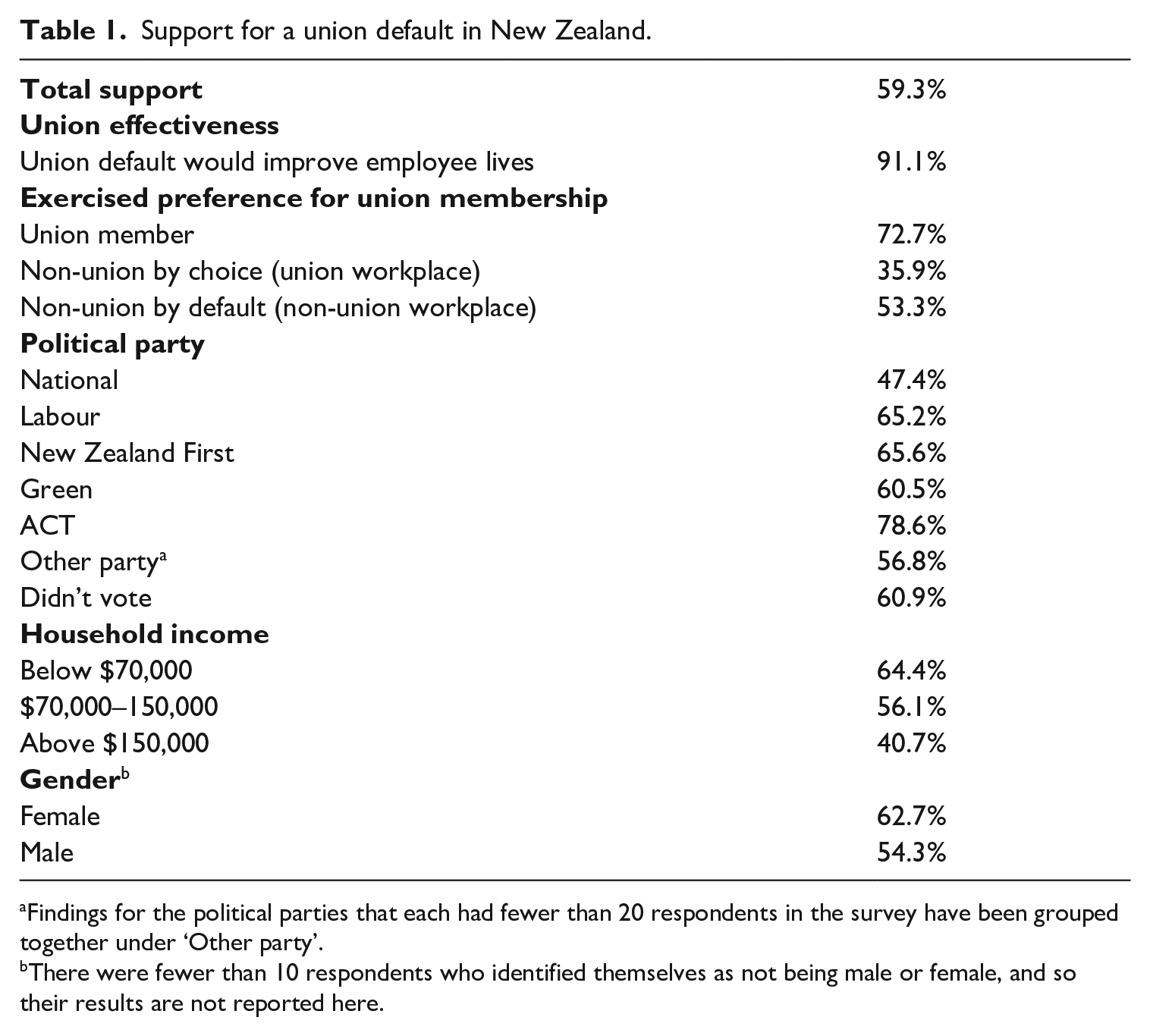
Findings for the political parties that each had fewer than 20 respondents in the survey have been grouped together under ‘Other party’.
There were fewer than 10 respondents who identified themselves as not being male or female, and so their results are not reported here.
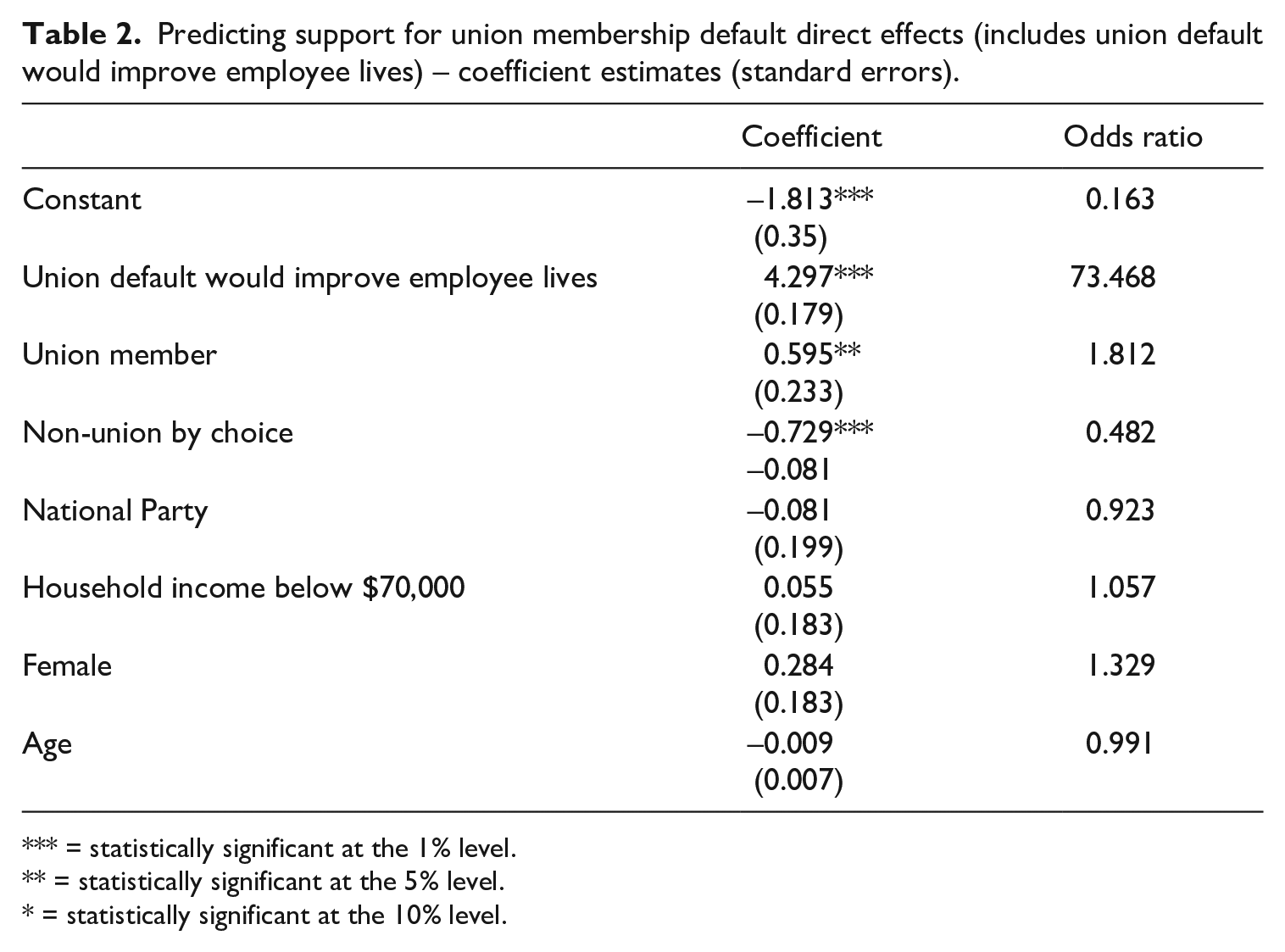
Table 2 outlines the logit findings for a direct effects model used to predict support for the default, with the ‘Union default would improve employee lives’ variable as the measure of union effectiveness. The Negelkerke R-square (0.692) and Cox and Snell R-square (0.513) statistics both suggest a high proportion of the variance in the choice to support a default is explained by the model. The classification table reveals the model accurately predicts 90% of respondents’ choices: 92% for those who supported the default and 87% for those who did not. 17
Predicting support for union membership default direct effects (includes union default would improve employee lives) – coefficient estimates (standard errors).
= statistically significant at the 1% level.
= statistically significant at the 5% level.
= statistically significant at the 10% level.
The coefficient estimate for each binary, independent variable is listed in the first column of Table 2, with the standard error in parentheses. The coefficient estimate for the constant is highly statistically significant and negative. It suggests, when all the independent variables are zero, the odds of a respondent supporting the default are 16:100, equivalent to a 14% probability. Positive, statistically significant coefficient estimates for the independent variables indicate an increase in the odds of the respondent supporting the default, whereas negative, statistically significant estimates indicate a decrease in such odds, in both cases in relation to the 16:100 odds implied by the constant coefficient.
The coefficient estimates for ‘Union default would improve employee lives’, ‘Union member’ and ‘Non-union by choice’ are all statistically significant. The ‘Union default would improve employee lives’ variable explains a high proportion of the variance in ‘Support for the union default’ (Wald statistic = 574.578). Likewise, the impact of this variable on the odds ratio is also very large: if a respondent believes a default would improve employees’ lives, the odds of supporting the default increase from 16:100 to nearly 12:1 (0.163 × 73.468 = 11.975), equivalent to a rise in probability from under 14% to more than 92% (e.g. 11.975/12.975). 18 The direct effects of the other statistically significant variables are much smaller and explain comparatively little of the variance in support for the default (e.g. the Wald statistics are 6.52 for ‘Union member’ and 6.762 for ‘Non-union by choice’). The coefficient estimates for these two variables suggest a near doubling of the odds ratio (1.812) for ‘Union member’ and a halving of it (0.482) for ‘Non-union by choice’. For instance, if the respondent is a union member, the odds of supporting the default increase from 16:100 to 3:10 (0.163 × 1.812 = 0.2953), equivalent to an increase in probability from 14% to 23% (0.2953/1.2953). The combination of union membership with a belief that a default would improve employees’ lives generates very high odds of support for the default. As an example, if a union member believes that a default would improve employees’ lives, the odds of supporting the default are 22:1 (0.163 × 1.812 × 73.468 = 21.6992), comparable to a 96% probability (21.6992/22.6992 = 0.9559).
The coefficient estimates for ‘National Party’, ‘Household income below $70,000’, ‘Female’ and ‘Age’ are all statistically insignificant. Hence, these results suggest that these variables have no direct effects on the odds of support for the default, independent of any effects mediated by the belief the default would improve employees’ lives. In other words, whatever the effects of such variables on support for the default, they are indirect and therefore mediated by the ‘Union default would improve employee lives’ variable.
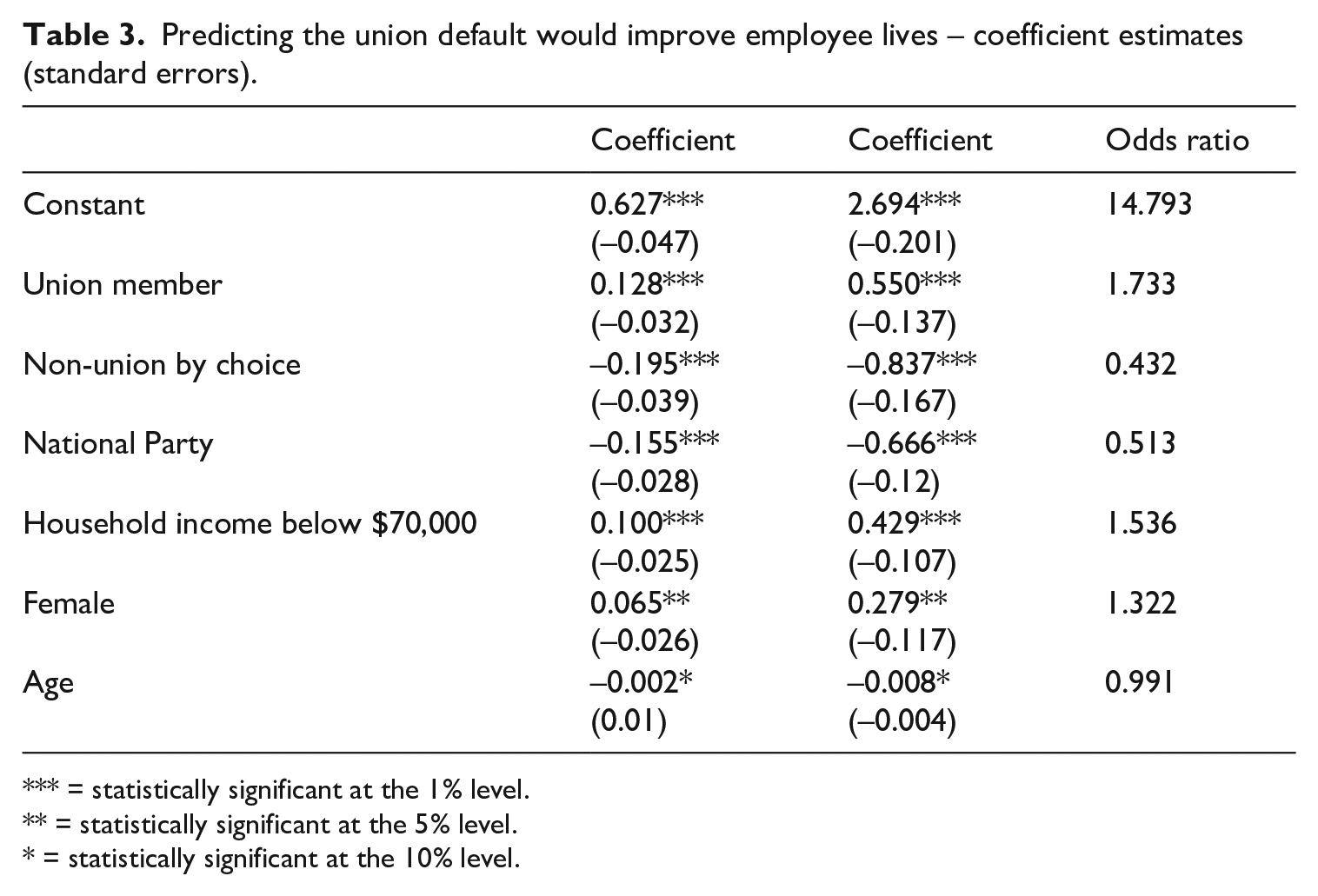
Table 3 outlines the MPlus logistic regression findings for an indirect effects model, where the ‘Union default would improve employee lives’, as the measure of default effectiveness, potentially mediates the relationship between the binary, independent variables and the binary, dependent variable, ‘Support for the union default’. The first column outlines the coefficient estimates for the effects of the independent variables on the mediator variable. The second column outlines the implied coefficient estimates for the eventual effects of the independent variables on the dependent variable via the mediator variable, with the overall change in the odds of ‘Support for the union default’ given in the third column.
Predicting the union default would improve employee lives – coefficient estimates (standard errors).
= statistically significant at the 1% level.
= statistically significant at the 5% level.
= statistically significant at the 10% level.
All the independent variables have indirect effects on the dependent variable, mediated by ‘Union default would improve employee lives’. The coefficient estimates for ‘Union member’, ‘Household income below $70,000’ and ‘Female’ are all positive and statistically significant. If any one of these conditions is satisfied, the respondent has higher odds of indicating the default would improve employees’ lives. For instance, union membership raises the odds of indicating the default would improve employee lives from 19:10 to 21:10 (1.871 × 1.136), almost 15% higher. In contrast, the coefficient estimates for ‘Non-union by choice’, ‘National Party’ and ‘Age’ are negative and statistically significant. If any one of these conditions is satisfied, the odds of the respondent indicating that the default would improve employees’ lives are lower. As an example, being non-union by choice lowers the same odds by almost 20% from 19:10 to 15:10 (1.871 × 0.8228). Likewise, being a National Party voter has a slightly smaller negative impact on these odds.
Table 3 (second and third columns) shows these relatively small, direct independent variable effects on the mediator variable have amplified, indirect effects on the dependent variable via the mediator’s large coefficient estimate (4.297) in the direct effects model described earlier in Table 2. For example, ‘Union member’, mediated via the ‘Union default would improve employee lives’ variable, nearly doubles (1.7332) the odds of support for the default. The positive impact on these odds is lower for ‘Household income below $70,000’ (1.5367) and ‘Female’ (1.3222). Conversely, being ‘Non-union by choice’ (0.4326) or a National Party voter (0.5137) roughly halves the odds of support for the default.
Discussion
Nearly 60% of respondents favoured a union default. Research suggests that actual experience of such a default would increase acceptance (Bang et al., 2018; Diepeveen et al., 2013). Why, then, has the union default not yet been enacted? Popularity is not the issue. As mentioned before, the public is largely unfamiliar with the concept of a default, that certain defaults already exist (e.g. non-union status), and that there might be an alternative to any given existing default (e.g. union membership). Once alerted, our findings indicate the public is prepared to consider alternatives to a status quo default.
Our findings also show that the greatest determinant of support for a union default is beliefs about its effectiveness. If respondents believe the default would improve employees’ lives, there is a roughly 90% chance they favour the default. The same is true in reverse. This is an important finding. It implies most individuals are pragmatic, in favouring defaults seen as generating positive outcomes for society. In contrast, previous research reveals ethical concerns about manipulation and deception have a limited impact on default choice, though only then when the default is not the individual’s preferred option (Junghans et al., 2015). Thus, right-wing objections to a union default are more likely to emanate from misalignment with personal beliefs about unions than any genuine worry about freedom of choice (Tannenbaum et al., 2017).
Other factors by themselves explain comparatively little of the variation in support for the union default. In addition, the influence of the independent variables is generally indirect, with mediation via union default effectiveness. To illustrate, women are more likely than men to believe the default would improve employees’ lives, and it is this, in turn, which raises the chances of support for the default. Once again, this is a major finding. Extant studies have not tested whether perceived default effectiveness mediates the impacts of other factors on public support for a given default.
Exercised preference for or against union membership explains relatively little of the variation in support for the default. One reason underlying this apparent puzzle is that most respondents had not exercised a preference for or against membership: they were either non-members by default (e.g. employees of a non-union employer) or non-employees (e.g. not in the workforce, unemployed, employers, self-employed). This is a diverse group and not obviously distinct from either of the groups that had exercised a membership preference. Yet, those who have not exercised a preference still have views about whether unions are effective, and this matters to their support for the default.
Implications
Our findings indicate a union default is a potentially popular alternative to a non-union default, and thus, we believe, deserving of consideration by policy-makers. Furthermore, support for the union default is broad-based and traverses a variety of groups within New Zealand. As the most important determinant of support is the belief the default would improve employees’ lives, any effort to promote the default should focus on the general benefits for all workers, such as improved pay and working conditions, stronger enforcement of laws, reduced inequality, and a formal voice at the workplace. In this, some of the public might need to be persuaded unions do not simply serve the interests of union leaders and activists or only particular groups of workers.
Prior studies do suggest individuals sometimes have concerns about manipulation and deception. Earlier research suggests these could be addressed through the design of the default itself, in particular its transparency. Acceptance of a union default would likely be greater if (a) workers were fully informed of having been defaulted to membership (e.g. via electronic notification), (b) similarly informed of an opportunity to opt out, and (c) the opt-out process was both easy (e.g. click on a link and fill out a form) and available soon after enrolment.
At the outset, we established there is substantial public support for unions. In New Zealand, it is reasonable to infer there is likely to be a positive association between this public support for unions and the high level of public support we identified for a union default. Notwithstanding concerns about effectiveness – which could be addressed by a default in practice – we believe it is also reasonable to make the same inference for Australia, Britain and Canada but not the US. 19 This is because ideological hostility to unions from employers and associated political forces is far higher and better resourced than in these three other countries. Therefore, we would anticipate that, even with the experience of a union default in practice, a majority of non-union workers might say they would exercise their right to opt out as well as exercise that right in practice. The former would undermine the public evidence case for a default while the latter would undermine the efficacy of a default for representational and bargaining strength and, in time, the default itself. The particular fulcrum around which employer opposition operates, we believe, is the influence of the National Labor Relations Act 1935 (NLRA) in creating a tyranny of majoritarianism in the certification process 20 (see Adams, 1993). That said, this tyranny is also found in Australia, Britain and New Zealand albeit not to the same extent. We suggest means to address this below. Before doing so, we highlight some arguments to counter the effects of employer hostility.
First, there is a ‘public good’ argument that unions have a positive effect on raising wages and conditions. The impact of a default secured on a lower than simple majority threshold is unlikely to make this effect any less strong. Second, the default resolves the Olsonian ‘collective action problem’ because, in the first instance, it puts the beneficiaries of the union in the union and has everyone paying dues. Third, the default provides for autonomous choice for both union and non-union workers in exercising their preferences compared to the non-union default (which is only compatible with the preferences of non-union workers), because it allows for opting out after experiencing union membership. Fourth, the argument for a union default has already been made by prominent US labour law academics like Bales (2017) and Sachs (2010). Sachs considers two types of default approaches (preference-eliciting, reversible). Both show a union default allows union and non-union preferences to be more easily and effectively realised.
Operationalising the default
A union default could be operationalised through modifications to existing statutory union recognition processes. Two options are envisioned. The first modifies union representation based on majority support, as practised in some form in Australia, Britain, Canada and the US. The second modifies the ‘all comers’ approach, where unions need not have majority support but only represent members, as practised in New Zealand.
The first option makes majority-based representation more responsive to workers’ actual preferences. Recognition would be established in two phases. Initially, the labour relations board (Canada, US), Fair Work Commission (Australia) or Central Arbitration Committee (Britain) would recognise a union’s right to represent and bargain for its members in a bargaining unit once the union had established a low threshold of support (e.g. 10–20% of workers), as evidenced by ‘card signings’ (Canada, US), a petition (Australia) or both (Britain). Once this had been achieved, all workers in the bargaining unit would be defaulted to membership, but with the right to opt out. The union would only represent its members (those joining before and after the default), and those opting out would be placed on individual agreements. These non-members would also be free to found and/or join an alternative union, which could also establish representational rights for its members in the bargaining unit, if the low membership threshold were satisfied.
Next, and upon union request, the aforementioned labour relations agencies would ballot all workers in the bargaining unit to determine their support for sole and exclusive union representation and bargaining rights for the default-designated union. With 50%+1 support from those voting, the union would then obtain these rights for all workers, union and non-union, in the bargaining unit, similar to current Australian, British, Canadian and American procedures. This second phase process would not be triggered until a union felt confident of winning the ballot and/or until a second union, in competition with the first, had also established representation rights for the same bargaining unit. Thus, a basic right to represent could be established easily, with majority support only necessary to determine sole and exclusive representation. In some respects, this is what the original architects of the NLRA planned. Certification was only supposed to resolve inter-union competition for representation rights of the same bargaining unit. It was not intended to be used to deny workers a right to be represented at all (e.g. if they failed to secure majority support via the election) (Morris, 2005).
The second option would involve an ‘all-comers’ approach (see Albertyn, 1989: 988), similar to New Zealand’s union recognition process under the Employment Relations Act 2000. First, the union would have to register (certify) as a non-discriminating, independently operated and controlled workers’ organisation, focused upon representing its members’ collective interests. 21 Second, it would secure the right to bargain in any given workplace by recruiting at least two members, the minimum required to establish a collective agreement. Third, bargaining unit coverage would then be negotiated via a mandatory term in the collective agreement. At present in New Zealand, any worker under coverage can join the relevant collective agreement simply by joining the union. Anyone who does not join remains on an individual agreement. We propose, instead, that all workers under coverage are automatically defaulted to membership, with subsequently the right to opt out. A second (or even third) union could also establish a right to represent similarly by recruiting at least two members under coverage. However, only the union with the largest number of members (likely to be the first union to win the right to represent) would have the default. Thus, in practice, one union (likely the first to win representation) would probably emerge as the dominant bargaining agent, representing not exactly exclusivity, but certainly something akin to it.
Both options would be underpinned by a duty to bargain in good faith with the union, as is the law (albeit to different degrees) in all five countries. If there were a failure to reach a first agreement within reasonable time limits, the union (and its members) could be afforded a right to strike and/or granted a Canadian-style process of first contract arbitration.
Conclusion
Our evidence of public support for a union default in New Zealand provides strong grounds to believe this would translate into actual support for a proposed union default, and increased union membership, once the default was established. This is not solely because of supportive public attitudes towards unions or default stickiness. It also reflects the belief in the potential effectiveness of the default for improving workers’ lives by empowering them to advance their terms and conditions of employment through union representation. Moreover, support for a union default is not just confined to those with left-of-centre beliefs, a key finding for policy-makers interested in utilising unions’ ability to act as levellers of economic inequality.
Likewise, we suggest there would be similar support for a default in Australia, Britain, Canada and the US, given comparable support for unions in these countries with New Zealand. However, because of strong anti-union opposition, the default would likely be less effective at increasing union membership in the US than elsewhere (albeit even here we would anticipate sizeable regional and sectoral variations in the strength of this opposition). 22 With this in mind, and confronting the challenge of how to enable workers to exercise their preference for unions in practice, we put forward two proposals for effecting a union default suited to different jurisdictions. Nonetheless, we recognise our study’s limitations for it leaves a number of questions unanswered, necessitating further research in New Zealand and further afield. Among these are how support for the union default might be affected by varying the characteristics of the default (such as transparency of information, opt-out timing and simplicity, and dues payment holidays).
Also, we do need to be realistic about our findings and their implications for other reasons. In particular, a union default is unlikely to have an even impact on membership, resources and power across the various unions. Some unions are likely to benefit much more than others. High-density unions with a stable membership base are unlikely to see much change, in the absence of other regulatory reforms. Possibilities for securing more members and resources and saving on organising costs are likely to be limited for such unions. By contrast, low-density unions might recruit many new members more easily, cheaply and effectively. However, whether they can retain those members and leverage higher membership into more effective collective bargaining to ‘improve employees’ lives’ is likely to depend on a host of factors. These include the presence of complementary regulatory reforms (e.g. centralised bargaining), the strategies and tactics of the unions themselves, the strategies and tactics of corresponding employers, the political capital of members, and the characteristics of relevant product and labour markets. As a result, increases in membership are not synonymous with union effectiveness (Gall and Fiorito, 2016). It is also important to acknowledge that some unions, albeit a small minority, might even be disadvantaged by a union default. For instance, where two or more unions represent the same bargaining unit, conferring default status on the union with the most members in that unit is likely to make it harder for other unions to compete for members. Thus, the default could reinforce the dominance of larger, national unions with lots of members over competing, smaller boutique unions with fewer members in the same workplaces. This may lead to differing levels of support from existing unions for a union default system. 23
Footnotes
Acknowledgements
We wish to thank the New Zealand Law Foundation for providing the funding to undertake the survey.
Declaration of conflicting interests
The authors declared no potential conflicts of interest with respect to the research, authorship, and/or publication of this article.
Funding
The authors received no financial support for the research, authorship, and/or publication of this article.
