




Abstract
To keep up job search motivation and maintain re-employment chances, it is important that unemployed individuals do not stop believing in their ability to (re)gain satisfying employment. This article examines whether further education during unemployment has a positive effect on perceived employability (i.e. the subjective assessment of one’s chances to obtain the desired job), based on a panel survey of unemployed young adults in Austria. The article finds that educational activities – either on own initiative or as part of an active labor market program – indeed help to sustain or even increase perceived employability. However, only for long-term programs do the effects persist beyond the duration of the activity. This study thus identifies substantial psychological side effects of active labor market policies involving further education, which could be used to increase actual employability.
Introduction
The high level of youth unemployment in many countries is one of the challenges of our time. If young adults experience prolonged periods of unemployment and unsuccessful job search activities early in their career, they may lose faith that they will ever find adequate employment (Fryer, 1997; cf. Schmillen and Umkehrer, 2013). This lack of faith, in turn, may result in reduced motivation for job search and detachment from the labor market, thereby becoming a self-fulfilling prophecy (Chen and Lim, 2012; cf. Steiber, 2013). Hence, it is important that the young unemployed do not stop believing in their abilities to find a job.
The ability to (re)gain suitable employment can be subsumed under the term ‘employability’. Employability has become somewhat of a buzz-word in the political discourse and is stressed in diverse strategy papers concerning active labor market policies. Recommendations on fostering employability have, for example, been central to UN and OECD reports (e.g. OECD, 1994; UN, 2001), part of the UK’s New Deal program (DfEE, 1997), and a basic component of the EU’s 2020 strategy (European Commission, 2010). The recommendations emphasize the role of education in enhancing employability, as higher levels of education are associated with a lower risk of unemployment, shorter transition periods between jobs, higher wages, etc. (see e.g. Becker, 1993). In response, several countries have reformed their active labor market policies (ALMPs) in order to provide the unemployed – especially young unemployed – with additional qualification or training opportunities. However, evidence in regard to the effects of such further education programs on employability of the unemployed is rather scarce and ambiguous (Card et al., 2010; Crépon and van den Berg, 2016), particularly in regard to the target group of young adults (Card et al., 2017). The mechanisms behind potential effects are not yet completely understood. Our study addresses this gap in the literature by focusing on potential psychological mechanisms.
As stressed above, what matters for motivational aspects – which are essential during job search – is not necessarily the actual employability of the individual, but how the individual perceives his or her own situation (Berntson et al., 2006). In the present article, we thus study perceived employability (specifically: the subjective chances of obtaining the desired job) among young unemployed aged 18–28 in Austria. Using panel data gathered at the beginning of an unemployment spell (t0) and one year after (t1), we test which factors are crucial in promoting or at least keeping up perceived employability in times of unemployment, with a specific focus on further education. In line with the previous literature, we find that individuals with higher levels of formal education report higher levels of perceived employability. In addition, we detect significant effects of further education during the period t0–t1. Individuals who participated in education or ALMP training activities at the time of the second interview displayed higher levels of perceived employability than those in NEET status (not in education, employment or training) or even those who found a job between the two interview dates.
Our study thus offers new insights on the effects of ALMPs from which we can deduce concrete policy recommendations. Moreover, we shed light on the factors behind perceived employability, a concept which has been found highly relevant not only for job search and career success, but also for mental health and general well-being (Berntson and Marklund, 2007; Green, 2011). We focus on young people, a group which is particularly vulnerable in terms of labor market participation and prone to lasting scarring effects from unemployment experience at early career stages (Klug, 2017). ALMP policies involving further education are especially targeted towards young adults (see, for example, the European Union’s Youth Employment Initiative and the Youth Guarantee). Hence, from a practitioner’s point of view, it is important to analyze the effectiveness of this approach. Furthermore, from a methodological point of view, it is helpful to analyze different age groups separately, as educational activities may differ considerably between groups.
The article proceeds as follows. First, we review the literature on employability in order to define the term ‘perceived employability’ for the purpose of this article. Next, we discuss which factors may affect perceived employability. Thereafter, we present our data and descriptive analyses of the dependent and the main independent variables. We then use regression models to test the hypotheses. In the conclusion, we discuss our results, their implications for ALMPs, and potential avenues for future research.
Defining perceived employability
We rely on the definition of employability applied by Hillage and Pollard (1998: 2): ‘While there is no singular definition of employability, a review of the literature suggests that employability is about work and the ability to be employed; i.e. the ability to gain initial employment […], maintain employment […], and obtain new employment if required […]. It is also, ideally, about the quality of such work or employment. People may be able to obtain work but it may be below their level of skill, or in low paid, undesirable or unsustainable jobs.’ Put differently, employability is ‘[t]he ability to keep the job one has or to get the job one desires’ (Rothwell and Arnold, 2007: 25).
Although this definition is widely applied, the term ‘employability’ has become blurred by its use in different contexts. In the political discourse as well as in some scientific studies, employability mainly refers to the individual’s employability skills. Researchers have identified a multitude of factors that relate to the ability of (re)gaining employment, such as human and social capital, adaptability, attitudes towards work and self-efficacy. These personal qualities are sometimes equated with employability (see e.g. Fugate et al., 2004). Other researchers, however, have criticized this approach for focusing solely on the supply side (Brown et al., 2003; McQuaid and Lindsay, 2005), arguing that it is not just the labor supply side, but also the demand side that affects the labor market chances of individuals. Thus, if someone has difficulties finding employment, the ‘problem’ does not solely reside with the individual, but can also be due to structural constraints (e.g. economic conditions) or a mismatch between supply and demand (McQuaid and Lindsay, 2005). Hence, while the certain characteristics of the individual may crucially affect employability, they do not equal it (Hillage and Pollard, 1998). In the present article, individual assets are therefore treated as preconditions of, but not equated with employability.
Employability has been studied in different contexts and the terminology has been adapted to the subject at hand. One major strand of research has looked into school-to-work transitions and the employability of graduates (e.g. Okay-Somerville and Scholarios, 2017; Pinquart et al., 2003). A second strand has focused on the unemployed and their chances of re-entering the labor market (Koen et al., 2013; McArdle et al., 2007; Westaby and Braithwaite, 2003). A third strand has studied employability among employed individuals, for example in contexts of job insecurity (Anderson and Pontusson, 2007; Wittekind et al., 2010) or building on the concept of boundary-less careers, which assumes that switches between jobs, employers and occupations are an inherent part of today’s employment histories (e.g. Eby et al., 2003). While the first two strands of research (on graduates or the unemployed) mainly study objective employability, especially the third strand (on employees) is predominantly concerned with perceived employability.
In contrast to objective employability, which relates to how easy (or difficult) it is, in reality, to obtain initial or new employment which is sustainable and satisfactory (Okay-Somerville and Scholarios, 2017; Saks and Ashforth, 1999), perceived employability relates to how easy (or difficult) one believes it will or would be to find satisfying employment if necessary (Berntson, 2008: 11). Perceived employability may thus differ from objective employability, as there is no guarantee that one’s evaluation is realistic (Hogan et al., 2013). This, however, does not render perceived employability an empty concept. To the contrary, as postulated by the Thomas theorem, the perception of a situation can be more important for shaping behavior, feelings and thoughts than the situation itself (Katz and Kahn, 1978; Lazarus and Folkman, 1984; Thomas and Thomas, 1938). Perceived employability has been shown to positively affect health (Berntson and Marklund, 2007) and self-esteem (McArdle et al., 2007). Moreover, perceived employability shows a moderating effect on the relationship between job insecurity and general well-being (Silla et al., 2008). Perceptions can thus influence the actual situation insofar as health, self-esteem and well-being are positively related to objective employability (Berntson, 2008: 11). Furthermore, perceived employability supposedly has an impact on the intensity of job search activities. Social cognitive theory stipulates that whether someone perceives goal attainment within reach or not affects behavior. According to this line of argumentation, perceived employability should stimulate search activities (cf. Pinquart et al., 2003). However, one could also conceive of the reverse relationship: overconfidence may result in lower effort (Vancouver et al., 2002). For unemployed individuals, McArdle et al. (2007) establish support for the first assumption. Using longitudinal survey data from Australia, they find that higher levels of perceived employability are related to increased job search activities. As job search activities are positively correlated with the probability of finding new employment, higher levels of perceived employability may result in higher levels of objective employability (Wanberg et al., 2010). To sum up, perceived employability is not just a weak measure of objective employability, but a factum in itself, which crucially affects the future career and well-being of individuals.
An important component of perceived employability as defined above is the quality and desirability of the job one perceives to be able or unable to obtain. The prospect of working in the desired occupation should stimulate job search activities and well-being to a greater extent than the prospect of a job which is not attractive. We thus study ‘perceived employability in the desired occupation’ as the outcome of interest in this article. In doing so, we offer a new perspective on perceived employability. To date, empirical research on perceived employability has not accounted for the aspect of job quality. Furthermore, in contrast to prior studies, we do not study perceived employability among employees, but among individuals who recently became unemployed. Using a longitudinal design, we also study how this perception changed in the first year after becoming unemployed, when some of the respondents were still searching for a job while others were employed, or engaged in education or training activities. We first look at the effects of education and other individual-level factors on perceived employability at the beginning of an unemployment spell. Then, we test whether further education affects the change in perceived employability during and after a period of unemployment.
Individual-level determinants of perceived employability
In the present study, we focus on the individual-level determinants of perceived employability. We follow Berntson (2008: 23–29), who distinguishes between the following individual resources that supposedly affect perceived employability: knowledge and skills, social capital, attitudes, dispositions and demographics.
Knowledge and skills are the most commonly referred to individual resources and thus constitute the focus of our study. Especially formal education is generally assumed to be among the most important factors behind labor market success. Its influence on objective employability has been widely established (Becker, 1993). In regard to perceived employability, in a study on hospitality and tourism workers from Greater London, Croucher et al. (2018) find support for a positive effect of education. In addition, using data from the fifth wave of the European Social Survey on employed individuals who were asked to evaluate how difficult or easy it would be for them to get a similar or better job if they had to leave their current job, Berglund and Wallinder (2015) also show that education positively affects perceived employability.
However, what happens if unemployed individuals (i.e. those who register at the public employment service in the aim of obtaining a job) start to engage in further education, either by taking up some sort of formal education (e.g. vocational training or academic studies) or in terms of specific occupational skills training courses (e.g. as part of active labor market programs)? In addition to the skills an individual already possesses, the individual’s capacities, i.e. the willingness and capability to develop new skills and to educate him- or herself, are supposed to be of importance for employability (Fugate et al., 2004). Yet, studies evaluating the effect of further education or training activities during unemployment (mostly in the context of ALMPs) have provided mixed results (Card et al., 2010). While some evaluations of specific programs have found evidence for a positive effect on employability, others have not been able to detect any effects, and sometimes even temporary negative ‘locking-in’ effects were discovered. An overall positive effect of ALMP training activities on labor market success is difficult to identify, as there is usually no random selection into these activities; rather, it is especially the most vulnerable individuals who participate in ALMP trainings. Consequences of further education on perceived instead of objective employability have – to the best of our knowledge – not yet been tested. 1 However, Creed et al. (2001) have shown that occupational skills training courses affect the level of self-efficacy. Moreover, Koen et al. (2013) find positive effects of re-employment interventions on the self-evaluation of employability skills such as human capital, adaptability and career identity. We therefore assume that further education – whether on own initiative or as part of ALMPs – also increases perceived employability in the desired occupation.
Apart from knowledge and skills, social capital is supposed to be an important factor behind employability (Fugate et al., 2004). Social capital is defined as the social structure that facilitates individual actions (Coleman, 1988), in our case finding employment. This social structure comprises of social relations and networks that prove useful when searching for jobs, by conveying information about job opportunities and linkages to potential employers (Freitag and Kirchner, 2011; Granovetter, 1973). Attitudes towards work may also influence employability, because they affect the motivation to seek work, explore different possibilities, and adapt to constantly changing work situations (Eby et al., 2003). Individuals who place more importance on work and show strong career aspirations are supposed to do better in finding a new job if necessary (Fugate et al., 2004). Furthermore, employability is supposed to be influenced by individual dispositions, such as neuroticism, affectivity, locus of control, self-esteem and self-efficacy. Of these intertwined and partially overlapping factors, especially self-efficacy, i.e. ‘beliefs in one’s capabilities to mobilize the motivation, cognitive resources and courses of action needed to meet given situational demands’ (Wood and Bandura, 1989: 408), is deemed to be of special importance. Self-efficacy in adolescence has, for instance, been shown to have long-term effects on unemployment and job satisfaction in adulthood (Pinquart et al., 2003).
Socio-demographic factors may also affect (perceived) employability. Women, especially mothers of small children, tend to experience greater difficulty in finding suitable employment than men. In addition, men are on average more optimistic and tend to perceive better opportunities than women (Berglund and Wallinder, 2015). Concerning age, both young adults at the beginning of their careers and older individuals at the end of their working life are more at risk of experiencing difficulties in finding (new) employment. As for perceived employability, younger individuals typically assess their chances in the labor market more favorably than older ones, who tend to worry more about job insecurity (Dixon et al., 2013). This finding, however, pertains to the broad group of individuals of working age while our study specifically focuses on young adults. Within this group, predictions are more difficult. On the one hand, the youngest who are about to start their career may have unrealistically high expectations. On the other hand, they may (realistically) be more pessimistic about their job opportunities compared to more experienced individuals. Thus, both positive and negative effects of age are conceivable. Finally, individuals with a migrant background often find it difficult to get a job and sometimes feel discriminated against, potentially resulting in lower levels of perceived employability (Berglund and Wallinder, 2015). Surprisingly, however, Wallinder (2018) detects a positive effect of being born in a foreign country on the subjective assessment of re-employment prospects.
In the following analysis, we will focus on the effect of further education on the perceived employability of young adults who recently became unemployed. To this end, we study changes in perceived employability in the year after the start of the unemployment spell. We test whether further education (either as part of an ALMP training or completely voluntarily, self-organized and self-funded) during this period had a positive effect, leading to an increase or at least a smaller decrease in perceived employability in times of unemployment. Thereby, we distinguish between education as part of an ALMP training on the one hand and self-organized and -funded education on the other hand, assuming that voluntary activities which require greater personal investments will have a greater effect on perceived employability, as they are on average more positively evaluated by participants (Steiber et al., 2017). Moreover, we distinguish between ongoing and past education in order to study whether potential effects on perceived employability wear off when the young adults leave the supportive environment of the program and return to NEET (not in education, employment, or training) status or to a job which does not suit them (cf. Andersen, 2008). Finally, we distinguish between short-term and long-term educational activities, assuming that length should positively affect perceived employability, as it has been found to increase actual employability (Card et al., 2010).
Hypothesis: Further education in the period t0–t1 positively affects the change in perceived employability between t0 and t1, especially if (a) the educational activity is self-organized (in contrast to being part of an ALMP), (b) the educational activity is still ongoing, and (c) the educational activity is of longer duration.
Data and variables
To test our hypotheses, we draw on panel survey data from Austria (Mühlböck et al., 2018; Steiber et al., 2017). In summer 2014, we conducted a survey among young adults aged 18–28 who had recently become unemployed (and registered at their local public employment service up to four weeks before the interview date). Respondents were recruited to participate in the survey at the public employment service in Vienna. The survey was self-administered; questionnaires were filled in on laptops by the respondents, but in the presence of interviewers. Respondents who were willing to participate in the follow-up interview were asked to provide their contact details. One year later, these young adults were contacted again to participate in the second wave of the survey, which was again self-administered and computer-assisted. At the time of the second interview, many respondents were still (or again) searching for a job (46%), whereas others were in education or had found new employment. Many questions, like for example the question on perceived employability, were asked at both the first (t0) and the second interview (t1) in order to be able to identify changes over time. In the first wave, our sample comprised of 1215 18- to 28-year-olds in Vienna who became unemployed during the observation period. In the second wave, we achieved a re-interview response rate of 51%, i.e. 625 persons participated in both waves. This response rate equals the response rate of the IZA evaluation dataset which was collected based on a similar design but covers a wider age range (16–54 years old) of newly unemployed individuals (Arni et al., 2014). Our panel comprises only of young adults, who constitute a particularly difficult and mobile target group. In order to correct for non-response and attrition bias, we computed weights. For the first wave, weights were calculated based on exact information about the combined distribution of the variables age, sex and education in the basic population (i.e. the inflow into registered unemployment in the age group 18–28 in Vienna in summer 2014) based on register data. For the second wave, we were able to incorporate further individual characteristics (socio-demographics, personality traits, costs in terms of time and cognitive burden, and readiness as well as ability to participate) based on the information gathered in the first wave in our weights. We calculated propensity scores based on the estimated probability of first wave participants to also participate in the second wave and combined them with the first wave post-stratification weights (for detailed information on sample selection, survey implementation and the weighting procedure, see Mühlböck et al., 2018). Importantly, no major changes in ALMPs directed towards young adults occurred in Austria between the first and the second survey wave.
The dependent variable, perceived employability (PE), was measured at both t0 and t1. First, respondents were asked to name their desired occupation. Those who indicated their preferred occupation (992 of the first wave and 507 of the second wave respondents) were then asked to rate the probability of becoming employed in this occupation in the future. 2 The answer scale ranges from 0 (= extremely unlikely) to 10 (= extremely likely), which was recoded to a scale from 0 to 1 for the following analysis. The operationalization reflects our focus on the quality of the potential employment (Hillage and Pollard, 1998; Rothwell and Arnold, 2007). In contrast to questions about how long it might take to find new employment or the likelihood of finding employment within a given time span, this kind of question can be applied to both employed and unemployed individuals. This is important, as some participants of the second wave had found (and kept) employment (not necessarily in their desired occupation) in the year after the first interview, while others were still (or again) unemployed at t1. The question also applies to respondents who already worked in their desired occupation when participating in the second wave, as they could simply pick the highest value. The difference between PE at t1 and PE at t0 was calculated for each respondent and denoted change in PE. Hence, if a respondent displayed a lower PE at t1 than at t0, change in PE has a negative sign. Figure 1 displays the distributions of PE at t1 and change in PE. As can be seen, PE at t1 was rather high with an average value of 0.72 and about a third of respondents picked the highest value. Between t0 and t1, PE decreased on average by 0.04 to 0.68. While 29% of the respondents reported higher levels of PE at t1 than at t0, for 27% PE neither increased nor decreased, and 44% reported lower levels of PE at t1 than at t0.
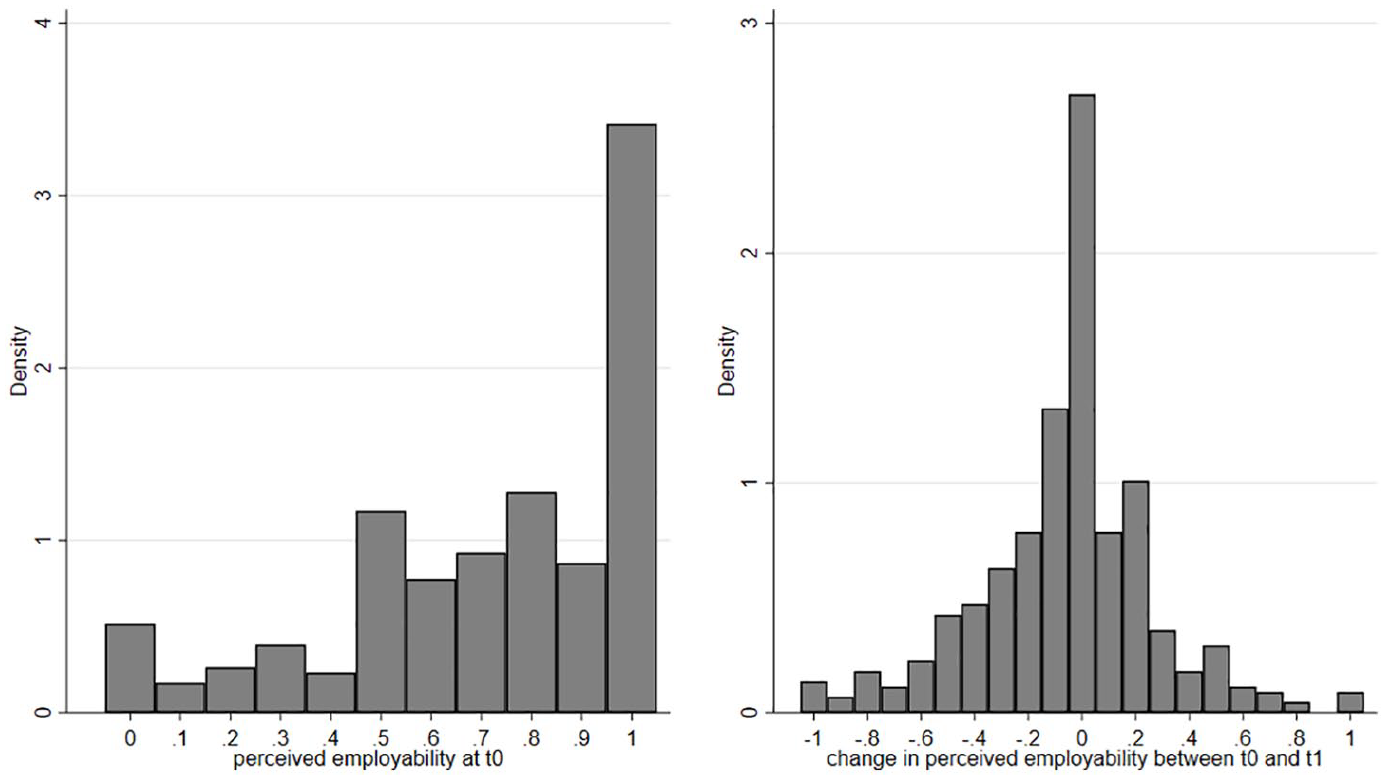
Histograms of perceived employability at t0 and change in perceived employability between t0 and t1.
Concerning formal education, we distinguish between four different levels according to the International Standard Classification of Education (ISCED) of 1997: 3 ISCED 0-2 (primary or lower secondary education), ISCED 3B (higher secondary education), ISCED 3A-4 (higher secondary education and post secondary education), and ISCED 5-6 (tertiary education, i.e. university degree or similar). The level of formal education is rather low in our sample (especially at t0), which accurately reflects the distribution of the variable in the population of young unemployed, as can be seen in Table A1 in the Appendix.
In this study, we are primarily interested in whether participating in some sort of educational activity between t0 and t1 or at t1 affects the change in PE. The variable ALMP training in t0–t1 measures if re-employment training was received during this period. ALMP trainings are assigned by the case workers in the public employment service, preferably to those young adults with a high probability of long-term unemployment. Hence, participation is usually not voluntary. Of the 625 second wave respondents, 34% had taken part in ALMP training in t0–t1 but already finished before t1, while 5% were still in training at the time of the second interview (t1); 31% of the respondents received short-term trainings of three months or less, while 9% participated in long-term activities of more than three months. The variable Education in t0–t1 denotes whether a respondent participated in any educational activities besides ALMP re-employment trainings (this was the case for 41% of the respondents in our sample, with some individuals participating in both ALMP training and a self-chosen educational activity in the period under review). 4 Such further education comprises of vocational training (as part of the dual educational track), secondary school, tertiary education, or some sort of (non-formal) specific occupational training (e.g. training for massage therapist, accounting). The unemployed usually self-organize the educational activity (but can be supported by case workers) and may apply to the public employment service for funding if necessary. We distinguish between past further education (if someone is no longer in education at t1, as was the case for 11% of the respondents), and current further education (if someone is still in education at t1, as was the case for 30% of the respondents). In addition, we account for the length of the educational activity (three months or less: 11%, more than three months: 30%).
In the regression analyses, we control for a number of further factors, which – as outlined in the theory section – have been found to affect (perceived) employability: number of friends (as an indicator for social capital), work centrality, self-efficacy, past labor market experience as an indicator for relevant skills (work experience, measured as the number of years previously employed) and socio-demographic characteristics like gender, age and migration background (cf. Berntson, 2008: 23–29). Details on the exact model specifications are given in the next section. Further information concerning the measurement of all variables is provided in the Appendix.
Analysis
As a first step, we test the effect of formal education on perceived employability among young unemployed. We estimate fractional logistic regression models with perceived employability at t0 as the dependent variable (see Table 1). 5 The first model only includes the dummy variables for the different educational levels, while the second model controls for other potentially influential variables. Both regression models are weighted using the weights for the first wave data as described in the last section (t0 weights). 6
Fractional logit regression on estimated probability of becoming employed in the desired occupation (PE) at t0.
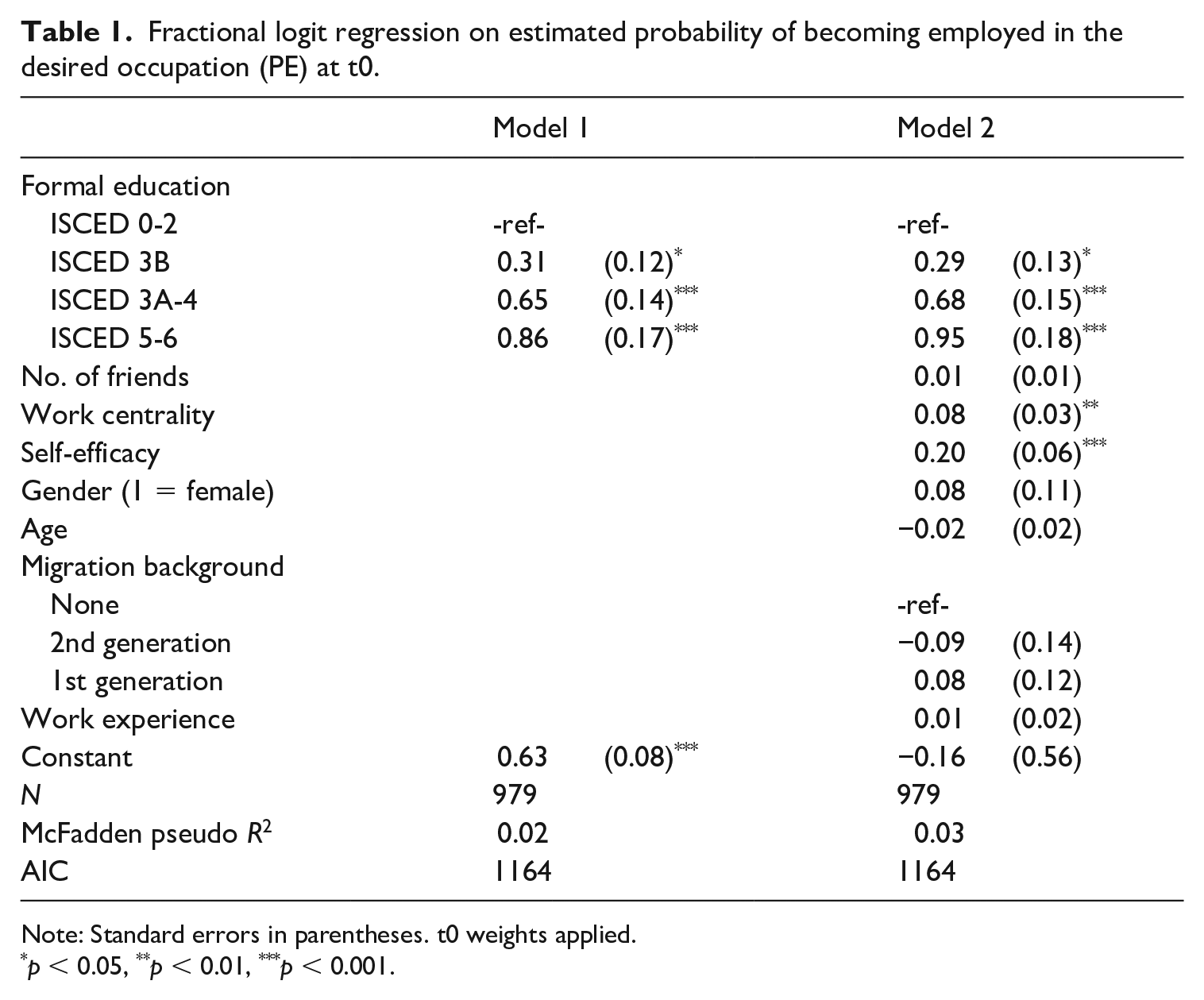
Note: Standard errors in parentheses. t0 weights applied.
p < 0.05, **p < 0.01, ***p < 0.001.
The regression analysis supports previous accounts in the literature regarding a positive effect of formal education. The higher the educational level completed, the higher the perceived employability. Further factors which prove to be of influence are work centrality and self-efficacy, while for example the number of friends, socio-demographic factors and the extent of previous work experience do not exhibit any notable effects in our model. 7
The effect of further education on the change in perceived employability between t0 and t1 is tested using a lagged dependent variable approach (Grill, 2017), i.e. we employ similar models as for the effect of education on perceived employability at t0, but now with perceived employability at t1 as the dependent variable, while controlling for the level of perceived employability at t0. This is equivalent to a model with change in perceived employability as the dependent variable controlling for perceived employability at t0 (i.e. a conditional change score model; Berrington et al., 2006). We include measures for education in the period from the first interview until the second, our main independent variables of interest. In Model 1 in Table 2, we distinguish between ALPM trainings and other types of further education. In Model 2, we further differentiate between current and past as well as short-term (⩽ 3 months) and long-term (> 3 months) educational activities. In both models, we include controls for demographic characteristics, number of friends, work centrality and work experience. Like the regression models for perceived employability at t0, the regressions on perceived employability at t1 are weighted, this time using the panel weights for the second wave (t1 weights). 8
Fractional logit regression on estimated probability of becoming employed in the desired occupation (PE) at t1 controlling for PE at t0.
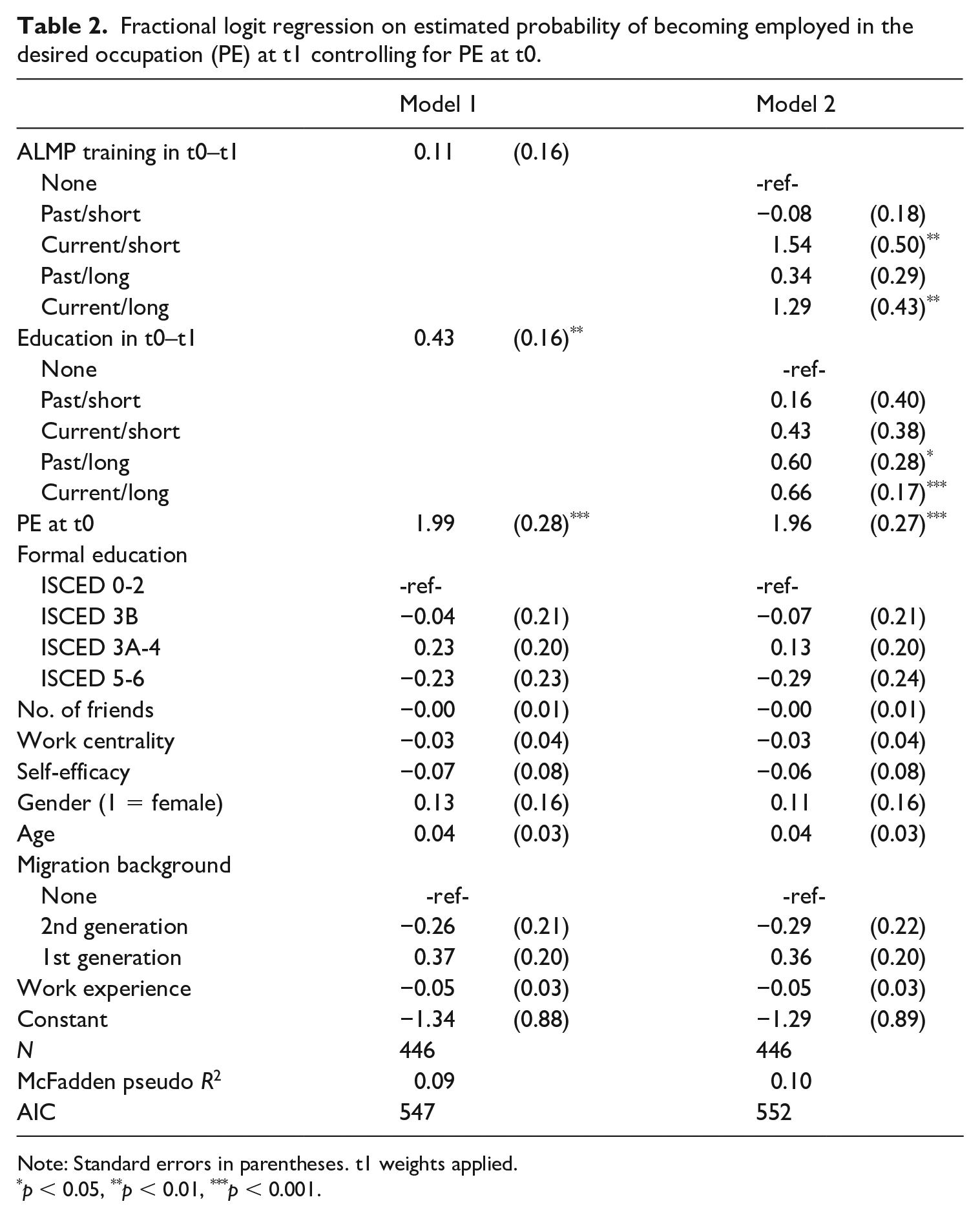
Note: Standard errors in parentheses. t1 weights applied.
p < 0.05, **p < 0.01, ***p < 0.001.
In Model 1, we do not find a significant positive overarching effect of ALMP training, but we do find one for other educational activities in the period t0–t1. However, Model 2 offers further important insights, which are illustrated in Figure 2. As can be seen, whether an ALMP training was still ongoing at t1 or already concluded made an important difference. Ongoing ALMP trainings have a statistically significant as well as sizable effect on perceived employability, notwithstanding whether they were short or long. For individuals who participated in an AMLP training activity at the time of the second interview, perceived employability at t1 was on average over 20% higher than for individuals who received no ALMP training. For those currently participating in a training activity, employability on average increased compared to t0, while decreasing for those who received no training or had concluded a short-term training before t1. Hence, the effect of current participation does not translate into a general significant effect of ALMP measures, as most respondents had already concluded their training at the time of the second interview – either returning back to NEET status, or to the labor market. In regard to other educational activities than ALMP trainings, the results indicate that duration is highly important for their effect on perceived employability. While the effect is not as strong as for ALMPs (just over 10% higher perceived employability for individuals participating in long-term activities compared to those who did not receive any further education in t0–t1), it does spill over to a general effect of educational (non-ALMP) activities, because most of these activities lasted for more than three months.
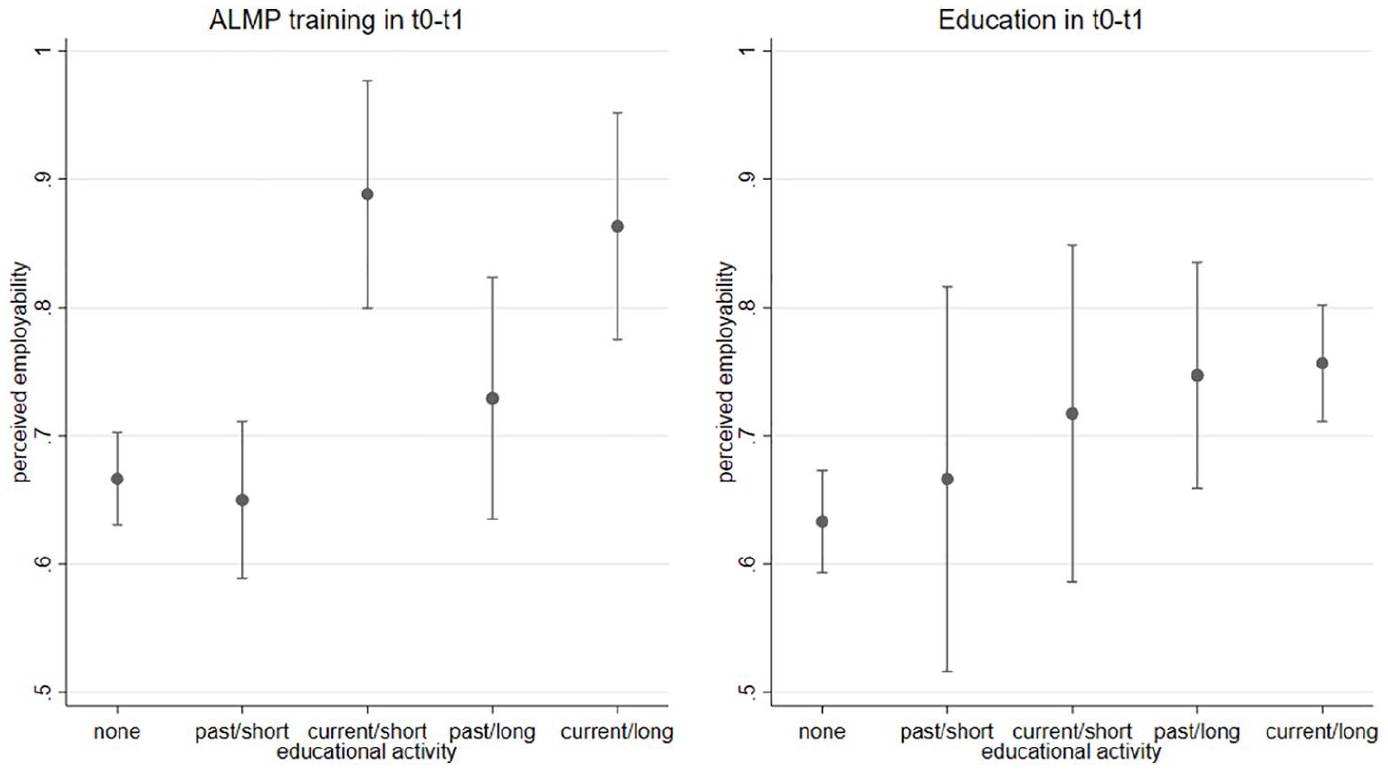
Predicted values for perceived employability at t1 dependent on whether someone participated in some form of ALMP training or further education in the period t0–t1.
The control variables (including the level of formal education) do not have any significant effects, indicating that they only influence perceived employability at t0, and do not affect the change in the dependent variable between t0 and t1. 9 Furthermore, controlling for the fact whether someone actually found a job in t0–t1 does not affect the results for ALMP training and further education (see Table A4 in the Appendix).
To sum up, we find support for the hypothesis that further education has a positive effect on the change in perceived employability and that this effect is on average stronger for self-organized educational activities than for ALMP trainings. We also find that duration matters – at least for education outside of ALMPs. For ALMP programs, there is a strong positive effect, which, however, is restricted to the duration of the program. This could also be due to the fact that ALMP trainings rarely last longer than three months.
Conclusion
Our study shows that education is closely linked to perceived employability among young adults with recent unemployment experience. Using data from an Austrian panel study on a sample of 18- to 28-year-olds who just became unemployed, we find that individuals with higher education perceived better chances to someday work in their desired occupation than those with low levels of formal education. Importantly, we also observe a positive effect of further education on changes in perceived employability in the year after becoming unemployed. On average, perceived employability declined during this period. However, if a person participated in further education (either on own initiative or as part of an active labor market program), his or her confidence to find suitable employment increased. However, we also find that the positive effects of the often short-term ALMP trainings wear off soon: someone who had participated in such an activity between the two interview waves, but was not doing so any longer at the time of the second interview, does not experience a significantly different change in perceived employability compared to someone who had not received any ALMP training. For other forms of further education, such as for example vocational training, schooling, or university studies, the effect depends not so much on whether the educational activity is still ongoing, but rather on the duration of the activity. For long-term education (i.e. more than three months), we find significant positive effects on the change in perceived employability.
As higher perceived employability may give rise to higher objective employability (Chen and Lim, 2012), our results are not only of importance for scientific research, but also for policy-makers. We offer empirical evidence for a positive effect of further education for young unemployed. Even the often spited re-employment trainings have the potential to boost the beliefs of young unemployed adults in their chances to find employment in their desired occupation – at least for the duration of the ALMP action. If this momentum of augmented optimism can be turned into increased motivation for job search and higher confidence displayed in job interviews, this may be an important avenue through which employment trainings offered by the public employment service can positively affect re-employment chances. At the same time, our findings indicate that voluntary and self-organized further education yields stronger effects on perceived employability than classic ALMP actions. Hence, such activities should be encouraged by case workers in the public employment service and funding opportunities should be expanded, especially because – as our results show – in order to be effective in the long run, educational activities should last at least a couple of months. Thereby, possible locking-in effects of such activities should of course be considered. However, if perceived employability indeed fosters search motivation and self-confidence, such locking-in effects can be offset by the increase in objective employability (cf. Card et al., 2017 on the positive effect of training programs in the medium and long run). Using the time during unemployment for further education and skill-acquisition may even help to reduce the scarring effects on the later career of young adults.
While this study provided evidence on the determinants of perceived employability in periods of unemployment, there is still much room for future exploration of the topic. First, while we focused on Austria, there is little reason why our results should not apply to other countries as well. Comparative research could, however, investigate potential differences caused by educational systems, labor market regimes or between coordinated and liberal market economies. Furthermore, as our findings do not necessarily pertain to young adults only, future research should explore potential effects of further education on older individuals. Additional potentially influential factors, e.g. effects of constraints/opportunities like sectoral labor market conditions or individual resources like cognitive abilities, are worth studying. Moreover, future research could strive to assess the relationship between perceived and actual employability. Finally, comparisons between employed and unemployed samples would also be of interest.
Footnotes
Appendix
Description of variables used in the regression models in alphabetical order.
Declaration of conflicting interests
The authors declared no potential conflicts of interest with respect to the research, authorship, and/or publication of this article.
Funding
The study is based on data from a panel survey which has been funded by the Austrian Federal Ministry of Labour, Social Affairs and Consumer Protection as part of the JuSAW project. Work on the article has been carried out as part of the CUPESSE project, which received funding from the European Union’s Seventh Framework Programme for research, technological development and demonstration under grant agreement no. 613257.
