




Abstract
This article examines the relationship between the deterioration of working conditions concomitant with macroeconomic turbulence and employees’ citizenship, i.e. discretionary effort, towards the organisation. In particular, this study focuses on teams and how to redress the employee backlash against the increasing adversity experienced. Having collected data from 151 employees in 23 Cypriot small and medium enterprise teams during a macroeconomic crisis, the findings demonstrate that adverse working conditions relate negatively to discretionary effort only for those teams with low and moderate levels of information sharing. The study highlights the vital role of team information sharing in dampening the negative workplace repercussions of a deeply recessional economy.
Keywords
If I give you all of my knowledge, I still have all of my knowledge left. (Mooji, 2010: 8)
Introduction
Employees exhibiting organisational citizenship behaviour directed towards the organisation (OCBO) exceed voluntarily their assigned duties and ‘go the extra mile’ with the intention to benefit their organisation by displaying civic virtue, loyalty and dedication (Lee and Allen, 2002; Organ et al., 2006; Podsakoff et al., 2009). OCBO relates to a number of employee and team outcomes, including individual and team task performance (e.g. Organ et al., 2006; Podsakoff et al., 2000, 2009, 2014), and has been recognised as an important coping mechanism to ‘workplace contingencies and change’ (Mossholder et al., 2011: 45). In the context of small and medium-sized enterprises (SMEs), OCBO is particularly important due to the paucity of resources relative to that of larger firms (Psychogios et al., 2019; Uçanok and Karabati, 2013) and hence, the imperative need for labour flexibility (Helfen and Schuessler, 2009; Mesu et al., 2012).
Macroeconomic turbulence heightens the vulnerability of SMEs (Prouska and Psychogios, 2018; Psillaki and Eleftheriou, 2015; Theodorakopoulos and Arslan, 2017) and may lead to adverse working conditions (AWCs), defined as the concurrent increase of workload, job insecurity and negative employer/manager behaviours (Psychogios et al., 2019). Although AWCs have been discussed substantively in extant studies (e.g. Kranz and Steger, 2013; Kroon et al., 2013; Naude et al., 2012), the literature on how AWCs influence OCBO in SMEs operating amid a national economic crisis is still in its infancy (Uçanok and Karabati, 2013). Indeed, our knowledge in crisis management literature of employee rather than manager or owner-related factors that may play an important role in the relationship between AWCs and OCBO remains limited (Psychogios et al., 2019). Furthermore, despite the acknowledgement that not all SMEs (and the teams within them) are equally exposed to a turbulent wider context (Låstad et al., 2018), there is a paucity of research accounting for differences among SMEs and their teams.
The aim of this study is to address the abovementioned gaps by examining the role of team information sharing in the relationship between AWCs and OCBO in SME teams operating under a macroeconomic crisis. In particular, this article sheds light on information as a highly valuable interpersonal resource, the exchange of which entails little risk for both the giver and the receiver (Foa and Foa, 1974; Wilson et al., 2010). Although the exchange of other resources, such as goods or services, is accompanied by a loss or a gain, sharing information even under a turbulent and insecure climate is a neutral action, as the giver maintains the same amount of the resource exchanged and thus is neither impaired nor enriched (Foa and Foa, 2012). We are particularly interested in team information sharing, i.e. the exchange of ‘advice, opinions, instruction, or enlightenment’ (Foa and Foa, 2012: 15) among the members of a team (Hu et al., 2018), not only as it relates to teams’ cohesion, shared understanding and performance (e.g. Mesmer-Magnus and DeChurch, 2009) but also because it helps build and sustain psychological safety and trust among the team members (Mesmer-Magnus et al., 2011), even in highly turbulent situations (Uitdewilligen and Waller, 2018). We focus on teams and team members’ experienced intensity of AWCs concomitant to external economic turbulence, as opposed to targeting SMEs under pressure per se: firstly, because teams are key contributory work units (Tu et al., 2019) and secondly, in view of the fact that even within the same firm different teams experience contrasting working conditions (Amabile et al., 1996). Our core argument is that although it is likely for team members in a buoyant economy to exhibit discretionary behaviour towards the SME, in times of national economic turbulence where working conditions have worsened significantly, they may be less willing to do so. Moreover, we hypothesise and find empirical support that team information sharing buffers the negative relationship between AWCs and OCBO, as it helps alleviate the risk involved with exhibiting OCBO and thus disadvantaging oneself vis-a-vis other team members. Figure 1 depicts the conceptual model of the study.
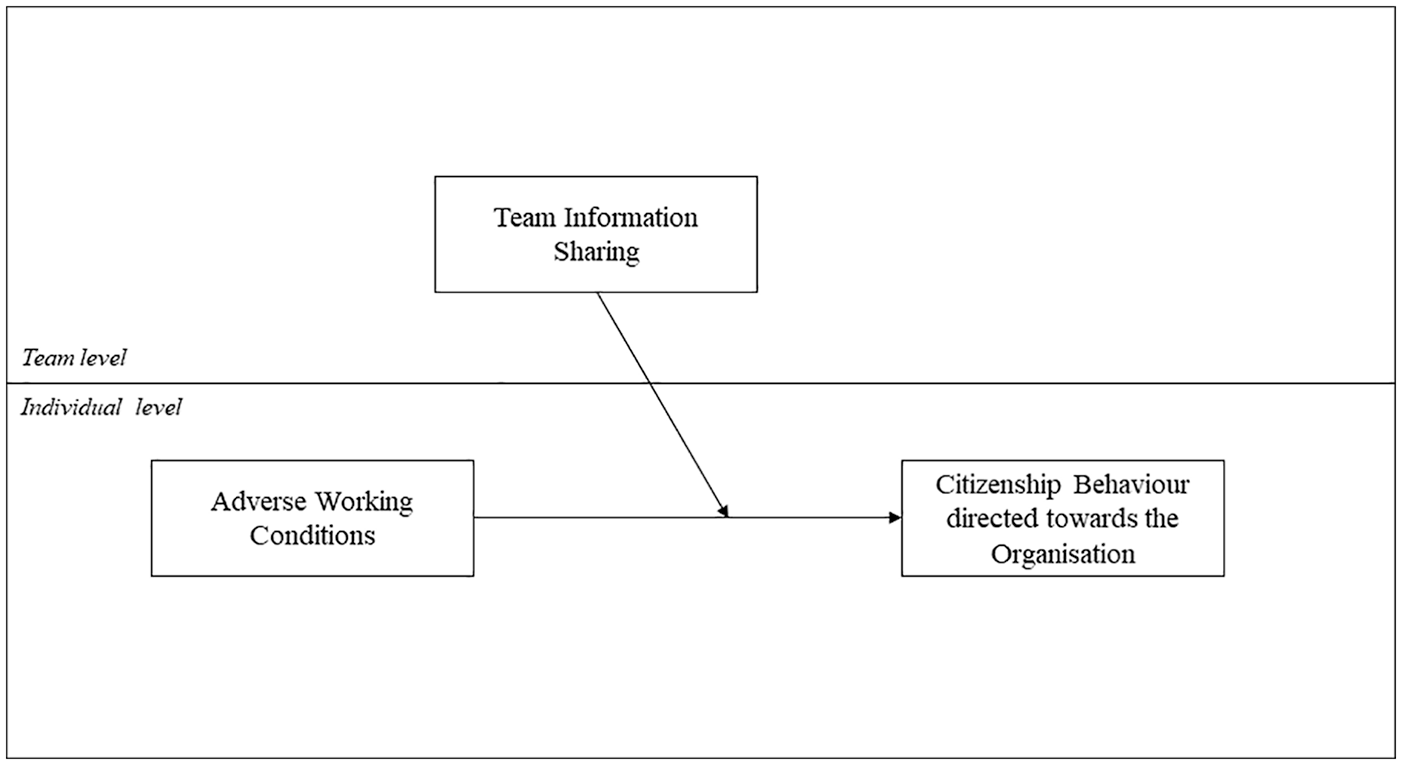
Conceptual model of the hypothesised relationship between AWCs, OCBO and team information sharing.
The study intends to make three contributions to the literature. First, in terms of context by focusing on the way in which a national economic crisis has unfolded for team members in SMEs, we offer an employee-centric approach to complement a wealth of literature that mainly focuses on SME crisis management from a management or owner perspective (e.g. Doern, 2016; Williams and Vorley, 2015). We do so by conducting our study with SME teams in Cyprus during the country’s most recent significant economic recession, which is a pertinent research setting. Second, our study extends recent work on AWCs that has focused solely on a single hierarchical level (Conway et al., 2014; Psychogios et al., 2019). In particular, we employ naturally nested data and multilevel modelling to account for variances in the experience of adversity and hardship among employees in different teams and hence, conduct a more rigorous examination of the relationship between AWCs and OCBO. Third, we contribute to theory on different resource exchange rules (Cropanzano and Mitchell, 2005) by identifying team information sharing as an alleviating resource to the employee backlash over the deterioration of working conditions. In so doing, we provide an explanation for previous inconsistent findings in terms of the relationship between AWCs and OCBO (Psychogios et al., 2019).
The rest of the article is organised as follows: first, we provide the theoretical background of the study and set out our hypotheses. Thereupon, we delineate the methodology adopted and present the findings. Finally, we discuss the theoretical and practical implications of the study, as well as the limitations and avenues for future research.
Theoretical context and hypotheses development
Adverse working conditions
Responding to financial pressures, as a consequence of operating within an economy under turbulence, organisations often develop short-range, defensive policies and drastic measures that lead to a severe deterioration of working conditions (Gialis et al., 2017; Markovits et al., 2014; Roche et al., 2011). Such survival strategies are even more pronounced in SMEs (Prouska and Psychogios, 2018; Wymen et al., 2012), whereby workforce adjustments, salary cuts and wage freezes tend to be the most commonly used methods to deal with the challenges of a nationwide economic turbulence (Antonioli et al., 2009; Guthrie and Datta, 2008; Iverson and Zatzick, 2011). Psychogios et al. (2019) identified three main elements of adverse working conditions in the workplace: cost reduction strategies that lead to increased workload, negative employer attitudes and job insecurity. The increased workload can mainly be explained by the downsizing of staff in combination with an effort to maintain the volume of operations as close as possible to pre-crisis levels (Datta et al., 2010; Mohrman and Worley, 2009). Conversely, the expectations for the SME employees are increased substantially due to pressures imposed by a national economic crisis or severe recession (Kroon et al., 2013). In particular, employees face pressures to meet shorter deadlines and work longer, often unpaid hours (Kroon et al., 2013; Shah et al., 2011). Moreover, they may encounter destructive supervisory behaviours that may take many forms, including verbal and physical assaults, or psychological abuse (Bartlett and Bartlett, 2011; Bible, 2012; Giorgi et al., 2015). Furthermore, during an economic crisis job insecurity prevails (Berntson et al., 2006; Wynen and Op de Beeck, 2014), as employees increasingly witness lay-offs (Arghyrou and Tsoukalas, 2010) and the prospects of finding alternative employment decrease sharply (De Cuyper et al., 2012). All in all, AWCs render employees deprived of both financial resources (e.g. unpaid hours and salary cuts) and status-related ones (e.g. being subject to abusive supervision and job insecurity; Foa and Foa, 2012).
Adverse working conditions and OCBO
Τhe literature suggests that affiliation and informality in SMEs play a crucial role in employees exhibiting OCBO (Bacon and Hoque, 2005; Edwards and Ram, 2009; Marlow et al., 2010). It is perhaps this informality along with close social and spatial proximity among individuals (employees and owner/managers) that creates a close-knit work community, or a ‘family’ as it has often been portrayed, which strongly identifies with the organisation (Gilman et al., 2015; Mallett and Wapshott, 2014) and is willing to go the extra mile (Molm, 2003). However, it is less clear whether loyalty and discretionary effort remain prevalent in SMEs when heightened AWCs concomitant of a national economic crisis prevail. Increased workload and pressure to perform have been linked to decreased job engagement (Nahrgang et al., 2011), while role overload, abusive supervision and job insecurity have been found to relate negatively to OCBO (Ahmad et al., 2019; Kuvaas and Dysvik, 2011; Stynen et al., 2015). Indeed, OCBO entails a certain risk from the helper’s point of view, in that the beneficiary is offered an advantage in relation to the benefactor (Shen and Benson, 2016). While in a buoyant economy employees may be willing to undertake such risk-taking in view of the long-term gains of loyalty and civic virtue, resource deprivation and redundancy prospects influence the different types of exchange in the workplace (Wilson et al., 2010). Under a macroeconomic turbulence, employees may be more likely to select a rational course of action that is based on carefully encountering the foreseen consequences (Meeker, 1971).
In particular, in an economic recession, expectations increase (Kroon et al., 2013), while the working conditions worsen (Datta et al, 2010; Mohrman and Worley, 2009; Psychogios et al., 2019). Moreover, given the typically informal nature of HR practices and the paucity of resources in SMEs in contrast to their large counterparts (Theodorakopoulos and Arslan, 2017), the adversity of working conditions may even be further exacerbated (Psychogios et al., 2014; Wymen et al., 2012). Arguably then, under external turbulence, employees may be less willing to get involved in risky exchanges (such as OCBO), because they may not only be insecure or uncertain of the long-term gains of such behaviour (Wong et al., 2005) but also disadvantage themselves in the short-term vis-a-vis their colleagues by focusing on behaviours not directly related to their performance appraisal (König et al., 2010). Indeed, Wong et al. (2005) demonstrated that during adversity employees tend to operate more rationally and adopt a short-term perspective. Thus, it is possible that amid redundancies and lay-offs employees may focus on those tasks and activities that are more likely to increase their chances of keeping their jobs rather than on extra-role performance. Further still, the deteriorated working conditions that emerge during an economic crisis and remain for a period of time thereafter make employees feel less loyal and less willing to embrace citizenship behaviours (Furåker, 2009; Markoczy et al., 2009; Psychogios et al., 2019), since ‘mutually beneficial interchanges are less likely to be engendered when people are transacting in harm’ (Cropanzano et al., 2017: 480). Therefore, based on the premise that not only the OCBO-related risk would be accentuated but also employees’ allegiance to the organisation would be attenuated in SMEs operating under economic crisis conditions, we advance the following hypothesis:
Hypothesis 1. Adverse working conditions are negatively related to organisational citizenship behaviour directed to the SME.
The moderating role of team information sharing
Team information sharing is a social exchange ‘involving the introduction of members’ individual held knowledge into the team’s public space’ (Uitdewilligen and Waller, 2018: 732). It derives through the network of relationships and the links among team members (Leana and Pil, 2006; Nahapiet and Ghoshal, 1998) and varies among teams within the same organisation (Schreurs et al., 2013). According to Mesmer-Magnus and DeChurch (2009: 541), greater volumes of information sharing within a team enable greater ‘collective processing’. Team information sharing flows from a sense of ‘we-ness’, that is a feeling of belonging and common purpose (Lee and Markham, 2013: 188), and helps build and sustain psychological safety and trust among the team members (Mesmer-Magnus et al., 2011). Employees feel they are significant contributors in contexts where information is shared freely (Pfeffer, 1998), while they are in a better position to select the right course of action in comparison to others who work in contexts with impaired information sharing (Chiaburu and Harrison, 2008; Kuvaas and Dysvik, 2010). Team information sharing has been consistently linked to effective teamwork (DeChurch and Mesmer-Magnus, 2010) and in particular, to work outcomes such as team performance (Mesmer-Magnus and DeChurch, 2009), team creativity (Hu et al., 2018) and learning (De Dreu, 2007). Notably, different streams of literature have highlighted the importance of team information sharing for team effectiveness in highly uncertain and critical contexts (e.g. Katakam et al., 2012; Ley et al., 2014; Uitdewilligen and Waller, 2018).
The above attributes may render team information sharing particularly instrumental in times of national economic turbulence, insecurity and resource scarcity. In line with social exchange theory, not only does the value of a resource increase the less likely it is to be accessed from different sources, but also employees under hardship may benefit to a greater extent from access to a resource that improves their working conditions (Anand et al., 2010), such as team information sharing. Indeed, the sense of ‘we-ness’ and collective processing may help ease the risk involved with exhibiting OCBO, including disadvantaging oneself against one’s team members. In addition, gaining more information offers team members a greater sense of control and thus may counterbalance fears of losing one’s job (König et al., 2010). In other words, the negative relationship between AWCs and OCBO may be less acute in teams with high rather than low information sharing. For example, it is less likely for employees to be keen to go the extra mile for their employer who has recently reduced their salary. However, those in teams with high information sharing may find out from their team members that they all received a similar reduction, thus resulting in their behaviour towards their employer being less influenced by the increase of AWCs.
Based on the above, we hypothesise that in SME teams operating under an economic crisis:
Hypothesis 2. The higher the level of team information sharing the weaker the relationship between adverse working conditions and organisational citizenship behaviour.
Methods
Survey context
Cyprus entered a severe economic crisis, starting in 2012, as a result of the Eurozone financial crisis and particularly the Greek crisis that provoked around €4 billion in losses for Cypriot banks, i.e. approximately 22% of the country’s gross domestic product (GDP; Demetriades, 2017). During this crisis, the public finances also deteriorated and the debt-to-GDP ratio rose to 108% in 2015 (Eurostat, 2019). Overall, in the period 2011–2014, the economy shrank by 11% and unemployment rates peaked at 17% (Panayi and Zenios, 2015). In SMEs, in particular, employment fell by 14.1% in 2014 alone (Muller et al., 2015), while the number of business bankruptcies and involuntary cessations remained high in comparison to pre-crisis levels (Muller et al., 2016).
Notably, the majority of SMEs in Cyprus are family-owned with a long tradition of paternalism and little legislative enforcement. They tend to rely on a quasi-formal system with voluntary HR practices, significant wage informalisation and limited structures for social dialogue (Stavrou-Costea, 2004). This is a common feature among Southern European countries (Psychogios et al., 2014). In that regard, Cyprus represents an instrumental setting or a case of what may be (Stake, 1995) due to not only the profound impact of the economic crisis for SMEs but also the paramount importance of SMEs for the national economy. It is noteworthy that 99.8% of organisations in Cyprus are categorised as SMEs; they represent 73% of the added value to the economy and account for more than 80% of jobs in the country (Muller et al., 2015).
Sample
As our hypotheses proposed an individual-level relation and a cross-level interaction, we adopted a survey research design that would allow the analysis of the two levels, i.e. employees within teams. In doing so, we administered a questionnaire to 220 employees in 33 teams, each in a different Cypriot SME operating in manufacturing, professional services and retail. The data were collected from December 2015 to January 2016, while Cyprus was still under the European Union/International Monetary Fund bailout programme. Overall, we received back 151 fully completed questionnaires from 23 Cypriot firms. On three occasions, we collected data from all the employees, because the firms were so small (i.e. N < 5) that all the members were working together as a team. Almost half of the sample was comprised of female participants (49.7%), with 62.3% of the sample coming from the services industry, 23.8% from the manufacturing industry, and 21% from the retail industry; 42.4% of the participants were employed in micro-enterprises of fewer than 20 employees, 39.1% were above 45 years old, and 29.1% indicated an organisation tenure of more than 10 years. The number of participants per team ranged from 2 to 24 with an average number of 6.56 participants per team.
Measurement variables
We used already validated measures and Brislin’s (1980) translation-back-translation technique for the administration of the questionnaires in the Greek language. All variables, unless otherwise stated, were measured on a seven-point Likert scale (from 1 = Totally disagree to 7 = Totally agree).
Employees’ perceptions of AWCs were measured using Psychogios et al.’s (2019) four-item scale. The participant employees were asked whether they had experienced certain adverse conditions in their workplace in the past two years and their answers could range from 1 = Not at all to 7 = Almost every day. Sample items included ‘Cuts in financial resources (salaries, bonuses, resources for training and development)’ and ‘Fear of losing your job’. The scale achieved a Cronbach’s alpha reliability of α = .83.
We used the eight-item scale developed by Lee and Allen (2002) to measure employees’ OCBO. Sample items included: ‘Take action to protect the organisation from potential problems’ and ‘Attend functions that are not required but that help the organisational image’. The alpha reliability for our sample was α = .89.
Team information sharing was measured using Hyatt and Ruddy’s (1997) six-item scale, which achieved an alpha reliability of α = .82. Sample items contained: ‘Employees in my work group engage in open and honest communication with one another’ and ‘Employees in my work group keep each other informed at all times’. We also calculated rwg(j) = .84, ICC(1) = .16 and ICC(2) = .55, which denoted strong within-team agreement, and adequate between-team variance and within-team consistency respectively.
We controlled for firm size, age and tenure, as they have been found to play a significant role in employees’ OCB (e.g. Kidder, 2002; Williams et al., 2002), as well as for industry type to avoid any confounding effects. This approach has been adopted in many studies undertaking hierarchical linear modelling (e.g. Cruz and Pil, 2011; Judge and Cable, 2011; Wu and Chaturvedi, 2009).
We also conducted confirmatory factor analysis (CFA) to assess the validity of the factor structure. In particular, we examined whether the hypothesised three-factor structure is a better fit than a two-factor structure (where team information sharing and OCBO are considered as a single factor) and a one-factor structure (where all three variables are considered as a single factor). In this regard, we employed the technique of item parcelling (e.g. Little et al., 2002) and examined the chi-square differences between each model and also the goodness of fit indices: root mean square error of approximation (RMSEA), standardised root mean square residual (SRMR), comparative fit (CFI), and the Akaike information criterion (AIC). As Table 1 demonstrates, the hypothesised three-factor model achieved a very good fit to the data (χ2(11) = 16.22, p < .001, RMSEA = .056; SRMR = .024; CFI = .990) and was significantly better than a two-factor (χ2(13) = 119.58, p < .001, RMSEA = .233; SRMR = .124; CFI = .792) and one-factor model (χ2(14) = 1569.27, p < .001, RMSEA = .259; SRMR = .122; CFI = .723).
Confirmatory factor analysis results for the hypothesised variables.
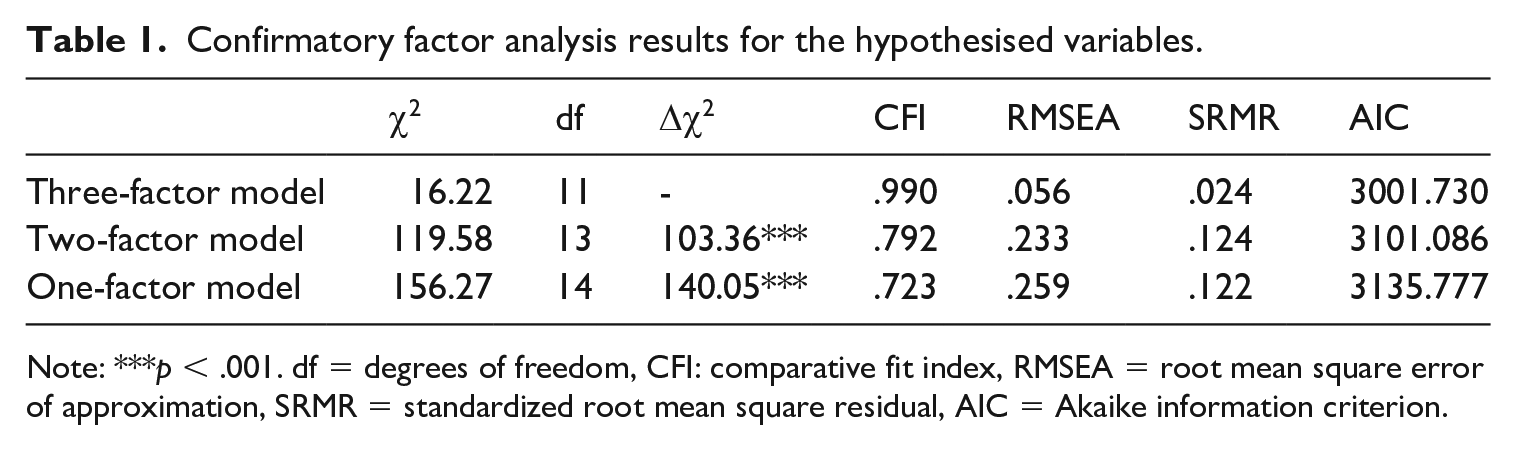
Note: ***p < .001. df = degrees of freedom, CFI: comparative fit index, RMSEA = root mean square error of approximation, SRMR = standardized root mean square residual, AIC = Akaike information criterion.
Data analytic method
We adopted hierarchical linear modelling and the HLM 7 software (Raudenbush et al., 2016) to test our hypotheses. Overall, our model comprised level-1 constructs (i.e. referring to individual members) and level-2 constructs (i.e. referring to the team as a whole). In particular, following recommendations by Hofmann (1997) and Aguinis et al. (2013), we tested our first hypothesis employing the random coefficient model (after we conducted a one-way analysis of variance). Thereafter, we examined our second hypothesis (cross-level interaction effect of team information sharing) by employing both the intercept and the slope-as-outcome models. AWCs was group-mean centred and team information sharing was grand mean-centred.
Analysis and results
Table 2 demonstrates the means, standard deviations and correlations of the variables of the study.
Means, standard deviations and correlations.
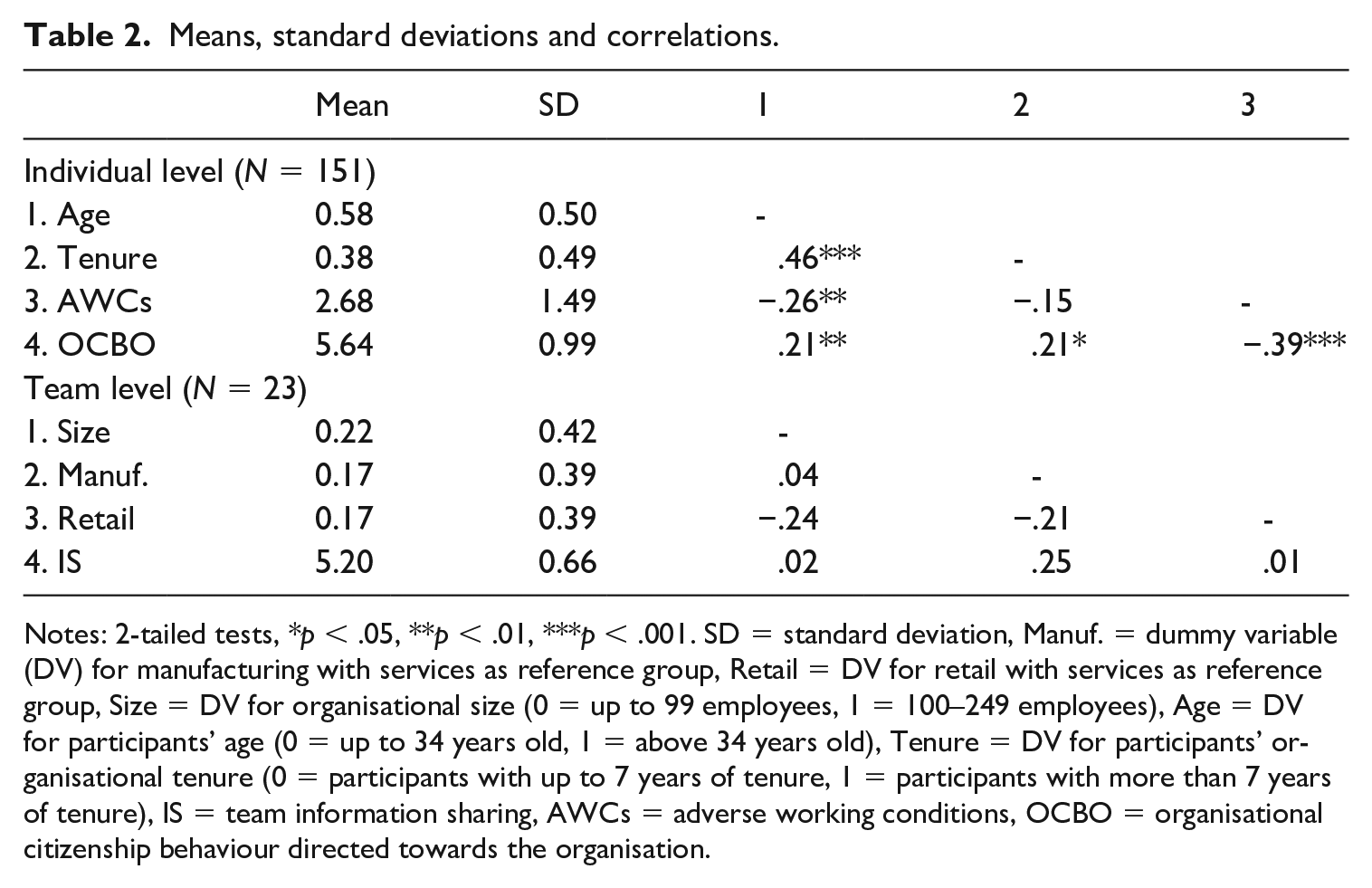
Notes: 2-tailed tests, *p < .05, **p < .01, ***p < .001. SD = standard deviation, Manuf. = dummy variable (DV) for manufacturing with services as reference group, Retail = DV for retail with services as reference group, Size = DV for organisational size (0 = up to 99 employees, 1 = 100–249 employees), Age = DV for participants’ age (0 = up to 34 years old, 1 = above 34 years old), Tenure = DV for participants’ organisational tenure (0 = participants with up to 7 years of tenure, 1 = participants with more than 7 years of tenure), IS = team information sharing, AWCs = adverse working conditions, OCBO = organisational citizenship behaviour directed towards the organisation.
Our first hypothesis, which stated that AWCs are negatively related to OCBO, was supported by the findings (β = –.25, p < .001) as per Table 3 (Model 2). We then tested our second hypothesis, according to which team information sharing plays a moderating role in the abovementioned negative relationship. As Table 3 illustrates (Model 4), the interaction between team information sharing and AWCs was significant (β = .48, p < .05). Simple slope analysis revealed that the negative relationship between AWCs and OCBO is significant only for low (β = –.51, p < .001) and moderate (β = –.19, p < .05) levels of team information sharing. High levels of team information sharing render the relationship between AWCs and OCBO insignificant (β = .13, p > .05). Figure 2 depicts the relationship between AWCs and OCBO for different levels of team information sharing.
Hierarchical linear modelling analysis for OCBO.
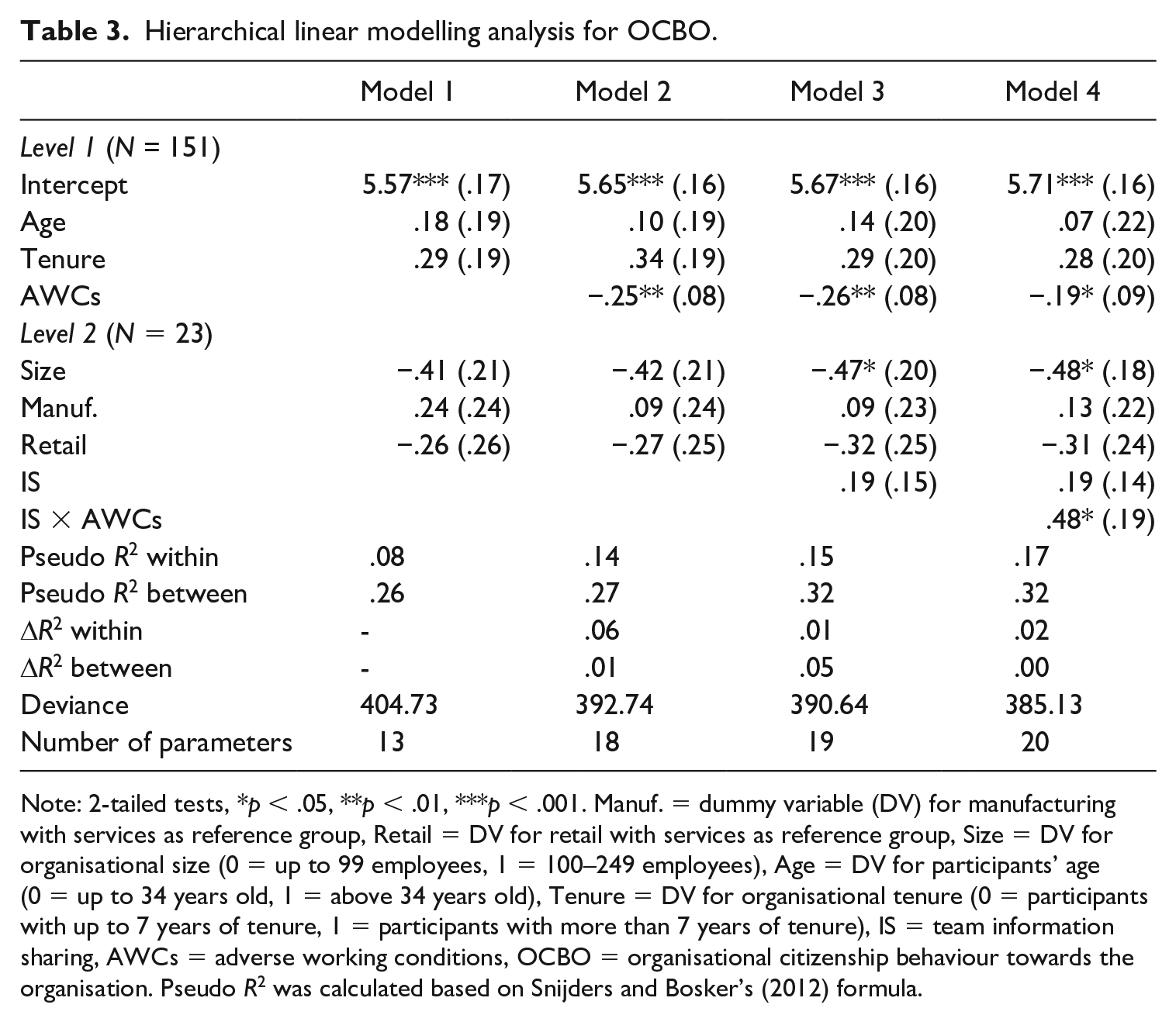
Note: 2-tailed tests, *p < .05, **p < .01, ***p < .001. Manuf. = dummy variable (DV) for manufacturing with services as reference group, Retail = DV for retail with services as reference group, Size = DV for organisational size (0 = up to 99 employees, 1 = 100–249 employees), Age = DV for participants’ age (0 = up to 34 years old, 1 = above 34 years old), Tenure = DV for organisational tenure (0 = participants with up to 7 years of tenure, 1 = participants with more than 7 years of tenure), IS = team information sharing, AWCs = adverse working conditions, OCBO = organisational citizenship behaviour towards the organisation. Pseudo R2 was calculated based on Snijders and Bosker’s (2012) formula.
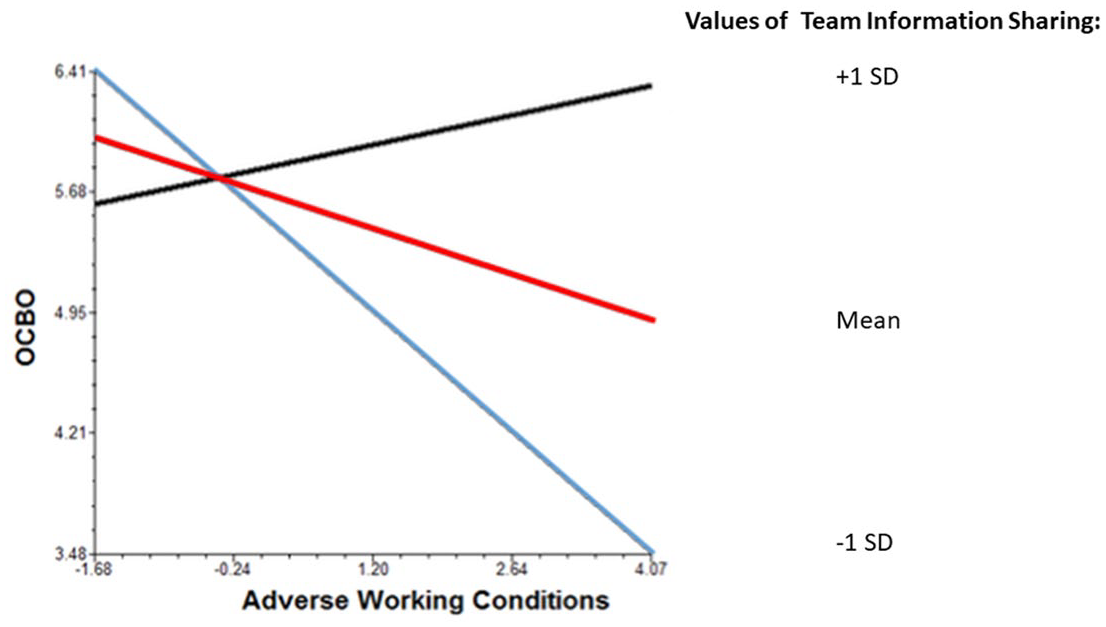
The moderating role of team information sharing in the relationship between AWCs and OCBO.
Discussion
The aim of this study was to investigate the role of team information sharing in the relationship between AWCs and OCBO in SME teams operating within the context of a national economic crisis. In line with our hypotheses, the findings reveal that the more adverse the working conditions are in a team, the less likely it is for the team members to engage in discretionary behaviour towards the firm. Yet, the findings also demonstrate that this negative relationship between AWCs and OCBO is weaker the higher the information sharing within a team. In particular, in teams where employees reported low levels of information sharing, AWCs were severely and negatively related to discretionary behaviour towards the firm. In teams with moderate levels of information sharing, AWCs were still negatively but less severely related to discretionary behaviour. Finally, in teams with high levels of information sharing, the relationship between AWCs and OCBO was positive but insignificant. In other words, in teams with high levels of information sharing, members’ involvement in OCBO was not related to the prevailing AWCs.
The study makes a significant contribution to the SME crisis management literature (e.g. Doern, 2016; Williams and Vorley, 2015) by adopting an employee-centric approach in extending our knowledge on the impact of a national economic crisis in the workplace. Specifically, while the majority of past studies elaborated on SME crisis management at a firm level (e.g. Irvine and Anderson, 2004; Runyan, 2006; Williams and Vorley, 2015) or from an owner/manager perspective (Cardon et al., 2011; Doern, 2016), our study focuses on employees, and in particular on their OCBO. In this respect, the study challenges the received view of SMEs in the extant literature, which portrays a family-like, close-knit environment (e.g. Gilman et al., 2015; Mallett and Wapshott, 2014; Mesu et al., 2012). Indeed, the findings highlight that hardship and adversity are related to decreased citizenship behaviour directed towards the firm.
In addition, we contribute to the literature on AWCs by turning the attention to team-related resources and responding to calls for research at different organisational levels (Låstad et al., 2018; Prouska and Psychogios, 2019). Previous studies have largely ignored team membership and team-level factors that may play a significant role in achieving work-related outcomes under adversity. Furthermore, teams within an SME experience dissimilar working conditions and levels of information sharing (Amabile et al., 1996; Schreurs et al., 2013), rendering the individual observations non-independent (Låstad et al., 2018; Wieseke et al., 2008). By employing multilevel analysis and accounting for the variance attributed to the different experience of members in different teams, our study contributes to a more robust examination of the way in which AWCs relate to citizenship behaviour in SMEs.
Moreover, our study heeds calls for additional studies on resource exchanges (Chambel and Alcover, 2011; Cropanzano and Mitchell, 2005; Wilson et al., 2010). In this regard, we expand this stream of research into recessional contexts and examine the role of information sharing as an important team resource in SMEs. In line with studies that highlight the significance of sharing business-related information among employees for the competitiveness of SMEs (e.g. Richbell et al., 2010), our work explicates the way in which team information sharing attenuates the backlash in employees’ discretionary effort due to the deterioration of working conditions. Indeed, our findings could be used to shed light on the non-significant direct relationship between AWCs and OCBO found in Psychogios et al.’s (2019) study, as it is possible that the majority of the participants in that research were part of teams with high information sharing.
Furthermore, our findings have strong practical implications. In particular, SME owners/managers and human resource (HR) practitioners in larger SMEs are encouraged to facilitate information sharing among team members as a way to alleviate the repercussions of AWCs stemming from a turbulent economic environment. While the end game for SMEs is financial performance, employees having a productive and pleasant atmosphere should not be underestimated (Collins and Smith, 2006). A way in which SMEs may encourage team information sharing and exchange is through the establishment of people-oriented HR initiatives that highlight mutual gains through long-term exchanges (Collins and Smith, 2006). However, given that not many SMEs establish HR departments (Theodorakopoulos and Arslan, 2017), in times of turbulence when resources are scant, promotion of information sharing within teams may be more attainable through informal and ad hoc routes, such as role modelling and mentoring. On this note, information sharing may be emphasised through the design of meaningful, challenging and diverse tasks, which empower team members by giving them a range of choices in exchanging information, as well as recognition of effort and progress (Nerstad et al., 2018).
Limitations and future research
Notwithstanding the abovementioned contributions of the study, it is important to acknowledge certain limitations and avenues for future research. Firstly, the study adopts a cross-sectional research design and therefore inferences on causality are limited. Whether one can cogently justify OCBO as an antecedent of AWCs is a moot point; yet, several studies have used working conditions as an antecedent in the literature (e.g. Sayin et al., 2019; Seidler et al, 2014; Sora et al., 2019). Future research may opt to follow a longitudinal design, in which team members report on working conditions at Time 1, on team information sharing at Time 2 and on their OCBO at Time 3, to increase confidence over the direction of the hypothesised relationship.
Secondly, since we relied on self-reported measures for all study variables, we cannot rule out the influence of common method bias on our findings (Podsakoff et al., 2012). Future studies would benefit from collecting data using multiple sources and/or at multiple time points in order to address this caveat. That said, we undertook several approaches to remedy this potential shortcoming of our study. In particular, we separated the scales under examination in the survey questionnaire by adding additional scales in between them and highlighting the confidentiality, anonymity, and voluntary character of the study. Furthermore, the scales employed in our study use a different reference point. Participants were asked to rate their workplace in terms of AWCs, their team members in terms of information sharing and themselves in terms of OCBO. Finally, we conducted a CFA that supported the hypothesised factor structure of the model.
Thirdly, although we are not aware of any job guarantees provided to the team members by the participant firms and while close relatives or owners were excluded from the study, it is possible that there may be some other policies or practices that influence both information sharing among team members and OCBO. As these initiatives are likely to be informal and ad hoc (Mallett and Wapshott, 2014; Marlow et al., 2010), future studies may choose to examine them by adopting a diary study research design that enables the identification of influences from short-term processes and procedures (Ohly et al., 2010).
Another avenue for future research is the identification of factors alternative to team information sharing that may help counteract the backlash in employees’ OCBO due to the deterioration of working conditions. For example, a team learning climate could trigger employees’ state learning goal orientation (Dragoni, 2005), helping employees perceive the various challenges as an opportunity to further learn and grow and thus be more willing to go the extra mile for their employer due to being less concerned about antagonistic behaviours. In addition, the owner/manager’s support could play a significant role in the way in which employees perceive AWCs in the workplace. Indeed, research has demonstrated that although highly challenging working conditions (including a hazardous environment and high frequency of critical incidents) are positively related to employees’ absenteeism when peer norms are present, the relationship is rendered insignificant when employees report high levels of supervisor support (Biron and Bamberger, 2012). Hence, future studies may focus on the support provided by the SME owner/manager as an alternative potential moderator that could lessen the negative impact of AWCs in the workplace.
Conclusion
The aim of this article was to enhance our limited knowledge of the relationship between AWCs and OCBO by examining how the relationship may be ameliorated. In this respect, we hypothesised team information sharing as an alleviating factor and tested our hypotheses in SME teams in Cyprus, operating within a turbulent economy. The findings revealed that the higher the information sharing that takes place among team members, the weaker the negative relationship between AWCs and OCBO. All in all, the contribution of our study is threefold. First, it contributes to the SME crisis literature by identifying remedial employee-centric responses. Second, it applies a more robust investigation of the relationship between AWCs and OCBO by employing multilevel modelling and thus taking into account the variance across different SME teams. Third, it extends our understanding of resource exchange rules highlighting the importance of team information sharing as an assuaging practice that moderates the negative OCBO repercussions of a national economic crisis.
Footnotes
Declaration of conflicting interests
The authors declare that the original submission was presented at the 80th Annual Meeting of the Academy of Management.
Funding
The authors received no financial support for the research, authorship, and/or publication of this article.
