




Abstract
Although studies have signaled a gap in trade union representation between workers with secure employment (i.e., ‘insiders’) and those without (i.e., ‘outsiders’), this gap has rarely been empirically analyzed at the micro-level. With recent micro-level data from the Netherlands, this study addresses two questions. First, to what extent do insiders and outsiders, measured through individuals’ employment status and self-perceived social risk, differ in their willingness/probability to join trade unions? Second, to what extent can these differences in trade union membership be explained as resulting from perceptions of interest representation and/or workplace social cohesion? The results suggests a clear insider–outsider gap in trade union membership related to employment status, but not to social risk. Furthermore, this gap can be explained by differences in perceptions of representation, but not workplace social cohesion.
Introduction
As in the majority of post-industrial democracies (Schnabel, 2013), trade unions in the Netherlands have witnessed a substantial decline in membership (Schnabel, 2013; Visser, 2011). One of the greatest challenges to trade unions has been the flexibilization of labor markets (Baglioni and Crouch, 1990). Since the 1980s in many European countries, including the Netherlands, employment protection legislation has been relaxed (cf. Gumbrell-McCormick, 2011). Consequently, the number of workers in Europe on secure and permanent contracts has dropped, and the number of individuals working on short-term, temporary contracts has increased substantially. The Netherlands are a textbook example in which the ‘standard worker’ (i.e., employees with a full-time, permanent contract) is decreasingly the standard as the share of fixed-term employees and the share of solo self-employed individuals has increased rapidly (see Figure 1).
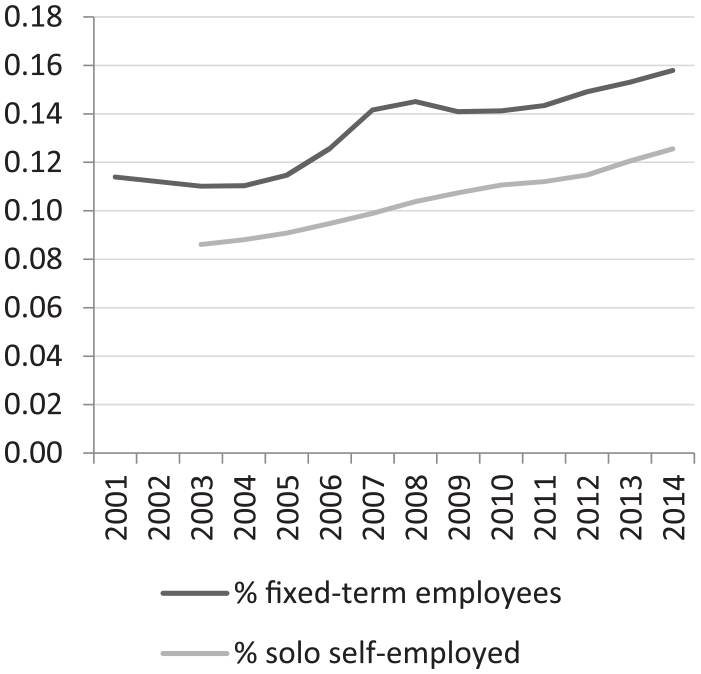
Trends in labor market flexibilization in the Netherlands (proportion of labor force).
This article aims to explain the difference in trade union membership between those with secure employment (i.e., ‘insiders’) and those without (i.e., ‘outsiders’). The flexibilization of work has posed a dual problem for trade unions. First, in addition to unions’ initial ideological resistance towards flexible working arrangements (Delsen, 1990; Gumbrell-McCormick, 2011; Vandaele and Leschke, 2010), it is more difficult for unions to accommodate flexible workers. Collective bargaining, for example, is increasingly difficult to provide because the long-term gains of an agreement may not benefit those with short-term contracts, and it may not always be clear with whom the union should negotiate because the employee–employer relationship is becoming more changeable and diffuse (Croucher and Brewster, 1998; Jansen and Akkerman 2014; Jansen et al., 2017). Second, the recruitment of flexible workers creates interest heterogeneity among a union’s membership, which makes it difficult to balance the interests of standard and flexible workers. Hence, it is often argued that trade unions predominantly represent ‘standard’ workers with permanent employment contracts. ‘Non-standard’ workers, including employees with temporary contracts, agency workers and the self-employed, are believed to be poorly accommodated by trade unions (Heery, 2009b; Schulze Buschoff and Schmidt, 2009). This representation gap is reflected in membership. The organization rate among temporary workers in the Netherlands, for instance, is less than half of that of employees on permanent contracts (Statistics Netherlands, 2013).
Our understanding of the insider–outsider representation gap is limited for two reasons. First, although many studies have signaled this gap (Benassi and Vlandas, 2015; Gumbrell-McCormick, 2011; Heery, 2009a, 2009b; Kornelakis and Voskeritsian, 2018), it has rarely been empirically analyzed at the micro-level (Goslinga and Sverke, 2003; Sánchez, 2007). In fact, the few earlier studies on labor market segmentation and attitudes towards trade unions did not find strong evidence for contract-based differences in union membership (Sánchez, 2007). Waddington and Whitston (1997) and Goslinga and Sverke (2003) cast doubt on the insider–outsider unionization gap by concluding that there are only a few differences in attitudes towards unions between permanent and fixed-term employees. Other studies even report more positive attitudes towards unions among fixed-term employees compared to permanent employees (Furåker and Berglund, 2003; Macías, 2003). Furåker and Berglund (2003), for example, found that temporary workers were somewhat more likely to agree that unions are needed. Hence, available individual-level studies are inconclusive regarding the presence of an insider–outsider divide.
Second, if differences do appear, the reasons for this gap are not yet well understood. In the literature on micro-level determinants of union membership, one of the dominant theoretical approaches is to see union membership in terms of an economic demand and supply framework (cf. Schnabel and Wagner, 2005). Differences would mainly be driven by economic explanations, related to cost–benefit considerations. Theories on labor market segmentation, either explicitly or implicitly, assume that type-of-contract based segmentation yields distinct and opposing economic interests between insiders and outsiders. Differences in demand would make it impossible for trade unions to offer equally satisfying supply in representing both equally well (Emmenegger, 2014; Rueda, 2007; Sánchez, 2007). Hence, differences in trade union membership are explained by outsiders feeling less well represented by trade unions than insiders.
However, next to differences in demand and supply, prior individual-level studies have also examined non-economic determinants for union membership. Recent theoretical advances stress that it is misleading to only consider the role of people’s individual cost–benefit calculations in explaining trade union membership. The social contexts in which they are embedded should not be neglected. The most notable theoretical example is the social customs explanation of membership, which refers to the role of exposure to norms of trade unionism, particularly at the workplace (Goerke and Pannenberg, 2004; Ibsen et al., 2017; Jansen, 2017a; Schnabel and Wagner, 2005; Tapia et al., 2015). Such explanations however presuppose that people are sufficiently socially embedded at their workplace and connected to their co-workers. Compared to insiders, outsiders generally have less long-term, stable workplace relationships. Hence, it is precisely this social cohesion at the workplace that systematically differs between insiders and outsiders. Hence, rather than merely reflecting differences in perceptions of trade union representation, the insider–outsider gap in trade union membership may well also result from differences in social cohesion experienced at the workplace.
Hence, our research questions are: (a) to what extent do insiders and outsiders differ in their willingness/probability to join trade unions, and (b) to what extent can differences in trade union membership be explained as resulting from perceptions of interest representation and workplace social cohesion?
Our study contributes to the understanding of trade union representation in three ways. First, we collect recent, high-quality, large-N micro-level data that include measurements of employment status, three types of self-reported social risk, actual trade union membership and the willingness to join trade unions of non-members, as well as a large set of socio-demographic controls. Second, we disentangle the role of two plausible mechanisms through which the insider–outsider gap in trade union membership may arise, i.e., through perceptions of interest representation and through workplace cohesion. Third, we test our hypotheses in the Netherlands, which is an ideal setting because the Netherlands is marked by (a) a comparatively low and decreasing level of trade union density and (b) a comparatively high and increasing level of labor market flexibility. Before presenting our theoretical framework, we first elaborate on the Dutch case in the next section.
The Dutch context: Trade unions and outsiders
The Netherlands has a system of voluntary trade union membership. Unlike ‘closed shop’ systems where union membership is mandatory, individuals can choose whether and which union to join – irrespective of the industry they are in or their contract type or employment status. Currently, slightly under one-fifth of employees in the Netherlands are members of a trade union, and this number has gradually declined over the last decades. However, partly due to extension practices, trade unions still negotiate collective labor agreements covering approximately 80% of Dutch employees. Because collective agreements cover employees regardless of whether they are trade union members, there are incentives for free-riding. The main Dutch trade union confederations are the FNV (Federatie Nederlandse Vakbeweging/Federation of Dutch Trade Unions – 1,094,800 million members in 2015), the CNV (Christelijk Nationaal Vakverbond/National Federation of Christian Trade Unions – 289,100 members) and the VCP (Vakcentrale voor Professionals/Trade Union Federation for Professionals – 102,000 members). The FNV and CNV historically were divided along religious and political lines. Whereas the FNV originated as a merger of the Catholic and socialist federations, the CNV stands in the tradition of Protestant trade unionism. Today, however, the political differences between the two are much less pronounced, and socially, they both attract manual and non-manual workers. The relatively minor VCP, established to organize senior staff, predominantly organizes high-skilled professionals (ETUI, 2017).
The extent to which trade unions in the Netherlands are outsider-friendly has changed over the last decades. Boonstra et al. (2012) and Keune (2015) show that until the 1980s, ‘non-standard’ employment was less of an issue for trade unions. It was only in the 1990s, when employers began to expand the use of atypical contracts, that unions started to address precarious work. Their initial response, however, was one of rejection as the original members of the unions felt threatened by these developments. In the second half of the 1990s, when unions observed that the use of flexible contracts had become more widespread, unions made a deal with employers and traded off employment security in exchange for the extension of social security rights to atypical workers (Boonstra et al., 2012). A decade later, however, unions realized that this so-called ‘flexicurity model’ was, to some extent, a miscalculation. Instead of putting a halt to flexibilization, non-standard employment had become even more widespread in most areas of the economy (Keune, 2015). As a result, trade union strategies with regard to precariousness changed again and now aim to achieve ‘decent work’ by limiting flexible contracts to ‘sick and peak’, promoting equal pay for equal work, and striving for work that enables workers to establish economic independence.
This ‘decent work’ agenda is embraced by both major Dutch trade union confederations. Both the FNV and CNV embarked on a ‘mixed strategy’ to address the problems of precarious work using instruments in the domain of collective bargaining (e.g., negotiating agreements on behalf of temporary agency workers), lobbying governments (e.g., for solo self-employment regulation) and organizing precarious workers (e.g., in the cleaning sector) (Boonstra et al., 2012; Keune, 2015). However, unions remain in a delicate position to balance the interests of insiders versus outsiders. Despite all initiatives, the number of fixed-term employees among union members did not increase over the last decade, and the number of permanent employees even decreased (Statistics Netherlands, 2013). The recruitment of specific atypical groups, such as the self-employed, does not compensate for the overall reduction in membership (Jansen, 2017a). In the remainder of this study we cannot distinguish between membership of different confederations. But the aforementioned discussion does suggest no fundamental differences regarding the major trade union confederations in the Netherlands regarding their positions towards outsiders.
Theory and hypotheses
Insider–outsider theory and trade union membership
Traditional accounts of workers’ collective interest representation considered workers a more or less homogeneous group with shared interests (e.g., Ashenfelter and Johnson, 1969; Booth, 1995; Hibbs, 1976; Korpi and Shalev, 1979). This notion, however, has been increasingly challenged by the recognition that different groups of workers may have diverging, and sometimes even conflicting, interests.
An important model of interest heterogeneity is found in the binary distinction between insiders and outsiders. Although prominent in labor economics since the 1980s (Lindbeck and Snower, 1989), the notion of insiders versus outsiders found its way to studies on political representation only about a decade ago (Rueda, 2007). In his ‘insider–outsider model of partisanship’, Rueda postulates that insiders are workers with highly protected jobs, whereas outsiders are ‘either unemployed or hold jobs that are characterized by low salaries and low levels of protection, employment rights, benefits and social security privileges’ (Rueda, 2005: 62). Insiders would be primarily concerned with their own job security but not with the labor market opportunities of outsiders. Outsiders, in contrast, would be preoccupied with their own job insecurity but not with protecting secure insider jobs. Consequently, Rueda posits that insiders favor policies geared towards employment protection and minimizing wage competition, whereas the reverse is true for outsiders. Applied to partisanship this implies that, in particular Social Democratic parties, motivated by historical, ideological and electoral considerations, mainly target insiders rather than outsiders. Although Rueda’s theory is primarily a supply-side model of party behavior, it contains assumptions about the individual-level demand-side reactions to party positions (Marx, 2014). More specifically, it is assumed that outsiders perceive Social Democratic parties as less responsive to their needs and are therefore less likely to support these parties.
What applies to partisanship likely also applies to union membership (cf. Carruth and Oswald, 1987). Like Social Democratic parties, for historical, ideological and strategic reasons, trade unions would be expected to promote the interests of their core constituency (i.e., insiders) rather than the interests of outsiders. Trade unions would thus advocate policies that aim to protect jobs and wages at the cost of supporting legislation that allows outsiders to improve their position by relaxing stringent employment protection. Trade unions would also be unlikely to support overly expensive welfare state provisions aimed at improving the living standards of outsiders (e.g., unemployment benefits and other policies aimed at compensating temporary job loss) at the expense of increased tax pressure on insiders. Emmenegger (2014) shows that trade unions are more willing to compromise with regard to the deregulation of temporary employment compared to open-ended contracts.
It may be argued that the allegedly one-sided orientation of trade unions towards insiders should not be exaggerated. Across Europe and other post-industrial economies, trade union initiatives have been developed to recruit outsiders, such as organizing atypical workers and the development of tailor-made services (Gumbrell-McCormick, 2011). A key example in the Netherlands is the establishment of solo self-employment branches by the two major trade unions (Jansen, 2017a). However, according to insider–outsider theory, such initiatives do not solve the fundamental problem for trade unions that labor market and welfare state policies that would be beneficial to outsiders are detrimental to their core constituency, the insiders. Hence, it would be unlikely that trade unions were able to completely close the representation gap between these groups.
Therefore, we begin by formulating a general hypothesis on insider–outsider theory and trade union membership. Following insider–outsider theory, trade unions cannot equally represent all groups on the labor market and may be assumed to be biased towards defending insiders rather than outsiders. We focus on three key groups of outsiders based on current labor market status: (a) employees with fixed-term contracts, (b) the solo self-employed and (c) the unemployed. Based on recent insights from the literature on trade union strategies, trade unions face great difficulties in representing these three groups of outsiders (e.g., Gumbrell-McCormick, 2011; Heery, 2009a; Jansen, 2017a, 2017b; Pernicka, 2005). These groups are contrasted to the prime insider group: employees with permanent contracts.
Hypothesis 1: The willingness to join a trade union will be lower among (a) fixed-term employees, (b) solo self-employed and (c) unemployed individuals when compared to permanent employees.
Building on Rueda’s binary distinction, other scholars advocate a more fine-grained conceptualization of ‘outsiderness’ related to either current labor market status or the propensity of social risk (cf. Rovny and Rovny, 2017). Emmenegger (2009), for example, uses a five-category classification based on status and labor market position. Others, such as Häusermann and Schwander (2011) and Rehm (2009), use continuous measurements based on labor market risks such as unemployment. We therefore include three measurements of social risk in our analysis: (1) the regularity of income, (2) the sufficiency of income and (3) job security. In general, regardless of labor market status, the more regular and sufficient a person’s income is and the more job security that person experiences, the lower the (perceived) social risks; thus, the more this person can be considered an insider. Hence, we expect the following for employed persons:
Hypothesis 2: Individuals are more willing to join trade unions as their income is (a) more regular and (b) sufficient and (c) as they experience more job security.
Perceived representation and the insider–outsider divide
One interpretation for the above hypothesized insider–outsider gap is that it arises due to the individuals’ perceptions of trade union instrumentality. According to insider–outsider theory, the representation gap hinges on trade unions’ inability to sufficiently fit their policies and policy-positions to the interests of outsiders. For example, from the perspective of a person with a temporary contract, trade unions’ advocacy of restrictive employment protection legislation limits this person’s own labor market opportunities and therefore does not align with that person’s self-interest. Based on this reasoning, two components would explain the membership gap between insiders and outsiders. First, outsiders feel personally less represented by trade unions compared to insiders. Second, the willingness to join (or, rather, not to join) a trade union depends on whether individuals perceive their self-interest to be served by that trade union. This understanding implies that how well individuals feel personally represented by trade unions is a mediating factor in explaining the link between employment position and trade union membership. Therefore, we hypothesize:
Hypothesis 3: The influence of employment status on the willingness to join trade unions (i.e., the differences between permanent employees and (a) fixed-term employees, (b) solo self-employed and (c) unemployed individuals) is mediated by the extent to which individuals feel personally represented by trade unions.
Hypothesis 4: The influence of perceived social risks (i.e., income regularity, sufficiency of income and job security) on the willingness to join trade unions is mediated by the extent to which individuals feel personally represented by trade unions.
Workplace social cohesion and the insider–outsider divide
Specifically for the difference between permanent employees, on the one hand, and fixed-term employees and solo self-employed individuals, on the other, an alternative interpretation for the insider–outsider gap in union membership may exist. The duration spent in the same workplace is generally shorter for fixed-term employees than for permanent employees. Something similar holds for solo self-employed individuals. Even though companies increasingly hire solo self-employed as an on-demand workforce, and despite the rise of co-working spaces for freelancers, self-employment is frequently conducted in isolation, as home-based activity without daily interaction with co-workers (Daniel et al., 2018).
The lack of long-term professional and social interaction is argued to diminish workers’ perceptions of workplace cohesion and their sense of collective interest (Golden et al., 2008). People’s identification and solidarity with their colleagues arguably positively affect union membership (Klandermans and Visser, 1995). Visser (2002) found that individuals who experienced job changes, including career interruptions, were less likely to stay in a union. He attributed this to weakening social cohesion (or ‘broken social ties’; Visser, 2002: 407) causing membership norms to deteriorate. Hence, differences in workplace social cohesion may contribute to the insider–outsider union membership gap. Thus, the relationship between employment status hypothesized under H1 can be expected to be mediated by workplace social cohesion:
Hypothesis 5: The influence of employment status on the willingness to join trade unions, i.e., the differences between permanent employees and (a) fixed-term employees, and (b) solo self-employed individuals, is mediated by workplace social cohesion.
Data and methods
Data
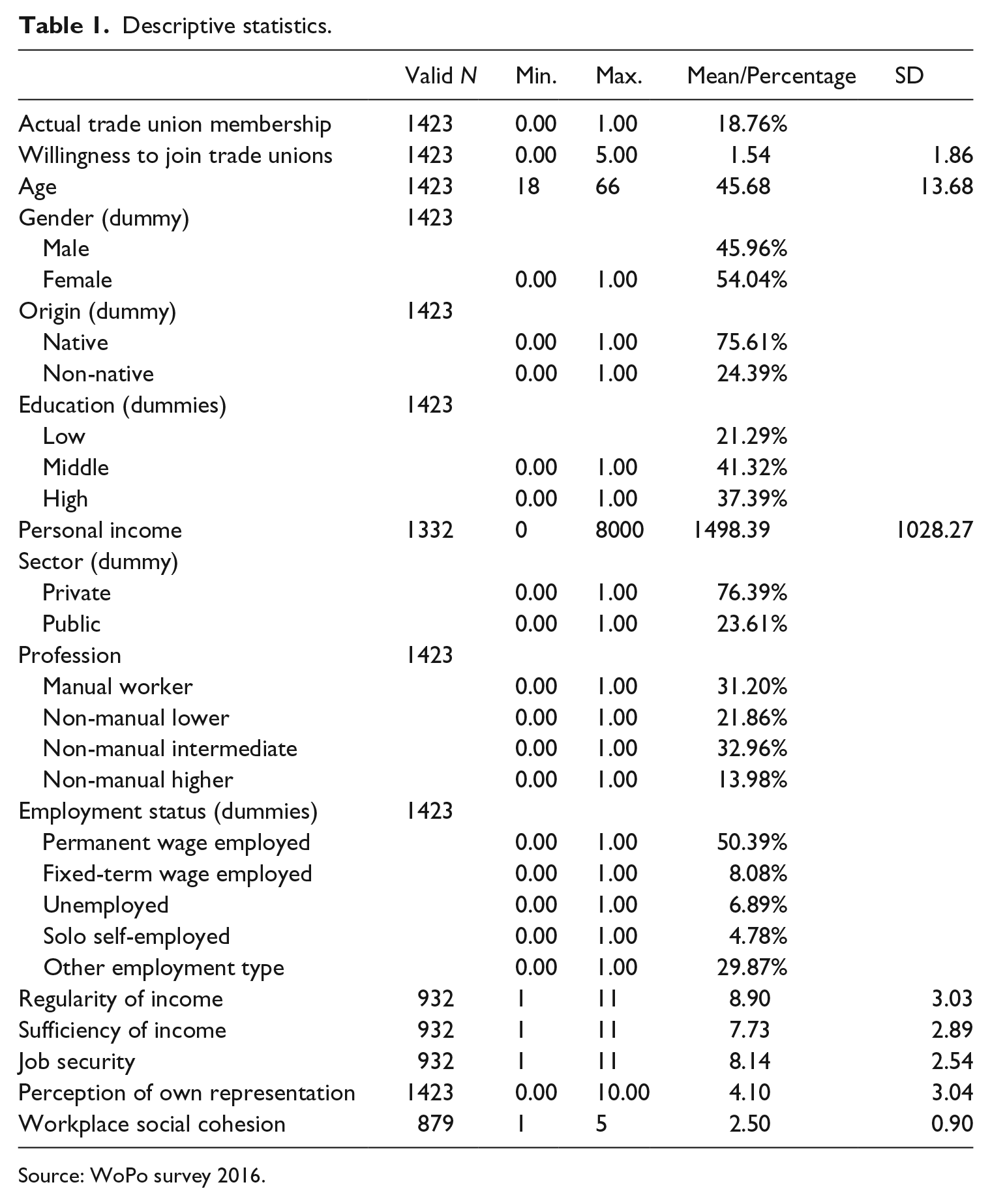
To test our hypotheses, we use the Work and Politics 2016 survey (WoPo survey 2016), a representative questionnaire survey of more than 1000 working-age Dutch citizens conducted in December 2015/January 2016. The WoPo 2016 survey is an initiative of Radboud University and focuses on voting behavior, political attitudes and labor market position. This one-off survey was conducted by CentERdata using respondents from the Longitudinal Internet Studies for Social Sciences (LISS) panel. 1 For the sample, 2087 respondents between 18 and 65 years were selected at random from the LISS panel for participation. Of the selected persons, 620 did not participate in the survey and 16 respondents produced incomplete responses, yielding a net response rate of 69.5%. The analyzed sample appears very representative, with the distributions of our main variables (e.g., trade union membership, employment status) closely resembling those observed in the population at large (see Table 1).
Descriptive statistics.
Source: WoPo survey 2016.
Measurements
We analyze two dependent variables: (1) actual trade union membership and (2) the willingness to join trade unions (i.e., membership intention). The measurements of these variables are based on two survey questions. First, we asked respondents whether they were or had been members of a trade union, with the possible response categories: ‘yes, I am currently a member’, ‘yes, I used to be a member, but I am not anymore’, and ‘no, I have never been a member’. The second question, which was only presented to those respondents who were not currently members of a trade union, was ‘How likely is it that you will become a member of a trade union in the next five years?’, with the response categories: ‘very unlikely – I will (almost) certainly not become a member’, ‘unlikely’, ‘neither likely nor unlikely’, ‘likely’, and ‘very likely – I will (almost) certainly become a member’.
For actual trade union membership, respondents that were currently a trade union member were coded as ‘1’, respondents that were not currently members were coded as ‘0’. This variable thus represents the standard practice of operationalizing union membership as a dichotomous variable distinguishing between members and non-members. However, this variable does not capture the variation in willingness to join trade unions among those that are currently non-members. Our second dependent variable, willingness to join trade unions, therefore pools the information on membership status and the willingness to join of non-members, based on the responses to the second question. With a substantial share of the working population not being a member, this allows us to analyze more variation in how likely individuals are to join trade unions. To do so, we combined the responses on the two questions into an ordinal variable for which higher values indicate that the respondents were more willing to join a trade union. Those who were members received the highest value ‘5’, and those who were not members received values from ‘0’ to ‘4’ corresponding to their answer to the second question. To assess the validity of this operationalization, we conduct extensive robustness analyses reported in a separate section below.
To measure employment status, the respondents were classified into five categories: (1) permanent wage employed, (2) fixed-term wage employed, (3) unemployed, (4) solo self-employed, and (5) other employment types. These categories were used to create dummy variables, with the permanent wage employed (i.e., the insider group) serving as the reference category.
The three indicators of social risk were each measured by asking employed respondents, ‘Thinking about your job and income, to what extent does the following apply to you?’ For regularity of income, the answering possibilities ranged from ‘0’ ‘My income is very regular; I earn roughly the same amount each month’ to ‘10’ ‘My income is very irregular; my earnings are different each month’. For sufficiency of income, the answering possibilities ranged from ‘0’ ‘I can easily make ends meet with my income’ to ‘10’ ‘I struggle to make ends meet with my income’. For job security, the answering possibilities ranged from ‘0’ ‘The probability that I will lose my current job is very small’ to ‘10’ ‘The probability that I will lose my current job is very large’. The answers to these items were reverse-coded to yield three variables for which higher values indicate less social risk.
Respondents’ perception of own representation by trade unions was measured with the following question: ‘To what extent do you think that trade unions represent the interests of yourself and others on the labor market? Please list – with a number from 0 to 10 – to what extent you think that the following groups in general, and you yourself in particular, are being represented by trade unions’, where ‘0’ indicated ‘interests are not represented by trade unions’ and ‘10’ indicated ‘interests are strongly represented by trade unions’. This question was asked for various different groups as well as for the respondents themselves. We used the score on this question for the respondents themselves, with higher values indicating that the respondents felt more represented by trade unions.
To measure workplace social cohesion, a scale was created by taking the mean value across three items on workplace cohesion (Cronbach’s α = 0.68) included in the WoPo 2016 (adapted from Widmeyer et al., 1985) and asking about the respondents’ agreement (‘1’ ‘completely disagree’ to ‘5’ ‘completely agree’, with ‘6’ ‘not applicable’ coded as a missing value) with the following statements: (1) ‘The people of my team would like to spend more time together, also outside working hours’, (2) ‘My colleagues are my most important social contacts’, and (3) ‘Some colleagues are also my best friends’.
Besides these two potential mediator variables, other compositional differences between insiders and outsiders may lead to differences in membership. Hence, we controlled the estimated effects for a range of standard predictors of trade union membership, the composition of which likely differ between insiders and outsiders: age, gender, origin, level of education of the respondents, income, sector, and profession. We do not adjust for several other variables that have previously been suggested to determine membership at the micro-level, such as political attitudes (e.g., Jensen, 2017; Riley, 1997; Schnabel and Wagner, 2007), trade union presence, strikes and turnover at the workplace (e.g., Hodder et al., 2017; Schnabel and Wagner, 2007; Waddington, 2015). Conditioning on political attitudes would be problematic as these attitudes are likely themselves to be influenced by membership and employment status, hence leading to biased estimates (Elwert and Winship, 2014). We lack adequate measurements on union presence, strikes, and turnover. It should be noted that the impact of the trade union presence is however likely limited in the Dutch context, where trade unions are generally not very active at the workplace level (Been and Keune, 2019). Though we are thus able to rule out many competing explanations, it remains possible that variables not included in the analysis lead to spuriousness.
Age of the respondent was measured in years. For gender, we created a dummy variable for ‘female’ with ‘male’ as the reference category. Origin was a dummy variable for respondents with non-native origins, using those with native origins as the reference category. Education of the respondents was classified as ‘low’, ‘middle’ or ‘high’, and a dummy variable was created for ‘middle’ and ‘high’, using ‘low’ as the reference category. Personal income is measured in euros earned each month. A dummy for those employed in the public sector was created, taking those employed in the private sector as the reference category. To classify the status of respondents’ profession, we used ‘manual worker’ as a reference category and created the dummies ‘non-manual lower’, ‘non-manual intermediate’, and ‘non-manual higher’.
It should be noted that the variables measuring social risk, workplace social cohesion, sector, and profession only had valid values for employed persons and were assigned missing values for those not employed.
Methods
We first discuss the main descriptive statistics. We then proceed to test the hypotheses about the total direct effects of employment status (H1) and social risk (H2) by estimating logit models for actual trade union membership and linear (OLS) regression models for willingness to join trade unions. The models include a full set of relevant control variables, and we calculate heteroskedasticity-consistent (‘robust’) standard errors for statistical significance test.
To test the mediation hypotheses that insider–outsider differences can be explained by perceptions of self-interest representation by trade unions (H3 and H4) or by workplace social cohesion (H5), we employ the standard approach suggested by Baron and Kenny (1986), wherein a linear structural equation model of the direct effects of the relevant independent variables (employment status and the three social risk measurements), the effects of the relevant independent variables on the relevant mediators (perception of interest representation and workplace social cohesion), and the effect of the mediators controlled for the independent variables are sequentially estimated. We follow this approach to model the indirect (through perception of own representation and workplace social cohesion) and remaining direct effects of insider–outsider differences on willingness to join trade unions. For actual trade union membership, we also estimate linear models for the mediators, but estimate logit models for the dependent variable. However, differing values for logit-coefficients of the same variable in models with differing sets of predictors could be due to substantive changes of the effects (i.e., there is mediation or confounding) or also due to changes to the residual variance of the underlying latent linear model that affect the scaling of effects (Winship and Mare, 1984). For tests of mediation effects of actual trade union membership, we hence use the re-scaling approach suggested by Kenny (2008).
The mediation models all include the full set of control variables. To evaluate the significance of the indirect effects, we estimate bootstrapped, bias corrected confidence intervals. 2 We evaluated the robustness of the mediation effects using the approaches suggested by Imai et al. (2010), and Breen et al. (2013) and report on this in a separate section below.
Analysis
Descriptive statistics
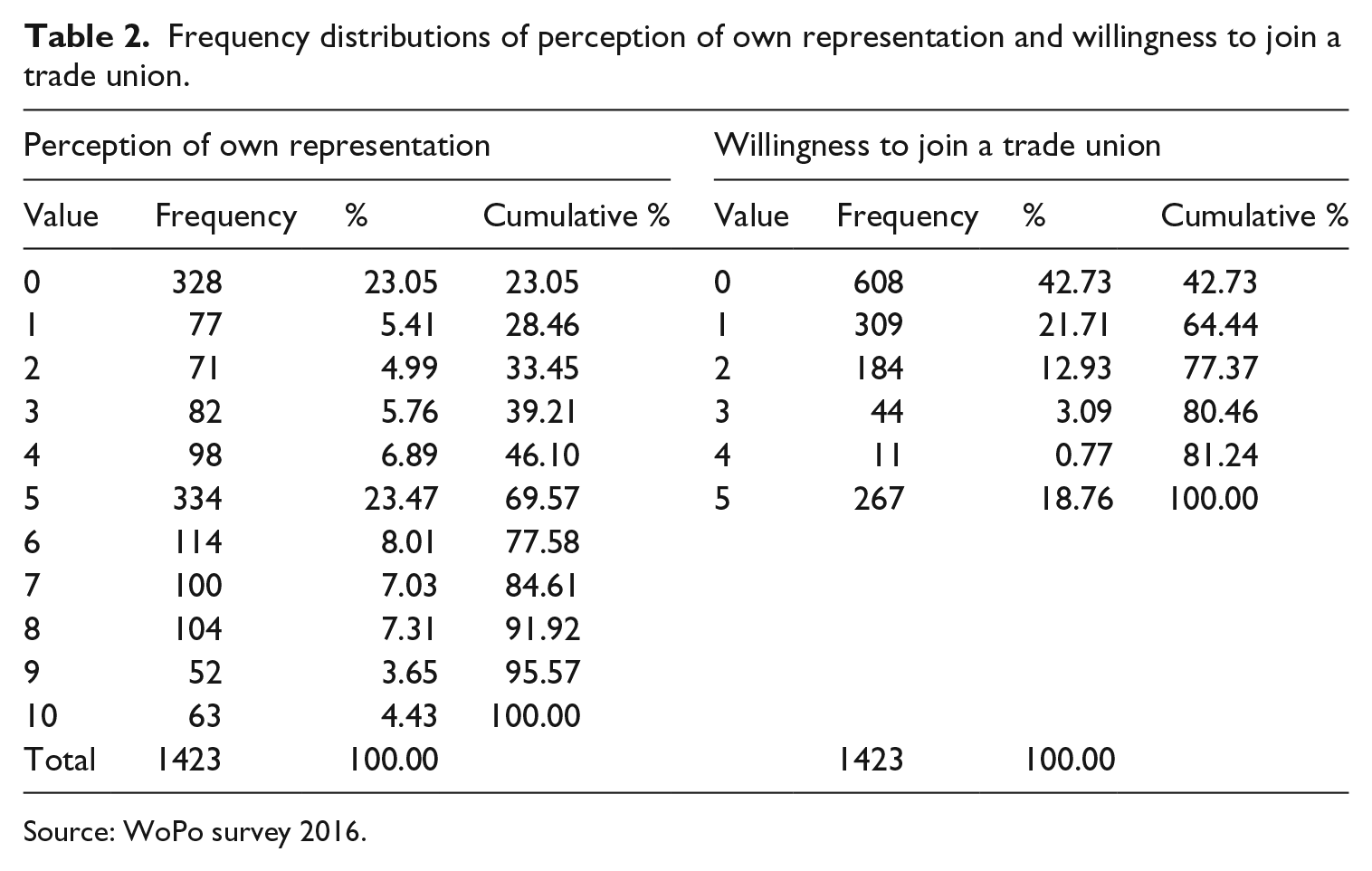
The descriptive statistics on all variables in the analysis are presented in Table 1. Slightly fewer than 19% of our sample are trade union members. The mean values observed for willingness to join a trade union and the perception of one’s own representation by trade unions are both rather low. These findings correspond to the relatively low union density in the Netherlands. Nevertheless, there is substantial variation in both variables across individuals. To illustrate this variation, the frequency distributions of willingness to join a trade union and of the perception of one’s own representation by trade unions are presented in Table 2. It is also worth mentioning the relatively high proportion of respondents that feel that their interests are not at all represented by trade unions (23.05%) and the high proportion of respondents who are not members of trade unions and indicate that they likely will never join a trade union (42.73%). Both observations provide further testimony to the limited support for trade unions in the Netherlands. In Figure 2, the mean values for the overall willingness to join a trade union and the perception of one’s own representation across the five types of employment status are shown. Clearly, those with permanent contracts, on average, feel the most represented by trade unions and are the most likely to join. The outsider groups show pronouncedly lower scores, especially the solo self-employed.
Frequency distributions of perception of own representation and willingness to join a trade union.
Source: WoPo survey 2016.
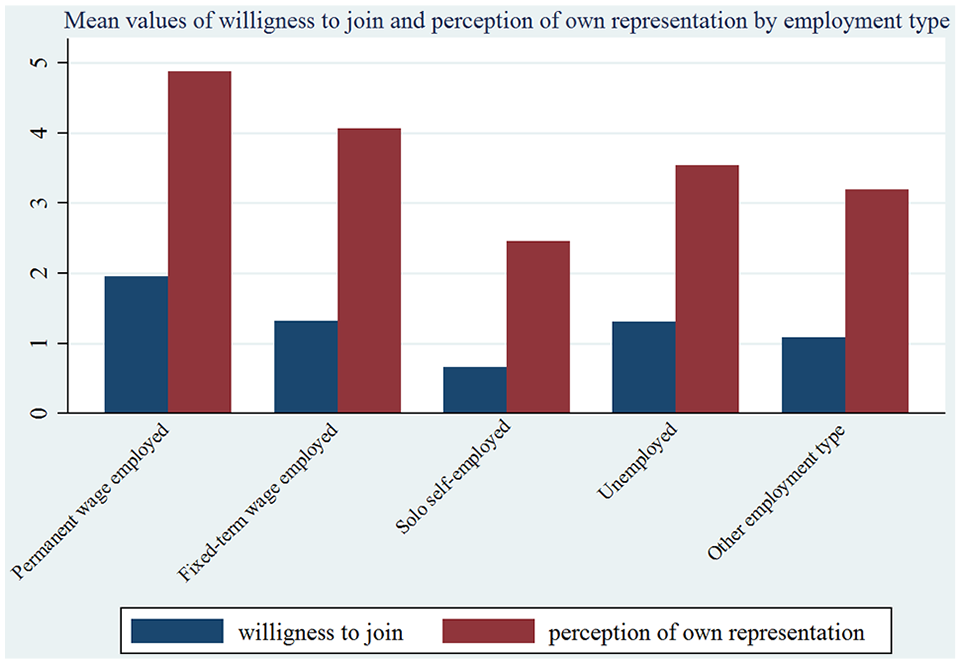
Bar chart of mean overall willingness to join trade unions and perception of own representation by employment status.
The effects of employment status and social risk on willingness to join a trade union
In Table 3, we report the estimated direct effects of employment status and social risk on actual trade union membership and willingness to join trade unions. In Model 1, only the effect of employment status is estimated, based on the full sample. In Model 2, we also include the effects of social risk variables. These estimates are based only on the employed persons in the sample as we only measured the social risk variables for this subset.
Logistic and linear regression estimates of actual trade union membership and willingness to join trade unions on employment status and social risk.
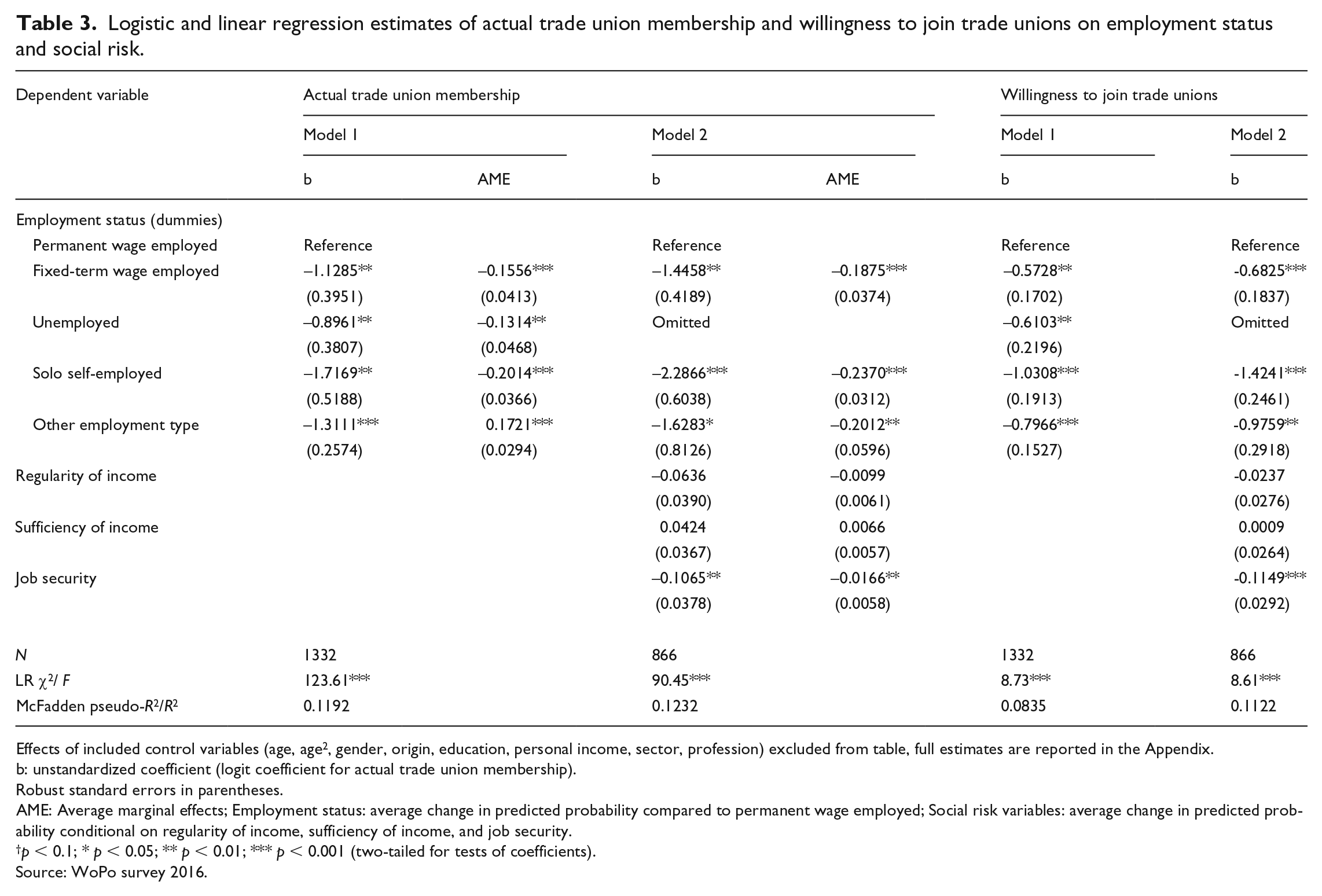
Effects of included control variables (age, age2, gender, origin, education, personal income, sector, profession) excluded from table, full estimates are reported in the Appendix.
b: unstandardized coefficient (logit coefficient for actual trade union membership).
Robust standard errors in parentheses.
AME: Average marginal effects; Employment status: average change in predicted probability compared to permanent wage employed; Social risk variables: average change in predicted probability conditional on regularity of income, sufficiency of income, and job security.
p < 0.1; * p < 0.05; ** p < 0.01; *** p < 0.001 (two-tailed for tests of coefficients).
Source: WoPo survey 2016.
The estimates support the hypothesis (H1) that those with fixed-term contracts, the solo self-employed and the unemployed are less willing to join a trade union than are the permanent wage employed. Based on Model 1 and Model 2, compared to the permanent wage employed, the average predicted probability of trade union membership is roughly lower by (a) between 16 and 19 percentage points for the fixed-term wage employed, (b) 13 percentage points for the unemployed, and (c) between 20 and 24 percentage points for the solo self-employed. Compared to the permanent wage employed, the predicted conditional mean for willingness to join trade unions is lower by roughly (a) 0.6 to 0.7 points for the fixed-term wage employed, (b) 0.6 points for the unemployed, and (c) between 1 and 1.4 points for the solo self-employed.
However, we find no evidence in favor of the hypothesis that less social risk increases the willingness to join trade unions (H2a, H2b, and H2c). Of the three social risk variables, only the coefficient for sufficiency of income takes the expected (positive) sign, but fails to reach statistical significance at any conventional level. For job security (H2c), our estimates actually suggest that more job security decreases rather than, as expected, increases willingness to join. While one explanation for these findings may be that we underestimated the true effect of the social risk variables, as they may be partially endogenous with respect to objective income and employment status, we find a similar pattern of effects for the three risk variables even when excluding income and employment status from the model. We also find no evidence suggesting collinearity problems. We reflect on possible explanations for this unexpected finding in the next section.
Self-interest and social cohesion as mediators
We now turn to analyses of the role of self-interest and social cohesion as reasons for the insider–outsider divide. The results for the mediation effects are presented in Table 4 (mediator is perception of own representation by trade unions) and Table 5 (mediator is workplace social cohesion). For completeness, we present the results for both employment status and social risk as independent variables – although the previous analysis already suggested that only employment status has the expected unmediated effect on willingness to join. In both tables, we present the estimated indirect effects of the independent variable on the dependent variables through the mediator variables, and the remaining direct effect of the independent variables. For both types of effects, we present the (bias corrected) bootstrapped 95% confidence intervals. We also report the proportion of the total effect that is mediated for those mediation effects that are convincingly significant.
Mediation effects through perception of own representation.
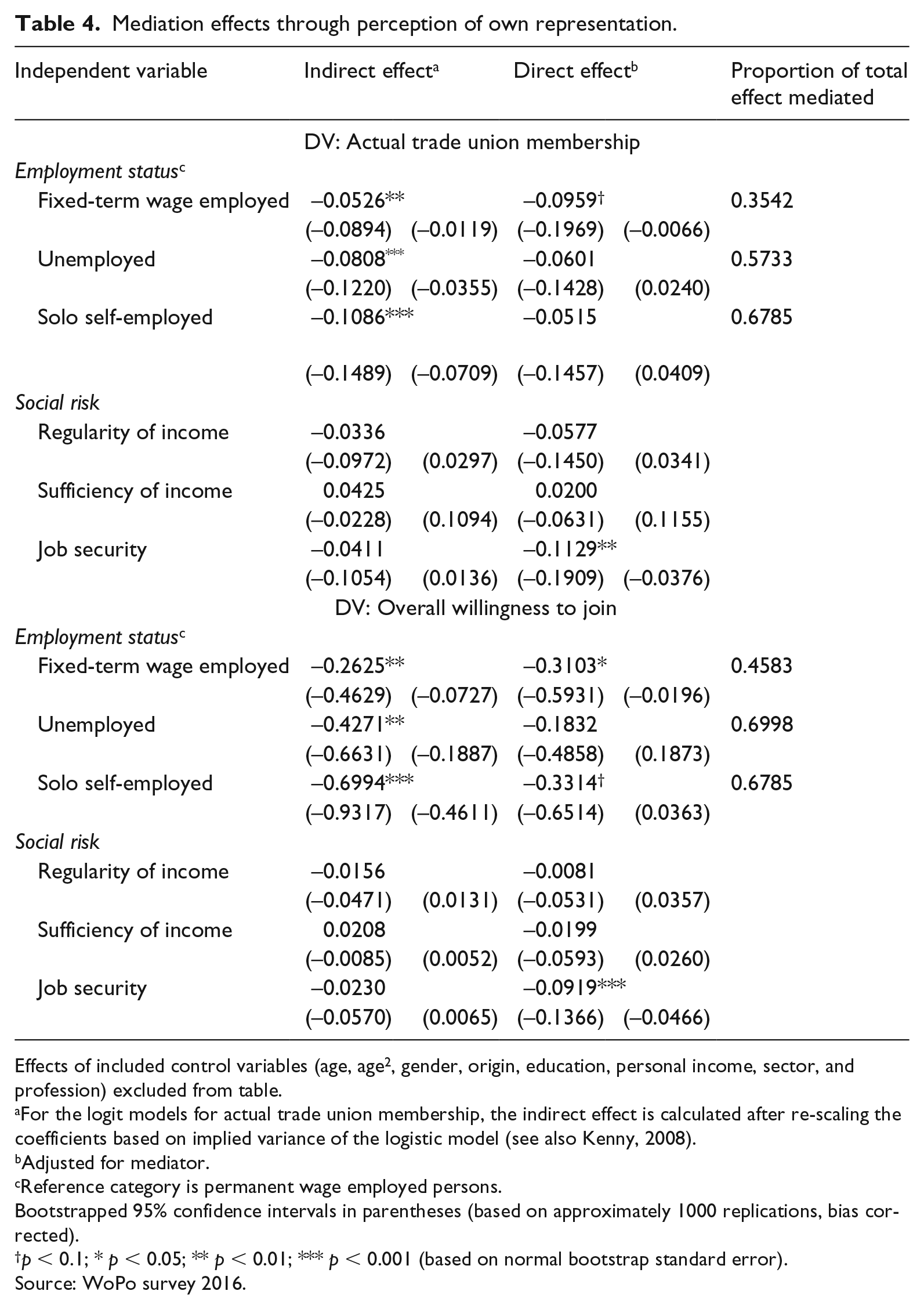
Effects of included control variables (age, age2, gender, origin, education, personal income, sector, and profession) excluded from table.
For the logit models for actual trade union membership, the indirect effect is calculated after re-scaling the coefficients based on implied variance of the logistic model (see also Kenny, 2008).
Adjusted for mediator.
Reference category is permanent wage employed persons.
Bootstrapped 95% confidence intervals in parentheses (based on approximately 1000 replications, bias corrected).
p < 0.1; * p < 0.05; ** p < 0.01; *** p < 0.001 (based on normal bootstrap standard error).
Source: WoPo survey 2016.
Mediation effects through workplace social cohesion.
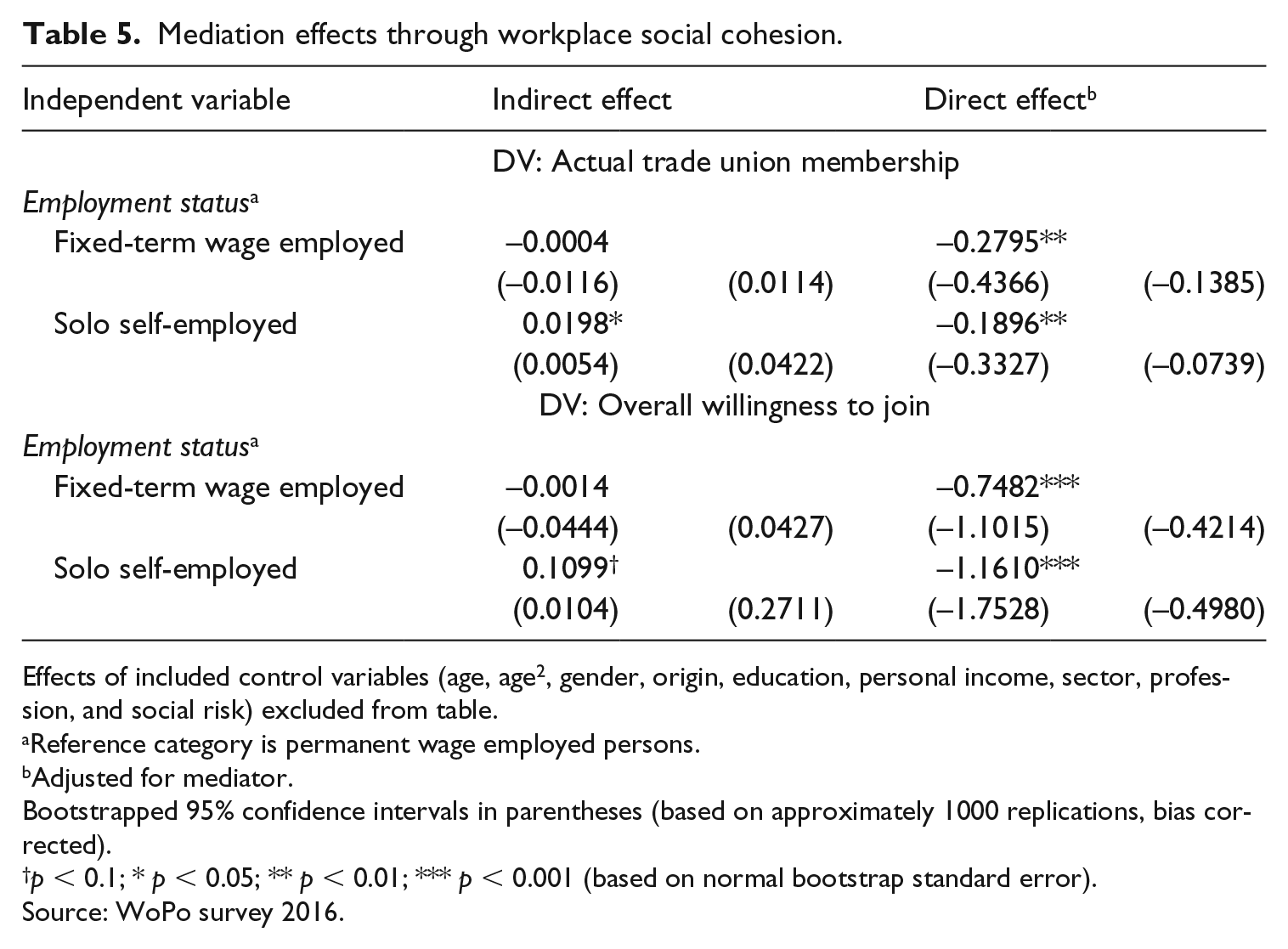
Effects of included control variables (age, age2, gender, origin, education, personal income, sector, profession, and social risk) excluded from table.
Reference category is permanent wage employed persons.
Adjusted for mediator.
Bootstrapped 95% confidence intervals in parentheses (based on approximately 1000 replications, bias corrected).
p < 0.1; * p < 0.05; ** p < 0.01; *** p < 0.001 (based on normal bootstrap standard error).
Source: WoPo survey 2016.
We find for our hypothesis that the lower willingness to join a trade union (compared to those with permanent contracts) of those with fixed-term contracts (H3a), the solo self-employed (H3b), and the unemployed (H3c) can be explained by their worse perception of self-interest representation by trade unions. Of the initial total effect on actual trade union membership, differences in perception of interest representation account for roughly (a) 35% for the fixed-term wage employed, (b) 57% for the unemployed, and (c) 68% for the solo self-employed. Similarly, of the initial total effects of employment status on willingness to join, about (a) 46% (fixed-term wage employed), (b) 70% (unemployed), and (c) 68% (solo self-employed) are mediated through perceptions of representation. As predicted in Hypothesis 3, the estimated indirect paths are negative, indicating that feeling personally well represented by trade unions increases willingness to join, and that outsiders feel personally less well represented than insiders. The bootstrapped confidence intervals clearly support the notion that these indirect effects can be generalized to the population. Hence, our findings clearly support the hypothesis that the effects of employment status are mediated by individual self-interest representation (H3).
We find no such support for the hypothesis that differences in social risk are mediated by individual self-interest representation (H4), which is unsurprising given the absence of the predicted total (i.e., unmediated) direct effect of these variables on willingness to join.
We also find no support for the role of social cohesion in explaining insider–outsider differences in willingness to join (H5). Differences in workplace social cohesion are unable to account for the lower willingness to join trade unions of the fixed-term wage employed and solo self-employed compared to the permanent wage employed. For the solo self-employed, the results are actually even suggestive of a suppressing relationship, with the total direct effect being decomposed into a negative direct effect and a positive indirect effect. This positive indirect effect is driven by a higher reported level of workplace social cohesion (adjusting for all covariates) by the solo self-employed than the permanent wage employed.
Sensitivity analyses
For the results presented above, we relied on simple and parsimonious statistical models that offer straightforward interpretations and are less prone to over-fitting than plausible alternative specifications. The assumptions needed to insure consistent estimates with these models should of course be carefully assessed, in particular given the choice to estimate linear models for a dependent variable that combines actual trade union membership with willingness to join of non-members into a single measure. To investigate this further, we replicated our findings by estimating generalized ordered logit models for willingness to join trade unions. 3 The implied relevant effects from these model estimates were substantially similar to those presented here. Furthermore, we re-estimated all models with plausible alternative operationalizations of the variables: using the natural logarithm of objective income, and using factor scores from a factor analysis of the three workplace social cohesion items. These again produced substantively similar results.
The linear structural equation model approach to estimating the mediation effects we present here has the benefits of being straightforward and well known in its interpretation. However, two issues may affect the reliability of our conclusion. First, omitted variable bias may lead to a correlation between the error terms in the models for the dependent variables and those for the mediators, 4 hindering causal inferences. Second, recent advances suggest that, for mediation analysis with logit models, alternative approaches may be more reliable than the re-scaling approach we employ. The alternative approach suggested by Imai et al. (2010) addresses both issues by (a) using simulations to estimate the direct and indirect effects, and (b) allowing for the estimation of a sensitivity parameter that indicates how large the correlation of the error terms between the models for dependent variables and those for the mediators would need to be to reduce any found mediation effect to 0. The approach advocated by Breen et al. (2013) first regresses the mediators on the independent variables, and then only uses the residual variation in the mediators to estimate the full mediation model, thus circumventing the re-scaling problem.
We evaluated the mediation we find of employment status via perceptions of trade union representation using both approaches. Regarding the mediation effects estimated with the logit models for actual trade union membership, we find that these approaches produce virtually identical estimates of the percentage of the total effect that is mediated. Furthermore, an analysis of the sensitivity parameter estimated with the Imai et al. (2010) approach suggests that these mediation effects persist even given fairly large degrees of endogeneity related to the mediator. We do find one notably different result with the Breen et al. (2013) approach: the outcome of their suggested test (cf. Karlson et al., 2012) of no differences between coefficients (net of re-scaling) across models offers only weak evidence against this null-hypothesis (p = 0.212) regarding the mediating role of perception of trade union representation in explaining the difference between those with permanent and fixed-term contracts in membership. 5
Conclusion and discussion
We addressed the question of the extent to which insiders and outsiders differ in their willingness to join trade unions and to what extent such differences can be explained by perceptions of interest representation and social cohesion. We formulated and tested hypotheses derived from two different interpretations of insider–outsider theory that explain the gap in trade union membership: the standard reading of this theory, which hinges on the role of self-interest, and a social cohesion reading of the theory, which stresses the importance of social interaction and group norms. In doing so, we answered recent calls to look beyond mere self-interest as a driving force of trade union membership (Goerke and Pannenberg, 2004; Ibsen et al., 2017; Schnabel and Wagner, 2005; Tapia et al., 2015).
The main conclusions are that an insider–outsider divide in trade union representation exists in the Netherlands, and it is primarily driven by considerations regarding self-interest rather than by workplace cohesion stemming from (a lack of) social interaction with colleagues. However, whereas outsiderness defined by employment status does lower people’s willingness to join trade unions, outsiderness as defined by social risks does not. The extent to which people have (ir)regular or (in)sufficient income seems unrelated to trade union membership. For job security, our analyses even suggest a negative effect on people’s willingness to join. Although this refutes our social risk-based prediction on ‘outsiderness’, it does resonate with previous studies in organizational psychology that have established a positive association between job insecurity and union membership (De Cuyper et al., 2014). Organizational psychologists have typically attributed this finding using the frustration–aggression thesis that explains union membership as a function of employees’ frustration with dissatisfying working conditions. Another economic explanation might be that more secure workers having relatively less to gain from union membership because they are better able to provide for themselves (Jansen, 2017a).
Our findings show that outsiders (employees with fixed-term contracts, unemployed individuals, and solo self-employed individuals) are indeed less likely to be a union member and less willing to join trade unions than are insiders (permanent wage employed persons). This study therefore shows different results compared to prior studies on labor market segmentation and attitudes towards trade unions (e.g., Furåker and Berglund, 2003; Goslinga and Sverke, 2003; Macías, 2003) that were conducted nearly two decades ago, partially in the same context. Using Dutch survey data from 1999, Goslinga and Sverke (2003) found that fixed-term employees reported higher rather than lower levels of union instrumentality. Yet, their sample included only employees who were already a member of a trade union. Our population sample shows different results. People’s perception of trade unions’ representation of their own interests clearly influences their decision to join a union. The perceptions of personal interest representations by trade unions are worse for outsiders than for insiders and can explain the differences between insiders and outsiders in their membership of/willingness to join trade unions. This holds for all employment categories deviating from permanent employment (i.e., fixed-term employment, unemployment, and solo self-employment). Among the solo self-employed, in particular, we not only found perceptions of union representation to be most negative, but also the mediation effects to be the strongest. These findings support the standard reading of insider–outsider theory of representation, which takes self-interest as the prime motivator. More sociological explanations would suggest that differences in workplace cohesion between insiders and outsiders should also matter. We find little to no evidence in favor of this argument. Social cohesion in the workplace, defined as social interaction with colleagues, does not mediate the relationship between employment status and trade union membership.
This study contributes to our understanding of the insider–outsider trade union representation gap by addressing not only whether but also why this gap may exist and by answering this question using appropriate micro-level data. Despite the novelty and insights delivered by this study, a few reservations apply. In addition to standard limitations on the use of cross-sectional data, it should be noted that there are three limitations to our study. First, the current study focused exclusively on the individual-level demand side of trade union representation. Further research should differentiate between various trade unions and should consider variation in ‘supply’ in terms of what different unions have to offer to different groups of insiders and outsiders (Emmenegger, 2009; Keune, 2015). In this study, we were unable to differentiate between various trade unions or union confederations because we relied on a general perception of trade union inclusiveness towards insiders and outsiders. Future research may combine individual-specific characteristics with a union-specific characteristics model to examine the relationship between demand and supply.
Second, this study was limited to the Netherlands and did not address the membership patterns of insiders/outsiders in other countries. Although the Netherlands provided a relevant case given the importance of atypical work relationships, trade union responses to temporary work or solo self-employment are not unique to the Netherlands (Vandaele and Leschke, 2010). In other countries, trade unions initially resisted and continue to struggle with the emergence of atypical work arrangements, fearing that these and other flexible arrangements may undermine not only secure working conditions but also union solidarity. However, further research is required to assess the insider–outside membership gap in other countries. Country comparative studies are required, for example, because the social and labor risks associated with non-standard employment may be stronger in more globalized markets or weaker in countries with more inclusive social security systems.
Finally, expanding on mere self-interest, this study tested only one explanation related to the social context, workplace cohesion. Additional explanations related to social customs and social norms are not addressed in this study. For example, membership norms are reflected by the aggregate level of union density at the workplace (Ibsen et al., 2017). In this study, we were unable to take differences in unionization rates across work environments into account. However, social cohesion at the workplace, such as we analyzed, likely aids the effectiveness of such membership norms by increasing the cost of deviating. Though we find no support for social cohesion as a mediator of the insider–outsider divide, our findings do suggest that social cohesion at the workplace does contribute to membership, independently of employment status and a host of background characteristics.
Moreover, the premise that individuals would generally comply with the norms and customs of the groups to which they belong at least partially relies on the notion of social identification. Yet, it remains to be seen how social identities are linked to the insider–outsider divide. Psychological research on workplace dynamics has shown that the distinction between permanent and temporary employees may be salient to workers and that employees use this distinction to classify themselves and others into in-groups and out-groups (Chattopadhyay and George, 2001; Geary, 1992; Smith, 1994). However, the bulk of the research in this area has considered the extent to which standard employees perceive temporary workers as threatening (Kraimer et al., 2005; von Hippel and Kalokerinos, 2012). It remains unclear with whom outsiders identify. Given the heterogeneity of the outsider group, it may be far more difficult to demarcate in-groups from out-groups. These questions, however, are crucial to understand trade unions’ ability to organize among atypical workers in the rapidly growing gig economy, including the rise of new forms of work via digital online platforms. Platform-mediated work is hyper-flexible, i.e., carried out in on-demand arrangements based on episodic ‘gigs’, often conducted in isolation over geographically dispersed areas, removed from physical workplaces and/or co-workers (Lehdonvirta, 2016). Being largely excluded from social protection, platform workers are perhaps the ultimate outsiders. The short-term nature of on-demand work, the competitive algorithmic systems of control, and rigid consumer evaluations would erode feelings of solidarity and mutual interests. At the same time, however, recent studies signal forms of collective action among platform workers (Wood et al., 2018) and sometimes even positive rather then negative views towards unions (Vandaele et al., 2019). We therefore encourage future research to further examine the process of social identification and the potential for collective organization among outsiders in general, and with a specific focus on new groups of outsiders in the digital economy.
Footnotes
Appendix
Declaration of conflicting interests
The authors declared no potential conflicts of interest with respect to the research, authorship, and/or publication of this article.
Funding
This research was supported by the Netherlands Organization for Scientific Research (NWO), grant 451-13-027.
