




Abstract
While the detrimental health effects of self-perceived job insecurity are well documented, less is known about the mechanisms through which insecurity affects health. In this article, potential explanations for this relationship are examined separately for three age groups (18–35, 36–50, and 51–65). Mediation analyses based on the German Socio-economic Panel show an ‘immediate shock effect’ that occurs when a person becomes worried, as well as a ‘prolonged stress effect’ that sets in when job loss worries persist over a longer period. Second, the results reveal that for middle-aged workers, both effects of self-perceived job insecurity are largely explained by the following factors: perceived financial problems, feelings of stress, exhaustion, and anxiety, a perceived lack of control, and family dissatisfaction. Yet it appears that these factors do not fully explain the detrimental health effects of job insecurity among younger or older workers.
Introduction
The detrimental effects of self-perceived job insecurity – a big issue in light of intensified international competition, technological changes, and the deregulation of labor markets in many countries (Brady et al., 2007; Kalleberg, 2009) – on various health outcomes are well documented. A large body of research has shown that worries about the future of one’s job are associated with a wide range of health indicators, among them self-rated health (Burgard et al., 2009; Ferrie et al., 2005; Låstad et al., 2018; László et al., 2010). Moreover, there is now strong evidence of a causal relationship between perceived job insecurity and health (see for a recent review De Witte et al., 2016). However, less is known about the mechanisms through which self-perceived job insecurity affects health. While various explanations have been proposed in the literature, only a few studies have empirically analyzed possible links between self-perceived job insecurity and health (see Chirumbolo and Hellgren, 2003; Ferrie et al., 2005 for notable exceptions). Up to now, there have been hardly any systematic studies that compared several possible mediators and their potentially varying effects across working life. In this article, I seek to fill this gap in the research by discussing and examining from a life course perspective a wide range of potential explanations for the relationship between job insecurity and health. In particular, the article will try to answer the question of which mechanism links self-perceived job insecurity and health in different age groups.
There are several potential explanations for the relationship between self-perceived job insecurity and health. First and foremost, an individual who expects to lose his/her current job may experience feelings of pressure, exhaustion, and anxiety, which may in turn harm the person’s health. Job insecurity may also cause an individual to worry about being able to maintain his/her living standards, and these financial concerns may also harm the person’s health. Furthermore, perceived job insecurity may decrease an individual’s belief in his/her ability to influence his/her own future. This personal belief, also known as a sense of control, is an important determinant of health. A reduced sense of personal control could therefore mediate the relationship between job insecurity and health. Another pathway through which job insecurity may affect health could be through family life. It has been shown that self-perceived job insecurity spills over to the whole family and reduces family satisfaction (Mauno et al., 2017). As family satisfaction is an important socio-psychological resource that protects health, family dissatisfaction may also mediate the relationship between self-perceived job insecurity and health.
The extent to which self-perceived job insecurity affects a person’s health, and the mechanisms through which this association occurs, might vary across the individual’s working life depending on the degree of job dependency (Greenhalgh and Rosenblatt, 1984). Job dependency may be caused by a range of circumstances, including having family obligations (such as being the breadwinner of a large family), having a low level of employability (and thus having limited actual or perceived chances of finding a new job), and attaching a high subjective meaning to the current job (such as feeling very loyal to one’s employer). Levels of job dependency tend to be especially high among middle-aged workers, as they usually have substantial family responsibilities at a time when their employability starts to decrease (Cheng and Chan, 2008; Glavin, 2015). Financial worries and family dissatisfaction should thus be important mechanisms through which job insecurity affects the health of middle-aged workers. The same factors should be less important for younger and older workers who have lower family responsibilities and who might be less dependent on their current job.
Although several mechanisms through which self-perceived job insecurity affects health have been proposed, the extent to which these factors explain the detrimental health effect of job insecurity – and whether these mechanisms are sufficient to explain this relationship for all age groups – remains unclear. Therefore, this article contributes to the existing research by assessing the role of different mediating variables simultaneously. These variables include feelings of pressure, exhaustion, and anxiety; financial worries; a reduced sense of control; and, finally, family dissatisfaction. Drawing on representative data from the German Socio-economic Panel (SOEP), I use a mediation method recently developed by Karlson, Holm, and Breen (KHB method) (Breen et al., 2013; Kohler, 2011), which allows one to assess the extent to which specific mediating variables explain the total effect job insecurity has on health. To take account of possible life course variations, the mediation analysis is run for the three age groups (18–35, 36–50, and 51–65) separately. Furthermore, the duration of self-perceived job insecurity is considered. I distinguish in my analysis between workers who were not worried about their job stability, became worried, remained worried, or who were insecure at baseline but not anymore at follow-up (labeled here overcame job loss worries). By using this approach, this article will enhance our understanding of the detrimental health effects of job insecurity and, more generally, of the social determinants of health.
This study investigates the health effects of self-perceived job insecurity in Germany. As all other industrial countries, it faces the problem of balancing the need for employment security, on the one hand, and the flexibility requirements due to growing international competition, on the other hand (Kalleberg, 2009: 15). The level of job security, however, is still comparable high in Germany and job loss worries are mainly caused by economic cycles (Anderson and Pontusson, 2007; Lübke and Erlinghagen, 2014).
In Germany and elsewhere, an empirically based understanding of the mechanism that underlies the association between self-perceived job insecurity and health is needed if one wants to mitigate the detrimental health effects of job insecurity. Self-perceived job insecurity, along with other workplace stressors, is a large contributor to both health problems and health care costs. For example, Goh et al. (2015) recently estimated that job insecurity contributes to about 29,000 deaths in the United States each year, and causes aggregated health care costs of $16 billion a year. These costs are likely to be similar in other Western countries. Thus, the prevention of work-related health risks is essential. Prevention can take two main forms: it can eliminate the root causes of these health problems by reducing job insecurity (primary prevention), and it can reduce the health effects of self-perceived job insecurity (secondary prevention) (Levi, 2017). While primary prevention measures are not always possible due to external factors such as international competition, implementing a secondary prevention strategy requires having extensive knowledge of the complex relationship between job insecurity and health. At present, far too little is known about this relationship. The aim in this article is to help to fill this gap, and thus to provide new insights that are relevant to researchers, policy makers, and health practitioners.
Self-perceived job insecurity and health
Self-perceived job insecurity can be defined as the concern an individual has about involuntarily losing his/her present job in the near future (Heaney et al., 1994; Sverke et al., 2002). This form of job insecurity is a subjective experience that is not equal to objective threats to job security, such as imminent plant closures (De Witte and Näswall, 2003; Dekker and Schaufeli, 1995). Self-perceived job insecurity results from the individual’s appraisal of such objective threats, and reflects not only the perceived probability of losing his/her current job, but also related (negative) feelings (so-called affective job insecurity; see Anderson and Pontusson, 2007). The perception of job insecurity can vary across individuals, even those in objectively similar situations (Sverke et al., 2002). Whether and to what extent workers worry about the future of their job depends on the economic and the institutional situation at the macro level (e.g., the unemployment rate) and on each individual’s (subjective) level of dependency on his/her current job (Berglund et al., 2014; Greenhalgh and Rosenblatt, 1984). A worker who places less importance on his/her current job (maybe because s/he is confident of easily finding a new one) will worry less than a worker who is highly dependent on his/her job. Thus, self-perceived job insecurity is not equally distributed across social groups. Types of workers who are most vulnerable to this form of job insecurity include those employed under a fixed-term contract, those who have previous experience with unemployment, and those with lower levels of education (Balz, 2017; Erlinghagen, 2008; Lübke and Erlinghagen, 2014; Näswall and De Witte, 2003).
The detrimental effects of job insecurity on a wide range of health indicators are well documented. Worries about the future of one’s job are associated with psychological well-being (Burgard et al., 2009; Rugulies, 2006); self-rated health (Burgard et al., 2009; Ferrie et al., 2005; László et al., 2010); as well as with various physical complaints, such as coronary heart disease (Cheng and Chan, 2008). There is also strong evidence of a causal relationship between perceived job insecurity and health from longitudinal studies (see De Witte et al., 2016 for a recent review).
Previous research suggests that the detrimental health effects of self-perceived job insecurity vary across a person’s working life (Cheng and Chan, 2008; Glavin, 2015). While it has been found that younger workers are less likely to experience self-perceived job insecurity (Lübke and Erlinghagen, 2014; Näswall and De Witte, 2003), some studies have further shown that younger workers also react much less than older workers to job insecurity (Cheng and Chan, 2008; Glavin, 2015). Cheng and Chan (2008) found in their meta-analyses that the effect of job insecurity on psychological and physical health was stronger among older (> 40 years of age) than younger employees. This finding is in line with the assumption made by Greenhalgh and Rosenblatt (1984) that job insecurity is particularly stressful for workers who are highly dependent on their job. It is, however, unclear whether the detrimental health effects of job insecurity continue to increase up to retirement or whether these health effects peak during middle age. The first possibility is supported by psychological contract theory, which posits that with increasing age, workers expect their employer to provide them with more job security in return for their long-standing commitment and loyalty (Sverke et al., 2002). It is further assumed that the higher such expectations are, the stronger the negative reactions to the (perceived) violation of them will be. There are also good reasons to suppose that the health effects of job insecurity are most severe among middle-aged workers. Workers between the ages of 35 and 50 not only face increasing difficulties in finding a new job, they are also very likely to have (financial) family obligations that increase the costs of job loss. And unlike their older counterparts, workers in this age group do not have the opportunity to retire early to evade the consequences of unemployment.
Furthermore, there is strong evidence from studies based on longitudinal data that the detrimental health effects of perceived job insecurity depend on the duration of this experience (Burchell, 2011; Burgard et al., 2009; Glavin, 2013; Heaney et al., 1994). In line with stress theory, health impairment should increase with ongoing exposure to job insecurity (Ferrie et al., 2002). Some studies have even suggested that only persistent (and not short-term) job insecurity is significantly related to poorer health outcomes (Burgard et al., 2009; Glavin, 2013). Furthermore, it has been shown that self-perceived job insecurity operates as a chronic stressor, and that its detrimental health effects are not immediately reversed by regaining secure employment (Watson and Osberg, 2017). Like unemployment, self-perceived job insecurity seems to have a ‘scarring effect’ on subsequent life outcomes, such as long-term health (Clark et al., 2001; De Witte, 2016).
Possible links between job insecurity and health
Based on stress theory, self-perceived job insecurity can be described as a stress experience that causes physiological and psychological responses, such as negative emotions, increased blood pressure, and a heightened vulnerability to infections (Bandura, 1977; Dougall and Baum, 2011; Lazarus and Folkman, 1984). Self-perceived job insecurity could be a stressor that directly affects health because it is causes feelings of pressure, exhaustion, and anxiety. Self-perceived job insecurity could also indirectly affect health when it affects other domains of life such as economic situation or family life. However, whether and how strongly stress is related to health depends on coping capabilities (Lazarus and Folkman, 1984).
Following stress theory, various mechanisms linking self-perceived job insecurity and health are possible. It has been shown that job insecurity affects health because it lowers job satisfaction and is accompanied by feelings of pessimism and financial insecurity (Ferrie et al., 2005). Other studies have focused on perceived control (Barling and Kelloway, 1996; Vander Elst et al., 2014) or trust in organizations (Richter and Näswall, 2019) as the main explanatory factor. In order to systematize these potential explanations, six (complementary and partly overlapping) mechanisms through which job insecurity may affect health are discussed in the following (see also Figure 1).
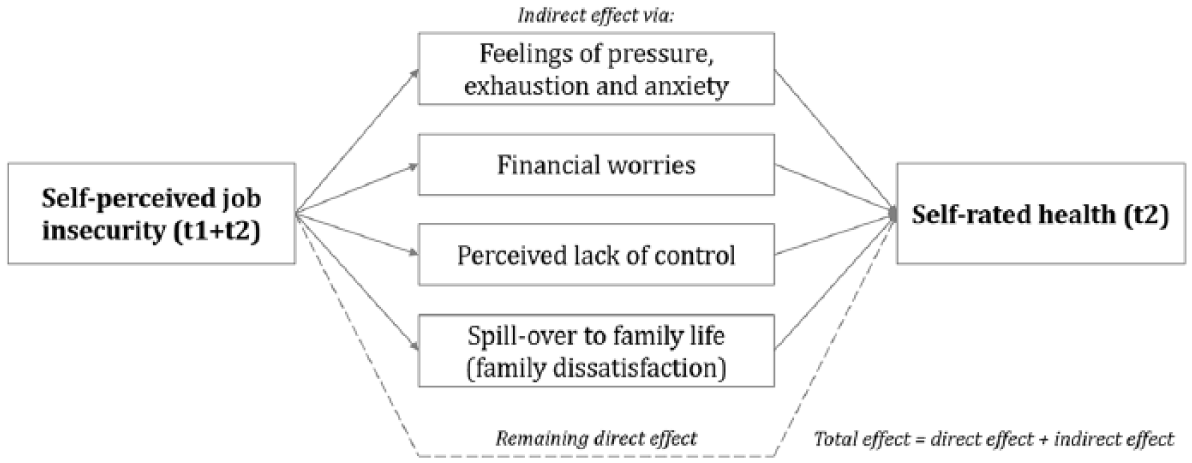
Potential mechanisms linking self-perceived job insecurity and health.
Via feelings of pressure, exhaustion, and anxiety
Self-perceived job insecurity is characterized by the perception that the future is unpredictable and uncontrollable (De Witte, 1999; Greenhalgh and Rosenblatt, 1984). Workers may anticipate a job loss, but they cannot be sure whether and at what point in time they will actually lose their job, which can make it difficult for them to develop a strategy for coping with this prospect (Dekker and Schaufeli, 1995). This precarious situation may trigger emotional stress reactions, such as feelings of pressure, exhaustion, and anxiety (Sverke and Hellgren, 2002). These stress reactions are generally known to affect health, and they may mediate the relationship between self-perceived job insecurity and health.
Via financial worries
In addition to causing work-related stress, self-perceived job insecurity may be seen as an immediate threat to a worker’s standard of living. Among other latent benefits, a primary function of work is to provide income and a livelihood for workers and their families (Jahoda and Zeisel, 1974). Perceived job insecurity may thus be associated with worries about the worker’s own economic situation, which may in turn cause stress and affect the worker’s health. It therefore seems reasonable to suppose that financial worries mediate the relationship between self-perceived job insecurity and health.
Via perceived lack of control
Another possible pathway through which self-perceived job insecurity may affect health is via a perceived lack of control. The sense of personal control is an important aspect of an individual’s personality that is discussed in psychology and sociology in various closely related forms, such as self-efficacy or agency (Bandura, 1977; Ross and Mirowsky, 2013). In a general sense, self-perceived personal control captures the degree to which a person believes s/he has control over meaningful events and circumstances in his/her life. Among other benefits, people with a strong sense of personal control experience better health than people with a weaker sense of control. If people are faced with difficult life events, their confidence in their personal control can erode. This is especially likely to occur when workers experience job insecurity, which usually results from external factors (such as the financial difficulties of the employer) that are beyond the workers’ control (Glavin, 2013; Vander Elst et al., 2014).
Via spill-over effect to family life
Self-perceived job insecurity may also affect health indirectly through decreased family satisfaction. It is known that the negative consequences of self-perceived job insecurity are by no means limited to the affected workers, as they can also spill over to aspects of family life (Mauno et al., 2017; Nolan et al., 2000). Individuals who are concerned about their job stability may, for example, be more aggressive and hostile, less able to communicate, and more tense and ill-tempered (Larson et al., 1994). Thus, family satisfaction is reduced (Larson et al., 1994; Mauno and Kinnunen, 1999), which could have detrimental consequences for workers’ health.
Health effects across different age groups
The mechanisms through which self-perceived job insecurity affects a worker’s health might vary across his/her working life as his/her degree of job dependency changes (Glavin, 2015; Greenhalgh and Rosenblatt, 1984). Young workers who are starting their careers tend to be more flexible and have fewer financial obligations than older workers (Glavin, 2015). However, job insecurity could be a threat to a young worker’s career aspirations, and might therefore cause feelings of pressure, exhaustion, and anxiety. Furthermore, job insecurity is likely to erode a young worker’s sense of control, as s/he might not have the experience needed to handle these situations. For a middle-aged worker with substantial family obligations, self-perceived job insecurity can affect his/her financial livelihood and spill over into his/her family life. I therefore hypothesize that financial worries and family dissatisfaction are the main mechanisms through which self-perceived job insecurity affects the health of middle-aged workers. An older worker might again be less dependent on his/her current job, as s/he has fewer family responsibilities and the opportunity to retire early to escape the consequences of unemployment. An older worker may, however, attach a greater meaning to his/her current job. Job insecurity might therefore trigger feelings of pressure, exhaustion, and anxiety that harm the worker’s health.
Aims of this article
In this article, I examine how self-perceived job insecurity is linked to subjective health. In particular, I study the short-term and long-term health effects for different age groups in order to reveal possible variations of the well-known detrimental consequences of job worries on health across working life. I therefore distinguished between workers aged 18–35, 36–50, and 51–65. Based on stress theory and previous literature, it is expected, on the one hand, that the health effect increases with age and, on the other, that the health effect increases with duration of job insecurity. Furthermore, I study the mechanism through which job insecurity affects health, again separated for different age groups. I therefore identified above six possible mechanism which I expect to link self-perceived job insecurity and health across all age groups.
Data, measures, and analysis strategy
Data
The following analysis is based on two consecutive waves of the Socio-economic Panel (SOEP v32.1; 2009, 2010). The SOEP is a representative longitudinal survey of the population in Germany conducted every year since 1984. It covers a wide range of individual characteristics, such as education and employment biography, working conditions, satisfaction, value orientation, and indicators of health (Wagner et al., 2007). As some of the relevant variables for testing possible mediating mechanisms (e.g., locus of control, feelings of depression) were queried only in 2010, the observation period of this study is limited to the years 2009 and 2010. The sample is restricted to respondents aged 18 to 65 who were full-time, part-time, or marginally employed throughout the two years of the observation period, and who answered the relevant questions about health and self-perceived job insecurity. The analysis sample consists of 7855 workers.
Measures
The outcome variable is the self-rated health status of workers in the second year (t2); information on self-rated health from the first year (t1) is used to adjust all of the following multivariate analyses for baseline health. In the SOEP, self-reported health is measured by asking respondents: ‘How would you describe your current health?’ The response options are ‘very good,’ ‘good,’ ‘satisfactory,’ ‘poor,’ and ‘bad.’ Self-reported health is a commonly used health indicator that correlates strongly with other objective health indicators, and is a robust predictor of subsequent mortality (Falconer and Quesnel-Vallée, 2017; Idler and Benyamini, 1997). In the following analysis, I use self-rated health as a dichotomous measure, whereby ‘very good’ and ‘good’ are coded as ‘1’ and ‘satisfactory,’ ‘poor,’ and ‘bad’ are coded as ‘0.’
Self-perceived (affective) job insecurity is measured by the question of whether the respondent is ‘very concerned,’ ‘somewhat concerned,’ or ‘not concerned at all’ about his/her job security. It is assumed that a response of ‘very concerned’ indicates that the individual is experiencing job insecurity. Using information from both waves of the observation period, I distinguished three groups of workers based on their self-perceived job insecurity: (1) workers who were not worried about their job stability throughout the two-year observation period, (2) workers who became worried from one year to the next, (3) workers who were worried over the entire period (persistent job insecurity), and (4) workers who perceived their job as insecure in 2009 but overcame these worries in 2010.
All mediating variables are measured in the second year (at t2). There is no option to control for any change in these variables between the two years, as most of the information on the variables was collected in 2010. Emotional stress reactions are measured through three single indicators: feelings of pressure, exhaustion, and anxiety. Respondents were asked how often they ‘felt rushed or pressed for time,’ ‘felt run-down and melancholy,’ and ‘felt angry.’ Respondents who reported having these feelings ‘always,’ ‘very often,’ or ‘often’ are coded as feeling pressure, exhaustion, and anxiety, respectively. Furthermore, respondents were asked whether and to what extent they are concerned about their ‘own economic situation.’ Workers who reported being very concerned about their situation are coded as having perceived financial worries. The SOEP contains five items to describe the external locus of control (‘what you achieve depends on luck,’ ‘others make the crucial decisions in my life,’ ‘I doubt my abilities when problems arise,’ ‘possibilities are defined by social conditions,’ ‘I have little control over my life’). Based on a seven-point Likert scale ranging from ‘disagree completely’ to ‘agree completely,’ an individual factor score is calculated, with a higher score indicating a lower personal locus of control (Cronbach’s alpha = 0.65) (Richter et al., 2013). Finally, family dissatisfaction is captured by an 11-point scale ranging from being ‘totally happy’ to being ‘totally unhappy’ with ‘family life.’
Furthermore, indicators that have been proven to be relevant for either health or job insecurity are included into the multivariate analysis as control variables. These indicators include socio-demographic characteristics such as age, gender, education, region (Eastern vs. Western Germany), and marital status; as well as characteristics of the individual’s employment situation (fixed-term contract, part-time employment, marginal employment, size and industry of firm, working in public sector), job tenure, and previous unemployment experience.
Analysis strategy
The analyses begin with descriptive results that provide initial insights into the distribution of self-perceived job insecurity and its relationship with health depending on the timing and the duration of self-perceived job insecurity. I then use the so-called KHB method, a recently developed mediation analysis, to determine the extent to which the selected mediating variables explain the total effect of job insecurity on health. This method provides an unbiased decomposition of total effects into direct and indirect effects for nonlinear probability models (Breen et al., 2013, 2018; Kohler, 2011). The total effect represents the impact of self-perceived job insecurity on health without the inclusion of mediator variables as controls. The direct effect is obtained using a full model with mediators, and indicates the (remaining) effect of self-perceived job insecurity on health (unexplained part). The indirect effects represent the parts of the total effect that run through the different mediating variables. The analyses were done using a user-written khb module for Stata (Kohler, 2011).
Findings
Descriptive results
Table 1 shows the proportions of workers who were not worried about their job stability throughout the two-year observation period, became worried from one year to the other, remained worried over the whole period, or overcame their job loss worries in the second year. A great majority (79.2%) of the workers surveyed in Germany reported that they were not worried about their job stability during the years 2009 and 2010. Consequently, only a small proportion of the workers reported experiencing job insecurity: 5.6% of the workers became worried, 8% remained worried, and 7.2% perceived their job as insecure in 2009 but overcame this feeling in 2010. These levels of self-perceived job insecurity are relatively low when compared internationally and over time (Anderson and Pontusson, 2007; Erlinghagen, 2008; Green, 2009), and might be attributable to the relative stability of the German economy following the worldwide financial crisis (Möller, 2010).
Distribution of self-perceived job insecurity.
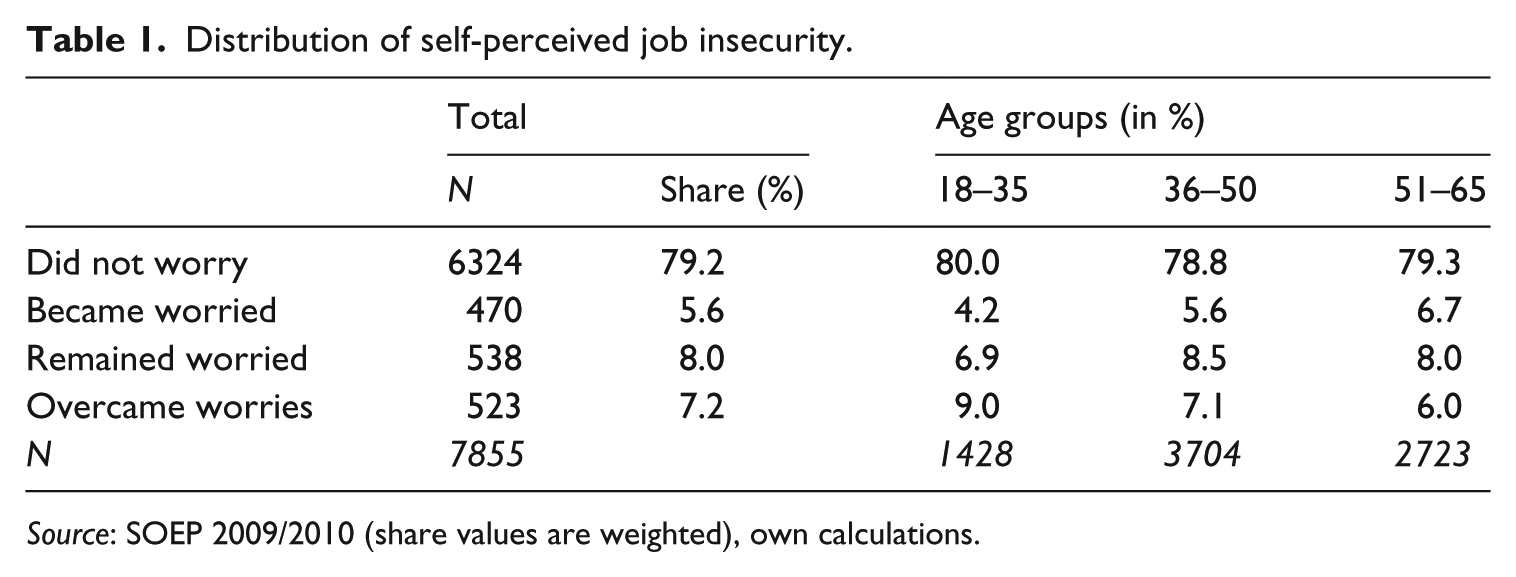
Source: SOEP 2009/2010 (share values are weighted), own calculations.
The experience of job insecurity varied across age groups, as can be seen in Table 1. The differences are especially evident between younger workers (aged 18–35) on the one hand and middle-aged (aged 36–50) and older workers (aged 51–65) on the other. Younger workers were, for example, more likely to have overcome their job loss worries (9.0% vs. 7.1 and 6.0%), whereas middle-aged and older workers were more likely to have remained worried (8.5 and 8.0% respectively vs. 6.9%). The differences between workers aged 36–50 and 51–65 are small, and do not allow us to draw any clear conclusions about the distribution of self-perceived job insecurity across the later life course.
The descriptive results, which are displayed in Figure 2, confirm the findings of previous research and show that self-perceived job insecurity is associated with reduced self-rated health. Across all age groups, the share of workers who reported their health as being very good or good was largest among those workers who were not worried over the observation period (ranging from 72.7% among younger workers to 60.9 and 46.5% among older workers). As expected, those workers who became worried reported having lower levels of health than secure workers did, while the workers who remained worried reported having the worst health status (for example, only 34.1% of workers aged 36–50 reported being in very good or good health). This result suggests that the health-damaging effects of job insecurity occur immediately, but also continue when job insecurity persists. An additional interesting finding displayed in Figure 2 is that the workers who overcame job insecurity reported having higher levels of health than the worried workers, but were (still) in worse health than the workers who did not worry at all. This finding suggests that some portion of the health-damaging effects of job insecurity persists even after the individual regains job security.
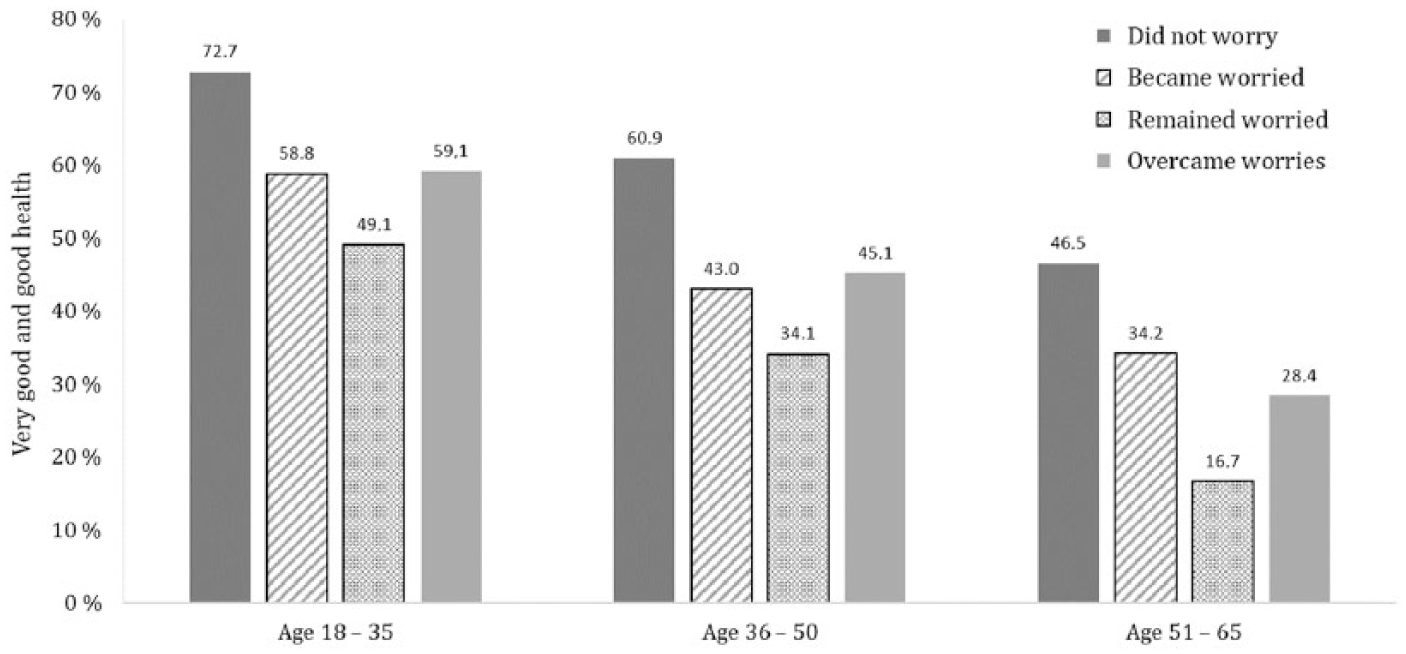
Relationship between job insecurity and self-rated health (across different age groups).
Multivariate results
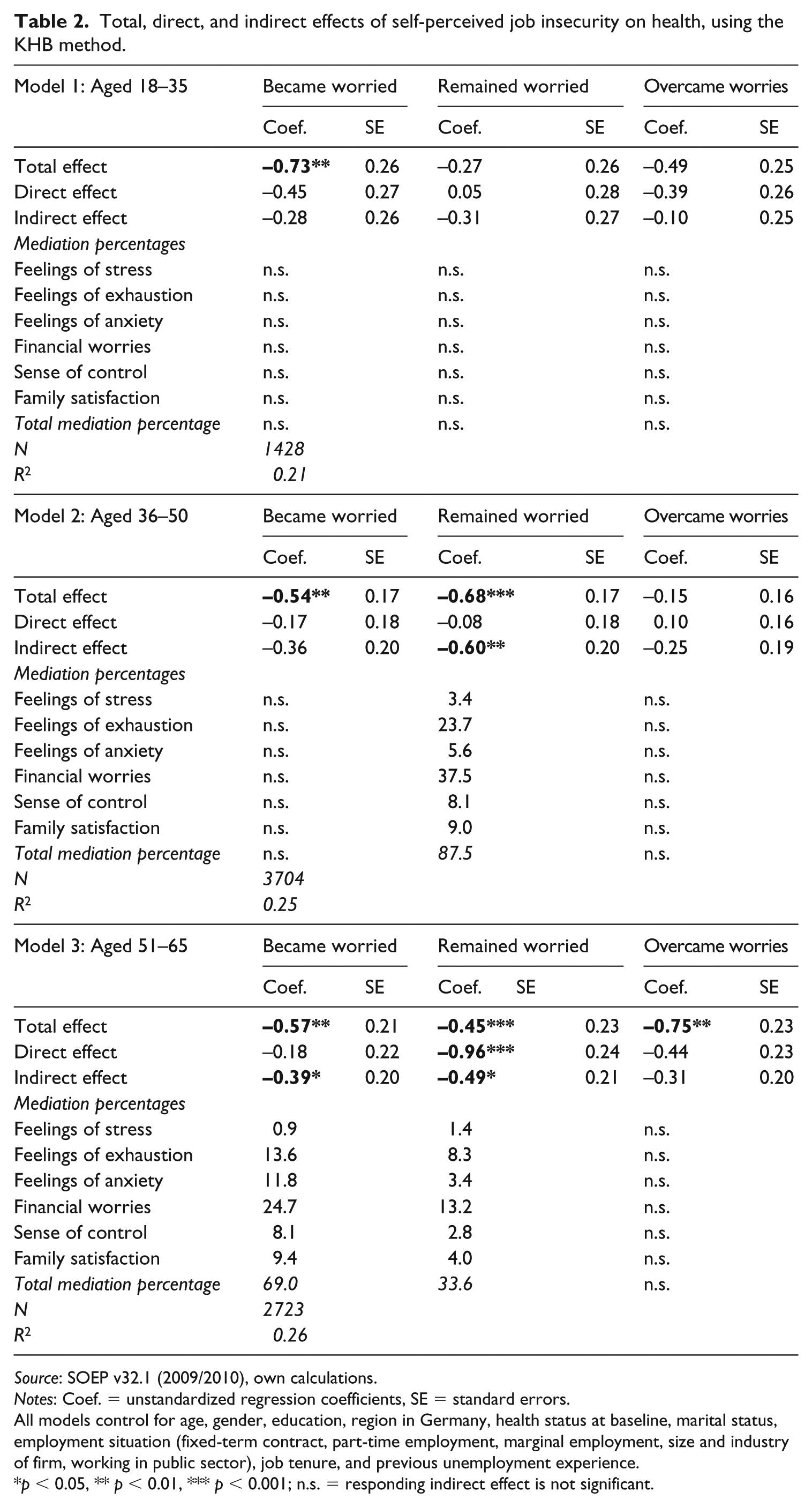
Table 2 presents the results of different mediation models separately for three age groups (18–35, 36–50, and 51–65). The KHB method is used to decompose the total effect of self-perceived job insecurity on self-rated health into indirect and (remaining) direct effects. The models contain all of the above-mentioned control variables, but only the results of the mediation analysis are presented. Turning the focus first to the total effect, the results can offer some observations about the overall effect of job insecurity on health. The total effect of becoming worried was negative and significant in all three models. This means that the likelihood of assessing one’s health as very good or good was reduced for those workers who became worried from one year to the next. This result appears to contradict the above-mentioned assumptions that only prolonged job insecurity harms health, and that only older workers are affected (Burgard et al., 2009; De Witte, 2016). Instead, the analysis shows that self-perceived job insecurity had an ‘immediate shock effect’ through which the health of workers of all ages was promptly affected.
Total, direct, and indirect effects of self-perceived job insecurity on health, using the KHB method.
Source: SOEP v32.1 (2009/2010), own calculations.
Notes: Coef. = unstandardized regression coefficients, SE = standard errors.
All models control for age, gender, education, region in Germany, health status at baseline, marital status, employment situation (fixed-term contract, part-time employment, marginal employment, size and industry of firm, working in public sector), job tenure, and previous unemployment experience.
p < 0.05, ** p < 0.01, *** p < 0.001; n.s. = responding indirect effect is not significant.
Furthermore, the total effect of remaining worried is also found to be negative and significant in two of the three models. As the analysis controls for health status at baseline, this outcome has to be interpreted as reflecting an additional deterioration of health caused by the lasting perception of job insecurity, and can thus be described as a ‘prolonged stress effect.’ This result is in line with stress theory, which assumes that long-term exposure to stress is particularly harmful to health as an individual’s capacity for dealing with stress erodes over time (Dougall and Baum, 2011). However, this prolonged stress effect is found to be significant only for workers aged 36 and above. It appears that the younger workers were better able to cope with persistent job insecurity, and thus did not experience any further damage to their health when insecurity continued.
The results of the multivariate analyses also support the descriptive finding that the workers who overcame job insecurity were in worse health than the workers who did not worry at all. This effect of having overcome job insecurity is shown to be significant only for workers aged 51–65. This means that the long-term scarring effect of job insecurity on health applies only to older workers, whereas among younger and middle-aged workers the health-damaging effect of job insecurity was reversed after regaining secure employment.
Turning now to the results of the mediation analysis, I start by looking at the total mediation percentage, which is displayed in Table 2 as well. The total mediation percentage indicates the extent to which all of the introduced mediating variables (including feelings of stress, exhaustion, and anxiety, financial worries, sense of control, and family satisfaction) together account for the total effect of self-perceived job insecurity on health. The total mediation percentage ranges from 33.6 to 87.5%; in several cases, the total mediation percentage cannot be interpreted, as the associated indirect effect is not significant.
The introduced mediating variables work best for middle-aged workers. Among the workers in this age group, feelings of stress, exhaustion, and anxiety, financial worries, sense of control, and family satisfaction accounted for about 87.5% of the total effect of remaining worried. Financial worries accounted for the largest part of the relationship between self-perceived job insecurity and health (33.8% for becoming worried and 37.5% for remaining insecure), followed by feelings of stress, exhaustion, and anxiety (15.8 and 23.7%), sense of control (9.6 and 8.1%), and family satisfaction (2.0 and 9.0%). Feelings of stress and anxiety, in contrast, played only a minor role. These mediation variables, however, do not explain the effect of becoming worried on health for that age group. So, it remains unclear what drives the ‘immediate shock effect’ for workers aged 36–50.
Looking at older workers, aged 51–65, one finds different results. Among workers in this age group, the introduced mediating variables still explained 69.0% of the total effect of becoming worried, but only 33.6% of the total effect of remaining worried. The indirect effect of overcoming worries was not even significant. These findings mean that the proposed explanations are either not sufficient to explain or, in the latter case, do not explain at all the observed relationship between job insecurity and health. The results are similar for younger workers aged 18–35. The analysis shows that the health of younger workers suffered in response to short-term job insecurity. The corresponding indirect effect was, however, not significant for workers. Thus, the detrimental health effect among younger workers could not be explained by feelings of stress, exhaustion, and anxiety, financial worries, sense of control, or family satisfaction.
Summary and conclusion
The analyses presented in this article confirm that self-perceived job insecurity detrimentally affects self-reported health. An ‘immediate shock effect’ was differentiated from a ‘prolonged stress effect.’ An immediate shock effect occurs when a person becomes worried from one year to the next, and applies to workers of all ages. In contrast to the results of previous studies by Burgard et al. (2009) and Glavin (2013), the findings clearly indicate that job loss worries are harmful to the health of younger, middle-aged, and older workers alike. In addition, the prolonged stress effect describes a further deterioration in the health of a worker when job loss worries persist over a longer period. However, this effect is found to be significant only for workers aged 36–50 and 51–65. It therefore appears that middle-aged and older workers are more vulnerable to persistent job insecurity than younger workers. In addition, for older workers, aged 51–65, the health-damaging effects of job insecurity are found to persist after they regain job security.
Second, the findings indicate that the mechanisms through which job insecurity affects health vary over a person’s working life. The theoretically assumed mechanisms work very well for middle-aged workers (aged 36–50). Among workers in this age group, perceived financial problems, feelings of stress, exhaustion, and anxiety, a perceived lack of control, and family dissatisfaction explain about 87.5% of the total effect on health of remaining worried. However, these factors either do not or do not sufficiently explain the detrimental health effects of job insecurity among other age groups. Especially notable is the finding that younger workers also suffer from job insecurity; but the explanation for this effect remains unclear. None of the hypothesized mediating factors explains the detrimental effects of self-perceived job insecurity on the health of younger workers. Similarly, the question of how persistent job insecurity affects the health of older workers has yet to be answered. The study is also unable to determine why older workers who overcame job loss worries continued to report being in worse health. These outcomes raise the question of what other factors might mediate the relationship between self-perceived job insecurity and self-rated health for younger and older workers.
Further explanations for the relationship between self-perceived job insecurity and health may, for example, include several behavioral reactions to self-perceived job insecurity. Like other stressful situations, job loss worries could result in unhealthy lifestyle behaviors, such as getting too little exercise, having a poor diet, smoking, or getting too little sleep (Siegrist and Rödel, 2006). It is also conceivable that workers with job loss worries may start to work overtime to protect themselves against job loss. This greater job pressure will sooner or later result in reduced job satisfaction and damage to health. Various psychological stress reactions that could not be considered here due to data restrictions could also help to explain the relationship between job insecurity and health. These reactions include anger, irritability, and restlessness. Furthermore, job insecurity might negatively affect a worker’s self-esteem and confidence, which could make him/her more vulnerable to health problems. This list of possible mechanism is not complete, and more research is required to further identify and examine factors that could mediate the relationship between self-perceived job insecurity and health.
The analysis in this article has several limitations that future research could address. To begin with, the analyses were restricted to a relatively short observation period. Using the data of two consecutive waves of a representative panel allowed to control for health at baseline, and thus to detect two different health effects of self-perceived job insecurity: namely, the ‘immediate shock effect’ and the ‘prolonged stress effect.’ Future research should extend the investigation period over more than the two years covered here. A longer study period would enable us to learn more about whether and, if so, how workers adapt to and cope with prolonged stress, such as self-perceived job insecurity. Furthermore, due to data restrictions the analysis was unable to control for the mediating variables at baseline as well. Second, the analyses in this article were restricted to examining the impact of affective job insecurity on self-rated health, and to distinguishing between three age groups (18–35, 36–50, and 51–65). It is, however, conceivable that the mechanisms that link self-perceived job insecurity and other health outcomes, such as mental and physical complaints, differ from those identified here. Furthermore, the detrimental health effects of job insecurity might depend not only on the age of worker, but on other socio-economic factors such as gender, family status, level of education, and several characteristics of employment (e.g., having a fixed-term contract). Third, the analyses in this study were limited to investigating the effects of self-perceived job insecurity on the health of the affected workers. It should, however, not be forgotten that the detrimental consequences of job loss worries spill over to partners and children. Future research should therefore also consider the effects of job insecurity on the health of family members. And last, this article is limited to the German context, which is different from other countries.
Despite these limitations and remaining research questions, the results of this study are relevant for policy makers and health practitioners. An obvious implication of the findings is that prevention measures should be undertaken to reduce self-perceived job insecurity in general (i.e., primary prevention). In particular, efforts should be made to limit the length of time a worker feels insecure about his/her future job stability, since the detrimental effects of this feeling on the worker’s health increase with the duration of exposure to job insecurity. This could, for example, be achieved through improvements in the frequency and relevance of communications within organizations that create clarity and predictability for workers (Mauno and Kinnunen, 2002; Vander Elst et al., 2010). Furthermore, prevention measures should be used to reduce the detrimental health effects of self-perceived job insecurity by targeting the underlying mechanisms (i.e., secondary prevention). This study has provided some initial orientation for such efforts. It has been shown that self-perceived job insecurity can negatively affect a worker’s health because s/he is worried about money and sees his/her livelihood as under threat. Financial worries seem, as far as we know, to be the main link between self-perceived job insecurity and health. This is not surprising, since they are a well-known stressor that detrimentally affect health. Whether job insecurity leads to financial worries, however, depends among others on the social security system in a country and its generosity of unemployment benefits. Higher replacement rates therefore should not only help people who have lost their job, but also may mitigate the health effects of self-perceived job insecurity due to a kind of spill-over effect that makes people perceive a possible job loss less severe.
Prevention efforts can also start by helping workers maintain and increase their employability. If a worker is confident that s/he will be able to find another job of sufficient quality in case of job loss, his/her financial worries will be reduced, and the negative effects of self-perceived job insecurity will be lessened (Greenhalgh and Rosenblatt, 1984). Independent of such financial considerations, job loss worries tend to shake a worker’s confidence in a secure future, and thus trigger different types of stress reactions. Prevention efforts based on these research findings will not only serve to alleviate health problems, they will help to reduce the substantial health care costs associated with work-related stress in many Western countries.
Footnotes
Funding
This research received no specific grant from any funding agency in the public, commercial, or not-for-profit sectors.