




Abstract
Drawing on recent incentive theory and the growing use of multiple incentives by firms, this article examines the effects of combining incentives on workplace labour productivity. Utilizing data from the British Workplace Employment Relations Survey, the article explores whether multiple incentives are more effective than single incentives. It is found that the productivity effects of individualized incentives are enhanced by profit sharing though not by collective payment by result schemes (PBR). Profit sharing also enhances the effect of collective PBR, and it is found that two group incentives are more effective than a single individual incentive. However there are limits on the number of incentive schemes that can be combined effectively. The effects of mixed incentives tend to be greater in workplaces with worker discretion and task variety, thereby providing support for a contingency perspective.
Introduction
An increasing proportion of companies and workplaces use multiple pay incentives for their employees. Nearly 40% of British workplaces were using two or more incentive systems by the mid-2000s compared with just over 20% two decades earlier (Pendleton et al., 2009: 279). This development in corporate practice is mirrored by developments in theory and research on incentives. Recent theory suggests that multiple incentives may be more productive than single incentives because the positive features of one can counteract negative effects of another. A wider range of incentives can spread employee effort across a range of desired tasks whereas a single incentive may lead to undue focus on just one task. Furthermore, the addition of incentives that encourage employee commitment to the company may counter the dysfunctional employee behaviour that often arises from individual incentives (Gibbons, 1998; Holmstrom and Milgrom, 1994; Roberts, 2010).
Despite these developments in theory and practice, there is as yet very little empirical evidence on these issues. A key issue is whether the provision of multiple incentives does indeed have the beneficial company outcomes that recent theoretical contributions and corporate practice imply. This article provides new evidence on this issue by addressing several interrelated questions that have been posed in the recent literature on incentives theory. Do combinations of incentives have a stronger impact on productivity than a single incentive (Holmstrom and Milgrom, 1994)? Are the effects of individual incentives, such as individual payment by results (IPBR), enhanced by the addition of apparently weaker incentives such as group payment by results (GPBR) or profit sharing (PS)? Is GPBR or PS more effective in this respect, given that PS would appear to have weaker incentive effects, as highlighted in the financial participation literature (Weitzman and Kruse, 1990)?
The article addresses these questions using data from the British Workplace Employment Relations Survey (WERS). It examines the ‘marginal effects’ of individual schemes, and combinations of them, on workplace productivity. In the first instance, the effects are examined for all private sector workplaces in the survey. Then, drawing on contingency approaches suggesting that the effectiveness and appropriateness of pay systems will depend on organizational context, the effects of combinations of incentive systems are assessed in contrasting work settings. Specifically we evaluate whether the effects of multiple incentives are contingent on the extent of worker discretion and work variety.
The results are supportive of recent theoretical contributions, and provide a rationale for the growing use of multiple incentives by companies. PS in particular plays a key role in ‘unlocking’ positive relationships between other payment schemes and productivity, even though theoretically it is the weakest incentive because of free-rider effects and a tenuous ‘line of sight’ between individual effort and measured outcomes (Conyon and Freeman, 2004). Given these apparent weaknesses, we suggest that the complementary effects of PS derive from its capacity to engender cooperation and reciprocity (Coyle-Shapiro et al., 2002; Morris and Pinnington, 1998). We suggest that it is these ‘softer’, social-psychological aspects of profit sharing, along with the broader performance metrics in profit sharing, that mitigate potentially dysfunctional incentives in individual incentive schemes.
These results contribute to the literature in several ways: whereas most recent articles evaluating multiple incentives consider the nature and incidence of incentives and measurement characteristics (e.g. Kauhanen and Napari, 2012), this article focuses on the important issue of outcomes. In contrast, though, to other studies examining outcomes (e.g. Barnes et al., 2011), our research examines effects at the workplace rather than employee level. The role of profit sharing in particular as a complement to other pay incentives provides a new perspective on the generally positive role of profit sharing observed over many years in the financial participation literature (Perotin and Robinson, 2003).
Prior to presenting the results, the article outlines our reasoning for expecting complementary effects from multiple incentives drawing on recent theory in personnel and institutional economics. The data and methodology is then outlined, prior to presentation of the results. The article concludes with some observations on the limitations of this research and some suggestions for future research.
Background
There has been a long tradition of research into the operation and effects of incentive pay schemes, reflecting persistent and long-standing interest amongst companies in finding effective ways to enhance worker performance. Linking wage payments to output or results is said to provide an incentive for workers to expend greater effort and thereby generate higher levels of output (Prendergast, 1999). This proposition has been formalized in agency theory, whereby incentives reduce the agency costs of monitoring worker effort and output (offset by the need to pay premiums to compensate workers for risk-bearing). Recent contributions have also highlighted the sorting effects of IPBR: higher pay for higher effort or output will attract higher quality recruits and possibly shake out less productive workers (see Lazear, 2000). Nearly all of the incentives literature in this tradition considers single incentive schemes, be they individual PBR, group PBR, profit sharing, share ownership plans, or stock options, in isolation from other schemes.
However, there is a growing body of theory, as yet mainly unmatched by empirical evidence, which suggests that multiple incentives may be more effective than single incentives (Gibbons, 1998; Holmstrom and Milgrom, 1994; Prendergast, 1999). The background to this supposition is the well-known limitations of single incentive schemes, especially those based on individual output or performance. The need for measurement and observability often complicates the design of efficient incentive contracts, which in turn dilutes the incentive, requires costly risk premiums, or encourages dysfunctional and costly worker behaviour. The measurement process itself may be costly, as exemplified by ‘time and motion’ studies in traditional IPBR.
Following Gibbs et al. (2009), the issues with measurement relate to noise, distortion and manipulability (arising from workers’ asymmetric information). Taking each in turn, measurement will be noisy insofar as output is influenced by factors other than the employee’s effort, and it is difficult to attribute output precisely to particular workers. This is risky for the (risk-averse) worker/agent. Risk may be controllable/uncontrollable by the worker: where it is under the worker’s control, additional incentives may be necessary to encourage the worker to behave appropriately (Prendergast, 2002); where it is not, workers will likely seek insurance (guaranteed payments for events outside their control) and risk premia. Agency theory predicts, therefore, a trade-off between risk and incentives (Prendergast, 2002), and there is evidence that incentive pay is less likely to be used, and less effective, when companies face higher product market risk (Bloom and Milkovitch, 1998: 290–291). A refinement of this argument, for which there is some empirical support, is that worker discretion moderates the risk–incentives relationship. Where workers have discretion, incentives help them to make the right choices under uncertainty (Devaro and Kurtulus, 2010).
Distortion occurs where the incentive causes the worker to devote inappropriate effort or attention to one aspect of their job (typically the element rewarded by the incentive payment). This reflects the difficulty of designing measurement systems that adequately capture the distribution and weighting of tasks. Distortion is likely to increase with task range and complexity. For this reason, individual incentives may be less effective where workers have discretion to organize their work tasks. Individual incentives may also be costly where managers want workers to experiment or innovate because new methods are not captured by the incentive scheme (Roberts, 2010). The solution may be to increase the number of dimensions of measurement, which is potentially costly, or else to add new types of incentive so as to encourage a spread of effort across the range of tasks.
Manipulation occurs where workers can exploit asymmetric information about the production process to secure incentive payments. Classic micro-sociological studies by Roy (1952) in the USA and Lupton (1963) in Britain showed how piece work gave rise to hoarding of output (giving workers de facto discretion over daily effort), manipulation of task times and restriction of effort and output. IPBR can also generate low trust, and hence encourage manipulation, by signalling that managers lack faith in the capability or motivation of workers to perform tasks or that the desired results are difficult to achieve (Ellingsen and Johannesson, 2008; Gneezy et al., 2011). These effects in turn underpinned conflictual industrial relations and pervaded the conduct of collective bargaining (see Brown, 1973; Edwards and Scullion, 1982). There is also widespread evidence of other forms of individual incentives being manipulated by employees, as in the findings from the stock options literature that top executives manipulate the timings of stock option awards and ‘reload’ options when prices fall (see Bebchuk and Fried, 2004; Brenner et al., 2000; Yermack, 1997).
A key element of recent incentives theory is the proposition that the addition of further incentives can ameliorate the measurement costs associated with individual incentives (Roberts, 2010). Additional incentives such as profit sharing may reduce manipulation by enhancing cooperation and commitment. PS may also mitigate the agent’s pursuit of insurance where risk is uncontrollable by signalling that employees will benefit from future company performance. Measurement noise may be mitigated in interdependent work environments by collective schemes that focus on group rather than individual output. Multiple incentives potentially soften distortion by rewarding a wider range of tasks and behaviour and limit workers’ opportunity to game incentives. For these reasons a mix of individual and collective, or combinations of group incentives may be more effective than individual incentives in many workplaces. By contrast, in those workplaces where measurement noise, distortion and manipulation are low (because tasks are repetitive, simple and independent), individual payment by results or single metric pay incentives may be effective on their own (cf. Gneezy et al., 2011; Kauhanen and Napari, 2012; Rynes et al., 2005).
Nevertheless, as has been widely observed in the literature, group-based incentives are not without their limitations. One, the 1/N problem means that individual employees may ‘free-ride’ on the efforts of others. Two, the ‘line of sight’ between individual work behaviour and payments determined by collective outcomes can be indirect and tenuous (Conyon and Freeman, 2004). These limitations are likely to increase with the size of the reward group, with those group-based incentives linked to company performance rather than group output likely to have very weak, perhaps non-existent, incentive effects (Prendergast, 1999; Sesil, 2006). In these terms, profit sharing is likely to have lower incentive power than group PBR systems because the ‘line of sight’ between individual effort and payments is especially indirect.
However, in practice profit sharing may be more effective than group PBR. Net measurement and compliance costs in profit sharing are likely to be negligible because profits have to be calculated anyway for the annual company report. Furthermore, group PBR may have negative effects that are not usually found in profit sharing. One important limitation of group PBR is that work groups often develop informal norms restricting output, as has been observed from the Hawthorne studies onwards (Rose, 1975).
The conjunction of individual PBR with group schemes may reduce free-riding and may help to develop an appreciation of the ‘line of sight’ between individual and collective results by encouraging individuals to focus on linkages between their own performance and collective outcomes. It may also deal with the sorting issue identified above. Against this, rewarding individual and collective performance may set up a ‘social dilemma’ for employees: which targets do they pursue?
Surprisingly, there is little empirical evidence on the effects of multiple incentives despite the theoretical case for them. An early study comparing the effects of hybrid (individual and group) incentives against both individual and group incentives found that the mixed incentives performed worst (Wageman, 1995). Recent studies have used experimental techniques to compare individual, group and mixed incentives, and have found little evidence for the superior performance of mixed arrangements (Barnes et al., 2011; Libby and Thorne, 2009). It has been argued that mixed arrangements can be confusing for employees, and this detracts from any potential to get the ‘best of both worlds’. These studies focused on the behavioural impact of combining incentives: what has been missing from the literature has been an empirical assessment of the impact on company or workplace economic performance. Arguably, this is the ‘acid test’ of whether multiple incentives are worthwhile. Accordingly, this article assesses the effects of combining incentives on workplace productivity.
Based on the reasoning presented so far, several predictions are used to guide the research. One, in general, multiple incentives will be more effective than a single incentive scheme in terms of affecting the probability of high levels of productivity. Two, more specifically, the addition of a collective incentive scheme to an individual-based scheme such as IPBR, or vice versa, will augment the productivity effects by more than the sum of the effects of the two incentive schemes. Three, based on the view that the net limitations of GPBR are greater than those of PS, GPBR will be less effective than PS when added to IPBR. Four, the combination of collective incentives such as GPBR and PS will be more effective than the use of IPBR by itself, highlighting the potential of apparently less powerful incentives to outperform individual incentives.
We further examine whether the effects of single and multiple incentive schemes are contingent on features of the work environment, given earlier findings on this issue (Belfield and Marsden, 2003: Brown, 1990). As Kauhanen and Napari (2012) point out, the trade-offs between risks assumed by the worker and distortion of work tasks and behaviour are likely to depend on job and work characteristics. In our research, the two key dimensions of task design examined are the extent of employee decision rights (task discretion) and the range of tasks (task variety).
Where a job is ‘narrow’ in terms of task range, the narrow performance measures typically found in IPBR are less likely to lead to distorted incentives, as they may capture all aspects of task performance that the employee undertakes. Where there is task variety, the addition of incentives with a broader set of metrics can encourage workers to spread effort appropriately across tasks.
As for task discretion, there are divergent perspectives in the literature concerning its moderating effects on the relationship between incentives and productivity outcomes. One perspective suggests that if task discretion is found when the production system is characterized by uncertainty and asymmetric information, incentives may be used to ensure that the worker makes the right decisions and to hold her or him to account (Devaro and Kurtulus, 2010; Prendergast, 2002). On this basis, IPBR may be expected to have positive productivity effects when there is task discretion. Meanwhile, where worker discretion is low, individual incentives may have strong productivity effects because incentive payments compensate for boring, repetitive work without decision-making powers (‘compensating differentials’).
Alternatively, IPBR may have adverse impacts by distorting the choices workers make where there is task discretion, and by enabling them to manipulate the incentive plan where they have superior information about work tasks. The worker may exploit discretion to pursue her or his own productivity-limiting preferences (e.g. to satisfice rather than optimize incentive payments), especially as individual incentives can convey low-trust signals from the employer (Ellingsen and Johannesson, 2008). If this is the case, the addition of other incentive systems may enhance productivity: group PBR may encourage cooperation with other workers (Sliwka, 2011) or impose peer pressure, whilst profit sharing may encourage workers with discretion to make decisions that are geared to bringing about good company performance.
Based on this reasoning, and the earlier discussion of relevant theory, several predictions guide the analysis of contingency effects. One, individual incentives will be effective in raising the probability of high levels of productivity in work contexts characterized by low task variety or task discretion but not in those where there is high variety or discretion. Two, adding collective incentives to individual incentives will have a complementary effect on productivity where there is high but not low task variety or discretion. Three, of the two collective incentives, profit sharing will be more effective than GPBR in this regard. Four, combinations of ‘weak’ incentives – GPBR and PS – will be more effective in work settings with high variety or discretion than those with low variety or discretion.
Methodology
The data used to address our questions come from the Management Questionnaire of the British Workplace Employment Relations Survey 2004 (WERS04). This survey provides information on a range of incentive arrangements, both individual and group, as well as broader information on employment relations, employment practices, workplace characteristics and performance measures across all sectors of the British economy. The sample is confined to private sector establishments because very few public sector workplaces have PS or GPBR. With this exclusion, and after accounting for missing values, this gives a working sample for our productivity estimates of just over 1300 workplaces. With the use of survey weights to compensate for sample-selection biases and identified non-response biases (for more information see Kersley et al., 2006: 334–335), and the use of the complex survey procedures in STATA, our results are nationally representative of private sector workplaces with five or more employees in Britain.
Our analysis focuses on evaluating the productivity effects of different configurations of incentive arrangements: whether the schemes work independently, jointly, or all together. Our productivity equations are estimated using an ordered probit model since the dependent variable is composed of several categories:

The productivity equations include all seven possible combinations of incentives arrangements – individual schemes (individual PBR, group PBR or profit sharing); joint – individual and profit sharing, individual and group, profit sharing and group; and the coexistence of all schemes. We further model the productive impact of multi-incentives according to different elements of the work environment; namely the extent to which largest occupational grouping has variety in their work and discretion over how they do their work. A series of four-way interaction models are run whereby the pay scheme interactions are supplemented by interactions using dummies to record whether workplaces have ‘high’ or ‘low’ levels of task variety and discretion.
The dependent variable is based on respondents’ assessment of the labour productivity of the establishment relative to other workplaces in the same industry. Respondents are asked to rate their establishment’s performance in terms of five, ordered categories ranging from ‘a lot below average’ to ‘a lot above average’. Overall, 52% of workplaces report ‘above’ or ‘a lot above average’ productivity, with most of the remainder reporting average productivity (42%). Much of our attention focuses on the 10% of workplaces whose labour productivity is ‘a lot above average’ (i.e. the best performing workplaces). Subjective performance measures of this type have been the subject of much debate and several investigations into their reliability and validity in the WERS series. These investigations have shown that these subjective measures have clear and reasonably strong associations with alternative objective measures of performance, and both types have been found to have similar associations with a range of independent variables (Haskel, 2005; Machin and Stewart, 1996; Wall et al., 2004). 1 Furthermore, the explicit reference to performance relative to that in similar firms normalizes productivity performance in a way that can be challenging when objective measures of performance are used. Thus, we have reasonable confidence that our variable provides a valid and acceptable measure of productivity.
The key independent variables in the analysis relate to various forms of incentive pay in which employees participate and have recently received payments. Individual PBR records the presence of a scheme which is based on individual performance or output. Group PBR records the presence of one that is linked to measures of team, workplace, or organizational performance. The definition of performance in the survey is a quantitative or objective one, and is clearly differentiated from subjective evaluations of performance. Profit sharing records the use of profit-related payments or bonuses to any employees in the workplace. This is an incentive scheme that is a form of group-based incentive but is differentiated from the other group incentive by its broader performance metric. In fact, the question relating to Group PBR explicitly excludes profit-related payments. Each of these variables is coded on a 0,1 basis capturing the incidence of each type of incentive arrangement, and of groupings of schemes (see Table 1). 2 Whilst the evidence suggests that each form of incentive pay is found in around one in five workplaces, this masks a more complex and nuanced configuration of incentives within firms. In all instances, the schemes are just as likely to operate alongside other incentive schemes as in isolation. Profit sharing is the most likely to exist alone but is also a widespread complement of both IPBR and GPBR. Indeed both individual and collective forms of PBR are more likely to exist with one or two other incentive arrangements than by themselves.
The incidence of multi-incentives (weighted percentage of workplaces).
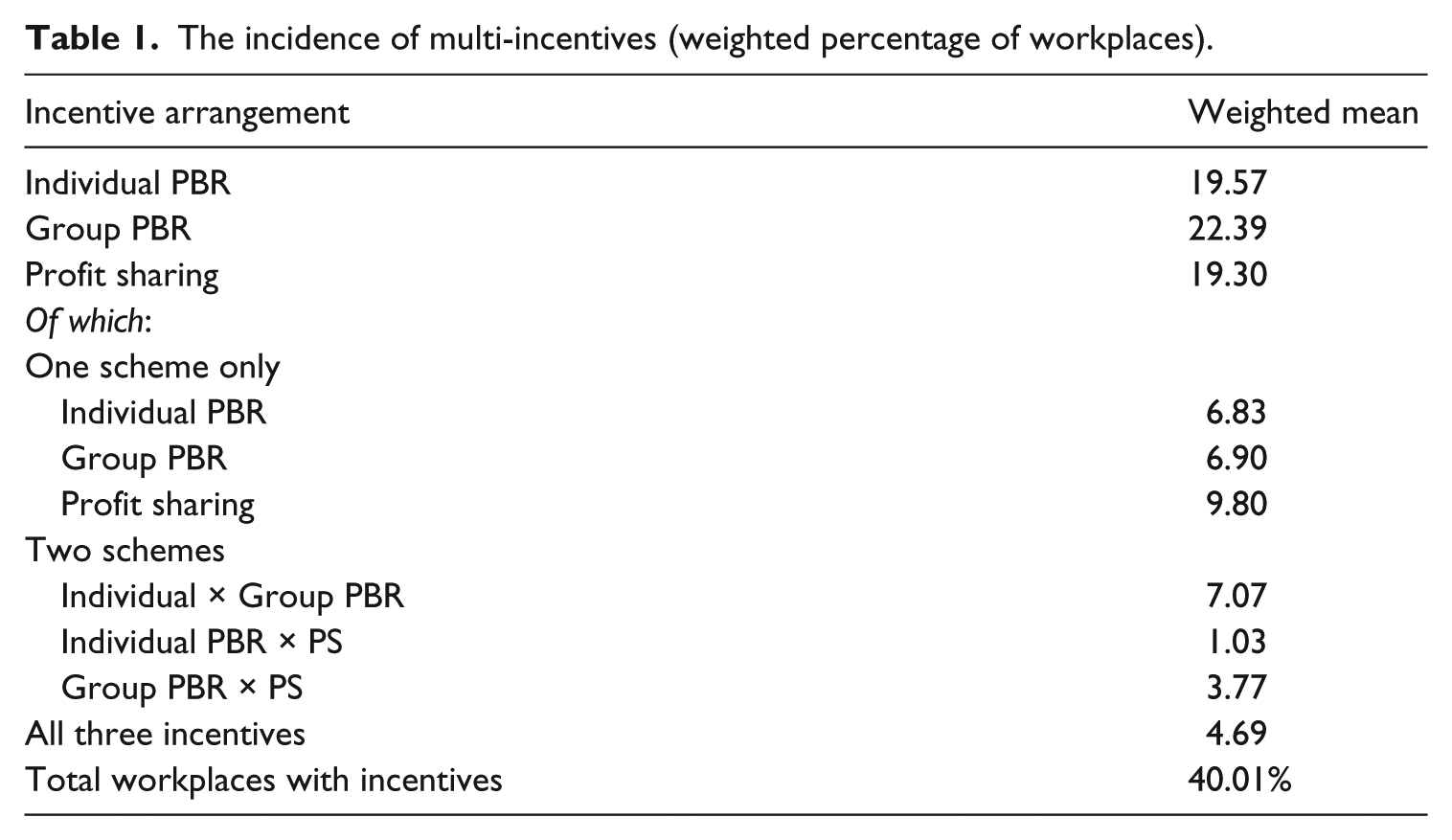
A key issue concerns the coverage of these schemes given the posited effects on workplace performance. Data on coverage indicate that individual incentives cover around half or more of the workforce in 61% of workplaces, whilst GPBR and PS cover the majority (60% plus) in 84% of cases. Thus, in the majority of cases most workers are covered by the incentive schemes in question.
In all specifications we control for a range of variables that might independently affect the level of labour productivity (see Appendix for further details on variable construction). Thus we include controls for organizational size (Medium Organization, Large Organization and Very Large Organization), workplace age (Age) and for Workplace Size. We control for Workforce Composition using the percentage of blue-collar workers in the workplace, and for the extent of Training using two dummies relating to the number of days of training provided per employee. We include a measure of Product Market Competition because this may influence the use of multiple incentives (see Pendleton et al., 2009) and it may affect the size of risk premiums that often accompany incentive schemes (Bloom and Milkovitch, 1998). A dummy variable records Trade Union Recognition and, since earlier work shows that employee involvement practices can affect productivity (Pendleton and Robinson, 2010), a measure for Involvement Practices is used (based on an additive scale of the number of direct involvement practices in the workplace). The use of subjectively determined Merit Pay is entered as a control. This does not form a more substantial part of the analysis because it is conceptually distinct from the objective variable pay schemes that are the primary focus: the latter provide supplementary bonus payments based on objective performance measures whereas merit pay is usually based on subjective performance evaluations and in Britain is typically incorporated into base pay (as additional increments or increases within salary ranges). Finally, the regressions include a set of 11 industry dummies based on the 12 main industry sectors in the British Standard Occupational Classification 2003. 3
In reporting our estimation results we note that the conventional output of limited dependent estimations (coefficients and standard errors) is not that insightful where the dependent variable is ordered and models involve numerous interaction terms. A more meaningful interpretation and understanding of the underlying relationships in such models need to be based on the reporting of marginal effects or predicted probabilities of the different incentive packages, as these can differ in direction, size and statistical significance from the traditionally reported output of coefficients and standard errors (Norton et al., 2004). We therefore use the STATA margins command to calculate and report predicted probabilities and marginal effects. In each case these results relate to the best performing workplaces (those that report ‘a lot better than average’ labour productivity).
Results
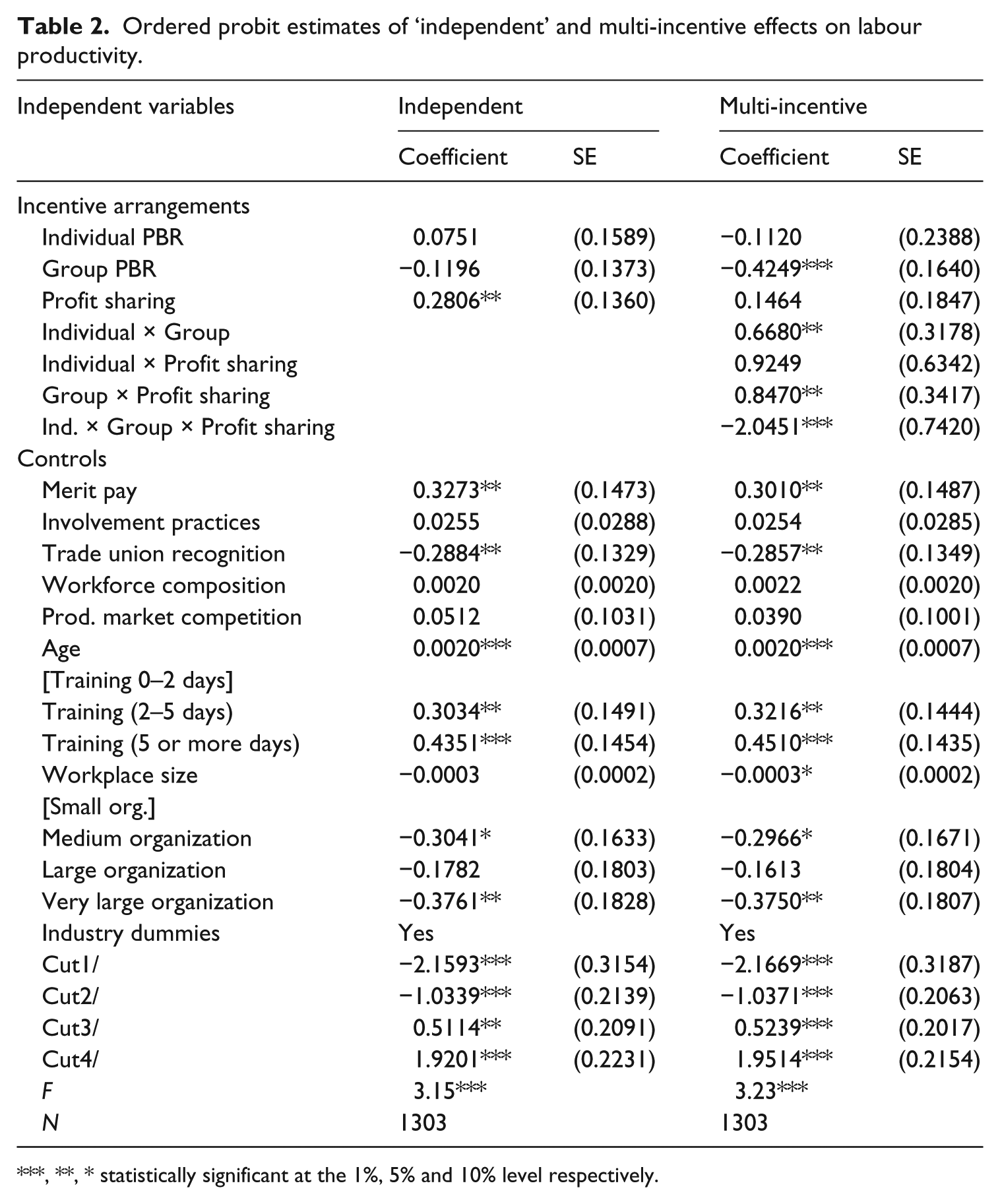
The output of the various stages of our analysis is reported in Tables 2 through 5. All models are well specified and provide good explanatory power, as indicated by significant F statistics. 4 Across all models our list of control variables reveals statistically significant associations with our productivity measure (see Table 2, left hand column). Trade union recognition and larger organizations are associated with lower comparative productivity but training and merit pay are positively associated with the best performing firms. Neither employee involvement practices nor the skills composition of the workforce are significantly associated with labour productivity.
Ordered probit estimates of ‘independent’ and multi-incentive effects on labour productivity.
, **, * statistically significant at the 1%, 5% and 10% level respectively.
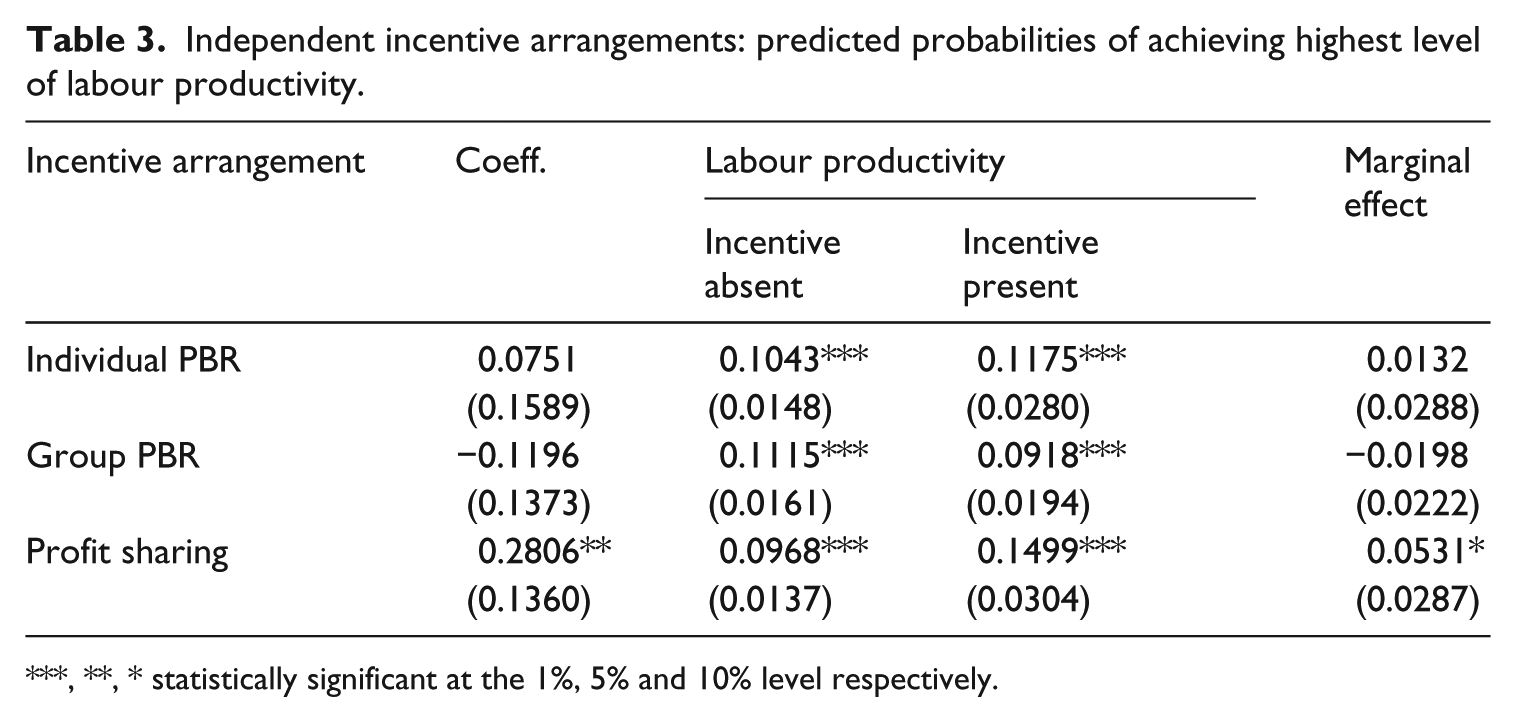
Independent incentive arrangements: predicted probabilities of achieving highest level of labour productivity.
, **, * statistically significant at the 1%, 5% and 10% level respectively.
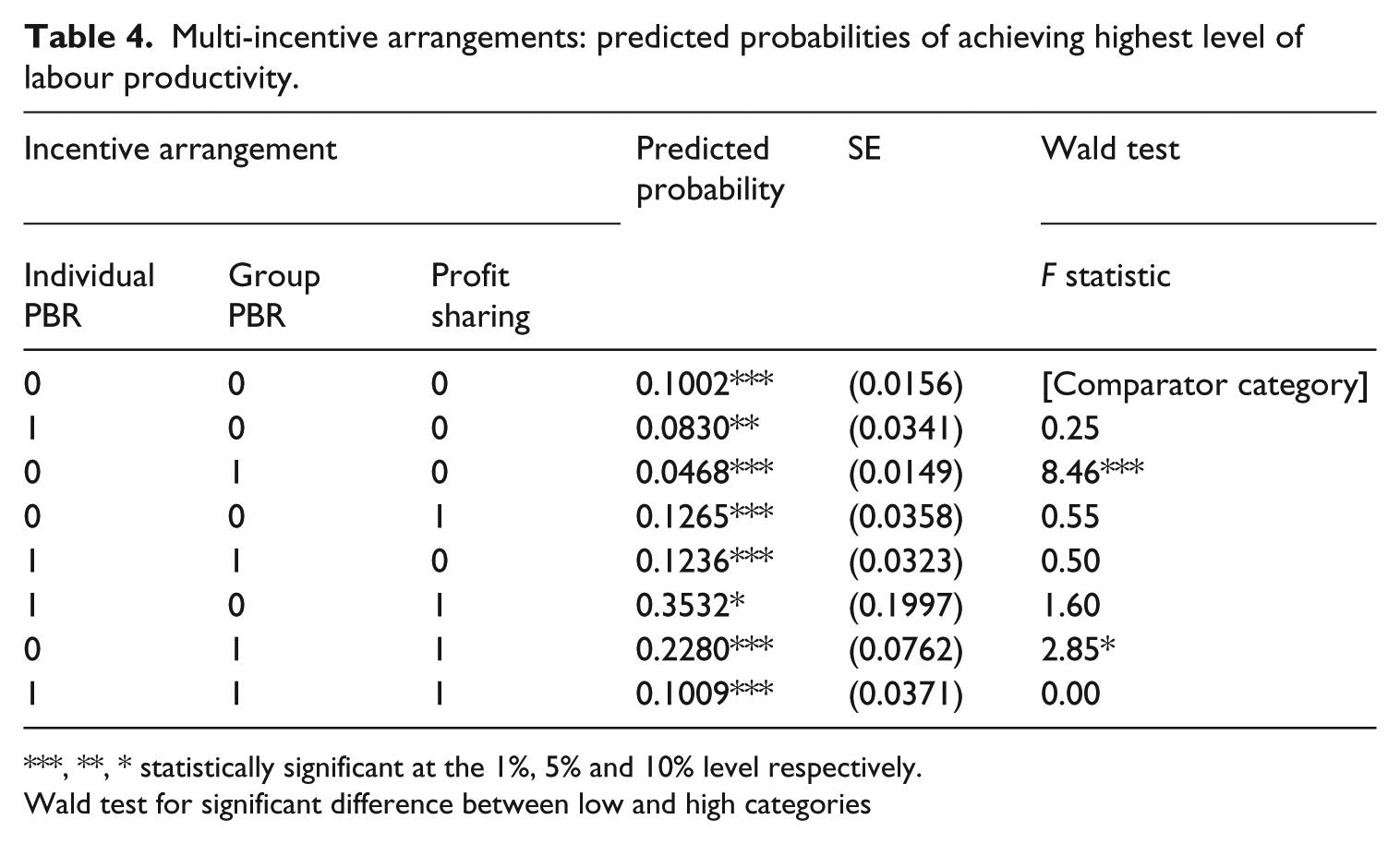
Multi-incentive arrangements: predicted probabilities of achieving highest level of labour productivity.
**, * statistically significant at the 1%, 5% and 10% level respectively.
Wald test for significant difference between low and high categories
Multi-incentive arrangements and job characteristics: predicted probabilities of achieving the highest level of labour productivity.
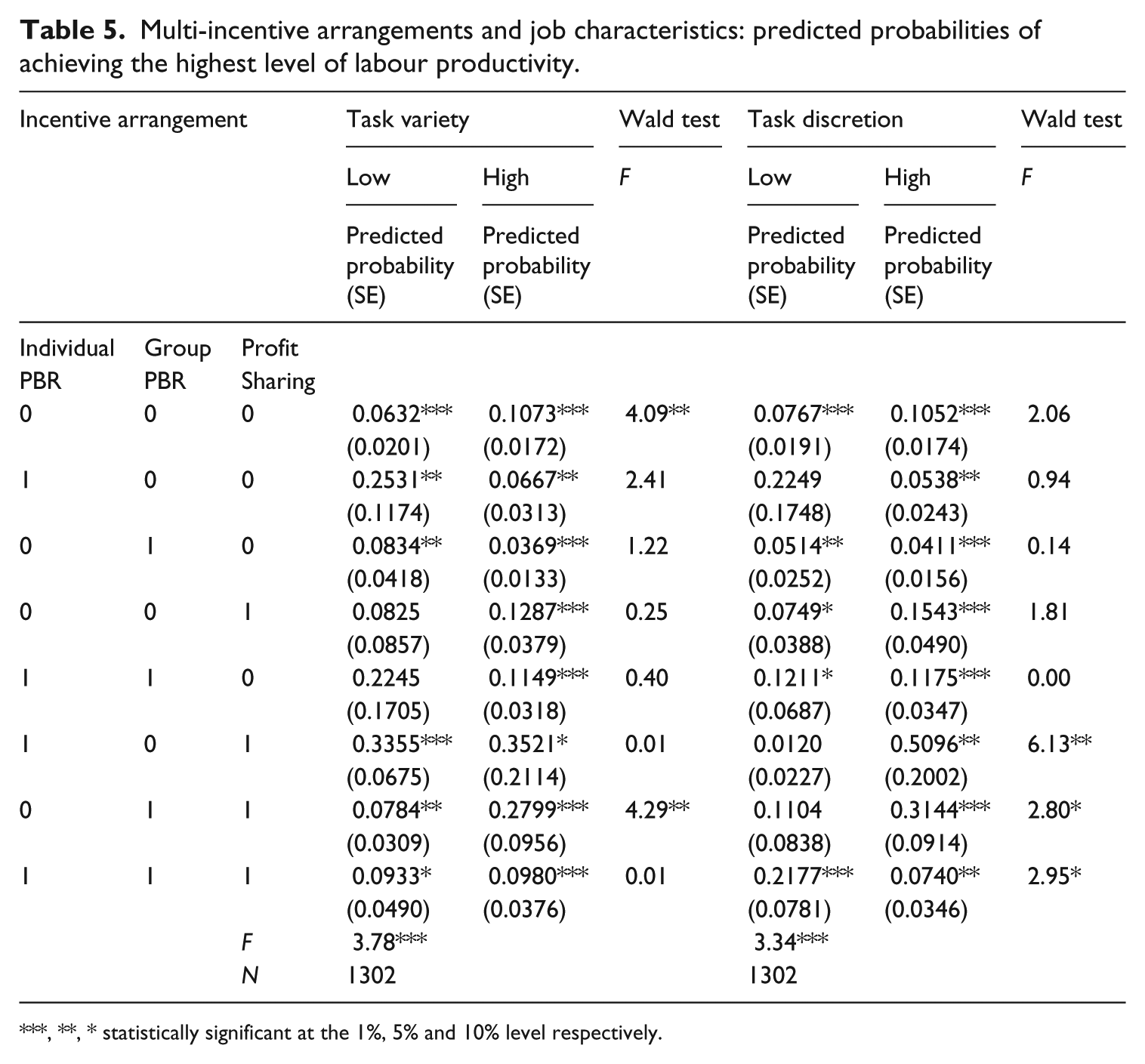
, **, * statistically significant at the 1%, 5% and 10% level respectively.
As with previous analysis of incentive arrangements, our baseline ordered probit model reports the independent effects of our incentive arrangements on labour productivity (see Table 2). However in order to provide a clearer picture of the magnitude and effectiveness of these incentive arrangements we calculate predicted probabilities for the different outcomes and the resultant marginal effects of these ‘independent’ incentive arrangements (see Table 3). What emerges supports the contention that some group incentives outperform individual incentives. IPBR schemes marginally outperform the likelihood of reporting the highest level of productivity relative to workplaces without such arrangements (11.75% as against 10.43%) giving a small positive but statistically insignificant marginal effect (the difference between the two predicted probabilities) of just over 1%. Workplaces with GPBR schemes fair even worse showing a lower probability of reporting the top level of labour productivity relative to workplaces without these arrangements (9.18% vs 11.15%), although the negative marginal effect is not statistically significant. Conversely, PS, apparently the ‘weakest’ of our incentive schemes in terms of incentive effects, is the only arrangement to show a statistically significant productivity enhancing effect, indicating that on average having such an arrangement will increase the probability of reporting ‘a lot better than average productivity’ by more than 5 percentage points compared to non-PS firms.
However, more often than not these schemes do not operate in isolation, thus questioning whether these results provide a true and fair representation of the effectiveness of these incentive schemes. As we will see, analysis of the configuration of incentive arrangements portrayed in Table 1 reveals a whole new story.
Multiple incentives
Following the format of our baseline model we report the coefficients and standard errors of our interaction model (Table 2, right hand column) and then calculate the predicted probabilities of reporting the highest level of labour productivity for all combinations of incentive schemes (see Table 4). In order to assess the extent to which the different incentive packages are performance enhancing, we can compare the predicted probability of each arrangement against a comparator workplace – those with no incentive arrangements (the first line in Table 4). Instances where these differences are statistically significant are reported in the table.
The productivity of our three incentive schemes varies according to whether they operate alone or alongside other incentives. Schemes operated in isolation show fairly small differences in the predicted probabilities of achieving the highest levels of productivity from those workplaces with no incentive arrangements – our comparator group. Combining two types of incentive arrangements reveal the most positive performance enhancing effects, but increasing this number to all three incentive schemes reduces the predicted probability of achieving very high productivity back to the level of the comparator group (i.e. no schemes).
With regard to stand-alone schemes, our labour productivity estimates reveal that PS works somewhat better whilst IPBR and GPBR perform less well than the comparator group. This is most marked in the case of GPBR which has only a 4.7% probability of reporting ‘a lot better than average’ productivity as against the 10% for workplaces with no incentive schemes (the difference being statistically significant at 0.01). The predicted probability of achieving the highest level of productivity with IPBR is somewhat lower than the comparator group (8% vs 10%), highlighting the potential limitations of this type of incentive. 5 Where collective incentives complement IPBR the predicted probabilities of the highest level of productivity increase: in the case of GPBR the effect approximates to the additive effect of IPBR and GPBR, whereas there is a substantial increase when PS is combined with IPBR (35%). Thus, our first prediction is mainly but not fully borne out. Multiple incentives are more effective than a single incentive except where profit sharing is used on its own. The second prediction is met in that the addition of a collective incentive to an individual incentive increases the effects of the latter. The third prediction, that PS will be more effective than GPBR in this respect, is also borne out.
A notable finding is that the combination of GPBR and PS is an effective one. The predicted probability of the highest level of productivity is 23% (significant at 0.01). This exceeds the probability where there are no schemes at all (10%) and where IPBR is in operation (8%). This lends credence to Roberts’s (2010) view that a combination of apparently ‘weak’ incentives can be more effective than a single, individual-based incentive. Thus, the fourth prediction is realized in our results.
Extrapolating from these results, the role and effect of PS stands out. When combined with either IPBR or GPBR, there is a substantial increase in the predicted probability of the highest levels of labour productivity. This is consistent with some experimental results relating to the effects of combining profit sharing and individual incentives on individual performance (Bellemare and Shearer, 2009). The significant productivity effects of adding profit sharing are perhaps surprising given that PS appears to have very weak direct incentive effects due to the potential for free-riding (Prendergast, 1999). However, if PS is viewed as embodying gift-like features, bearing in mind that PS payments tend to be infrequent and usually un-contracted, the results are far more explicable. If PS establishes relationships of reciprocity between employees and employer, through its contribution to perceptions of organizational justice (Coyle-Shapiro et al., 2002), prior tendencies to restrict effort and free-ride may well be mitigated (Dodlova and Yudkevich, 2009). It may also weaken any tendencies towards manipulation of asymmetric information (Fehr and Gachter, 2000), thereby also helping to account for the positive effects of the PS–IPBR combination. However, reciprocity may be undermined when contracted incentives predominate – this may explain why the use of all three incentive schemes, including PS, has very weak effects on productivity compared with using no schemes at all.
Multiple incentives and the work environment
Much of the previous literature on incentives recognizes the contingent role of work settings in influencing the appropriateness and effects of incentives. For instance, where workers have high levels of task discretion individual incentives may be less effective because of the capacity of workers to manipulate the scheme. To investigate the role of work contexts further we replicate the analysis to distinguish between situations where there is high and low task discretion and variety. To do this we add an additional interaction term to our previous analysis based on three-way interactions. The various combinations of incentive schemes are further interacted with the dummy measures for each work context. This analysis around the work environment provides a more nuanced interpretation of the aforementioned results in situations where the scope for noise, distortion and manipulation may arise. For each job characteristic – task variety and discretion – we report the predicted probability of reporting ‘best performance’ for each incentive combination depending upon whether they operate where the characteristics are deemed ‘low’ or ‘high’ (see Table 5). In an earlier analysis, we also investigated these effects by splitting the sample by these work characteristics: the results were qualitatively very similar.
The effects match expectations especially in the case of task discretion. Stand-out results relate to the efficacy of incentive arrangements involving IPBR. These strongest of incentives appear to work particularly well by themselves where workers have less discretion over how they do their work and thus little scope for distortion and manipulation. In such instances they have a 22% probability of being amongst the most productive workplaces, though a caveat is that this result is not significant at 10% (it is significant at this level in the unreported split-sample results). Conversely, IPBR performs less well than ‘no incentives’ where there is scope (high task discretion) for employees to make decisions which reflect their preferences and which may well reflect the measurement limitations of IPBR schemes. These results conflict with the argument made by some (e.g. Devaro and Kurtulus, 2010) that IPBR ought to be effective in these circumstances because it encourages employees to make the right choices. Seemingly, these effects can be overcome with the addition of PS and, to a much lesser extent, GPBR. This complementarity lifts the predicted probability of reporting a lot better than average productivity to 51% and 12% respectively when task discretion is high.
Indeed, most of the best performing incentive arrangements are evident where workers have some freedom to choose what they do and how they do it. The broader metrics and attitudinal potential of PS seem to thrive under these conditions whether PS is operated in isolation or alongside PBR – individual and collective. There is a 15% probability of the highest levels of productivity where PS is used (compared with 11% where there is no scheme of any sort) but this increases to 31% when used in combination with GPBR. In each instance, the individual and combined effects of PS are much higher than in low discretion workplaces where this sort of incentive seems less appropriate. However, GPBR schemes by themselves are ineffective in these circumstances, with a lower predicted probability of high productivity where there is high job discretion than low discretion (it is also lower than where there is no scheme at all). It is possible that there is greater capacity for the weaknesses of collective schemes, such as free-riding and group norms restricting output, to come to the fore when workers have greater freedom to organize their work. In these circumstances, the reciprocity-inducing characteristics of profit sharing may come to the rescue, with a substantial and significant enhancement of the probability of high productivity being observed where PS and GPBR are combined. However, even the efficacy of PS can be undermined when there are a large number of incentive schemes: the predicted probability of high productivity is lower when all three schemes are present than when there are no schemes at all. The reduced effectiveness of PS is consistent with Fehr and Gachter’s (2000) argument that reciprocity can be crowded out by explicit incentives. Conversely, all three schemes are significantly more effective in low discretion environments suggesting that a wealth of incentives may compensate for boring work without decision-making powers.
Turning to task variety, the pattern of incentive effects is similar. In line with predictions, IPBR is highly effective in low task variety work settings (as indicated by a substantial improvement in the predicted probability of the highest levels of labour productivity compared with where incentive schemes are absent). The addition of GPBR and PS has no effect in the case of the former and a simple additive effect in that of the latter. In high variety work contexts, the results are rather different. Here, as predicted, IPBR has an adverse effect on the probability of very high productivity. Combining IPBR with GPBR has a small complementary effect whilst the combination of IPBR and PS has a substantial effect (as does the combination of GPBR and PS). The combination of PS and IPBR, however, works well in both settings possibly by encouraging appropriate allocations of effort in high variety work environments and by ‘softening’ the hard edges of performance management in low variety contexts. Combinations of GPBR and PS work very well in high variety settings, but not where there is low variety. The use of all three schemes has small negative effects in high variety workplaces and small positive effects where there is little variety.
In summary, the results for task variety and discretion support our predictions as follows. One, individual incentives are indeed effective where there is low task variety or discretion, and harmful where there is high task variety or discretion. Two, adding a collective incentive to an individual incentive has complementary effects where there is high task variety or discretion but it diminishes the effectiveness of individual incentives in workplaces with low task variety or discretion. Three, as predicted, profit sharing is more effective than GPBR in this respect in both high task variety and high discretion workplaces. Four, combinations of so-called ‘weak’ incentives (profit sharing and other group incentives) are ineffective where there is low task variety or discretion but are effective in raising the probability of reporting high productivity where there is high variety or discretion. There is therefore a clear contingency dimension to our results: the nature of the work environment moderates the effects of incentives and combinations of them.
Discussion and conclusions
In the article we posed three questions about the operation of incentives and combinations of them. The first enquired whether combinations of incentives have a stronger impact on productivity than single incentives. The answer is yes in most, but not all, instances. The second question asked more specifically about the addition of group to individual incentives. Here it was found that the productivity effects of IPBR are increased when group incentives are added but the difference is not very large when it is GPBR that is added. The effects are very much larger when it is PS that is added, and this provides an answer to the third question about the relative efficacy of GPBR and PS. Our results show clearly that PS has stronger effects. This also applies to the use of these schemes in isolation: in general PS works better. A further result of interest is that there seems to be an optimal number of incentives schemes. Our findings show that the use of all three incentives has negligible effects compared with using no schemes at all.
Overall, our results provide empirical support for recent theory on the power and nature of incentives. Individual incentives can have negative effects but these can be mitigated by the addition of group schemes with apparently weaker incentive power (Gibbons, 1998; Holmstrom and Milgrom, 1994). We suggest that the capacity of the group incentives to mitigate the dysfunctional effects of higher powered incentives by reducing distortion and manipulation is likely to be important here. Recent theory has also suggested that weak incentives are likely to be optimal in certain work environments, such as where there is multi-tasking (Roberts, 2010). Our results are mainly consistent with these claims. For instance, IPBR has negative effects in high discretion work settings but these become mildly positive when GPBR is added and strongly positive when profit sharing is added. By contrast, where there is low task discretion there is evidence that IPBR may be effective on its own, presumably because there is limited noise and little opportunity for distortion and manipulation. Our results contrast with recent findings in the literature that suggest that individual incentives can be effective where there is task discretion because they encourage workers to make the right decision (Devaro and Kurtulus, 2010).
One important aspect of the results is that GPBR is indeed weak when operated on its own (cf. Sesil, 2006). GPBR has weaker effects than PS, when operated singly or in conjunction with IPBR. On the surface this is surprising because the incentive effects of PS would appear to be weaker than GPBR for a variety of reasons such as irregularity of payments and weak linkages to individual behaviour. It becomes easier to explain if PS is viewed as means of generating reciprocity between employees and the firm (Coyle-Shapiro et al., 2002). As with employee share ownership, it can signal management’s good intentions to the workforce. The trust and commitment this generates may dampen the dysfunctional effects that can arise from the use of individual incentives, thereby explaining why the productivity effects are so much larger when PS is combined with IPBR. Although the financial participation literature has shown that profit sharing has positive effects on productivity, it has so far considered these effects in isolation from other incentive schemes (see Perotin and Robinson, 2003). Our findings therefore generate new and interesting insights into the effects of profit sharing. Future research might explore and test these relationships further, perhaps using employee-level data.
We are acutely conscious that our research only goes so far in investigating complementarities between forms of incentive pay, and that further research is necessary to clarify a range of issues. For instance, we need to know more about the balance of positive and negative effects of specific types of incentive, and how these interact with those of other incentives. This inevitably means that we need to observe the characteristics of schemes more fully, including the gearing and the performance metrics. Worker behaviour, as has been observed over the years in a succession of rich case studies, is also highly relevant. Unfortunately, we do not have this information in our data source, and we have had to make several important assumptions about how schemes operate and the strength of their effects, positive and negative.
The data source has also been criticized for its cross-sectional nature and the use of subjective evaluations of workplace performance. However, WERS has been extensively used to investigate the effects of human resources and labour practices, and it is generally thought that the design strengths of the survey outweigh these limitations (Brown and Edwards, 2009). In regard to these two specific limitations, the extant evidence from panel-based studies is consistent with the direction of causality postulated here (Heywood et al., 2002; Jones and Kato, 1995; Kruse, 1993), whilst extensive evaluation of the subjective performance measures has found them to correlate satisfactorily with more objective measures (Haskel, 2005; Wall et al., 2004).
As is common in research of this type, there is always the potential for endogeneity to bias the observed effects. Unfortunately, responding to this potential problem is not at all straightforward given the nature of the variables and the data in the survey. Endogeneity may take two forms in our research: the key dependent and independent variables may influence each other simultaneously, and omitted variables may bias the effects of key independent variables through their influence on the error term. Whilst it is now possible to deal with endogeneity where there is a binary dependent variable by using instrumental variables and two stage regression procedures, it is not feasible to use standard instrumental variable procedures where the dependent variable takes an ordered, categorical form. A further significant problem, as noted by Conyon and Freeman (2004), is the identification of suitable instruments given that many of the WERS survey questions are on connected themes. In the survey there are no suitable measures that correlate highly with the key independent variables but not the dependent variable. Conceptually, if there is an important omitted variable in our analysis, it is probably management quality as this may simultaneously affect both productivity and the decision to use incentive schemes. As a somewhat imperfect substitute, we experiment with inserting an additional control that may proxy for management quality (whether the manager responsible for employee relations has a formal HR qualification) in the main stage regressions, but the influence of this on the model and the magnitude of the pay system effects is negligible. 6
Even with the limitations outlined above, we believe that our study makes a valuable contribution to the study of multiple incentives. The research has provided empirical support for several important ideas on incentives that have currency in personnel and institutional economics. An important finding for the literature is that some mixed incentives do indeed give the ‘best of both worlds’ though others do not. We have highlighted the role of profit sharing in this respect. Our findings add to a growing strand of literature which suggests that behavioural insights need to be added to the standard agency model to fully understand the operation and effects of contingent rewards (Ellingsen and Johannesson, 2008; Wiseman and Gomez-Mejia, 1998). It has also provided a new angle on human resource management complementarities, given that the literature to date has mainly examined relationships between incentive schemes and other HR practices rather than with each other. Finally, the results provide an economic rationale for the widespread and growing use of multiple incentives in British workplaces.
Footnotes
Appendix
Variables.
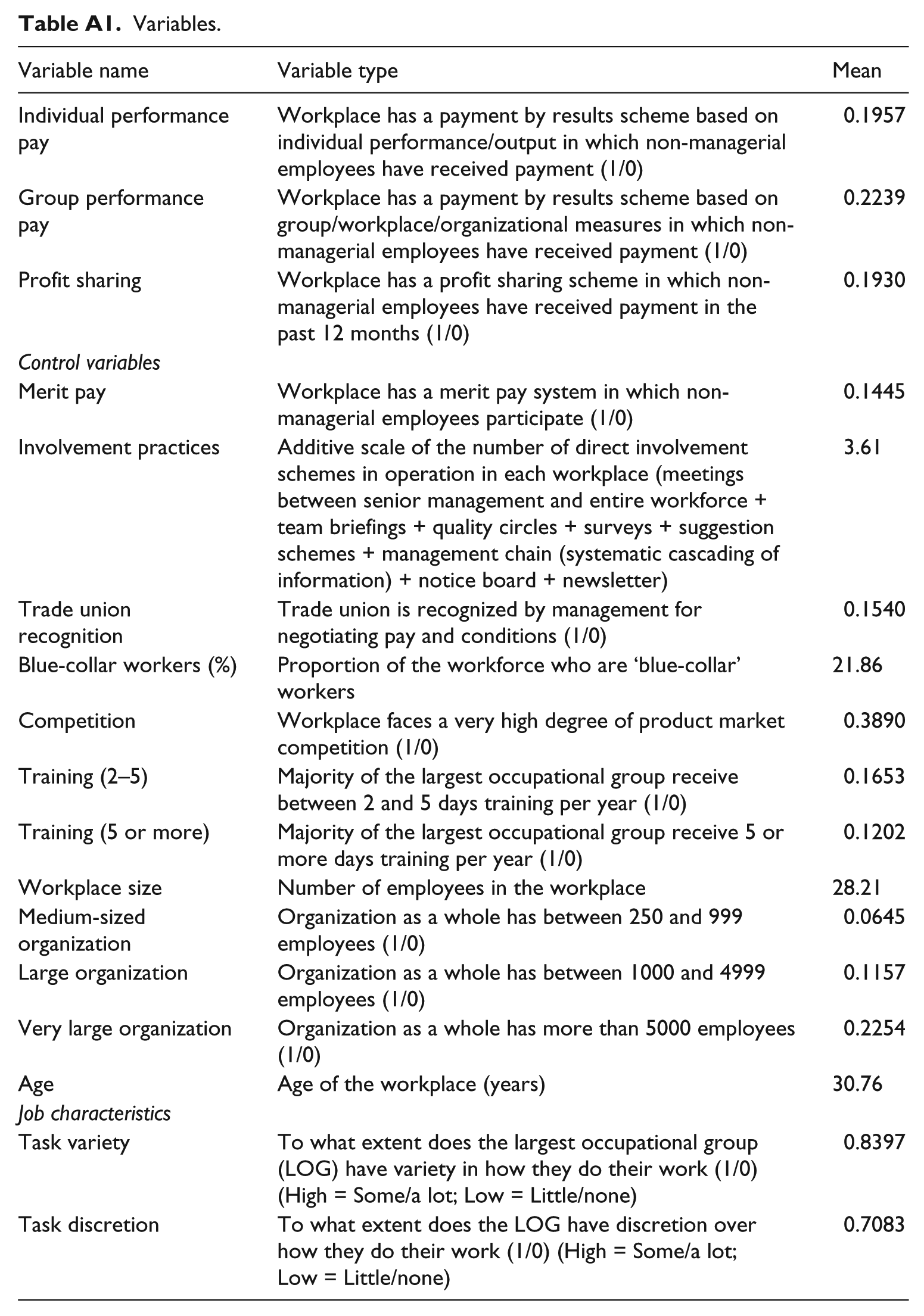
| Variable name | Variable type | Mean |
|---|---|---|
| Individual performance pay | Workplace has a payment by results scheme based on individual performance/output in which non-managerial employees have received payment (1/0) | 0.1957 |
| Group performance pay | Workplace has a payment by results scheme based on group/workplace/organizational measures in which non-managerial employees have received payment (1/0) | 0.2239 |
| Profit sharing | Workplace has a profit sharing scheme in which non-managerial employees have received payment in the past 12 months (1/0) | 0.1930 |
| Control variables | ||
| Merit pay | Workplace has a merit pay system in which non-managerial employees participate (1/0) | 0.1445 |
| Involvement practices | Additive scale of the number of direct involvement schemes in operation in each workplace (meetings between senior management and entire workforce + team briefings + quality circles + surveys + suggestion schemes + management chain (systematic cascading of information) + notice board + newsletter) | 3.61 |
| Trade union recognition | Trade union is recognized by management for negotiating pay and conditions (1/0) | 0.1540 |
| Blue-collar workers (%) | Proportion of the workforce who are ‘blue-collar’ workers | 21.86 |
| Competition | Workplace faces a very high degree of product market competition (1/0) | 0.3890 |
| Training (2–5) | Majority of the largest occupational group receive between 2 and 5 days training per year (1/0) | 0.1653 |
| Training (5 or more) | Majority of the largest occupational group receive 5 or more days training per year (1/0) | 0.1202 |
| Workplace size | Number of employees in the workplace | 28.21 |
| Medium-sized organization | Organization as a whole has between 250 and 999 employees (1/0) | 0.0645 |
| Large organization | Organization as a whole has between 1000 and 4999 employees (1/0) | 0.1157 |
| Very large organization | Organization as a whole has more than 5000 employees (1/0) | 0.2254 |
| Age | Age of the workplace (years) | 30.76 |
| Job characteristics | ||
| Task variety | To what extent does the largest occupational group (LOG) have variety in how they do their work (1/0) (High = Some/a lot; Low = Little/none) | 0.8397 |
| Task discretion | To what extent does the LOG have discretion over how they do their work (1/0) (High = Some/a lot; Low = Little/none) | 0.7083 |
Acknowledgements
The authors acknowledge the Department of Trade and Industry, the Economic and Social Research Council, the Advisory, Conciliation and Arbitration Service and the Policy Studies Institute as the originators of the 2004 Workplace Employment Relations Survey data, and the Data Archive at the University of Essex as the distributor of the data. The National Centre for Social Research was commissioned to conduct the survey fieldwork on behalf of the sponsors. None of these organizations bear any responsibility for the author’s analysis and interpretations of the data. We are grateful to participants in seminars held at Warwick Business School, Helmut Schmidt University and the London School of Economics, as well as those attending the International Association for the Economics of Participation conference, for comments on earlier versions of this article.
Funding
This research received no specific grant from any funding agency in the public, commercial, or not-for-profit sector.