




Abstract
Background
The archetype-based housing stock study can lead a better coordination between the government and local authority-led retrofit planning.
Purpose
This study investigates the energy, energy cost and carbon performances of different retrofit scenarios.
Research Design
Using deterministic modelling, the existing performance of fourteen archetypes is compared by adding system-only, fabric-only, staged retrofit and whole-house retrofit.
Result
System-only retrofit is seen as a faster domestic carbon savings benefit but could be a trigger for the homeowner’s interest in a wider heat pump uptake due to its energy cost savings barriers. Fabric-first retrofit significantly reduces residual carbon emissions, but longer economic payback times, with an average of 33 years, stress the importance of retrofit incentives. Whilst the average upfront embodied carbon investment for whole-house retrofit could pay back after 3 years, it could take up to 18 years, depending on the material and equipment selections. By quantifying the impacts of comfort-taking behaviour on energy cost and operational carbon savings, this study highlights that providing necessary information about retrofit sensitivities is important for a retrofit policy and consumer engagement across different archetypes.
Conclusion
This study can be seen as a context-dependent dialogue example for the South Yorkshire housing stocks, addressing retrofit policy initiatives, delivering retrofit sequencing at the right time, and preparing for the future energy infrastructure to align with retrofit deployment.
Practical application
This study presents the energy, energy cost and carbon performance of fourteen archetypes, comparing environmental and economic payback as key indicators for the UK’s housing stock retrofit deployment. Using the presented archetype-based modelling study and other GIS-based retrofit planning models with socio-demographic databases, the combined method can rapidly and appropriately target respective dwellings to enable local authority-led area-based retrofit delivery. This work will be of interest to policymakers, retrofit providers and energy suppliers.
Keywords
Introduction
Four in five homes that will be occupied in 2050 have already been built, and retrofitting the existing homes to improve fabric energy efficiency with low and zero-carbon energy systems is an industry-wide policy challenge for many countries to achieve net zero emissions.1–3 Implementing different decarbonisation strategies, such as building fabric and systems retrofit, in parallel to grid decarbonisation, aims to reduce domestic carbon emissions, improve housing quality, and tackle fuel poverty. 3 In the UK, various retrofit schemes, such as the Energy Company Obligation (ECO) Scheme, 4 Local Authority Delivery (LAD) and Home Upgrade Grant (HUG) Schemes, 5 Home Energy Efficiency Programmes for Scotland (HEEPS)’s area-based schemes, 6 Social Housing Decarbonisation Funding (SHDF), 7 Great British Insulation Scheme (GBIS) 8 and the Green Deal 9 have been introduced to deliver housing retrofit through top-down (government-led) and bottom-up (civil society-led) approaches. However, many retrofit schemes and policies have not been oriented to achieve a net-zero target, 10 and it appears that neither recent retrofit deployments are sufficient in themselves due to the lack of central government coordination and localised projects in the planning for retrofitting at scale. 11 This poor retrofit policy design affects an unattractive financial proposition and a lack of consumer engagement. 9 Differentiating the energy demands and associated energy cost and carbon emissions of different archetypes in pre- and post-retrofit conditions can provide valuable insights for retrofit decision-making, increasing the wider uptake of retrofit delivery, and raising awareness among local communities to deliver retrofit towards a net-zero housing stock.
The robustness of retrofit measures relies on how the various facets of building performance are balanced against one another. The choice of retrofit measures significantly influences indoor environmental quality 12 and the associated carbon and cost savings of a building. 13 In the cold climate context, typical heating energy savings are achieved by adding insulation as a single retrofit measure 14 ; however, addressing ventilation requirements simultaneously is essential to prevent dampness, mould growth and humidity-driven health problems. An example of adding external wall insulation to 386 private homes in Fishwick showed evidence of large-scale retrofit failure due to the ineffective piecemeal retrofit. 15 Unlike a single retrofit measure, in a whole-house retrofit, besides adding insulation, mechanical ventilation is further added as a systems retrofit to avoid overheating and the lack of fresh air in cold-climate homes to cope with lower external temperatures and poor ventilation. This is similar to the Passivhaus approach, as the fabric energy efficiency and airtightness of the building envelope are increased, a mechanical ventilation and heat recovery system is added to maintain the necessary indoor environmental quality. 16 As retrofit is delivered from different stages, for example, fabric upgrade and system efficiency improvement, delivering the right retrofit at the right time is essential to achieve the benefits of retrofit.
Housing retrofit is often delivered from five approaches, namely, whole-house, fabric-first, room-by-room, step-by-step and measure-by-measure, in line with the availability of financial investment and retrofit activities. Retrofit planning for those approaches varies in either one-off time or over time. 17 Among them, the terms “step-by-step”, “stepped”, “staged” and “phased” are used synonymously to express the retrofit process in achieving energy-efficient retrofitting of buildings by using a sequential order over a longer period while a low-carbon improvement plan is implemented to avoid missed opportunities and lock-in interventions. Research and existing projects have shown that a whole-house retrofit for energy efficiency first (i.e., fabric first) approach is a holistic pathway to achieve higher carbon and cost savings and indoor environmental quality improvement in homes.18,19 For the EU, the EPBD recast suggests that a deep renovation should result in at least a 60% reduction in primary energy consumption 19 while the PAS 2035 in the UK suggests applying a fabric-first approach and encourages staged retrofit to make whole-house retrofit more accessible. 18 However, a global perspective of the deep retrofit model 2 shows that many countries do not specifically define whole-house retrofit as a definition or a principle to start due to upfront costs and potential for upheaval. Particularly, the fabric-first approach is proving barriers for retrofit cost and upfront carbon investment, as well as a timescale to meet the net-zero target. 20 In this work, the impacts of the retrofit sequencing and stages on the energy and carbon performance of different archetypes are investigated by incorporating passive and low-carbon design considerations. Energy cost and carbon-saving barriers of the fabric-first retrofit in different archetypes are then discussed.
Whilst the fabric retrofit is a theoretically sound and practically proven approach towards domestic carbon savings,10,21 fabric improvement alone would not decarbonise the housing stock, as heating systems, which are currently widely reliant on gas, need decarbonising. 20 In addition to ongoing decarbonisation of the electricity grid, new energy infrastructures need to be prepared for the sensitivity of residual energy demands from different housing stocks. Furthermore, the retrofit scenarios should be in line with the net-zero action plans of respective countries. For instance, in the UK, the use of gas boilers for heating is expected to phase out by 2035 1 while a high electrification pathway by increasing the uptake of heat pump installation (2029 to 2037) is expected to meet the carbon budget. 22 For a homeowner, information about energy demand changes in different retrofit stages is important for their retrofit decision-making and planning for different stages. Likewise, an energy supplier expects to understand how different archetypes from different retrofit stages respond to energy demands. Those concerns are also essential for policymakers to prepare for strategic real-world initiatives and strengthen policy for retrofitting at scale.
Time Use Survey data and Probabilistic Occupancy Model show that the active and passive role of occupants significantly influences the energy demands of homes, from using building systems for comfort to the interactions with window opening and shading. 23 Providing necessary information and the sensitivity of retrofit results to the participants is essential for domestic retrofit initiatives. Before a retrofit, if a household has an under-consumption of energy services or the existing construction of a dwelling is better than assumptions made for the retrofit performance prediction, the pre-bound effect occurs, and the energy savings gap between existing and post-retrofit could be smaller than the expected. 24 In contrast, if a household’s daily rhythm of heating and ventilation needs is changed due to comfort taking (e.g., it is often found that setting high-level comfort in temperature settings can alter energy demands) is found in post-retrofit conditions, the rebound effect occurs, and an energy efficiency increase may also lead to an increase in the final energy consumption. 24 These effects could lead to inaccuracies in calculating the retrofit payback and the subsequent national retrofit and decarbonisation results. The importance of quantifying the prebound and rebound effects in retrofit policies has been called into attention in the literature and practices to highlight the energy savings deficit and the energy performance gap.25,26 Research has informed the impacts of existing conditions and archetype characteristics,27,28 retrofit scenarios, 29 retrofit delivery approach, 17 occupant behaviour, 30 future climate mitigation strategies in retrofit design, 29 and cost-effectiveness and carbon savings results from the retrofit 21 using the measured data and simulations. Still, limited studies demonstrate a range of archetype-based comparisons for a broader theoretical understanding of staged-based and whole-house retrofits.
Objectives of the study
Research has flagged that the role of local authorities in net-zero retrofit deployment, and local authorities need resources to develop and coordinate a programme.
31
The archetype-based housing stock study can lead a better coordination between top-down and bottom-up retrofit planning.
11
This paper seeks to address this gap and is structured the three case studies with the following objectives. 1. To investigate the effectiveness of retrofit measures (i.e., fabric, systems, and a combination of both) for different archetypes and their environmental and economic payback. 2. To investigate the changes in residual energy demands and carbon savings by adding a staged retrofit. 3. To quantify the impacts of comfort-taking behaviour on energy cost and operational carbon savings.
Overview of the case studies
This paper is structured as follows. The ‘Methods’ section details the archetype identification and categorisation approach, and the database and assumptions used in the presented case studies. Case study 1 compares the energy, carbon and cost performance of the retrofit scenario. The results demonstrate the impacts of carbon payback by comparing the results of embodied carbon investment for fabric and system retrofits. This opens further discussion for real-world applicability, as material and equipment selection could be varied across archetypes due to homeowners’ retrofit decisions and considerations such as fire safety, acoustic comfort, maintenance, environmental impacts and financial feasibility. Case study 2 demonstrates how the energy demands from homes can be reduced step by step by adding staged retrofits. The results inform homeowners to make incremental, affordable improvements over time, rather than attempting an expensive whole-house retrofit at once. Furthermore, this opens further discussion of policy making and financing for regional and national retrofit deployment. Case study 3 presents how the impacts of comfort taking alter the energy and carbon savings from the expected retrofit measures. The results stress that, in addition to fabric and system retrofit for home energy efficiency improvement, there are scopes of post-occupancy evaluation to understand household energy consumption and comfort-taking behaviour in future post-retrofit scenarios.
The presented case studies of this work will be of interest to homeowners, policymakers, retrofit providers and energy suppliers. This is followed by a ‘Discussion’ section for nationwide retrofit deployment by integrating different decarbonisation approaches, limitations and future works.
Methods
The study employs a comparative research method using fourteen archetypes. The following sections present the database and assumptions used in the simulation-based experimental models.
Archetype identification and categorisation
In this work, archetype-based modelling is employed to compare the embodied and operational carbon impacts of retrofitting fourteen archetypes that were derived for the South Yorkshire housing stock, UK. The EPC (Energy Performance Certificate) database 32 shows that the region’s housing stock is composed of houses and bungalows (78.9%), flats and maisonettes (1.4%) and unspecified (19.7%). To categorise archetypes, first, houses and bungalows are grouped from their built forms – Detached, Semi-Detached, End-terrace and Mid-terrace. Second, the design style of British homes from housing history studies33–35 and house design style studies36–41 are reviewed, and it was noted that some design styles, such as Georgian and Victorian styles, were dominantly found in the early construction ages, whereas some archetypes were found across different construction ages. About 4.8% of properties were built before 1900, 35% of all properties are likely to have been built before 1950, 42.9% between 1950-2002, and less than 8.8% after 2002. Third, the Verisk GIS database is used to quantify the floor area sensitivity of each archetype. 42
The archetype classification of this work is similar to the TABULA and LSE’s EIFER projects43,44, whereas the design styles of built forms were further subdivided in this work. In line with the complexity of the floor footprint found in distinctive design styles, as shown in Figure 1, the fourteen archetypes are identified in three groups – • Large footprint, complex • Small footprint, complex • Small footprint, rectangular Archetype categorisation approach.
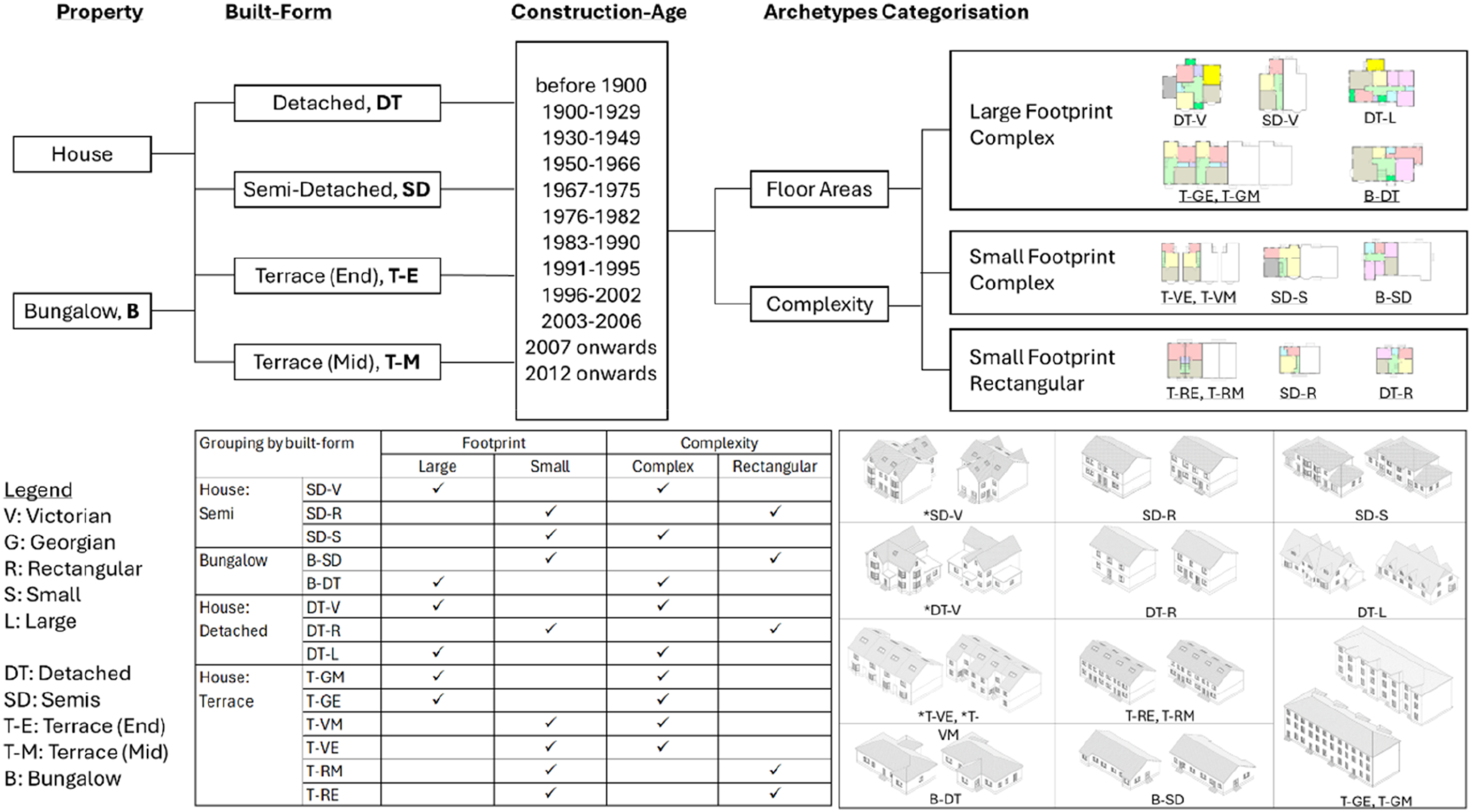
The architectural drawings of the archetypes are traced from local property advertisements, whilst their generalisability is further assessed via housing history studies33–35 and house design style studies.36–41 Cellars and dormer windows, their contribution to built form, floor areas and indoor air volume, are excluded from this study. Appendix Tables 5 and 6 present envelope characteristics modelled for different archetypes and other key factors of variation, including treated floor areas, insulation areas, window areas and numbers of rooms. Figure 10 presents floor plans of fourteen houses/bungalow archetypes used in this study. Therefore, the treated floor areas of the archetypes can be compared to the average national floor areas. 45
Case study 1: Retrofit scenarios and sequencing
The retrofit scenarios presented in Table 1 are used in this work to illustrate their impacts on energy demand and carbon emissions. ‘X’ presents a pre-retrofit, existing construction with a gas boiler; therefore, energy demand for heating only is calculated. ‘A’ presents a system-first approach by replacing a gas boiler with a heat pump, considering a scenario without a fabric retrofit. ‘B’ presents a fabric-first approach where no heat pump replacement is added to the house yet; therefore, energy demand for heating only is calculated. ‘C’ represents a whole-house approach where system retrofit is added to scenario B. Retrofit scenarios used in the study.

According to the IPCC’s multi-model, 46 mean surface air temperature warming and associated uncertainty ranges for 2090 to 2099 relative to 1980 to 1999 are A1B weather scenario with 2.8 °C (1.7 °C to 4.4 °C) and A1FI weather scenario with 4.0 °C (2.4 °C to 6.4 °C). For Case Study 1, the 2030 A1B 50th percentile future weather file for Sheffield is used to understand the instant impact of whole-house retrofit in the near future. The A1B weather scenario is assumed to be a “balanced” approach, emphasising all energy sources. Therefore, it is expected to have a higher heating demand prediction using the A1B weather prediction against the A1FI weather year.
Case study 2: Staged retrofit
Various stages of a staged retrofit approach (Figure 2) are considered in this study, comparing fourteen archetypes. The sequencing of the staged retrofit could be varied according to a retrofit plan executed by a homeowner and site conditions. In this work, the staged retrofit starts by adding insulation to the roof in Stage 1, considering a significant amount of heat is lost through the roof, and insulating the attic is often the easiest and most cost-effective way to reduce heat loss and improve energy efficiency. Window replacement is then followed in Stage 2 improves the performance of the glazing and frame. External insulation is added in Stage 3; therefore, it ensures a good fit of windows and avoids potential damage to the insulation during window replacement. A complete fabric-first retrofit is considered in Stage 4 by adding insulation to the floors and draught-proofing for an airtight envelope. Different stages of a staged retrofit approach in this study.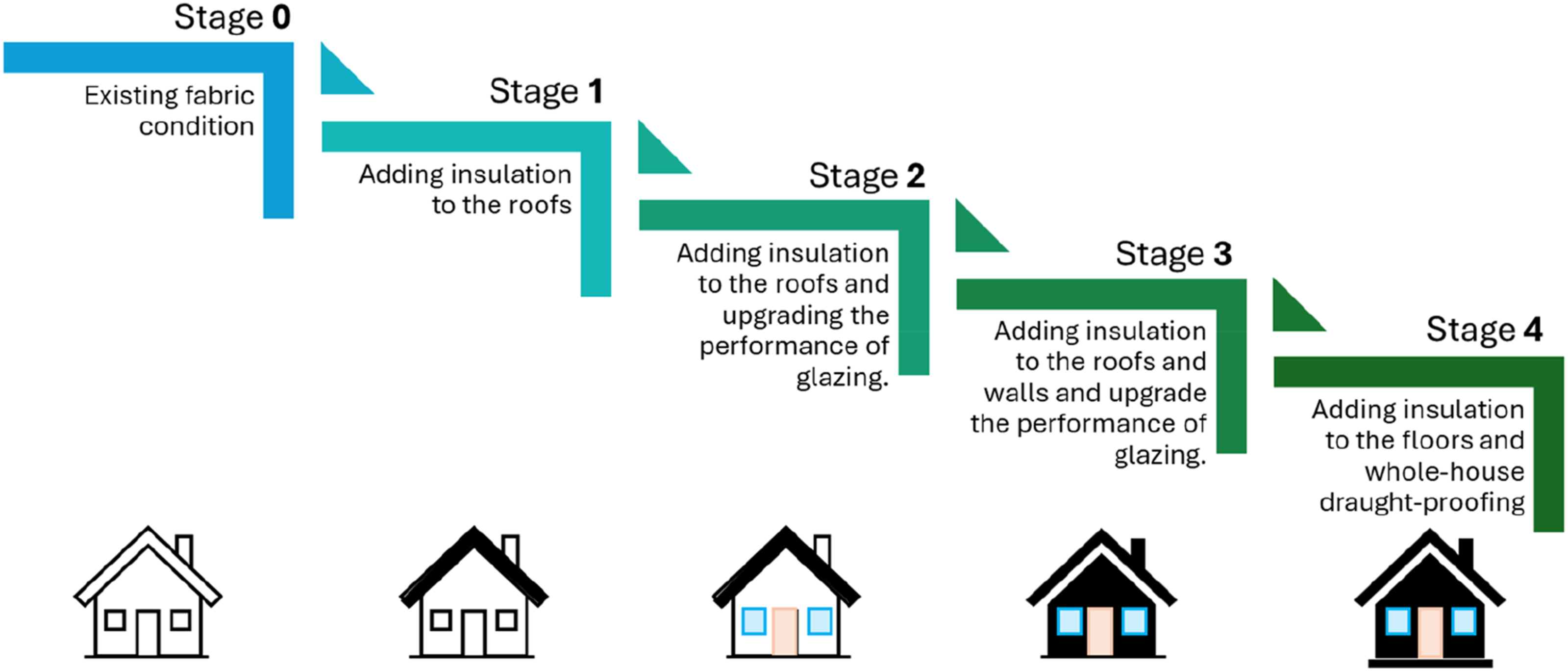
Figure 11 demonstrates the impacts of different weather predictions on dry bulb temperature, relative humidity and direct normal radiation, and it appears that buildings in the UK are expected to face warmer weather in the future. For Case Study 2, the 2050 A1FI 90th percentile future weather file for Sheffield is used to compare the impacts of staged retrofit scenarios, considering the fossil-intensive and a long-term plan to retrofit the whole housing stock by 2050. Therefore, it is expected to have a prediction for lower heating demands and higher cooling demands against the 2030 A1B weather year.
The weather files used in all studies are from the Prometheus project, which was developed using the 1961-1990 baseline period for UKCP09. 47 Hence, further updates would be required to compare with UKCP18’s 20-year baseline period of 1981-2000. For instance, increased occurrence of summer and autumn tropical nights in urban conurbations, more dry days in summer and autumn, and lower average precipitation on wet days in summer lie outside the ranges included in the Prometheus weather files. 48 Therefore, the source of the reference weather files could influence the energy demands and carbon emissions presented in this work.
Case study 3: Assumptions for heating and cooling set point temperatures
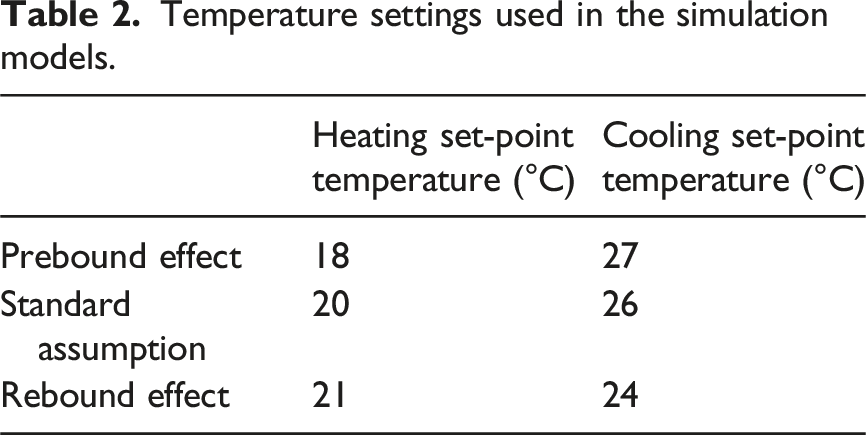
Temperature settings used in the simulation models.
Assumptions for fabric retrofit
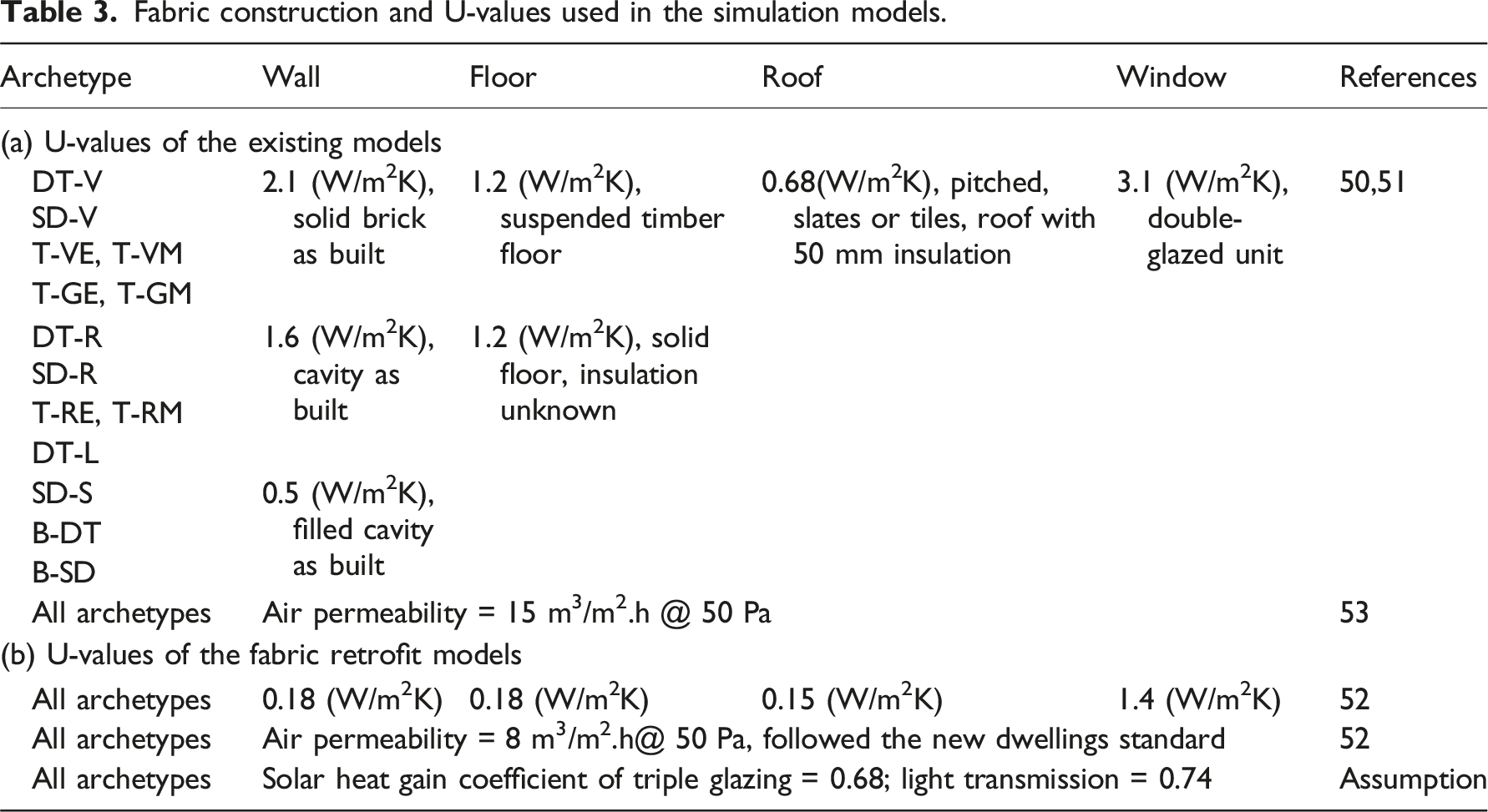
Fabric construction and U-values used in the simulation models.
Assumptions for operational settings in simulations
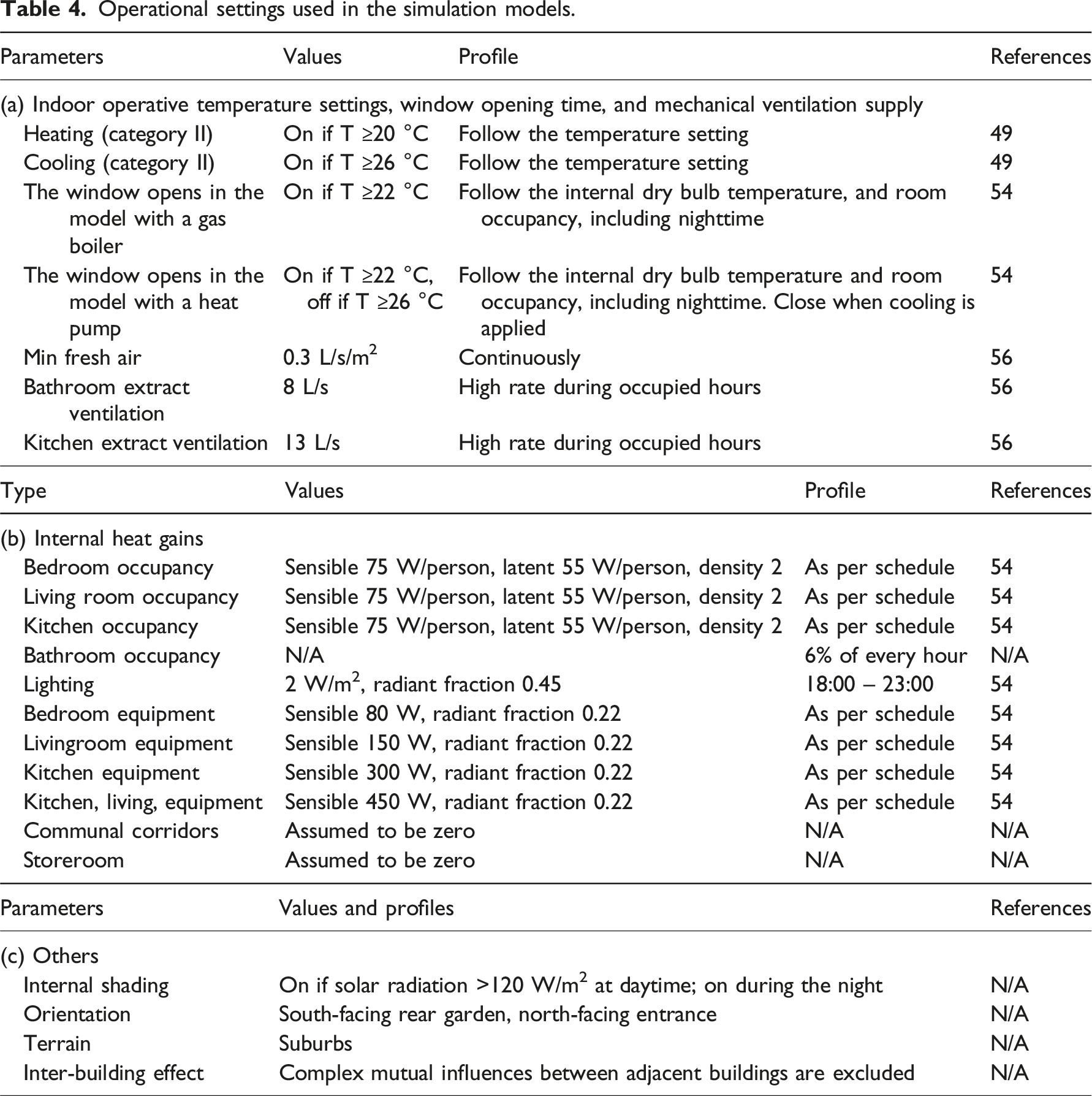
Operational settings used in the simulation models.
Assumptions for COP, energy tariffs and carbon factors
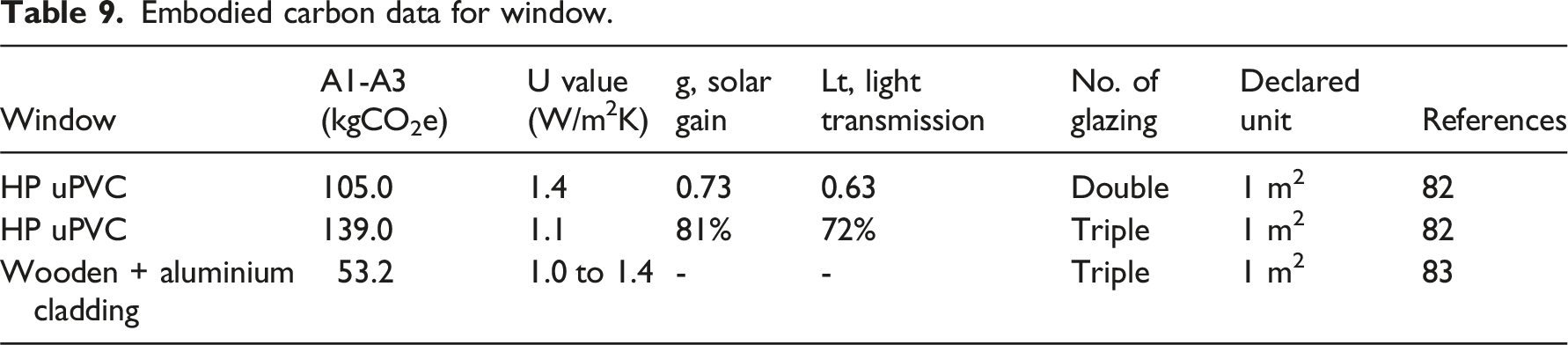
A deviation of rated efficiencies can be expected in different building systems - heating, cooling operations, which alters the Coefficient of Performance (COP) of heat pumps and gas boilers. Furthermore, the efficiencies of COP could vary seasonally and with peak demands. This study aims to understand energy and carbon performance in different retrofit approaches across diverse archetypes; hence, the COP values are fixed in the energy calculation. The operational carbon emission factors for gas boilers (natural gas) and heat pumps (electricity) are based on the 2025 greenhouse gas reporting conversion factors in the UK. The energy tariffs for natural gas and electricity are referred to the 2025 energy price cap in the UK. The COP values, operational carbon emission factors and energy tariffs used in the study are presented in the Appendix Table 7. Embodied carbon, the total greenhouse gas emission associated with the lifecycle of a product or building, is influenced by several factors. In this work, changes in embodied carbon emissions are compared, highlighting the material selections for insulation, windows, doors, and vapour control membranes. The embodied carbon emission factors of the materials solely rely on the database presented in the Appendix Tables 8–14.
Results
This section presents the comparisons of retrofit scenarios, staged retrofit and sensitivity in retrofit performance due to comfort takings.
Case study 1: Energy, cost and carbon performance of different retrofit scenarios
Focusing on the energy, cost and carbon (i.e., operational and embodied) performance of different retrofit scenarios (Table 1), this section presents how different archetypes perform by adding system-only, fabric-only and whole-house retrofit and compares against the existing condition. Figure 3 compares the annual heating energy demands of fourteen archetypes in existing scenarios against national domestic gas consumption for heating for typical households, as reported by Ofgem.
57
The simulated annual heating demand data are generated with a fixed boundary condition assumption and a future weather file to supply heating throughout the year if the indoor temperature is below 20 °C. The Ofgem data is based on the historical record. Despite the differences in database usage between Ofgem and simulated data, this comparison reinforces the reliability of the simulation experiment models, while also highlighting the impacts of floor areas and the characteristics of archetypes on energy demands. Heating energy demands of fourteen archetypes in an existing condition compared to the Ofgem data.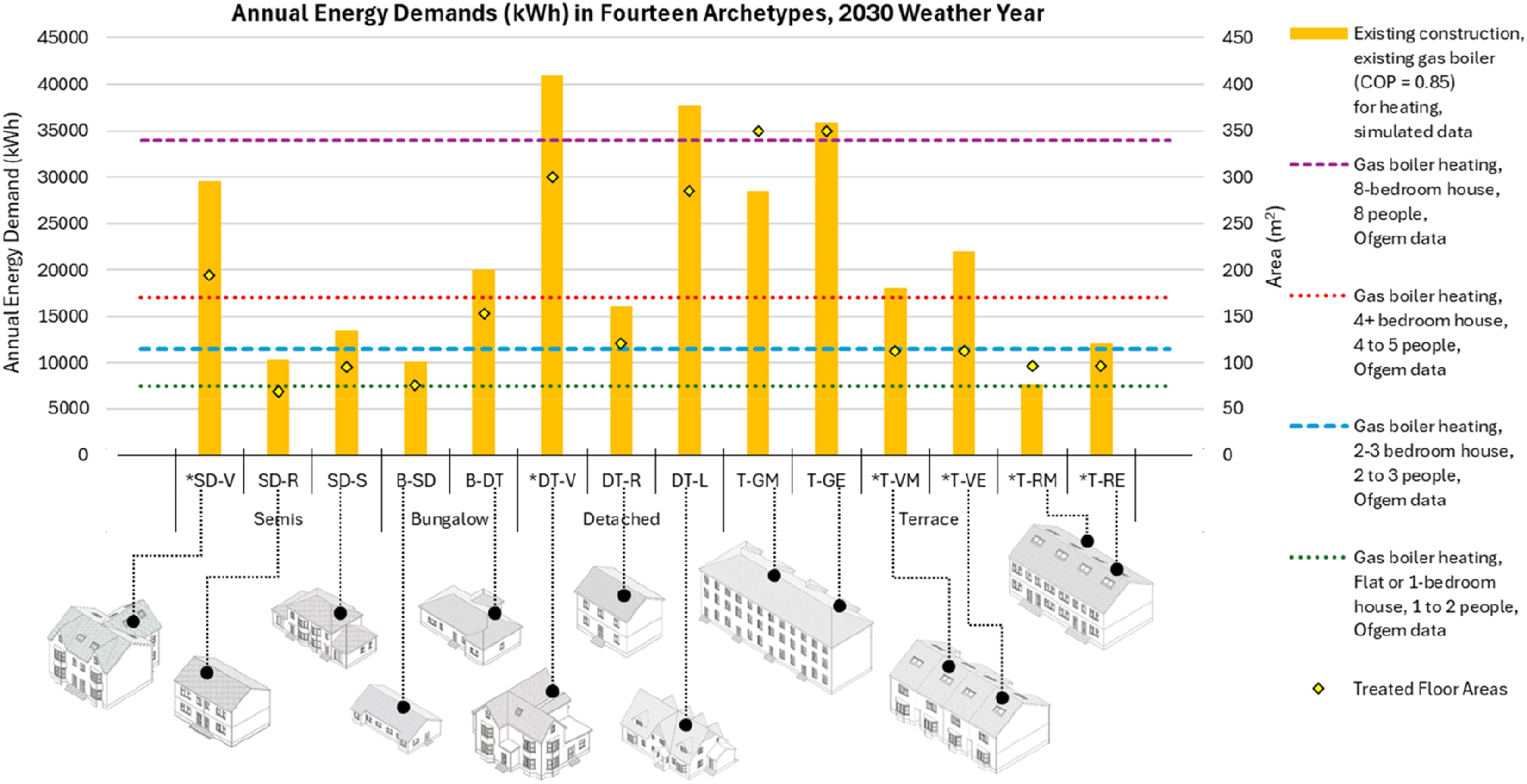
Figure 4 presents the annual energy demand, energy cost and operational carbon emissions of fourteen archetypes by adding fabric and systems retrofits to the existing condition. The annual absolute energy cost and operational carbon emissions of the fourteen archetypes have changed relatively according to the respective factors used for the energy source. Heating energy savings by a system-only retrofit by switching a gas boiler to a heat pump are relative to the coefficient of performance (COP) of the system. For instance, the heating energy demands from a typical existing semi-detached house (SD-S) with a gas boiler were 13460 kWh/a, and it could change to 3815 kWh/a by switching from a gas boiler (COP 0.85) to a heat pump (COP 3.0), indicating 3.5 times heating energy savings. The sub-figure of Figure 4, which compares the percentages of energy, carbon and cost changes in system-, fabric- and whole-house retrofit scenarios, shows the opportunities and challenges of different retrofit measures. According to the 2025 tariffs for natural gas and electricity, the energy cost for electricity is 3.9 times higher than gas. In contrast, the carbon factor for electricity from the national grid is only 96.7% of the carbon factor for natural gas. Therefore, the impacts of those factors on energy costs and operational carbon emissions can also be observed. For instance, a whole-house retrofit, which reduces residual heating demands and provides cooling and ventilation, has a more profound operational carbon savings than energy cost savings, resulting in a typical semi-detached house with 2.28 tonnes of annual operational carbon savings. This further demonstrates that switching from a gas boiler to a heat pump without adding a fabric retrofit could trigger the energy cost consideration due to higher tariffs for electricity against natural gas. Due to the given climate contexts of South Yorkshire, the heating energy demands are significantly higher in the existing conditions. The cooling and ventilation demand in a post-retrofit scenario is relatively small compared to the heating demand found in the existing conditions. However, if the energy demands for heating, cooling and ventilation are compared in a post-retrofit scenario C, it can be observed that cooling and ventilation demands in some archetypes (e.g., mid-terraces) could be higher than their heating demands. In this study, a number of parameters are fixed in the simulation assumptions; therefore, it is noted that the characteristics of archetypes, such as built form and glazing ratio, contribute to higher cooling and ventilation demands. Comparison of fourteen archetypes for different retrofit scenarios and their annual operational performance for (a) energy demands, (b) operational carbon emissions, (c) operational energy costs. The sub-figure of each plot indicates an average change from the existing scenarios.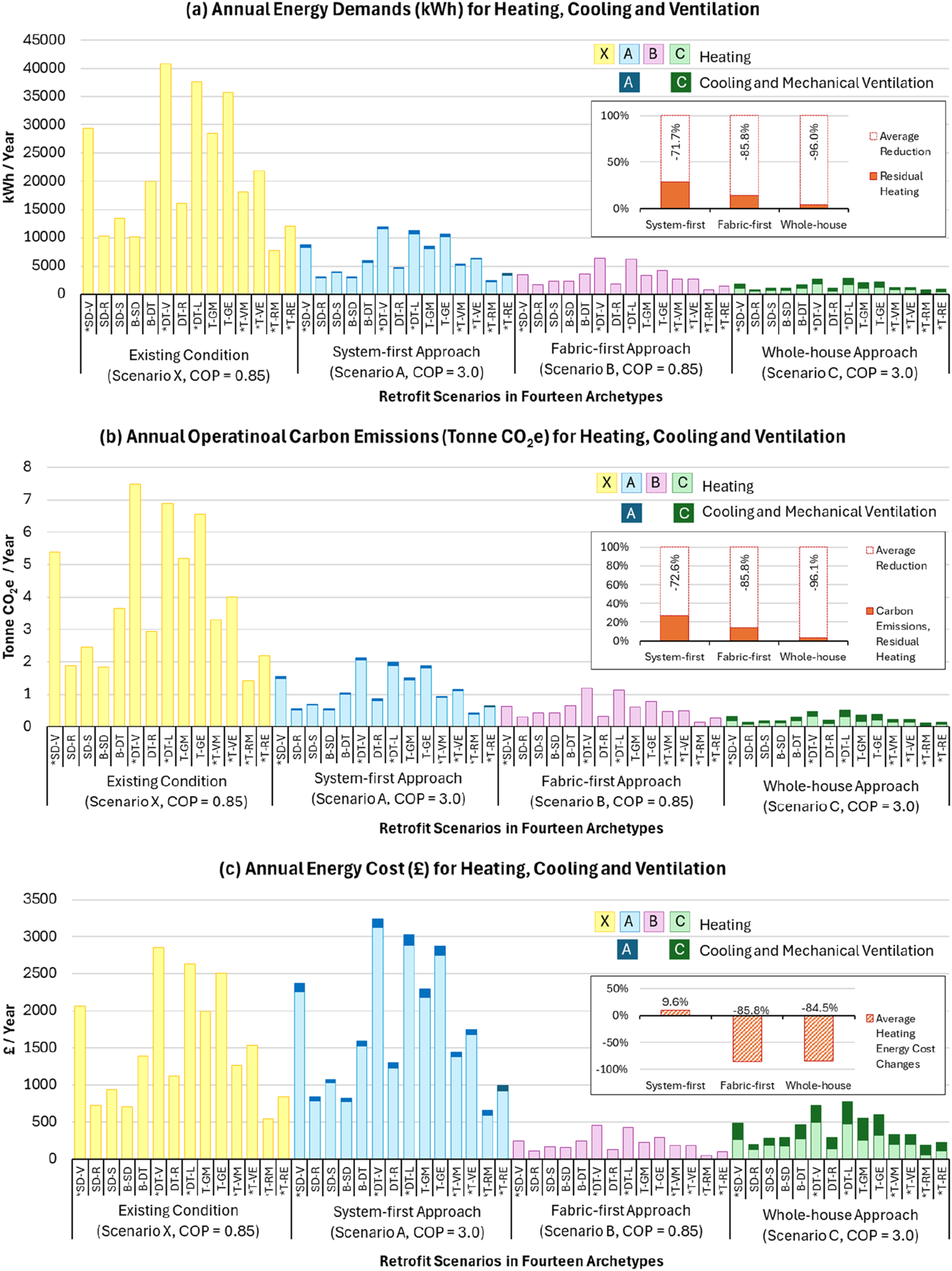
Figure 5 presents annual energy unit intensity, cost unit intensity and operational carbon unit intensity of fourteen archetypes to understand energy efficiency, carbon performance and progress towards net-zero. The sub-figure of Figure 5 shows similar trends in results to Figure 4; however, the use of intensity-based metrics could be a barrier to communicating with homeowners. However, both metrics have different advantages in understanding the impacts of floor plan variations within the same archetypes. For instance, the floor plans of the fourteen archetypes, compared to the average national archetype (Figure 10) show that a range of floor plan variations could be expected in South Yorkshire and the UK housing stocks. A comparison of archetype-based results (Figure 4) and relative area-based results (Figure 5), shows that the oldest archetypes, such as T-VE and T-VM, experience higher energy unit intensity due to their poor fabric energy efficiency. The same fabric energy efficiency is assumed for T-GE, T-GM, T-VE, and T-VM; however, the compact built form of T-GE and T-GM allows the houses to be more energy efficient, while the end-terrace requires more energy demands. While the archetype-based results show that the larger the treated floor areas (TFA), the higher energy demands in general, the relative area-based visualisation reveals no absolute relationship between the TFA and the energy demands. Comparison of fourteen archetypes for different retrofit scenarios and their annual operational performance for (a) energy unit intensity, (b) carbon unit intensity, and (c) cost unit intensity. The sub-figure of each plot indicates an average change from the existing scenarios.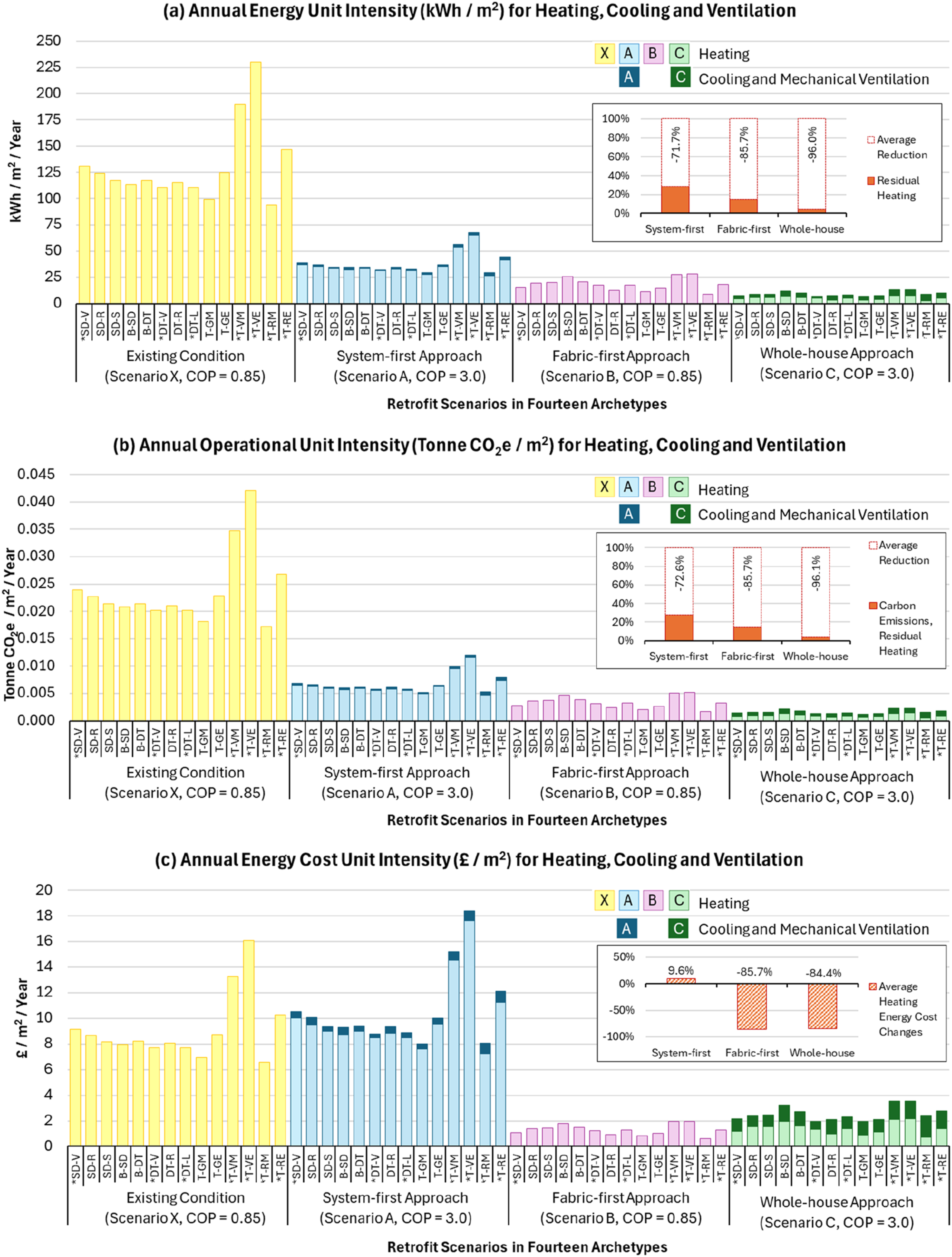
Figures 4 and 5 demonstrate the impacts of retrofit sequencing – adding system retrofit first (Scenario A) and fabric retrofit first (Scenario B) on energy demands, associated energy cost and carbon emission. In these results, the challenges of adding system retrofits without a fabric retrofit can be observed as energy and carbon savings are directly reliant on the COP of the heat pump and the carbon factor of grid electricity. This comparison further reveals that a fabric-first approach is essential for energy, energy cost and carbon savings. Due to the given temperate climate contexts of South Yorkshire, the heating demands are expected to be higher in all archetypes if fabric energy efficiency is not improved in the existing housing stocks.
Figure 6 demonstrates absolute embodied carbon emissions of fourteen archetypes for fabric and system retrofit. The results differentiate how the embodied carbon emissions can be relatively changed by the (higher, average and lower) carbon emission factors associated with the selections for fabric and system retrofits. For instance, to calculate a lower projection (Figure 6(a)) for fabric retrofit-driven embodied carbon emissions, the recycled natural fibre insulation is considered for the whole-house retrofit. To calculate an average projection (Figure 6(b)), glass wool insulation for the roof and floor and EPS (Expanded Polystyrene) insulation for the wall are considered. To calculate a higher projection (Figure 6(c)), aerogel insulation is considered. In terms of material specification, glass wool is highly moisture sensitive, and it would require careful management in the retrofit process and maintenance, whereas the use of aerogel could reduce the thickness of insulation (2.7 times thinner than EPS insulation thickness), which helps to solve spatial constraints. Furthermore, the cost of aerogel and its carbon emission factor could be a trigger for retrofit investment and embodied carbon emissions. Comparison of fourteen archetypes and their absolute embodied carbon emissions due to the selection of fabric and system retrofits using (a) higher carbon factors, (b) average carbon factors, (c) lower carbon factors, and (d) comparison of proportional embodied carbon contributions from retrofit activities using carbon factor from (b) in fourteen archetypes.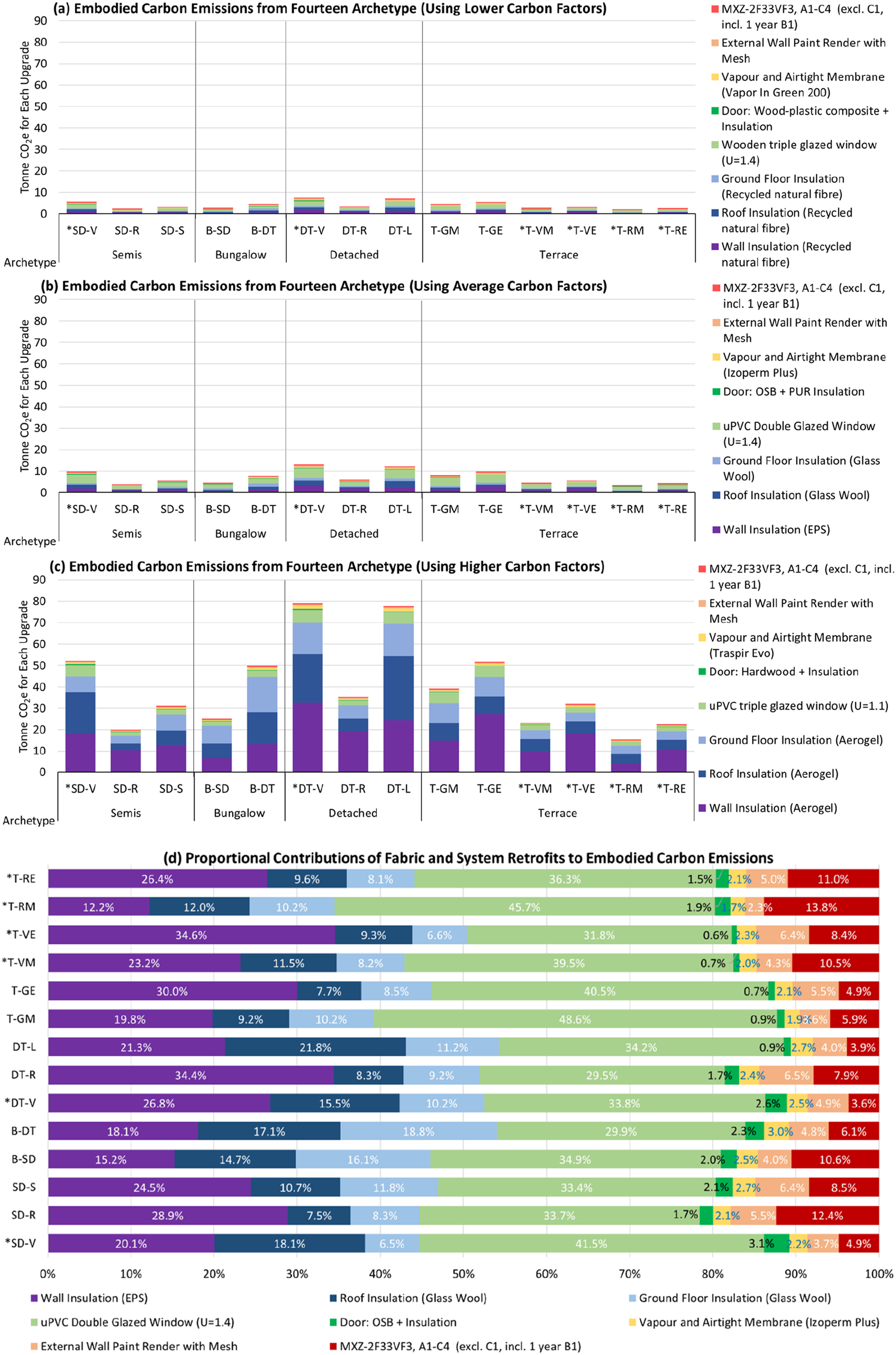
Upfront embodied carbon investment of a system retrofit is calculated from heat pump replacement only, and plumbing and electrical works for this upgrade are excluded from this calculation. In this work, the embodied carbon results of the heat pumps are calculated considering 1 year of refrigerant use; therefore, further calculations are required to add the carbon emissions from the refrigerant of the heat pumps. For the fabric retrofit, window upgrade for high-performance glazing contributes the highest embodied carbon investment across all archetypes (Figure 6(d)), followed by the insulation and finishes for walls, floors and roof energy efficiency improvements. As the embodied carbon of the refrigerant data is calculated for 1 year (considering it will change as operational carbon), the results of the upfront fabric retrofit-related embodied carbon emission show the need for retrofit material decarbonisation.
Similar to the selection for insulation, the selection for finishes and vapour control membrane could affect the embodied carbon emission. Appendix Table 14 shows that the selection of a heat pump alters both embodied carbon emissions and the capacity for heating and cooling, whereas the cost and installation of a heat pump influence decision-making for system retrofit. Large archetypes such as DT-V and DT-L have a larger TFA and window glazing areas, and exposed walls and roof areas. Those characteristics result in higher upfront embodied carbon investment to complete the fabric retrofit and require a larger system sizing to supply necessary heating, cooling and ventilation. Therefore, the upfront embodied carbon investment for system retrofit in larger archetypes is higher than in smaller archetypes.
Figure 7 demonstrates that annual net operational carbon savings from archetypes (green bar plot) could be sensitively varied by several factors, such as fabric energy efficiency, COP of the system retrofit, and operational emissions factors for energy sources. The results also highlight the benefit of a fabric-first approach (Scenario B) over a system-first approach (Scenario A). The highest net operational carbon savings are found in a whole-house retrofit approach (Scenario C). Figure 7 also demonstrates the results of carbon payback year by adding fabric and systems retrofits, showing that a longer carbon payback period is expected in a whole-house retrofit. For instance, a typical existing semi-detached house emits about 2.5 tonnes/year of operational carbon for heating, whereas about 5.9 tonnes of embodied carbon investment is required to achieve a whole-house retrofit. Although the embodied carbon emissions could be subjectively varied by the choice of fabric and system retrofits, in general, the carbon payback year between embodied and operational carbon is found in less than 3 years if an average projection (Figure 6(b)) is used. However, the carbon payback year could increase up to 8 to 18 years if higher embodied carbon retrofit, such as aerogel insulation and outdoor heat pump units, are used. This comparison informs the impacts of selecting retrofit material and equipment on carbon payback. Carbon payback by trading off between operational and embodied carbon from retrofit measures.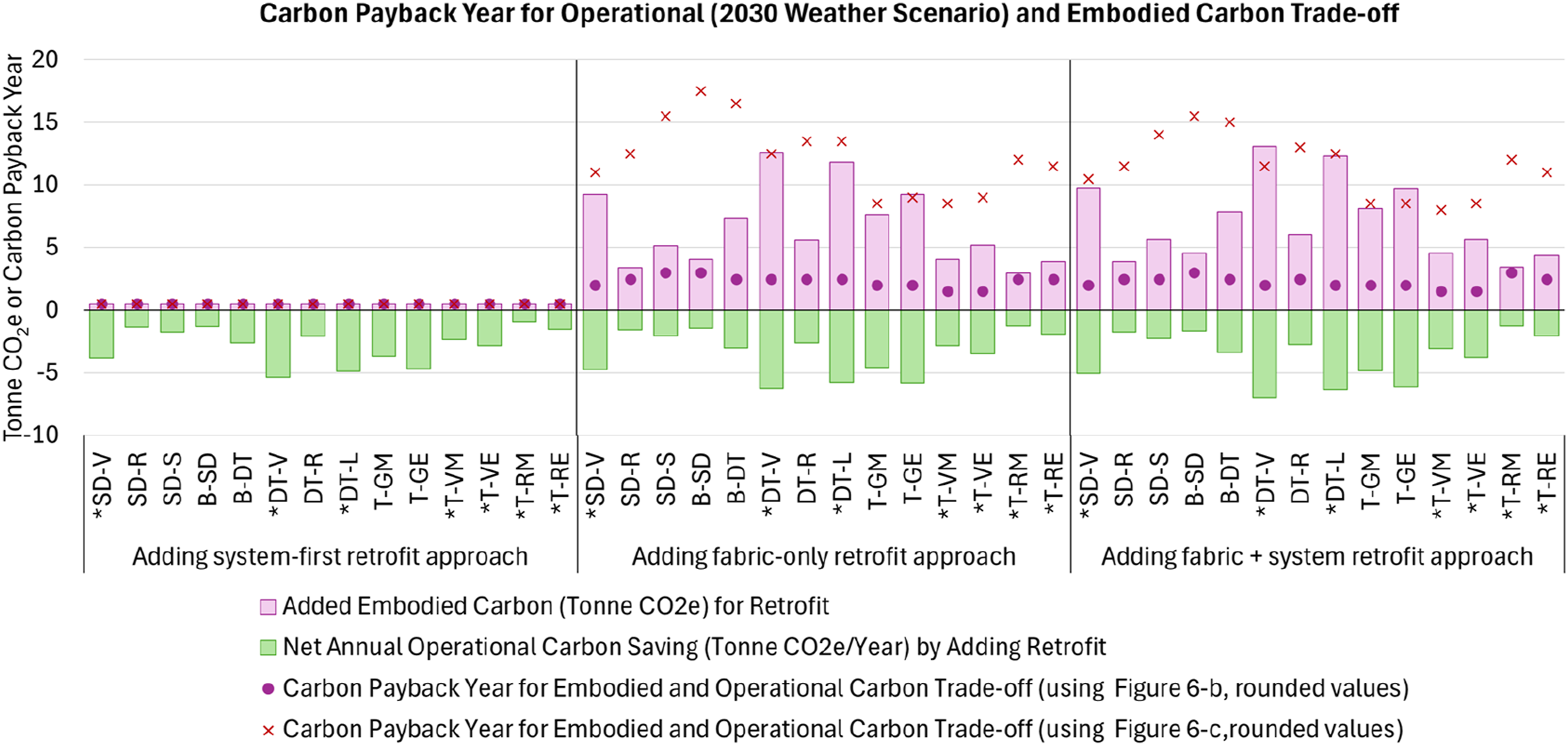
Case study 2: Operational energy performance of staged retrofit
This section presents how the operational energy performance of archetypes is changed by adding staged retrofits (Figure 2). The results demonstrate a decrease in heating demand and an increase in cooling and ventilation demands. Heating demand reductions in fourteen archetypes by adding different stages of retrofit are shown in Figure 8(a). Due to lower heating degree days in 2050, lower heating demands for an existing condition (Stage 0) against 2030 weather scenarios (Figure 3) are observed. Across all archetypes, the percentages of average heating demand reductions (Figure 8(b)) are observed in Stage 1 (7%), Stage 2 (13%), Stage 3 (63%), and Stage 4 (86%), whereas higher reductions are found in larger archetypes. The results in Figures 8(b) and (c) show that Retrofit Stage 3 (adding insulation to the roof and walls, and upgrading glazing performance) plays a key role in reducing heating, cooling, and ventilation loads. Up to Stage 3, the models remain in a leaky stage without improving floor energy efficiency. When the fabric retrofit is fully completed in Stage 4, the increment in cooling and ventilation demands is observed against the existing scenario due to the requirements to maintain thermal comfort and indoor air quality in an air-tight envelope. (a) Annual heating demands changes in fourteen archetypes by adding different stages of staged retrofit, and the results are predicted for the 2050 weather year, (b) the heating demand changes from the existing stage, (c) the cooling and ventilation demand changes from the existing stage, (d) annual cooling and ventilation demand differences in 2030 and 2050 weather years after fabric retrofit are added, and (e) comparison of heating, cooling and ventilation demands after fabric and system retrofit are added in 2050 weather year.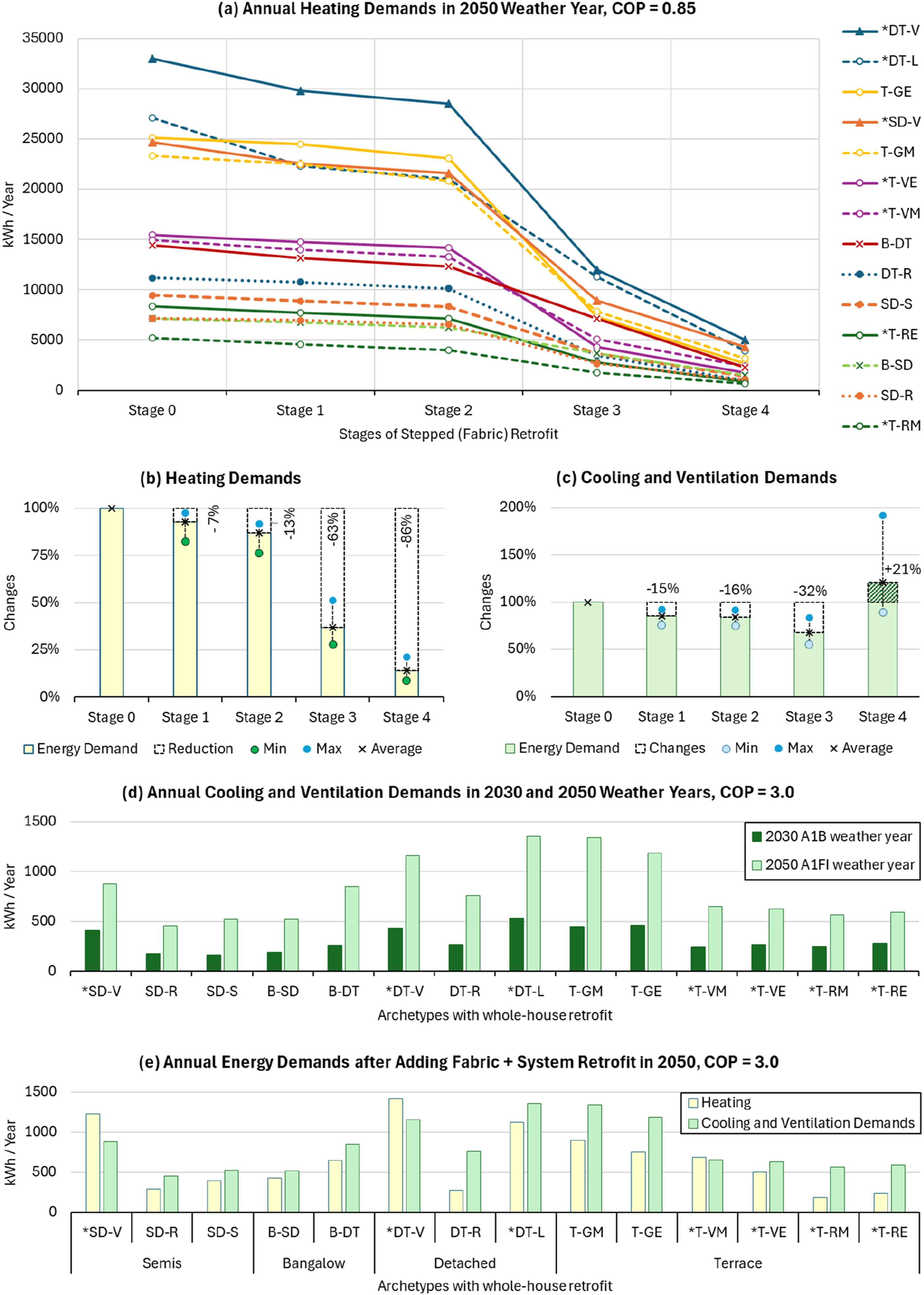
While Case study 1 is an investigation of the energy and cost performance of fabric, system, and a combination of two retrofit scenarios in 2030 A1B weather years, Case study 2 used the 2050 A1FI weather year to examine the long-term climate impact on the stages of retrofit to better understand the requirements to deliver housing stock retrofit. Hence, Figure 8(d) compares the cooling and ventilation demands in 2030 and 2050, considering that a system retrofit is added when the staged retrofit is completed. This also represents the results of a whole-house retrofit in two distinct weather years, 20 years apart. The results stress that doubled or tripled cooling and ventilation demands are expected in all archetypes due to the changing climate conditions. By 2050, after fabric and system retrofit are added, Figure 8(e) shows that most archetypes could experience higher cooling and ventilation demands than heating demands.
After adding retrofit, only Victorian archetypes, such as SD-V and DT-V, are expected to experience slightly higher heating demands than cooling and ventilation needs. In sum, the results of Case Study 2 reveal the same trends of the effectiveness of the staged retrofit in fourteen archetypes, but also highlight the trade-off between different energy demands, particularly stressing the requirements to achieve an airtight envelope for heating demand reductions. Furthermore, the loss of the ground cooling effect appears to be the cooling demand increment in Stage 4.
In Case Studies 1 and 2, the cooling needs are calculated when the indoor temperature reaches 26 °C, while the retrofit design considers the passive design implementation of daytime wind-driven and night purge ventilation to reduce the cooling demands. Therefore, adding insulation does not directly alter cooling and ventilation demands, but the design of the retrofit does, i.e., an integration of passive and active systems. The results of the staged retrofit show that a trade-off between energy demands is expected at Stage 4, where the whole building is highly insulated and air-tight. Passive cooling efficacy can be improved by adding external shading, which was unable to be tested herein. However, the need for ventilation is undeniable for highly insulated and airtight buildings, particularly during the wintertime when implementation of extended natural ventilation time could hinder the heating demands.
Case study 3: Impacts of comfort taking in retrofit measures
Focusing on comfort-taking behaviour, this section demonstrates how a changed percentage of energy cost and carbon emissions could be expected in different archetypes by comparing different heating and cooling temperature settings for different retrofit scenarios (Table 2). In practice, when the building occupiers purposely set heating and cooling set point temperatures to reduce energy cost, the prebound effect occurs. Likewise, setting a higher heating set point or a lower cooling set point temperature causes the rebound effect. Figure 9 compares the sensitivity of operational carbon emissions and energy costs that are changed by different heating and cooling temperature set points. Note that the Y-axis of the energy costs for the existing condition are five times higher than post-retrofit scenarios, whereas the operational carbon emissions for the existing condition are 20 times higher than post-retrofit scenarios. For comparison purposes, the Y-axis of the post-retrofit scenarios is fixed at the same values for heating and cooling demands. Carbon and cost performance of fourteen archetypes according to comfort-taking in different retrofit scenarios and temperature settings: (a) for annual heating in existing constructions, (b) for annual heating after fabric and system retrofits are added, and (c) for annual cooling and mechanical ventilation after fabric and system retrofits are added.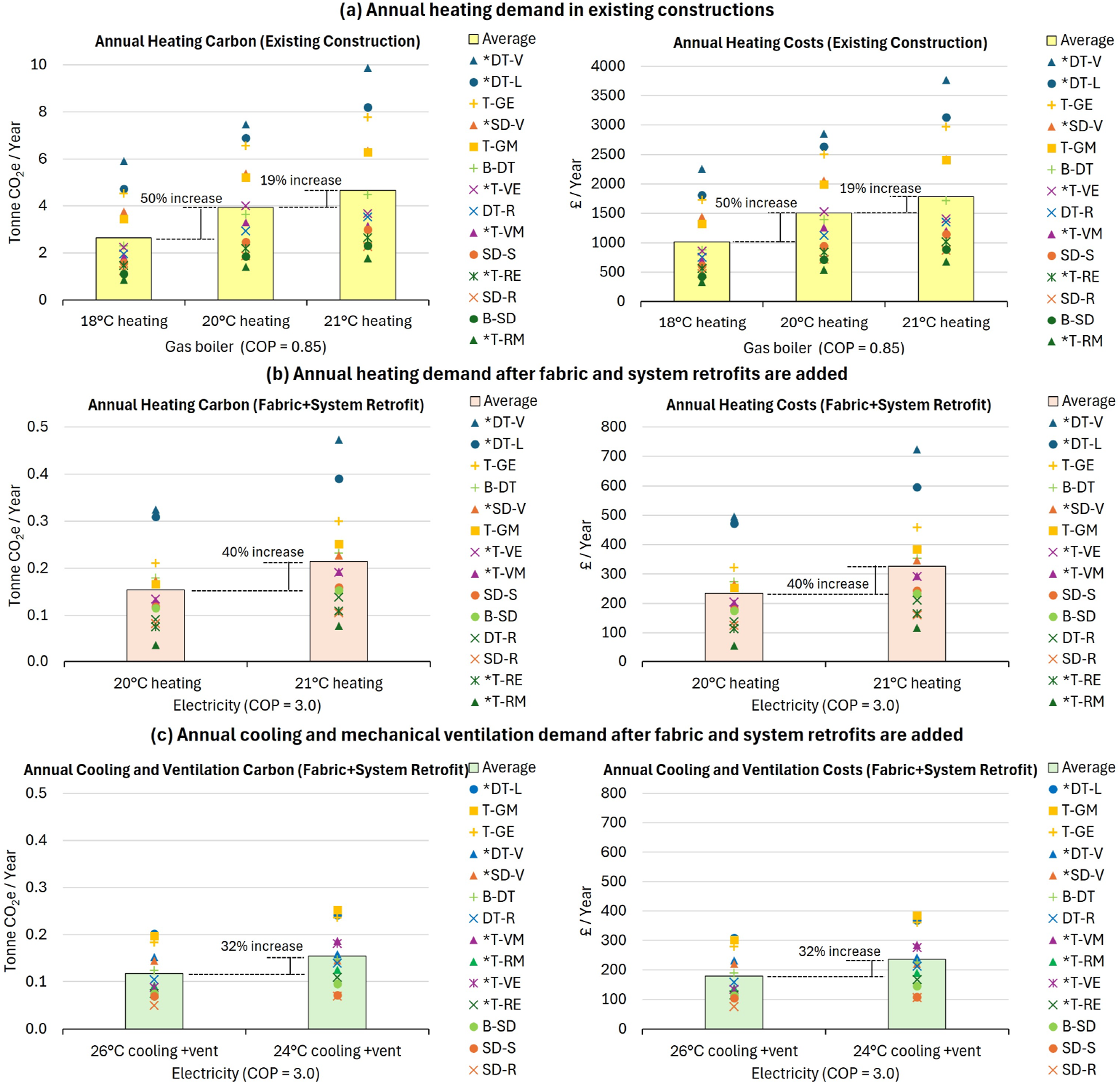
A wider percentage difference of about 50% could be expected in the existing condition by switching a 2 °C difference of the heating set point from 18 °C to 20 °C. However, about a 19% change could be expected by switching a 1 °C difference of the heating set point from 20 °C to 21 °C. At an existing condition, larger archetypes such as SD-V, DT-V and DT-L could experience higher energy demands and higher operational carbon emissions if they set a higher comfort level in their homes. Even though the same comfort setting is applied across fourteen archetypes, the impact of temperature settings is less profound in smaller archetypes such as DT-R, SD-S and B-SD. A non-linear relationship between temperature set points and energy demands for heating, cooling and ventilation indicates that the impacts of comfort-taking could significantly contribute to the sensitivity of energy cost and operational carbon savings from the respective housing stock.
Discussion
System-only retrofit: Operational carbon savings benefits and energy cost savings barriers
In this work, a comparative study of energy demands, energy costs, and operational carbon emissions in different retrofit scenarios is presented to understand the robustness of different retrofit measures. Research has shown that a heat pump or other low- and zero-carbon alternative heat supply will be sufficient to decarbonise heating in many cases, 20 particularly due to technological advancements in refrigerants and heat pump efficiency, and future grid decarbonisation. The system-first retrofit results presented in this work also confirm that operational carbon emissions can be significantly reduced across all archetypes by about 73% from an existing condition due to a lower carbon factor for grid electricity and the COP of the heat pumps (Figure 4(b)). The results (Figure 4(c)) also emphasise that a higher tariff for electricity is the primary challenge to adopting heat pumps, as the heating energy cost alone could be approximately 10% higher than using an existing gas boiler for heating. In the UK, the price of an air source heat pump (ASHP) for a 3-4-bedroom house ranges between £7,000 – £13,500 (4 kW – 16 kW), or £12,000 on average; however, the overall cost can be lowered by £7,500 by taking a grant. 58 Despite the grant, a comparison of existing and system-retrofit archetypes (calculated based on COP differences) presented in this work also discloses that the concern of heat pump investments and associated energy cost savings from a system-only retrofit could be a trigger for the homeowner’s interest in a wider heat pump uptake nationally. The results of energy, carbon and cost performance of different retrofit scenarios presented in this work therefore underline to learn from the rise and the fall of the UK’s Green Deal, 9 which is a recent example of a poor financial proposition for most households.
Whilst the peak energy demand results are unable to be presented herein, research has reported that buildings with poor fabric energy efficiency suffer a higher peak demand. 59 For instance, deep retrofit homes with ASHP operation in Ireland showed the impact of extreme weather on peak electricity heating demand during the winter. 60 Without adding a fabric retrofit, a higher heat pump size and related capital cost are expected in a system-only retrofit. For the climate context of the UK, adding retrofit measures to improve system efficiency is mainly to decarbonise heat, and heat pumps are therefore the main future options. For instance, the cost of a heat pump with a heating-only energy supply could be cheaper than a reversible heat pump, but this could affect the quality of indoor conditions. To date, no large-scale case studies compare the return on investment (ROI) of retrofit from system-only and whole-house retrofit, considering the energy demands changes, i.e., an increase in cooling and ventilation demands and a decrease in heating loads, compared to upfront investment for fabric and system retrofit measures across different archetypes. Decarbonising the grid and energy systems is one of the solutions for complex socio-environmental problems to achieve a net-zero built environment; however, future research is needed to inform the sensitivity of ROI changed by the decision of the homeowner for system-only, whole-house retrofit selections. This will help bring homeowners’ interest to be involved in the nationwide net-zero retrofit deployment.
Fabric retrofit: Lower residual carbon emissions and longer economic payback times
In the UK, a review of 15 sources in 2017 showed that external wall insulation, party cavity wall insulation, loft insulation, solid floor insulation, external window replacement and draught proofing for an average UK home could cost about £24,855. 61 For a typical house in the UK, the capital cost (nominal undiscounted cost in 2030) of fabric retrofit to achieve a higher space heating standard (e.g., 15 kWh/m2/year) with an ASHP heat pump could be about £26,300. 62 If this fabric retrofit investment is considered for a typical semi-detached house (i.e., SD-S in this study), the cost payback year could be up to 33 years. Furthermore, the fabric-first retrofits tend to be disruptive, carbon-intensive, expensive and will take decades to convert the stock.20,63 Due to the electricity traffic, the impacts of whole-house retrofit are more profound in operational carbon savings than energy cost savings. Although a trade-off for cooling and ventilation needs in a whole-house retrofit could hinder energy cost and carbon savings, the results of Case Study 1 reveal that adding a fabric-first retrofit before system retrofit to deliver a whole-house retrofit allows about 85% of energy cost savings from the existing condition. Whilst a staged retrofit is encouraged to make the whole-house retrofit more accessible,18,19 in terms of the retrofit ROI perspective, as even high-income households will need retrofit incentives for a staged retrofit to be involved in a faster decarbonisation approach. 64 Regarding the carbon savings perspective, the longer the staged retrofit delivery takes to complete, the higher the cumulative residual carbon emissions from the existing housing stock. Considering the residual energy demands from different stages of retrofit in fourteen archetypes, this work stresses the importance of staged and whole-house retrofit, speeding up energy infrastructure decarbonisation and making clean energy affordable for everyone. There are limitations in current research and retrofit policy in terms of cost-effectiveness for the fabric-first approach staged retrofit. Therefore, future retrofit policy research is needed to develop retrofit incentives and the necessary supply chain for staged retrofit to quickly reach a whole-house retrofit.
Embodied carbon investment and the need for national policy
The results of this work demonstrate that the selection of insulation, finishes, airtight and vapour membranes, heat pump for fabric and system retrofit would influence the carbon payback year, an average of 3 years for whole-house retrofit, and it could take up to 18 years. The results are in line with the other study, 65 which assesses the life cycle impact of a terrace house and showed 1.4 to 3.9 years of carbon payback time for deep retrofit, i.e., similar to the T-VE and T-VM of the presented case studies. As a retrofit decision could vary across archetypes, a policy reinforcement is important to tackle the barrier to shortening the carbon payback time and reducing upfront embodied carbon investment for housing stock retrofit. The other study, which investigates carbon-budget compliant retrofit measures, also shows that a careful selection of insulation materials is key in bringing down the embodied emissions, particularly to meet stricter carbon budgets. 13 In this work, night-time ventilation and internal shading are considered to integrate passive measures according to the predefined simulation settings. Night ventilation has been widely advocated in the context of passive measures to prevent overheating and reduce cooling energy demands 66 ; however, the approach itself has several challenges in external factors such as noise, air quality and security concerns. A study which assesses overheating risk in existing UK homes shows that external shutters are the most effective, followed by blinds and internal shutters. 29 The whole life embodied in external sliding shutters is 4.5 times higher than internal venetian blinds, 67 and the installation cost could vary for different circumstances. The calculation for the whole life cycle carbon impact of retrofit materials could vary significantly by the database used for embodied carbon and embodied energy data. 68 Notably, integrating passive and active retrofitting approaches could further alter building performance, carbon payback and long-term energy and carbon savings. 69 Whilst the embodied investment and carbon trade-off by retrofit measures have received significant attention for retrofit design, in the absence of a national policy for embodied carbon, little is known about the projected embodied carbon investment to decarbonise the existing housing stocks. The allocation of the remaining carbon budget for residential retrofit and different archetypes is complex. 70 Future research is needed to investigate the impacts of retrofit embodied carbon investment, the needs for material decarbonisation and the impacts of implementing passive design measures on housing stock retrofit to address the interconnectedness of the retrofit carbon budget policy and the environmental sustainability of the built environment.
Retrofit prebound and rebound sensitivities
In this study, a direct rebound from fabric retrofit measures is seen as an energy trade-off for cooling and ventilation needs to maintain necessary indoor conditions. Indirect prebound and rebound results of energy demands can be seen in Case Study 3, where the comparison of different temperature set point settings quantified the retrofit prebound and rebound sensitivities driven by comfort-taking across archetypes. In practice, the energy and carbon performance of different retrofit scenarios is also subject to the occupant behaviour of different archetypes. 30 Research has flagged that fuel poverty occurs where low-income households have high prebound effects. 25 In this regard, the retrofit carbon savings from those households could be different from the presented results of this study. The presented results also inform how the energy consumption and comfort-taking behaviour may hinder the return on investment from retrofit and expected carbon savings. It is well-understood that environmental payback times are quicker than economic payback times. 71 For instance, empirical estimates of the direct rebound effect have ranged from 0% to 100% due to poor installation and increased use of comfort taking, 72 although the latter, indirect rebound effect, improves the well-being of building occupiers through an increase in comfort. 73 As climate change can drive a robust increase in annual and peak cooling and ventilation demands, how different archetypes in the UK would respond to this is a key question for the energy suppliers. For energy suppliers, this is critical to prepare for the future energy infrastructure to supply the necessary annual and peak electricity demands from archetypes with different retrofit scenarios. Whilst the presented work partly fills the research gap, future research in post-occupancy evaluation for retrofitted homes is essential to quantify how the prebound and rebound sensitivities could influence the net-zero carbon target. Towards a net-zero housing stock, this study therefore stresses that providing necessary information about retrofit sensitivities is important for a retrofit policy and consumer engagement across different archetypes.
Retrofit at scale and calls for pilot studies
Complete decarbonisation of the housing stock would take decades. A key question is how to effectively scale up and prioritise retrofit deployment by taking into account the socio-demographic and socio-economic status of housing stock. In the UK, the “place-based” and “street-by-street” retrofit delivery approaches aim to target fuel-poor areas and define multiple eligible properties to allocate funding and retrofit at once. This can be seen in HEEPS’s area-based schemes 6 and Levenshulme area-based retrofit. 74 Many local authorities in the UK are ambitiously planning to achieve net-zero emissions. This presented study can be applied to the GIS-based retrofit planning model with other socio-demographic databases. 75 The combined method can rapidly and appropriately target respective dwellings to enable area-based whole-house retrofits for local authority-led retrofits, for example, further development for the Optimised Retrofit Programme (ORP). 76 While the mapping of archetypes and social reality is technically feasible, future challenges of prioritising archetypes and retrofit scaling barriers rely on organisational directions, financial planning, retrofit policy and citizen involvement. Proven pilot studies at a neighbourhood scale are essential to address the challenges and limitations discussed above. According to the carbon savings benefits presented in the work, this study suggests scaling up retrofit to use a staged-based and whole-house retrofit, whereas defining area-based retrofit requires selecting a specific archetype or a combination of similar archetypes, both at the South Yorkshire and national levels.
Limitations and future works
The limitation of this work lies in the lack of stochastic or probabilistic modelling, seasonal and peak demands, and evidence gaps.23,30 Fixed assumptions of archetype data (e.g., floor areas, floor height, orientation, fabric construction and variations within specific design style), existing fabric energy efficiency and TM59 assumptions for internal gains and building operation schedules in energy and carbon calculations for different retrofit scenarios were simplified against real-world heterogeneity, and this could lead to energy performance gaps in the results. 28 Hence, the uncertainties and rebound effects associated with socioeconomic factors and occupant behaviour variables were unable to be considered in the results of pre- and post-retrofit scenarios. Further study is needed to investigate how the daily peak energy demands change in different retrofit stages, as it will influence the sensitivity of future energy infrastructure. Furthermore, the impact of different retrofit stages and scenarios on thermal comfort and indoor air quality across diverse archetypes needs to be reviewed. Whilst the evidence gaps and real-world validations are essential to understand the future energy demands and carbon emissions, the comparative results of fourteen archetypes improve data reliability and enhance a broader theoretical understanding of staged-based and whole-house retrofits to develop a retrofit initiative and net-zero policy.
Conclusion
This study presents the energy, energy cost and carbon performance of fourteen archetypes, comparing environmental and economic payback as key indicators for system-only, staged-based fabric retrofit and whole-house measures. Inequalities in carbon emission results across domestic archetypes stress the policy challenge to prioritise residential archetypes for retrofit deployment at scale effectively. Within the presented method, the author suggest (1) developing a retrofit policy that reviews the energy and carbon performances of retrofit measures from each archetype before retrofit deployment, (2) providing information for retrofit decision-making to incorporate passive and low-carbon retrofit design strategies to maximise energy and carbon savings in diverse archetypes, and (3) highlighting carbon and cost-saving barriers of the fabric-first retrofit due to post-retrofit rebound sensitivity. Comparisons of fabric, systems and a combination of both retrofits inform the need to develop a future retrofit policy to decarbonise residual energy demands from the housing stock. The results of this study can be seen as a context-dependent dialogue example for the South Yorkshire housing stocks addressing local authority-led net-zero planning for retrofitting at scale, and it can be applied to the whole UK and similar housing stocks. The findings of this work provide valuable insights for energy suppliers, local authorities and policymakers to develop real-world initiatives, review the retrofit policy, manage at a local level and develop a strategic and holistic approach for retrofitting at scale. This is pertinent in the future development of retrofit funding schemes as a holistic package for housing performance improvement to meet net-zero targets and climate limit carbon budgets.
Footnotes
Acknowledgments
The author would like to express sincere gratitude to Dr Hadi Arbabi and Professor Danielle Densley Tingley at the University of Sheffield for their invaluable discussion and insightful feedback throughout this project. This project was funded by the Research England Development Fund through the South Yorkshire Sustainability Centre, The University of Sheffield.
Declaration of conflicting interests
The author declared no potential conflicts of interest with respect to the research, authorship, and/or publication of this article.
Funding
The author disclosed receipt of the following financial support for the research, authorship, and/or publication of this article: this project was funded by the Research England Development Fund through the South Yorkshire Sustainability Centre, The University of Sheffield.
Research development
This article is an expanded version of a symposium paper entitled: Investigating Archetype-based Retrofit Prioritisation at Scale, which was presented at the CIBSE IBPSA-England Technical Symposium, at UCL Bentham House, London, on 24-25 April 2025.

Data Availability Statement
The dataset is available upon request from the authors.
Appendix
Area data from the simulated archetype models for energy and thermal calculation. aIndicates the attic rooms in the archetypes.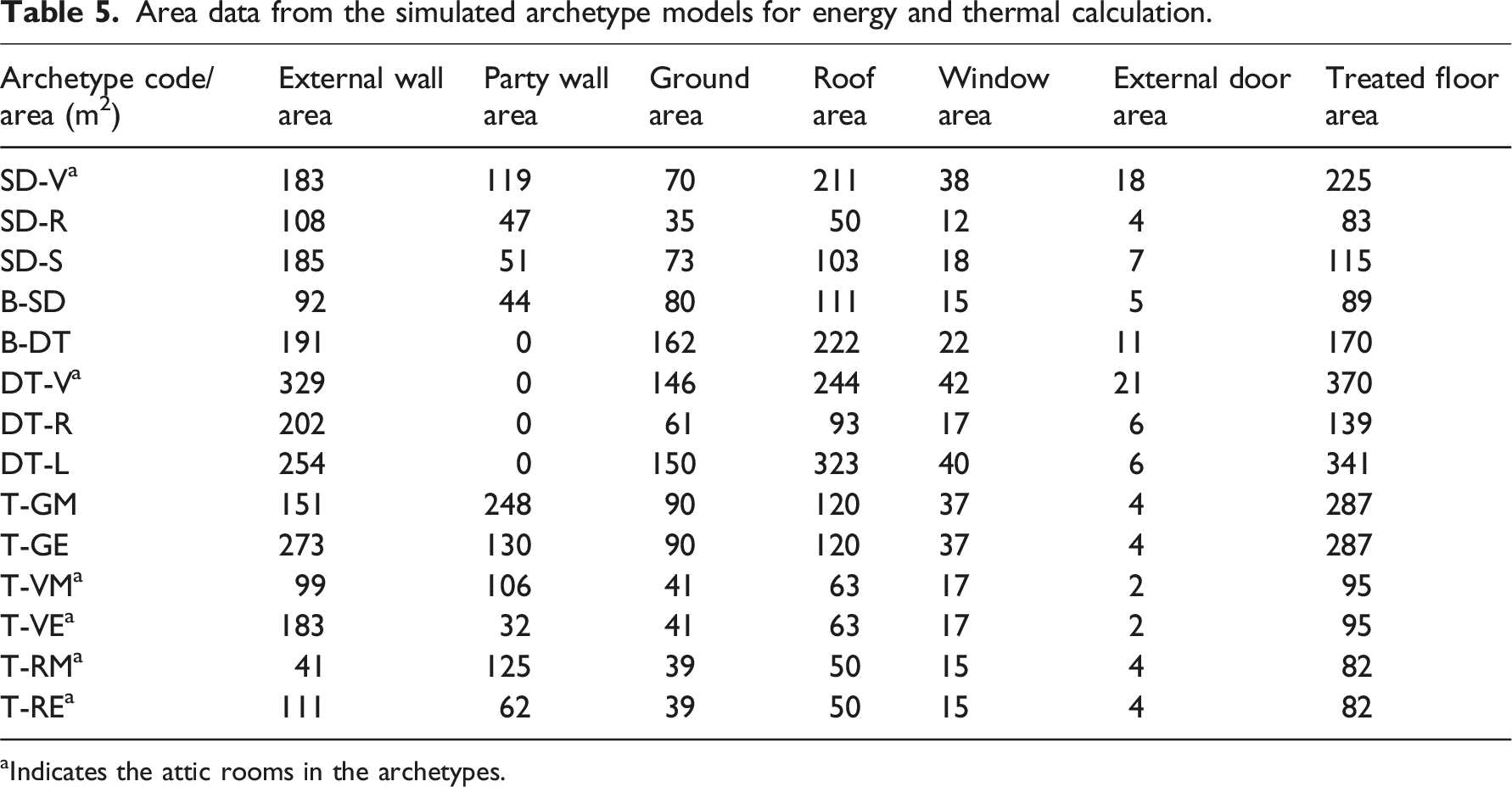
Archetype code/area (m2)
External wall area
Party wall area
Ground area
Roof area
Window area
External door area
Treated floor area
SD-V
a
183
119
70
211
38
18
225
SD-R
108
47
35
50
12
4
83
SD-S
185
51
73
103
18
7
115
B-SD
92
44
80
111
15
5
89
B-DT
191
0
162
222
22
11
170
DT-V
a
329
0
146
244
42
21
370
DT-R
202
0
61
93
17
6
139
DT-L
254
0
150
323
40
6
341
T-GM
151
248
90
120
37
4
287
T-GE
273
130
90
120
37
4
287
T-VM
a
99
106
41
63
17
2
95
T-VE
a
183
32
41
63
17
2
95
T-RM
a
41
125
39
50
15
4
82
T-RE
a
111
62
39
50
15
4
82
Rooms data from the simulated archetype models for energy and thermal calculation. aIndicates the attic rooms in the archetypes.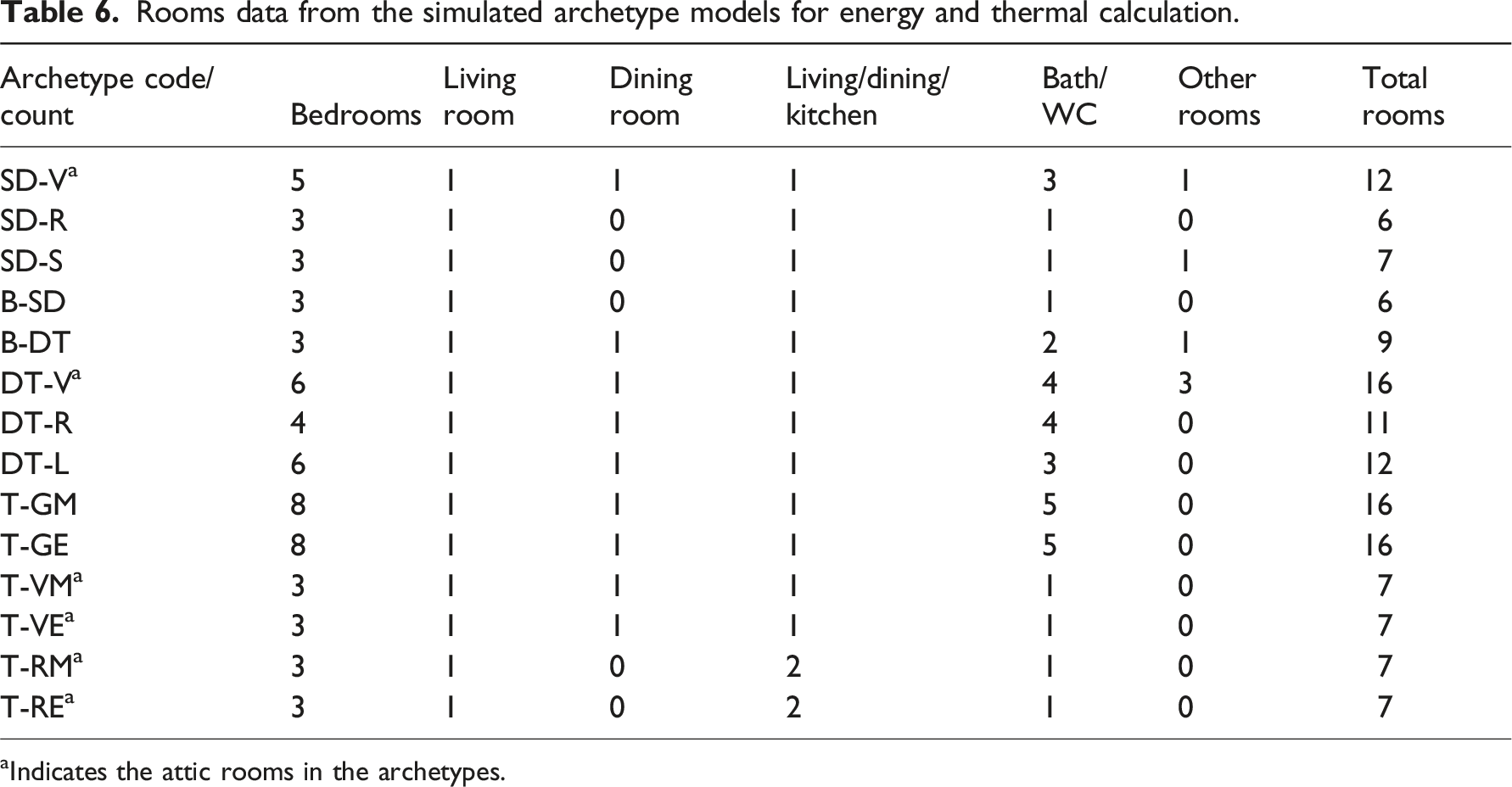
Archetype code/count
Bedrooms
Living room
Dining room
Living/dining/kitchen
Bath/WC
Other rooms
Total rooms
SD-V
a
5
1
1
1
3
1
12
SD-R
3
1
0
1
1
0
6
SD-S
3
1
0
1
1
1
7
B-SD
3
1
0
1
1
0
6
B-DT
3
1
1
1
2
1
9
DT-V
a
6
1
1
1
4
3
16
DT-R
4
1
1
1
4
0
11
DT-L
6
1
1
1
3
0
12
T-GM
8
1
1
1
5
0
16
T-GE
8
1
1
1
5
0
16
T-VM
a
3
1
1
1
1
0
7
T-VE
a
3
1
1
1
1
0
7
T-RM
a
3
1
0
2
1
0
7
T-RE
a
3
1
0
2
1
0
7
Floor plans of the fourteen archetypes used in this study.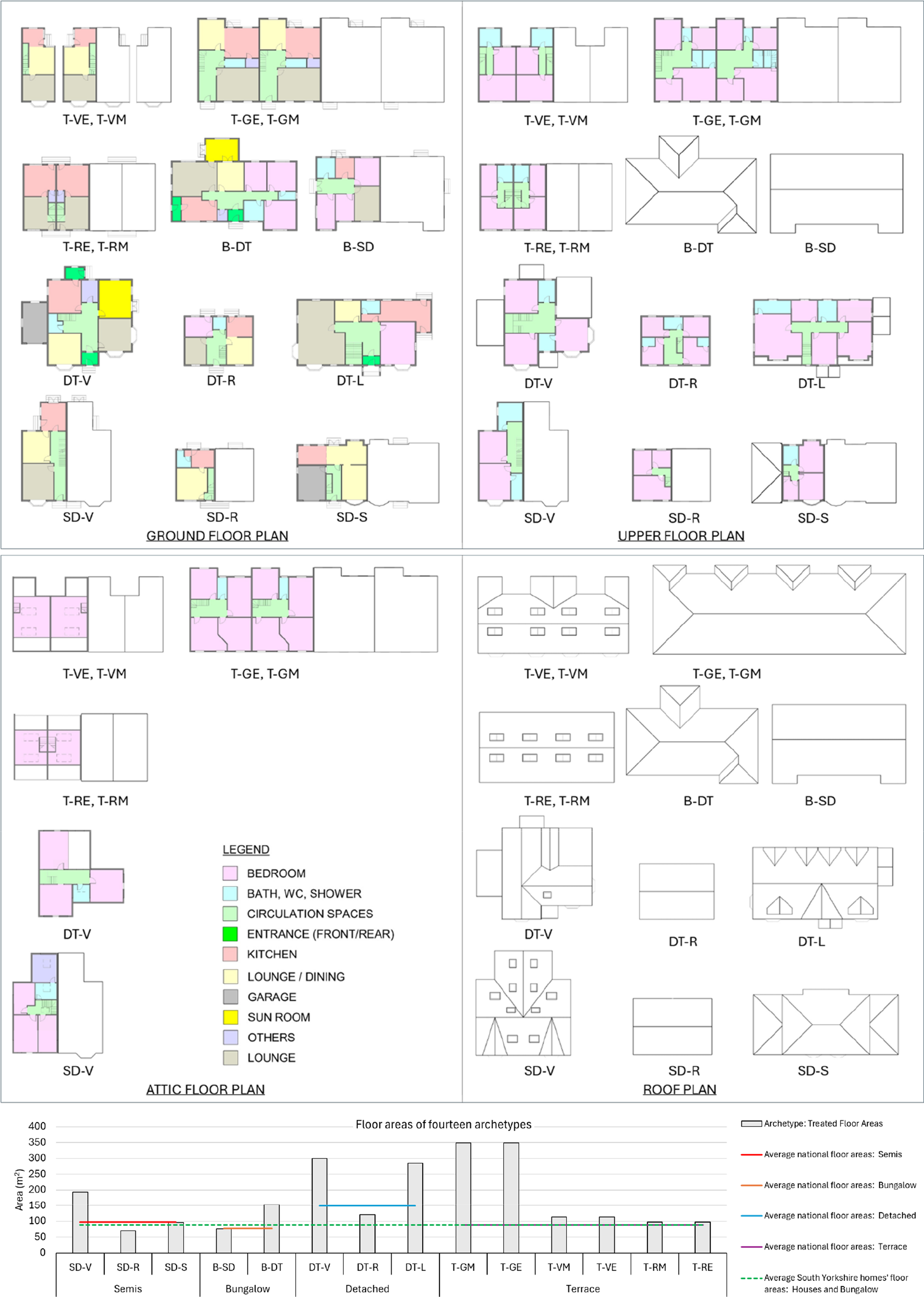
Comparison of future weather scenarios (a) temperature distribution, (b) cumulative probability change in future weather, and (c) a bivariate distribution of dry bulb temperature and relative humidity. (Figure generated using the data from Ref. 47).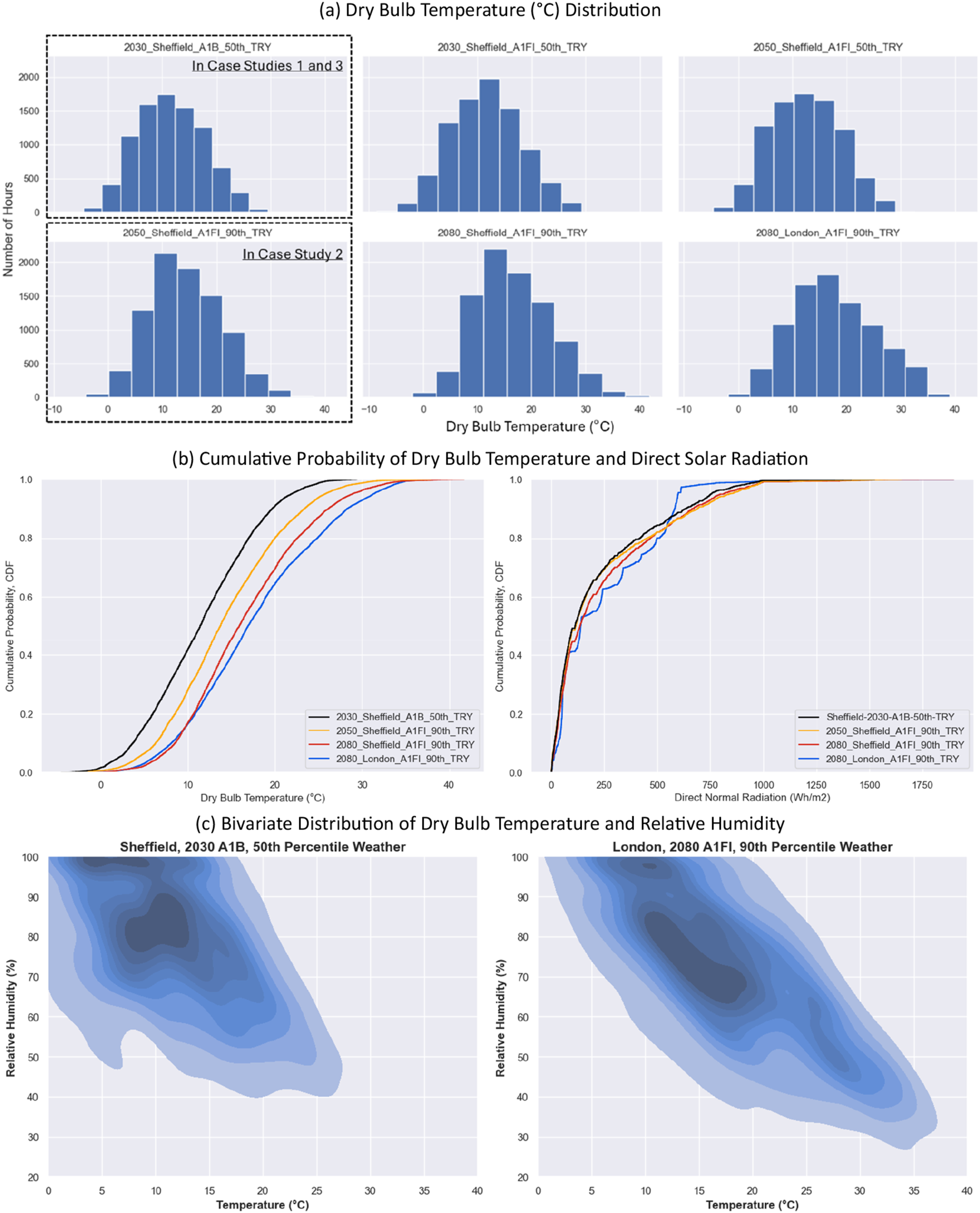
Coefficient of performance (COP), operational carbon emission factors and energy tariffs used in the study.

Embodied carbon data for insulation.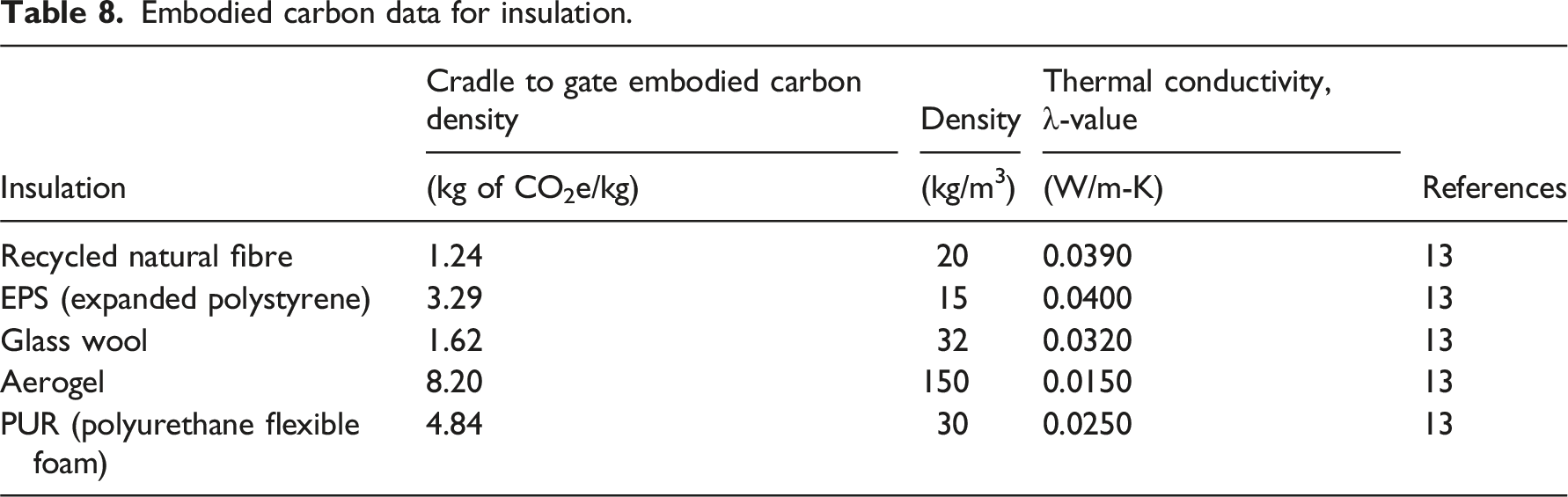
Insulation
Cradle to gate embodied carbon density
Density
Thermal conductivity, λ-value
References
(kg of CO2e/kg)
(kg/m3)
(W/m-K)
Recycled natural fibre
1.24
20
0.0390
13
EPS (expanded polystyrene)
3.29
15
0.0400
13
Glass wool
1.62
32
0.0320
13
Aerogel
8.20
150
0.0150
13
PUR (polyurethane flexible foam)
4.84
30
0.0250
13
Embodied carbon data for window.
Embodied carbon data for wood type in doors.

Embodied carbon data for vapour control membrane.
Vapour control membrane
A1-A3 (GWP total)
Description and declared unit (kg CO2e/1 m2)
Location
Reference
TRASPIR EVO
1.78E + 00
Highly breathable monolithic membrane
Italy
85
VAPOR IN GREEN
2.38E-01
Vapour control membrane based on natural cellulose
Italy
85
IZOPERM PLUS
4.14E-01
Extremely strong, yet lightweight vapour control layer
Ireland
86
Embodied carbon data for paint and mesh for external render.


Embodied carbon data for reversible heat pumps.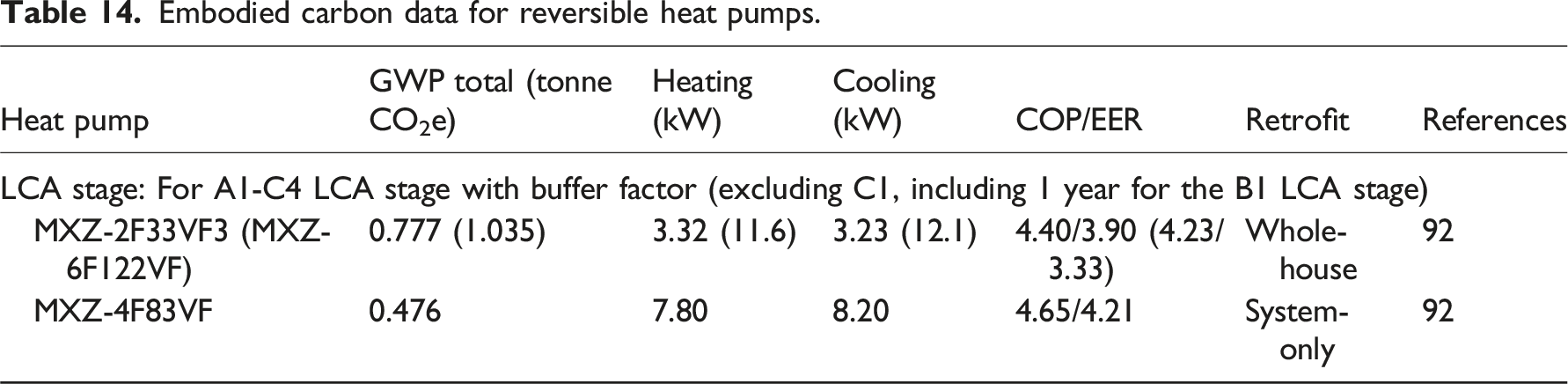
Heat pump
GWP total (tonne CO2e)
Heating (kW)
Cooling (kW)
COP/EER
Retrofit
References
LCA stage: For A1-C4 LCA stage with buffer factor (excluding C1, including 1 year for the B1 LCA stage)
MXZ-2F33VF3 (MXZ-6F122VF)
0.777 (1.035)
3.32 (11.6)
3.23 (12.1)
4.40/3.90 (4.23/3.33)
Whole-house
92
MXZ-4F83VF
0.476
7.80
8.20
4.65/4.21
System-only
92