




Abstract
This paper describes a heat pump investigation for GreenSCIES (GS), a fifth Generation district heating and cooling (5DHC) network in Islington, London. The paper describes the GreenSCIES concept integrating Mobility, Power and Heat into a Smart Local Energy System (SLES). At the heart of the system is an ultra-low temperature ambient loop network, which permits bi-directional flow within the pipes to allow energy exchange between heating and cooling customers at different times and in different locations, depending on where demand is at any given time. An existing data centre provides the primary source of waste heat for the scheme. Heat pumps in distributed energy centres are utilised to amplify the temperature of the ambient loop to deliver heat in connected buildings. The energy centres integrate heat pumps with building-mounted solar photovoltaic (PV) systems and electric vehicle (EV) charging points. The paper provides an overview of the integrated SLES concept, focussing on the heat pump selection and the short and long-term thermal storage options designed for the scheme. The results show that even the smaller constructible ‘New River’ scheme will save 5,000 tons of CO2e annually. This will tend to 100% as the grid decarbonise further. Therefore, the GS SLES concept applied to urban areas could deliver significant carbon emission savings in the UK and elsewhere.
Introduction
The role of district heating and cooling in meeting net-zero
In 2019, the UK Government committed to reduce its carbon emission to Net-Zero by 2050. 1 Meeting this legal commitment will require virtually all heat in buildings to be decarbonised, and heat in industry to be reduced to close to zero carbon emissions. Heating of buildings is one of the major contributors to greenhouse gas emissions, and therefore, decarbonisation of the sector is a critical in order to meet climate targets. The combination of heat pumps and heat networks offers a major pathway to decarbonise heat in buildings. The UK’s Committee for Climate Change estimates that around 18% of UK heat will need to come from heat networks by 2050 if the UK is to meet its carbon targets cost-effectively. 2 Therefore, the UK Government has provided technical and project management support through its Heat Networks Delivery Unit (HNDU) for a number of years. This has supported heat mapping, detailed feasibility and detailed project development for over 100 projects. BEIS is currently investing up to £320 mn through the existing Heat Networks Investment Project (HNIP), using grants and loans to accelerate the growth of the market. This scheme will come to an end in 2022 but will be followed by a further £270 mn in further funding from 2022 through the new Green Heat Network Fund. 3 As part of its Net-Zero Strategy, 4 BEIS expects the annual energy supply from heat networks to grow from 14 TWh in 2019 to 70 TWh in 2050, which would represent around 20% of the UK’s domestic heating demand in that year.
The generation of energy networks
There is also an apparent move to reduce temperatures in heat networks. Traditional, early generation networks can be expensive and can suffer from significant distribution losses. The proposed SLES concept presented in this paper formed around a fifth generation district heating and cooling (5DHC) network concept where customers can be producers and/or consumers (prosumers) of thermal energy flows within the network. 5DHC is a non-traditional topology with decentralised plant, usually electric heat pumps, supplying heat or coolth to the connected prosumers through an ambient loop. 5DHC networks are characterised by distribution temperatures in the ambient range of 15–25°C, which not only reduces heat loss but also allows for integrating various kinds of low temperature waste heat sources such as heat from urban data centres.
The economic benefits of lower distribution temperatures have been estimated by Averfalk and Werner, 4 and shown to be significant in comparison to the traditional higher temperature systems. Further benefits of 5DHC networks were investigated and discussed by a number of authors which all showed to be significant compared to the operation of previous generation networks. Jones 5 and Revesz et al. 6 both highlighted opportunities associated with prosuming of energy between applications, with the greater prosuming leading to greater carbon savings. Boesten et al. 7 concluded that 5DHC systems provide a high level of flexibility as a result of their integration of heating, cooling and electricity infrastructures and the availability of storage facilities at different temperatures and time scales. The work of Buffa et al. 8 assessed the drawbacks and benefits of 5DHC systems by the means of a SWOT and a statistical analysis of 40 existing systems. The study concluded that ultra-low temperature nature of the 5DHC concept allows recovering many kind of excess heat which is locally available. Moreover, it was highlighted that 5DHC systems are resilient to changes in boundary conditions like variations in building efficiency levels and user needs. This particular benefit is related to the decentralised nature.
As recognised by the UK Government’s Heat and Buildings Strategy, 9 low carbon heat networks systems such as the 5DHC concept should be considered where large-scale neighbourhood regeneration occurs. The Strategy acknowledges that such networks represent a fundamental technology, particularly in densely populated urban areas, as they enable the coupling between heating and other energy vectors and can benefit from economies of scale. It also expected that most large heat networks will be in energy dense city centres and these have increasing amounts of cooling. Cooling demands are rising, whereas heating demand is generally reducing due to improved building efficiency. In these circumstances with large heating and cooling in the same locality, then both should be addressed. 5DHC ambient loop networks offers a way to utilise waste heat from cooling loads and share this into heating demands. For example, in the GreenSCIES project in London a large data centre supplying waste heat to heat other local buildings. 10
Project GreenSCIES
Project GreenSCIES (GS) is a detailed design study to develop a Smart, Local Energy System (SLES) for a large community in the London Borough of Islington (LBI). The project is funded by Innovate UK, part of UK Research and Innovation (UKRI) through the Government’s Industrial Strategy Challenge Fund on Prospering from the Energy Revolution. 11 The GS consortium has developed an innovative SLES concept centred around a 5DHC network in the London Borough of Islington. The GS design has focused on investigating SLES opportunities across the area of approximately 1/3 of the Council and supplying low carbon heat to over 10,000 residents living in 3,500 homes and up to 70 local businesses. A feasibility study showed that even the construction-ready design of GS (New River scheme) would result in more than 5,000 tons of CO2e savings annually. This is equivalent to reduce carbon emissions by 80% (over conventional systems) and therefore a significant decarbonisation solution in large cities. The fundamental aim of the project is to develop a construction-ready design for a scheme, which tackles fuel poverty by providing significant reduction on consumer bills, deliver large reductions in air pollution, and improve local skills, jobs and economies. The GS project aims to not only achieve a significant reduction of carbon emissions but also to develop a commercial business model that generates revenue streams through maximising integration of distributed energy resources and unlocking valuable sources of flexibility.
The GS Future Plan covers a large proportion of Islington; however, the focus of this paper is on a smaller sub-scheme called New River. The New River scheme will include three council-owned residential blocks, two university campuses, a theatre, primary school, library and, crucially, a data centre. The layout options for the network under consideration, including the pipework route, connected buildings and energy centres, are shown in Figure 1. GreenSCIES New River Scheme layout.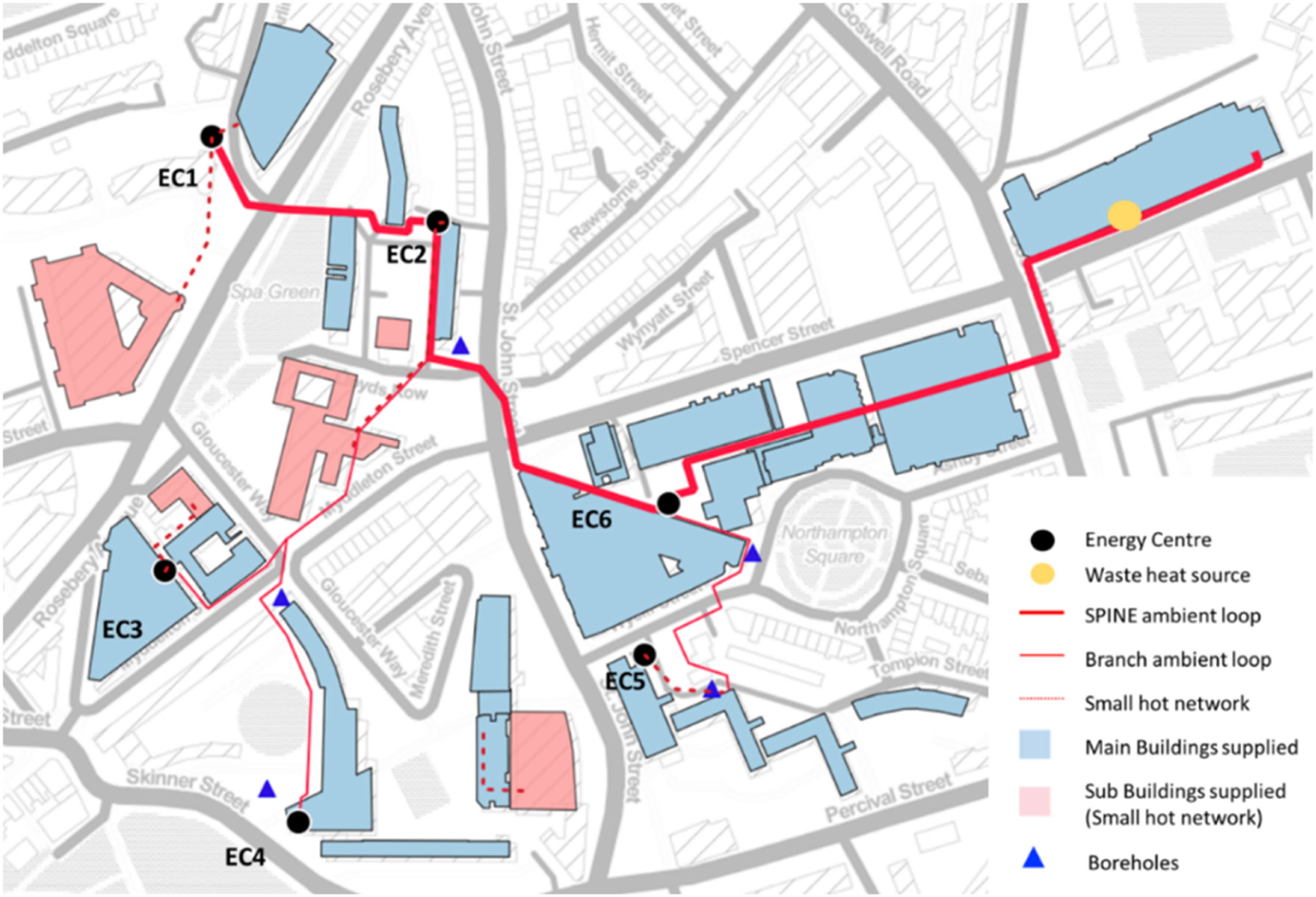
The GreenSCIES concept
System integration
The GreenSCIES concept integrates Mobility Heat and Power (MPH) energy vectors. The fully integrated GS concept is illustrated in Figure 2. It can be seen in the figure that each of the decentralised energy centres incorporates the hydraulic and electrical connection of heat pumps with thermal storage, solar photovoltaic (PV) and electric vehicle (EV) charge infrastructure. Smart integration of MPH energy vectors opens up flexibility and sharing opportunities within an energy system, resulting in carbon emission reductions and significant cost, with service and comfort benefits to end-users. GreenSCIES: Mobility, Power and Het integration behind the meter, and the shared trenching concept.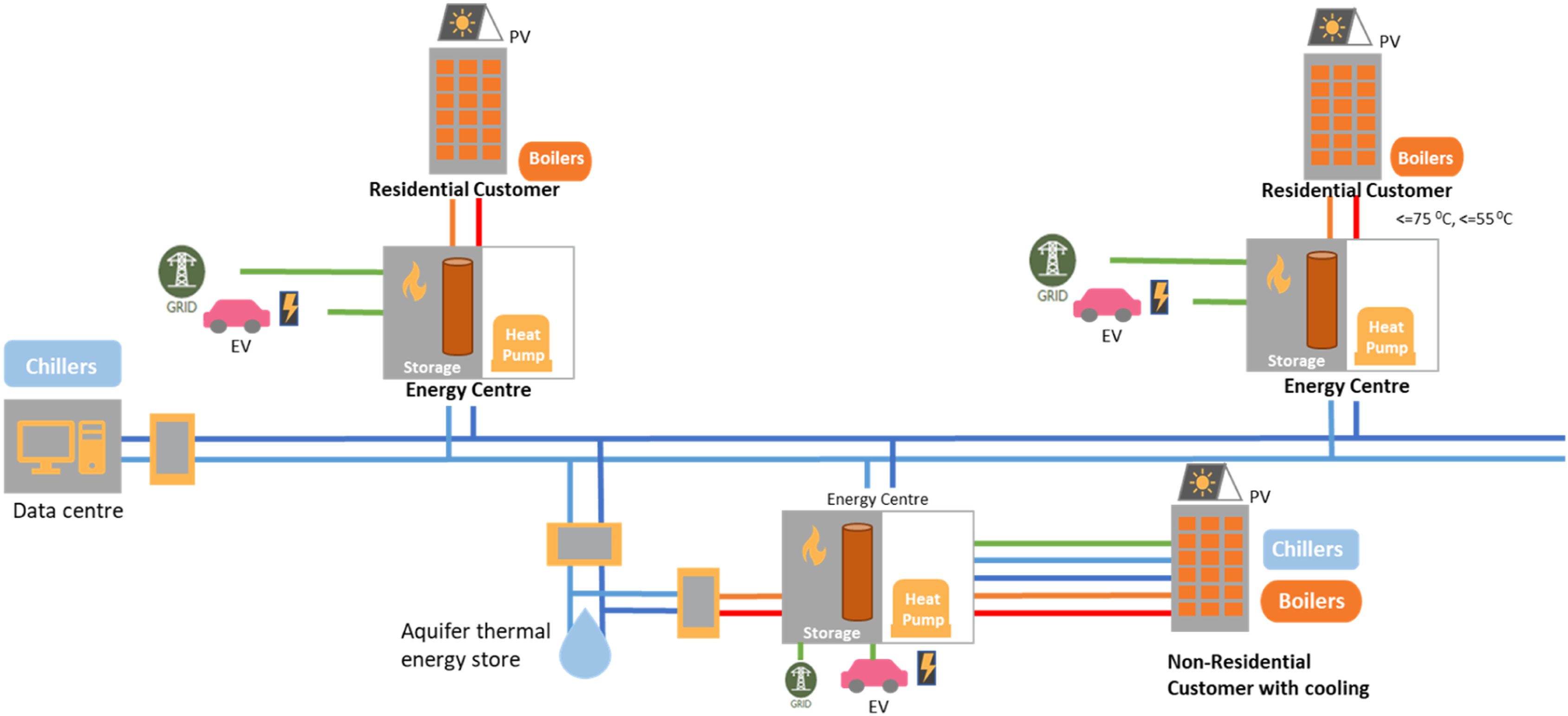
The integration is achieved at each decentralised energy centres – using a ‘behind the meter’ approach, that is, all the assets like EV chargers, PV systems and heat pumps are sub metered behind the main meter. The concept for energy system integration is shown in Figure 3. GreenSCIES: Mobility, Power and Het integration behind the meter, and the shared trenching concept.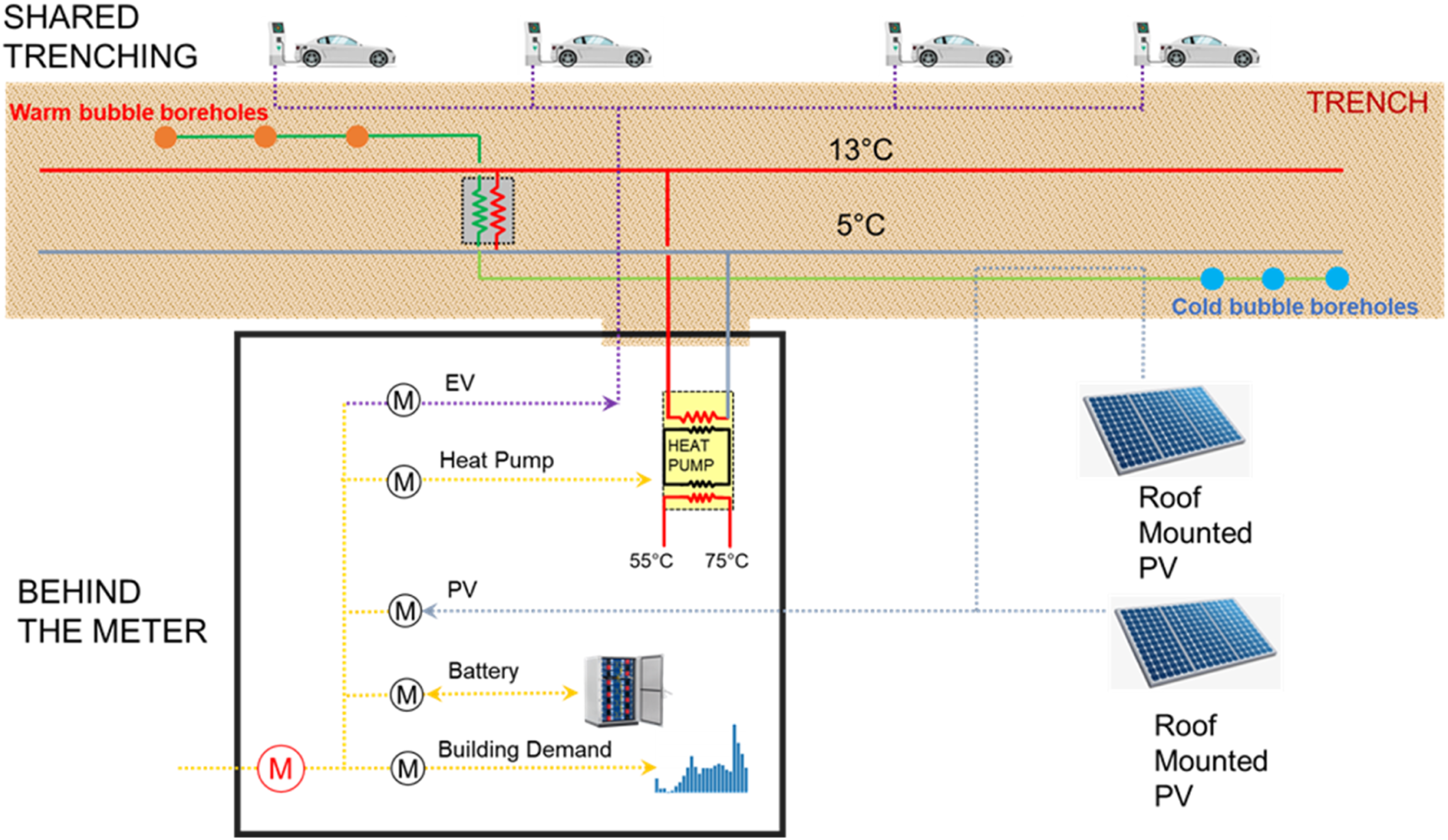
This approach allows the monitoring, control of assets from the perspective of metering power flow and enables generation of revenue from their flexible operations and energy service provision. It can also be seen in Figure 3 that the integration involves the physical sharing of infrastructure between the vectors, that is, using the same trench for the ambient loop and borehole pipes, EV charge post cables and power cables. The techno-economic benefits of energy system integration are detailed in Revesz et al. 11 The authors’ paper discusses that the behind the meter integration of the assets enables flexibility, which is a key potential value, stream for SLES concepts. Whilst SLES are frequently driven by values rather than profits, it is difficult to build a scheme that does not stack up financially. This paper focusses on the heating and cooling aspects of the scheme, in particular the heat pump selection and short/long-term thermal energy storage design.
The operation of the ambient loop
From a heating and cooling perspective, the scheme can essentially be summarised as using data centre heat recovery to supply heat demands in all the remaining buildings. Or to describe this in another way, sharing (prosuming) between the data centre cooling and the heat demands. Figure 3 illustrates this concept. It can be seen that the waste heat recovered from the data centre is distributed in the warm ambient loop header at approximately 13°C. Each of the decentralised heat pumps at the individual customer’s energy centres then supply low carbon heat to the end-users at either 65 or 75°C. The cooling (which is the by-product of heating) from the heat pumps is transported back to the data centre through the cold header of the network. It can be seen that the data centre chilled water system circuits operate between temperatures of 9 and 14°C.
The hydraulic concept is based on a two-pipe ambient loop radial network connecting to customers and energy sources through dedicated energy centres containing heat pumps or heat exchangers. The network will be configured as a radial bi-directional flow system, with a warm pipe and a cold pipe, consisting of a spine with branch connections linking individual customers and energy sources to the main spine. The warm and cold pipes are intended to operate as low loss headers, with modest flow velocities and pressure drops at the design condition. Design velocities are envisaged to be between 1.5 to 2 m/s in order to provide an optimal balance between investment and operating costs over the life of the project. The hydraulic design is subject to ongoing optimisation.
Temperatures within the warm and cold pipes will vary according to the energy balance across the system. However, it is important to maintain a balanced heat and coolth flow across the network to maximise economic and carbon benefits. The introduction of interseasonal storage can then make use of the local aquifer achieving Aquifer Thermal Energy Storage (ATES) providing a novel way of balancing. It can be seen in Figure 2 that the ATES system in GreenSCIES is being achieved through the formation of warm and cold borehole wells providing long-term thermal energy storage capacity. During periods when customer demand for high temperature heat is less than the data centre demand for cooling, heat recovered from the data centre will be injected into the aquifer hot store. Thermal stores provides more information around the approach implemented to investigate the applicability of an ATES system in Islington.
The provision of cooling to the data centre is the central part of the economic considerations. Therefore, the data centre heat exchanger will be configured as the primary cooling customer and will normally be given preferential access to coolth over the borehole and other cooling customers connected to the network. Daily imbalances between high temperature heat demand and data centre cooling demand require careful balancing. Reversing flow through borehole wells to meet these short-term variations is not an option, since the thermal inertia of system is too high to make this effective. In order to ensure un-interrupted cooling supply, the GreenSCIES design proposes to configure the largest heat pump on the network to have the facility to operate as a water-cooled chiller (referred to as A-loop) at times when there is no or insufficient customer demand for high grade heat. During these times, the heat pump will condition the ambient loop cold side through the evaporator circuit and reject condenser heat into the aquifer. The switchover arrangement between the heat pump and A-loop chiller operation is described in Figure 4. Results of techno-economic investigations showed that this configuration significantly improves financial returns. The ambient loop with interseasonal ATES storage, heat pumps and the A-loop chiller.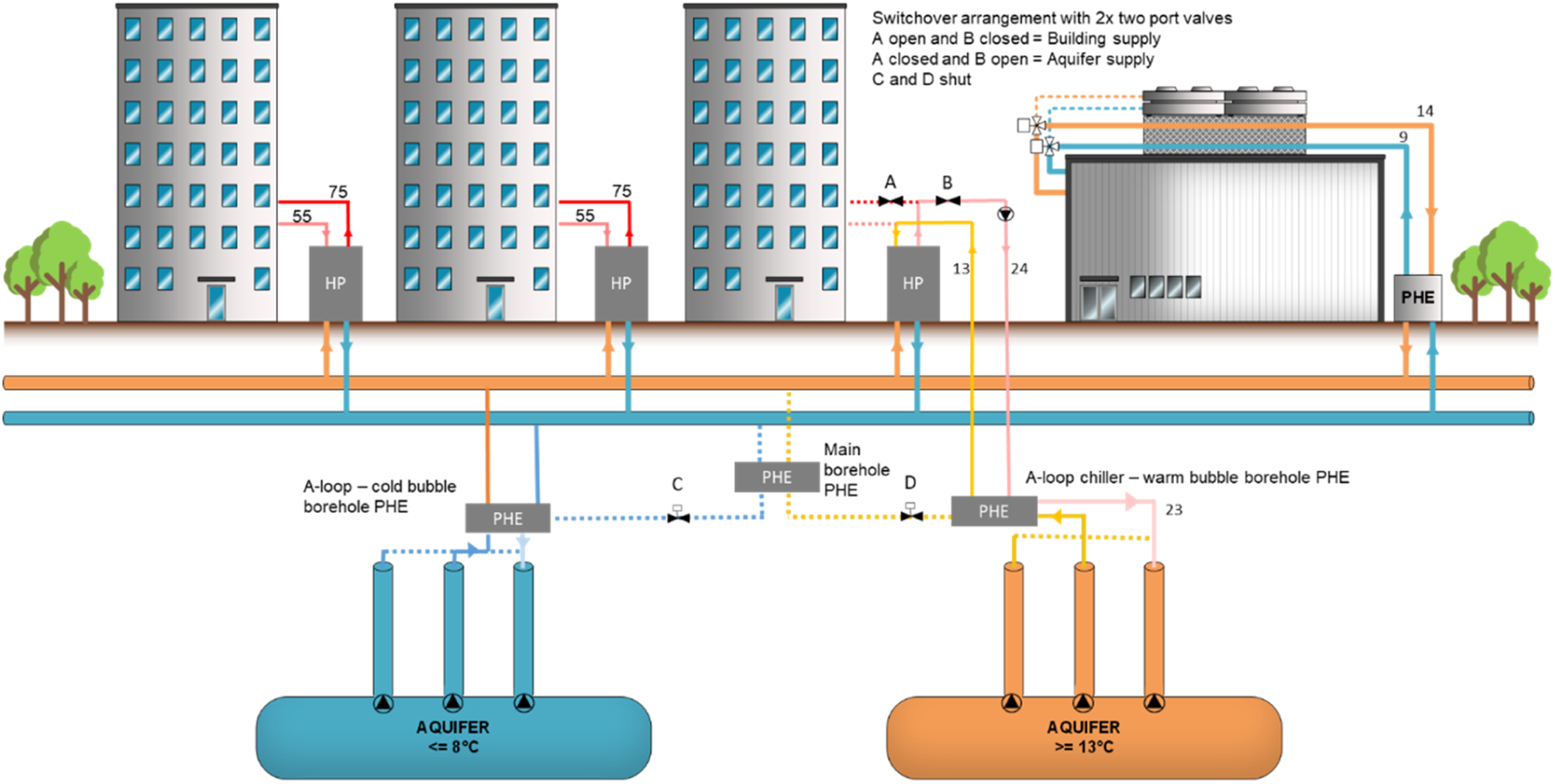
Thermal demands and component selection
Heating and cooling demands of the New River Scheme
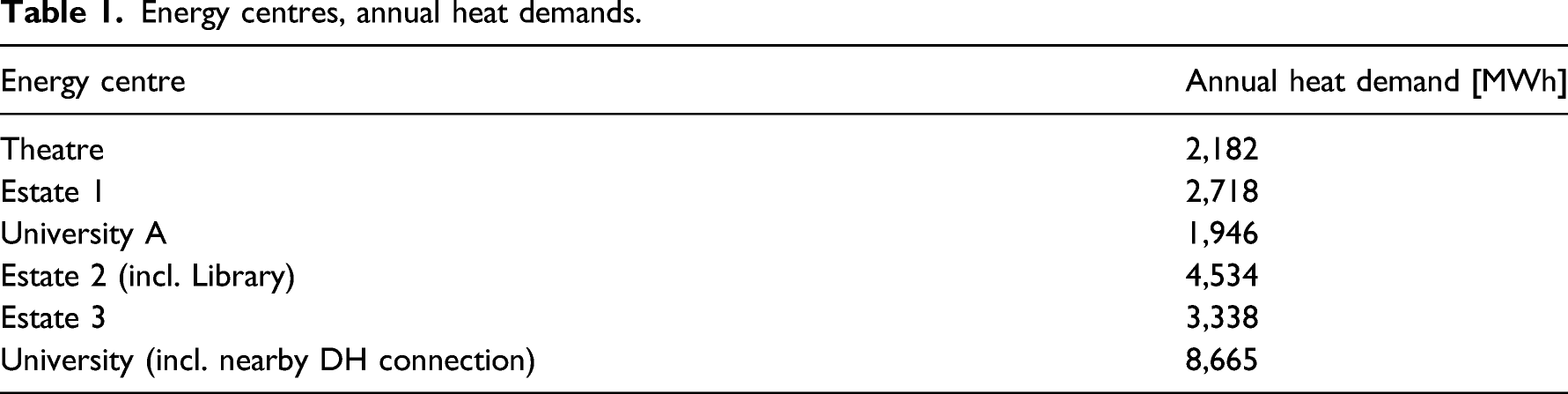
Figure 5 shows the combined heating and cooling demand data for the New River Scheme. The data centre has approximately 3 MW of constant cooling demand across the year (topped up with some of the buildings cooling demand in the summer period). Where possible data was gathered from actual half-hourly gas and electricity data. Where this was not available annual consumption was used and profiled according to a combination of weather data and a typical profile shape for that building type developed from previous work. The breakdown of the annual heat and coolth demand for each of the Energy Centres (EC) together with the selected heat pump capacities for each of them are shown in Table 1. Combined heating and cooling demand of the New River scheme. Energy centres, annual heat demands.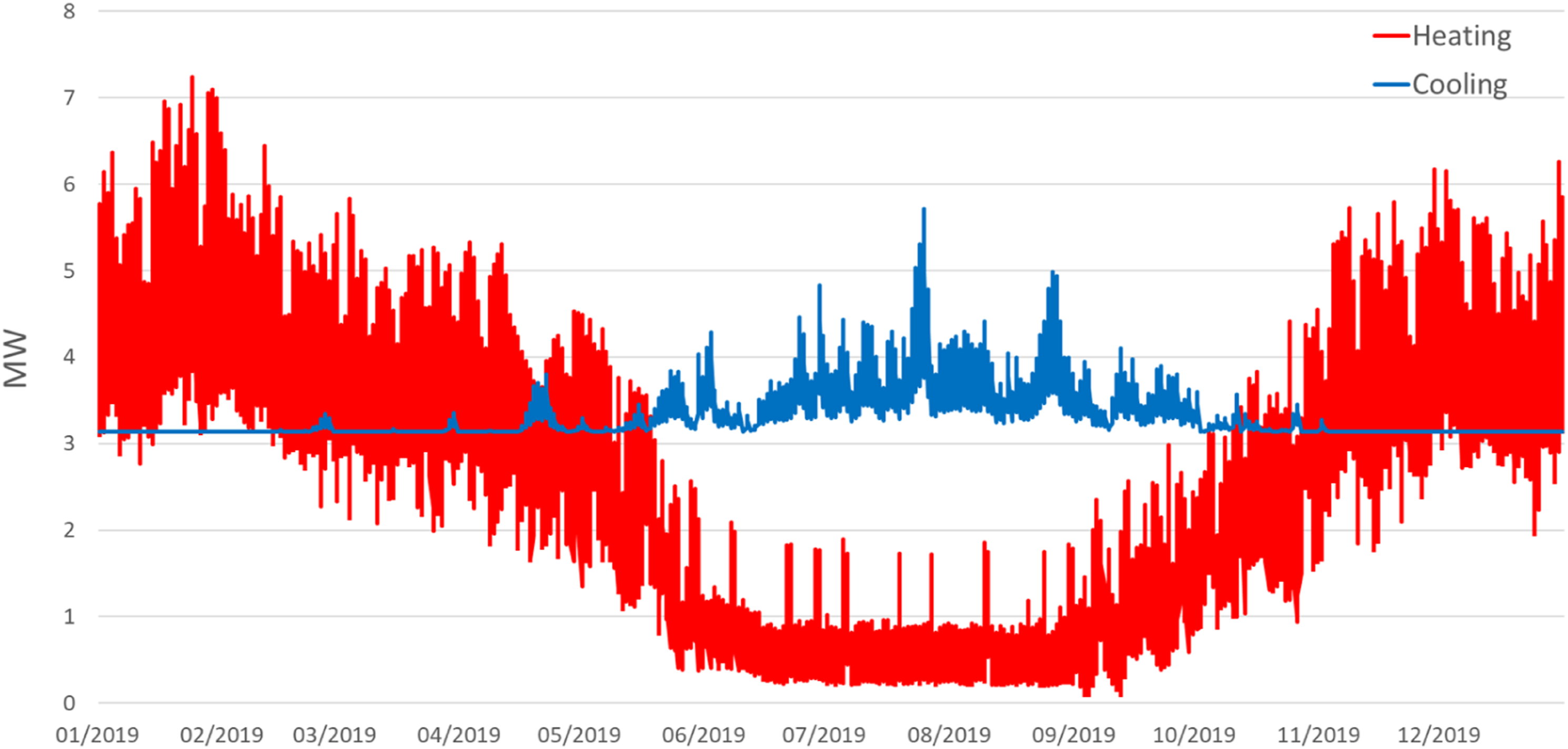
Initial heat pump selection
Heat pump and thermal store sizing was originally based on a strategy of the minimum size required to avoid the use of gas boilers – given the particular half-hourly profile of data used. Note this is not the same as the peak demand for each site because thermal stores allow the peak to be met at a much lower heat pump size than the peak seen in the half hour of highest heat demand. This strategy does not guarantee that gas boilers will not be used in practice. This is because a sustained future cold snap, which is worse than any experienced in the temperature year being used for the modelling, could produce a higher peak and/or any heat pump downtime, longer than the thermal store could provide for, would necessitate an alternative source of heat.
Initial heat pump appraisal.
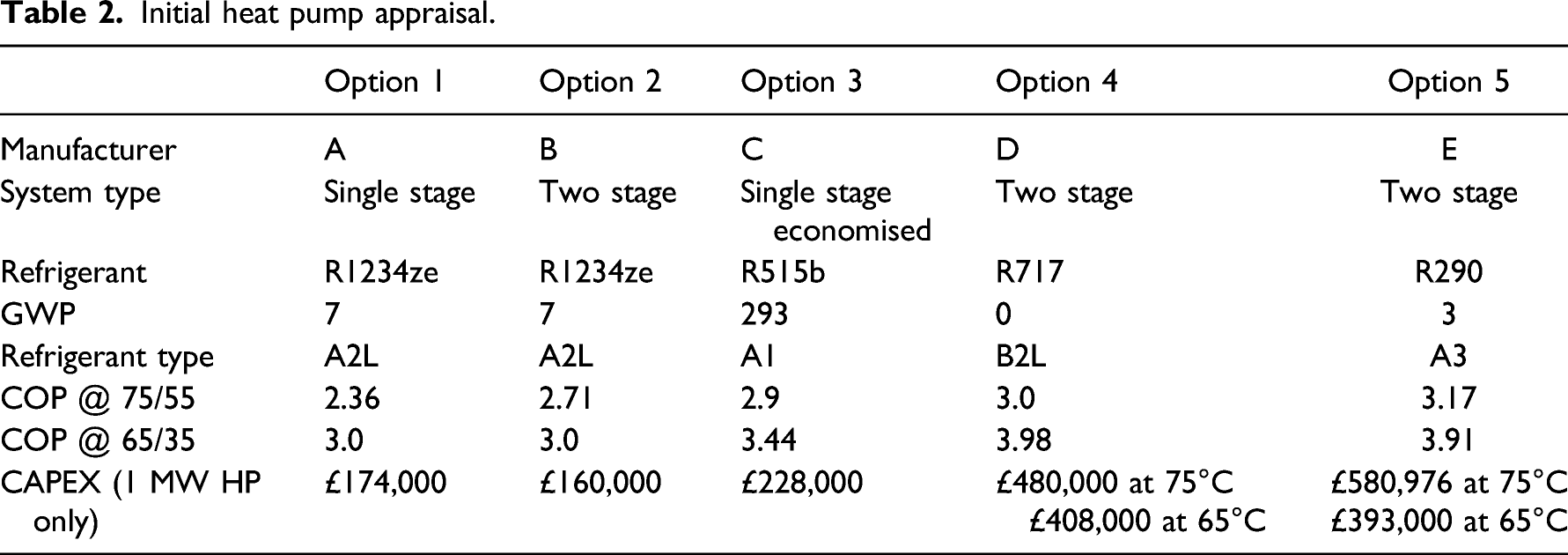
For each of the options compared in Table 2, the normal supply/return temperature used from/to the heat pump was 75/55°C. We also investigated a scenario where the heat pump can operate in weather compensated mode (or a scenario where radiators are replaced for larger ones) in the scheme down to 65/45°C.
It can be seen in Table 2 that the natural refrigerant options ammonia (R717) and hydrocarbons (R290) perform well on COP but are capital intensive at more than 2 times the capital cost of the cheapest units. The lowest capital cost models have low COP. The mid-range option 3 has relatively good COP and medium capital cost. This is achieved through the use of an economiser and low approach temperatures on both condensers and evaporators. It also uses R515b – a non-flammable, nontoxic (A1) refrigerant which minimises plant room costs associated with the options using mildly flammable (A2L) (R1234ze), high toxicity/low flammability (B2L) (Ammonia) and high flammability (A3) (hydrocarbon) refrigerants. In the cases of R1234ze, ammonia and hydrocarbons the additional CAPEX requirements, that is, leak detection, ammonia de-risking, emergency ventilation, etc. could be significant and have been included in the analysis later on. All refrigerants selected are have ultra-low GWP, which is important bearing in mind revisions to the FGas Regulations and longevity of the system.
In addition to the initial appraisal, a further investigation was carried out to explore performance improvements of the heat pumps. This investigation considered the performance of multiple heat pumps operating with condensers in series. The main thrust of this study was to exploit the opportunity that heat pump COP increases when temperature lift is reduced. A number of series connected combinations were investigated and these were assembled based on the capacity ranges available from the pre-selected manufacturer (option three in Table 1). This investigation showed that arranging multiple heat pumps with condensers and evaporators in series, COP could be improved significantly, by nearly 30% compared to the single heat pump option. Apart from the COP, the major advantage with arranging multiple units in series are resiliency and flexibility in maintenance. It is possible to take one machine out for maintenance and run the other one for a lot of the year. There is an additional capital cost and space requirements associated with multiple heat pumps and further work will value the life cycle cost including the equipment and plant room costs.
Thermal stores
Short-term storage
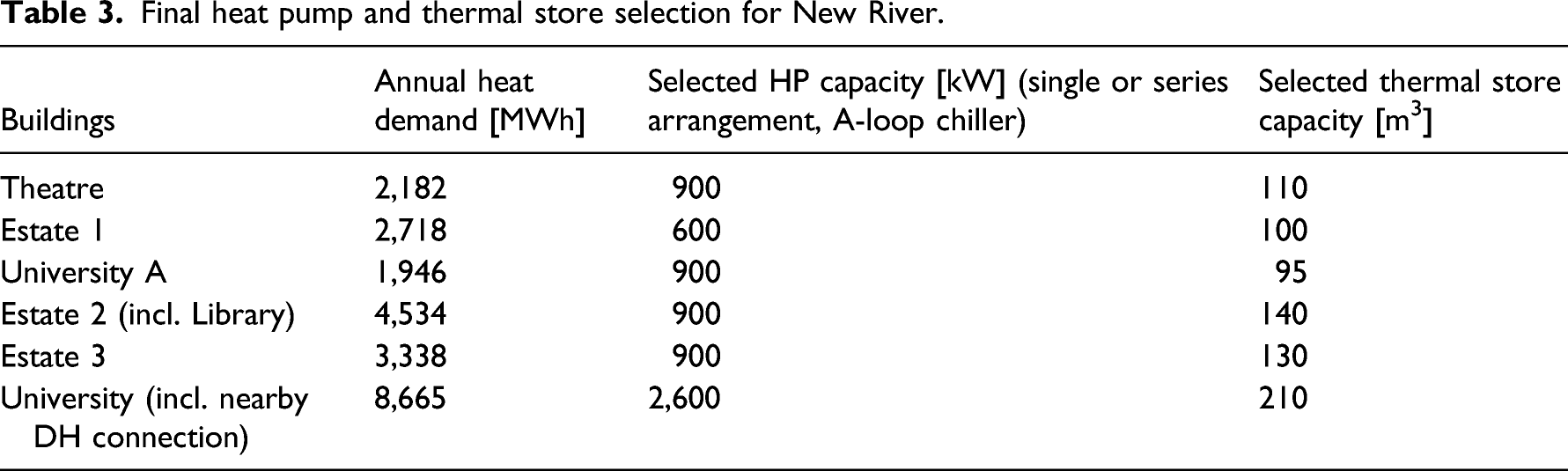
Final heat pump and thermal store selection for New River.
Long-term interseasonal storage – ATES
As mentioned previously in the paper, the local aquifer could be used to provide a balancing mechanism for the network and long-term thermal storage through an innovative concept called Aquifer Thermal Energy Storage (ATES). Establishing opportunities for deploying an ATES system in Islington started with preliminary investigations aimed to assess the potential for abstraction and injection of groundwater in the project area. Revesz et al. 12 discussed the methodology used to investigate the ATES potential in Islington and the preliminary outcomes of the study in detail. The investigation started with identifying the hydro-stratigraphy. It was established that the area is typical for the London Basin. Following the preliminary assessment a numerical model was built to investigate the effects of groundwater flow on the long-term performance of the ATES system. Preliminary results from coupled groundwater flow and heat transport modelling of the ATES system showed that the proposed system is viable and practical with varying degrees of efficiency. Key findings are that: (i) the warm/cold bubble approach to ATES provides substantial interseasonal storage; (ii) the level of on-site thermal interference was considered acceptable for the successful operation of the proposed GSHP system. From a financial point of view the initial investigation concluded that the proposed ATES system would increase the annual revenue of the New River scheme by approximately £94,000 annually. From a carbon prospective operating the boreholes in an ATES manner would save an additional 260 tonnes of CO2e per year A.
The next steps of the study will include the drilling and testing of a borehole, to be used in the final operation of the system. Conducting an extensive aquifer test program will also be subject to further works. Results from the upcoming field test will be used to verify an update the numerical model.
Spatial integration considerations and challenges
Special requirements for energy centres containing high temperature heat pumps include the need to accommodate heat pumps, thermal storage, expansion, balance of plant (pumps inverters control panels water treatment) and electrical connection.
Physically integrating the equipment within available plant room spaces is typically not possible, since these plantrooms were originally designed to accommodate equipment with far more compact requirements. Similarly, existing electrical supplies are typically inadequate to new transformer substations or upgraded electrical connections will be required to support heat pumps electrical load requirements.
Constructing new energy centres presents challenges in terms of cost, planning approval and access (for construction and maintenance). The largest items are typically the thermal store the heat pump on the transformer substation.
Options to accommodate the requirements within available spaces include the following: (i) Constructing energy centres across two or more storeys in order to reduce footprint; (ii) Constructing energy centres with a basement in order to minimise visual impact; (iii) Integrating phase change material thermal storage to increase the energy density of the stored energy.
Additional complexity and cost is introduced due to the need to safeguard energy centres to accommodate: (i) Extension of the scheme through hot networks in the local vicinity at a future time; (ii) A range of technology solutions offered by the market and organisations tendering to construct the scheme; (iii) Future changes in technology, such as, for example, lower GWP refrigerants that are expected to significantly increase market share of over the project lifecycle.
An indicative arrangement for a new energy centre in Islington housing 1,000 kWth high temperature lift heat pump with a thermal store and ancillary equipment is shown in Figure 6. Indicative arrangement for a new energy centre near the Brunswick Estate in Islington.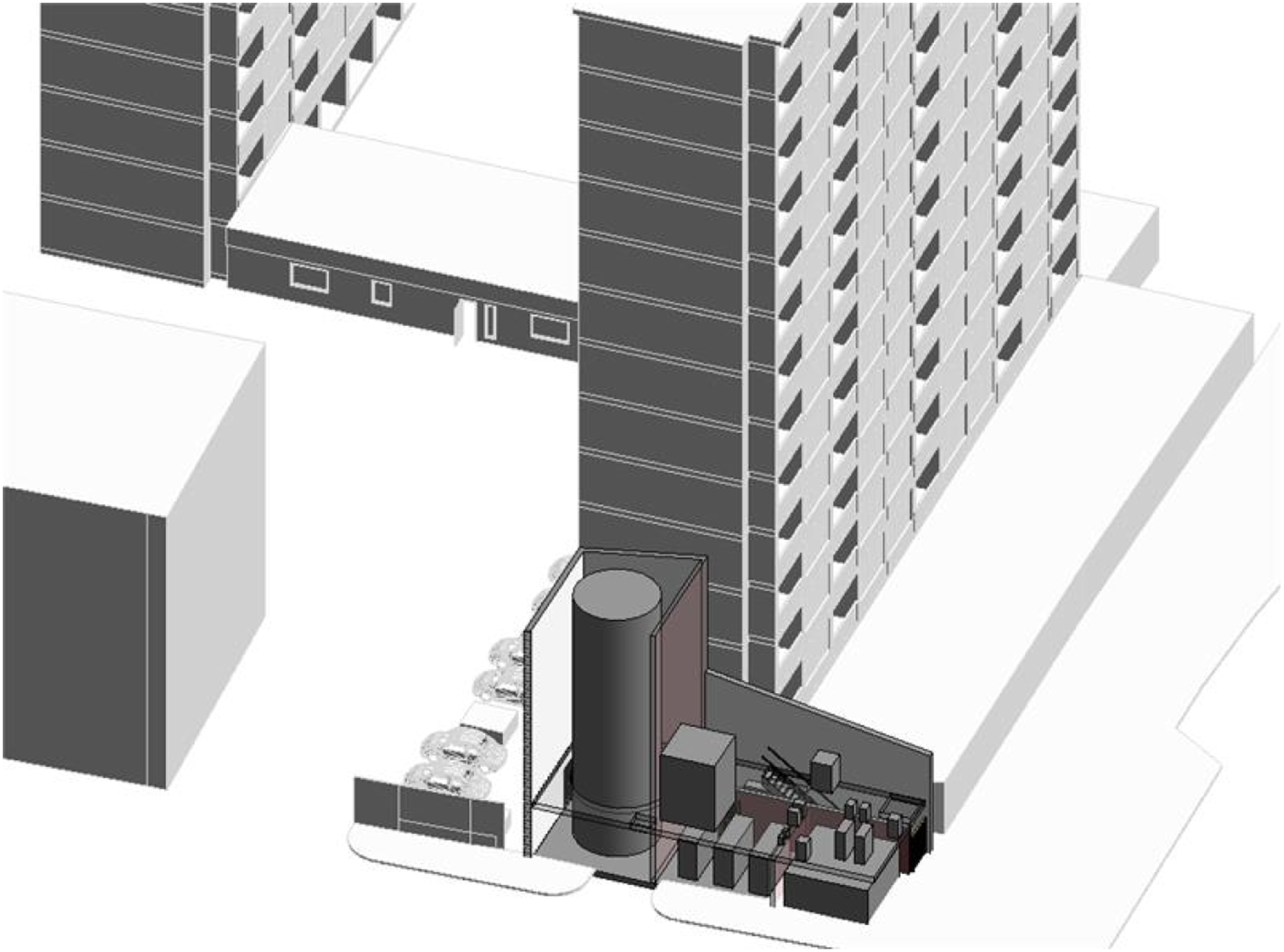
Final component selection for the New River Scheme
Techno-economic performance of the scheme
The final component selection was imported into an energyPRO 8 techno-economic model to investigate the long-term performance including the financial payback and carbon saving associated with operating the GreenSCIES New River scheme. The details of the model development and key technical and financial assumptions are described in details in the authors’ previous work.
New River scheme economics and carbon savings.

Barriers for schemes like New River
Key barriers to implementing New River include the following: • UK has one of the highest spark gaps (i.e., the difference between the price of gas and the price of electricity) in the industrialised world. Whilst the heat pump/heat network combination is one of the leading carbon solutions, it is still challenging to make it economic. • The lack of incentives: The Renewable Heat Incentive (RHI) has provided the support to rebalance this low gas price and to help grow the heat pump sector to more scalable and economic levels of supply/installation. However, the Non-domestic RHI is due to end later this year, with no equivalent replacement proposed. • The cost of replacing individual dwelling level boilers in existing residential blocks is currently hard to justify on cost grounds and this is missing major opportunities to decarbonise many local authorities’ housing blocks/estates. • The pipework infrastructure costs can be very high. Lower cost, environmentally friendly solutions will needed to be developed as well as the need for innovate business models with long-term investment view.
Next steps
As recognised by the UK Government’s Heat and Buildings Strategy, 9 that low carbon heat networks such as GS represent a fundamental technology, particularly in densely populated urban areas, as they enable the coupling between heating and other energy vectors and can benefit from economies of scale. As part of its Net-Zero Strategy, 13 BEIS expects the annual energy supply from heat networks to grow from 14 TWh in 2019 to 70 TWh in 2050, which would represent around 20% of the UK’s domestic heating demand in that year. Most large heat networks will be in energy dense city centres and these have increasing amounts of cooling. In these circumstances with large heating and cooling in the same locality, then both should be addressed. The concept described in this paper offers a way to utilise waste heat from cooling loads and share this into heating demands.
The replication potential of the GS concept is significant. Approximately three quarters of UK local authorities have declared climate emergency and more than half of them have set a goal of reaching net-zero carbon emissions locally by 2030 or sooner; however, few of those local authorities are clear on how they will make the transition to net-zero happen. A holistic SLES design approach recently introduced by our consortium 11 is replicable, and therefore, it can be used as a guide for SLES developers, local authorities and stakeholders within an energy system. However, it is important to highlight that the integrated SLES solution developed for the New River Scheme have been designed for the given local context and cannot simply be copied and pasted into other localities with different local characteristics. A rich understanding of a local context and identification of the value that SLES could bring to that particular location should always be the first step when assessing opportunities.
The GS consortium propose further developing and standardising a novel design approach to evaluate the feasibility of GS-like schemes in different localities. The proposed feasibility design tool will allow the evaluation of the most suitable technical, commercial approach for any localities and guide its users on estimating environmental and social benefits a SLES could bring in a particular location. Our proposed tool will help answer critical questions during the planning of SLES, such as where the value lies and how it can be accessed. This will help local authorities and developers to accelerate deployment of SLES where they are most appropriate and deliver their contribution to the UK’s net zero commitments. In addition, our tool will support local-level energy planning and help areas better prepare for the transition to net zero, reduce overall costs, mitigate risks and seize local opportunities. This will enable the effective and efficient roll-out of SLES at scaled up capacity, broadening replicability to sizeable inner-city regions.
In addition, members of the GS Consortium have established a new Centre of Excellence (CoE) in Smart Local Energy Systems. The CoE aims to support local authorities across the UK in strategic decision making on the route to net-zero and at the same time help accelerate the development and roll-out of integrated SLES. Apart from strategic consultancy, the CoE will also provide additional service strands including training, and high impact research. Next steps will also explore the applicability of the proposed SLES concept across the entire area of Islington, supporting full decarbonisation within the Borough by 2030.
Conclusions
• The electricity grid is decarbonising and the heating sector is changing rapidly. The combination of heat pumps and heat networks offers a major pathway to decarbonise heat in buildings. • Innovate UK have provided funding for the GreenSCIES project to lead the way and provide detailed design on an innovative SLES that can provide huge carbon savings. • Initial results showed that the GreenSCIES concept with large decentralised heat pumps and thermal stores in a fifth generation heat network can be viable with significant opex cost savings and carbon savings, whilst providing affordable warmth to residents. • The GreenSCIES consortium are at the forefront of new applications where heat/coolth can be shared across ultra-low temperature networks and these new approaches present even greater opportunities to move closer to net-zero carbon. • Large heat pump technology is readily available and offers very large carbon emissions reductions. It is important to select one with a low GWP refrigerant to ensure longevity of the system. • A number of heat pump options from five different manufacturers have been investigated and compared. One option using R515b a low GWP ‘A1’ class refrigerant produces a good COP at relatively low capital cost and delivers the lowest life cycle cost over time. • The warm/cold bubble approach to ATES provides substantial interseasonal storage. The level of on-site thermal interference was considered acceptable for the successful operation of the proposed scheme. • Spatial integration of large decentralised heat pumps and thermal stores into existing plant rooms can be challenging but with clever and innovative design is doable. • There are number of obstacles to roll-out schemes like New River. One of the biggest barrier is that the UK has the highest spark gap (i.e., the difference between the price of gas and the price of electricity making heat pump based solutions difficult to compete with fossil fuel based systems. Rebalancing of gas and electricity prices is crucial to meet net-zero targets. • The replication potential of the GS concept is significant. Approximately three quarters of UK local authorities have declared climate emergency and more than half of them have set a goal of reaching net-zero carbon emissions locally by 2030 or sooner. The GS consortium is currently developing a novel design approach to evaluate the feasibility of GS-like schemes in different localities. This will help local authorities and developers to accelerate deployment of SLES where they are most appropriate.
Footnotes
Acknowledgements
The authors are grateful to InnovateUK and EPSRC for the support received through projects GreenSCIES (Green Smart Community Integrated Energy Systems) and LoT-NET (Low Temperature Heat Recovery and Distribution Network Technologies).
Declaration of conflicting interests
The author(s) declared no potential conflicts of interest with respect to the research, authorship, and/or publication of this article.
Funding
The author(s) disclosed receipt of the following financial support for the research, authorship, and/or publication of this article: This article was supported by InnovateUK.
