




Abstract
Overheating is increasingly becoming a key issue for building design across the world. In the UK, better building fabric performance and warmer weather can increase the risk of overheating events in badly designed buildings. The impacts of these overheating events could be reduced by adapting building designs at an early design stage using building thermal models using appropriate weather data such as a design summer year. In this work, a method to determine probabilistic design summer years will be presented. These years take into account the return periods of actual events, are presented within a probabilistic framework and therefore include a description of the severity of the year at each location.
Introduction
Building thermal modelling is regularly used as part of the building regulation compliance assessment and as a way of influencing design decisions. In the UK, this includes the modelling of energy use and carbon emissions to meet targets as set out within part L. 1 Such modelling usually makes use of a weather file containing an hourly time series of the important weather variables (such as temperature, relative humidity, solar radiation and wind speed) at a location near to where the building will be sited. In the UK, modelling is often completed with two files. One, termed the test reference year (TRY) represents a typical year, the other, the design summer year (DSY), represents a year with a warmer than typical summer.
The concept of a DSY was established in 2002 2 with the purpose that building designers could test their designs in near extreme conditions to evaluate the risk of overheating using dynamic thermal models. The number of locaions was increased, from the initial 3, to 14, in 2006. 3
The method of selecting the DSY is relatively straight forward. The mean temperature over the period April to September inclusive for each year in the observation series is calculated and the chosen year is the third hottest. However, over the years, it has become apparent that this original DSY can provide less overheating in terms of the hours over a 25℃ and 28℃ than the TRY for the same location, while for other locations, such as Leeds, the DSY can be much more severe than would be expected for the latitude. Jentsch et al.
4
formalised the issues with the CIBSE method and can be summarised as:
The severity of the DSY varies across all locations – the severity problem. The tails of the temperatures distribution for the TRY can be more extreme than that of the DSY – the temperature problem. A number of sites can produce more overheating using the TRY than the DSY for a number of building types – the overheating problem.
This has consequences for building design as it brings into question the whole idea of the DSY representing an atypically warm summer. The causes for the failure though are numerous and go beyond revisiting the data availability as the structural deficiencies of the simplistic selection method would not be addressed. 5 Overheating in buildings is not associated with slightly above average temperatures over an extended period of time as per the definition of the DSY. Overheating is usually defined as a period where the internal temperature is above what is considered by an occupant to be comfortable. As such, it is more typical to experience overheating with shorter periods of weather which are extreme compared to the typical conditions.6,7 Selecting the year with the third warmest mean temperature over a six month period has no guarantee of selecting such a period of extreme weather. 4 The original DSY, although simple to define, has no basis to produce a year with any overheating events.
Recently, probabilistic design summer years (PDSYs) were developed for the London area 8 in an effort to replace the London DSY with a set of years which better describe overheating events, their relative severity and their expected frequency. Here, this methodology will be extended to create PDSYs which are consistent across all 14 CIBSE locations. 3 A brief overview of the potential overheating criteria will be described as well as statistical methods used to characterise a range of hot weather events. The buildings’ response to the external temperature depends on the form of the building as well as how it is used. As such, it is not possible to define a control building which can represent all possible buildings so a simplification must be made. In this research, a conceptual building will be used as defined in TM49. 8 The building is free running and the operative temperature is equal to the external air temperature at all times. This building is equivalent to a building with a high ventilation rate where all external gains are removed and the external temperature is equal to the internal temperature. While this conceptual building is a clear simplification as it does not include the effects of thermal mass or solar gain through windows, it is easy to implement as external temperatures can be considered as a proxy for the internal temperatures. Finally, probabilistic design weather years for all CIBSE locations will be presented.
Updated weather data for new weather years
Using a more recent baseline to develop new weather years has the advantage that any changes in the observed climate are taken into account and buildings can therefore be designed to take into account such changes. In the previous approach, 21 years of data were considered sufficient to describe the baseline climate. 3 However, climatologists typically use longer periods of observations to compare current climatological trends to that of the past or what is considered ‘normal’. A normal typically consists of a 30-year period, as it is long enough to filter out any inter-annual variation, but also short enough to be able to show any longer climatic trends. Thirty years has been used within the climate change projections UKCP09 to investigate as the underlying climate trends 9 and was used to evaluate the effects of climate change. 10
The baseline weather data observation site, beginning and end date used at each site and the number of years available to the analysis.
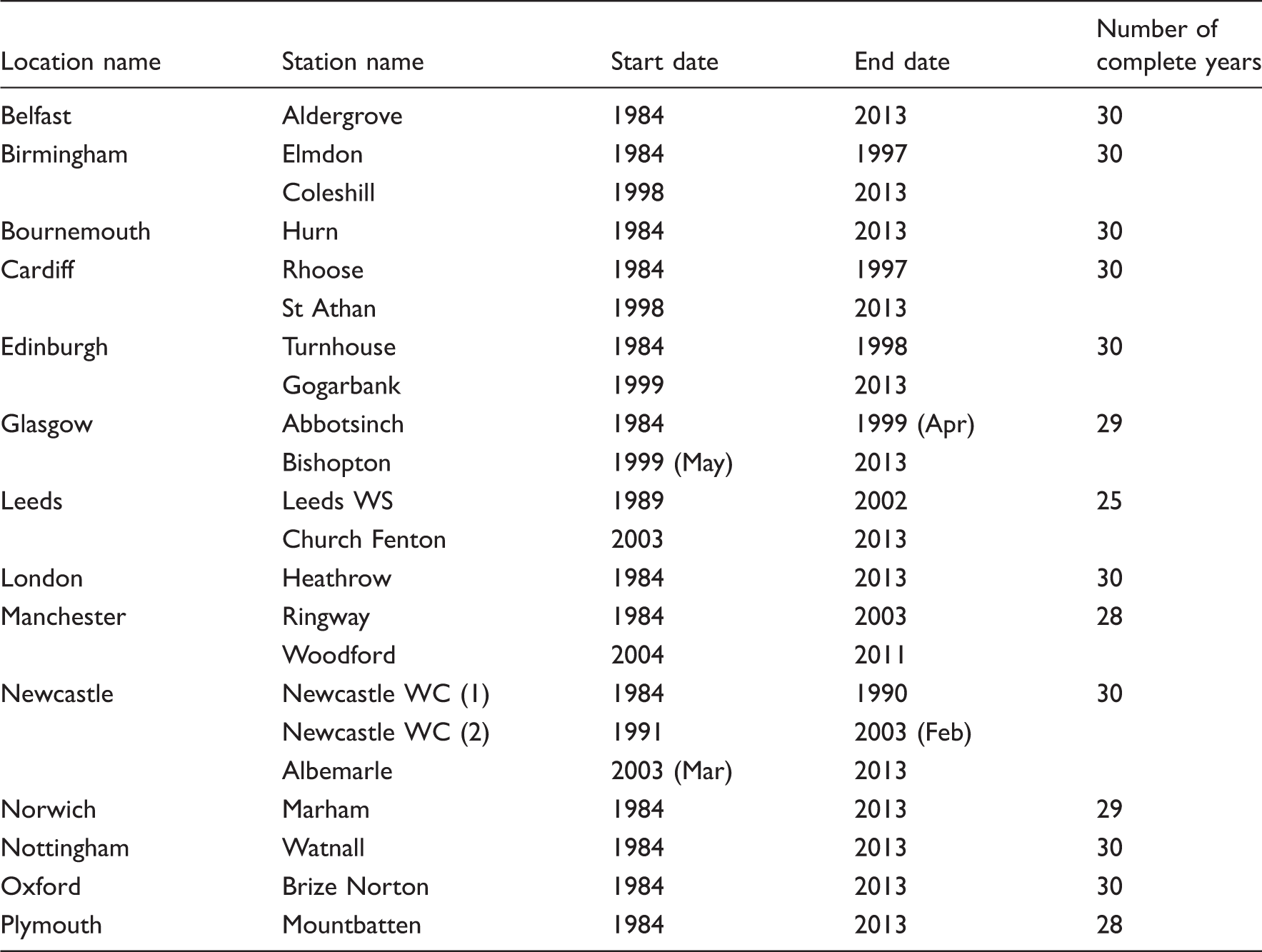
Even with selecting new weather sites to increase the number of observations available, there are still many holes in the BADC raw data which must be interpolated for use in the analysis. In this work, missing data are interpolated if less than 20% of the observations of dry bulb temperature for that month are missing, otherwise the month, and therefore the year is removed. If the weather is recorded on a bihourly basis, these data are interpolated even though only 50% of the total data are available. 14 Missing temperature data are interpolated in a four stage process. Firstly periods of data which are unlikely to contain a daily minima or maxima are flagged for interpolation. During the flagged periods, missing daily extrema are interpolated using valid points either side. Similarly, the hours at which these extrema occur are linearly interpolated. Finally, all other missing data are interpolated along with the generated minima and maxima using a spline algorithm.3,15
Method
The weighted cooling degree hour and conceptual building overheating criteria
There are a number of ways in which overheating could be described. 8 The simplest candidate considers the number of hours which are greater than a threshold (e.g. hours over 28℃) as has been typically used to define overheating in schools. 16 However, while this is relatively simple to calculate and gives the total duration of the exposure it does not describe the severity. For example, if the threshold is 28℃, 40℃ would be considered an equal exceedance to 28.1℃. This is probably unrealistic and the former is clearly going to cause more discomfort. 17 Another candidate model is the cumulative hours above a threshold weighted by the temperature difference above the threshold (a degree hours definition). While this considers both the duration and the severity, it assumes a linear relationship between the exceedance and the level of discomfort which may be a simplification of the reality. It is likely that a temperature much above a given threshold is going to cause more discomfort than a temperature around the threshold. A third possibility weights the exceedance by the number of people dissatisfied given by a thermal comfort model. 7 Although this metric would have the closest match to reality, it is more complex than simply counting the number of hours over a threshold.
For each form of overheating, the internal temperature of a building as a response to the external conditions will be required so that the level of overheating can be calculated. Using the conceptual building, the external air temperature is equal to the internal operative temperature and a suitable comfort model must be considered. For free running buildings, BS EN 15251 suggests the use of adaptive thermal comfort model to assess comfort.
18
Using adaptive comfort criteria, the thermally neutral temperature is related to the daily running mean temperature which is given by

where Tc is the predicted comfort temperature on a given day. Trm is the daily running mean temperature which is given by

where Trm−1 is the running mean temperature of the preceding day and Tmean−1 is the average temperature of the preceding day. Although Nicol et al.
7
developed an overheating metric using the thermal comfort concepts,
7
termed the potential daily discomfort, a simpler implementation of the approach can be considered, termed the weighted cooling degree hours (WCDH).
8
The weighting function in this case is then a quadratic expression given by,

and

where Top is the internal operative temperature. The weighting puts a much greater emphasis on operative temperatures which depart further from the comfort temperature. The WCDH approximation is related to the duration of the exceedance event as well as giving emphasis to more extreme temperatures which therefor takes into account the severity of the event.
Exploration of alternative overheating metrics
The original overheating metric analysis of TM49 (the ‘first metric’ considered above) was carried out in locations around the London area including Heathrow Airport, Gatwick Airport and London Weather Centre (central London).
8
These locations consist of some of the warmest in the UK with a high probability of this overheating metric being exceeded which will not necessarily be true of locations further north where the maximum temperatures are usually much cooler. A simple search through the available data shows that for London each year contained some degree of overheating above the comfort temperature; however, for Belfast, 8 of the 30 available years had no overheating as defined by this metric. To ensure the relative severity of overheating can be compared across all locations, a number of overheating metrics will be considered with results compared in addition to the WCDH as described above. The second metric will consider the weighted degree hours based on a static temperature threshold from which discomfort can be attributed. In the UK, a heat wave, as defined by the Met Office, depends on the location. In London, the threshold day time temperature is 32℃ where as in the North East this reduces to 28℃.
19
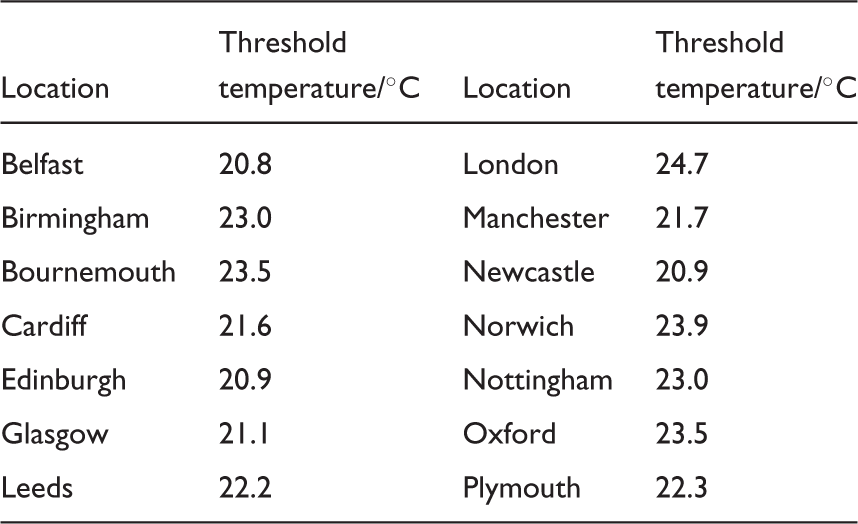
However, it is apparent that excess deaths can begin to be attributed at much lower temperatures and can be attributed to the 93rd centile temperature at each region with strong statistical significance
20
and therefore potential discomfort can occur at much cooler temperatures than the heatwave definitions. In this second metric, the WCDH will be calculated with the comfort temperature set to the 93rd centile temperature for that region for which the weather station is found,
20
which in this case is a static temperature. This metric is therefore termed the static weighted cooling degree hours (SWCDH). The total for each location is therefore given by

Temperature thresholds where excess heat related mortality occurs.
The third metric combines the adaptation and comfort temperature of the WCDH metric with the regional threshold of method 2. This metric builds on the knowledge that regional mortality rates are correlated to different exceedance temperatures
20
by reconciling with the first metric that discomfort is correlated to departures from the running average temperature. Furthermore, using adaptive comfort theory, it is currently recommended that the threshold for more vulnerable occupants is reduced.
18
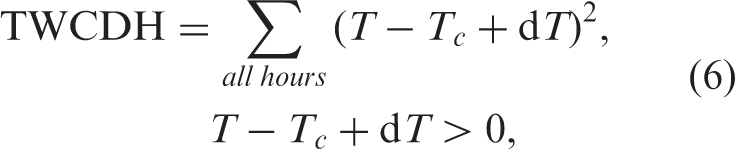
This method considers that the comfort temperature threshold is also related to the location. For this metric, the threshold weighting degree hours (TWCDH) is given by
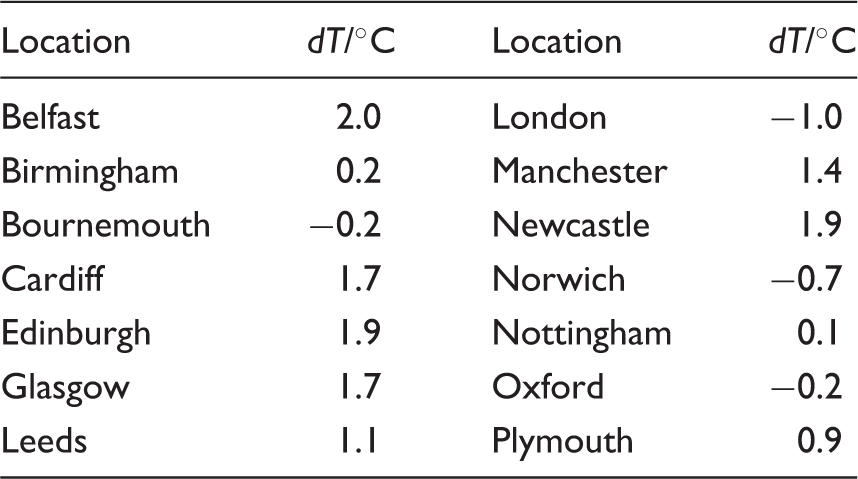
Difference between a locations average summer (April to September) comfort temperature across all years and the regional 93rd centile temperature threshold where excess heat related mortality occurs.
Estimating return periods of warm summers
The return period of an event refers to the frequency of the event with an associated exceedance value. The original DSY methodology considered the third hottest summer on the basis of average April to September temperature from a base period which was up to 21 years in length. This means that, assuming the current climate has no underlying trend, any given future summer has a 1-in-7 chance of being equal or hotter than the selected DSY 4 or such a summer has a return period of seven years. The original DSY selection also assumes that each year is equally likely. The mean temperature in any given year could be described as a random event and could take a range of values. However, years which have a mean temperature similar to the overall mean should occur more often and therefore have a higher probability of occurrence associated with it. To provide a better estimate of the underlying distribution of the mean temperature, it is possible to fit different classes of functions to the data.
The generalised extreme value (GEV) distribution
21
is frequently applied to climatological data to model the most extreme value within a period such as the extremes of rainfall
22
or to evaluate the effects of climate change.
23
To describe the statistics of rare events, the GEV approach estimates the return period of these extreme events. Assuming the observed threshold events are independent and uniformly distributed the probability density function of a set of events (x, such as SWCDH) is given by

where µ is the location parameter, σ is the scale parameter and k is the shape parameter. The events are typically fitted to the distribution using a maximum likelihood estimator method, as used by Matlab.
24
The T-year return values XTgev are then estimated from,
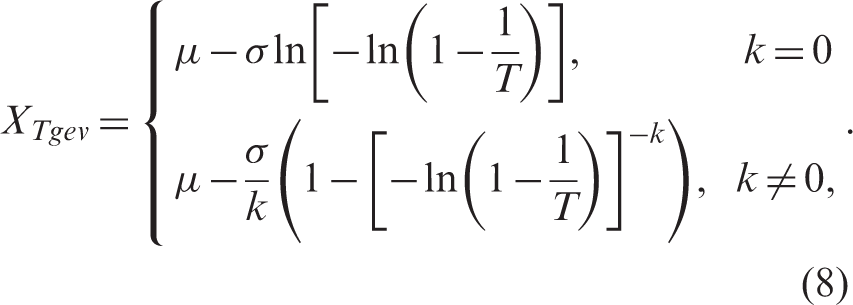
Within this analysis, the threshold events will be the data generated for each metric and the period will be one year.
Although the GEV theory is straight forward to apply, the use of a yearly value may result in extensive data reduction. For example, in this work for a given year we are interested in the sum of all temperatures which are extreme deviations from a comfort temperature. For locations which are inherently colder, typically further north, there is a high probability that there is little or no overheating if the threshold is too extreme. In this case, the large number of ‘zero’ events would have the greatest influence on the distribution, while years which have a number of independent overheating events are summed to produce a single value. While this has been considered by using more than one comfort threshold to carry out the analysis, the generalised Pareto distribution (GPD), or peak over threshold method, could be used as an alternative. Using the GPD, each individual exceedance event is included as a separate entity (rather than modelling a single peak value) so there are more extreme events in the analysis25,16 allowing the calculation of the return periods for the individual events. The key aim of this work is to determine the severity of warm temperatures by assigning return periods to the events. This in turn will allow the selection of PDSYs to inform practitioners of the risk of overheating of their building design. However, selecting a year from individual events with particular return periods is less straight forward. It is likely that for a given year that more than one event could exist with different return periods. As these return periods are independent from each other, no correlation can be generalised from the distribution of these events. A simple solution may be to once the year has been selected from an event at a given return period to exclude it from further analysis. However, this still leaves the dilemma when determining what is a more extreme year; for example, is a year with two events each with return periods of 1 in 20 years less or more severe than a year with a single 1 in 25 years event? If this approach is taken there is a strong possibility that industry could find that for what is determined a more frequent, less extreme year to have much more overheating than a more extreme year leaving industry no better off than before this exercise. An alternative would be to consider that all overheating events in a given year are dependent on each other. This would give a maximum number of events equal to the maximum number of years in the baseline. This is equivalent to fitting the GPD to the original data set for all years where the total is greater than 0. However, this approach is likely to violate the criteria that the events should be independent with a frequency given by a Poisson process as most years would be used in this analysis. 21 Furthermore, even using this technique it is likely that too few data points would be included to ensure accuracy of the fitted GPD.
The GPD is highly suitable for determining the return periods of the individual events contained within a dataset, there are potential difficulties of extending the analysis to determine the return periods of a contiguous year which can be used in building simulation. To establish PDSY and assign appropriate return periods, the most robust approach is the GEV distribution fitted to the sum of the metric for the year and will be used in the following analysis.
Results
Extreme value analysis and return periods of events
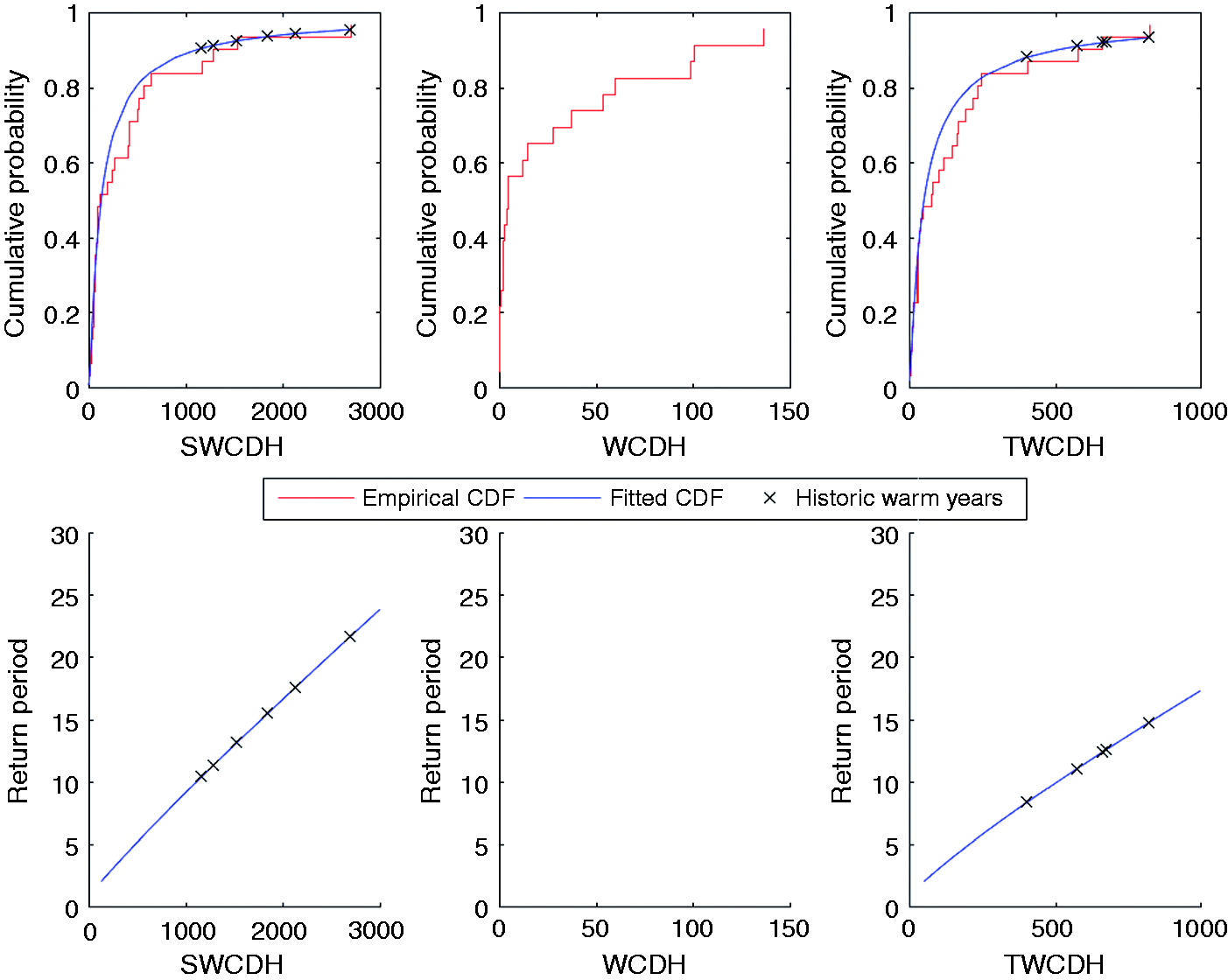
The results of the return period analysis for all three overheating metrics as described above for London and Belfast are shown in Figures 1 and 2 and Tables 4 and 5, respectively. The empirical and fitted GEV cumulative distributions for the years 1983–2013 and the calculated return periods for each metric for each location are shown in Figures 1 and 2 demonstrating the goodness of fit. The GEV distribution in each case is used to calculate the return periods of all available years from 1961 and all historic warm periods are marked then. The 10 warmest years ranked according to the SWCDH metric for all three overheating metrics are listed in Tables 4 and 5 along with the return periods of the locations TRY. The TRY year is created using the same updated baseline (1984–2013) and then using the method of Eames et al.
26
Return period analysis against SWCDH, WCDH and TWCDH for London. The locations of historic warm summers are also shown by crosses. Cumulative probability and return period analysis against SWCDH, WCDH and TWCDH for Belfast. The locations of historic warm summers are also shown by crosses. Yearly return periods for all overheating metrics for the ten warmest years for London ordered by the number of SWCDH. The return period of the TRY is also shown. SWCDH: static weighted cooling degree hours; TWCDH: threshold weighting degree hours; WCDH: weighted cooling degree hours; TRY: test reference year. Yearly return periods for all overheating metrics for the ten warmest years for Belfast ordered by the number of SWCDH. The return period of the TRY is also shown. SWCDH: static weighted cooling degree hours; TWCDH: threshold weighting degree hours; WCDH: weighted cooling degree hours.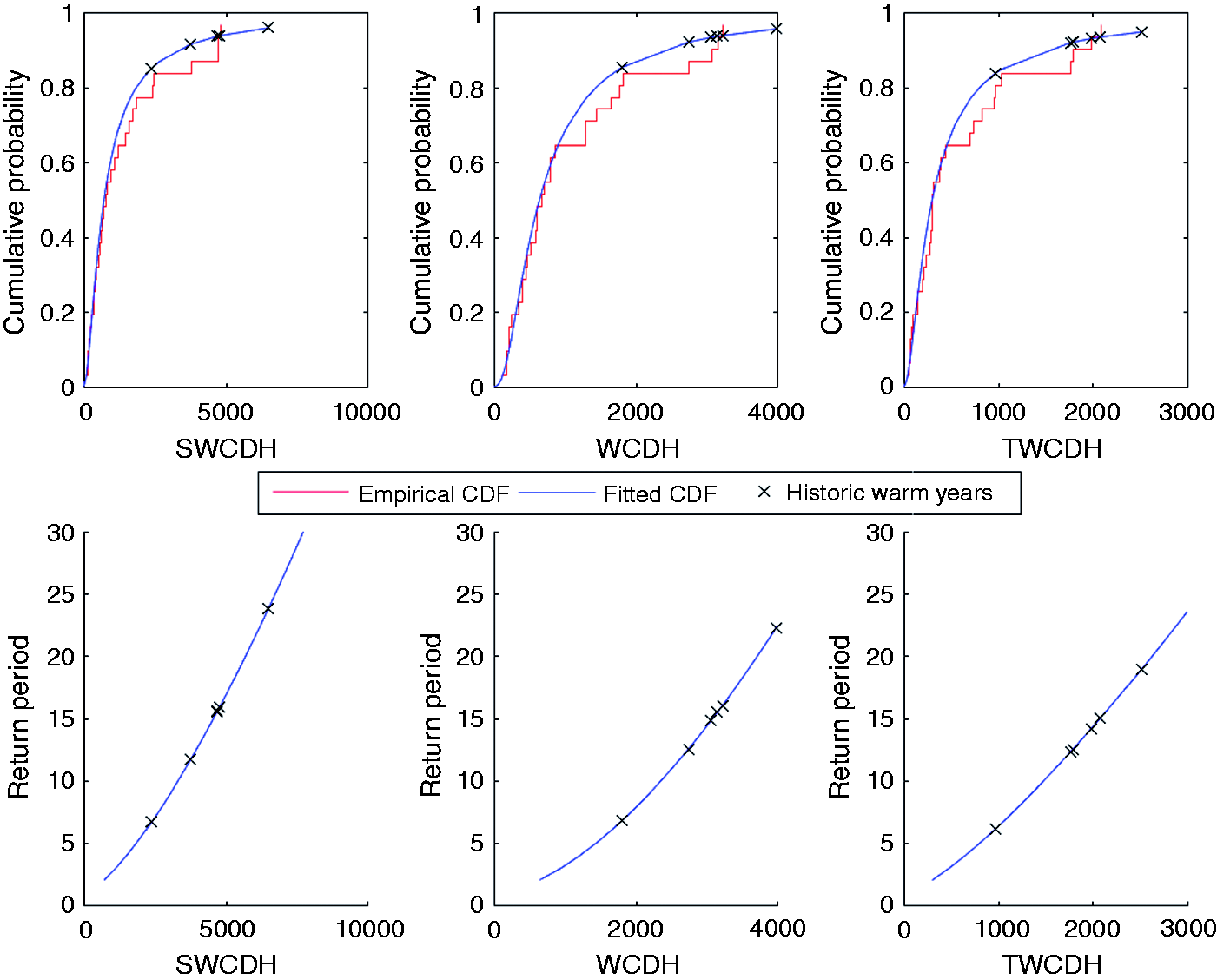
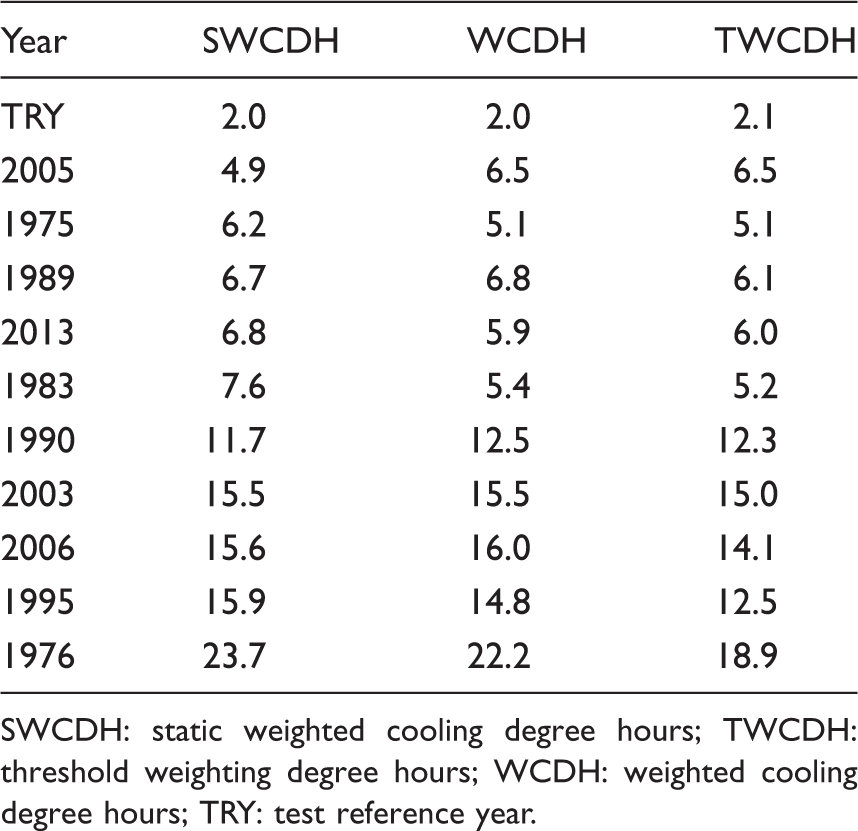
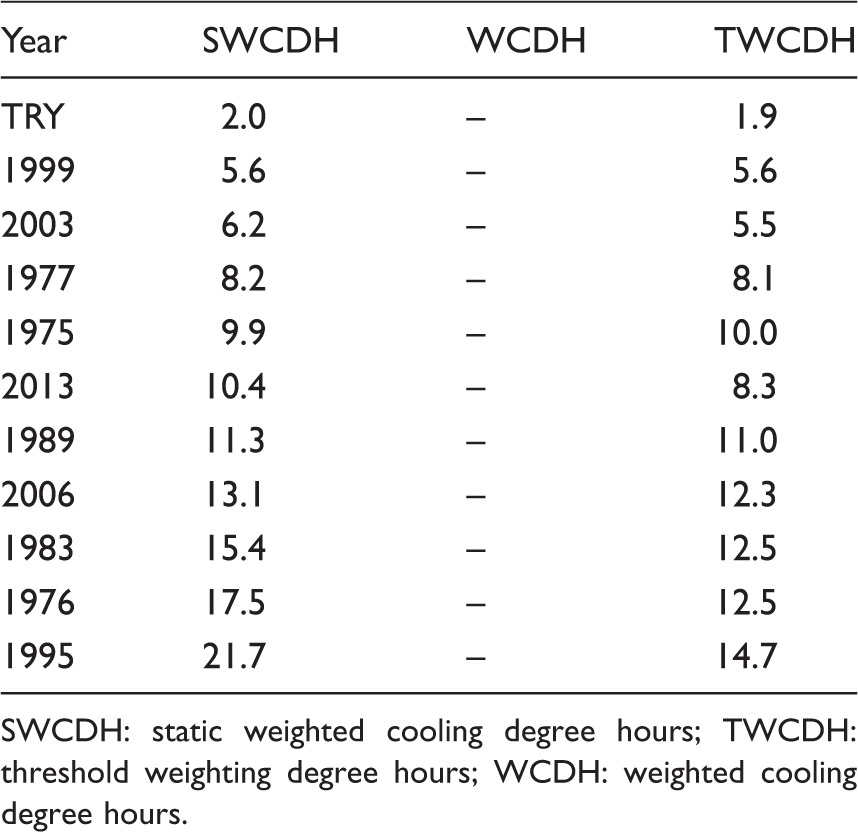
The analysis shows that for London the DSY established in 2006 (1989) can now be defined as having a return period of 6.7 years using the SWCDH metric, 6.8 years using WCDH metric and 6.1 years using the TWCDH metric (Table 4). Overall the order of the years is dependent on the metric used but the hottest years (1990, 2003, 2006, 1995 and 1976) remain the hottest years with return periods of the order of 11.7 to 23.7 years.
The analysis shows that for Belfast there is not enough data to fit the GEV distribution to the WCDH metric (Table 5). There are eight years from the baseline which have no WCDH data with most years having very few exceedances above the comfort temperature threshold dominating the GEV analysis. For the SWCDH and TWCDH metrics, the return periods were calculated as between 5.5 and 21.7 years for the 10 warmest years, similar in magnitude to the London return periods. The hottest years by the two remaining definitions remain the hottest years although in this case the 2013 moves from sixth hottest for SWCDH to seventh hottest using TWCDH.
Tables for all locations as listed in Table 3, similar to Tables 4 and 5, can be found in the Appendix. Overall the TRY years at each location are found to have return periods which range from 1.3 years to 5.6 years. The vast majority of the TRYs have return periods of less than four years.
It must be noted that the error in the estimated return periods increases as the return period gets greater. For return periods of the order of 3 or less years, a 90th percentile confidence interval is of the order of 0.4 years, for 7-year return period the interval increases to 2 years and for a 23-year return period the interval increases to the order of 7 years. For the extreme cases such as a return period of 50 years as found for Norwich, the 90th percentile confidence band is 20 years. The confidence intervals are always positively skewed giving much greater confidence in the lower return periods.
Choosing PDSYs
The previous methodology used to create DSYs considered a moderately warm summer as the third hottest from a typically 21 years implies a return period of 7 years. 3 For many locations much less complete data were available, 4 while maintaining the third hottest requirement. This would have the consequence of reducing the return period for the effected locations but this was not the original intention of the method. A moderately warm event year will be considered as the year with a return period closest to seven years similar to the original intention of the DSY methodology. However, the use of return period analysis removes the requirement that all data for all locations need to be available. It is clear from Tables 4 and 5 (and the Appendix) that the definition of a 1 in 7 years depends on the metric chosen. For example, for London, the candidate years are 2013 (SWCDH), 1989 (WCDH) and 2005 (TWCDH). Similarly for Belfast, the candidate years are 2003 (SWCDH) and 1977 (TWCDH). To get a better understanding, a closer examination of the three metrics is required. The SWCDH is a weighted measure of the number of hours above a temperature threshold which has been determined as the point at which adverse effects started. The weighting gives stronger influence to temperatures which are further from the threshold temperature. The WCDH metric is the weighted measure of the number of hours above an adaptive comfort temperature. In this case, exceedances above the comfort temperature put emphasis on rapid changes in the weather. The TWCDH metric is similar to the WCDH metric but includes an offset to take account of the regional effects as outlined in Table 3. From Table 2 and equation (1), the threshold temperature for the WCDH metric is more extreme than the regional threshold used to calculate the SWCDH. The TWCDH metric is a regionalised, slightly less extreme measure of overheating than the WCDH metric but again still puts an emphasis on rapid changes in recent weather. The SWCDH is a regionalised threshold based on the point at which a risk to occupants due to temperature starts to appear so, the candidate moderately warm summer year can be considered as the year with the SWCDH return period of seven years (or the year with the return period closest to seven years). For London, the moderate DSY (DSY-1) is 2013 and for Belfast the year is 2003. Note the London moderate DSY is different from that selected in TM49 but according to Table 4 there is little difference between 2013 and the TM49 year of 1989.
This single PDSY does not capture the entire risk to the building occupants as different people will have different thermal responses to different warm weather events. Where the occupants of a building are more vulnerable, these warmer summer conditions must be considered. TM49 defined two more extreme overheating events with different characteristics. 8 The first is a year with a long period of persistent warmth and the second is a year with a shorter more intense warm spell. For the purpose of this analysis, these candidate years must also be more extreme in terms of WCDH return periods (where available) and TWCDH return periods.
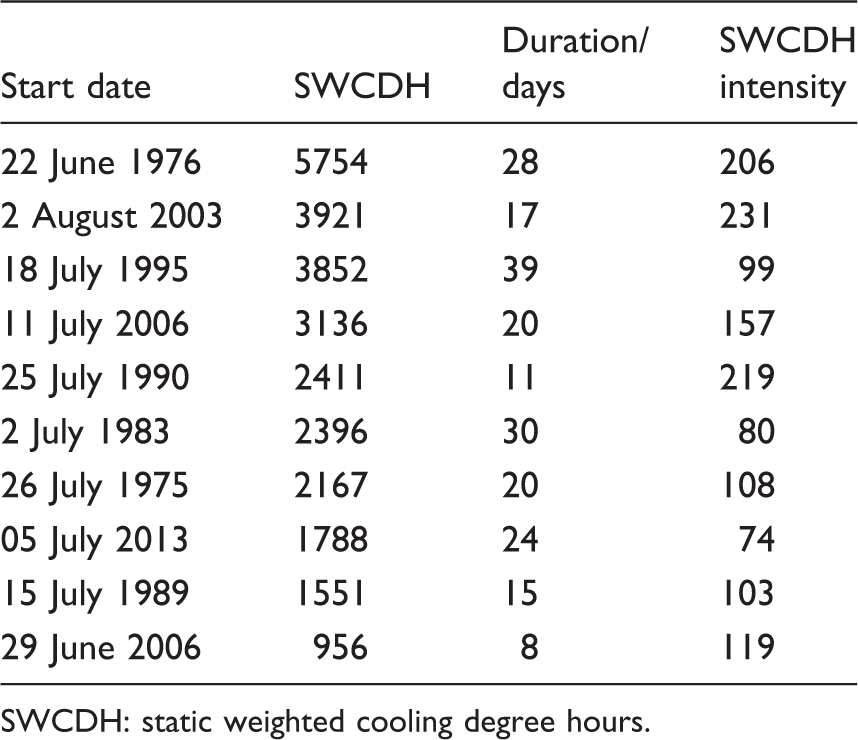
Characteristics of the ten warmest events ordered by the total SWCDH for London.
SWCDH: static weighted cooling degree hours.
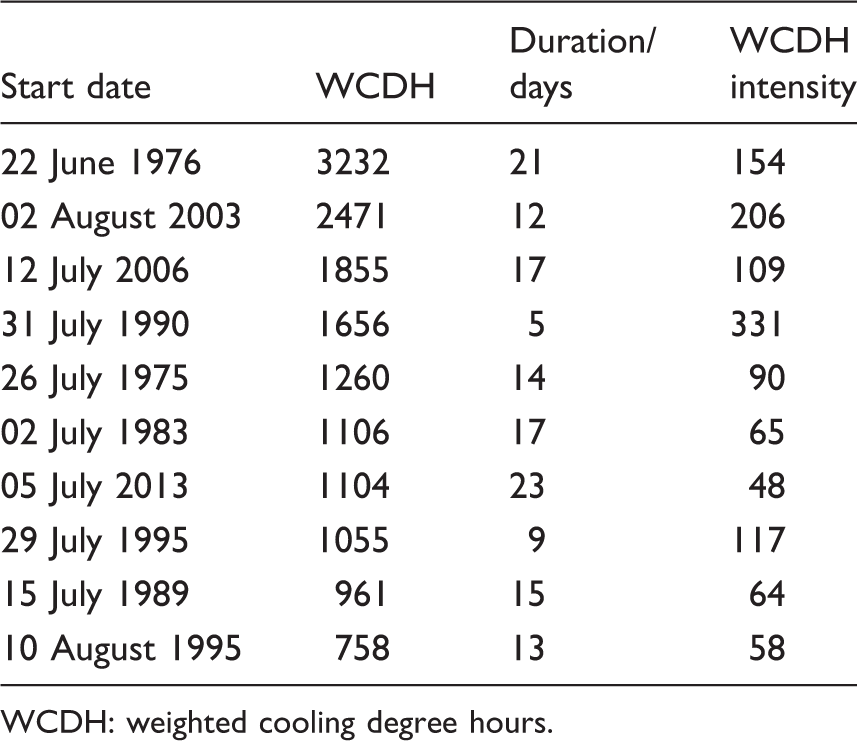
Characteristics of the ten warmest events ordered by the total WCDH for London.
WCDH: weighted cooling degree hours.
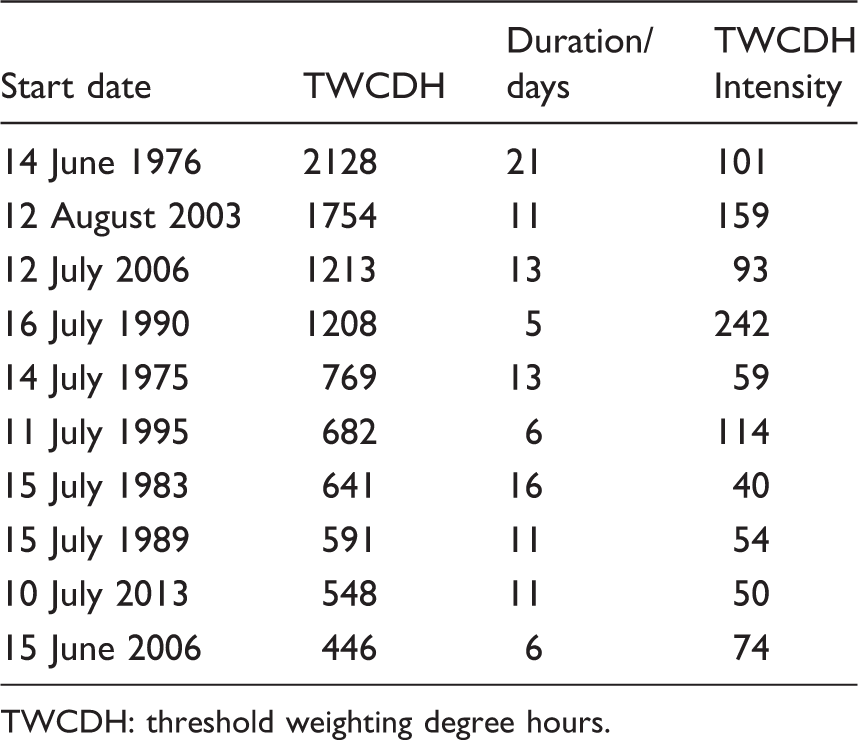
Characteristics of the ten warmest events ordered by the total TSWCDH for London.
TWCDH: threshold weighting degree hours.
From Table 4, there are six years which have a larger return period compared to 2013 in terms of SWCDH for London. The features of these six years will be examined more closely: It is clear that longest 1976 event is longer in duration than that of 2013 and is approximately two to three times more intense for each metric; 1983’s warmest event, although longer in duration than 2013 in terms of SWCDH is less intense for the TWCDH and shorter for the WCDH; 1990 has a single very short very intense event; 1995’ss warmest event is very much less intense in terms of SWCDH but very much longer than the warmest 2013 event and in the more extreme metrics (WCDH and TWCDH) the event is not particularly long; 2003 has an event which is approximately the same duration or shorter than 2013, depending on the metric but is much more intense in every metric; 2006 has an event which is similar to 2003, but is much less intense.
On the basis of this analysis, 2003 is selected as the second PDSY; the SWCDH return period is just over double that of 2013 (Table 4) and the duration of the warmest event is similar to 2013 but is more intense in every metric (Tables 6, 7 and 8). Similarly, the third PDSY is selected as 1976; the SWCDH return period is just over three times that of 2013. In this case, the duration of the warmest event of 1976 is much longer in duration than both 2003 and 2013 but is also less intense than 2003 and simultaneously more intense than 2013.
Probabilistic design summer years for all locations.
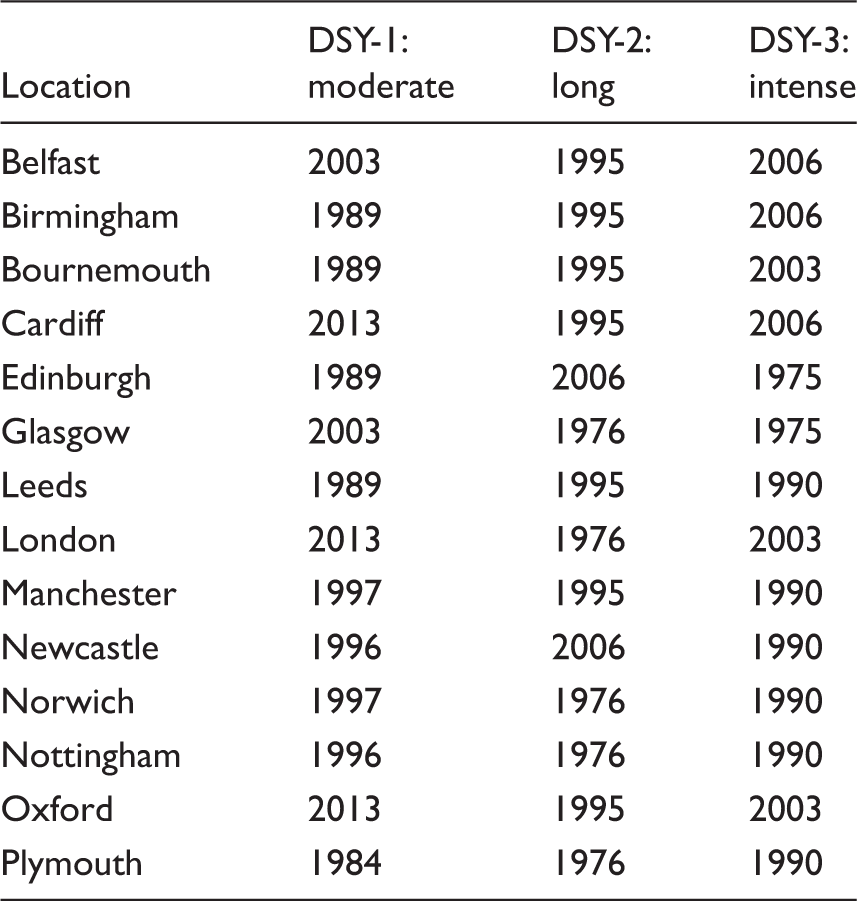
Discussion and conclusion
The method described in this work assigns return periods for warm weather events using three definitions of overheating: the SWCDH with the threshold given as the 93rd centile temperature for the region of the weather station; the weighted cooling degree hours with the threshold given as the comfort temperature; and the threshold weighted cooling degree hours where the threshold is adjusted from the comfort temperature according to the region. The moderate event DSY was defined as the year with the SWCDH return period equal to (or closest to) seven years. The more extreme summer years were then selected on the basis that they were both more extreme than the moderate year and consisted of overheating events with a different character (either of longer duration and more intense or of about the same duration but much more intense). The method ensures that the moderate summer is consistently defined across the UK and that the more extreme events at each location have a clear relative definition for that location. This methodology ensures that point 1 as detailed in the background – the severity problem – and by Jentsch et al.4,5 is addressed.
For the moderate DSY, the year selected in each case ranged from the 10th hottest (Plymouth) to the 4th hottest (Leeds) on this metric. In this case, the use of a return period to choose a year is not to find the nth hottest year from a set of years, but to choose a year which has the same probability of occurrence at each location. The GEV distribution is fitted to the meteorological normal period of 1984–2013 and then this distribution is used to establish return periods for all available years since 1961 (depending on location). For Leeds, the data are only available from 1989 for both parts of this analysis so it is consistent that the chosen year is the fourth hottest out of 25 years compared to the average across all locations of eighth hottest out of 48 years. For the more extreme years, there are strong correlations between all locations. Four possible years are selected for the intensive extreme year (1975, 1990, 2003 and 2006), whereas three years are selected as the long extreme year (1976, 1995 and 2006). Interestingly, 2006 is a shorter intense extreme year for Birmingham, Belfast and Cardiff but becomes a longer less extreme event for the more northern locations of Newcastle and Edinburgh.
The corresponding TRY files are less extreme than the chosen DSYs years for all locations as listed in Tables 4, 5 and the Appendix in terms of the SWCDH and TWCDH. In each case, the TRY has a maximum return period of 5.6 years. It may be expected that the equivalent TRY file would have a return period of the order of 2 years given that it is supposed to represent the average yearly conditions. However, the TRY months consist of the most average temperature, solar radiation (by means of average cloud cover), relative humidity with the use of wind speed as a secondary variable and so it is of no surprise that the return periods are slightly higher than the expected two years. The metrics used to determine the PDSYs give preference for a series of days which are warm, whereas the TRY methodology gives preference for days which are average, but may still contain a warm/hot day. On closer examination of the files, there are three locations where the peak TRY temperature is similar but greater than a peak PDSY temperature (Cardiff, Leeds and Norwich) equivalent to the peak temperature or one warm day. For these locations at least the next 28% (and up to 100%) of all temperatures within the DSY file are warmer than the TRY file. This approach has helped with point 2 as detailed in the background – the temperature problem. The use of observations might limit the ability for this issue to be eliminated completely if desirable and the use of mathematical transformations would then be required. 5 Furthermore, as stated above, the TRY selection criteria do not disallow the selection of hot days.
This issue may not necessarily be an issue for this set of weather files. The various warmest days within the TRY files form part of warm periods which lasts at most two days. Within each PDSY, the peak temperature is found amongst a number of warm days which could increase the likelihood of overheating when used in building simulation – the building fabric might already be spun up to a warmer state before the warmest period occurs. For all weather files, return periods of the years have been determined which allows the level of overheating to be put into perspective. Although a reference building was used to determine the PDSYs and predict overheating to deal with point 3 as detailed in the background – the overheating problem, verification is still required as to the extent to which these years can be used to determine overheating in real building models.
A consistent set of probabilistic weather years have been produced for all locations but the statistical methods used are based entirely on the external temperature and ignore the effect of solar radiation. While this is might be an issue for heavily glazed buildings, it is clearly impossible to create a conceptual building which can account for all forms of glazing. It is unlikely that the solar radiation is consistent across the set of moderate event years as this considers the peak above the lowest threshold considered. However, the more extreme years are more likely to be consistent with warmer spells which contain longer high pressure systems, which bring warmer temperatures, clearer skies, longer solar duration and thus more solar radiation. With both warm intense events and shorter much more intense events considered a range of overheating events can be investigated during building design.
Footnotes
Acknowledgments
The author would like to thank members of the CIBSE Weather Files steering group for their useful comments when writing this manuscript.
Declaration of conflicting interests
The author(s) declared no potential conflicts of interest with respect to the research, authorship, and/or publication of this article.
Funding
The author(s) disclosed receipt of the following financial support for the research, authorship, and/or publication of this article: EP/J002380/1 and CIBSE for their financial support of this research.