




Abstract
Building on an increasing emphasis on social justice, recent writing has focused on practitioner psychologists’ policy advocacy. Research indicates that school and counseling psychologists experience policy work as rewarding and challenging, and it has been suggested that initial training programs need to equip new practitioners with the skills required to engage in policy advocacy. We present an analysis of interviews with eighteen school and counseling psychologists across the US and UK who have experience with policy work, focusing on how they experienced their own graduate psychology training in relation to working with policy and their views of training in this area. We highlight four themes suggesting that participants rarely, if ever, received any formal input in policy work during training. Participants described applying some of the soft skills covered in their training to policy work but believed programs should be doing more to teach the ‘hard skills’ required. We conclude that if policy advocacy is a core part of psychologists’ roles, further guidance on how to accomplish this work is needed, as are changes to graduate curricula and pedagogy. We suggest strategies and activities that training programs can use to increase students’ policy advocacy skills.
Whilst social justice and anti-oppressive practice are by no means new for psychology (see for example the long history of critical psychology approaches, e.g., Parker, 2015, and community psychology e.g., Kagan et al., 2019), they represent ideas and practices that have gained significant ground in the mainstream of psychological professions over the last twenty years. Winter and Charura (2023) recently laid out core principles for ‘social justice informed therapeutic practice’, arguing that it is ethical, transformative, and politically informed and manifests in practices such as collaboration, broaching and epistemic justice, relationality, and reflexivity, curiosity, and openness. Nevertheless, social justice involves going beyond traditional individual therapeutic or psychological work with clients to challenge injustice on a broader macro level (Tribe & Bell, 2018). Public policy advocacy is defined as attempts to influence practice, policy, and legislation by working on a macro level to challenge injustice “through education, lobbying and communication with legislators and elected officials” (Heinowitz et al., 2012, p.373).
This article presents an analysis of data generated from interviews with counseling and school psychologists across the United Kingdom (UK) and United States (US) who have engaged in public policy advocacy work related to children and young people as part of their roles as psychologists. In our discussion of this analysis, we highlight the complexities evident in public policy advocacy, arguing that practitioner psychologists are not always equipped in their initial training with the knowledge and skills needed to go beyond individual work to engage in these broader macro-level endeavours. Therefore, we illustrate a potential need for development in the training of practitioner psychologists. Importantly, however, we also raise significant questions about whether or not school and counseling psychologists consider public policy work as falling within their ‘core’ scope of practice; we also consider how to address challenges that arise when working in a space where politics and psychology inevitably intertwine.
School and counseling psychology share many core values and skills globally. In the UK context, school (educational) psychologists focus on working with children and young people, specifically from their early years up through 25 years of age, in educational settings. They offer consultation, assessment, therapeutic interventions, advice and support to young people, families, teachers, and education providers. Educational psychologists complete a three-year doctoral level training program, following (typically) three years of undergraduate training and the gaining of relevant experience and/or other qualifications to strengthen their application. In the US, the roles of school psychologists are similar to that of educational psychologists in the UK, although the primary role of most US school psychologists is to evaluate students’ eligibility for special education services. US school psychologists complete either the equivalent of a three-year full-time specialist-level graduate program or a four- to six-year (or longer) doctoral program.
In the UK, counseling psychologists have a similar training pathway to school (educational) psychologists, often with additional training in counseling skills prior to a doctoral degree. They work in a range of settings offering therapeutic interventions to young people as well as adults and older adults focused on enhancing well-being and alleviating distress. In the US, counseling psychologists at the doctoral level typically complete a five- or six-year program aimed at becoming a health service psychologist, which a speciality in counselling psychology. At the masters’ degree level, there are a variety of options, with a degree in mental health counselling being a very common choice. In both cases (as in the UK), US-based counselors/counseling psychologists can work in a wide range of settings that support children and adolescents, such as private practice, college and pre K-12 school settings, and hospitals. In this study, we focus specifically on the experiences of UK and US school and educational psychologists as well as counseling psychologists who work with children and young people.
Engaging with policy in psychology
Much has been written about psychology's engagement with public policy, and globally there have been calls for psychologists to engage with policy given their research and clinical expertise (Frost & Oulette, 2004; Huminuik, 2024). However, this call has not gone without questioning by some scholars. Indeed, Walker et al. (2018) highlighted problems with a push for ‘policy impact’ by UK psychologists; for example, they cautioned psychologists to seek genuine engagement and collaboration rather than attempt to claim influence on policy based on a single research project without considering its broader implications. Nevertheless, when considered as part of a broader call for social justice action, we see public policy advocacy as an area where psychologists might move beyond rhetoric to challenge injustice on a broader scale—something which is “both possible and worthwhile” (O’Hare & Meheux, 2023, p. 210).
In the UK, engaging with policy has only recently made its way into the Standards of Proficiency of the Health and Care Professions Council (HCPC), and notably only for clinical psychologists (not educational or counselling psychologists), who must now “understand and be able to act on and provide advice on policy concerning health and care” (HCPC, 2023, p. 28). Despite not appearing in the statutory standards, examples exist in the literature of school psychologists working to influence policy in the UK in recent years (O’Hare & Meheux, 2023). While there also are examples of school psychologists working to influence public policy in the US—for example, the National Association of School Psychologists (NASP) has a “Policy Matters” podcast and annually hosts a summer institution in Washington, DC to train its members in public policy advocacy—there is no significant mention of public policy in NASP's Practice Model document (i.e., its formal standards regarding the roles and responsibilities of school psychologists). Similarly, while the American Psychological Association (APA) includes knowledge of health policy work as one behavioral anchor of many within its “Competencies for Psychology Practice in Private Care” (APA, 2015), it otherwise does not list public policy work as a stated standard for health service psychology professions.
Despite reporting high levels of belief that this is an important area of work for psychologists, research suggests that practitioner psychologists might have relatively low actual engagement with policy advocacy in practice (Forestieri et al., 2024). Research suggests that, rather than working to influence, develop and change existing public policy for the better, many practitioners typically encounter public policy through individual level work (e.g., with clients who are negatively impacted by existing policy; Cantrell et al., 2021). Practitioners report being unclear on how they might take a more active approach to tackling higher-level change (Cantrell et al., 2021). Previous studies of the perspectives of psychologists who have influenced public policy through their professional work indicate that their roles in this area developed gradually over time and were significantly impacted by mentors, earlier experiences of social activism, and a developing sense of what social justice might mean in practice (Browne et al., 2020; Winter et al., 2024). Moreover, barriers to public policy advocacy have included disinterest, uncertainty and unawareness (Heinowitz et al., 2012) along with stress, and pushback from others (Winter et al., 2024).
Practitioner training and policy advocacy
Perhaps because of the potential struggles highlighted in research (e.g., the gap between belief and action), multiple authors have recommended increased training and education for practitioner psychologists in public policy advocacy work (Cohen et al., 2012). Similar calls can be seen in the literature for training in social justice and advocacy more broadly, and examples have been provided of courses where this has been realised, along with research outlining framework and social justice competencies to be covered within education (e.g., Constantine et al., 2007; Goodman et al., 2004). Research has described existing social justice practica (Hage et al., 2020); how to navigate change over time and the importance of organisational consultation (Grapin, 2017); and difficult dialogues pedagogy (Toporek & Worthington, 2014). Research with trainees involved in these programs suggests that training opportunities where they can put their social justice values into action are vital (Briggs et al., 2009). Nevertheless, other work which has looked across training programmes in psychology suggests that social justice is not always centered in curriculum and graduate programes (e.g., see Luh et al., 2023), and one study found that counseling psychologists across three training institutions in the UK (of the 13 existing at that time) did not experience ‘social justice’ is mentioned on their course (Winter & Hanley, 2015).
Specifically in relation to training focused on public policy advocacy, Alexander and Allo (2021) provide an example of education on policy engagement through the ‘mock legislative testimony exercise’ in their training module on social justice and advocacy. This highlights one example of creating a climate where trainee psychologists are encouraged to see policy advocacy as a core part of their role and can experience a taste of this during their education. Similar to research which looks more broadly at social justice training in psychology, research suggests that attending a public policy advocacy training increases the subsequent time engaged in advocacy (Lyons et al., 2015), indicating that such training is indeed an important way to tackle some of the barriers noted above. Mallinckrodt et al.’s (2014) scientist-practitioner-advocate model of training attempts to underscore the need to view advocacy work as a core part of our roles, in the same way as research and practice.
Rationale and research questions
Research demonstrates that some practitioner psychologists, including school and counseling psychologists, are engaged in public policy work as part of their professional roles (Browne et al., 2020; Winter et al., 2023). Social justice literatures suggest that translating values into changes in curricula and training approaches can be challenging, and there may be gaps between psychologists’ articulated values and their action (Forestieri et al., 2024; Winter & Hanley, 2015). To understand further the interconnections between social justice, public policy and practice in counseling and school psychology, it is important to examine experiences and views of practitioner training, in relation to providing a grounding for subsequent policy work as a qualified practitioner. This paper therefore extends previous work and reflects on the following question: How do school and counseling psychologists describe their views on, and experiences of, initial practitioner training in relation to developing the necessary skills and knowledge to engage with policy work as a practitioner psychologist?
We focus here on the training experiences of those school and counseling psychologists who have experience engaging with public policy work, as a useful starting point to begin to understand the landscape and where training experiences have both been helpful and lacking in providing the foundations required to embed this skill in our practice.
Method
In this paper, we analyze and discuss a subset of data from a broader study looking at how school and counseling psychologists working with young people engage with public policy and social justice. Analyses relating to different research questions within that project have been presented elsewhere (Winter et al., 2023).
Participants
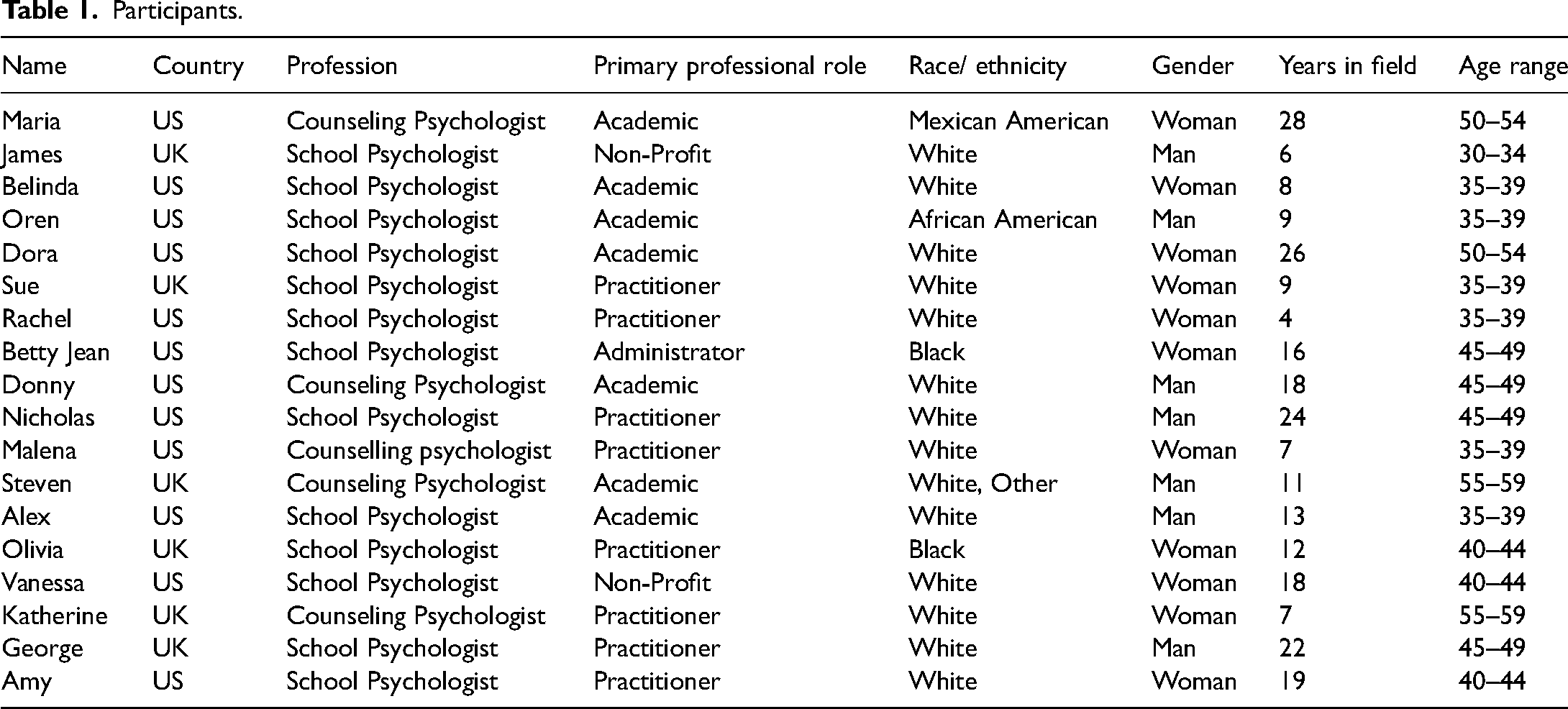
The sample included eighteen participants. Eleven identified as women and seven as men. Six participants were based in the UK and twelve in the US. The ages of participants ranged from 33–58, with a mean of 43.7 years. Three participants identified as Black or African American, one identified as Mexican American, thirteen identified as white, and one identified as white/other. Professionally, five participants came from counseling psychology backgrounds and thirteen from school psychology, and their primary places of work included a range of settings, such as schools, community organisations, and academic settings. Participants had been working in their field for 4–28 years, with a mean of 14.3 years. Table 1 provides demographic information for each participant, including their primary job roles.
Participants.
Data generation
Upon obtaining appropriate ethical approvals from the universities involved in this project, study participants were recruited in a variety of ways. Participants were recruited via social media, with a dedicated research account created for the purposes of the study. Researchers also reached out to select individuals (members of NASP's Social Justice and Public Policy committees, individuals known to be involved in social justice and public policy efforts in the US, and members of the British Psychological Society [BPS] Division of Educational and Child Psychology and Division of Counseling Psychology in the UK) to see if they met study criteria and ask them for other recommendations. Selection criteria stipulated that participants should (a) be qualified, professionally registered school or counseling psychologists (with a particular focus on children and young people) in the UK or US (“educational psychologists” in the UK); (b) self-identify as a psychologist with an active interest in public policy work as part of their role; and (c) have experience in contributing to policy at a national level. Exclusion criteria included, for example, trainee psychologists, those with no experience in working to influence public policy, and counseling psychologists whose speciality was not working with children and young people.
All participants took part in a single semi-structured interview. Questions were designed to reflect the core research questions in this study and were developed by all members of the research team following an initial draft by the first and third authors of this paper. They were open and approached flexibly with participants, as per semi-structured interview good practice (Brinkmann & Kvale, 2018). Relevant to this analysis were questions relating to participants’: (a) training experiences, including how such training supported their later public policy work; (b) views on psychologists’ training needs in relation to public policy; (c) views on necessary developments in training to meet those needs.
Data analysis
Reflexive thematic analysis was used to analyse a subset of the broader dataset specifically relevant to the present research questions (Braun & Clarke, 2021). The process involved authors initially re-familiarising themselves with the dataset by reading and re-reading transcripts of interviews. Having previously conducted a Consensual Qualitative Research process (Hill & Knox, 2021) on the dataset to address separate research questions, familiarisation ahead of the thematic analysis involved stepping back and re-engaging with the data and being open to different parts of participants’ stories and experiences. Coding involved fine-grained review for relevant, meaningful units of data related to a particular research question. Once the codes were generated and identified, the next step involved generating initial themes that meaningfully addressed the research question. Candidate themes were developed and reviewed, with a number being re-named, reworked, and rejected prior to refining the final four themes presented below. All stages of the reflexive thematic analysis were undertaken initially by the lead author, with the second and third authors offering reflections and contributions to the final analysis after all stages had been completed once.
Reflexive thematic analysis involves a high degree of self-reflection and an acknowledgement that one's analysis represents constructed knowledge rather than objective ‘truth’ (Braun & Clarke, 2021). The ways in which we influenced the project and analysis underpinned the broader work of the research team throughout our collaboration. We therefore present here brief information on each author to provide context on our identities and to ground our analysis for readers. The first author is a counseling psychologist and trainer based in the Northwest of England in the UK. She identifies as a white, middle-class, not yet disabled, heterosexual cisgendered woman and therefore is afforded many socially structured advantages in society. She has worked as an academic for 11 years and was Programme Director for four years of a doctoral training programme in counseling psychology (with no explicit input on policy work to date). She has an active interest in how we might extend micro-level advocacy efforts to engage with socially just practice on a larger scale in our roles as psychologists. The second author is a post-doctoral fellow focusing on clinical practice with neurodiverse children, although she was a student when the data were initially collected. She identifies as white, cisgender, and able-bodied. These visible identities provide her with inherent privilege. She entered this project with limited experience in the public policy world; however, she regularly engaged in attending and hosting training opportunities focused on different areas of cultural humility and social justice and is interested in continuing to strengthen her knowledge and understanding in these areas to ensure she can successfully advocate for the families and students she works with. The third author is a school psychologist and trainer in the Midwest of the US. He identifies as a Jewish, middle to upper class, invisibly disabled, heterosexual man. In addition to being in privileged categories based on gender, class, and sexual orientation, his ability to pass for “white” (as long as he does not visibly display his Judaism) affords him great unearned advantage. He has long been interested in ways that a commitment to social justice principles might impact school psychology practice and is committed to personal reflection and growth in his own practice.
Analysis
Four themes were generated and discussed below. Participant quotes (using pseudonyms) are included to provide context for the reader. In addition to pseudonyms, we indicate participants’ professional role (i.e., School Psychologist [SP] or Counseling Psychologist [CP](SP/CP) and countries of residence (i.e., US or UK).
Theme 1: Outside of our scope? initial training did not focus on influencing public policy
All but one of our participants suggested that their initial practitioner training did not fully equip them with the knowledge and skills needed to influence public policy in their professional roles. This theme highlights the absence of policy work within initial training in school and counseling psychology. Participants understood this absence as signaling that public policy work is “outside of the scope” of traditional practice in their respective fields. They also recognized it as a potential barrier, blocking psychology from progressing further with work in this area and from ensuring that all graduates are equipped with the necessary skills and knowledge.
Most participants told us that their practitioner training did not touch on public policy at all, for example, participants noted that “public policy, advocacy, I never heard those words in my graduate training” (Oren, SP/US), and “certainly there was nothing in my training which kind of looked at policy work” (Steve, CP/UK). Only one participant, a counseling psychologist in the US, said that their training exposed them to “role models of folks who engaged with social justice issues and policy in different ways” (Donny), but this participant did not describe any formal instruction in their programme on contributing to policy work.
Some participants reported that their courses covered how to comply with core pieces of legislation or existing policy or gave an overview of particularly relevant public policy to be aware of. Others said that there was a notion communicated about influencing policy as being an “aspirational idea” (James, SP/UK) without any sense of how to put this aspiration into practice. Several participants described needing to follow up their practitioner training with either additional formal education, continuing professional development courses, or learning ‘on the job’ to develop their work and confidence in this area. For several participants in the US, this training was facilitated through NASP, but other opportunities included subsequent doctoral study or informal training with mentors or colleagues already working in this area.
Almost all our participants conveyed that their profession viewed public policy work as outside of ‘core’ practice; thus it was not a focus of their initial practitioner training and education. This was at odds with their perception of public policy work as a natural step to making progress and enacting their professions’ social justice values. Our analysis suggested that public policy work might have been seen as outside of the scope of mainstream training and practice in psychology for two reasons. First, participants highlighted that their training was largely focused on work with individuals (e.g., individual therapy and assessment), which was considered to be more within the traditional scope of both school and counseling psychologists’ work. Participants described: “…being trained in a very traditional way as a counseling psychologist to really, uh, emphasize the use of therapy and assessment to help people grow and um you know heal from issues” (Maria, CP/US). “…it was like learn these assessments, learn how to write reports” (Oren, SP, US).
Relatedly, a small number of participants noted that initial training is complex and that there is a lot of material to cover in a relatively brief amount of time, implying that there is insufficient time to cover topics widely regarded as less central, such as policy advocacy.
According to participants, a second reason public policy work may be widely viewed as beyond the scope of traditional psychological practice concerns the complexity of entering political territory. Two participants talked about the connections between politics and public policy work. One participant noted that: “…people often conflate policy and politics. And so, I do think that there has been some hesitation to present policy and an objective analysis of the impact that that had out of fear of appearing to be political. It's a delicate line to walk, and I totally understand especially if you’re working in a university where you they have said, you know, you will not be political in your classroom, that that might put some fear, a little bit.” (Vanessa, SP/US)
This participant went on to say that school psychology has emphasised the distinction and separation between politics and education in the past, arguing that education is not political. This has, in her view, meant that some psychologists feel like public policy advocacy is beyond the scope of their practice, as it strays too far into the territory of politics rather than education. She argued that psychologists can engage with public policy without taking a position in terms of electoral politics; thus, such misunderstandings need to be corrected. This is discussed further below.
Theme 2: ‘Soft skills’ are transferable to public policy work
Although almost all participants’ initial training did not have any explicit content or focus on engaging with public policy work, our analysis indicated that they viewed some of their “soft skills,” which were useful in such work, as having been well developed in their initial programmes. One participant simply stated that: “I think it's more of a performance deficit than a skill deficit… as psychologists we are uniquely trained and situated to be very effective as advocates. I mean, I think every skill we currently train in future psychologists…the people skills, the relational skills, the understanding of context, the motivations, um to be able to distil and communicate evidence-based practice…those are all skills of a very effective advocate. So, it's not a skill gap” (Alex, SP/US).
Similarly, other participants noted that their training in listening and communication, facilitating dialogue with others who they might not agree with, and communicating research evidence all positioned them well for influencing policy and working alongside policymakers. For example, more than one participant reflected on situations in which they used their communication and active listening skills to navigate policy-based conversations. Maria (CP/US) told us that her communication skills facilitated moments where she needed to keep politicians on track during conversation to avoid drifting to less relevant areas. Oren (SP/US) told us that: “…like when you're trying to communicate with people, particularly those…state officials, federal officials… do your homework, you have got to know your topic, you really have to know, but you have to be able to be flexible in how you communicate right because the way you would communicate with parents will be very different with how you would communicate with administrators, but you're giving the same message right, so you have to be flexible in your communication, know your topic, have some quick talking points. All of that is really important that I, that I’ve learned in this work.”
Several participants reflected on the way in which their training equipped them to understand systems and to take an ecological perspective on situations and distress; one participant mentioned, for example, the ‘ecosystem’ and ‘Bronfenbrenner’ (Olivia, SP/UK). Another participant described how this perspective positioned them well for policy advocacy: “…there was so much time spent on systems and system thinking that it was always like ‘well if I’m looking at a problem, I need to understand how the system is inter playing with this’, so it just got me thinking like if I wanted to change more than just the individual then I wanted to look at all these different you know concentric circles.” (Nicholas, SP/US)
In this quote, we can see that teaching focused on viewing problems ecologically not only motivated this participant to engage with public policy in the first place (to look at the different, perhaps broader environmental spheres of influence), but also potentially provided the skills needed to formulate a systemic understanding of problems, which are required to engage fully with public policy. Our analysis indicated that skills such as relationship building, systemic thinking, and communication had clear, transferable relevance for engaging with policy makers and wielding the necessary influence to make change happen.
Theme 3: We need confidence to believe we can (and should) influence public policy
Participants suggested that training needs to develop practitioners’ confidence in influencing and engaging with public policy. Participants understood that training and education should not only equip people with confidence that they can influence public policy, but also a belief that they should work to influence policy in their roles. A small number of participants suggested that their initial training helped them to develop this confidence, whereas the majority indicated that this was an area in which training needed to develop.
Several participants indicated that, in order to work in the public policy arena, one needs such “confidence,” given that working with policymakers can be “intimidating”: “…there really is sort of a you know I think a confidence and self-efficacy piece that comes with you know reaching out to these folks and saying, I would like to be heard” (Maria, CP/US)
Relatedly, one participant explained this confidence with the use of the Yiddish word ‘chutzpah’, which they interpreted as “it's kind of like courage… but it's a bit kind of cheekier than that. And it's just like putting yourself forward…being able to speak out…when you’re not 100% sure. And I think there's something about policy work that, you know when you’re involved …you need to have confidence” (Steven, CP/UK).
Another participant reflected on the way that education and training can open psychologists up to the possibility of engaging with public policy. They described seeing colleagues around them who appeared to not feel like their views were important or valid in the policy arena, despite these colleagues’ wealth of experience and knowledge. Participants viewed psychologists’ lack of belief in their ability to influence and make worthy contributions to public policy as a barrier to engaging in this work.
Beyond stressing the need to equip psychologists with the belief and self-confidence that they can influence public policy, participants thought psychologists should be educated to view public policy as a central responsibility of professionals: “What are our duties as a psychologist, is it just to deliver therapy, or sit in our therapy room, or teach or whatever, or do we have a wider duty? And I certainly feel it as a duty, I feel like I should be doing this. And maybe others don’t feel that I don’t know. I feel we do have a duty to use our knowledge and our experience to improve, to improve the lives of others in other ways, in general rather than as individuals” (Katherine, CP/UK).
Similarly, one school psychologist, when asked about integrating public policy with their role as a psychologist, noted that: “I almost kind of wonder if integrate is the right word. Cuz in some ways that says you have to take an external variable and put it into your existing practice. And I think that, that's my response. Right, you know [laughs]…it can’t be viewed as something extra” (Alex, SP/US).
The same participant later stated that, in their view, policy work is a “moral obligation” of psychologists. Whilst the strength of this statement perhaps represents only one participant's view, others suggested that confidence is important for psychologists to be able to influence policy and that training can begin to foster such confidence. Viewing public policy advocacy as a responsibility shifts this confidence from a self-belief that they can do something optional to a self-belief that they can do this work and that it is central to their role.
Theme 4: Training needs to equip psychologists with the ‘hard skills’
This final theme indicates that participants saw some important ways in which initial training in counseling and school psychology could be improved with regard to public policy advocacy work. Specifically, the ‘hard skills,’ such as a knowledge of how laws are made, were mentioned by participants both in the US and UK, and across counseling and school psychology, as being important for psychologists to receive training in: “You know, learning about I mean really, I’ll be honest with you, I didn't know, you know, terms of how bills were passed and that whole process that wasn't something that was really part of my graduate training program” (Betty Jean, SP/US) “…how it works in the UK, it's very complex in terms of like the parliamentary system, for example. You have a Secretary of State, you have ministers for that department, you have permanent secretaries, you have special advisors… I think we could do a lot as a discipline and a profession to clue up psychologists around how to engage in public policy work and who to speak to” (James, SP/UK).
Participants said that they personally gained knowledge and skills in this area through other means but that initial training programmes should demystify this work for emerging practitioners.
Participants suggested that training would benefit significantly from organised programs to hear from policymakers or to placement opportunities wherein trainees could practice public policy advocacy. Such opportunities might occur via coursework or practica within policy-focused settings. Further, participants proposed that when consultations on specific public policy were advertised (as they are regularly in the UK through the BPS), trainers could utilise these as both classroom activities and other ways of engaging trainees in real-life public policy work.
One geographical difference was evident in the dataset. Specifically, participants from the US noted that professional organisations, such as NASP, had begun to run policy trainings and that prospects for getting involved in policy work were improving in their context. Whilst UK participants reflected on the possibilities for psychologists to influence and engage with public policy, they also noted that their professional organisations, like the BPS and its Divisions, could do much more in this regard, such as running trainings. Such trainings may be instead of or in addition to those offered through university training programmes.
Discussion
This study aimed to examine school and counselling psychologists’ initial training experiences in preparing to engage in public policy advocacy as part of their professional roles. Data from interviews with school and counseling psychologists from the UK and US who have experience in working with policy as part of their roles were analysed to address this aim. When considered in the context of broader literatures, themes generated suggest that questions remain both about (a) the place of public policy advocacy – either inside or outside of the core scope of practice of counseling and school psychologists – and (b) how psychologists should be equipped with the skills and knowledge to engage in this part of social justice work.
Participants had between 4 and 28 years of experience prior to participation in the study, and overall, they painted a mixed picture in terms of how well their training equipped them with the necessarily skills and experience to engage in public policy advocacy. Consistent with some previous research on social justice education (Luh et al., 2023; Winter & Hanley, 2015), participants suggested that their training did not cover public policy, with the majority seeking additional subsequent training and education. This ranged from descriptions of brief continuing professional development (CPD) opportunities to longer and more formal educational pursuits. These experiences echo previous findings describing the many ways in which psychologists may integrate advocacy and policy during the lifespan of their training, rather than covering it all within their initial training (Glassgold & Wolff, 2020).
Though many participants’ initial training did not address public policy advocacy explicitly, this did not necessarily mean that it did not equip them with some necessary skills to engage in the work. Participants highlighted some transferable ‘soft skills’ that psychologists develop during training and provide scaffolding for work in public policy. For example, they noted the importance of psychologists having a systemic, ecologically-rooted understanding of problems was highlighted, along with skills in relationship building, communication, and research. This coincides with previous work indicating the importance of relationships and clear communication when influencing public policy as a psychologist (Browne et al., 2020). Participants called for greater attention to training in the ‘hard skills,’ however, such as knowing: (a) how legislation is made and laws are passed; (b) who is involved in this process and who therefore they might seek to influence; and (c) more of the ‘how to’ of this work. Practitioner psychologists may therefore be developing some important skills during training but not necessarily the knowledge required. This gap in training may (in part) connect with the need identified by participants to develop psychologists’ confidence and self-belief for getting involved in policy work.
Analysis regarding the interplay between politics and public policy advocacy, though a relatively small thread in our broader dataset, is of note because it highlights the complexities surrounding the supposed neutrality of psychologists and how this might sit within a broader social justice agenda (see Winter, 2021). Whilst Vanessa suggested that politics and policy work were separable, questions may be raised when psychologists stray into territory inevitably connected to electoral politics, as elected representatives are involved in the law-making process. Whilst psychologists might not be aligning themselves with particular political parties in doing such work, they are engaging with policies passed or endorsed by particular political parties.
The absence of specific, explicit training on public policy advocacy was interpreted by participants as illustrating a problem with their disciplines’ engagement with social justice and advocacy more broadly: if it was a core part of what they were expected to do (such as assessments and individual therapeutic work), then surely it would be included in training. The lack of training in this area indicates that policy engagement is viewed as an optional add-on or specialty rather than an expectation of all counseling and school psychologists. In the case of counseling and school psychologists in the UK, this is reflected in the ‘Standards of Proficiency’ outlined by the regulatory body the HCPC (2023), as these standards contain no explicit mention of policy for either field. Ultimately, our analysis suggests that until public policy advocacy is positioned as a core component of training curricula, practitioners may not feel confident that they really do have something to add to policy discussions.
Implications
There are two important implications arising from this study. First, if public policy is to be viewed as a core element of the social justice agenda of both school and counseling psychology, then either initial training programs and/or subsequent CPD should address ‘hard’ skills and knowledge gaps related to the ‘who,’ ‘what’ and ‘how’ of policy advocacy. Importantly, if these areas not covered by initial training programs, policy work will continue to be viewed as beyond the core scope of counselling and school psychologists’ professional activities. Furthermore, as Alexander and Allo (2021) note, it will be difficult for trainers to provide this education until they themselves have completed relevant training or they have access to experts from the field (such as those we interviewed here) to provide guidance. The second implication is that professional organizations in school and counselling psychology should support practitioners in this work, particularly in regarding to collaboration, sharing good practice, and building confidence. NASP, BPS and HCPC should recognise this in their relevant competency frameworks, and ideally, they would provide guidance documents, examples of previous policy engagement by psychologists, and CPD related to developments in policy work. Further, professional bodies should work to reduce barriers to participating in these ongoing professional development opportunities or accessing existing resources.
As suggested by participants, one strategy might involve including content in training programs that explains legislative and policymaking systems that are local and relevant to those programs. This may help psychologists understand how policy comes to be and who the people involved in making decisions are, thus providing the bedrock for understanding how to influence the process (and some of the ‘hard skills’, or knowledge noted above). Two further options for developing training include embedding classroom-based activities and policy-focused practice in curricular offerings. In relation to the former, trainers can use the framework outlined by Alexander and Allo (2021) to scaffold learning, and inevitably, applications will vary across institutions and contexts. Teaching might focus on, for example, demonstrating how ‘soft skills’ can be used in a policy context and using role play activities to simulate communication with policymakers. Didactic input might focus on how current context and policy events are relevant to psychologists’ work, and guest speakers could involve psychologists who have already made progress in this area. Drawing on Alexander and Allo (2021), we suggest that trainees complete an assignment to review legislation or policy and consider a) their own views on it as a psychologist, drawing on research; b) potential consequences for different groups; c) organisations they might work alongside; and d) their conclusions about this work and why the public should care. An exercise like this would hopefully build confidence that public policy advocacy is a possible area of work for trainees. Similarly, hearing directly from psychologists who have worked in this area may make macro-level social justice work appear more achievable. Finally, building on literature on social justice education, we encourage trainers to ensure that policy advocacy training includes a reflexive focus, wherein trainees consider how their identities might impact (and be impacted by) work in this area (Winter & Charura, 2023; Winter et al., 2023).
Limitations
Our study has several limitations that should be acknowledged. For example, given the broader project from which the data were drawn, all participants were worked on public policy in relation to children and young people. Therefore, further work might wish to address this with broader samples of counseling psychologists who have different areas of focus. Further, our sampling strategy allowed us to recruit a range of professionals across both countries; nevertheless, given differences in training routes and the state and discipline of psychology across countries, our findings may be particular to the group of people we spoke with. Given the qualitative positioning of the article, this is not presented as a weakness of our work but rather an important consideration for utilizing findings.
Finally, it is worth noting the socio-historical context for this research. The data for this analysis were generated in 2021, and there have been numerous significant developments in public policy, both in the UK and US, since participants were interviewed (e.g., the Loper Bright Enterprises v. Raimondo Supreme Court Case in the US, and the Cass Review and draft guidance for schools on ‘Gender Questioning Children’ in the UK). Such developments may well be areas that psychologists may have reflected upon should we have conducted the same interviews in 2024.
Conclusion
Whilst school and counseling psychologists might be well-equipped with ‘soft’ skills applicable to policy settings, such as relationship building, research communication, and difficult dialogue, initial training programs do not always equip practitioners (on qualification) with the ‘hard’ skills or the confidence to navigate systems of public policy in their role as practitioners. Public policy advocacy is one possible facet of macro-level social justice work that allows psychologists to translate their values into action on a broader scale. Nevertheless, unless psychologists equip all practitioners with the necessary skills and knowledge to engage in this work, public policy advocacy will continue to be seen as ‘outside the scope’ of their roles and responsibilities.
Footnotes
Acknowledgements
The authors wish to acknowledge the contributions of Jazlyn Rowan, Maria Ruiz, Jaylin Soto, and Ciara Thomas. Collectively they contributed to different portions of this study, ranging from helping to think through the study design, conducting one of the interviews, and transcribing and coding data. We thank you all for making this study stronger.
Declaration of conflicting interests
The authors declared no potential conflicts of interest with respect to the research, authorship, and/or publication of this article.
Ethical approval
This study was approved the Institutional Review Board of Indiana University Bloomington. The IRB number for this study was #2010250652 and Ethical Approval from the University of Manchester (2021-10604-18824).
Funding
The authors received no financial support for the research, authorship, and/or publication of this article.
