




Abstract
Prior research indicates that high negative emotionality in combination with low peer status is conducive of clinically identified problems in childhood. This three-wave longitudinal study examined how negative emotionality and peer status are linked over time in middle and late childhood. Participants were recruited from second grade (n = 90, mean age = 8.85) and fourth grade (n = 119, mean age = 10.81) and were followed across a period of 2 years. Cross-lagged structural models examining concurrent and longitudinal associations between teacher-reported negative emotionality and peer ratings of likability were analyzed separately for externalizing emotion (anger) and internalizing emotion (sadness and fear). Both analyses provided support for a conceptual model in which high negative emotionality lowers peer status, and low peer status, in turn, through a feedback loop, increases negative emotionality over time. Bidirectional influences are interpreted as reflecting a transactional process involving the effects of negative emotionality on social behavior. The findings highlight the need for active efforts to help children with high negative emotionality gain acceptance from classmates.
During middle- and late childhood, peer relations deepen and peers play an increasingly important role in the social world of the child. Since children during this age period spend so much of their time at school, it is essential that they have a good relationship with their classmates. Yet we know that many children are rejected, and even bullied, by their peers at school. Research has found that rejected children are at an increased risk of being badly treated by peers (Demol et al., 2020); often feel angry, sad, and lonely (Xiao et al., 2020; Zhang et al., 2014); and are more likely than other children to develop externalizing or internalizing problems (Ladd, 2006; Spilt et al., 2014; Sturaro et al., 2011). Moreover, the schoolwork of children and adolescents who are rejected and victimized by peers tends to deteriorate (Ladd et al., 2008; Liu et al., 2014).
According to transactional models of development (Sameroff, 2009), developmental outcomes are often the result of reciprocal transactions between individuals and their social contexts, including experiences with family and peers. These transactions may reinforce and sustain positive or negative behaviors over time (Parker et al., 2006; Sameroff & MacKenzie, 2003). Children's status among peers (acceptance or rejection) is fairly stable across time (Cillessen et al., 2000; Jiang & Cillessen, 2005). This stability seems to be due, at least in part, to the fact that children possess relatively stable physical or psychological characteristics that may trigger positive or negative reactions from peers. For example, compared to accepted children, rejected children tend to be either more aggressive or more withdrawn (Casper et al., 2020; Xiao et al., 2020). Accepted children, in contrast, tend to be socially skilled and display high levels of prosocial behavior, which makes them more attractive as friends and partners in peer play (McDonald & Asher, 2018; Slaughter et al., 2015). Importantly, in these interactions with peers, accepted children may further improve their social skills in a way that is not available to children who are socially rejected. Thus, the social experiences of accepted children may reinforce the psychological characteristics that originally determined their social status (Wang & Hawk, 2020). Similarly, peer rejection may be part of a transactional process in which child characteristics trigger negative reactions from peers and the experience of these reactions changes the behavior of the rejected child in a way that sustains or intensifies peer rejection (Beeson et al., 2020; Tseng et al., 2014). For instance, a child who has difficulty controlling his or her anger may face negative reactions and rejection from others; this, in turn, could make the child even more angry, which, in turn, might fuel further rejection. The current study examines whether children who frequently express strong negative emotions at elementary school may be caught in this type of vicious circle in which negative emotionality and peer status influence one another over time.
The frequency and intensity with which children express negative affect are influenced by hereditary factors and, in research, often conceptualized as temperamental negative emotionality/affectivity. Children with high negative emotionality experience and/or express negative feelings (e.g., anger, fear, and sadness) frequently and intensely, and do not easily downregulate these feelings. Individual differences in this temperamental trait show moderate to high stability across childhood (Peterson et al., 2018; Sallquist et al., 2009), and seem to play a role in the etiology and maintenance of internalizing and externalizing problems (Davis et al., 2015; Eisenberg et al., 2001). Anger has been specifically linked to externalizing problems, and fear to internalizing problems (Muris et al., 2007; Rydell et al., 2003).
High negative emotionality tends to be associated with low status among peers throughout childhood (Dougherty, 2006; Shin et al., 2011). In examining links between negative emotionality and peer status, it may be useful to analyze anger separately from fear and sadness. Children's anger may affect their peer status negatively primarily if the anger leads to aggressive acts directed at peers (Hanish et al., 2004). Aggressive children are often disliked by peers and risk being mistreated themselves (Casper et al., 2020). This, in turn, can increase their anger. Sadness and fear, on the other hand, may motivate children to withdraw from social interaction (Goodman & Southam-Gerow, 2010). In middle childhood, withdrawn behavior in the social group is often perceived negatively (Rubin et al., 1990), leaving socially withdrawn children at increased risk of being disliked and badly treated by peers (Chen & Santo, 2016). Thus, a transactional pattern may develop in which a child's internalizing emotion leads to social withdrawal and persistent negative responses from peers, which, in turn, increases the child´s experiences of unease in social situations and tendencies to withdraw from potentially harmful social interactions (Rubin et al., 2009).
Longitudinal attempts to study the direction of influences over time between negative emotionality and peer status have yielded inconsistent and complex findings. In an early study of 4- to 6-year olds (Maszk et al., 1999), peer-reported anger and crying, as well as teacher-rated emotional intensity (primarily negative emotion), predicted a drop in social status across a 5-month period. Higher initial social status predicted a decrease in peer-reported anger over time, providing partial support for possible bidirectional influences. The results of more recent studies, however, suggest unidirectional rather than bidirectional influences between negative emotional expressivity and peer status. Hernández et al. (2017) examined bidirectional influences between children's negative emotional expressivity and peer status from the fall semester to the spring semester of Kindergarten. They found that negative emotion in the fall semester predicted low peer acceptance in the spring semester for girls, but not for boys. Peer acceptance did not predict change in negative emotion during the same period. In a related study (Hernández et al., 2018), predictions from Kindergarten to Grade 1 were examined separately for emotions expressed in the classroom and emotions expressed during lunch or recess. High peer acceptance in Kindergarten predicted a drop in negative emotion expressed in the classroom, but not during lunch or recess. No effects of negative emotion on later peer acceptance were found. Finally, using cross-lagged path analysis with three waves of measurement, Hasenfratz et al. (2015) examined bidirectional influences between temperamental negative emotionality and peer problems (being negatively perceived or treated by peers) from early- to middle childhood. Results revealed that temperamental negative emotionality consistently predicted an increase in peer problems over time. The influence was unidirectional, that is, peer problems did not affect children's negative emotionality over time.
The present study extends prior longitudinal research, which has focused mainly on early childhood, by examining bidirectional influences between negative emotionality and peer status in middle and late childhood. Although negative emotionality tends to be associated with low peer status already in early childhood, this association may grow stronger in middle and late childhood. First, with age, children become increasingly aware of their social status among peers (Anderson et al., 2001). Second, during the elementary school years, peer group norms for age-appropriate behavior are strong and include increasing demands on emotional self-regulation (Ziv et al., 2017) with a likely accompanying less tolerant view of strong, unregulated negative emotional expressions at school.
We assessed children's negative emotionality and peer status on three occasions during their elementary school years, each consecutive measurement being separated by 1 year. Analyses were performed on the interplay between peer status and internalizing emotion, as well as on the interplay between peer status and externalizing emotion. We hypothesized that (a) there would be significant stability in negative emotionality and peer status over time and (b) there would be significant reciprocal relationships between negative emotionality and peer status consistent with a causal flow in which negative emotionality and low peer status become increasingly associated across time.
Method
Participants
Participants were recruited by contacting the school authority in three municipalities in southern Sweden. Each authority then provided contact information to one public school interested in participating. Of the three participating schools, one school was situated in a socioeconomically mixed city area, another in a community outside the city, and a third in a small country village. At the start of the research project, all second graders and fourth graders in the three schools were invited to participate in the study (n = 251). In Sweden, children start Grade 1 of elementary school the year they turn 7, and leave after completing Grade 9. Written consent was received from 209 of the children and their parents (younger cohort: mean age = 8.85, SD = 0.33, n = 90, 47% girls; older cohort: mean age = 10.81, SD = 0.30, n = 119, 47% girls). The lower proportion of participating girls reflected the gender distribution in the invited classes (48% girls). Information on socioeconomic status for the individual children was not collected. However, the vast majority of elementary school-aged children in Sweden attend their nearest public school. Our sample is therefore likely to reflect the socioeconomic status of the local communities in which the schools are situated (average educational level for adults 25–54 years of age: 13% less than high school, 48% high school, and 39% more than high school) (Statistiska centralbyrån [SCB], n.d.).
Procedure
Data were collected as part of a larger longitudinal project designed to study the development of social competence in middle and late childhood. The project comprised three data collection waves (T1, T2, and T3), with 1-year intervals between the waves, and was approved by the regional ethical board, Etikprövningsnämnden in Lund (approval number: 2010/74). The children were tested and interviewed individually for about one hour in a quiet room at their school by a trained research assistant. The peer rating measure was part of the interview. Children's negative emotionality was rated by their teachers toward the end of each spring semester, always within 2 months after the peer ratings had been completed.
Peer ratings
A peer rating method (Asher et al., 1979) was used to measure children's social status among peers. The interviewer presented the children with a list containing the names of the participating children in their class. Participants indicated their attitude toward each classmate on the list using three response alternatives (e.g., like, don't know, don't like). A child's positive peer rating score was defined as the proportion of participating classmates that gave him/her a “like” rating. A child's negative peer rating score was defined as the proportion of participating classmates that gave him/her a “don't like” rating. Conceptually, children's peer status is positively related to their positive peer rating score and negatively related to their negative peer rating score.
Emotionality ratings
Teachers reported on their pupils’ negative emotionality (e.g., anger, sadness, and fear) via the Emotion Questionnaire. In its original form, the Emotion Questionnaire (presented in full in Rydell et al., 2003) is a parental questionnaire, assessing the parent's view of his/her child. In the current study, the items were slightly modified to instead reflect a teacher's perspective of his or her pupil. Using a 5-point Likert-type response scale, teachers rated how well a number of proposed reactions applied to the pupil in situations likely to evoke a certain negative emotion (ranging from 1 = doesn't apply at all to 5 = applies very well). The proposed reactions measured Emotional reactivity (the frequency and intensity of reactions), and Soothability (the ability to downregulate reactions). Conceptually, negative emotionality is positively related to emotional reactivity and negatively related to soothability.
For each negative emotion, teachers reported on their pupil's reaction in three hypothetical situations. To illustrate, in one of the hypothetical situations likely to arouse sadness (“The pupil has fallen and hurt him/herself”), teachers rated how well each of the following three reactions applied to the pupil:
He/she reacts strongly and intensely. It's easy for others for instance a teacher to make him/her feel better. He/she has difficulties finding something to make him/herself feel better.
Ratings of reaction (a) measure reactivity and ratings of reactions (b) and (c) measure soothability (with reverse coding for item c). For each negative emotion, the questionnaire yielded an average reactivity score based on four rated reactions, and an average soothability score based on six rated reactions. Across the three data collection waves, alpha values for the reactivity measures ranged from .82 to .91 for the reactivity scores and from .90 to .94 for the soothability scores. Previous research (Rydell et al., 2003) has validated the Emotion Questionnaire emotional reactivity scores against similar scales on the Children's Behavior Questionnaire (CBQ; Rothbart et al., 2001).
Analysis strategy
First, a missing data analysis was conducted. Next, basic descriptive statistics for the study variables were computed by gender and age cohort. Subsequently, we explored the distribution of the study variables and computed Pearson correlations between emotionality and peer status variables. Finally, we used
Results
Missing data analysis
Missing data occurred due to children moving schools (nine participants at T2 and 13 participants at T3). In addition, one teacher in the younger cohort did not consent to provide differentiated ratings on emotionality at T3 (n = 18), as she was relatively new to the class. Missing data ranged from 0% to 19.14% across study variables. Children with complete data for peer status (T1–T3) had significantly more positive peer ratings, t(207) = 2.75, p = .006, and less negative peer ratings, t(207) = −2.90, p = .004, at T1 than children who moved to other schools. Children with complete data for teacher-rated emotionality (T1–T3) had lower reactivity for sadness, t(207) = −2.94, p = .004, and higher soothability scores for anger, t(207) = 2.48, p = .014, sadness, t(207) = 3.10, p = .002, and fear, t(207) = 3.13, (p = .002) at T1.
Descriptive statistics for the emotionality and peer status measures are presented in Table 1. Collapsed across gender, all the emotionality variables and the positive peer rating scores were approximately normally distributed at T1, T2, and T3 (skewness values between −1 and + 1). The negative peer rating scores were positively skewed (skewness value of 1.55, 1.34, 1.38 at T1, T2, and T3, respectively).
Means and SD of emotionality and peer status variables at T1, T2, and T3.
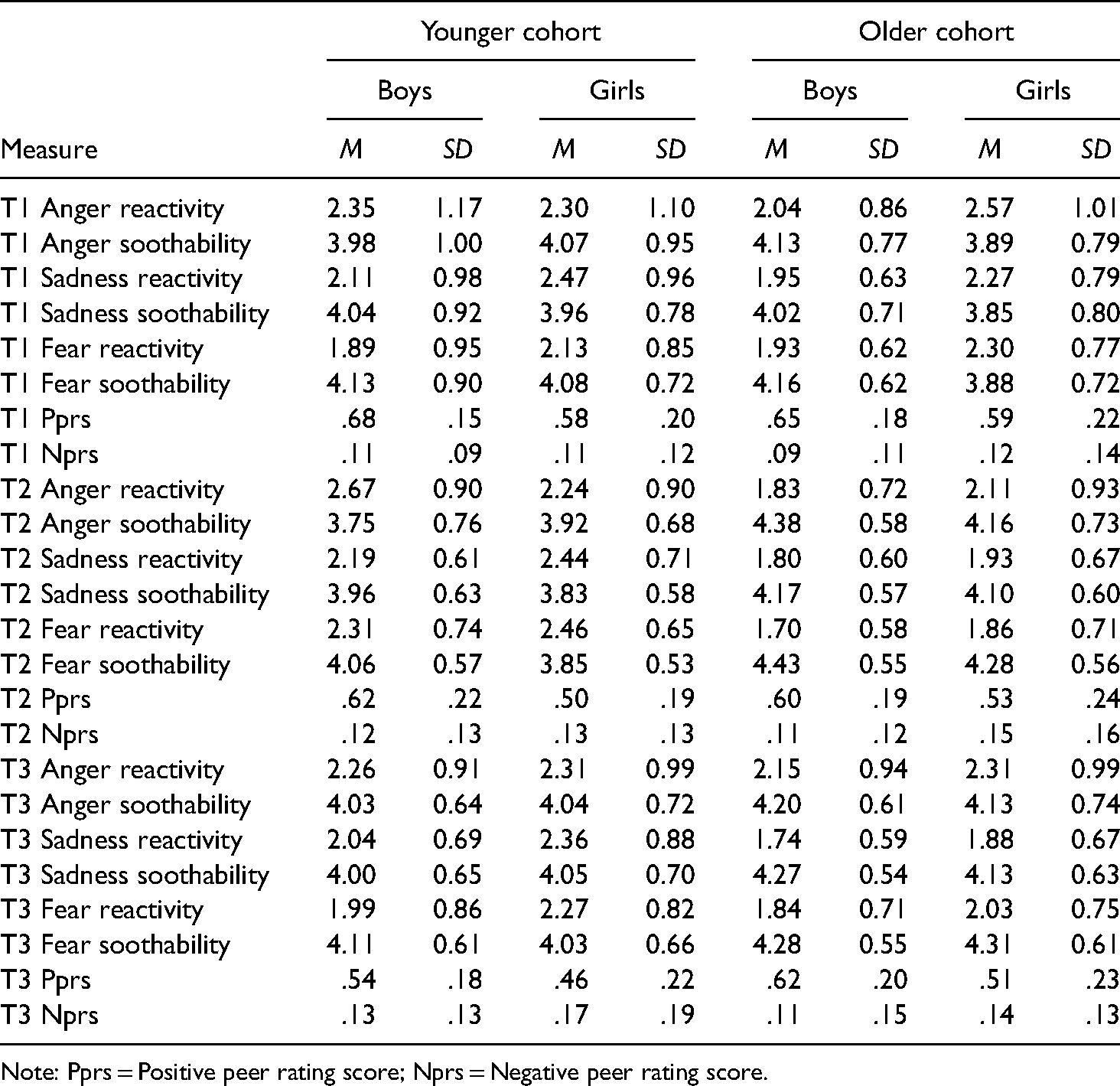
Note: Pprs = Positive peer rating score; Nprs = Negative peer rating score.
Correlations between peer status and emotionality measures
Table 2 presents Pearson product-moment correlations between peer status measures and negative emotionality measures when the effects of gender and age cohort are controlled for. Overall, concurrent correlations, as well as correlations across time, were highly significant in the expected direction. Thus, in general, positive peer rating scores were negatively related to negative emotional reactivity and positively related to soothability. In contrast, negative peer rating scores were positively related to negative emotional reactivity and negatively related to soothability. Only fear reactivity tended to be unrelated to measures of peer status.
Partial Pearson correlation coefficients between measures of peer status and negative emotionality at T1, T2, and T3, controlling for gender and age cohort.
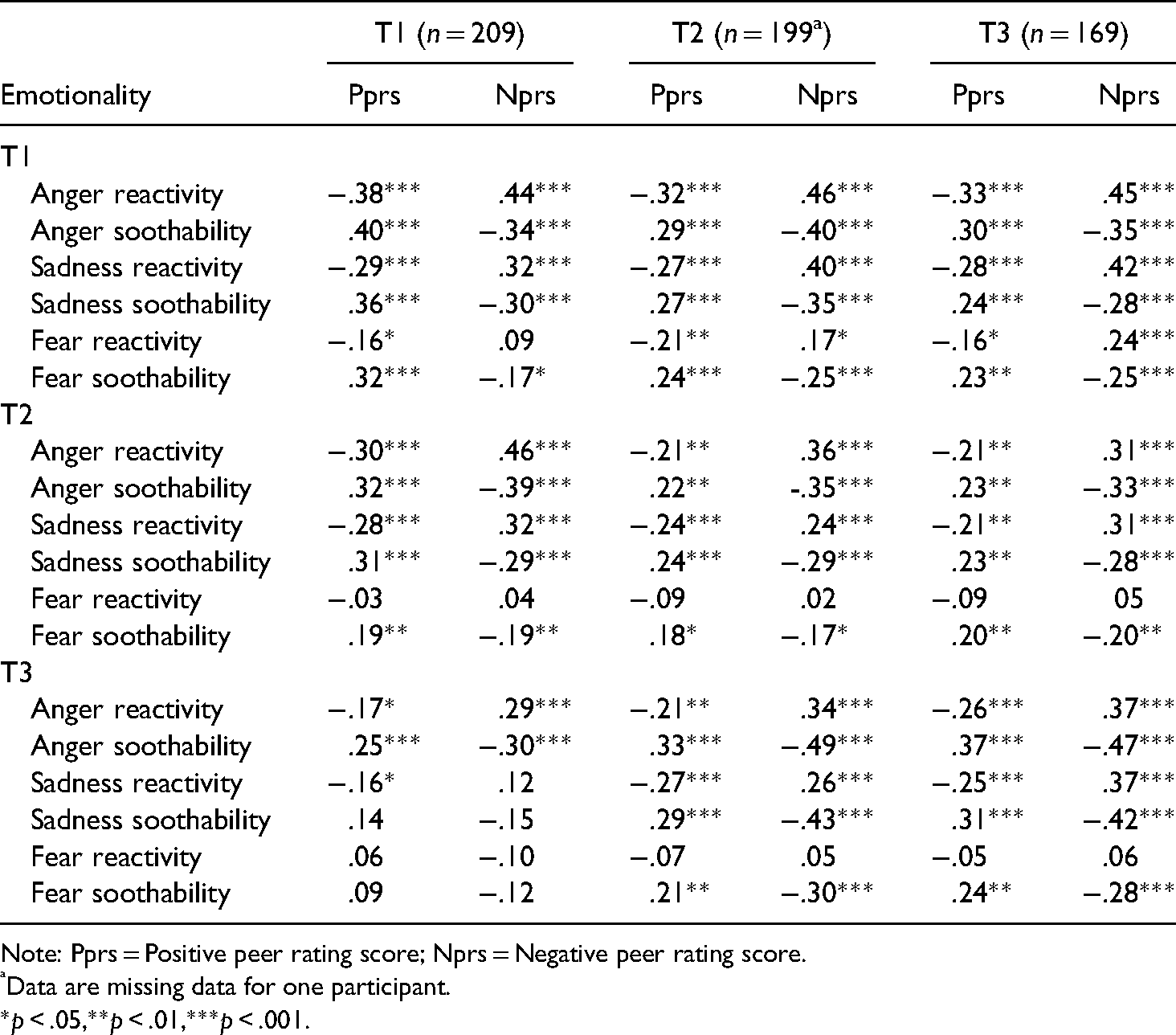
Note: Pprs = Positive peer rating score; Nprs = Negative peer rating score.
Data are missing data for one participant.
p < .05,
p < .01,
p < .001.
Longitudinal SEM models
The longitudinal associations between negative emotionality forms and peer status were first examined through cross-lagged modeling, in which the potential confounding effects of participant gender and age on these associations were controlled at T1, T2, and T3. The fit of the model with externalizing emotion was acceptable χ2 (52) = 105.22, p < .001; TLI = .94; CFI = .97; RMSEA = .07, 95% CI (.05–.09). Results showed significant gender differences in peer status at T1 (β = −.16, SE = .03, p = .033), with boys scoring higher than girls. There were also significant age differences in externalizing emotion at T2, (β = −.31, SE = .04, p < .001), and in peer status at T3 (β = .13, SE = .01, p = .018). Children in the older cohort had lower externalizing emotion at T2 and made more positive peer ratings at T3 than children in the younger cohort. Similar effects were found in the model with internalizing emotion, χ2 (49) = 115.78, p < .001; TLI = .91; CFI = .96; RMSEA = .08, 95% CI (.06–.10). Results indicated that boys had more positive scores on peer status than girls at T1(β = −.17, SE = .03, p = .015), and older children had lower scores on internalizing emotion at T2 (β = −.35, SE = .03, p < .001), and more positive peer rating scores at T3 (β = .13, SE = .01, p = .023) than younger children. In addition, girls had significantly higher scores on internalizing emotion at T1 than boys (β = .20, SE = .10, p = .004), Informed by these initial results, for parsimony, the models were simplified by pruning nonsignificant paths from gender and age cohort. Results of estimated pruned models are shown in Figure 1. Test of the cross-lagged structural model of peer status and externalizing emotion indicated an acceptable fit to the data, χ2 (61) = 116.18, p < .001; TLI = .95; CFI = .97; RMSEA = .07, 95% CI (.05–.08). As shown in Figure 1(a), the measured variables are loaded in the expected direction on the latent constructs. Thus, latent externalizing emotion refers to higher tendencies to express externalizing emotion, and latent peer status refers to a positive peer status. As expected, externalizing emotion and peer status were negatively related at T1 (r = −.55, p < .001). In addition, the autoregressive paths were significant for externalizing emotion (T1–T2: β = .58, SE = .06, T2–T3: β = .39, SE = .07.ps < .001), and peer status (T1–T2: β = .64, SE = .08, p = .015, T2–T3: β = .81, SE = .08, ps < .001), indicating relative stability of the latent constructs. The hypothesized transactional nature of the interplay between peer status and negative emotionality was supported by significant negative paths from T1 externalizing emotion to T2 peer status (β = −.20, SE = .01, p = .007), and from T2 peer status to T3 externalizing emotion (β = −.36, SE = 37, p < .001). The negative path from T1 peer status to T2 externalizing emotion was close to statistical significance (β = −.12, SE = .34, p = .086). Age effects were still significant, but the gender effect on peer status was no longer significant (p = .135).

Cross-lagged structural models of associations between peer status and (a) externalizing emotion, (b) internalizing emotion.
Also test of the cross-lagged structural model of peer status and internalizing emotion yielded an acceptable fit, χ2 (57) = 117.63, p = .000; TLI = .93; CFI = .96; RMSEA = .07, 95% CI (.05–.09). The autoregressive paths were significant for internalizing emotion (T1–T2: β = .55, SE = .06, T2–T3: β = .39, SE = .07, ps < .001), and peer status (T1–T2: β = .67, SE = .08, T2–T3: β = .81, SE = .08, ps < .001), as was also the association between internalizing emotion and peer status at T1 (r = −.35, p < .001). In addition, as shown in Figure 1(b), there were significant negative paths from T1 internalizing emotion to T2 peer status (β = −.20, SE = .02, p = .002), and from T2 peer status to T3 internalizing emotion (β = −.24, SE = .23, p < .001). Gender and age cohort effects were still significant.
Discussion
This study investigated longitudinal bidirectional influences between negative emotionality and peer status in elementary school children. It was hypothesized that children with high negative emotionality might be trapped in a vicious circle in which negative emotionality and low social status among peers contribute to one another across time. Our results supported this hypothesis, both for externalizing emotion (anger) and internalizing emotion (sadness, fear). This finding is important as the combination of negative emotionality and peer rejection carries a particularly high risk of developing later adjustment problems. Prior research has shown that negative emotionality in childhood may be linked to later adjustment problems via its negative effect on peer status (Brendgen et al., 2005), and that negative emotionality may amplify the effect of peer rejection on depression (Buil et al., 2017). Thus, the dynamic interplay between negative emotionality and peer rejection may determine the long-term consequences of negative emotionality on mental health.
Consistent with prior longitudinal studies of younger children (e.g., Hasenfratz et al., 2015; Maszk et al., 1999), negative emotionality predicted low peer status. Taken together, these findings indicate that a child's frequent and intense expression of negative emotion is perceived negatively by peers throughout childhood. Accordingly, unless young children with high negative emotionality are able to develop better control over their emotions, they risk gaining a long-lasting low status among peers that, as already noted, is associated with considerable distress and negative developmental outcomes.
Negative emotionality may contribute to low peer status in several ways. Children who often react with strong negative emotions may be disliked because they tend to be more aggressive or withdrawn than their peers, but also other factors could mediate the effect of negative emotionality on peer status. Strong negative emotions may interfere with information processing in social situations, making it more difficult to direct attention to relevant social cues, and flexibly enhance or suppress emotional expressions to align with situational demands (Lemerise & Arsenio, 2000). Both children's attentional problems (Tseng et al., 2014), and inability to flexibly suppress emotional expressions in line with situational demands (Wang & Hawk, 2020), have been shown to predict low peer status. Hence, such problems might potentially mediate a negative effect of negative emotionality on peer status.
Results supporting the hypothesized positive feedback effect of low peer status on negative emotionality are in accord with previous developmental studies that have shown that low status may increase negative emotionality in younger children. Yet, earlier support for this effect is quite inconsistent (Hernández et al., 2017; Maszk et al., 1999), and, in two studies, no predictive effect of peer status on negative emotionality over time was found (Hasenfratz et al., 2015; Hernández et al., 2018). A possible explanation for this heterogeneity of results is that age-related growth in cognitive skills allows children to improve their emotional control (Bengtsson & Arvidsson, 2011). Thus the effect of peer status on negative emotionality over time may be balanced by improvements in emotion regulation skills, and, in statistical analyses, these opposite effects may sometimes cancel each other out. Future research should therefore examine contextual factors that might moderate the influence of peer status on negative emotionality.
Concurrent associations between emotionality measures (teacher ratings) and social status (peer ratings) were highly consistent, most of them moderate in size. One factor that contributes to this consistency is that teachers and classmates to a large extent are likely to base their impressions of a child on common experiences in the school environment. Because strong expressions of negative emotions can disrupt structured school activities, it is likely that such expressions will receive a lot of attention. Thus, our findings are based on children's expressed negative emotions and may not apply equally to their subjective emotional experience. Children's self-reported negative emotionality correlates only modestly with ratings made by their parents or teachers, as they are based only in part on the same set of observations (De Los Reyes & Kazdin, 2005).
Consistent with several earlier findings, the current findings revealed a considerable stability in children's relative position over time on continuous measures of negative emotionality (Peterson et al., 2018; Sallquist et al., 2009) and peer status (Jiang & Cillessen, 2005). Theoretically, bidirectional influences between negative emotionality and peer status may contribute to this stability. Individual differences in children's negative emotionality are likely to be maintained, or even increased, if children who frequently and intensely express negative feelings are rejected by peers. Peer rejection, in turn, leads them to continue, or increasingly, react with strong and frequent negative emotions during peer interactions. Similarly, if children's relative peer group status is negatively affected by their tendency to display strong negative affect, rejected children are likely to continue to be rejected if peer rejection encourages an increase in displays of strong negative affect.
Limitations and future directions
In the current study, participants were recruited from socioeconomically mixed schools in both urban and rural areas. This sample diversity should increase the generalizability of the findings to other schools. Nevertheless, more research is needed to clarify the generalizability of our results. There are cultural differences in display rules for emotions and social behaviors that are often driven by emotions, including social withdrawal and aggressive acts (Matsumoto et al., 2008). Such differences can be expected to influence how the relation between negative emotional expressivity and peer status develops over time. Furthermore, it is uncertain whether our findings apply equally to all types of school contexts. There are circumstances in school that probably can attenuate the link between negative emotionality and peer status. For example, links between negative emotionality and peer status might be attenuated when deliberate attempts are made to help children with high negative emotionality gain acceptance from peers and expressions of negative emotion in the classroom are handled in a constructive way that does not reinforce negative peer attitudes toward the emotionally afflicted child. Finally, because in the current study, all measurement was deliberately restricted to the school environment, our results are limited to the effects of peer status on emotional expressivity at school. Future research should examine whether children's popularity among classmates has effects that generalize to children's behavior at home, or in other out-of-school contexts, and investigate the potential ensuing interpersonal dynamics.
The outcome of a longitudinal study like ours will depend on how well the chosen data collection intervals match the time dynamics of the studied phenomenon. In the current study, we examined cross-lagged effects with data waves separated by approximately 1 year. Had shorter or longer time spans been selected, the conclusion from the study might have been different. Another factor that may have affected our results is the association between the study variables and participant attrition, dropouts having higher negative emotionality and lower peer status than non-dropouts. This effect may have caused changes in classroom dynamics and participants’ relative position on study measures that would not have occurred without participant dropout. Accordingly, more research is needed on how timespan and factors are affected by timespan and how time-related factors, such as changes in the composition in the peer group, moderate the reciprocal effects of negative emotionality and peer status.
The estimated cross-lagged structural models of peer status and negative emotionality had an acceptable fit to the data. This fit may have been further increased by controlling for the effect of socioeconomic background on peer status and negative emotionality. Thus, the fact that information on socioeconomic status for the individual children was not collected is a limitation of the study. Moreover, in future studies, more differentiated rating scales may be used to assess participants’ attitude toward classmates. A 5-point rating scale would probably better capture nuances in attitudes than the 3-point rating scale employed in the current study. Finally, our results highlight the need for research on interventions that may be used in efforts to help children with high negative emotionality avoid getting caught in the vicious circle that may be generated by the reciprocal effects of negative emotionality and peer status.
Footnotes
Declaration of conflicting interests
The authors declared no potential conflicts of interest with respect to the research, authorship, and/or publication of this article.
Funding
This research was supported by a grant from Crafoordska stiftelsen.
