




Abstract
This study investigated how Spanish-speaking children interpret events when confronted with evidential and epistemic markers. Seventy-two children aged four, six, and eight completed a narrative comprehension task involving three conditions: sincerity (linguistic and visual information aligned), trickery (conflicting information), and blind (linguistic information only). Results revealed clear age-related differences in interpretation. Four-year-olds showed higher accuracy with expressions of subjective certainty, whereas 6- and 8-year-olds were more accurate when evidential markers explicitly indicated the source of information, particularly in the blind condition. These findings point to an age-related shift from reliance on subjective certainty to greater sensitivity to source-based linguistic cues, even in a language such as Spanish that lacks grammaticalised evidentiality.
Introduction
When acquiring a language, children do not just passively receive the information, but they actively evaluate where this information comes from, distinguishing between seeing something first-hand and being told about it, or between being sure of a fact and merely guessing. The acquisition of linguistic markers that convey the source and reliability of information constitutes a critical component of pragmatic and cognitive development in early childhood. Among these, evidentiality (i.e. linguistic marking of information source) and epistemic modality (i.e. marking the speaker’s degree of certainty) play central roles in how speakers express their knowledge, beliefs, and degrees of certainty.
Research on the acquisition of evidentiality has shown that, in morphologically marked systems—many of which are agglutinative languages—such as Turkish, children often produce evidential forms before they demonstrate full comprehension of their semantic and pragmatic implications (Aksu-Koç, 1988; Fitneva, 2018; Ünal & Papafragou, 2016). However, some studies indicate that the acquisition of evidential distinctions depends not only on conceptual readiness, such as source monitoring, but also on the distribution and syntactic–semantic complexity of evidential and epistemic forms in the input (Koring & De Mulder, 2015; Papafragou et al., 2007b; Ünal & Papafragou, 2016).
While a considerable amount of research has been conducted in morphologically marked languages, much less is known about the development of evidential and epistemic meanings in languages like Spanish, where these meanings are conveyed through a variety of lexical and syntactic strategies rather than through dedicated grammatical markers. The present study addresses this gap by investigating age-related differences in the interpretation of evidential and epistemic markers in Spanish-speaking children between the ages of four and eight. Using an experimental design with multimodal scenarios that combine linguistic information with visual evidence, we examine how children across different age groups evaluate conflicting or converging information sources, and how their judgements are shaped by different types of markers and grammatical constructions. The study further compares how physical and linguistic evidence is interpreted across age groups and identifies which linguistic forms are assigned greater interpretive weight at different ages. In doing so, this research aimed to contribute to our understanding of the cognitive and linguistic factors involved in the interpretation of evidential and epistemic meaning in Spanish.
This paper is structured as follows. Section “Literature Review” reviews the relevant literature on evidentiality and epistemic modality, with a focus on their expression in Spanish and on prior findings from acquisition studies in typologically diverse languages. Section “Present Study” presents the research questions and hypotheses guiding the current study. Section “Method” describes the experimental methodology, including participants, materials, design, and procedures. Section “Results” reports the results of the pre-task and main task, including both descriptive and binary logistic regression models. Section “Discussion” discusses the findings in relation to previous research, theoretical implications, and potential explanations for developmental trends. Finally, Section “Limitations and Future Directions” addresses limitations and outlines directions for future research, followed by concluding remarks in Section “Conclusion.”
Literature Review
Evidentiality and Epistemic Modality in Spanish
Evidentiality and epistemic modality are two closely related yet conceptually distinct linguistic categories. Evidentiality refers primarily to the linguistic encoding of the source of information, indicating how the speaker has acquired knowledge or information (Aikhenvald, 2004; González Ruiz et al., 2016). Aikhenvald (2004) distinguishes between direct and indirect evidentiality as two fundamental types. Direct evidentiality refers to information acquired through firsthand experience, typically visual or sensory perception. Indirect evidentiality, by contrast, includes information obtained through inference or hearsay. These distinctions are often grammatically encoded in languages with evidential systems, marking whether the speaker directly witnessed an event or learned about it through secondary means. Epistemic modality, on the other hand, concerns the speaker’s evaluation of the reliability, certainty, or likelihood of the proposition expressed (Boye, 2012; Cornillie, 2007). Although these two categories frequently interact and overlap in natural language use, it is crucial to distinguish them clearly as separate semantic domains (Boye, 2012; Cornillie, 2009).
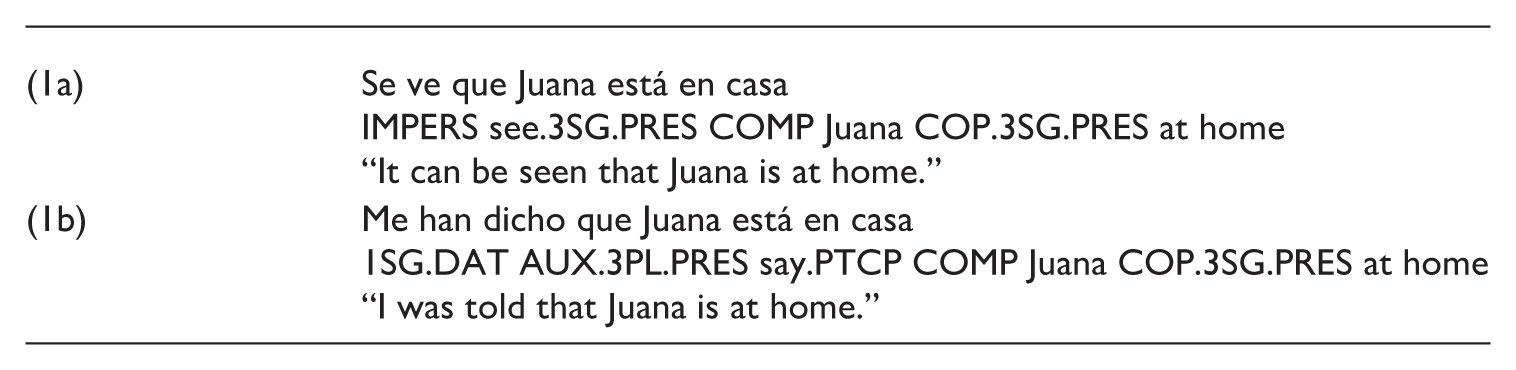
In Spanish, evidentiality is not grammaticalised as a dedicated morphological category, unlike in languages such as Quechua or Turkish. Instead, evidential meanings are conveyed through a range of lexical and grammatical resources. Lexical verbs of perception and cognition constitute the primary means of expressing evidentiality in Spanish. Verbs such as ver (“see”), oír (“hear”), parecer (“seem”), and resultar (“turn out”) explicitly encode sensory or inferential sources of information (Cornillie, 2007; González Ruiz et al., 2016). Constructions with perception verbs, such as se ve que (“it can be seen that”) or se oye que (“it can be heard that”), mark direct evidentiality, referring to first-hand perceptual access (see example 1a) (Marcos Sánchez, 2016). By contrast, indirect evidentiality encompasses meanings derived from inference or report, as in me han dicho que. . . (“I’ve been told that. . .”) or parece que. . . (“it seems that. . .”) (example 1b).
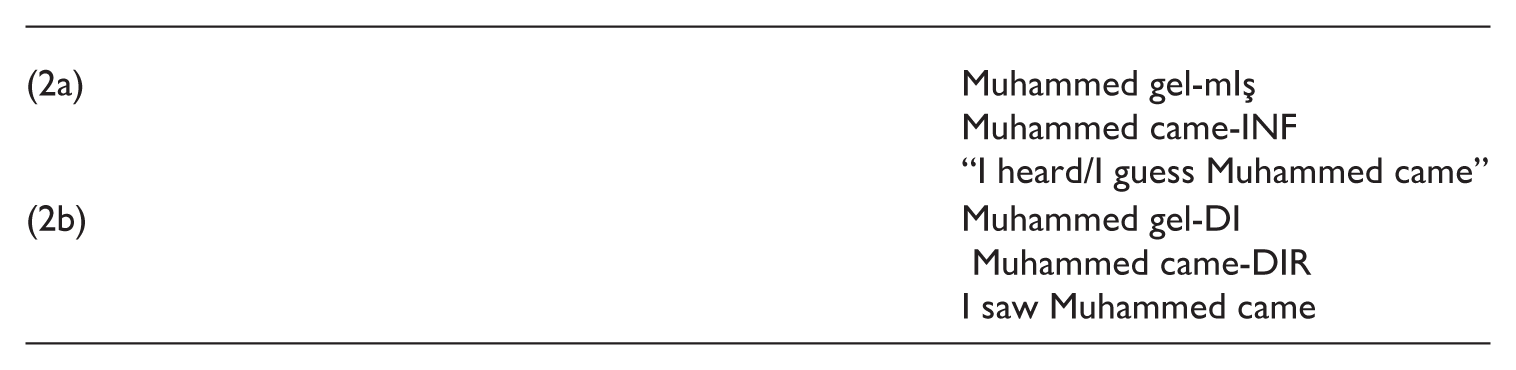
Other languages, such as Turkish or Quechua, grammaticalise evidentiality through affixes or particles. For instance, Turkish obligatorily marks past events with one of two suffixes (Papafragou et al., 2007a): -mIş (indirect evidence: inference/hearsay) or -DI (direct evidence) (see examples 2a and 2b 1 ).
In turn, Quechua distinguishes between three evidential enclitics: -mi (direct), -cha (inference), and -si (report) (see examples 3, extracted from Courtney, 2015, pp. 5–6).
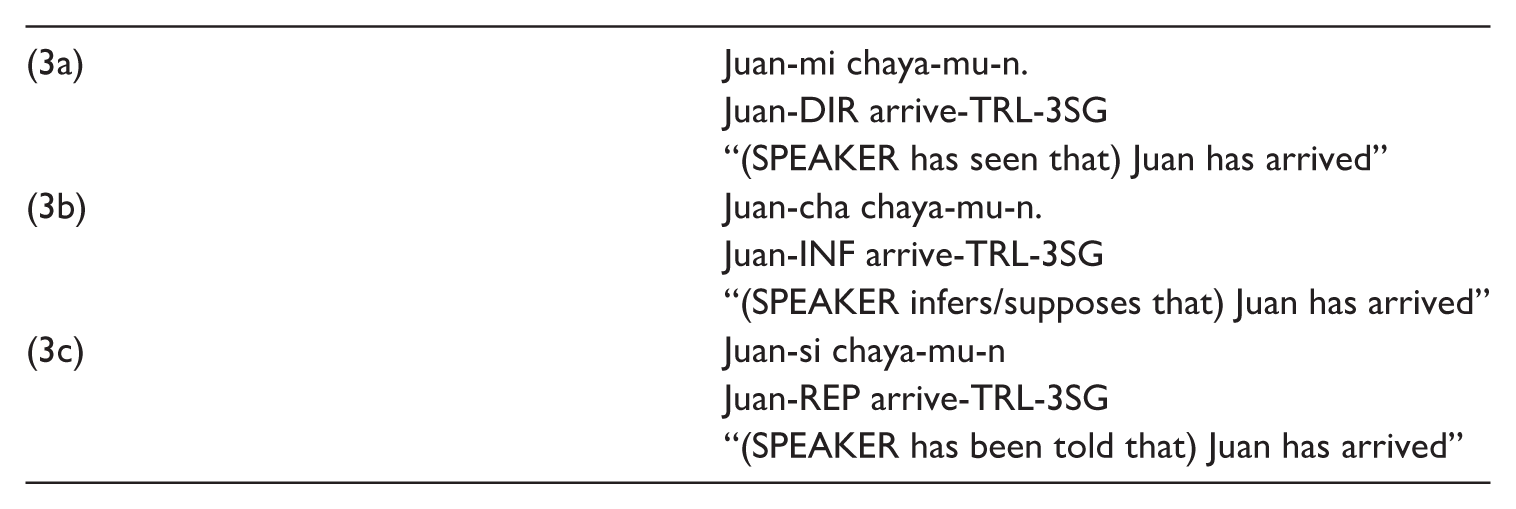
This internal classification into direct (first-hand perception) and indirect (inference or hearsay) evidentiality parallels the morphological contrasts found in systems such as Turkish (-DI vs. -mIş) or Quechua (-mi vs. -si). Evidential meanings in Spanish are further expressed through adverbs (aparentemente “apparently,” evidentemente “obviously”), verbal constructions (conditional or perfect forms such as habría llegado “he would have arrived,” ha debido salir “he must have left”) (Cornillie & Gras, 2015; González Ruiz et al., 2016), and discourse markers (al parecer “apparently,” según parece “seemingly”) or parenthetical expressions (creo yo “I think,” me parece “I believe”), which signal either the informational source or the speaker’s stance towards the proposition (Cornillie, 2009; González Ruiz et al., 2016).
Epistemic modality in Spanish encodes the speaker’s assessment of the certainty, doubt, or probability associated with a proposition. Spanish expressions form a continuum of epistemic strength, ranging from high to low certainty. At the high end are verbs such as saber (“know”) and intensifying predicates like estar muy seguro (“be really sure”); intermediate expressions include estar bastante seguro (“be quite sure”) and adverbs such as probablemente (“probably”); low-certainty expressions include creer (“believe”) and posiblemente (“possibly”). Epistemic meanings are realised through diverse grammatical and lexical resources: modal verbs (poder “can,” deber “must”), adverbs (quizá “maybe,” probablemente “probably,” seguramente “most likely”), verbal moods (indicative vs. subjunctive), and tense–aspect combinations (Cornillie & Gras, 2015; González Ruiz et al., 2016). For instance, the indicative mood generally encodes higher certainty or factuality (Juan está enfermo “Juan is sick”), whereas the subjunctive mood typically conveys uncertainty or hypothetical meanings (Quizás Juan esté enfermo “Maybe Juan is sick”) (Cornillie & Gras, 2015). Modal verbs such as deber “must” often indicate inferred knowledge or assumption based on indirect evidence (Debe estar en casa ahora “He must be home now”), thus combining epistemic modality with evidential nuances (Cornillie & Gras, 2015; González Ruiz et al., 2016). This gradient organisation—spanning strong, intermediate, and weak certainty—captures the scalar nature of epistemic modality in Spanish and aligns with cross-linguistic analyses of epistemic strength (Boye, 2012; Cornillie, 2007).
Acquisition of Evidentiality in Morphologically Marked Languages
Previous research has primarily examined languages where evidentiality is marked morphologically, such as Turkish, Korean, Japanese, or Quechua (Aksu-Koç, 1988; Aksu-Koç et al., 2009; Courtney, 2015; Matsui & Yamamoto, 2013; Ozturk & Papafragou, 2016). Studies on evidentiality have employed various approaches, including observational methods, as well as production and comprehension tasks (see Fitneva, 2018, for a comprehensive review).
Observational research provides interesting insights on how evidentials emerge in child speech from early on, since these studies usually include younger participants than those in experimental studies. For example, in Turkish, it was observed that children start to use the direct evidential -DI at about 18 months and the indirect evidential -mIş at about 21 months (Aksu-Koç, 1988). Different uses of -mIş are also reported. By 24 months, Turkish children use -DIr (deduction from previous knowledge or experience, in Aksu-Koç et al., 2009) to name objects and, by 30 months, for long-standing knowledge-based inferences. Finally, at the 36th month, -mIş marks hearsay information. A similar developmental pattern is observed in Quechua, a language that has optional evidential enclitics and verb suffixes. In observational studies by Courtney (1999, 2015), it was discussed that while young children begin to use evidential enclitics and verb suffixes early, their understanding of evidential distinctions develops gradually. Between ages three and four, -mi is used for direct evidence, -cha for inference, and -ra and -sqa for direct and indirect experiences, respectively. The hearsay enclitic -si emerges later, around age 4;2, mainly to relay third-party commands. Results from production-based studies in Turkish and Korean indicate that evidential meanings are established by approximately the age of four (Aksu-Koç, 1988; Papafragou et al., 2007a).
Comprehension studies in Turkish examined how children identify speakers using -DI vs. -mIş and -DI vs. -DIr in picture-based tasks (Aksu-Koç, 1988, 1998; Aksu-Koç et al., 2005). In the pioneer study by Aksu-Koç (1988), children aged from three to six described toy-acted events from two perspectives: (a) a direct observer witnessing all phases (-DI) and (b) an indirect observer seeing only the start and end (-mIş). Three-year-olds showed strong control of -DI, that is, the direct evidence (approximately, a 90% accuracy), while -mIş was mastered around age 4, particularly for reportative use. Similarly, the use of -DIr, which conveys logical inference or general truths, was stabilised by 4-4;5 years (Aksu-Koç, 1988; Aksu-Koç & Alp, 2005; Ögel, 2007).
Ünal and Papafragou (2016) conducted five experiments to investigate how Turkish-speaking children acquire evidential morphology. Their findings revealed a notable asymmetry: While 3- to 6-year-olds accurately produced evidential markers, they struggled with comprehension across the first four experiments. The final experiment provided further insight, showing that children had difficulty reasoning about others’ sources of evidence in non-linguistic tasks but performed well when evaluating their own evidential sources.
Similarly, Papafragou et al. (2007b) examined the acquisition of evidential markers in two languages with different evidential systems: Korean, in which evidentiality is expressed morphologically through particles marking direct and indirect evidence, and English, which lacks grammaticalised evidentiality. Using a combination of production, comprehension, and non-linguistic source-monitoring tasks, they found that although 3- and 4-year-old Korean-speaking children were able to produce evidential markers, their comprehension was inconsistent across tasks. Crucially, despite these difficulties in linguistic tasks, Korean-speaking children performed on a par with their English-speaking peers in non-linguistic source-monitoring tasks, suggesting that conceptual understanding of information sources is not dependent on the comprehension of grammatical evidential markers. These findings raise the question of whether, and under what conditions, linguistic expressions of evidentiality facilitate children’s interpretation of information sources in languages without grammaticalised evidential systems. The present study addresses this question by examining Spanish, a language that, like English, lacks obligatory evidential morphology but, unlike English, makes extensive use of lexical and discourse-based evidential markers. By comparing children’s interpretation of evidential and epistemic cues across age groups in Spanish, the current study provides further cross-linguistic evidence on how different linguistic strategies for expressing evidentiality shape children’s evaluation of information sources.
Related evidence for this objective in another language without morphologically marked evidentiality comes from Ifantidou (2009), who investigated the development of lexical evidential expressions in Modern Greek in relation to children’s metarepresentational abilities. Using comprehension tasks and reasoning tasks, the study showed that children are often better at evaluating sources of information than at interpreting linguistic evidential markers. In particular, when linguistic cues conflicted with perceptual evidence, children tended to rely on direct perceptual information, suggesting that integrating linguistic and non-linguistic sources of evidence involves greater metarepresentational complexity. These findings raise the question of how children integrate linguistic evidential cues with other sources of information when evaluating speakers’ knowledge states, and under what conditions linguistic expressions of evidentiality facilitate children’s interpretation of information sources in languages without grammaticalised evidential systems.
Acquisition of Epistemic Modality
The acquisition of epistemic modality has been extensively studied, revealing a persistent delay in children’s use of epistemic modal verbs (must, might, may) compared with their root counterparts (can, have to) (Cournane, 2021; Kuczaj & Maratsos, 1975; Wells, 1979). This so-called Epistemic Gap (Cournane, 2021) has traditionally been attributed to conceptual immaturity, particularly limitations in metarepresentational reasoning linked to Theory of Mind (Papafragou, 1998, 2001).
However, corpus and experimental studies challenge this explanation, suggesting that syntactic complexity and input factors better account for the delayed acquisition of epistemic modal expressions (Cournane, 2021; van Dooren et al., 2022). Research shows that while epistemic modals appear later in production, children as young as 12 months exhibit epistemic reasoning abilities, such as monitoring knowledge states and expressing uncertainty (Goupil et al., 2016; Onishi & Baillargeon, 2005). Moreover, children frequently use epistemic adverbs (maybe, probably) well before their first epistemic modal verbs (O’Neill & Atance, 2000). In fact, epistemic uses of modal verbs are cross-linguistically less frequently attested in the input than in root use. Eye-tracking studies provide further evidence that children are sensitive to epistemic modality before they can reliably produce it. Moscati et al. (2017) found that 5-year-olds grasp the distinction between possibility and necessity modals at an earlier stage than their behavioural responses suggest.
Corpus analyses reveal that epistemic modal verbs are rare in child-directed speech, making up only 8% of modal uses in English (van Dooren et al., 2017) and an even smaller proportion in other languages, such as Dutch and Bosnian/Croatian/Serbian (van Dooren et al., 2019; Veselinović & Cournane, 2020). The first epistemic modal verbs children produce tend to be those that are more frequent and primarily epistemic in the input, such as might and must in English, whereas epistemic readings of polysemous modals emerge even later. In contrast, epistemic adverbs appear from age 2 in multiple languages (Bassano, 1996; Veselinović & Cournane, 2020), and children’s early adverb uses already show adult-like distribution and pragmatic appropriateness (Cournane, 2021). This discrepancy suggests that children’s difficulties with epistemic modal verbs arise not from a lack of epistemic concepts but from the greater syntactic complexity of modal verbs, which take larger complements and require higher syntactic embedding (Hacquard, 2010).
Beyond semantics, children must develop pragmatic competence in epistemic modality, particularly in scalar implicatures (e.g. posiblemente “possibly” vs. seguramente “most likely” involving a different modal strength). Children struggle with deriving scalar implicatures, due to developmental factors. Studies show that younger children (4–5 years old) often fail during those inferences, while by age 6 to 7, most succeed (Foppolo et al., 2012). Two main explanations exist: The lexicalist approach argues that children have not yet linked scalar terms in a structured scale, making retrieval difficult (Barner et al., 2011; Tieu et al., 2015), while the processing approach suggests children prioritise cognitive efficiency over enriched interpretations (Pouscoulous et al., 2007). Additionally, research indicates children perform better with ad hoc implicatures, which rely solely on context, than with scalar implicatures, which require lexical knowledge (Stiller et al., 2015; Horowitz et al., 2018).
Taken together, previous research shows that children’s ability to interpret epistemic and evidential meanings is shaped by multiple factors, including the grammatical systems of their languages, the distinction between production and comprehension, and the syntactic and discursive properties of the markers involved. Yet, almost all prior work has focused on languages with grammatical evidentiality. Spanish, where evidentiality is exclusively expressed by discursive or lexical means, has received virtually no attention in developmental studies, despite offering a typologically distinct setting in which evidential and epistemic meaning must be inferred without grammatical support. This gap highlights the need to investigate how Spanish-speaking children evaluate different sources of information in the light of lexical expressions that encode evidential or epistemic meanings.
Present Study
As described earlier, the acquisition of evidentiality and epistemic modality has been widely explored in many languages, especially those that use morphological markers to express direct and indirect sources of information (Aksu-Koç, 1988; Aksu-Koç et al., 2009; Fitneva, 2018; Ozturk & Papafragou, 2016; Ünal & Papafragou, 2016). However, to our knowledge, no previous study has investigated the development of these features in Spanish-speaking children. Therefore, the objective of the present study was to investigate event interpretation when using evidential or epistemic expression in children aged 4, 6, and 8 years.
This study aimed to answer the following research questions in relation to how children evaluate source information in event interpretation:
In the current study, we operationalised evidentiality in terms of source type (direct vs. indirect) and epistemic modality in terms of degree of certainty (strong vs. weak). These distinctions are essential to capture the full range of interpretive cues available to Spanish-speaking children. Building on previous research on evidentiality acquisition (Aksu-Koç, 1988; Fitneva, 2018), we hypothesise that there will be group differences in accuracy rates when children are presented with evidential and epistemic expressions. Evidentials are predicted to enhance confidence in linguistic information by explicitly indicating the source, with the older group being more accurate in comparison with the younger group (RQ1). Besides, following Ifantidou (2009), we hypothesise that children’s responses will be shaped by the presence or absence of physical evidence, particularly in cases where it conflicts with linguistic input. In such scenarios, we expect children to prioritise physical evidence (RQ2). Finally, we expect modalisers (specifically adverbs) to provide more reliable cues in younger age groups due to their earlier acquisition (Bassano, 1996; Veselinović & Cournane, 2020) (RQ3).
Method
Participants
We recruited 72 children from a school in Galicia (Spain). All children were bilingual native speakers of Spanish and Galician and were reported to be typically developing. The participants were divided into three age groups:
Instrument Development
The development of the experimental instrument involved several phases. First, we compiled an initial list of potential lexical markers expressing different degrees of evidential and epistemic strength. These items were embedded in short sentences and presented to native Spanish adults in order to assess the degree of certainty conveyed by the sentence. The test included seven sentences and was presented to the participants as an online questionnaire. The structure of the question was the following:
¿Cuál de ambas frases te hace pensar que es más probable que Juan esté en el bar?
(“Which of the phrases makes you think it is more probable that Juan is in the bar?”)
He visto que Juan está en el bar (“I’ve seen that Juan is in the bar”).
Me han dicho que Juan está en el bar (“I’ve been told that Juan is in the bar”).
Misma probabilidad (“Same probability”).
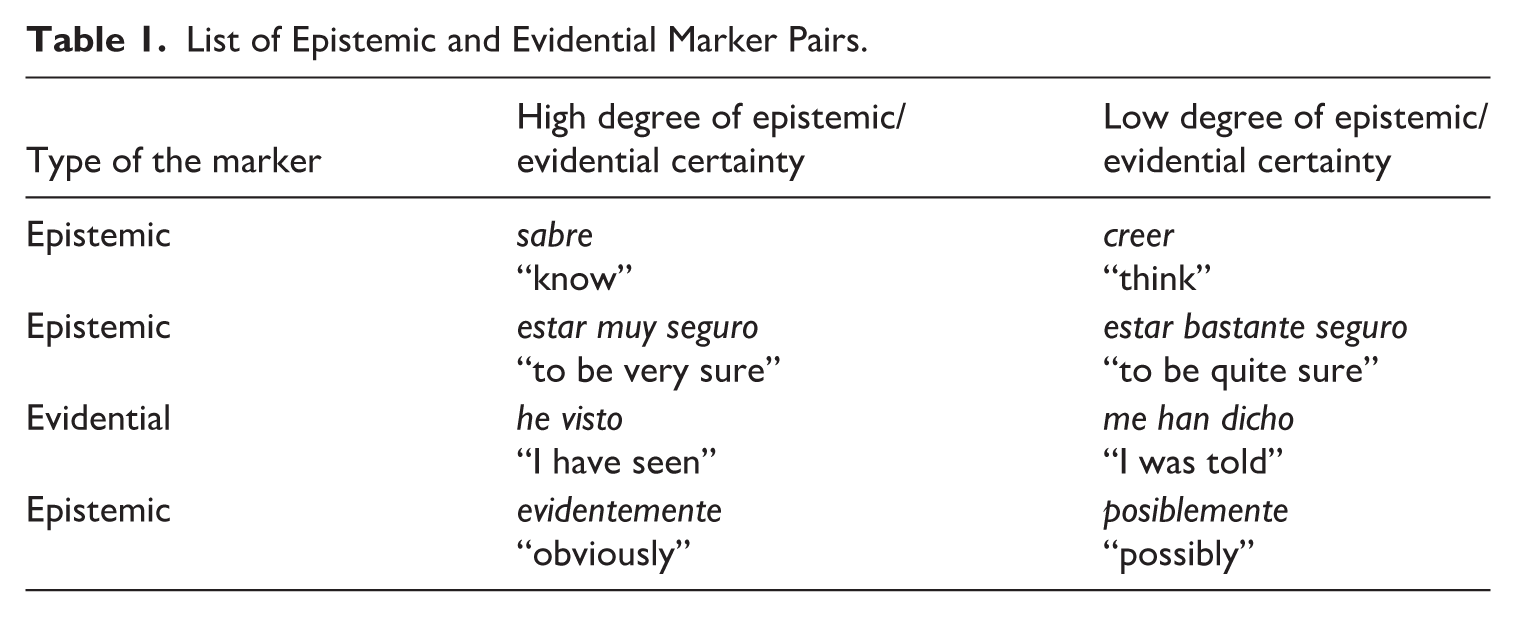
Items that did not yield a clear contrast in degree of certainty, such as posiblemente “possibly”—probablemente “probably,” and suponer “suppose”—creer “believe,” were excluded from the list. This initial questionnaire not only validated these pairs but also established a clear hierarchy of evidential/epistemic strength within each pair. This hierarchy was later used to determine accuracy in the blind condition, where no visual information was available, and the correctness depended solely on the reliability of the linguistic marker used by each character. As the children in our study are Spanish-Galician bilinguals, we selected only those markers with equivalent syntactic, semantic, and pragmatic values in both languages; therefore, we minimised potential cross-linguistic interference. Table 1 summarises the final list of marker pairs. The epistemic marker pairs (verb, adverbs, and expressions of certainty) were included because they all belong to the same semantic domain—encoding degrees of speaker certainty—and because the adult-piloting confirmed consistent reliability contrast within each pair. Although these pairs differ syntactically, they provide comparable epistemic information, allowing us to examine children’s sensitivity to relative certainty across linguistic forms. In contrast, the evidential domain is more limited in Spanish, where evidentiality is not grammaticalised. Only one pair he visto / me han dicho offered a clear evidential contrast appropriate for child testing. For this reason, the number of epistemic and evidential pairs is not symmetrical, but the two domains are treated separately in further analyses.
List of Epistemic and Evidential Marker Pairs.
The experiment task itself consisted of a recorded video presenting 12 scenarios. Each scenario involved a picture and an accompanying narrated story voiced by a female native speaker of Spanish. All pictures were obtained from open-access sources. The images of the princess and the snowman were licensed through Mostphotos (UiT license).
The task was framed as a fairy tale in which participants helped two main characters—a princess and a snowman—find objects needed to prepare a magic potion. In each scenario, the two characters made competing statements about the location of an object. For example, in one trial the princess said “Yo sé que el libro está en la estantería” (“I know that the book is on the shelf”), whereas the snowman said “Yo creo que el libro está en el taburete” (“I think the book is on the stool”). Children were asked to decide which character was right.
The experiment included three conditions (adapted from Ifantidou, 2009), and each scenario fell into one of these conditions:
Sincerity condition: linguistic information matched the physical evidence.
Trickery condition: linguistic information conflicted with the physical evidence.
Blind condition: no physical evidence was available, and children had to rely solely on linguistic cues.
The remaining dimensions described in the study—age group, linguistic marker pair, grammatical form, and epistemic/evidential category—were not additional conditions but independent factors of the stimuli that were crossed with these three conditions. The full script of the story with corresponding conditions is provided in Supplemental Appendix 1.
Accuracy in the trickery and blind conditions was determined according to the following rules. In the trickery condition, the linguistic cue conflicted with the physical evidence shown in the picture. Despite this conflict, one character’s utterance always corresponded to the actual location of the object. For example, in one scenario, the children saw that the magic book was on the stool. The princess said, “I know that the book is on the shelf,” while the snowman said, “I think the book is on the stool.” Although “think” conveys less certainty than “know” as a linguistic marker, the snowman’s statement matched the true location and was therefore coded as the correct answer. Thus, accuracy in trickery trials depended on identifying the factually correct statement, even when it was paired with a weaker linguistic marker. In the blind condition, no visual information was available, but the two characters’ utterances differed in epistemic strength. One provided a statement with a stronger evidential or epistemic basis (e.g. “I’ve seen X,” or “I’m very sure”), while the other produced a weaker one (e.g. “I’ve been told X,” or “I think”). The “correct” answer was defined as selecting the character with the objectively stronger linguistic marker, following the established hierarchy of certainty.
When the experimental task was prepared, it was piloted with 40 adult native speakers of Spanish. Adults performed at ceiling in the sincerity condition (98%), showed high accuracy in the trickery trials (95.6%), and were above chance in the blind condition (74%), confirming the expected reliability contrast and validating the experimental manipulation. Adults relied most strongly on the saber/creer pair when judging which character was correct.
Procedure
The experiment was conducted in a designated classroom provided by the school the children attended. Each child participated individually in the study, meeting with the researcher responsible for data collection. The classroom setting consisted of a table, a laptop displaying the experiment, and a tablet used by the researcher to record responses.
At the beginning of the session, children were presented with a slideshow training phase. The researcher paused on each slide until the child provided an oral response, which was then recorded by the researcher.
The main experiment was presented in the form of a video. The researcher played the video and paused it at each response item. At each pause, the child was asked, ¿Quién tiene razón? (“Who is right?”) If the child did not respond, the researcher repeated the question once more: ¿Quién tiene razón? (“Who is right?”). A maximum of seven seconds was allowed for a response. If the child did not answer within this time frame, the video continued to the next item. The researcher was responsible for recording all responses. At the end of the experiment, each child was rewarded with a science-themed pin, aligning with the school’s academic focus for that year.
Statistical Analysis
Participants’ responses were coded as correct (1) or incorrect (0) for each experimental trial. The independent variables included age group, with three levels representing different age cohorts (4-year-olds, 6-year-olds, and 8-year-olds); condition type, with three levels (sincerity, blind, and trickery); and linguistic markers, which could be classified in three ways:
By type: saber/creer vs. he visto/me han dicho vs. evidentemente/posiblemente vs. estoy muy seguro/estoy bastante seguro.
By grammatical category: verbs (saber/creer, he visto/me han dicho) vs. modalisers (evidentemente/posiblemente, estoy muy seguro/estoy bastante seguro).
By epistemic or evidential distinction: epistemic (saber/creer, evidentemente/posiblemente, estoy muy seguro/estoy bastante seguro) vs. evidential (he visto/me han dicho).
A descriptive analysis of participants’ responses was conducted, and a mixed-effects logistic regression was fitted to examine the effects of age, condition, and linguistic marker on response accuracy. All analyses were conducted in RStudio.
Results
Descriptive Results
This section presents the descriptive accuracy rates across age groups and conditions. Descriptive analysis revealed that, overall, the 4-year-old group provided 72.54% correct answers in the test. The 6-year-olds answered correctly 80% of the time, while the 8-year-olds achieved an 85% accuracy rate.
In relation to RQ 1, we analysed participants’ responses according to the type of knowledge source encoded by the linguistic marker, distinguishing between epistemic and evidential meanings. Importantly, this comparison was motivated by semantic–functional considerations rather than by grammatical form: Epistemic markers in the study included verbs, adverbs, and expressions of subjective certainty, whereas evidential markers were limited to verbal constructions explicitly encoding source of information. As shown in Figure 1, 4-year-olds exhibited comparable accuracy rates for epistemic and evidential markers (71% and 74%, respectively). In contrast, children aged 6 and 8 showed higher accuracy with evidential markers (85% and 95%) than with epistemic markers (79% and 81%, respectively), suggesting an increasing sensitivity to explicit source-of-information cues with age.
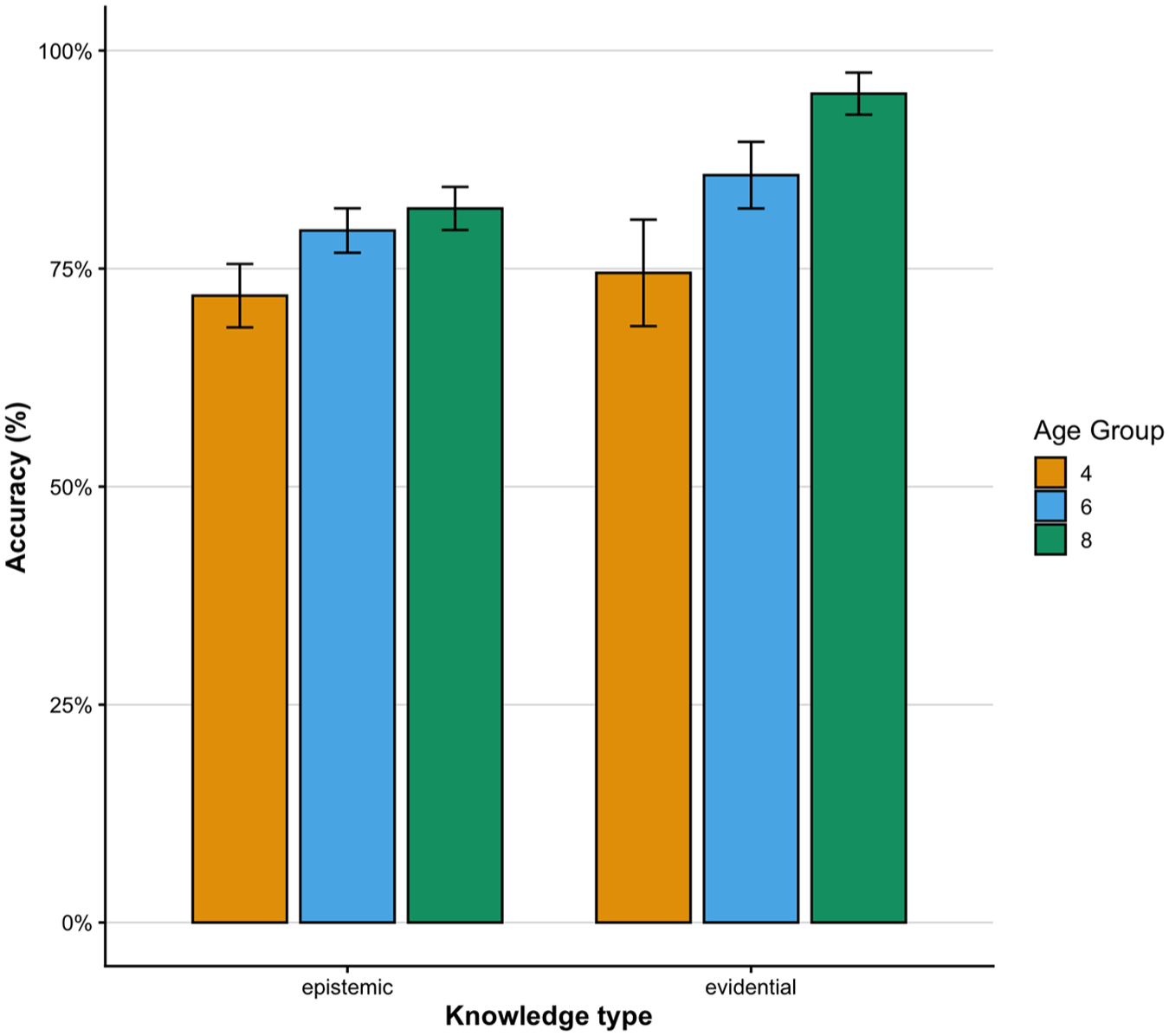
Mean responses per knowledge source in each age group.
Regarding descriptive results of responses in different conditions (RQ 2), all groups of participants responded more correctly in the sincerity condition (4-year-olds = 86%, 6-year-olds = 92%, 8-year-olds = 96%). The lowest results are observed in the blind condition (4-year-olds = 54%, 6-year-olds = 62%, 8-year-olds = 69%). In the trickery condition, the responses were quite accurate in all groups (4-year-olds = 76%, 6-year-olds = 88%, 8-year-olds = 89%) (see Figure 2).
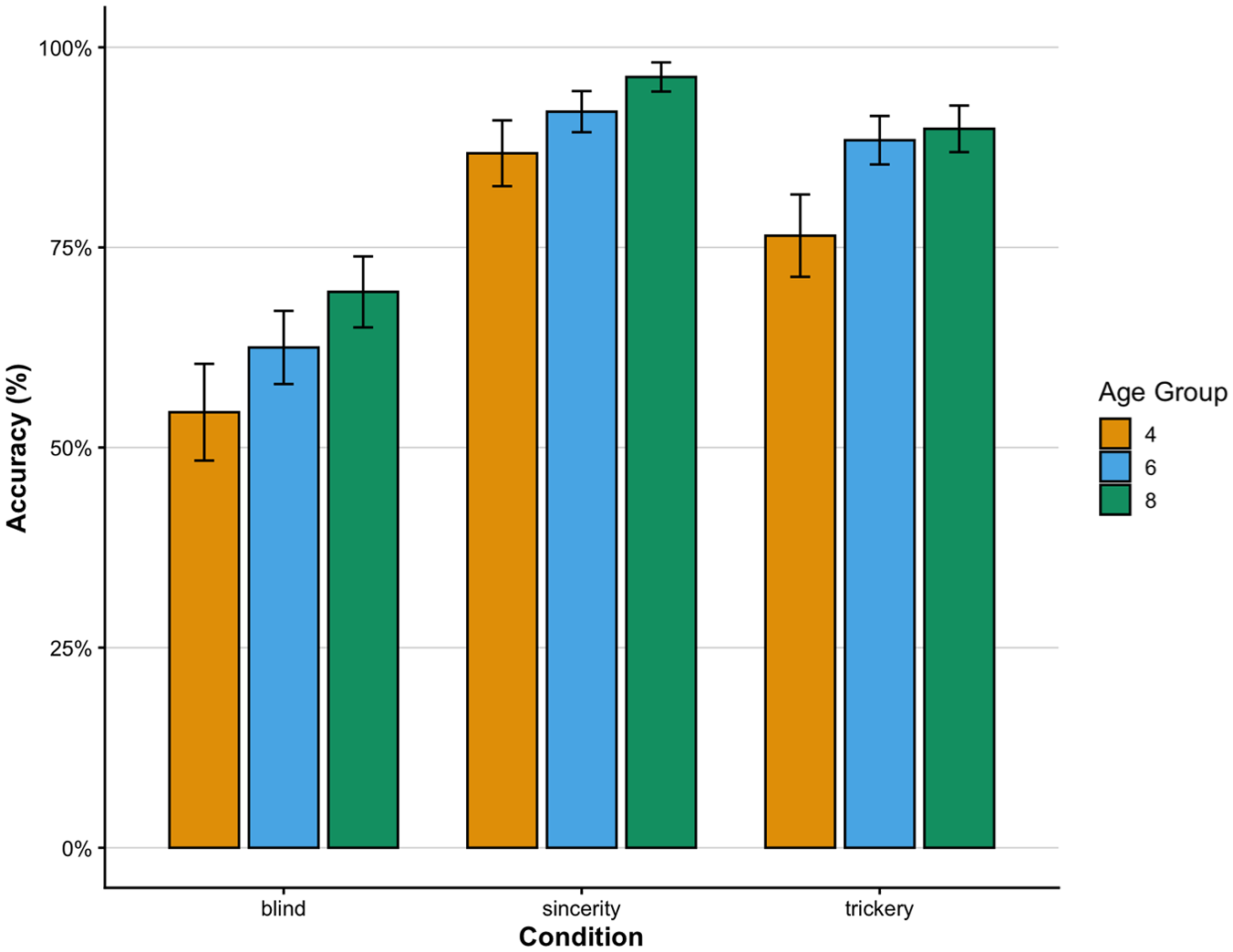
Mean responses per condition in each age group.
As for descriptive results of responses in different linguistic markers (RQ 3), some pairs of markers, such as muy seguro/bastante seguro “really sure/quite sure” or he visto/me han dicho “I’ve seen/I’ve been told” consistently show high response rates across all age groups. For instance, muy seguro/bastante seguro “really sure/quite sure” has a 90% of correct responses in age 4, 77% in age 6, and 76% in age 8. Other markers, like evidentemente/posiblemente “obviously/possibly” or saber/creer “know/think” show lower response rate in younger ages (68% and 56% respectively in 4) but increase with age (75% and 85% in 6, and 80% and 88% in 8) (see Figure 3).
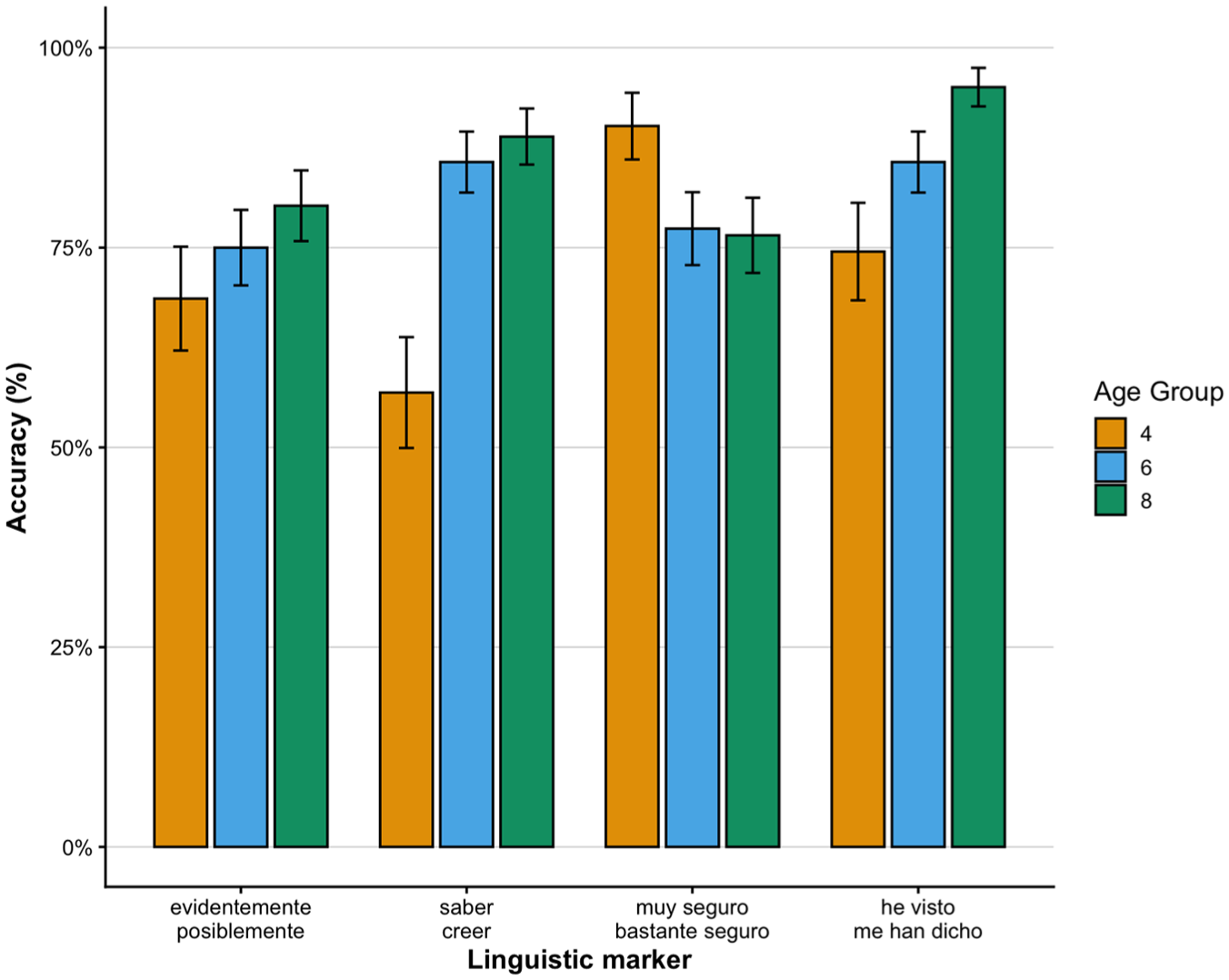
Mean responses per linguistic marker in each age group.
In the next step of the analysis, we calculated the mean responses in each grammatical type in all age groups. While quite similar results are observed in modalisers across age groups (79% in 4, 76% in 6, and 78% in 8), younger children show less accuracy with verbs (65% in 4 compared with 85% and 92% in groups of 6 and 8, respectively) (see Figure 4).
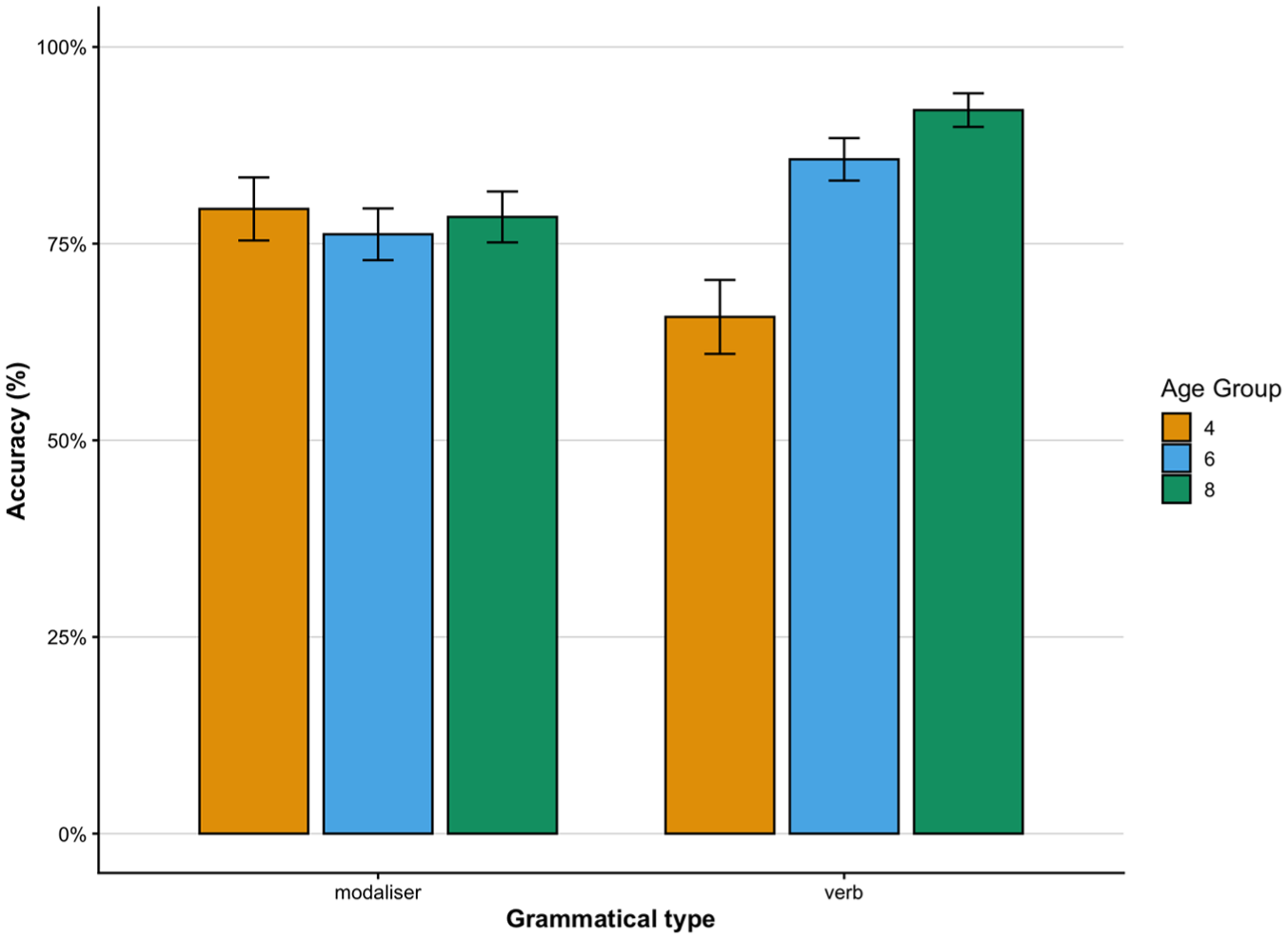
Mean responses per grammatical type in each age group.
Mixed-Effects Logistic Regression
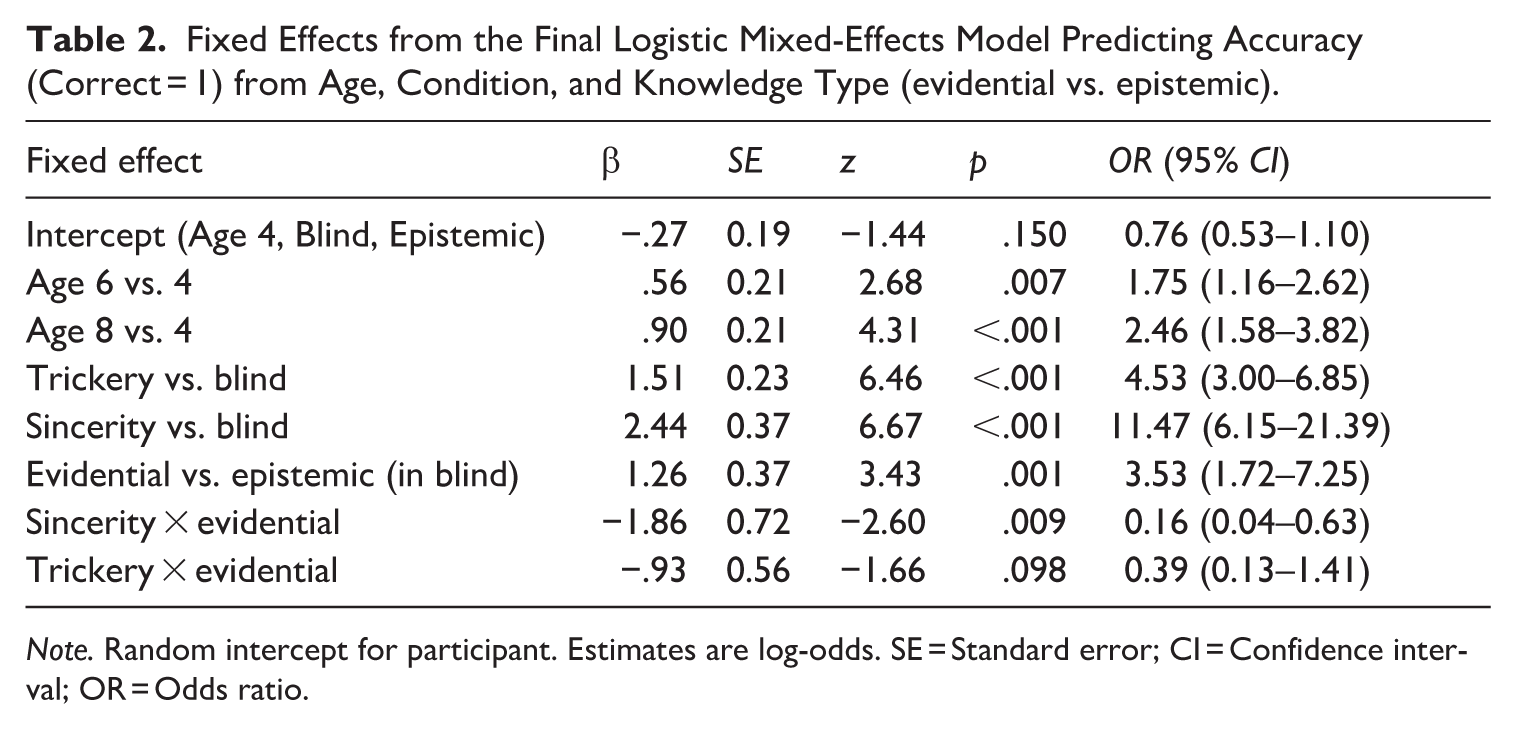
Accuracy was analysed using mixed-effects logistic regression (binomial family with a logit link) in R, with a random intercept for participant. Fixed effects included age group (4, 6, 8 years) and condition (sincerity, trickery, blind). To operationalise the linguistic manipulation, we compared three competing predictors—linguistic marker (4 levels), grammatical category (2 levels), and knowledge type (epistemic vs. evidential)—each entered alongside age and condition. Model comparison by Akaike information criterion (AIC) indicated that the model including knowledge type provided the best fit and was the most parsimonious; adding linguistic marker or grammatical category did not improve fit. We therefore retained knowledge type in the final model.
Adding Age × Condition did not improve fit (χ2 test, p > .5), and adding Age × Knowledge did not improve fit once condition was included (χ2 test, p > .5). In contrast, including a Condition × Knowledge Type interaction improved fit (ΔAIC > 6; χ2(2) = 6.3, p ≈ .04). The final model thus included main effects of age, condition, and knowledge type, plus the Condition × Knowledge interaction (random intercept for subject).
Table 2 reports the fixed effects. There was a robust main effect of age, with higher accuracy in older groups: 6-year-olds outperformed 4-year-olds (β = .56, p = .007; Odds ratio [OR] = 1.75), and 8-year-olds outperformed 4-year-olds (β = .90, p < .001; OR = 2.46). There was also a strong main effect of condition: Compared with that in blind, accuracy was substantially higher in trickery (β = 1.51, p < .001; OR = 4.53) and sincerity (β = 2.44, p < .001; OR = 11.47). Knowledge type further affected performance such that in the blind condition (which served as the statistical baseline), evidential cues supported higher accuracy than epistemic cues (β = 1.26, p = .001; OR = 3.53).
Fixed Effects from the Final Logistic Mixed-Effects Model Predicting Accuracy (Correct = 1) from Age, Condition, and Knowledge Type (evidential vs. epistemic).
Note. Random intercept for participant. Estimates are log-odds. SE = Standard error; CI = Confidence interval; OR = Odds ratio.
These main effects were qualified by a significant Condition × Knowledge Type interaction. Specifically, the evidential advantage observed in blind was attenuated and reversed in sincerity (β = −1.86, p = .009), indicating that, relative to blind, evidential cues were less beneficial in the sincerity context. The corresponding interaction for trickery was smaller and did not reach conventional significance (β = −.93, p = .098). No interactions involving age were retained, indicating that age-related differences were primarily additive across conditions and cue types.
Discussion
Assessing source reliability is a cognitive and pragmatic developmental milestone, enabling children to navigate a social world with varying degrees of evidence and certainty. The present study investigated how Spanish-speaking children between the ages of 4 and 8 interpret events when confronted with evidential and epistemic markers, shedding light on the developmental trajectory of epistemic vigilance in a language that encodes these categories lexically rather than morphologically. The central thesis emerging from our findings is that the acquisition of evidential reasoning in Spanish follows a developmental shift from a reliance on subjective certainty and direct physical reality in the preschool years to a prioritisation of objective information sources during the early school years. This progression mirrors patterns observed in languages with obligatory grammatical evidentiality, such as Turkish and Korean (Aksu-Koç, 1988; Papafragou et al., 2007b), suggesting that the ability to utilise linguistic markers of evidence for source monitoring is a cognitive achievement that transcends specific typological constraints.
Our results regarding research question 1, which examined age-group differences in interpreting evidential versus epistemic expressions, reveal a distinct developmental discontinuity. While accuracy improved with age across all conditions, the weight assigned to different linguistic cues shifted dramatically between age 4 and age 6. The 4-year-olds in our sample demonstrated a certainty bias, performing significantly better with expressions of high subjective certainty (e.g. estoy muy seguro, “I’m really sure”) than with evidential verbs (e.g. he visto, “I’ve seen”). This finding aligns with the proposal that young children initially map reliability onto the speaker’s asserted confidence rather than the epistemological basis of that confidence (Matsui & Miura, 2009). In contrast, 6- and 8-year-olds exhibited a source prioritisation, showing higher accuracy with evidential markers that explicitly encoded the source of information than with epistemic markers.
This developmental lag in the comprehension of evidential markers, despite their likely presence in the children’s productive vocabulary, is consistent with the production–comprehension asymmetry documented extensively in the literature (Ünal & Papafragou, 2016). Just as Turkish-speaking children produce the direct past suffix -di long before they can rely on it to judge a speaker’s reliability in forced-choice tasks (Aksu-Koç, 1988; Ögel, 2007), Spanish-speaking 4-year-olds appear unable to leverage the evidential implications of ver (“to see”) to resolve informational ambiguity in the absence of physical cues. This supports the hypothesis that the difficulty lies not in learning the lexical items themselves, but in the metarepresentational demands of linking a linguistic form to an abstract concept of information access (Papafragou et al., 2007b). Evaluating a statement like “I saw X” requires the child to simulate the speaker’s perceptual history and deduce its causal link to current knowledge, a process significantly more cognitively taxing than accepting a direct claim of certainty like “I am sure.”
Intriguingly, the performance of the adult control group in the pilot study adds a layer of complexity to this trajectory, suggesting a U-shaped developmental curve rather than a linear progression. Adults placed the highest reliance on the epistemic verb saber (“to know”), treating it as the ultimate marker of reliability, whereas the 6- and 8-year-olds relied more heavily on the evidential he visto (“I have seen”). This discrepancy likely stems from the factive nature of saber in Spanish; for a mature speaker, saber presupposes the truth of its complement and implies the possession of adequate evidence (Cornillie, 2007). School-aged children appear to prioritise the concrete mechanism of access (seeing) over the abstract state of knowledge (knowing), effectively hyper-correcting for source. It is only later, presumably in adolescence or adulthood, that speakers fully integrate the notion that saber encompasses both high certainty and sufficient evidence, returning to an epistemic preference that is now conceptually grounded rather than superficially based on confidence.
Research question 2 addressed the interplay between physical and linguistic evidence across the sincerity, trickery, and blind conditions. The results unequivocally demonstrate that for all age groups, physical evidence serves as the primary basis for event interpretation. These results are in line with Ifantidou (2009) findings for Modern Greek, another language without grammaticalised evidentiality. Just as in Ifantidou’s sample, our Spanish-speaking participants demonstrated that, when linguistic cues conflicted with perceptual evidence, children default to physical evidence. In fact, the high accuracy rates in the sincerity condition (where visual and verbal cues converged) and the trickery condition (where they conflicted) indicate that children prioritise their own perceptual experience over contradictory testimony. The “seeing is believing” heuristic (Robinson et al., 1997) remains robust from ages four to eight. In the trickery condition, identifying the correct character required rejecting the speaker who used a strong marker (e.g. “I know it is in X”) in favour of the one whose claim matched the visual reality. The success of even the youngest children in this condition confirms that they are not blindly credulous; they possess a baseline epistemic vigilance that allows them to reject false testimony when it conflicts with a visible “ground truth” (Clément et al., 2004; Koenig & Harris, 2005).
However, the stark drop in performance in the blind condition, particularly for the 4-year-olds, exposes the fragility of this vigilance when it must rely solely on linguistic cues. Without visual confirmation, 4-year-olds performed near chance levels, struggling to distinguish between certain (he visto “I’ve seen”) and less certain (me han dicho “I’ve been told”) sources. This finding is critical because it isolates the specific cognitive deficit: It is not a failure to detect error (which they do in trickery), but a failure to evaluate the provenance of information in the abstract. This supports the information access theory, which posits that explicit reasoning about how knowledge is acquired—and how to weigh conflicting sources—is a distinct skill that matures significantly between the ages of four and six (Gopnik & Graf, 1988; Wimmer et al., 1988). The significant interaction found in our model between condition and knowledge type further corroborates this; the advantage of evidential markers over epistemic ones was most pronounced in the blind condition for older children. This suggests that evidential markers are functionally most valuable—and thus developmentally consolidated—precisely for those contexts where direct verification is impossible.
Regarding research question 3, which explored the impact of grammatical categories (verbs vs. modalisers), our data challenge the “adverb advantage” often posited in the acquisition literature for Germanic languages (e.g. epistemic adverbs appearing earlier than modals due to simpler syntax; Cournane, 2021; Hacquard, 2010). In our Spanish-speaking sample, we found no significant accuracy advantage for adverbs like evidentemente (“obviously”) or posiblemente (“possibly”) over verbal constructions, as evidenced by the fact that grammatical category did not significantly improve our regression model’s fit during AIC comparison. If anything, the trend favoured verbal forms, particularly for the older children. This discrepancy can be attributed to typological and pragmatic differences. In Spanish, the specific adverbs tested are polysyllabic and register-dependent, occurring less frequently in child-directed speech than their English equivalents like maybe or probably (González Ruiz et al., 2016). Furthermore, the interpretation of weak epistemic adverbs (e.g. posiblemente “possibly”) relies heavily on scalar implicatures (inferring “possibly” implies “not certainly”). Previous research has consistently shown that preschool children struggle to compute scalar implicatures, often interpreting weak scalar terms logically rather than pragmatically (Noveck, 2001; Papafragou & Musolino, 2003).
By contrast, the Spanish verbs saber and ver carry semantic entailments of factivity and sensory access that may be more transparent to the child than the pragmatic enrichment required for adverbs. The 4-year-olds’ relative success with estoy seguro “I’m sure” further suggests that predicating certainty directly of the speaker (“I am. . .”) is an accessible strategy that bypasses complex syntactic or pragmatic processing. Thus, the acquisition of epistemic modality in Spanish appears to be anchored in mental state verbs and adjectival predicates rather than in the adverbial hierarchy observed in English. This finding underscores the importance of input frequency and language-specific lexicalisation patterns in shaping the developmental pathway (van Dooren et al., 2017).
From a theoretical standpoint, this study contributes to the debate on the relationship between language and thought in the domain of evidentiality. The linguistic determinism view might predict that children acquiring Spanish—a language without obligatory morphological evidentiality—would show a delayed or qualitatively different trajectory of source monitoring compared with children acquiring Turkish or Quechua. However, our findings reveal a striking parallelism: Spanish-speaking children display the same initial insensitivity to source cues and the same timing of conceptual breakthrough (around age six) as their peers in evidential languages (Courtney, 2015; Ozturk & Papafragou, 2016). This supports the conceptual hypothesis (Papafragou et al., 2007b), which argues that the development of evidential reasoning is driven by general cognitive maturation in Theory of Mind and metarepresentation, rather than being bootstrapped solely by the grammar of the input language. The Spanish data suggest that whether the markers are suffixes or lexical verbs, the cognitive hurdle—realising that knowledge states depend on informational access—remains the same.
Limitations and Future Directions
While this study offers valuable insights into the acquisition of evidential and epistemic markers in Spanish-speaking children, several limitations should be acknowledged. To ensure the task remained age-appropriate and engaging for young participants, a structured narrative format with only twelve experimental trials was employed. As a result, each combination of linguistic markers and physical evidence appeared only once, which may have limited the robustness and generalisability of condition-specific findings. Future studies should aim to increase the number of trials and systematically vary the combinations of linguistic cues and contextual conditions to allow for more reliable within-condition comparisons and broader generalisation. Furthermore, the shifting task demands—requiring children to prioritise visual evidence in some trials and linguistic cues in others—may have imposed an additional cognitive load, potentially contributing to the lower overall accuracy observed in the blind condition.
Second, although the study included a relatively large sample across three distinct age groups, expanding both the sample size and the age range would provide a more comprehensive understanding of the developmental trajectory and allow for the detection of more subtle age-related differences. In addition, because the present study uses a cross-sectional design, the patterns observed reflect group-level age differences rather than individual developmental change; therefore, developmental interpretations should be treated with caution. Moreover, the study examined only a limited set of linguistic markers. Future work would benefit from incorporating a wider range of evidential and epistemic expressions, particularly additional verb–adverb pairs and gradable modals, to capture more fully the variability and complexity of these domains in Spanish.
Finally, recent advances in experimental methodologies, such as eye-tracking, have not yet been applied to the study of evidentiality acquisition in children. Eye-tracking could provide more fine-grained, real-time insights into children’s processing of evidential and epistemic information, as has been shown in research with bilingual adults (e.g. Arslan et al., 2015). The integration of such methodologies into developmental studies represents a promising direction for future research in this area.
Conclusion
The present research offers a comprehensive analysis of the acquisition of evidential and epistemic markers in Spanish, demonstrating that the ability to navigate the landscape of information sources is a multifaceted developmental achievement. Our findings indicate that while children as young as 4 years old possess a basic form of epistemic vigilance—grounded largely in direct perceptual verification and explicit assurances of certainty—they do not yet fully exploit the linguistic resources available for source monitoring. The significant improvement observed in 6- and 8-year-olds marks a critical transition towards a more adult-like stance, where the provenance of information (having seen vs. being told) becomes a primary criterion for establishing reliability, particularly in the absence of physical evidence.
Crucially, this study challenges the notion that morphological evidentiality is a prerequisite for early sensitivity to information sources. The Spanish data show a developmental timeline that aligns closely with findings from Turkish, Korean, and Quechua, suggesting that the “evidential shift” is driven by broader conceptual maturation rather than by specific typological features. Furthermore, the observed advantage of evidential verbs over epistemic adverbs in our older participants highlights the language-specific pathways that Spanish-speaking children take, anchoring their epistemic evaluations in high-frequency verbal predicates rather than in the adverbial scales often emphasised in Germanic languages.
These results have broader implications for our understanding of how children learn to trust testimony. They suggest that the “trust in testimony” is not a uniform trait but a dynamic process that evolves from a reliance on confidence cues to a reliance on evidential warrant. By delineating the distinct contributions of evidential and epistemic markers, this study provides a nuanced framework for future research to explore how children in diverse linguistic environments learn to evaluate the truth, reliability, and authority of the voices around them.
Supplemental Material
sj-docx-1-fla-10.1177_01427237261435794 – Supplemental material for From Subjective Certainty to Information Source: The Interpretation of Evidential and Epistemic Markers in Spanish-Speaking Children
Supplemental material, sj-docx-1-fla-10.1177_01427237261435794 for From Subjective Certainty to Information Source: The Interpretation of Evidential and Epistemic Markers in Spanish-Speaking Children by David Navarro-Ciurana, Anastasiia Ogneva and María-Helena Agrafojo-Nieto in First Language
Footnotes
Acknowledgements
We are thankful to all the families of children who participated in this study. We would also like to thank Sara Cervera-Cervera for lending her voice to this experiment. Finally, we wish to thank the two anonymous reviewers and the editor, whose comments have greatly improved this article.

Ethical Considerations
The study was approved by the Ethics Committee of the University of Santiago de Compostela (USC 58/2024) and by the Consellería de Educación, Ciencia, Universidades e Formación Profesional of the Xunta de Galicia.
Consent to Participate
Written informed consent was obtained from the parents or legal guardians of all participants before data collection.
Author Contributions
Funding
The authors received no financial support for the research, authorship, and/or publication of this article.
Declaration of Conflicting Interests
The authors declared no potential conflicts of interest with respect to the research, authorship, and/or publication of this article.
Data Availability Statement
Supplemental Material
Supplemental material for this article is available online.