




Abstract
Cross-linguistic research has shown that object which-questions are the hardest types of wh-questions for children to comprehend and are acquired late. The present study asks when Spanish Differential Object Marking (DOM), an early cue to object marking, is actively used to successfully comprehend object which-questions in Spanish-speaking children. We also investigate whether DOM is first used in object which-question with human objects versus animal objects. Fifty-five child learners of Argentinian Spanish (N = 28, age 5–6; N = 27, age 7–8) and nine monolingual adults participated in a picture matching task. The experimental stimuli are which-questions where DOM indicated an object interpretation (¿ A qué bomberoobject está salpicando la doctorasubject?) or where absence of DOM made the structure ambiguous between a subject and an object question (¿Qué bomberosubject/object está salpicando la doctorasubject/object?). The results showed that DOM helped adults arrive at an object interpretation for object which-questions. When DOM was absent, adult responses did not differ from chance. Children did not use the morphological marking to interpret object which-questions, and absence of DOM determined a strong subject interpretation. In addition, a developmental effect indicates that at age 7 to 8, a subgroup of the children performed target-like. Spanish-speaking children used an agent-first bias to interpret ambiguous which-questions (i.e., without DOM). However, by age 7 to 8, children start using DOM as a reliable cue to override or prevent commitment to an agent-first interpretation.
Keywords
Introduction
Children are asked a vast number of questions on a daily basis. Parents and educators are arguably the main initiators of questions directed to children. A study reported social studies teachers asking third to sixth graders 50.6 questions per half hour (Susskind, 1979) and the late educator Robert Hyman (1979) would state that ‘It is impossible to conceive of teaching without asking questions’ (p. 1). Given the presence of questions in socialization and education, mastery of questions constitutes a key developmental milestone in native language acquisition.
Children learn to formulate wh-questions (such as what, where, who, etc.) as they develop cognitively (Bloom et al., 1982). Of particular interest here are which-questions, a type of filler-gap dependency where the complement of the wh-word (the filler) is dislocated from its canonical position. In (1), we present an example of a subject-which question in English, where the filler is the subject/agent of the sentence. The sentence in (2) illustrates an object which-question where the filler is the object/patient of the main verb. Research has shown that in English, comprehenders have a bias for interpreting the first noun phrase (NP) in a sentence as the agent (MacWhinney & Bates, 1989). Under probabilistic accounts of sentence processing, in the context of an object filler-gap dependency, comprehenders predict a more frequent subject structure, and when their prediction turns out to be incorrect, they experience a processing difficulty (Levy, 2008; MacWhinney & Bates, 1989). In the case of object which-questions like (2), the agent-first bias has to be overridden upon encountering the second NP (the doctor), and the filler has to be kept active in working memory until the dependency can be completed after the verb. The revision required to comprehend sentence (2) and the late completion of the filler-gap dependency make the comprehension of object which-questions more taxing.
1. Which firefighter is splashing the doctor?
2. Which firefighter is the doctor splashing?
Under capacity theories, the processing difficulty of filler-gap dependencies increases with the linear distance between the filler and the gap (e.g., Dependency Locality Theory, Gibson, 2000; see also the structural intervention account proposed by Friedmann et al., 2009 1 ). Longer distances require more cognitive resources due to the burden on working memory to maintain the filler and anticipate its resolution (Lewis et al., 2006). It is worth noting that capacity theories and probabilistic accounts are not mutually exclusive, as constraints on working memory and distributional information may interact in processing filler-gap dependencies (Staub, 2010). While memory constraints account for immediate difficulties in maintaining and resolving filler-gap dependencies, probabilistic cues can modulate these effects by shaping long-term expectations and processing strategies (Contemori et al., 2025).
Cross-linguistic research indicates that object which-questions like (2) are the hardest types of wh-questions for children to comprehend (e.g., Greek: Stavrakaki, 2006; Italian: De Vincenzi et al., 1999; Hebrew: Friedmann et al., 2009; English: Contemori et al., 2018; Romanian: Bentea & Marinis, 2021; German: Roesch & Chondrogianni, 2021). When listening to an object which-question such as (2), adults commit to a subject interpretation upon hearing the NP ‘Which firefighter’, and then reanalyze the initial interpretation when they encounter the NP ‘the doctor’. Adults can quickly override the early subject interpretation, whereas children demonstrate a strong agent-first interpretation bias and a subsequent difficulty reanalyzing the initial interpretation (e.g., Contemori et al., 2018; for other patient-first structures: Huang et al., 2013; Marinis & Saddy, 2013).
If additional information is offered to disambiguate the interpretation of a complex sentence, however, children can effectively use the available cues to attain an accurate interpretation (e.g., animacy cues: Arosio et al., 2011; number cues: Adani et al., 2014; Contemori et al., 2018; gender cues: Belletti et al., 2012). Based on these findings, a current model of parsing in language acquisition suggests that learners can use language-specific cues during real time processing if the cues to structure and meaning can prevent the parser from committing to incorrect interpretations (e.g., Pozzan & Trueswell, 2015). Nevertheless, it may be difficult for children to revise an early interpretation when additional cues to revision appear later in the sentence, suggesting that the position of the cues that allow reanalysis may have an important role for children’s interpretation. More specifically, cues that occur early in a sentence can facilitate reanalysis (or prevent commitment) more than cues that occur later (e.g., Atkinson et al., 2018; Contemori et al., 2018; Omaki et al., 2014; Roesch & Chondrogianni, 2021).
In Spanish, if an object which-question includes two animate NPs, the wh-word with the object NP typically appears in sentence-initial position and receives Differential Object Marking (DOM). In (3), we illustrate an example of an object which-question where DOM clearly identifies the first NP (bombero ‘firefighter’) as the object, and the second NP (doctora ‘doctor’) as the postverbal subject. The same sentence without DOM, as in (4), is potentially ambiguous, because the unmarked complement of the wh-word (bombero ‘firefighter’) could now be interpreted as either the subject or the object. Thus, while in (4), the absence of DOM makes the which-question ambiguous between a subject and an object question, in (3), DOM clearly indicates that the first NP should be interpreted as the direct object/patient.
3. ¿
DOM which firefighter is splashing the doctor?
Which firefighter is the doctor splashing?
4. ¿Qué bomberosubject/object está salpicando la doctorasubject/object?
Which firefighter is splashing the doctor?
Which firefighter is splashing the doctor?/Which firefighter is the doctor splashing?
In the present study, we investigate when Spanish-speaking children acquire the use of DOM in the comprehension of object which-questions. We test the accuracy in interpreting sentences like (3) and (4) in a group of 5- to 8-year-old children and a group of Spanish-speaking adults. In addition, we will examine if accurate interpretation of DOM-marked questions is first observed with human, specific objects, the type of noun phases that consistently carry DOM marking in Spanish. To this aim, we manipulate the animacy feature of the NPs included in the experimental sentences (human vs. animal). In the next section, we review the evidence on the acquisition of DOM in Spanish-speaking children and we present previous research on the comprehension of which-questions in case-marked languages.
Children’s interpretation of which-questions
Previous studies focusing on the comprehension of which-questions in case-marked languages have shown that case marking can be successfully used to guide the interpretation of object which-questions (Roesch & Chondrogianni, 2021; Schouwenaars et al., 2018). For example, Schouwenaars et al. (2018) looked at the comprehension of subject and object which-questions in 7- to 10-year-old German-speaking children. In German, case marking on the initial wh-word can distinguish a subject from an object interpretation. The experimental task designed by Schouwenaars et al. included questions that either contained a nominative-marked wh-word (Welcher ‘which’), an accusative marked wh-word (Welchen ‘which’), or an ambiguous nominative/accusative wh-word (Welche ‘which’). In addition, verb agreement occurring later in the sentence provided an additional cue to sentence interpretation. Comprehension accuracy and eye-tracking results suggested that children’s comprehension of object which-questions was adult-like when both case marking and verb agreement pointed to an object interpretation. Similarly, a study with 4- to 5-year-old German-speaking children by Roesch and Chondrogianni (2021) tested the accuracy in comprehending object which-questions that included either (a) a wh-case marked word (early case cue); (b) a wh-case marked word and a second case marked-NP (double case cue); or (c) a second case marked-noun (late case cue). The results demonstrated that 5-year-olds were above chance at comprehending object which-questions with an early case cue and double case cues, and 4-year-olds were above chance in the double case cue condition. Roesch and Chondrogianni’s study suggests that a single early cue to case marking may suffice to help children arrive at accurate interpretations of object which-questions by age 5.
For languages that use DOM, only three studies have looked at children’s interpretation of which-questions (Bentea & Marinis, 2022; Sauerland et al., 2016 for Romanian; Mateu, 2022 for Spanish). Sauerland et al.’s (2016) large-scale study across 19 languages included a condition of which-questions in Romanian. The study showed an overall effect of case marking in wh-question interpretation. Romanian, however, requires clitic doubling (ClD) of the object whenever the object receives DOM. Therefore, which-questions in Romanian contained more than just the DOM cue. Bentea and Marinis (2022) examined the comprehension of multiple wh-questions in Romanian, such as ‘Which girl patted which cat?’. In Romanian, the two wh-phrases appear fronted (e.g., ‘pe-DOM which girl which cat her-ClD patted?’). Children were administered a self-paced listening task with picture verification and they had to identify both participants in the question to select the correct picture. Question word (which vs. who) and word order (SO and OS, the latter ungrammatical with who) were manipulated. Romanian-speaking children ages 6;11-9;8 had no difficulty comprehending multiple wh-questions headed by who regardless of word order. However, they struggled to comprehend multiple wh-questions with which, especially in OS word order. Finally, Mateu (2022) conducted a study testing the interpretation of subject and object which-questions in Spanish-speaking 4- to 6-year-olds with the aim of comparing the comprehension of sentences with action verbs versus psychological verbs. In addition, the author included a manipulation of the number features of the NPs (e.g., ¿
Spanish DOM
The evolution of Romance languages was characterized by the development of new forms of marking grammatical Case. Simply put, Case is ‘the alternation in the form of a nominal or adjectival constituent based on its function’ (Polinsky & Preminger, 2014, p. 150). With the loss of obligatory Case marking present in Latin, Romance languages resorted to two main ways of signaling constituent function (Bossong, 1991). Some of these languages, like standard French, developed positional marking while others, including Spanish, introduced morphological Case markers. Spanish uses a for DOM, as in (5).
5. Cristiano Ronaldo no empujó
Cristiano Ronaldo
Cristiano Ronaldo didn’t push a fan after the defeat . . .
Spanish DOM has been studied from various theoretical approaches (see Fábregas, 2013), and usage data support the idea that DOM marks unlikely direct objects (i.e., objects that have subject-like properties, such as +animacy, high discourse topicality) (see Laca, 1995). In a popular formulation, Aissen (2003) captures the diachronic evolution and modern use of Spanish DOM by resorting to harmonic alignment of the animacy and definiteness scales (see Comrie, 1986; Croft, 1988). An oversimplified depiction is presented in Figure 1, where objects are ranked based on these two internal properties resulting in a continuum from objects that categorically receive DOM (in black), to objects that may receive DOM (in gray), and objects that categorically reject DOM (in white). This being said, as a living system, Spanish DOM has been shown to extend (Arechabaleta Regulez & Montrul, 2021; López, 2012) and retract (Alfaraz, 2011), in certain varieties. Yet speakers generally favor the marking of human and animate objects when these are definite and specific. When it comes to non-human animate objects, DOM is particularly found in cases of highly individuated objects (e.g., DOM may precede the object ‘Bluey’ in a sentence about someone splashing a pet dog with that name), but may be absent with less individuated objects (e.g., when the non-human animate object of the verb ‘splash’ is a worm). For the purposes of the present study, it suffices to say that human and non-human animate definite and specific objects are expected to carry DOM. This study focuses on DOM as a cue to comprehending which-questions with two animate NPs in the roles of sentential subject and object.
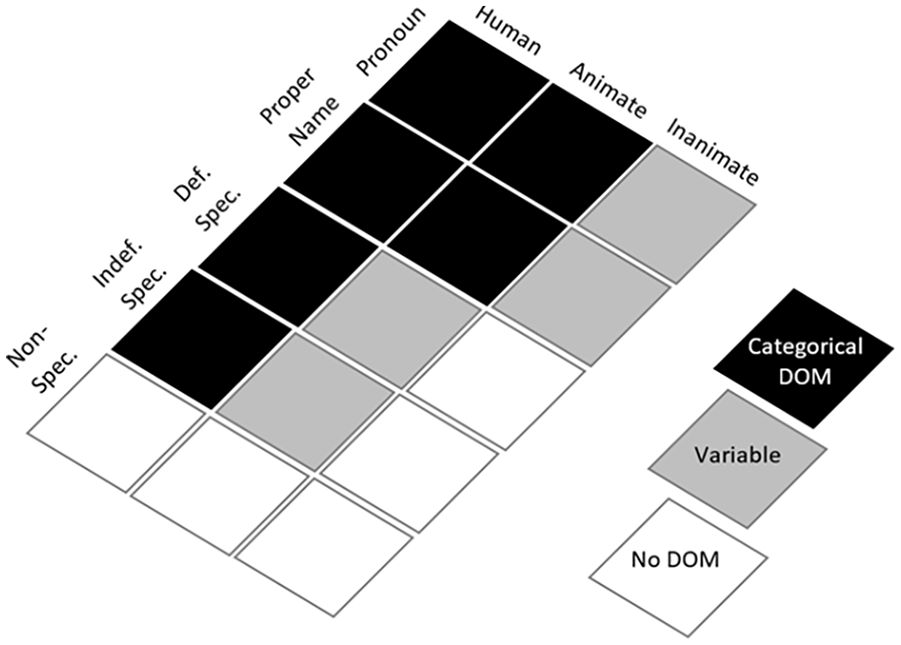
DOM in modern Spanish.
Monolingual child acquisition of Spanish DOM unfolds very early on. Analyses of longitudinal corpora of spontaneous speech between the ages of 0;9 and 3;0 have revealed almost errorless use of DOM in Categorical DOM contexts and few errors of omission in No DOM contexts (Rodríguez-Mondoñedo, 2008, Ticio & Avram, 2015). But even when omission or commission errors are reported, these could be apparent, as pointed out by Requena (2023b, p. 8). Research that considers the variation in DOM along the animacy scale has found that towards the end of their third year of age (2;8–2;11), monolingual children distinguish objects based on animacy (human vs. non-human animate) in their production of DOM (Callen & Miller, 2022). These results were expanded by research looking at variation along the full animacy scale in two monolingual children ages 1;7 to 2;11. Requena (2023b) revealed individual patterns of DOM use (including not only prototypical uses, but also seemingly innovative uses) in two monolingual children. Interestingly, an analysis of their input showed that these children were exposed to innovations from their caregivers. The target-like use of Spanish DOM by age 3, including the acquisition of variable as well as innovative uses from the input, suggests that DOM develops together with other major morphological markers in the monolingual Spanish-speaking child (see Soto-Corominas, 2021).
Studies on the acquisition of DOM in monolingual children have dealt primarily with production (see corpus studies examining very young children that we mentioned above). Research that tested older monolingual children also indicates errorless performance in elicited production tasks (Montrul & Sánchez-Walker, 2013; Requena, 2023a). To our knowledge, however, no research has investigated when DOM begins to guide sentence interpretation in the acquisition of Spanish. Compared to children acquiring which-questions in languages without case marking (e.g., Sauerland et al., 2016), Spanish-speaking children may comprehend object-which questions earlier due to the presence of DOM, because DOM is an early-acquired feature of Spanish morphosyntax that also appears early in the surface representation. This could make DOM the type of cue that could prevent commitment to an agent-first interpretation (or facilitate revision and reanalysis).
The present study
This study examines offline comprehension of which-questions in monolingual Spanish-speaking children. Previous research has demonstrated that by age 5, child comprehenders can use case-marking cues occurring at the beginning of which-object question to override the agent-first bias (Roesch & Chondrogianni, 2021; Schouwenaars et al., 2018). In addition, it has been demonstrated that multiple case-marking cues can have a cumulative effect, by increasing children’s accuracy with object which-questions (Roesch & Chondrogianni, 2021). The present study contributes to this line of research by investigating when children start using Spanish DOM to override the agent-first bias and accurately comprehend object which-questions. To address this research question, we designed a picture-matching task where participants choose a character in answer to a which-question posed by the experimenter. The task included which-questions introduced by DOM, as in (4), and ambiguous which-questions like (5), without DOM. We selected only definite and specific animate objects because these objects are expected to carry DOM in modern Spanish (Aissen, 2003). By comparing accuracy in the two conditions, we can examine the strength of DOM as a processing cue relative to the well-attested subject bias in wh-question comprehension (e.g., Contemori et al., 2018). We expect that children may prefer the subject interpretation for the ambiguous which-questions where DOM is omitted, while adults will display no clear preference for either the subject or object character, due to the ambiguity of the structure. For object which-questions introduced by DOM, adults should choose the object character at ceiling. For children, one possibility is that starting from age 5, they can integrate the DOM cue to avoid a commitment to a subject interpretation or perform reanalysis, comparably to existing findings on the use of case in German which-questions (Roesch & Chondrogianni, 2021; Schouwenaars et al., 2018; but see Mateu, 2022). In another case scenario, young children may not be able to integrate the case-marking cue to prevent the agent-first interpretation. Notice that, unlike German which-questions, which include case marking both in the wh-word and in its complement 3 (i.e., double cue), the sole presence of DOM may not be a strong enough cue for young Spanish-speaking children. Thus, Spanish-speaking children may not perform above chance on DOM marked object which-questions as early as German-speaking children do. To address the question about age, in the present study, we recruit children 5 to 8 years old. The wide age-range of our participants allows us to better understand the developmental pattern for at least the DOM cue to object which-question comprehension in Spanish.
In the present study, we also manipulate for the first time the animacy feature of the two NPs in which-questions, by presenting either human or animal characters in each sentence. Accuracy in comprehending conditions with two human participants, as in (3) and (4) above, is compared to accuracy in comprehending similar sentence structures with two animal participants, as shown in (6) and (7).
6. ¿
DOM which goat is pushing the cow?
Which goat is the cow pushing?
7. ¿Qué chivo está empujando la vaca?
which goat is pushing the cow?
Which goat is the cow pushing?/Which goat is pushing the cow?
The comparison between human and non-human animate object conditions allows us to test whether DOM becomes a reliable cue to argument structure during interpretation first with humans, where the marking is categorical in naturalistic language use. For the human feature manipulation, it is possible that DOM is a stronger cue due to greater informative value. Human participants are prototypical agents and unlikely patients (Comrie, 1989, p. 128). Since one property often associated with DOM is to mark objects that deviate from the prototype, we could expect that DOM is the most informative (and thus salient) when it precedes human-specific objects, since they are the farthest from the prototypical object in terms of animacy. If children exploit the reliability of DOM to predict argument structure with human objects, they will comprehend more accurately object-which questions where the fronted NP introduced by DOM is human (3), in comparison to when the NP is an animal object (6). However, it is possible that by age 8, children may not have accumulated enough experience with case marking to have clear expectations concerning the saliency of human-marked objects. In this case scenario, we expect that children will perform comparably when comprehending the conditions with DOM including human versus animal objects.
To summarize, our research questions for the present study are: when is Spanish DOM used by children to override the agent-first interpretation of object which-questions? Is the use of DOM to guide comprehension first observed with human rather than non-human objects?
Methods
Participants
Fifty-five child learners of Spanish (5;5–8;4; M = 7; SD = 1) were recruited in Córdoba, Argentina. Ethical approval for the study was obtained from the Institutional Review Board at the University of Texas at San Antonio. Parents provided written consent and children provided verbal assent prior to participation in a single testing session at the school. Children did not have a history of language delay or impairment, and Spanish was the only language spoken in the family. Nine monolingual adults were recruited as a control group. They were recruited in the same city through word of mouth. 4
Materials
Comprehension of which-questions was tested using a picture selection task, including pairs of pictures and questions. Spanish has two wh-words that could be used in which-questions: cuál ‘which’ and qué ‘what’. This presents us with the need to establish how these question words work in Spanish and, most importantly, which ones are more intuitive for children, so as to avoid adding unnecessary difficulty to the comprehension task. First, we assessed the frequency of use of each question word followed by an NP (as in which-questions) relative to the frequency of use followed by a verb phrase. The Argentine Spanish data of the Corpus del Español (Davies, 2016) consist of 169.4 million words produced by adult speakers of that dialect. As Table 1 indicates, cuál is six times less frequent overall than qué. The uses of qué + NP are more prevalent in the corpus than all uses of cuál in these contexts together. This suggests that children in this dialect are more likely to hear qué than cuál in these contexts.
Frequency of verbal and nominal continuations to qué and cuál/es.
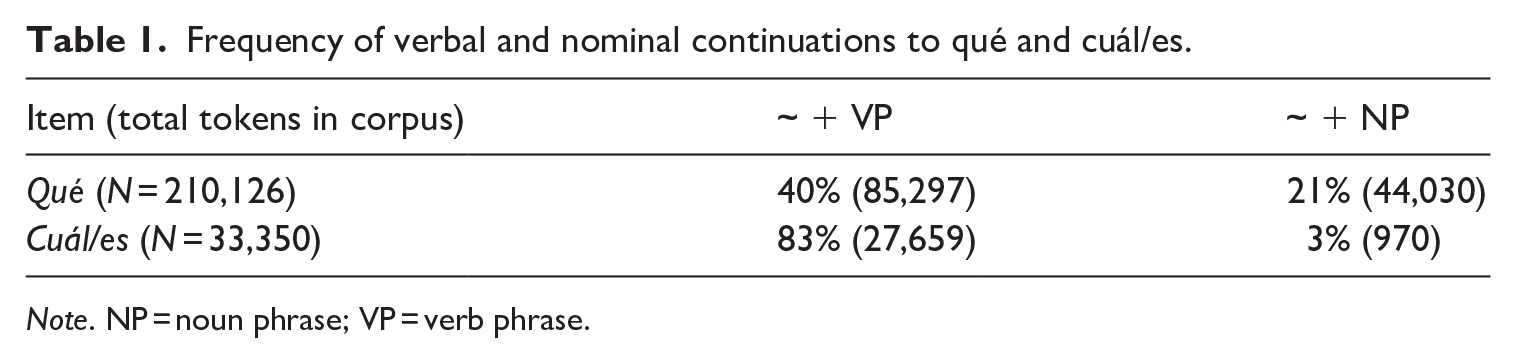
Note. NP = noun phrase; VP = verb phrase.
A similar search adding the Spanish sentence initial question sign ‘¿’ provides further evidence of these frequency distributions in direct questions, such as the ones used in our stimuli. Table 2 shows these frequencies. As seen in column C, direct questions introduced by ¿Qué + noun are almost 60 times more frequent than ¿Cuál + noun. A look at a subset of these questions where the next element is a verb (see column D) indicates that almost half of the ¿Qué + noun questions are indeed ¿Qué + noun + verb, as in object which-questions such as (5) and (7). To look at the relative frequency of DOM in these questions, we also searched for direct questions introduced by ‘a’ (without distinguishing function of ‘a’). The results in Table 2 (columns B and E) indicate that these question words are seldom introduced by ‘a’. Nevertheless, in direct questions ‘a’ precedes qué slightly more often than it precedes cuál relative to the frequencies of use of each question word in the corpus. Finally, we examined the frequency of these ¿Qué/Cuál + noun + verb when introduced by ‘a’ (see column F). Again, qué stands out as more frequent.
Frequency of verbal and nominal continuations to qué and cuál/es in direct questions.

Note. The figures marked with * are also included in the immediately adjacent cell to their left.
It should be noted that these searches only illustrate patterns of surface co-occurrence without taking into consideration syntactic function of the noun or the question word involved. The main conclusion of the frequency analysis presented so far is that whereas both question words allow NP continuation, relative to other contexts of use of these words, qué occurs more frequently than cuál/es in such context. However, we do not know the frequency of these question words in the input that children are exposed to. Thus, we conducted an additional analysis of two longitudinal corpora of naturalistic production by speakers of Argentine Spanish available in CHILDES (MacWhinney, 2000). The Montes corpus (Montes Miró, 1987) consists of naturalistic interaction between caregivers and a child (Koki) between ages 1;07 and 2;11 and the Remedi (2014) corpus consists of naturalistic conversation between caregivers and a child (Vicky) between ages 1;11 and 2;10. The results of caregiver speech shown in Table 3 indicate that very young children hear more instances of qué than cuál. What is more, qué is more frequent than cuál in caregiver speech when a noun follows. A look at oral production by the two very young children in the CHILDES corpora shows that Qué/Cual + noun constructions are very infrequent before age 3. For example, the two tokens produced by Koki towards the middle of their third year are illustrated below in (8) and (9). Overall, use of the two question words by the children across contexts points to qué as the which-question word that should be easier for children.
Frequency of qué and cuál/es across contexts in two CHILDES corpora.
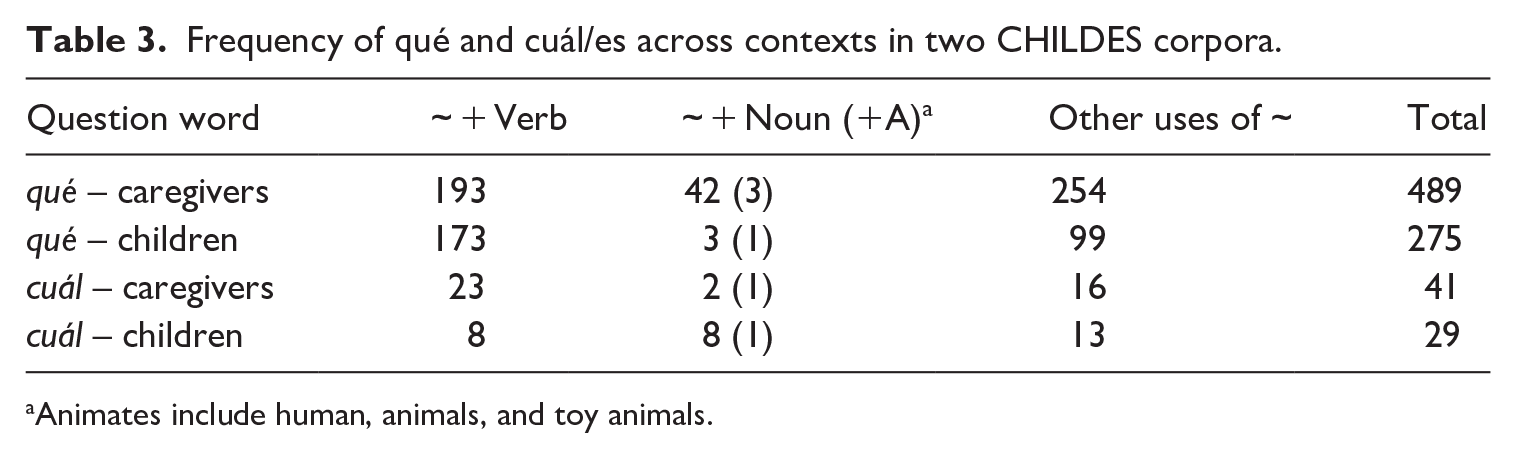
Animates include human, animals, and toy animals.
8. qué cositas ? (Koki, 2;05.24, line 362)
Which things?
9. qué ot(r)o ? (Koki, 2;06.10, line 446)
Which other?
In the picture selection task used in the present study, four conditions were created, including which-questions with and without DOM, as shown in (10) to (13). In Spanish, the absence of DOM makes the which-question ambiguous between a subject and an object question, as illustrated in (10) and (11). On the other hand, DOM indicates that the first NP should be interpreted as the direct object/patient, as shown in (12) and (13). Twelve which-questions with DOM and 12 which-questions without DOM were included in the task. Three transitive verbs were selected (patear ‘kick’, salpicar ‘splash’, and empujar ‘push’), and each of them was used for eight which-questions. All sentences were semantically reversible. In addition, the human feature of the two NPs included in the question (subject and object) was manipulated. In half of the sentences, the two NPs were human characters, as shown in (10) and (12), and in half of the sentences, the NPs were animal characters, as illustrated in (11) and (13).
Which-question without DOM (potentially ambiguous):
10. ¿Qué bombero está salpicando la doctora?
Which firefighter is splashing the doctor? /Which firefighter is the doctor splashing?
11. ¿Qué cabra está empujando la vaca?
Which goat is pushing the cow?/Which cow is pushing the goat?
Which-question with DOM (unambiguous object which-question):
12. ¿
Which firefighter is the doctor splashing?
13. ¿
Which goat is the cow pushing?
In each picture paired to the question, an animal/human character was presented on the left, one was presented in the middle and one was presented on the right. The right character performed an action on the character in the middle, while the character in the middle performed the same action on the character on the left, as illustrated in Figures 2 and 3. This depiction of the action was chosen to create a pragmatically appropriate experimental setting for a which-question (e.g., Adani, 2011). In addition, the NPs included in each sentence depicted characters matched in size to avoid size-bias interpretation.
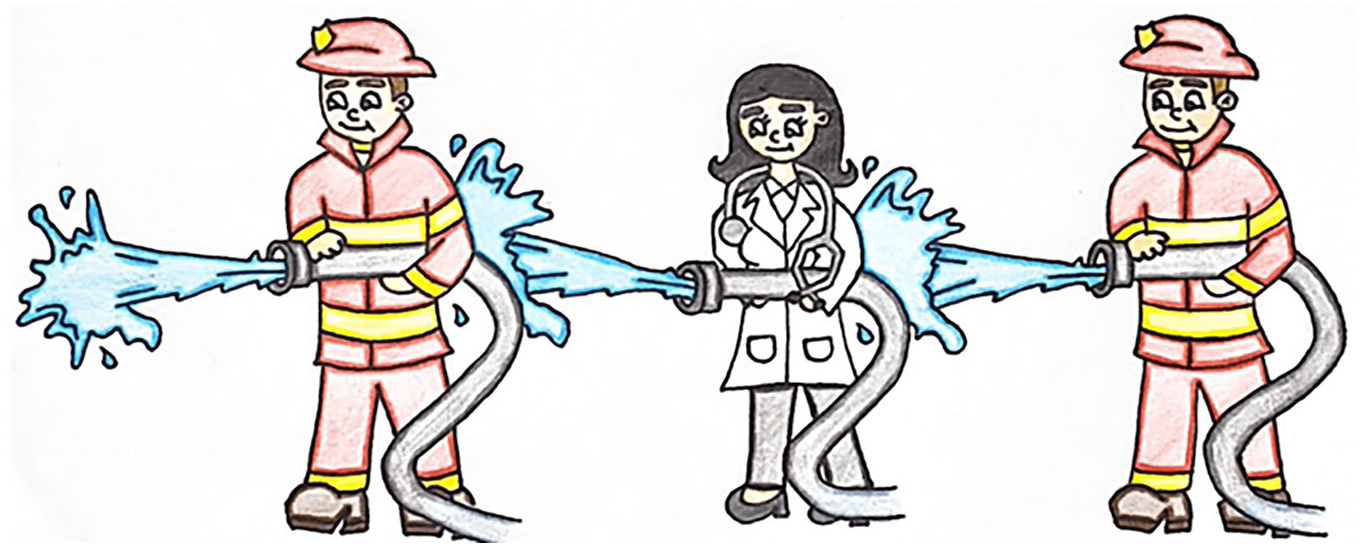
Example of a picture corresponding to sentences (10) and (12).

Example of a picture corresponding to sentences (11) and (13).
The experiment followed a 2 × 2 design, where the DOM and animacy factors were manipulated within participants. Each participant received six items per condition. Twelve filler sentences were interspersed with the experimental sentences. The filler sentences included Quién ‘Who’ followed by a verb. Six filler items used a progressive construction (e.g., Who is standing on the stool?) and the other six filler items contained the verb be to express location (e.g., Who is on the airplane?). Filler trials were accompanied by images displaying only two characters.
Coding and procedure
The task was administered to children in person, using Qualtrics and a touch screen. Participants were presented with the pictures one by one and were asked to choose one of the characters presented on the screen to answer the experimenter’s questions. If the child requested it, the sentence could be repeated. Children were instructed to touch the screen in order to select the correct character. Participants’ responses were recorded by identifying the region occupied by each character in each trial picture.
Results
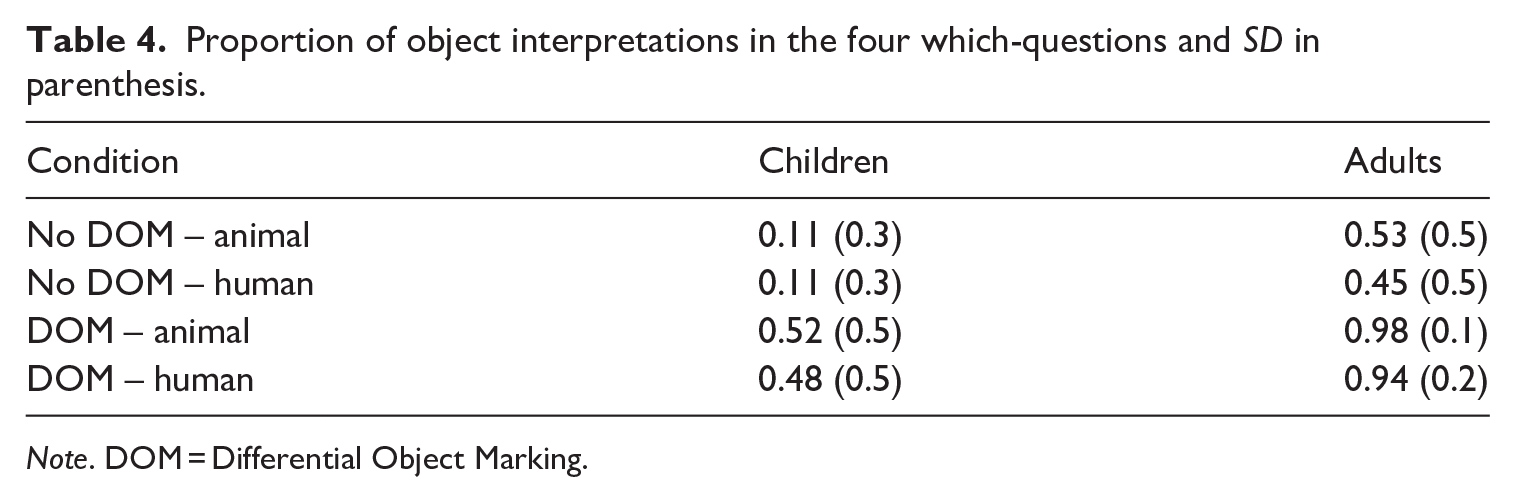
Table 4 shows the proportions of object interpretations produced by children and adults in the four conditions. Figures 4 and 5 illustrate children and adults’ results, respectively.
Proportion of object interpretations in the four which-questions and SD in parenthesis.
Note. DOM = Differential Object Marking.
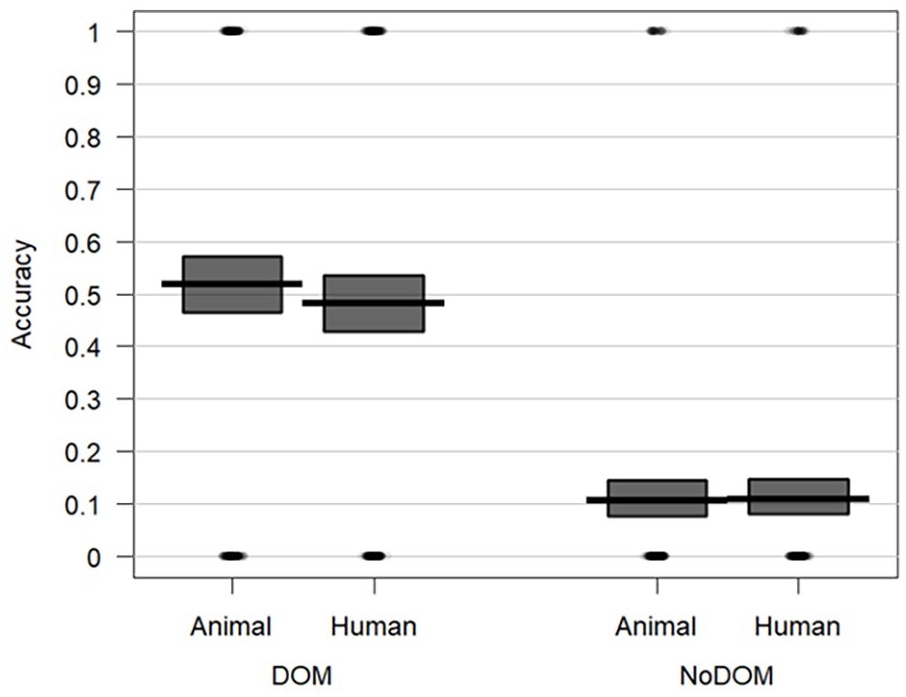
Proportion of object choices in the four which-questions in the child group.
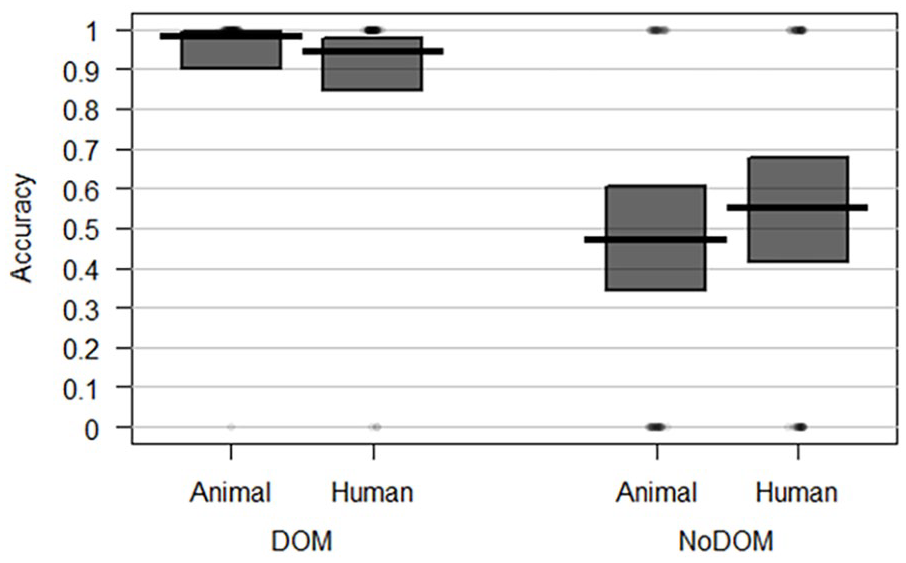
Proportion of object choices in the four which-questions in the adult group.
Table 5 summarizes the full model. Given the lower number of participants in the adult group, we did not compare the child and adult results statistically. However, the adult results clearly show that which-questions without DOM are ambiguous between a subject and an object interpretation, as expected. Conversely, adults choose the object interpretation at ceiling for which-questions with DOM. In the analysis, we used object interpretations as dependent variable. Mixed-effects logistic regression was used (Jaeger, 2008), coding number of interpretations per each subject and item as 1 or 0. The analyses were conducted using glmer (lme4 library, Bates & Sarkar, 2007). A stepwise backward inclusion procedure was used to test both first-level effects and the interactions between the fixed-effect factors. The independent variables are DOM (present vs. absent), and Human Feature (human vs. animal), and Age in months which was included as a continuous variable. Trial-level data are publicly available at https://osf.io/vd4yg/
Full model statistics.
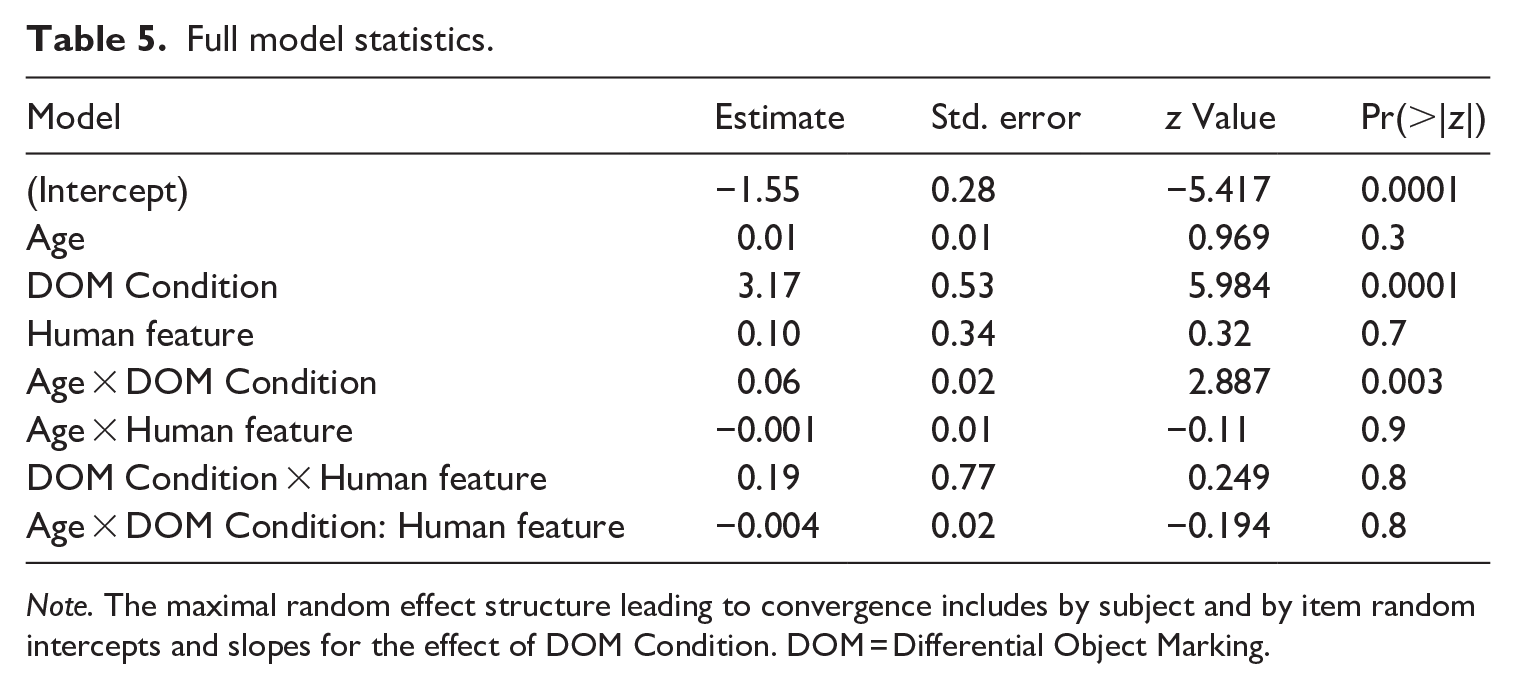
Note. The maximal random effect structure leading to convergence includes by subject and by item random intercepts and slopes for the effect of DOM Condition. DOM = Differential Object Marking.
The model revealed a significant main effect of DOM Condition, demonstrating that children produced significantly more object interpretations for which-questions with DOM than for the sentences without DOM. The main effect was qualified by an interaction with Age. No other main effect or interaction was significant.
To better illustrate the DOM Condition × Age interaction, we divided participants in two groups, based on a median split of age (N = 27, age 5–6; N = 28, age 7–8) and conducted a comparison between the two age groups using DOM as the main factor with two levels (present vs. absent). The analysis using a median split did not show any significant differences between the two age groups when DOM is present (β = −.78, SE = 0.46, z = −1.682, p = .09; Intercept: β = −.01, SE = 0.46, z = −0.05, p = .9) or absent (β = .27, SE = 0.54, z = 0.508, p = .6; Intercept: β = −3.11, SE = 0.43, z = −7.168, p < .0001). The DOM Condition × Age interaction is shown in Figure 6. As indicated by the CI of the model estimates in Figure 6, children prefer the subject interpretation for both sentence types (with and without DOM) at age 5;4. While the preference is not overridden for which-question without DOM, children increasingly adopt an object interpretation for which-questions with DOM at age 6 and 7. At a group level, older children’s interpretations of which-questions with DOM remain at chance level, as demonstrated by the results of a one-sample t-test (7–8 y.o., which-questions with DOM: t(27) = 1.057, p = .3). However, in the older group, a developmental pattern can be observed, with 10 children performing below 50% (i.e., the which-questions with DOM are interpreted as subject questions) and 18 children performing above chance (i.e., the which-questions with DOM are interpreted as object questions), as illustrated by the confidence intervals in Figure 6.
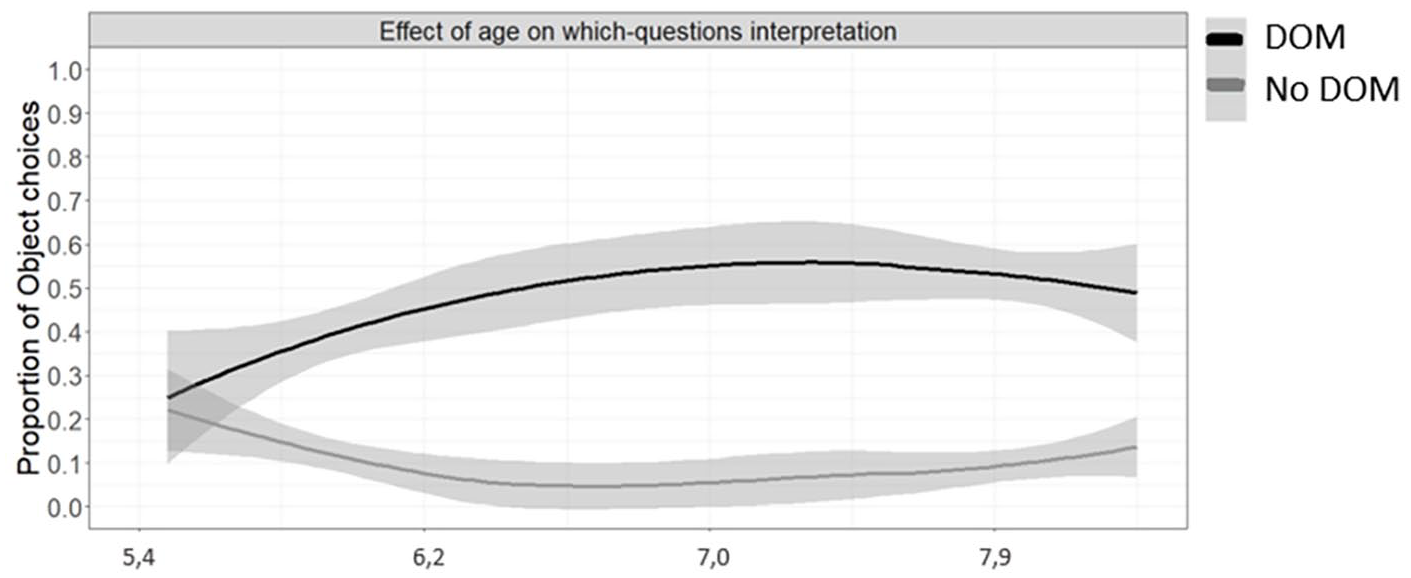
Proportion of Object choices in which-questions with and without DOM as a function of age (DOM Condition × Age interaction).
Discussion
In the present study, we looked at children’s use of Spanish DOM to interpret which-object questions in a picture selection task. We recruited a group of 5- to 8-year-old learners of Argentinian Spanish and a group of adult speakers. The results of the comprehension task revealed an interaction between the DOM condition and age, included in the analysis as a continuous predictor. Post hoc analyses using a median split did not reveal significant differences between the two age groups.
5
Additional t-tests suggest that children prefer to interpret which-questions with and without DOM as subject questions. This result is in line with the study by Mateu (2022), where 4- to 6-year-olds comprehended object which-questions with two singular NPs with about 40% accuracy (e.g., ¿
Concerning the interpretation of which-questions without DOM, the adult results demonstrate that the structure is ambiguous between a subject and object interpretation. The lack of DOM does not allow adults to clearly identify a unique interpretation, under the assumption that DOM marking could have been omitted either from the first NP (in an object question) or from the second NP (in a subject question). Interestingly, this is not a possible assumption for children, who maintain a strong subject interpretation for the ambiguous structures. Unlike adults, who interpret the structure as an object dependency half of the time, 5- to 8-year-old learners do not entertain this interpretation and choose the subject interpretation at ceiling. Under probabilistic models of sentence processing (Levy, 2008), in the context of an object filler-gap dependency, comprehenders predict a more frequent subject dependency structure. This account predicts that Spanish-speaking children may rely on an agent-first bias when processing a more infrequent structure like an object-which question (e.g., Contemori et al., 2018). Following capacity theories, the challenges with processing filler-gap dependencies are due to cognitive resource constraints (e.g., Gibson, 2000; Lewis et al., 2006). For children, the developmental limitations in working memory can affect the resolution of these dependencies, resulting in greater susceptibility to interference (e.g., Friedmann et al., 2009). While our data cannot provide evidence in support of capacity theories or probabilistic models, we propose that infrequent exposure to which-questions and capacity limitations may explain the difficulty that children experience with these structures (e.g., Staub, 2010). Thus, we emphasize the importance of both internal cognitive resources (working memory capacity) and external input factors (exposure frequency) in shaping syntactic development (Contemori et al., 2025).
In the statistical analysis, we did not find any significant effects for the animacy manipulation, indicating that children’s accuracy on questions with human versus animal objects was comparable. Even though DOM is an early-acquired feature in Spanish and previous corpus studies led us to expect a stronger association of DOM with human than nonhuman animate objects (Callen & Miller, 2022; Requena, 2023a, 2023b), the 5- to 8-year-olds in our study displayed an association between DOM as a cue to question interpretation for all animate objects alike. One possibility is that children anthropomorphize nonhuman characters (and even inanimate objects), thus contributing to the equal treatment of all animates with respect to DOM use. The similar behavior or human and animals in our experiment (both performing the same actions) could have contributed to equal treatment of all objects with respect to animacy.
A study of naturalistic conversation between a parent and child revealed that in the dialect tested here, speakers omit DOM not only with nonhuman animate objects, but also with human objects (Requena, 2023b). However, this dialectal characteristic is unlikely to explain our results. Despite the small dataset, Requena (2023b) only found that child and caregiver produced DOM omission with human pronouns and proper names. No omissions were found with human-specific NPs (as those used in our study). But both child and caregiver in that corpus produced DOM omissions with nonhuman animates, whether they were pronouns, proper names, or specific NPs. This suggests that, despite the variation in DOM use in the dialect spoken in Cordoba, when we consider specific NPs, we can expect DOM omission with nonhuman animate objects, but not with human ones. If future studies examine dialects that do exhibit DOM omission with human-specific NP objects (e.g., U.S. Spanish or Cuban Spanish), they should take this into consideration and maybe use more sensitive measures to detect animacy differences in DOM use, since more omissions are still expected with nonhuman animates that with human animates.
Research on processing times has found that monolingual adults combine information on DOM use as well as animacy (+ human, + human) during processing for comprehension (Bel & Benito, 2024). Online techniques such as eye-tracking could reveal some early sensitivity to DOM as a processing cue by the younger children tested here. Studies with (monolingual and bilingual) adult speakers have reported that such online measures tap on Spanish speakers’ sensitivity to DOM usage during comprehension, even when the effects are too subtle for behavioral measures to detect, such as sensitivity to nonnormative innovative uses (Arechabaleta Regulez & Montrul, 2021, 2023).
To conclude, the present study demonstrates that while DOM is an early-acquired feature of Spanish morphosyntax, children start using it at age 7 to 8 to interpret syntactically complex sentences like which-object dependencies, one of the latest acquired structures in child language development. The animacy feature of the subject and object NPs in which-questions with DOM did not have an effect on child interpretation in our study. In addition, only a subgroup of older children performed above chance on which-object questions with DOM, suggesting that DOM is used to guide the interpretation of filler-gap dependencies starting at age 7 to 8 in Spanish.
Footnotes
Acknowledgements
The authors would like to thank Escuela Dr. Dalmacio Vélez Sársfield for their support during data collection.
Author contributions
Consent to participate
Written parental consent and oral child assent were used in this study.
Funding
The author(s) received no financial support for the research, authorship, and/or publication of this article.
Ethical considerations
The study was approved by the Institutional Review Board at The University of Texas at San Antonio.
