




Abstract
This study focuses on parental use of parentese: the acoustically exaggerated, clear, and higher-pitched speech produced by adults across cultures when they address infants. While previous research shows that parentese enhances language learning and processing, it is still unclear what drives the variability in the amount of parental parentese use. We report on the development of a survey related to parental beliefs, knowledge, and self-awareness of parentese, and the cross-validation of this survey with daylong recordings in which parental parentese was measured through observation. Forty mother–father (18 monolingual English and 22 bilingual Spanish/English) U.S. families with infants between 3 and 24 months of age participated. Scores on the parentese questionnaire showed wide variability, suggesting that many parents were unsure about the effects of parentese on infant language development, and had limited self-awareness of their own parentese use. Almost half of the parents claimed that they talked to their child ‘like an adult’, and a similar number disagreed with the claim that parentese can support language learning. Our observational assessment of parentese demonstrated that all mothers and all fathers used parentese when talking to their infants; mothers in an average of 81% and fathers in an average of 69% of child-directed segments. Importantly, maternal parentese knowledge/beliefs scores, as well as their self-reported parentese use, were significantly positively correlated with observed parentese use; these relations were not significant for fathers. These results demonstrate that maternal and paternal links between beliefs, self-awareness, and behavior may be distinct, emphasizing the importance of studying all caregivers and using observational methodologies. More broadly, a thorough understanding of the factors that shape infants’ language environments contributes to theories of language acquisition and can aid in intervention design.
Introduction
In the middle of the twentieth century, scientific interest in the role of language input in children’s language acquisition began to increase. It was during this time that linguistic anthropologists began to document cross-cultural data on a speech register observed when adults direct speech toward infants. This style of speech, first termed ‘baby talk’, then ‘motherese’, and eventually ‘parentese’ because fathers also used it, possessed special qualities that distinguished it from ‘standard’ speech directed toward adults. Later research on parentese demonstrated that this speaking style had fewer and simpler lexical items compared to standard speech, a simpler phonology and grammar, a higher pitch, exaggerated intonation contours, a significantly slower tempo with elongated vowels (Fernald & Simon, 1984; Grieser & Kuhl, 1988), and was observed being used by mothers, fathers, adults who do not have their own children, and siblings, in both spoken and signed languages (Fernald, 1989; Reilly & Bellugi, 1996; Soderstrom, 2007). From early on, it was also noted that a similar speaking style was used in conversations with non-native speakers, or when addressing family pets (Hirsh-Pasek & Treiman, 1982; Mitchell, 2001; Snow et al., 1981), leading some to wonder whether parentese was a misnomer. However, it was later clearly demonstrated that parentese contains unique characteristics that distinguish it from other speech registers. For instance, parentese, but not pet-directed speech, is characterized by vowel hyperarticulation (Burnham et al., 2002; Gergely et al., 2017; Kuhl et al., 1997), and speech directed to non-native speakers lacks the positive affect and high pitch that characterize parentese (Singh et al., 2002; Uther et al., 2007).
From its very early descriptions, parentese has also been the subject of intense debates about its purpose and effects on children’s language learning. Early scholars warned that its use may be damaging to children’s language development (McCarthy, 1954). In 1965, Chomsky characterized parental language input to children as ‘fairly degenerate in quality’, full of ‘fragments and deviant expressions of a variety of sorts’ (Chomsky, 1965, p. 201). Around the same time, Ferguson observed that ‘in our society it is quite widely believed that the use of baby talk inhibits learning of language’ (Ferguson, 1964, p. 112). However, the same author also speculated that ‘perhaps the primary purpose is felt to be teaching a child to talk’ (Ferguson, 1964, p. 110).
Though Ferguson had some reservations, his idea that parentese could facilitate language learning later became the focus of intense research. Scientific investigations soon demonstrated that parentese was fully grammatical, used phonology that avoided complex clusters of consonants (Newport et al., 1977; Phillips, 1973; Snow, 1977), and vowels that were temporally and spectrally expanded (Burnham et al., 2002; Kuhl et al., 1997), providing an entry point for infants into the complexities of language learning. Researchers have further noted that infants prefer parentese over standard adult-directed speech from as early as 2 days after birth (Cooper & Aslin, 1990; see also Fernald, 1985; Fernald & Kuhl, 1987). Two recent large-scale studies have documented this preference across cultures, procedures, languages, and laboratories, in monolingual and bilingual infants (Byers-Heinlein et al., 2021; The ManyBabies Consortium, 2020). At the same time, laboratory research demonstrated that parentese facilitated several language learning mechanisms such as infants’ word segmentation (Thiessen et al., 2005), word recognition (Singh et al., 2009), and fast mapping (Ma et al., 2011). Finally, over the last decade, naturalistic recordings have demonstrated that higher rates of parentese use in the homes of monolingual and bilingual infants are associated with higher rates of child babbling at one year of age and greater productive vocabularies at 24 and 33 months of age (Ramírez-Esparza et al., 2014, 2017a, 2017b; see also Ferjan Ramírez et al., 2022; Shapiro et al., 2021). In summary, a growing body of research using a range of methodologies suggests that parentese may represent an ideal high-quality signal for language learning in infancy.
Nevertheless, the significance of parentese continues to be disregarded by some (e.g., Hornstein, 2005; Pinker, 1994), typically on the grounds of an argument that this type of speech is only characteristic of well-educated, Western, middle-class children, and that outside of these populations, children may not be universally deemed to merit specialized input (Saxton, 2009). Most of these arguments have been made on the basis of a few linguistic anthropologists, who reported on beliefs about child-rearing practices, oftentimes without direct observations of such practices (see Saxton, 2009 for a review). Discrepancies about parental self-awareness, knowledge, beliefs, and their actual behavior have also been reported in the literature. For example, Haggan (2002) reports that adult Kuwaitis who believed that the use of parentese delays language learning nevertheless used this speech register when they were observed during child play. A recent, perhaps the most wide-ranging study on parentese so far casts further doubt on the claims that the use of parentese is limited to Western, middle-class families. In this study, researchers collected 1615 voice recordings from 410 parents on six continents, in 18 languages, and from a range of communities (rural/urban, hunter-gatherers/urban dwellers, etc.; see Hilton et al., 2022). Listener sensitivities to the acoustic features were then studied in 51,065 people from 187 countries. Results demonstrated that language-naïve listeners were able to distinguish parentese from adult-directed speech on the basis of its acoustic features, which were similar from group to group, suggesting that the way adults talk to infants may be nearly universal. What remains to be studied in greater detail is whether parents use this speech register consciously and whether they are aware that it may be beneficial to children’s language learning.
Historically, language acquisition researchers have drawn their conclusions with regard to language input from relatively short recordings of parent–child interaction, typically made under semi-controlled conditions, such as free-play or book reading sessions in the lab or a child’s home. While such research methods are valuable in that they provide an information-rich view into specific types of language interactions, they are also limited in that they do not capture the full range of communicative situations that a child typically experiences throughout the day, and especially situations when a researcher is not present. Recent technologies, such as the Language ENvironment Analysis (LENA), have allowed researchers to continuously record children’s whole waking days with a wearable microphone, and study child-directed speech (CDS) as it occurs naturally in children’s day-to-day lives, by analyzing daylong recordings (Greenwood et al., 2011). These studies have demonstrated that the amount of speech that parents direct to their children varies widely from culture to culture. For example, Casillas and colleagues recently demonstrated that Tseltal children hear approximately 3.6 minutes of CDS per hour, which is approximately a third of what has been reported in North American children, but comparable to Tsimane children and Yucatec Mayan children (Casillas et al., 2020; see also Cristia et al., 2019; Shneidman & Goldin-Meadow, 2012). While these studies do not differentiate CDS into parentese and standard speech, they nevertheless demonstrate that children’s naturalistic language environments are extremely variable. Other studies that have considered parentese specifically (as identified based on acoustic features) demonstrate wide variability in its frequency within individual samples in Western societies. For example, Ramírez-Esparza and colleagues report that some infants in the U.S. receive most of their language input through parentese, while other infants experience parentese relatively infrequently (Ramírez-Esparza et al., 2014). Such within-group variability was observed in monolingual English-speaking families in the U.S., as well as U.S. bilingual Spanish/English-speaking families of Latinx descent, although the latter had a lower average rate of parentese use (Ramírez-Esparza et al., 2014, 2017a; see also Ferjan Ramírez et al., 2022).
The above-described variability in parental frequency of parentese use remains largely unexplained. One possibility is that it is related to parental knowledge and beliefs, or self-awareness around parentese use. Previous research has shown that parental beliefs about child development are related to parenting behaviors (Goodnow & Collins, 1990; Sigel et al., 1992) and that parenting behaviors are related to child outcomes (McGillicuddy-De Lisi & Sigel, 1995; Rowe, 2008). However, while there are measures that assess parental knowledge of child development in general, the field currently lacks a comprehensive measure of parental knowledge, beliefs, or self-awareness with regard to parentese specifically, and previous research on this topic is scarce. One study found that first-time mothers were unsure of the rationale for using parentese with their infants, despite the fact that they seemed to recognize the importance of early language input to children’s language learning (Whitmarsh, 2011). Another recent study reports that, compared to females, males were significantly less likely to believe that parentese was beneficial to infant development; however, participants in this study were non-parents (Kennison & Byrd-Craven, 2015).
While we know relatively little about parental knowledge, beliefs, or self-awareness of parentese use, a recent study demonstrates that the link between parental use of parentese and child language learning may be causal: that is, experimentally altering the frequency of parentese through intervention results in enhancements in children’s language development (Ferjan Ramírez et al., 2019, 2020). In that study, English-speaking U.S. parents were coached to use more parentese with their 6- to 18-month-old infants. The parents who received coaching produced a larger proportion of their utterances in parentese, and their children showed higher vocabulary and enhanced turn-taking in infancy and toddlerhood (Ferjan Ramírez et al., 2019, 2020; Huber et al., 2023). Follow-up studies that tracked the same children longitudinally demonstrated positive associations between parentese in infancy, and sentence length, lexical diversity, turn-taking, as well as emergent literacy skills at Kindergarten entry (Ferjan Ramírez et al., 2023; Weiss et al., 2022). Together, this supports the idea that caregiver use of parentese in infancy may serve as a stepping stone to language, catalyzing positive developmental cascades, and supporting robust language development that goes beyond infancy and toddlerhood. Despite these widespread and well-documented positive effects, however, the belief that parentese is beneficial for infants’ language development is still not widely held among U.S. caregivers. For example, during the parent coaching appointments in the above-mentioned study, the researchers informally observed that parental knowledge and beliefs around parentese varied widely (Ferjan Ramírez et al., 2019, 2020). Further, they report that, while some parents appeared to be aware of their own parentese use, others denied using it altogether, and were surprised to hear themselves using this speech register when presented with clips from their own audio recordings (Ferjan Ramírez et al., 2019, 2020).
A more thorough understanding of what parents know and believe about parentese is important for at least two reasons: First, parental knowledge, beliefs, and self-awareness are the building blocks supporting the theory of behavior change for many language interventions (Suskind et al., 2018; Woods & Brown, 2011; see also Abraham & Michie, 2008). An important principle behind the theory of behavior change is that enhancing parental knowledge about specific language behaviors will lead to higher-quality language environments. Second, and perhaps more importantly, the ability to assess parental beliefs, knowledge, and self-awareness can enable those who work with parents to educate with further information and/or address common misconceptions regarding parentese.
The present study
This pilot study reports on the development of a survey related to parental beliefs, knowledge, and self-awareness of parentese, and the cross-validation of this survey with daylong recordings in which parental parentese was measured through direct observation. We study mothers and fathers, in monolingual English-speaking and Spanish/English bilingual Latinx families residing in the U.S., where parentese is well documented, but its frequency nevertheless varies widely. For example, recent studies have shown that fathers use less parentese compared to mothers (Ferjan Ramírez et al., 2022; Shapiro et al., 2021). Furthermore, some research suggests that Latinx families in the U.S. may use less parentese compared to non-Latinx U.S. families (Ramírez-Esparza et al., 2014, 2017a) differences that remained unexplained. The Latinx population is the largest and fastest-growing ethnic minority in the U.S., predicted to account for more than 30% of the U.S. population by 2050 (Federal Interagency Forum on Child and Family Statistics, 2017). While Latinx families are diverse in terms of their language use, many households report speaking Spanish and English through a range of different patterns (i.e., in some families, both parents may speak both languages, while in others each parent speaks one language; see King et al., 2008). Studying the language environments and parental beliefs in bilingual Latinx U.S. families is important because this population is socioculturally distinct, allowing for examinations of how cultural and demographic factors may influence language input. From a practical standpoint, with a greater understanding of parental beliefs and their relation to language input in the context of Latinx families, practitioners, and clinicians can design culturally sensitive recommendations and/or interventions.
With these two subgroups of participants in mind, we ask the following specific questions: First, what do mothers and fathers know and believe about parentese? Do mothers and fathers differ in their knowledge/beliefs, or are they similar? Do Latinx and non-Latinx U.S. families differ in their knowledge/beliefs, or are they similar? Second, are parental knowledge/beliefs and self-reported parentese use associated with their real-time parentese use as observed in daylong recordings?
Methods
Participants
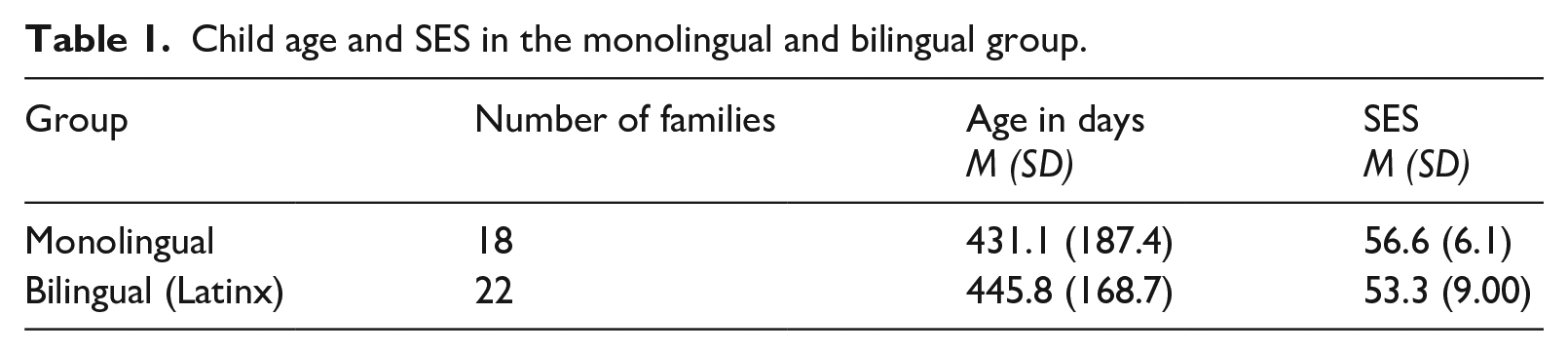
Participating families were recruited through the University of Washington Subject Pool and advertisements through flyers, social media, and email listserves. Participants were assessed for eligibility via video chat (in Spanish or English, participants’ choice). The criteria for inclusion in this study were infant age between 1 and 24 months of age; the infant is exposed to English and/or Spanish via direct interactions at home; the infant was born full-term (within + 14 days of the due date), of normal birth weight (6–10 lbs), and had no major birth or postnatal complications. Forty-one families met the eligibility criteria and were enrolled in this study. One family withdrew from the study prior to completing the study procedures. The final dataset used in this study therefore includes 40 families with young children (23 girls; mean age: 14.5 months, range: 3–24 months; Table 1). Of these, 18 were monolingual, English-speaking non-Latinx families. The rest of the participating families (N = 22) were bilingual and reported speaking both Spanish and English in the home. While all bilingual families were of Latinx descent (i.e., one or both of the parents self-identified as Latinx), it is important to emphasize that they varied in their generation status, countries of origin, levels of acculturation, ethnicities, and patterns of language practices that they reported during recruitment. For example, with regard to language use, some of the families adopted the one-parent, one-language approach, while in other families, one or both parents spoke both languages to their infant. Similarly, in some of the participating bilingual families, only one parent was of Latinx descent, while in others, both parents self-identified as being of Latinx descent. Participants’ socioeconomic status (SES) was measured via the Hollingshead Index (Hollingshead, 2011), a widely used measure, which codes parent educational attainment and occupational prestige to generate a number between 8 and 66. Participating families ranged in SES from middle to upper-middle and upper-class families, with a mean Hollingshead Index of 54.5, and a range from 33 (e.g., both parents with high school diploma/some college, working in sales or construction) to 66 (e.g., both parents with advanced degrees, working as professionals). There was no significant difference in SES scores, t(38) = 1.33, p = .19, or age, t(38) = 0.26, p = .80, between the monolingual and the bilingual (Latinx) families. Experimental procedures were approved by the Institutional Review Board at the University of Washington and informed consent was obtained from parents. The study conforms to the U.S. Federal Policy for the Protection of Human Subjects. All study procedures, tasks, instructions, and surveys were available in either Spanish or English.
Child age and SES in the monolingual and bilingual group.
Study design
Families who agreed to participate were invited to a brief video chat, during which they were shown how to use the LENA equipment. They also agreed on the recording dates and were mailed the LENA recorders. LENA recordings were then analyzed in the lab to determine the frequency of maternal and paternal parentese use (henceforth called ‘observed parentese’). After the recorders were returned to the lab, families completed two online questionnaires, a Demographic Survey, and a Parentese Survey.
Observed parentese use assessed through LENA
This study used similar procedures as those reported in previous studies that tracked parental parentese use in children’s homes (Ferjan Ramírez et al., 2019, 2020, 2022; Ramírez-Esparza et al., 2014, 2017a, 2017b; Shapiro et al., 2021). Two LENA recorders and vests were sent to families in the mail. Parents were instructed to record a ‘typical’ weekend, defined as two consecutive days when both parents were home and not working. Parents were asked to start each recording in the morning when the infant woke up and to turn off the recorder at night when the infant went to sleep. They were asked to go about their activities as usual, while their infants wore the LENA device inside the front pocket of a LENA vest. The average duration of the LENA recordings was 12 hours and 41 minutes (range: 8 hours 6 minutes to 16 hours), and the average estimated number of adult words heard by the child (AWC) per 12 hours was 19,550. These data demonstrate that infants in the present sample were exposed to lots of adult speech, as has been previously documented in U.S. English- and Spanish/English-speaking samples with similar background characteristics (Bergelson et al., 2019; Ferjan Ramírez et al., 2019, 2020, 2022; Ramírez-Esparza et al., 2014, 2017a, 2017b; Shapiro et al., 2021).
The LENA data preparation and annotation procedures closely followed those outlined in previously published studies (Ferjan Ramírez et al., 2019, 2020; Ramírez-Esparza et al., 2014, 2017a, 2017b; Shapiro et al., 2021). The LENA software produces an automatic count of child vocalizations (child vocalization count, CVC), words produced by nearby adults (adult word count, AWC), and adult-child conversational turns (conversational turn count, CTC); however, our main variables of interest, observed frequency of maternal and paternal parentese use, cannot be identified automatically and were therefore quantified through manual (human) annotation, following previously published procedures (Ferjan Ramírez et al., 2019, 2020; Ramírez-Esparza et al., 2014, 2017a, 2017b; Shapiro et al., 2021). The LENA audio files were processed using the Advanced Data Extractor Tool (ADEX), which was used to identify intervals with the language activity of interest (high AWC) for manual analysis, in order to avoid coding when there is no social or linguistic activity (e.g., during naps). Each participant’s two daily recordings were segmented into 30-second intervals. For each of the two recording days, 50 intervals with the highest AWC that were at least 3 minutes apart were selected, yielding a total of 100 30-second coding intervals per participant. To collect a broad range of environments, we further required that the selected intervals be spaced at least 3 minutes apart. Three research assistants, fluent in Spanish and English, followed the procedures outlined by Ramírez-Esparza and colleagues (2014, 2017a, 2017b) and Ferjan Ramírez and colleagues (2019, 2020). Note that CDS consists of parentese and standard speech. The focus of this study is on parentese, which is distinguished from standard CDS by its acoustic features. To identify parentese and distinguish it from standard CDS, the same criteria were adopted as described previously by Ramírez-Esparza and colleagues (2014, 2017a, 2017b) and Ferjan Ramírez and colleagues (2019, 2020, 2021). Ramírez-Esparza et al. (2014) independently verified that the intervals defined as parentese or standard speech contained the acoustic differences characteristic of these two speech styles (i.e., higher pitch and larger pitch range for parentese). In these analyses, 60 occurrences of the word ‘you’ were analyzed. The 60 occurrences of ‘you’ represented 30 pairs (30 produced as parentese and 30 as standard speech) produced by the same adult addressing the same infant. Mean pitch and pitch range were significantly higher for parentese than standard speech (see Ramírez-Esparza et al., 2014 for further details).
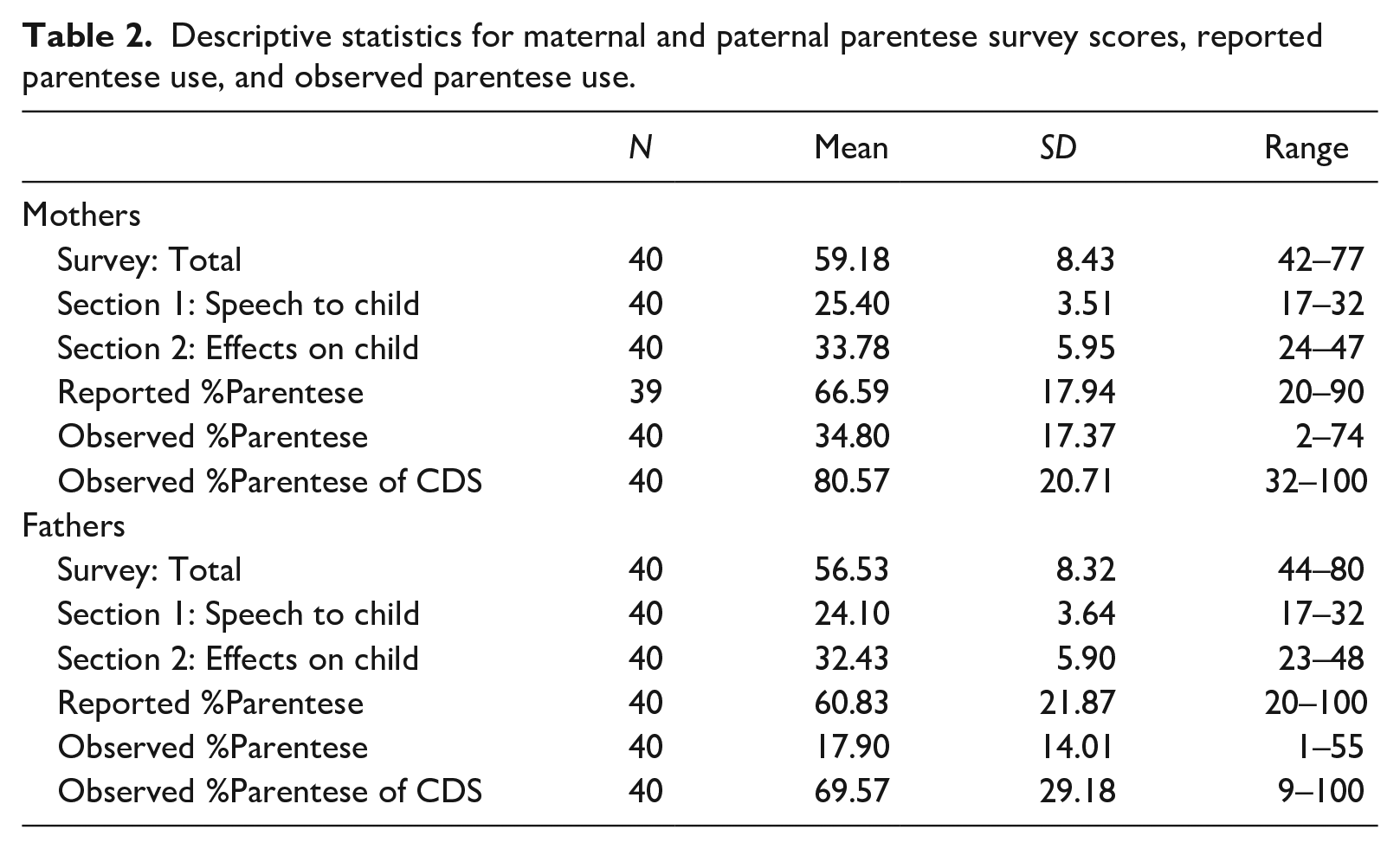
After training, all coders were tested independently with a training file of 100 intervals from Ramírez-Esparza and colleagues (2014) and a training file of 100 intervals from the present dataset used to evaluate inter-coder reliability. The reliability analysis produced an intra-class correlation (ICC) of 0.97 for maternal parentese and 0.93 for paternal parentese, indicating effective training and reliable coding, based on a two-way random effects model (ICC [2, k]; Shrout & Fleiss, 1979; see also Ferjan Ramírez et al., 2019, 2020; Ramírez-Esparza et al., 2014, 2017a, 2017b). The data matrices for each participant were aggregated to provide relative time use by calculating the percentage of intervals containing parentese. This means that the variable ‘Observed %Parentese’ denotes the percent of 30-second intervals in which an adult spoke directly to the child and parentese speech style was used for at least some of the interval (Table 2). For each parent, we also calculated the proportion of parentese speaking style when CDS was used (i.e., when a parent is talking to the child, how likely are they to use the parentese-speaking style). This variable was named ‘Observed %Parentese of CDS’ (Table 2).
Descriptive statistics for maternal and paternal parentese survey scores, reported parentese use, and observed parentese use.
Questionnaires
After completing the LENA recordings, families were emailed links to two online questionnaires (surveys). The first one, the Demographic Survey, was filled out by one parent from each family. The Demographic Survey contained questions about demographic information, such as language(s) spoken in the home, and family composition. It also collected the information necessary to calculate each family’s SES via the Hollingshead Index (Hollingshead, 2011).
The second questionnaire, the Parentese Survey, was filled out by both parents in each family. This questionnaire was created for the purposes of this study based on the literature on the linguistic features of parentese and their effects on learning (see Golinkoff et al., 2015; Saint-Georges et al., 2013 for review), as well as on the findings from a previously published parent coaching intervention study (Ferjan Ramírez et al., 2019, 2020). In that study, parents of typically developing English-learning infants (N = 53) were ‘coached’ on the use of parentese via in-person appointments when infants were 6, 10, 14, and 18 months of age. During the coaching appointments, the coach engaged parents in a conversation about the linguistic features of parentese and their effects on child language learning. The coach then played snippets of parentese from the families’ own recordings, to engage parents in further discussion. The coach took notes about parents’ remarks around parentese, which were reviewed for the purposes of this study and used in preparation for the Parentese Survey.
Two separate groups of questions were created for the Parentese Survey in order to probe parental awareness of their own parentese use (Section 1), as well as their beliefs about the potential effects of parentese on children’s language learning (Section 2). These two sections were created and scored separately, as they test two potentially distinct, though related concepts. Section 1 was titled, ‘How I talk to my baby’ and asked the parents to think about the ways in which they speak to their child. This section included questions such as ‘When I talk to my baby, my speech is simpler compared to when I talk with an adult’ (see Supplemental Material for a complete list of questions). The second subsection was titled ‘How babies learn language’ and asked parents to respond to questions about the effects of parentese on child language learning. It included statements such as ‘When adults talk to babies in a playful, exaggerated tone of voice, babies respond by looking at the adults, smiling, or making sounds’ (see Supplemental Materials for a complete list of questions). In both subsections, participants were asked to indicate how strongly they agreed or disagreed with each statement. The response options used a 0 to 3 Likert-type scale, ranging from ‘definitely disagree’ (0 points) to ‘definitely agree’ (3 points). Responses were scored out of 33 possible points for Section 1 and out of 48 points for Section 2, together yielding a total ‘Parentese Survey score’ (highest possible score: 81 points), with a higher score representing greater knowledge around parentese. The Parentese Survey had a Cronbach’s alpha of 0.88, indicating high internal consistency.
Finally, at the end of the Parentese Survey, participants were asked to indicate how often they think they use parentese with their child, by answering the following question: ‘On average, how often do you think you use playful, sing-song, or exaggerated speech with your baby?’ Participants answered by simply filling in the gap in the following statement: ‘I think I use playful, sing-song, or exaggerated speech with my baby about _____% of the time’.
Statistical analyses
All continuous variables were summarized as mean ± standard deviation (SD). Independent sample t-tests were used to consider whether the Parentese Survey scores, self-reported parentese use, and observed parentese use differed between the monolingual or bilingual families. Paired sample t-tests were used to consider whether the Parentese Survey scores, self-reported parentese use, and observed parentese use differed between mothers and fathers. Associations between the Parentese Survey scores and observed parentese use were evaluated using Pearson correlation. Pearson correlations were also used to assess the associations between self-reported and observed parentese use. Throughout, two-tailed statistical tests were used, with statistical significance defined as α = 0.05. With 40 participants and a 0.8 power, the α value of 0.05 allows us to reliably capture medium to large effect sizes, based on previous research that used similar procedures to annotate parentese from daylong recordings (Ferjan Ramírez et al., 2019, 2020; Ramírez-Esparza et al., 2014, 2017a, 2017b; see Serdar et al., 2021).
Results
The Parentese Survey
Descriptive statistics for maternal and paternal Parentese Survey scores are shown in Table 2. For mothers and fathers, these scores varied widely, between 42 points (52% of total possible points) and 80 points (99% of total possible points). Scores by group (bilingual/monolingual) are shown in Supplemental Results, Supplemental Table S1.
We first considered whether maternal or paternal Parentese Survey scores differed between bilingual (Latinx) and monolingual English-speaking, non-Latinx families. Using an independent sample t-test, we learned that this was not the case (all ps for individual subsections and totals in mothers and fathers were between p = .45 and p = .99). As such, all data were analyzed as a single group in subsequent steps.
Next, we considered whether the average maternal and paternal Parentese Survey scores differed from one another. Using a paired sample t-test, statistical significance was not reached, although maternal scores were numerically above paternal scores, t(39) = 1.64, p = .11 for Section 1; t(39) = 1.29, p = .21 for Section 2; t(39) = 1.68, p = .10 for both sections together. This means that, on average, maternal and paternal knowledge and beliefs about parentese and its effects on child language development do not significantly differ.
We also informally inspected the mean scores of individual survey items separately for mothers and fathers, to identify statements where scores were the lowest, as these could potentially represent the most common misconceptions about parentese (Table 3; see also Supplemental Results for statements separated by group). These lowest-scoring statements appear to be similar for mothers and fathers, across both groups. For example, ‘When I talk to my baby, I speak slower than when I speak to an adult’ and ‘Babies learn language best if spoken to in an adult-like way’ were among the lowest five scoring statements across mothers and fathers, in the Latinx and non-Latinx group. By contrast, ‘repeating the same word or phrase multiple times’, ‘speaking slowly and clearly’, or ‘concerns around using incorrect grammar’ did not appear on the list of the lowest five scoring items for any one of the subgroups.
Five Parentese Survey statements with lowest scores for mothers and fathers.
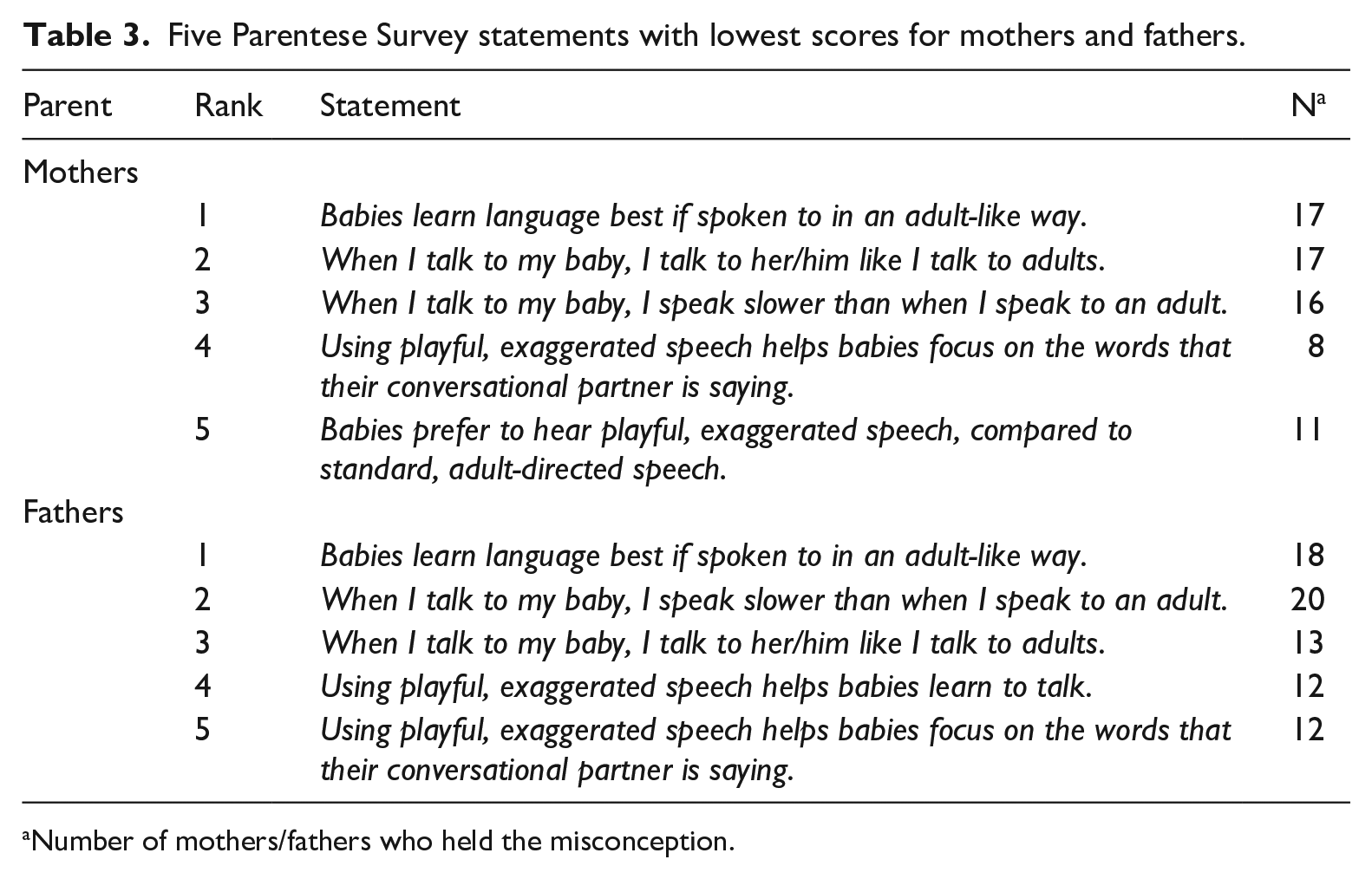
Number of mothers/fathers who held the misconception.
Reported and observed parentese use
The average reported parentese use (obtained through the Parentese Survey), observed parentese use (obtained through LENA), and observed parentese use within CDS (obtained through LENA) for mothers and fathers are listed in Table 2. These scores did not differ significantly between monolingual and bilingual (Latinx) families (i.e., all ps > .1; see all scores by group in Supplemental Results, Supplemental Table S1). As such, all data were analyzed as a single group. As is shown in Table 2, mothers on average self-reported that they use parentese 66.6% of the time, while fathers on average reported that they use parentese 60.8% of the time. According to our observation (via LENA recordings), mothers used parentese in an average of 34.8% of intervals (or 80.6% of the time when they used CDS), while fathers used it in 17.9% of the intervals (or 69.6% of the time when they used CDS). In summary, all mothers and all fathers in the present sample used at least some parentese during their home recordings, though their frequencies of use varied widely, as has been documented in previous research with U.S. families. For example, several parents in the present sample always used parentese when addressing their child (i.e., their Observed % parentese when using CDS was 100%), while others used parentese quite rarely (e.g., only 9% of the time when using CDS, or as low as 1% of the time when all speech was considered).
Based on the self-report, the difference between maternal and paternal frequency of parentese use was not significant, though approaching significance t(38) = 1.79, p = .082, with mothers reporting numerically higher frequency of parentese use compared to fathers. Based on observation via LENA recordings, there was a significant difference between maternal and paternal frequency of parentese use, both overall, t(39) = 5.73, p < .001, and when only CDS was considered, t(39) = 3.34, p = .002, with mothers using parentese significantly more frequently than fathers in both cases. Observed maternal parentese frequency was higher than observed paternal parentese frequency in 35 out of 40 families, while the remaining five families showed the opposite pattern.
Associations between Parentese Survey scores, reported parentese use, and observed parentese use
Next, we considered maternal and paternal reported parentese use in relation to observed parentese use. Maternal (r = 0.34, p = .035) but not paternal (r = 0.18, p = .27) observed parentese use was positively correlated with child age. Controlling for age using partial correlation, maternal reported parentese use and maternal observed parentese use were significantly positively correlated, r = 0.40, p = .001. On the other hand, paternal reported parentese use and paternal observed parentese use were not significantly correlated, r = −0.23, p = .16.
Finally, we considered maternal and paternal Parentese Survey scores in relation to observed parentese use (i.e., Observed %Parentese). This was done first individually for each of the two survey sections (Section 1: ‘How I talk to my baby’; Section 2: ‘How babies learn language’), and then together for the sum of both sections (Total). Controlling for child age using partial correlation, maternal Section 1 (r = 0.36, p = .024), Section 2 (r = 0.36, p = .023), and Total (r = 0.41, p = .009) survey responses significantly correlated with maternal observed parentese use. By contrast, paternal Section 1 (r = −0.16, p = .32), Section 2 (r = −0.052, p = .75), and Total (r = −0.11, p = .51) scores did not correlate with paternal observed parentese use.
Discussion
This pilot study reports on the development of a questionnaire assessing parental knowledge/beliefs and self-report of parentese use and directly relates parental questionnaire scores to naturalistic parentese use, assessed via manual analyses of daylong LENA recordings. A sample of 40 U.S. families with young children participated, of which approximately half were bilingual and of Latinx descent. Results demonstrate that parental knowledge/beliefs around parentese were variable and, on average, did not differ between mothers and fathers. However, significant differences between mothers and fathers were detected in the observed, objectively measured parentese use, with mothers using parentese almost twice as frequently as fathers. Interestingly, there was a significant positive correlation between maternal self-reported and observed parentese use, an association that was not significant for fathers. To our knowledge, this is the first attempt to assess the links between parentese self-awareness, parental knowledge/beliefs, and actual behavior, in mothers and fathers. Our results demonstrate that maternal and paternal links between knowledge, self-awareness, and behavior may be distinct, emphasizing the importance of studying all caregivers (including fathers) and using observational approaches.
The present results also support some of the previously documented observations around discrepancies between what parents report they do in talking to their children, and their actual behaviors (Haggan, 2002), a mismatch that could be attributed to a number of different factors. For example, parents may provide responses that they think might be socially acceptable or desirable, or they might encounter difficulties in recalling or estimating the characteristics of their speech. Parents may also find it difficult to reflect on their speech, given that they may not have had much experience performing metalinguistic tasks. Further, it may be that parents use different speaking styles in different social contexts (i.e. using parentese when alone with the baby, but not when others are around), or that they simply have different interpretations of what it might mean to speak to a child ‘differently than to an adult’. In the present study, many parents claimed that they ‘talk to their child like to an adult’, even though every single one of them used at least some parentese in their daylong recordings, and many parents used it nearly always when addressing their child. Interestingly, when parents were asked to self-report how often they used ‘playful, sing-song, or exaggerated speech with their baby’, none of them indicated 0% (i.e., the lowest self-assessment score was 20% for mothers and fathers), even though half of them reported that they ‘talk to their child like to an adult’. This indicates that not only can parental survey responses be inconsistent with their actual behavior, but they can also be somewhat dependent on how the question is posed (i.e., I use playful, sing-song, or exaggerated speech with my baby _____ % of the time might imply that the answer is unlikely to be 0%). Together, this provides further support for supplementing survey and interview approaches with observational methodologies.
Similar to previous research with monolingual and bilingual (Spanish-English) U.S. samples (Ferjan Ramírez et al., 2022; Shapiro et al., 2021), the current results indicate that children heard much less parentese from fathers compared to mothers, even though both parents were asked to be at home when the recordings were collected, and even though maternal and paternal scores on the parentese questionnaire were not statistically different. Gaps between maternal and paternal frequency of parentese use have been documented across North American families of varying backgrounds and will be important in designing future interventions for Latinx and non-Latinx families. Importantly, this study documents a significant positive correlation between knowledge and behavior as well as between self-report and behavior for mothers, but not for fathers. One possible interpretation of this finding is that fathers have poorer introspection about how they talk to their children compared to mothers, perhaps as a result of spending less time with the child, and/or talking less to their child. While recent societal changes have increased fathers' time spent in hands-on activities with their children in many Western societies (Cabrera et al., 2018), the division of childcare responsibilities is still unequal in many U.S. families, and these inequalities were exacerbated during the COVID-19 pandemic (Zamarro & Prados, 2021). Relatedly, rates of paternity leave-taking in the U.S. are still very low, and the majority of fathers who take leave take only one week or less, resulting in unequal distribution of time spent with the child between mothers and fathers (Petts et al., 2020). Thus, one variable worth exploring in future studies on paternal language input may be their ‘experience as the main caregiver’.
This study did not detect any statistical differences in parental beliefs or in parental parentese use between non-Latinx and Latinx families. This is an interesting finding mainly because the Latinx population is socioculturally distinct, and cultural contexts are known to influence language and learning (see, e.g., Cabrera & Bradley, 2012; Cycyk & Hammer, 2020); furthermore, previous studies have reported differences between Latinx and non-Latinx U.S. families, with the former using quantitatively more parentese compared to the latter (Ramírez-Esparza et al., 2017a). There are a few possible interpretations of these findings. First, it may be that our sample was too small to detect potential between-group differences if they do exist. Second, patterns of CDS can vary by SES (Rowe, 2008). In the present study, SES was equivalent between the two groups, which was not the case in some of the previous comparative work (Ramírez-Esparza et al., 2017a). Thus, some of the previously observed differences between Latinx and non-Latinx families’ parentese use could potentially be attributed to SES factors, rather than cultural differences alone. Third, in several of the Latinx families in the present sample, only one parent was of Latinx descent, while the other parent was non-Latinx. Fourth, it is also important to acknowledge that the current study considered all Latinx families as a single group. In reality, they consist of different subgroups varying in generation status, with different countries of origin, varying levels of acculturation, ethnicities, and other factors that should be further investigated in future research, as they may impact parental beliefs and practices around language use. The small sample size used in this study prevented us from conducting such analyses.
Other limitations should be considered when interpreting the findings presented here. The current sample is relatively small from a statistical perspective and considers children of a wide age range. Future studies implementing a longitudinal design will be needed to investigate the effects of children’s age on parental parentese use and beliefs around it. Furthermore, future studies will have to consider families across a broader SES range, and parents across more varied educational backgrounds to further examine the potential effects of these factors on parental beliefs and knowledge around parentese. Follow-up studies will have to be conducted to further validate the current (pilot) version of the questionnaire and test it with larger, more diverse samples. For example, we created two sections of the Parentese Survey to test two theoretically different concepts (i.e., parental beliefs around their own use of parentese and parental beliefs around the effects of parentese on language learning), but parental scores on these two sections suggested that these two concepts may, in fact, be related and could potentially be merged. Future studies using carefully designed cognitive interviews and additional statistical analyses will be needed to further test this idea (see Suskind et al., 2018 for a similar procedure). Finally, we recognize that documenting potential cross-cultural and cross-linguistic differences in parental beliefs around parentese is a topic of great interest to many. It will be especially important to include families from cultures where parents have previously been observed to hold beliefs around childrearing that are distinct from those held in Western societies (Ochs, 1982; Pye, 1986). While we were not able to include such families here, our hope is that the present pilot study can serve as a guide to those who have an opportunity to do so.
As in previous studies that examined naturalistic language samples collected in North American English-speaking and Spanish-English-speaking households with young children (Ferjan Ramírez et al., 2022; Ramírez-Esparza et al., 2014, 2017a, 2017b; Shapiro et al., 2021), all participating mothers and fathers in the present sample used at least some parentese. Furthermore, when parents directed their speech to children, their use of parentese was very frequent (81% for mothers, and 70% for fathers). This seems to suggest that most U.S. parents consciously or unconsciously realize that conversing with a young child requires certain adaptations and that without such modifications, communication may be compromised. While parental conscious realizations of making such adaptations are variable, even those who lack such conscious insight seem to adapt their speech, perhaps in response to incomprehension on the part of the child, or simply out of desire to communicate. Given that this behavior appears to be widespread among U.S. parents, but its impacts are still often misunderstood or only partially understood by the general public, it may be beneficial for researchers to work with communications specialists to adapt the current narrative on parentese. In our experience taking with the media, parents, and lay audiences, parentese is typically perceived as something ‘cute’, ‘silly’, and sometimes even ‘annoying’. The present results also demonstrate that many parents still hold several misconceptions about parentese, and that these are similar for mothers and fathers (i.e., Babies learn language best if spoken to in an adult-like way). Years of research demonstrate that using parentese is not only a completely natural way to facilitate communication, it is also preferred by young children and beneficial to their language learning. In a recently proposed model, Rowe and Snow (2020) conceptualized the features of high-quality caregiver input that facilitate language development in terms of three dimensions: linguistic, interactive, and conceptual. Parentese has been demonstrated to maximize all three of these dimensions (Ferjan Ramírez et al., 2023). Linguistically, key features of parentese are its distinct segmental and prosodic features, which are adjusted in real time and based on the child’s responses. Interactive features include the behaviors that co-occur with parentese, such as turn-taking, joint attention, contingency, reciprocity, and connectedness. Conceptually, caregivers tend to use parentese to talk about the objects and events preset immediately in front of the child, with frequent pointing and attention-sharing. Thus, parentese speech in the natural social context in which it is delivered may present an ideal catalyst for language learning (Ferjan Ramírez et al., 2020). Our results here suggest that evidence-based findings around parentese should be translated into practical techniques for communicating with parents, those who work with children, and those who make decisions that affect them.
Supplemental Material
sj-docx-1-fla-10.1177_01427237231216010 – Supplemental material for What do parents really think? Knowledge, beliefs, and self-awareness of parentese in relation to its use in daylong recordings
Supplemental material, sj-docx-1-fla-10.1177_01427237231216010 for What do parents really think? Knowledge, beliefs, and self-awareness of parentese in relation to its use in daylong recordings by Naja Ferjan Ramírez in First Language
Footnotes
Acknowledgements
Special thanks to Lili Correa for her valuable assistance.
Author contributions
Declaration of conflicting interests
The author declared no potential conflicts of interest with respect to the research, authorship, and/or publication of this article.
Funding
The author disclosed receipt of the following financial support for the research, authorship, and/or publication of this article: The research described here was supported by the University of Washington’s Language Acquisition and Multilingualism Endowment.

Supplemental material
Supplemental material for this article is available online.
References
Supplementary Material
Please find the following supplemental material available below.
For Open Access articles published under a Creative Commons License, all supplemental material carries the same license as the article it is associated with.
For non-Open Access articles published, all supplemental material carries a non-exclusive license, and permission requests for re-use of supplemental material or any part of supplemental material shall be sent directly to the copyright owner as specified in the copyright notice associated with the article.
