




Abstract
Comprehension of sentences with a center-embedded, object-gapped relative clause (ORC) is challenging for children as well as adults. Mismatching lexical and grammatical features of subject noun phrases (NPs) across the main clause and relative clause has been shown to facilitate comprehension. Adani et al. concluded that children’s comprehension improved under conditions of NP number mismatch (e.g., singular main clause subject and plural relative clause subject) as compared with NP number match (e.g., both singular subjects). However, their stimuli provided number information on verb phrases (VPs) as well as NPs creating a confound for conclusions about facilitative effects of NP number mismatch. In this study, we isolated the contribution of NP number mismatch. Notably, 32 6-year-olds with typical language participated in a center-embedded, ORC sentence comprehension task with 4 types of stimuli: (a) NP number mismatch without VP number information (NP mismatch only), (b) NP number match without VP number information (NP match only), (c) NP number mismatch with VP number mismatch (NP + VP mismatch), and (d) NP number match with VP number match (NP + VP match). Children selected one of four pictures in an array to a verbally presented relative clause sentence; 56 sentences were presented. The within-subjects comparison for NP mismatch only and NP match only was not significant. However, the within-subjects comparison for NP mismatch only and NP + VP mismatch was significant. Children were more successful in NP + VP mismatch sentence comprehension (
Introduction
For children as well as adults, center-embedded object-gapped relative clause (ORC) sentences, as in (1), are generally more difficult to comprehend than final-branched ORC sentences, as in (2) (Kidd & Bavin, 2002).
The boy that the mother praised won the award. 1
The coach acknowledged the boy that the mother praised.
ORC sentences are among the most challenging relative clause sentences for children to comprehend. Studies of English- and Portuguese-speaking children provide evidence that 3–5-year-olds better comprehend final-branched ORC sentences than ORC sentences (Corrêa, 1995; Kidd & Bavin, 2002). Similarly, school-age English- and Hebrew-speaking children performed worse on tasks involving ORC sentence comprehension than other types of relative clause sentences, such as final branching and subject-gapped relative clause sentences (Contemori & Marinis, 2014; Friedmann & Novogrodsky, 2004). Several explanations for this asymmetry in relative clause sentence comprehension have been advanced, including increased processing costs associated with the center-embedding of long filler-gap dependencies (Arnon, 2010; Kidd & Bavin, 2002) and the relative infrequency of spoken ORC sentences in children’s language learning environments (Diessel, 2004).
However, child and adult comprehension of ORC sentences can be enhanced when features of the head noun phrase (NP; i.e., main clause subject) and the relative clause subject NP are mismatched. Adani (2012) reported that German-speaking 4-year-olds comprehended ORC sentences with inanimate head NPs (e.g., the sweater) better than those with animate head NPs (e.g., the man) when the head NP preceded an animate relative clause subject (e.g., the child). Friedmann et al. (2009) reported that NP lexical restriction mismatch (e.g., + pronoun, + lexical noun) resulted in a final-branched ORC sentence comprehension advantage over NP lexical restriction match (two lexical nouns) such that (3) was better comprehended than (4).
3. Show me the one that the boy is wetting (Friedmann et al., 2009).
4. Show me the monkey that the boy is hugging (Friedmann et al., 2009).
In a study of Italian, which marks gender on NPs, Adani et al. (2010) reported that preschool children comprehended ORC sentences with NP gender mismatch, as in (5), better than ORC sentences with NP gender match, as in (6) (odds ratio 0.52; Adani et al., 2010). Similarly, Guasti et al. (2012) found that Greek-speaking children better comprehended presentational object RC sentences (e.g., ‘Show me the monkey that is washing the bear’) when sentences only had the presence of case information than when the case is neutralized, and sentences only had agreement on the verb. According to Guasti et al. (2012), Greek-speaking children utilized the morphological case information on NPs, as in (5) and (6), to enhance their comprehension of presentational RC sentences.
5. Dhikse mou ti maimou pou pleni
Show me the monkey that is washing the bear (Guasti et al., 2012).
6. Dhikse mou ti maimou pou pleni
Show me the monkey that is washing the bear (Guasti et al., 2012).
In a study of Hebrew- and Italian-speaking children, Belletti et al. (2012) replicated Adani et al.’s finding in Hebrew-speaking children’s comprehension of ORC sentences but failed to replicate Adani et al.’s finding in Italian-speaking children.
7. Il gatto che la capra sta lavando e salito sullo sgabello.
The cat that the goat is washing has climbed onto the chair (Adani et al., 2010).
8. Il gatto che il topo sta lavando e salito sullo sgabello.
The cat that the mouse is washing has climbed onto the stool (Adani et al., 2010).
More recently, researchers (Adani et al., 2014; Contemori & Marinis, 2014) have studied the role that mismatched NP number information plays in relative clause sentence comprehension for English-speaking children. Adani et al. (2014) investigated whether mismatching head NP number and relative clause subject NP number would enhance ORC sentence comprehension. Notably, 6-year-olds accurately matched sentences with mismatched NP number information (e.g.,–singular, + singular) to correct pictures more than sentences with matched NP number information (odds ratio = 1.75). Adani et al. concluded that NP number mismatch across the main clause subject NP and relative clause subject NP enhanced children’s comprehension. 2 Adani et al. argued that the simultaneous presence of plural or singular number on both NP constituents made ORC sentences harder to interpret due to the intervention of the embedded constituent (Adani et al., 2010, 2014).
With presentational relative sentences (i.e., This is a boy [relative clause]) with final-branched object relative clause stimuli, Contemori and Marinis (2014) asked 6;0 to 8;11 children to identify pictures that matched to sentences in one of four conditions: (a) NP number Plural–Plural, (b) NP number Plural–Singular, (c) NP number Singular–Plural (e.g., [9]), and (d) NP number Singular–Singular (e.g., [10]). Children accurately matched sentences with mismatched NP number information, conditions (b) and (c), to the correct picture more than sentences with matched NP number information, conditions (a) and (d) (
9. This is the cow that the goats is pushing in the field on Thursday (Contemori & Marinis, 2014).
10. This is the cow that the goat is pushing in the field on Thursday (Contemori & Marinis, 2014).
Explanations of NP number mismatch and sentence comprehension advantage
Two theoretical accounts may explain why children’s comprehension of ORC sentences improves when NPs mismatch rather than match in number: (a) relativized minimality effects (Rizzi, 1990) and (b) cue-based accounts of relative clause comprehension (McElree et al., 2003). We briefly summarize each account and then consider the predictions that each generates.
Rizzi (1990) proposed that relative clause sentence comprehension is difficult when the head NP and the gap in the relative clause is interrupted by an NP with features that are similar to the head NP (Figure 1). This comprehension difficulty is an instance of relativized minimality effects, in which X and Y fail to relate if Z, the intervener, shares featural specifications with X and is linearly closer to Y (Garraffa & Grillo, 2008). For example, in Figure 1, the head NP the cat and the relative clause subject NP the mouse share singular number features. Due to these shared number features, a disruption in thematic role assignment would result in the head NP being inappropriately interpreted as the relative clause subject. Friedmann et al. (2009) speculated that thematic role assignment is challenged because preschool and early school-aged children adhere to a stricter version of relativized minimality effects which makes it difficult for them to fill the gap with the copy of the head NP. Friedmann et al. stated that this stricter version of relativized minimality has to do with children applying universal grammar principles in a stricter form as the product of their still-developing language systems. It is hypothesized that older children and adults do not adhere to this stricter version of relativized minimality; however, NP feature mismatch continues to impart a small object relative clause sentence comprehension advantage (Friedmann et al., 2009).
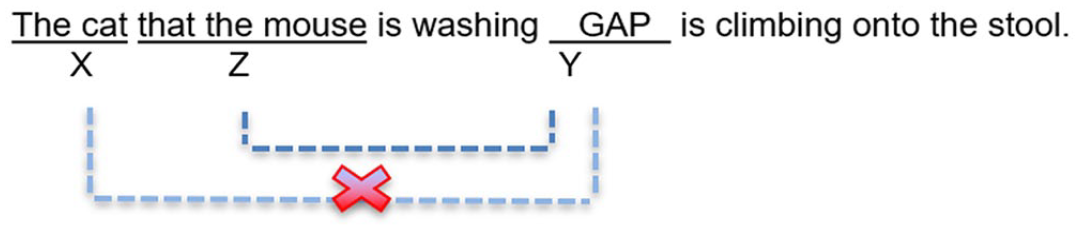
Illustration Depicting How Relativized Minimality Can Result in Incorrect Comprehension of an Object Relative Clause Sentence (Friedmann et al., 2009; Rizzi, 1990). ‘X’ Is the Target of the Local Relation, ‘Z’ Is the ‘Intervener’, and ‘Y’ is the ‘Origin’. The Relation Between ‘X’ and ‘Y’ Fails if Intervening ‘Z’ Is Similar in Featural Specification to ‘X’ (Friedmann et al., 2009). This Failure Allows for Inappropriate Relation Between ‘Z’ and ‘Y’.
McElree et al. (2003) proposed that listeners and readers use cues to make sense of relative clause sentences. Cues provide information that establishes a linguistic dependency, such as a subject-predicate dependency (Martin & McElree, 2018). When multiple NPs satisfy the featural constraints of a verb phrase (VP) (e.g., number agreement and gender agreement), subject identification is difficult and children do not establish the distant dependency (Lewis et al., 2006; Wagers et al., 2009). In Figure 2, the shared grammatical features of the head NP the cat and the relative clause subject the mouse satisfy the featural constraints of the main VP is climbing (e.g., singular number). However, when featural constraints differ across NPs, such differences can enhance relative clause comprehension by helping to disambiguate subject-predicate dependencies (MacWhinney, 2001). In this way, NP and VP number information, like word order and NP animacy, is one of many available cues that help listeners build a sentence representation or a meaning of who does what in a sentence (MacDonald et al., 2020; MacWhinney, 2001). Anticipatory-looking studies have provided evidence that preschoolers use NP and VP number information to support sentence comprehension (Deevy et al., 2017; Deevy & Leonard, 2018). For example, in an anticipatory-looking study of English-speaking preschoolers, Deevy and Leonard (2018) found that children use the earlier-appearing number information in the auxiliary or copula form to constrain NP identification in simple sentences.

Illustration Depicting How Subject Identification Is Made Difficult Within Cue-Based Accounts of Relative Clause Sentence Comprehension. In the Figure, Subject NP Identification Is Made Difficult Because Multiple NPs Satisfy the Featural Constraints of the VPs (e.g., Number Agreement). SG Indicates Singular Number.
In previous NP number mismatch studies, mismatching NP number information was expressed on the VPs as well as the NPs. Sentences with mismatching NP and VP number information, such as (11), could help children select correct pictures more than sentences with mismatching NP number information only, such as (12). Therefore, it remains unclear whether NP number mismatch in isolation or the combination of NP number mismatch and VP number mismatch enhances children’s ORC sentence comprehension.
11. The cats that the mouse is washing have climbed onto the stool (Adani et al., 2014).
12. The cats that the mouse can wash can climb onto the stool (Adani et al., 2014).
To address the limitations of previous NP number mismatch studies, the study reported here isolated the effects of NP number mismatch on children’s comprehension of ORC sentences. We tested comprehension of center-embedded ORC sentences that contrasted NP number mismatch with NP number match wherein the main clause and relative clause VPs had no number information (i.e., sentences that contain the modal auxiliary can).
Research questions
To the best of our knowledge, researchers have not evaluated the impact of NP number features (match vs. mismatch) in the absence of VP number information. Thus, we asked one primary research question: In a group of typically developing 6-year-olds, is there a within-subjects difference between comprehension of NP number match ORC sentences and NP number mismatch ORC sentences? Importantly, the methods of Adani et al. (2014) can be manipulated to create sentence and picture stimuli that isolate NP number features, allowing for an evaluation of whether NP number mismatch alone leads to an ORC sentence comprehension advantage.
We asked this question using stimuli that did not include VP number information, such as (13) and (14).
13. The pig that the tiger can push can sit on the bed.
14. The pig that the tigers can push can sit on the bed.
We hypothesized that there would be a significant within-subjects difference such that children’s comprehension performance on NP number mismatch ORC sentences would exceed performance on NP number match ORC sentences. Our hypothesis was based on prior work that has shown that children comprehend NP feature mismatch sentences without VP feature information better than NP feature match sentences without VP feature information (e.g., lexical restriction; Adani et al., 2010; Friedmann et al., 2009). However, we recognized that prior exploration of number features did not isolate NP number features from VP number features.
Two potential follow-up research questions were identified, with the question asked contingent on the outcome of the primary research question. If the hypothesis for a benefit of NP number mismatch alone is supported, then we ask whether VP number information enhances the impact of NP number mismatch. In a group of typically developing 6-year-olds, is there a within-subjects difference between comprehension of NP number mismatch sentences with VP number information and NP number mismatch sentences without VP number information? We address this question using stimuli such as (15) and (16).
15. The pig that the tigers are pushing is sitting on the bed.
16. The pig that the tigers can push can sit on the bed.
Due to the dearth of research on the impact of VP number information on relative clause sentence comprehension, we did not have a hypothesis for this research question.
If the hypothesis for an effect of NP number mismatch alone is not supported, then we ask whether VP number information alongside NP number information is necessary for a comprehension advantage. In a group of typically developing 6-year-olds, is there a within-subjects difference between comprehension of NP number mismatch sentences with VP number information and NP number match sentences with VP number information? We ask this question using stimuli such as (17) and (18).
17. The pig that the tigers are pushing is sitting on the bed.
18. The pig that the tiger is pushing is sitting on the bed.
We hypothesized that we would replicate the significant within-subjects difference of Adani et al. (2010, 2014).
Methods
The study methods were approved by the Vanderbilt University Internal Review Board and the California State University, Los Angeles Internal Review Board. All data collection activities were completed by the first author and were conducted remotely via the Zoom® platform.
Participants
A total of 32 English-speaking, typical-language 6-year-old children (Mage = 6;7; SD = 0;3) participated. We recruited children from the metro Nashville area and metro Los Angeles area (a) using a web-based participant matching system (Research Match), (b) the Vanderbilt University Study Finder website, (c) by contacting previous Child Language and Literacy Lab research participants whose parents indicated interest in study participation, (d) by contacting previous California State University, Los Angeles research participants whose parents indicated interest in study participation, and (e) we encouraged participating families to share the Child Language and Literacy Lab and California State University, Los Angeles contact information with friends. Six-year-old children were the target participant group because this age group did not score at the floor nor ceiling in previous NP number mismatch child investigations (Adani et al., 2014; Contemori & Marinis, 2014). Children were recruited within two age bands; age freely varied within each age band (see Table 1). Notably, 6 boys and 9 girls were between 6;0 and 6;5 (Mage = 6;3; SD = 0;18), and 8 boys and 9 girls were between 6;6 and 6;11 (Mage = 6;8; SD = 0;14). A total of 36 children were consented and 32 met the eligibility criteria. Parents reported maternal education and race/ethnicity information.
Participant demographic information.
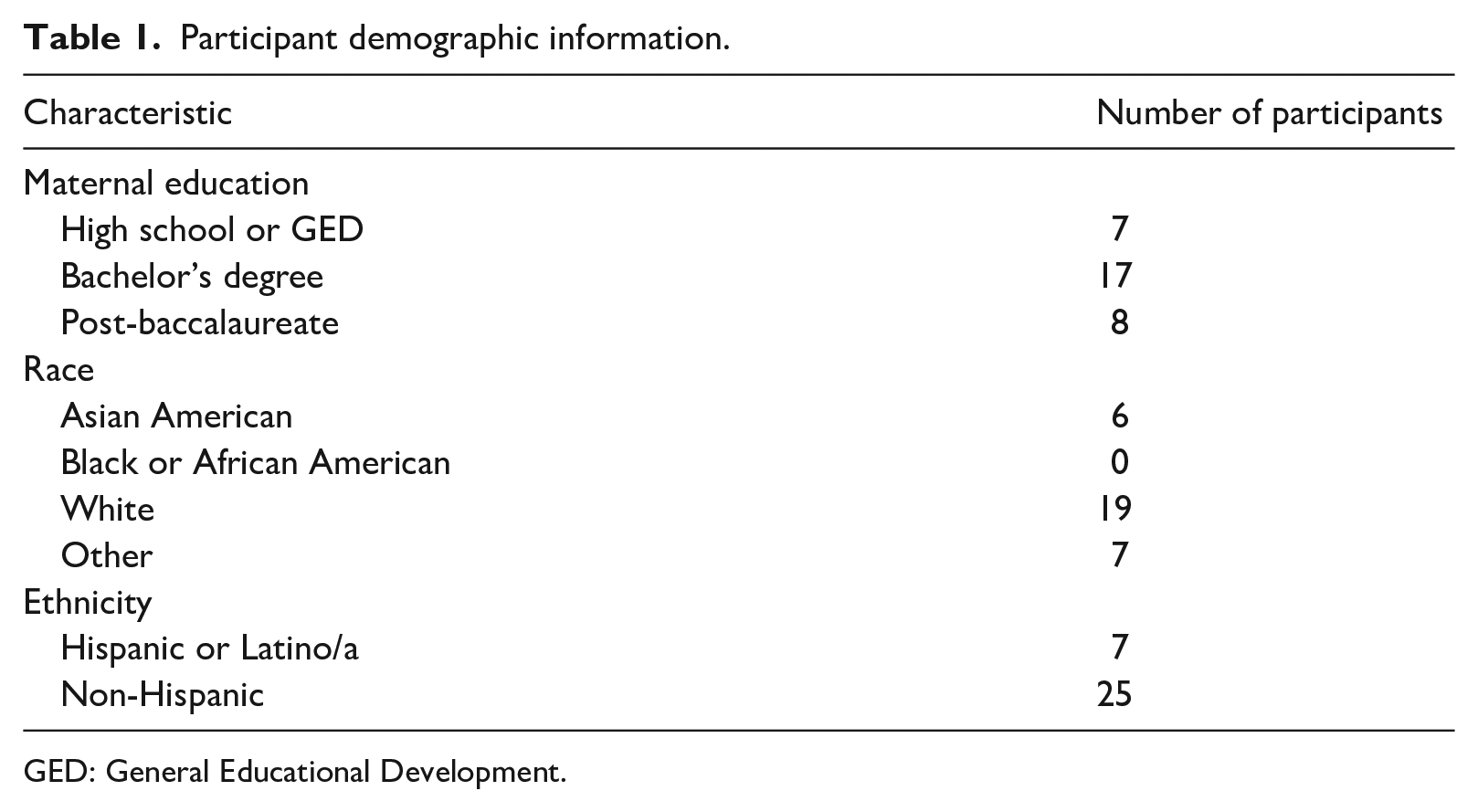
GED: General Educational Development.
Eligibility criteria included: (a) monolingual English speaker, (b) standard score of >85 on the Test of Auditory Comprehension of Language-Fourth Edition (TACL-4; Carrow-Woolfolk, 2014), (c) standard score of >85 on the Structured Photographic Expressive Language Test-Third Edition (SPELT-3; Dawson et al., 2003), (d) name numerals 1–4, and (e) 70% accuracy on a final-branched, ORC sentence comprehension task (see Table 2). We excluded children who (a) currently or previously received speech-language therapy and (b) could not use a digital tablet with assistance from a parent (per parent report).
Participant scores on eligibility measures.
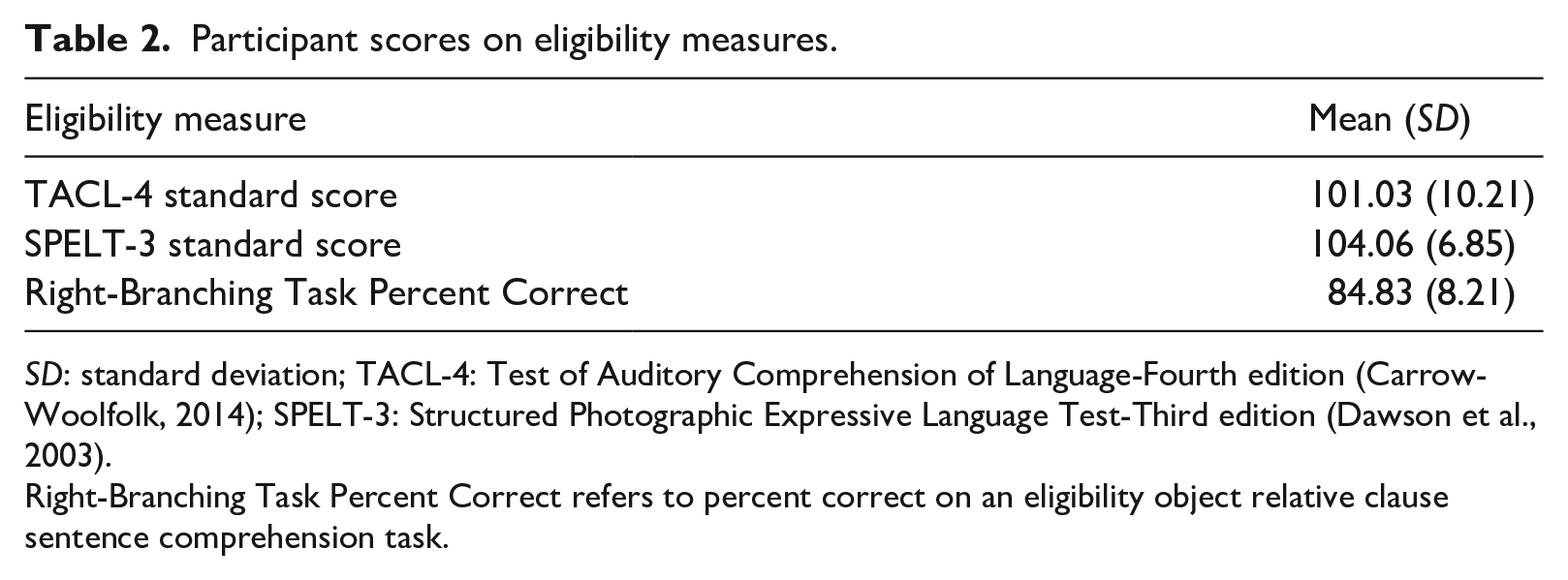
SD: standard deviation; TACL-4: Test of Auditory Comprehension of Language-Fourth edition (Carrow-Woolfolk, 2014); SPELT-3: Structured Photographic Expressive Language Test-Third edition (Dawson et al., 2003).
Right-Branching Task Percent Correct refers to percent correct on an eligibility object relative clause sentence comprehension task.
Eligibility norm-referenced measures
The TACL-4 and SPELT-3 were administered to confirm typical language status. The TACL-4 is a measure of receptive semantics, morphology, and syntax normed on children from 3;0 to 12;11. Children select a picture from a field of three that matches a phrase or sentence read aloud by the examiner. The SPELT-3 is a measure of expressive morphology and syntax normed on children from 4;0 to 9;11. Children respond to prompts to explain or describe pictures of children engaged in familiar daily activities.
Numerical naming task
The numeral naming task was administered to ensure that participants could name numerals 1–4 for the purpose of providing answers in the eligibility comprehension task and the experimental task. The numerals appeared in a 2 × 2 array that was presented via a PowerPoint® slideshow. Numerals were positioned in the array such that the number ‘1’ was positioned in the upper-left quadrant, the number ‘2’ was positioned in the upper-right quadrant, the number ‘3’ was positioned in the lower-left quadrant, and the number ‘4’ was positioned in the lower-right quadrant. The examiner activated an animation that revealed a red circle around the numeral ‘1’ and asked the participant ‘What number has a circle around it?’ After the child’s response, the circle dissolved and the process was repeated for numerals 2–4.
Eligibility object relative clause comprehension task
The eligibility final-branched, object relative clause comprehension task was created for this investigation. Successful performance on this task provided evidence that child failures on the experimental task were not attributable to a general failure to comprehend ORC sentences. The task required children to match a spoken sentence to a picture from a four-picture array. The task was presented via a PowerPoint® slideshow; each item involved presentation of a four-picture array with an embedded audio recording of a sentence. A male speaker recorded the sentences on a Sony PCM-D10 recorder in an anechoic chamber to ensure recording clarity.
Sentence stimuli
The 10 final-branched, object relative clause sentence stimuli (see Table 3) matched the length of experimental sentence stimuli (12 words). Each sentence included the relative marker that and a predicate prepositional phrase (e.g., Show me the big horse that the puppy washes in the bath). The relative clause VPs consisted of lexical verbs marked with third person singular present tense -s (e.g., washes) which expressed tense and number without providing exposure to the verb forms used in the experimental task (e.g., auxiliary + VP).
Constituent frequency in eligibility object relative clause comprehension task.
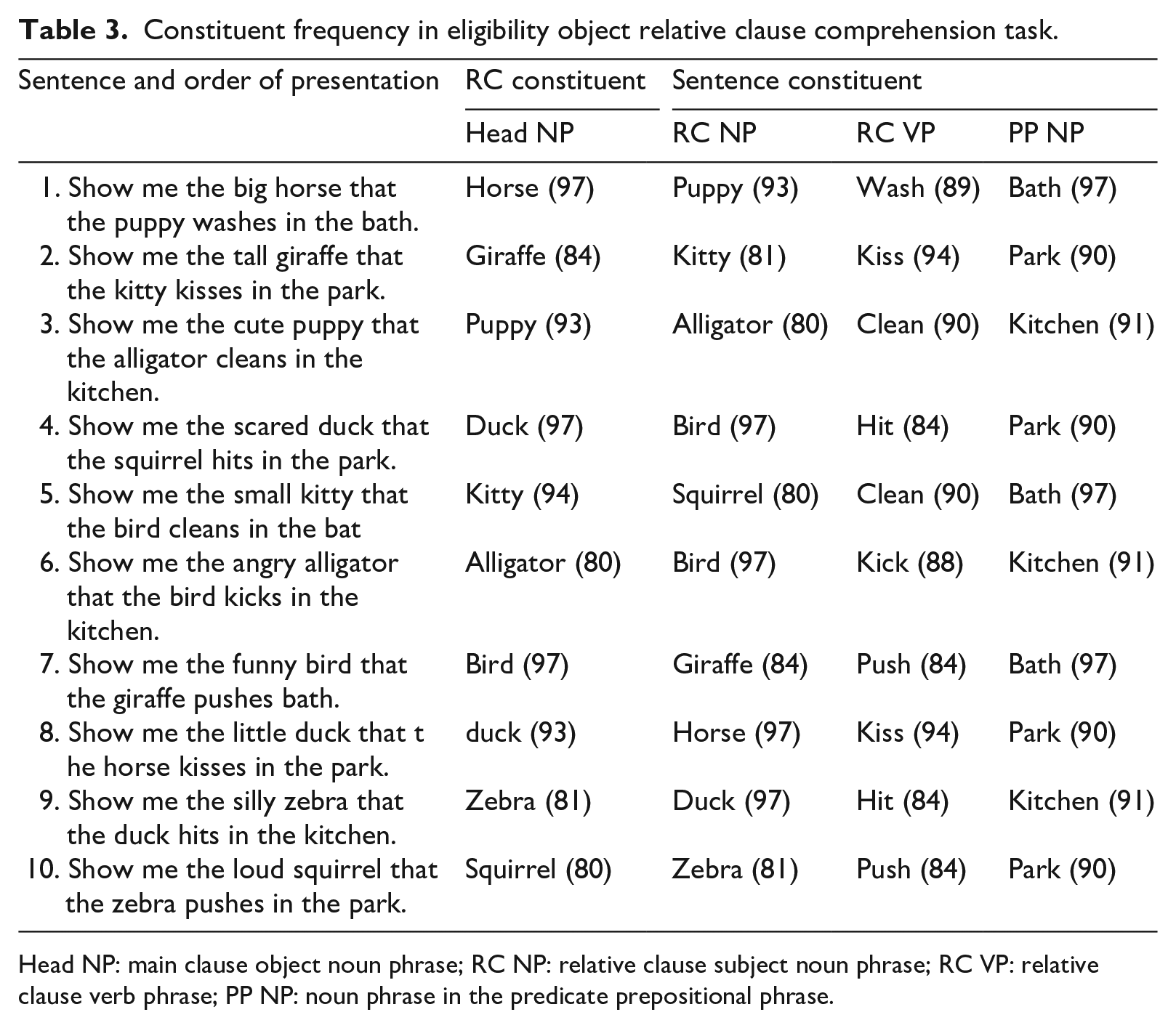
Head NP: main clause object noun phrase; RC NP: relative clause subject noun phrase; RC VP: relative clause verb phrase; PP NP: noun phrase in the predicate prepositional phrase.
Picture stimuli
One picture in the four-picture array (see Figure 3) depicted the correct interpretation of the relative clause sentence and three pictures were distractors. Distractor pictures depicted three possible comprehension errors: (1) an object NP comprehension error in which the main clause object NP is interpreted as the relative clause subject NP, (2) a relative clause subject NP comprehension error in which the relative clause subject NP is interpreted as the main clause object NP, and (3) an object NP and a relative clause subject NP comprehension error in which the main clause object NP is interpreted as the relative clause subject NP and the relative clause subject NP is interpreted as the main clause object NP.
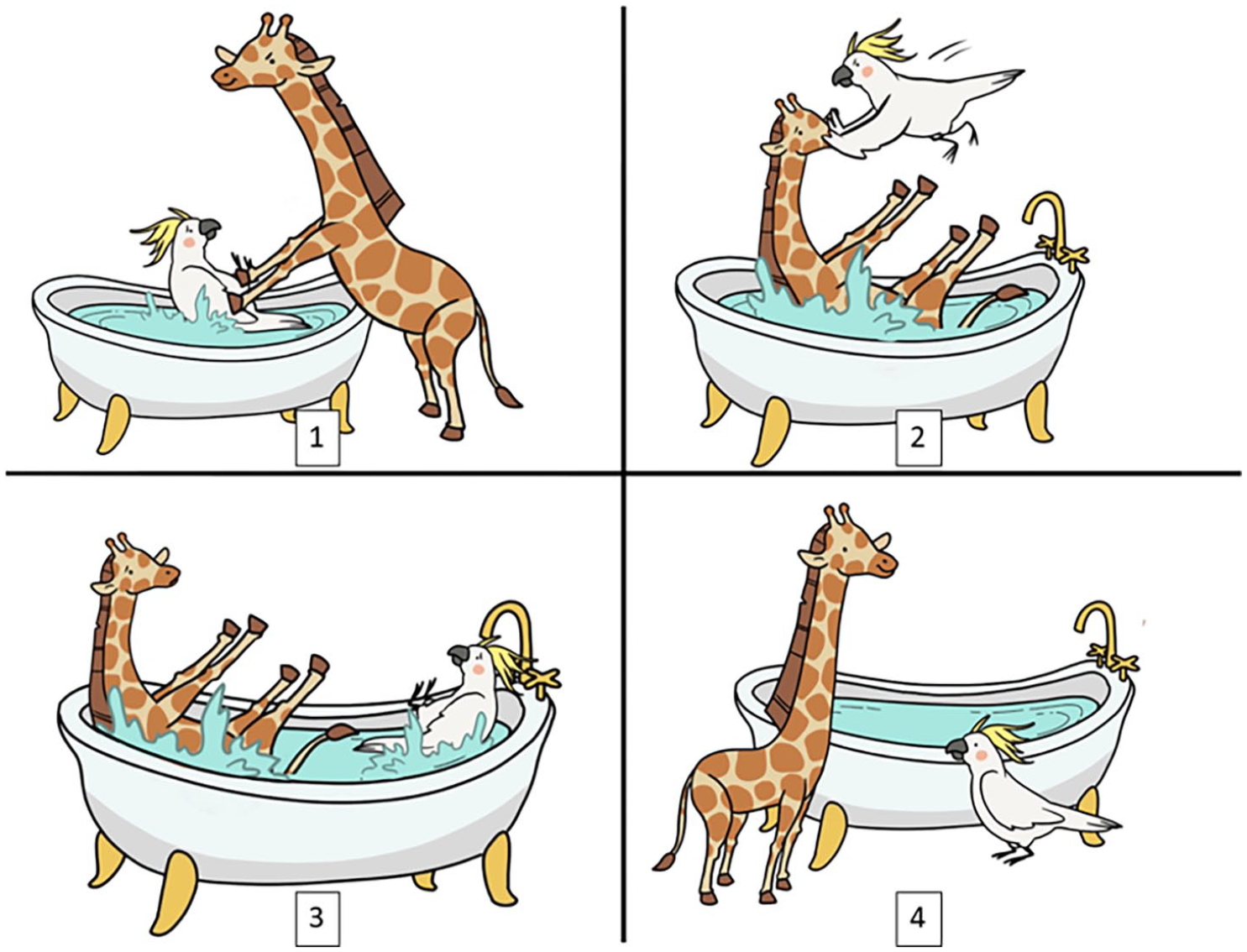
Example Illustration for Eligibility Sentence Show Me the Funny Bird That the Giraffe Pushes in the Bath. Picture 1 is the Correct Selection. Picture 2 Depicts a Relative Clause Comprehension Error (Show Me the Funny Bird That Pushes the Giraffe in the Bath). Picture 3 Depicts a Relative Clause and Main Clause Comprehension Error (Show Me Funny Bird That Pushes and the Giraffe That Pushes in the Bath). Picture 4 Depicts an Additional Incorrect Scenario (Show Me the Funny Bird and the Giraffe by the Bath).
Picture arrays were created by a university student artist who worked with the authors to ensure that each picture accurately depicted the intended meaning. The artist received detailed instructions to ensure that each animal type looked as similar as possible from picture to picture (e.g., animal size and color). If an animal type or a depicted action was not consistent across pictures, the artist was given revision instructions. To document the feasibility of the final picture stimuli, (a) a graduate student in speech-language pathology completed the eligibility object relative clause comprehension task and received a score of 100% and (b) 2 non-participant 6-year-olds completed the eligibility task and received scores of 90% and 100%.
Experimental task
The experimental object relative clause comprehension task was created for this investigation as an adaptation of Adani et al.’s task. The experimental task required children to match a spoken sentence to a picture from a four-picture array (same as the eligibility comprehension task). The task was presented via a PowerPoint® slideshow; each task item involved presentation of a four-picture array with an embedded audio recording of a stimulus sentence. Sentences were recorded by a male speaker on a Sony PCM-D10 recorder, in an anechoic chamber to ensure recording clarity. The experimental task included four conditions, with a unique type of sentence in each condition.
Sentence stimuli
To answer the primary research question, we constructed two types of ORC sentences: (a) NP-only match and (b) NP-only mismatch, as illustrated in the top row of Table 4. For NP-only match sentences, the subject NP in the main clause (i.e., head NP) and the subject NP in the relative clause matched in number. Half of the sentences included singular subjects; half of the sentences included plural subjects. For NP-only mismatch sentences, the subject NP in the main clause (i.e., head NP) and the subject NP in the relative clause did not match in number. Half of the sentences included a singular subject NP in the main clause and a plural subject NP in the relative clause; the other half had the reverse pattern. These two sentence types included no number information in the main clause VP or relative clause VP; the VP in each clause included the modal auxiliary can plus a main verb. Sentences included the relative marker that and a predicate prepositional phrase. The inclusion of the relative marker that maintained continuity with Adani et al. (2014).
Number features of experimental sentence stimuli across four conditions.
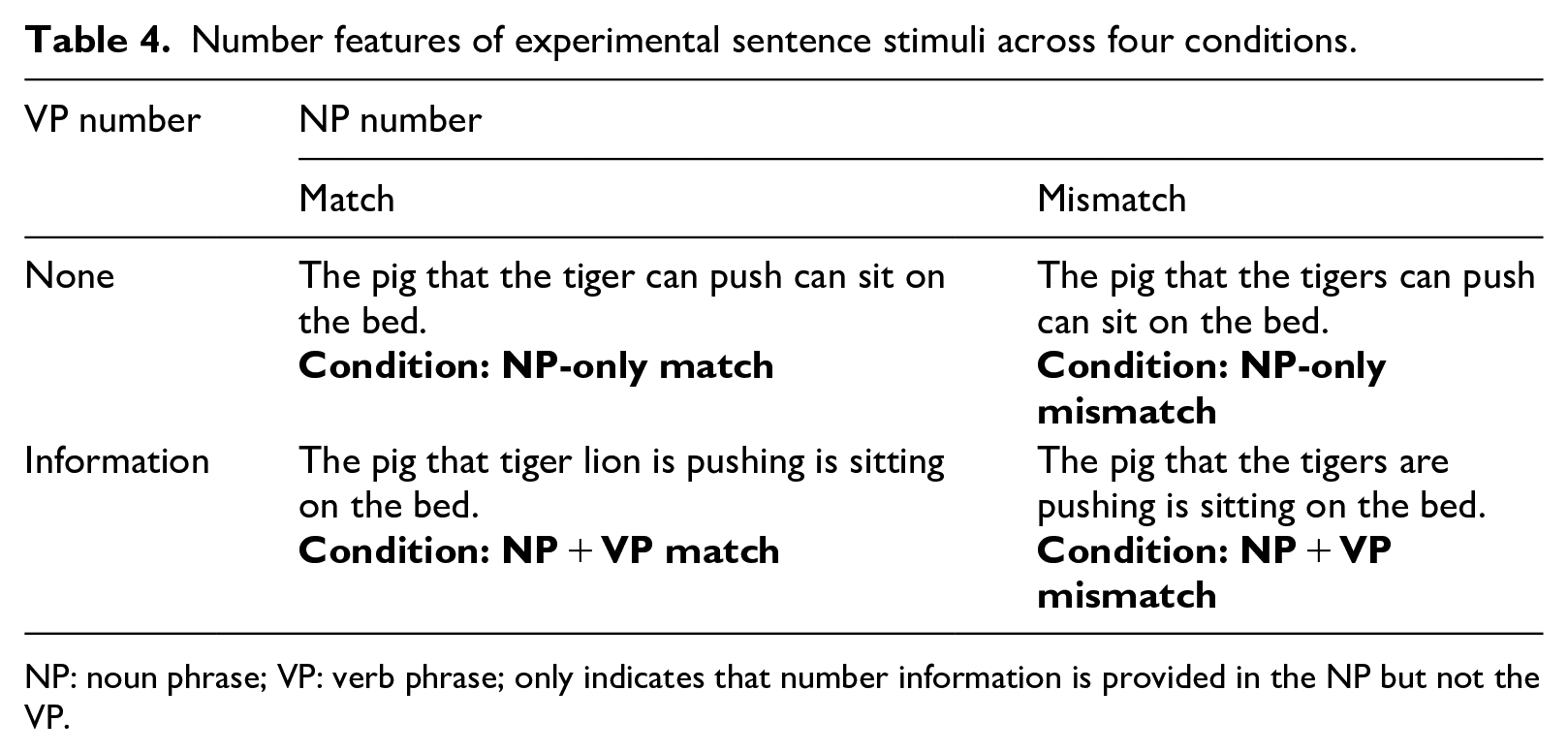
NP: noun phrase; VP: verb phrase; only indicates that number information is provided in the NP but not the VP.
To answer our two potential follow-up research questions, we constructed two additional types of ORC sentences: (a) NP + VP match and (b) NP + VP mismatch, as illustrated in the bottom row of Table 4. For NP + VP match sentences, the subject NP and VP in the main clause matched in number with the subject NP and VP in the relative clause. Half of the sentences included a singular subject NP + VP in the main clause as well as in the relative clause; half of the sentences included a plural subject NP + VP in the main clause as well as in the relative clause. For NP + VP mismatch sentences, the subject NP and VP in the main clause differed in number from the subject NP and VP in the relative clause. Half of the sentences included singular in the main clause and plural in the relative clause; the other half had the reverse pattern. The VP in each sentence included an auxiliary be + present progressive VP.
All experimental sentences contained one animal noun (e.g., the tiger) as the subject NP in the main clause and one animal noun (e.g., the elephants) as the subject NP in the relative clause. One inanimate noun (e.g., the bed) was within the predicate prepositional phrase. Each animal noun was used two times in each of the four conditions, once as a head NP and once as a relative clause subject NP. We selected lexical verbs with the same considerations used when developing the eligibility object relative clause comprehension task (see above). Main clauses included intransitive verbs and relative clauses included transitive verbs. Each verb was used four times within each condition. We did not confirm that all children comprehended each included NP and VP prior to the experimental task (cf. Adani et al., 2010). Rather, to create the likelihood that sentence vocabulary was known to the children, sentence stimuli words were drawn from Wordbank to include only words used by at least 80% of 30-month-olds (http://wordbank.stanford.edu; Frank et al., 2017).
Picture stimuli
One picture in the four-picture array (see Figure 4) depicted the correct interpretation of the relative clause sentence and three pictures were distractors, based on Adani et al. (2014). The three distractor pictures depicted one of three comprehension error types. First, a main clause error (MCE) type refers to when a relative clause subject NP is interpreted as the main clause subject NP. Second, a relative clause error (RCE) type refers to when a main clause subject NP is interpreted as the relative clause subject NP. Third, a double clause error (DCE) type refers to when a main clause subject NP is interpreted as the relative clause subject NP and the relative clause subject NP is interpreted as the main clause subject NP. Picture positions within each item were determined by a random number generator; first, the correct picture position was assigned, followed by the RCE picture, the MCE picture, and the DCE picture.
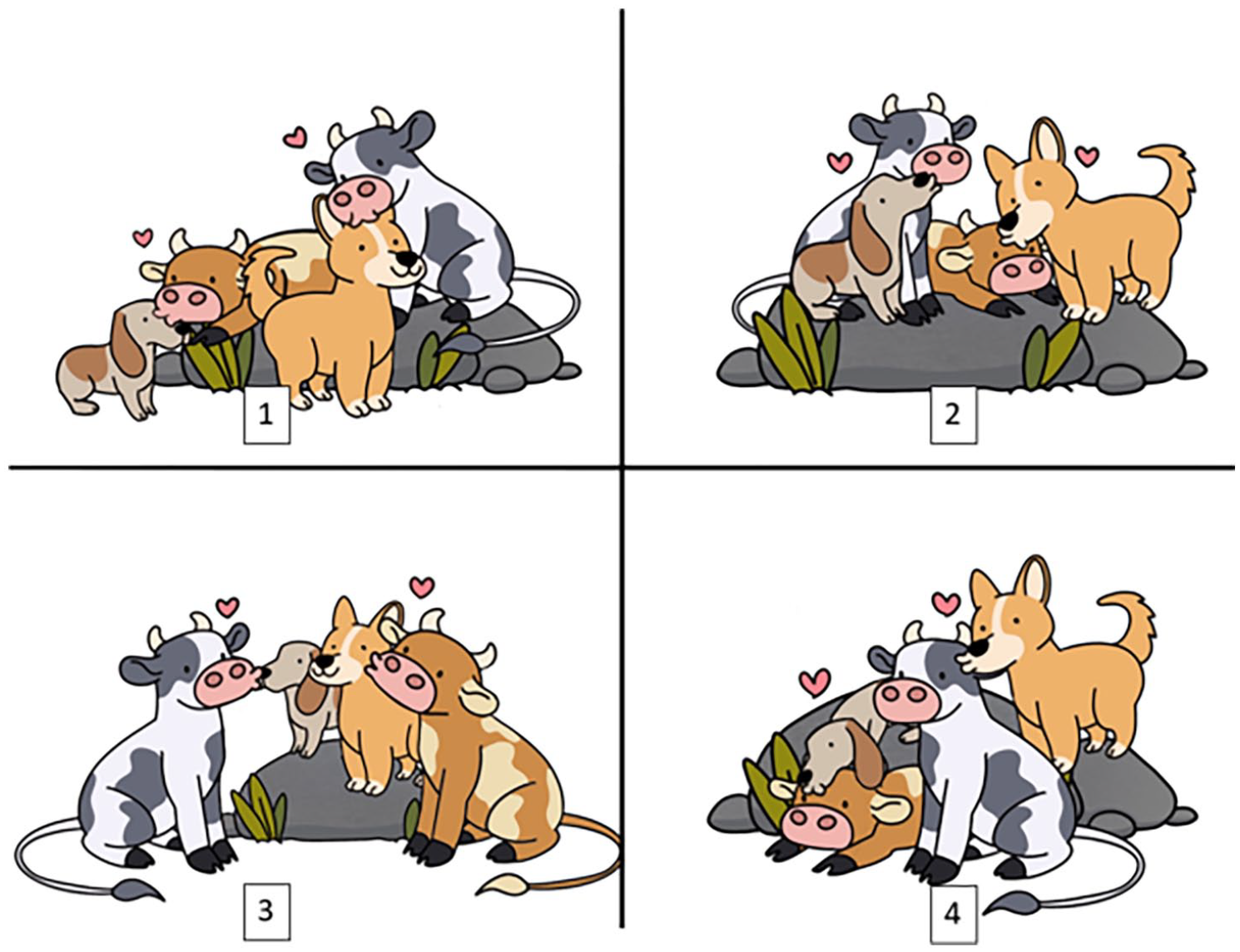
Example Illustration for Experimental Sentence The Dogs That the Cows Are Kissing Are Climbing on the Rock. Picture 3 Is the Correct Selection. Picture 1 Depicts a Main Clause Error (The Cows That Are Kissing the Dogs Are Climbing on the Rock). Picture 2 Depicts a Relative Clause and Main Clause Comprehension Error (The Dogs Are Kissing the Cows That Are Climbing the Rock). Picture 4 Depicts a Relative Clause Error (The Dogs That Are Kissing the Cows Are Climbing the Rock).
Pictures were produced by seven university student artists who worked with the authors to ensure that each picture accurately depicted the correct meaning or the planned incorrect meaning of the sentence. The picture development process and feasibility process were identical to the eligibility object relative clause comprehension task picture stimuli. To document the feasibility of the final experimental picture stimuli: (a) a graduate student in speech-language pathology completed the experimental task and received a score of 96% and (b) two non-participant 6-year-olds completed the experimental task and received scores of 73% and 80%.
Remote research materials
Research tasks were presented via a 10-inch Apple® iPad tablet with 4G cellular data service. Responses were audio recorded using a Palovue iMic Portable Microphone attached to the iPad. The iPad was placed on a Lamicall tablet holder to ensure that children could easily view picture stimuli.
Research task procedures
Each child completed two remote research sessions from his or her home. The examiner delivered the research materials to each family prior to the first research session. Parents received written instructions with the iPad to access the video conferencing application (Zoom®) and to start the iPad audio recording application before the child began the session. The examiner provided spoken instructions to the child at the start of each research session.
In the first session, the child completed, in this order, the TACL-4, the SPELT-3, the numeral naming task, and the eligibility object relative clause comprehension task. All norm-referenced measures were administered following the manualized instructions with one exception. Each plate of the TACL-4 easel and SPELT-3 picture booklet was scanned and imported into a PowerPoint® slideshow to permit remote administration. In the second session, the child completed the experimental task.
The eligibility object relative clause comprehension task PowerPoint® show began with the author reading the instructions, ‘We are going to look at some pictures and listen to some sentences. I want you to tell me which picture goes with the sentence. Listen carefully because I can only play each sentence once. Ready?’ A 4-picture array was presented and, following a 2-second delay, a 2-sentence recording was played (e.g., ‘Say the number of the picture that goes with what I say. Show me the big horse that the puppy washes in the bath’.). The examiner manually advanced slides at a pace appropriate for each child until all items were administered.
The experimental task PowerPoint® show began with 2 simple sentence training items, followed by 56 experimental items. The two training items were intended to (a) orient the child to the task by practicing listening to a sentence and making a picture selection and (b) ensure that the child listened to the entire sentence before making a picture selection. The examiner read instructions that were identical to instructions for the eligibility task. A 4-picture array was presented and, following a 2-second delay, a 2-sentence recording was played (e.g., ‘Say the number of the picture that goes with what I say. Here is the happy puppy on the chair’). If the child provided an answer before the end of the recording, the examiner told the child: ‘Listen to everything before you answer’, and the training item was readministered. If the child made an incorrect picture selection, the examiner told the child the correct answer and readministered the item. The training task ended when the child (a) responded after the presentation of the sentence and (b) selected the correct picture after hearing the sentence, for both training items.
The 56 experimental sentences (see Table 5) were presented to each participant in 1 of 4 random sequences. The examiner presented each experimental sentence in a fashion identical to the training items. Following the presentation of each sentence, the child said the number of the picture s/he chose to match with the sentence. If the child did not respond after hearing the sentence, the examiner told the child to ‘just give your best guess’. If the child responded before the end of the recording, the examiner said to the child ‘Listen to the whole sentence. Don’t answer until the end of the sentence’. The examiner replayed a sentence if the child answered before the end of the recording. If a child responded before the end of the recording on more than three experimental sentences, the examiner planned to discontinue the task with the child. However, no child met the discontinuation criteria.
Constituent frequency in eligibility object relative clause comprehension task.
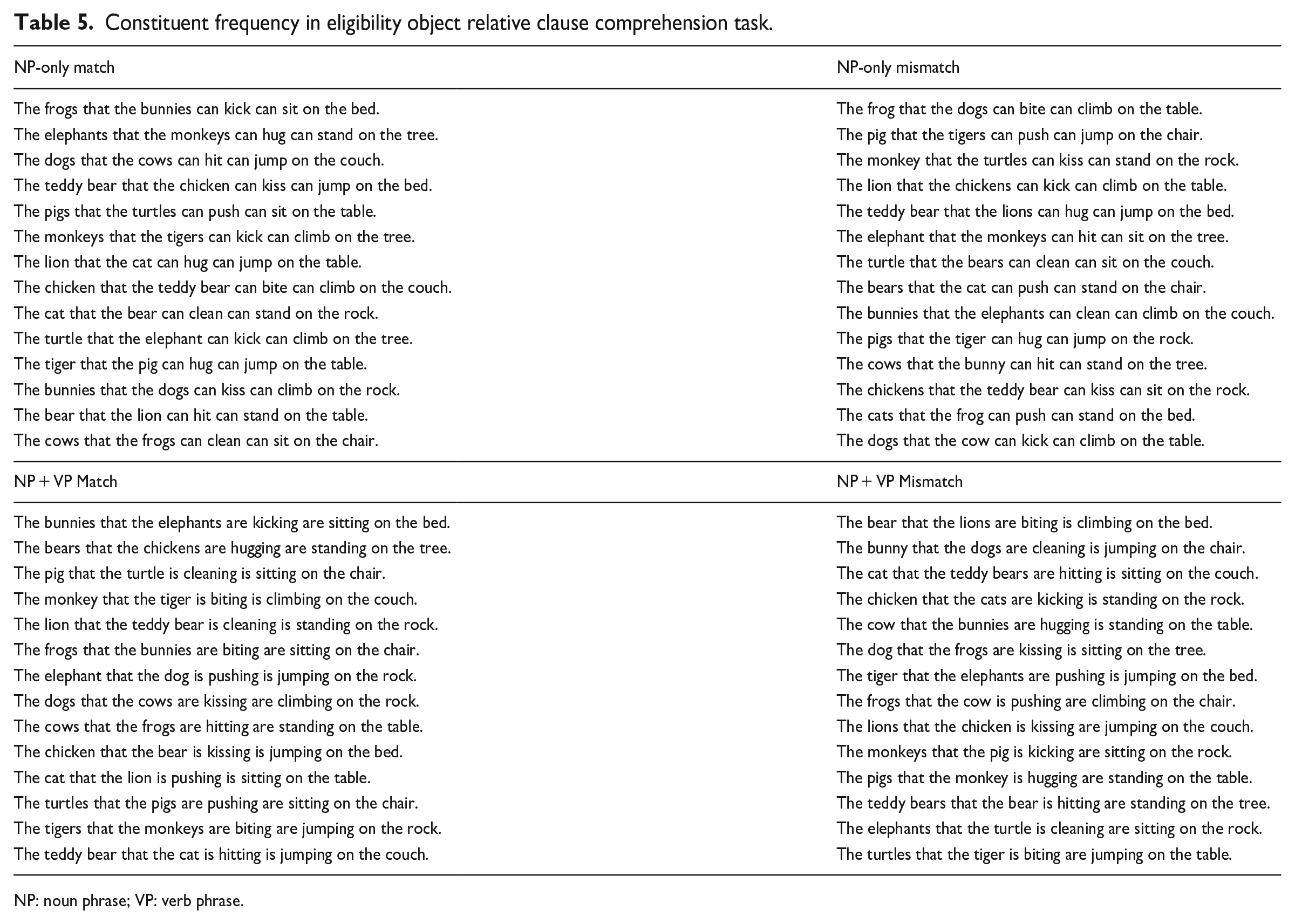
NP: noun phrase; VP: verb phrase.
Scoring
The examiner wrote the child’s responses (i.e., 1, 2, 3, or 4) on the task protocol form and scored each response as correct (‘1’) or incorrect (‘0’). After administration, the examiner tallied the total correct responses within each condition (max. = 14).
Reliability
To establish scoring reliability for the eligibility object relative clause comprehension task, a research assistant (an undergraduate student trained in assessment) randomly selected three children in each age band and scored each child’s performance from audio recordings. The research assistant’s scores were compared with the examiner’s online scoring; the mean sentence-by-sentence agreement was 100%. Thus, we concluded that reliability standards were met and used the examiner’s online scoring of the task.
To establish scoring reliability for the experimental task, the research assistant randomly selected three children in each age band, listened to the audio recording of the child’s performance, and scored each experimental task responses as correct or incorrect. The research assistant’s scores were compared with the examiner’s online scoring; the mean sentence-by-sentence agreement was 99% (R = 98%–100%). Again, we concluded that reliability standards were met, and analysis proceeded using the examiner’s online scoring.
Dependent variables and analysis plan
Tallied correct responses within each condition yielded four raw score variables for each child, one for each condition: (a) NP-only match, (b) NP-only mismatch, (c) NP + VP match, and (d) NP + VP mismatch. The purpose of our primary research question was to evaluate the impact of NP number mismatch in isolation (i.e., no verb number information); NP-only match and NP-only mismatch were compared within subjects. A Wilcoxon signed-rank test was used to compare the number of correct responses in NP-only match to the number of correct responses in NP-only mismatch. The signed-rank test was selected due to the non-normal distribution of the data. We set the statistical significance at 0.05. If a statistically significant difference was detected, effect size was calculated using the matched-pairs rank biserial correlation coefficient,
Based on the outcome of the primary research question analysis, we planned a follow-up analysis. If there was a significant within-subjects difference for the primary research question, then NP-only mismatch and NP + VP mismatch would be compared within subjects. If we did not reject the null hypothesis for the primary research question, then NP + VP match and NP + VP mismatch would be compared within subjects. We stated a priori that we would not reject the null hypothesis if the obtained p-value was larger than 0.05.
3
A Wilcoxon signed-rank test was used to compare the two dependent variables in our follow-up analysis. We set the statistical significance at 0.05. The effect size was calculated using the matched-pairs rank biserial correlation coefficient,
Results
Table 6 provides the median number (and range) of correct responses by condition. Because NP mismatch and NP + VP mismatch data were not normally distributed based on the Shapiro-Wilk test (ps < 0.05), we report the median data for each condition. Table 7 summarizes the mean number of correct responses and mean number of responses for each comprehension error type by condition; we report these data to assist in comparison with Adani et al. (2010, 2014).
ORC sentence comprehension by condition.
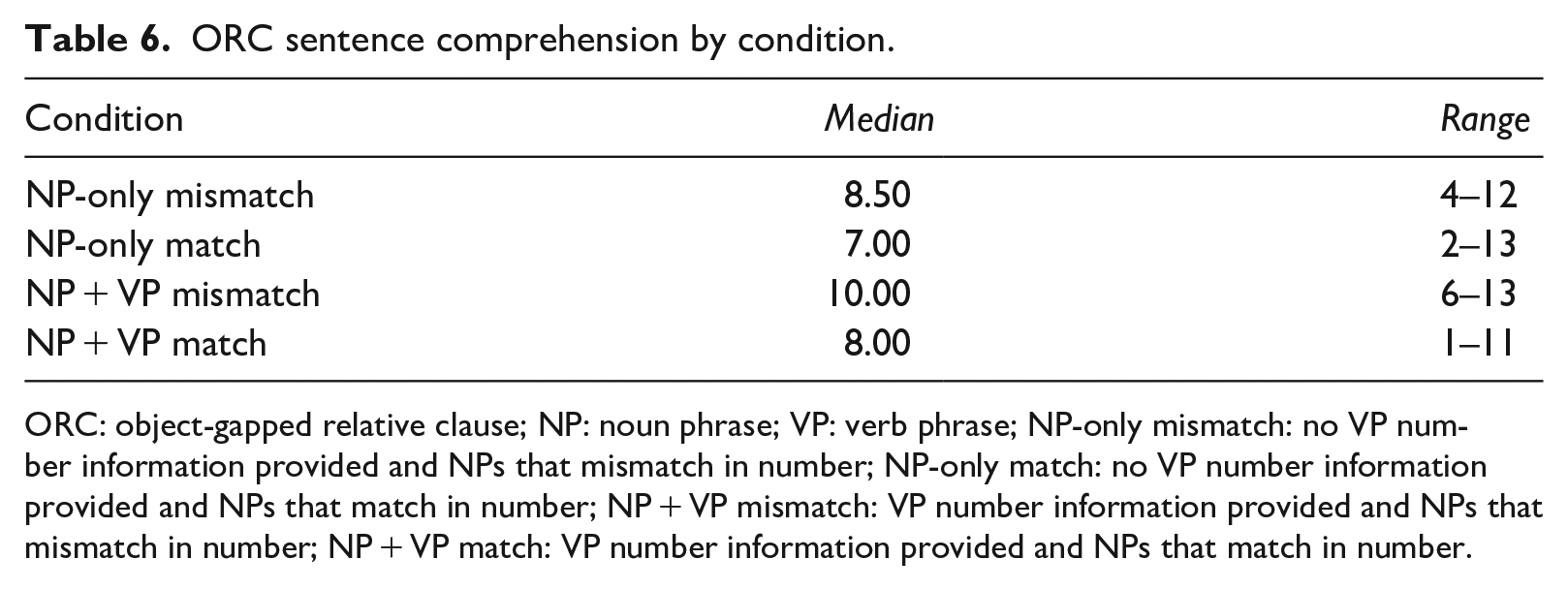
ORC: object-gapped relative clause; NP: noun phrase; VP: verb phrase; NP-only mismatch: no VP number information provided and NPs that mismatch in number; NP-only match: no VP number information provided and NPs that match in number; NP + VP mismatch: VP number information provided and NPs that mismatch in number; NP + VP match: VP number information provided and NPs that match in number.
ORC mean (standard deviation) number of responses by response type for each condition.
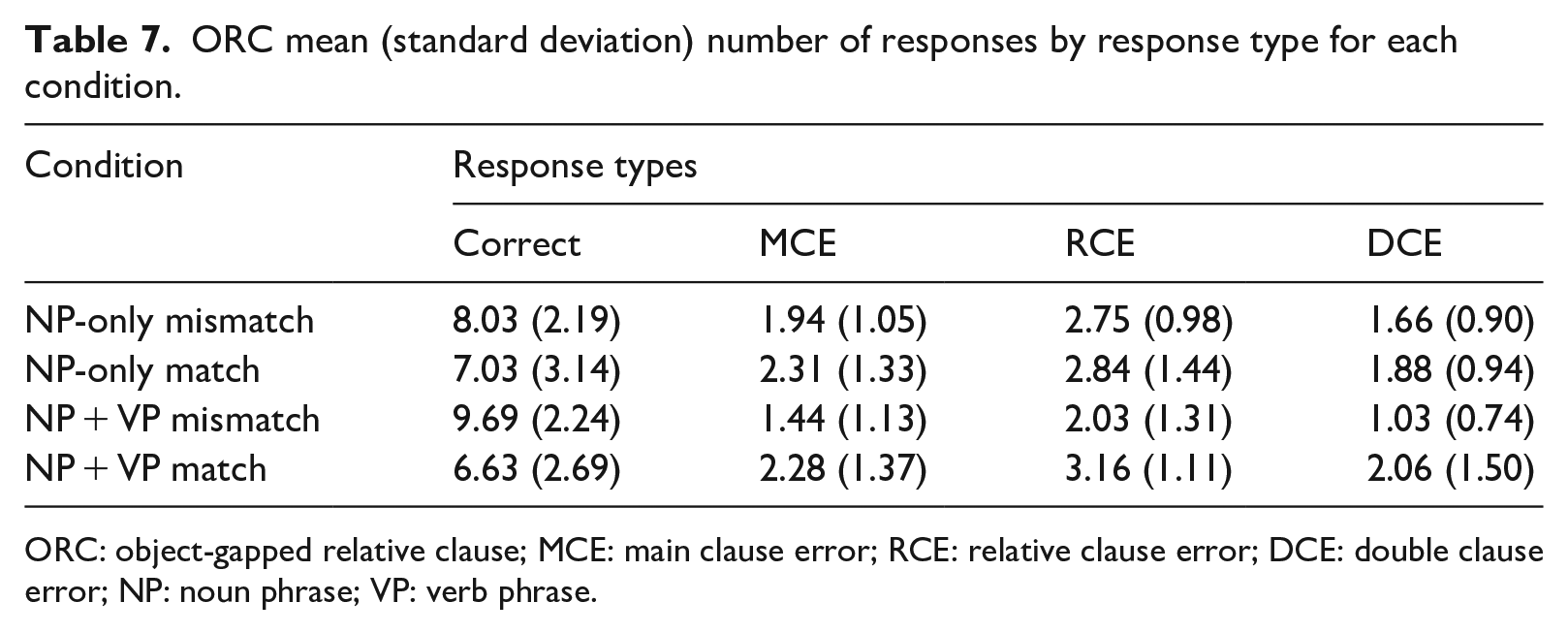
ORC: object-gapped relative clause; MCE: main clause error; RCE: relative clause error; DCE: double clause error; NP: noun phrase; VP: verb phrase.
NP-only match and NP-only mismatch
In a group of typically developing 6-year-olds, is there a within-subjects difference between comprehension of NP number match ORC sentences and NP number mismatch ORC sentences? Figure 5 illustrates scores used in the Wilcoxon signed-rank test. To construct the figure, each child’s NP-only match score was subtracted from the child’s NP-only mismatch score. When a child’s NP-only mismatch score exceeded the NP-only match score, a positive value was obtained, represented by blue solid bars. When a child’s NP-only match score exceeded the NP-only mismatch score, a negative value was obtained, represented by the striped bars. The frequency distribution of values is represented along the x-axis. There was not a significant within-subjects difference (Wilcoxon Z = –1.49, p = 0.14; N = 32). Contrary to our hypothesis, children’s accuracy on the NP-only mismatch sentences did not exceed their accuracy on the NP-only match sentences.
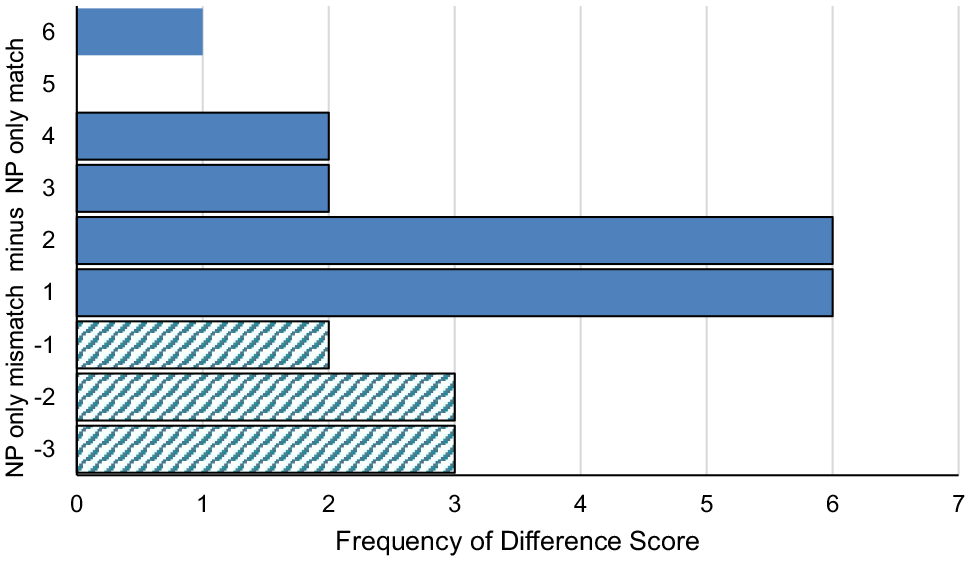
Bar Graph of NP-Only Mismatch Sentence and NP-Only Match Sentence Difference Scores. The y-Axis Indicates the NP-Only Match Score Subtracted From the NP-Only Mismatch Score for Each Child. The x-Axis Indicates the Frequency in Which Each Difference Score Was Obtained (Blue Solid Bars Indicate NP-Only Mismatch > NP-Only Match; Blue Striped Bars Indicate NP-Only Mismatch < NP-Only Match). Difference Scores of ‘0’ (n = 5) Are Not Represented on the Bar Graph.
NP number mismatch with VP number information and NP number match sentences with VP number information
In a group of typically developing 6-year-olds, is there a within-subjects difference between comprehension of NP number mismatch sentences with VP number information and NP number match sentences with VP number information? Given the lack of statistical significance on the primary research question, NP + VP number conditions were compared. Figure 6 illustrates scores used in the Wilcoxon signed-rank test. To construct the figure, each child’s NP + VP match score was subtracted from the child’s score NP + VP mismatch. When a child’s NP + VP mismatch score exceeded the NP + NP match score, a positive value was obtained, represented by blue solid bars. When a child’s NP + VP match score exceeded the NP + VP mismatch score, a negative value was obtained, represented by the striped bars. The frequency distribution of values is represented along the x-axis. There was a significant within-subjects difference (Wilcoxon Z = 3.99, p < 0.001; N = 32). The effect size was large (
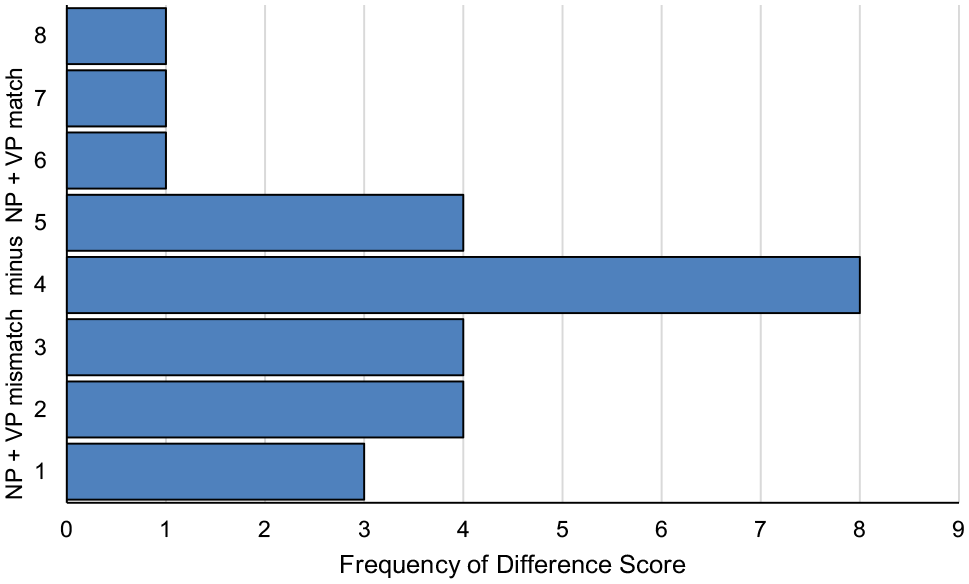
Bar Graph of NP + VP Mismatch Sentence and NP + VP Match Sentence Difference Scores. The y-Axis Indicates the NP + VP Match Score Subtracted From the NP + VP Mismatch Score for Each Child. The x-Axis Indicates the Frequency in Which Each Difference Score Was Obtained (Blue Solid Bars Indicate NP + VP Mismatch Sentences > NP + VP Match Sentences). Difference Scores of ‘0’ (n = 5) Are Not Represented on the Bar Graph.
Exploratory analysis
Interpretation of the findings reported above can be aided by exploratory analyses that address two points. First, VPs expressing number information are more common in children’s input than VPs that do not express number information (Räsänen et al., 2014). Second, if a relative clause sentence comprehension advantage only occurs when mismatching VP number information is present, children’s comprehension of NP + VP mismatch sentences should be greater than NP-Only mismatch sentences.
Analysis of NP number match conditions
Regardless of NP number match or mismatch, relative clauses with VP number information may be easier to comprehend than relative clauses with modals because children are more familiar with VPs containing number information. If the presence of VP number information matters in relative clause comprehension, children’s comprehension of NP + VP match sentences should be greater than NP-only match sentences. We analyzed NP-only match and NP + VP match sentences to clarify the role that VP number information plays in relative clause comprehension.
Figure 7 illustrates scores used in the Wilcoxon signed-rank test. To construct the figure, each child’s NP-only match score was subtracted from the child’s NP + VP match score. When a child’s NP + VP match score exceeded the NP-only match score, a positive value was obtained, represented by blue solid bars. When a child’s NP-Only Match score exceeded the NP + VP Match score, a negative value was obtained, represented by the striped bars. The frequency distribution of values is represented along the x-axis. There was not a significant within-subjects difference (Wilcoxon Z = –1.50, p = .13; N = 32). Children’s performance on the NP + VP Match sentences did not exceed the NP-Only Match sentences.
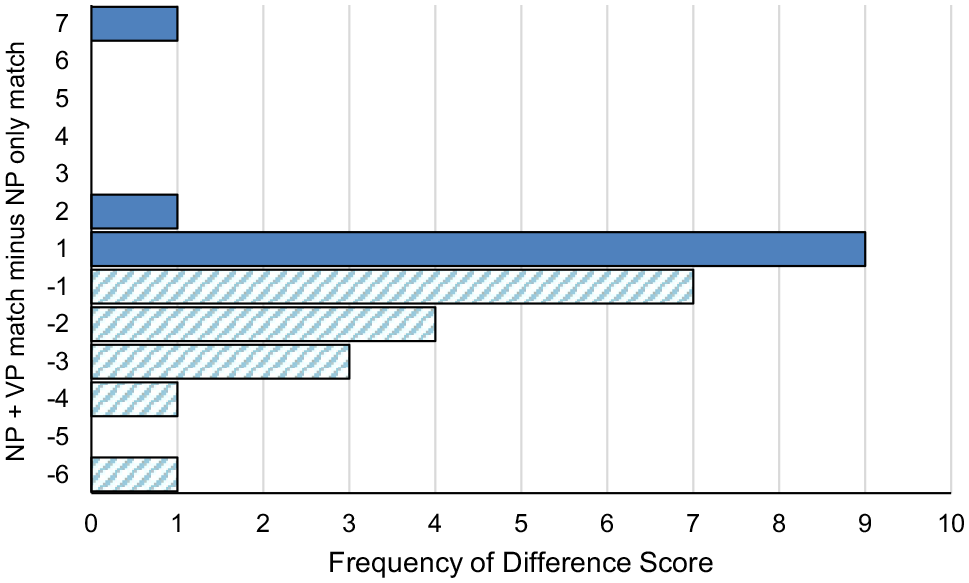
Bar Graph of NP + VP Match Sentence and NP-Only Match Sentence Difference Scores. The Y-Axis Indicates the NP-Only Match Score Subtracted From the NP + VP Match Score for Each Child. The X-Axis Indicates the Frequency in Which Each Difference Scores Was Obtained (Blue Solid Bars Indicate NP-Only Match > NP + VP Match; Blue Striped Bars Indicate NP-Only Match < NP + VP Match). Difference Scores of ‘0’ (n = 3) Are Not Represented on the Bar Graph.
Analysis of NP number mismatch conditions
If the NP number mismatch comprehension advantage is the result of matching VPs with NPs, then NP + VP mismatch sentence comprehension should exceed NP-only mismatch sentence comprehension. We compared NP-only mismatch and NP + VP mismatch scores to rigorously test whether the NP number mismatch comprehension advantage is dependent on the presence of VP number information.
Figure 8 illustrates scores used in the Wilcoxon signed-rank test. To construct the figure, each child’s NP-only mismatch score was subtracted from the child’s NP + VP mismatch score. When a child’s NP + VP mismatch score exceeded the NP-only mismatch score, a positive value was obtained, represented by blue solid bars. When a child’s NP-only mismatch score exceeded the NP + VP mismatch score, a negative value was obtained, represented by the striped bars. The frequency distribution of values is represented along the x-axis. There was a significant within-subjects difference (Wilcoxon Z = 4.50, p < 0.001; N = 32). The effect size was large (
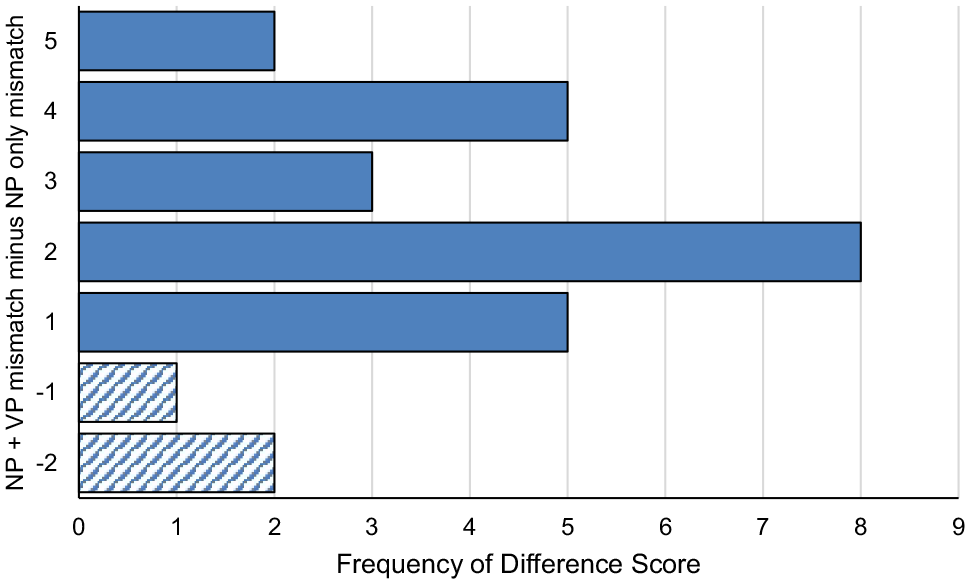
Bar Graph of NP + VP Mismatch Sentence and NP-Only Mismatch Sentence Difference Scores. The y-Axis Indicates the NP-Only Mismatch Score Subtracted From the NP + VP Mismatch Score for Each Child. The x-Axis Indicates the Frequency of Each Difference Score (Blue Solid Bars Indicate NP + VP Mismatch > NP-Only Mismatch; Blue Striped Bars Indicate NP + VP Mismatch < NP-Only Mismatch). Difference Scores of ‘0’ (n = 4) Are Not Represented on the Bar Graph.
Discussion
ORC sentences are difficult for listeners to comprehend, especially for preschool and school-age children (Kidd & Bavin, 2002). We explored whether NP number mismatch provided an advantage for 6-year-olds’ comprehension of ORC sentences. To the best of our knowledge, our study is the first to isolate the contribution of NP number mismatch to ORC sentence comprehension. To answer our primary and follow-up research questions, we constructed ORC sentences with and without NP number mismatch across the main and relative clauses and with and without VP number information between main and relative clauses.
Following Adani et al.’s proposal, we hypothesized that NP number mismatch would provide an advantage for 6-year-olds’ comprehension of ORC sentences. This hypothesis was not supported. However, the presence of NP number mismatch and VP number information did provide a comprehension advantage. Children’s performance on NP + VP mismatch sentences was greater than children’s performance on NP + VP match sentences. Our NP + VP mismatch sentences closely resembled Adani and colleagues’ sentence stimuli in that: (a) number information was manipulated to create number match and number mismatch conditions and (b) there was VP number information in sentence stimuli (Adani et al., 2010, 2014). When converted into a percentage, the mean of the NP + VP mismatch sentences comprehended in our study (67.8%) approximates the mean of English-speaking 6-year-olds (64.6%) and Italian-speaking 5-year-olds (64%) in Adani and colleagues’ NP number mismatch studies (Adani et al., 2010, 2014). Our findings highlight the importance of VP number information in children’s comprehension of English NP mismatch ORC sentences. We next consider our findings through the lens of the Relativized Minimality account and cue-based accounts of relative clause comprehension.
The relativized minimality account
Within the relativized minimality account, a restrictive relativized minimality effect makes it difficult for preschool and school-aged children to fill the relative clause gap with the copy of the main clause subject NP. When the features of the relative clause subject NP match the features of the main clause subject NP, the relative clause subject NP may fill the gap. The main clause subject NP is interpreted as the relative clause subject NP. However, when the number features on NPs mismatch, the relative clause subject NP is blocked from inappropriately filling the gap. As a result, ‘featural disjointness’ on NPs enhances comprehension (Friedmann et al., 2009). Within this account, VP number information does not contribute to the featural disjointness on ORC sentence NPs.
Our findings do not support the notion that NP number mismatch alone results in a relative clause sentence comprehension advantage for English-speaking 6-year-olds. If NP number mismatch alone can block the inappropriate NP from filling the gap, there should have been a within-subjects difference between comprehension of NP-only mismatch sentences and NP-only match sentences. We did not find a within-subjects difference. Second, within the relativized minimality account, VP number information should not contribute to an NP mismatch comprehension advantage. However, there was a within-subjects difference between comprehension of NP + VP mismatch sentences and NP-only mismatch sentences.
We note that both Friedmann and colleagues (2009) and Guasti et al. (2012) argue that either the absence of morphological features or the partial overlap of features may result in relativized minimality effects. Guasti et al. (2012) found that Greek-speaking children comprehended object RCs better when NPs display unambiguous morphological case than when NPs bear ambiguous case. Notably, Italian-speaking children could not benefit from unambiguous morphological case because Italian does not mark morphological case on NPs. Like Italian, English does not mark morphological case on NPs. Without the featural disjointness provided by both NP number mismatch and unambiguous morphological case, the relative clause subject NP may not be blocked from inappropriately filling the gap. Thus, the language-specific absence of morphological features may influence the degree that featural disjointness on NPs enhances comprehension.
Cue-based accounts of relative clause comprehension
Within cue-based accounts of relative clause sentence comprehension, VP number information is one of many available cues (e.g., word order and animacy) that helps listeners build a sentence representation or a meaning of who does what in a sentence (MacWhinney, 2001). Our findings provide support for VP number information as a converging cue for ORC sentence comprehension.
Six-year-olds’ comprehension of NP + VP mismatch ORC sentences provides some support for cue-based accounts of ORC sentence comprehension. Within cue-based accounts, VP number information is a cue that integrates NPs with VPs when a listener attempts comprehension of an ORC sentence (McElree et al., 2003). As a result, the number information expressed on the VP should assist in the identification of its related NP and provide an ORC sentence comprehension advantage.
Cue-based accounts generate the prediction that there is a within-subjects difference between comprehension of NP + VP mismatch ORC sentences and NP + VP match ORC sentences. Because there was a within-subjects difference between NP + VP mismatch sentences and NP + VP match sentences, we argue that VP number information is used as a cue when a listener attempts comprehension of an ORC sentence.
Within most cue-based accounts of final-branched and center-embedded ORC comprehension, VP number information is considered less important for comprehension of English sentences than other cue types (Lewis et al., 2006; MacWhinney et al., 1984). Our findings suggest that, despite questions of its relative importance, VP number information plays a role in the NP mismatch ORC sentence comprehension advantage.
Verb number information as a converging cue
Within MacWhinney’s (2001) competition model, the strongest cues are those that are the most available and reliable. In English, word order is a strong and reliable cue; native English speakers overwhelmingly identify the first NP in the preverbal position as the clausal agent (MacWhinney et al., 1984). Because word order is such a strong cue in English, verb number information has been considered a ‘weak’ cue that is largely ignored by English listeners (MacWhinney, 2001). However, there are instances in which the first NP in the preverbal position is not the clausal agent, as in ORCs. In such cases, it is possible that agent identification is supported by converging cues or cues that ‘point in the same . . . direction for meaning interpretation in a sentence’ (Li & MacWhinney, 2013).
Our findings support the notion that English speakers use VP number information as a converging cue when identifying the agents of ORC sentences (Li & MacWhinney, 2013). Our findings are in line with prior work that found that VP number information played a larger role in agent identification in noun-noun-verb (NNV) word sequences – the word sequence found in ORC sentences – than NVN word sequences (Devescovi et al., 1999; MacWhinney et al., 1984; Schelstraete & Degand, 1998). A related body of research has found that English-speaking preschool children used the converging cues of NP animacy and word order to identify the agent in NNV word sequences (MacWhinney et al., 1984; Noble et al., 2016). In summary, our study adds to the small body of evidence that weak cues, such as VP number information and NP animacy, play a role in the comprehension of NNV word sequences.
Although our findings support the plausibility that VP number information aids in ORC sentence comprehension, it is possible that our findings may not generalize to all relative clause sentences. We briefly describe why our findings should be interpreted with caution and why future ORC sentence research is needed.
Exploring other explanations for our findings
Our sentence comprehension tasks required participants to match VPs with NPs by using VP and NP number features. However, sentence comprehension is a complex task that involves other important factors, such as the familiarity of an NP or the semantic plausibility of an NP as an agent (Kim & Osterhout, 2005; Van Dyke & McElree, 2006). We controlled for factors such as word familiarity by selecting only NPs and VPs that are very familiar to 6-year-old children (Frank et al., 2017). However, by controlling for these other factors, we may have removed many of the cues that listeners use when comprehending ORC sentences. Although we have argued for verb number information as a converging cue, it is possible that VP number information only emerges as a useful cue when other important factors are excluded from the comprehension task (Ambridge & Lieven, 2011).
We also consider whether our findings generalize beyond ORC sentences. ORC sentences are infrequent in preschool and school-age children’s input and are rarely produced by young children in conversation (Diessel, 2004). In contrast, final-branched ORC sentences (e.g., ‘The mom sees the boy that the dog kisses’) frequently occur in children’s input and are easier to comprehend than ORC sentences for children and adults (Diessel, 2004; Kidd & Bavin, 2002). Due to the unfamiliarity and difficulty of ORC sentences, our participants may have adopted an agent identification strategy that they would not employ with more familiar and frequently occurring relative clause sentence types (Martin & McElree, 2018). Because only ORC sentences were evaluated, it is unknown whether our findings extend to other relative clause sentence types.
Study limitations
In this study, we asked whether NP number mismatch in isolation provided an ORC sentence comprehension advantage. We designed this study based on previous experimental studies of NP number mismatch in ORC sentences. For example, we matched several aspects of our sentence stimuli and picture stimuli with the Adani et al. (2014) sentence stimuli and picture stimuli. However, our study differed from Adani et al. in some notable ways. First, COVID-19 restrictions may have introduced a confound by requiring remote administration of all experimental tasks. Selecting correct picture numbers within a videoconferencing session may be more demanding for 6-year-olds than selecting correct pictures in-person. Although 6-year-old participant performance matched that of Adani et al. (2014) 6 year-olds, it is possible that the challenges of videoconferencing adversely affected our participants’ performance. For example, because children only listened to ORC with number match and mismatch, it is possible that our participants would have obtained scores that exceeded Adani et al. (2010, 2014). Our findings would be strengthened by a replication study with in-person administration.
Second, we recruited participants from a single age group rather than multiple age groups. We streamlined our study to investigate whether NP number mismatch in isolation produced an ORC sentence comprehension advantage in a participant age group likely to show a comprehension advantage. However, it remains unclear whether NP number mismatch provides an ORC sentence comprehension advantage for a brief period in development or for a prolonged period beyond childhood (Adani et al., 2010, 2014). Our findings would be strengthened by future cross-sectional studies including multiple age groups.
Third, mood within experimental sentences was not controlled. In NP-Only conditions, sentences contain the modal verb ‘can’ which indicates ability. In NP + VP conditions, sentences are in the present indicative along with finite grammatical morphology. Like previous child language studies, we developed these sentences to create the necessary contrast between VPs that convey number information and VPs that do not within complex syntax sentences (Owen & Leonard, 2006). However, it is possible that children’s familiarity with the modal verb ‘can’ may have influenced our results. Future studies should utilize a pre-experimental task that ensures children understand the modal ‘can’.
Finally, our findings have been discussed in the context of two families of theoretical models: the relativized minimality account and cue-based accounts of sentence comprehension. Due to our focus on the NP number mismatch and VP number information, we only considered theoretical models that explicitly address the roles of NP and VP number features. However, we have not considered many lexical, structural, and semantic factors that are included in other theoretical accounts of sentence comprehension (Padó et al., 2009). For example, within surprisal-based accounts, listeners and readers generate online predictions about upcoming words and phrases (Levy, 2008). Sentences are most difficult to understand when low-probability words and phrases disrupt a listener’s or reader’s online predictions. Our study is ill-suited for the evaluation of accounts like Levy’s (2008) surprisal-based account for two reasons. First, we included high-frequency NPs and VPs in our experimental sentences and ensured that all NPs could complete all actions indicated in VPs (e.g., all NPs were animate; Frank et al., 2017). Second, all sentences were ORC sentences, a syntactic structure that is infrequently heard in adult and child conversations. Because we did not manipulate the familiarity of experimental sentences’ NPs or relative clause sentence types, our findings do not provide meaningful information about surprisal-based accounts.
Conclusion
Our study investigated how NP number mismatch leads to an ORC sentence comprehension advantage within these theoretical accounts. Within the relativized minimality account, the influence of NP number mismatch leads to a comprehension advantage after the second of two NPs is comprehended. Our study found that NP number mismatch alone does not lead to a comprehension advantage. Within cue-based accounts, listeners receive the benefit of number mismatch once dependencies between NPs and VPs are established. When the NPs differ in number, listeners may use VP number information to establish dependencies between NPs and VPs.
Footnotes
Acknowledgements
We thank the children and families who participated in this study. We appreciate the reliability scoring provided by Ana Delgado as well as Kaitlyn Hamers for her role in providing eligibility measure scoring reliability.
Author contributions
Declaration of conflicting interests
The author(s) declared no potential conflicts of interest with respect to the research, authorship, and/or publication of this article.
Funding
The author(s) disclosed receipt of the following financial support for the research, authorship, and/or publication of this article: The study was supported by a Preparation of Leadership Personnel grant from the U.S. Department of Education (H325D140087; Principal Investigator: C.M.S.) as well as funding from the Vanderbilt Institute for Clinical and Translational Research. The Vanderbilt Institute for Clinical and Translational Research (VICTR) is funded by the National Center for Advancing Translational Sciences (NCATS) Clinical Translational Science Award (CTSA) Program, Award No. 5UL1TR002243-03. The content is solely the responsibility of the authors and does not necessarily represent the official views of the National Institutes of Health or the U.S. Department of Education.
