




Abstract
This article analyzes the acquisition of the passive voice in Northern East (NE) Cree and pays particular attention to the interaction of frequency effects and language-specific cues in the way children form and employ expectations, the process of anticipating oncoming structure in the ambient language. The passive has long been of interest in first-language acquisition, and expectations may play a role in the reported challenges acquiring the passive in languages such as English. We present two studies analyzing approximately 24 hours of naturalistic video recordings involving one adult and two children: Daisy (age 3;08–5;11) and Billy (4;06–5;10). Study 1 examines the passive voice in child-directed speech (CDS). CDS employs passive verbs frequently, at rates much higher than what has been reported for other languages. Passives also typically occur without overt arguments and most often are derived from verbs with two animate participants. Study 2 traces the acquisition of the passive by Daisy and Billy. Daisy demonstrates productivity with all three passive suffixes by age 3;11. Billy’s recordings begin at a later age, and he shows productivity with suffixes -naaniu at 4;06, -ikiwi at 4;10, and -ikiniw at 5;05. Both children produce passives at rates much higher than what has been reported in child speech for other languages. They also most frequently produce passives without overt arguments, and they show no difficulties passivizing verbs with two animate arguments. These results expand the typological purview of passives research and shed additional light on the role of expectations in acquiring the passive voice. The combination of high frequency and particular structural characteristics for the passive voice in Cree CDS allows children to build expectations differing greatly from those of children acquiring languages such as English. In turn, children acquiring NE Cree do not show the same difficulties in acquiring the passive voice.
Keywords
Introduction
The present study investigates the acquisition of the passive voice, a phenomenon that has received a tremendous amount of scrutiny within the field of language acquisition, in the understudied language of Northern East Cree (henceforth NE Cree). As early as the 1960s (e.g. Fraser et al., 1963; Turner & Rommetveit, 1967), researchers noted the difficulty that children demonstrate in acquiring the passive voice in languages such as English, showing that children can struggle with the comprehension and production of the passive as late as age 9 years (Maratsos, 1985). This view became entrenched over the next three decades or so, through research primarily on Western European languages. During this same period, however, some studies focusing on languages less represented in acquisition science – for example, Allen and Crago (1996) on Inuktitut; Pye and Poz (1988) on Kʼicheʼ Mayan; and Suzman (1985) on Zulu – showed that children acquire the passive voice with surprising ease and at remarkably early ages. Famously, Demuth (1989) argued that Sesotho-acquiring children show evidence in naturalistic speech of acquiring the passive by age 2;08. Later on, refinements in experimental methods helped show that even English-acquiring children may comprehend the passive at much younger ages than previously thought (e.g. Deen et al., 2018; Messenger et al., 2011; O’Brien et al., 2006), although revealing this knowledge requires a very careful and sophisticated method of investigation.
One question that arises from this landscape is why such a measurable difference exists: Why are passives more readily evident from children acquiring languages such as Inuktitut, Sesotho, and Zulu, but much harder to evince from children acquiring languages such as English, German, Japanese, and Spanish? Part of the explanation is likely that children encounter passives with different degrees of frequency per language. The more passive tokens a language presents to children, the faster the passive voice may be acquired. Part of the explanation may also lie with structural factors within a language, which intersect with frequency effects contingent on the rate at which something is encountered in the input (see, for example, Ambridge et al., 2015). For example, Allen and Crago (1996, pp. 150–152) contend that children acquire Inuktitut passives early because they are so frequent and because the language employs pervasive head and noun phrase movement, which gives children plentiful experience with the processes necessary to produce passives. However, Lau (2011) shows that Cantonese-acquiring children can comprehend passives as early as age 3;0, even though they encounter passives in the input at an even lower frequency than in English. Lau attributes this early acquisition to strong structural cues in passive sentences, namely, the obligatory presence of the agent in a ‘by’ phrase, which overcomes the low frequency of the passive.
We argue that the acquisition of the passive hinges on the way frequency effects and language-specific cues – such as canonical word order, animacy, and case marking – interact in the way children form and employ expectations: the process of anticipating oncoming structure in the ambient language. There is ample evidence that people parse sentences in an expectation-based fashion: As they listen to or read sentences, people use their statistical experience to generate linguistic predictions about the structure of the remainder of the sentence (see Altmann & Kamide, 1999; Fine et al., 2013; Hale, 2001; Levy, 2008; and many others). Each incoming word or linguistic unit is used to update a running hypothesis about what is the most likely syntactic structure of the current sentence that the person is encountering. This is used to predict upcoming syntactic structure, thereby facilitating processing and comprehension. This predictive process is very likely based upon probability: The most probable structure is ranked highest compared with alternative structures.
As an example from English, the input to children frequently contains sentences with canonical Subject–Verb–Object (SVO) word order. A large proportion of such utterances have an animate agent as the subject acting upon an inanimate patient as the object. Through experience with these constructions, children amass enough statistical knowledge to expect that a pre-verbal noun in a sentence is likely to be animate, the agent, and the subject. This expectation works very reliably for sentences in the active voice, but the passive voice scrambles the mapping of grammatical and thematic roles: The first noun is still the subject, but it is the patient instead of the agent (Bever et al., 1967). Passive forms also account for a small fraction of verbs in English-language input (0.29%, according to Gordon & Chafetz, 1990), so children have little opportunity or reason to adjust the expectations they build from active voice sentences. In fact, even early work (de Villiers & de Villiers, 1973) showed that children often interpret passive sentences as their active counterparts. Although this early study had few participants, there has been a wealth of subsequent research that confirms this basic finding, using quite different methods (e.g. Deen et al., 2018; Huang et al., 2013). The role of expectations is not constrained only to comprehension of passive structures, because expectations may bleed into the planning of sentences as well. If English-acquiring children adopt the initial bias to encode agents, then they are more likely to produce active than passive sentences. This inclination may be modified through factors that suspend the agent-first bias, such as topicalization or wh-questions highlighting the theme, as demonstrated by Crain et al. (2009) and others.
We contend that such evidence testifies to the interaction of frequency effects (Ambridge et al., 2015) and language-specific cues in the formation and usage of expectations. In languages such as Inuktitut, the high frequency of the passive and particular structural cues leads to expectations which ultimately facilitate early acquisition of the passive. In English, the frequency of the active voice, SVO word order, and pre-verbal nouns that are animate, agents, and subjects all influence the forming of particular expectations – which the passive voice challenges, causing children difficulty. However, the strong structural cues in Cantonese seem to be enough to facilitate early acquisition of the passive despite its low raw frequency. The present study investigates the acquisition of passives in NE Cree, where passives in the input are even more frequent than in Inuktitut and Sesotho – but also where crucial differences in the obligatory presence of overt arguments help children shape expectations that diverge from those of children acquiring languages such as English.
NE Cree
Spoken in Eeyou Istchee territory within Northern Québec, East Cree is a variety in the Cree-Innu-Naskapi dialect complex within the Algonquian language family (MacKenzie, 1980). Approximately 20,000 people across all age groups speak East Cree (Grand Council of the Crees, 2019b). This article focuses on the dialect NE Cree (ISO 639-3 crl) as spoken in the Cree Nation of Chisasibi, a community of 4985 people where 3990 report speaking Cree as their mother tongue (Statistics Canada, 2022). Importantly, East Cree communities have undergone significant political, cultural, social, and economic changes – particularly since hydroelectric projects beginning in the 1970s – and accompanying pressures from English and French have increasingly led to Cree language loss throughout Eeyou Istchee (Collette, 2005; Louttit et al., 2018; Neacappo, 2012). Today all varieties of East Cree are endangered (Brittain & MacKenzie, 2010). However, Cree communities have for decades led important language teaching and promotion efforts, and we hope the present study can help contribute to such ongoing work ‘to reclaim, revitalize, maintain and strengthen the Cree language’ (Grand Council of the Crees, 2019a, p. 5).
Notation conventions
Examples are provided in East Cree Standard Roman Orthography (see Junker et al., 2013) and interlinearized according to Leipzig Glossing Rules (Max Planck Institute for Evolutionary Anthropology, 2015). 1 The third line in examples such as (1) follows Drapeau et al. (2019), with subscript notations indicating verb classes and inflectional paradigms (called ‘orders’ in Algonquian linguistics). Free English translations for examples have been provided by native speakers of NE Cree, and we also include a literal translation for examples where the free translation does not directly reflect a passive construction. Third person is gender neutral in NE Cree, so we use ‘she/her’ as a default translation throughout this article for convenience. Parenthetical citations indicate the speaker’s name, file number of the recording, age for a child speaker, and timestamp.
(1) Nichiih miyikiwinaan anichii. ni-chiih miy-ikiwi-naan ani-chii 1-PST.PVB giveTA-PASS-1PLIND DEM-AN.PL ‘We were given those’. (Daisy, B1.07, 4;01, 00:44)
Verbs and arguments
Algonquian languages such as Cree are considered ‘polysynthetic’, head-marking languages (Nichols, 1986) with relatively flexible word order. Each noun type in Cree is classified as grammatically animate or inanimate. This animacy classification generally corresponds to biological animacy, although some classifications such as animate piyichiis ‘pants’ versus inanimate pichiwiyaan ‘shirt’ are quite arbitrary. The animacy of arguments plays a crucial role in determining verb class.
The verb generally references arguments via agreement for: person (first, second, or third), number (singular or plural), and animacy (animate or inanimate) – and also obviation (proximate or obviative) for third persons. Such rich agreement permits liberal omission of lexical arguments. Verbs may also involve preverbs, which are phonologically independent words that are morphosyntactically part of the verb complex, as with the past-tense marker chiih in (1).
The verb stem comprises a root along with derivational morphology, which encodes information about transitivity and the grammatical animacy of one argument. For example, the verbs in (2–4) each contain the root waap- ‘light’ but have a different derived stem and inflectional morphology.
(2) Ni ni-waap-i-n 1-light-AIAI-SAPIND ‘I see’. (3) Ni ni-waap-iht-aa-n 1-light-by.headTI-IN.OBJ-SAPIND ‘I see it’. (4) Ni ni-waap-im-aa-u 1-light-by.headTA-DIR-nSAPIND ‘I see her’.
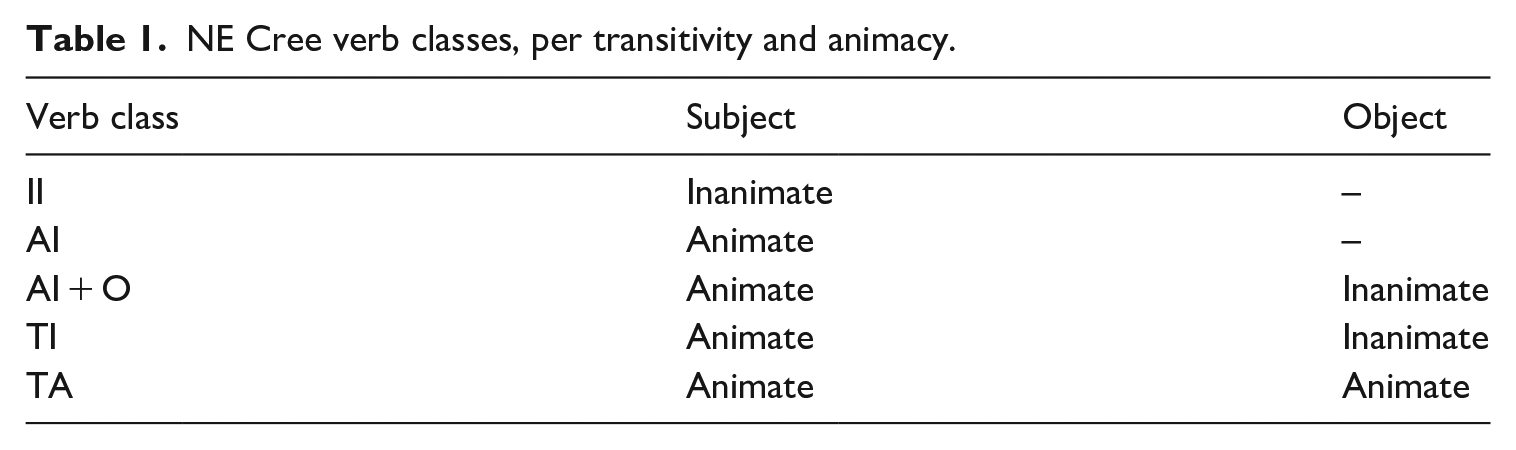
This verb stem structure yields the basic four-way classification of verbs represented in Table 1, which lists verb classes by the animacy of arguments as well as their traditional names in Algonquian linguistics, such as ‘AI’ or ‘animate intransitive’ verbs. Table 1 includes the sub-class ‘AI + O’ verbs, which have intransitive morphology but are syntactically transitive. For the present study, we follow common Algonquianist conventions to construe the grammatical subject as: (1) the sole argument of an intransitive verb and (2) the argument of a transitive verb which typically plays the more agentive or actor-like role.
NE Cree verb classes, per transitivity and animacy.
Much of this article hinges on expectations involving word order and interpreting verbal arguments, showing how NE Cree places an entirely different set of heuristic pressures on children than languages such as English. Given that lexical arguments are frequently omitted, NE Cree utterances commonly consist of a single verbal element. Although more extensive research is needed, previous work involving the same database used by the present study found that 542/793 (68.3%) of verbal clauses in child-directed speech (CDS) have null arguments, with only 188/793 (23.7%) of verbal clauses containing an argument referenced by a lexical noun phrase (Brittain et al., 2014). The proportion of omitted arguments in adult-to-adult speech may be even higher, but no published study yet exists.
The default ordering of major constituents in NE Cree is (O)V(S) (Branigan & Brittain, 2023). This ordering, however, is also flexible and frequently disrupted by discourse-driven operations, which fronts topics and focused items. These differences with languages like English are especially important in the passive voice, since whatever cues there might be to non-canonical argument encoding are fewer and more focused on the verbal complex. Thus, the opportunities to revise expectations from the canonical active interpretation of a sentence to the passive are focused on the verbal complex, and not spread through other cues such as case, animacy, and word order. We turn now to a description of the passive voice in NE Cree.
The passive voice: form and function
Passive constructions have been described in other Cree-Innu-Naskapi varieties, such as Plains Cree (Dahlstrom, 1991; Wolfart, 1991) and Innu (Drapeau, 2012, 2014) as well as in other Algonquian languages, such as Ojibwe (Rhodes, 1991; Valentine, 2001). To our knowledge, this brief overview presents the first dedicated description for NE Cree, although some passive paradigms are available through the online reference grammar (Junker & MacKenzie, 2010–2014). As needed, this section draws upon Drapeau’s (2012, 2014) in-depth analyses of passives in Innu, which is closely related to NE Cree.
We adopt a traditional distinction between active and passive voice (e.g. Payne, 1997) to define passive verbs in NE Cree, which exhibit the following characteristics:
The passive voice construction reduces the valency of the corresponding active construction by one.
The argument corresponding to the subject in the active voice is omitted in the passive and cannot be referenced by an overt noun phrase co-occurring with the verb. This is consistent with other Cree dialects, where passives are obligatorily agentless (e.g. Dahlstrom, 1991; Wolfart, 1991).
For passives derived from transitive verbs, the argument corresponding to the object in the active voice is the subject in the passive. The passive verb bears intransitive verbal morphology that agrees with the animacy of that subject.
Passives derived from intransitive verbs are subjectless. The passive verb bears intransitive verbal morphology associated with an inanimate subject and can be neither referential nor plural.
Passives are derived from transitive verbs through suffixes sensitive to person. The suffix -kiwi creates passives with a subject that is a speech-act participant (first or second person), as in (5). The other suffix -kiniwi derives passives with third-person subjects (6).
(5) Chaa waapimikiwiyin anitaah. chaa waap-im- FUT.PVB light-by.headTA- ‘We will see you in there’. (Lit. ‘You will be seen in there’.) (Adult, B3.04, 4;06, 22:19) (6) Taapaa wiyaash waapimaakiniwichaa. taapaa wiyaash waap-im- NEG in.some.way light-by.headTA- ‘It doesn’t matter if she is seen’. (Adult, B1.28, 5;05, 12:23)
A different suffix, -naaniu, derives impersonal passives from intransitive verbs that have an animate subject (7). This suffix cannot be applied to create impersonal forms of verbs from any other class. We follow Drapeau (2012) for Innu in assuming such impersonal passives inflect for a ‘dummy’ subject.
(7) Nikimunaaniuh. nikimu- singAI- ‘Do we sing it?’ (Lit. ‘Is it sung?’) (Adult, B1.18, 4;09, 4:52)
Although many languages do not have such a passivizing operation that applies to intransitive verbs, many other languages do (see, for example, Payne, 1997, pp. 206–207). The present study follows Drapeau’s (2012) classification for Innu and considers such impersonal constructions as passives alongside the more prototypical passives derived from transitive verbs: Both types of passives are derived from verbs with an animate subject in the active voice, and both maintain that referent implicitly in the passive while nonetheless rendering it unspecified.
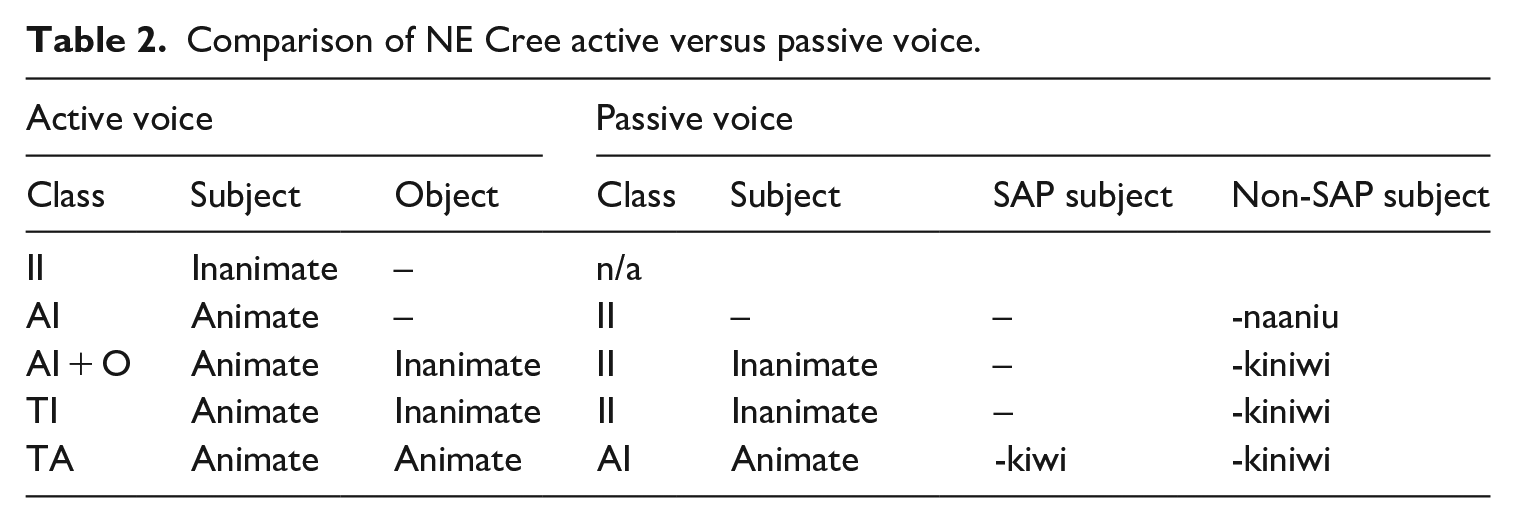
Table 2 summarizes the characteristics of the active and passive voice in NE Cree, along with the distribution of the three passive suffixes. Each of these three suffixes has a few allomorphs, but we do not discuss this further because that allomorphy is phonologically conditioned.
Comparison of NE Cree active versus passive voice.
As in Innu (Drapeau, (2012), NE Cree passives do not allow the agent to appear in a co-occurring noun phrase, but the agent can nonetheless be implicitly referenced within the verb complex by an agent-oriented preverb such as wiih ‘want’ (8).
(8) Chiwiih waapimikiwin waash anitaah. chi- 2- ‘They want to see you there’. (Lit: ‘You are wanted to be seen there’.) (Adult, A1.17, 2;09, 35:55)
While the full range of functions of the passive remains to be established for NE Cree, some basic contexts of usage are clear. The passive is often used when the action referenced by the verb has an unknown agent. The impersonal passive in particular typically refers to some unknown human actor or collective – similar to how Innu impersonals have an implied, unspecified subject referencing ‘loosely collective human actors’ (Drapeau, 2012, p. 186) – which translators commonly translate as ‘we’. The passive also is used to refer to things that happen habitually – similar to the ‘habitual passive’ described by Allen and Crago in Inuktitut (1996) – as well as to what people normally do or say. In addition, passives frequently describe how things were typically done in the past.
As a final note, it is clear that passives in Cree display some important differences compared with languages such as English. For one, Cree encodes passives via verbal morphology while English uses a combination of morphology and syntax. In addition, Cree passives fully suppress the overt expression of the agent via a noun phrase while languages such as English allow it. Such differences between languages mirror some of the disparities the literature evinces between definitions of ‘prototypical’ passives (cf. Payne, 1997, p. 204; Zúñiga & Kittilä, 2019, p. 83). Nonetheless, the crucial point for the present study is that passives in Cree, English, and many other languages share core characteristics in reducing valency from the active voice.
We turn now to the two studies exploring the acquisition of the passive voice in NE Cree. Study 1 describes the presence and properties of passive constructions in CDS, and Study 2 traces the acquisition of the passive by two children.
Method
Data source
All data come from the video corpus of the Chisasibi Child Language Acquisition Study (CCLAS, mun.ca/cclas/). CCLAS is a naturalistic, longitudinal study that began in 2004 and was initiated by the Cree School Board of Québec in collaboration with linguists at Memorial University of Newfoundland. Between 2005 and 2007, CCLAS recorded about 60 total hours of child and child-directed speech in the Cree Nation of Chisasibi. Over the long-term, CCLAS objectives include contributing to contemporary theories of first-language acquisition; linguistic descriptions of NE Cree; and educational and clinical applications in Cree communities (e.g. Brittain & Rose, 2021; Henke, 2019, 2020, 2023; Henke & Brittain, 2022; Rose & Brittain, 2011). Most CCLAS data cannot be shared publicly due to privacy agreements with participating families, but some audio files and transcripts are publicly available through PhonBank (phonbank.talkbank.org). We have permission from CCLAS to use the data for this article.
Participants
Three participants are represented in our studies here: one child code-named Daisy (age 3;08–5;11), another child code-named Billy (4;06–5;10), and one adult. Each child is acquiring NE Cree as an L1 in Chisasibi. The adult is Darlene Bearskin, a resident of Chisasibi who also speaks NE Cree as an L1. She was the project coordinator for CCLAS, recorded all the videos in the CCLAS corpus, and she knows each child well. Each child was filmed primarily in home settings at 2-week intervals (when possible) across a 30-month period between 2005 and 2007. The children each generally interact alone with the adult, although other people are occasionally present. Interactions were unstructured and typically involved activities such as looking through picture books, playing with toys, or playing pretend. See Brittain et al. (2007) for further details regarding data collection, processing, storage, and management.
The data sample, coding procedures, and defining productivity
We sampled 38 total video recordings (approximately 24 total hours), which includes 25 recordings with Daisy and 13 with Billy. We employed a mixture of convenience and purposive sampling: We searched Cree-language transcriptions throughout the CCLAS corpus to identify all passive constructions, and we selected the highest-quality recordings while aiming to sample one video every 3 or 4 weeks per child. Some gaps exist in this sample due to recording quality or a lack of recording. See Supplemental Tables 17 and 20 in the Supplemental Appendix for the full list of sampled recordings per child.
Within this sample, we coded each passive verb token using the scheme outlined in Supplemental Table 14 in the Supplemental Appendix. We excluded any passive verb token that was unclear or a repetition of another token within five utterances. For Study 2, we evaluate child productivity with each of the three passive suffixes (see Table 2) as a way to analyze their acquisition of the passive voice. We synthesize and adapt approaches from existing CCLAS studies by Johansson (2012) and Henke (2020) to establish a child’s productivity with a suffix, once the following criteria are met:
The suffix is used with two different verbal lexemes either: (1) within one recording or (2) across two consecutive sampled recordings; and
The child has used each such lexeme with at least one non-passive token; and
The child has error-free usage of the suffix in 80% of tokens during that recording.
Study 1: the passive voice in CDS
This study examines characteristics of the passive voice in child-directed NE Cree from the adult to the two children represented in Study 2. We consider the frequency of passives, the co-occurrence of overt arguments (i.e., noun phrases) with passive verbs, the overall usage of each of the three passive suffixes, the distribution of passive forms per verb class, and passive forms that reference the agent of the action.
Overall frequency of passives
The sampled data contains 10,566 total child-directed verb tokens. Overall, the adult uses 531 (5.01%) total passive verb tokens, which includes 366 tokens directed toward Daisy and 165 toward Billy. See Supplemental Tables 15 and 16 in the Supplemental Appendix for a count of passive verb tokens in CDS per recording.
CDS employs 23.1 passives per hour on average, and each child encounters passives at a nearly identical rate: 23.3 passives per hour to Daisy, and 22.8 to Billy. Previous work by Johansson (2012, p. 62) finds that Billy hears passives at a rate of approximately 16 per hour. The present study differs from these results because we examine more recordings and also include passives derived via the suffix -naaniu.
These results indicate that children acquiring NE Cree hear passives at a much higher rate than children acquiring languages such as English and even Inuktitut. Allen and Crago (1996, p. 150), for example, compare sources reporting passives per hour in CDS for English – between 1.1 per hour (Gordon & Chafetz, 1990) and 2.7 per hour (Maratsos, 1985) – for Inuktitut (7.8 per hour). The data here indicate that NE Cree exposes children to passives at a rate almost triple that of Inuktitut.
Overt arguments with passives
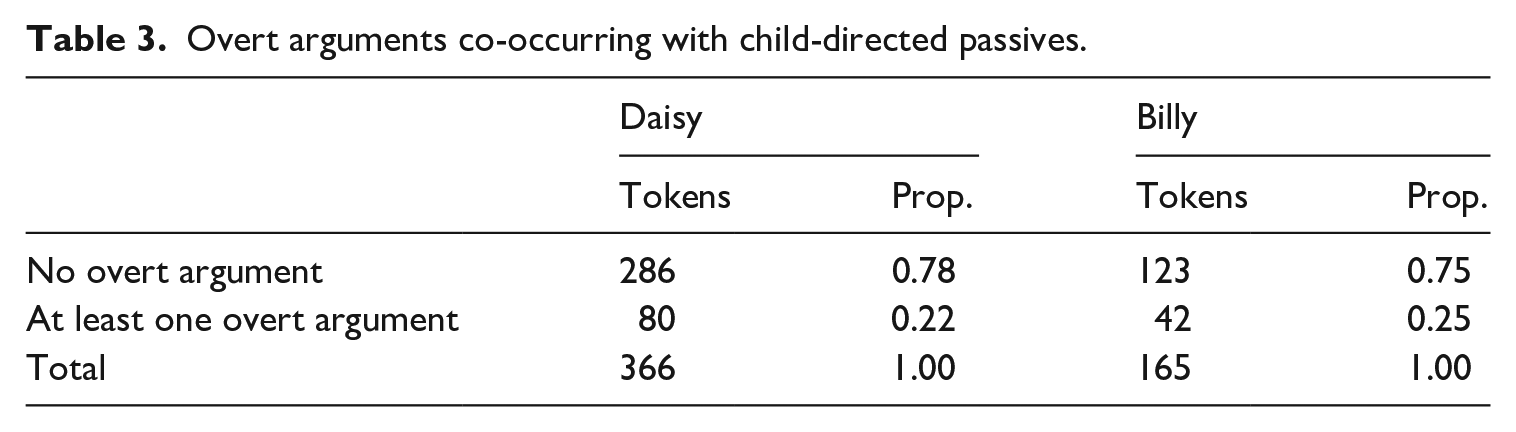
In addition to their sheer frequency, the majority of passive tokens in CDS co-occur with no overt arguments: 409/531 total tokens (77.0%). Table 3 tabulates the passive verb tokens in CDS that co-occur with an overt argument and those tokens that contain no overt argument.
Overt arguments co-occurring with child-directed passives.
To illustrate, examples (9–12) provide contrasting child-directed forms of the verb miyaau ‘she gives it to him’. (9) shows the verb in the active voice, which includes a post-verbal agent. Example (10) provides the corresponding passive construction without any overt arguments. The verb in (11) has one overt argument, and (12) has two overt arguments.
(9) Nichiih paachi miyikw anitaah iskwaaush. ni-chiih paachi miy-ikw-∅ ani-taah iskwaau-sh 1-PST.PVB toward.here.PVB giveTA-INV-3SG>1SGIND DEM-LOC woman-DIM ‘A lady gave it to me’. (Adult, B3.18, 5;10, 16:23) (10) Nichiih miykiwin. ni-chiih miy-kiwi-n 1-PST.PVB giveTA-PASS-1SGIND ‘It was given to me’. (Adult, B1.23, 4;11, 24:27) (11) Taanitaah chaa chiih uhchi miyikiwiyin siiutiish. taanitaah chaa chiih uhchi miy-ikiwi-yin how FUT.PVB able.PVB from.PVB giveTA-PASS-2SGCJ ‘How will they give you (Adult, B1.15, 4;06, 15:51) (12) Taapaa nimiyikiwin niiyi aapihiikinh naashtiyich utih, aa. taapaa ni-miy-ikiwi-n NEG 1-giveTA-PASS-1SGIND ‘They don’t give (Adult, B3.13, 5;02, 20:51)
Each child encounters similar proportions of passive verbs without overt arguments: 286/366 tokens (78.1%) for Daisy and 123/165 tokens (74.5%) for Billy. These numbers resemble those of a previous study examining the rate of overt arguments in overall CDS to Billy, where 542/793 (68.3%) of total verbal clauses have null arguments (Brittain et al., 2014). NE Cree diverges greatly from English, where the canonical presence of overt arguments leads to the expectation that a pre-verbal noun is the subject, animate, and agent – most Cree passives have no such nouns at all.
Overall usage of each passive suffix
NE Cree has three passive suffixes (section ‘NE Cree’), and Table 4 tallies the overall rates of each in the sampled CDS.
Overall usage of each passive suffix in child-directed passives, per verb type.
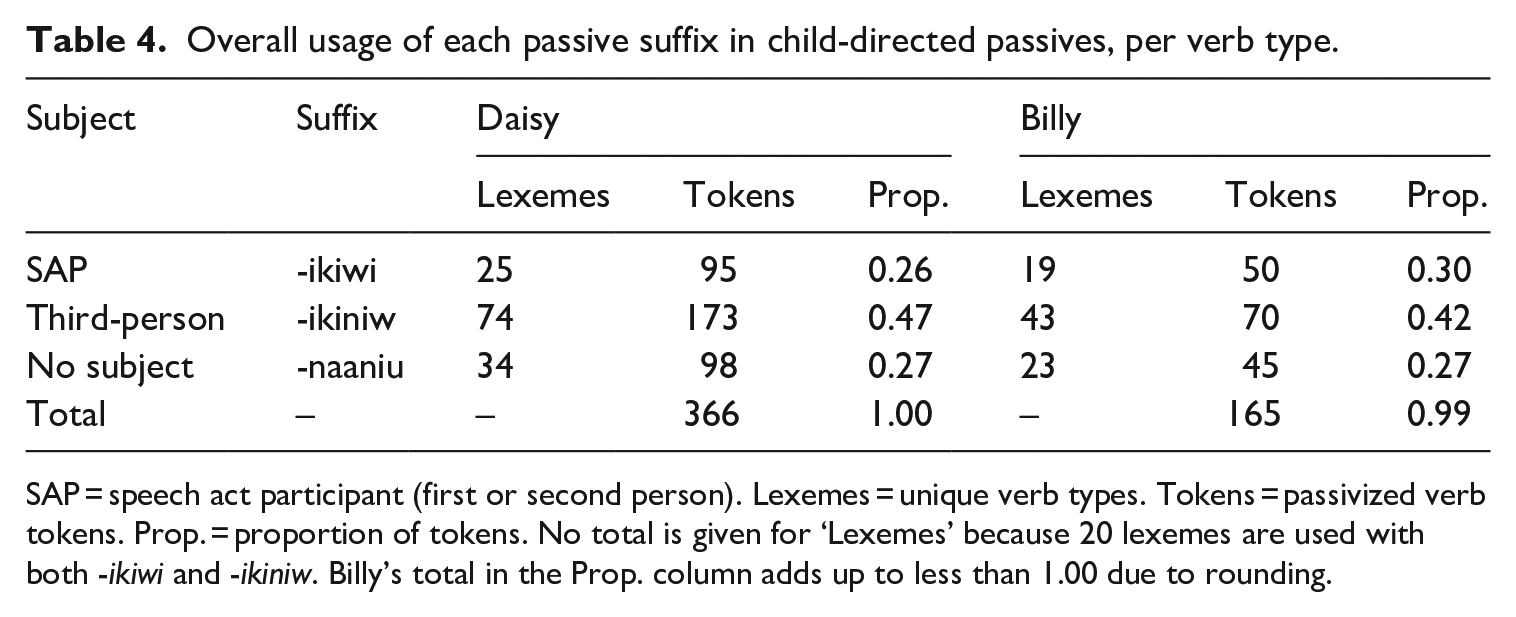
SAP = speech act participant (first or second person). Lexemes = unique verb types. Tokens = passivized verb tokens. Prop. = proportion of tokens. No total is given for ‘Lexemes’ because 20 lexemes are used with both -ikiwi and -ikiniw. Billy’s total in the Prop. column adds up to less than 1.00 due to rounding.
A plurality of overall passive verb tokens in CDS uses the suffix -ikiniw: 243/531 (45.8%). There is a near-even split between the remaining suffixes. 145/531 (27.3%) of tokens involve the suffix -ikiwi, while 143/531 (26.9%) of total passive tokens use -naaniu. Once again, the input across children is quite consistent: Despite differences in overall tokens, Daisy and Billy both hear each passive suffix at a similar rate. Furthermore, the children hear each passive suffix used across a variety of verb lexemes. This testifies to the productivity of passivization in CDS and also indicates that individual passive word forms are unlikely to be acquired as lexicalized units.
Passives per verb class
Children acquiring languages such as English are more challenged with passives involving two or more animate arguments. This is because children are unable to use animacy as a cue for assigning thematic roles for overt arguments, and must therefore rely on syntax to comprehend the passive. Thus, animacy is an important consideration when investigating the passive in CDS and child speech.
Cree verb classes hinge on the number and animacy of participants (section ‘NE Cree’), and Table 5 breaks down child-directed passives across each verb class per child. Once again, each child receives strikingly similar input: Whether in terms of verb lexemes or tokens, the proportions of passives that Daisy and Billy each hear across verb classes are nearly identical.
Overall usage of passives per verb class in child-directed passives to (a) Daisy and (b) Billy.
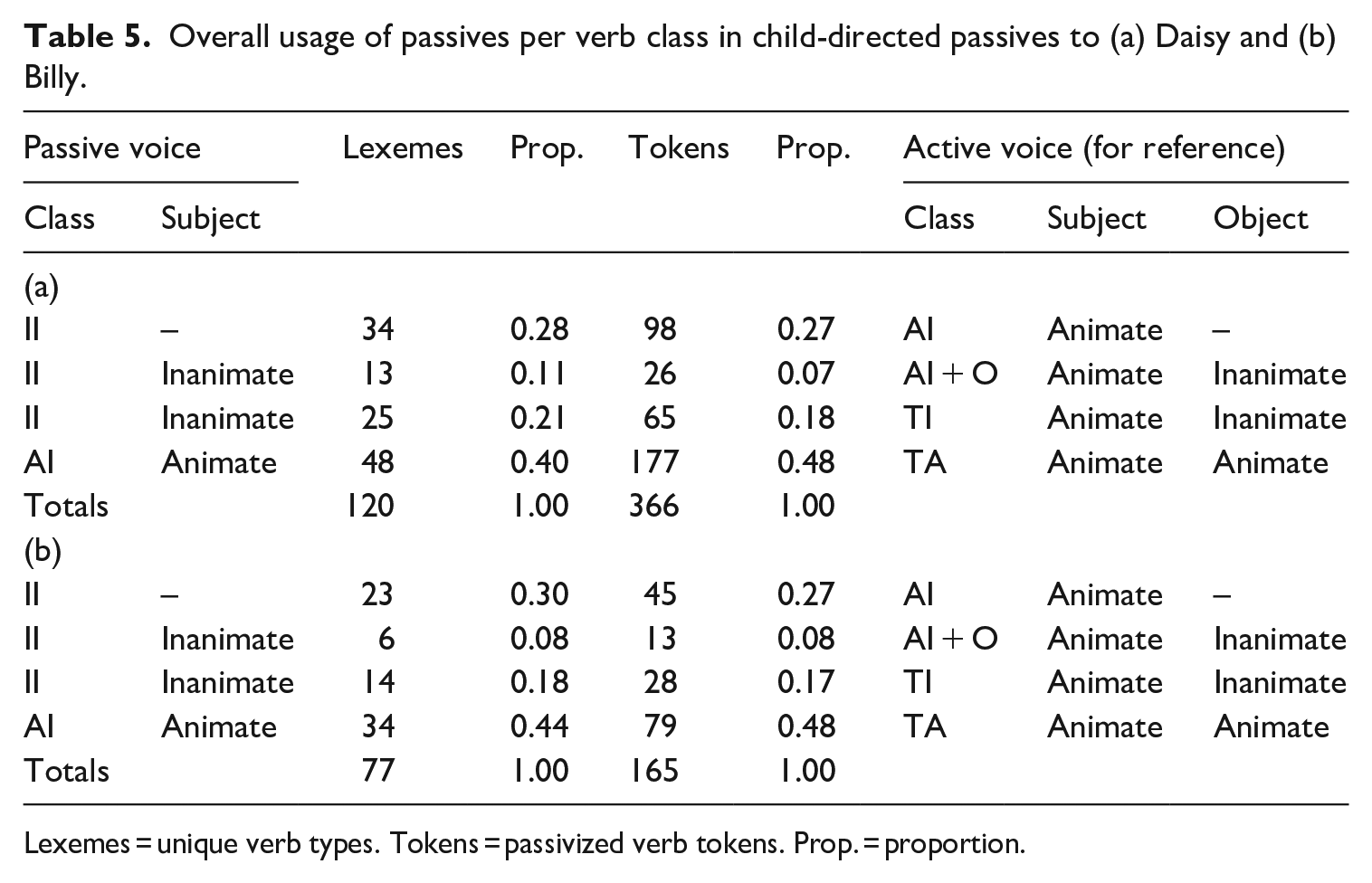
Lexemes = unique verb types. Tokens = passivized verb tokens. Prop. = proportion.
Crucially, Cree-language input teems with passives involving more than one animate participant. Whether considering verb lexemes or tokens, both children encounter more passives derived from TA verbs, which have an animate subject and animate object, than from any other verb class.
Referencing the agent
Passivized verbs do not allow a co-occurring overt agent referenced by a noun phrase, and CDS contains no passive verb tokens that have such an overt agent. However, the agent may still be referenced by an agent-oriented preverb such as wiih ‘want’. The sampled CDS uses only four such verb tokens, as in (13), so these constructions are relatively rare amid passives in the input.
(13) Nimaas aah wiih kaahchishtinaakiniwit, taan aashinihkaataach. nimaas aah fish COMP.PVB ‘When we want to catch a fish . . .’ (Lit: ‘When a fish is wanted to be caught . . .’) (Adult, B1.15, 4;06, 6:15)
Summary
Both children represented in the sampled data encounter similar input when it comes to the passive voice. The average rate of passives per hour to each child is nearly identical. Daisy and Billy also hear very similar proportions related to the presence of overt arguments, the usage of each passive suffix, and passives per verb class.
The high frequency of the passive voice should interact with facets of Cree structure to shape children’s expectations and ensure that children can acquire the passive voice earlier than in languages such as English. Passives occur in Cree CDS at a much higher rate than in English and in other languages where children acquire the passive early. Furthermore, Cree-acquiring children will have no reason to develop the same expectations that lead to challenges acquiring the passive in languages such as English. Most Cree passives occur without an overt argument, and word order is much more flexible, so children have less reason to look toward syntax to comprehend passives. Furthermore, the high proportion of passives derived from verbs with two animate arguments should lead children to expect that any argument of a passive verb, whether overt or covert, may well be animate – and they will also have no reason to assume any pre-verbal noun is the agent of a passive. Therefore, Cree-acquiring children will avoid the fetters that English-style expectations impose when comprehending and producing the passive voice.
Study 2: the passive voice in child language
This study follows from the findings of Study 1 and traces the acquisition of the passive voice by two children of different age ranges: Daisy (age 3;08–5;11) and Billy (4;06–5;10). Beginning with Daisy, we consider for each child their overall frequency of the passive voice before exploring their productivity with each passive suffix. We also examine each child’s usage of overt arguments with passives, passives per verb class, as well as references to the agent within the verb complex.
Daisy: overall frequency of passives
Daisy uses 272 total passive verb tokens throughout her sampled recordings. On average, she produces 16.5 passives per hour. Children acquiring other languages show far lower rates of passives per hour (Allen & Crago, 1996, p. 137): 0.4 times per hour for English passives (Pinker et al., 1987), 3.0 per hour for K’iche’ Mayan (Pye & Poz, 1988), 1.7 per hour for Sesotho (Demuth, 1990), and 2.8 per hour for Inuktitut. Daisy’s production of passives is more than five times that of the closest published rate, although Daisy is older than some of the children represented in those studies. See Supplemental Table 17 in the Supplemental Appendix for a breakdown of her passive tokens per recording.
Across her entire data sample, Daisy uses passive morphology with 126 unique Cree lexemes. Her most frequently passivized lexemes are represented in Table 6, of which five are also most frequently passivized in CDS.
Most frequent lexemes used by Daisy in passive tokens, age 3;08–5;11.
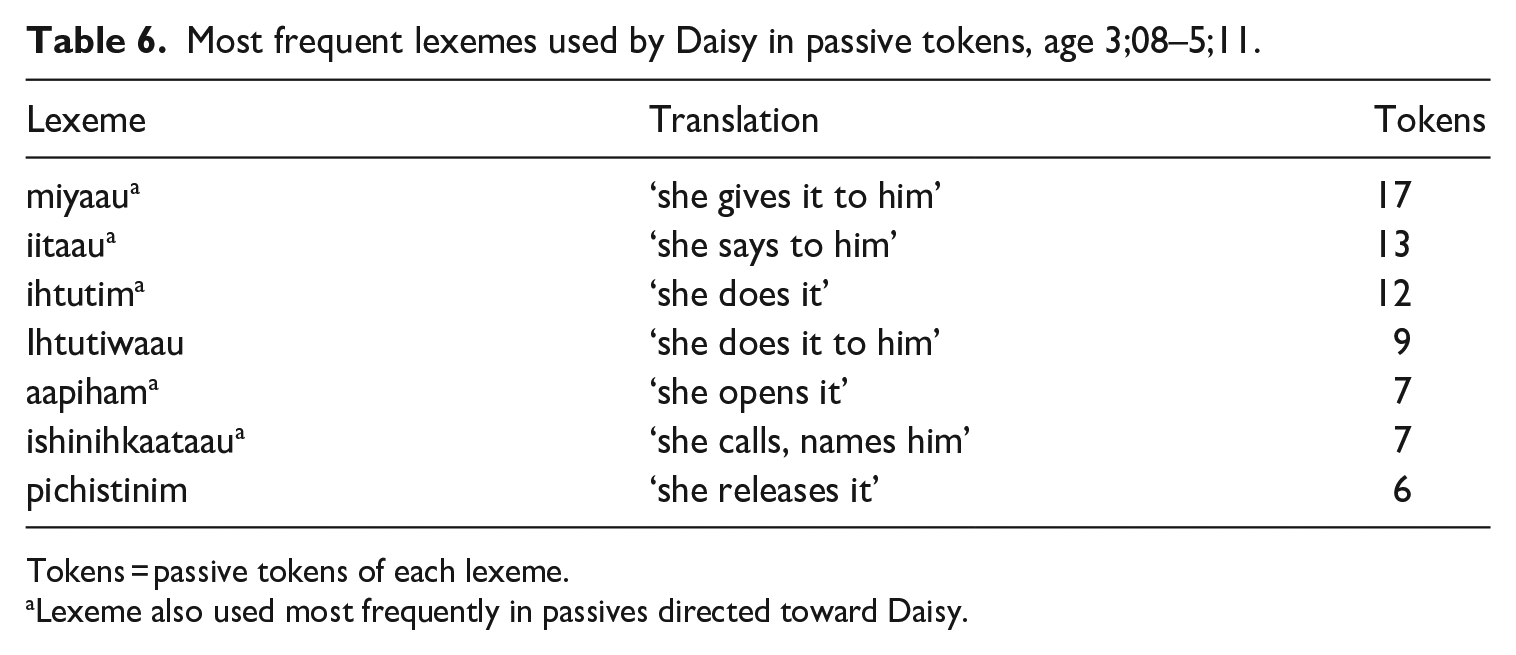
Tokens = passive tokens of each lexeme.
Lexeme also used most frequently in passives directed toward Daisy.
Daisy: productivity with each passive suffix
The following three subsections evaluate Daisy’s productivity with each of the three passive suffixes, using the criteria outlined in the ‘The data sample, coding procedures, and defining productivity’ section. Table 7 provides a breakdown of her overall usage of each suffix across her sampled recordings.
Overall usage of each passive suffix by Daisy, age 3;08–5;11.
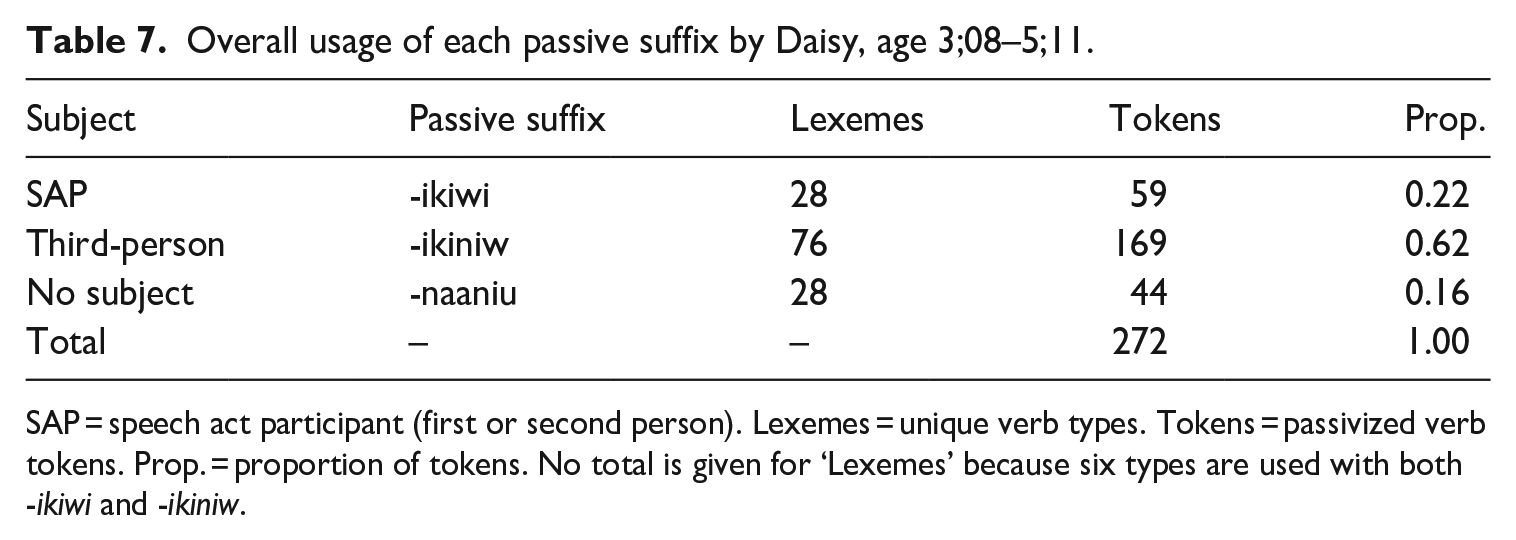
SAP = speech act participant (first or second person). Lexemes = unique verb types. Tokens = passivized verb tokens. Prop. = proportion of tokens. No total is given for ‘Lexemes’ because six types are used with both -ikiwi and -ikiniw.
Daisy’s acquisition of the passive voice is already underway when her recordings begin: She produces 18 passive tokens involving 12 different lexemes in her very first recording, so we do not get the chance to see the initial emergence of Daisy’s passives.
Productivity with -ikiniw
Compared with CDS, Daisy uses an even greater proportion of -ikiniw forms, which represent 169/272 (62.1%) of her total passive tokens. In her first available recording at age 3;08, Daisy applies -ikiniw to nine different verbal lexemes (15 total tokens). She also satisfies the criteria for demonstrating productivity with the suffix at this age: She has non-passive tokens of six such lexemes – as illustrated with the lexeme ihtutim ‘she does it’ in (14) versus (15) – and she has no errors with the suffix.
(14) Maautaah aahtutikiniwich-h. maau-taah aahtut- DEM-LOC do.ICTI- ‘We do it like this’. (Lit: ‘It is done like this’.) (Daisy, B1.01, 3;08, 3:41)
2
(15) Utaah aa ihtutim aniyaah. u-taah aa ihtut-im-∅ ani-yaah DEM-LOC Q do-TI-3SG>ININD DEM-IN.OBV.PL ‘Is he doing that to those?’ (Daisy, B1.01, 3;08, 7:03)
Daisy’s derivation of passives via -ikiniw picks up even more at age 3;09. Here she applies the suffix to 18 different lexemes (28 total tokens), only two of which she had used previously in passive form. Daisy clearly shows robust productivity with -ikiniw by age 3;08, and she is likely productive with the suffix before her recordings begin.
Productivity with -ikiwi
Daisy takes a bit longer to demonstrate productivity with the suffix -ikiwi. The child first uses the suffix at age 3;09 in a single token of the lexeme misinaapiskihwaau ‘she videotapes, photographs him’ (16), with a non-passive token of the same verb (17).
(16) Maakwaach nimisinaapiskihukiwin. maakwaach ni-misin-aapisk-ihu- meanwhile 1-write-metal.mineral-by.instrumentTA- ‘I am being filmed right now’. (Daisy, B1.02, 3;09, 12:28) (17) Aakuu maak paachi misinaapiskihuuh. aakuu maak paachi misin-aapisk-ihuu-h enough so toward.here.PVB write-metal.mineral-by.instrumentTA-2SG>1SGIMP ‘Stop filming me!’ (Daisy, B1.02, 3;09, 4:45)
But it is not until age 3;11 that she satisfies the criteria for demonstrating productivity with -ikiwi. Here she applies the suffix to five lexemes (seven total tokens), with non-passive forms of the three of those lexemes, and no errors.
Productivity with -naaniu
The passive suffix -naaniu accounts for only 44/272 (16.2%) of Daisy’s overall passive tokens (Table 7), but she evinces productivity with -naaniu in her first recording at age 3;08. Here she uses the suffix with three lexemes, produces non-passive forms for all three lexemes – as in (18) versus (19) – and she has no errors.
(18) aah miichisunaaniwich aah miich-isu- COMP.PVB eat-AI- ‘for eating’ (Daisy, B1.01, 3;08, 12:20) (19) Maautaah niiyi aahtiyaan aah miichisuyaan. maau-taah niiyi aaht-i-yaan aah miich-isu-yaan DEM-LOC 1SG be-AI-1SGCJ COMP.PVB eat-AI-1SGCJ ‘This is how I eat’. (Lit: ‘I’m like this when I eat’.) (Daisy, B1.01, 3;08, 12:20)
At age 3;09, Daisy continues her rich usage of the suffix, when she applies -naaniu to eight different lexemes (11 total tokens).
Summary of productivity
Daisy’s acquisition of the passive voice in NE Cree is clearly well underway by the time her recordings begin at age 3;08, so we miss the opportunity to see each the emergence of each suffix. She demonstrates immediate and robust productivity with suffixes -ikiniw and -naaniu in her first recording, but she takes until 3;11 to show productivity with -ikiwi. Although Daisy evinces productivity with all three passive suffixes before age 4;0, this is not the end of the story. Her sampled data furnish some additional patterns and asymmetries that provide more insight into in her acquisition of the passive voice.
Daisy: overt arguments with passives
Compared with CDS, Daisy uses a much higher proportion of overt arguments in her overall passives production. Table 8 shows that 112/272 (41.2%) of her passive tokens contain an overt argument, as in (20), which references the subject ‘sugar’ and the location ‘here’ while the agent is disallowed. See Supplemental Table 18 in the Supplemental Appendix for Daisy’s rate of overt arguments per recording.
Overt arguments co-occurring with Daisy’s passives, age 3;08.10–5;11.25.
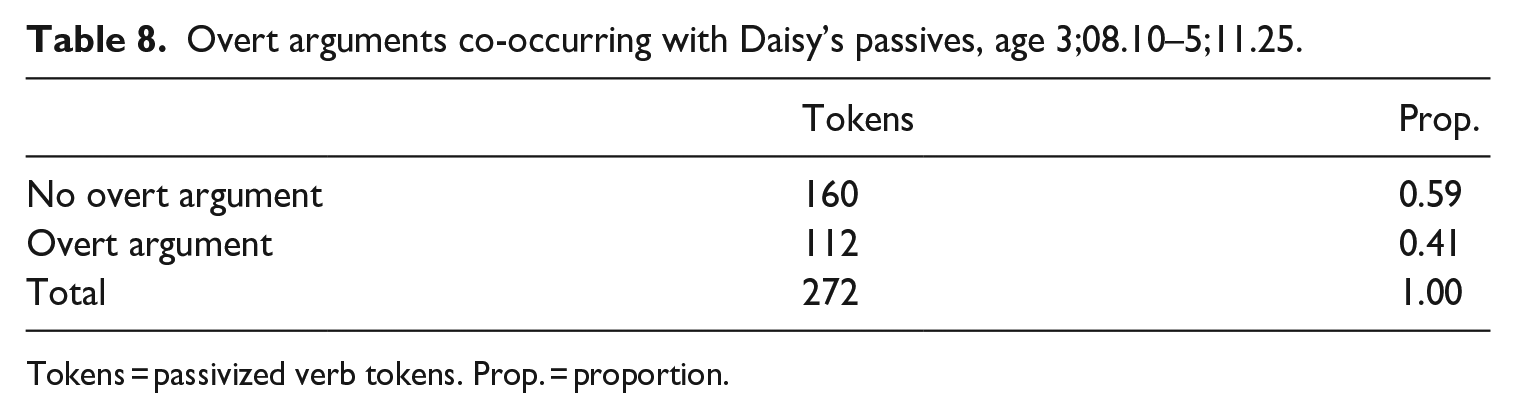
Tokens = passivized verb tokens. Prop. = proportion.
(20) Shuukaau waash utih pichistinikiniuu. ‘Sugar is put in here’. (Daisy, B1.03, 3;09, 21:15)
Daisy: passives per verb class
Although children acquiring English tend to have difficulty interpreting passive forms of verbs involving two animate arguments, Daisy shows no such issue at any time in the sampled data. As in CDS, Daisy passivizes more TA verbs than any other verb class (Table 9). Supplemental Table 19 in the Supplemental Appendix traces Daisy’s production of passives per verb class for each of her recordings.
Overall usage of passives per verb class in Daisy’s passives, age 3;08.10–5;11.25.
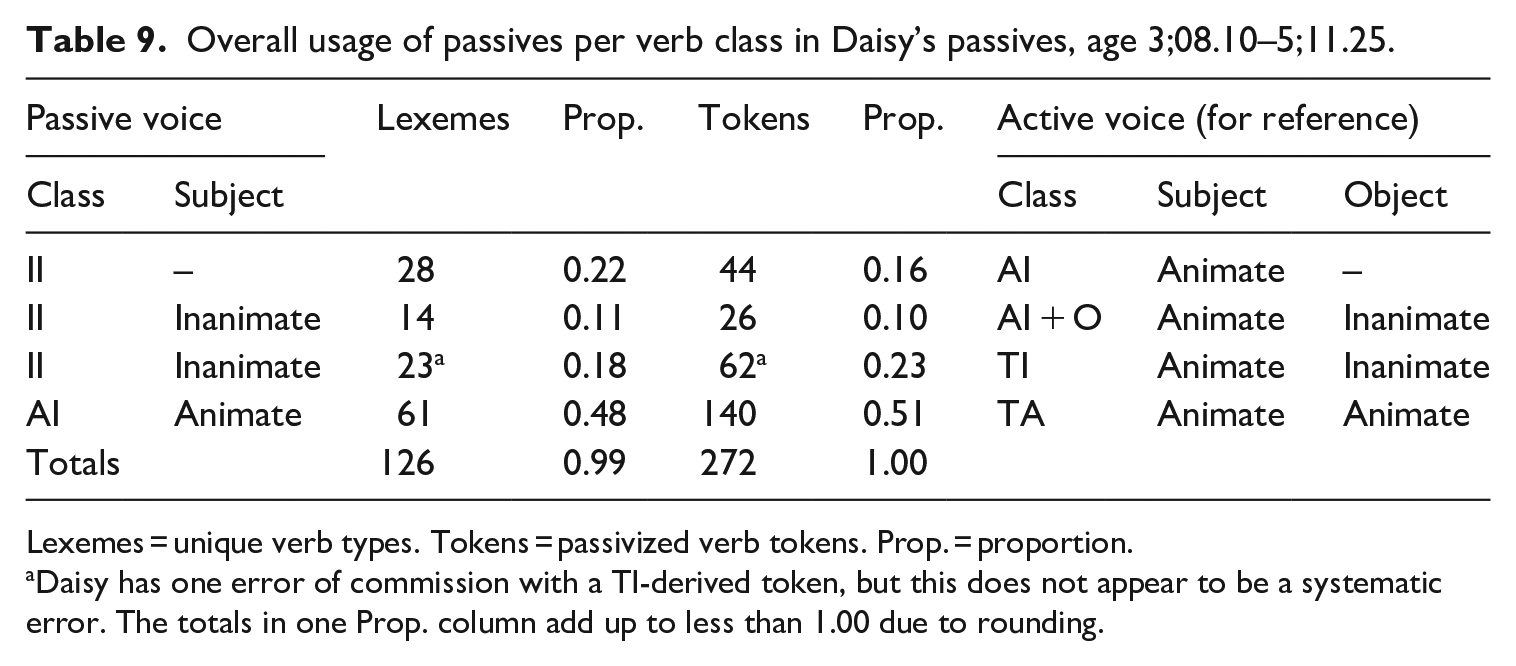
Lexemes = unique verb types. Tokens = passivized verb tokens. Prop. = proportion.
Daisy has one error of commission with a TI-derived token, but this does not appear to be a systematic error. The totals in one Prop. column add up to less than 1.00 due to rounding.
Passivizing verbs with two animate arguments never appears to stymie Daisy. She has two passive tokens of the TA lexeme iitaau ‘she says to him’ in her first recording, and she produces passive forms of 10 different TA lexemes (11 total tokens) across her first three recordings, from age 3;08–3;09.
Daisy: referencing the agent
There is only one area in Daisy’s sampled data where she evinces obvious errors with passives: She produces a very small number of overt agents as noun phrases co-occurring with her passive verbs. This pattern is ungrammatical and does not occur in any of the sampled CDS.
Daisy’s first such error occurs at age 4;00. In (21), Daisy uses the overt noun phrase chikaawii ‘your mother’ with the passive verb chiitikiwin ‘you are told’.
(21) Aashtim chiitikiwin chikaawii. Aashtim-Ø ch-iit- come.hereAI-2SGIMP 2-tellTA- ‘“Come here!”, you are told [*by your mother]’. (Daisy, B1.05, 4;00, 21:13)
Her second and final such error occurs at age 4;06. In (22), Daisy uses the noun phrase awaanichii ‘people’ as an overt agent with the passive verb chaa miyikiwiyaan ‘I will be given’.
(22) Chaa miyikiwiyaan awaanichii. Chaa miy- FUT.PVB giveTA- ‘I will be given (something) [*by some people]’. (Daisy, B1.15, 4;06, 15:56)
Passivized verbs with an agent referenced by the preverb wiih ‘want’ are rare in CDS, and we have a small amount of evidence that they may be acquired late by Daisy. Daisy produces just two passive tokens with the preverb wiih ‘want’, as in (23), and these two tokens do not come until age 4;10.
(23) An anitih chishaayaakushish wiih maatishwaakiniuu. an ani-tih chishaayaakushish DEM DEM-LOC baby.bear ‘That bear cub, they want to cut it up’. (Lit: ‘That bear cub there, it is wanted to be cut up’) (Daisy, B1.21, 4;10, 23:41)
However, due to the rarity of such agent-referencing passives in the input, we cannot say with certainty whether these constructions are acquired late or if they simply occur rarely in child speech too.
Daisy: summary
Daisy uses hundreds of passive tokens across many different lexemes, at an overall rate that is comparable to CDS – and at a far higher rate than has been reported for other languages. She also demonstrates productive usage of the passive voice early in her recordings. Daisy shows productivity with the suffixes -ikiniw and -naaniu at age 3;08, and she is productive with the third passive suffix, -ikiwi, at age 3;11.
Importantly, Daisy shows no evidence that her production may be hindered by English-like expectations regarding passives. Most of her passives have no overt arguments, and at no time does she show difficulty passivizing a verb that has two animate arguments. Daisy does produce two ungrammatical passive tokens with overt noun phrases referencing agents, but with just two tokens, these do not appear to represent a systematic error pattern.
Billy: overall frequency of passives
We now turn to the second child, Billy (4;06–5;10). This study follows previous work by Johansson (2012, pp. 68–104), who provides a preliminary analysis of Billy’s passive-voice acquisition. We expand and revise that analysis, although Johansson also considers some additional phenomena that we do not approach (e.g., configurations of inflectional marking on passivized verbs). We analyze more passives than Johansson, because we include impersonal passives and examine three additional recordings.
In our sampled data, Billy uses 52 total passive verb tokens. See Supplemental Table 20 in the Supplemental Appendix for a breakdown of his total passive tokens per video recording. Compared with Daisy, Billy produces far fewer passive tokens. Much of this difference is likely attributable to his temperament, as Billy is less talkative than Daisy. On average, Billy uses seven passive tokens per hour, which is much less than in CDS or Daisy’s speech – but still much more than has been reported in other languages. See Supplemental Table 20 in the Supplemental Appendix for details regarding Billy’s passive tokens and passives per hour for each recording.
Billy passivizes a total of 37 Cree verbal lexemes. He only produces more than one passive token of seven unique lexemes, all listed in Table 10. Our findings do not accord with Johansson’s (2012) observation that Billy primarily leans on passives meaning ‘do’ up to age 4;09. In fact, he passivizes ten different Cree lexemes before age 4;09, and only three involve ‘do’: ihtutim ‘she does it’, ihtutiwaau ‘she does it to him’, and iyihtiu ‘she does’.
All lexemes used more than once by Billy in passive tokens, age 4;06.08–5;10.20.
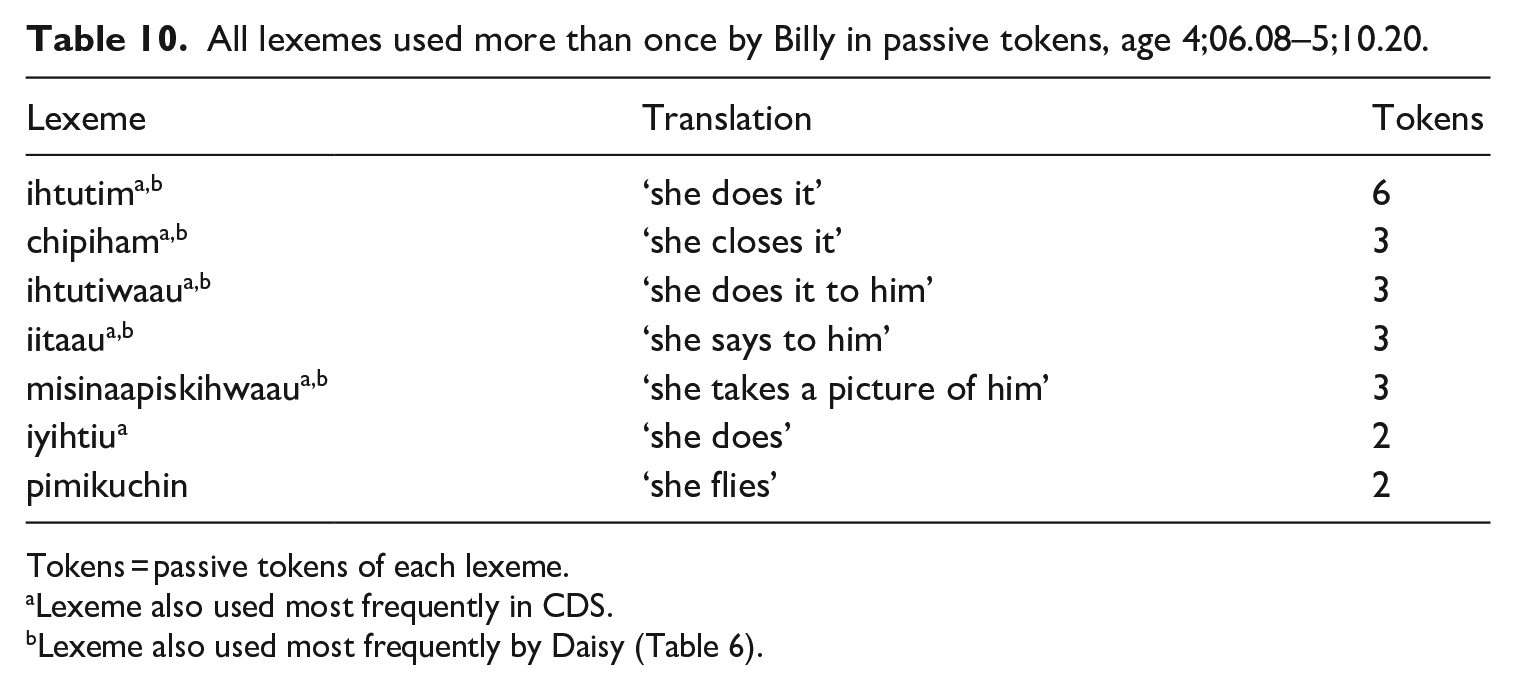
Tokens = passive tokens of each lexeme.
Lexeme also used most frequently in CDS.
Lexeme also used most frequently by Daisy (Table 6).
Billy: productivity with each passive suffix
The next three subsections examine Billy’s productivity with each of the passive suffixes, and Table 11 overviews his usage of each suffix. Billy produces far fewer passive tokens than Daisy, and his acquisition of the passive proceeds along a different trajectory as well.
Overall usage of each passive suffix by Billy, age 4;06.08–5;10.20.
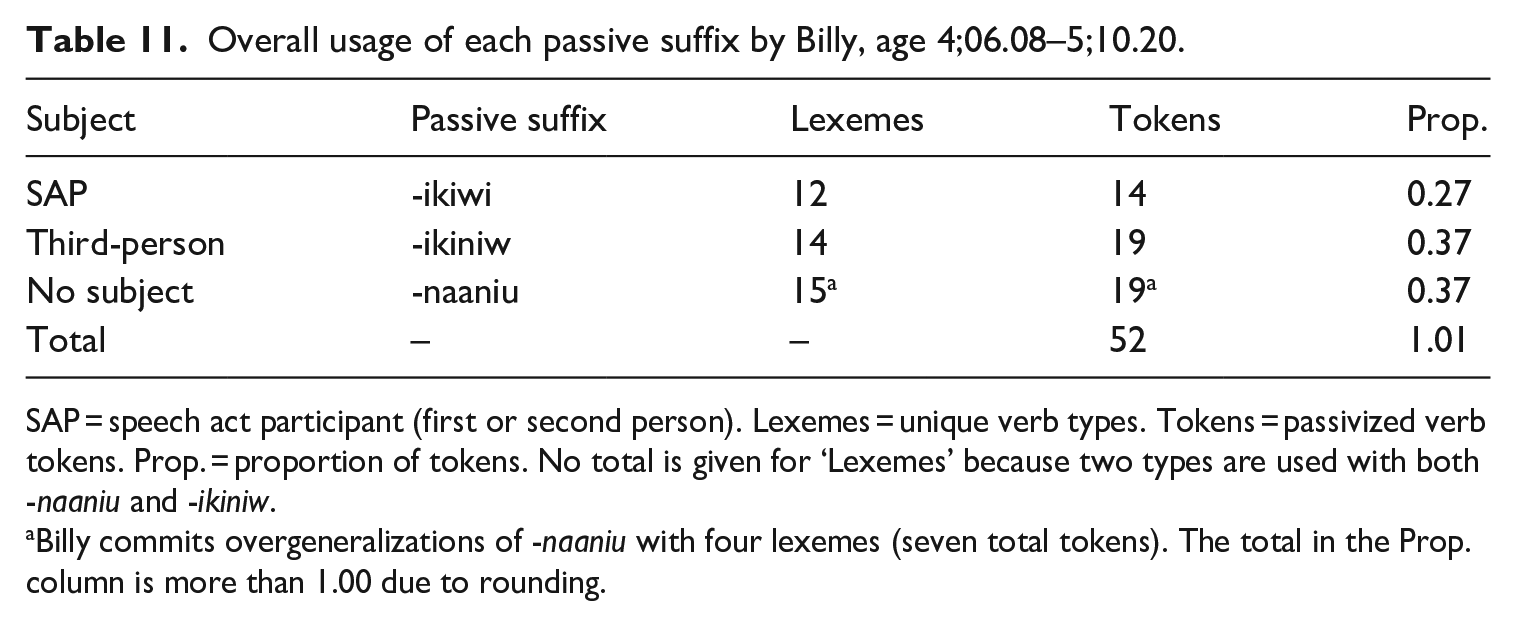
SAP = speech act participant (first or second person). Lexemes = unique verb types. Tokens = passivized verb tokens. Prop. = proportion of tokens. No total is given for ‘Lexemes’ because two types are used with both -naaniu and -ikiniw.
Billy commits overgeneralizations of -naaniu with four lexemes (seven total tokens). The total in the Prop. column is more than 1.00 due to rounding.
Productivity with -ikiniw
Like Daisy, Billy uses the suffix -ikiniw most often (25/52 total tokens, 48.1%). However, Billy does not readily evince Daisy’s early and robust productivity with the suffix. Part of this may be due to inter-child variation in acquisition, and part may be due to the fact that he produces fewer data points to analyze.
In his first recording at age 4;06, Billy has just one passive token with -ikiniw (24). Over his next two recordings, Billy twice uses -ikiniw with another lexeme, ihtutiwaau ‘she does it to him’. But he does not yet have the contrasting non-passive forms to establish productivity.
(24) Maautaah aaspiyihaakiniwit. maau-taah aas-piyi-h- DEM-LOC thusly.IC-INCHAI-CAUSTA- ‘This is how you make it go’ / ‘You move it this way’. [Lit. ‘This is how it is moved’.] (Billy, B3.04, 4;06, 10:22)
At 4;07, Billy begins a systemic overgeneralization: He uses the impersonal suffix -naaniu when -ikiniw is required. Here he overgeneralizes -naaniu with one token of chipiham ‘she closes it’ and three tokens of ihtutim ‘she does it’, as in (25).
(25) Maautaah aahtutikiniwich kiyipwaa. Target: maau-taah aahtut- DEM-LOC doTI- Actual: maau-taah aahtut-* DEM-LOC doTI-* ‘This is how it is done, obviously’. (Billy, B3.06, 4;07, 9:00)
Because Billy also has on-target production of -naaniu with five other lexemes, these overgeneralizations indicate that the child is using -naaniu as an all-purpose passivizer for verbs without an animate object. These overgeneralizations continue until age 5;00 (see section ‘Productivity with -naaniu’).
Billy does not satisfy the criteria for establishing productive usage of the suffix -ikiniw until age 5;05. At this point, he has used -ikiniw with two different lexemes – ihtutim ‘she does it’ and waapinim ‘she throws it away’ (26) – across two consecutive recordings, with no errors.
(26) Shaash chiih waapinikiniuu. shaash chiih waap-in- already PST.PVB throw.out-by.handTI- ‘It was already thrown out’. (Billy, B3.15, 5;05, 27:14)
Billy is error-free in his usage of -ikiniw for his remaining recordings, where he applies the suffix to six new lexemes (seven total tokens).
Productivity with -ikiwi
Billy’s emergence of productivity with the suffix -ikiwi follows a different trajectory. He uses the suffix once during his first sampled recording at age 4;06, shown in (27).
(27) Nichiih misinihukiwin. ni-chiih misin-ihu- 1-PST.PVB write-by.instrumentTA- ‘They wrote my name down’. (Lit: ‘I was written’.) (Billy, B3.04, 4;06, 11:39)
However, Billy does not satisfy the criteria for productivity until age 4;10. Here he has used the suffix with three different lexemes across two consecutive recordings, with non-passive tokens of two of these lexemes, and no errors (cf. Johansson, 2012, pp. 98–99).
Productivity with -naaniu
Billy satisfies the criteria for establishing productivity with -naaniu at age 4;06. By this point, he has used the suffix with three lexemes – utinichaau ‘she buys stuff’, iispiyiu ‘she goes there’ (28), pimikuchin ‘she flies’ – with non-passive forms of two of those lexemes, and no errors.
(28) Utaah aa aah iispiyinaaniwich. u-taah aa aah iis-piyi- DEM-LOC Q COMP.PVB thusly-INCHAI- ‘To go like this?’ (Billy, B3.05, 4;06, 26:41)
At 4;07, Billy begins a particular pattern of overgeneralization. Although he uses -naaniu correctly with another two intransitive lexemes, he also starts incorrectly applying the suffix to transitive verbs – but only to transitive verbs that have an inanimate object. He does this with two lexemes: chipiham ‘she closes it’ (one token) and ihtutim ‘she does it’ (three tokens).
To put the pattern in perspective: Until 4;07, Billy has had no errors deriving passives from intransitives or from verbs with an animate object. He has not yet attempted to passivize a verb with an inanimate object, and when he finally does at age 4;07, he uses -naaniu instead of -kiniw. He systematically recruits -naaniu to create passive verbs that have an inanimate subject.
Billy continues this pattern at age 4;10, where he overgeneralizes -naaniu with three lexemes (one token each): chikimuhtaau ‘she sticks it on’ (29), chipiham ‘she closes it’, and piihtiham ‘she puts it inside something’.
(29) Tape chiih chikimuhtaakiniuu shaash. Target: tape chiih chikimu-htaa- tape PST.PVB attach-CAUSAI+O- Actual: tape chiih chikimu-htaa-* tape PST.PVB attach-CAUSAI+O- ‘They already put a tape there’. (Billy, B3.09, 4;10, 5:01)
At 5;00, Billy ceases his overgeneralization of -naaniu by producing his first on-target passive of a lexeme with an inanimate object (30). At this age point, he also has two more adult-like uses of -naaniu with intransitive lexemes lockuu ‘she locks (it)’ and shaakichiwaau ‘she climbs up’.
(30) Aah mininikiniwiyich-h uyaayiuh, nimaa. aah min-in- COMP.PVB remove-by.handTI- ‘You take these off, right?’ (Billy, B3.11, 5;00, 3:35)
From this point forward, Billy is entirely on-target with his application of -naaniu across the rest of his sampled recordings.
Summary of productivity
As with Daisy, Billy has begun acquiring the passive voice before his recordings begin, but he follows a different path in demonstrating productivity with the three passive suffixes. He uses the suffix -ikiwi in his first recording and establishes productivity at age 4;10. Billy is also productive with the impersonal passive suffix -naaniu even earlier at age 4;06, and at no time does he have an error using the suffix to passivize an intransitive verb.
His path to productivity with the suffix -ikiniw is less smooth. He first overgeneralizes -naaniu when -ikiniw is needed. He corrects this error at 5;00 and establishes productivity with -ikiniw at 5;05. These overgeneralizations show that the animacy of participants is an important factor in Billy’s acquisition of the passive voice. We explore that further in the ‘Billy: passives per verb class’ section after taking a look at his overt arguments.
Billy: overt arguments with passives
Table 12 shows Billy’s overall proportion of overt arguments is nearly identical to the rate in CDS: Only 12/52 (23%) of his total passive tokens contain an overt argument, as in (31). Supplemental Table 21 in the Supplemental Appendix tallies Billy’s rate of overt arguments per recording.
Overt arguments co-occurring with Billy’s passives, age 4;06.08–5;10.20.
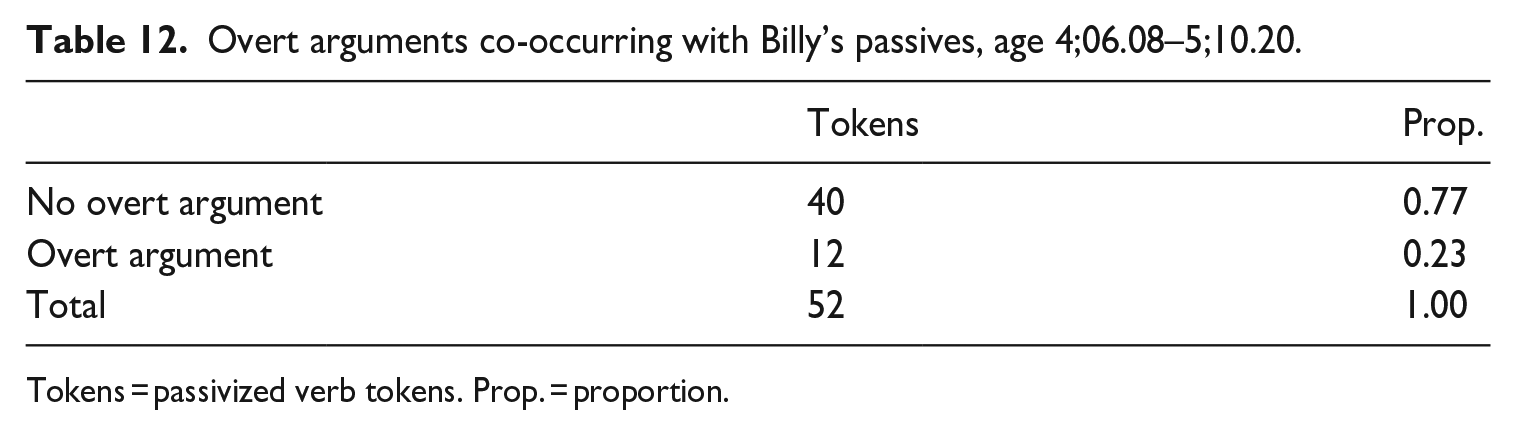
Tokens = passivized verb tokens. Prop. = proportion.
(31) Chiih iituhtihaakiniuu waash anitaah awaashish. chiih iituht-ih-aakiniu-u waash ani-taah PST.PVB go-CAUSTA-PASS-3SGIND EMPH DEM-LOC ‘They took the child over there’. (Lit. ‘The child was taken over there’.) (Billy, B3.18, 5;10, 11:41)
Billy: passives per verb class
As with Daisy, Billy shows no difficulty passivizing verbs with two animate arguments. He also passivizes such verbs more than any other verb class (Table 13). Supplemental Table 22 in the Supplemental Appendix outlines his production per each of his recordings.
Overall usage of passives per verb class in Billy’s passives, age 4;06.08–5;10.20.
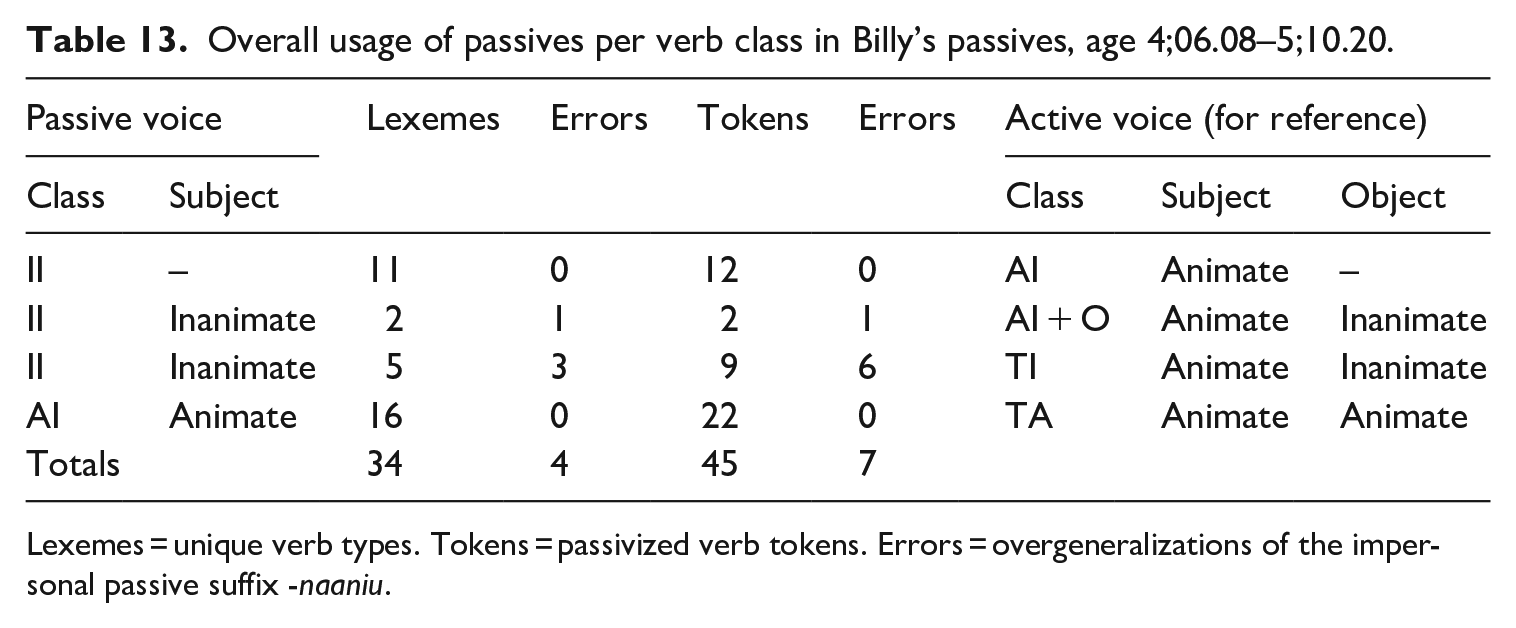
Lexemes = unique verb types. Tokens = passivized verb tokens. Errors = overgeneralizations of the impersonal passive suffix -naaniu.
Billy: referencing the agent
Billy does not produce a passive verb token referencing the agent in his sampled data. He does not use the agent-oriented preverb wiih ‘want’ with a passive, which is a pattern rare in the input. Unlike Daisy, Billy never produces a passive verb token with an ungrammatical overt agent.
Billy: summary
Compared with Daisy, Billy produces fewer passive tokens at a slower rate – yet still at a higher rate than has been reported for other languages. Billy eventually shows productivity with all three passive suffixes, although his facility with the passive voice develops with a different trajectory from Daisy. He first demonstrates productivity with the impersonal passive suffix -naaniu at age 4;06, although he soon recruits the suffix as an overgeneralized, all-purpose passivizer for lexemes without two animate participants. He shows productivity with the passive suffix -ikiwi at age 4;10, and he takes until age 5;05 to master the suffix -ikiniw after his period of overgeneralization.
As with Daisy, Billy never shows signs that English-like expectations may impede his passives. He uses passive tokens co-occurring with overt arguments at about the same rate he encounters them in CDS. Crucially, he never has difficulty passivizing verbs with two animate arguments – in fact, his only errors come in passivizing verbs with an inanimate object.
Discussion
We have presented in-depth data regarding the passive voice from CDS and child speech in NE Cree. The morphosyntactic structures involved are complex, but both Daisy and Billy show productive abilities with many facets of the passive voice early on in their recordings. Both children also hear and produce passive constructions at rates that are far higher than what has been reported for other languages. This proclivity indicates that challenges presented by languages such as English regarding comprehending and producing the passive voice do not apply in NE Cree.
We understand these results as telling the following story. The passive voice in NE Cree does not present children with some of the crucial challenges they must overcome in other languages. In English, the low frequency of the passive conspires with the high frequency of structural cues from the active voice to shape expectations which make acquiring the passive more difficult. To illustrate, English presents a basic challenge with the ambiguity of the first nominal in an utterance. Children encountering the first nominal simply do not know whether it encodes the agent, theme, or something else. There are some clues, but they are less-than-perfect predictors of the status of that nominal. One clue is topicality, where children can assume the first nominal tracks the discourse topic and therefore assign thematic roles on the basis of what they already know about the referent of that first nominal in discourse. Another clue is the distribution of sentence types in the input: Children encounter so many agent-first utterances that they can consider this a useful heuristic. But both of these clues are extra-grammatical and thus unreliable, especially when it comes to the passive voice.
The passive in NE Cree, however, involves a more complementary interaction of frequency and structural cues that shape expectations which facilitate earlier acquisition – resembling, for instance, the picture for Inuktitut presented by Allen and Crago (1996). Cree-acquiring children encounter the passive voice at a high overall rate, and they also hear each passive suffix used across a variety of verb lexemes. Most child-directed utterances involve null arguments, where only the verbal complex itself provides the recipe for an explicit mapping of thematic roles to grammatical roles for participants. The absence of the ambiguities seen in languages such as English results in children receiving a more predictable signal regarding thematic and grammatical roles. Children acquiring NE Cree frequently hear a single verb form and learn that information regarding the agent, theme, and any other relevant argument is encoded immediately in that verb form. Thus, if the verb form lacks any evidence of an agent, the child knows it is an agent-less utterance. NE Cree also employs flexible word order, so when a nominal is present before the verb, children have little reason to expect it signifies the agent. Furthermore, verbs with two animate arguments are frequently passivized, so children also will not expect that an animate nominal is necessarily the agent. Finally, passive verbal morphology gives reliable structural cues regarding the subject, because the passive morph encodes whether the verb has a speech-act participant, third-person, or dummy subject. Learning the passive voice is therefore a much more straightforward process than in languages such as English. The linguistic computations involved in deriving a passive are not a challenge either (cf. e.g. Borer & Wexler, 1987; Snyder & Hyams, 2015). If they were, we would expect difficulties to manifest regardless of the lack of ambiguity in NE Cree.
This straightforward process of comprehension relates directly to production, where the planning of sentences also draws upon expectations built over time. Children acquiring NE Cree will have no expectation that an utterance will have a pre-verbal nominal indicating the agent. Instead, they will expect fully formed propositions from the verbal complex. If a child wishes to express a proposition involving a demoted agent (either unmentioned or obscured), and a topically promoted theme, and perhaps an event with an adversative reading, then they will select from a number of passive verb forms that they have acquired. Their planning begins with those kinds of considerations, and is therefore significantly different from the kinds of planning that occurs in languages like English. This is not to say that children’s utterances are entirely formulaic, but the structure of the language necessitates planning before even a single word can be uttered.
Our claims open up opportunities for much further research. For example, we suggest that frequency and structural cues work together to shape expectations that facilitate the acquisition of passives in NE Cree, but we have not teased apart the exact contributions of each factor. Future research is also needed to further dissect and discern how individual structural characteristics, such as flexible word order and argument omission, may contribute to the construction of expectations. One key prediction that we make is that the sentence processing of polysynthetic languages (by adults and children) differs substantially from that of non-polysynthetic languages, because of differences in the flow of information. We leave questions such as this for future research, by us and by others. Ultimately, we have shown the passive voice in NE Cree is productive in the language of two young children, often to degrees not seen in any other language. We attribute much of this to the polysynthetic nature of the language, particularly where an absence of ambiguity pertaining to nominal arguments promotes the acquisition of the passive. We look forward to further investigation of the acquisition of NE Cree, and we hope such findings contribute to community goals supporting the language and its transmission to the next generation.
Supplemental Material
sj-docx-1-fla-10.1177_01427237231198758 – Supplemental material for The acquisition of the passive voice in Northern East Cree
Supplemental material, sj-docx-1-fla-10.1177_01427237231198758 for The acquisition of the passive voice in Northern East Cree by Ryan E. Henke, Julie Brittain, Kamil U. Deen and Sara Acton in First Language
Footnotes
Acknowledgements
We gratefully acknowledge the editors and anonymous reviewers for their questions and suggestions. Our principal thanks go to the children and families who participated in CCLAS as well as the language consultants who contributed their expertise to this project: Helen Bobbish-Atkinson, Luci Bobbish-Salt, Alice Duff, and Elsie Duff. We also thank the Cree Nation of Chisasibi and the Cree School Board of Québec for their support.
Author contributions
Funding
The author(s) disclosed receipt of the following financial support for the research, authorship, and/or publication of this article: This study was supported by Social Sciences and Humanities Research Council of Canada (SSHRC) Standard Research Grant 410-2004-1836 (2004–2008); Cree School Board of Québec grant in support of The Chisasibi Child Language Acquisition Study (2005–2006); SSHRC Standard Research Grant 410-2004-1836 (2008–2012); Memorial University of Newfoundland Vice-President’s Research Grant, Dean of Arts/Vice-President (Research) Special 4A Award (2012–2013); and SSHRC Insight Grant 435-2013-1297 (2013-2022).

Supplemental material
Supplemental material for this article is available online.
Notes
References
Supplementary Material
Please find the following supplemental material available below.
For Open Access articles published under a Creative Commons License, all supplemental material carries the same license as the article it is associated with.
For non-Open Access articles published, all supplemental material carries a non-exclusive license, and permission requests for re-use of supplemental material or any part of supplemental material shall be sent directly to the copyright owner as specified in the copyright notice associated with the article.
