




Abstract
The present study investigated the role of morphosyntactic information in the acquisition of transitive and intransitive verb argument structures (VAS) in the Japanese language, which allows massive omissions of arguments and case markers. In particular, we investigated how the ‘variation sets’ proposed by Küntay and Slobin work in Japanese. Longitudinal interaction data from three Japanese-speaking mother–child pairs were collected at five different times between the ages of 0;10 and 3;01. Children’s acquisition of VAS and mothers’ use of verbs were examined, including morphologically related verbs in a variety of sentence frames with null and overt arguments. The results indicate that all three mothers showed an increase in overt arguments in different syntactic roles as well as lexical given arguments around the time that children started uttering words. However, the use of a variety of sentence frames with null and overt arguments was not uniform among the mothers, and such individual differences were related to the acquisition of VAS among children. These findings support the role of ‘variation sets’ in the acquisition of VAS in Japanese and suggest that the availability of morphosyntactic information in the input helps children to reconstruct VAS.
Introduction
As they acquire their first language, children set out to learn words, and extensive research has been conducted to investigate how children learn words. In particular, how children learn nouns and verbs has been widely studied, and many researchers agree that leaning verbs is more challenging than learning nouns (Gentner, 1982; Gleitman, 1990; Hirsh-Pasek & Golinkoff, 2006). This is because, unlike many nouns which refer to concrete objects, verbs refer to actions, activities, or changes of state, which involve relations between such actions and one or more entities. This difference allows nouns to be used in a more ostensive manner than verbs, by pointing and naming an object, whereas verbs are often embedded in a sentence used to comment on a particular event or to regulate the child’s behavior. Furthermore, verbs are conceptualized differently across languages and children must learn language-specific patterns for the use of verbs (Gentner, 1982). It has been proposed that children’s learning of verbs is guided by syntactic structures in which the verbs appear because syntactic structures narrow down their possible meanings. This learning process is called syntactic bootstrapping (Gleitman, 1990; Naigles, 1990, etc.).
Previous research has suggested that, in English-learning children, the number of noun phrases (NPs) in a sentence is a reliable syntactic cue for learning verb meaning and verb argument structure (VAS) (Hirsh-Pasek et al., 1996; Matsuo et al., 2012). For example, when a child was presented with two NPs in a sentence with a novel verb (The duck is gorping the bunny), English-learning children interpreted it as a transitive verb (VT), but when presented with only one NP (the duck is gorping), they interpreted it as an intransitive verb (VI). This is because children use the structural information of English sentences to interpret verbs; the first NP (the subject) acts on the other (the object) in the transitive frame, and only one NP (the subject) is described in the intransitive frame. The number of NPs and word order provide children with a cue to interpret verb meaning.
Japanese is a subject–object–verb (SOV) language with relatively free word order. It has no agreement morphology on the verb for gender, number, or person of the arguments. Arguments can be realized as null (ellipsis) when they are identified from the discourse or context (Guerriero et al., 2006; Tsujimura, 1996). Grammatical cases of overt arguments are marked by case markers, which are omitted when the arguments are null. Previous research reported that parents used null subjects and objects 55%–79% of the time when talking to the child younger than 3 years of age (Guerriero et al., 2003, 2006; Rispoli, 1989). In addition to massive argument omissions, case markers are dropped in casual speech even when arguments are overt, which makes interpretation of Japanese sentences even more difficult. However, Matsuo et al. (2012) reported that Japanese children (average 2;4) gave causative interpretation to the transitive sentences with two NPs with case markers, as opposed to those without case markers, thus supporting the theory of morphosyntactic bootstrapping. Furthermore, although findings from research with case-marked languages other than Japanese also showed that the presence of case markers on NPs in a sentence provided a cue to transitivity of novel verbs (German: Ditmar et al., 2008; Turkish: Göksun et al., 2008), several studies in Japanese (Matsuo et al., 2012; Rispoli, 1989, 1991; Tanaka & Shirai, 2014) showed very low rates of case marker use (1%–9%) in the input, indicating that Japanese children are rarely exposed to case markers. In fact, it has been reported that their acquisition of case markers is as late as 5 years of age, although they begin to use intransitive and transitive verbs with few errors at around 2 years of age (Rispoli, 1987, 1995). 1 Rispoli (1991, 1995) argued that children start understanding VAS using semantic information such as animacy of theme or patient referents and morphemes implying planned action such as -te (request), -tai (desiderative), and -(y)oo (hortatory) before acquiring case markers. It seems that even though Japanese children could use case markers to figure out the role of arguments in transitive sentences in an experimental study, what actually facilitates children’s learning of VAS may not be case markers in the parental input.
Let us examine the following sentence; without a case marker on the argument, it can be interpreted as either the ‘mouse’ as the sentential subject or as the object of the verb ‘to eat’: 1) nezumi tabe-te(i)ru. mouse eat-PRG
2
[a mouse is eating / (it’s) eating a mouse]
Young children acquiring Japanese must realize that surface patterns of argument realization do not always reflect the argument structure of the verb. In other words, children need to learn that a referent of arguments can be realized covertly as well as overtly, and the number of NPs in a sentence cannot be a reliable cue for the argument structure. For example, in a grammatical transitive sentence, there may be only one NP or no NPs at all, making it hard to tell apart VIs from VTs based on the input. How do Japanese children figure out VAS from such input? In this article, we investigate how syntactic bootstrapping works in Japanese, in which the input on VAS is supposedly impoverished by massive omissions of arguments and case markers.
Several studies have explored the acquisition of VAS in null argument languages. For example, Lee and Naigles (2005) examined parents’ speech to 10 Mandarin Chinese-speaking children (mean age 1;10–1;11). Chinese allows frequent argument ellipsis as in Japanese, and the presence or absence of the direct object does not always distinguish a VT from a VI. They found that VTs appeared significantly more frequently than VIs with post-verbal NPs. They argue that the presence of post-verbal NPs in parental input is a reliable cue to distinguish VTs from VIs. They conclude that the input contains informative syntactic frames and provides the necessary information for the acquisition of argument structures of VIs and VTs in Mandarin Chinese, supporting the theory of syntactic bootstrapping.
Küntay and Slobin (1996) investigated the child-directed speech (CDS) of a Turkish-speaking mother when the child was 1;08–2;03. They found that the mother often repeated the same content in sentences with slight variations; with different word orders, omission of arguments, and addition or substitution of phrases. They referred to a series of such utterances as a ‘variation set’. They reported that most variation sets in the mother’s CDS repeated verbs, and considered the repeated verbs to be reliable lexical items in the input. They argued that, although these types of variation sets are helpful for children to figure out the meaning of repeated verbs, in order to discover VAS in null argument languages such as Turkish, a modified version of syntactic bootstrapping is needed, which ‘reconstructs’ the full argument structure by comparing different types of sentence frames used in the variation set. This is because the full argument structure of the verb is not necessarily expressed in any individual utterance.
Naigles et al. (2006) investigated whether the acquisition of VAS is influenced by language-specific properties in different languages. They found that children learning Turkish or Mandarin Chinese demonstrated an early understanding of verb frames compared with children learning English. They argued that different types of ellipsis in Turkish and Mandarin Chinese might have facilitated the acquisition of VAS; when verbs with a variety of sentence frames are provided in the input with null or overt arguments, as in Turkish and Mandarin Chinese, children learn VAS faster than when sentences with arguments fully specified are constantly presented as in English. They argue that when stable verbs are presented with varying frames as in variation sets, it facilitates children’s acquisition of VAS.
In this study, by analyzing naturalistic mother–child interactions in longitudinal observations, we investigated whether a variety of sentence frames with null and overt arguments are used in Japanese mothers’ input to children, and whether such input patterns are related to children’s acquisition of the distinction between VI and VT. We employed the notion of ‘variation sets’, defined more broadly than as originally proposed by Küntay and Slobin (1996). That is, we defined ‘variation sets’ as varieties of sentence frames for VTs and VIs employed in interactions within a time period (1-hour observation session), which are based on the presence or absence of overt arguments, as presented below (∅ represents a null argument).
2) Surface representations of the transitive frame in Japanese: a. N N V (overt subject and object) b. N ∅ V (overt subject only) c. ∅ N V (overt object only) d. ∅ ∅ V Surface representations of the intransitive frame in Japanese: e. N V (overt subject) f. ∅ V
These sentence frames do not need to occur as a variation set in a continuous sequence of utterances as originally defined by Küntay and Slobin (1996); mothers do not provide variation sets all the time when talking to their children. In fact, Küntay and Slobin themselves reported that variation sets constituted only 21% of the maternal input in their study. They suggested that children learning a null argument language must store relevant information across a range of separate utterances and assemble a particular sentence frame for subcategorization of verbs.
In addition, we investigated whether morphologically related VI–VT pairs such as kowareru [to break] and kowasu [to break something] provide an important source of information for the distinction between VIs and VTs. 3 Japanese contains a number of such pairs derived from the same/similar verb stems (Jacobsen, 1992), and yet refer to different actions or states that require different argument frames. A single situation can be described in either the transitive or intransitive frame, and by hearing parents use morphologically related pairs describing the situation, children may notice that verb argument frames used with these verbs as well as verb endings can be an important morphological cue for differentiating VIs from VTs. Kayama and Oshima-Takane (2019), who analyzed the use of morphologically related VI–VT pairs in three Japanese mother–child pairs in a longitudinal study (children’s ages were 0;10–3;01), reported that the child whose mother used these VI–VT pairs together in the same contexts most often from the early periods correctly produced various types of VI–VT pairs earlier than the two other children whose mothers used fewer types of VI–VT pairs together. They suggested that mothers’ frequent use of different types of morphologically related VI–VT pairs together in the same contexts is likely to speed up the process of learning similar-sounding morphologically related pairs as VIs and VTs.
When arguments are often elided in the input, however, the transitivity of verbs is ambiguous if children have not yet acquired morphologically related VI–VT pairs. Guerriero et al. (2003, 2006) reported that, unlike English-speaking mothers, Japanese-speaking mothers rarely use first- and second-person pronouns when talking to young children, and the pronouns children hear from their mothers are demonstratives used in reference to inanimate objects. They also found that Japanese mothers tend to use lexical arguments even when the information carried by the argument is given. If mothers often use lexical arguments with verbs including morphologically related verbs in the variation sets of VI and VT frames when the information is given, the distinction between VIs and VTs may become clearer to the children. Thus, we analyzed whether and how mothers use lexical arguments in the variation sets when their referents are given.
Method
Participants
Longitudinal data were obtained from three typically developing Japanese-speaking children and their mothers who resided in the Kanto area (in/near Tokyo) and spoke standard Japanese. Child 1 and Child 3 were girls, and Child 2 was a boy. All children were the first-born in their family and received Japanese-only input from birth. The data were taken at five time periods at their homes, when the children were 0;10, 1;09, 2;06, 2;08, and 3;01. For Child 3, data from some time periods were unavailable, so the set contains data at 1;03 instead of 0;10 and 2;11 instead of 3;01.
Data collection
The mother–child interactions were videotaped at home for 60 minutes for each period. During each session, the dyad interacted naturally and played with their toys, such as dolls, bricks, puzzles, and picture books. Most of the time, the video camera was placed on a tripod for recording. Sometimes the father held the video camera, but he did not interact with the child or the mother. No investigator was present during the recording. It should be mentioned that, in Child 1’s video-recording from 2;06 until 3;01, her infant brother (2 years younger than the target child) was sometimes present in the room together with the mother and the child. The mother and the child occasionally spoke to the baby. 4
Transcription and coding
All utterances were transcribed in JCHAT (Japanese Codes for the Human Analysis of Transcripts) format (Oshima-Takane et al., 1998) by native speakers of Japanese. After each transcript was created, it was checked against the video by one or two native speakers of Japanese for accuracy. Apparent transcription errors were fixed, and if there were any discrepancies between the transcribers, the discrepancies were added as alternatives on the transcripts. The CHILDES MOR program was performed on each transcript in order to calculate the children’s general language measures such as MLU in morphemes, total number of utterances, total number of verbs (tokens), and total number of different verbs (types). The data included a total of 455 verb tokens (131 types) from Child 1, 493 verb tokens (116 types) from Child 2, 686 verb tokens (205 types) from Child 3, 2064 verb tokens (411 types) from Child 1’s mother, 1654 verb tokens (278 types) from Child 2’s mother, and 2368 verb tokens (517 types) from Child 3’s mother. These are all the verbs present in their utterances calculated by the MOR program.
Verb arguments
In order to examine how children and mothers used verb arguments, each verb in the main clauses was coded according to the following: (1) the transitivity of the verb (i.e. VI vs VT), (2) the grammatical role of the argument; whether it is the subject of a VI (S), the subject of a VT (A), or the object of a VT (O), (3) the referential form of the argument; whether it is a null, pronominal, or lexical form (NUL, PRN, LEX), (4) the informativeness of the referent; whether the referent of the argument has already been mentioned (given) in the previous context (up to 20 previous utterances) or it is being mentioned for the first time (new), and (5) whether the utterance is spontaneously produced or not. Only the spontaneous utterances were included in the present analysis.
The same exclusion criteria used in Guerriero et al. (2006) were used; verbs appearing in embedded clauses, relative clauses, and conditional clauses were not coded. The sentences that contained interrogative pronouns were excluded from the coding. Passive verbs, copular verbs, the verb naru [to become], and verb-adjective compounds (e.g. tabe-yasui [easy to eat]) were not coded. Verbs that take two sentential objects (i.e. ditransitive verbs) were not coded either. Also, verbs appearing in singing, book reading, reciting, set phrases, and utterances meant for non-target individuals (e.g. siblings and father) were excluded from the coding.
In addition, there were utterances that were coded but excluded from the data; these include the verbs suru and yaru [to do/perform], since in many cases their status as VIs and VTs is ambiguous because of null arguments. Children’s exact repetitions of previous utterances by mothers (= imitations), since they are not spontaneous productions; and imperative sentences, since they do not require overt subject arguments.
After these exclusions, there were 37 types (145 tokens) of VIs and 30 types (125 tokens) of VTs in Child 1, 31 types (195 tokens) of VIs and 22 types (60 tokens) of VTs in Child 2, 55 types (200 tokens) of VIs and 43 types (111 tokens) of VTs in Child 3, 114 types (519 tokens) of VIs and 77 types (404 tokens) of VTs in Child 1’s mother, 60 types (540 tokens) of VIs and 41 types (200 tokens) of VTs in Child 2’s mother, and 127 types (712 tokens) of VIs and 86 types (374 tokens) of VTs in Child 3’s mother. The CLAN program (MacWhinney, 2000) was used to obtain the frequencies of each verb type (VI, VT), the syntactic role of the argument (S, A, O; abbreviations adopted from Du Bois, 1987), the argument form (NUL, PRN, LEX), and the information status of the argument (given, new). All of the original codes by the first coder were checked by a second coder, along with the video-recording. When the coding by the second coder did not match the original one, the final codes were determined by discussion between the two coders. When the coders could not agree on a certain code, it was coded as ‘undecided’ and excluded from the analysis.
In order to determine whether the children understood the argument structures of VIs and VTs, we counted the number of different VIs and VTs with overt arguments in children, either pronominal or lexical. This is because without overt arguments, it is hard to determine whether or not children are able to correctly distinguish between VIs and VTs.
Morphologically related verb pairs
In order to examine how mothers used morphologically related VI–VT pairs, we looked into the MOR program coding lines to analyze VI–VT pairs which share the same verb stems based on Jacobsen’s (1992) list of morphologically related VI–VT pairs, and counted the frequency of VI–VT pairs in different syntactic roles and argument forms.
Mothers’ lexicalization strategies
In order to examine the mothers’ tendency to use lexical forms in reference to given arguments, we categorized and coded how they used lexical given arguments in the following way. Mothers often repeat children’s utterances that contain a verb and lexical argument(s). We coded this as ‘Repetition’ (e.g. Child: banana-taberu ‘eat banana’ Mother: banana-taberu ‘eat banana’). Mothers add a verb to noun-only utterances by children, expanding the noun into a sentence (e.g. C: banana ‘banana’ M: banana-taberu ‘
Results
In order to investigate whether mothers’ input patterns are related to children’s acquisition of the distinction between VI and VT, we first confirm whether there were individual differences in the developmental speed of the distinction between VIs and VTs among children. We will present the children’s data and then their mothers’ data.
Children’s speech
Table 1 summarizes the age, MLU value, total number of utterances, type and token number of all verbs, and number of VIs and VTs produced by the children in each time period. None of the children produced any verbs at the earliest observation period (0;10 for Child 1 and 2, 1;03 for Child 3). However, by the end of the observation periods, all the children had produced more than 50 types of verbs, although the age of doing so depended on the child. Furthermore, when they produced more than 50 types of verbs, the type ratios of VIs and VTs were almost the same.
Children’s age, MLU, total number of utterances, and types and tokens of VI and VT by period.
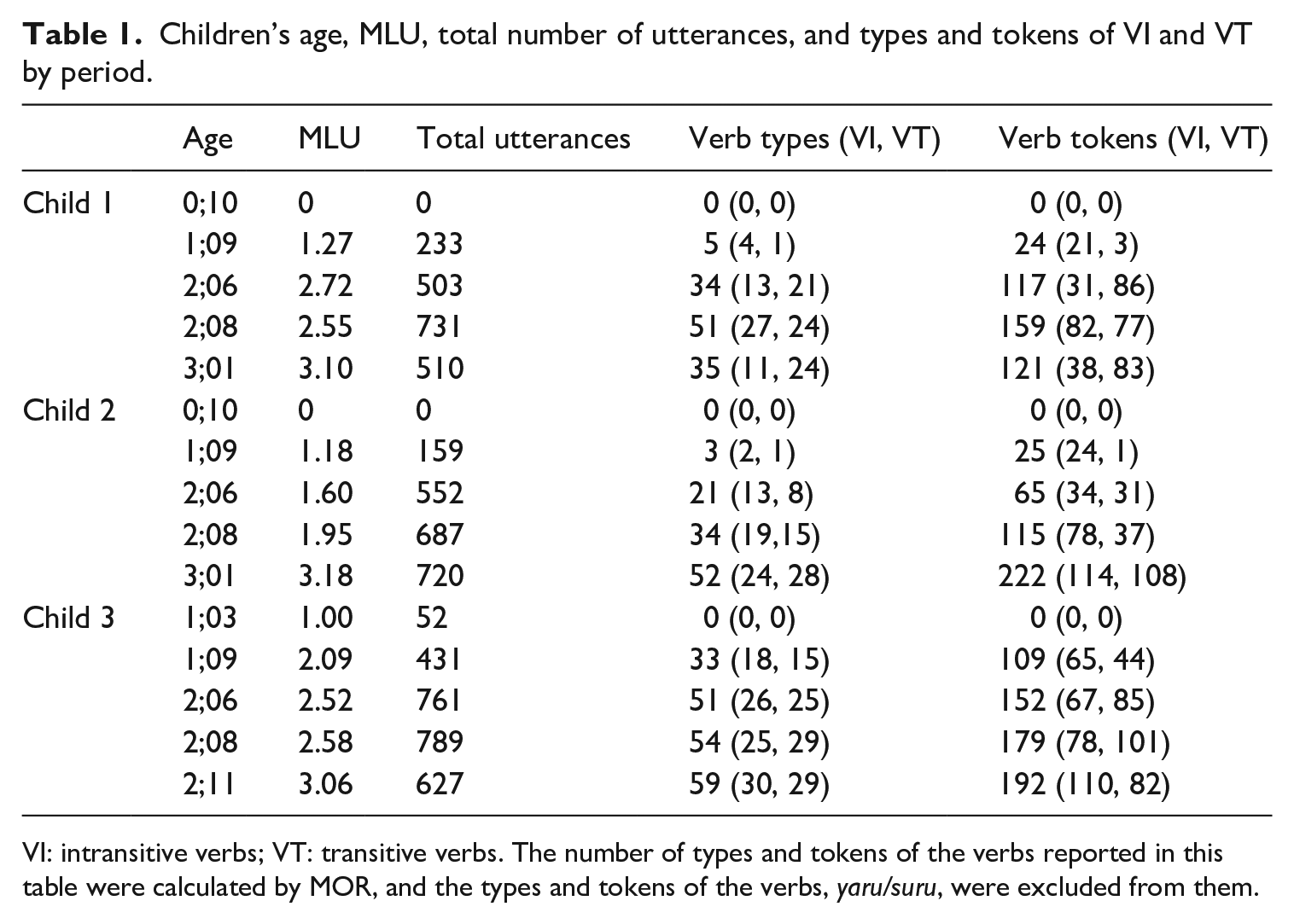
VI: intransitive verbs; VT: transitive verbs. The number of types and tokens of the verbs reported in this table were calculated by MOR, and the types and tokens of the verbs, yaru/suru, were excluded from them.
From Table 1, we can see that the rates of acquiring verbs differed among the children. The time period when Child 1 produced more than 30 verb types was at 2;06, while Child 2 was at 2;08, and Child 3 was at 1;09. More than 50 verb types were produced by Child 2 at only 3;01, while the other two children did so much earlier (Child 3 at 2;06 and Child 1 at 2;08). The MLU sizes appear to reflect their verb production; although all three children produced their first words after 1 year old and reached almost the same MLU around 3 years of age, Child 3’s MLU values were much higher than the other two children from the earliest stage. Child 1’s MLU caught up to Child 3’s by 2;06, and Child 2’s did so by 3;01. Child 3’s MLU at 2;11 was close to the other children’s MLUs at 3;01. From these results, we can see that Child 3 acquired verbs faster than Child 1, who did so faster than Child 2. While Child 3’s data at 3;01 were not available, her MLU at 2;11 was comparable to that of the other two children at 3;01, so in this study we compared the data on the use of VIs and VTs from Child 3 at 2;11 with those from Child 1 and Child 2 at 3;01.
In order to examine the children’s acquisition of VAS, the number of different VI and VT types used with overt arguments (lexical and pronominal combined) were counted for each syntactic role. Figure 1 presents the cumulative count of VI and VT types used with overt arguments in each syntactic role by each child from 1;09 to 3;01 (1;09 to 2;11 for Child 3).
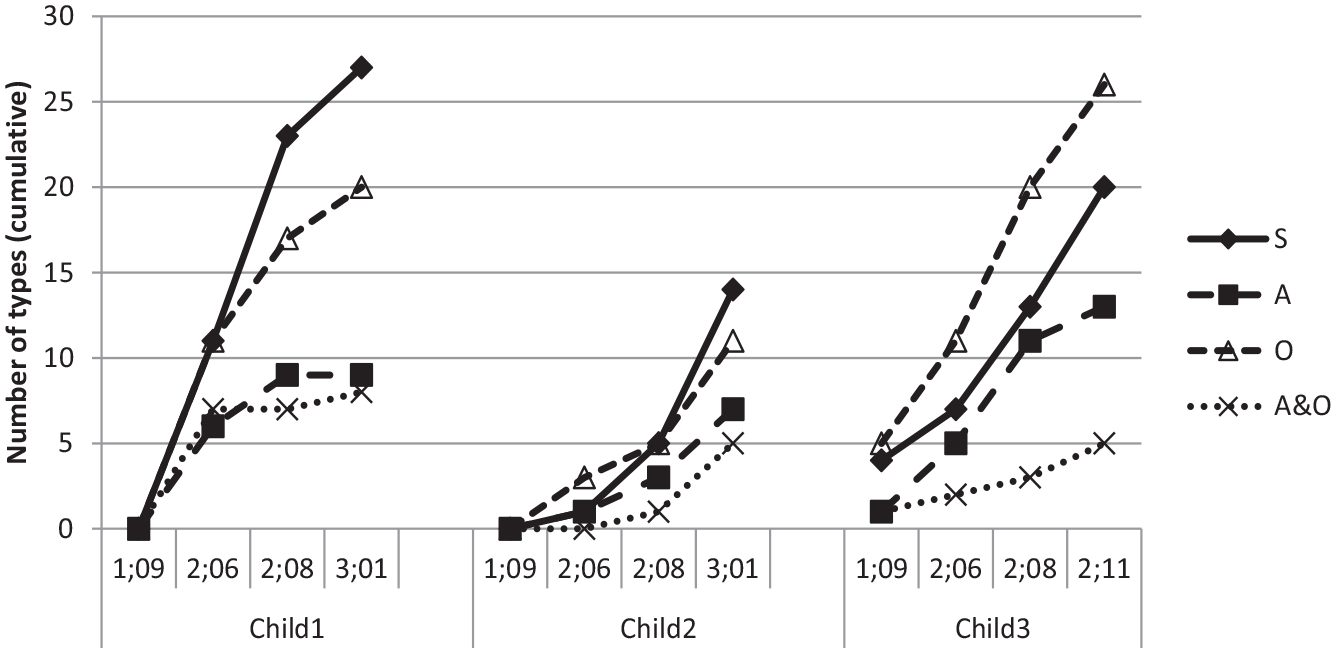
Cumulative Number of VI and VT Types Used with Overt (Lexical and Pronoun) Arguments by Each Child from 1;09 to 3;01 (to 2;11 for Child 3). S: Intransitive Verbs with Overt Subject, A: Transitive Verbs with Overt Subjects Only, O: Transitive Verbs with Overt Objects Only, and A and O: Transitive Verbs with Both Overt Subjects and Objects.
All of the children produced a larger number of VI types with overt subjects (S) and of VT types with overt objects (O) only, compared with the number of VT types with overt subjects (A) only and VT types with both overt subjects and objects (A and O). By 2;06, Child 1 produced 11 different VIs and 17 different VTs with overt arguments (A and O combined), and the cumulative number of verb types produced with overt arguments continued to increase rapidly until the end of the observation periods (3;01). By contrast, Child 2 used fewer overt arguments than Child 1 at 2;06, producing overt arguments with one VI and four different VTs (A and O roles combined). His production of overt arguments showed only a small increase at 2;08. However, by the age of 3;01, the cumulative verb types that Child 2 produced with overt arguments increased to 14 different VIs and 18 different VTs (A and O combined), approaching those of Child 1 at 2;08. Unlike the other children, Child 3 already produced a few overt arguments at 1;09. By 2;06, she produced 7 different VIs with overt arguments and 16 different VTs (A and O combined). Her use of verbs with overt arguments continued to increase afterward. The results show that only Child 3 was able to produce all sentence frames at 1;09, while the two other children produced only null arguments and no overt argument at this time period. Child 1 produced all sentence frames at 2;06, while Child 2 still did not use overt arguments in A and O simultaneously at this time period. Table 2 summarizes the cumulative numbers of VI and VT types used with overt arguments (including pronouns) by the end of the observation period, followed by the 10 most frequent verbs used with overt arguments in each child.
Total number of verb types used with overt (lexical/pronominal) arguments (cumulative) and 10 most frequent verbs.
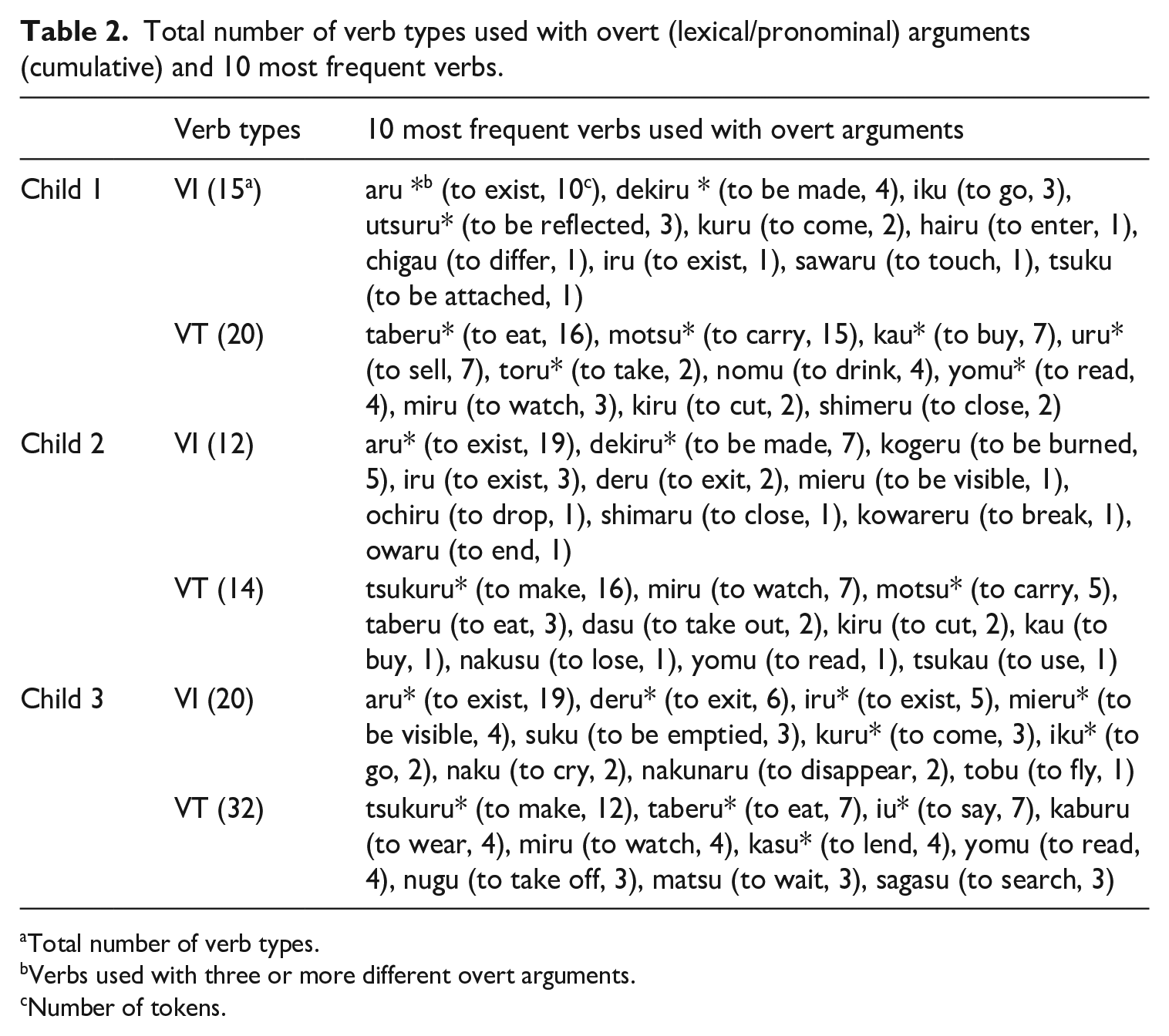
Total number of verb types.
Verbs used with three or more different overt arguments.
Number of tokens.
By the end of the observation periods, Child 1 produced 3 VIs and 6 VTs with 3 or more different overt arguments, Child 2 produced 2 VIs and 2 VTs, and Child 3 produced 6 VIs and 4 VTs, indicating that the children were able to use those verbs with overt arguments productively. By examining the verb development of the three children, it is clear that they did not acquire verbs at the same rate. Child 3 was the most advanced in verb production at the early stages, and Child 2 was the least advanced.
Mothers’ speech
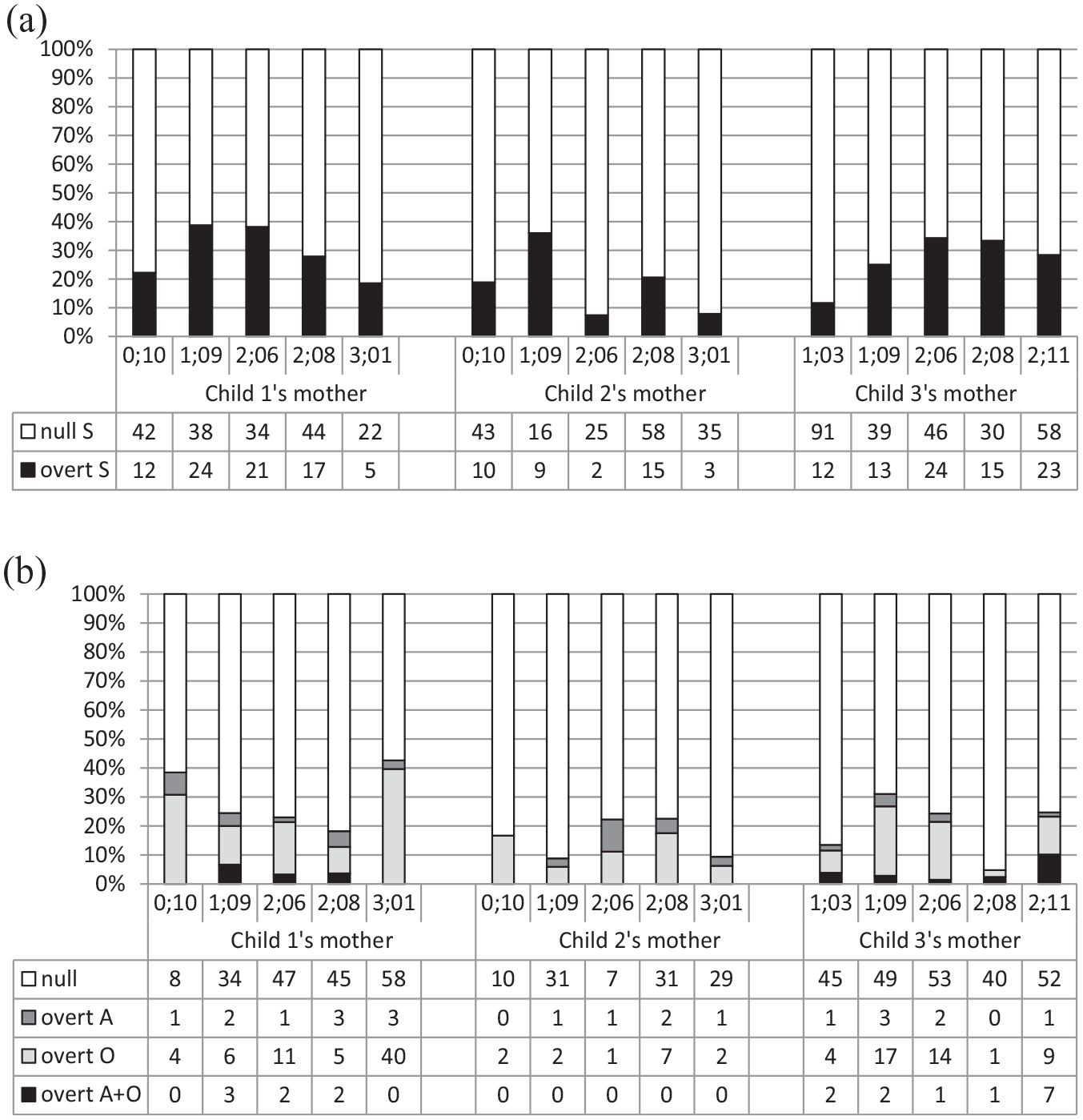
In order to examine whether mothers used varieties of sentence frames with null and overt arguments, we first analyzed their utterances containing VIs and VTs by the referential form of argument (null or overt) and syntactic role (S, A, O, A + O). Figure 2 shows the proportions of argument forms in each syntactic role used by verb type.
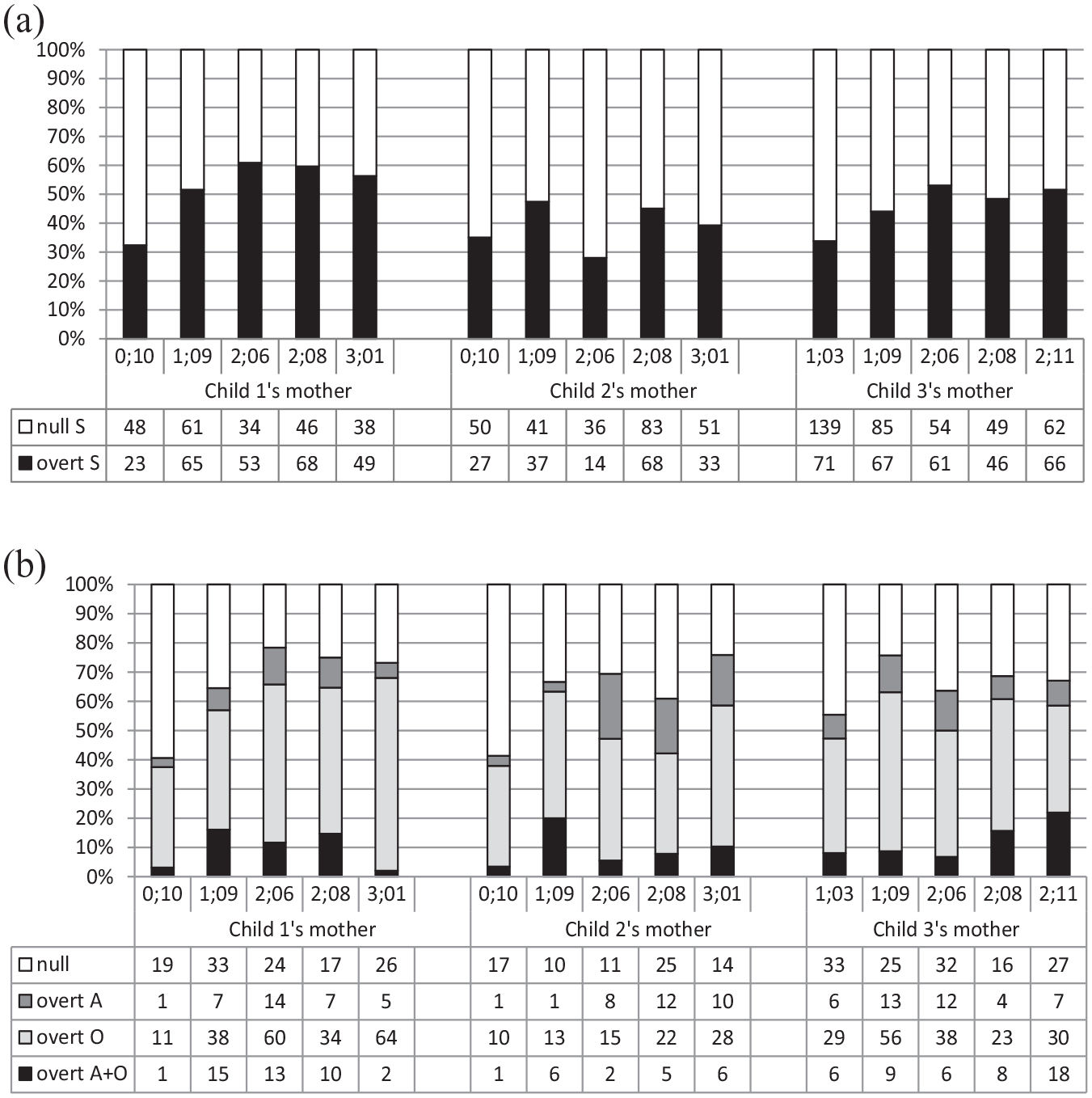
Proportions of Argument Forms (Null or Overt) Used with All Verbs by Each Mother from 0;10 to 3;01 (1;03 to 2;11 for Child 3’s Mother). The Numbers in the Tables Below the Graphs Indicate the Frequencies of Different Types of Argument Forms. Overt S: Overt Subjects in VIs, Null S: Null Subjects with VIs, Overt A: Overt Subjects-only with VTs, Overt O: Overt Objects-only with VTs, Overt A + O: Overt Subject and Object with VTs, and Null: Null Subject and Object with VTs. (a) Argument Forms Used with All VIs. (b) Argument Forms Used with All VTs.
All three mothers showed changes in their input patterns as their children grew older. Initially, mothers’ input contained higher proportions of null arguments in both VI and VT sentences (44.6%–67.6%). After the children started producing utterances at around 1;09, the mothers used null-arguments-only sentences less often (21.6%–60.7%) and used more overt arguments in all syntactic roles, except for Child 2’s mother, whose use of overt arguments in S decreased from 1;09 to 2;06.
The above figures also show that the transition patterns of overt argument use were not identical among three mothers. While Child 1’s mother showed a sharp increase in the use of overt arguments with both VIs and VTs in all syntactic roles from 0;10 to 2;06, Child 3’s mother did not show any sudden increase in overt arguments with VTs throughout the observation periods, except from 1;03 to 1;09. Child 2’s mother, however, showed a clear increase in overt arguments between 0;10 and 1;09 with both VIs and VTs. In S, her overt argument rates stayed between 35.1% and 47.4%, except at 2;06, when it went down to 28%. In A + O with VTs, she showed a small increase in overt arguments from 0;10 (3.5%) to 1;09 (20%), but it remained at 5.6%–10.4% after that. Comparing the actual numbers of overt argument use among the mothers, Child 2’s mother’s used fewer overt arguments than the other mothers in all syntactic roles. Furthermore, the mean rates of lexical arguments as opposed to pronominal arguments across syntactic roles (A, S, and O combined) showed that both Child 1’s mother and Child 3’s mother showed much higher rates of lexical arguments (Child 1’s mother: M = 84.6% with a range of 74.0%–90.4%; Child 3’s mother: M = 84.5% with a range of 72.1%–92.0%) than Child 2’s mother (M = 68.6% with a range of 58.6%–72.4%). These results indicate that Child 1’s and Child 3’s mother used more varieties of sentence frames with different types of overt arguments for VIs and VTs, compared with Child 2’s mother.
Next, the mothers’ use of morphologically related VI–VT pairs with overt arguments was analyzed for each syntactic role. Figure 3 shows the proportions of argument forms (null or overt) used with morphologically related VI–VT pairs by syntactic role.
Proportions of Argument Forms (Null or Overt) Used with Morphologically Related VI–VT Pairs by Each Mother from 0;10 to 3;01 (1;03 to 2;11 for Child 3’s Mother). (a) Argument Forms Used with VI–VT Pairs (VIs). (b) Argument Forms Used with VI–VT Pairs (VTs).
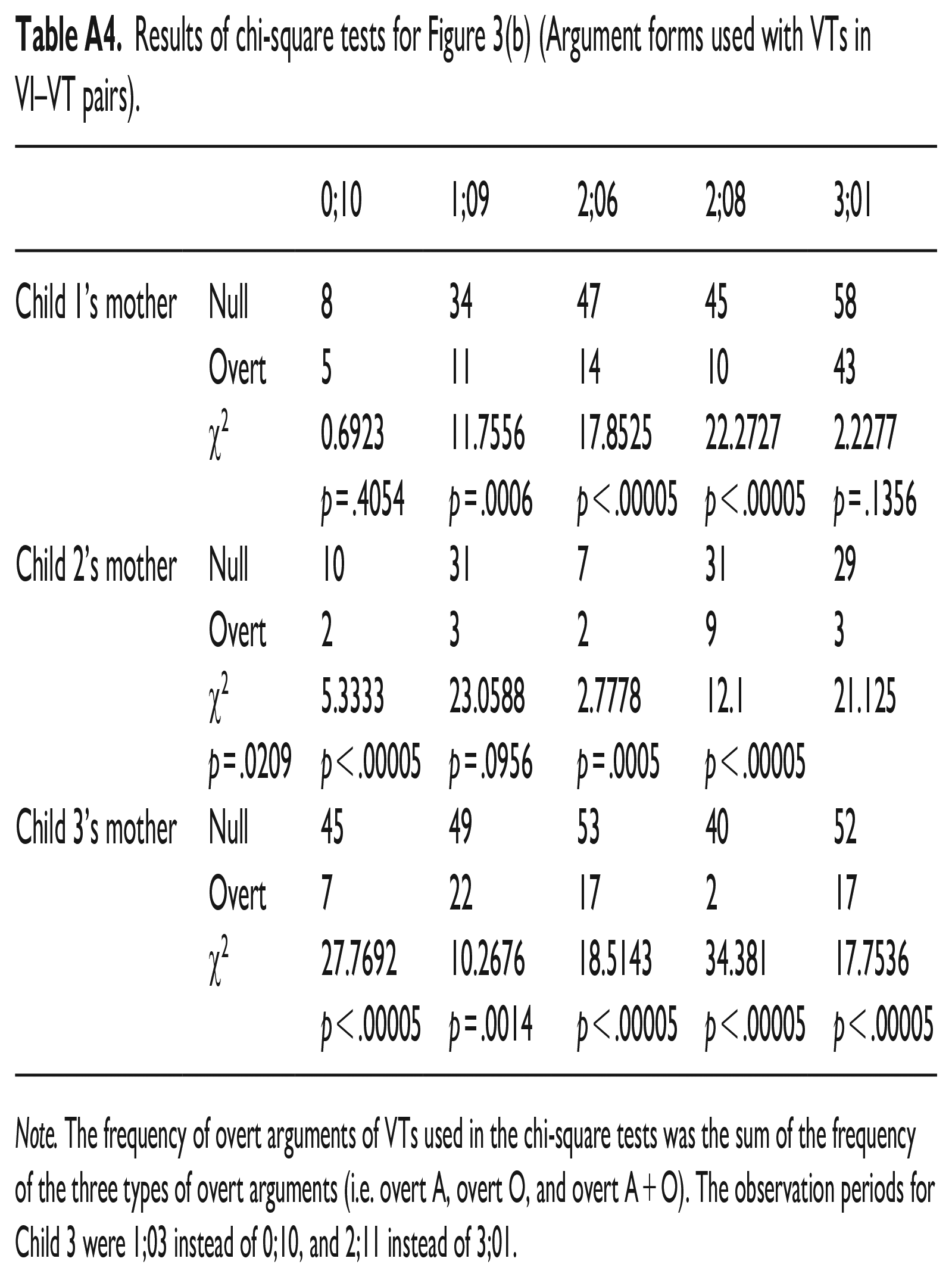
Chi-square tests conducted on the frequency of null and overt arguments in Figure 3 indicated that the frequencies of null and overt arguments with VI–VT pairs showed significant differences, p < .05, two-tailed (or marginally significant differences, p < .10, two-tailed), with the frequency of null arguments higher than that of overt arguments in most cases, except for Child 1’s mother’s VTs at 0;10 and 3;01, and Child 2’s mother’s VIs at 1;09 (see Tables 6 and 7 in Appendix 1 for the results of chi-square tests). Child 2’s mother used the least varieties of sentence frames. First of all, her null arguments rates were, on average, the highest among mothers for both VIs (81.9%) and VTs (85%). At 0;10 with VTs, she used overt arguments only in the O role. Although she produced overt arguments in the A role after 1;09, she never produced overt arguments simultaneously in the A and O roles. By contrast, both Child 1’s and Child 3’s mothers used more varieties of sentence frames than Child 2’s mother; their overt argument rates were higher in both VIs and VTs. Child 3’s mother used all types of sentence frames throughout the observation periods and Child 1’s mother used all types from 1;09 to 2;08.
We then examined mothers’ use of different verbs with overt arguments for each syntactic role (S, A, O) in order to compare it with the children’s use of verbs with overt arguments (lexical and pronominal combined). Figure 4 shows the cumulative count of verbs used with overt arguments.
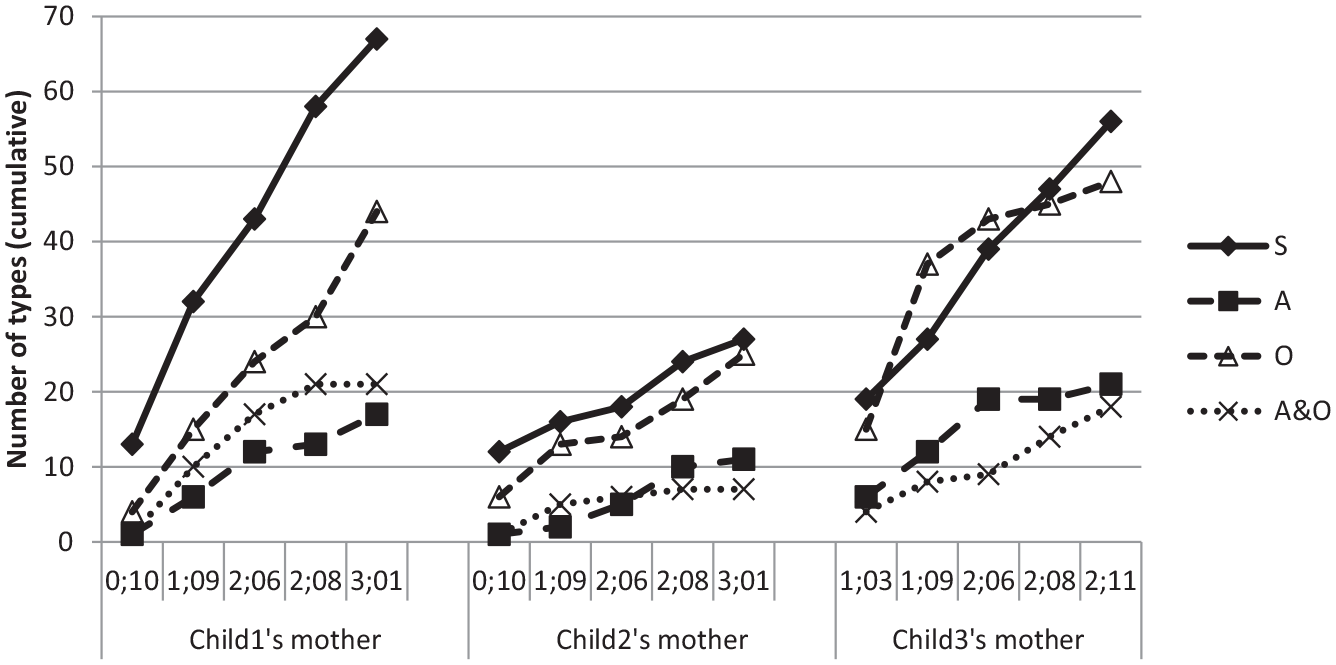
Cumulative Number of VI and VT Types Used with Overt (Lexical and Pronoun) Arguments by Each Mother from 0;10 to 3;01 (1;03 to 2;11 for Child 3’s Mother).
Similar to the developmental pattern of children’s use of overt arguments, all mothers tended to use the subject of VIs (S) and the object of VTs (O) overtly. The rate of realizing arguments as overt was higher for the mothers of Child 1 and Child 3, with the cumulative count rapidly increasing as the children aged. Their use of overt arguments showed a sharp increase after their children started talking (at 1;09). However, Child 2’s mother’s use of overt arguments did not increase as much as the other mothers. The cumulative count of different VI types with overt arguments in S at 3;01 was 67 and 56 for Child 1’s and Child 3’s mother, respectively, whereas it was 27 for Child 2’s mother. The cumulative count of different VT types with overt arguments (A-only, O-only, and both A and O together) was 55 and 62 for Child 1’s and Child 3’s mothers, respectively, but only 33 for Child 2’s mother.
From the above results, we found that Child 1’s mother produced the highest proportions of overt arguments among the three mothers, and Child 3’s mother provided more variety of frames with overt arguments compared with the other mothers. A close examination of the referential forms and information status of these overt arguments revealed that most of the overt arguments were lexical and that they referred to given information (i.e. referents that should have been identifiable from the discourse or context without being lexicalized). The average number of lexical forms in given arguments were 93.8 for Child 1’s mother, 60.2 for Child 2’s mother, and 91.6 for Child 3’s mother. When mothers talk about given information rather than new information, using lexical arguments for the subject of VI (S) and objects of VT (O), it is possible that children learn the meaning and argument structures of VIs and VTs more readily, because it is easier to process given information and they can direct more attention to the argument structures of the verbs.
In order to understand why and how the mothers used lexical arguments for given information, we performed a close analysis of how they produced lexical arguments for given referents, and identified different lexicalization patterns they employed in the interactions with their children. We classified these patterns into three strategies: Expansion (mothers add a verb to the previous noun-only utterance, expanding the noun into a sentence), Repetition (mothers repeat the previous utterance that contains a verb), and Nul-to-Lex (mothers add lexical noun[s] to a verb-only utterance, replacing null argument[s] with lexical argument[s]). Table 3 summarizes the frequency of the mothers’ lexicalization strategies used after the children’s and mothers’ own utterances by syntactic role (A, O, S) by period.
Frequency of mothers’ lexicalization strategies at each time period.
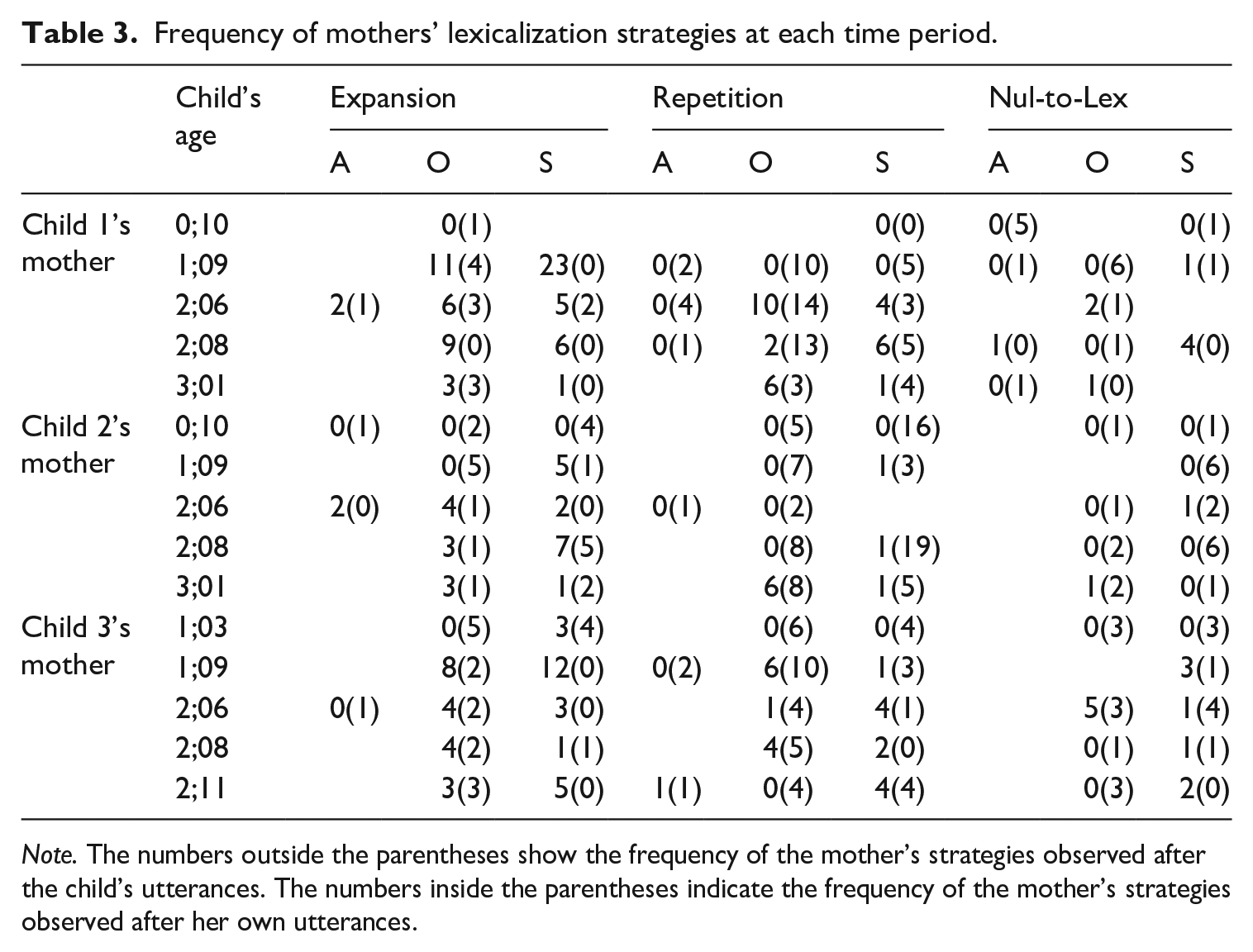
Note. The numbers outside the parentheses show the frequency of the mother’s strategies observed after the child’s utterances. The numbers inside the parentheses indicate the frequency of the mother’s strategies observed after her own utterances.
‘Expansion’ of the child’s or mother’s own lexical utterances was the most commonly used strategy for all three mothers. The mothers added verbs to the previously uttered nouns and turned them into arguments on the S and O roles, but not often on the A role. As can be seen in Table 3, mothers tended to employ Expansion of their children’s lexical utterances more often than Expansion of their own utterances. The time periods when Expansion was frequently used differed among the mothers. Child 1’s mother used the Expansion strategy most frequently at 1;09 (38 times), when the child started uttering words. The frequent use of this strategy decreased as the child became older. Child 2’s mother used Expansion at almost the same rate from 1;09 until 2;08, with the most frequent use at 2;08 (16 times). Child 3’s mother showed the most frequent use of Expansion at 1;09 (22 times) and it gradually decreased after that. The example (4) was taken from Child 1’s data; the mother and child were talking about the zoo they had previously visited. Although the child produced only one noun in each utterance, the mother supplied verbs with those nouns, expanding them into sentences with lexical arguments, which were given referents: 4) CHI. pe(ng)in. penguin [Penguins] MOT. pengin nani tabe-te(i)ta-:? penguin what eat-PST.PRG [What were penguins eating?] CHI. mamma. food [Food] MOT. mamma tabe-te(i)ta ne-:. food eat-PST.PRG SFP [(They) were eating food, weren’t (they)?] (Child 1 at 1;09)
Mothers often repeated verbs and the arguments produced by their children (‘Repetition’ strategy). This was commonly seen in Child 1’s and Child 3’s mothers but not as frequently in Child 2’s mother, who repeated her own utterances most of the time. In example (5), taken from Child 3’s data, the child produced a new lexical argument oimo, and the mother repeated the argument and the verb, turning it into a question: 5) CHI. oimo: tabe-nai. potato eat-NEG [(I) won’t eat potato] MOT. imo tabe-nai no? potato eat-NEG SFP [(You) won’t eat potato?] (Child 3 at 1;09)
In the exchange above, the mother’s response could have been perfectly acceptable if she had produced the verb with null arguments (∅ tabenai no? ‘eat-NEG SFP’ don’t you eat?). By repeating the full sentence, she lexicalized the given argument.
Although not very many instances of Nul-to-Lex strategy were observed, mothers also used this strategy to lexicalize given arguments. Example (6) is taken from Child 2’s data. In this example, mother and child were looking at a book which had a goldfish hiding on each page. Prompted by the mother, the child uttered one verb and pointed to the fish on the page. The mother produced the full sentence after repeating the verb the child uttered: 6) MOT. kingyo doko ni i-ta? goldfish where at exist-PST [Where is the goldfish?] CHI. i-ta. exist-PST [(It) exists] MOT. i-ta. exist-PST [(It) exists] MOT. kingyo koko ni i-ta. goldfish here at exist-PST [The goldfish is here] (Child 2 at 1;09)
As seen in these examples, mothers tended to follow up on their children’s one-word utterances by providing full sentences or repeating the overt arguments uttered by the children. This could be part of the reason why lexicalized given arguments in the mothers’ speech increased after the children started producing utterances. Comparing the three mothers’ results, it seems reasonable to conclude that mothers’ strategies to lexicalize given arguments play an important role in children’s acquisition of VAS in Japanese.
Discussion
The present study investigated whether Japanese mothers’ input provides the necessary morphosyntactic information for the acquisition of argument structures of VIs and VTs, by performing detailed analysis on the longitudinal data of the mothers’ production of different sentence frames of VIs and VTs with overt and null arguments, and comparing their input patterns and the children’s developmental patterns. One important finding is that all three mothers’ use of overt arguments increased around the time that the children started uttering words, namely, 1;09; they produced relatively high rates of overt arguments (44.1%–78.4%) between 1;09 and 3;01 (2;11 for Child 3’s mother). Furthermore, they frequently produced overt arguments in S and O roles, but not in A or A + O roles. Rispoli (1995) also reported that only 10% of the transitive sentences used by Japanese caregivers had two overt NPs (A + O) and only 1% of them were syntactically marked with case particles. He questioned how Japanese children acquire VI–VT distinctions with such a small amount of overt arguments in A + O role and case particles using syntactic bootstrapping. The mother–child pairs in the present study often omitted arguments in the A role when they referred to themselves, which was very clear from the context. Furthermore, the transitive verbs observed in mother–child dyads in the present study did not appear in bare forms; they were often conjugated with volitional or imperative forms (e.g. -[y]oo [Shall we~], -te (goran) [(You) do~]) as reported by Rispoli (1989). These verb endings may signal the missing subjects (A) of transitive verbs, even though the Japanese language does not have verb agreements, as mentioned earlier. When only one argument is overt in O, it will not be misanalysed as S with these verb endings, because, for example, akeru [to open] in X ake-yoo? ([Shall we] open X?) can never be interpreted as a VI, but only as a VT.
However, there were individual differences in the use of overt arguments among mothers: Child 3’s mother used a higher number of overt arguments from the early periods than Child 1’s mother, who in turn produced more overt arguments than Child 2’s mother. The question is whether such individual differences in the input were related to the children’s acquisition of VAS.
The results from the children’s data revealed that all the children produced more than 50 verb types as shown in Table 1, correctly used more than 10 different VIs and VTs with overt arguments by the last observation period (2;11 or 3;01), and produced some of these verbs with three or more different overt arguments, as observed in Table 2. This indicates that the children were able to productively use VIs and VTs with overt arguments at around 3 years of age, despite the fact that the input they received contained a high rate of verbs with null subjects and objects. The results also showed that the developmental rates and degree of flexibility in the use of VIs and VTs with overt arguments largely differed among the three children. Child 1 and Child 3, whose mothers used higher rates of overt arguments, produced more verb types with overt arguments earlier than Child 2. When the variety of sentence frames was examined, the mothers again showed individual differences. Child 3’s mother used all possible sentence frames (2a–f) with morphologically related verbs throughout the observation periods, while Child 1’s mother did so for three time periods out of five (i.e. 1;09, 2;06, 2;08). Child 2’s mother did not use the transitive frame with overt subject and object (2a) at any of the time periods. The children’s results resembled their mothers’ input pattern, and Child 3 started producing all varieties of sentence frames at 1;09, followed by Child 1 (at 2;06), and then Child 2 (at 2;08). Thus, the present results are consistent with the suggestion by Naigles et al. (2006) that the variety of sentence frames used in the input facilitates children’s acquisition of VAS.
It is possible that the direction of influence is from the child to the mother rather than from the mother to the child. For instance, Child 2’s mother may have used lower rates of variation sets with overt arguments than the other two mothers in order to adjust her utterances to the level of Child 2’s language development. In order to examine this possibility, we compared the cumulative number of VI and VT types with overt arguments used by the mothers at the time when the children’s language development level was comparable in terms of verb types and verb tokens (Child 1: 2;06; Child 2: 2;08; Child 3: 1;09) in Figure 4. This comparison found that the cumulative number of verbs with variation sets used by Child 2’s mother was fewer than those used by the two other mothers. Furthermore, as shown in Tables A1 and A2 in Appendix 1, the results of chi-square tests on the difference in VTs used with null and overt arguments in each mother revealed that Child 1’s and Child 3’s mothers showed significant differences in their use of VTs with more overt than null arguments (p < .05, two-tailed) at the 2;06 and 1;09 time periods respectively, whereas Child 2’s mother showed only a marginally significant difference between overt and null arguments (p < .10, two-tailed) at 2;08. The results for VIs indicate that Child 1’s mother showed a significant difference with more overt than null arguments (p < .05, two-tailed), whereas Child 2 and Child 3’s mothers showed no significant difference between the two. These comparisons seem to suggest the possibility that the use of fewer variation sets with overt arguments was Child 2 mother’s own style rather than an adjustment to the child’s language development.
Consider the following examples: 7) a. kuma-san dete-kita bear come-out-PST [bear came out] b. Mama ∅ dashita Mommy take-out-PST [Mommy took (it) out] c. ∅ omocha dashita toy take-out-PST [(someone) took a toy out] d. Mama omocha dashita Mommy toy take-out-PST [Mommy took a toy out]
One may argue that overt arguments in S with VIs (7a) and overt arguments in A-only with VTs (7b) may be indistinguishable for young children, even though they understand that both S and A are the subjects of verbs. However, if the same VTs are used with overt arguments in O (7c) or in both A and O (7d), failure to distinguish S and A can be avoided. We examined whether VTs with overt arguments in A-only were ever used with overt arguments in other syntactic roles (i.e. O-only or both A and O). We found that Child 1’s mother used 13 out of 17 verbs (76.5%) with overt arguments in other roles. For Child 2’s mother, 7 out of 12 verbs (58%), and for Child 3’s mother, 16 out of 22 (73%) verbs were used with other syntactic roles as well. This suggests that the majority of VTs used in the input are not likely to be misunderstood as VIs even though VTs are sometimes used with the subject argument (A) only.
All the mothers showed patterns of lexicalizing given arguments as their children started uttering words. The tendency to overuse lexical forms for given arguments may be due to the limited number of referential forms that are allowed in Japanese syntax (Guerriero et al., 2003, 2006). Unlike other languages, Japanese lacks subject–verb agreement, and pronouns and demonstratives generally do not contain number or gender features. In order to effectively communicate with their children, Japanese mothers need to supply lexical arguments to avoid ambiguity, ensuring that children understand what is being talked about in a natural context that contains several possible referents. The present finding that Child 1’s and Child 3’s mothers employed lexicalization strategies more often than Child 2’s mother suggests that high rates of lexical arguments in the variation sets used by mothers seem to help children acquire the argument structures of VI and VT.
Our analysis has shown that mothers employ strategies to lexicalize given arguments in interactions with their children, such as expanding the child’s one-word utterances into sentences. In Japanese, a situation can be described using either the VI or VT of morphologically related pairs. It is possible that children are initially not completely sure of the transitivity of the verbs upon hearing them. However, mothers frequently repeat single words that the children utter (often nouns) and provide longer sentences (often by adding verbs together with the children’s nouns as lexical arguments) in turn, as observed in Examples 4–6. In this way, the children are exposed to possible sentence frames of the verb, and may learn the correct verb transitivity through these interactions. The phenomenon of mothers following up on children’s utterances with lexical arguments appears to be connected to the variation sets discussed in Küntay and Slobin (1996), who argued that mothers’ repeated utterances containing verbs with and without null arguments in the same context help the child to reconstruct VAS. The present study suggests that children may be able to reconstruct VAS based not only on the variation sets for VIs and VTs in the input, but also on the mothers’ expansions of the children’s or their own lexical noun utterances by supplying verbs to make them into sentences with lexical arguments through the interaction. This further expands Küntay and Slobin’s argument.
There is a line of investigation on parents’ and children’s joint attention (Skarabela et al., 2013). These studies have shown that parents talked about objects and events that were already in the child’s attention (i.e. given information) using null arguments. The current study showed not only that Japanese mothers did so, but also that they employed lexical arguments frequently when the referents were in the child’s attention, making the referents of the arguments clearer. Such lexicalizations would help children understand the correspondence between the events that they are attending to and the argument structures of the verbs expressed in their mothers’ speech, clarifying ambiguous utterances like Example (1).
It should be noted that the present study was not designed to demonstrate a causal link between the mothers’ input and the children’s output, but rather to show that morphosyntactic information useful for children to acquire VI and VT argument structures is available in Japanese input. In particular, this study demonstrated that Japanese mothers begin using more overt arguments in a variety of sentence frames when children start uttering words, which is a critical point in their language development. We argue that the lexicalization of the subject of VIs and the object of VTs and the variety of sentence structures with overt and null arguments, together with the lexicalization strategies that utilize overt forms for given arguments, inform children of the argument structures of VIs and VTs in Japanese. In addition, we suggest that frequent use of morphologically related VI–VT pairs in the variety of sentence frames helps children to notice verb endings as important morphological cues for VI–VT distinctions. Future research should examine a larger scale of data to ensure that the present findings can be commonly observed in Japanese parents and their children. It is also important to investigate whether and how such morphosyntactic information interacts with children’s acquisition of the semantic information of verb morphemes implying planned actions (e.g. -yoo and -te) and the animacy of referents of arguments. Data from other null argument languages should also be examined to see whether the present results in Japanese can be generalized to other null argument languages with similar language-specific properties.
Footnotes
Appendix 1
Results of chi-square tests for Figure 3(b) (Argument forms used with VTs in VI–VT pairs).
| 0;10 | 1;09 | 2;06 | 2;08 | 3;01 | ||
|---|---|---|---|---|---|---|
| Child 1’s mother | Null | 8 | 34 | 47 | 45 | 58 |
| Overt | 5 | 11 | 14 | 10 | 43 | |
| χ2 | 0.6923 | 11.7556 | 17.8525 | 22.2727 | 2.2277 | |
| p = .4054 | p = .0006 | p < .00005 | p < .00005 | p = .1356 | ||
| Child 2’s mother | Null | 10 | 31 | 7 | 31 | 29 |
| Overt | 2 | 3 | 2 | 9 | 3 | |
| χ2 | 5.3333 | 23.0588 | 2.7778 | 12.1 | 21.125 | |
| p = .0209 | p < .00005 | p = .0956 | p = .0005 | p < .00005 | ||
| Child 3’s mother | Null | 45 | 49 | 53 | 40 | 52 |
| Overt | 7 | 22 | 17 | 2 | 17 | |
| χ2 | 27.7692 | 10.2676 | 18.5143 | 34.381 | 17.7536 | |
| p < .00005 | p = .0014 | p < .00005 | p < .00005 | p < .00005 |
Note. The frequency of overt arguments of VTs used in the chi-square tests was the sum of the frequency of the three types of overt arguments (i.e. overt A, overt O, and overt A + O). The observation periods for Child 3 were 1;03 instead of 0;10, and 2;11 instead of 3;01.
Acknowledgements
This research was supported by grants from the Japanese Society of Promotion of Science and the Social Sciences and Humanities Research of Canada. We thank the mothers and the children for their participation in this study, Sumiho Kawata, Reiko Itsubo, Natsumi Kinoshita, and Kayo Nakamura for their assistance in transcribing the data, and Keiko Ito, Hisako Noguchi, and Kanako Hirama for their assistance in coding. We also thank Simcha Samuel, Marie Lippeveld, Mary-Jane Blais, Michelle Ma, and Jodie Beck for their helpful comments and suggestions.
