




Abstract
The current study investigates narrative retelling and comprehension among 30 native Arabic-speaking preschool children with a mean age of 5:10. Narrative features of text-complexity (less-complex and more-complex episodic structure) and language variety (Spoken Palestinian Arabic [PA] and Modern Standard Arabic [MSA]) were analyzed for their effect on narrative retelling and comprehension. Four narratives accompanied by six pictures each (Gagarina et al., 2012) were used. Two were presented in MSA and two in PA, the children’s spoken vernacular. Two of them, one per each language variety, matched on episodic structure, were less complex, and two were more complex. Although children were free to choose which language to use for the retelling, they all used PA. Retelling performance was analyzed according to macrostructure, microstructure, and the use of Internal State Terms (ISTs). Comprehension was tested via questions addressing the character’s goals, ISTs, and Theory of Mind. With respect to text complexity, the results showed that the participants produced longer texts and demonstrated better comprehension when the narratives were more complex. Language variety was only associated with a difference in comprehension, with higher scores for the narratives presented in MSA. Older children produced longer texts and a higher number of ISTs. Finally, a three-way interaction emerged in the use of ISTs – while younger children produced more ISTs for the PA narratives, the older ones produced more of those for the MSA narratives. The study suggests that language variety and text complexity may exert different effects on narrative production and comprehension in Arabic-speaking preschool children.
Arabic-speaking preschool children grow up in a diglossic context in which they use Spoken Arabic (SpA) variety in everyday interaction but are often exposed to stories via storybook reading in Modern Standard Arabic (MSA), the only variety that has a conventional written form. This diglossic situation raises the question of whether the language variety of the narrative (SpA and MSA) would impact the ability of Arabic-speaking preschool children to understand and retell a story or would other narrative properties such as text-complexity play a more salient role. The present study examines the ability of Palestinian Arabic (PA)-speaking preschool children to retell and comprehend narratives within the diglossic context of Arabic by comparing stories presented in a spoken language variety, PA, versus in MSA. In addition to diglossia, features of text complexity were examined to address their roles in narrative microstructure, macrostructure, use of Internal State Terms (ISTs), and narrative comprehension.
Narrative retelling
Retelling a story requires a wide range of skills including the ability to produce complex sentences, morpho-syntax and vocabulary (namely, microstructure), the ability to construct a coherent story using story grammar components (namely, macrostructure), and the ability to produce ISTs that represent the protagonist’s perceptions and thoughts (Labov, 1972).
Microstructure and macrostructure
Microlevel measures of narrative ability often focus on the diversity and frequency of words, the total number of syntactic units, the length of sentences/utterances, and their syntactic complexity. In contrast, the macro-level of narrative analysis assesses the ability to organize narratives around story grammar elements. Macrostructure complexity is measured according to story grammar components and episodic build-up (Peterson & McCabe, 2013). In particular, macro-level analysis is concerned with the inclusion in the narrative of the following elements: a setting, initiating events, actions of the characters, consequences and internal responses, and goals of the characters in the story. The child’s ability to produce initiating events, goal statements, reactions, and attempts to reach goals demonstrates his or her awareness of intentionality and the goal-directed behavior of the narrative protagonist and other characters (Gagarina et al., 2012). It is noteworthy that microstructure and macrostructure are not completely independent of each other as microstructure elements, such as causal and temporal connectors (e.g. because) or ISTs (e.g. wanted, tried), are often used to mark story grammar elements (e.g. the goal). Indeed, research has demonstrated a significant correlation between microstructure and macrostructure narrative skills in children (e.g. Asli-Badarneh et al., 2022).
Internal state terms
An essential aspect of successful social interactions and communicating personal needs is understanding that what others do and say is fed by their internal mental states, such as their intentions, motives, thoughts, beliefs, and desires (Astington & Dack, 2008). Theory of mind (ToM) is a cognitive ability that imputes mental states to explain and predict behavior to oneself or others (Howlin et al., 1999). Various language abilities have been shown to influence ToM skills. Westby (2005) argues that the use of metalinguistic verbs (referring to acts of speaking, such as shout and say), metacognitive verbs (such as think and wonder), and words expressing emotion (e.g. sad and angry) indicate awareness of others’ states of mind. Durrleman et al. (2017) argue that mastery of complex sentences significantly influences ToM development by providing ways to reflect on people’s mental attitudes and beliefs.
A cohesive and coherent narrative requires awareness of others’ states of mind which may be represented by ISTs (Cain et al., 2004). An analysis of ISTs in children’s narratives may provide essential information about their ToM abilities, such as the narrator’s awareness of characters’ mental states, motivations, intentions, and goals (Westby, 2005). ISTs include motivational verbs (want, need), experiential expressions (surprised, thirsty), belief verbs (think), linguistic verbs, or verbs of saying and telling (say, shout), and emotional words (happy, angry) (Fusté-Herrmann et al., 2006). Research has shown that higher levels of narrative structure were associated with a higher frequency of use of ISTs (Astington & Dack, 2008).
Narrative comprehension
Comprehension of a text involves creating a mental model that is forming a meaning-based representation of the text. Text comprehension is a complex task that draws on many different cognitive and linguistic skills. To form a coherent representation of the meaning of a text, the listener or the reader has to recognize and parse words and phrases in the text, determine their meaning in the text, comprehend, remember and connect between word meanings and propositions in the text, and generate inferences by linking the different components of the text with his or her own general knowledge. This requires processing skills of lexicon, syntax, cognition, and knowledge about the text that are simultaneously accomplished through the text (Kintsch & Rawson, 2005). Knowledge about narrative genre and the way texts are structured also contributes to the ability to comprehend a text (e.g. Perfetti, 1994). Moreover, story understanding involves interpreting emotions, goals, and intentions of protagonists (Curenton & Justice, 2004).
Text complexity
Text complexity has been considered an aspect of microstructure (e.g. complex syntax, lexical density, frequency of verbs, temporal markers, and causal connectives) and also as a macrostructural aspect (e.g. story grammar, familiarity with characters, episodic complexity, narrative cohesion, and narrative styles; e.g. Amora et al., 2020). An example of differences between texts in a microstructural lexical component of complexity is pointed out in the Tagalog adaption for LITMUS-MAIN (Amora et al., 2020), explaining that fox and goats, which were used in one of the stories, are less familiar than dog, cat, and birds used in the other narratives.
In the same way, Hyvärinen (2010) and Lehtimäki et al. (2012), in their discussion of macrostructure-based differences in text complexity, argue that one aspect of text complexity involves deviation from the classical structure of a beginning, middle, and end by fragmented and distributed narratives. Ochs and Capps (2009) relate text complexity to the use of cohesive devices at the microlevel and the concept of narrative coherence at a global level. Petersen et al. (2008) relate to text complexity by presenting characters, setting, initiating events, internal responses, plans, action/attempts, complications, consequences, narrator evaluations, formulaic markers, temporal markers, and causal adverbial clauses as weighted in favor of episodic complexity and narrative cohesion. Similar arguments were discussed by Mitchell (2011) and Poulaki (2015) in their definition of complexity as using elements associated with the characters and the rules that dominate their behavior, motives, aims, plans, actions, and emotions.
Narrative skills in Arabic: the role of diglossia
A unique feature of Arabic is diglossia, a dual linguistic context into which all Arabic native-speaking children are born (Ferguson, 1959). In diglossic Arabic, the spoken or the colloquial variety is acquired naturally by native speakers as a ‘mother tongue’. It is the primary language variety used for the everyday speech by everyone everywhere for all informal functions (Albirini, 2016). SpA is also used at school in interactions between students and teachers outside of the classroom setting and inside the classroom for different functions (Amara, 1995). However, SpA does not have an official status (Albirini, 2016), and it does not have a standard uniform written form. Instead, MSA is the codified variety that is used for reading/writing and is the language variety of literacy and education (Albirini, 2016). MSA is acquired mainly, though not exclusively, via formal education and is used for conventional writing and formal speech (Ferguson, 1959). Albirini (2016) argues for the emergence of new patterns of language exposure and use that reflect recent changes in Arabic sociolinguistics and which might, in turn, affect diglossia in the Arabic context and its consequences for language and literacy acquisition. For instance, children today might be more able to comprehend and use MSA due to their informal exposure to MSA through children’s stories and children’s cartoons as well as other mass media programs for children that use MSA.
MSA and SpA differ in all linguistic domains including phonology, morphology, lexicon, and syntax (Saiegh-Haddad & Henkin-Roitfarb, 2014). This distance may take different forms in each one of the aforementioned domains. For example, according to Saiegh-Haddad and Spolsky (2014), the lexicon of PA-speaking children and MSA is widely divergent, and Arabic lexemes may be (a) identical words that have an identical phonological form in both PA and MSA (e.g. /na:m/ ‘sleep’, or /daftar/ ‘notebook’); (b) cognate words that are phonologically related yet show only partially overlapping phonological forms when used in each of the two varieties (e.g. PA /dahab /versus MSA /ðahab/ ‘gold’); or (c) unique words that have a unique form in MSA that is completely different from the one used in SpA (e.g. PA /juzda:n/ versus MSA /ħaqi:bah/ ‘bag’). Saiegh-Haddad and Spolsky (2014) report that 21.2% of the words in the 5-year-old PA-speaking child’s spoken lexicon are identical words, whereas the remaining words were approximately evenly divided between cognate and unique words.
Saiegh-Haddad and Haj (2018) showed that lexical–phonological distance between PA and MSA had a significant impact on the quality of phonological representations for words among preschool young children as well as older first, second, and even sixth graders. The phonological distance was also shown to impact phonological memory (Saiegh-Haddad & Ghawi-Dakwar, 2017) as well as other literacy-related skills including letter naming (Asaad & Eviatar, 2013), phonological awareness (e.g. Saiegh-Haddad, 2007), and word decoding (e.g. Saiegh-Hadadd & Schiff, 2016). The impact of lexical–phonological distance might also impact story comprehension and retelling especially when stories are presented in MSA.
The development of preschoolers’ narrative abilities within Arabic diglossia has only rarely been investigated. Henkin (1998) investigated oral narratives of Bedouin from south Israel and showed that when children (aged 8–11) were read stories to in MSA at school, they usually chose to retell these stories in the colloquial dialect. The same finding was observed by Ravid et al. (2014) who found that despite the fact that the story was presented to children in MSA, younger children retold the story primarily in the colloquial Palestinian dialect. In addition, they found that more concrete scenes were more easily reconstructed than the backgrounded content units relating to internal and abstract states.
The influence of diglossia on narrative abilities in Arabic-speaking kindergarten children aged 5:3 to 5:8 years was further examined by Leikin et al. (2014), testing performance in retelling and comprehension of stories told in MSA versus other stories told in SpA. The results for narrative comprehension demonstrated an advantage for the text presented in SpA. In addition, children were significantly less fluent, produced shorter clauses, and made more morphosyntactic errors when they retold a narrative that was told in MSA. In contrast, macrostructure showed no difference between the two varieties.
A recent study investigated narrative production in Arabic diglossia among Arabic-speaking new immigrants in Canada between the ages of 9 and 12 (Asli-Badarneh et al., 2022) using a fine-tuned diglossia-specific rubric for classifying the words used in the narratives. The study revealed that the dominant lexicon that the participants used in the narratives was derived from the children’s SpA vernaculars. Nonetheless, a clear pattern was observed according to which children were aimed at producing the narrative in MSA rather than in SpA as reflected in the use of cognate words in their MSA form and unique MSA words instead of cognates in their SpA form or unique SpA words. This might be related to the fact that the instructions were given in MSA and the narratives were elicited at school. Moreover, the results showed that the frequency of use of MSA words (cognate and unique MSA words), but not their SpA equivalent forms, predicted unique variance in macrostructure, beyond Arabic language proficiency and narrative length.
The present study investigates narrative skills in Arabic diglossia among native monolingual speakers of PA in Israel by comparing story retelling and story comprehension in PA and MSA. The study addresses the role of text complexity and language-variety (PA and MSA) in narrative retelling, with a focus on the use of microstructure, macrostructure, and ISTs in narrative comprehension. We predicted performance in narrative comprehension and production to be higher in narratives presented in PA than in MSA and to be higher for less-complex than for more-complex narratives.
Method
Participants
Thirty monolingual Arabic-speaking preschool children aged 5:4 to 6:7 (M = 5;10, SD = 0.4) participated in this study. All children were monolingual speakers of a dialect of PA used in the north of Israel. Based on general patterns of language exposure, the participants, like other Arabic native-speaking children, are exposed to MSA mainly by watching TV and from storybook reading at home and school (Saiegh-Haddad, 2022). All children attended public preschools in the north of Israel where the language of instruction is only Arabic. All participants came from mid-high socioeconomic status families and none had hearing, health, behavioral, or developmental problems. Parental consent was obtained, and the study was approved by Bar-Ilan University Humanities Review Board and the Israeli Ministry of Education.
In order to confirm that all participants had typical language development, all children were screened with Arabic Language: Evaluation of Function (ALEF; Kornilov et al., 2016). Six ALEF tasks were used: word articulation, expressive vocabulary, nonword repetition, nonword discrimination, sentence completion, and sentence imitation task. Rapid naming using RAN for colors and Forward Digit Span was also used for screening. Children who performed below the ALEF norms were excluded.
Material
Four narratives from the Multilingual Assessment Instrument for Narratives (LITMUS-MAIN) (Gagarina et al., 2012) were adapted for the current study to MSA and PA (two in each variety) and were followed by comprehension questions as in the LITMUS-MAIN protocol. The narratives were ‘Baby Birds’, ‘Baby Goats’, ‘The Boy and the Cat’, and ‘The Boy and the Dog’. These narratives are suitable for use with the age group targeted in the current research (Gagarina et al., 2012) and have been used in the current study to evaluate both narrative comprehension and retelling. Each story begins with a setting component that describes time and place and introduces the characters. This component is followed by three episodes. Each episode consists of the protagonist’s goal, an attempt by the protagonist to reach his or her goal, the outcome of that attempt, and internal states initiating the goal and expressing reactions. Each story is presented along with six pictures, each two consecutive pictures depicting an episode.
The children were asked to listen to each story and retell it without specific demands on how to retell it and what language variety to choose. However, all children chose to retell the narratives in PA, regardless of the presented language variety.
Text complexity
Measures of text complexity in the present study focus on the complexity of the stimuli. LITMUS-MAIN was designed to provide parallel sets of picture stimuli with different fictional characters and events to tell or retell stories that consist of comparable complexity and plotline in addition to identical global story structure and episode structure (Gagarina et al., 2012). However, Gagarina et al. (2012) point to a slight script difference in complexity between the designed narratives (p. 24), and they also refer to complexity differences concerning the direct quotations used in ‘Baby Birds’ and ‘Baby Goats’ which were very different pragmatically from the direct quotes in ‘The Boy and the Cat’ and ‘The Boy and the Dog’. ‘Baby Birds’ and ‘Baby Goats’ use directives/orders, whereas ‘The Boy and the Cat’ and ‘The Boy and the Dog’ use exclamations/declarations of frustration/affect: ‘Get away from the baby birds’; ‘Let go of the baby goat’; ‘Oh no! There goes my ball!’; ‘Oh no! There goes my balloon!’ (p. 49).
In addition to the abovementioned differences in complexity, we noted that while the four stories contained two sets of narratives matched on episodic structure and text complexity, ‘Baby Birds’ and ‘Baby Goats’ use a less-complex structure (see explanation below) whereas ‘The Boy and the Cat’ and ‘The Boy and the Dog’ were more complex. The rationale based on which ‘The Boy and the Cat’ and ‘The Boy and the Dog’ narratives were deemed more-complex includes the following reasons:
Story structure: The events in the narratives of ‘Baby Birds’ and ‘Baby Goats’ are chronologically ordered and the events are all presented in the pictures. By contrast, in ‘The Boy and the Cat’ and ‘The Boy and the Dog’, the last two pictures depict two simultaneously occurring and parallel events each, so the storyteller needs to describe two goals, two attempts, and two outcomes in parallel instead of just one each.
Endings: The ending in ‘Baby Birds’ and ‘Baby Goats’ provides closure as the family that has been attacked is happy at the end. By contrast, in ‘The Boy and the Cat’ and ‘The Boy and the Dog’, the ending is left open with some dissonance: While both characters are happy, the boy in both stories has not discovered yet what the dog/cat had done. The boy’s feelings toward them are likely to be paradoxical, since they took his fish/meat.
Emotions: ‘The boy and the Cat’ and ‘The Boy and the Dog’ narratives involve several more varied emotions than the ‘Baby Birds’ and ‘Baby Goats’ (e.g. anger and sadness).
ISTs: The narrative scripts differed in the variability of ISTs. Each narrative script included between 14 and 16 ISTs. However, ‘The Boy and the Cat’ and ‘The Boy and the Dog’ narratives included an additional type (consciousness ISTs).
Episodic complexity: In the narratives of ‘Baby Birds’ and ‘Baby Goats’, each character has a specific goal, while in the narratives of ‘The Boy and the Cat’ and ‘The Boy and the Dog’, the dog and the cat had two goals each (for the dog, to catch the mouse and to eat the meat; for the cat, to catch the butterfly and to eat the fish). This makes the latter two narratives far more complex than the first two. In addition, in the narratives of ‘Baby Birds’ and ‘Baby Goats’, two of the characters (mother bird, and the dog) share the same goal, which is the safety of the baby birds, while in ‘Boy and the Dog’ and ‘Boy and the Cat’, each character pursues a different goal which makes them more complex.
Language variety
Within each text complexity level, one story was presented in MSA and the other in PA: ‘Baby Birds’ in MSA and ‘Baby Goats’ in PA, whereas ‘The Boy and the Cat’ in MSA and ‘The Boy and the Dog’ in PA. In the MSA adaptation of the narrative, 37% of the content words were ‘unique’ to MSA, 34 % were ‘cognate’ words, and 29% were ‘identical’ words in PA and MSA, reflecting an approximately similar distribution of the various lexical categories in the lexicon of children (Saiegh-Haddad & Spolsky, 2014). In addition, where possible, MSA case and mood inflections were reduced, as is common when using MSA in speech, with the result that 27.5% of all tokens in the two MSA narratives were not inflected for case/mood. In terms of length, the scripts contained 121 word tokens for ‘Baby Birds’ (the less-complex MSA narrative); 142 tokens for ‘Baby Goat’ (the less-complex PA narrative); 126 tokens for ‘The Boy and the Cat’ (the more-complex MSA narrative); and 124 tokens for ‘The Boy and the Dog’ (the more-complex PA narrative).
Procedure
Data collection was done during the COVID-19 pandemic when preschools were closed. Children were interviewed at their homes where they heard the four stories in four different sessions over 8 weeks, with 2-week intervals between the sessions. The six pictures displaying each narrative were presented as prerecorded PowerPoint presentations. All children were unfamiliar with the stories. The children heard the prerecorded story as the pictures unfolded following the protocol suggested by Hamdani et al. (2021). Then, the child was asked to retell the story while looking at the PowerPoint presentation and being able to move between the slides, while each time he or she moved a slide, the child could still see the previous pictures (see Figure 1 for an example of a slide taken from the ‘Baby Birds’ narrative).
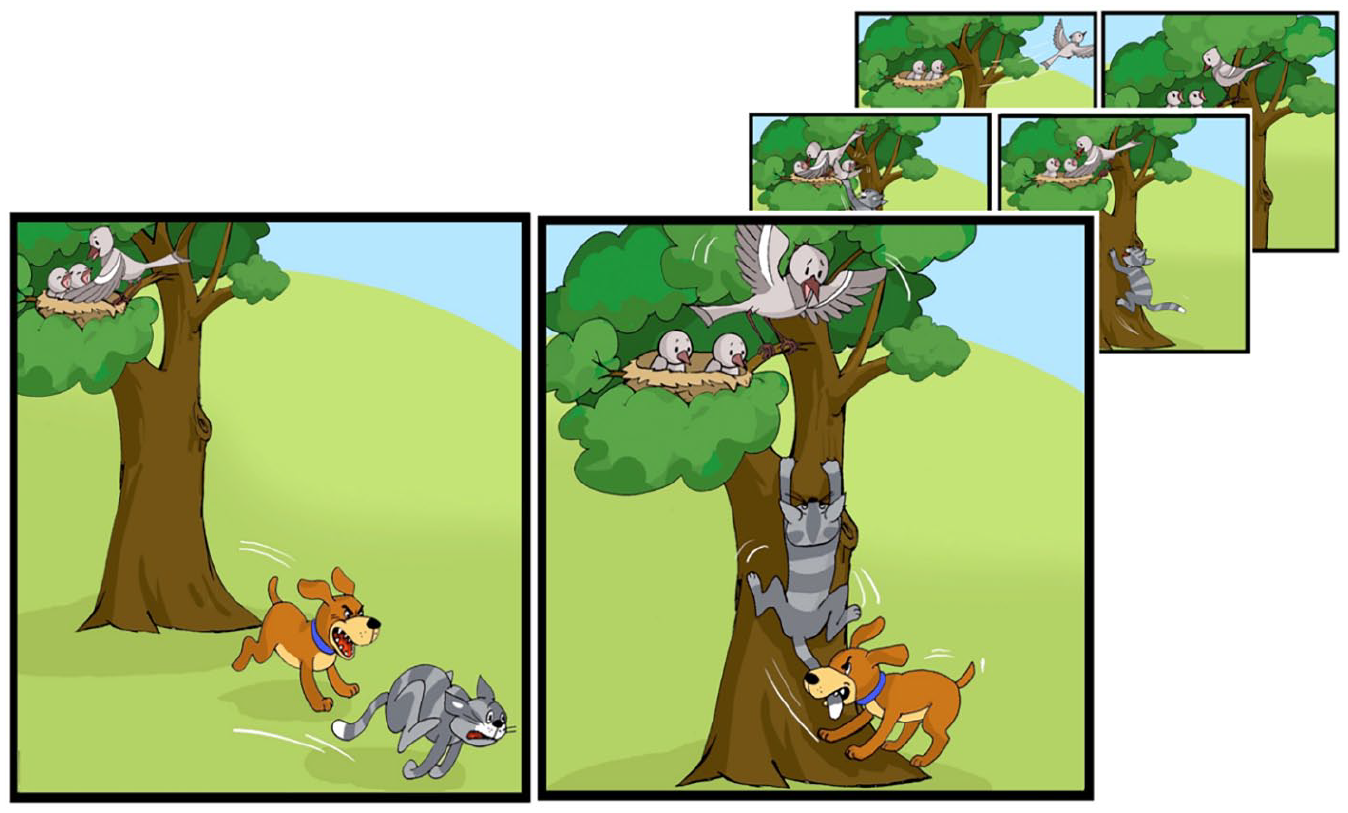
The ninth slide in ‘Baby Birds’ narrative.
After the retelling, he or she was asked 10 questions of which three questions tapped the protagonist’s goals, six questions elicited ISTs, and one question elicited ToM, following the LITMUS-MAIN protocol (Gagarina et al., 2012). We chose to conduct the retelling task first and then the comprehension questions based on earlier findings showing that narratives elicited after questions were more coherent than those produced before the questions, whereas narrative order did not influence the accuracy of responses to questions (Silva & Cain, 2019).
The LITMUS-MAIN was selected as it enables testing the two language varieties of Arabic-speaking children (PA and MSA) with a parallel tool. As expected in a diglossic situation, our participants are dominant in PA, their ‘mother tongue’, and have a more passive command of MSA. Therefore, all interviews were conducted in PA to make sure that participants understood the task. The instructions and the comprehension questions were presented in PA. The experimenter encouraged the child to remain on task and did not interfere in any way that could influence the language variety chosen by the child, the story content, or the structure. The children were free to generate their stories in whichever language variety they chose. The interviewer prompted the participant as follows: ‘/raħ nesmaç ʔussa w nʃuf suwar, baçden raħ ʔatlub minnak teħkiha, w bel ʔaxer raħ ʔasʔalak ʔasʔele çan l ʔussa/’, ‘we will hear a story while watching the pictures depicting the story, afterwards I am going to ask you to retell the story, and then I will ask you questions about the story’. This protocol diverges from Gagarina et al. (2012), as instructions are provided in the dominant language only but might be useful for using LITMUS-MAIN in other contexts of passive bilingualism.
All participants retold their narratives in PA. The participants were audio-recorded while telling their stories. The interviewer (the first author), a native speaker of PA and a certified speech clinician, did not provide verbal feedback that could influence the content of the narrated stories, offering only supportive neutral comments such as ‘uh huh’ or a simple gesture like a nod of the head.
Coding and analyses
Narratives were transcribed phonemically using Arabic orthography. Coding addressed repetitions and self-corrections. Utterances were divided into syntactic units. A syntactic unit was defined according to Berman and Slobin (1994) as a ‘unit containing a unified predicate, whether in the form of a verb or adjective’ (p. 26). Narrative retelling was coded and analyzed for macrostructure, microstructure, and ISTs. Narrative comprehension was measured using the LITMUS-MAIN protocol which uses 10 questions per story. As chronological age might impact children’s knowledge of MSA, especially in the transition from kindergarten to school, it was used as a covariate in all analyses to control such effect.
Macrostructure
The macrostructure analysis applied in LITMUS-MAIN describes stories as reflecting the goal-directed behavior of a protagonist who is motivated to carry out some action with the intention of attaining a goal. Each story included a setting presenting time and place reference, and three episodes each consisting of: (a) ISTs as an initiating event, (b) a protagonist goal statement, (c) an attempt to reach the goal, (d) an outcome of the attempt, and (e) ISTs as reaction to the outcome. The present study coded macrostructure in terms of the proportion of goals, attempts, and outcomes produced in the total story retelling (out of a maximum of nine). This coding method was presented by the MAIN manual to make the scoring task transparent and avoid the need for interrater reliability.
Microstructure
Three measures of microstructures were coded manually and used for the current study as follows:
Narrative length
The length of each retold narrative was measured by the number of word tokens. A word was defined as an orthographic word containing grammatical morphemes concatenated to content words used including plural suffix /at/, determiner /el/, negative suffix /ʃ/, conjunctions /w/ and /fa/, concatenated prepositions /be/ ‘in’ and /le/ ‘to’, and suffix enclitic pronouns.
Lexical diversity
Lexical diversity in the present study was measured both as a type token ratio (TTR) and as a moving average TTR (MATTR). MATTR calculates the lexical diversity of a sample of the text using a moving window that estimates TTRs for each successive window of fixed length. Initially, a window of 10 words in length is selected and the TTR for Words 1 to 10 is estimated. Then, the TTR is estimated for Words 2 to 11, then 3–12, and so on to the end of each text. For the final score, the estimated TTRs are averaged. Mean length of utterance (MLU) was calculated as the total number of tokens divided by the total number of syntactic units.
Internal state terms
All ISTs were counted for frequency of use in the retelling (total number of ISTs as word tokens) and diversity (each of perceptual, physiological, consciousness, emotion, mental, and linguistic state terms out of the total number of word tokens). ISTs included the following types: Perceptual (e.g. see and hear), Physiological (e.g. thirsty and hungry), Consciousness (e.g. alive and awake), Emotion (e.g. sad, happy, and worried), Mental (e.g. think, forget, and decide), and Linguistic verbs of saying and telling (e.g. say and shout).
Comprehension
Comprehension was measured by means of orally presented questions that align with the LITMUS-MAIN protocol which uses ten questions per each story: Three questions target the three main goals of the protagonist, for example ‘Why does the mother bird fly away?’ Six additional questions elicit ISTs connected either to the initiating event or to the reaction elements, e.g. ‘How does the fox feel?’ These questions assess reasoning, that is the child’s ability to interpret physical and emotional cause–effect relationships and recognize characters’ goals, the reasons for these goals, and reactions following attempts to reach the goals (Hedberg & Westby, 1993). Finally, one question elicits TOM/inferencing, for example ‘Who does the mother goat like best, the fox or the bird? Why?’. The aim is to see if the child can attribute mental states to explain behavior or feeling to the character or infer meaning about the story as a whole. Correct answers to the 10 comprehension questions received one point each, with a maximum comprehension score of 10 points per story.
Reliability
All 120 narratives were coded by the first author. In addition, an adult native speaker of Arabic, a university student, scored the data for 20% of the narratives (four narratives by six different participants). Intraclass correlation coefficients (ICC) were calculated on two sets of scores with six observations in each set. The results showed that for all the variables the ICC was above .75 indicating satisfactory interrater reliability (Koo & Li, 2016).
Statistical analysis
The background and study measures were described by counts and frequencies for categorical and ordinal data and by means, standard deviations, medians, and interquartile ranges for numerical discrete and continuous variables. With regard to inferential statistics and significance tests, since the study sample was small and the dependent variables were characterized by abnormal distributions, a nonparametric distribution-free approach was taken using the nparLD package for R software that performs nonparametric analysis of longitudinal data in factorial experiments (Noguchi et al., 2012). The data were analyzed as a within-within design where narrative complexity (less-complex/ more-complex) and language variety (PA/MSA) served as within-subject variables. Also, since age was associated with some of the dependent variables, the participants’ age was divided into tertiles (percentiles 0%–33%; 33%–66%, and 66%–100%) and was included in the analysis as a between-group controlling variable. Therefore, each analysis tested three main effects (narrative complexity, language type, and age), three simple interaction effects, and a single triple interaction effect. The design is termed F1-LD-F2 in the package mentioned above. Descriptive analysis was carried out using SPSS software V28; inferential analysis was carried out using R software V4.0.2. Results yielding a p-value ⩽ .05 were considered statistically significant.
Results
The impact of text complexity and language variety on retelling, macrostructure, microstructure, IST use, and comprehension, is reported below. Descriptive statistics comparing performance on the four narratives are followed by nonparametric significance tests as reported above. All children chose to use only PA for the retelling of all narratives, including those presented in MSA.
Macrostructure
The proportions of Goal, Attempt, and Outcome (GAO) components out of nine components (three per episode) are presented in Table 1 for each of the narratives.
Descriptive statistics of the macrostructure measure of goals, attempts, and outcomes (GAO) by text-complexity and language-variety.
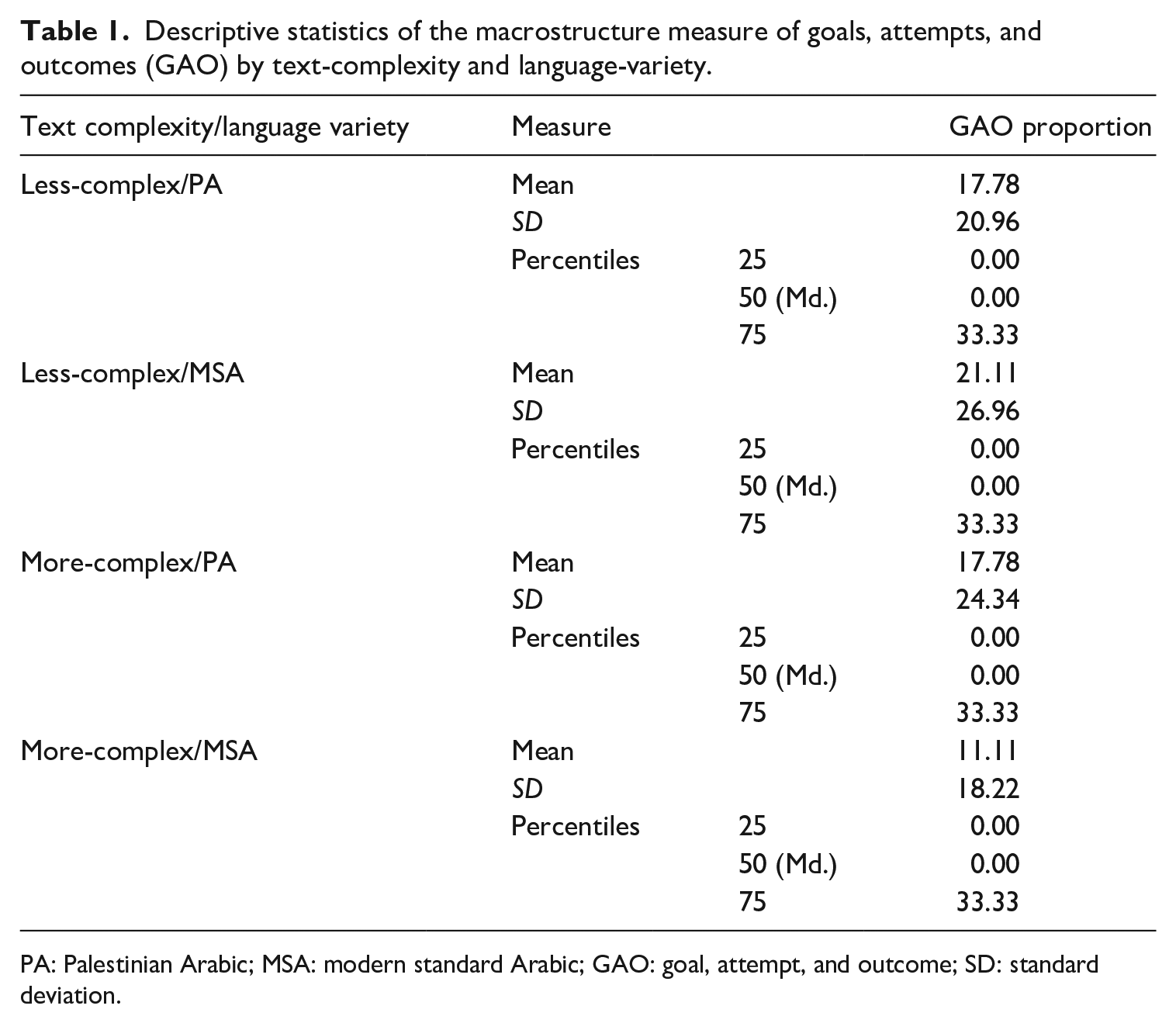
PA: Palestinian Arabic; MSA: modern standard Arabic; GAO: goal, attempt, and outcome; SD: standard deviation.
Descriptive results indicate that the participants were hardly producing any macrostructure of goals, attempts, and outcomes. The inferential analysis revealed no significant effects for the difference between the four narratives.
Microstructure
Table 2 presents descriptive statistics of the four retold narratives in length, lexical diversity (measured as TTR and MATTR), and MLU.
Descriptive statistics of the microstructure measures by text complexity and language variety.
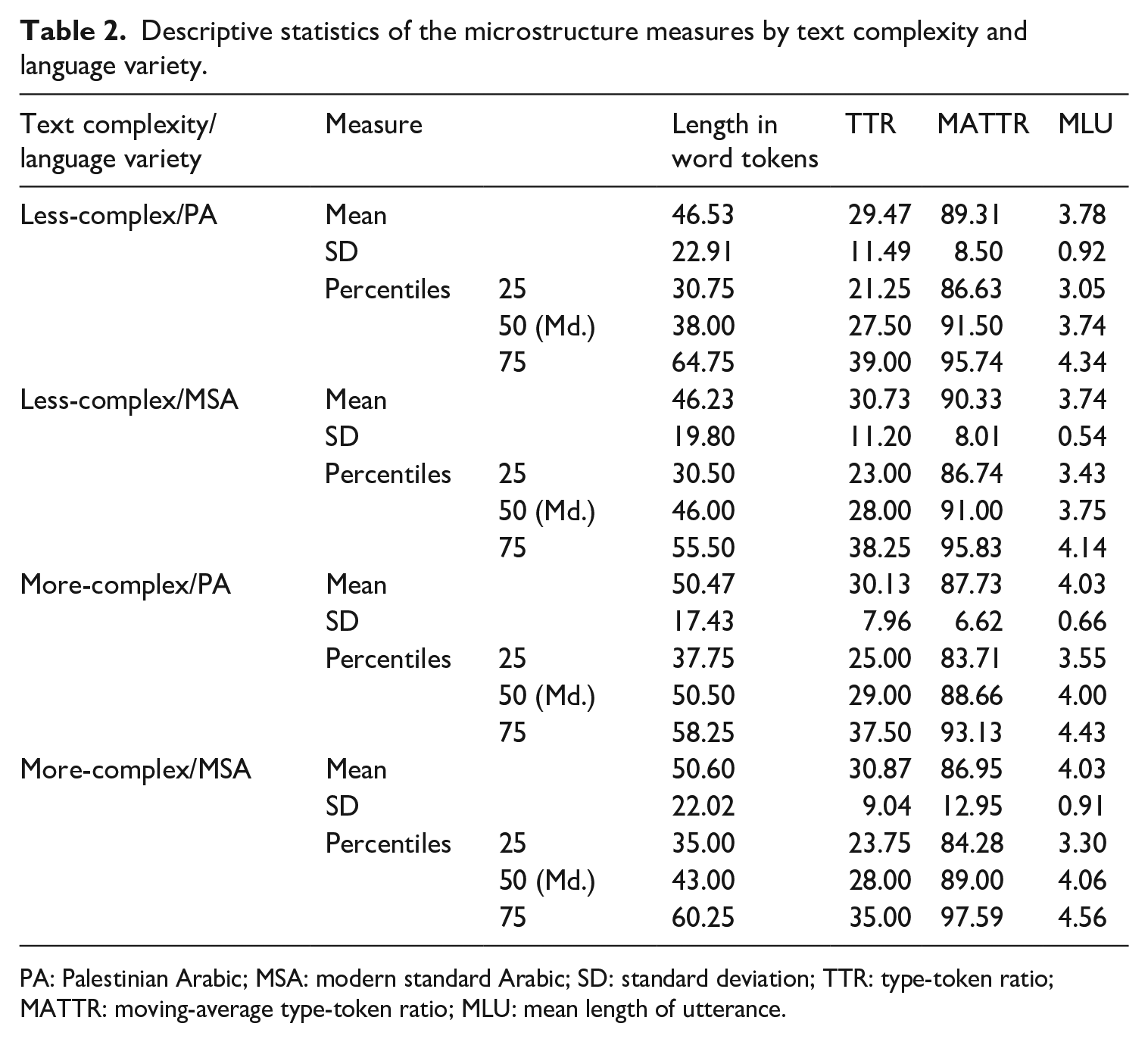
PA: Palestinian Arabic; MSA: modern standard Arabic; SD: standard deviation; TTR: type-token ratio; MATTR: moving-average type-token ratio; MLU: mean length of utterance.
The inferential analysis of the microstructure indices showed that with regard to length in word tokens, a main effect for age was found, Wald(2) = 6.74; p = .03, indicating that older participants produced longer narratives compared to younger participants. In addition, the main effect for text complexity was found, Wald(1) = 6.54; p = .01, indicating that participants produced longer narratives for more-complex narratives compared to less-complex narratives. All other effects for microstructure measures were not significant.
Internal state terms
Table 3 presents descriptive statistics of ISTs out of the total number of word tokens in percentage in each narrative. The inferential analyses of ISTs (Table 4) revealed the following effects.
Descriptive statistics of ISTs measures by text-complexity and language-variety.
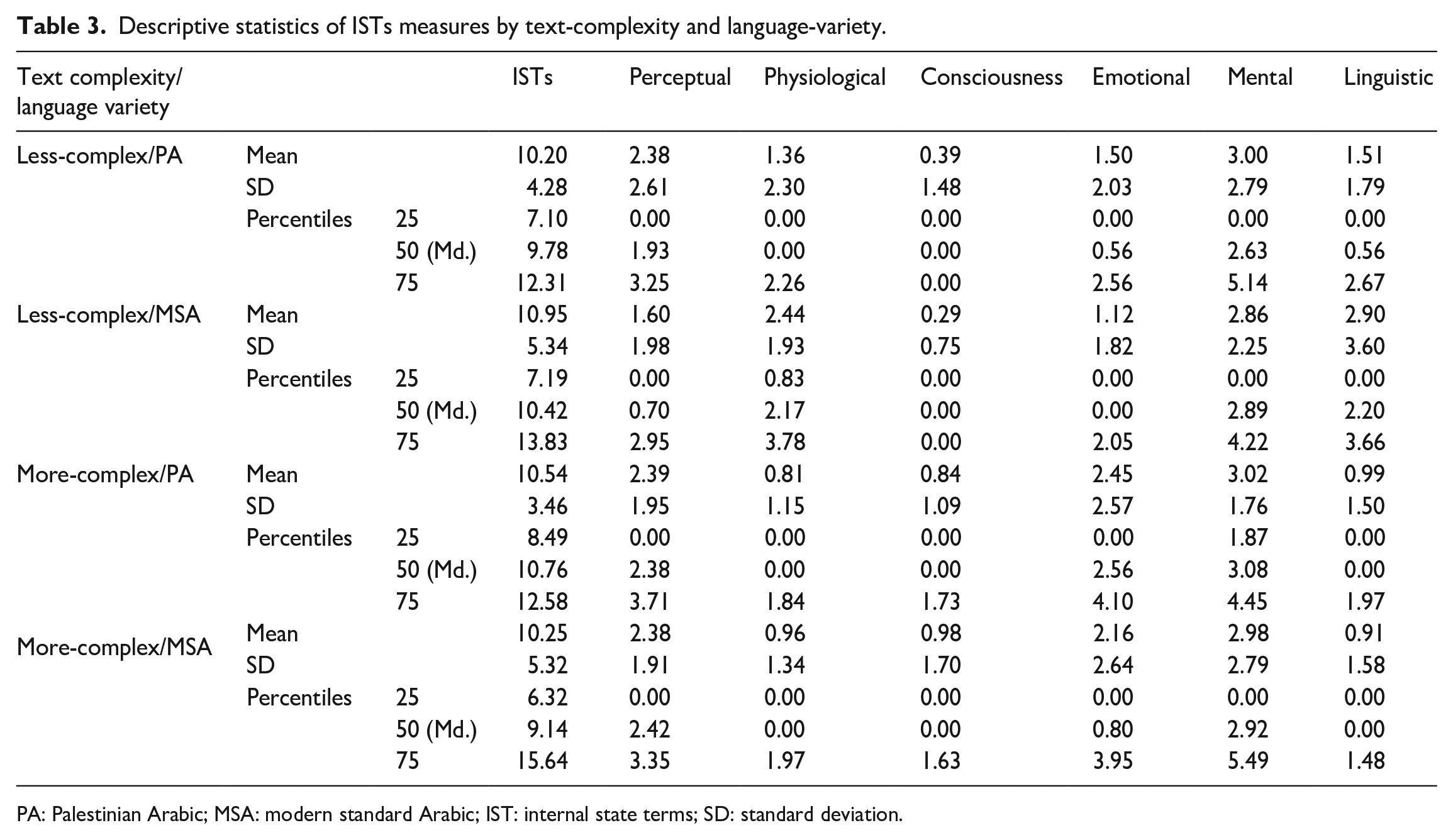
PA: Palestinian Arabic; MSA: modern standard Arabic; IST: internal state terms; SD: standard deviation.
The effects of age, text complexity, and language variety on ISTs measures.
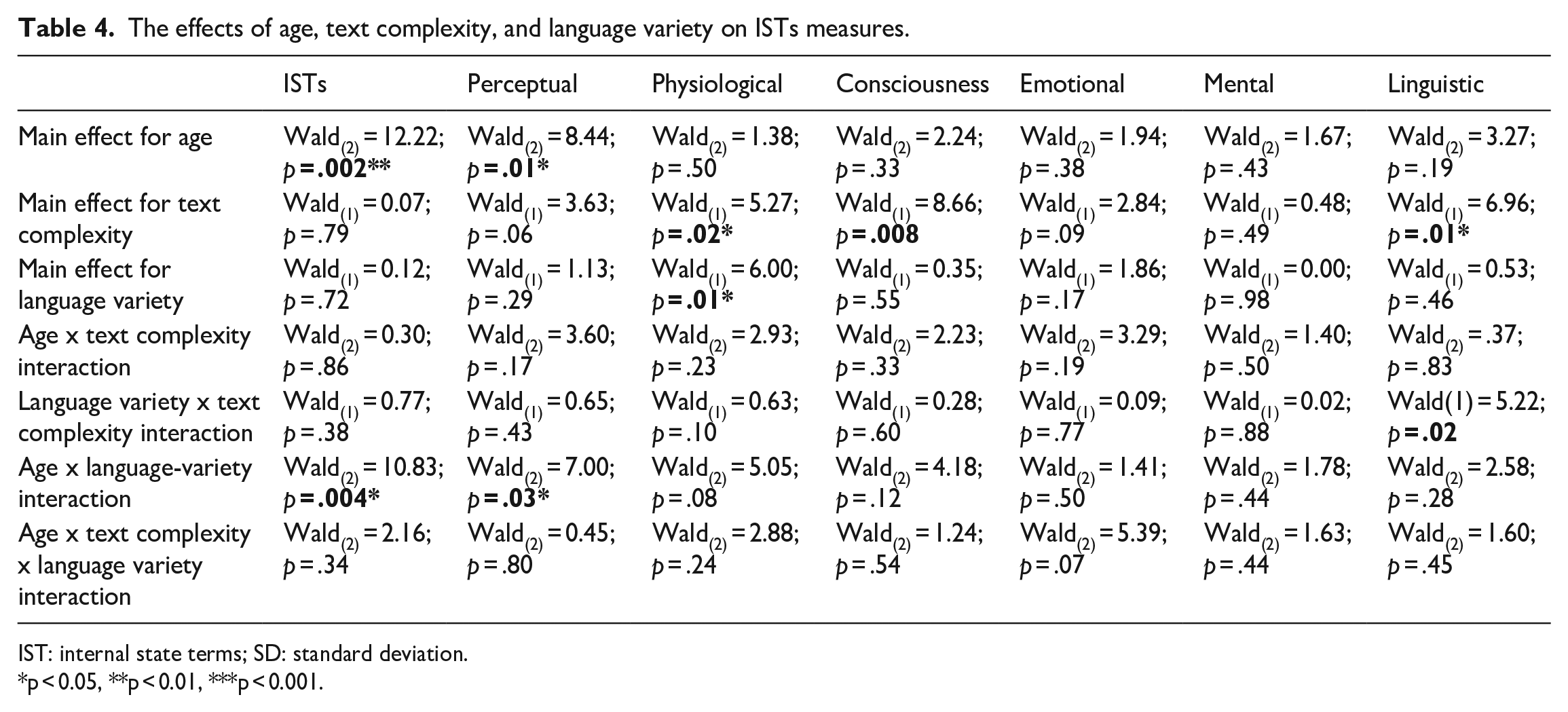
IST: internal state terms; SD: standard deviation.
p < 0.05, **p < 0.01, ***p < 0.001.
For total ISTs, a main effect for age was found (p = .002), indicating that, overall, older participants produced more ISTs than younger participants. In addition, a significant interaction effect was found between age and language variety (p = .004), indicating that while the younger participants produced more ISTs for the PA condition, the older participants produced more ISTs in the MSA condition (see Figure 2).
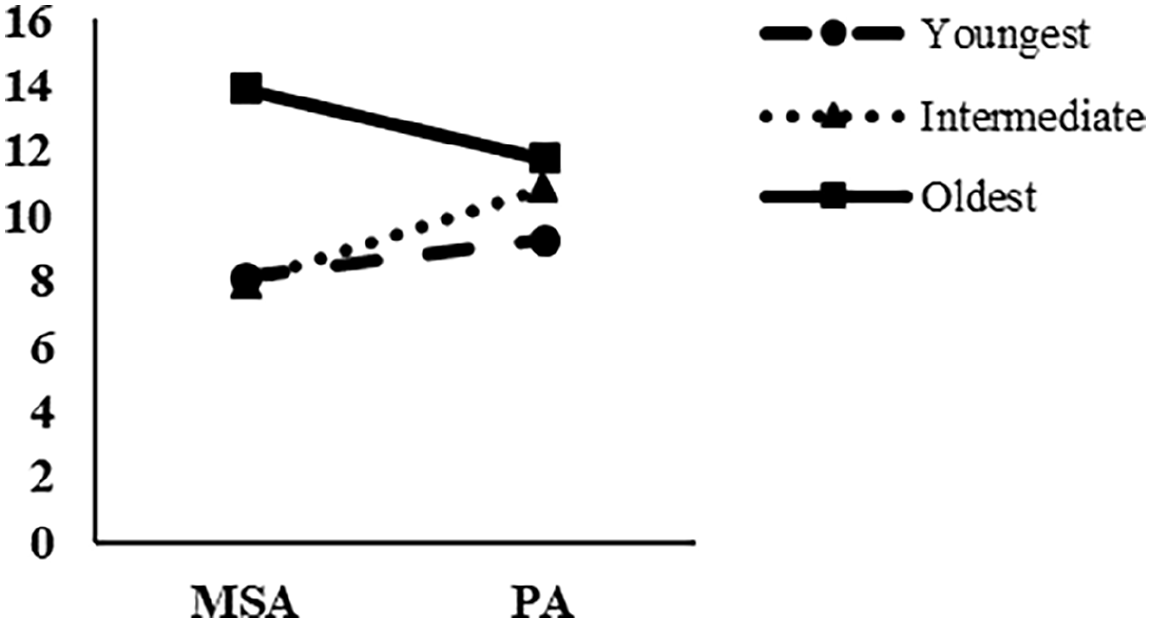
Interaction of age by language variety on total ISTs (in percentages).
For perceptual ISTs, a main effect for age was found (p = .01), indicating that older participants produced more than younger participants. In addition, an interaction between age and language variety was found (p = .03), indicating that while the younger participants produced more perceptual ISTs for the PA condition than for the MSA condition, within the older participants this difference was much smaller (see Figure 3).
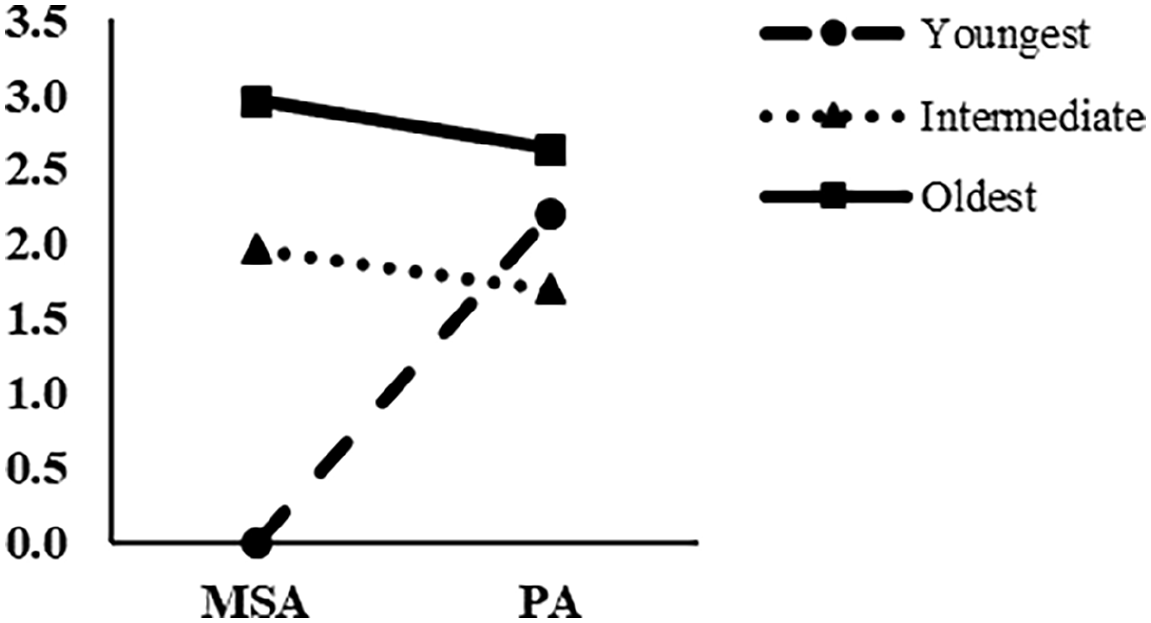
Interaction of age by language variety on Perceptual ISTs (in percentages).
For physiological ISTs, the main effect for text complexity was found (p = .02), indicating that overall participants produced more physiological ISTs on less-complex narratives. In addition, a main effect for language variety was found (p = .01), indicating that overall, participants produced more physiological ISTs for narratives heard in MSA compared to PA.
For consciousness ISTs, a main effect for text-complexity was found (p < .001), indicating that overall, participants produced more consciousness ISTs in the more-complex narratives compared to less-complex narratives.
For linguistic ISTs, the main effect for text complexity was found (p = .01), indicating that overall, participants produced more linguistic ISTs for less-complex narratives. In addition, an interaction between text complexity and language variety was found (p = .02), indicating that participants produced more linguistic ISTs in the MSA condition than in the PA condition in the less-complex narratives, while within more-complex narratives this difference was much smaller.
Comprehension
Table 5 presents the descriptive statistics of percent correct accuracy on the narrative comprehension questions (mean of Total score, Goal, ISTs, and ToM question) by text complexity and language variety.
Descriptive statistics of the comprehension measures by text complexity and language variety.
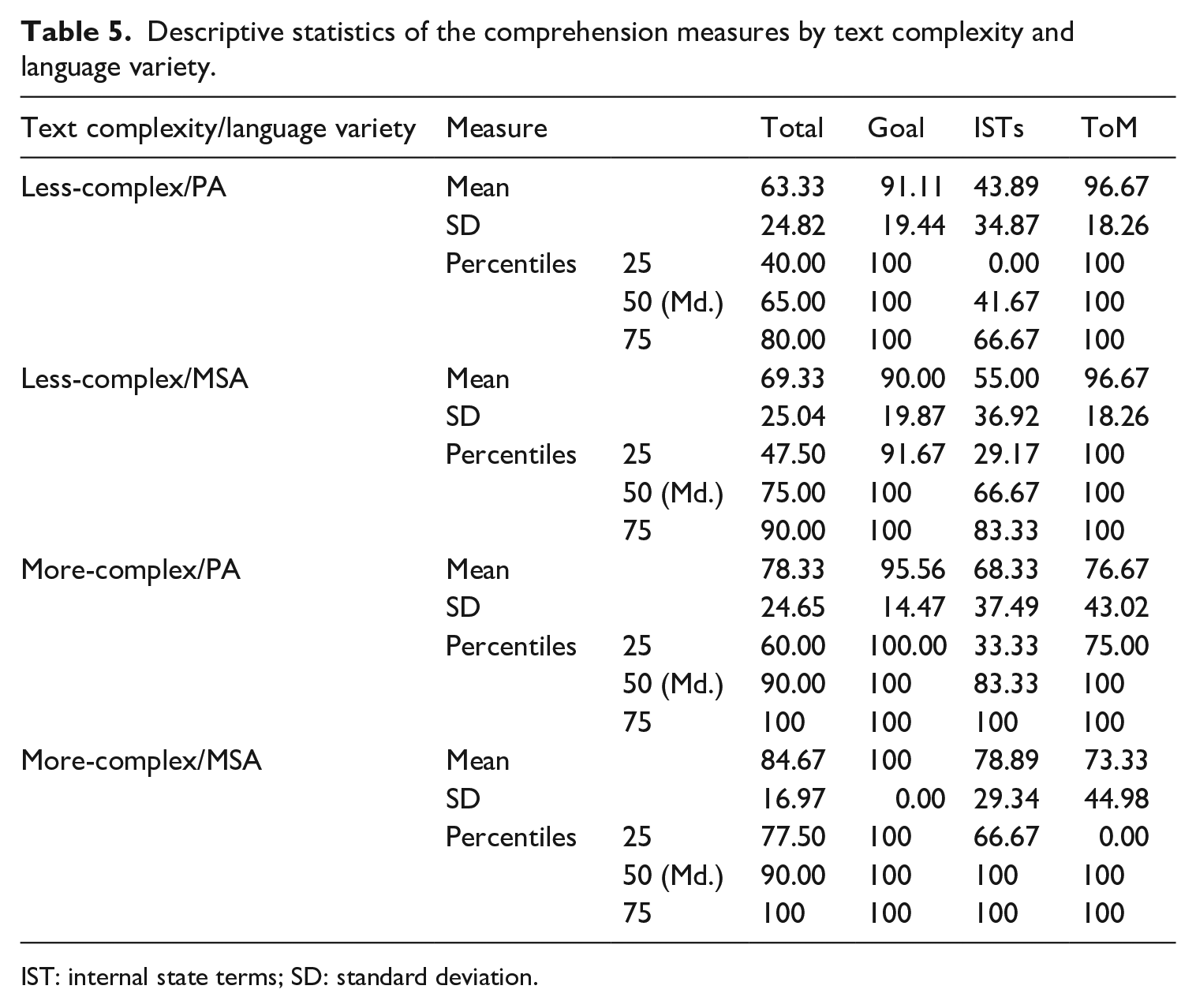
IST: internal state terms; SD: standard deviation.
The inferential analyses of comprehension as presented in Table 6 revealed that for the total comprehension score, the main effect for text complexity was found (p < .01), indicating that overall participants scored higher on more-complex narratives than on less-complex ones. In addition, the main effect for language variety was found (p = .02), indicating that participants scored higher in the MSA condition, compared to the PA condition.
The effects of age, text complexity, and language variety on comprehension measures.
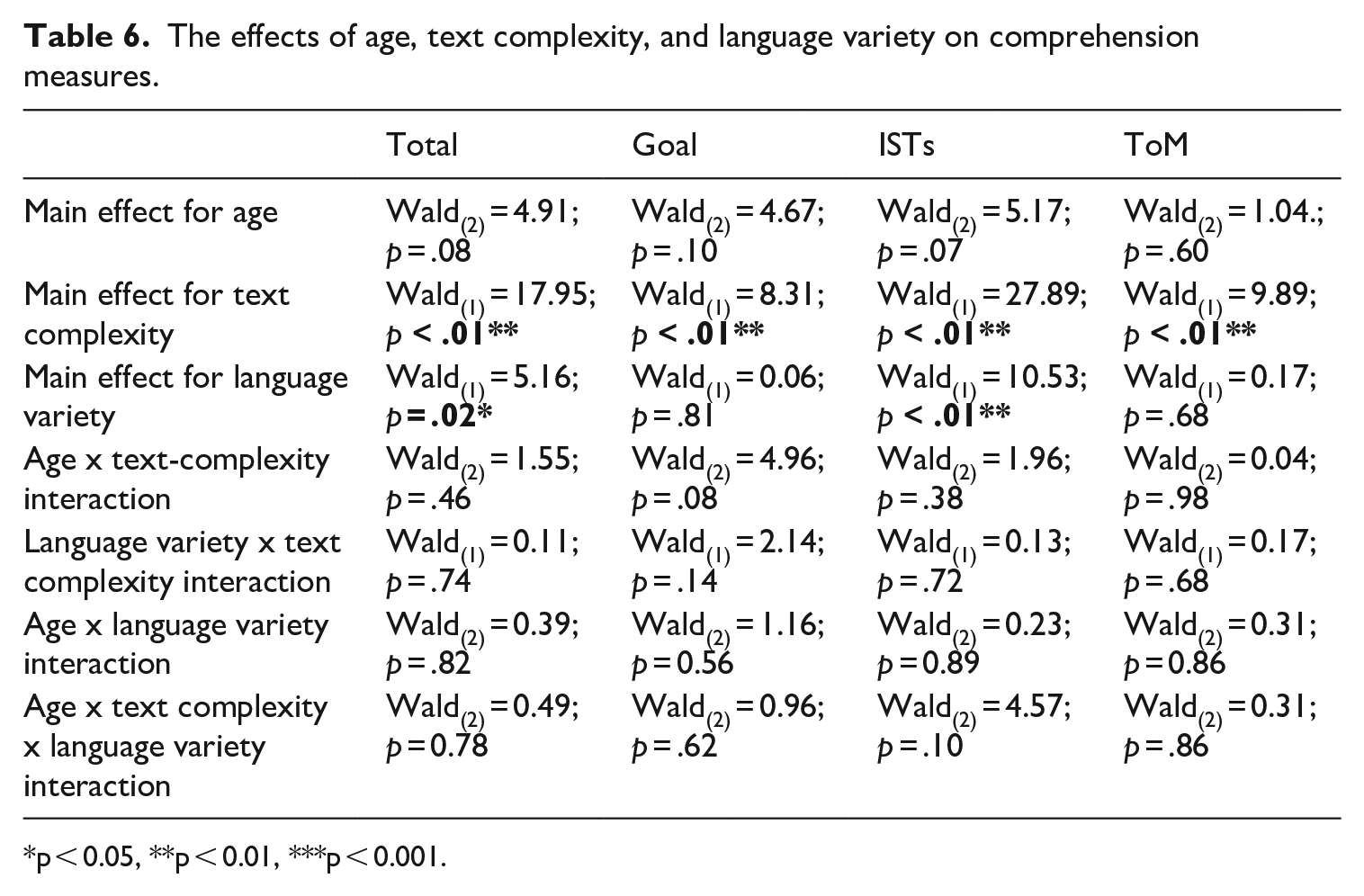
p < 0.05, **p < 0.01, ***p < 0.001.
For Goal questions, a main effect for text complexity was found (p < .01) indicating that participants scored higher for more-complex narratives, compared to less-complex narratives. For IST questions, a main effect for text complexity was found (p < .01), indicating that participants scored higher for more-complex narratives, compared to less-complex narratives. Also, a main effect for language variety was found (p < .01), indicating that participants scored higher for the MSA condition than for the PA condition. Finally, for ToM question, a main effect for text complexity was found (p < .01), indicating that participants scored higher on less-complex narratives, compared to more-complex narratives.
In summary, significant main effects for text-complexity were found for: narrative length (more-complex narratives were longer), physiological and consciousness ISTs (more for more-complex), linguistic ISTs (more for less-complex), and comprehension measures based on total score, goal and IST questions (higher for more-complex) as well as the ToM question (higher for less-complex). Significant main effects for language variety were found for Physiological ISTs and total comprehension and ISTs comprehension questions (higher for the MSA condition). Significant main effects of age were found for narrative length, total ISTs, and perceptual ISTs (more for older). Finally, significant interaction effects were found between language variety and age for total ISTs; whereas younger participants produced more ISTs for the PA narrative, older participants produced more ISTs for the MSA narrative (see Figure 2). Furthermore, perceptual ISTs were produced more for the PA narrative by the younger participants (see Figure 3). Significant interaction effects were found between narrative complexity and language variety too, with participants producing more linguistic ISTs in the MSA less-complex narrative.
Discussion
The present study aimed to investigate the role of the language variety in which a narrative is presented (MSA, PA) and text complexity on children’s retelling and comprehension of narratives. It was hypothesized that children’s performance would be sensitive to both text complexity and language variety, with better performance on less-complex narratives than on more-complex ones, and better performance on retelling and comprehension from a narrative presented in PA than in MSA.
Narrative retelling: the role of text complexity and language variety
Before addressing the main questions of the study regarding the impact of text complexity and language variety, an interesting finding emerges, that pertains to the macrostructure of the narratives. The results show that the participants in general produced very low scores for macrostructure measured as goals, attempts, and outcomes in retelling the stories. Similar results were reported in former research using narratives elicited from LITMUS-MAIN in other languages (e.g. Altman et al., 2016; Košutar et al., 2022; Lindgren, 2019). The very poor macrostructure skills observed in our sample might reflect children’s poor experience with storytelling and with informal literacy in general. Arabic-speaking children in Israel generally come from poor home-literacy environments and this influences their familiarity with narrative macrostructure skills (Aram et al., 2013). The current study did not test this variable and so it is not possible to evaluate its impact on narrative outcomes. Future research should incorporate this aspect of the child’s home literacy background in order to better understand their linguistic and narrative skills development.
With respect to the question of the impact of text complexity on narrative skills, the results of the study showed that text complexity did not affect narrative retelling macrostructure reflecting the generally low macrostructure scores. The absence of an effect of text complexity on retelling has been reported by Abdalla et al. (2020) who compared a one-episode story with a more-complex three-episode story. However, text length measured as the number of word tokens was impacted by text complexity; unexpectedly, participants produced longer narratives for more-complex narratives compared to less-complex narratives, and narrative length correlated with the age of children. This unexpected finding whereby children were more productive when the narrative was more-complex fits with the argument that children can show better learning when the task is cognitively more challenging. This phenomenon has been referred to as ‘desirable difficulties’ (Bjork, 1994; Bjork & Bjork, 2011; Bjork & Kroll, 2015). This hypothesis, however, is for future research to investigate.
Our study also manipulated the language variety in which the narrative was presented to examine whether language variety affected children’s ability to retell a story. Before we address the impact of language variety on narrative skills, it is noteworthy that even though two of the stories were presented in MSA, participants chose to retell all narratives in PA, including those presented in MSA. This finding accords with earlier reports (Asli-Badarneh et al., 2022; Henkin, 1998; Ravid et al., 2014) and it might reflect the difficulty that children have in producing a text in MSA. Alternatively, children might have been following internalized sociolinguistic patterns of the distribution of codes in Arabic diglossia as it is played out in storybook reading especially in preschool, namely, a text is read/heard in MSA, usually by the teacher or a parent and then paraphrased or retold in PA (Iraki, 1992).
Given the influence of limited exposure and passive use of MSA on the development of various language and metalinguistic skills in children (for a review, see Saiegh-Haddad, 2022), we predicted that they would find it more difficult to retell a story when it is presented to them in MSA than in PA. Unexpectedly, however, the results showed that presenting a story in PA was not related to an advantage in macrostructure or microstructure features, supporting earlier reports of Arabic speakers (Leikin et al., 2014) and bilingual children (Altman et al., 2016). This might be seen as preliminary evidence for the readiness of preschool children to equally retell short picture-supported narratives in PA and MSA. Yet, this conclusion has to be taken with great caution and has to be evaluated in light of the specific design of the current study which used short picture illustrated narratives and a simpler form of MSA that does not mark case and mood inflections on all words. As such, the MSA texts used in the current study made less use of case and mood inflections (only 27.5% of all word tokens). This might have reduced the linguistic distance between the two varieties and hence the cognitive and linguistic load of processing.
Previous research has shown that ISTs pose a challenge for children and they tend not to account for them in their story retellings (Johnston et al., 2001). Therefore, we considered the number of ISTs that a narrative calls upon a complexity dimension of the narrative. Our results indicate that children were sensitive to the ISTs in the different narratives, and they used them in their retellings. Moreover, the use of ISTs correlated positively with the age of participants. Most importantly, the total use of ISTs interacted with language variety and age; while the younger participants produced many more ISTs in the response to the PA narratives, the older ones did so in response to the MSA narratives. This finding, especially in the older participants, might lend itself again to the notion of ‘desirable difficulties’ according to which difficulty forms better learning conditions and leads to more durable and flexible learning (Bjork & Bjork, 2011; Bjork, 1994; Bjork & Kroll, 2015).
With respect to subtypes of ISTs, the results also showed that physiological and linguistic ISTs were produced more in the less-complex narratives than in the more-complex ones, and consciousness ISTs were produced more in the more-complex narratives than the less-complex ones. Physiological ISTs were also influenced by language variety with more productions in MSA than in PA. ISTs were examined in the present study due to their importance in narrative production as a bridge between micro- and macrostructure (Westby, 2005). For specific IST types, the numbers were very small and the differences found between the less-complex and the more-complex narratives and language variety might have been triggered by variations in ISTs across the narratives presented to the children. For example, the less-complex narratives included ‘Baby Birds’ and ‘Baby Goats’ included more physiological ISTs, such as, ‘hungry’ and linguistic ISTs, such as, ‘roared’ and fewer consciousness ISTs.
Narrative comprehension: the role of text complexity and language variety
Another question that this study examined was whether text complexity and language variety affected narrative comprehension. The results showed that both text complexity and language variety affected narrative comprehension. Yet, unexpectedly, the results showed better scores for more-complex than for less-complex narratives, and better comprehension for MSA than PA narratives (except for the ToM question).
The unexpectedly higher comprehension scores of the more-complex narratives and of those presented in MSA might be theoretically interpreted in light of the ‘desirable difficulties’ argument mentioned above (Bjork, 1994; Bjork & Bjork, 2011; Bjork & Kroll, 2015), especially as MSA is not only a less familiar and a more challenging variety but is also associated with formal and academic functions. Practically, these results imply that children might be capable of comprehending a text presented in MSA to the same level as a text presented in PA even before formal schooling and exposure to MSA. This finding might reflect increasing exposure to the MSA language variety in recent years as a function of greater informal exposure via book reading and the media (Albirini, 2016) as well as heightened awareness on the part of parents and of the educational system in Israel of the importance of exposing children to MSA in preschool via storybook reading (Saiegh-Haddad & Everatt, 2017). It is noteworthy that our results contrast with those reported in Leikin et al. (2014) who found that narratives heard in SpA were better comprehended than those heard in MSA. The mixed results might be related to the fact that Leikin et al. (2014) did not match narratives on their episodic complexity and used what might have been a more-complex narrative in MSA. Moreover, our results must be evaluated in light of the specific design of the current study which used short picture illustrated narratives and a reduced encoding of case and mood inflections.
Limitations and future research
To the best of our knowledge, few studies manipulated text complexity in a study of narrative production or comprehension and those that did focused on differences in genre (personal vs expository), or differences in task (telling vs retelling), but not on differences in the micro and macrostructural elements. The choice of the LITMUS-MAIN stories was due to them being parallel, but still different. The author(s) of LITMUS-MAIN suggest counterbalancing the procedure according to which half of the children tell story A in one language and story B in the other, while the reversed order applies to the other half of the children (the same is true for stories ‘The Boy and the Cat’ and ‘The Boy and the Dog’). Since this was not the case here, differences between parallel stories could have an impact on the results. While we addressed this concern by spreading the four narratives over 8 weeks, future studies might consider following this protocol.
The present study is pioneering in this respect and our results, which made use of an available tool, call for further studies in which the stories differ in exactly one element or a specific number of elements (which are manipulated) whereas everything else (e.g. syntactic structures, lexicon) is matched or controlled for to closely monitor effects on the results. Future research should also try to prompt children to produce MSA narratives so that arguments about their linguistic skills in MSA at this age are empirically tested.
Summary and conclusion
The findings of the present study show that both text complexity and language variety affect different analyses levels of narrative abilities among preschool children differently. At the same time, our results imply that preschool children have already acquired enough MSA lexicon and structure, albeit passive, that allows them to retell and comprehend short and picture-illustrated narratives when presented in MSA. These findings are promising when language and literacy acquisition in Arabic diglossia is contemplated. Nonetheless, before this finding is generalized, it should be noted that investigation of its external validity is warranted. One important replication should address the role of pictures in narrative research as well as the role of the language of the narrative and particularly the degree of distance that the lexicon, and the morphosyntax of the narrative depicts from the spoken vernacular of children. This is a critical aspect of the current study to bear in mind. The current study has reduced the use of case/mood inflections in almost one-third of the words used in the MSA narratives. Moreover, the majority of the lexical items used were identical and cognate MSA words. These linguistic aspects of the text might have made it easier for children to comprehend a text presented in MSA and they should be taken into consideration in designing narrative-based tasks and narrative interventions for young children.
Footnotes
Author contribution(s)
Ethical approval and informed consent
Parental consent was obtained, and the study was approved by Bar-Ilan University Humanities Review Board and the Israeli Ministry of Education.
Funding
The author(s) disclosed receipt of the following financial support for the research, authorship, and/or publication of this article: This research was supported by an Isreal Science Foundation grant to Saiegh-Haddad, E. and Armon-Lotem, S. (Grant number No. 454/18).
