




Abstract
Previous research has uncovered that, despite the omnipresence of focus in utterances, children typically do not compute the exhaustivity inference associated with cleft(-like) syntactic focus constructions at adult-like levels before 7 years of age. Children’s comparable limitations with lexically triggered scalar implicatures, inferences with an essentially identical logical structure, have been argued to stem not from the lack of their competence to compute the implicature itself, but from their immature contextualization abilities to identify relevant scalar alternatives. We address the question whether the same extraneous factor may underlie preschooler’s difficulties with focus exhaustification in a comprehension study of 5- to 6-year-old Hungarian children which investigated the effect of contextual cues on their focus interpretation. It was found that while the presence of an explicit Question Under Discussion significantly raises children’s accuracy in identifying the focus and its alternatives (sub-experiment 1), it fails to induce a similar increase in the proportion of exhaustive interpretations (sub-experiment 2). These results indicate that, in contrast to the case of scalar implicatures, children’s low rate of exhaustification of focus reflects a deeper, less context-dependent difference from adult-like comprehension, possibly rooted in the linguistic representation of focus exhaustivity.
Introduction
One of the central, and virtually omnipresent, information structural categories in human language is focus, whose core function is the highlighting of new information in an utterance, as, for instance, in answers given to questions (Halliday, 1967). In addition, focus constructions in different languages may bear various other meaning components, such as correctiveness or exhaustivity. In this article, we investigate children’s understanding of focus in Hungarian, a language which marks focus both prosodically and syntactically. Syntactic marking involves a cleft-like construction in which the focus is fronted to a unique syntactic position, delineating it from the background. As is cross-linguistically typical of clefts, the syntactically marked focus of Hungarian tends to give rise to an exhaustive interpretation (Horvath, 2010; É. Kiss, 1998). In prior research, preschool children have been recurrently found not to interpret this type of focus exhaustively in the way adults do.
Motivated by previous work on the acquisition of scalar implicature comprehension, our study explores to what extent children’s failure to interpret cleft-type focus constructions exhaustively may stem from a limitation in accurately identifying the focus of the sentence, which involves reconstructing what question the sentence functions as an answer to. To address this question, we performed an experiment consisting of two sub-experiments in which we tested whether the presence of an explicit question in the context significantly raises children’s accuracy in identifying the focus and its alternatives (sub-experiment 1), and if so, whether it gives rise to a similar increase in the proportion of exhaustive interpretations (sub-experiment 2). The article is structured as follows. In the remainder of this “Introduction” section, we provide a brief overview of previous experimental work on the acquisition of focus comprehension, followed by some background on the interpretation of focus and the notion of Question Under Discussion (QUD). This part is concluded by the formulation of the research question. In the “Method” section, we introduce the two sub-experiments, as well as alternative predictions for possible outcomes. Results are presented, analyzed, and discussed next. The article is concluded with a summary.
The acquisition of focus comprehension
Despite the overwhelmingly frequent occurrence of focus in utterances, a large number of acquisition studies show that children’s difficulties both with producing and especially with comprehending sentences with focus are manifold even at around 5 or 6 years of age (see Höhle et al., 2016 for a detailed overview). In the following, we concentrate on challenges that are most relevant to this study, namely those concerning the identification and exhaustive interpretation of focus. Focus identification involves the division of the sentence into focus and background, and the association of the focus role with the constituent intended (and marked) by the speaker as the focus. Exhaustivity is a key inference that may be associated with focus, namely, that the background holds only of the constituent in focus.
The accurate identification of focus is problematic for children, whether it is marked prosodically or syntactically. With regard to prosodic focus in English, Wells et al. (2004) found that 5-year-old children fail to perform above chance level in a receptive task involving the identification of corrective focus based on accentuation in the case of sentences like (1):
(1) I wanted CHOCOLATE and honey. (Wells et al., 2004, p. 761)
According to Hornby’s (1971) and Cruttenden’s (1985) results, even 10-year-olds cannot exploit accent patterns in an adult-like manner to identify contrastive information. Another well-attested fact is that preschool age children systematically provide erroneous responses in experimental tasks measuring whether they can associate exclusive particles such as only in English (Crain et al., 1994; Gualmini et al., 2003; Paterson et al., 2005), nur in German (Müller et al., 2011), or zhiyou in Mandarin Chinese (Notley et al., 2009; Zhou & Crain, 2010) with the prosodically marked focus constituent of the utterance. For instance, in sentences like (2) children investigated by Crain et al. (1994) typically associated only with (holding) the flag, instead of the subject:
(2) Only THE CAT is holding a flag. (Crain et al., 1994, p. 460)
Using a modified version of the task in Hornby (1971), Szendrői et al. (2018) obtained a divergent result, according to which English, French, and German children exhibit adult-like performance patterns in the identification of prosodically marked focus already at ages 3–6. These authors argue that the discrepancy between the previous findings and theirs is likely due to task effects in prior experimental treatments. That non-adult-like accuracy in focus identification is not merely a methodological artifact is suggested by the fact that even 5-year-old Mandarin-speaking (Chen et al., 2019) and Hungarian-speaking children (Surányi & Pintér, 2022) have difficulties in the same task that was used by Szendrői et al. (2018).
By contrast to the identification of prosodically marked focus, to the best of our knowledge, children’s identification of syntactically marked focus has not been systematically studied to date. What has been a central topic of investigation in this domain, instead, is the correct assignment of thematic roles in cleft constructions. English it-clefts have occupied center stage in this research, a recurrent finding of which is that children have difficulties in comprehending clefts with a syntactically focused object, as in (3) (Bever, 1970; Dick et al., 2004; Lempert & Kinsbourne, 1980).
(3) It is THE CAT that the dog is biting. (Dick et al., 2004, p. 366)
Similarly to focus identification, the acquisition of focus exhaustivity, obtaining in some syntactic focus-marking constructions, is also a prolonged process. As revealed by the findings of Heizmann (2012) from it/es-clefts in English/German and those of Tieu and Križ (2017) from c’est-clefts in French: in contrast to adults, young children below the age of 6 interpret these constructions mostly non-exhaustively. To illustrate, on a non-exhaustive interpretation, a sentence like (4) is accepted as a description of a scenario in which not only the pumpkin and the sunflower, but also a third item, popped up:
(4) It was THE PUMPKIN AND THE SUNFLOWER that popped up. (Heizmann, 2012, p. 107)
A similar pattern was found in the cleft-like focus fronting construction of Hungarian: children below the age of 7 generally understand fronted foci non-exhaustively in the studies of Kas and Lukács (2013), Babarczy and Balázs (2016), and Pintér (2018).
It has not been clarified, however, what explains this consistent finding. The issue is not trivial, given that children are not unable to compute exhaustive interpretations in general, as evidenced by their comprehension of exclusive particles. Even the youngest age group of Hungarian children included in Pintér’s (2018) study, namely 5-year-olds, assign an exhaustive reading to focused constituents associated with the exclusive particle csak ‘only’ at a high rate.
(5) Csak A NYUSZI emel-t-e fel a zászló-t. (Pintér, 2018, p. 362) only the rabbit raise- ‘Only the rabbit has raised the flag’.
French-speaking preschoolers around the age of 3 also have an adult-like (i.e. exhaustive) understanding of sentences containing a focus linked to il n’y a que ‘only’ (Tieu & Križ, 2017).
Apparently, then, preschool children have the cognitive capacity to compute an exhaustive meaning associated with focus, hence their difficulty in associating exhaustivity with syntactically marked focus in cleft(-like) constructions must lie elsewhere. This article makes a contribution to clarifying the nature of this limitation.
Research question
The particular research question to be addressed is formulated here in terms of Alternative Semantics, the most widely held formal semantic approach to focus (Krifka, 2008; Rooth, 1992), although the question can be transposed to other frameworks without affecting its substance. According to this approach, the basic interpretive task in the comprehension of utterances containing a focus involves the computation of contextually relevant alternatives to the current sentence, namely, propositions that differ from the current one only with regard to the element in focus. To illustrate, the successful identification of the subject as the focus in a sentence like (6a) is equivalent to the recognition of a set of alternative propositions exemplified in (6b). These only differ from the proposition in (6a), as well as from each other, with respect to the (singular or plural) individual functioning as the subject:
(6) a. [BILL]Focus loves Sue b. John loves Sue; Paul loves Sue; John and Bill love Sue; John, Bill and Paul love Sue; . . .
Interpreting focus, then, crucially involves establishing a particular relation between the sentence and its discourse context. From the perspective of discourse structure, the nature of this relation is often characterized drawing on the basic concept of question-answer coherence (Halliday, 1967). Specifically, each (declarative) sentence can be thought of as a congruent answer to a question of current relevance at the given point of the discourse, called the QUD (Roberts, 1996/2012). In these terms, (6a) is one of the possible answers to a QUD containing an information gap regarding who loves Sue, with the answers in (6b) as possible alternatives. QUDs may be made explicit, in the form of an actual question (like (7)), but they typically remain implicit.
(7) Who loves Sue?
Identifying the focus of (6a) corresponds to construing the sentence as one of the alternative congruent answers to the current QUD in the discourse, expressed as (7).
From the perspective of this general approach, interpreting the focus of (6a) exhaustively consists in inferring not only that the core proposition expressed by (6a) is a true answer to the QUD, but also that the propositions in (6b), in which the focused element is replaced with any of its possible alternatives in the context (that yield alternative propositions that are not entailed by the asserted proposition), constitute false alternative answers to the same QUD. Children’s difficulty with exhaustive interpretations may then in principle relate (i) to the reconstruction of the QUD in the current context and thus a set of contextually relevant alternative propositions, which is tantamount to the accurate identification of the focus, or (ii) to drawing the inference that all these alternative propositions are false. Our study seeks to adjudicate between these two types of explanations.
The plausibility of the first of the two possibilities as an explanatory factor behind the high rate of children’s non-exhaustive interpretations is indirectly supported by several considerations. To start with, as briefly reviewed earlier, while the identification of syntactically marked focus has not yet received sufficient attention in prior literature, it has been a recurrent finding that preschoolers have trouble identifying prosodically marked foci and comprehending cleft constructions with a focus marked by fronting. Importantly, the majority of this work tested the comprehension of sentences containing a focus without any textual context. Notable exceptions include Müller et al.’s (2011) and Berger and Höhle’s (2012) study of German. Indeed, these works found that, as compared to previous studies, children perform better in associating the correct constituent with a focus particle if the relevance of the alternatives to the focused item is boosted by the explicit mention of alternatives in context. A more direct way of making the QUD more accessible is providing a preceding congruent question in the context, which has also been shown to increase the ratio of correct associations of focused subjects with only in the performance of English-speaking children (Hackl et al., 2015) and to improve the comprehension of both subject and object clefts to adult-like levels (Aravind et al., 2018).
The enrichment of the context with (direct or indirect) cues that serve to make a relevant QUD salient has been revealed to also help children in comprehending other aspects of sentence meaning that are not directly represented in sentence form, such as non-surface logical scope (Gualmini et al., 2008) and scalar implicatures (a part of semantic and pragmatic content, respectively). While scalar inferences were found to be acquired late in early studies, more recent results show that when adequate contextual support is provided to make the identity and relevance of alternatives clear as part of the experimental task, these inferences appear to be present already at much earlier ages (Barner et al., 2011; Foppolo et al., 2012; Guasti et al., 2005; Papafragou & Musolino, 2003; Skordos & Papafragou, 2016). This latter finding is especially pertinent to the study of focus exhaustivity because the computation of scalar implicatures also requires the identification, and subsequent exclusion, of the relevant set of (stronger or weaker) alternatives to the scalar item. 1
To our knowledge, so far no child language research has concentrated on the potential effect of the accessibility of the QUD in the context on the exhaustive interpretation of focus. This is the issue the experiment we report on below explores. Based on the foregoing overview, a comprehender’s unrestrained access to the QUD makes the set of contextually relevant alternatives to the focus salient, helping the identification of the focus of the sentence as the pivot of this set of alternatives. If it is children’s limited ability to reconstruct the QUD and thus identify the focus and its contextually relevant alternatives that is chiefly responsible for their difficulty in understanding sentences with focus exhaustively (=explanation type (i) above then making the QUD easily accessible is expected to substantially increase their rate of exhaustive interpretations. Recent results from study of adults’ sentence comprehension, employing an explicit wh-question as a context-setter to fix the QUD, lend plausibility to this expectation. Investigating English sentences containing a prosodic focus, Clifton and Frazier (2018) found that a constituent is interpreted significantly more exhaustively if it corresponds to the wh-phrase of the preceding question than if it does not. In their experiments on pre-verbal focus in Hungarian, Pavlović (2019) and Tóth and Csatár (2020) obtained analogous results: adults’ rate of exhaustive interpretations of sentences containing a focus is enhanced when the sentence is presented as an answer to an immediately preceding focus-congruent wh-question. 2
If, however, children’s main difficulty lies in generating the exhaustivity inference itself ( = explanation type (ii)), then making the QUD salient in the preceding context may at best have a minor effect on the rate of their exhaustive interpretations of focus. This would mean that children’s trouble with focus exhaustivity is in substantial part independent of the processing of the sentence–context relation, and relates instead to a non-adult-like linguistic representation of focus. According to formal accounts of focus meaning, the exhaustivity inference is due to a silent, lexically unanchored operator in sentence representation (similar in its meaning contribution to exclusive particles like only; Chierchia, 2004; Horvath, 2010). In terms of this type of formal approaches, children may then have trouble postulating this silent operator in their parse of sentences containing a focus.
Our study aims to arbitrate between these two alternative accounts by exploring their opposing predictions through an experimental study of sentence comprehension in 5- to 6-year-old Hungarian children.
Method
The comprehension experiment consisted of two sub-experiments: in the first one, we tested the extent to which participants can correctly identify the focus of the sentence and its alternatives by measuring focus-congruent corrections, and in the second one, we investigated whether they associate an exhaustive interpretation with the focused constituent. In order to keep the number of the items relatively low, the type of focus was not varied: we consistently used subject-focus stimulus sentences throughout the experiment. As illustrated below, these assertions always contained a verbal particle, whose linear position unambiguously marks the focus syntactically (on top of prosodic marking): in Hungarian, a focused phrase is obligatorily fronted to an immediately pre-verbal position, and if a verbal particle is present, it must surface post-verbally. Each sub-experiment consisted of a No-Question and a Question condition: in the first session, stimulus sentences were presented without any textual context, whereas in the second session (which took place at least 1 week later), each item was preceded by a focus-congruent question.
Material and procedure – Sub-experiment 1
The focus identification sub-experiment employed the correction task developed by Szendrői et al. (2018), in which participants are required to judge whether assertions uttered by a puppet are true or false of the simultaneously presented picture, and crucially, they were also asked to correct any false statements. In the critical trials, sentences containing a focused constituent were invariably false, and depending on whether the identification of the focus was accurate, they could be corrected either in a congruent or in an incongruent manner (in the sense of Rooth, 1992).
As a sample sentence–picture pair from this sub-experiment illustrates below (see (8) and Figure 1), a congruent response to the critical sentence in (8) would be correcting the focused element: ‘No, because it’s the mouse who lifted the turtle’ (subject correction). A correction like ‘No, because it’s the rabbit who the crocodile lifted’ (object correction) would be classified as incongruent in this case:
(8) the crocodile lifted ‘It is

Sample Picture from Sub-Experiment 1.
While in the No-Question condition, only an assertion accompanied each picture, in the Question condition the assertion was preceded by a focus-congruent wh-interrogative like (9):
(9) who lifted
The same assertion type was used in control items, in which the sentence was true of the accompanying picture, and therefore was expected to elicit acceptance rather than correction by the participants. Filler trials also contained true assertions about similar pictures, but there the object of the verb ‘lift’ was expressed by a quantified noun phrase (e.g. ‘two animals’ in ‘The bear lifted two animals’).
This sub-experiment consisted of a total number of 20 trials, divided into two sessions corresponding to the No-Question and Question conditions. After a short warm-up phase, participants judged five critical, three control, and two filler sentence–picture pairs (presented in a fixed order) during each session. Pictures and pre-recorded audio stimuli were presented to the participants using Microsoft PowerPoint through screen sharing in a video call on Zoom. The instructions and all test sentences of Subexp1, each with a description of the accompanying picture, are listed in Appendix 1.
Material and procedure – Sub-experiment 2
When testing focus exhaustivity, we used a Truth Value Judgment Task (Crain & Thornton, 1998) where the evaluation of the stimulus pairs involved the use of a three-point visual scale. This kind of ternary judgment task was applied by Katsos and Bishop (2011) in their seminal acquisition study of the comprehension of scalar implicatures. On the basis of a series of experiments, these authors show that ternary scales are superior to binary truth value judgment tasks in the investigation of meaning components that are not part of the main assertion expressed by the sentence. As exhaustivity in cleft-like constructions is also part of the non-asserted sentence meaning, this response mode proved to be an efficient tool in testing young children’s sensitivity to the violation of the requirement of exhaustivity in Hungarian by Babarczy and Balázs (2016) and Pintér (2018) as well. 3 In this study, we followed Pagliarini et al. (2018) by employing the scale of a sad face, a silver medal, and a gold medal. The use of this scale was explicitly explained to participants as part of the instructions (see Appendix 2A and 2C).
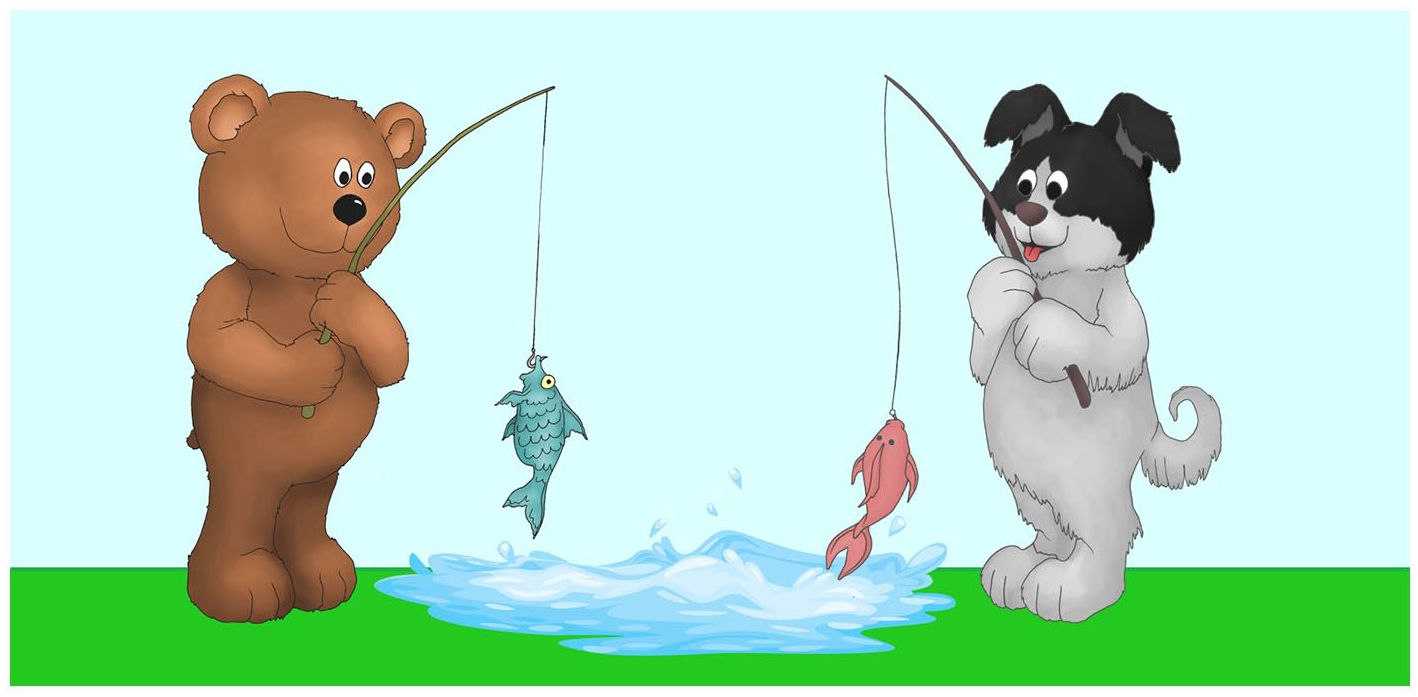
In the critical trials, the picture depicted two animals engaged in the same activity (see Figure 2), while only one of them was contained in the test sentence as the agentive subject (as in (10)). Crucially, the subject appeared in the pre-verbal focus position, and the verb was always followed by a verbal particle and an indefinite object.
(10) the bear caught ‘It is
Sample Picture from Sub-Experiment 2.
As a syntactically marked focus, the subject in critical trials was supposed to be interpreted exhaustively, thus the puppet was expected to be rewarded either with a silver medal or with a sad face depending on the strength of the rejection. Participants were also required to explicitly justify their rejection (see the instructions of sub-experiment 2 in Appendix 2).
Similarly to the first sub-experiment, there was a No-Question and a Question condition: in the second session, the puppet’s assertions were presented as answers to focus-congruent wh-questions asked by the experimenter (such as (11)):
(11) who caught ‘
Control items involved the same type of sentences as the critical trials, except that they provided a true description of the presented images; out of the two depicted animals, only the one in narrow focus performed the mentioned activity. Thus the assertion was true with the focus interpreted as exhaustive. Accordingly, in these control trials participants were expected to reward the puppet with a gold medal.
Both the No-Question and the Question condition consisted of eight filler trials, each of which contained a picture depicting three animals and a sentence with a S(ubject)V(erb) order. The subject was a plural definite and had a topic role, while the verb carried the nuclear accent: these sentences had focus on the verb (or the verb phrase), as illustrated in (12). (In the Question condition, these assertions were preceded by a verb [phrase] focus question, for example, ‘What are the rabbits doing?’)
(12) A nyusziká-k the rabbit- The rabbits are
Out of the eight filler items of each session, five were unambiguously false of the presented picture (as the animals were engaged in a different activity), therefore, in these cases, the expected response was the sad face. The remaining three filler sentences, however, were only partially true, given that the assertion was true only for two of the depicted animals, but not for the third one. For example, in the case of (12), two rabbits were eating ice cream, while one rabbit was eating a carrot. As the requirement of homogeneity linked to plural definite descriptions was violated (to which preschoolers at the tested age range are sensitive according to the findings of Tieu & Križ, 2017), we expected participants to opt for the middle option, that is, the silver medal, in these trials. Fillers helped verify if a child understood the judgment task and used the scale properly.
Our second sub-experiment comprised 36 trials, of which the 18 items of the No-Question condition (five critical, five control, and eight filler sentence–picture pairs) were presented in a fixed order during the first session, following the No-Question condition of the first sub-experiment. The 18 trials of the Question condition had the exact same internal distribution: these items were evaluated by the participants during the second session, conducted through Zoom approximately 1 week after the first one. All test sentences, each with a description of the accompanying picture, are listed in Appendix 2.
Participants
The same 35 monolingual Hungarian-speaking preschoolers completed Subexp1 and Subexp2, but since three participants (who did not utilize the full scale in the control and filler trials of Subexp2) had to be excluded, the statistical analyses were conducted based on data collected from 32 children: 16 5-year-olds (mean age = 5;2, SD = 3.92) and 16 6-year-olds (mean age = 6;5, SD = 2.84). As controls, we also tested 12 adult native speakers of Hungarian.
Predictions
Having established in the “Introduction” section that preschoolers have limited ability to identify the focus and its alternatives by recovering the corresponding QUD, it is expected that providing a preceding explicit, congruent wh-question will increase the proportion of focus-congruent corrections in Subexp1.
As for Subexp2, if children’s actual core problem in computing exhaustive interpretations is their limited ability to identify the focus and its relevant alternatives (=explanation (i)), then it is predicted that the presence of a congruent wh-question will substantially raise the rate of exhaustive responses in this sub-experiment, and it will do so by a degree comparable to the increase in Subexp1. However, if children’s key difficulty lies in the postulation of the exhaustivity inference itself (=explanation (ii)), with contextual cues helping the identification of focus and its alternatives playing only a lesser role, then it is predicted that the explicit wh-question in Subexp2 will either not raise the proportion of exhaustive interpretations at all, or it will do so by a smaller rate than it does in Subexp1.
Results
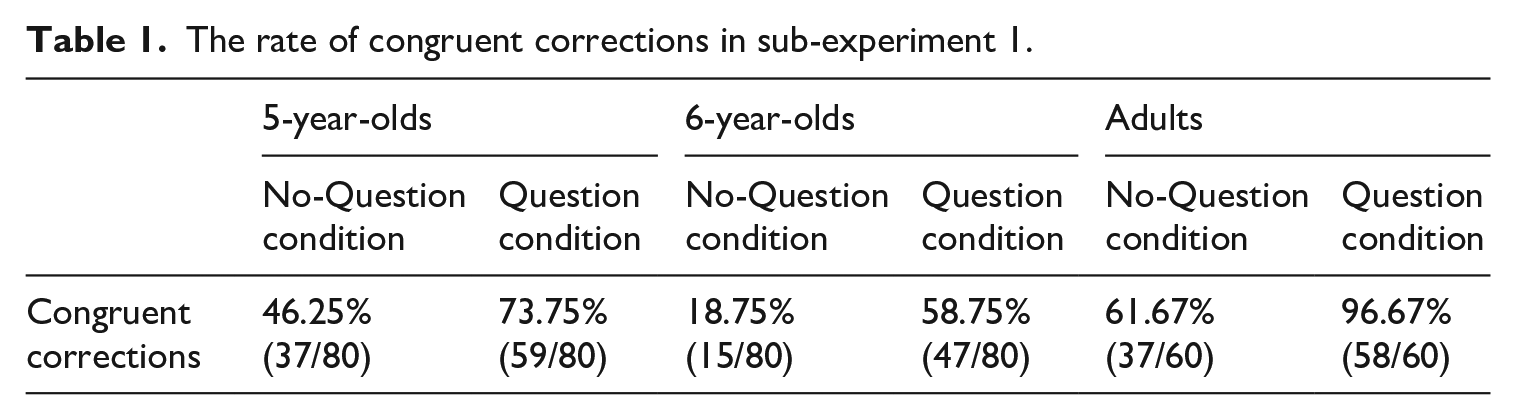
Responses obtained in Sub-experiment 1 were encoded as either non-congruent or congruent (the latter corresponding to successful focus identification, as described in the “Method” section earlier). Table 1 provides an overview of the rates of congruent responses, grouped by condition and age group.
The rate of congruent corrections in sub-experiment 1.
The ratios of the three response types assigned by participants in the critical (i.e. non-exhaustive) trials of Sub-experiment 2 are shown in Table 2, grouped once again by condition and age group.
The distribution of responses in sub-experiment 2.
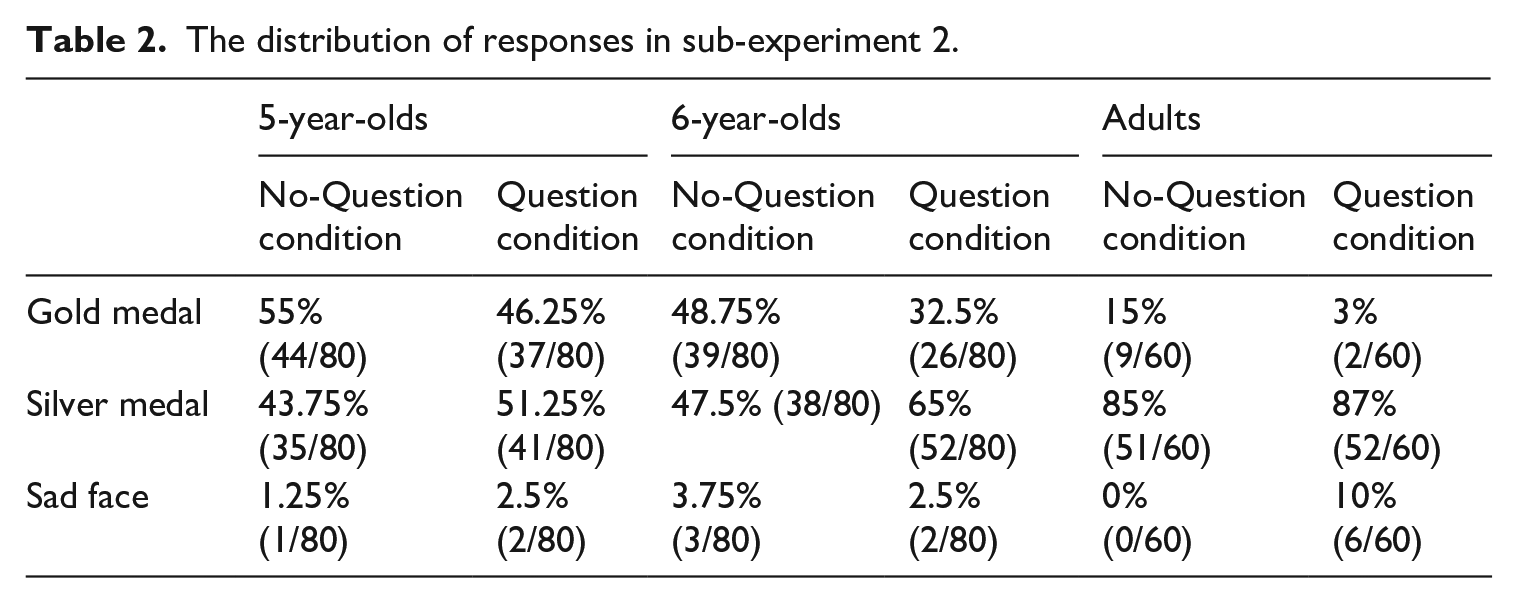
As will be recalled, an exhaustive interpretation of focus was expected to be revealed in critical trials by rejecting the subject-focus stimulus sentence by using either a silver medal (the intermediate rating) or a sad face (the lowest rating), as both of these response types reflect the perception of a mismatch between the sentence and the picture. Furthermore, participants’ explicit justification of both these response types was expected to make reference to the fact that the animal denoted by the subject is not the only one performing the activity denoted by the predicate. These considerations dictate that in the critical condition any sad face or silver medal choices that are accompanied by such a justification are both to be categorized as an expected response in the case of successful focus exhaustification. This classification is further supported by the finding that precisely this type of justification complemented virtually all sad face and silver medal responses (save one sad face given by a 6-year-old participant in the No-Question condition, which was therefore not categorized as expected). In fact, as is apparent from Table 2, of these two types of responses it is the silver medal that was selected in the overwhelming majority of cases (with sad face choices accounting for a mere 3% of all responses). Furthermore, in the adult group, the silver medal was by far the most frequent choice of all three choices. This is in line with the fact, mentioned above, that exhaustivity violations concern a non-asserted component of sentence meaning.
We performed a within-subject comparison of the results of the two sub-experiments in a single model. For the purposes of this statistical analysis, we coded the responses as follows: the congruent corrections in Subexp1, and the silver medal or sad face choices (accompanied with a justification indicating an exhaustive interpretation) in Subexp2 were encoded as expected answers, while incongruent corrections and gold medal rewards, respectively, counted as non-expected. Figure 3 displays the proportion of the expected responses of the critical items in both sub-experiments across the three tested age groups.
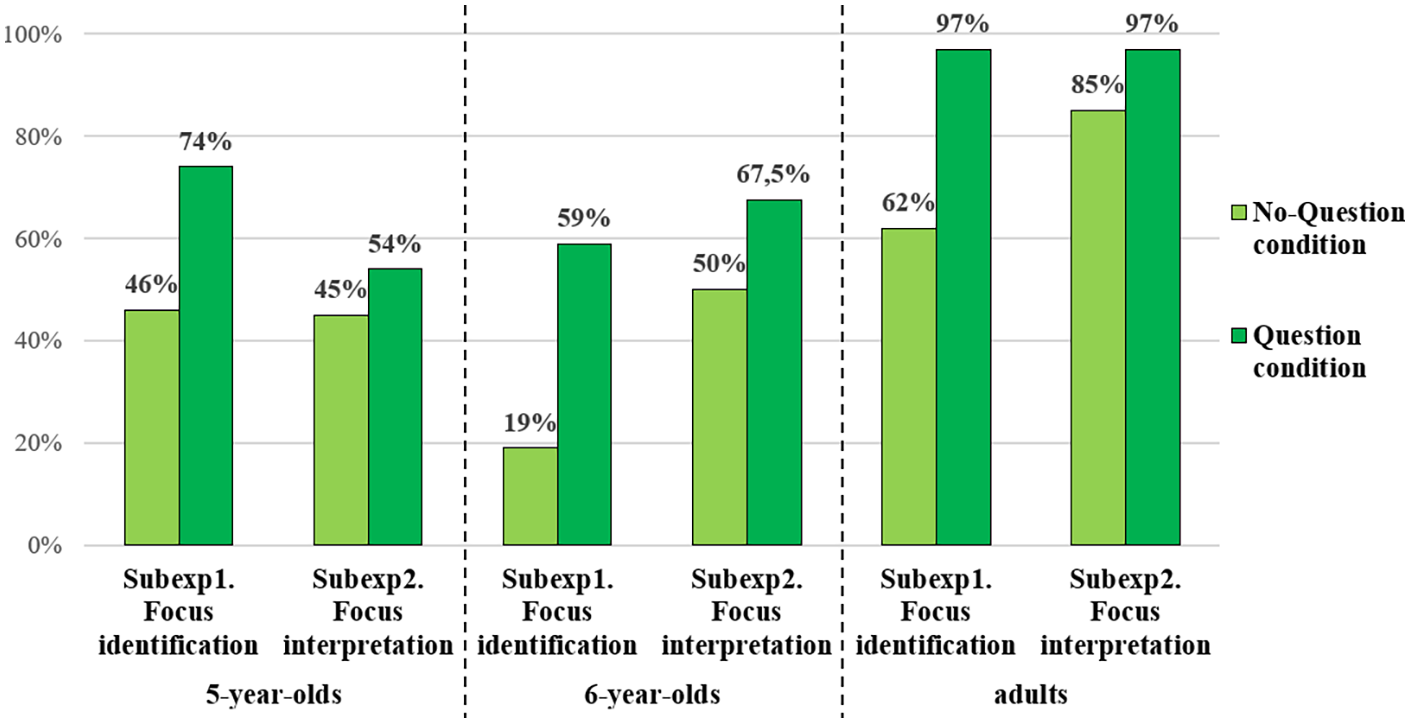
The Rate of Expected Responses in the Two Sub-Experiments.
The resulting dataset was analyzed by binomial Generalized Mixed-effect Models in R (R Core Team, 2020) using the package lme4 (Bates et al., 2015), including maximal converging random effects structure (Barr et al., 2013). The binary (non-)expected responses served as the dependent variable; the three fixed effects were
The analysis revealed that all three fixed variables affected the ratio of expected responses significantly. The effect of
Further tests performed using the Anova () function (from the car package by Fox & Weisberg, 2019) revealed that while there was no interaction among the three fixed effects, χ2(2) = 0.25, p = .884, each pair of factors were in significant interaction with each other. First,
Second, the interaction between
Finally, the most crucial finding was the strongly significant interaction of
In order to be able to address the two main predictions concerning children’s focus comprehension formulated at the end of the “Method” section, we further explored the data collected from the two groups of preschoolers separately from adult responses.
First off, to verify that the main findings above (i.e. the effect of
Second, based on the interaction of
Discussion
The objective of the two sub-experiments was to shed light on the source of preschool children’s limited ability to arrive at exhaustive interpretations of focus, which was also detected in this study. In this section, we evaluate the results in view of the role of the two potential explanatory factors considered earlier, namely, (i) the proper identification of focus and its alternatives, and (ii) computing the exhaustivity inference itself.
First, it was expected independently of the choice between (i) and (ii) that adding an explicit and congruent wh-question would enhance children’s accurate identification of the focus and its contextual alternatives (by boosting the latter’s relevance), and would thus increase their rate of focus-congruent corrections. Our first sub-experiment corroborates this prediction, as it shows a marked difference between the No-Question and the Question conditions in children’s data: the ratio of congruent subject-focus corrections was significantly higher in the second session involving a preceding interrogative (with a 34% rise on average), and this effect was not significantly modulated by a difference between the two child age groups.
It is the results of Subexp2 and their relation to the results of Subexp1 regarding which the predictions of explanations (i) and (ii) diverge. The first account, according to which children’s chief problem is with appropriate contextualization, predicted that the presence of a question would significantly raise the rate of children’s exhaustive focus interpretations in Subexp2, and that it would do so by roughly the same extent as the presence of a question improves the rate of accurate focus identification in Subexp1. The second account, according to which children’s main difficulty is with enriching sentence meaning with the exhaustivity inference itself, predicted that the insertion of a preceding wh-question will either not raise the proportion of exhaustive interpretations at all, or it will do so by a smaller rate than it does in Subexp1. The significant interaction between
It emerged from the analysis of children’s responses in the two tasks that while the two age groups were impacted similarly by the presence of the question in the focus identification task in Subexp1, their behavior was affected differentially in the exhaustification task of Subexp 2 (as revealed by the significant interaction between
A possible alternative explanation draws on a different answer to question (a) concerning the factor behind the rise in exhaustive readings seen in Subexp2. Thus far, we have based ourselves on the assumption that the key contribution of a preceding wh-question in the experiment, prominently figuring in Subexp1, is the better identification of the focus and its alternatives in the context. However, wh-questions might have an additional effect on the interpretation of sentences with a focus. In particular, it has been proposed that by default, adults interpret wh-questions as requiring an exhaustive answer. If that is so, then a wh-question may directly enhance the very inference of negating the relevant alternative propositions. Formal accounts of wh-question exhaustivity ascribe this property to the presence of a silent exhaustivity (or maximality) operator linked to the wh-phrase (Groenendijk & Stokhof, 1984), essentially similar to the lexically unanchored silent operator associated with an exhaustively interpreted focus (see the “Introduction” section). Expressed in these terms, the silent exhaustivity operator that comes with wh-questions primes construing a sentence containing a congruent focus as also including the same kind of operator. 5 If children’s difficulty in interpreting focus has to do directly with drawing the exhaustivity inference itself (=account (ii)), then one would expect that, similarly to what was found for adults both in the present experiment and in earlier studies cited above, they will interpret sentences with a focus more exhaustively if it is preceded by a congruent wh-question.
The latter expectation crucially draws on the hypothesis that, like adults, children interpret wh-questions as requiring an exhaustive answer. This, however, is a property of children’s comprehension that has been shown to be developing precisely at around the ages examined in the current experiment. Roeper et al. (2007) found that in the course of language acquisition, children move at around the age of 6–7 (depending on the language) from a stage in which they interpret questions as only requiring a singleton answer to a stage in which they already take wh-questions to need an exhaustive response. This converges with our findings and could straightforwardly explain the difference between Hungarian 5-year-olds and 6-year-olds, resolving question (b) above. Specifically, if wh-questions are more likely to be interpreted by 6-year-olds as needing an exhaustive answer, then this age group is more likely to be primed by wh-questions to understand focus in the answer as also exhaustive. Note that this explanation of the divergence between 5- and 6-year-olds in Subexp2 crucially relies on account (ii) of preschoolers’ difficulty with focus exhaustivity, to which it therefore lends further credence.
Additional support for account (ii) comes from an interesting correspondence in children’s responses in Subexp1. Namely, in the case of focus identification in the presence of the contextual support provided in the Question condition children reach the level of adult performance that is found in the No-Question condition. This indicates that in this task contextual support helps children perform at a level that is not unlike adult behavior in the absence of contextual support. What is noteworthy is that the same pattern is not seen in the exhaustification task. Specifically, in Subexp2, in the presence of the same kind of contextual support available in the Question condition children’s performance does not even come close to the performance of adults in the No-Question condition. This observation further corroborates our main conclusion that, in line with account (ii), preschool children have difficulty with focus exhaustification itself, which cannot be explained away as being simply due to failing to reliably identify the focus in the sentence based on the context.
We find an interesting mismatch between the developmental trajectory in Subexp1 and that seen in Subexp2, which is decidedly unexpected under account (i), which posits that children’s problem with focus exhaustification derives from their difficulties with focus identification. 6 In particular, somewhat surprisingly, in the identification task, 6-year-olds provided significantly fewer congruent corrections than 5-year-olds, giving rise to an overall U-shaped developmental curve. At the same time, in the exhaustification task, the trajectory is perceptibly different: the rate of expected responses in the 6-year-old group is slightly increased from that found in the 5-year-old group, with further development taking place until adulthood. While unexpected on account (i), this difference between the two acquisition paths is not inconsistent with account (ii), which does not purport to marry preschoolers’ exhaustification limitations with their focus identification difficulties. 7
Although we must concede upfront that the five judgments collected from each participant in each critical condition cannot serve as a firm basis to analyze within-subject consistency in our data, as we find a near 50% share of expected responses in four sets of responses given by either 5-year-old or 6-year-old children in some condition (see Figure 3), it is important to look into the individual patterns behind these chance-like group performances. Close scrutiny reveals that they are not simply due to guessing behavior. If we consider the performance of a child mixed if she gives an expected response two or three times out of the five critical trials, then we get the following picture of these chance-like group patterns. In two cases (5-year-olds and 6-year-olds in the No-Question condition of Subexp2) only 12.5% of children (2/16) gave mixed judgments, in one case (5-year-olds in the Question condition of Subexp2), 25% of children (4/16) responded inconsistently, and in one other case (5-year-olds in the No-Question condition of Subexp1), 37.5% of the given child group (6/16) provided mixed responses. As these rates reveal, guessing is not the most common individual pattern behind any of the four cases in which we see chance-like performance at the group level. 8
Finally, it is worth briefly contrasting these findings with those obtained from experimental work on the acquisition of scalar implicatures associated with scalar items like some. As noted in the “Introduction” section, it has been convincingly argued that contrary to prior empirical generalizations, preschoolers have the ability to compute these inferences, provided that sentences containing the scalar trigger are appropriately contextualized, making the relevance and identity of scalar alternatives to the trigger sufficiently clear. Our results suggest that children’s difficulties with exhaustification in cleft-like focus constructions like pre-verbal focus in Hungarian may be qualitatively different, since analogous contextualization seems to have little to no effect on the rate of exhaustive interpretations of focus. This contrast with scalar implicatures is also of relevance to a long-standing and recently renewed debate regarding the source of exhaustivity in syntactically marked focus in Hungarian and in clefts in languages like English and German. Specifically, in the controversy that revolves around the question whether this meaning component is due to a scalar implicature or a presupposition (the former being more context-dependent than the latter; for a recent overview, see Onea, 2019), it provides indirect evidence against the scalar implicature approach. If the exhaustivity inference in cleft-like focus constructions indeed differs from that associated with purely prosodically marked focus not only in terms of strength (cf. Note 1), but also regarding its nature, then this study makes clear and testable predictions concerning languages like English and German. In particular, an explicit QUD in the immediately preceding context should greatly enhance preschool children’s exhaustive interpretations of prosodically marked focus in these languages, especially compared to it/es-clefts, whose exhaustivity is expected to be affected at most to a minor extent, if at all. These predictions are hoped to be checked by future research.
Conclusion
This study reports on two sub-experiments designed to explore the source of preschool children’s limited access to the exhaustive interpretation of focus in the cleft-like pre-verbal focus construction of Hungarian. According to the predominant view emerging from recent work on the acquisition of scalar implicatures, preschooler’s high rate of failure to associate a scalar inference with items like some is only apparent in that it does not reflect the lack of their competence to compute the inference itself, but rather it stems from their immature contextualization abilities, including the capability to access contextually relevant alternatives. By contrast, our findings indicate that children’s low rate of exhaustification of focus reflects a genuine qualitative difference from adult-like focus comprehension, possibly rooted in a non-adult-like linguistic representation of focus exhaustivity. As shown by our experimental results, this inadequacy cannot be overcome through providing an appropriate discourse context that helps identify the focus and its alternatives by making the QUD explicit.
Footnotes
Appendix 1
Appendix 2
Acknowledgements
The authors thank the anonymous reviewers and the associate editor for this paper, Virginia C. Mueller Gathercole, for their insightful comments and helpful suggestions.
Author contribution(s)
Funding
The author(s) disclosed receipt of the following financial support for the research, authorship, and/or publication of this article: The research reported here was funded by the Hungarian National Research and Innovation Fund (grant no. KH-130558), and it was also supported by the Thematic Excellence Program of the Hungarian Ministry for Innovation and Technology (project no. 2020-4.1.1-TKP2020-NKA-11, Theoretical and Experimental Linguistics) as well as the ÚNKP-20-4 New National Excellence Program of the Ministry for Innovation and Technology (grant no. 20-4-II-PPKE-46) awarded to the first author.
