




Abstract
While it is common for deaf children to be bilingual in a spoken and signed language, studies often attribute any delays in language acquisition to language deprivation, rather than as a result of cross-linguistic interaction. This study compares the production of simple sentences in three languages (Palestinian Arabic, Modern Standard Arabic, and Israeli Sign Language [ISL]) and three language modalities (spoken, written, and signed) by deaf and hearing students in an Arabic-speaking community. Thirty-eight school-age Palestinian Arabic–speaking students participated in a sentence elicitation task in which they retold the events portrayed in video clips. Hearing students (n = 19) produced the sentences in spoken Palestinian Arabic and in written Modern Standard Arabic. Deaf students (n = 19) produced the sentences in these two language varieties and additionally in ISL. Omissions of arguments and verbs were compared across the two groups and three languages. Results showed that deaf students omitted more arguments and verbs compared with their hearing peers who scored at close to ceiling. Deaf students produced more omissions for direct objects and more omissions in ISL. The findings can be interpreted in two possible ways: atypical effects resulting from inconsistent language input and cross-linguistic transfer known to arise in multilingual children.
Keywords
Introduction
Deaf children often present delayed spoken and written language abilities compared with hearing children (e.g. Friedmann et al., 2008; Tomblin et al., 2005). However, it has been shown that when deaf children grow up in a bimodal-bilingual environment with exposure to both signed and spoken language, their rate of language acquisition is comparable with their hearing peers (Davidson et al., 2014; M. L. Hall et al., 2019; Rinaldi & Caselli, 2014). Yet, when spoken and signed languages interact in bilingual settings, this results in contact-induced phenomena such as transfer of spoken language elements into sign language (Quinto-Pozos & Adam, 2015 for an overview) or vice versa (Koulidobrova, 2016).
The current study provides insights into language contact between Israeli Sign Language (ISL) in the signed modality, Palestinian Arabic (PA) in speech, and Modern Standard Arabic (MSA) in writing. Specifically, we explore argument and verb omissions in these languages by groups of deaf and hearing school-age students.
Language deprivation
Deaf children sometimes experience language deprivation (W. C. Hall, 2017). Note that the term language deprivation here does not relate to environmental neglect, which is caused by lack of childcare or absence of a nurturing and loving environment. Deaf children in these studies were raised by caring families, and in most cases, hearing impairment identification and intervention started at an early age (including in Israel, the site of the current study, see Novogrodsky et al., 2018). Moreover, parents seek support to enhance language and communication at an early age (Keen, 2007; Napoli et al., 2015). For deaf children, language deprivation reflects lack of exposure to a consistent language input (Meir, 2014; Novogrodsky et al., 2017). Deaf children receive limited spoken language input compared with hearing children, and this limitation is even more apparent for incidental language input (Novogrodsky et al., 2018; Tomblin et al., 2005). For children who use sign language, as is the case for the students in this current study, language input is often inconsistent because for most of them, sign language input differs between home and school; they do not receive explicit sign language instruction and teachers are not necessarily proficient users of sign language (Hou et al., 2019; Meir, 2014). In many cases, teachers use a combination of signed and spoken language (such as signed English or signed Arabic). Furthermore, those children from non-signing families receive reduced exposure in terms of incidental sign language input. This leads to unique and difficult conditions for language acquisition (Meir, 2014).
Language interaction
Deaf children who use sign language become bilingual during the school-age years when they learn to read and write the spoken language of the surrounding community. The common term used for this phenomenon in the literature is bimodal-bilingualism. Some use this term in a broad way (Lillo-Martin et al., 2014) and some in a more restricted way (Novogrodsky & Meir, 2020a). In the current study, we follow the broader definition of bimodal-bilingual. According to Lillo-Martin and colleagues (2014), in the broad sense, bimodal-bilinguals can be hearing or deaf, with varying abilities in spoken, written, and signed languages. In contrast, Davidson et al. (2014) focused on bilingual-bimodal deaf children who sign (American Sign Language [ASL]) and speak (English), before acquiring written language at school. They showed that deaf children with cochlear implants, who are exposed to both language modalities from an early age, scored similarly to their hearing counterparts on spoken language measures. The control group included bimodal-bilingual hearing children with deaf parents who use ASL and English as their native languages. The results suggest that sign language might mitigate negative effects of early auditory deprivation of spoken language (Davidson et al., 2014). In another study, the mixed language input of four deaf mothers and the mixed output of their three deaf and three hearing children were explored (Van den Bogaerde & Baker, 2005). The deaf mothers used code-blending (mixing between Dutch and Sign Language of the Netherlands) in their communication with their children. However, while the deaf children (up to 3 years) showed minimal code-blends in their productions, the hearing children showed code-blends similar to their mothers’. The authors attributed the gap between the two groups in terms of degree of access to spoken Dutch, which was reduced for the deaf group. This study highlighted the effects of exposure and language interaction on early stages of bimodal-bilingual acquisition.
Deaf children with functioning hearing, 1 which allows them to perceive and produce spoken language, and who are exposed to both spoken and signed languages, become bimodal-bilingual (to varying degrees). Language skills of bilingual children who are exposed to two spoken languages are usually distributed unequally across the two languages and even within the same language that the child speaks (e.g. comprehension vs production, vocabulary vs syntax; see Kohnert, 2010). Similarly, the language ability of bimodal-bilingual children varies across the two languages and it might show differences in language dominance as the child’s languages develop. This bimodal-bilingual continuum is shown to relate to factors such as age of hearing loss identification (and in some cases, the age of hearing loss), the severity of hearing loss, the age of exposure to the respective languages, the hearing status of the parents, and schooling policy (Plaza-Pust & Morales-López, 2008).
For bimodal-bilinguals (both deaf and hearing), some linguistic properties are transferred from one language into the other, and this process is known as cross-linguistic transfer. These effects have been recorded in a number of language pairs (ASL – English, Italian Sign Language – Italian, British Sign Language (BSL) – English, and Sign Language of the Netherlands – Dutch; for an overview, see Koulidobrova, 2016). For example, Koulidobrova (2016) tracked the language acquisition of two bimodal-bilingual hearing children who grew up exposed to ASL and English. She focused on instances of subject and object omissions, which in ASL is more freely possible than in English (Lillo-Martin, 1986) and found evidence of cross-linguistic effects. The bimodal-bilingual children omitted more arguments than English speakers and these omissions were consistent with their ASL, which allows null arguments (Koulidobrova, 2016). Likewise, Pe’er-Strugo (2020) tested bimodal-bilingual school-age deaf students in ISL and Hebrew. The children in this study showed omissions of function words in Hebrew, an infrequent feature in ISL. Plaza-Pust and Morales-López (2008) suggested that for deaf children, contact phenomena between signed and spoken languages range from a switch to another language, integration of loan vocabulary and language change on the diachronic level (which is beyond the scope of the current study). For example, bimodal-bilingual signers of Chinese and Chinese Sign Language combine elements of Chinese Sign Language and mouthing from spoken Chinese, together with elements of written Chinese by tracing the strokes of characters in the air or on the palm of the hand. Therefore, language contact phenomena are a ‘natural’ outcome of language contact and bilingualism.
In addition to being bimodal-bilingual, students in the current study use two distinct varieties of Arabic. Arabic is a typical case of diglossia, in which the spoken and written languages are linguistically related, yet different at all linguistic levels: phonology, morpho-syntax, lexical-semantic, and pragmatics (Khamis-Dakwar et al., 2012; Saiegh-Haddad & Spolsky, 2014). The spoken language (in our case, PA) is the first language acquired by hearing children and is used in regular day-to-day interactions. While the written language, MSA, is formally taught in school, hearing children are also exposed to it in specific contexts such as children’s books and in some spoken language contexts, such as religious sermons. Therefore, there is interaction between PA and MSA in acquisition and with age, children develop the ability to distinguish between these two distinct language varieties (e.g. Ravid et al., 2014). In the case of deaf children though, MSA is used mostly in reading and writing, because spoken MSA (e.g. radio, television) is not fully accessible to them in the auditory modality.
Few studies have tested the interaction between PA and MSA in terms of syntactic acquisition, which is the domain explored in the current study (e.g. Khamis-Dakwar et al., 2012; Ravid et al., 2014). Khamis-Dakwar et al. (2012) examined the acquisition of ten syntactic structures among 120 children from first to fifth graders. Six structures represent a mismatch between PA and MSA (subject–verb agreement, negation, yes/no questions, dual number marking, relative pronouns, and passive) and four structures are similar across the two language varieties (plural, adjective definiteness agreement, construct phrases, 2 and wh-questions). All structures are taught explicitly as part of the MSA curriculum between Grades 1 and 4 (except for passive structures which are not addressed in the curriculum), and children are exposed to them incidentally through the MSA curriculum and outside of school. The findings showed that in a judgment task, children performed better on structures that were similar across the two language varieties. Furthermore, children performed better on structures that are acquired early (e.g. plural marking and word-order agreement) and poorly on structures that are acquired late cross-linguistically (e.g. passive structures and relative pronouns). These studies show the clear interaction between PA and MSA in language acquisition.
The current study examined the omissions of arguments and verbs in simple sentence production. We examined both PA and MSA. The next section explains the notion of argument structure and its acquisition.
Acquisition of argument structure by hearing children
Verbs play a central role in language acquisition in spoken and signed languages. They link meaning and sentence structure, and it is the argument structure of verbs which represents this link. Argument structure includes the subject of the verb and its complements and the rules about the constituents that must be present in the sentence (Botwinik-Rotem & Friedmann, 2009; Pinker, 1989). Arguments can be obligatory in some languages and optional in others. Furthermore, the number and types of complements are determined by the verb’s meaning and by the syntactic requirements of the language. For example, verbs can have no complements, or multiple complements (e.g. ‘I run’, ‘I eat an
The acquisition of argument structure in spoken languages starts at pre-school and extends into adolescence (Berman, 1986; Gentner, 1978; Naigles et al., 1992). In typical acquisition, the first true verbs appear during the period of ‘single word utterance’, around 16 months, after the child has acquired numerous nouns (Gentner, 1978). Based on observational and experimental data from children aged 2:6–5:6 years, Berman (1986) suggested that children reach near-mastery of the concepts of causativity and the distinction between transitivity and intransitivity of verbs (e.g. push vs run) at pre-school age. Development continues into school-age and until adulthood (Naigles et al., 1992) and is affected by different variables, including verb-specific frequency (Abbot-Smith & Tomasello, 2010). In the next section, we discuss the acquisition of argument structure by deaf children.
The acquisition of argument structure by deaf children
As aforementioned, some deaf children show delays in their language proficiency, compared with hearing children with typical language development (Boons et al., 2013; Friedmann & Haddad-Hanna, 2014). With regard to PA, which is explored in the current study, school-age deaf children have been shown to score significantly lower than hearing children in a variety of syntactic tasks (e.g. Friedmann & Haddad-Hanna, 2014; Kawar et al., 2019; Novogrodsky et al., in press). These findings might suggest that deaf children face difficulties in acquisition at the sentence level. However, to the best of our knowledge, no study has explored omissions of arguments in simple sentence production in deaf children from Arabic-speaking communities.
Since the current study is interested in argument structure of deaf signing students, we take a moment to briefly consider how sign languages represent arguments in sentences and how omissions might arise. It is claimed that there are no dedicated morphemes to distinguish arguments (e.g. subject vs object) from each other in sign languages (Cormier, 2012). Some sign languages, however, do have special signs, such as object pronouns, whose sole purpose is to signify the object in the utterance (see Meir, 2003 for ISL; Börstell, 2019 for Swedish Sign Language). For those sign languages that lack overt marking, word order is an important strategy for expressing grammatical relations (Cormier, 2012), but word order itself is also affected by properties of the arguments (e.g. animacy) (Meir et al., 2017).
Similar to spoken languages, argument structure of sign languages is also largely based on verb semantics. In a corpus-based study of 25 verb meanings in Russian Sign Language, Kimmelman (2018) confirms that some verbs are more ‘transitivity prominent’ than others because of their semantics, as shown in spoken languages (Haspelmath, 2015). For example, verbs which almost always require a direct-object in terms of their semantics (e.g. ‘see’) are transitive, while those that do not are intransitive (e.g. ‘laugh’) (Oomen & Kimmelman, 2019). This was further corroborated by Börstell and colleagues (2019) in four other sign languages: Sign language of the Netherlands, German Sign Language, Finnish Sign Language, and Swedish Sign Language, although considerable variation between individual languages was evident. In addition to the transitivity distinction (intransitive vs transitive) in sign languages, most verbs fall into one of three inflectional classes subject to their argument structure (Rathmann & Mathur, 2003). These include: (1) verbs that take two animate arguments as part of their argument structure, (2) verbs of motion and location, and (3) the rest of the verbs, which take one animate argument along with other inanimate arguments. The first class of verbs, also known as agreeing 3 verbs according to Padden’s (1988) morphological criteria, show agreement for person and number. For agreeing verbs, the movement of a sign such as GIVE can move from one location to another to agree with the subject and/or object (see Figure 1). In the second class of verbs, also known as spatial verbs, the movement of the sign agrees with locations (Meir, 2002). Finally, the last class of verbs, plain verbs, do not show any agreement (e.g. EAT, WANT 4 ). More specifically in ISL, the same three verb classes have been documented and discussed in depth by Meir (1998, 1999).
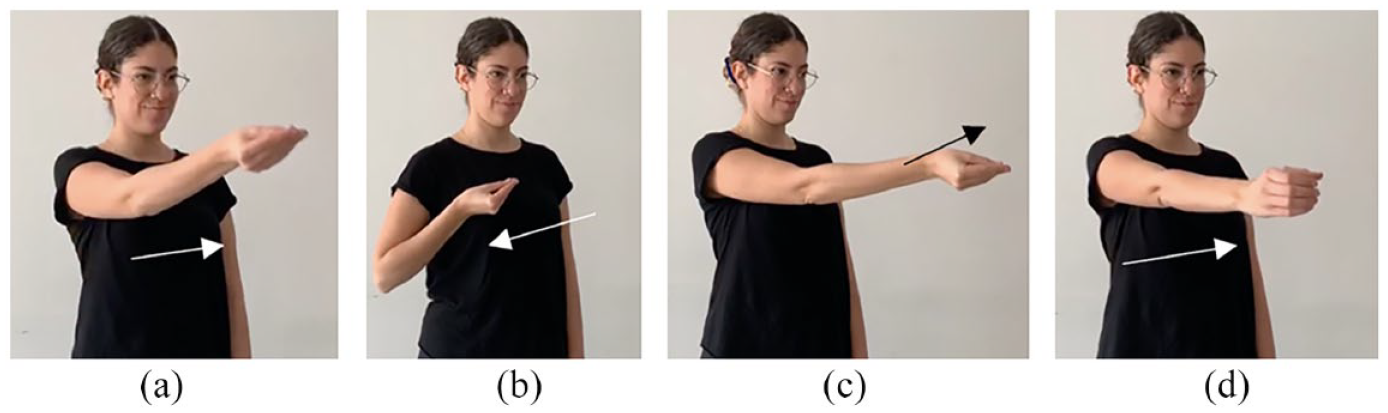
The ISL Sign GIVE Agrees with Person in (a) I-GIVE-YOU, (b) YOU-GIVE-ME and (c) SHE-GIVES-HIM, and (d) I-GIVE-YOU (Something Cylindrically-Shaped) Produced with a Handling Classifier.
In some sign languages, arguments may be omitted, for example, (1) when produced with agreeing verbs (Lillo-Martin, 1986), (2) with body-anchored verbs (Oomen & Kimmelman, 2019), or (3) or when indicating agent defocusing (Nordlund, 2019). Studies suggest that the presence of verb agreement can result in the omission of subjects and objects (Lillo-Martin, 1986 in ASL), although the nature of this omission is debatable (Koulidobrova, 2016). Meir and colleagues (2017) describe the notion of ‘body as subject’ verbs in which for plain verbs, a signer’s body represents one of the arguments, the subject, and therefore, subject omission is acceptable or rather represented by the body. Similarly, Hou and Meier (2018) found that the center of the chest is the default first person object marker in ASL, with the exception of only a few signs. Verb agreement is reported to be acquired by the age of 3–4 years (see Morgan et al., 2006 for BSL; Meier, 1987; Supalla, 1982 for ASL) or even earlier (Quadros & Lillo-Martin, 2007).
Some verbs may be modified to incorporate features of arguments using classifier handshapes (Emmorey, 2003). Classifier handshapes depict whole or part entities or the handling and size and shape of objects (Johnston & Schembri, 2007). In fact, Meir (1999) describes verb classifiers in ISL as instances of noun incorporation. For example, the handshape of the verb GIVE can be modified to indicate the object, a bottle, using a handling handshape (as shown in Figure 1(9d)). Note that the handling classifier does not replace the lexical sign for BOTTLE as the classifier alone can be confused with any cylindrical-shaped object. That said, in a relatively new sign language in Turkey (Ergin et al., 2018), adult signers produced object omissions and in these cases, signers incorporated object handshapes into the verb (e.g. in the sentence WOMAN BALL-ROLL [i.e. ‘woman rolls the ball’, the sign for ‘roll’ was produced with a handling classifier to represent the object ‘ball’]). Similar to spoken languages, these findings suggest that sign languages can omit arguments but that this is dependent on the syntactic structures and verb characteristics of each specific language.
The present study
The deaf students investigated as part of the current study are an interesting case of multilingualism. They are not only bimodal-bilingual, in PA and ISL, but they can be better described as trilingual, they also use written MSA, a distinct language variety as aforementioned. We explored simple sentence production of school-age deaf students in three modalities: in speech and writing in two distinct language varieties of Arabic (PA and MSA), and in a third language, ISL. These productions were compared with the same sentences produced by hearing students (with the exception of ISL). Specifically, we explored argument omissions and verb omissions, which gave us insight into the acquisition of argument structure in each language and language interaction of the three languages.
Following previous studies exploring omissions in atypical populations (e.g. Novogrodsky et al., 2018; Thordardottir & Ellis Weismer, 2002), we treated omissions as an indication of lack of proficiency of verb argument structure. We predicted that deaf students would show more argument omissions compared with hearing students due to lack of exposure to a fluent language model. We discuss the findings in light of two possible interpretations: language deprivation and cross-linguistic transfer.
Method
Participants
Thirty-eight students were recruited from the North of Israel; they all used the same PA dialect from the Nazareth area. Students were recruited through personal connections and parents provided signed informed consent for all participation.
Deaf students
Nineteen bimodal-bilingual school-age deaf students (11 boys and 8 girls), aged 11:08–21;00 participated in this study. They all attend special classes for deaf students, use ISL and PA for daily communication and MSA mainly for writing in school-related activities. All students are severely or profoundly deaf and they use bilateral hearing devices: hearing aids, cochlear implants, or a combination of the two (see Table 1 for students’ characteristics). Typically, students who attend special classes with sign language as the language of instruction do not have sufficient hearing function (i.e., their hearing abilities with the hearing device) to rely on spoken language alone in a learning environment. However, as part of the intervention program, students received the best amplification for their hearing impairment. All students are able to perceive speech and they communicate in spoken language on a daily basis with good speech intelligibility, allowing them to complete the task as part of the current study. With regard to sign language, while all students are exposed to ISL at school (the school follows a bilingual program of ISL and PA as the languages of instruction, for an overview of bilingual programs see Plaza-Pust & Morales-López, 2008), 13 come from families with deaf relatives, 11 of these from families with first-degree deaf relatives (see details in Table 1). Six come from families with no deaf relatives. Though we did not measure sign language exposure directly, we took the presence of close deaf relatives as a proxy for sign language exposure in the home environment. This was based on the sociolinguistic characteristics of PA-speaking families in Israel, in which in most cases, extended families live in close proximity, within the same village, town, or neighborhood. ISL was not assessed in this study, since no standardized ISL language tests exist for this age range.
Information about the deaf group (n = 19).
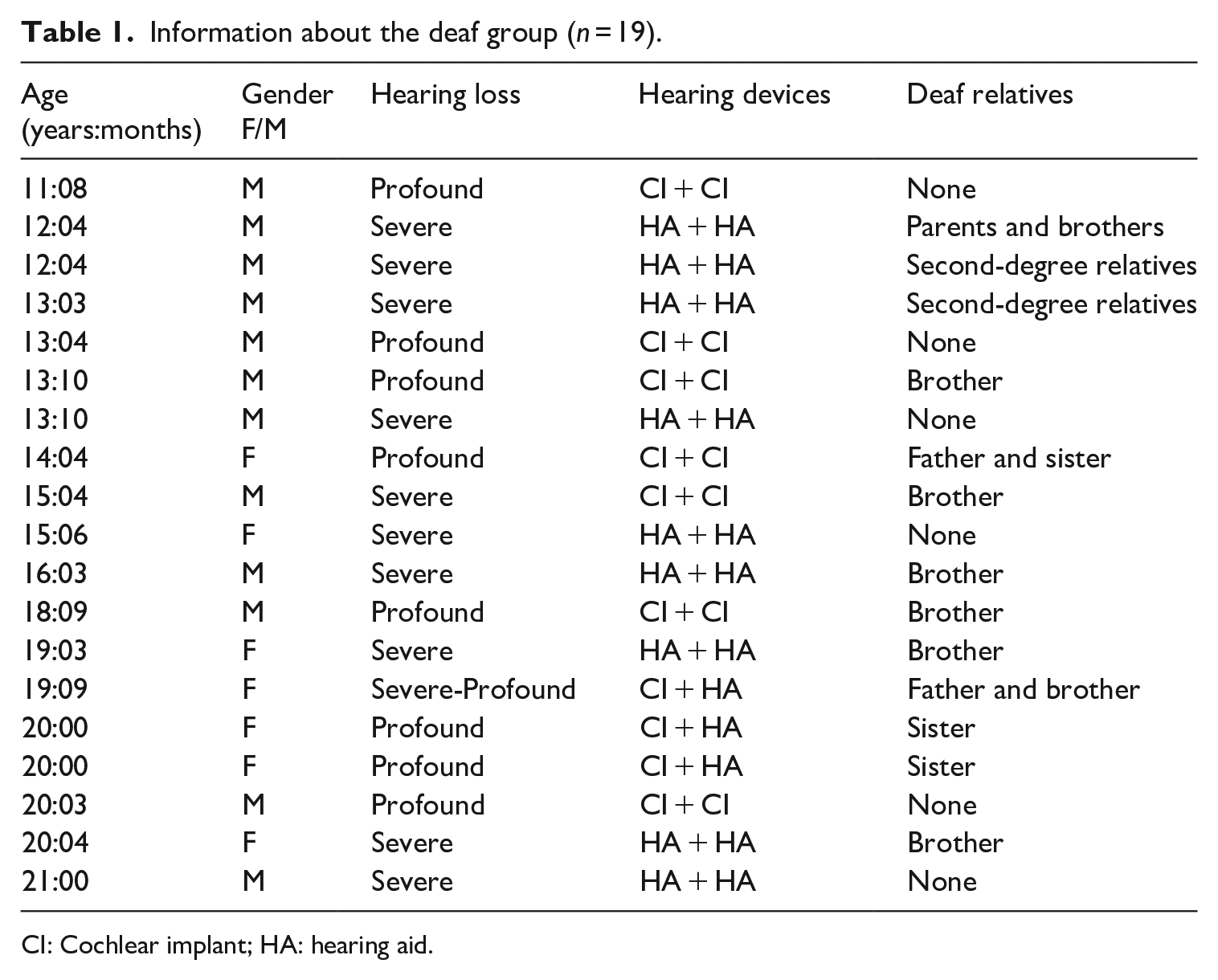
CI: Cochlear implant; HA: hearing aid.
Hearing students
Nineteen students (8 boys and 11 girls) aged 8–14 participated in this study. They all had typical hearing, based on parental reports. The group was divided into two age groups (ages 8–10 and 12–13), with the aim of comparing the omissions of deaf children to the omissions of younger hearing children, as is common in the field of atypical acquisition (e.g. Novogrodsky & Kreiser, 2015). However, as shown in our results, the performance of both age groups was near-ceiling with no significant difference between them, and therefore, the two groups were combined into one control group.
In both groups, students had no additional cognitive or neurologic disorders based on reports from their parents and teachers. The Ethics Committee at the University of Haifa approved this study.
Materials
The research stimuli included 24 short video clips in which one event occurs (see Appendix 1 for a full list of the described events). All target responses could be described in a simple sentence. The target sentences included 8 with two arguments and 16 with three arguments. The sentences were controlled for animacy; of the sentences with two arguments (8 sentences), 4 included animate objects (Table 2(a)) and 4 included inanimate objects (Table 2(b)), and of the sentences with three arguments (16 sentences), 8 sentences included one animate object and one inanimate object (Table 2(c)) and 8 included two inanimate objects (Table 2(d)).
Examples of target sentences in each language.
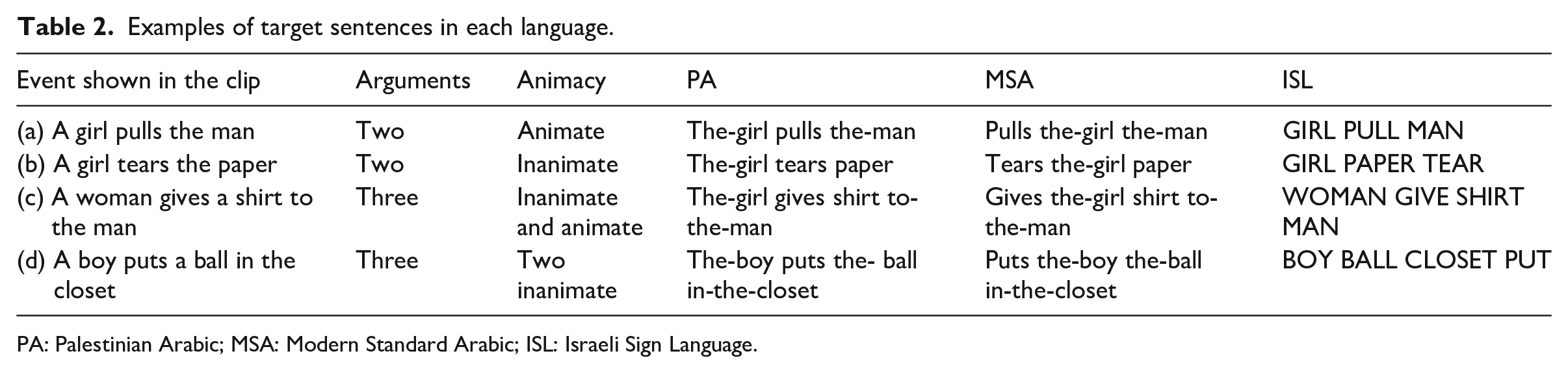
PA: Palestinian Arabic; MSA: Modern Standard Arabic; ISL: Israeli Sign Language.
To check the obligatoriness of arguments, we consulted three hearing PA-speaking individuals and three deaf native ISL individuals. All six individuals completed the same task and two acceptable omissions were found, one object omission in PA and MSA, and one indirect-object omission in ISL. All stimuli sentences required the presence of at least one subject, verb, direct-object, and in 16 of the 24 sentences, also an indirect-object, with only two exceptions. First, in the sentence ‘the man washes the dishes’, the direct-object ‘the dishes’ can be optionally omitted in PA and MSA. For this sentence, the direct-object ‘dishes’ is inferred from the choice of the verb, which is specific to the act of washing dishes. Second, in the sentence ‘the boy puts the sock on his head’, the verb ‘to put’ and the indirect-object ‘his head’ can be incorporated into a single sign (e.g. in ISL ‘BOY SOCK PUT-ON-HEAD’); that is, signers modify the location of the verb, producing it at the head location. Oomen (2017), in her work on psych-verbs such as LOVE or THINK in Russian Sign Language, formalizes the body of the signer as part of a locative adjunct, attached to the verb phrase. Although the sign PUT in ISL is not body-anchored, the position of the verb ‘on the head’ is interpretable from the spatial modification of the verb. For a syntactic analysis of similar examples, see Oomen and Kimmelman (2019). These two examples were not counted as omissions in this study. We return to these examples in the ‘Discussion’ section with regard to understanding more closely the contribution of cross-linguistic transfer.
Procedure
After students watched a video clip, they described what they saw. The same video clips were shown in all conditions. The order of clips was initially randomized and then the same order was maintained across participants and tasks. Students were tested in spoken PA, written MSA, and signed ISL. Instructions were given in PA for all three tasks. Students responded appropriately to each condition suggesting that they understood the task. The signed and spoken tasks were filmed and for the MSA task, the responses were written in a notebook. Deaf students were tested in two separate meetings, in the first meeting they were tested in ISL and in the second one in PA and MSA; hearing students were tested in one meeting in both PA and MSA. The aim of this procedure was to avoid the task effect of Arabic (MSA and PA) on the signed modality, since the aim of the study is to explore the interaction between languages and not the effect of one task on another. In both groups, half of the students started with PA followed by MSA and half started with MSA followed by PA.
Coding schema
An omission was defined as the absence of an argument, which would otherwise be present in the production of the same sentence stimuli by adult users of the language. To determine this, we ran the same task with adult PA-speakers and adult ISL native signers, as described above (see Appendix 2 for an example from ISL). Based on the responses, argument omissions (see examples a, b, c) and verb omissions (d) were counted. For all responses, the third author of the paper who is a native PA speaker coded the PA and MSA productions. This was cross-checked by a research assistant, also a PA speaker from the Nazareth area. Any discrepancies were discussed, and in all cases, errors were immediately rectified. ISL productions were coded by the first author, a linguist who researches ISL. This coding was confirmed by three deaf native ISL signers (one of them is bimodal-bilingual in Arabic and ISL and the other two are bimodal-bilingual in Hebrew and ISL).
Examples of omissions:
(a) Subject omission (in ISL). ‘WATER BOTTLE BOY GIVE’ (target: ‘GIRL WATER BOTTLE BOY GIVE’).
(b) Direct-object omission (in PA). ‘the-girl puts on the-father’ (target: ‘the-girl puts stickers on the-father’).
(c) Indirect-object omission (in ISL). ‘BOY APPLE PUT’ (target: ‘BOY APPLE PUT BOX’).
(d) Verb omission (in MSA). ‘the-girl table shoe’ (target: ‘put the-girl a shoe under the-table’).
Results
Omissions for both groups in three languages are shown in Table 3. While hearing students scored at near-ceiling with a total of only 33 omissions (~1%), deaf students produced 335 omissions (~7%). Note that while 13 hearing students produced at least one omission, all deaf students produced at least one omission.
Raw number of omissions (percentage of omissions to one decimal place).
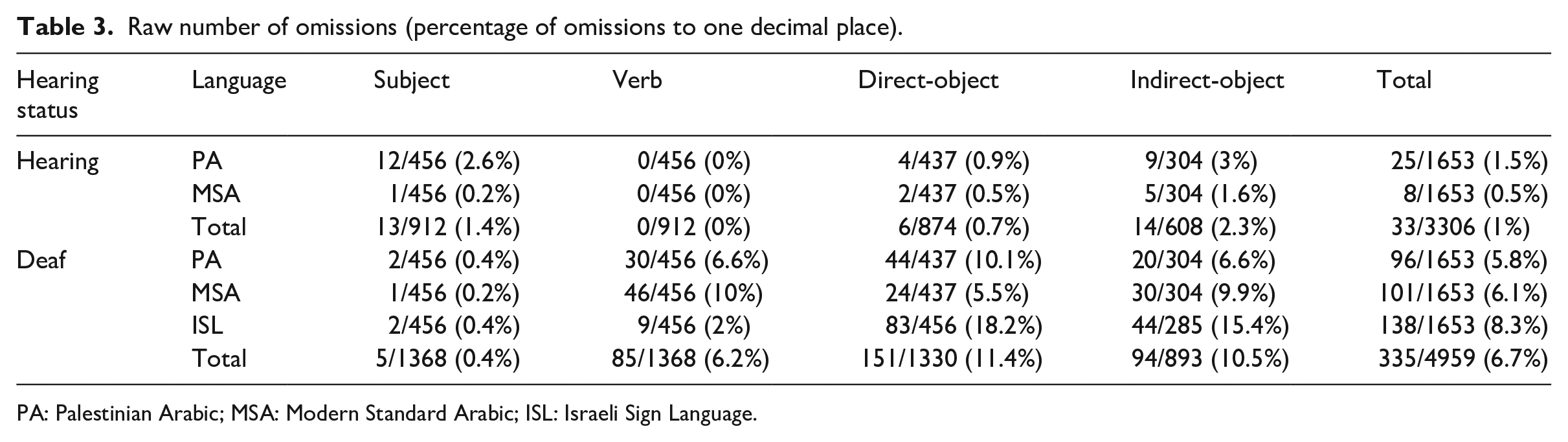
PA: Palestinian Arabic; MSA: Modern Standard Arabic; ISL: Israeli Sign Language.
To investigate the effects of sentence constituents (subject, verb, direct-object, and indirect-object), language (PA, MSA, and ISL), hearing status (deaf and hearing), age (as a continuous variable), and sign language exposure (deaf relatives and no deaf relatives) on omissions, we carried out several multivariate statistical analyses of the data using Rbrul. Of the 8265 tokens analyzed, 368 were omissions. We ran the data in three separate analyses: (1) combined data, (2) hearing students only, and (3) deaf students only. The dependent variable was binary: the presence or absence of omissions. In addition, we included participant and stimuli item as random effects. The inclusion of these two variables enabled us to account simultaneously for participant- and stimuli-specific variability and allowed for generalizations beyond our sample of students and our set of stimuli sentences. Table 4 presents the results, including the log-odds, number of tokens analyzed, percentage of omissions, and the centered factor weight (with omission as the application value). Results with a positive log-odd and a factor weight over 0.5 indicate that this factor results in an increased likelihood that omissions will be present (highlighted in bold in Tables 4 to 6), while a negative log-odd and a factor weight below 0.5 indicate decreased likelihood that omissions will be present in this dataset.
Significant results of the mixed-effects logistic regression (dependent variable: omission; independent variables: sentence constituents, hearing status, language, and age [continuous]).
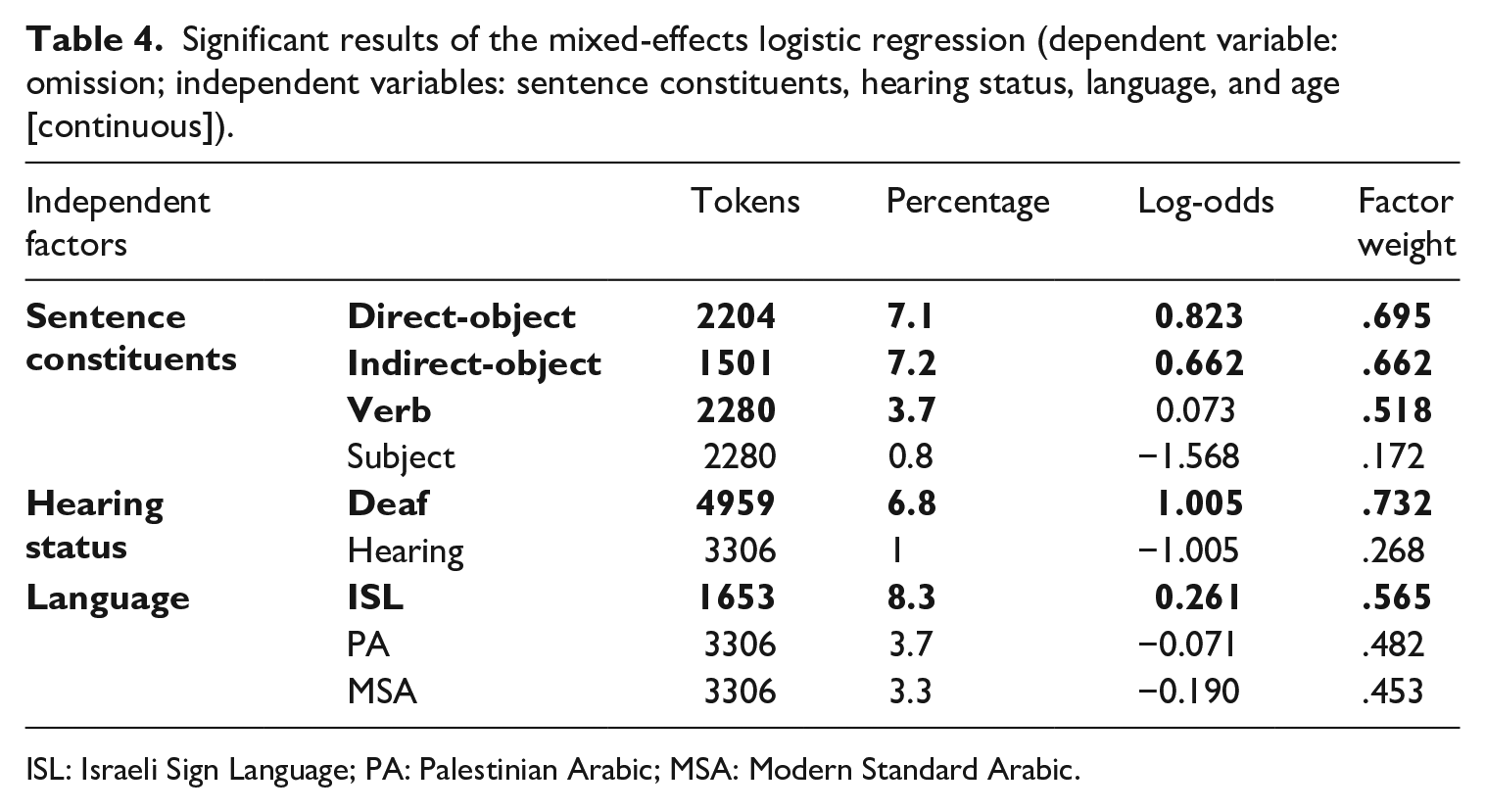
ISL: Israeli Sign Language; PA: Palestinian Arabic; MSA: Modern Standard Arabic.
Significant results of the mixed-effects logistic regression for the hearing group (dependent variable: omission; independent variables: sentence constituents, language, age [continuous]).
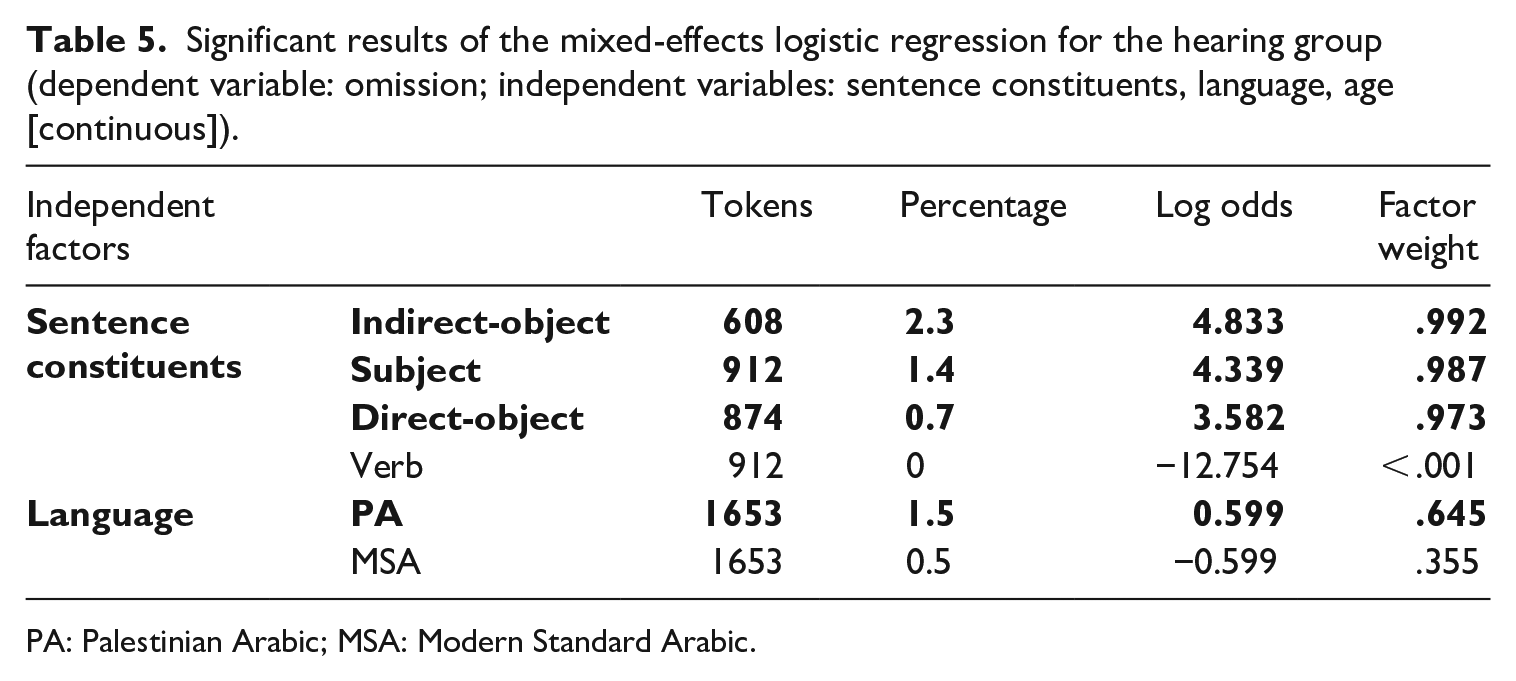
PA: Palestinian Arabic; MSA: Modern Standard Arabic.
Significant results of the mixed-effects logistic regression for the deaf group (dependent variable: omission, independent variables: sentence constituents, language, and age [continuous]).
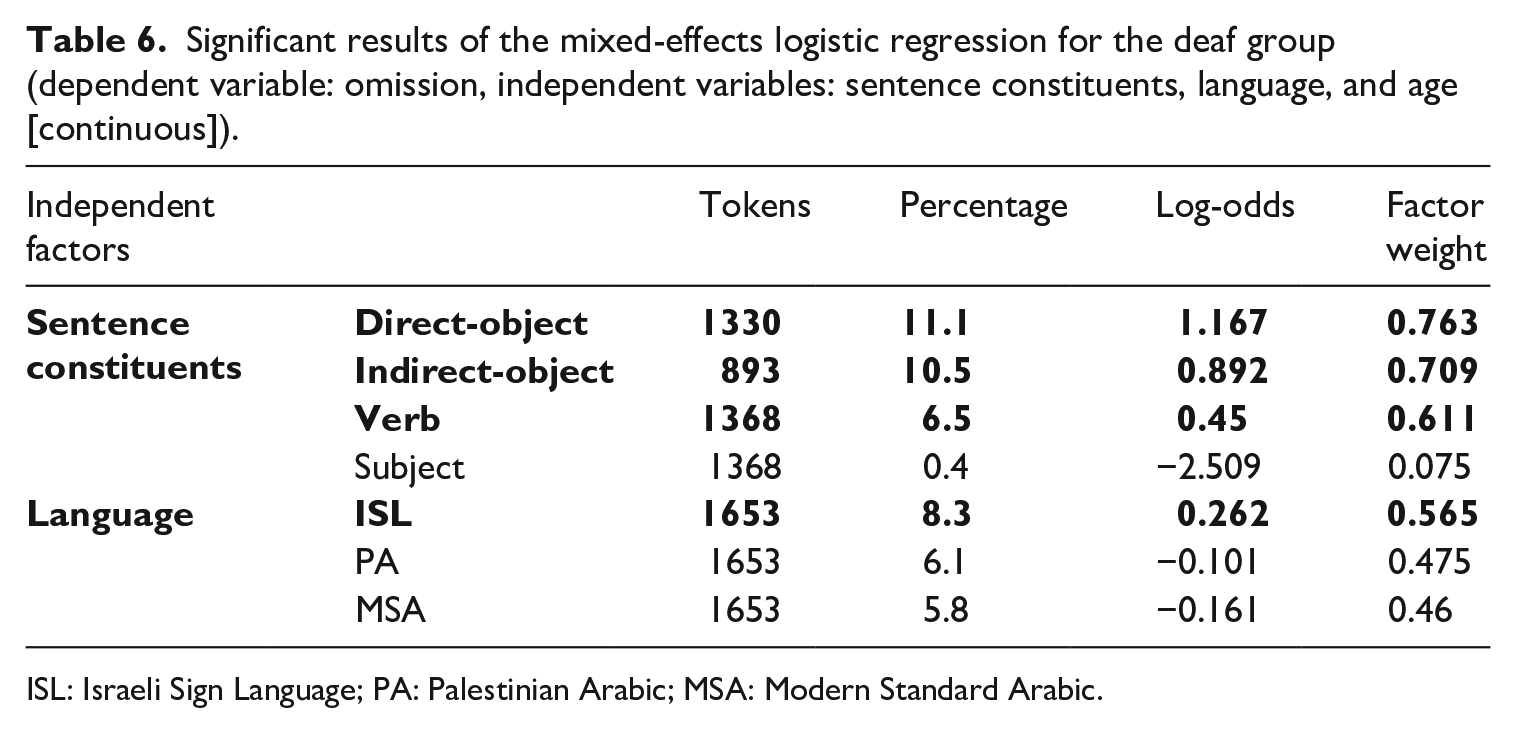
ISL: Israeli Sign Language; PA: Palestinian Arabic; MSA: Modern Standard Arabic.
In the first analysis (shown in Table 4), we found significant main effects of sentence constituents (p < 0.001), hearing status (p < 0.001), and language (p = 0.002). The findings showed that students were more likely to omit direct-objects (e.g. ‘The girl puts on the father’ in PA, for the target sentence: ‘The girl puts stickers on the father’), indirect-objects (e.g. ‘BOY APPLE PUT’ in ISL, for the target sentence: ‘BOY APPLE PUT BOX’, ‘The boy puts the apple in the box’) and verbs (e.g. ‘The girl a-picture on the-wall’ in MSA, for the target sentence: ‘The girl hangs a picture on the wall’). Moreover, deaf students were more likely to omit sentence constituents compared with hearing students and the highest number of omissions were in ISL. Age was not significant in this analysis.
For hearing students (3306 tokens), three fixed-effects were included in the model: sentence constituents (subject, verb, direct-object, and indirect-object), language (PA and MSA), and age (as a continuous variable). There were two significant main effects (see Table 5): sentence constituents (p < 0.001) and language (p = 0.001). The findings showed that students were more likely to omit indirect-objects, subjects and direct-objects, and least likely to omit verbs. Omissions were also most likely in PA and age was not found to be a significant predictor of omissions.
For our deaf group (4959 tokens), four fixed-effects were included into the model: sentence constituents (subject, verb, direct-object, and indirect-object), language (PA, MSA, and ISL), sign language exposure (deaf relatives and no deaf relatives), and age (as a continuous variable). Two significant main effects were found: sentence constituents (p < 0.001) and language (p < 0.001), as shown in Table 6. The findings showed that deaf students were more likely to omit direct-objects, indirect-objects, and verbs, and least likely to omit subjects. Omissions were most likely in ISL. Sign language exposure was not significant, although those individuals with deaf relatives (n = 13) produced a lower average omission rate of 6.8% (SD = 5.4) than those from hearing families (n = 6), with an average omission rate of 8.5% (SD = 4.2). While there is a decrease in the total omissions with age, age was not found to be significant.
Cross-linguistic transfer
To investigate cross-linguistic transfer as a possible effect on omission rates, we analyzed deaf students’ data in more detail. In particular, here we focus on the two exceptions in which the omission of a sentence constituent was acceptable in one language and not in the students’ other language. We discuss two examples. First, in PA and MSA, in the sentence ‘the-man washes the-dishes’, it is acceptable to omit the direct-object ‘the-dishes’, because the verb ‘to wash’ is specific only to the action of washing dishes. However, in ISL, the verb WASH is a more generic verb and therefore the argument ‘dishes’ seems to be required. Second, in ISL, in the sentence describing the event ‘the boy puts the sock on his head’, it is acceptance to omit the indirect-object ‘on head’ by modifying the verb location. However, this is not acceptable in PA and MSA. In addition, we explored the relationship between the use of handling classifiers and omissions. We examined specifically whether the acceptance of an omission in one language was transferred to the students’ other language and resulted in non-acceptable omissions.
ISL into Arabic
For the target sentence ‘the boy puts the sock on his head’, incorporation of the verb and indirect-object ‘on head’ was common in ISL with 7 of the 19 deaf students (37%) producing it as ‘BOY SOCK PUT-ON-THE-HEAD’, in which the verb location was modified. Because the argument ‘on head’ is not produced as a separate sign in ISL, we looked at whether this had an influence on the production of the same argument in the other two languages. In the PA condition, we found that three students (16%) omitted the indirect-object ‘on head’ (e.g. ‘boy put socks’). Similarly, in the MSA condition, we found that three students (16%) omitted the indirect-object ‘on head’ (e.g. ‘the-boy put socks’). Though these numbers are small, when we compared this with another sentence in which all arguments appear to be obligatory in ISL, such as ‘a girl puts the shoes under the table’, we found only a single omission in MSA and no omissions in PA, suggesting that the omission of ‘on head’ is in fact a result of cross-linguistic transference.
Furthermore, of all sentences in ISL that included a direct-object omission, 81% of the verbs were produced with a handling classifier, which in part represents the object. When exploring related cross-linguistic transfer in Arabic for these parallel sentences, we found that for those sentences with object omission in ISL, there was also direct-object omission in 13% of PA sentences and 11% of MSA sentences.
Arabic into ISL
We found acceptable omissions of the direct-object by three students in the PA condition (16%) (e.g. ‘the-guy is washing’) and four students (21%) in the MSA condition (e.g. ‘the-father is washing’). To explore transfer from Arabic into ISL, we looked at this special instance and checked whether the direct-object was also omitted in the ISL condition, in which the object must be signed explicitly (confirmed by our three deaf consultants, see ‘Methods’ section). Ten of 19 students (53%) omitted the direct-object ‘dishes’ in ISL (e.g. FATHER WASH), suggesting that cross-linguistic transfer might be taking place. When we compared this with another sentence in which all arguments appear to be obligatory in PA and MSA, such as ‘a girl tears the paper’ as the target sentence, we found only a single omission in ISL.
To summarize, school-age deaf students showed more omissions compared with hearing students, who scored at ceiling. Some of these omissions may be attributed to cross-linguistic transfer, in which grammatically acceptable omissions are transferred from one language to another. We discuss this further in the next section.
Discussion
In the current study, we investigated the production of simple sentences by school-age deaf and hearing students in PA, MSA, and ISL. Hearing students scored at ceiling on a task which involved simple sentence production in PA and MSA. In contrast, deaf students showed a high number of omissions on the same task, and additionally in their ISL production.
Our discussion focuses on two possible interpretations, each addressed below: language deprivation and cross-linguistic transfer. On the one hand, deaf students in the current study may have experienced language deprivation due to limited access to spoken language and inconsistent sign language input. On the other hand, these students are bimodal-bilingual and therefore acquisition might be influenced by cross-linguistic transfer.
Language deprivation
Language deprivation might in part explain the performance by deaf students compared with hearing students. Meir (2014) discussed the case of deaf students from PA-speaking homes and suggested that they present a complex situation of language inconsistency. According to Meir, due to the different spoken dialects and the different signed variations (e.g. ISL, signed Arabic), children are exposed to inconsistent linguistic input within each language context (spoken and signed). This inconsistency is present in the structure of the languages and in their setting. For example, a deaf child can hear different dialects of PA from different teachers in the school setting and different signed varieties at home and at school. Note that our argument here is not that there is exposure to many different languages (which is the case for many typical multilinguals), but that there is lack of access to consistent language input.
While hearing students scored at ceiling on the task in both PA and MSA, deaf students omitted a high number of arguments and verbs in the sentences they produced, most notably for direct-objects. We suggest that the inconsistent language input they experience has a direct impact on their acquisition of the full linguistic rules of argument structure in the languages they use. In particular, the results showed higher omissions of arguments and verbs in the ISL condition. Notably, ISL is not taught as a language, only used as a language of instruction and this too, might contribute toward our findings.
Another finding supporting the idea of language deprivation is the different types of omissions. Within the small numbers of omissions in the group of hearing students (1% omissions), they did not omit verbs and they only omitted six direct-objects in both PA and MSA (see Table 3). In contrast, most omissions in PA by deaf students were direct-objects, which are obligatory for transitive verbs, as shown by the production of our hearing students. Furthermore, in some instances, deaf students omitted the verb of the sentence, which is arguably the core constituent of any sentence.
Finally, the effect of language exposure at home was tested in the current study by exploring language background: students with exposure to signing at home and those without. Our results show fewer omissions in ISL for signers with exposure to signing at home, although this was not statistically significant. This finding falls in line with studies showing that deaf children exposed to signing from the earliest stage of language acquisition outperform those who are delayed in their sign language exposure (Henner et al., 2018; Mayberry & Lock, 2003; Novogrodsky et al., 2017).
Cross-linguistic transfer
Our second explanation which might account for the high number of omissions in our deaf group is the effects of cross-linguistic transfer (Cummins, 1979; Kawar et al., 2019; Quinto-Pozos & Adam, 2015). Transfer of knowledge from ISL to Arabic and from Arabic to ISL might explain the omissions observed. Our first example involves cross-linguistic transfer from ISL to PA and MSA by incorporating the location of the argument (e.g. head) into the verb (e.g. ‘to put’) in ISL. We suggest that this acceptable omission in ISL (which was not counted as an omission) might account for some of the object omissions found by deaf students in their PA and MSA productions. Our second example shows cross-linguistic transfer in the opposite direction, from Arabic to ISL. In Arabic, the verb ‘to wash (dishes)’ allows an optional direct-object omission since the verb is specific to the act of washing dishes in both language varieties. When students showed examples of direct-object omissions in PA and MSA, they also showed direct-object omissions in ISL, in which the object is obligatory. This finding is in line with evidence showing interaction between Hebrew and ISL in school-age deaf bimodal-bilingual students (Pe’er-Strugo, 2020).
Some of the verbs in our dataset accept semantically locative arguments such as ‘in the closet’/‘under the table’ and these arguments can be treated as goals (Thordardottir & Ellis Weismer, 2002) from a semantic point of view and as obliques 5 from a syntactic point of view. It is possible that obliques are less obligatory than other indirect-objects in ISL, despite the fact that locative arguments were never omitted by our adult ISL signers. As explained by Börstell et al. (2019), distinguishing between oblique arguments and oblique adjuncts is particularly difficult in sign languages and from a semantic perspective, location descriptions are not normally considered arguments, except in cases when they accompany location verbs such as ‘put’. In Börstell et al.’s (2019) study, they found that locative argument-taking verbs showed more variation in terms of transitivity prominence ranking of verb meanings in the five sign languages they investigated. If we err on the side of caution, we can treat our 44 omissions of locative arguments as acceptable in ISL. In doing so, we strengthen our argument for cross-linguistic effects as we can also attribute a further 68 omissions observed in PA and MSA by our deaf students as potential transfer from ISL. This, of course, warrants further investigation. Importantly, the most frequent omissions in ISL and PA by our deaf students were direct-objects, to which we turn next.
Interestingly, we found that when deaf signers omitted an object in ISL they produced the verb with a handling classifier, which in part represents the direct-object. This finding falls in line with Ergin et al.’s (2018) study in which they found that direct-object omissions were accompanied by the use of a classifier handshape in the production of the verb. Furthermore, for those sentences with object omission in ISL, omissions of the direct-object were also found in PA and MSA sentences. Comparing the omissions of different constituents in ISL supports this explanation. In ISL, our deaf signers had only nine omissions of verbs in comparison with 83 omissions of direct-objects and 46 omissions of indirect-objects. This finding suggests that they had the knowledge that verbs might be carrying information about the objects. 6
Not all language transfer may result from absence of a feature in one language (in which the absence is accepted) causing absence of the same feature in the other language (in which the feature is obligatory). Deaf students in our study omitted a high number of verbs in both MSA (10%) and PA (7%), and yet few omissions were seen in ISL (2%). Take the example, ‘a boy puts the apple in the box’, some deaf students produced ‘boy apple basket’ in PA, omitting the verb ‘put’. We assume that deaf students interpret the verb classifier in ISL as one constituent and in this case, the salient feature, which the students overtly produce in PA and MSA is the handshape classifier representing an ‘apple’. This follows Meir’s (1999) claim that verb classifiers are examples of noun incorporation, which serve to narrow the scope of their host verbal root. In this example, the verb PUT or MOVE-TO-PLACE (in terms of its more abstract movement predicate meaning) represents the noun through its handshape morpheme. In another example, ‘a girl puts the shoes under the table’, some deaf students omitted the verb ‘put’ in PA and MSA and instead produced ‘girl table shoe under’. We suggest that deaf students interpret the spatial verb ‘put’ and the preposition ‘under’ in ISL, which are expressed as a single constituent through the use of space, and they explicitly mention only ‘under’ in PA and MSA. In sum, deaf students in these two cases might experience cross-linguistic transfer effects from ISL into Arabic, which are less obvious at first analysis. We suggest that the effect of verb classifiers on the number of omissions warrants further investigation.
Note that deaf students in this study are more accurately described as trilingual, acquiring ISL, PA and MSA, which are all distinct language varieties. This linguistic condition makes them notably different from the hearing group, who are exposed to only two language varieties. However, studies thus far show no disadvantage in language acquisition for trilinguals compared with bilinguals (Hirosh & Degani, 2018). The trilingual condition awaits further investigation in which trilingual deaf children, like those in the current study, are compared with trilingual hearing children, fluent in PA, MSA, and ISL. Furthermore, future studies should include a direct measure of language exposure as potentially the deaf group may spend more time with ISL and PA compared with MSA, which differs from the hearing group. This difference might affect trajectories of development. Professionals who work with deaf bimodal-bilingual children should be aware of cross-linguistic transfer across modalities. In assessment, when testing bimodal-bilingual children, productions should be checked for cross-linguistic transfer, which is a frequent phenomenon in bilingual and bimodal-bilingual children (for an overview, see Novogrodsky & Meir, 2020b), and only if no cross-linguistic transfer effects are found, should it be identified as an atypical production. With regard to intervention, the higher number of omissions by deaf students in the current study suggests that intervention should include explicit teaching of argument structure rules of each of the languages used.
In this study, the elicitation material was not designed with the aim of exploring cross-linguistic transfer specifically. Therefore, no contrastive conditions between the languages were included. Thus, the fact that we found evidence of cross-linguistic transfer means that the effects might be more evident in a custom-designed task with the aim of investigating cross-linguistic transfer. Questions about directionality and size of these cross-linguistic transfer effects await future studies.
To conclude, the current study explored a special situation in which deaf students from Arabic-speaking communities produced simple sentences in PA, MSA, and ISL. We found that deaf students produced significantly more omissions compared with hearing students. We suggest that exposure to limited and inconsistent language input as well as cross-linguistic transfer can explain these omissions, highlighting the importance of early and consistent language intervention as well as awareness of cross-linguistic transfer for professionals.
Footnotes
Appendix
An example response by a deaf native adult ISL signer (arguments are marked with underline).
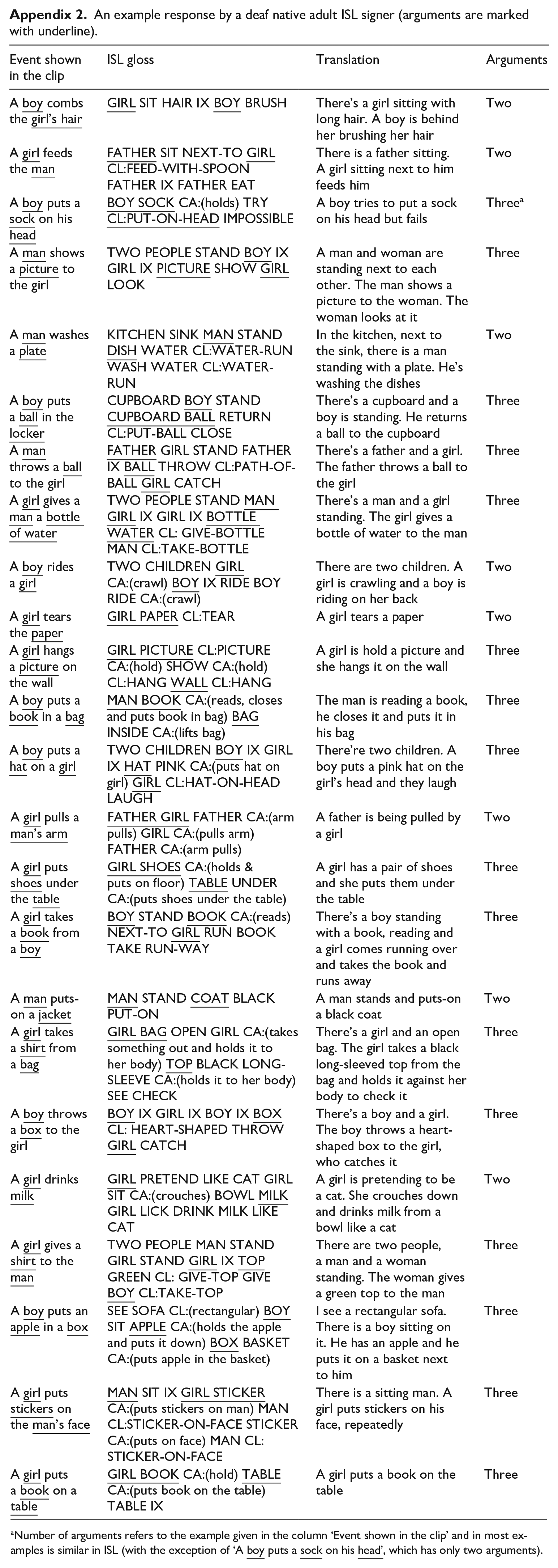
| Event shown in the clip | ISL gloss | Translation | Arguments |
|---|---|---|---|
| A |
There’s a girl sitting with long hair. A boy is behind her brushing her hair | Two | |
| A |
There is a father sitting. A girl sitting next to him feeds him | Two | |
| A |
A boy tries to put a sock on his head but fails | Three a | |
| A |
TWO PEOPLE STAND |
A man and woman are standing next to each other. The man shows a picture to the woman. The woman looks at it | Three |
| A |
KITCHEN SINK |
In the kitchen, next to the sink, there is a man standing with a plate. He’s washing the dishes | Two |
| A |
CUPBOARD |
There’s a cupboard and a boy is standing. He returns a ball to the cupboard | Three |
| A |
There’s a father and a girl. The father throws a ball to the girl | Three | |
| A |
TWO PEOPLE STAND |
There’s a man and a girl standing. The girl gives a bottle of water to the man | Three |
| A |
TWO CHILDREN |
There are two children. A girl is crawling and a boy is riding on her back | Two |
| A |
A girl tears a paper | Two | |
| A |
A girl is hold a picture and she hangs it on the wall | Three | |
| A |
The man is reading a book, he closes it and puts it in his bag | Three | |
| A |
TWO CHILDREN |
There’re two children. A boy puts a pink hat on the girl’s head and they laugh | Three |
| A |
A father is being pulled by a girl | Two | |
| A |
A girl has a pair of shoes and she puts them under the table | Three | |
| A |
There’s a boy standing with a book, reading and a girl comes running over and takes the book and runs away | Three | |
| A |
A man stands and puts-on a black coat | Two | |
| A |
There’s a girl and an open bag. The girl takes a black long-sleeved top from the bag and holds it against her body to check it | Three | |
| A |
There’s a boy and a girl. The boy throws a heart-shaped box to the girl, who catches it | Three | |
| A |
A girl is pretending to be a cat. She crouches down and drinks milk from a bowl like a cat | Two | |
| A |
TWO PEOPLE MAN STAND GIRL STAND |
There are two people, a man and a woman standing. The woman gives a green top to the man | Three |
| A |
SEE SOFA CL:(rectangular) |
I see a rectangular sofa. There is a boy sitting on it. He has an apple and he puts it on a basket next to him | Three |
| A |
There is a sitting man. A girl puts stickers on his face, repeatedly | Three | |
| A |
A girl puts a book on the table | Three |
Number of arguments refers to the example given in the column ‘Event shown in the clip’ and in most examples is similar in ISL (with the exception of ‘A
Acknowledgements
The authors thank Debi Menashe, Ora Ohanin, and Nida Abu-Amneh for their ISL expertise. Special thanks go to all of our parents and deaf students who were involved in our study. Finally, we would like to dedicate this paper to Irit Meir, our colleague and dear friend, who developed the project together with us and who passed away in February 2018.
Funding
The author(s) disclosed receipt of the following financial support for the research, authorship, and/or publication of this article: This research was supported by the ISRAEL SCIENCE FOUNDATION (grant No. 1068/16). During the writing of this manuscript, Rose Stamp was funded by the ISRAEL SCIENCE FOUNDATION grant (number 2757/20).
