



Abstract
This study revisits a contested textual variant concerning the presence, placement, and person of an imperative directed at wives in Eph. 5.22. Most previous treatments of this variant have decided the matter (typically in favor of the reading without an imperative) on the basis of manuscript support and transcriptional arguments about how readers and copyists of the text would have changed it, but the intrinsic probabilities of what the author would have written based on his argument and style have generally been neglected. This study fills this gap by assessing the intrinsic probabilities of the variant readings in Eph. 5.22 using discourse and information structure, the pragmatics of the Greek imperative, and stylistic observations in Ephesians. As a result of this analysis, the reading with the highest intrinsic probability is shown to be τοῖς ἰδίοις ἀνδράσιν ὑποτασσέσθωσαν, which bolsters the recent case made by Gurry (2021) for the same reading.
Introduction
‘Submitting to one another in fear of Christ’ (ὑποτασσόμενοι ἀλλήλοις ἐν ϕόβῳ χριστοῦ) is how the author of Ephesians 1 leads into the Haustafel or ‘household code’ at 5.21. Throughout this section, he offers injunctions on submission and authority with respect to three different domestic relationships—wives and husbands, children and parents, and slaves and masters—and expounds on how the example and lordship of Christ motivate the commanded behavior in each case. He first covers the domestic relationship of wives and husbands in 5.22–33, and he begins with the wives.
It is in Eph. 5.22 that we encounter an important and vexing textual problem. Some significant witnesses to the text have no imperative verb in this verse, while others have an explicit imperative commanding wives to ‘be subject’ to their own husbands. Of the witnesses that do have an imperative in the verse, some place the verb before ‘their own husbands’ (τοῖς ἰδίοις ἀνδράσιν), while others place it after. In addition, some of these witnesses have a second-person imperative (ὑποτάσσεσθε), while others have a third-person imperative (ὑποτασσέσθωσαν). A summary apparatus presenting this variation unit in its context appears in Table 1. 2
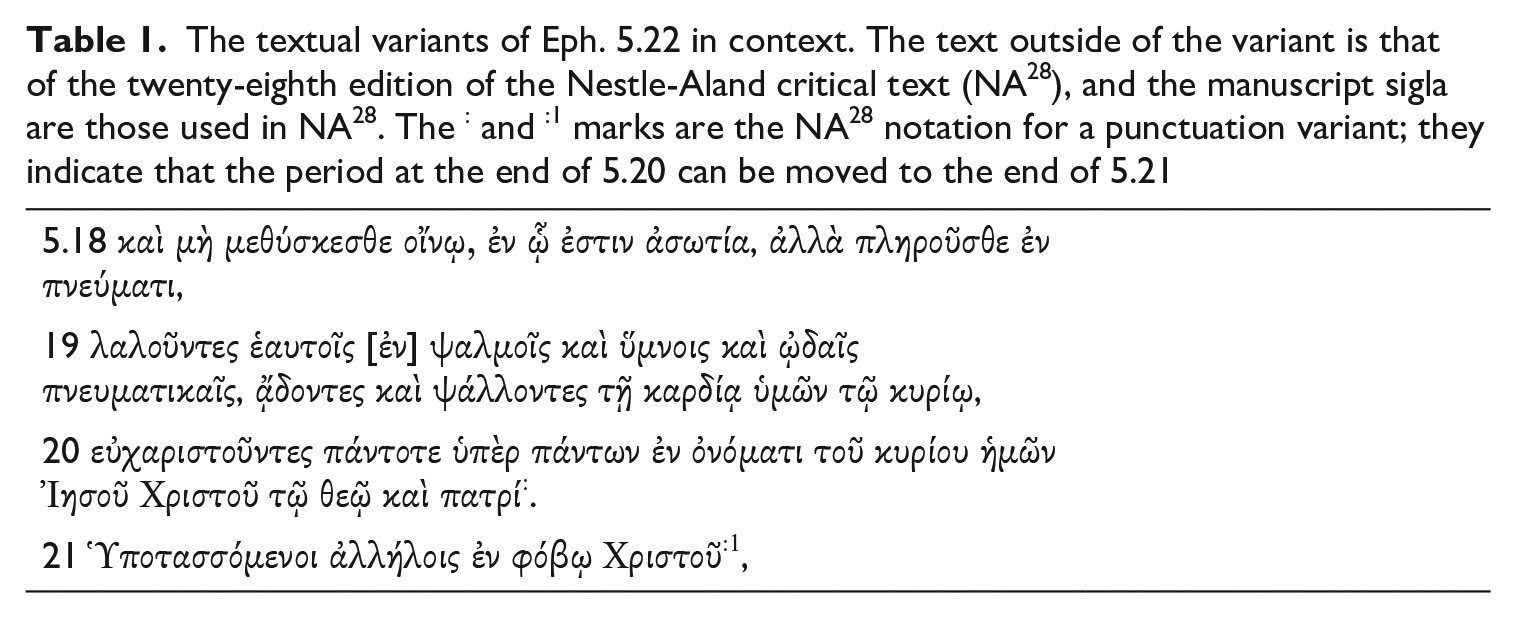
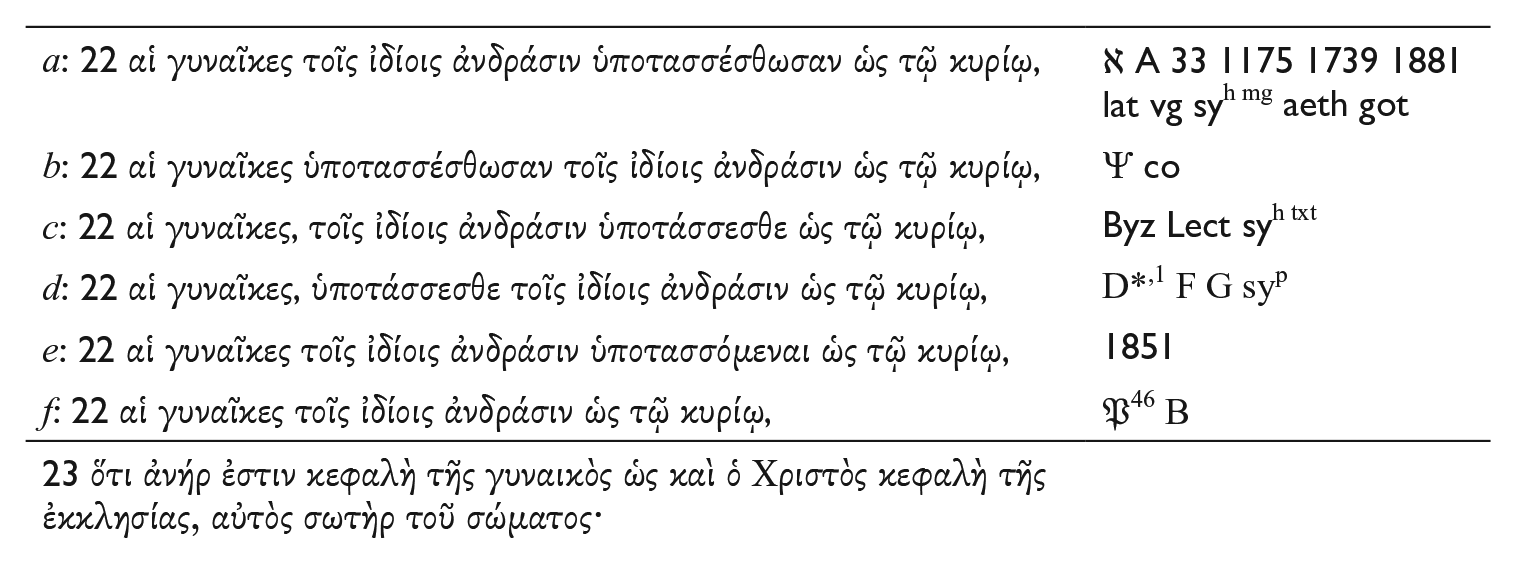
All of these variant readings broadly convey the idea that wives are to follow the more general injunction of submission with respect ‘to their own husbands’, but as we will see, these textual differences affect the shape and emphasis of the discourse.
Most recent editions and commentators have adopted the reading that lacks an imperative on the grounds that the various longer readings represent independent attempts by different scribes to supply a clarifying verb from the context. 3 While a handful of editions and commentators over the last two centuries have adopted or defended one longer reading or another, 4 the transcriptional argument in favor of the shorter reading has historically prevailed by virtue of its simplicity and the lack of a compelling transcriptional argument in the opposite direction. As a result, it has been rehearsed or assumed in subsequent monographs and dedicated studies on the Haustafel in Ephesians. 5 Many of these studies concern themselves with another problem in the discourse that arises from the adoption of the shorter reading: if Eph. 5.22 lacks its own verb, then it is no longer clear whether or not 5.21 and 22 are part of the same sentence or which one begins the Haustafel. 6 The difficulty of the text with the shorter reading has also prompted conjectures that the Haustafel is an early interpolation to the text of Ephesians. 7 Given the amount of research conducted on the assumption of the shorter reading’s originality, it would be easy to think that the textual question in Eph. 5.22 has long been settled in favor of the shorter reading.
Recently, however, in an article revisiting this textual variant, Peter J. Gurry has shown that the case is far from closed (Gurry 2021). In terms of external evidence, he demonstrates that the support for the shorter reading, though early, is also sparse, while the reading τοῖς ἰδίοις ἀνδράσιν ὑποτασσέσθωσαν enjoys an early and broad attestation among manuscripts, versions, and patristic quotations. 8 In terms of transcriptional evidence, he shows that the reading τοῖς ἰδίοις ἀνδράσιν ὑποτασσέσθωσαν could have given rise to the shorter reading by a skip of the eye from -σιν to -σαν, 9 and he argues that this longer reading is transcriptionally unlikely to arise from the shorter given the rarity of third-person imperative compared to the second-person imperative. 10 In these respects, he has turned the traditional arguments for the shorter reading on their head and rebalanced evidence that was thought to tilt in favor of the shorter reading.
But although he neutralizes the case against the longer readings on external and transcriptional grounds, Gurry dedicates almost no discussion to intrinsic probabilities. Intrinsic probabilities concern the suitability of a variant reading to the author’s argument and style; to quote F. J. A. Hort’s definition, they are the object of our inquiry when ‘we ask what an author is likely to have written’ (Westcott and Hort 1882: 20). While Gurry argues extensively that τοῖς ἰδίοις ἀνδράσιν ὑποτασσέσθωσαν can transcriptionally account for the other variant readings at least as well as the shorter reading can, he spends comparatively little time addressing the question of why this reading fits the author’s content and usage better than any of the other readings. His treatment of the intrinsic evidence is limited to a single paragraph just before the conclusion of his discussion of the variant, and it is mostly concerned with the person of the imperative in 5.22 rather than the questions of its presence or position. 11 The external and transcriptional arguments given by Gurry do not clearly favor τοῖς ἰδίοις ἀνδράσιν ὑποτασσέσθωσαν over τοῖς ἰδίοις ἀνδράσιν, so a fuller treatment of this variant on intrinsic grounds is needed.
The relative neglect of intrinsic evidence is not new, and it is not unique to Eph. 5.22. This can be explained in large part by the fact that, for better and for worse, the textual history that Hort and his coeditor B. F. Westcott proposed in their critical text of the New Testament cast a long shadow over later work in the field. The traditional ‘Lachmannian’ or genealogical approach to textual criticism that preceded Westcott and Hort (and has continued to be used in the textual criticism of other works) begins with the identification of passages where the authorial reading is intrinsically clear and the use of a subset of these passages to construct a putative stemma or family tree that relates the surviving witnesses by way of hypothesized ancestors. With such a model in hand, the external evidence can be weighed and used to quantify which variant reading is most likely to be original in cases where the internal evidence is less decisive (for details, see Trovato 2014: 52–67). While the predominance of mixture in the tradition of the New Testament prevented Westcott and Hort from applying this approach rigorously (Colwell 1969), they still employed intrinsic and transcriptional evidence to establish levels of fidelity or error characteristic of different groups of witnesses. Things would change after the publication of their New Testament. Textual critics after Westcott and Hort have identified shortcomings in the pair’s judgments (Epp 1993: 161–63; Aland and Aland 1995: 14; Metzger and Ehrman 2005: 312), but this has not stopped them from tacitly assuming Westcott and Hort’s estimations of witnesses as a proxy for a history of the text in their weighing of external evidence. Consequently, in their judgments between variant readings, they have regarded the testimony of the ‘best’ witnesses—a classification based on the questionable premises of Westcott and Hort’s theory 12 —as equally or more important than the intrinsic and transcriptional probabilities of the readings themselves, with intrinsic probabilities often taking a back seat to transcriptional probabilities. 13 In practice, the role of intrinsic evidence is downplayed until textual critics encounter instances like Eph. 5.22, where the usual counsels of external and transcriptional evidence are too divided to offer a way forward.
Yet New Testament textual criticism is not homogenous, and some textual critics have demonstrated that intrinsic evidence has much to offer if it is not treated as a last resort. The power of taking intrinsic evidence seriously is perhaps most famously exemplified in an exceptional twentieth-century contribution to the field: Günther Zuntz’s series of lectures on the texts of 1 Corinthians and Hebrews (Zuntz 2007 [1953]). By way of thorough coverage of textual variants and a special attention to the rhythm and rhetoric of the text, Zuntz offers fresh evaluations of witnesses and groups of witnesses and, with them, refinements to Westcott and Hort’s theory of the text. A more recent study that reflects a similar regard for these types of intrinsic evidence is Stephen C. Carlson’s dissertation on the tradition of Galatians (Carlson 2015), which also shows that, with the appropriate adaptations, the stemmatic approach refused by Westcott and Hort can become the cornerstone of a robust reconstruction of textual history. It should not be any wonder that intrinsic probability is a compelling form of evidence in its own right; it directly concerns the original text that so many textual critics aim to recover, after all. But in New Testament textual criticism, studies like these that recognize and take advantage of this point are more the exception than the rule.
In general, the hesitancy in New Testament textual criticism to use intrinsic evidence has contributed to a collective atrophy of certain philological muscles. One symptom of this tendency is that intrinsic probabilities are less understood than, and sometimes mistaken for, their transcriptional counterparts. The classic canon stating that ‘the harder reading is to be preferred’ 14 is commonly understood correctly when it is applied with transcriptional probabilities: scribes and readers would gravitate toward readings that were easier to them in terms of explicitness and immediate clarity, and the result, as Hort puts it, often combines ‘the appearance of improvement with the absence of its reality’ (Westcott and Hort 1882:27). But blindly declaring the harshest reading the most intrinsically likely on this principle would be a fundamental error because the operating assumption of intrinsic probabilities is that authors have a good sense of what they want to communicate and how they want to communicate it; the suggestion that an author would choose a harder reading simply because it is harder is antithetical to the goals of most authors. We are reminded of this point whenever we encounter a ‘harder reading’ that seems ‘too hard’ even for the author, but it remains true even in less extreme cases. In all cases, the distinction that informs the canon of the harder reading is probably more useful than the canon itself: authors and scribes both tend toward readings that make sense to them, but they sometimes do so in ways that are exegetically distinguishable. 15 This distinction will play a crucial role in this study’s assessment of intrinsic probabilities.
To be sure, real authors are more complicated than the authorial model that underlies intrinsic probabilities. Hort himself cautions that ‘authors are not always grammatical, or clear, or consistent, or felicitous’ (Westcott and Hort 1882:21). But this does not mean that intrinsic evidence has no bearing on the reconstruction of textual history. On the contrary, the assumptions and models underlying intrinsic evidence are precisely those that make textual criticism possible in the first place. We assume that authors communicated effectively and consistently more often than they did not because if we assumed the opposite, then any variant reading would have an arbitrary claim to authority. We deal in the currency of what authors were likely to do rather than what they did do because, in the vast majority of cases, we do not have access to their autographic text. 16 Ultimately, the value of intrinsic probability is that it is a probability. While authorial errors or inconsistencies always remain possible and may be justified a posteriori from other types of evidence, considerations of the author’s argument and style constitute a priori evidence that can helpfully inform textual judgments.
The assessment of intrinsic probabilities can be conducted rigorously and consistently using proven resources from other fields of philology. Because effective communication is governed by linguistic factors, resources from linguistic studies can shed more light on the intrinsic merits of competing readings. The study of information structure, which aims to establish principles governing the flow of discourse, the order of constituents, the placement of clitics, and other related matters, will be relevant for our purposes in this study. 17 Studies on the Greek imperative—and specifically, which factors warrant a choice of the third-person imperative over the second-person imperative—will also be relevant. 18 Despite the contentions of reasoned eclecticism, compelling judgments on intrinsic evidence have already been made based on a knowledge of Greek language and style, 19 and I suspect that many more are waiting to be made.
To this end, in the analysis that follows, I will examine how factors of the author’s argument and style bear on intrinsic probabilities, specifically in Eph. 5.22, paying particular attention to the information structure of the Haustafel implied by the variant readings. The majority of this study will be occupied by my analysis of the intrinsic evidence, which will cover the three distinct dimensions of variation in this verse in detail. Following this, I will sum up the results of this analysis and demonstrate that τοῖς ἰδίοις ἀνδράσιν ὑποτασσέσθωσαν is the reading most likely to be original to the author of the Haustafel.
Analysis
In the subsections that follow, I will structure my discussion of the variant readings according to the three fundamental points of variation identified in this variant: the presence or absence of an explicit imperative in 5.22; the imperative’s placement before or after τοῖς ἰδίοις ἀνδράσιν, if it is present; and the person of the imperative, if it is present.
Presence of the Imperative
The suitability of an explicit imperative to the author’s argument is intertwined with the question of whether the participial phrase in Eph. 5.21 belongs with what precedes it or with what follows it. Specifically, if 5.22 contains an imperative, then it can represent the start of a new sentence (with 5.21 closing the previous sentence), but if it does not, then it must be part of the same sentence as 5.21 so that the verbal sense of the ὑποτασσόμενοι of 5.21 can carry over to it. 20 Lingering uncertainty about whether or not 5.21 and 5.22 are part of the same sentence can be seen in how NA28 prints rare editorial alternatives for punctuation at the end of 5.20 and 21.
But most modern commentators assume the priority of the shorter reading and proceed from there—a move that does not give full consideration to underlying variant readings and their intrinsic probabilities. 21 Since we are revisiting the question of the variant readings from the perspective of intrinsic probabilities, we must work in the opposite direction and start by considering the feasibility of a sentence beginning at 5.21. If such a division of the text is not feasible, then the shorter reading in 5.22 is intrinsically improbable.
Syntactically, 5.21 fits naturally with the material that precedes it. Commentators have generally agreed that it belongs grammatically to the sequence of participles in 5.19–20 (λαλοῦντες, ᾄδοντες, ψάλλοντες, and εὐχαριστοῦντες) that elaborate on the command πληροῦσθε ἐν πνεύματι in 5.18. 22 Likewise, if a new sentence begins with 5.22, then the asyndeton at the start of the new sentence would effectively mark the transition into the Haustafel as a new section in the discourse. 23 Finally, a sentence break between 5.21 and 22 would also allow for the connection between the two sections to be further marked by different forms of ὑποτάσσω as a catchword. 24 Syntactically, grouping 5.21 with what precedes it facilitates the transition that the author is signaling with this verse.
This grouping is less obvious when we compare the content of 5.21 with what precedes it, but on balance, it remains plausible. While some commentators have argued that the idea of submission in 5.21 is difficult to place under the rubric of being ‘filled with the spirit’ to which the other participles belong (see, e.g., Hodge 1856: 309; Ellicott 1884: 131; and Abbott 1897: 164), others have responded that submission of Christians to one another can easily be understood as part of a spirit-filled lifestyle. 25 The objection that the content of 5.21 does not cohere with the content that precedes may also be tempered by the objection made by other commentators that a reference to ‘submitting to one another’ is not consistent with the hierarchies presented in the verses that follow, either. 26 The tenuous relationship 5.21 has with both of the sections that surround it may be explained by the observation that it is a ‘hinge verse’ bridging the two sections (Eadie 1861: 416; Sampley 1971: 10; Barth 1974: 608; Tanzer 1994: 333–34; Seim 1995: 175; Dawes 1998: 19; MacDonald 2000: 489; Hering 2007: 130 n. 65; Merkle 2016: 177). In light of this, the minor discrepancies observed by commentators may be explained by the possibility that the verse is more functional than informational. 27
If, on the other hand, we join 5.21 to 22, then we encounter a more serious set of syntactic problems. The most immediate issue is the lack of concord between the masculine participle ὑποτασσόμενοι and the feminine subject αἱ γυναῖκες—the nearest nominative phrase in the sentence that could correspond to the participle. Two explanations for this discrepancy are available: either 5.21 is a general heading for the Haustafel, 28 or it is interrupted by anacoluthon before 5.22. We will address these possibilities separately.
As for 5.21 serving as a heading, it is unlikely on its face, and it creates more syntactic problems in 5.22 than it solves. First, the use of a phrase as a standalone heading would be both unprecedented 29 and unfitting, 30 even if an imperative is present in 5.22. Second, if 5.21 is understood as a heading to the content that follows, it would be detached from the text, and a related verb in 5.22 particularizing the general principle of the heading to wives would be necessary (Meyer 1880: 289; Salmond 1897: 365). So even if 5.21 is regarded as a heading, it is incompatible with the shorter reading.
If, on the other hand, anacoluthon occurs between 5.21 and 22, then we must consider why this would happen. Smyth notes two general causes for anacoluthon: (1) ‘the choice of some form of expression more convenient or more effective than that for which the sentence was grammatically planned’ or ‘the insertion of a brief expression of an additional thought not foreseen at the start’, and (2) ‘the intrusion of some explanation requiring a parenthesis of such an extent that the connection is obscured or the continuation of the original structure made difficult’, in which case the initial thought is typically repeated or resumed (Smyth 1920: §3005). We will consider option (2) first, then option (1).
If the anacoluthon marks a digression starting at 5.22, then there is no resumption from the resulting digression, which is stylistically abnormal for the author. While it is clear that the author of Ephesians digresses frequently, it is worth noting that outside of this possible instance, the author takes care in returning from his digressions to the main thread of his thought, typically marking his resumptions using a key phrase reminiscent of the interrupted discourse. 31 So if the Haustafel constitutes a digression, then it is unlike any other in Ephesians. The only catchphrases that would signal a resumption of 5.21 occur in 5.33, which is only partway through the Haustafel. 32 After 6.9, the author simply moves on to exhortations related to the armor of God. Thus, if a digression is at play here, then what we have between 5.21 and 22 is, to quote Weiss, ‘a completely obscure anacoluthon’. 33
The other explanation for the anacoluthon is Smyth’s explanation (1), which leaves us with the perplexing impression that the author of Ephesians intended to encourage his readers toward mutual submission but then changed his mind and proceeded to lay out a more hierarchical set of rules, either as a correction or a caveat. 34 In sum, if 5.21 is part of the same sentence as the verses that follow it, then this would attribute to the author a construction he never uses elsewhere, a carelessness with digressions that is unusual for him, or a conspicuous change of mind. The various hindrances to the author’s argument that arise from grouping 5.21 with what follows it rather than what precedes it suggest that the shorter reading is too harsh to be preferred on intrinsic grounds.
General stylistic considerations also militate against the shorter reading. While some commentators have claimed that the shorter reading fits the ‘succinct style’ of Pauline admonitions (Abbott 1897: 165, followed by Metzger 1994: 541, and Hering 2007: 131 n. 66), Gurry points out that all other admonitions in the Haustafel explicitly include their imperative verbs, and more generally, that succinctness is not at all characteristic of the style of the author of Ephesians (Gurry 2021: 575). Factors related to the author’s style and argument, therefore, favor the inclusion of an explicit imperative.
Position of the Imperative
The difference effected by whether the imperative is placed before or after τοῖς ἰδίοις ἀνδράσιν is one of broad versus narrow focus. To put it briefly, focus is the most important part of the sentence: it corresponds to new or salient information that an author or speaker communicates to readers or listeners about the topic of the sentence, which typically corresponds to known, established information (Chafe 1970: 211–12; Dik 1995: 25; Levinsohn 2000: 7; Runge 2010: 189). In classical and Koine Greek, if a constituent that would normally follow the predicate is fronted immediately before it, then it is marked for ‘narrow focus’ or is said to be in ‘focus position’ (Dik 1995: 11–12; Levinsohn 2000: 37–38; Matić 2003: 588, Rule i; Runge 2010: 190); otherwise, the predicate itself has ‘broad focus’. 35 Thus, the question of where the imperative was more likely placed is a question of whether the author is making a point about the wives’ submission to their own husbands in particular or about their submission more broadly.
While broad focus is typically appropriate for imperative verbs (as can be seen in how most of the imperatives before and after 5.22 precede their constituents), the information structure of 5.22 and its surrounding verses favors a narrow focus in this case. The idea of submission was already introduced through ὑποτασσόμενοι in 5.21, so it is a known and familiar part of the discourse. Because an imperative conveying the same idea corresponds to presupposed information, it is nonvital and unlikely to be put in a prominent place in the sentence (Dik 1995: 98). The object of the imperative, however, is both new and pertinent to the author’s argument: it is ‘to their own husbands’ (note the emphatic ἰδίοις), and not just ‘to the lord’, that wives should direct their submission. That τοῖς ἰδίοις ἀνδράσιν is not presupposed information is made clear when the author proceeds to explain in 5.23 why the husband’s relationship with the wife justifies this expectation. 36 To make this clear, the author would place τοῖς ἰδίοις ἀνδράσιν in the focus position between the topic αἱ γυναῖκες and the verb. Thus, on the grounds of information structure, the author was more likely to have placed the verb after τοῖς ἰδίοις ἀνδράσιν than before it.
Person of the Imperative
While both the second-person ὑποτάσσεσθε and the third-person ὑποτασσέσθωσαν find support in different contextual factors, more immediate factors favor ὑποτασσέσθωσαν. In particular, the language used for the object of the imperative, τοῖς ἰδίοις ἀνδράσιν, fits a third-person imperative better than a second-person imperative (Gurry 2021: 578). More common phrases like τοῖς ἀνδράσιν ὑμῶν and τοῖς ἑαυτοῖς ἀνδράσιν would be readily available for a second-person imperative. 37 As to the question of why the author would choose the third-person imperative in the first place, we have potential explanations in two use cases of the third-person imperative as categorized by Joseph D. Fantin: commanding a second person indirectly, and commanding a third person indirectly through a second person who is actually being addressed. 38 According to the first use case, where the author is commanding wives indirectly, the third-person imperative would serve the author well because it allows him to redirect his commands from the congregation in general to a more specific audience of the Haustafel while still keeping the wider audience in mind for the moral justifications of these commands. 39 Assuming this is correct, only the wives would be addressed with a third-person imperative because the shift in audience from general to specific would only have to be marked once. For the remaining groups addressed in the Haustafel, a vocative before the second-person imperative would be sufficient to mark the change in audience, and for the return to the general audience in 6.10, the resumptive phrase τοῦ λοιποῦ (or τὸ λοιπόν, as in other witnesses), possibly accompanied by a general vocative like ἀδελϕοί or ἀδελϕοί μου, would effectively mark the change back. Alternatively, the wives might be exclusively addressed this way if the second use case of the third-person imperative—in this case, an indirect command to wives intermediated by their husbands—is in view. This usage would serve the author well if, as some commentators have argued, he is speaking primarily to husbands and relegating wives to a passive or peripheral role in their shared section of the Haustafel. 40 It may seem conspicuous that a similar paradigm is not used for the children-parents and slaves-masters sections of the Haustafel, but the relative amount of attention that the author of Ephesians devotes to the wives-husbands section and the fact that he uses this section as a means to convey something new about the relationship between Christ and the church suggest that he views the marriage relationship as especially significant. 41 Indeed, his understanding of husband and wife as ‘one flesh’ in 5.28–33 (against the backdrop of Gen. 2.24) may be his justification for addressing both parties with primary reference to the husbands. 42
If the second-person imperative is read, then wives are situated as the author’s primary addressees in the usual way. This usage fits the pattern of second-person imperatives both before and throughout the Haustafel. 43 Additionally, if the second-person imperative is read, then αἱ γυναῖκες must be read as a vocative rather than a nominative, and the presence of the vocative here, paired with its function as a point of departure shifting from a general set of addressees to a specific one, would even more clearly mark 5.22 as the start of a new section (on this principle generally, see Levinsohn 2000: 276, 278). The primary contribution of ὑποτάσσεσθε to the author’s argument is that it more obviously marks the Haustafel as a new section of the discourse.
Ultimately, the third-person imperative ὑποτασσέσθωσαν introduces and communicates the unique concerns of this part of the Haustafel better than the second-person imperative ὑποτάσσεσθε does. In terms of its immediate context, a third-person imperative fits syntactically with ἰδίοις better than a second-person imperative would. As a marker of the shift in addressees from 5.21 to 22, a third-person imperative is more emphatic than the usual second-person imperative would be. Finally, the third-person imperative better sets up the author’s argument about the nature of the relationship between wives and husbands. On these grounds, it is intrinsically more suitable.
Conclusion
To sum up, syntactic factors favor the inclusion of an imperative, factors of information structure favor the placement of the imperative after τοῖς ἰδίοις ἀνδράσιν, and pragmatic factors favor a third-person imperative over a second-person imperative. It follows that the reading τοῖς ἰδίοις ἀνδράσιν ὑποτασσέσθωσαν is the most satisfactory candidate for the authorial reading in Eph. 5.22.
This reading’s intrinsic suitability to its context is illuminated by comparison to its parallel in Colossians. According to the NA28 critical text, Col. 3.18 reads αἱ γυναῖκες ὑποτάσσεσθε τοῖς ἀνδράσιν ὡς ἀνῆκεν ἐν κυρίῳ, so in terms of the textual issues discussed for Eph. 5.22, it has an explicit imperative, that imperative is placed before its argument τοῖς ἀνδράσιν, and that imperative is in the second person. However, it is evident that the argument in Colossians is developed differently from the one in Ephesians because the passage in Colossians lacks specific contextual features that warrant different readings in Ephesians. Colossians lacks a hinge verse before the start of its Haustafel with a participial phrase for submission, so an explicit imperative in Col. 3.18 is more obviously necessary to that verse’s syntactic viability. The reasons for this verse’s use of a second-person imperative and broad-focus word order are also clear: since the address to wives in Colossians is not followed by additional exposition on the relationship between husbands and wives, the emphasis of ἰδίοις is not needed in Col. 3.18, and accordingly, the third-person imperative and narrow-focus word order are not needed. Thus, regardless of one’s source-critical view of the relationship between Ephesians and Colossians, it is evident that the respective introductions to their Haustafeln, like their Haustafeln generally, were crafted differently, and the author of Ephesians was more likely to use the wording that most effectively communicated his own argument.
This study’s findings in favor of τοῖς ἰδίοις ἀνδράσιν ὑποτασσέσθωσαν dovetail with Gurry’s case for the same reading on external and transcriptional grounds. More specifically, this study has added a dedicated analysis of intrinsic probabilities to his and others’ assessments of the external and transcriptional evidence, and it has refined or reconsidered the more incidental points that he and others have made on the intrinsic evidence. With this last piece of evidence accounted for, we now have a reasonably complete picture of the textual evidence in Eph. 5.22.
More generally, this study demonstrates that with a close and careful reading of the author’s argument in a passage, one can fruitfully assess intrinsic probabilities at a textual variant. While studies like this one are almost always preceded by others based on external and transcriptional evidence, the results they achieve on intrinsic grounds should demonstrate that intrinsic evidence need not and should not be a last resort for the textual critic. In a field concerned primarily with what the author wrote, intrinsic probabilities are eminently suitable for the job, and they deserve a place of prominence in the textual critic’s toolbox.
Footnotes
Acknowledgements
I wish to thank my PhD supervisor, Stephen C. Carlson, whose conversation and notes have made each of the many initial drafts of this paper progressively more organized and effective; Benjamin A. Edsall, whose questions and notes of potential objections helped me refine my arguments; and the anonymous referees, whose informed and engaging feedback strengthened the submitted draft.
Funding
The author(s) disclosed receipt of the following financial support for the research, authorship, and/or publication of this article: This work was supported by an Australian Government Research Training Program (RTP) Scholarship.
