



Abstract
This article asks why Jesus in Mk 2.10 interprets the authority (ἐξουσία/שלטן) of the Son of Man in Dan. 7.14 as the authority to forgive sins. I approach this question by looking at 11QMelchizedek (11Q13). Drawing on a constellation of texts pertaining to jubilee (Lev. 25, Isa. 61.1, Dan. 9.24–27), 11QMelchizedek portrays Melchizedek as forgiving Israel’s sins by his jubilean declaration of ‘liberty (דרור)’ (II 6). In light of similar intertextual moves being made in Mark, I suggest that Mk 2.10—‘the Son of Man has authority to forgive sins on the land (ἀϕιέναι ἁμαρτίας ἐπὶ τῆς γῆς)’—invokes the language of the jubilee legislation in Lev. 25.10: ‘you will declare forgiveness on the land (διαβοήσετε ἄϕεσιν ἐπὶ τῆς γῆς).’ I conclude that this interpretation of ‘authority’ in Dan. 7.14 stems from an assumed conflation between the Son of Man of Dan. 7.13–14 with the herald messiah of Isa. 61.1, as well as an interpretation of Isa. 61.1 in which the messiah enacts the eschatological forgiveness of Israel’s sins by his jubilean declaration of liberty.
Who Is Able to Forgive Sins?
In Mk 2.1–12, a conflict between scribes and Jesus arises when Jesus declares to a paralysed man, ‘Child, your sins are forgiven (τέκνον, ἀϕίενταί σου αἱ ἁμαρτίαι)’ (2.5). The scribes respond to this act by accusing him of blasphemy: ‘Why does this man speak in this way? He is blaspheming! Who is able to forgive sins except the One God? (τί οὗτος οὕτως λαλεῖ; βλασϕημεῖ· τίς δύναται ἀϕιέναι ἁμαρτίας εἰ μὴ εἷς ὁ θεός;)’ (2.7). 1 Jesus defends himself against the charge of blasphemy by saying ‘the Son of Man has authority to forgive sins on the land (ἐξουσίαν ἔχει ὁ υἱὸς τοῦ ἀνθρώπου ἀϕιέναι ἁμαρτίας ἐπὶ τῆς γῆς)’ (Mk 2.10). 2
As many have noted, the collocation of the epithet ‘the Son of Man (ὁ υἱὸς τοῦ ἀνθρώπου)’ and the noun ‘authority (ἐξουσία)’ draws on Dan. 7.13–14, where ‘one like a son of man’ receives authority: ‘I saw in the night visions one like a son of man (MT: כבר אנש; OG: ὡς υἱὸς ἀνθρώπου) coming with the clouds of heaven ... and authority was given to him (MT: ולה יהיב שלטן; OG: ἐδόθη αὐτῷ ἐξουσία) ... His authority is an everlasting authority (MT: שלטנה שלטן עלם; OG: ἡ ἐξουσία αὐτοῦ ἐξουσία αἰώνιος) that shall not pass away.’ 3 Thus, when the scribes accuse Jesus of performing an action which (they think) is the prerogative solely of the One God, 4 Jesus dispels the accusation with an appeal to Dan. 7.13–14, interpreting this ‘authority’ as entailing the authority to forgive sins. To explain Jesus’s action of forgiving sins in this scene, scholars have attempted to identify various parallels in which a messiah, 5 priest/high priest, 6 exorcist/prophet, 7 or angel 8 ostensibly forgives (or has the ability to forgive) sins. But Daniel Johansson has, I think, convincingly shown that the parallels proposed thus far do not actually depict a figure forgiving sins by declaration. 9 He concludes that ‘No conclusive evidence has been put forward in support of the view that other figures than the God of Israel forgave sin in early Judaism. Passages which have been invoked to demonstrate exceptions appear to depict various agents who expiate sin, intercede on behalf of others, or mediate forgiveness from God. But they do not pardon sin.’ 10
Johansson helpfully points out how scholars have misread the texts normally adduced to show that certain figures were thought to be able to forgive sins. But the difficulty with Johansson’s conclusion is that it leaves open the question of how Jesus’s appeal to the Danielic Son of Man actually works. One may be tempted to conclude from Johansson’s arguments that, by forgiving sins by declaration, Jesus is in effect indicating that he himself is the One God. But the issue is more complicated than this. The authority of the Son of Man in Dan. 7.14, to which Jesus appeals, is an authority bestowed from an external source: it is given to him (יהיב/ἐδόθη). 11 The disagreement between Jesus and the scribes therefore revolves around one key question: Has the One God delegated the prerogative to forgive sins to a divine mediator? The scribes say no, and they have good reason to think so, since no Jewish scriptures indicate that divine mediators can forgive sins. Jesus claims that Dan. 7.13–14 proves that the One God has distributed the authority to forgive to a mediator. But Jesus’s appeal to this text in defence of his actions should leave us perplexed: nothing in the book of Daniel implies that this ‘authority’ entails the right to forgive sins. This therefore raises the primary question of this article: Why does Mark’s Jesus interpret the ‘authority’ of the Son of Man as the authority to forgive sins? 12
Before proceeding, a methodological point is in order. Though some scholars have doubted the historical accuracy of the scribes’ objection in Mk 2.7, we must at least account for the fact that Mark thought this objection would have seemed plausible to his readers. 13 I find it doubtful that Mark would have included this kind of objection if (as some have suggested) virtually all Jews agreed that certain divine mediators could forgive sins. In light of Johansson’s arguments, there are good reasons to think that the scribes’ objection has some verisimilitude. That being the case, the following methodological criterion arises: any explanation of the issue of forgiveness in Mk 2.1–12 must account both for the verisimilitude of the scribes’ objection and for the logic of Jesus’s defence by appeal to Dan. 7.13–14. This places immense pressure on the interpreter: any convincing explanation must account for Jesus’s reading of Dan. 7.13–14 as expressing a viewpoint not shared by all Jewish groups, and it must further account for the potential reasons for this disagreement. A reading of this passage that claims that all Jews held that a divine mediator could forgive sin cannot account for the basis for the scribes’ objection, but any explanation that states that the scribal objection represents all ancient Jewish views on the matter cannot account for the logic of Jesus’s defence.
I will suggest in this article that the Markan Jesus’s view is indeed a viewpoint not shared by all Jews, yet—Johansson’s criticisms notwithstanding—it is nonetheless not without parallel in Jewish literature. Though it has gone mostly overlooked in scholarly discussions about Mk 2.1–12, 11QMelchizedek, I will argue, provides us with an example of a second temple Jewish text apart from the canonical gospels in which a divine mediator forgives sins by way of declaration. 14 My argument here is not that Mark knew 11QMelchizedek; rather, I propose that detecting certain thematic patterns in 11QMelchizedek will help us be more attentive to potentially similar patterns in Mark’s gospel. By reading Mark in light of 11QMelchizedek, I will offer an explanation of Mk 2.10 which both accounts for the verisimilitude of the scribes’ objection and provides a plausible explanation for why Mark’s Jesus appeals to Dan. 7.13–14 to establish his ability to forgive sins. More specifically, I argue that Jesus’s interpretation of Dan. 7.13–14 is based on potentially contentious intertextual connections between Daniel and Isaiah which facilitated the notion that the authority of the Son of Man would include his right to enact eschatological jubilee and thus forgive sins.
This argument will proceed in two steps. First, I turn to 11QMelchizedek to elucidate how a particular synthesis of certain scriptural texts related to jubilee results in the idea that Melchizedek performs a speech-act that forgives Israel of their sins. Second, I return to Mark to explore how similar (though not identical) intertextual connections are at work, and how they may have generated the notion that Jesus can forgive sins at his own discretion.
11QMelchizedek
Of the fragments we have from 11QMelchizedek (dated on paleographic grounds to c. 75–50 bce), 15 the best preserved fragments contain the text of column II. 16 Here I present the text of lines 2–9 of column II with my own translation. Lines 2–6 follow the newer readings of Alexey (Eliyahu) Yuditsky and Esther Haber, 17 line 7 follows the reading recently proposed by Ariel Feldman, 18 and lines 8–9 follow DJD. 19 The reconstructions throughout are also based on DJD.
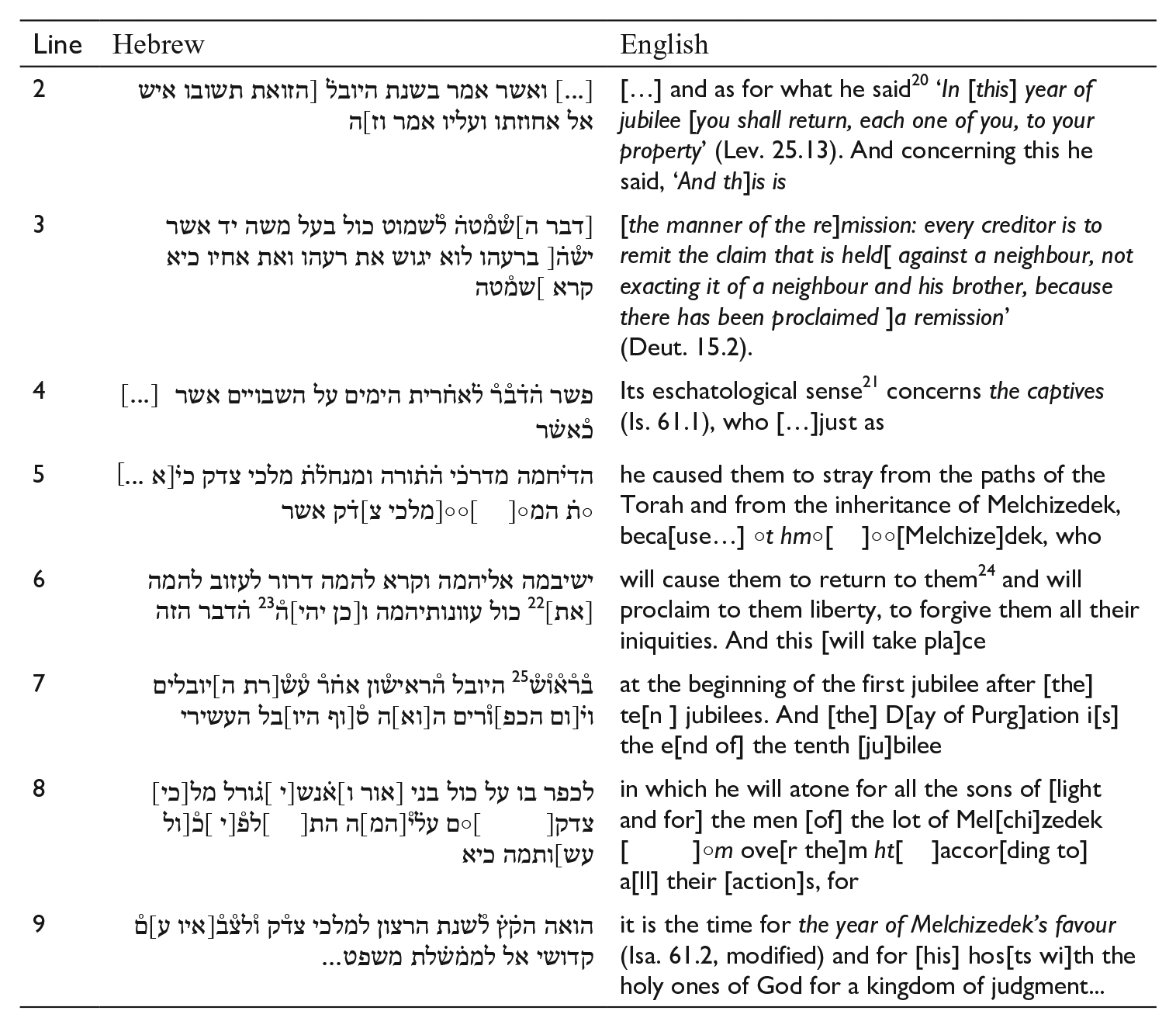
In this section, I address three issues: the portrayal of Israel’s exile as a form of debt-slavery, Melchizedek’s declaration in II 6, and the interpretation of Dan. 9.24–27 in II 6–7.
Accounts (Un)Payable: Israel’s Debt-Slavery in Exile
With the phrase ואשר אמר (‘as for what he said’) in line 2, the text introduces the primary object of interpretation in the entire scroll: the jubilee legislation.
26
According to Lev. 25, in the first year of every forty-nine-year cycle,
27
an announcement of ‘liberty (דרור)’ is made and certain people estranged from their ancestral property are to return to it:
8
You shall count off seven weeks of years, seven times seven years, so that the period of seven weeks of years gives forty-nine years.
9
Then you shall have the trumpet sounded loud; on the tenth day of the seventh month—on the day of atonement—you shall have the trumpet sounded throughout all your land.
10
And you shall hallow the fiftieth year, and you shall proclaim liberty throughout the land to all its inhabitants (וקראתם דרור בארץ לכל ישביה).
11
It shall be a jubilee for you (יובל הוא תהיה לכם): you shall return, every one of you, to your property and every one of you to your family (ושבתם איש אל אחזתו ואיש אל משפחתו תשבו) ....
13
In this year of jubilee you shall return, every one of you, to your property (בשנת היובל הזאת תשבו איש אל אחזתו).
28
Although nothing in this legislation says anything about the forgiveness of debts, 11QMelchizedek II 2–3 cites Deut. 15.2 as a subsidiary elaboration 29 of this legislation on the assumption that the jubilee includes aspects of or coincides with the shemittah year of Deut. 15.1–3, at which time all outstanding debts are to be cancelled. 30 By synthesizing these two sections of the Pentateuch, the author portrays the jubilee as including two related but distinct features: return to ancestral property and the release of all debts. 31 This conflation between jubilee (יובל) and the shemittah year (שמטה) is attested in other contemporary Jewish authors, including possibly the Septuagint, which translates the terms יובל (jubilee) in Lev. 25.10/13, דרור (liberty) in Lev. 25.10, and שמטה (release) in Deut. 15.1–2, with the noun ἄϕεσις—‘release’ (or ‘forgiveness’). 32
The text claims that the jubilee legislation has an eschatological sense which concerns the ‘captives (שבויים)’ of Isa. 61.1—Israelites who still remain in the captivity of exile (11QMelchizedek II 4). We should pause here to note that, while the jubilee legislation itself does not directly refer to anything eschatological, in 11QMelchizedek (as in other Jewish texts) Israel’s restoration is understood as a kind of eschatological jubilee. It is not difficult to understand why: the jubilee legislation is concerned with the return of enslaved Israelites to their native property, and, according to the legislation in Lev. 25.47–55, the jubilee even restores Israelites who have become slaves to non-Israelites (גר ותושב in 25.47). The jubilee legislation would have provided fertile ground for Jews to think about Israel’s restoration, since restoration would entail being released from foreign domination and the scattered Israelites returning to their ancestral land. The author of 11QMelchizedek, then, presumes that the practice of the jubilee and shemittah year offers an embodied, practical anticipation of Israel’s eschatological restoration. 33
If Israel’s return from exile occurs as an eschatological jubilee—which, according to 11QMelchizedek II 2–3, includes the cancellation of all debts—then it is no surprise that the problem of Israel’s exile is understood as a kind of debt-slavery. 11QMelchizedek II 5 outlines the process by which these Israelites have become ‘captives’. As Chanan Ariel points out, if Belial is the implied subject of הדיחמה (‘he has caused them to stray’) in II 5 (cf. II 12–13)
34
and if the object suffix in הדיחמה refers to the ‘sons of light’ mentioned later in II 8, then ‘The first of Belial’s actions is to drive sinners away from the ways of the Torah’.
35
He goes on: In the second stage of his action, removal from the ways of the Torah gives Belial the legal right to remove the sinner from the spiritual inheritance of Melchizedek. In order to be repaid by the indebted sinner, Belial charges him from his share in the lot of the sons of light …. Belial continues to entice the debtor to persist in sin until he dispossesses him of all his inheritance in the lot of Melchizedek. And once the iniquities accumulate, the debt becomes large, and the debtor becomes unable to repay his debt, then he is forced into exile from the lot of light and forced to become the slave and captive of Belial....
36
11QMelchizedek therefore articulates two intersecting problems: Israel has not only been exiled from their ancestral property by being sold off as debt-slaves, but this has befallen them because they have accrued an unpayable debt to Belial due to their sins. 37
Melchizedek’s Debt-Cancelling Declaration
Enter Melchizedek. 38 Melchizedek resolves the twofold problem of Israel’s exile with a corresponding twofold action in which he restores those Israelites still in exile to the sons of light and forgives their sins—that is, he cancels their debts. So Melchizedek will ‘cause them [i.e., the captives] to return to them [i.e., the sons of light] (ישיבמה אליהמה) and will declare to them liberty (וקרא להמה דרור), to forgive them all their iniquities (לעזוב להמה [את] כל עוונותיהמה)’ (II 6). 39 In this context, one may also take the infinitive לעזוב as epexegetical: ‘he will declare to them liberty, thus forgiving them all their iniquities’. 40 Either way, this attributes to Melchizedek not only the ability to enact Israel’s eschatological return from exile but also the ability to enact the eschatological forgiveness of sins by his jubilean declaration of liberty (דרור). 41 By cancelling their debts, he thus delivers them from authority of Belial, who had claim over them due to their debts: ‘Melchizedek will execute the vengeance of Go[d]’s judgements, and [in that day he will de]liv[er them from the power] of Belial, and from the power of all the sp[irits of his lot]’ (II 13). 42 Read this way, 11QMelchizedek II 6 provides us with a second temple Jewish text apart from the canonical gospels that portrays a divine mediator directly forgiving sins by declaration.
Why does the text portray Melchizedek as setting in motion the eschatological jubilee? A key intertext here is Isa. 61.1–2, a passage invoked throughout 11QMelchizedek. 43
רוח אדני יהוה עלי יען משח יהוה אתי לבשר ענוים שלחני לחבש לנשברי לב לקרא לשבוים דרור ולאסורים פקח קוח לקרא שנת רצון ליהוה ויום נקם לאלהינו לנחם כל אבלים The spirit of the Lord yhwh is upon me, because yhwh has anointed me; he has sent me to bring good news to the oppressed, to bind up the brokenhearted, to proclaim liberty to the captives and release to the prisoners, to proclaim the year of yhwh’s favour and the day of vengeance of our God, to comfort all who mourn.
The phrase ‘to proclaim liberty (לקרא דרור) to the captives’ draws on the language of the jubilee legislation in Lev. 25, of which a central command is Lev. 25.10: ‘you shall proclaim liberty throughout the land to all its inhabitants (וקראתם דרור בארץ לכל ישביה)’. 44 Isa 61.1, then, already construes Lev. 25 eschatologically, portraying Israel’s return from their ongoing exile as initiated in the eschatological jubilee reported by this messianic herald. 45 A few key interpretative moves are made by 11QMelchizedek in relation to this text. First, 11QMelchizedek identifies the messianic herald of Isa. 61.1 with the figure of Melchizedek from Psalm 110.4 and Genesis 14.18–20, 46 the only two texts where the epithet מלכי צדק appears in the Hebrew Bible. 47 Second, though Isaiah 61.1 does not explicitly relate the jubilee to forgiveness of sins, 11QMelchizedek articulates that this eschatological jubilee entails the forgiveness of Israel’s sin. 48 The use of the word לעזוב (‘to forgive’, or perhaps more accurately here ‘to remit’ or ‘to cancel’) shows that sin is being metaphorically construed as a debt, since the use of words associated with the notion of ‘remission’ in Hebrew (עזב), Aramaic (שבק), and Greek (ἀϕιέναι/ἄϕεσις) only occur in connection with sin being understood as a debt. 49 In 11QMelchizedek’s reading of Isaiah 61.1, then, the messiah’s jubilean declaration of liberty does not just concern the return of the captives but also the debt-cancellation of their sins. This interpretation is not surprising in light of the conflation between the jubilee and shemittah year in 11QMelchizedek. Third, though it would be perfectly reasonable to interpret the phrase ‘to proclaim liberty to the captives’ in Isaiah 61.1 as expressing that the herald messiah simply reports something about God’s eschatological action, 11QMelchizedek construes Melchizedek as effectively enacting eschatological forgiveness of sins by his declaration of liberty. Crucially, it is the phrase ‘to forgive them all their iniquities’ in 11QMelchizedek II 6 that clarifies the latter two interpretative moves with respect to Isaiah 61.1’s eschatological adaptation of the jubilee. In other words, 11QMelchizedek portrays Melchizedek as enacting the forgiveness of sins by declaration on the basis of a conflation between Melchizedek of Genesis 14.18–20/Psalm 110.4 with the herald messiah of Isaiah 61.1, as well an interpretation of Isaiah 61.1 in which the herald messiah enacts the eschatological forgiveness of Israel’s sins by his jubilean declaration of liberty.
But if that is the case, why has this text not featured in the debates in Markan scholarship over whether there are Jewish texts that depict divine mediators forgiving sins? Johansson, for example, brings up but then immediately dismisses the relevance of 11QMelchizedek: ‘Melchizedek is an “agent of the expiation”, but he does not forgive sins’ (citing II 7–8, but not II 6!). 50 This striking oversight is, I think, due to the way 11QMelchizedek II 6 has been problematically translated in the editions likely used by New Testament scholars. In his editio princeps published in 1965, A.S. van der Woude states, ‘Das Subjekt von קרא kann bei diesem Zitat kaum Gott selbst sein, vielmehr sein Gesalbter’. 51 Since van der Woude is convinced that the figure later identified in II 18 as ‘the messenger (המבשר)’ (referring to Isa. 52.7) and ‘the anointed of the spirit ([מ̇שיח הרו̇[ח)’ (referring to the anointed messiah of Isa. 61.1) is not Melchizedek, and since he thinks the figure who announces liberty in II 6 must be the same figure as the one in II 18, he concludes that the subject of וקרא in II 6 cannot be Melchizedek. 52 He nevertheless articulates an agent as the subject of וקרא in his translation of II 6: ‘und er wird den Erlass für sie ausrufen.’ 53
For the same reasons, the editors of DJD take the subject of וקרא as the anointed messenger and not Melchizedek, but their resulting translation is crucially different. The editors assert that ‘In Isa. 61.1 the “anointed” is the subject of קרא, but the distinction between the “anointed” and Melchizedek has not been made in the text. The subject of the verbal form [וקרא] should rather be regarded as indefinite’. 54 Thus, the resulting translation in DJD eschews any subject of the verb: ‘And liberty shall be proclaimed to them, to set them free from [the debt] 55 of all their iniquities’. 56 With וקרא taken as indefinite, this translation inhibits anyone from seeing that an agent is involved in making this declaration that enacts forgiveness of sins. Given that DJD contains the English translation of 11QMelchizedek that is most likely to be used by many New Testament scholars, I suspect DJD’s translation decision is the reason why 11QMelchizedek II 6 has been overlooked in debates over Mk 2.10.
But such an interpretation does not by any means represent a consensus, and a strong constituency of scholars hold that וקרא should be understood as an active verb with Melchizedek as the subject. 57 The proposal that the subject of וקרא is the anointed messenger and not Melchizedek, as well as its resulting indefinite translation in DJD, can be called into question on numerous grounds. First of all, the immediate context of II 6 strongly pushes against the view that the subject is not Melchizedek. If מלכי צדק is to be reconstructed from the fragmentary –ד̇ק in II 5, 58 then Melchizedek must be the subject of the verb in the relative clause that crosses from line 5 to line 6: ‘[Melchize]dek, who will return them to them (מלכי צ]ד̇ק אשר ישיבמה אליהמה]).’ 59 Given that (1) וקרא comes immediately after ישיבמה (whose subject is Melchizedek), (2) there are no breaks in the text, and (3) there is no new subject introduced, it simply strains credulity to argue that וקרא suddenly has an unexpressed subject that is an entirely different character who has ostensibly not even been introduced yet. To show how unlikely van der Woude’s translation is, it is worth pointing out that his reading would require the following understanding: ‘Melchizedek, who will return them to them, and he [not Melchizedek, but the anointed of the spirit] will proclaim liberty to them’. 60 As for the translation in DJD, in the absence of any sort of introduction of this new figure, it stretches the text to its breaking point to argue that an ancient reader would somehow reflexively read וקרא as indefinite when it is so closely preceded by an active verb of which Melchizedek is the subject. 61
If Melchizedek is the subject of וקרא, then we should conclude that the figure identified as ‘the messenger’ and ‘the anointed of the spirit’ in II 18 is also Melchizedek. One may be inclined to argue that, because Melchizedek is identified as a god throughout the scroll, Melchizedek cannot also be the messenger. 62 Since the messenger announces that ‘your God reigns!’ and ‘your God’ is identified as Melchizedek in II 23–25, it would mean that the messenger announces his own kingship. 63 But we should not be averse to the possibility that Melchizedek does in fact announce his own reign. As Bergsma observes, ‘Although this may seem odd to modern readers, the author of 11QMelch has little or no difficulty melding the identities of different scriptural personae. The equation of “God” with “Melchizedek” (lines 24–25) is a prime example!’ 64 To reiterate my point here, then: all this suggests that it is better both to interpret וקרא in 11QMelchizedek II 6 as an active verb and to understand the subject of that verb to be Melchizedek. We therefore can say on good evidence that Melchizedek not only performs the declaration of liberty but also thereby forgives Israel’s sins by this declaration.
Daniel’s Jubilean Chronology in 11QMelchizedek II 7
11QMelchizedek articulates a chronology for the occurrence of this eschatological jubilee that is based on a scheme of 10 jubilees (II 7). The division of the time before the eschaton into 10 jubilees constitutes an interpretation of Daniel’s ‘seventy weeks’ of years (Dan. 9.24), which amounts to 490 years—10 jubilee cycles. In this passage, Daniel inquires of God regarding why Jeremiah’s prophecy that the restoration of Judah would occur after 70 years in Babylon had not been fulfilled (Dan. 9.2–3). Daniel then intercedes for the whole people, confessing their sin and pleading for forgiveness on their behalf so as to enact Israel’s restoration (Dan. 9.4–20). The angel Gabriel responds (Dan. 9.24–27): Seventy weeks are decreed for your people and your holy city: to do away with rebellion, to put an end to sin, and to atone for iniquity, to bring in everlasting righteousness, to seal both vision and prophet, and to anoint a most holy place. Know therefore and understand: from the time that the word went out to restore and rebuild Jerusalem until the time of an anointed prince, there shall be seven weeks; and for sixty-two weeks it shall be built again with streets and moat, but in a troubled time. After the sixty-two weeks, an anointed one shall be cut off and shall have nothing, and the troops of the prince who is to come shall destroy the city and the sanctuary. Its end shall come with a flood, and to the end there shall be war. Desolations are decreed. He shall make a strong covenant with many for one week, and for half of the week he shall make sacrifice and offering cease; and in their place shall be an abomination that desolates, until the decreed end is poured out upon the desolator.
The prediction of seventy weeks of years is not a claim that this is what Jeremiah secretly meant all along. 65 Jeremiah’s oracle was originally a conditional promise that God would restore Judah after 70 years ‘if you seek me with all your heart’ (Jer. 29.13). 66 But since, despite the punishment of exile, Israel as a whole has not repented (Dan. 9.13), God—according to the principle in Lev. 26 that refusal to repent results in sevenfold expansion of punishment—has multiplied their punishment by seven times, extending the years of chastisement and delaying Judah’s (and, by extension, Israel’s) full restoration. 67
It has long been noticed that, like the many other second temple Jewish texts that organise history according to jubilee cycles,
68
the period of ‘seventy sevens’ seems to draw on the chronological scheme of the jubilee.
69
Bergsma points to three primary reasons for this: (1) the passage is universally recognized as speaking of ‘weeks’ of years, and the most explicit biblical precedent for the concept of a ‘week of years’ is found in Lev 25:8, which concerns the calculation of the jubilee year, (2) the author also seems to assume the interpretation of Jeremiah’s ‘seventy years’ as missed sabbatical years as per 2 Chron 26:21, which establishes a link with Lev 25:1–7 and 26:34–35, and (3) the Day-of-Atonement imagery in the text, such as the reference to ‘atonement for iniquity’ (כפר עון, Dan 9:24), is also relevant, since the jubilee was proclaimed on the Day of Atonement.
70
Since the jubilee occurs after each 49th year, Daniel’s invocation of a period of 490 years signals that Israel’s restoration would be like a grand jubilee. 71
At this point, it is worth noting a puzzling issue regarding the chronology of 11QMelchizedek. The editors of DJD, following the earlier proposal of Milik, transcribed II 6–7 as ‘And this [wil]l [happen] in the first week of the jubilee (ב֯ש֯ב֯ו֯ע֯ היובל ה֯ראיש֯ון) (that occurs) after [the] ni[ne] jubilees (ת֯ש֯[עה ה]יובלים).’ And [the] D[ay of Atone]ment i[s] the e[nd of] the tenth [ju]bilee (ס̊[וף ]ה̊[יו]בל העשירי). 72 Whereas Daniel appears to place the eschatological jubilee in the 491st year (i.e., after the 10th jubilee cycle), 11QMelchizedek, on this reading, would place the announcement of jubilee well before that, during the 10th jubilee. Furthermore, that the jubilee announcement would occur before the Day of Atonement would not align with the scheme of Lev. 25, which sets the Day of Atonement at the beginning of the jubilee year. 73 However, in light of the clearer photographs in the Leon Levy Dead Sea Scrolls Digital Library, Ariel Feldman has argued that the traces of ink that have been transcribed/reconstructed as ב֯ש֯ב֯ו֯ע֯ (‘in the week’) and ת֯ש֯[עה (‘nine’) should be transcribed rather as ב̊ר̊א̊ו̊ש̊ (‘at the beginning’) and ע̊ש̊[רת (‘ten’), respectively. 74 The result is the following reading of II 6–7: ‘And this [will take pla]ce at the beginning of the first jubilee after [the] te[n ]jubilees. And [the] D[ay of Atone]ment i[s] the e[nd of] the tenth [ju]bilee.’ This reading not only far better accounts for the ink traces seen more clearly in the Leon Levy photos but also resolves the obvious chronological discrepancy between Daniel 9.24–27 and 11QMelchizedek. According to 11QMelchizedek II 7, then, Melchizedek’s declaration of liberty would occur in precisely the 491st year, inaugurating the eschatological jubilee after the age of God’s wrath is complete.
Mark
Mark scholars have not often considered the possibility that Mark’s gospel invokes motifs associated with the jubilee, eschatological or otherwise. 75 Most of the scholarly energy has been exerted in exploring this motif in the gospel of Luke, in which Jesus reads out Isaiah 61.1–2 LXX (Lk 4.18–19) and declares that ‘Today this scripture has been fulfilled in your hearing’ (Lk 4.21). 76 But the fact that Mark does not have this scene should not deter us from being open to the possibility that jubilee motifs are present in Mark as well. Indeed, if Mark’s Jesus is announcing and enacting the restoration of Israel in his eschatological activity, we should be attentive to the possibility that Mark invokes the same jubilee texts and concepts that some of his contemporaneous Jews utilised to depict Israel’s restoration. In this section, then, I proffer that Mk 1–2 draws on the same constellation of jubilee texts invoked by 11QMelchizedek—Dan. 9.24–27, Isa. 61.1, and Lev. 25.10. Tracing allusions to these texts in Mk 1–2 will help us be attentive to the theme of jubilee in Mark and help us ascertain the implicit reasoning undergirding the claim that the Son of Man has authority to forgive sins.
Dan. 9.24–27: The Time Is Fulfilled
In Mk 1.15, Jesus initiates his proclamation of the coming kingdom by saying, ‘The time is fulfilled (πεπλήρωται ὁ καιρός), and the kingdom of God has come near; repent and believe the good news!’ While a previous generation of interpreters often took καιρός in Mk 1.15 to mean ‘appointed time’, 77 Joel Marcus (drawing on a study by Franz Mussner) observes that ‘Since peplērōtai would have initially evoked for Greek speakers this image of a container, and since kairos can indicate, indeed in the LXX and NT usually does indicate, a span of time, it seems more logical to begin with the hypothesis that Mk 1.15a speaks of a span of time that has now become full, i.e. is over, and only to deviate from this interpretation if impressive reasons for doing so can be adduced.’ 78 In other words, whereas the phrase ‘the kingdom of God has come near’ refers to the (near) inauguration of a new time, the phrase ‘the time is fulfilled’ refers to the end of a previous set of time. 79 What Marcus does not consider, however, is the possibility that this ‘span of time that has now become full’ is in fact the (jubilean) chronology of Dan. 9.24–27. 80
In support of this proposal, we should note that Josephus singles out Daniel as the prophet who articulates the chronology of when certain prophecies should come to pass: ‘For the books which he wrote and left behind are still read by us even now, and we are convinced by them that Daniel spoke with God, for he was not only wont to prophesy future things (οὐ γὰρ τὰ μέλλοντα μόνον προϕητεύων διετέλει), as did the other prophets, but he also fixed the time at which these would come to pass (ἀλλὰ καὶ καιρὸν ὥριζεν, εἰς ὃν ταῦτα ἀποβήσεται)’ (Ant. 10.267). 81 Furthermore, as is well known, Josephus claims about the Great Revolt initiated in 66 ce that ‘What more than all else incited them to the war was an ambiguous oracle (χρησμὸς ἀμϕίβολος), likewise found in their sacred scriptures (ὁμοίως ἐν τοῖς ἱεροῖς εὑρημένος γράμμασιν), to the effect that at that time (κατὰ τὸν καιρὸν ἐκεῖνον) one from their country would become ruler of the world’ (War 6.312). 82 Anthony J. Tomasino has persuasively shown that both of these passages in Josephus almost certainly refer to the chronology of Dan. 9.24–27. 83 This suggests not only that Josephus associated the identification of the timing of eschatological events specifically with Dan. 9.24–27 but also that a key impetus for at least one Jewish revolutionary movement was the conviction that Daniel’s 70 weeks of years were on the verge of completion at the time of 66 ce. It is suggestive that one of the first actions of the rebels of the Great Revolt was to head to the debt archives and to burn all the records so as to obstruct the collection of debts (War 2.427). This should make us wonder if this action was a way of economically actualising the eschatological jubilee that was to occur at the end of Daniel’s 70 weeks of years. 84
Reflecting a similar chronology to the rebels of the Great Revolt, the reference to the ‘abomination of desolation’ in Mk 13.14 (alluding to Dan. 9.27) places the end of Daniel’s 70 weeks around the destruction of the temple in 70 ce. Crucially, this identifies Jesus’s proclamation in Mk 1.15 as occurring (in 11QMelchizedek’s terms) in the final, tenth 49-year jubilee cycle of Daniel’s 490 years. 85 James Davila therefore concludes that ‘we can say that first-century Jewish circles, including the first-generation Jesus movement, were aware of an exegetical tradition in which the consummation of the tenth jubilee and eschatological redemption were expected around the year 70 C.E.’ 86 In tandem with the vast influence of Daniel’s 490-year chronology on second temple Jewish eschatology more generally, 87 this evidence pressures us to interpret ‘the time is fulfilled, and the kingdom of God has drawn near’ as an announcement that Daniel’s 70 weeks of years—the time of divine wrath—are nearly complete and that the new age, and therefore the eschatological jubilee, is just on the horizon. 88
Isa. 61.1: The Spirit-Filled Herald Messiah
Mark opens his gospel with ‘as is written in the prophet Isaiah’, followed by a composite citation of Exod. 23.20, Mal. 3.1, and Isa. 40.3 in reference to John the Immerser (Mark 1.2–3). But the first chapter of Mark is riddled with overtones of other sections of Isaiah as well—including Isa. 61.1. 89 Isa. 61.1 LXX depicts a figure who is anointed and on whom the spirit rests: ‘The spirit of the Lord is upon me, for which reason he has anointed me (πνεῦμα κυρίου ἐπ᾽ ἐμέ, οὗ εἵνεκεν ἔχρισέν με)’; in the first line of Mark, Jesus is called the anointed one (χριστός) (1.1), and in Mk 1.10 the spirit descends on (into?) him (τὸ πνεῦμα … καταβαίνον εἰς αὐτόν). 90 Furthermore, in Isa. 61.1 LXX, the messenger is sent to ‘announce good news to the poor (εὐαγγελίσασθαι πτωχοῖς)’ and to ‘proclaim (κηρύξαι) liberty to the captives’; the opening line of Mark identifies the book as the good news (τὸ εὐαγγέλιον) (1.1), and Jesus goes into Galilee proclaiming the good news of God (κηρύσσων τὸ εὐαγγέλιον τοῦ θεοῦ) (1.14). The specific cluster of motifs in Isa. 61.1—a figure who is anointed by God, on whom the spirit rests, and who proclaims the good news—comes to expression in the opening of Mark. 91 Of course, taken independently, each of these features do not in themselves necessarily allude to Isa. 61.1, and, to be sure, I am not claiming that only Isa. 61.1 is operative in these texts. 92 But the combination of these three motifs in such close proximity would signal to anyone familiar with Jewish scripture that Jesus is at least being depicted as the spirit-filled anointed herald of Isa. 61.1 who announces the eschatological jubilee. 93
Lev. 25.10: Forgiveness on the Land
While Mark alludes to at least two texts containing jubilee motifs—Dan. 9.24–27 and Isa. 61.1—does Mark, like 11QMelchizedek, ever quote or allude to the jubilee legislation itself? I would like to suggest that Jesus’s defence in Mk 2.10 draws not only on the language of Dan. 7.13–14 but also on the language of the key jubilee command of Lev. 25.10. Consider the similarities between these two texts: Lev. 25.10 LXX: καὶ And Mk 2.10: ἐξουσίαν ἔχει ὁ υἱὸς τοῦ ἀνθρώπου the Son of Man has authority
I know of no modern scholar who has suggested that Mk 2.10 alludes to Lev. 25.10, but the similarities between them are quite striking. Lev. 25.10 constitutes the only instance in the Septuagint in which the noun ἄϕεσις or the verb ἀϕιέναι is used in conjunction with ἐπὶ τῆς γῆς (or any similar phrase such as ἐπὶ τῇ γῇ or ἐν τῇ γῇ). Potentially strengthening this connection, in both Lev. 25.10 and Mk 2.10–11 the result of the declaration of forgiveness is the return to one’s property. In Lev. 25.10 LXX, the announcement of forgiveness (ἄϕεσις) initiates the time at which ‘each one shall depart to his property, and each shall depart to his homeland (ἀπελεύσεται εἷς ἕκαστος εἰς τὴν κτῆσιν αὐτοῦ, καὶ ἕκαστος εἰς τὴν πατρίδα αὐτοῦ ἀπελεύσεσθε).’ After Jesus forgives the sin of the paralytic, he says, ‘I say to you, stand up, take your mat and go to your home (ὕπαγε εἰς τὸν οἶκόν σου)’ (Mk 2.11).
While the final words of Jesus’s assertion in Mk 2.10 are nearly identical to Lev. 25.10, there are two key differences. Mk 2.10 uses the verb ἀϕιέναι instead of the phrase διαβοῆσαι ἄϕεσιν and adds the object ἁμαρτίας. These two modifications are quite similar to how 11QMelchizedek combines the phrase ‘to forgive them all their iniquities’ with Melchizedek’s announcement of jubilee in II 6. Recall that, whereas one may understand the activity of the herald messiah of Isa. 61.1 as simply announcing God’s eschatological action of returning the ‘captives’, the infinitive phrase ‘to forgive them all their iniquities’ in 11QMelchizedek II 6 specifies that Melchizedek’s announcement of jubilee both includes the forgiveness of sins (as a form of debt-cancellation) and enacts that forgiveness. Similarly, by writing ἀϕιέναι (to forgive) instead of διαβοῆσαι ἄϕεσιν (to announce forgiveness), Mark makes clear that the Son of Man is not just reporting God’s forgiveness but enacting it himself, and Mark’s addition of the word ἁμαρτίας signals that this jubilee announcement pertains the forgiveness of sins, also understood as a kind of debt cancellation. 94 Mark’s twofold modification of the language of Lev. 25.10 very closely aligns with how 11QMelchizedek specifies the nature and effect of Melchizedek’s jubilee-announcement. Thus, the differences between Lev. 25.10 and Mk 2.10 notwithstanding, I suggest that the phrase ‘the Son of Man has authority to forgive sins on the land’ constitutes a composite allusion that invokes not one but two texts—both Dan. 7.13–14 and Lev. 25.10. 95 This implies that Jesus defends himself against the scribes’ accusation of blasphemy by claiming that he, qua the Son of Man, has the authority to enact eschatological jubilee and inaugurate the restoration of Israel.
Making Sense of Jesus’s Defence
Once again, we arrive at the key question of this article: Why does Mark interpret the ‘authority’ of Dan. 7.14 in this way? In light of everything previously discussed, I suggest that it is a particular interpretation of Isa. 61.1 that is the crux for both 11QMelchizedek and Mark’s understanding of their respective messianic figures which facilitates the idea that the messiah forgives sins by declaration. I propose that, in light of Mark’s allusions to Isa. 61.1 and the portrayal of Jesus as forgiving sins with the language of the jubilee legislation, Mark likely assumes an interpretation of Isa 61.1 along the lines of 11QMelchizedek—namely, that the herald messiah enacts forgiveness of sins by his jubilean announcement of liberty. 11QMelchizedek and Mk 1–2, then, synthesize different texts with Isa. 61.1: 11QMelchizedek identifies the jubilee-declaring messiah of Isa. 61.1 with Melchizedek (the figure of Gen. 14.18–20 and Ps. 110.4) and accordingly depicts Melchizedek as enacting forgiveness of sins by declaration with the language of the jubilee (דרור); Mk 1–2 identifies the jubilee-declaring messiah of Isa. 61.1 with Daniel’s ‘one like a Son of Man’ (7.13–14) and accordingly depicts the Son of Man as enacting forgiveness of sins by declaration with the language of the jubilee legislation (ἄϕεσις/ἀϕιέναι + ἐπὶ τῆς γῆς). 96 Therefore, I conclude that Mk 2.10 portrays the Son of Man as having the authority to forgive sins by declaration on the basis of an assumed conflation 97 between the Son of Man of Dan. 7.13–14 with the herald messiah of Isa. 61.1, as well as an interpretation of Isa. 61.1 in which the herald messiah enacts the eschatological forgiveness of Israel’s sins by his declaration of liberty. In other words, the Son of Man can forgive sins because he identifies Daniel’s Son of Man with Isaiah’s jubilee-enacting and sin-forgiving messiah. 98 Thus, for Mark’s Jesus, God has indeed bestowed the authority to forgive sins to a divine mediator.
This, however, brings us to a key difference between 11QMelchizedek and Mark. 11QMelchizedek seems to communicate that Melchizedek’s singular action initiates Israel’s restoration in one fell swoop: his declaration of liberty functions ‘to forgive them all their iniquities.’ But in Mk 2.10 the eschatological jubilee declaration is only applied to a single individual—the paralytic. This may be explained if we consider the effect of conflating Dan. 7.13–14 with Isa. 61.1. Once this conflation is made, it is not a huge step to conclude that the ‘authority’ which is given to the Son of Man entails that he is authorised to do the activities of Isa. 61.1 at his own discretion and not all at once. In this connection, the chronological difference between 11QMelchizedek and Mark perhaps becomes significant: whereas 11QMelchizedek strictly locates Melchizedek’s singular redemptive action in the year after the end of the 10th jubilee (i.e., in the 491st year of Daniel’s 70 weeks of years), Mark portrays Jesus as inaugurating the eschatological jubilee before the end of the Daniel’s 70 weeks of years. 99 Mark may therefore be portraying Jesus’s ministry as a kind of transition era in which Jesus begins to enact glimpses of the eschatological jubilee that will be fully realised later. Such an understanding would align with Jesus’s claim that the kingdom of God is like a mustard seed, which begins extremely small, grows slowly, and eventually blooms so as to become the largest of all plants (Mk 4.30–32). In that case, Jesus’s enactment of eschatological jubilee at his own discretion for the paralytic would be part and parcel with the slow and steady growth of the kingdom of God. The paralytic experiences the realisation of the coming grand jubilee in his own person, receiving the forgiveness of sins that will soon embrace all Israel.
Finally, we should note that Jesus’s act of healing is a key aspect of his theological defence against the scribes. It is crucial to take seriously that the appeal to Dan. 7.13–14 is embedded within an apparently hanging purpose-clause in Mk 2.10 that precedes the act of healing: ‘“So that you would know (ἵνα δὲ εἰδῆτε) that the Son of Man has authority to forgive sins on the land”—he said to the paralytic, “I say to you, stand up, take your mat and go to your home”’ (Mark 2.10–11). Here, Jesus’s physical act of healing is, as it were, the main clause to which the purpose clause is subordinated. In other words, Jesus’s healing of the paralytic not only makes the scribes ‘know’ that he is the Son of Man but also constitutes evidence for his theological conviction that God has delegated the prerogative to forgive sins to another agent. 100 This healing functions as an exegetical proof, showing that his interpretation of the word ‘authority (שלטן/ἐξουσία)’ in Dan. 7.14 is correct. 101
Conclusions, Implications, Speculations
In this article, I have proposed that Mark’s Jesus interprets the authority of Daniel’s Son of Man as the authority to forgive sins on the basis of an assumed conflation with the herald messiah of Isa. 61.1, interpreted as depicting a messiah who forgives sins by announcing the arrival of the eschatological jubilee. I have argued that these exegetical moves share many affinities with 11QMelchizedek, which makes this reading of Mark more plausible.
At the outset of this article, I established the criterion that any plausible interpretation of Mk 2.10 must account for the verisimilitude of the scribal objection as well as the coherence of Jesus’s defence. I suggest that my proposals here satisfy this criterion. The interpretation of Isa. 61.1 in 11QMelchizedek—according to which the herald messiah forgives sins by declaration—is not the most obvious or natural reading of that text. As noted, one could read Isa. 61.1 as simply saying that the messiah will announce that God is doing something monumental for Israel. If I am right to say that Mark’s both reads Isa. 61.1 similarly to 11QMelchizedek and that he identifies the anointed herald with the Danielic Son of Man, then Mark’s interpretation of the Son of Man’s ‘authority’ depends on two potentially contentious interpretative judgments. It would not be surprising at all if not everyone agreed with these interpretative moves. My conclusion regarding the intertextual and exegetical logic of the claim in Mk 2.10 can account for the objection of the scribes: it is entirely reasonable for them to believe that no one can forgive sins but the One God. At the same time, by reading Mk 2.10 in light of 11QMelchizedek, we see that Jesus’s defence in Mk 2.10—that Dan. 7.13–14 signals that God has indeed delegated to others the ability to forgive—is not entirely without analogy in ancient Judaism. 102 Mk 2.10 certainly would not represent what all Jews believed about forgiveness, but 11QMelchizedek shows us that some Jews did think that God is not the only one who can forgive sins. This renders the debate between Jesus and the scribes perfectly reasonable.
Now to consider some implications of this article. First, it is worth evaluating whether ‘the Son of Man has authority on earth to forgive sins’ (Mk 2.10 NRSV) is an accurate translation of Mk 2.10. This translation communicates that the phrase ‘on earth (ἐπὶ τῆς γῆς)’ identifies the location of his authority, perhaps in contrast to authority in heaven. 103 But the fact that ἐπὶ τῆς γῆς is closer to ἀϕιέναι ἁμαρτίας than ἐξουσίαν—the latter of which is further separated from ἐπὶ τῆς γῆς by the verb ἔχει and the noun ὁ υἱὸς τοῦ ἀνθρώπου—makes it extremely unlikely that the phrase ἐπὶ τῆς γῆς modifies ἐξουσίαν. 104 On my reading, the phrase ἐπὶ τῆς γῆς articulates not the location of his authority but the location of his authorised activity of forgiving sins. And in light of the connection to Lev. 25.10, translators may consider rendering the whole phrase more straightforwardly as ‘the Son of Man has authority to forgive sins on the land.’
Second, the evidence reviewed in this article invites further scholarly inquiries into possible jubilee motifs in the gospel of Mark (or other gospels for that matter). In 11QMelchizedek, a key aspect of Melchizedek’s jubilean action is to free captives from the power of Belial and the spirits of his lot (II 13) by cancelling their debts to Belial (II 6). In light of how the ‘authority (ἐξουσία)’ of the Son of Man in Mk 2.10 indexes (at least) his authority to enact the eschatological jubilee of Isa. 61.1, it may not be a coincidence that Jesus’s exorcism of a man with an unclean spirit in Mk 1.23–27 is identified as a demonstration of his authority (ἐξουσία) (1.27). 105 In other words, Jesus releasing people from the power of unclean spirits may be constitutive of him ushering in the eschatological jubilee.
Read this way, the fact that Jesus ‘gives [to the disciples] authority over unclean spirits (ἐδίδου αὐτοῖς ἐξουσίαν τῶν πνευμάτων τῶν ἀκαθάρτων)’ (6.7; cf. 3.15) would imply that Jesus bestows on the disciples the same jubilee-enacting authority of the Son of Man (cf. Dan. 7.27). This pattern would comport remarkably well with the broader structure of the Isaianic servant songs, according to which the activity of the servant produces more servants (Isa. 54.17; 56.6). 106 It is perhaps no surprise, then, that Mark’s Jesus—the Isaianic herald who claims ‘[the Lord] has sent me (ἀπέσταλκέν με) ... to proclaim liberty to the captives (κηρύξαι αἰχμαλώτοις ἄϕεσιν)’ (Isa. 61.1 LXX)—also sends out his disciples to proclaim (ἵνα ἀποστέλλῃ αὐτοὺς κηρύσσειν), thus (as it were) commissioning more servants (Mk 3.14). Perhaps, then, the use of the term ‘apostle (ἀπόστολος)’ among early Jesus followers is itself an allusion to Isa. 61.1.
Third, the arguments in this article should make us attentive to the possibility of seeing other aspects of Mark’s gospel as related to Melchizedek. At the very least, we might question the scepticism of some scholars who insist that, although Mark has Jesus refer to Ps. 110.1 in relation to himself on two occasions (Mk 12.36; 14.62), Mark does not at all have in mind that Ps. 110.4 refers to Melchizedek. 107 Indeed, is it merely a coincidence that the Son of Man in Mk 2.10 bears such close affinity with Melchizedek in 11QMelchizedek and that, in Mk 14.62, Jesus explicitly conflates the Son of Man with the Melchizedekian and davidic king-priest of Ps. 110? 108 Far more tentatively, it is worth considering whether Jesus distributing bread and wine at the last supper (Mk 14.22–25) constitutes a deliberate imitation of Melchizedek, who brings out bread and wine (Gen. 14.18).
Fourth, my proposal that a particular interpretation of Isa. 61.1 facilitates the notion that the Son of Man can forgive sins may also shed some light on Jn. 20.21–23: Jesus said to them again, ‘Peace be with you. As the Father has sent me, so I send you.’ When he had said this, he breathed on them and said to them, ‘Receive the holy spirit. If you forgive the sins of any, they are forgiven them.’
Why does John connect the bestowal of the spirit with the ability to forgive sins? John may be drawing from an interpretation of Isa. 61.1 that is similar to Mark’s interpretation. Notice the strong similarities between this passage and Isa. 61.1: Isa. 61:1 LXX: The Jn 20:21–22: καθὼς As the Father
For the sake of the argument, let us imagine that John, like Mark, assumes that the spirit-anointed herald messiah of Isa. 61.1 can forgive sins at his own discretion, and let us also imagine that John thought that the initial claim that ‘The spirit of the Lord is upon me’ meant that specifically the spirit authorises and empowers the figure of Isa. 61.1 to forgive sins in this way. 109 It would not be difficult to conclude that any human who is similarly bestowed with the spirit is both sent and authorised to do the kinds of things that the herald messiah does in Isa. 61. 110 On such an interpretation of Isa. 61.1, the bestowal of the spirit to the disciples would enable them to forgive sins at their own discretion. Again, this would also comport rather well with the motif of the Isaianic servant producing more servants.
Finally, the evidence in this article should lead us to consider whether the ideas in 11QMelchizedek could have been more widespread than has been typically thought, even if they still constituted a minority viewpoint and were not popular among all groups. The similarities adduced between Mark 1–2 and 11QMelchizedek are surprisingly numerous: both texts invoke similar clusters of texts in close proximity (Dan. 9.24–27, Isa. 61, and Lev. 25); both texts portray a divine mediator forgiving sin; and both texts invoke the language of jubilee to portray this figure forgiving sin. While my argument does not depend on arguing that Mark came into contact with 11QMelchizedek (or some recension thereof), I do not think it would be wrong to suspect that 11QMelchizedek was copied, distributed, read, and heard throughout some Jewish groups in ancient Palestine and that the circulation of these ideas might have had an impact upon members of the early Jesus movement (the sectarian identification of this text notwithstanding). 111 We may rightly speculate about whether these ideas may have been formative for Jesus’s own messianic self-understanding. 112 To close with a more tentative proposal: since 11QMelchizedek very closely associates the messiah Melchizedek with yhwh and even identifies him as a god, 113 to entertain the possibility that 11QMelchizedek’s ideas were in the air in first-century Palestine would require us to affirm that Jesus’s divine self-consciousness constitutes a real historical possibility. 114
Footnotes
Acknowledgements
I am deeply thankful for Crispin Fletcher-Louis, Rebecca Harris, Matthew Thiessen, Andrew Rillera, Emily Gathergood, Isaac Soon, Paul Sloan, Madison Pierce, Jason Staples, and Brandon Hurlbert, whose critical comments improved this article. I am also grateful to the two anonymous reviewers, who saved me from making a number of wrongheaded arguments.
1
2
The reasons for this translation will become clear in what follows.
3
For the view that Mk 2.10 appeals to Dan. 7.13–14, see the discussion and bibliography in Williams (2021: 31).
4
Ernst Lohmeyer (1967: 53) and Ernst Haenchen (1968: 102) contended that the objection of the scribes is factually incorrect: all Jews, they argued, knew that priests regularly pronounced forgiveness during sacrificial rites in the temple (cf. Koch: 1966: 226). Attempting to resolve this problem, James Dunn contended that the issue in Mk 2.5 ‘was not so much that Jesus usurped the exclusive prerogative of God to forgive sins which caused offence’ but rather that ‘Jesus pronounced sins forgiven both outside the cult and without reference (even by implication) to the cult’ (Dunn 2003: 787–88, emphasis original; cf. Dunn 2006: 60–61; Sanders 1985: 272–74). There are two problems here. First, numerous scholars, such as Klauck (1981: 237), Hofius (1983), Hägerland (2011: 133–35), and Johansson (2011: 354–55) have pointed out that there is no evidence that forgiveness was ever enacted by a priestly pronouncement in the temple. Second, Dunn’s view requires too much reading between the lines: the accusation in Mk 2.7 is not that Jesus does something outside the temple but rather that he does something that ostensibly only God can do (see further, Barber 2023: 59–60). Taking another view, E. P. Sanders pointed to the passive voice of ἀϕίενται in Mark 2.5 and suggested that the scribes take issue with how Jesus presumes God’s forgiveness, not that he directly forgives sins on God’s behalf (Sanders 1990: 63). However, Jesus’s defence—‘the Son of Man has authority to forgive sins on the land’—confirms that the scribes and Jesus agree that he was directly forgiving sins on God’s behalf (so  : 166).
5
Weiss (1892: 57); Friedrich (1956: 293–94); Koch (1979); Baumgarten (1999). Though I agree with Johansson’s (2011: 365–66) criticisms of Baumgarten regarding CD 14.19 (the focus of Baumgarten’s article), I agree with : 539) regarding 11QMelchizedek, as will become clear in this article.
6
Fletcher-Louis (2007: 71–74); : 293–94). See also note 4.
7
Dupont-Sommer (1960); : 154–58).
8
Berger (1977: 188); Hägerland (2011: 167–78); Kellermann (1993); McClellan (2022: 203); : 205–08) (for more, see note 10).
9
Johansson (2011); see the further criticisms in Hägerland (2011: 133–40) and in .
10
Johansson (2011: 369). Pointing to what God says about the angel in Exod. 23.21 MT (‘He will not forgive your sins, for my name is in him’), Daniel McClellan has proposed that Jesus’s ability to forgive sins in Mk 2.10 is an example of an early Christian tendency ‘to link Jesus with the rich and complex messianic tradition that had been developing over the previous centuries and included elaboraton [sic] and innovation on the significance of [the] messenger’s possession of the divine name’ (McClellan 2022: 203). McClellan here draws evidence from the Similitudes of Enoch (1 En. 37–71): ‘the title “Son of Humanity” is linked with the messianic endowment with the divine name via 1 Enoch, which describes this “Son of Humanity” possessing the “hidden name” (1 En. 69.14) and being “named in the presence of the Lord of Spirits, the Before-Time” (1 En. 48.2)’ (McClellan 2022: 203). But neither of these texts warrant the conclusion that the Son of Man in the Similitudes is bestowed with the divine name. The passage in 1 En. 69.14 refers to a hidden name used in oaths (which may be related to the divine name, see Nickelsburg and VanderKam 2012b: 306–07), but in context this name is not related to the Son of Man in any way. More crucially, although the Son of Man is ‘named’ in 1 En. 48.2, nothing signals that he is named with the divine name (so Nickelsburg and VanderKam 2012b: 169). And, as Mock (2022: 151) argues, ተጸውዓ in 48.2 might be better translated as ‘he was summoned’ rather than ‘he was named.’ Though McClellan quotes from the translation of Nickelsburg and VanderKam (2012a), it is worth noting that the alternative translation of 1 Enoch 48.2 offered by Ephraim Isaac—that the Son of Man was ‘named . . . by the name’ (Isaac 1983: 35 n. 48b)—is an impossible translation of any extant Gəʽəz manuscript of 1 Enoch, though his translation has invigorated the recent scholarly speculation about the Son of Man bearing the divine name (see the review and criticisms in Mock 2022: 147–53). Thus, there is no clear line connecting the name of yhwh in the angel of the Lord of Exod. 23.21 with the name of the Son of Man in the Similitudes, let alone the authority of the Son of Man to forgive in Mark. More crucially, McClellan never shows that Jews in antiquity thought Exod. 23.21 implied that the angel could forgive sins. Joel Marcus, however, finds evidence for this in Exodus Rabbah 32.4, which polemically denies this interpretation of Exod. 23.21 (: 207). But this text is far too late (about a millennium after Mark) to tell us anything certain about how first-century Jews were interpreting Exodus. Moreover, neither McClellan nor Marcus address how Mark quotes Exod. 23.20 LXX as referring not to Jesus but to John the Immerser (Mk. 1.2), who does not forgive sins by declaration.
12
13
For the scholars who think the scribes’ objection is ahistorical, see note 4; cf. Broer (1992); : 166).
14
15
See Milik (1972: 97) and : 223).
16
The DJD text can be found in García-Martínez et al. (1998: 221–41). The editio princeps was published in .
22
Milik (1972: 98, 103) reconstructed משא (‘debt’), followed by García-Martínez et al. (1998: 225). Qimron (2010–2014: 2.279) however offers את as the more straightforward (and, in my view, convincing) reconstruction, which Yuditsky and Haber also follow (Ariel 2017: 18; cf. : 206 n. 25).
24
25
See the discussion below.
26
Fitzmyer (1967: 29): ‘The thread which apparently runs through the whole text and ties together its various elements is Lev 25’; cf. Tzoref (2009: 197–98); : 357–59).
27
For the view that the jubilee is simultaneously the fiftieth and first year of two adjacent 49-year cycles, see Bergsma (2007: 88–92). 11QMelchizedek holds the same view, since 10 jubilee cycles is presumed to be equivalent to 490 years in II 7, on which see below. Other second temple texts hold the same view (see : 250).
28
Lev. 25.8–10, 13.
30
Since the jubilee is the 1st/50th year of a 49-year cycle, it would never coincide with a shemittah year, which occurs every seventh year. There are two ways that ancient readers came to the conclusion that Deut. 15.1–3 applies in the jubilee. Philo accepted that the jubilee year would never coincide with a shemittah year while also claiming that the legislation for the shemittah year should be enacted not only in each seventh year but also in the jubilee year (Virt. 100). Others, however, held that the debt-release of the shemittah year would occur at the beginning of the jubilee year by reading the phrase מקץ שבע שנים in Deut. 15.1 not as ‘every seventh year’ (NRSV) but ‘at the end of [i.e. after] every seventh year’. : 183 n. 21) notes that this interpretation is widely attested in ancient sources, as in the translation of Deut. 15.1 in the Peshitta (ܘܒܬܪ ܫܒܥ ܫܢܝ̈ܢ) and the Targums (Onqelos: מסוף שבע שנין; Pseudo-Jonathan: מסוף שבעתי שנין; Neofiti: לסוף שבע שנין), as well the interpretation of Deut. 15.1 in Sipre Deut 111, and b. ʿArak. 28b.
31
See the helpful treatment in Bartos and Levinson (2013), who argue that this conflation is motivated by the confusing omission of debt-release commands in Lev. 25; pace van der Woude (1965: 361) and : 320–23), who think that these texts were connected because יובל (jubilee) שמטה (release) were synonymous.
33
The phrase ‘the interpretation of the word for the end of days (פשר ה̇ד̇ב̊ר̊ ל̇אח̇רית הימים)’ in II 4 evinces the careful hermeneutical distinctions of the text: whereas the psalms and prophets have only eschatological referents (hence simply ‘its interpretation (פשרו)’ in II 12, 17, 20), the identification of a specifically eschatological sense implies that the author believes the jubilee/shemittah year to have both eschatological and non-eschatological dimensions (see : 282).
34
Similar language is used in 1QM XIV 9–10, which states that Belial (and presumably his spirits) ‘have not led us astray ([הדיחונ̇[ו) from your covenant.’
37
The metaphor that sin is (or accrues) a debt was made possible by the influence of the Aramaic term חוב on the semantics of the Hebrew words עון and חטא. As Yuditsky and Ariel argue, ‘The catalyst for this semantic development was, apparently, the ambiguity of the noun חוב. Its original meaning seems to be ‘debt’, attested in such early sources as Egyptian Aramaic and Biblical Hebrew. However, in Aramaic it acquired the sense of ‘sin.’ Because of the bivalence of חוב, the meaning of the verbs שבק and עזב signifying remission of debts was extended to express remission of sins. As a result, other Hebrew synonyms of עזב, such as הניח and השמיט, were also used to denote the remission of sins’ (Yuditsky and Ariel 2016: 229; cf. Sutcliffe 1961). In other words, the semantic influence of חוב in Aramaic facilitated the hermeneutical possibility of reading texts about debts and their remission (e.g., the shemittah legislation) as eschatologically referring to sins and their forgiveness. On sin as a metaphorical debt and the use of debt-cancellation metaphors for forgiveness, see Anderson (2005: 14–18; 2009); Lam (2016: 87–155); cf. : 25–52).
38
Overviews of Melchizedek traditions include Stuckenbruck (2018); Mason (2008a: 138–90; 2012); Kobelski (1981); Horton (1976). Many have argued that Melchizedek is an angel in 11QMelchizedek, specifically the angel Michael (Angel 2010: 155–56; Davila 1996; Flowers 2016: 208–14; Kobelski 1981: 49–74; Milik 1972: 125; van der Woude 1965: 369; Yarbro Collins and Collins 2008: 79–86; cf. van de Water 2006 for a slightly different view). Manzi (1997: 51–96) and Batsch (2007) argue that Melchizedek is a name for God in this text, but, as Aschim (1999: 135) points out, ‘The statement that Melchizedek is to “exact the vengeance of God’s (אל) judgement” [II 13] seems to presuppose that Melchizedek and God are two different beings’ (emphasis original). See also the criticisms of Manzi in Cavicchia (2010: 520–23) and Yarbro Collins and Collins (2008: 82). Carmignac (1970: 367–69), Flusser (1988; 1983: 294), Rainbow (1997), and Fletcher-Louis (2002: 216–21) contend that Melchizedek is a human, which seems to me more likely. All the evidence adduced for the angelic identity of Melchizedek in other scrolls comes from reconstructions of lacunae, as in 4Q544 3 2 (Puech 2001: 329), 4Q401 11 3 (Newsom 1985: 133), 4Q401 23 3 (Newsom 1985: 143–44, albeit reconstructed cautiously); and 11Q17 II 7 (Davila 2000: 133; see the criticism in Stuckenbruck 2018: 131). The reconstruction of מלכי צדק in 4Q401 11 3 seems probable, but, pace Newsom (1985: 37), it is not clear that this figure must be an angel. Melchizedek is a human in many other extant second temple Jewish texts (1Q20 XXII 14–17; Pseudo-Eupolomus apud Eusebius, Praep. ev. 9.17.5–6; Jos. War. 6.438; Ant. 1.179–81; Philo Abr. 235; Congr. 99; Leg. 3.79–82; Heb. 7; Jub. 13.25 as reconstructed by VanderKam 1989: 82), and the parallel between 11QMelchizedek II 6 and 4Q541 9 I 2 suggests a human identity (: 190). In any case, for the sake of my argument, one only needs to agree Melchizedek is not just another name for God, which seems to be the scholarly consensus, despite a few detractors.
39
I take those whom Melchizedek causes to return to include Jews who were currently in the land and (according to the author of the scroll) still disobedient, as well as the 10 tribes of northern Israel who were still in foreign lands (both are the ‘captives’ of II 4). I take those to whom they are returned as the ‘sons of light’. I assume the parsing between Jews and Israel argued in Staples (2021). This reading of ‘he will return them to them’ aligns with the widespread view that Israel’s restoration would at least include the removal of disobedience from all Israel as well as the reunification of the lost Israelites with the southern tribes in the promised land, a hope which we find (inter alia) in the scrolls (see Staples 2021: 259–89; Bergsma 2008; ).
40
It would be difficult to interpret לעזוב as having a different subject from וקרא in this sentence. There are some occasions in which an infinitive that modifies a finite verb has a subject different from that finite verb, though often (not always) the new subject of the infinitive is either explicitly stated (1QHa XIII 37–38; 1QpHab X 11–12) or the subject of the infinitive can be identical to the expressed object of the main verb (1QHa VI 36–37; X 37–38); on these examples see Muraoka (2020: 112–13; : 84–85). To anticipate a potential objection, I see no compelling reasons to think that God is the implied subject of לעזוב instead of Melchizedek. Given that Israel’s plight includes both estrangement from land and debt from sin, the fact that Melchizedek solves the first issue by causing them to return should lead us to think that לעזוב depicts him solving the second problem.
42
Assuming the text and reconstructions of García-Martínez et al. (1998: 225). The notion of return from exile and deliverance from evil spiritual forces should not be played off each other, as they are connected in many texts (see ).
43
The term ‘captives (שבויים)’ in II 4 draws from Isa. 61.1; the phrase ‘the year of Melchizedek’s favour (שנת הרצון למלכי צדק)’ in II 9 is a modification of the phrase ‘the year of .
44
Bergsma (2007: 198–203; see 198 n. 75 for list of other interpreters in this vein); also Sommer (1998: 141–42); : 324–28).
45
As Gregory (2007) points out, this passage assumes that Israel’s exile is ongoing during the second temple period (pace Bryan 2018). On Israel’s enduring exile in other texts, see Halvorson-Taylor (2011); .
46
: 173) outlines a potential reason for identification: ‘For the purpose of elucidating 11QMelch, it is interesting that the Melchizedek-king of Sodom pericope [Gen. 14.8–24] revolves about the subject of returning people and property to their proper owners. These are, of course, the heart of what the sabbatical and jubilee legislation is all about, and Melchizedek figures in the middle of this story. Also, some terms and ideas that play a role in the cave 11 text come from Genesis 14, e. g., the word captive and the notion of returning or restoring.’
47
As many have pointed out, the text of Ps. 110.4 (אתה כהן לעולם על דברתי מלכי צדק) could be translated as ‘You are a high priest forever by the order of Melchizedek’, thus taking the final yod on על דברתי as a hireq compaginis (as in LXX: κατὰ τὴν τάξιν Μελχισεδεκ), but it may also be translated, ‘You are a high priest forever by my order, O Melchizedek’ (Cargill 2019: 81–94; cf. Bates 2009: 391; Flusser 1988: 189; Kugel 1998: 279; Milik 1972: 138). Read this way, the entire psalm could be taken as an address to Melchizedek, which would further facilitate readers connecting the figures of Gen. 14.18–20 and Ps. 110. Some have doubted the relevance of Ps. 110.4 and/or Gen. 14.18–20 for 11QMelchizedek, such as Fitzmyer (1967: 31–32); Horton (1976: 80 n. 1). But on the relevance of Genesis 14.18–20, see VanderKam (2000: 173) (in the previous note) and Aschim (1996). The parallels between 11QMelchizedek and Ps. 110 are too extensive to ignore, as Granerød (2010: 208–10) and : 52–55) show.
48
Of course, this event would surely be correlated with the eschatological forgiveness of sins for the author of Isa. 61.1. But it is not clear that the motif of eschatological jubilee per se entails forgiveness of sins in Isa. 61, in contrast to the explicit connection between jubilee and forgiveness of sins in 11QMelchizedek.
50
Johansson (2011: 360 n. 45), quoting : 16 n. 56).
52
This view is reiterated in de Jonge and van der Woude (1966: 306); see similarly García-Martínez et al. (1998: 231) (on which see below); Horton (1976: 78); Lim (1992); .
55
See note 22 above on this reconstruction.
57
Those who take Melchizedek as the implied subject include Alexander (2006: 70–71); Bergsma (2007: 282–83) García-Martínez (1996: 139–40); Fitzmyer (1967: 34); Vermes (2004: 533). : 63) holds out this reading as a possibility.
58
Others who reconstruct this include Yuditsky and Haber (in Ariel 2017: 18); García-Martínez et al. (1998: 224); : 358).
59
: 34) observes that it is possible that the subject of ישיבמה could be a nomen regens to which מלכי צדק is the nomen rectum in a construct phrase. However, since Melchizedek is the primary actor in this text (he judges Belial in II 13 and is surely the priest who makes atonement in II 8), it is best to take מלכי צדק as the antecedent of אשר.
60
61
: 283 n. 80) opines that ‘The decision of García Martinez et al. not to translate וקרא with Melchizedek as the subject (line 6), because in their opinion Melchizedek is not the “anointed,” simply ensconces their bias in the translation’; cf. Bergsma (2007: 282 n. 78).
62
The author edits the phrase ‘the year of yhwh’s favour (שנת רצון ליהוה)’ from Isa. 61.2 and changes it to read ‘the year of Melchizedek’s favour (שנת הרצון למלכי צד̊ק)’ (II 9). In II 9–10, the scroll interprets Ps. 82.1 as being written about him (כאשר כתוב עליו): Melchizedek is the God (אלוהים) who acts as judge in the divine council and executes judgment against the unjust gods (II 10, 13), whom the scroll interprets as referring to ‘Belial and the spirits of his lot’ (II 12). In II 10–11, the text quotes Ps. 7.7–8—‘over it take your seat on high, yhwh judges the people’—but amends יהוה to אל and claims that David spoke about Melchizedek (ועל̇יו א̇מ̇[ר). Rainbow (1997: 182–83) thinks the two uses of עליו in II 10 mean ‘about it’ (not ‘about him’) and argues that the Psalm citations do not refer to Melchizedek (see : 365–67 for a similar view). The view seems hard to square with the preceding context, which is entirely about Melchizedek.
67
Lev. 26.18, 21, 23, 28. See Bergsma (2009: 55–58); Boccaccini (2002: 186) (the criticisms of Ulrich 2016: 484–85 notwithstanding); Staples (2021: 163). Whether this means that punishment is 560 years in total (Jeremiah’s 70 years plus Daniel’s 70 weeks of years) or 490 years in total is not clear, though I prefer the former, following : 58–60).
68
For example, Jubilees; 1Q20 VI 9–10; 4Q379 12.1–7; 4Q181 2.1–4. Like Daniel and 11QMelchizedek, 4Q390 1 schematises the period between exile and restoration in relation to jubilee cycles. For an analysis of these and other texts, see Bergsma (2007: 233–94); .
70
Bergsma (2007: 225–26); cf. : 157–58).
71
Bergsma (2007: 229); : 2, 51–54, 152).
72
García-Martínez et al. (1998: 225, 229); cf. : 98).
75
The exceptions to this at least include Barker (2000); : 269–71).
76
For discussions on jubilee in Luke, see Blosser (1979); Galbraith (2020: 163–68); Kim (2011); Luthy (2019; 2021); Sanders (1992b; 2020); Sloan (1977); Smith (2018); .
77
78
Marcus (1989: 50, emphasis original); Mussner (1967: 88); cf. : 172).
80
Other scholars who connect this phrase to Dan. 9.24–27 include Barker (2000: 28); Davila (2003: 269–71); Lansing (1916: 87–88); : 264). I am grateful to Chrissy Hansen for pointing me to most of these references.
81
Marcus LCL.
82
Thackeray LCL.
83
Tomasino (2008); cf. : 161).
84
Wright (1996: 294). On the one hand, though Josephus critically recounts that this was a ploy to manipulate the poor (ἄποροι) to join their ranks and rise up against the rich, his negative evaluation of the revolt should make us question whether he is fairly representing their motivations (: 325 n. 2688). On the other hand, Josephus’s account may suggest that the rebels’ goals were informed by Isa. 61.1, in which the poor (πτωχοί) are identified as particular beneficiaries of the eschatological jubilee.
85
Barker (2000: 28); : 271).
86
Davila (2003: 271); cf. : 162–63).
87
On which, see Berner (2006); Beckwith (1981; 1996: 217–75); Dimant (1993); Galbraith (2020: 159–63); Mason (1994); Scott (2005: 73–158); Tomasino (1995; 2008); Wacholder (1975); .
88
Pace Allison (2010: 32), who claims that Jesus in the gospels is ‘innocent’ of ‘timetables’ and ‘numerology’. For a criticism of Allison on this point, see .
89
For various Isaianic allusions in Mark 1, see Marcus (1993: 12–79; 1995: 449–54); Schneck (1994: 27–68); : 53–121).
90
Also Bock (2015: 116); Marcus (2002: 160); : 160).
91
Moreover, in Isa. 61.1 LXX the messenger announces the returning of sight to the blind (τυϕλοῖς ἀνάβλεψις); in Mark, Jesus makes the blind (τυϕλός) see again (ἀναβλέπω) (Mark 8.22–25; 10.51–52).
92
The word χρίστος, of course, would not by itself bring to mind Isa. 61.1; elsewhere in Isaiah the spirit rests on the servant, as in Isa. 42.1 (ἔδωκα τὸ πνεῦμά μου ἐπ̓ αὐτόν; cf. Isa. 59.21) and a connection between Mk 1.10 and Isa. 63.14 has been suggested by, e.g., Feuillet (1959), Schneck (1994: 43–47), and : 49–50); elsewhere in Isaiah the servant proclaims good news, as in 52.7 (εὐαγγελιζόμενος ἀγαθά).
93
So also Marcus (2002: 160): ‘Messiah/Christ, after all, means “anointed one,” and Isa 61:1, which is cited elsewhere in the NT (Luke 4:16–22; Acts 10:38), speaks of a figure who is anointed with the spirit and who proclaims good news, which is what Jesus does shortly after his baptism, in Mark 1:14–15.’ Pace : 116): ‘the immediate context of Exodus imagery and the content of the voice together suggest that Isaiah 61:1 is not Mark’s primary emphasis in the baptism account.’ If there is Exodus imagery in Mk 1.10, I see no reason to construct this kind of dichotomy, as if Mark must only be highlighting a single text or motif at a time.
94
Again, the use of the word ἀϕιέναι to denote forgiveness depends on understanding sin as a kind of debt.
95
96
It is worth noting here that numerous scholars have pointed out strong resonances between Melchizedek in 11QMelchizedek and other texts that feature a Son of Man figure (Flusser 1988; Kvanvig 2007: 190–91; Bertalotto 2011; ).
97
For both of these texts, the conflation between various figures is assumed rather than demonstrated. 11QMelchizedek’s assumed conflation of Melchizedek with Isaiah’s herald messiah leads the author to directly connect the language of the jubilee legislation with Melchizedek; similarly, Mark’s conflation of the Son of Man with Isaiah’s jubilean herald messiah leads the author to connect the language of the jubilee legislation directly with the Son of Man.
98
This would align quite well with other places in Mark where the Son of Man is connected to the Isaianic servant songs; on which, see Marcus (1995: 458–62; : 94–110, 164–98).
99
Of course, this problem goes away if one holds to the reading offered in DJD as opposed to Feldman’s reading. But, as noted, I find the reading of the former unlikely.
100
The fact that forgiveness is related to Jesus healing this man of paralysis coheres with how, according to the Greek version of Deuteronomy, God will have compassion on Israel and grant them forgiveness when he sees them paralysed: ‘For the Lord will judge his people, and he will relent on his slaves (καὶ ἐπὶ τοῖς δούλοις αὐτοῦ παρακληθήσεται), for he saw them paralysed (εἶδεν γὰρ παραλελυμένους αὐτούς), deserted in distress, and weakened [or paralysed] (καὶ παρειμένους)’ (Deut. 32.36 LXX). Jesus’s ability to reverse the Deuteronomic curse of paralysis would therefore also prove his ability to forgive sins. I owe this observation to Paul Sloan.
102
It is relevant to consider whether Mark knows the Old Greek of Dan. 7.13. Whereas the MT and Theodotion versions state that the ‘one like a son of man’ comes unto the ancient of days (ועד עתיק יומיא מטה / ἐρχόμενος ἦν καὶ ἕως τοῦ παλαιοῦ τῶν ἡμερῶν), the Old Greek says, ‘on the clouds of heaven he came as a son of man (ἐπὶ τῶν νεϕελῶν τοῦ οὐρανοῦ ὡς υἱὸς ἀνθρώπου ἤρχετο), and he was present as the Ancient of Days (καὶ ὡς παλαιὸς ἡμερῶν παρῆν).’ If the Old Greek version of Dan. 7.13 is assumed in Mk 2.10, then Jesus’s claim to be the Danielic Son of Man would entail that he can be ‘present as the Ancient of Days’, which may also be relevant for his defence against the charge of blasphemy.
103
As interpreted in Marcus (1994: 203–04); cf. : 39).
106
See Blenkinsopp (1997: 171–72). Marcus (1995: 462–64) argues that the motif of a community of servants is picked up in Mark; cf. Dunne (2017: 128–92) and : 208–09) in relation to Paul.
107
E.g., Hay (1973: 43–44). I thus agree with the assessment in : 324).
108
On Mk 14.62, see Botner (2019a). I also assume the view of that Mark portrays Jesus as a davidic king.
109
110
If the synoptics also understand Isa. 61.1 in this way, it may also help explain why blaspheming the holy spirit is the unforgivable sin (Mk 3.28–29; Mt 12.31–32; Lk 12.10): to blaspheme against the spirit is to blaspheme the one who authorises Jesus to forgive sins.
111
Those who have classified 11QMelchizedek as sectarian include (for example) van der Woude (1965: 357); Campbell (2004: 59); : 178).
112
Similarly, Davila (2003: 271) (drawing on ) opines, ‘the evidence that Barker has collected does support the possibility that either Jesus’s early followers or even Jesus himself drew on eschatological jubilee traditions about Melchizedek to construct a theology of the mission and person of Jesus.’
113
See note 62.
114
I owe this consideration to a helpful conversation with my student Charlie Flanagan.