



Abstract
When Paul and the author of 1 Clement write letters to Corinth to address crises of leadership, both discuss Moses’ παρρησία (frankness and openness), yet they evaluate it rather differently. In this article, I view both authors as entrepreneurs of identity and explore the ways in which they try to shape their audience’s social identity and influence their behaviour in the crisis by selectively retelling scriptural narratives related to Moses. The article shows that social psychological theories under the umbrella term of the social identity approach help to illuminate the active role of leaders in identity construction as well as the processes of retelling the past in order to mobilize one’s audience.
Introduction
The Corinthians were not an easy congregation to lead. 1 1 Corinthians attests to factiousness within the congregation, and in 2 Corinthians, Paul feels the need to fiercely defend himself. About half a century later, the letter known as 1 Clement addresses an acute crisis in Corinth where some of the established leaders have been deposed. When trying to settle the crisis, both authors appeal to scriptural traditions and discuss Moses, an important symbolic figure from the past, and his παρρησία (frankness and openness). However, while 1 Clement praises Moses for embodying this virtue, Paul states that παρρησία distinguishes him and his co-workers from Moses who failed to act according to it. Why is Moses’ παρρησία evaluated so differently by these two authors, and why do they refer to it when trying to settle the disputes concerning leadership and authority?
In this article, I argue that social psychological theories known as the social identity approach 2 help to examine how Paul and the author of 1 Clement use Moses tradition to shape the self-understanding of the Corinthians. I will show how the two authors refer to the same scriptural character and the same ethical and political virtue, παρρησία, to offer completely different accounts of who ‘we’ are and what this suggests in terms of leadership. In 1 Clement, Moses’ παρρησία springs from his solidarity with his people and is intended to inspire the audience to imitate this solidarity. In 2 Corinthians, Moses’ failure to demonstrate παρρησία in his actions underlines Paul’s merits as an apostle and invites the Corinthians to appreciate their privileged status. I will thus illuminate how the Corinthian group identity is directly relevant for the leadership crises the authors attempt at solving. The ways in which the Corinthians understand their ‘true essence’ and core values should affect their views on who is worthy to lead them. I hope to demonstrate the potential of the social identity approach in clarifying such connections between leadership, using authoritative tradition and negotiating the self-understanding of communities. Examining the interconnectedness of the three also helps to explain the wealth of scriptural material in both letters even though their main topic is an acute crisis of leadership. This is particularly relevant for 1 Clement where the substantial amount of scriptural material has often perplexed commentators. 3
While the social identity approach has been applied to early Christian texts since the late 1990s (Esler 1998), 4 in this article I will apply more recent developments of theorizing that examine social identity 5 from the perspective of leadership. This article views Paul and the author of 1 Clement as entrepreneurs of identity. This term refers to the active role of leaders in identity construction: entrepreneurs of identity envision a story of the group and find the means to make it appear the embodiment of the true essence of the group (Reicher and Hopkins 2001: 57). 6 Effective leaders should act as entrepreneurs of identity, intentionally shaping the identity of their group to be able to direct its collective social power (Haslam, Platow and Reicher 2011: 75). Paul and the author of 1 Clement actively seek to influence the Corinthians’ understanding of who they are and what they should become, what their core values are, and what all this implies for leadership. The social identity approach provides concepts to analyse with more clarity than before the way these authors apply authoritative tradition to subtly redefine the values and norms of their audience. In the course of the article, it will become evident that the social identity that Paul and the author of 1 Clement wish to shape has potentially concrete social consequences. While Paul attempts at strengthening his own authority within the congregation he has founded but which is suspicious of his merits, the author of 1 Clement seeks to convince the Corinthians to reinstate the deposed leaders and thus restore peace and order.
Leaders Negotiating Social Identity
The social identity approach is an umbrella term for two closely related social psychological theories and their recent refinements. The social identity theory, developed by Henri Tajfel and his student John Turner in the 1970s–1980s, aims at explaining intergroup relations with a special focus on intergroup discrimination. This theory examines how members compare their group with out-groups and seek to redefine the constitutive categories of their group to achieve positive distinctiveness. Building on the social identity theory, John Turner’s self-categorization theory examines the psychological process when an individual defines him- or herself in terms of categories shared with other in-group members. 7 Personal identity moves to the background when social categories 8 such as ‘we biblical scholars’ or ‘we Finns’ become salient. This self-categorization is the basis for all group processes, including leadership, for ‘without a shared sense of “us,” neither leadership nor followership is possible’ (Haslam et al. 2011: 54; see also Reicher and Hopkins 2001: 47).
The social identity approach is being constantly revised, refined and applied to new areas of research, and recently to the sphere of leadership. Since social identities are fluid and contextual, they can be intentionally shaped by skilled in-group members, would-be leaders. Social identities reflect present social reality, answering the question of who we are, but they also have a future orientation, suggesting a vision of who we want to become (Reicher and Hopkins 2001: 57; Haslam et al. 2011: 72, 188). Leaders who successfully shape their group’s social identity are able to mobilize their group and direct its collective social power (Haslam et al. 2011: 59-60).
When applying the social identity approach on leaders to Paul and the author of 1 Clement, I focus on their role as ideological leaders who try to influence and mobilize their audiences by means of writing. Paul sought to lead the congregation while absent, 9 whereas 1 Clement articulates the concern of the Roman congregation for their brothers and sisters in Corinth. The Romans try to avoid giving the impression that they would seek to lead the Corinthians, but they do try to influence the situation through the letter. In the following, these dynamics will be examined through passages in 1 Clement and 2 Corinthians that discuss Moses and particularly his παρρησία. I will then compare the different strategies of the two authors, seeking to explain why one praises Moses’ παρρησία while the other claims that Moses lacked παρρησία.
The Humble but Bold Moses of 1 Clement
1 Clement is a letter from Rome to Corinth, 10 usually dated somewhere between the late first or early second century. 11 While the letter was already connected with the name of Clement in antiquity, traditionally considered the third bishop of Rome, 12 the letter itself consistently uses the first person plural when referring to its senders, not mentioning ‘Clement’ at all. Its consistent style and language, however, suggest one executive writer whom I will call Clement. He has a vast vocabulary, considerable rhetorical skills and profound knowledge of the Jewish scriptures. 13 The aim of the letter is to persuade the Corinthians to return the deposed leaders, who are called interchangeably presbyters or bishops, to their positions and thus to return peace and order to the congregation (44.4-6; see also 3.3; 47.6). 14 Yet the crisis itself is discussed directly only later in the lengthy letter. Instead, Clement embarks on a journey through scriptural narratives, picking up characters, narratives and themes that highlight certain virtues.
Clement’s strategy of addressing a crisis of leadership by first examining scriptural narratives makes sense from the perspective of the social identity approach. According to Haslam and his colleagues, the nature and the direction of the mobilization of the group members’ energy depends on the ways in which the social category (e.g., ‘we Corinthians in Christ’) is defined (Haslam et al. 2011: 70-71). This is why successful leaders actively seek to shape the content of the social category, thus redefining the norms and values constitutive for the group. The author of 1 Clement wishes to mobilize the Corinthians so that they return the deposed presbyters to power and restore the previous social order. 15 In order to direct the collective energy to this purpose, Clement offers a narrative of the core values and characteristics that define Christ-followers. He systematically emphasizes the virtues of humility, submission to divine order, and peace, summoning forth one scriptural hero after another to demonstrate that these virtues are constitutive to who ‘we’ are. In the vocabulary of the social identity approach, these scriptural heroes function as in-group prototypes that epitomize the true meaning of the group and represent its values, norms and characteristics. The concept of an in-group prototype does not imply that Abraham or David would correspond to the ‘average’ Corinthian Christ-follower. Rather, ‘[t]o be prototypical is to be uniquely representative of the shared values, norms, beliefs, and qualities that characterize our group and make it different from other groups’ (Haslam et al. 2011: 154).
When shaping the social identity of their in-groups, entrepreneurs of identity use constructions of the past as fuel for promoting a certain understanding of ‘us today’. Marco Cinnirella suggests that groups ‘create shared “life stories” or narratives of the group which tie past, present and predicted futures into a coherent representation’ (Cinnirella 1998: 235).
16
What kind of past social identities are activated varies according to the context (Cinnirella 1998: 236-37). In the words of Haslam and his colleagues: [E]ffective leaders are those who can root their proposals for the group in the sayings of cultural icons, in the received wisdom surrounding formative historical events, in the characterization of kings, liberators, and other group heroes. Those who can combine linguistic skills and cultural knowledge to give such weight to their accounts of identity and their invocations to action will have a clear advantage over those who cannot. (Haslam et al. 2011: 177)
17
1 Clement offers highly selective and carefully framed episodes from the life of important characters of the Jewish scriptures and from the early days of the Christ movement, packaged with considerable rhetorical skill. Importantly, the idealized figures of the past do not need to be consonant with the present values and norms of the group, for it is possible for entrepreneurs of identity to suggest that the group has strayed from its true and ‘original’ identity and to challenge them to return to it (Haslam et al. 2011: 154, 161). 1 Clement begins with describing at some length the exemplary virtuous past of the congregation: ‘For has anyone ever visited you who did not approve your most excellent and steadfast faith? … [Y]ou lived in accordance with the laws of God, submitting yourselves to your leaders and giving to the older men among you the honor due them’ (1 Clem 1.2-3). 18 The scriptural and apostolic heroes that Clement then discusses are to lead the Corinthians back to their real identity.
Clement refers to Moses several times in the letter. Everything associated with him, such as the sacred books he transcribed, is discussed with a tone of appreciation. From the very beginning Moses, not unlike the deposed presbyters in Rome, was a victim of jealousy and constant rebellion (1 Clem 4.10). In his portrayal, Clement emphasizes Moses’ position as God’s chosen servant whose divinely established leadership is constantly challenged by sinful rebels, as well as his remarkable humility despite his status: Moses was called faithful in all his house, and through his ministry God judged Egypt with their plagues and the torments. But even he, though greatly glorified, did not boast but said, when an oracle was given to him at the bush, ‘Who am I, that you should send me? I have a feeble voice and a slow tongue’. (1 Clem. 17.5)
Clement combines this quotation with similar utterances from Abraham, Job and David, great men who, despite their achievements and position, were acutely aware of their unworthiness. Moreover, according to Clement, their example has inspired God’s people throughout the centuries: ‘Accordingly, the humility and subordination of so many people of such great renown have, through their obedience, improved not only us but also the generations before us’ (1 Clem. 19.1).
This passage highlights the active and creative role of the author as an entrepreneur of identity. While humility and meekness also feature as important virtues in other early writings, Clement gives the impression that they represent the central characteristic of Christ believers. To suggest that the great men of the past, Abraham, Job, Moses and David, are heroes of humility is not a self-evident move. In another context, the author might have highlighted some other virtue to achieve a different kind of mobilization. Yet, in the words of the social identity approach, ‘[c]ategory content defines the direction of the mobilization. The ways in which the norms and values of the group are defined determines what sort of actions are seen as appropriate’ (Haslam, et al. 2011:71; similarly, Reicher and Hopkins 2001:47). Therefore, to gain support from the group, the mobilization suggested by the leader should appear to correspond to their norms and values. In the case of the Corinthians, Clement needs to inspire his audience to see humility and subordination to divine order as Christian core values. According to Stephen D. Reicher and Nick Hopkins, the skill of effective entrepreneurs of identity ‘lies both in defining categories as such that they entail the form of mobilization necessary to realizing the desired future and in making these definitions seem so self-evident that they are immune to counter positions’ (Reicher and Hopkins 2001: 57). The wealth of well-selected scriptural material in 1 Clement would make it rather difficult for a reader to question the category content (that is, the norms, values and qualities constitutive for ‘us’) and to offer an equally compelling view of what defines a true Christ-follower.
Interestingly, however, Moses is not only an example of humility but also of remarkable boldness and courage: he directly opposes God and argues against his plan. In the right situation, such lack of humble subordination can be exemplary. This is the case in the Golden Calf incident as Clement retells it. He first describes the narrative context in his own words and quotes God’s plan to destroy the idolatrous people and make a new people out of Moses. Clement’s quotation of Moses’ protest is much bolder than in the Septuagint. 19 In the following table, the verbal agreements between the two are in bold.
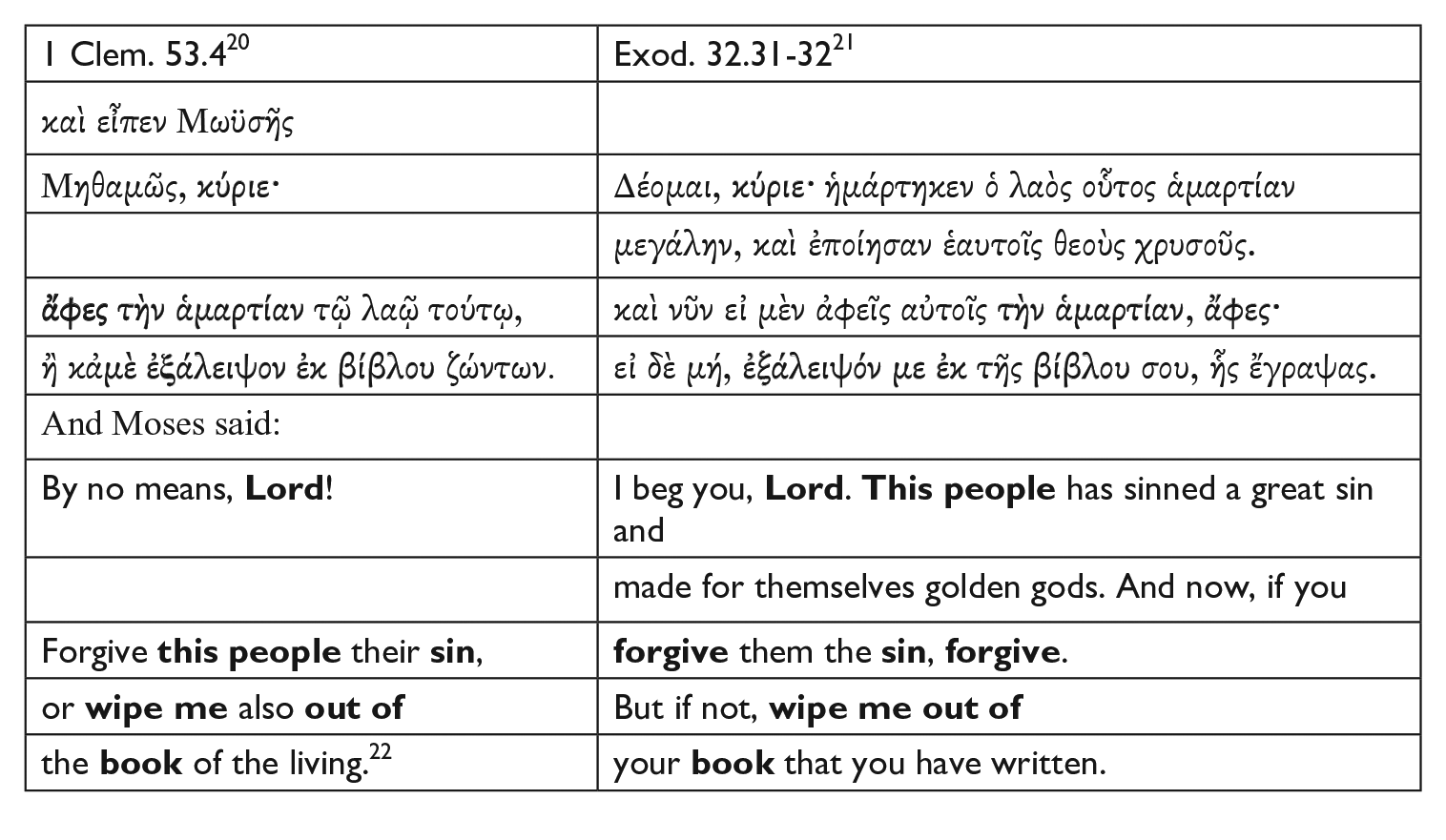
Compared with the reading of the Septuagint, Clement’s modified version of Moses’ protest is more concise and rhetorically more effective. Moses opposes God firmly and directly: Μηθαμῶς, κύριε (‘By no means, Lord!’). Clement rewrites the Septuagint’s conditional clauses so that they become a direct demand and then praises Moses precisely for his boldness: ‘What mighty love! What unsurpassable perfection! The servant speaks boldly to the Lord’ (παρρησιάζεται θεράπων πρὸς κύριον, 53.5). παρρησία, outspokenness or frankness, originally referred to the licence to speak freely in public, particularly associated with Athenian democracy. David Konstan (2012: 10) describes παρρησία in fifth-century Athens as ‘a kind of bold speech, carrying a certain connotation of defiance’ with ‘a suggestion of boldness or even insubordination … always attached to the term’. 23 παρρησία denotes speech that is plain and open in the sense that it conceals nothing (e.g., Mk 8.32) and is open to the public (e.g., Jn 18.20). Because of the risks of such uncensored frankness, παρρησία can denote ‘courage, confidence, boldness, fearlessness, esp. in the presence of persons of high rank’ (BDAG, παρρησία 3). This is the sense of the verb παρρησιάζομαι, ‘to speak freely, openly, fearlessly’ in 1 Clem. 53: it highlights Moses’ courage in a confrontation characterized by disparity (‘the servant – the Lord’). The verb does not derive from the narrative of Exodus but represents Clement’s interpretation. Although the exchange between Moses and the Lord has no listeners in the narrative of Exodus and is therefore not public, Clement comments on Moses’ answer with a word that has clear political and ethical connotations. 24 He chooses a word that associates Moses with integrity, fearlessness and great public figures who take risks by speaking openly.
The boldness of Moses’ answer, which becomes more apparent after Clement’s adjustments, is laudable, because it is motivated by love. Moses is presented here as an in-group champion, a leader who acts for the group and uses his influence to promote the group’s interest (Haslam et al. 2011: 71, 110). Preferring to die together with his group rather than let it be destroyed, he represents an extreme case of such leadership. What Clement intends the Corinthians to emulate is not Moses’ παρρησία as such, but the greater virtue that παρρησία serves in the passage. Clement does not wish to present Moses as a prototype of courageous speech but of love and solidarity that inspire this outburst of παρρησία in an otherwise humble servant (who is also pessimistic about his oratory talents, as Clement has shown).
Clement then uses Moses’ inspiring example of solidarity with his people to provide a way out for the rebels (as Clement views them) without them losing face. He suggests that they should imitate Moses’ sacrificial love and similarly act in the interest of their congregation, in this case by leaving it: Now, then, who among you is noble? Who is compassionate? Who is filled with love? Let that one say: ‘If it is my fault that there are rebellion and strife and schisms, I retire; I will go wherever you wish, and will do whatever is ordered by the people. Only let the flock of Christ be at peace with its duly appointed presbyters.’ The one who does this will win great fame in Christ, and every place will welcome that person. (1 Clem. 54.1-3)
The voluntary exile of the rebel leaders is Clement’s solution to the crisis. 25 While in other passages in the letter he applies the strategy of shaming the Corinthians for the situation (1 Clem. 1.1; 47.6-7), this passage, directed to the would-be leaders, is all about honour. Leaving the congregation for voluntary exile is the honourable course of action. The mobilization Clement wishes to achieve is therefore twofold. The entirety of the congregation is to repent that they have allowed such a shameful situation to develop and, if necessary, to remove the new leaders and restore the divinely established order. Yet in the passage cited above, Clement addresses the new leaders and offers them a possibility to leave the stage, not in shame but in Moses’ footsteps.
Moses Hiding behind a Veil in 2 Corinthians
2 Corinthians gives an impression of a serious conflict in which Paul’s authority has been challenged. 26 In the apologetic section 2.14–7.4, he appears to respond to various kinds of criticism, defending his and his co-workers’ integrity and honesty as well as his worthiness for acting as God’s διάκονος. What considerably complicates the attempts to reconstruct the development of the Corinthian conflict and the agenda of Paul’s opponents is the highly disputed composition of 2 Corinthians. In this article, I examine 2 Cor. 3 as part of 2.14–7.4, which undeniably forms its literary context, 27 and refrain from explaining Paul’s argumentation in the light of what he says about the ‘super-apostles’ in chs. 10–13. In this sense, my reading is ‘minimalist’, whereas a more ‘maximalist’ reading would offer more information about Paul’s adversaries by assuming that chs. 10–13 refer to the same stage of the crisis as 2.14–7.4, 28 and that the criticism Paul responds to in 2.14–7.4 is articulated by the super-apostles. 29 However, scholars such as Margaret Mitchell (2003: 17-53) and Paul B. Duff (2015: 65-81) convincingly demonstrate that it is possible to read 2 Cor. 2.14–7.4 as Paul’s reaction to the dissatisfaction and distrust that has arisen within the Corinthian congregation itself. My main argument in this article works with either a minimalist or a maximalist reading (that is, however one understands the relation between 2.14–7.4 and chs. 10–13), but I will argue my case based on the immediate and undeniable context alone. Important here is that in 2 Cor. 2.14–7.4 Paul considers his authority and integrity threatened and defends them vigorously, highlighting his own merits as a διάκονος who has been made worthy and competent (ἱκανός) by God himself (3.5-6). 30 He tries to dispel any suspicion of his sincerity (2.17; 4.1-3) and demonstrate the transparency of his conduct. Paul claims that he needs no letters of recommendation either to or from the Corinthians, for the existence of the Corinthian community itself represents sufficient proof of his competence and efficacy (3.1-3).
Paul’s selective and elliptic retelling of the story of Moses’ veil (Exod. 34.30-35) in 2 Cor. 3.4-18 is connected to this defence of his ministry and integrity. 31 This intriguing passage poses several problems, but as most of them go beyond the scope of this study, I will address here only those that are directly relevant to questions of social identity, leadership and παρρησία. While Clement interprets Moses’ protest to God in Exod. 32.31-32 as a demonstration of Moses’ παρρησία, Paul comments on the lawgiver’s παρρησία in connection with Exod. 34.30-35. Notably, neither passage in Exodus mentions παρρησία. Moses has various roles in 2 Cor. 3.4-18. He is at the same time a symbol for ‘the old covenant’, a text that is being read aloud, and a leader comparable to Paul and his co-workers. While 1 Clement is interested in Moses’ person and in the virtues he exemplifies as a leader, Paul’s treatment of Moses is more complex and moves on different levels. 32 Moses’ descent from Sinai is echoed already in Paul’s comparison between the tablets of stone and the tablets of human hearts written with the Spirit (3.3). Paul then compares Moses’ ministry (διακονία) and the covenant this ministry serves with his own ministry in the service of the new covenant. His argument proceeds a minore ad maius (3.8, 10, 11): 33 if already the transient glory on Moses’ face was overwhelming, the ministry of the Spirit will be even more glorious. This focus on the two ministries and what they have to offer connects the passage to Paul’s apology and to the question of his worthiness (2.14–7.4). 34
In this article, I focus on Paul’s interpretation of Moses’ reason for veiling himself. In the narrative of Exodus, when Moses descends from Sinai with the stone tablets in his hands, his face is ‘made glorious’. While the Israelites are initially afraid to approach him, they overcome their fear (Exod. 34.30-32). Paul’s statement that ‘the Israelites could not gaze at Moses’ face because of its glory’ (2 Cor. 3.7) probably refers to this initial apprehension, although it differs from Exodus by changing fear to inability. 35 After Moses has relayed to the people all the commandments, he places a veil over his face. Every time Moses converses with the Lord, he removes the veil (Exod. 34.30-33). Paul seems to imply that Moses veiled himself to conceal the fading of the glory on his face: ‘Since, then, we have such a hope, we act with great openness, not like Moses, who used to place a veil over his face so that the Israelites might not gaze at the end of what was passing away’ (πρὸς τὸ μὴ ἀτενίσαι τοὺς υἱοὺς Ἰσραὴλ εἰς τὸ τέλος τοῦ καταργουμένου, 2 Cor. 3.12-13). 36 This ambiguous statement has puzzled commentators, for it is not clear what Paul claims that Moses tries to conceal from the gaze of the Israelites and why, nor where his understanding of Moses’ motive derives from. Does Paul introduce an external element into the narrative? (Furnish 1984: 226-27)
The narrative in Exodus gives no reason for Moses’ habitual use of the veil. Although the Israelites are at first afraid of Moses’ appearance, this initial reaction is overcome, and they do approach him. Francis Watson (2004: 269) convincingly argues that Paul’s interpretation is in fact rooted in this narrative gap in Exodus and offers an exegetical solution to the unmotivated use of the veil: One would expect the glory to fade with the passing of the immediate occasion of encounter with divinity – as in the later case of the transfigured Jesus. It is just this supposition that the veil makes it impossible to confirm: for the transfigured Moses places the veil over his face until his next encounter with deity, and only removes it again in the private space of the tent of meeting.
37
Watson argues that, in the light of the Christ event, Paul concludes that the splendour of Moses’ face was only temporary and that the veil was needed to conceal this. By veiling himself, Moses lets the people remain in the wrong assumption that the glory would be permanent and always present on his face (Watson 2004: 269-70).
Paul uses this lack of openness on Moses’ part to highlight his own immaculate conduct: ‘we act with great openness (πολλῇ παρρησίᾳ χρώμεθα), not like Moses …’ (3.12-13). However one translates Moses’ motive for concealing his face, and whether one interprets it as intentional deception or some kind of measure aimed at protecting Israel, Paul in any case presents Moses’ practice of veiling himself as a failure to act in a frank and open manner. 38 The comparison with Moses serves to highlight the integrity of Paul’s person and actions. In this context, παρρησία appears to refer to openness: in contrast to Moses, Paul has concealed nothing from his audience. In comparison with the passage from 1 Clement discussed above, the connotations of courage and fearlessness are not pronounced here: Moses is inferior to Paul not so much in terms of boldness but of transparency. 39 Several NT passages use παρρησία to describe how believers boldly and fearlessly approach God and have confidence in him (e.g., Heb. 10.19; 1 Jn 3.21; 5.14), which reflects one use of the term in the Septuagint. This bold confidence in one’s relationship with God appears to have developed as one meaning of παρρησία among Greek-speaking Jews (Marrow 1982: 437-41). However, this is not the primary meaning of the word either in 1 Clem. 53.4 or 2 Cor. 3.12. In 1 Clement, the writer does not praise Moses for his confidence in God but for the bold frankness of his protest to God. 40 In the case of 2 Corinthians, the issue is not Moses’ and Paul’s confidence towards God as such but their openness towards the people they are leading. 41
A couple of verses later, Paul returns to the issue of the openness of his conduct: ‘We have renounced disgraceful hidden things. We refuse to practise cunning or to distort God’s word, but by the open proclamation of the truth we commend ourselves to everyone’s conscience before God’ (2 Cor 4.2-3). Here Paul emphatically negates any act of concealment or dishonesty. The passage resembles 7.2, in which Paul appears to react against accusations of dishonest dealings (Duff 2015: 77-78, 175): ‘We have wronged no one, we have corrupted no one, we have taken advantage of no one.’ 42 The renunciation of such things is followed by Paul restating the openness of his conduct: ‘My actions toward you are characterized by great openness’ (πολλή μοι παρρησία πρὸς ὑμᾶς, 2 Cor. 7.4). 43 Moses may have failed to be open with his people but Paul has not. By asserting his own frank and open behaviour, Paul implies that ‘if there is anything about him or his message that has been hidden or unclear to the Corinthians, it has not resulted from anything that he has done’ (Duff 2015: 177).
While Paul compares his ministry with Moses and highlights the openness and sincerity that distinguishes himself, the main point of his argument lies not in this comparison between two individuals and their virtues. Instead, Paul wishes to remind the Corinthians of everything they have received through Paul’s ministry. The comparison between the old and new covenant serves to emphasize the superior situation of the Corinthians as members of the new covenant. Paul wishes them to be well aware of this superiority, for it highlights the greatness of the gift of his ministry. He claims that the Corinthians are themselves his letter of recommendation, and making them feel proud of their new existence in Christ thus underlines his merit. In the language of the social identity approach, Paul seeks to shape the identity of the Corinthian community.
One of the basic principles of Tajfel’s social identity theory is that groups aim at positive distinctiveness: they seek to define their group in positive terms so that it is distinguished from out-groups (e.g., Tajfel 1978a: 86, 93-94; 1978b: 67, 74-75). Individuals need to have a positive view of themselves and of their groups, which leads to social comparison. The ‘desire for positive self-evaluation provides a motivational basis for differentiation between social groups’ (Abrams and Hogg 1990: 3; see also Reicher and Hopkins 2001: 43; Haslam et al. 2011: 50). Paul’s discussion in 2 Cor. 3–4 can be viewed from the perspective of promoting the positive distinctiveness of the Corinthian Christ-believers by means of comparison with other groups. He simultaneously confirms the glory of Moses’ ministry and emphasizes its temporary nature in the face of the surpassing glory of ‘the ministry of the Spirit’, the permanent glory of which the Corinthians partake thanks to Paul’s ministry. The minds of the ‘sons of Israel’ of the past were made insensible (ἐπωρώθη τὰ νοήματα αὐτῶν), 44 and the Israelites of Paul’s day similarly remain ignorant of the true meaning of the Torah (3.13-14), whereas through Paul’s ministry the Corinthians see the glory of the Lord with unveiled faces. While unbelievers are blinded by ‘the god of this world’ (4.4), the Corinthians are transformed by the glory of Christ (3.18). Underlining the positive distinctiveness of the Corinthian believers serves to remind them who they are to thank for their privileged status. 45
Moses’ παρρησία and Strategies for Identity Construction
The use of the motif of Moses’ παρρησία is connected to the different ways in which Paul and the author of 1 Clement seek to negotiate the group identity of their audiences. When commenting on Moses’ παρρησία, both writers use the same stem but with a slightly different emphasis. In 1 Clem. 54, παρρησιάζομαι has the sense of fearlessly speaking one’s mind in front of a high-rank addressee. In the modified quotation, Moses directly protests to the Lord and demands a different course of action. παρρησία manifests itself as boldness of open speech and uprightness in the presence of the furious deity, motivated by Moses’ profound solidarity with his people, which distinguishes him as an exemplary leader. In the case of 2 Corinthians, Paul’s παρρησία is boldness to be completely frank and open with the Corinthians: he conceals nothing either when proclaiming the gospel or when interacting with the congregation. In 2 Corinthians, in contrast to 1 Clement, Moses is not the prototype embodying the values and norms of the group. Instead, the prototypical leader is Paul himself. 46
From the perspective of the social identity approach, Clement puts a lot of effort into defining the category content, that is, the qualities, characteristics, values and norms that unite ‘us Christ-followers’. Through the scriptural narratives and other examples, he presents humility, love, solidarity and peaceful co-existence as defining characteristics of God’s people. According to the social identity approach, leaders should be seen as prototypes of their category: they are expected to epitomize the group’s core values and characteristics (Haslam et al. 2011: 71). In Clement’s portrayal, Moses accomplishes this both through his humility and through his love and solidarity, which should all be imitated by the Corinthians. In contrast, in 2 Corinthians Moses fulfils a very different function, or perhaps more accurately at least two functions. First, the comparison with Moses who failed to be open with his people serves to highlight Paul’s transparent and sincere conduct, which seems to be disputed by Paul’s adversaries. Paul is more virtuous than Moses himself. Second, Moses is representative of the old covenant that Paul contrasts with the new one. The contrast highlights the amazing status of the Corinthian believers and everything that they have gained through Paul. Because of Paul’s ministry, their situation is superior to that of ancient Israelites or Jews of their own day: they understand the meaning of the scriptures, they experience freedom, they behold the glory of the Lord.
Paul’s and Clement’s use of scriptural traditions in identity construction also differ in the ways in which they display continuity or discontinuity with the scriptural past. Clement’s use of the Jewish scriptures contains no sense of disruption caused by the Christ event: the Christians are the self-evident direct heirs of the patriarchs, and the scriptures are their own ancestral tradition. Clement never questions the authority of any part of the tradition, nor does he ever imply that different scriptural voices could disagree. Every scriptural hero is on the same side, and Paul and Moses are both equally presented as victims of jealousy and strife. Threatening outsiders are absent in the letter that focuses on the problem of deviant insiders. 47 Interestingly, at one instance the letter acknowledges the existence of factiousness in Paul’s time, referring to 1 Corinthians (1 Clem. 47.1). However, Clement reminds the audience that the past situation concerned parties centred on apostles who were all appointed by God, whereas in the present situation, the rebels have deposed leaders who were duly appointed and called by the apostles or by men appointed by them. He therefore exhorts the Corinthians to take up Paul’s letter and to study the apostle’s reprimand for the factiousness of the congregation. 48 The scriptures as a whole and the entirety of their protagonists stand together with the apostles, Christ and the God of good order in one front against the troublemakers in Corinth.
In 2 Cor. 3–4, in contrast, the discontinuity between the time before and after the Christ event frames Paul’s discussion. On the one hand, Paul presents himself as an interpreter who provides a valuable connection with the mythical past and the authoritative tradition. Yet from the perspective of the Christ event, Paul can present Moses’ glory as merely transient, thus simultaneously affirming and relativizing the glory of Moses’ descent from Sinai in the tradition. While the minister of the less glorious covenant is constitutive for Paul’s argument, in the binary frameworks that he sketches, Moses is not quite one of ‘us’. He becomes a representative of an inferior relationship with the divine than what the Corinthians are allowed to experience. Furthermore, as God’s envoy, Moses’ conduct does not meet the high standard set forth by Paul.
Conclusions
In this article, I have viewed Paul and Clement as entrepreneurs of identity, ideological leaders who intentionally try to shape the social identity of their audience to bring about a certain kind of mobilization. The relationship between social identities and ‘real world’ is best viewed as cyclic: the social reality affects the ways in which the category of ‘us Christ-followers’ can be defined and how it needs to be negotiated within those boundaries. The shaping of the category is intended to result in collective action, which again changes the social reality (Haslam et al. 2011: 72). In Clement’s case, he defines ‘us’ in ways intended to influence the audience to restore peace and order within the congregation. Paul’s identity construction in 2 Cor. 3 can be viewed as a self-enhancing discourse with two aims. First, it intends to make the Corinthians appreciate the privileged position of their in-group in comparison with Israel of the scriptural past, present Jews, and ‘those who are perishing’ (4.3). 49 Second, the Corinthians should acknowledge that they have acquired their privileged position through Paul’s ministry, which is characterized by exceptional openness and transparency. They should understand themselves as a letter of recommendation attesting to Paul’s ministry (2 Cor. 3.1-3), for as a community, they provide themselves with evidence for Paul’s integrity. Accordingly, they should make room in their hearts for Paul and his co-workers (2 Cor. 6.13; 7.2). The section on Moses’ veil is thus an integral part of the apology in 2 Cor. 2.14–7.4.
This article has highlighted how authoritative traditions of the past can be creatively retold by entrepreneurs of identity to suggest a certain course of action. The past ‘provides a number of resources that we can draw on in order to create a contemporary understanding of ourselves … [I]t is like a dressing-up box from which we can select and choose items, reshape them, and use them in new combinations to clothe our present aspirations’ (Haslam et al. 2011: 178). While this quote may sound too simplistic when applied to writings that Paul and 1 Clement also genuinely struggle with and that they consider sacred, it aptly highlights the constructedness of the authors’ accounts of the scriptural past. The same character and the same virtue, παρρησία, is used by Paul and Clement for different constructions of social identity. The contextuality and flexibility of social identity means that in a different situation, Paul could well have sided with Moses and used him as an in-group hero the way Clement does (just as Paul uses Abraham in Rom. 4). Clement already presents Moses as a prototype of two different qualities, humility and love (that can manifest itself in bold speech). To bring about a different kind of social mobilization, he could have used Moses to highlight some further aspects of Christian life as well.
The benefit of applying the social identity approach and particularly its perspectives on leadership to ancient texts is heuristic. The theoretical framework helps to raise new questions and observe connections that have gone unnoticed (Baker 2012; Nikki 2018: 45-46). It offers analytical tools for describing with more nuance the cognitive, emotional and motivational factors behind processes of identity construction (Hakola 2015: 11, 148). I hope to have shown that the perspective on leaders that the social identity approach provides can offer conceptual clarity for explaining the connections between using authoritative tradition, shaping the social identity of one’s audience, and wielding power through texts.
Footnotes
1.
I would like to thank the ‘Texts, Traditions, and Early Christian Identities’ team (Institute for Religion and Critical Inquiry, Australian Catholic University) for their valuable comments on the draft of this article, as well as Professor Jutta Jokiranta’s team ‘Finnish Interdisciplinary Study of Social Identity Transmission’ (University of Helsinki) who helped me to finalize the article.
2.
4.
For an overview on the use of the theory in biblical studies, see Baker 2012;  .
.
5.
Social identity refers to an individual’s awareness that he or she belongs to a certain group together with the values and emotions attached to this membership (Tajfel 1974). Social identities are not rigid and static but are fluid, flexible and constantly changing according to the context (Oakes, Haslam and Turner 1994: 98; Haslam, Platow and Reicher 2011: 67). While in one context an individual might identify him- or herself as a New Testament scholar (as opposed to patristics), in another the same person might speak of ‘we who are working in the humanities’ (as opposed to hard science), and in a third context the operative identity might be that of an academic who defends the role of academia and scientific research as a whole in society.
6.
For applying the term to Pauline material, see Esler 2003: 38, 109; Shkul 2009: 11-12; .
7.
For the relationship between the theories, see Abrams and Hogg 1990: 1-9; : 52-54.
8.
A social category is a collection of individuals who share certain attributes.
9.
Paul frequently appeals to his own authority rather than giving the impression that he trusts the local leaders in Corinth; see 1 Cor. 4.18-21; 5.3; 7.9; 2 Cor. 10.8.
10.
Recently, Clare K. Rothschild (2017: 66) has argued that the letter is based on a ‘historical fiction’ and was ‘neither written from a church in Rome not intended for (let alone delivered to) a Church in Corinth’. According to Rothschild, ‘Rome might connote those whom the author associated with proto-orthodoxy in Rome’ and Corinth ‘those whom the author associated with the wayward behavior Paul addresses in his first letter to the Corinthians’ (: 63). However, Rothschild’s arguments against viewing 1 Clement as a genuine letter are weak. She mentions ‘the lack of historical evidence’ concerning churches in Corinth and Rome’ and makes much of the fact that the epistolary elements were not accepted as the title of the letter. That ‘Corinth’ would function as a self-evident symbol for wayward behaviour and ‘Rome’ for ‘proto-orthodoxy’ and ‘Paul’s legacy’ appears to me implausible in the early second-century context.
11.
1 Clement is traditionally dated to the very end of the first century (see, e.g., Lindemann 1992: 12; Lona 1998: 75-78; Jaubert 2000: 20), but for the problems of this exact dating, see Welborn 1984. According to Andrew Gregory, there are no firm arguments for a more exact dating than between c. 70 and c. 140 ce (: 142-66).
12.
See Irenaeus, Adversus haereses 3.3 for the succession. Although Irenaeus does not claim that Clement wrote the letter, he connects Clement’s time as the bishop with the sending of the letter.
13.
14.
In older research it was common to assume that the conflict was between pneumatics (representing the ‘original’ Pauline charismatic governance) and advocates of institutionalization. The pneumatics would have reacted against the increasing institutionalization of leadership structures (for examples of this view, see : 77 n. 74). However, Kloppenborg convincingly argues that such view of office-less Pauline communities is unconvincing in light of insciptions attesting to the practices of Graeco-Roman associations: ‘There is little reason to suppose that early Christ groups, anomalously, had an office-free regime, and good reason to suppose that they mimicked both the flat-hierarchical practices widely attested elsewhere, and that patronage and wealth function to install some leaders as permanent officers’ (Kloppenborg 2015: 75). Kloppenborg argues that the discord referred to in 1 Clement should rather be seen as a common struggle for honour and status, typical of Mediterranean societies. It is ‘probably a conflict provoked by an influential person and potentially powerful patron managing to displace some long-time leaders’ (Kloppenborg 2015: 80). Kloppenborg’s article helpfully illuminates common practices in the organization of associations. However, it is important to note that the author of 1 Clement appeals to divine order and divine authority when defending the deposed leaders (1 Clem. 42), not to fair play in fulfilling the offices.
15.
‘Mobilization’ is a technical term describing the step from social identity to transforming social reality (cf. ). It does not therefore suggest that the Corinthians were somehow passive before receiving the letter. The social identity shaped by the new leaders, for example, may have suggested a mobilization that led to deposing the previous leaders.
17.
Numerous other approaches also emphasize the importance of narratives for identity (e.g., ). Yet the social identity approach is particularly suitable for explaining how entrepreneurs of identity actively select and adapt the narratives to articulate the social identity in ways that suggest a certain kind of mobilization. Thus, the approach is helpful for clarifying the links between narratives, social identity, leadership and social reality.
18.
19.
In fact, the basis for Clement’s rewritten version is not Moses’s first protest when God informs him of the idolatry (Exod 32.11-13), but his second plea on the following day (Exod 32.30-32).
20.
The Greek text of Exodus is taken from J.W. Wevers’s edition Exodus. Vetus Testamentum Graecum: Auctoritate academiae scientarium Gottingensis editum (Göttingen: Vandenhoeck & Ruprecht, 1991).
21.
No Greek variants that would offer support for 1 Clement’s wording are preserved. Clement of Alexandria quotes the same passage in verbatim agreement with 1 Clement (Stromateis 4.19 [118.3]), but since he was a great admirer of the letter, his quotation does not support a hypothesis of an otherwise unattested reading of the passage.
22.
My translation.
23.
For the use of the term in the Roman High Empire, see Fields 2009, and in the Septuagint, see .
24.
26.
Already in 1 Corinthians, it is obvious that Paul’s leadership and authority are insecure. He addresses the factiousness of the Corinthian congregation, and in the language of the social identity approach, he seeks to redefine the boundaries of the in-group so that those identifying themselves as followers of Paul or Apollos would adopt the superordinate identity of fellow Christ believers, ‘God’s servants’ and ‘God’s field’ (1 Cor. 3.5-8).
27.
In practically all redaction critical models, 2 Cor. 3 is considered part of the apology in 2.14–7.4 (with the exception of 6.14–7.1).
28.
29.
Thomas Schmeller (2010: 16, 174), for example, assumes that Paul refers to the visiting missionaries also in 2.17; 3.1; 5.12. It has also been proposed that the super-apostles introduced Moses (and perhaps his veil) to the debate in the first place (e.g., ).
30.
The use of ἱκανός vocabulary may echo Moses’ protest in Exod. 4.10 that he is not competent (οὐχ ἱκανός εἰμί). Just as God made Moses competent to achieve the task, so he has made Paul.
32.
: 270-71) aptly summarizes the polyvalence in Paul’s treatment of Moses: ‘[O]ne sees the figure of Moses undergoing a series of metamorphoses, from negative foil of the Christian apostle (2 Cor 3.12-13), to metonymy for the Jewish scriptures themselves (2 Cor 3.14-15), to positive exemplar for all those in Christ and the Spirit (2 Cor. 3.16-18)’.
34.
35.
36.
37.
Margaret E. Thrall (1994: 243) makes a similar observation concerning the fading of the glory: ‘With some degree of ingenuity it is just possible to detect the idea in Exod 34.34-35 … it would seem that contact with Yahweh renews the radiance, and one might deduce that it fades when the contact is broken. But the thought is implicit in the narrative only for those determined to see some disparaging element in it.’ The question of the permanence of Moses’ glory was viewed in different ways in Jewish interpretative traditions (see ).
38.
Victor Furnish (1984: 232-33) and Ralph Martin (1986: 68) both argue against a deceitful motive on Moses’ part and suggest that Paul presents Moses ‘in a good or neutral light’. According to Richard B. Hays, it probably did not occur to Paul to raise the question of Moses’ motives. In Hays’s reading, Moses is mysterious, evasive and keeps his wisdom to himself, but this is as far as Hays allows Paul to go in his implicit criticism (Hays 1989: 140-42). In contrast, according to Margaret Thrall, ‘it does seem that some degree of intentional deception is attributed to him’ (: 258).
39.
I therefore prefer ‘openness’ to ‘boldness’ (found in the NRSV).
40.
Obviously, Moses’ protest implies that he also has confidence in God, because he thinks the appeal is worth making. Yet ‘confidence’ is clearly not what Clement has in mind when he praises Moses’ answer (παρρησιάζεται θεράπων πρὸς κύριον).
41.
: 272) suggests that ‘[w]hile in 2 Cor 3.12-13, Paul speaks of a “horizontal” parrhēsia directed toward other human beings, which Moses does not exemplify, in 2 Cor 3.16-18, Paul describes a second kind of parrhēsia, a “vertical one,” to use the language of Michel Foucault, which bespeaks an “unveiled” appearance before God in mystical vision of the divine image and glory. Moses, who lacks the first kind of parrhēsia in 2 Cor 3.13, becomes, by the end of the exegesis, the prime exemplar of this second kind of Pauline parrhēsia.’ However, in his undisputed letters, Paul never uses παρρησία in the sense that Cover calls the ‘second kind of Pauline parrhēsia’. In Phil. 1.20, 1 Thess. 2.2 and Phlm. 8, παρρησία refers to bold speech. For 2 Cor. 7.4, see below.
42.
Margaret Mitchell (followed by Duff 2015: 81-85) suggests that the delivery of the collection to Jerusalem (and particularly the question of a Corinthian representative in the delegation) may have increased the tensions between Paul and the Corinthians to the extent that Paul was accused of deceitful motives. This reconstruction of the events is dependent on Mitchell’s hypothesis that ch. 8 is part of an earlier letter (: 21-23). While this hypothesis is highly contested, the collection could well have been a source for mistrust and suspicion.
43.
In the light of the accusations of deception in 7.2, παρρησία as openness in the sense of transparency seems preferable to the translation of the NRSV (‘I often boast about you’). Alternatively, Paul may imply that he can be completely frank with the Corinthians and bold in his exhortation to them (so : 445), but this boldness would seem misplaced as it immediately follows Paul’s defence of himself.
44.
ἐπωρώθη is probably the divine passive just as ἐπωρώθησαν in Rom. 10.7 (where the following verse 10.8 shows undeniably that it is a case of the divine passive). I prefer to translate πωρόω as ‘to make insensible’ rather than ‘to harden’, for Paul uses the verb to refer to intellectual blindness rather than wilful disobedience (Robinson 1901; ).
45.
: 195-96) makes a similar point concerning the self-understanding of the Corinthians: they are Christ’s letter (3.3) and image (3.18) only because of Paul. Schmeller helpfully highlights the inclusion of the addressees both at the beginning (3.1-3) and end (3.12-18) of the chapter: in both sections, Paul refers to the Corinthians as the goal and legitimation of his ministry. The middle sections discuss Paul’s ministry in the new covenant (3.4-6) and compare that ministry with Moses (3.7-11). Thus, Schmeller identifies a chiastic structure in ch. 3.
46.
Cf. 1 Cor. 4.16 (‘I urge you, then, be imitators of me’); 7.7; 10.33; 14.18-19.
48.
Unfortunately, the question of whether Clement knew 2 Corinthians is methodologically impossible to answer: cf. Gregory and Tuckett 2005: 62: ‘Not only is it impossible to demonstrate knowledge of a text unless it is used, but also the inability of subsequent scholarship to demonstrate the use of one text in another does not mean that non-use, let alone ignorance, has been proved’. While scholars agree on the high probability of 1 Clement using 1 Corinthians and Romans, the evidence for knowledge of 2 Corinthians is inconclusive (: 129-57). 1 Clement refers to Paul’s letter in the singular, but too much weight should not be placed on this detail. As for the topic of this article, the differing views on Moses can hardly be used as an argument for Clement not knowing 2 Corinthians. Despite the use of Romans and 1 Corinthians, the author of 1 Clement is not a faithful student of Paul but a creative writer whose competence in rhetoric and scriptural argumentation at least equals Paul’s skill. Even if Clement knew 2 Cor. 3, I suspect that he would not have been particularly impressed but would rather have considered Paul’s depreciation of Moses counterproductive and likely to encourage just the sort of trouble that Corinth suffered from in Clement’s time.
49.
It is unclear whether ‘the ones who are perishing’ (4.3; 2.15) and ‘unbelievers’ (ἄπιστοι, 4.4) refer to unbelieving Jews, Gentiles or both. That ‘the god of this age’ has blinded their minds (4.4) could refer to the inability of present Israelites to understand the scriptures because of the veil (3.14). However, if God makes the Israelites insensible (see n. 43 above), it appears more probable that the unbelievers who are blinded by ‘the god of this age’ are Gentiles.