




Abstract
This study seeks to demonstrate that the Pauline phrase πίστις Χριστοῦ is best understood grammatically as the ‘Christ-faith’ in accordance with the so-called ‘third view’, where ‘faith’ is taken to mean a system or set of beliefs, and ‘Christ’ qualifies what the system is about. I argue that the grammar disallows the meaning ‘faith in Christ’ where Christ is the object of one’s ‘trust’, since objective genitives can only mean ‘belief of something (to be true)’, as is shown by an analysis of the data in the NT and in Harrisville 1994; 2006. Additionally, the subjective genitive rendering often fails to make sense within the literary context and faces its own grammatical difficulties. Drawing on work from theoretical linguistics in lexical semantics and syntax, I show that the third view meaning, translated as the ‘Christ-faith’, is the most likely rendering given the context of each of the passages, the Greek case system and the meaning of the noun πίστις as used in the NT and other Koine Greek writings.
1. Introduction 1
This study seeks to demonstrate that the Pauline phrase πίστις Χριστοῦ is best understood grammatically as the ‘Christ-faith’ in accordance with the so-called ‘third view’, where ‘faith’ is taken to mean a system or set of beliefs, and ‘Christ’ qualifies what the system is about. I argue that the grammar disallows the meaning ‘faith in Christ’ where Christ is the object of one’s ‘trust’. Additionally, the subjective genitive rendering – that is, ‘Christ’s faithfulness’ – often fails to make sense within the literary context and faces its own grammatical difficulties. Drawing on work from theoretical linguistics in lexical semantics and syntax, I show that the ‘Christ-faith’ is the most likely rendering given the context, the Greek case system and the meaning of the noun πίστις as used in the NT and other Koine Greek writings.
This article opens, then, with a brief literature review of the grammatical 2 arguments of relevance to the πίστις Χριστοῦ discussion. Second, I introduce the concepts from theoretical linguistics relevant for the conversation. Third, I survey the uses of πίστις and πιστεύω in extant Koine texts in order to establish how native speakers understood these words. Finally, using this data, my exegesis of the relevant passages will lead us to conclude that the third view makes the most sense contextually and syntactically.
2. Literature Review
The πίστις Χριστοῦ debate has been a long-standing battle between two major camps who understand the genitive either as subjective or objective. 3 The ‘third view’ has received comparatively little attention. In Easter’s (2010) survey, this reading receives a single sentence at the paper’s start, while the remainder of the article compares and contrasts the ‘two’ sides. In spite of the entrenchment of these two camps, there stands a general consensus that ‘We cannot hope to solve such a delicate and sensitive issue as the meaning of the phrase πίστις Χριστοῦ simply by means of Greek linguistics, because there is more at stake – including exegesis and theology’ (Porter and Pitts 2009: 53, emphasis original). This assessment comes from the most linguistically oriented chapter in the collection of essays The Faith of Jesus Christ, which earlier hints that many scholars ‘despair of solving the issue linguistically’ (Porter and Pitts 2009: 35). Some have even suggested that Paul was intentionally ambiguous to allow his audience to understand the phrase in multiple ways (Jewett and Kotansky 2006: 277). 4
Against these suggestions, I propose that modern linguistics literature enables readers to eliminate the objective genitive position and to render the subjective genitive position as highly improbable. Theoretical linguistics has developed helpful tools to explore the scope of meaning in the genitive relation, the semantics of nominals and the syntactic function of the dative – all of which are crucial to a successful grammatical analysis of πίστις Χριστοῦ. By focusing on the below arguments for each side, it will become apparent that supporters of the ‘two’ positions make exaggerated appeals to literary/thematic context in one way or another. By addressing every argument given in Easter 2010 (cf. Kugler 2016), I seek to demonstrate how each of these arguments (for both sides) either offers support for the third view or does not adequately support the subjective and/or objective positions.
2.1 Summary of the Objective Genitive Position
The objective genitive position is that the phrase πίστις Χριστοῦ should be taken to mean ‘faith in Christ’, where ‘Christ’ is the ‘object’ of faith. Following the summaries in Easter 2010: 34-38 and Kugler 2016: 248-49, the objective reading can be broken down into the six arguments given below. For each, I give the section number(s) in this article where I deal with that particular argument and note whether I agree (A), disagree (D) or remain neutral (N).
The lack of the article disfavors the subjective reading (4.2.1.3, 4.2.2 – A).
πίστις ἐν Χριστῷ is not a Pauline idiom (2.1 – D).
εἰς Χριστὸν Ἰησοῦν ἐπιστεύσαμεν in Gal. 2.16 explains πίστις Χριστοῦ (3.1 – D).
Works of law vs. πίστις Χριστοῦ – both must be human-oriented (5.1, 5.2 – A).
Abraham is a model of faith, not faithfulness (5.1 – N).
New Testament evidence for the objective genitive reading (4.2.1.3 – D).
Although the first argument about the article seeks to undermine the subjective reading rather than offering a positive argument for the objective, I show below that our understanding of the article actually presses against both of the dominant positions (though more strongly against the subjective). The second point is an argument from silence based on a reduced Pauline corpus. It also assumes that Paul’s Greek was fundamentally different than other speakers’: Paul would have had to have used a different construction, the genitive, to express the same meaning that others were using the preposition for, which hardly seems tenable. Thus, I leave aside this argument.
Many of the ‘grammatical’ arguments for the objective genitive appeal to the sense of πίστις and/or πιστεύω in the surrounding context to support a similar reading in πίστις Χριστοῦ (Matlock 2000; 2009: 77-78). Others argue that it is the relationship between the noun/verb and its syntactic complement that carries over to the phrase (e.g. Burton 1921: 121; Silva 2005: 160-61). If Paul uses a particular relationship between πιστεύω and its complement in the same verse, so the argument goes, why should he use a different relationship with the genitive and the cognate noun in the same verse? A variation of the context argument is used specifically with reference to Abraham as a model of faith. Proponents of the objective position point out that it is Abraham’s ‘faith’ (and that towards God) that is referred to throughout Rom. 4 and not his ‘faithfulness’, so the referent of πίστις in our phrase must also be ‘faith’, and not ‘faithfulness’, towards God. These are arguments about the nature of roots and how they should be interpreted when forming different words (e.g. nouns vs. verbs) in the same context. I discuss this in 3.1 and 5.1.
Still others cite examples of the objective genitive in the NT outside of the disputed texts. In section 4.2.1.3 below, I discuss how some of these examples are, in my view, legitimate cases of objective genitives, but they have the wrong meaning. In principle, however, this is not an argument for the objective genitive in the specific contexts cited but an argument for the general possibility of an objective genitive with πίστις.
2.2 Summary of the Subjective Genitive Position
The subjective genitive position is that the phrase πίστις Χριστοῦ should be taken to mean ‘faithfulness of Christ’, where ‘Christ’ serves as the subject of the phrase. Although the subjective genitive position has been around for quite some time (Schliesser 2015), the influential study of Hays (2002; originally published in 1983) sparked renewed interest in it. From the outset, the position has been characterized by an appeal to the narrative structure, and the story that Paul is telling continues to be the foundational argument (Wright 2013: 836-38). While these authors may be right about the story that Paul is telling, this does not necessitate a subjective reading of πίστις Χριστοῦ, as will be shown below. The following six major arguments for the subjective reading have been cited (Easter 2010: 38-42; Howard 1992: 758; the sixth being from Howard who is drawing on Kittel 1906: 424).
The objective genitive creates redundancies (5.2 – N).
πίστις followed by a genitive of a person never refers to faith in that person (4.2.1 – A).
How does human faith reveal God’s righteousness? (4.2.3, 5.3 – A)
Hab. 2.4 and ἐκ πίστεως (5.2 – N).
Arrival of singular, external πίστις (4.2.3, 5.2 - A).
The genitive relation carries over from other uses of πίστις (5.1 – D).
Like the arguments cited above for the objective reading, some of the subjective arguments are actually arguments against the objective position, specifically 1, 3 and 5. And again similarly, the subjective side makes several appeals to context, particularly in 4 and 6. If Paul uses a subjective genitive in Rom. 3.3 and 4.16, so the argument goes, why should he use a different kind of genitive in Rom. 3.22? I discuss this more in 5.1. The reference to Hab. 2.4 has also been a major argument for the subjective camp. The basic idea is that the phrase ἐκ πίστεως is equivalent to διὰ πίστεως, and both phrases refer to the citation of Hab. 2.4 previously in Rom. 1.17 or anticipated in Gal. 3.6 (or implicit in the other passages) (Campbell 1994: 268). The next line of reasoning is that whoever’s faith is referred to in Hab. 2.4 is also being referred to in the πίστις Χριστοῦ passages. If we accept these premises, we must still establish whose faith is being referred to in Hab. 2.4 in order to conclude who has faith in the relevant passages, but this also is disputed (cf. Campbell 2009a: 613-16; Watson 2009: 148-49). I leave this argument aside, since it is, on principle, compatible with any position. 5
2.3 Summary of the Third View
The third view understands the phrase πίστις Χριστοῦ to mean something like the ‘Christ-faith’ where ‘Christ’ refers to the content of ‘faith’ (see 4.2.3 below). I give the following six arguments in favor of the third view.
Lack of article suggests the nominal is not an AS-nominal 6 (4.2.1.3, 4.2.2).
No early evidence for native speakers understanding the phrase as subjective (4.2.1.2).
Wrong meaning in the objective reading (4.2.1.1-3).
The types of verbs predicated of πίστις (4.2.3, 5.2).
The third view meaning fits contexts both about Jesus’ work and the response to Jesus (5.2).
Examples from the early church fathers in Harrisville 1994 support the third reading (4.2.1.2).
Arguments 1, 2 and 3 are all negative arguments against the objective and subjective positions, while 4, 5 and 6 are positive, grammatical arguments for the third view. Sprinkle helpfully lists and summarizes the proponents of the third view, noting also three variations in how the phrase πίστις Χριστοῦ is defined: ‘content of the gospel (Christ-event), the preached gospel (the message about the Christ-event), or the sphere of salvation created by the gospel (i.e., the church)’ (2009: 175). I hope to provide some clarity on the meaning πίστις brings to the table in the phrase under discussion because it has been, in my view, sometimes sloppily described. For instance, Schliesser (2016: 282) says that the third view highlights ‘the eschatological quality of πίστις’. The noun πίστις itself, however, does not have any eschatological quality associated with it. It may be used in eschatological contexts, but its meaning, its specific contribution to the context, does not seem to be about eschatology. Nevertheless, advocates of the third view seem to consistently place emphasis on πίστις as an event, drawing on contexts where the noun is connected with an event, such as in Gal. 3.22-26 and Rom. 3.22-26. I discuss this more in 4.2.3 and 5.2-3. My translation of the phrase as the ‘Christ-faith’ is meant to highlight the type of faith as that which is centered on the Christ.
3. Linguistic Framework
This section is devoted to introducing the crucial concepts for my analysis. Drawing on work done in theoretical linguistics on case and nominals, I show that there is a distinct semantic difference between arguments introduced by prepositions and objective genitives which are, in fact, underlying accusatives. By ‘argument’, I mean another word or phrase required by the verb or noun to complete the concept the verb or noun is associated with. 7 Arguments introduced by a preposition have the meaning ‘trust in’ (for more on this meaning, see n. 29 below), while arguments introduced by the accusative or an objective genitive have the meaning ‘believe something to be true’. Bare dative arguments occupy a middle ground, and their meaning can be disambiguated based on the semantics of the argument itself (whether it is something to be ‘trusted in’ or ‘believed to be true’).
3.1 The Roots of Nouns and Verbs
Before discussing nouns and verbs, I start with what is considered to be the most basic unit of all words in Distributed Morphology: the root. 8 There is a tremendous amount of literature on roots in linguistics, particularly on what information they actually contain. 9 For our purposes, the important point is how a noun and a verb formed from the same root (which I will designate as √root) should relate to each other. The objective genitive position has claimed that the noun formed from πιστ should have the same meaning as the verb formed from πιστ when used in the same context. This is an empirical claim: there should be no (or few) examples of a noun and verb with different senses when the same root is used in the same context. This claim, however, cannot be sustained. For example, consider the two English clauses the doctor examined the patients and he put their examinations on the table (for similar examples, see Grimshaw 1990: 49). In the first clause, the verb examine (derived from √exam) refers to an event, but in the second clause, a noun with the same root is used (examination) with a different sense, i.e. a concrete entity, not an event. Likewise, J. Grimshaw’s (1990) seminal study insists that many nominals are systematically ambiguous, communicating different meanings if they function as an event (on the one hand) or an entity (on the other). Subsequent work agrees that shared meaning between nouns and verbs with a common root depends upon whether or not the noun has a verb phrase embedded within it and refers to the same event as the verb (for examples, see (1) below). 10 Shared meaning, then, is not simply determined by proximate context and shared roots. 3.2 Nominals
The above discussion on roots leads us to nominals. Consider the following paradigm from the English pair believe and belief.
(1)
11
a. John believed Mary that she raised a pet bear. b. John believed Mary. c. John believed in Mary. d. John’s belief of Mary that she raised a pet bear (was unfounded). e. John’s belief of Mary (was unfounded). f. John’s belief in Mary (was unfounded).
The above examples suggest that belief in English is a deverbal noun because it shares the same syntactic patterns with its verbal counterpart. A variety of terms have been used for such nominals, but their defining characteristic is that they are nouns with underlying verbs that refer to the same event as the verb from which they are derived, i.e. they are deverbal nouns. I will combine the terminology in Borer 2013 and Lieber 2016 and call the deverbal nouns that take their verbal arguments and refer to the event denoted by the verb ‘AS-nominal readings’ (Argument Structure nominal) and those that do not refer to events and do not take the arguments of their verbal counterparts I will call ‘R-nominal readings’ (Referential nominal). Both terms are called ‘readings’ because the distinction between AS-nominal and R-nominal readings does not actually divide up the nominals themselves but how they are understood, since the same nominal can be an AS-nominal in one context and an R-nominal in another context (see Lieber 2016: 3-5 for discussion). AS-nominal readings share the argument structure of their underlying verb. 12 By ‘argument structure’ I mean the number, type and meaning of the noun(s) that a verb requires to complete the concept the verb is associated with. Compare, for example, the parallel arguments required by the following verb and noun pair: the enemy destroyed (verb) the city and the enemy’s destruction (noun) of the city. 13 The nominal counterpart to the verb destroy has the same argument structure as the verb because the number, type and meaning of the arguments are identical. From this we begin to understand what a true objective genitive is: it is an AS-nominal reading that requires an object just like its corresponding verb.
Consider again the paradigm in (1). The nominal belief has the same argument structure and meaning as the verb believe, which means it has AS-nominal readings. Pressing the implications of this reading of belief further, an enormous body of research in lexical semantics has also demonstrated that when the syntax of the sentence changes, the meaning of the verb/noun also changes. 14 The implication of this is simple: a change in the argument structure from believe x to believe in x is accompanied by a change in meaning, and this also holds for the corresponding structures of the AS-nominal belief of x and belief in x. Roughly speaking, to believe something means to believe it is true, while to believe in something means (in English) to ascribe existence, an ability or some other modal meaning to it. 15 The implication of this discussion is that we can use the argument structure of a verb as a guide to help us determine the meaning of a nominal if the nominal has an AS-nominal reading.
Like the nominal belief in English, πίστις has an AS-nominal reading with a parallel argument structure to its related verb πιστεύω.
(2) a. ἵνα κριθῶσιν πάντες οἱ μὴ πιστεύσαντες τῇ ἀληθείᾳ (2 Thess. 2.12) in order that all may be judged who do not believe the truth b. οὐ μόνον τὸ εἰς αὐτὸν πιστεύειν (Phil. 1.29) not only to trust in him c. ὅτι εἵλατο ὑμᾶς ὁ θεὸς ἀπαρχὴν εἰς σωτηρίαν ἐν … πίστει ἀληθείας (2 Thess. 2.13) because God chose us as the first-fruits for salvation by … belief of the truth d. τὸ στερέωμα τῆς εἰς Χριστὸν πίστεως ὑμῶν (Col. 2.5) the steadfastness of your trust in Christ
Examples (2a-d) demonstrate that – like the English word belief – the Greek nominal πίστις has AS-nominal readings, since it has the same argument structure as its underlying verb πιστεύω. (2a) has a bare dative complement meaning ‘something believed to be true’, and in (2c), a (objective) genitive complement functions as the argument of the noun πίστει with the same meaning. On the other hand, the verb in (2b) has a prepositional complement (εἰς αὐτὸν) in the same way that the AS-nominal reading in (2d) has a prepositional complement (εἰς Χριστὸν). What is noteworthy here is that a change in syntax reflects a change in meaning for πίστις. Although an objective genitive reading is possible for πίστις (just as the underlying verb can take a bare dative or accusative with certain nouns), it has a different meaning than πίστις ἐν/εἰς (just as the underlying verb has a different meaning with these prepositional complements).
The above discussion has sought to show what an objective genitive is, how it is derived and its distinctive semantic nature. We now turn to consider the subjective genitive. Although J. Dunn (2002: 265-66) criticizes the subjective genitive position for having an unclear referent (for discussion, see 4.2.2 below), most of its proponents understand the phrase to speak of Christ’s faithfulness to God’s plan/his own death (cf., e.g., Hays 2002: 150-53; Wallis 1995: 85-87; Wright 2013: 839). On this understanding, the subjective reading would also be an AS-nominal, referring to the event of Christ being faithful to his mission (or to the God who ordained that mission). 16
I have argued that πίστις has AS-nominal readings, but it must also be noted that many deverbal nouns are ambiguous between AS-nominal and R-nominal senses. πίστις is no different; it also has R-nominal readings (see the senses in Danker 2000: 820). 17 As suggested above, R-nominals are distinct from AS-nominals in that they do not refer to an event, but an entity (whether concrete or abstract). 18 R-nominal readings also have the potential to be relational. For example, the noun brother speaks of an entity but requires another argument, for a brother must always be a brother of someone. 19 In other cases, the argument of such nouns can refer to the content of the noun: e.g. the report of the crime is on the table. Here, of the crime refers to the content of the report. Following Kratzer (2006: 1), I will call these content nouns. As an R-nominal, then, πίστις may depict something like a system of beliefs, similar to the English noun faith. For example, the faith of Islam refers to the system of beliefs of which Islam is the content. In this way, πίστις may be used as a relational R-nominal, with its genitive argument introducing the content. This definition for πίστις is not new (cf. Danker 2000: 820), and it is precisely this sense of the noun that I will argue is at play in the phrase πίστις Χριστοῦ. In sum, the noun πίστις is an inherently relational noun which may have either an R-nominal or an AS-nominal reading, and these senses can be distinguished by syntax and the semantics of the noun.
3.3 Case
3.3.1 Genitive Case
In linguistics, the genitive has been treated in various frameworks, but there is a general consensus on how relational nouns should be analyzed in the genitive construction: the noun in the genitive should stand in the relation expressed by the relational noun (Partee and Borschev 1998: 1-2; Vikner and Jensen 2002: 196-97; Asher 2011: 274-80). Consider the noun brother again. When another noun is placed in the genitive after brother, as in the brother of Sue, the entity referred to by the phrase must be someone who stands in the relation specified by the noun brother (i.e. a male with the same parents), and that relation is with Sue. Similarly, the phrase the sister of Sue refers to someone in a sister-relation to Sue. With relational nouns, the genitive interpretation is not random: it is determined by the relation encoded in the noun itself. 20
Because πίστις is a relational noun, readers do not need to guess about the relation between πίστις and the genitive noun.The relation will be determined by the sense of the noun – and especially, whether it has an AS-nominal or R-nominal reading. In sum, then: (1) if πίστις is an AS-nominal with the objective genitive rendering, the relation between the nouns in the phrase πίστις Χριστοῦ would be equivalent to the relationship between the verb and its object, i.e. πιστεύω Χριστόν or πιστεύω Χριστῷ 21 (ὅτι …); (2) with the subjective genitive construal, the noun Χριστοῦ would be equivalent to the subject of the corresponding verb, i.e. Χριστός πιστεύει (εἰς τινά); (3) finally, if πίστις is an R-nominal requiring an argument clarifying the content of faith, the genitive phrase would qualify the type of faith.
3.3.2 Dative Case
Before delving into the data, it is important to note that the dative case can serve (at least) two distinct functions with verbs: an applicative function and prepositional function. First, the Greek dative can add an argument to a verb, which is the applicative use (Cuervo 2003; Pylkkänen 2008). This can be seen in the example in (1) above, such as John believed Mary that … and also in Jn 4.21 (given below in (4)), where the dative introduces the one who spoke or is associated with the proposition to be believed. Crucially, the proposition can be deleted when supplied by the context, e.g. John believed Mary. When a human applicative argument is introduced with such verbs, an implied proposition is associated with the person in the dative case. 22 The noun referring to a person (i.e. Mary) has been coerced into functioning like a proposition. As a result, notice how the semantics of the verb is identical in sentences like John believed Mary, John believed Mary that she raised a pet bear, and John believed that she raised a pet bear. Each formulation communicates the same sense of believe, i.e. ‘to believe something is true’. An example of a person being coerced into a proposition is given in (3), and (4) shows an example with the proposition explicit.
(3) εἰ ἀλήθειαν λέγω, διὰ τί ὑμεῖς οὐ πιστεύετέ μοι; (Jn 8.46) If I speak truth, why do you not believe me? (4) πίστευέ μοι, γύναι, ὅτι ἔρχεται ὥρα… (Jn 4.21) Believe me, woman, that an hour is coming …
And finally, the dative noun in such constructions need not be a person. The applicative can also be a content noun with an implicit proposition (e.g. John believed the report vs. John believed the report that Mary raised a pet bear). In Koine, the content noun may likewise function as a bare dative applicative.
(5) εἰς τὸ πιστεῦσαι αὐτοὺς τῷ ψεύδει (2 Thess. 2.11) in order that they might believe the lie
In English, both Mary and the report function as applicative nouns after believe, and both would be expressed in the dative case in Koine (as per (4) and (5) above).
Other than the applicative use described above, the dative has been shown to have strong similarities with prepositional phrases (Baker 1997). 23 Thus, the dative may stand in for certain prepositions, which means that it may have an identical meaning to πιστεύω εἰς. This is the standard way that Josephus, for example, expresses the meaning ‘trust in’, and the bare dative is found, though rarely, in the NT as well. 24
(6) Κρίσπος δὲ ὁ ἀρχισυνάγωγος ἐπίστευσεν τῷ κυρίῳ (Acts 18.8) But Krispos the synagogue leader trusted in the lord
Given the applicative and prepositional uses of the bare dative, it is apparent that there is a potential ambiguity in a clause like πιστεύει μοι: it can mean ‘he/she believes me (that …)’ or ‘he/she believes in me’, i.e. trusts in me. However, a crucial difference between the two remains: the former involves an implicit proposition, whereas in the latter, the person is the only argument of the verb. Attention to this distinction will help us to disambiguate the two relevant senses of πίστις/πιστεύω, namely ‘believe something to be true’ and ‘trust in’.
4. The Data
With these details in mind, we can now examine the Koine Greek data. 25 In line with the brief discussion above, I will argue that there are no clear instances of an objective genitive meaning ‘trust in’. 26 We will identify the various argument realizations with πιστεύω before doing the same for πίστις. Following this task, we will look at the semantics of the objective, subjective and relational (third view) genitives with πίστις.
4.1 The Semantics of πιστεύω and its Arguments
As demonstrated above in (2), the verb πιστεύω can have a variety of argument structures. What is crucial for the argument against the traditional objective genitive reading is that the construction underlying the actual objective genitive is one where the noun πίστις means ‘to believe the truth of’ something, not to ‘trust in’ (which is expressed with prepositional complements or the prepositional use of the bare dative; cf. Wallis 1995: 70). I treat the possible argument structures of πιστεύω below and explain the semantics of each, discussing them in the following order: accusative (along with ὅτι), accusative and dative, dative, and prepositional complement.
4.1.1 πιστεύω + Acc. or ὅτι Clause
When the verb πιστεύω takes a single accusative argument, it means ‘to believe something to be true’. There are only five examples in the NT of πιστεύω as an active verb with a single, accusative argument, one being Jn 11.26. 27
(7) καί πᾶς ὁ ζῶν καὶ πιστέυων εἰς ἐμὲ οὐ μὴ ὰποθάνῃ εἰς τὸν αἰῶνα. πιστεύεις τοῦτο; (Jn 11.26)
All who live and trust in me will certainly never die. Do you believe this? This example shows the contrast between ‘trusting in’ and ‘believing something’. When Jesus asks Martha πιστεύεις τοῦτο, he is asking whether she believes the previous proposition to be true. ιστεύω with accusative case always has this meaning in my corpus. 28 Although there are only a handful of examples of πιστεύω with the accusative, there are many more examples of the same sense with ὅτι clauses. In other words, this sense of πιστεύω can take either of these two syntactic patterns.
As previously observed, applicative arguments can be added with the dative case. In (1) and (4), we saw that an applicative can be added before a proposition, and that argument is usually the one who said the proposition, e.g. John believed Mary that … This pattern is, then, the same as the ὅτι clause. We have simply added an argument that is associated with the proposition, but the semantics of the verb has not changed. In (3) above, we saw that the proposition itself can be deleted if the context supplies it. In the same way that a person can be associated with a proposition, (5) demonstrated that a content noun will be in the dative after πιστεύω, but as a content noun, it has an implicit proposition. Thus, we see the following options for the complement in this pattern: (1) an accusative noun referring to a proposition, (2) a proposition (with ὅτι), (3) an applicative person and a proposition, (4) an applicative person with an implicit proposition and (5) an applicative content noun with an implicit proposition. I include all of these options under the accusative pattern because, even though they appear quite differently, they share precisely the same semantics with predictable and expected patterns. All of these are essentially the same construction at the level of interpretation: they all mean to believe a proposition, whether implicitly or explicitly expressed, to be true.
4.1.2 πιστεύω + Acc. + Dat
I distinguish between the sense with the accusative outlined above from the sense with an accusative and dative, which always requires both arguments. In this sense, πιστεύω means ‘to entrust’. Whereas the construction above only requires two arguments (i.e. a believer and a thing to be believed), this pattern requires there to be something entrusted, someone entrusting and someone being entrusted with that something. Because this construction is not relevant to my argument, I do not discuss it further, but only note that, again, the syntax reflects a difference in meaning. 29
4.1.3 πιστεύω + Dat./Prepositional Complement
As previously established, the bare dative is ambiguous, sometimes being equivalent to πιστεύω with an accusative and other times to πιστεύω with a preposition. We noted – in (3), where a person stands in for a proposition, and in (5), where a content noun is found in the dative – that the argument of the verb can be realized as a dative without a change in the verb’s semantics. Thus, such uses of the bare dative were categorized under the accusative pattern because there is an implicit proposition, which seems to represent the accusative argument. When πιστεύω takes a prepositional complement, however, the meaning changes, and the dative may also be used for this sense in place of the preposition (see (6) above).
The meaning of πιστεύω εἰς/ἐν, identified in (6) as ‘trust in’, has been noted in the literature and is well attested in the NT and other Koine texts. 30 Although the bare dative is ambiguous, the NT makes a fairly systematic syntactic distinction between the two interpretations. Even though ‘trust in’ can sometimes be close in meaning to ‘believe something to be true’ in English, this article forthwith uses ‘trust in’ in a separate way that represents an underlying Greek phrase which, as shown by the definition in BDAG, includes an element of commitment that is not present in a simple conviction that something is true. The meaning of ‘trust in’, as in (8), is almost always expressed with a prepositional complement, whereas the meaning of belief in a proposition associated with a person is almost always expressed with the bare dative. 31
(8) ὁ πιστεύων εἰς τὸν υἱὸν ἔχει ζωὴν αἰώνιον· ὁ δὲ ἀπειθῶν τῷ υἱῷ οὐκ ὄψεται ζωήν (Jn 3.36) The one who trusts in the son has eternal life, but the one who is disobedient to the son will not see life.
At least in this context, πιστεύω εἰς entails obedience. Just as one cannot simultaneously ‘have eternal life’ and ‘not see life’, so one cannot be both ‘disobedient’ and πιστεύων εἰς (i.e. something close to ‘faithful to’) at the same time. Although I am uncertain whether the use of the prepositional complement with πιστεύω exclusively means ‘trust in’, it does seem to carry this meaning in contexts involving ‘trust in’ a person, particularly a leader. 32
We have seen that πιστεύω has three different senses, each reflected in its argument structure, particularly in the different types of complements the verb takes. This is summarized in Table 1.
Argument structures and meanings of πιστεύω
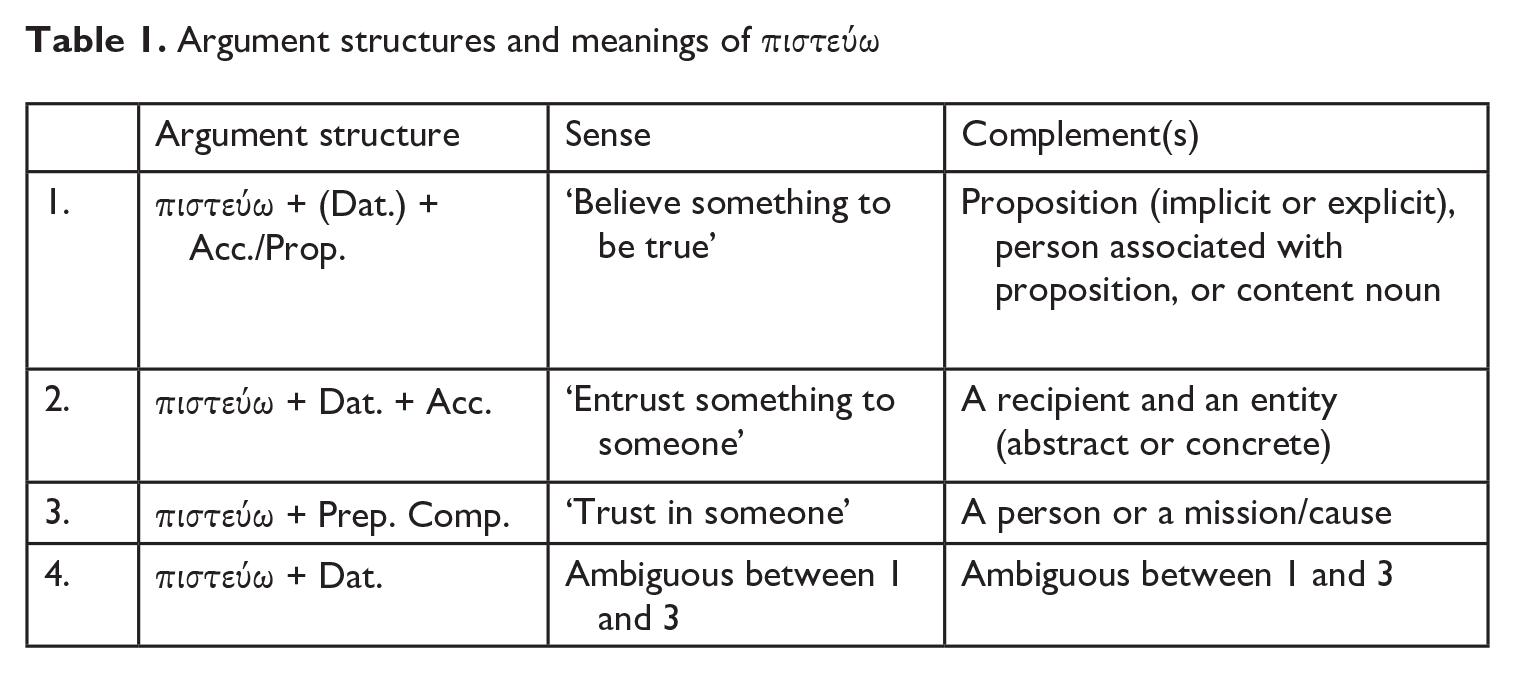
Of great importance is the fact that the distribution between argument structure and semantics in the table above (with attention to the verb πιστεύω) is paralleled in the nominal domain when πίστις has an AS-nominal reading. In the verbal domain, πιστεύω will always have an accusative associated with it when it means ‘believe something to be true’. Sometimes, this will be explicit, as in (7) above, but in most cases, the accusative will be the implicit proposition associated with a person or a content noun. Again, such content nouns are special precisely because they carry propositional content with them that can ‘satisfy’ the need for this sense to have a propositional complement, which would be realized in the accusative case. In this sense, bare dative content nouns with πίστις function equivalently to accusatives with πιστεύω.
In the nominal domain, however, these content nouns will surface as genitives, since they actually carry with them an (accusative-marked) proposition. On the other hand, the nominal meaning of ‘trust in’ is expressed with a dative or prepositional complement. Thus, the objective genitive, being a true object in the accusative case, must have sense 1 in the chart above (or 2 in theory, but this sense is irrelevant), and the data presented below shows this to be the case. It follows that the phrase πίστις Χριστοῦ, if it is an objective genitive, cannot mean ‘trust in Christ’, but only ‘belief of Christ’, i.e. some proposition associated with him. Since there is no appropriate proposition in the context (again, this proposition is normally something a person has said), the genitive cannot be objective (nor do translations agree with such a rendering in the first place, since translations never have ‘belief of Christ’). The traditional objective reading position is, therefore, linguistically impossible, since the true objective genitive signals the presence of an argument with propositional content and not the ‘trust in’ sense normally assumed.
4.2 πίστις and its Arguments
We have seen that πίστις, like many other nominals, is ambiguous between an AS-nominal and R-nominal reading. As noted above, the AS-nominal reading will inherit the argument structure from the underlying verb πιστεύω. Because the specific genitive relation is typically determined by the relational element of the noun (if it has one), we examined the types of relations that the underlying verb in πίστις had to its arguments. However, when πίστις has an R-nominal reading, it has a slightly different meaning and relation to its argument. From these observations, we can anticipate the three options for the πίστις Χριστοῦ phrase in the literature: the genitive is either the object of an AS-nominal (objective genitive), the subject of an AS-nominal with an implicit argument (subjective genitive) or a complement of a relational R-nominal (third view). The interpretation of the phrase, then, will be determined in part by the reading of πίστις, since its sense will determine the relation that the following genitive has.
4.2.1 The Objective Genitive
As I have suggested, when an objective genitive is used with the noun πίστις, the meaning is very close to John’s belief of Mary (i.e. belief that propositional content of some kind is true). In order to demonstrate this further, we will look at two influential studies of Harrisville (1994, 2006). Harrisville aims to show that πίστις Χριστοῦ was understood as an objective genitive by its original audience; that the objective genitive with the noun πίστις is ‘good Greek’ by giving examples of it in Classical Greek authors (Harrisville 2006); and that the Early Church Fathers’ comments on the πίστις Χριστοῦ phrase reveal that they understood it as an objective genitive (Harrisville 1994). My position is that all of the examples of the objective genitive given in Harrisville 2006 should be understood as ‘belief of a proposition (to be true)’ rather than ‘trust in’ someone. Likewise, I contend that all of the Early Church Fathers understood the πίστις Χριστοῦ phrase as the third view, but Harrisville misread them because he assumed that the genitive could only be objective or subjective. After treating these two studies, I will demonstrate how all the other passages in the NT with πίστις followed by a genitive can be understood in one of these two ways: either the genitive is not actually objective or πίστις communicates the sense ‘belief of a proposition’.
4.2.1.1 The Meaning of the Objective Genitive – Another Look at Harrisville 2006
When approaching the objective genitive cases cited by Harrisville, we must ask whether the nouns refer to things to be believed (either content nouns or propositions which may or may not be associated with a person) or people to be trusted. What is striking about the data in Harrisville 2006 is that many of the objective genitives are clearly content nouns, which is expected in my account, since true objective genitives with πίστις have a proposition associated with them. Again, these nouns are unique because of the implicit content associated with them, on account of which they behave like propositions. Consider one such noun, γραφή ‘writing/written thing’, as found in Plato’s Phaedrus: ἅτε διὰ πίστιν γραφῆς ἔξωθεν ὑπ’ ἀλλοτρίων τύπων (Plato, Phaedrus 275a) ‘because, due to belief of something written, produced outside of themselves …’. 33
Harrisville also includes examples of the genitive after the verb πιστεύω, all of which introduce a proposition or a content noun: Demosthenes, On Organization 13.32 and Philippic II 6.20; Plato, Symposium 207c; and Xenophon, Memorabilia 1.2.8. At other times, Harrisville gives examples where the sense of πίστις is simply not ‘belief’ as an AS-nominal, so the genitive, likewise, cannot be objective. 34 In sum, the data presented in Harrisville 2006 ultimately offers robust support that objective genitives have a particular meaning, and that meaning is not ‘trust in’ someone.
Problematically, Harrisville (2006) frequently labels each of his examples as either subjective or objective genitives, but such miscategorizations reflect a deeper issue at the heart of the whole debate. Scholarship has long understood the genitive with πίστις to be either subjective or objective, but this should not be the case for nouns, like πίστις, which have both AS-nominal and R-nominal readings. We should not expect there to be only two options for the genitive, which presses us to take another look at Harrisville’s other influential study on the interpretation of πίστις Χριστοῦ by the Early Church Fathers.
4.2.1.2 The Third Option – Another Look at Harrisville 1994
Harrisville (1994) claims that there are clear examples of at least some Early Church Fathers understanding πίστις Χριστοῦ as an objective genitive. However, Harrisville himself never discusses a third option, and throughout the article he uses the impossibility of a genitive being subjective as a basis for calling it objective (Harrisville 1994: 237-39). But a closer look at each of the contexts reveals that the examples he gives as ‘objective’ actually support the third view. In each case, what is significant is the type or quality of the faith under discussion – namely, that it is a faith that concerns Christ. This is exactly the meaning the third view advocates for. For example, Harrisville quotes this translation of Acta Petri ch. 3: If your god [referring to Christ] has power enough – he whom the Jews destroyed, and they stoned you who were chosen by him – let him show that [πίστις αὐτοῦ] is of God; let it be shown at this time whether it be worthy of God.
35
Harrisville goes on to say that the phrase πίστις αὐτοῦ ‘must … refer to contemporaneous faith’. This context does, indeed, seem to disallow a subjective genitive reading, but the third view is not ruled out. Furthermore, it seems odd to discuss whether ‘trust in Jesus’, the act of trusting, is of God, but it is perfectly natural to say that one religious system is of God and another is not – which is exactly what the context demands. What makes the third view reading stand out here is that the discussion is all about the nature or content of this πίστις. The question under discussion is how the faith which concerns Christ should be considered; whether Peter trusts in Christ or not is not in question.
In addition to the example above, P. Sprinkle (2009: 180-82) has already shown that several other passages in Origen treated by Harrisville are better understood with the third view reading. My claim is stronger: all the passages he cites are better understood with this reading. Even a cursory look at the contexts cited in Harrisville 1994 reveals that the nature or content of πίστις is what is at issue. He quotes, for instance, Origen of Alexandria from Selecta in Psalmos; after a verse with the πίστις Χριστοῦ phrase, Origen says, ‘For those who rightly believe faith is reckoned as righteousness’. The contrast, then, is not between those who trust in Jesus and those who do not, but those who have a kind of faith that is right (i.e. the content is right) versus those who have a kind of faith that is wrong.
Harrisville examines four other passages from Origen and Chrysostom that are relevant for this discussion.
(9) καὶ δικαιῶν τὸν ἐκ πίστεως, τουτέστιν τὸν πιστεύοντα εἰς Ἰησοῦν καὶ διὰ Ἰησοῦ τῷ Θεῷ, καὶ οὐκ ἄτοπ̣όν γε προλαβόντας εἰς τὸ ‘δικαιοῦντα τὸν ἐκ πίστεως Ἰησοῦ’ εἰπεῖν [ὅτι] ὥσπερ Ἀβραὰμ ἐπίστευσεν τῷ Θεῷ καὶ ἐλογίσθη αὐτῷ εἰς δικαιοσύνην, οὕτως τοῖς πιστεύσασιν εἰς τὸν Ἰησοῦν ἢ εἰς τὸν Θεὸν διὰ τοῦ Ἰησοῦ λογίζεται ὁ Θεὸς τὴν πίστιν εἰς δικαιοσύνην, καὶ οὕτω δικαιοῖ τὸν ἐκ πίστεως Ἰησοῦ And justifying the member of the faith, that is the one who trusts in Jesus and through Jesus in God – and it is not out of place, indeed, to say beforehand ‘justifying the member of the Jesus-faith’ which is to say that like Abraham trusted in God and it was counted to him as righteousness, so to the ones who trust in Jesus, or in God through Jesus, God counts that faith as righteousness – and thus he justifies ‘the member of the Jesus-faith’ (Origen, Commentarii ad romanos on Rom. 3.26). (10) … ἀλλὰ τὴν ἐκ Θεοῦ δικαιοσύνην, τὴν διὰ τῆς πίστεως Ἰησοῦ Χριστοῦ. Εἶτα λέγει ποίας πίστεως· … τοῦ γνῶναι αὐτὸν καὶ τὴν δύναμιν τῆς ἀναστάσεως αὐτοῦ καὶ τὴν κοινωνίαν τῶν παθημάτων αὐτοῦ. ‘… but the righteousness of God, the one through the Jesus-Christ-faith.’ Then he says what kind of faith ‘… to know him and the power of his resurrection and the sharing of his sufferings.’ (Chrysostom, De incomprehensibili dei natura, Homily 2, line 419) (11) Τί δέ ἐστι, Φύσει Ἰουδαῖοι; Οὐ προσήλυτοι, ἀλλ’ ἐκ πρώτης ἡλικίας ἐντραφέντες τῷ νόμῳ, τὴν σύντροφον ἀφέντες πολιτείαν, κατεφύγομεν εἰς πίστιν τὴν εἰς Χριστόν. Εἰδότες ὅτι οὐ δικαιωθήσεται ἄνθρωπος ἐξ ἔργων νόμου, εἰ μὴ διὰ πίστεως Ἰησοῦ Χριστοῦ, καὶ ἡμεῖς εἰς Χριστὸν ἐπιστεύσαμεν. But what is it to be ‘Jews by nature’? We are not proselytes, but from the first age were trained in the law, leaving that way of life which one is raised in, we fled to the faith, namely the one in Christ. ‘Knowing that man will not be justified from works of the law, but through the Jesus-Christ-faith, we, too, trusted in Christ’. (Chrysostom, In Epistulam ad Galatas 61.633 Homily B, section 5, lines 65-69) (12) άλιν ἐὰν συνῶμεν τὴν γενομένην ἐν τῷ λόγῳ ζωήν, τὸν εἰπόντα Ἐγώ εἰμι ἡ ζωή, ἐροῦμεν μηδένα τῶν ἔξω τῆς πίστεως Χριστοῦ ζῆν, πάντας εἶναι νεκροὺς τοὺς μὴ ζῶντας θεῷ Again, if we know the one who became life in the word, the one who said, ‘I am the life’, we will say there is no life for the ones outside of the Christ-faith, or all are dead who do not live for God. (Origen, Commentarii in evangelium Joannis 2.16.115)
We begin with Origen’s commentary on Rom. 3.26. Origen begins by discussing who is the ‘one of faith’ (τὸν ἐκ πίστεως) whom God justifies, identifying that person as the one who ‘trusts in Jesus’ (τὸν πιστεύοντα εἰς Ἰησοῦν). The mere fact that Origen feels the need to clarify the referent of the phrase ‘the one of faith’ by using a participle with a prepositional complement does not suggest that the two phrases are equivalent (contra Harrisville 1994: 238), but rather that they have distinct meanings that refer to the same referent. The one who belongs to the Christ-faith is such because he or she trusts in Jesus, but that does not make the two phrases semantically equivalent. In the broader sweep of the passage, Origen seeks to explain how ‘the member of the Jesus-faith’ is connected to Abraham’s faith who, it is said, trusted in God, not Jesus. In other words, not only does God count righteous those that trust in him, but he also counts righteous those who are of the Jesus-faith because they trust in Jesus and, through Jesus, in God. In line with the third view (discussed more fully below), it is the type of faith that matters: faith having to do with Jesus or faith having to do with God.
The next excerpt is from Chrysostom. Immediately after quoting Phil. 3.9, he asks the question ‘what kind of faith’ (ποίας πίστεως). This is exactly the question prompted by a third view reading of the phrase because the quality or kind of faith is the thing at stake. Thus, Chrysostom is asking something like ‘What exactly is this Christ-faith like?’ The answer is that being a part of this kind of faith means ‘to know him and the power of his resurrection and the sharing of his sufferings’. But notice what Chrysostom does not ask. After quoting the verse, he does not ask, ‘What does it mean to have faith in Jesus’, but rather he questions the nature of the faith, again in line with the third-view meaning.
Harrisville identifies passages (11) and (12) as two examples where the objective rendering ‘may be argued against’ (1994: 239). Both are contrasting two different lifestyles. In (11), we see Jews who leave their way of life under Torah to flee to the ‘faith which is in Christ’ (πίστιν τὴν εἰς Χριστόν), and the support for taking such an action is taken to be Gal. 2.16. As noted by Harrisville, Chrysostom does not directly comment on the meaning of the verse, but in the immediate context he does contrast the lifestyle of Torah with trusting in Jesus. There is nothing incompatible with a third-view reading here. The Christ-faith represents the alternative system to the Torah system, and the way to become a part of that system is to ‘trust in Jesus’ (πιστεύω εἰς Χριστόν) (as is found in every context in which the πίστις Χριστοῦ phrase is used). In this respect, (12) is very similar. It is only those who are included in the ‘Christ-faith’ (τῆς πίστεως Χριστοῦ) system that have life; everyone ‘outside’ is ‘dead’.
If my assessment is correct, each of these early occurrences of the πίστις Χριστοῦ phrase can be read with the third-view reading, and each context suggests that this is the correct reading. Harrisville (1994) does effectively show, however, that no one understood the genitive in the disputed phrase to be subjective. And because of his assumption that an argument against the subjective is an argument for the objective, he concludes that the Early Church Fathers read the phrase objectively, but this, as we have seen, need not be the case. But significantly, as noted above and discussed below, the third-view reading is close at times to the objective reading (since the one who buys into the Christ-faith system does so by trusting in him), though they still have different meanings.
4.2.1.3 The Objective Genitive with πίστις in the NT
We have already established that there are two possible explanations of the πίστις + genitive cases mentioned in the corpus: belief of propositional content to be true or the genitive is not actually an objective genitive but a relational genitive with an R-nominal reading (the third view). A clear example of the former is found in 2 Thess. 2.13: ὅτι εἵλατο ὑμᾶς ὁ θεὸς ἀπαρχὴν εἰς σωτηρίαν ἐν ἁγιασμῷ πνεύματος καὶ πίστει ἀληθείας ‘Because God chose you as a firstfruits for salvation through sanctification of the spirit and belief of the truth’. The latter can be found in Rev. 14.12: οἱ τηροῦντες τὰς ἐντολὰς τοῦ θεοῦ καὶ τὴν πίστιν Ἰησοῦ ‘The ones who keep the commandments of God and the Jesus-faith’. In 2 Thess. 2.13, the noun ἀλήθεια is a content noun, and it is preceded by two other instances of the verb πιστεύω with content nouns in the dative. From the context, the question is clearly whether falsehood or truth is believed to be true. The phrase thus means ‘belief of the truth’, i.e. belief that the truth is actually true. 36 Revelation 14.12, on the other hand, is simply not an objective genitive. The angel calls on people to keep ‘the Jesus-faith’. The point is that they must hold fast to that particular type of faith in light of the chaos surrounding them and with so many people abandoning the faith.
Scholars have identified many objective genitives across the NT as support for the ‘faith in Christ’ rendering. D. Moo (1996: 225) lists the typical verses cited: Mk 11.22; Acts 3.16; Jas 2.1; Rev. 2.13; 14.12; Col. 2.12; Phil. 1.27; 2 Thess. 2.13. If what I have argued is true, each of Moo’s examples must be understood in one of two ways: (1) a true objective genitive with the wrong meaning, e.g. Mk 11.22 (person for proposition, θεοῦ); Acts 3.16 (content noun, ὄνομα); Col. 2.12 (proposition, τῆς ἐνεργείας τοῦ θεοῦ τοῦ ἐγείραντος αὐτὸν ἐκ νεκρῶν); 2 Thess. 2.13 (content noun, ἀλήθεια); or (2) the third-view reading, which can be found in Phil. 1.27; 37 Jas 2.1; Rev. 2.13; 14.12.
In order to avoid belaboring the same points made above with Harrisville’s examples, I address only two of the more difficult texts cited by Moo: Mk 11.22 and Jas 2.1. We can compare Mk 11.22 to our assessment of 2 Thess. 2.13 above, since the noun in the genitive is something to be believed. At first glance, ἔχετε πίστιν θεοῦ looks problematic for my position because the noun θεός is not a content noun and thus, not typically something that can be ‘believed to be true’. However, as we have seen in 3.3.2 above, it is linguistically plausible to keep the objective reading if we allow θεοῦ to stand in for a proposition. This would retain the meaning of the objective genitive with πίστις established above while staying faithful to the context. Jesus is not telling his disciples to ‘have faith in God’ with the sense ‘trust in him’, but instead, to ‘believe God’ that he can answer prayer. For this reason, Jesus encourages his followers ‘to not doubt’ in the following verse. The question under discussion is whether the disciples will believe the truth of something (God’s ability to answer), not whether they ‘trust in’ someone. Mark 11.22 does contain an example of the objective genitive, then, but it does not mean ‘trust in God’.
Another difficult example often cited is Jas 2.1: Ἀδελφοί μου, μὴ ἐν προσωπολημψίαις ἔχετε τὴν πίστιν τοῦ κυρίου ἡμῶν Ἰησοῦ Χριστοῦ τῆς δόξης ‘My brothers, do not show partiality as you hold the faith of our lord of glory, Jesus Christ’. This text has been treated in various ways in the debate; for example, Lowe (2009: 240) notes that Dunn (2002: 253) says it is probably subjective (though he is on the objective genitive side) and Wallace (1996: 116) calls it objective (though he is on the subjective side). Lowe himself takes the phrase to be subjective, but he describes it as ‘speaking of “Jesus’ faith” as illustrated by the tradition of his life and teaching’ (2009: 255). In Lowe’s view, then, James is encouraging the believers to act in line with a certain ‘tradition’, which, once again, fits the third-view meaning perfectly. A faith like the Jesus-faith should not be prejudiced, as James describes. Once this interpretation is allowed for, it becomes clear that it is not only a viable option, but it is the most salient reading.
In this section, we have seen that the objective genitive reading, as it has traditionally been understood, is not an option for the πίστις Χριστοῦ phrase. The argument structure of the ‘trust in’ sense with πίστις always includes a dative argument or a prepositional complement, not a genitive. 38 Careful examination of a broad sweep of texts has demonstrated that an objective genitive with πίστις simply cannot mean ‘trust in’.
4.2.2 The Subjective Genitive
In addition to both the exegetical reasons to dismiss the subjective genitive reading (treated below) and the absence of native speakers of Koine Greek reading the phrase subjectively (4.2.1.2), there remain two basic linguistic cases in the literature that have been made against this interpretation: a missing argument of the noun and the absence of the article.
In the first place, the interpretation of πίστις Χριστοῦ with a subjective genitive is missing an argument. In the AS-nominal reading, πίστις requires two arguments like its corresponding verb πιστεύω, i.e. there is someone that must ‘believe/trust’, and there is something or someone that must ‘be believed/trusted’. Both of these arguments may be expressed with the noun πίστις, as shown in (13).
(13) ἀκούσαντες τὴν πίστιν ὑμῶν ἐν Χριστῷ Ἰησοῦ (Col. 1.4) Having heard of your faith in Christ Jesus.
I do not mean, of course, that both arguments must always be expressed. If the argument is easily recoverable from the context, then the author need not express it, as shown, for example, by Luke’s frequent omission of the second argument 39 of the verb πιστεύω in Acts. 40 So what does the omission of the argument tell us in the πίστις Χριστοῦ phrases? It tells us either that πίστις in the phrase in question is not an AS-nominal reading, in which case it cannot be a subjective genitive, or that there is an implicit argument easily recoverable from the context. In Acts, it is clear what the second argument is: the phrase ‘in Jesus’. Dunn’s (2002: 265-66) question to the subjective genitive side about what the phrase would refer to is relevant here because it is not immediately clear to whom or to what Christ would be faithful. On the other hand, the entire subjective genitive position is grounded upon the supposition that the ‘narrative substructure’ of a book like Galatians or Romans actually does supply the needed context (Hays 2002: 112-15). Thus, I leave this issue aside, noting only that it is something those on the subjective side must account for. 41
Second, we turn to how the article relates to the interpretation of nouns. In Grimshaw’s (1990: 54-55) influential study on deverbal nominals, she claims that nominals with argument structure must be definite, but this has since been refuted in Lieber 2016: 51. Following Lieber, I do not think that AS-nominal readings need to be definite, but they do show a strong tendency towards definiteness. Whether or not an article is required for an AS-nominal reading, it should be noted from the outset that the presence of the article would not make the reading an AS-nominal – it would only be normal for AS-nominal readings. R-nominal readings can also take the article. For Greek, Burton (1921: 482) notes that the article is ‘almost invariably present’ when there is a subjective genitive. 42 Thus, we can conclude from both the linguistics literature and the Greek data that there is, at the very least, a strong tendency for AS-nominals with a subjective genitive to be definite, which renders the subjective genitive grammatically possible but unlikely. This combined with the fact that the native speaker evidence we have disfavors the subjective reading suggests that we should look for an alternative reading.
4.2.3 The Third View – Relational Genitive
If the objective genitive view cannot be linguistically sustained, and the subjective genitive view is also grammatically unlikely, what exactly would πίστις mean in the third view? πίστις with this sense has an R-nominal reading and is a content noun, which means it takes another noun as an argument that supplies the content of the ‘faith’. The various senses of the verb, noun and adjective that this root can have clearly have something to do with a mental state of cognitive commitment to something (whether that means ‘fidelity’ or ‘to believe’ or ‘the evidence’ that might cause one to believe). 43 It can also represent a system to be adopted or to be faithful to, which I will call a ‘system of thought’. I suggest that πίστις, in this sense, is a system of thought that one may hold to, which, depending on the content, may entail a certain way of life (cf. Oakes 2018: 264-68)
Philippians 1.27 offers one of the clearest examples of the third sense: συναθλοῦντες τῇ πίστει τοῦ εὐαγγελίου 44 ‘struggling for the faith of the gospel’. The word gospel here is the content of the faith, or the system of thought that concerns the gospel, as should be expected for a genitive phrase with content following πίστις. Note that this meaning is actually very close to how some have actually described the objective and subjective positions – namely as adjectival in character (even if none of these writers (Williams 1987: 437; Seifrid 2001: 146; Hultgren 1980: 257) are explicit advocates of the third view). This is because relational nouns have a similar relationship to their argument that an adjective has to a noun it modifies. In a phrase like the picture of Mary, for instance, Mary describes or qualifies the type of picture, just as blue in blue ball describes or qualifies the type of ball. Compound words in English can also be used attributively (i.e. basically as an adjective; Borer 2005: 133; Lieber 2016: 162-69), so the translation ‘the Christ-faith’ attributes the property of being about the ‘Christ’ to the content noun ‘faith’, which matches the semantic description we have given for the phrase.
Philippians 1.27 is not unique – support for the ‘system of thought’ interpretation can be found across the NT. 45 As something that can be believed or committed to, the phrase πίστις in this sense can be preached (Gal. 1.23), be rejected (Acts 13.8), can come (Gal. 3.23) or can have certain actions linked with it (Rom. 1.5), to name only a few of its possible associated events. This is, I suspect, the reason why third-view advocates often associate πίστις Χριστοῦ with an event. When πίστις has this interpretation, it can have all kinds of events predicated of it, though the noun itself does not refer to the event. That said, when πίστις has an AS-nominal reading, the noun does refer to the event (or, more accurately, the state), but it is normally odd to predicate an event of an event. Consider again examination. In the sentence The doctor’s examinations came in the mail, the noun must have an R-nominal reading because it has another event, come, predicated of it. This contrasts with the ungrammatical sentence *The doctor’s examinations of the patients for three hours came in the mail 46 where examinations cannot have another event like come predicated of it because the noun itself is an AS-nominal (forced by the adverbial). In other words, we should expect an event such as come, like we find in Gal. 3.23 discussed in 5.2 below, to be predicated only of R-nominal readings and not of an AS-nominal reading, since events/states themselves do not normally ‘come’.
Finally, an anonymous reviewer suggests that the article should also be expected with the third-view reading, since ‘the faith (of Christ)’ also seems to be definite, at least in English. The use of the article is a particularly difficult issue in general linguistics (see Lyons 1999 for the standard overview), and there is a good deal of variation from language to language. Without going into the complex discussion of determiners in general, several comments can be made. First, as pointed out in Peters 2014: 1-3, the Greek and English article do not behave the same way, so it cannot be concluded that because our phrase would require an article in English, it should also require one in Greek. Second, Lyons (1999: 10) points out several reasons for using the definite article in English, one being that the noun phrase is inherently unique. For example, the word sun is inherently unique because there is only one of them, it referring to the single star in our solar system. Thus, in English, it is ungrammatical to say *a sun is shining. 47 However, this is not the case with Greek, which allows ἥλιος (‘sun’) to occur without the article. 48 The same could be said for the much more common noun Χριστός, which we would also expect to be definite in English (‘the Messiah’ not ‘a Messiah’) because there was only one expected Christ. The point of this discussion is to show that the reason why we would mark the third-view meaning definite in English is because of the uniqueness of the referent (there is only one ‘Christ-faith’), but this requirement for definite marking does not hold in Greek. With that being said, much more work needs to be done on the Greek definite article, particularly as it interacts with the semantics of different kinds of nouns, and while the absence of the article seems to support the third view (since AS-nominals have a strong tendency to be used with the article in Greek, and at least some unique nouns, like Χριστός, often do not have the article where we would expect them to in English), I do not consider the article to be a conclusive argument for any position.
Having discussed the objective, subjective and relational genitive, I summarize the meanings and structures of πίστις in Table 2.
Argument structures and meanings of πίστις
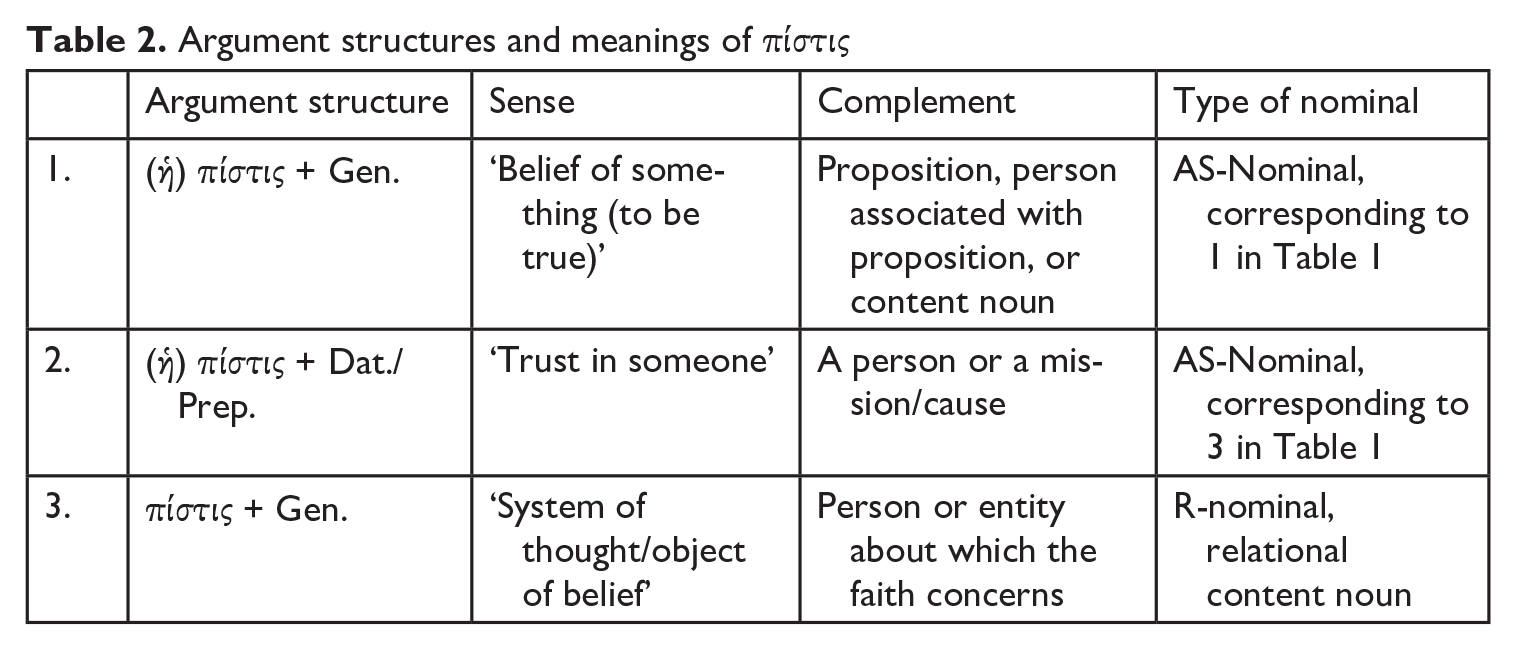
5. Exegesis
We turn finally to the passages with πίστις Χριστοῦ. I do not intend to offer a comprehensive treatment, but rather, to point out the elements in particular contexts that are relevant for determining the meaning of the phrase. I treat the following texts in turn: Gal. 2.16; 3.22; Rom. 3.22, 26; Phil. 3.9; Eph. 3.12. First, however, I briefly discuss the relationship between context, syntax and exegesis.
5.1 Context, Syntax and Exegesis
Precisely because an appeal to context has dominated the line of defense for both subjective and objective positions, we need to think carefully about the relationship between context, syntax and exegesis. Advocates of the objective genitive have argued that because the phrase πίστις Χριστοῦ is contrasted with ἔργα νόμου, it must also be ‘human-oriented’. This is, in my view, a legitimate appeal to context since the two phrases are clearly contrasted in the immediate context (Gal. 2.16; Rom. 3.21-22; Phil. 3.9). Yet, the objectivists’ frequent appeal to the ‘faith’ of Abraham rather than his ‘faithfulness’ is an illegitimate appeal to context. Likewise, the subjectivists’ attention to other genitive relationships that πίστις can have in the surrounding context makes the same mistake. In these cases, both sides argue that the meaning of a noun or the genitive relation is taken from another proximal occurrence of the same noun or genitive relation, but this is not nuanced enough. With regard to the latter, we normally do not determine genitive relations on the basis of other genitive relations; they are determined on the basis of the relational element encoded in the words (as discussed above). Likewise, we are comfortable interpreting a sentence like The lunch was delicious but took forever (from Asher 2011: 11), even though there are two different senses of the word lunch used in the same sentence: the actual food and the event of sharing the meal. In the same way, it would not have troubled an ancient reader to use two different senses of πίστις in the same context. Context often allows for many readings, but the syntax and semantics constrain the possible interpretations that context allows.
5.2 Galatians 2.16; 3.22
With the preceding discussion in mind, I treat Gal. 3.22 first, since it is clearer and can help us understand Gal. 2.16.
(14) ἀλλὰ συνέκλεισεν ἡ γραφὴ τὰ πάντα ὑπὸ ἁμαρτίαν ἵνα ἡ ἐπαγγελία ἐκ πίστεως Ἰησοῦ Χριστοῦ δοθῇ τοῖς πιστεύουσιν (Gal. 3.22) But the scriptures imprisoned everything under sin in order that the promise from the Jesus-Christ-faith might be given to those who trust [in him].
This verse is immediately followed by another reference to πίστις which has seemed peculiar to many exegetes who assume either the subjective or objective reading of πίστις Χριστοῦ. The subsequent verse says that faith ‘came’ and ‘was revealed’, which has led some scholars to suggest that πίστις here means something like the message of Christianity (Mundle 1932: 93; Lightfoot 1890: 148; Longenecker 1990: 145; cf. Schliesser 2016: 279). As noted by Sprinkle (2009: 178-80), this interpretation fits perfectly within the third view, and the events predicated of πίστις also suggest an R-nominal reading rather than an AS-nominal reading (see 4.2.3 for discussion). The πίστις Χριστοῦ phrase in this context refers to a system of thought about the person Jesus and what he has done, which is the content of the message. And although that message certainly includes his ‘faithfulness to his mission’ (as detailed in Gal. 3.10-14), this meaning is probably not explicitly expressed in πίστις Χριστοῦ. This is where the third view and the subjective genitive readings overlap: the Christ-faith includes the story of Christ, of which his faithfulness to his mission is central.
In spite of this overlap with the subjective reading, each of the contexts with the πίστις Χριστοῦ phrase do seem to contrast one system of thought with another, normally that of ἔργα νόμου. The third view also fits this context, as exemplified in Gal. 2.16.
(15) εἰδότες [δὲ] ὅτι οὐ δικαιοῦται ἄνθρωπος ἐξ ἔργων νόμου ἐὰν μὴ διὰ πίστεως Ἰησοῦ Χριστοῦ καὶ ἡμεῖς εἰς Χριστὸν Ἰησοῦν ἐπιστεύσαμεν ἵνα δικαιωθῶμεν ἐκ πίστεως Χριστοῦ καὶ οὐκ ἐξ ἔργων νόμου ὅτι ἐξ ἔργων νόμου οὐ δικαιωθήσεται πᾶσα σάρξ. (Gal. 2.16) But knowing that a human is not justified from works of the law but through the Jesus-Christ-faith, we also trusted in Jesus Christ in order that we might be justified from the Christ-faith and not from works of the law because from works of the law, no flesh will be justified.
Like Gal. 3.22, this passage also contrasts two systems of thought: a system that would include justification 49 by ‘works of the law’ and a system where justification is by ‘the Christ-faith’. 50 Subjectivists have repeatedly pointed out a problem of redundancy for the objective genitive position (see Matlock 2007 for a discussion). Why would Paul say that a person is justified by ‘faith in Jesus Christ’ and ‘we have faith in Jesus Christ’? Although I do not consider redundancy to be an argument against the objective genitive position (see 2.2), 51 if the third view is admitted, there is no discussion of redundancy. The Jesus-faith has come, which is the thing by which God justifies, and Paul also describes the human response in that system, namely to ‘trust in’ Jesus. In this point, at least, the third view overlaps with the objective genitive reading. The Jesus-faith would not only include what Jesus has done, but also the human response to the revelation of Israel’s true Messiah-King. Essential to the early Christian message of the faith was a call for people to commit themselves to the ‘way’ of Jesus the Messiah rather than to Jewish observances (Gal. 2.20-21) – though this ‘trust in’ him is not explicitly expressed in the formulation πίστις Χριστοῦ.
In spite of these points of overlap, I am not suggesting that the third view is some sort of hybrid between the subjective and objective genitive readings, which is not tenable grammatically. 52 Nevertheless, the third view accommodates both contexts about Christ’s work and about the human response to Christ. In passages like Gal. 2.16 and 3.22, both sides have claimed to have ‘context’ on their side for one reason or another. Indeed, the third view’s embrace of both allows us to remain agnostic about difficult, debated issues in the passages (including the significant question of whether Hab. 2.4 refers to Christ’s faith (Campbell 2009b: 58-61) or the believer’s (Watson 2009: 148-48); see 2.2 above). This leads us to our next passage: Rom. 3.22, 26.
5.3 Romans 3.22, 26
Here is Rom. 3.22a, 26: (16) 22 δικαιοσύνη δὲ θεοῦ διὰ πίστεως Ἰησοῦ Χριστοῦ εἰς πάντας τοὺς πιστεύοντας … 26 ἐν τῇ ἀνοχῇ τοῦ θεοῦ, πρὸς τὴν ἔνδειξιν τῆς δικαιοσύνης αὐτοῦ ἐν τῷ νῦν καιρῷ, εἰς τὸ εἶναι αὐτὸν δίκαιον καὶ δικαιοῦντα τὸν ἐκ πίστεως Ἰησοῦ. (Rom. 3.22a, 26) But the righteousness of God [has been revealed] through the Jesus-Christ-faith for all who trust [in him] … in the forbearance of God, to show his righteousness in the present time, so that he might be just and justify the one of the Jesus-faith.
Like the passages in Galatians, Rom. 3 has been pivotal in the πίστις Χριστοῦ debate. As noted above, and as has been widely noted by scholars, the two passages are remarkably similar and surely represent the same basic thought in Paul’s thinking. The key arguments in favor of the third view in Galatians also apply here: the verb reveal suggests an R-nominal reading just like come as does the contrast with another system of thought ἔργα νόμου.
In addition to these factors, it is worth repeating here that the anarthrous rendering of πίστις (though similar to the Galatians passage) presents a problem for both the objective and subjective positions, since both must assume that πίστις is an AS-nominal. As noted above, AS-nominals are normally definite, and nouns with a clear subjective genitive almost always have the definite article in Koine. More striking than the anarthrous phrase in Rom. 3.22 is the repetition of that phrase in Rom. 3.26. The definite article can, of course, be used anaphorically, and this is common when the same phrase is repeated in a single context. Let us consider what would happen if Paul had used the article. If he had, we may have understood the noun to be an AS-nominal, since they are ordinarily definite. However, he leaves off the article initially in Rom. 3.22. This suggests that the genitive should not be taken as either subjective or objective, because the anarthrous use makes an AS-nominal unlikely. When he comes back to the phrase in 3.26, he could use the article anaphorically, but this might suggest that he understands the phrase differently, as an AS-nominal rather than an R-nominal. Thus, when no article is used where an anaphoric use would be appropriate, it may suggest that Paul was trying to employ more unambiguous syntax intentionally: syntax that supports the third view. It seems unlikely that Paul would use the subjective or objective genitive without the article twice in the same passage, especially since this is extremely rare with πίστις across the NT. Still, more work needs to be done on the article in Greek and thus, the anarthrous rendering should not be understood as a decisive argument for any position.
Finally, it should be noted that the context in Rom. 3.22-26 is very similar to Gal. 2–3, speaking to both the human response as well as the work of Jesus. Verse 26 probably provides the best example of how the third view may overlap with the objective position. God justifies ‘the one of the Jesus-faith’, i.e. the one who adopts the system of thought which concerns Jesus. Again, the third view fits both the syntax and meaning of the phrase here.
5.4 Philippians 3.9
As the reader might anticipate, the arguments for the third view in the above passages are equally applicable to Phil. 3.9.
(17) καὶ εὑρεθῶ ἐν αὐτῷ, μὴ ἔχων ἐμὴν δικαιοσύνην τὴν ἐκ νόμου ἀλλὰ τὴν διὰ πίστεως Χριστοῦ, τὴν ἐκ θεοῦ δικαιοσύνην ἐπὶ τῇ πίστει. (Phil. 3.9) And I may be found in him, not having my own righteousness from the law but through the Christ-faith, the righteousness from God based on trusting [in him].
Yet, there is an important difference between this passage and those previously cited: the inclusion of the adjunct phrase ἐπὶ τῇ πίστει. Unlike our other passages, Phil. 3.9 lacks a clause affirming that ‘we have trusted in him’ following the πίστις Χριστοῦ phrase. But I propose that ἐπὶ τῇ πίστει functions equivalently to such a phrase, which would assign to πίστις an AS-nominal reading, i.e., ‘on the basis of trusting (in him)’. In this case, the object is easily recoverable from the context, the sense would parallel the phrases in the other passages, and the article is present, which makes an AS-nominal reading more plausible.
5.5 Ephesians 3.12
Finally, we come to the last passage in the debate. It is unique because it has both a different context and structure than the other passages.
(18) ἐν ᾧ ἔχομεν τὴν παρρησίαν καὶ προσαγωγὴν ἐν πεποιθήσει διὰ τῆς πίστεως αὐτοῦ. (Eph. 3.12) in whom we have boldness and access with confidence through his faith.
First, the question under discussion in the other passages was how God’s righteousness is revealed, but the δικαι- root is missing from the context in Ephesians. Instead, the author of Ephesians discusses how his readers can have confidence before God. Second, the contrasting system of thought in the other passages (ἔργα νόμου) is also lacking from the immediate context in Eph. 3.12. The third-view reading is less salient, then, since the question under discussion is not clearly the quality or nature of the faith as opposed to another system. Still, it is not unreasonable to assume, with the third view, that it is the nature of the faith (the Christ-faith) that enables a person to have confidence before God.
Syntactically, the article is present only in the Ephesians passage, which makes it more likely than the others to be an AS-nominal. In addition, a plausible second argument for πίστις is explicitly mentioned in the context: πρόθεσις ‘plan’ (Eph. 3.11). Explicit mention of a possible second argument in the immediate context would make the absence of the second argument more plausible in our phrase. All of this suggests that if a subjective genitive rendering of our phrase is to be found, it would be here, though the third view is also possible.
6. Conclusion
In this paper, I have analyzed the controversial phrase πίστις Χριστοῦ using modern linguistic tools. Much of the discussion in the πίστις Χριστοῦ debate has assumed either a subjective or objective genitive reading and has not given due attention to the minority position, the third view. I have shown that the objective genitive position cannot be sustained linguistically, the subjective genitive position has its own problems, and the neglected third view actually has the support of the Early Church Fathers and fits each of the contexts well. Ultimately, the third-view interpretation of the ‘Christ-faith’ is not merely a contender in the debate; it is the most linguistically plausible meaning of the phrase in light of πίστις’s range of meaning, the syntax of the πίστις Χριστοῦ phrase, the context surrounding the phrase, and early interpretations of the phrase by native speakers of Koine. Having shown that this is the most likely reading, as Harrisville (2006: 358) states: ‘The rest is theology’.
Footnotes
1.
I would like to thank Elitzur Bar-Asher Siegal, Jordash Kiffiak, Nick Messmer, Wes Olmstead, Joshua Mann and an anonymous reviewer for their helpful comments on earlier drafts of this article. In addition, I thank Michael Grasso for discussing some of the exegetical issues with me. A special thanks to Brooke Olmstead who greatly improved the paper on all levels both with her comments on the language and as a stimulating conversation partner. Any mistakes or errors are solely my responsibility. All translations from Greek are my own unless otherwise noted. Italics are used for English examples, and single quotes are used for translations.
2.
That is, this study focuses only upon grammatical arguments rather than theological arguments.
3.
For a survey of recent scholarship, see Easter 2010 and Kugler 2016, and for historical scholarship, see Hunn 2009 and  .
.
4.
5.
My personal position on the issue is that linking πίστις Χριστοῦ with Hab. 2.4 based on the similarity of meaning between ἐκ and διά is probably incorrect. And even if the prepositions were serving identical functions, the noun πίστις would still not need to refer to the same thing.
6.
The term AS-nominal refers to Argument Structure nominals, which are deverbal nominals that retain the same argument structure as their underlying verbal counterparts. For more on this term, see section 3.2.
7.
For example, walk requires one argument, which is animate, to do the act of walking (e.g. Kathy walked), whereas hit requires two arguments, one that does the hitting and one that is being hit (e.g. The ball hit the fence). Other kinds of words have arguments as well, but they are irrelevant here.
8.
9.
For helpful discussions, see Marantz 2000; Borer 2005: 3-13; Alexiadou, Borer and Schafer 2014; .
10.
11.
In keeping with standard practice for linguistic articles, I number the examples that demonstrate a grammatical point outside the body of the text to aid the reader when I refer back to previous examples and grammatical issues. For the sake of brevity, I include some original language examples in the body of the text, though longer examples I also set apart from the main body.
12.
This goes against the statement in Porter and Pitts 2009: 47 that ‘the πίστις Χριστοῦ construction, however, functions at the word-group level where subject-object relations are not grammaticalized … The labels unwarrantedly move the discussion to the clause level, treating πίστις as a Predicator and Χριστοῦ as a subject or object, when the relations are strictly nominal.’ Many linguists have recognized the fundamental similarity between verbs and nouns that refer to events (again, see ).
14.
See Levin and Rappaport Hovav 2005 for a survey. The interaction between the meaning of words and the syntactic construction in which they are found is a central topic in linguistics. Some have argued that words may determine the syntactic context in which they are found, while others have argued that the syntactic context determines the meaning of the words (for a more historical introduction as well as current trends in the literature, see ). This, of course, does not mean that a change in meaning will always be reflected in the syntax.
15.
This is a grossly oversimplified definition of both believe and believe in, but the specific meaning of the English word believe is inconsequential for my argument. What is important is that the two different meanings are reflected in the syntax.
16.
From this point forward, I will simply assume the subjective genitive position is ‘Christ’s faithfulness to God’, though what he is faithful to is irrelevant for my argument. Alternatively, what is called the subjective reading could be something like Christ’s faithfulness as an abstract quality, but this does not seem to be argued for (nor would it be a subjective genitive in this case, since ‘faithfulness’ as an abstract quality would not be an AS-nominal, and the genitive would be possessive, not subjective).
17.
In fact, many nouns formed with the -ις ending in Greek show this pattern. For example, βρῶσις (‘consumption’) may refer either to the act of eating or to the thing eaten. Other such examples are the following: γνῶσις (‘knowledge’), ἀποκάλυψις (‘revelation’), παράδοσις (‘handing over/tradition’), παράκλησις (‘request’), etc. See the definitions in BDAG for this alternation.
20.
Although this is generally true, : 279-80) does show that the relation can be overridden by a very strong context, but as his examples prove, the context must be extraordinarily clear. Given the existence of the debate itself, I assume the context is not sufficiently clear to override the relation found in the noun πίστις itself.
21.
The difference between the bare accusative and bare dative will be discussed in more detail below.
22.
This has been called coercion in the linguistics literature; see Pustejovsky 1995: 118-22 and : 256 for analyses and discussion.
23.
Although I make the terminological distinction between an applicative dative and a prepositional dative, they would ordinarily both be called applicatives in the linguistics literature (). The difference between the two would be in their position in the syntax, which would determine their meaning. However, this is not relevant for our purposes, so I make the terminological distinction between the two meanings for the sake of clarity.
24.
In fact, Josephus almost never uses a preposition with the verb πιστεύω, and I did not find a single example of him using the preposition with this same sense, which is most similar to πιστεύω εἰς in the NT. He always uses the bare dative for that meaning, at least in Antiquities and Against Apion.
25.
This includes my corpus of the NT, the LXX, Josephus’s Antiquities and Against Apion, the Apostolic Fathers, the Pseudepigrapha and Philo.
26.
Some that support the subjective genitive side have also argued this (Howard 1967: 460-61; Robinson 1970: 78-79; Williams 1987: 434), but they have failed to answer the rebuttals (Dunn 2002: 253; Moo 1996: 225) or explain why this would be the case linguistically. For a discussion of the issue and more references to both sides, see : 39.
27.
The examples are the following: Jn 11.26; Acts 13.41; 1 Cor. 11.18; 13.7; 1 Jn 4.16.
28.
Other references outside the NT include the following: Hab. 1.5; Josephus, Ant. 8.232; 14.284, 455; 16.125, 190; Polycarp, Philippians 8.2; Ign. Smyrn. 3.1.
29.
Clear examples of this sense in the NT are Lk. 16.11; Jn 2.24.
30.
I translate this sense as ‘trust in’ throughout, but the specific nuance of the definition is irrelevant for my argument. It only must be different than ‘believe something to be true’, which it is, I believe, on all accounts of the objective genitive reading. For this sense, : 820) says there is an ‘implication of total commitment to the one who is trusted’. If this is correct, the phrase would mean something between ‘trust in’ and ‘be faithful/loyal to’ in English (since the former does not imply ‘total commitment’ while the latter would), but I leave this aside for further research. The precise rendering into English is also, of course, dependent upon the subtle differences between ‘trust in’, ‘believe in’, ‘have faith in’ and ‘be faithful to’ in English itself.
31.
There are some counterexamples to this generalization. Sometimes, the bare dative has the sense of ‘trust in’, as in the following examples: Jn 6.30 (parallel to εἰς); 8.31 (parallel to εἰς); Acts 18.8. There is one example which seems to go the other way with εἰς introducing a person that is associated with a proposition: Rom. 4.18. The generalization is, nevertheless, quite robust.
32.
33.
34.
The following senses are found: sense of ‘oath/pledge’ in Euripides, Medea 413, Demosthenes, Against Timotheus 49.43, and Lysias 18.19; sense of ‘confidence’ in Demosthenes, On the Crown 18.215 and Against Leptines 20.17 and Thucydides, Histories 7.67.4.
35.
All of the examples Harrisville cites are also anarthrous, which, as discussed below, is also support for the third view.
36.
The KJV translates the phrase that way as well. It should be noted that the phrase ‘belief in the truth’ in English may be quite similar to ‘belief of the truth’, but this is an overlap between belief of and belief in in English, not necessarily in Greek.
37.
Phil. 1.27 is a truly ambiguous use in the context. Paul could either be saying they should be struggling to continue in ‘believing the gospel’ or for the sake of the ‘faith of the gospel’. The content noun in this context makes the choice difficult, but this is still perfectly in line with what I am proposing.
38.
The relevant verses with their respective prepositions are (εἰς): Acts 20.21; 24; 26.18; Col. 2.5; 1 Pet. 1.21; (ἐν): Rom. 3.25; 1 Cor. 2.5; Gal. 3.26; Eph. 1.15; Col. 1.4; (πρός): 1 Thess. 1.8; (ἐπί): Heb. 6.1; (bare dative): Gal. 2.20.
39.
I use the term ‘second argument’ for the argument that comes second in the English ordering, e.g. in Emily believed Greg, Greg would be the second argument. The linguistic term for this is actually the internal argument, but this is a more complicated term for a number of reasons, so I avoid it here. Thus, the ‘first argument’ is used for the subject, and the ‘second argument’ is used for the complement (whether that is a direct object or an oblique complement, as in Emily believed in Greg).
40.
See Acts 2.44; 4.4, 32; 5.14; 8.13; 11.21; 13.12, 39, 48; 14.1; 15.5, 7; 17.12, 34; 18.8, 27; 19.2, 18; 21.20, 25; 26.27.
41.
Although I do not take a strong stance on either side here, I would tend to favor Dunn’s argument. While the death of Jesus is referred to in each of the contexts, that in itself would be an odd second argument of the noun (i.e. it would be odd to say ‘Jesus is faithful to his death’). Jesus’ death as the accomplishment of his mission or God’s purpose would make more sense, but equivalents of ‘his mission’ or ‘God’s purpose’ are much less obvious in the contexts (and are often read into the contexts). Although an argument could be made for Galatians and Romans in this respect, Philippians would be a much more difficult case. Since Paul seems to have the same basic idea in mind in each passage and this missing argument would be very difficult to recover from the context in Philippians, I believe Dunn’s point stands here.
42.
See also : 49-51 for a discussion. A representative sample are the following: Mt. 9.2, 22, 29; 15.28; Mk 2.5; 5.34; 10.52; Lk. 5.20; 7.50; 8.25, 48; 17.19; 18.42; 22.32; Acts 15.9; Rom. 4.5, 9; Col. 1.4; 2.5. Note that the noun not only has to have a genitive, but it has to be an AS-nominal as well for the example to be relevant.
43.
It should be noted that by ‘mental state’ I do not mean something that is merely cognitive, but the mental state may entail obedience, such as in the ‘trust in’ sense.
44.
See also The Epistle to Diognetus 11.6 for the same phrase clearly meaning ‘faith of/which concerns the gospel’.
45.
See, for example, Acts 6.7; 13.8; 16.5; Rom. 1.5; Gal. 1.23; 6.10; Eph. 4.13; Col. 2.7; Phil. 1.27; 2 Thess. 1.11; 1 Tim. 4.6; Jude 3; etc. The equivalent Hebrew word àÁîוּðÈä is also found with an almost exact parallel sense in Avot 6.6 in the phrase àîåðú çëîéí, where the sense seems to be ‘the system of thought associated with the sages’ or ‘the faith of the sages’. Thanks to Elitzur Bar-Asher Siegal for this reference.
46.
The * symbol is used here to mark a sentence as ungrammatical as is standard in linguistics literature.
47.
This assumes the sense of sun being referred to is ‘the star in the solar system with the earth in it’ and not ‘any star within a solar system’. The latter might be used by a science fiction writer, for example, to refer to one of two stars in the same solar system.
48.
The examples are the following: Mt. 13.6; Lk. 21.25; Acts 27.20; 1 Cor. 15.41; Rev. 7.2; 22.5.
49.
I am aware of the difficulties of translating δικαιοσύνη. However, the differences between the possible translations of δικαιοσύνη are not directly relevant to my argument, so I translate it as justified and leave the issue aside here.
50.
When I say that ἔργα νόμου stands for a system of thought here, it should be remembered that I define such systems as potentially entailing certain actions. The point is that ἔργα νόμου represented not just deeds done, but a worldview in which it is particularly the Jewish νόμος that is crucial for justification.
51.
Matlock (2007: 178) points out that those on the subjective side are willing to admit repetition for emphasis in other contexts (and gives many examples in Paul where this is indeed the case) and that repetition is simply given different labels by each side: emphasis on the objective side and redundancy on the subjective side. I remain neutral on this argument because using it as an argument either way already presupposes a certain syntactic analysis of the phrase, and Paul could easily either be avoiding redundancy or emphasizing something, again as shown in Matlock 2007: 176-78. What should be pointed out is that a basic conversational principle developed in the sub-field of pragmatics in linguistics is the ‘maxim of quantity’, which states that one should be as informative as possible and no more (: 45-46). However, Grice’s maxims are often flouted for rhetorical effect, so even though we should not expect redundancy, it is, obviously, not uncommon (as exemplified by this note). Thus, as stated previously, I do not take this point to be for or against the objective position, only noting that the third view renders it a non-issue like the subjective would.
52.
That is, the genitive relation was almost certainly not understood as both, as suggested in Hooker 1989: 341-42 and more recently in : 271-73, who focuses on Christ as the locus of faithfulness between humanity and God more generally. Simply put, such double meanings do not represent how language ordinarily works, and it takes a very special context for that to be plausible.