




Abstract
A growing number of scholars have argued that Christ’s offering in Hebrews is not limited to the cross but extends into heaven; in recent work David Moffitt contends that Christ’s heavenly, atoning offering is perpetual and coextensive with his intercession. This article calls this further step into question, by examining the function of Christ’s heavenly session in Hebrews’ construal of sacrificial process, and by exploring the nature of his heavenly intercession and its relation to his offering and enthronement. It argues that Christ’s session is a hinge, marking an emphatic close to his sacrificial work for the forgiveness of sins, and inaugurating his royal reign and priestly prayer.
1. Introduction
The nature of Christ’s heavenly work in the Letter to the Hebrews has long been a subject of debate. The prevailing assumption in modern scholarship and beyond has been that Christ’s saving work is essentially finished on earth and at the cross, paving the way for his ascension into heaven where his only work is to pray. This assumption has been challenged by several scholars in the past 60 years or so. These scholars point to the process of the Yom Kippur sacrificial rite, in order to argue that the high priest’s actions within the Holy of Holies – and therefore also Christ’s work in the heavenly sanctuary – form an integral, indeed climactic, part of the sacrifice he offers. This perspective is still being digested but is increasingly recognized as making sense of the argument of Hebrews. 1
However, a significant question remains as to the precise extent and nature of the process of Christ’s sacrifice. This article argues that Hebrews indicates a definitive end point to Christ’s sacrificial offering, at his session in the heavenly tabernacle. After outlining the scholarly conversation, I establish my case on two fronts. First, by examination of the function of Christ’s session in the sacrificial logic of the letter, I argue that the royal enthronement motif of Ps. 110.1 is carefully integrated with the ritual movement of Yom Kippur to indicate that Christ’s sacrifice ends after his heavenly entrance at the point of his enthronement. Secondly, giving attention to the nature of Christ’s ongoing intercession (Heb. 7.25), I argue that this derives from the daily prayer associated with the tamid and not from Yom Kippur, and that it is therefore not co-extensive with Christ’s Yom Kippur offering and does not remove sins.
2. Sacrificial Process in Hebrews Scholarship
Aelred Cody’s monograph on the heavenly sanctuary in Hebrews identifies three stages in the Yom Kippur liturgy which Hebrews maps onto Christ’s salvific act (Cody 1960). These are the immolation of the victim, which equates to Jesus’ death, the entrance into the holy of holies, which is his ascension, and ‘the final stage’ which is ‘the climax of the whole work, the heavenly liturgy itself’ (Cody 1960: 170-202, at p. 180). This final stage incorporates the purification of the sanctuary, appearance in God’s presence, and intercession, although, as Cody argues, these functions are not entirely distinct (Cody 1960: 193). Cody’s work has not received the attention it perhaps deserves, although its reception may have been hampered by a dependence on Platonist categories as the explanatory matrix for Hebrews’ thought world.
2
When Cody comes, then, to describe Christ’s presence and ministry in heaven, he turns to language of ‘eternity’: The historical acts of Christ are not eternal in themselves, not even as internal acts distinguished from their external aspect … Their eternity has to be sought on the side of the eternal spirit with which they are in contact at that prismatic point which on the one side is the termination of an historical past at the moment of the Session and on the other is the now of eternity. (Cody 1960: 198)
3
We might note a similar Platonist interpretation in an article by Walter Brooks (1970), published a decade after Cody’s monograph. Brooks argues that Christ’s initiation at the point of resurrection to a lasting priesthood implies that his offering is made in heaven and reinforces this with reference to the Yom Kippur rite. In entering heaven, Christ’s offering ‘takes on a sharing in that eternal quality’; ‘this climactic moment is an offering made “once for all” but is performed in that sphere, where to be, is to be eternally’ (Brooks 1970: 211, 212). 4 By definition, then, Christ’s sacrifice must become eternal when it has entered the heavenly realm, because to be in that realm is in some sense to be eternal. A similar reading of language of ‘once-for-all’ ([ἐϕ]άπαξ) as characterizing the heavenly sphere in line with the categories of Middle Platonist dualism can be found in James Thompson’s article on the one and the many in Hebrews (Thompson 2007; note my critique in Moore 2015: 11-14).
More recently Richard Nelson (2003) and, most extensively, David Moffitt (2011) have extended this line of argumentation. However, while their work concurs with the attempt to read Hebrews in line with the Yom Kippur ritual process, it differs starkly in adopting a more consistently Jewish thought world in line with both the OT and other Second Temple period literature. Nelson, like Cody, identifies three episodes in Hebrews’ portrayal of the effecting of salvation: the death of the victim, entrance into the most holy place, and the use of blood to effect purification. Jesus’ crucifixion and exaltation are ‘elements of a single sacrificial script’, and although the author ‘avoids describing any actual ritual of purification involving that blood, perhaps to avoid pressing the symbolic language too far’ (Nelson 2003: 255, 256), there is a clear process which culminates in Jesus’ enthronement and which has a continuing aspect in his priestly intercession. Moreover, Nelson counters the Platonist account of Jesus’ heavenly ministry: it is not ‘an eternal sacrificial self-offering’, but rather ‘a series of acts … done only “once”’ (Nelson 2003: 257).
David Moffitt’s monograph does much more than simply expand Nelson’s argument, but it does largely affirm its approach and conclusions. He outlines a clear ‘sequence of events’ that constitute the sacrificial process,
5
and expands on the coherence of Christ’s heavenly session as a stage within this process: Jesus, having already risen and ascended into heaven, is right there in God’s presence, in front of God’s throne in the heavenly holy of holies. There in heaven he presents his offering before God. Then, having effected atonement for sin by means of his offering, he is invited by God to sit at the right hand. This he does. (Moffitt 2011: 227)
Notably, Moffitt sees the making of the offering as a distinct stage in the process which is followed by Jesus’ session at God’s right hand, and thereafter by his intercession. However, in subsequent work Moffitt’s language has taken a different turn, as for example in an essay in the 2017 LNTS volume Muted Voices, where he elucidates Jesus’ high-priestly service as follows: This ministry consists, then, both of the presentation of his atoning sacrifice to the Father, something that is effectively a perpetual reality by virtue of his remaining in the Father’s presence, and of his perpetual intercession there for his people. (Moffitt 2017: 168)
In an essay provocatively entitled ‘It is Not Finished’ by way of reference to the theological weight placed on the single word τετέλεσται, uttered by Jesus on the cross in John’s gospel, Moffitt further fills out this picture: The logic of Heb. 7:25 implies that, were it the case that Jesus were not actively interceding for his people, their complete salvation would not be possible. Yet this implication suggests another: Jesus’ followers are in need of ongoing atonement. The very work that the high priests on earth could do only once a year is done by Jesus perpetually. (Moffitt 2019: 168)
Moreover, Moffitt explicitly excludes the attempt to separate the activities of offering and intercession: ‘supplication on behalf of the people and the other ritual acts performed in the holy of holies, including the offering of the blood, would be inseparable on Yom Kippur’ (Moffitt 2019: 168). 6
This survey sharpens the questions driving this article. With regard to Hebrews, how ought we to correlate the motif of Christ’s heavenly session with the motif of Christ’s sacrifice or offering? And, with regard to Christ’s ongoing intercession, is this encompassed within his offering (and/or vice versa) or coextensive with it, or ought they in fact to be distinguished? These questions are taken up in turn in what follows.
3. Heavenly Session and Sacrifice
The motif of heavenly enthronement of a being other than God has a relatively slender basis in the OT, with a number of significant texts (esp. Pss. 8; 110; and Dan. 7) becoming increasingly important in the Second Temple period. 7 The question of whether the few exalted individuals who are enthroned in heaven sit on God’s throne or another throne is contested in the interpretation of these texts, 8 but Second Temple texts remain strongly reticent about the possibility of this action, despite their increased fascination with the heavenly throne. The NT is a category apart given early Christians’ widely held conviction that Jesus was the exalted, seated messiah of Ps. 110.1 (see Gourgues 1978; Hay 1973; Loader 1978). Jesus’ session relates primarily to his present rule (with both royal and cultic nuances, although the emphasis falls on the former) and, on occasions, to judgment. The enthronement of others throughout these texts tends to relate primarily if not exclusively to a future anticipation rather than a present reality.
3.1 Overview of Heavenly Session in Hebrews
We can identify nine places in Hebrews in which one or more of the various elements of the heavenly enthronement motif occurs. 9
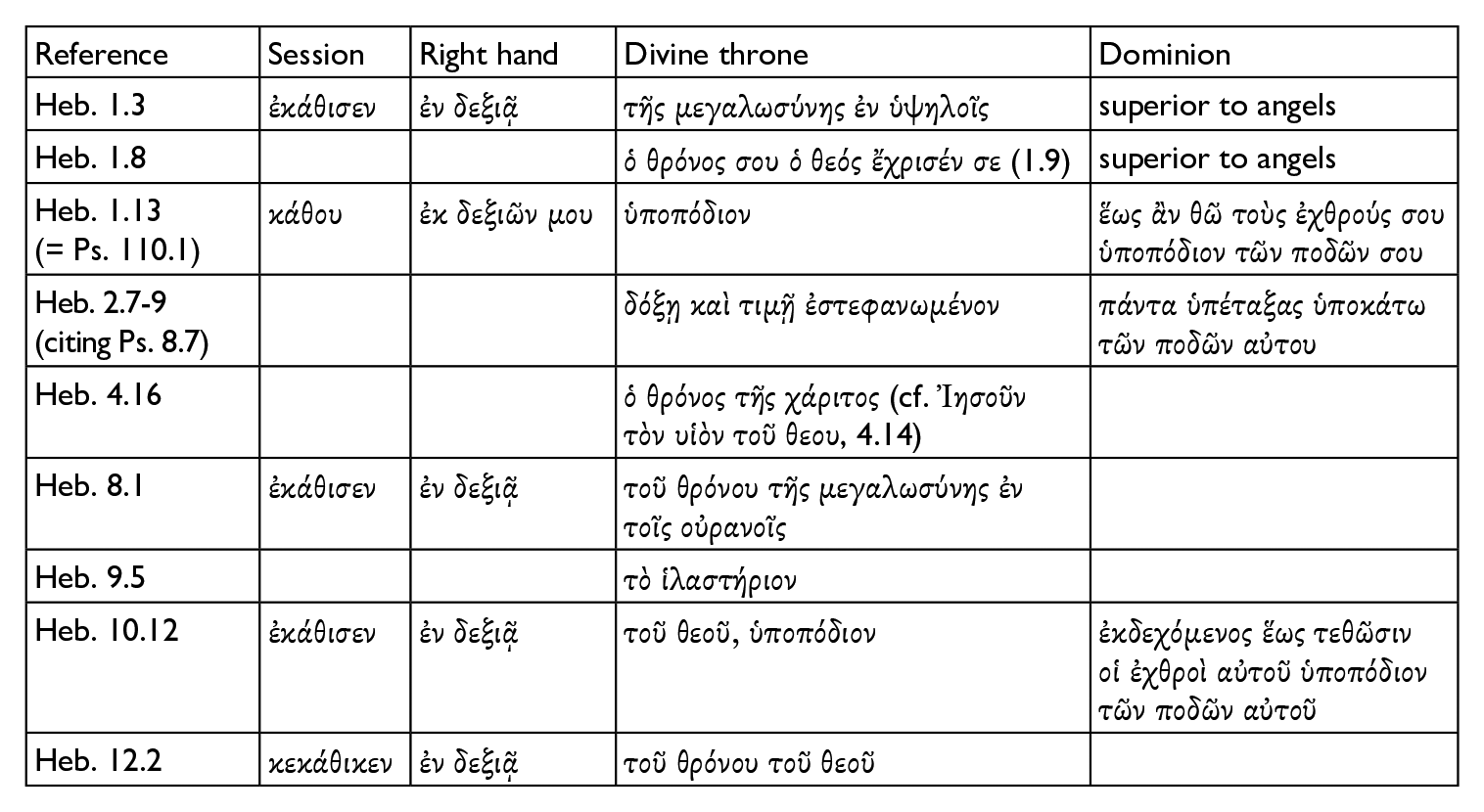
Several features of Hebrews’ deployment of this motif can be noted, which are distinctive within wider Second Temple and early Christian usage. First, Hebrews cites Ps. 110.1 directly in one place (1.13) and alludes to it in four other places (1.3; 8.1; 10.12; 12.2), more than any other NT text. 10 There are also three other mentions of the divine throne or mercy seat (1.8; 4.16; 9.5) and one description of Jesus’ coronation on the model of the son of man of Ps. 8. 11 Secondly, Hebrews directly evokes the throne or mercy seat in many of these instances, including where there is an allusion to Ps. 110.1, unlike many of the other NT instances or indeed the psalm itself. Thirdly, Hebrews makes consistent use of the aorist (in one case the perfect) of καθίζω, except in the direct citation of Ps. 110.1 where the imperative of κάθημαι is retained. This is in striking contrast to many early Christian texts where verbs of sitting disappear altogether (often in favour of εἴμι) and emphasis falls on Christ’s continuing presence at God’s right hand. 12 These last two points taken together suggest a particular emphasis on the act of sitting and the heavenly seat or throne itself. Fourthly, most of these instances have an explicitly cultic context, the exceptions being 2.7-9 and 12.2. 13 To establish the role played by the session motif, we will now look at the three most prominent passages in turn: Heb. 1 (taking all three references together); Heb. 7.23–8.6; and Heb. 10.10-14.
3.2 Hebrews 1: Purification Precedes Session
The exordium of Hebrews is generally regarded as summarizing the key themes of the letter. It opens with God as grammatical subject, who has spoken in these last days through a Son (1.1); this Son is ascribed both an eschatological and a protological role (1.2), and then becomes the grammatical subject from 1.3. Further aspects of his work are described using the present participles ὢν and ϕέρων (his relation to God’s being, and his sustaining of all things). There follows a further participial phrase followed by an indicative verb: καθαρισμὸν τῶν ἁμαρτιῶν ποιησάμενος ἐκάθισεν ἐν δεξιᾷ τῆς μεγαλωσύνης ἐν ὑψηλοῖς When he had made purification for sins, he sat down at the right hand of the Majesty on high. (NRSV)
The first phrase here serves as an eloquently concise summary of the entire cultic section of the letter, which occupies most of Heb. 5–10 and should be taken to include the whole sacrificial process on the model of Yom Kippur which Cody et al. have laid out. The NRSV translation is correct to take the aorist participle ποιησάμενος as indicating action antecedent to the main verb, and the aorist indicative ἐκάθισεν as describing past action (so Barnard 2012: 132-33, 149). General grammatical considerations support this reading: (1) the shift from present participles to an aorist implies a distinction between the two previous statements, which describe gnomic or ongoing states or events (the Son’s reflecting God’s being, and his sustaining of creation), and the third one, which describes a completed action; (2) in Koine Greek, where participles precede the main verb they tend to describe action antecedent to it (Fanning 1990: 407; Porter 1989: 380-81); (3) although the aorist indicative ἐκάθισεν could be gnomic or timeless, it is much more likely to describe past action, a consideration reinforced by the semantic content of the word which suggests the action of sitting down and not simply of being or remaining seated. 14
Further evidence can be adduced from a contrasting instance of the author’s usage. In 9.12 the author describes Jesus’ once-for-all entry into the most holy place and goes on to say ‘obtaining (εὑράμενος) eternal redemption’. We find the same combination of aorist indicative with aorist participle, only in the opposite order. If the participle denotes antecedent action, as is possible (‘after obtaining/having obtained redemption’), then it tells against a close mirroring of Yom Kippur rite on Hebrews’ part. 15 However, given Hebrews’ close reading and extensive use of the Levitical cult, we do well to seek to interpret it in line with that sacrificial system wherever possible. A better reading of 9.12 is (again as in the NRSV): ‘he entered once for all … thus obtaining eternal redemption’, which places the action of the participle concurrent with or subsequent to that of the main verb; this is common when an aorist participle follows a main verb (Porter 1989: 385-87). This renders the verse consistent with the process of Yom Kippur ritual, and thus with the wider argument of Hebrews. For our purposes, it also suggests that the author is well aware of the nuances of locating participles in relation to the main verb. Nothing would have prevented him from placing the participial phrase in 1.3 after ἐκάθισεν to suggest subsequent action. Hebrews 1.3, anticipating and encapsulating the cultic argument of the entire letter, suggests a completion of the act of purification from sins before the Son’s heavenly session. 16
Turning briefly to the other two references to heavenly enthronement in Heb. 1, 17 we can see here an emphasis on the continuing work of the enthroned one, in contrast to the completed work in 1.3. Hebrews 1.8-9 cites Ps. 45.6-7, evoking the enthronement and anointing of a king who is addressed as θεός. His throne is described as ‘forever and ever’ (εἰς τὸν αἰῶνα τοῦ αἰῶνος), in line with much other Second Temple enthronement material, with its emphasis on the royal and enduring aspects of the divine throne. Hebrews 1.13 directly cites the imperative of Ps. 110.1, framed with the question ‘to which of the angels has [God] ever said …’ The following verse emphasizes the cultic service of the angels, service which benefits those who are to inherit salvation. Again, here there is an emphasis on an ongoing work – this time of the angels, but under the authority and in the service of the enthroned Son – incomplete until the eschaton (Attridge 1989: 62). Hebrews deploys the enthronement motif in two different ways in close proximity, first to delineate a finished cultic work, and secondly to introduce a continuing work which is both cultic and royal. This same dynamic will become apparent in the other passages to which our attention now turns.
3.3 Hebrews 7.23–8.6 – Completed Sacrifice, Continuing Intercession
The next prominent reference to enthronement comes in Heb. 8.1. The author highlights the ‘chief point’ (κεϕάλαιον – either of this section of his argument, or of the whole) as believers’ present possession of a high priest, ‘who sat down at the right hand of the throne of the majesty in the heavens’ (my translation). An influential stream of translation has rendered the aorist indicative ἐκάθισεν with an English present tense auxiliary plus past participle, ‘is seated’, 18 highlighting Jesus’ present position. However, the context demonstrates that his completed work is at least as salient as his present state in heaven, and thus supports the translation ‘sat down’, which also coheres with the other occurrences of ἐκάθισεν in the letter.
The preceding section, 7.23-28, constitutes the climax of a comparison between the Levitical priesthood and Christ’s priesthood. In 7.23-25 we find emphasized Jesus’ permanence and continuity as a priest, in contrast to the mortality of the Levitical priests (cf. 7.23, κωλύεσθαι παραμένειν, with 7.24-25, μένειν, εἰς τὸν αἰῶνα, ἀπαράβατον, εἰς τὸ παντελὲς, πάντοτε). However, immediately following (7.26-27) the focus shifts to the completed nature of Christ’s work. In 7.26 the author describes Jesus’ total fittedness for the office of high priest, holy, blameless, undefiled, and evokes his exaltation using the aorist participle γενόμενος and the comparative ὑψηλότερος. It is not impossible to take γενόμενος in a gnomic sense (‘being higher …’), but again the combination of verbal aspect and semantics would suggest the emphasis falls on Jesus’ ‘having become higher than the heavens’. In 7.27 the sense of completion becomes more prominent, the aorist indicative ἐποίησεν reinforced by the emphatic ἐϕάπαξ and explicated with the aorist participial phrase ἑαυτὸν ἀνενέγκας, here following the main verb and denoting coincident action: Jesus did this, that is, offered a sacrifice for sins, when he offered himself, and he did it moreover once and for all. The next verse brings these two perspectives together: Jesus, established by the word of the oath that came after the law, is a Son who has been made perfect (τετελειωμένον, denoting completion both by its semantic content and its verbal aspect) forever (εἰς τὸν αἰῶνα, denoting continuity).
In this light, Heb. 8.1 can be seen to summarize the immediately preceding argument by laying stress on both the present work of Christ (‘we have a high priest’) and his finished work (‘who sat down at the right hand’) (Cockerill 2012: 351-52). In the following verses, Jesus’ ongoing work comes to the fore: he is the cult-minister (λειτουργός, 8.2) who has a present priestly ministry (λειτουργία, 8.6), just as he is also a covenant mediator (μεσίτης διαθήκης, 8.6). Even here, however, the foundation of the new covenant is treated as a completed event (it ‘has been enacted’, 8.6). 19
In sum, mention of intercession comes in a context which foregrounds continuity, and mention of sacrifice in a context which foregrounds completion; these two aspects are summed up in 8.1 under the dual heads of Jesus’ priesthood and his session, respectively.
3.4 Hebrews 10.10-14 – Completed Sacrifice, Continuing Effects
As we turn to our next passage, the same dynamic tension between completion and continuity can be observed. In 10.10 believers are ‘those who have been sanctified’ (ἡγιασμένοι ἐσμὲν) through Jesus’ sacrifice ‘once and for all’ (the emphatic ἐϕάπαξ). The following two verses establish a contrast between, on the one hand, the standing and daily service of the Levitical priests, many times offering the same sacrifices (10.11), and on the other, the one sin-offering which Jesus has offered before he then sat down (10.12). The combination of aorist participle and aorist indicative should here be taken in the same way as 1.3 (see above) indicating that offering (προσενέγκας) is an action antecedent to sitting down (ἐκάθισεν). The phrase εἰς τὸ διηνεκές, ‘forever’ is interposed between ‘sacrifice’ (θυσία) and ‘sat down’. The chiastic reflection which heightens the rhetorical contrast in 10.11-12 suggests that this should be taken with the action of sitting:
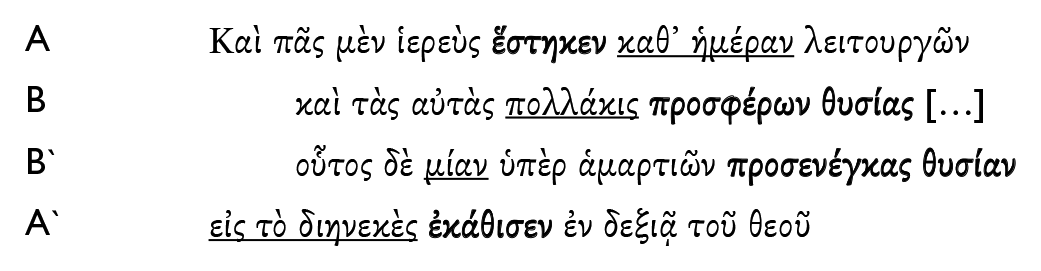
Between A and A` the contrast is standing/sitting, and the similarity is in this action’s perpetuity; between B and B` the contrast is many/one and the similarity is in offering sacrifice. This treatment of the motif of sitting reflects what we found in the two other passages we have examined: it is both the end of the sacrificial process and at the same time the beginning of something ongoing (Attridge 1989: 280-81). In this instance, however, it is not explicitly an active work of Jesus: rather, Heb. 10.13 speaks of him waiting for his enemies to be made his footstool, following very closely the language of Ps. 110.1 with its connotations of royal enthronement and awaiting full and final dominion. 20 The ongoing work in view here is in believers (10.14), and they are simultaneously those who are being sanctified (τοὺς ἁγιαζομένους) and those who have already been made perfect by one offering (μιᾷ γὰρ προσϕορᾷ τετελείωκεν) (Cockerill 2012: 451-53).
An additional argument can be adduced from 10.2. This verse presents the counterfactual supposition that if believers had been perfected under the old covenant, they would have had no conscience/consciousness of sins and would therefore have ceased offering. Tracing this logic, under the new covenant believers have been perfected (10.14), therefore have a cleansed conscience (10.22), and are thus in need of no further sin offering (10.18). The relationship of perfection, singularity and enthronement is of immense significance for Hebrews: [S]ingularity is to Christ’s sacrifice what perfection is to his priesthood: both terms are evocative of a process … yet most importantly both stress the aspect of completion. Not only this, but [in Heb. 10.11-18] enthronement re-enters the picture as well. In the space of a few verses we find combined the messianic-priestly session of Ps. 110.1 with priestly-vocational perfection and historical-traditional singularity, together providing the supreme expression of the theological finality and all-sufficiency of the atonement, and the perpetuity of its effects. (Moore, 2015: 177)
With the use of these three different motifs, the author of Hebrews is able to depict the results of a developed and clear process whereby Christ’s sacrifice culminates in his entry to heaven and presentation of himself before God. Among these three motifs, Christ’s heavenly session locates the end of this process more precisely than either perfection or singularity on their own. Moreover, as we have seen, the session is not simply a close but rather a hinge: it brings his sacrifice to a definitive end, and at the same time inaugurates his royal rule and priestly intercession.
4. Intercession, the Most Holy Place and Sacrifice
In relation to the ongoing intercession of the enthroned Christ (Heb. 7.25) an important question remains outstanding. Specifically, in answer to Moffitt’s contention that high-priestly intercession and offering in the most holy place on Yom Kippur cannot be separated, does Hebrews give grounds for identifying or distinguishing them? 21 An initial response would be to point back to the distinction between the permanent aspects of Jesus’ priesthood in 7.23-25 and the finished aspects in 7.26-27 (see above). However, as Moffitt’s position depends on Hebrews’ implicit reliance on the logic of OT sacrifice, we need to address the question of the interrelation of intercession and offering in the OT and other Second Temple period texts. In this section I first call into question the association of high-priestly prayer with the most holy place, I then relate Christ’s ongoing intercession to the tamid instead of Yom Kippur, and finally I explore factors in Hebrews’ argument that help explain this integration of ‘ordinary time’ with Yom Kippur space.
4.1 High-Priestly Prayer and the Most Holy Place
Moffitt contends that by the Second Temple period, prayer was understood to be part of what the high priest did in the most holy place on Yom Kippur.
22
Yet the evidence for this is very limited. As Israel Knohl states: The only prayer uttered inside the Temple was that of the high priest on the Day of Atonement. But even this prayer is not conducted in the holiest place of all – the holy of holies – nor is it recited as accompaniment to the cultic act of offering up the incense or sprinkling the blood. The priest recites his prayer only after he has completed the sanctified ritual and left the holy of holies. Here, too, the prayer is separated from the cultic act. (Knohl 1996: 23)
23
The only evidence to the contrary is found in Philo, whose account of Agrippa’s letter to Gaius highlights the high priest’s offering of incense and prayers in the most holy place on Yom Kippur (Legat. 306). The external-facing and political nature of the Embassy to Gaius – in the context of Roman intentions to erect cultic statuary in the most holy place – accounts for the emphasis on prayer for the whole world, the omission of mention of sacrifice and the explicit reference to Yom Kippur. Philo’s apologetic intent is to defend the absence of statuary in the most holy place, and the Jewish cult’s benefit for the entire world. The universal scope of the high priest’s prayer is in keeping with Philo’s symbolic-universe interpretation of his office and garments elsewhere (Spec. Leg. 1.84-97); what is more, he seems to introduce prayer to expand or explain the reference to incense (ἐπιθυμιάσων καὶ κατὰ τὰ πάτρια εὐξόμενος). 24 This association is well known (cf. Ps. 141.2; Jdt. 9.1; Wis. 18.21; Rev. 5.8; 8.3-4) but is not (as we shall see below) drawn in Hebrews.
In no other extant text of the period is high-priestly prayer located in the most holy place. We find ample references to (1) high-priestly prayer (or blessing or confession) on Yom Kippur in other locations besides the inner sanctuary; 25 (2) high-priestly prayer which is not associated with Yom Kippur at all; 26 and (3) heavenly prayer which is unrelated to a high-priestly figure or Yom Kippur. 27
In this context, it is striking that the biblical texts themselves are silent on the question of high-priestly prayer. In Lev. 16 and Exod. 30, the two Pentateuchal texts in which the Yom Kippur ritual is most fully described, there is no mention of prayer. 28 We might connect the incense offered daily and on Yom Kippur with prayer (see references above), but this association is nowhere made in the Pentateuch or in later OT reflection on Yom Kippur, nor in Hebrews, which mentions the incense altar (9.4) 29 but does not elaborate on the role of incense at all. Indeed, the incense in Lev. 16.12-13 is not related to prayer, but rather functions to prevent the high priest from seeing the mercy seat, in stark contrast to Jesus in Hebrews who is seated upon it and visible (2.9).
One other aspect of the tabernacle service in its Pentateuchal form which might be linked to intercession is the cultic garments. The ephod which Aaron as high priest wears when he performs cultic service has two stones on its shoulders bearing the names of the twelve tribes of Israel; these are ‘stones of remembrance’ to be borne before the Lord (Exod. 28.6-14; v. 12, אבני זכרן/λίθοι μνημόσυνου). Similarly, the breast piece has twelve precious stones mounted on it, with the names of the twelve tribes engraved one on each stone, and he is instructed to wear it when he enters the sanctuary in order ‘to bring them to regular remembrance before the Lord’ (Exod. 28.15-30, v. 29, לזכרן/μνημόσυνον). Philo explicitly interprets the high-priestly vesture as relating to prayer (Spec. Leg. 1.97). 30 Yet these garments are not worn on Yom Kippur: in Lev. 16.4 Aaron is told simply to put on linen coat and undergarment, along with linen sash and turban, not the multi-coloured yarn of the ephod or breast piece. 31 If they do represent prayer under the form of remembrance, then that prayer takes place as part of the high priest’s regular service and not on Yom Kippur.
There is no denying that the connection between prayer and sacrifice is present in the OT and seems to strengthen in the Second Temple period; 32 at the same time, prayer can be distinguished both conceptually and temporally from the offering of incense or of sacrifice. In particular, the contention that they are coextensive or coterminous on any occasion, especially on Yom Kippur, remains unproven.
4.2 Christ’s Intercession and the tamid
While the Yom Kippur rite is primary in Hebrews, it is not all encompassing and does not exclude other aspects of the wider tabernacle system, some of which also play significant roles in the letter’s cultic argument. A number of features of the preceding discussion have pointed us towards the tamid, the regular daily offerings. We know that the high priest was involved in this service and that when he served in this way he wore the ephod and breast piece, bearing the names of Israel as a memorial before the Lord. 33 Moreover, he did this regularly (תמיד, Exod. 28.29-30 MT). This same term, consistently translated διὰ παντός in the LXX, carries the technical meaning of the daily tamid offerings in several places in the NT, including in Heb. 9.6 and 13.15 (see Hamm 2004). These two instances are not isolated or incidental. Rather, Hebrews contains an all-embracing typology which understands the entire tabernacle system as foreshadowing both the priestly service of Christ and, to some extent, the priestly service of the church through Christ (13.15-16).
This is best seen in Heb. 9.1-14. The μέν … δέ construction in 9.1, 11 structures a comparison between the whole tabernacle system (9.1-10) and Christ’s cultic work (9.11-14). Within this, the regular (διὰ παντός) service of the priests in 9.6 foreshadows the ongoing aspect of Christ’s priestly work (αἰώνιος, 9.12, 14) just as much as the once-yearly (ἅπαξ τοῦ ἐνιαυτοῦ) actions of the high priest in 9.7 foreshadow Christ’s once-for-all (ἐϕάπαξ, 9.12) entry into the heavenly most holy place. 34
This reading of Christ’s work is fully consistent with his continual intercession in 7.25 and is reinforced by the almost incidental reference to the high priest’s involvement in the daily tamid offerings in the close context of this verse. He ‘offers sacrifices day after day (καθ᾽ ἡμέραν), first for his own sins, and then for those of the people’ (7.27). 35 Although the thrust of this verse is that Jesus does not need to offer for sin daily, because he has done this once in his self-offering, it also discloses the author’s assumption that the high priest was involved in the tamid. It makes better sense within Hebrews’ overarching cultic framework, then, to suppose that Jesus’ perpetual intercession derives typologically from regular daily prayer rather than from prayer on Yom Kippur.
4.3 Sacrifice, Session, and Intercession in Hebrews
The argument so far suggests that, for Hebrews, Jesus after his heavenly session is in Yom Kippur space but in ordinary or tamid time. 36 This combination might seem surprising, but a number of features of Hebrews’ argument disrupt a straightforward mapping of Yom Kippur onto Christ’s saving work and thus help to account for it; they are explored in this final subsection.
Hebrews details a number of divergences from the Yom Kippur rite (see Gelardini 2012: 242-45). In Heb. 7.27 the author states that Jesus has no need to make a sin offering for himself, unlike the high priest; this is important for his Christology, but not for our purposes here. A second difference is that no high priest remained in the most holy place on or after Yom Kippur: the understanding of his entry ‘once’ (אחד/ἅπαξ) allows for several entrances (with incense, and with the blood of the goat and the bull, separately or possibly together) and also includes his exit (cf. m. Yoma 7.4), yet when Hebrews speaks of Jesus entering heaven ‘once’ ([ἐϕ]άπαξ), this does not entail multiple entrances or any exit. Indeed, when Hebrews does describe Jesus’ exit from heaven at the eschaton it uses the phrase ἐκ δευτέρου (9.28).
A further difference has already been in focus in this article: the fact that Jesus sat down in the most holy place (8.1). No priest ever sat down in the sanctuary, as cultic service was always performed standing, and Jews in the Second Temple period were well aware of this and its rationale. In particular, in relation to the heavenly cult, the angels as cultic servants do not sit in God’s presence. 37 It is especially noteworthy that one extant mention of sitting down in the context of cultic service, in the Letter of Aristeas 94, specifically refers to a place ‘where those who are relieved from duty sit’ (οὗ καθίζουσιν οἱ διαναπαυόμενοι); that is, the priests sit only when they rest from their service (and stand again when they return to it). This reinforces the contention of the first half of this article, that Jesus’ session represents the end of his sacrifice.
What is more, although entirely inappropriate for the offering of sacrifice, a position of being seated and/or at the right hand is appropriate for intercession. 38 A vivid illustration of this is found in Bathsheba’s intervention with Solomon on Adonijah’s behalf in 1 Kgs 2.19-21; here she enters Solomon’s presence, a throne is brought and placed on his right, she sits upon it, and only then is her request made. 39
One further feature of Christ’s intercession in Hebrews helps to explain its distinction from Yom Kippur sacrifice: its focus is primarily forward-facing help not to sin and thus to persevere, rather than backward-facing help in the form of forgiveness of sin (Attridge 1989: 211-12; Loader 2018: 236, 243-44, 266, 269, 273-74). This fits with Hebrews’ emphasis on the need for perseverance to avoid the stark alternative of falling away and can be seen most clearly in two places. Hebrews 2.17 introduces the theme of Christ’s merciful and faithful priesthood, and the atonement he makes for the sins of the people. Verse 18 goes on to highlight Christ’s solidarity in testing/temptation as a qualification for him to help people undergoing the same thing. This picks up on the strong solidarity theme throughout Heb. 2, but notably it passes over the theme of atonement which has just been mentioned. The same idea is in play in Heb. 4.14-16: here Jesus as high priest sympathizes with human weakness, having undergone testing/tempting himself, and is thus able to supply timely help. The most obvious enduring aspect of Jesus’ priestly ministry which would enable him to provide such help is his intercession, which breaks the surface explicitly in 7.25. 40
This section has argued that the location of high-priestly intercession in the most holy place on Yom Kippur finds little support in biblical or Second Temple literature, that it is more plausible to understand Jesus’ perpetual intercession in Hebrews as deriving from the tamid, and that several factors weigh against Yom Kippur alone controlling Hebrews’ portrayal of Jesus’ heavenly ministry. 41 In particular, the act of sitting signifies the ending of the Yom Kippur sacrifice (in a context where the obvious signal of this, the high priest’s emergence from the most holy place, is absent), and the position of being seated is appropriate to intercession whose goal is present aid in perseverance.
5. Conclusion
In conclusion, I wish to draw out four points of relevance to the wider dialogue with David Moffitt. First, the assertion that Christ’s offering is ‘effectively perpetual’ and that his ongoing intercession is atoning seems in tension with his otherwise sequential narration of sacrificial process. In this respect, his position is closer to Platonist construals of Christ’s heavenly work in Hebrews than Jewish apocalyptic ones, something of an irony given his clear commitment to interpreting Hebrews within an apocalyptic framework. 42 I have highlighted a number of features from both Jewish tradition and Hebrews itself which suggest that a clearly delineated process of entrance, offering, session and then intercession is in fact in operation.
Secondly, in holding both sacrifice and intercession to be ongoing, Moffitt runs the risk of espousing an insufficiently realized account of Hebrews’ eschatology. The position I articulate here aims to maintain the balance or (better) the tension in Hebrews’ eschatology: Christ has both completed (7.28; 10.10) and yet also continues his work (4.16; 7.25); believers are not only being sanctified (10.14) and striving towards perfection (6.1), they have also already been sanctified and perfected (10.10, 14).
Thirdly, a word on terminology. I have steered clear of language of ‘atonement’ in this article, given that Hebrews uses it in only two places (ἱλάσκεσθαι, 2.17; ἱλαστήριον, 9.5), and its precise nuance in 2.17 is contested. If such terminology is used to refer to the whole of God’s work in reconciling humankind to himself through Christ, then in that sense Christ’s heavenly intercession is readily described as ‘atoning’, just as is his whole ministry from incarnation (Heb. 10.4) to eschaton (9.28). It would seem that Hebrews uses the verb σώζω in this sense in 7.25 in describing the impact of Christ’s intercession (cf. σωτηρία in 1.14; 2.3, 10; 5.9; 9.28). However, if atonement is used in the narrower, Levitical sense of forgiving or removing sins, then Hebrews is emphatic that this is complete at Christ’s session, and that there no longer remains a sin offering (10.12, 18, 26). 43 It is along these lines that the letter uses language such as purification (καθαρισμός, 1.3), redemption (λύτρωσις, 9.12) and forgiveness (ἄϕεσις, 10.18). As noted in the previous point, word groups such as perfection (τελείωσις, τελειόω) and sanctification (ἁγιασμός, ἁγιάζω) appear to span both nuances and thus encapsulate the eschatological tension inherent to salvation.
Fourthly and finally, as important as the Yom Kippur rite is for Hebrews, all interpretations must allow for the author’s theological creativity; the key question is where and how the author has innovated. Moffitt sees a conflation of offering, session and intercession to the point where they are coextensive, and relates all three to the author’s implicit reliance on and development of Yom Kippur. I have sought to show that the combination of these elements makes little sense within a Yom Kippur typology alone. Rather, by incorporating royal enthronement and ongoing high-priestly prayer Hebrews breaks the bounds of Yom Kippur, affirming the Christian tradition that Christ’s enthronement inaugurates his present royal-priestly reign, and at the same time transforming Christ’s session into the climax and close of his sacrifice. 44
Footnotes
1.
See the taxonomy offered by Jamieson 2017; note also the responses by Kibbe 2014;  .
.
2.
So, e.g., Cody 1960: 78-82. Scholarship (at least English-speaking) now largely concurs that while Hebrews uses language which evokes Platonist concepts, it does not subscribe to a Platonist worldview (see Barnard 2013; Schenck 2002; ).
3.
Similarly: ‘the intercession of Our Lord is really and simply equivalent to His expiatory activity, carried out once in earthly history and brought up against eternity in the celestial order’ (: 199); ‘But the one sacrificial action of Christ […] accomplished once in history, is present to the divine power and is, through that presence, eternal on the side of the divine power. The sacrifice of Christ “continues” in that the historical sacrifice of Christ has become present to the eternal spirit’ (p. 200).
4.
Similarly: ‘Christ is the eternal priest, offering his once-and-for-all sacrifice in the heavenly tent’; ‘As an earthly reality his sacrifice is over. It is completed. Yet this sacrifice … spans two worlds so that it is over, yet in its climactic moment perdures forever’ (: 212, 214; emphases added).
5.
‘These events are the resurrection of Jesus’ human body, his ascension into heaven, his presentation of his atoning offering – that is, his very life – and his session at God’s right hand … Jesus entered into God’s presence in heaven. There he made his atoning offering. After making that offering, he took his seat at the throne at God’s right hand’ (: 42-43, emphasis original).
6.
Similarly: ‘It may be objected that one must distinguish between the offering of Jesus’ high-priestly sacrifice and his high-priestly intercession. Yet the only time the Jewish high priest could intercede for God’s people in the holy of holies would be on Yom Kippur when he is presenting the sacrificial blood of the bull and the goat. Simply put, there is no high-priestly intercession in the holy of holies apart from the presentation of the Yom Kippur sacrifice.’ (: 163 n. 23)
7.
Space precludes a detailed exploration of the enthronement motif in the OT or Second Temple period, but see Hannah 2003; .
8.
9.
10.
With ‘alludes’ here I am highlighting a non-verbatim re-use of several terms from the source text; in all four cases Hebrews uses καθίζω in the indicative and ἐν δεξιᾷ (vs imperative of κάθημαι and ἐκ δεξιῶν μου in the psalm). On Ps. 110 in Hebrews, see Anderson 2001; Compton 2015; Jordaan and Nel 2010; : 15-21 and passim.
11.
Dominion is present in the context: both mankind’s dominion in the citation of Ps. 8 (in the author’s elaboration he points out that this is not currently achieved), and also Jesus’ implied dominion as the one now ‘crowned with glory and honour’ (Heb. 2.9).
12.
Amidst widespread use of Ps. 110.1 in the NT, the only other places where Christ’s enthronement is referred to as a past act are Acts 2.33; 5.31 (ὑψόω); Mk 16.19 (longer ending, καθίζω); Eph. 1.20-22 (καθίζω, used transitively); Rev. 3.21 (καθίζω); in all of these the focus remains on Christ’s current authority.
13.
1.3: καθαρισμός. 1.8, 13 are part of the continuing description of heavenly enthronement, the cultic aspect of which is foregrounded by 1.3 and surfaces e.g. in 1.14 (λειτουργικός). 4.16 and 8.1: ἀρχιερεύς. 9.5 and 10.12 come in the context of discussions of tabernacle furniture and service respectively.
14.
One might discern a distinction along these lines between καθήμαι (‘being seated’) and καθίζω (‘sitting down’), with its factive suffix, but too much weight should not be placed on this as, although καθήμαι (with the exception of the imperative) tends to denote ‘being seated’, both verbs can be used in both senses.
15.
16.
This would be consistent with purification occurring either at the cross or in heaven.
17.
On Heb. 1 as an enthronement scene, see Barnard 2012: 144-70, 243-75; Caneday 2008; Mason 2012; .
18.
From the KJV ‘is set’ comes ‘is seated’ in RSV, NRSV, ESV, NKJV. Contrast, correctly, ‘sat down’ (NIV) and ‘has taken His seat’ (NASB) (so also Attridge 1989: 216; : 374-75).
19.
No weight can be placed in either direction on 8.3 – which affirms the necessity of Jesus having something to offer just like the Levitical priests did – given the absence of a finite verb. Cf. NIV ‘it was necessary … to have’ with NRSV ‘it is necessary … to have’. The subjunctive provides a neat, if somewhat outmoded, solution: ‘necessary that [he] have’ (KJV, NASB).
20.
With regard to Heb. 1.3 and 10.12 Barnard states: ‘Christ can take a seat because his sacrificial work is complete. It is because of the unique nature of Christ’s atonement (i.e. as the final and definitive sacrifice) that he is allowed to sit down and rest from his work, just as God rested from his work of creation on the seventh day (4:4)’ (Barnard 2012: 148). By a similar token I have argued in this journal that Heb. 4.10 refers to Jesus’ entrance into rest after his saving work on the model of the exodus, which if correct would again parallel Jesus’ session after his saving work on the model of Yom Kippur ().
21.
23.
Knohl writes with respect to the Priestly Torah but the insight applies equally to the Second Temple (p. 21).
24.
25.
Lev. 16.21. M. Yoma identifies high-priestly prayer over the scapegoat (m. Yoma 6.2) and blessings in preparation for the sacrifices (7.1), but does not mention prayer in the most holy place; indeed, m. Yoma 5.1 describes the high priest praying once he has re-emerged into the outer sanctuary. The Talmud describes Yom Kippur prayers at greater length, including by the high priest in the holy place (b. Yoma 53b; 70a; 87b; 88a). On the inauguration of Aaron’s priesthood, Moses and Aaron offer prayers on their exit from the outer sanctuary (Philo, Mos. 154).
26.
Philo, Spec. Leg. 1.97, 113; 3.131; Mos. 2.133, 147; Som. 1.215. Josephus includes prayer among the high priest’s duties, twice in Ant. 3.189-91. Sirach 45.15-16 mentions blessing the people and offering the memorial portion, not explicitly prayer (cf. in 50.1-21, where the people offer prayer in v. 19). Sirach 50 with its description of Simon the high priest’s elaborate garments would seem to be describing the daily tamid offerings and not Yom Kippur (: 50). Onias the high priest prays both on earth and in heaven in 2 Macc. 3.31-33; 15.12-14 respectively.
27.
The saints pray in the heavens in 1 En. 47.2, while even the heavenly furniture prays, blesses and praises in the Songs of the Sabbath Sacrifice (4Q403 1 2 10-16; cf. the ‘roar of praise’ at the entrance and exit of the throne-chariot, 4Q405 20 2 21-22 1-11). An angel intercedes for Israel in T. Levi 5.6, while the third of the four angels in 1 En. 40.6 intercedes and prays. The priests’ and Levites’ prayer in 2 Chron. 30.27 is heard in God’s heavenly dwelling (cf. Sir. 50.19-20). In Apoc. Zeph. 11.2-6 the righteous pray daily to the Lord.
28.
We find high-priestly prayer in connection with Korah’s rebellion in Num. 16.20-22; Wis. 18.20-25.
29.
Or θυμιατήριον could be taken as ‘censer’, to avoid the problem that Hebrews appears to locate the incense altar within the most holy place. There is, however, little evidence for a censer remaining in the most holy place as a permanent item of furniture, so ‘incense altar’ is the better translation. The most plausible explanation is that Hebrews engages in a possible interpretation of Exod. 30.6, whereby the incense altar is before the mercy seat and blood is administered to its horns on Yom Kippur.
31.
Philo contrasts the white linen garments (= the purity of the heavenly realm) with the multi-coloured garments, worn outside the sanctuary (= the manifold nature of earthly life; Ebr. 85-87) (Hayward 1996: 50). In Spec. Leg. 1.84, Philo describes the high priest entering the innermost sanctuary (τὰ ἄδυτα) in plain linen robes (cf. 1.83) and then moves on to explore the symbolism of his ornate robes; he neither states nor implies that the high priest entered the most holy place wearing the ornate robes. Similarly, in Som. 1.216 he takes off his variegated robes and puts on pure white linen to enter the inner sanctuary (: 230-31).
32.
Cf., e.g., 2 Sam. 24.25; 2 Chron. 7.12; Job 42.8; Ps. 141.2; Isa. 56.7; Dan. 9.21; 2 Macc. 3.31-32; Wis. 18.21; LAB 13.2; Philo, Spec. Leg. 3.131; Josephus, Ant. 3.189; 11.326. The apparent antithesis between prayer and sacrifice, e.g. in Pss. 50.23; 51.15-16; Prov. 15.8, in fact depends on their association.
33.
For ‘memorial’/‘remembrance’, see above on Exod. 28; also Jub. 50.10-11.
35.
This verse has at least two difficulties: the implication that the high priest had to offer every day, and that the daily offerings were for his own sins and those of the people. In response to the first, the high priest was involved in the tamid as we have seen above, and Lev. 6.20-23 appears to command the high priest (Aaron and his successors) to offer the daily grain offering (cf. Num. 4.16; Sir. 45.14). As for the connection of the tamid with sin, the grain offering is linked to atonement in Lev. Rab. 3.3; Philo, Her. 174 (ὑπὲρ ἑαυτῶν).
36.
It is beyond the scope of this article, but one might further identify this tamid time as sabbath time, given the importance of rest (κατάπαυσις) specified as sabbath celebration (σαββατισμός) in Heb. 4 (see Calaway 2013; ).
37.
For angels standing in God’s presence, see Dan. 7.10; Tob. 12.15; 4Q530 (= Enochic Book of Giants); 1 En. 14.22; T. Abr. 7.11; Lk. 1.19; in 1 En. 39.12–40.2 angels are ‘those who do not slumber but stand before your glory’. For an exalted heavenly figure, see 2 En. 21.3; 22.5-6 (Enoch stands before the Lord forever); in 2 En. 24.1 Enoch sits/is placed at God’s left hand. Rabbinic traditions hold there is no sitting in the world above (b. Hag. 15a, in relation to the account of Metatron’s punishment for sitting in the divine presence, 3 En. 16.1-5; cf. 3 En. 18.24), and that angels cannot sit as they have no knees (y. Ber. 1.1 8d-f). Hannah plausibly traces this back to ShirShabb, which states (albeit in a fragmentary text) of the angels, ‘they do not sit …’ (4Q405 20-21-22 ii.2;11Q17 vii.4-5) (2003: 89-90). Note also Jesus’ heavenly stance standing at God’s right hand in Acts 7.55-56, which is much more in line with cultic service than Hebrews; highlights this.
38.
So Loader 2018: 266; Nelson 2003: 257. : 388-89) suggests that Hebrews downplays certain elements of both royal session and priestly intercession in order to harmonize the two images.
39.
Cf. 2 Sam. 7.18 where David sits and petitions God; 1 Macc. 10.63, where Alexander’s enthronement of Jonathan at his side pre-empts the accusatory petitions (ἐντυγχάνω) of others.
40.
Cockerill (2012: 335-37) elucidates Christ’s intercession in terms of enabling perseverance. Note also that the verb ἐντυγχάνω is not used in the LXX in any plea for deliverance from divine judgment (: 366).
42.
I appreciate that in his later work Moffitt has made a careful distinction between ‘eternal’ and ‘perpetual’, presumably in order to avoid any hint of a Platonist interpretation. Contrast Jesus’ ‘offering for eternal atonement’ (2011: 43) with ‘his sacrificial, atoning work is perpetual’ (: 173).
44.
I am grateful to Bobby Jamieson for comments on a draft of this piece, and above all to David Moffitt for his cordial engagement with my argument at a session devoted to this question at the British New Testament Society Conference, Twickenham, in September 2018.