




Abstract
Aims
The purpose of this study was to initiate and stimulate collaborative research efforts to support United European Gastroenterology Federation (UEG) member societies facilitating digestive health research in European on the one hand and, on the other hand, to increase EU-funded digestive health research by providing evidence and advice to funding bodies on priority areas. The UEG Research Committee initiated a survey of the current and future research interests of each individual UEG ordinary member society (specialist societies).
Methods
A questionnaire was sent by mail to 17 UEG ordinary member societies asking them to specify research demands related to the most urgent medical need including basic science research, translational research, clinical research, patient management research and research on disease prevention, in an open fashion but with limited word count.
Results
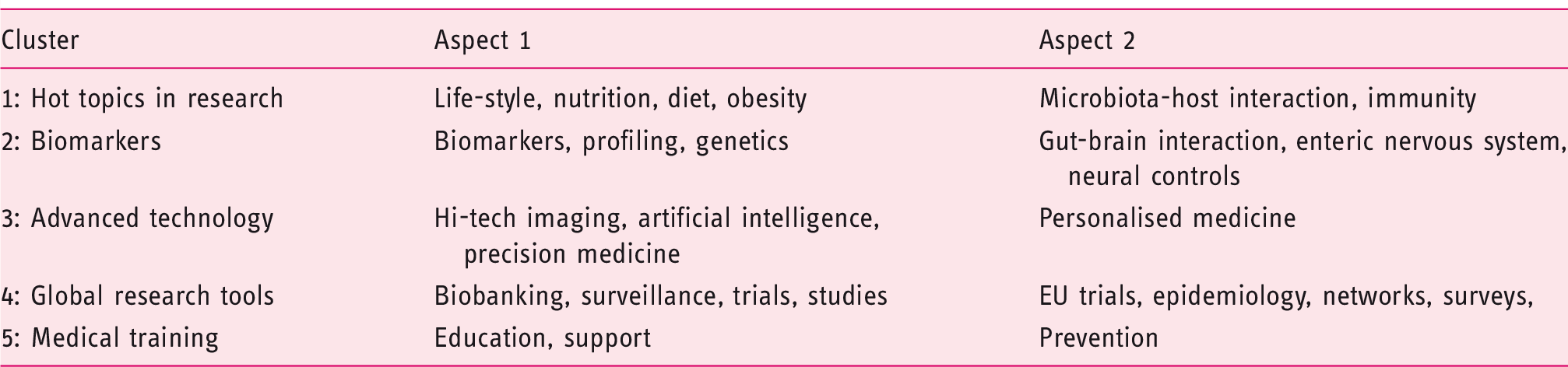
The responses from 13 societies were analysed in a semi-quantitative and in a qualitative way, and were clustered into five domains with two aspects each that were consented and shared between three and seven of the responding 13 societies. These clusters resemble topics such as ‘Hot topics’ (e.g. life-style, nutrition, microbial-host interaction), Biomarkers (genetic profiling, gut-brain interaction), Advanced technology (artificial intelligence, personalised medicine), Global research tools (bio-banking, EU trials), and Medical training (education, prevention).
Conclusion
The generated topic list allows both collaboration between individual specialist societies as well as initiating and fostering future research calls at the EU level and beyond when approaching stakeholders.
Introduction
The vast majority of European medical associations started as an assembly of national societies of the same subspecialty (e.g. gastroenterology, cardiology, rheumatology etc.) but display a much higher diversity not only due to the heterogeneity of languages across Europe. They tend to organise themselves as ‘umbrella organizations’ focusing on harmonization, training and education, while leaving research initiatives mostly in the hands of either national societies or subspecialty societies. This is no different in the United European Gastroenterology (UEG) federation that was founded in 1992 by the ‘Seven Sisters’: Association of National European and Mediterranean Societies of Gastroenterology (ASNEMGE), European Society of Gastrointestinal Endoscopy (ESGE), European Association of Gastroenterology, Endoscopy, and Nutrition (EAGEN), European Association for the Study of the Liver (EASL), European Federation International Society for Digestive Surgery (EFISDS), European Pancreatic Club (EPC), European Society for Paediatric Gastroenterology, Hepatology and Nutrition (ESPGHAN) (for the history see the UEG video). 1
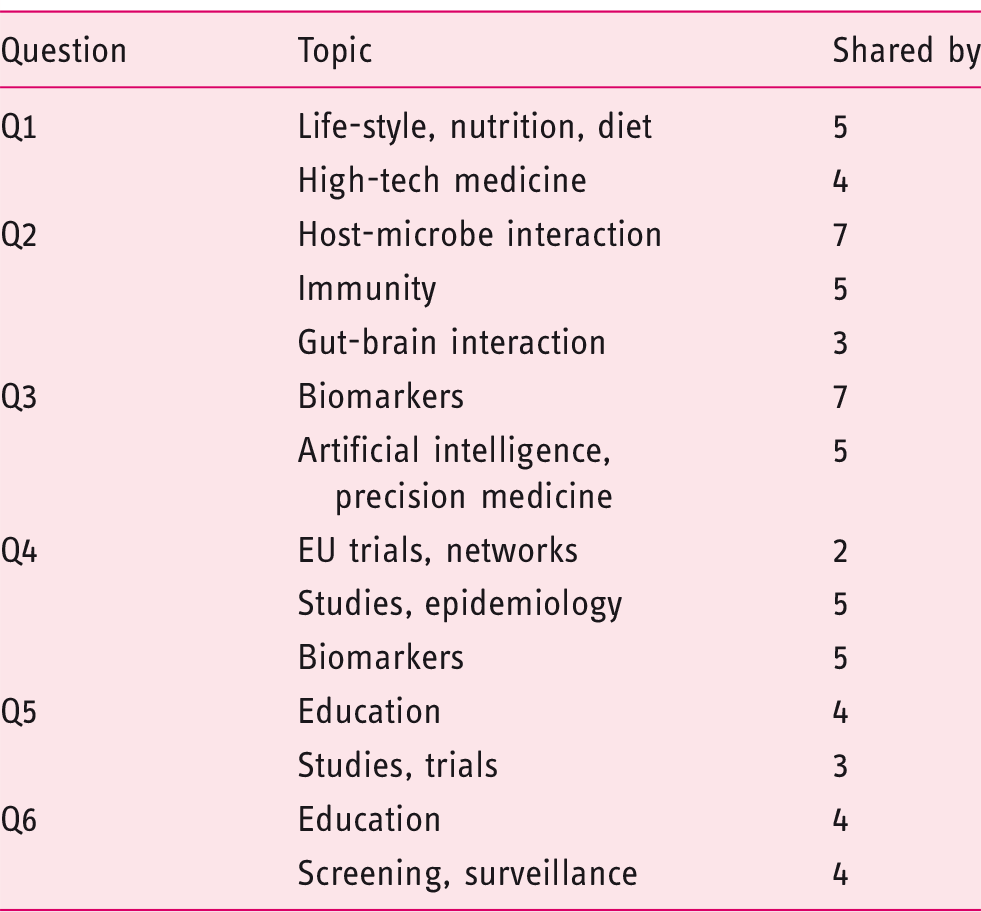
Research topics identified with the six questions (Q1–Q6) and shared by three of more of the 13 specialist societies of the United European Gastroenterology Federation (UEG). For details of the methodology, see text and Supplementary Material 1 and 2.
Under these complicated circumstances it is easily conceivable that developing a research agenda would be challenging for the UEG, leading to possible competition due to rather diverse research interests of the individual societies under its umbrella. To bundle the various research activities of the UEG and its member societies, to foster common research activities for all of the UEG, and to develop and promote future research plans, the UEG established a Research Committee with representatives of all member societies in 2017, which paved the way for subsequent actions, among which the survey reported here is just one. It was preceded by the ‘white book project’, 2 a successful attempt to collect epidemiological data illustrating the range as well as the economic and social burden of major gastroenterological diseases across Europe, with emphasis on the differences and similarities between individual countries.
However, as outlined in the UEG strategic plan 2019–2022, the ultimate goal and mission of the UEG is to act as the united and trusted voice of all fields of European gastroenterology.
3
Its strategic research objectives are (among others):
Initiating and stimulating collaborative research efforts to support our member societies in facilitating digestive health research in Europe. Increasing EU-funded digestive health research by providing evidence and advice to funding bodies on priority areas in close liaison with our member societies. Establishing a dedicated researchers’ network and platform for exchange on EU-funded research and offering a meeting hub for research consortia. Supporting and providing endorsement for pan-European consortium forming initiatives in the exploratory phase of applications to EU funding (UEG strategic plan 2019–2022, p.11).
3
These objectives require not only harmonization of clinical and educational strategies across Europe, but also outlining of future demands and requirements for diagnostic and therapeutic developments, patient management and research that needs to be accomplished to provide better health care in all areas of medicine. The publication of the UEG White Book 2 was a step in this direction, as it established a lobbying platform in Brussels, including formal meetings with European stakeholders and politicians, and fostered European gastroenterology grant applications. 4 With this in mind, the UEG Research Committee initiated a survey of the current and future research interests of each individual UEG ordinary member society (specialist societies). The development of a map of these interests was another attempt towards this common goal.
Methods
Questionnaire and timeline
A questionnaire was sent by mail to 17 ordinary member societies (specialist societies) of the UEG in early April 2018 (addressed to the individual president/chairperson responsible), with the following introduction followed by six questions (see the Supplementary Material for the full questionnaire): UEG, in planning its activities for the years ahead 2020, is attempting to collect and compose a summary of the most urgent research needs in gastroenterology and its subspecialties and for this is asking the boards of all its member societies (and - if available - their respective sub-committees and/or officers) to state the most urgent needs in the following six research areas. Please use a max of 250 signs for each question and return your answers no later than 22 April 2018. You may add as many aspects of the question that you address in each text field but please explain why you choose this and not another topic, and avoid using special abbreviations that not everybody understands. Q1. Most urgent medical need (taking into account socio-economic rational). Q2. Basic science research. Q3. Translational research. Q4. Clinical research. Q5. Patient management research. Q6. Disease prevention research.
Asking open, instead of closed, questions (e.g. rank the following research topics according to your society’s preference) allowed maximum freedom for the societies to enter any topics of their choice.
Evaluation
To evaluate and summarise the results, two different approaches were used (see Supplementary Material 1): (a) a semi-quantitative evaluation of the responses using full text answers; (b) a qualitative approach using manually identified key terms. 5
Results
Overall response
Of the 17 sister societies, all but four (European Association of Endoscopic Surgery (EAES), EFISDS, European Society of Coloproctology (ESCP), The European Society for Clinical Nutrition and Metabolism (ESPEN)) responded in time to enter this evaluation process.
Unfortunately, the PDF version provided of the questionnaire did not operate well in all cases, so that most societies sent back a Word document instead – and most ignored the pre-set word/character limit. This imbalance between societies created problems in further evaluation (see Supplementary Material 2).
Evaluation A: word counting and word clouds
This evaluation step did not reveal any insights (see Supplementary Material 2).
Evaluation B: key terms and global sorting
From the extracted key sentences per question across all societies, we identified and highlighted terms denoting society-specific research topics (Figure 1(a)), as well as those that appeared across more than one society’s answers (Figure 1(b)).
Example of the qualitative analysis of answers, here for Question 1 and 4. (a) All answers of all societies to Question 1, with the raw answers (left), answers identified as society-specific (middle, yellow), and topics that occur in more than one societies’ statement (right, marked in different colours); (b) The same sorting for Question 4 where society-specific topics were not identified, but three topics for more than two societies.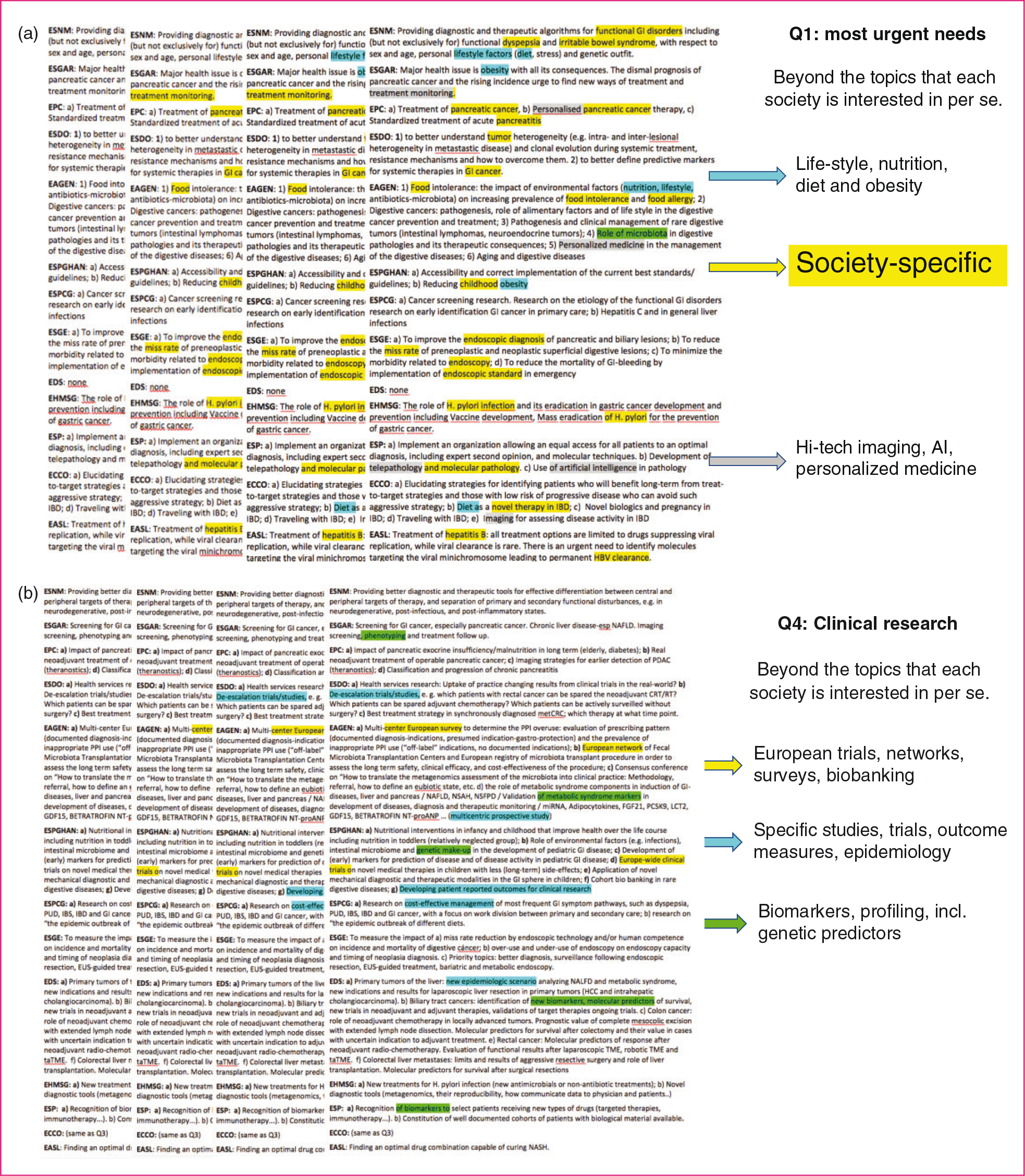
Clustered research topics and aspects of research. For details of the methodology, see text and Supplementary Material 1 and 2.
The society statements attributed to each of the clusters are shown in Supplementary Material 2.
Additional open question
A response to the open question (see Methods) was given by only four of the societies; it did not reveal an output that would easily be summarised across the member societies, but individual statements were to the best of our knowledge, integrated into the other clusters.
Discussion
In agreement with the strategic plan of UEG as of 2018, 3 the Research Committee set out to follow up its initial ‘White Book’ initiative 2 with a survey among its member societies asking for ‘the most urgent need' in various research areas (basic, translational, clinical, patient management, prevention) to stimulate collaborative research efforts among them, to establish a network and platform of researchers and to increase EU funding for digestive health research. 4 In the past, digestive health research has been poorly funded by EU calls. This was deemed necessary especially because of the wide range of clinical and scientific activities under the umbrella of UEG, as compared to other medical subspecialties.
The approach chosen was an open, though structured, questionnaire to the respective research boards and/or chairpersons of the 17 member societies, similar to a project conducted under the supervision of the European Society of Gastrointestinal Endoscopy (ESGE) among its national member societies. 6 It was meant to provide an unsupervised and unbiased survey to distil important research topics across the entire gastroenterological field. Yet, it carried the risk of being dominated by the interests of single societies that are stronger in research, and in funding for research, than others. While it was surprising to see that most of the 17 societies responded favourably to the request, it has to be noted that for unknown reasons four (=23%) societies did not respond. This is indicative of the fact that UEG still needs to put some efforts into reaching out to all European gastroenterologists, at least with respect to research activities under its umbrella.
As we have discussed above, while the chosen approach (open questions) may have been close to optimal to receive a response, it was fairly suboptimal to standardise the volume of responses received, and instead allowed too much variability in answering. Thereby, it prevented a simple and quantitative evaluation and, instead, required a semi-quantitative or a vigorous qualitative approach to overcome the quantitative imbalance. For this, we had no valid template but had to develop one in the course of the study.
By extracting core statements for each question and each society, subsequently eliminating society-specific and trivial research demands, and finally condensing research questions that are nominated by two or more societies, we were able to identify 10 research topics that cluster into five areas, most of which were coherent with the majority of member societies involved.
The key remaining, yet unanswered, question is how this can be turned into a research or a research-supporting agenda, from an UEG point of view in the future. For a start, the societies that have named similar research interests within one cluster or aspect should join forces and collaborate on topics they otherwise would promote and conduct ‘on their own’, as this clearly will enhance their chances to receive national and European funding. In a similar fashion, the UEG can provide support for collaborative research proposals along these clusters and aspects, rather than for individualised projects, as done currently done with their educational projects. Finally, the clusters would allow more coordinated political lobbying for future UEG-funded research projects, e.g. for the UEG Public Affairs Committee, that would overcome current limitations, 4 and would also feed into other initiatives, e.g. the Biomed-Alliance.
Supplemental Material
Supplemental material for Future research demands of the United European Gastroenterology (UEG) and its member societies
Supplemental material for Future research demands of the United European Gastroenterology (UEG) and its member societies by Paul Enck, Søren Meisner, Ceu Figueiredo, Julia Mayerle, Luigi Ricciardiello and the UEG Research Committee in United European Gastroenterology Journal
Footnotes
UEG Research Committee
Members of the UEG Research Committee (in alphabetical order):
Pilar Acedo, London, UK (Young Talent Group) Lars Agreus, Huddinge, Sweden (European Society for Primary Care Gastroenterology (ESPCG)) Francesc Balaguer, Barcelona, Spain (National Societies) Isabelle Cleynen, Leuven, Belgium (ECCO) Antanas Gulbinas, Kaunas, Lithuania (ESSAT) Gianlica Ianiro, Rome, Italy (independent) Tamara Matysiak-Budnik, Nantes, France (ESDO) Mathias Reeh, Hamburg, Germany (ESSAT) Frank Ruemmele, Paris, France (ESPGHAN) Harry Sokol, Paris, France (independent) Geert JAWanten, Nijmegen, Netherlands (ESPEN)
References
Supplementary Material
Please find the following supplemental material available below.
For Open Access articles published under a Creative Commons License, all supplemental material carries the same license as the article it is associated with.
For non-Open Access articles published, all supplemental material carries a non-exclusive license, and permission requests for re-use of supplemental material or any part of supplemental material shall be sent directly to the copyright owner as specified in the copyright notice associated with the article.
