




Abstract
This article is in our series on Winston Churchill’s illnesses
Introduction
Sir Winston Churchill, aged 83 years, planned to have a recuperative holiday in January and February 1958 in the south of France at La Pausa, a villa in Roquebrune-Cap-Martin, in the Alpes-Maritimes, some 6 miles east of Monte Carlo. The villa was designed and built by the French fashion designer Coco Chanel in the early 1930s and owned by Chanel until 1953 when she sold it to the Hungarian publisher Emery Reves, Churchill's long-time literary associate, who with his future wife Wendy, were to be Churchill's hosts.
The villa stands high on the shoulder of the mountainside above Cap Martin and commands sensational views towards Menton on one side and Monte Carlo on the other.
1
Detective Sergeant Edmund Murray,
2
Churchill's bodyguard, wrote, Its setting, in green and well-tended gardens full of Mediterranean flowers and lavender, shaded by olive trees, was quite superb. It was perched several hundred feet above sea-level, adjacent to the mediaeval village of Roquebrune, a noted tourist attraction, with to the east a fine view towards the Italian mountains…it was a house furnished with an eye to taste of the high order, but, despite this and the Rodin statues and the highly valuable paintings, sense of coldness, or soullessness was always present, to me, at least.
Methods
Information regarding Churchill's illness in 1958 was available from various sources. Foremost were those of Churchill's personal physician, Lord Moran and Dr Thomas Hunt, who had acted previously as Churchill's physician, and who was invited by Lord Moran to provide a second opinion. By courtesy of the present Lord Moran and the Library at the Wellcome Collection, we have had access to his grandfather's original papers regarding this illness. However, permission to include information not previously in the public domain 3 was not granted. The Library at the Wellcome Collection generously granted access to Dr Hunt's previously closed medical records on Churchill. Mary Soames1,4,5 (Churchill's daughter) added further details, as did Martin Gilbert6,7 (Churchill's main biographer), Anthony Montague Browne 8 (Churchill's Joint Principal Private Secretary 1952–1955; Private Secretary 1955–1965) and Churchill's bodyguard, Detective Sgt Murray.2,9
13 January–16 February 1958: Holiday
On 13 January 1958, Sir Winston Churchill flew to Monte Carlo together with Anthony Montague Browne and Detective Sgt Murray. On 18 January, Churchill wrote to his wife Clementine explaining that a fur muff she had given him was a great success in keeping his hands warm. ‘I use it at all meals, and on the whole it achieves its purpose. It is v(er)y cold.’ 5 When Churchill wrote again to his wife on 23 January he told her that he had started painting again ‘indoors for the snow is on the hills all around. Flowers arranged by Wendy is the subject…’ 6
At the end of January, President Eisenhower invited Churchill to visit the United States and to stay at the White House. Churchill hoped that he could accept and he pressed his wife to join him. 6 On 13 February, Dr Adenauer (Chancellor of the Federal Republic of Germany) paid a visit to Churchill at La Pausa. 10 Montague Browne described an altercation in the local press over whether Churchill should call on Adenauer or the other way round. In fact, Churchill had said that as he was a private citizen, he should go to see the Chancellor, and the latter with his usual perfect courtesy, insisted on calling on the older man. 8
17 February 1958: An extended lunch on a yacht
On 17 February, Churchill was invited to lunch on the yacht belonging to Aristotle Onassis (a Greek shipping magnate who lived in Monaco). After lunch, at about 3 o’clock, Churchill expressed a wish to go to the Rooms at Monte Carlo to have a little gamble. 3 Reves suggested that they might play chemin de fer on the yacht instead. 3 They played for high stakes and drank more alcohol than usual. As the afternoon wore on, it was noted that Churchill was very white and tired. 3 At about 7 o’clock, Reves reminded Churchill that they had been invited for lunch. Was it not time to go home? Winston grumbled that Reves was breaking up the party. 3 Nonetheless, the party broke up and Churchill returned in an unheated Rolls-Royce driven by his host to La Pausa. 9 Churchill seemed ‘all in’ 3 and had a sleepless night. 9
18 February 1958: Assessment by Dr Roberts: Fever and cough
Churchill was not well enough to be driven to Nice airport to meet his wife, arriving from London for a planned visit. 9 Lady Churchill was met at the airport by Montague Browne and Churchill's daughter, Sarah, who had arrived 10 days earlier. 1 During the day, Churchill developed a fever and cough and was assessed by Dr David Roberts, his local doctor on the Riviera, who prescribed penicillin. In fact, Churchill was not even fit enough to leave his bed and ‘outdoors staff’ were told that he had a stomach chill. 9 Roberts spent most of the day at La Pausa and a telegram was sent to Lord Moran asking him to come and assess Churchill. 9 At the same time, a bulletin was issued announcing that Churchill was in bed with a slight cold and asking the press and the public to refrain from phoning the villa. 9
Montague Browne issued a statement which said that Churchill was indisposed and must stay in bed. ‘The press are asked not to telephone to the villa. Another bulletin will be issued tomorrow…’ 11
Murray
9
has written that Such a bulletin was bound to arouse doubts and fears, so it was not surprising that the next day, like vultures scenting prey, the Press began to congregate once more from most parts of Europe. Before long they had made their HQ in the Hôtel de Paris in Monte Carlo. Mr Montague Browne was issuing daily reports at impromptu press conferences in the Hotel.
19 February 1958: Assessment by Lord Moran and Dr Roberts: Bronchopneumonia
Moran flew out on 19 February and stayed for two weeks. On arrival, he examined Churchill and made a diagnosis of bronchopneumonia. A medical bulletin issued on 19 February by Moran and Roberts stated, ‘Sir Winston Churchill is suffering from pneumonia at the base of the lung and pleurisy. He had a good night and has passed a comfortable day.’ 12 Roberts added that ‘We are very pleased with Sir Winston's condition. He is responding to treatment marvellously, but it will take some time.’ 12 Montague Browne stated that ‘Sir Winston was in good spirits and spent the day seeing members of his family and dealing with his correspondence.’ 12
20–27 February 1958: Assessments by Lord Moran and Dr Roberts: rigors
On 20 February, Moran 3 entered Churchill's room about noon and found him shivering violently, his teeth chattering. Moran 3 concluded that a rigor on the third day meant the infection was spreading. Moran 3 decided to change the antibiotic to oxytetracycline and get a blood count. The arrival of a French bacteriologist led to a protest by Churchill about the potential pain the blood test would cause. 3 Moran and Roberts issued a further medical bulletin which stated, Sir Winston's condition is not greatly changed since yesterday. He is comfortable, his strength is maintained, and his fever is a little lower, 13 Roberts said later that Churchill was ‘bearing up well’. 13
The medical bulletin issued on 21 February stated that Churchill's pneumonia was clearing up and his condition was showing ‘very definite improvement’. 14 The bulletin said that Churchill had had a good night and was more comfortable and that his ‘progress is so far satisfactory’. 14 Churchill kept a thermometer by the bed and took his temperature at all times of the day and night, showing alarm at any irregularity. 9
In keeping with his usual practice, Churchill had demanded to see the medical bulletins, 3 ‘I would be more candid and less revealing’ he complained. 3 Churchill told Montague Browne he was keen to stir up his doctors. ‘If I don't push them along, nothing at all would happen’. 3 He was bent on returning to England in time for The Other Club (a club founded by Churchill and FE Smith KC [later Lord Birkenhead] in 1911) on 27 February. 3
Montague Browne told reporters that Churchill was in bed but had dealt with considerable correspondence and was in excellent spirits. 14 He said that the Queen had made enquiries about Sir Winston's health and that there had been many enquiries from all over the world. 14 Churchill had sent a telegram to Her Majesty. ‘My wife and I are deeply grateful to Your Majesty for your most kind enquiries.’ 15
President Eisenhower also sent a telegram on 21 February. ‘Mrs Eisenhower and I have been delighted to hear the reports each day of your steady recovery from your bout with pneumonia we now know you will continue to get well and we are looking forward to your visit with us in April. With affectionate regards to Clemmie and as always the best to yourself, as ever. IKE’ 16 Churchill replied on 22 February, ‘I am most grateful for your warm-hearted message. I think I am making good progress. Clemmie joins me in affectionate good wishes to you both. WINSTON’ 17
Lady Churchill said that her husband was ‘very well’. 14 Lord Evans, the Queen's Physician, had arrived in Nice today on holiday and said he would make a courtesy call on Churchill in the next few days. 14
Moran
3
recorded on 22 February that, I am not really anxious about Winston, but at 83 it is all guesswork. Perhaps if he felt ill he would be more amenable. This morning he announced that he intended to go downstairs to luncheon, although he has not yet been out of bed. Dr. Roberts, in order to dissuade him, said something about his heart. It has been a comfort to me that my heart is sound and that I shall not lurch into the next world without warning. And now you talk about my heart as if it were diseased…I know a great deal. I'm not dependent on my doctors. I know what I can do.
3
By 23 February, Churchill's temperature was normal. 18 The Medical Bulletin signed by Moran and Roberts stated that ‘certain laboratory investigations of a routine nature which were carried out this morning are all normal. Sir Winston's progress continues to be satisfactory.’ 18 A further bulletin was issued on 24 February which stated that the ‘pneumonia continues to resolve and the pleurisy is causing him less discomfort’. 19 Churchill's general condition was stated to be satisfactory. During the day Churchill received M. Pierre-Jean Moatti, Prefect of the Alpes-Maritimes Department and Mme. Moatti. Mr Moatti was an old friend and he brought the greetings and good wishes of President Coty, the French Government and the Alpes-Maritimes Department. 19 These were Churchill's first visitors apart from members of his family since he fell ill. 19
Vice President Richard Nixon wrote a letter to Churchill on 24 February:
20
My dear Sir Winston Along with your countless admirers throughout the world, I was pleased to learn that you are recovering so nicely from your recent illness. This is the kind of encouraging good news all of your friends want to hear! In a recent letter from Mr Joyce Hall he told me about the enthusiastic reception your exhibit received at the Nelson Gallery in Kansas City [Churchill had selected 35 of his paintings for the exhibition]. The fact that all previous one-day attendance records were broken on the opening day is, I am sure, indicative of the way your work will be received everywhere in the United States. It was a great disappointment to me not to be among those present on the first day of the showing. Both Mrs Nixon and I hope to have an opportunity to see your canvases before they leave our country, and we look forward with pleasure to welcoming you to Washington again soon. Our kindest regards to you and Lady Churchill Sincerely Richard Nixon. I am touched that with your many burdens you should have taken the time to write such an agreeable letter. Thank you so much. I too am looking forward to our meeting. With warm regards to Mrs Nixon and yourself.
A portable X-ray machine was procured 9 and permitted Churchill's doctors to state in the final Medical Bulletin issued on 26 February: ‘An x-ray of Sir Winston Churchill's lung taken yesterday is very satisfactory. There are no abnormal shadows and there is no fluid in the pleural cavity. It is not our intention to issue further bulletins.’ 23 Montague Browne told reporters: ‘So far nothing is changed in Sir Winston's plans to visit President Eisenhower in Washington in April.’ 23
On 27 February, the Prime Minister, Harold Macmillan, and Hugh Gaitskell, Leader of the Opposition, in the name of the House of Commons, sent Churchill a telegram: ‘At the end of Questions today the whole House asked that a message of congratulations should be sent to you on your recovery, conveying the warm good wishes of us all.’ 24 The reply from Churchill dated 28 February was read to the Commons by Mr Butler and stated: ‘I am deeply honoured that the House of Commons should send me a message as you have done. I hope soon to be once more in my seat. Meanwhile please accept my grateful thanks.’ 25 While the message was read, Churchill's customary seat on the front row below the gangway was carefully left untenanted. 26
Brendan Bracken (Viscount Bracken; former MP and great friend of Churchill who died from oesophageal cancer in August 1958) wrote on 27 February:
27
My dear Winston, I am pleased and relieved beyond all telling by the news of your rapid recovery. If you were to write a book on Health without rules it would outsell all your other books and would soar above the fantastic sales of Mary Baker Eddy's Science and Health with Key to the Scriptures. It is claimed by Christian Scientists that this book has already sold 50 million copies but as Madam Baker Eddy only attained the trifling age of 62, your book would be a much more authoritative guide to the best means of attaining long life! As the Inland Revenue would take away any profits you derive from such a masterpiece, this must remain one of the great unwritten books of our age. Yours ever, Brendan.
Before Moran left La Pausa, he had developed a temperature. On the balcony, after dinner, Moran was not looking very happy. Churchill advised him, ‘Now you get off to bed and take your temperature. Use my thermometer if you like. And let me know if there is anything else I can get you’! 9
7 March 1958: Departure of Lord Moran from La Pausa
Moran recorded on 7 March that Churchill felt that his troubles were at an end. He hoped to go home for a week, ‘partly because he is getting bored-there is nobody exciting out here-and partly because he wants to go to the Other Club, Moran flew back to England on the afternoon of the 7 March.
13–23 March 1958: Dr Roberts provides continuing care
Pol Roger dispatched a case of 12 bottles of Pol Roger EXTRA DRY 1934 to Churchill on 13 March. 28 Churchill wrote to Odette Pol Roger on 15 March, ‘How charming of you to send me the case of delicious champagne. It is making my recovery most cheerful and pleasant. I am much better now, and shall be returning to England soon.’ 29
Field Marshal Lord Montgomery (Deputy Supreme Commander, Europe) arrived at Nice Airport on 15 March on his way to spend the weekend with the Churchills. 30 During the day, Sir Winston and Lady Churchill left the grounds of the villa for the first time since his illness began and took luncheon at his favourite restaurant in Nice. 30 Montgomery departed on 18 March and Lady Churchill described Montgomery's visit ‘as a great tonic’. 1
On 16 March, Churchill developed the signs of a left-sided basal pneumonia and Roberts instituted treatment again and by 19 March Churchill's temperature was normal. Roberts communicated this to Moran in a letter dated 20 March.
On 17 March, the fourth and final volume, The great democracies, of Churchill's History of the English Speaking Peoples was published. 31 Churchill inscribed a copy to ‘David Myrddin Roberts from Winston S. Churchill, March 1958’.
Roberts informed the press on 19 March that Churchill had to stay indoors today, but reported that Sir Winston was doing very well.
32
‘People should stop worrying about his health. If he is confined indoors it is because of a bit of strain and bad weather on the French Riviera.’
32
In fact, Roberts was so concerned about his patient that he wrote to Churchill on 19 March:
33
Dear Sir Winston, In the past three weeks you have had two attacks of basal pneumonia, the first with pleurisy, the second without. The second attack was a relapse owing to tiredness of effort. The fertile soil of this type of pneumonia is a wetness of the lower parts of your lungs in which a low grade infection has been able to thrive. From this you will see that in order to avoid another relapse we must wait until your lungs are dry before we can allow you to do too much. The lower part of your left lung is dry this morning, but you must still take care not to do too much. I know that this convalescence is tedious for you, but a lasting result can only be obtained by waiting a little longer before returning to your normal mode of life D M Roberts.
24–31 March 1958: Further assessments by Lord Moran and Dr Roberts: Obstructive jaundice
Moran was staying with the Freybergs (Lieutenant-General The Right Honourable The Lord Freyberg, VC who was Deputy Constable and Lieutenant-Governor of Windsor Castle) in the Norman Tower at Windsor when he was telephoned by Montague Browne on the evening of 23 March, who informed him that Roberts wanted to speak to him3. Roberts reported that since Moran's return to England, Churchill had suffered two bouts of fever.3 Moran 3 said that he thought he ought to see Churchill again and after explaining this to Lady Churchill, he flew to Nice again on the morning of 24 March. Mary Soames travelled with Moran from London and joined her mother and sister at La Pausa. 36 Her sister, Diana Sandys, had arrived the previous night while on a tour of the continent and was staying at a hotel in Monte Carlo. 36 On arrival at Nice Airport, Moran told reporters, ‘There is nothing alarming that I know of’. 36
After examining Churchill, Moran
3
wrote, Winston hardly looked at me as I entered his room. He said not a word. I took no notice of this wintry reception and began questioning him. He admitted grudgingly that he had been very worried on Saturday, and had wanted to see me; but now it was too late, his illness was all over.
Moran and Roberts nonetheless told reporters that ‘all is well’. 36 Moran said that ‘Sir Winston Churchill may now have to stay on the Riviera for a little longer’. 36 Montague Browne told reporters that Churchill was still weak after the weekend recurrence of pneumonia, but he was eating well and making good progress. 36 It was not intended at present to issue any Bulletins. 36
During 31 March, Churchill strolled in the garden of the villa and will do so each day until he returns home, a member of the household reported. 37 Moran returned to London later in the day. 37 At Nice Airport he told reporters that, ‘Sir Winston who is 83 had made a remarkable recovery and was now perfectly fit’. 37 Churchill was ‘going fine’. 37
Lady Churchill's 73rd birthday was on 1 April and a small party had been arranged at La Pausa. A birthday cake in the form of a large Easter egg had been flown out from London. 37
Roberts examined Churchill on 2 April and judged him fit to fly back to London. Lady Churchill sent a handwritten note dated 2 April to Mrs Riley, Roberts’ mother-in-law, which read: ‘We are so grateful to Doctor Roberts, not only for his great professional skill, but for his kindness & understanding. He has been wonderful in getting my husband through this troublesome and dangerous illness.’ 38 The Churchills entertained President Coty at dinner at La Pausa later that day. 39
3 April 1958: Churchill's return to Chartwell
The Churchills returned from the south of France on 3 April.
26
The Times
40
reported that this was in a Viscount airliner of British European Airways, though Murray
9
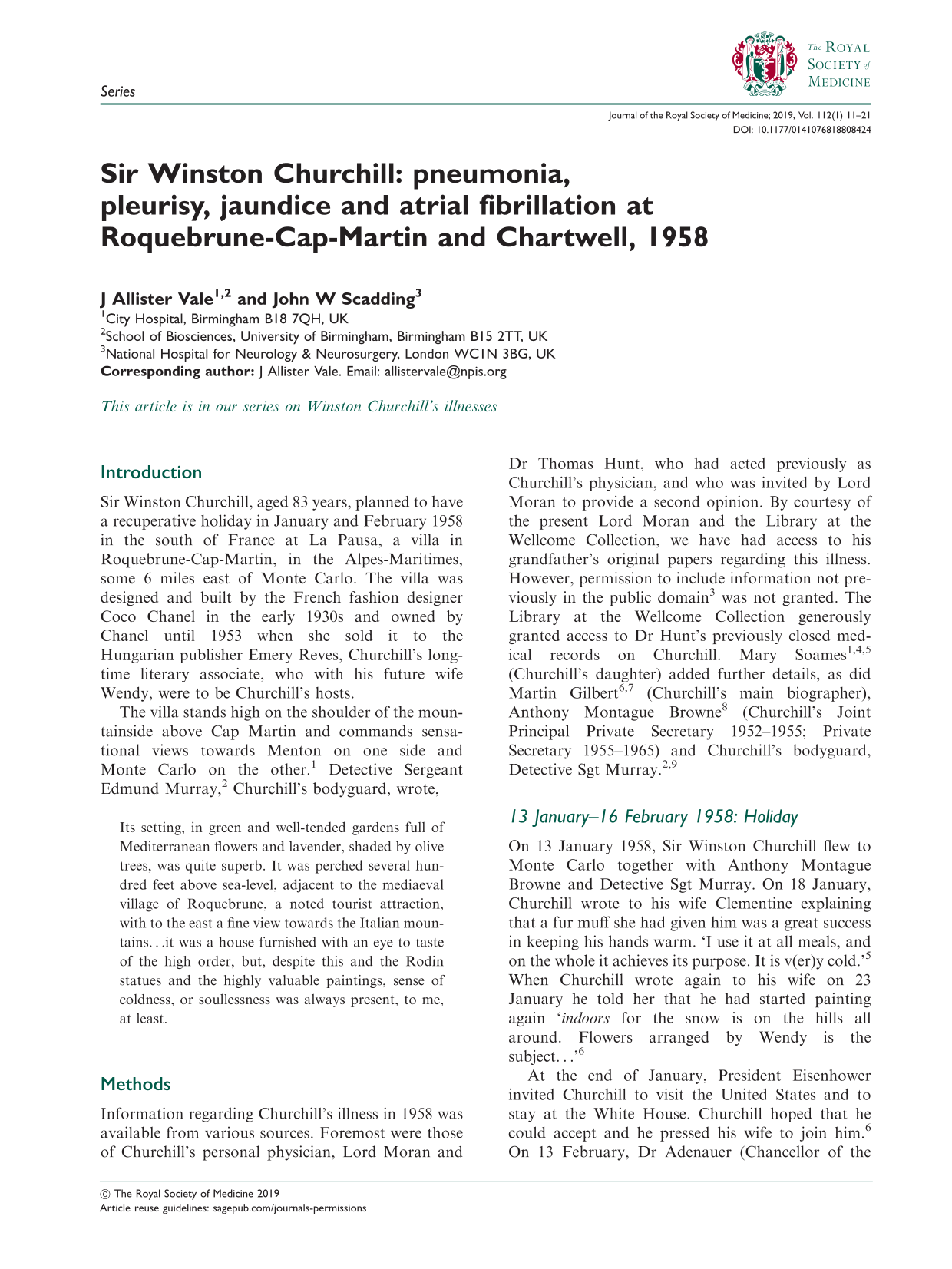
has claimed that the plane belonged to Olympic Airways, which was owned by Onassis (Figure 1). At Nice airport, Churchill met Lord Beaverbrook.
6
‘I saw Winston for fifteen minutes or more. He was certainly clear in mind and I do hope that by this time he is strong in body.’
6
Lady Churchill sent a telegram to Roberts, ‘Winston stood the journey very well and is in good spirits. Thank you so much for all you have done.’
41
Churchill began his convalescence at Chartwell on Maundy Thursday.
Sir Winston Churchill disembarking after flying back from Nice on 3 April 1958. Source: ©Alamy.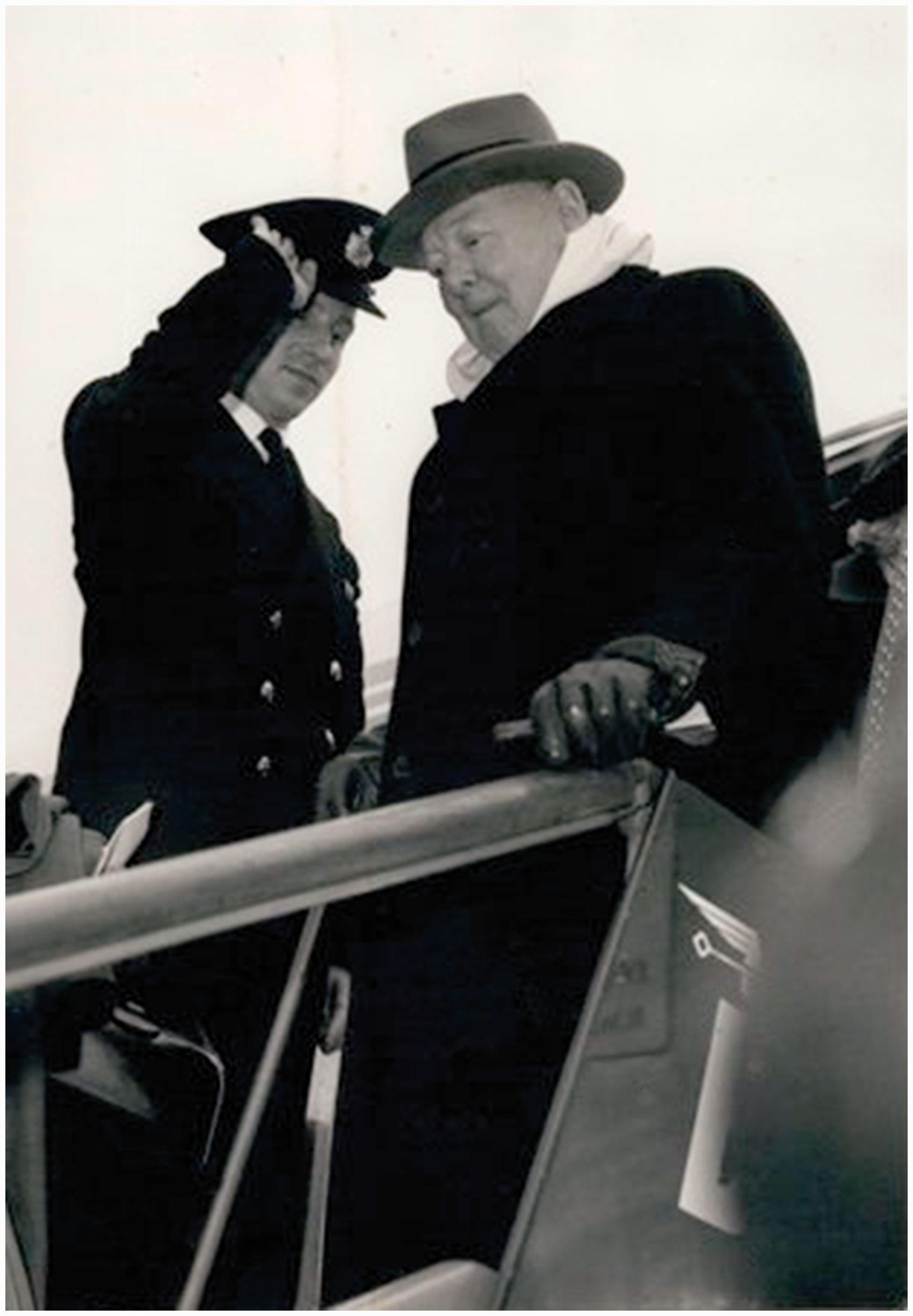
Roberts submitted his professional fees for 27 days attendance of Fr 55,000 (approximate equivalent in 2018, £7,400).
4–11 April 1958: Further assessments by Lord Moran: Jaundice and fever
Moran saw Churchill twice in the first week following his return from France. Moran wrote:3 On each occasion he poked fun at me as a prophet. I had urged him to get back to England in case he was stricken by a third attack of jaundice. ‘Pray, at what moment may I expect this mysterious malady to appear?’ He said this with an assumption of gravity, and I am bound to admit that he has not seemed so alert and free from symptoms for a long time. But when I went to his room this morning he looked glumly at me. He had a pain over his lower ribs on the right side.
On 10 April, Churchill informed President Eisenhower that he considered it inadvisable to undertake the journey at present. 42
Churchill had planned to watch an important gallop that had been arranged for one of his horses on 10 April. Moran told him that the wind was bitter and that judging by the course of events in his first two attacks:3 I thought he might well be running a temperature by teatime. I said this not as if I were opposed to his going, but just to bring before him a few relevant facts. Then I left him. About five o'clock [Nurse] Wright telephoned that Sir Winston's temperature was 100°F [37.8℃]. He had stayed in bed all day.
12–22 April 1958: Assessments by Lord Moran and Dr Hunt: Jaundice and atrial fibrillation
Nurse Shepherd telephoned Moran before breakfast on 12 April to inform him that Churchill was jaundiced and his pulse had gone up from 64 to 110/ min. Moran invited Dr Thomas Hunt (Senior Physician at St Mary's Hospital) to review Churchill. Moran
3
wrote: As I pulled aside the curtain that separates his room from the study, [Nurses] Wright and Shepherd were removing the bedclothes to get him into his vest and bed-coat. Winston sleeps naked, and I noticed that his chest and belly were bright yellow. Wright said Sir Winston had been talking rubbish; he was sure he was wandering. When I sounded him his heart was fibrillating. It looks as if we may be in for trouble.
That night Moran
3
dined with Lady Churchill but found it difficult to keep my mind on the conversation. When Clemmie left the table I crept into Winston's room in case he was asleep. He has held his own all day, and is perhaps a little more alert tonight.
When Moran saw Churchill on the same day he burst out, ‘I’ve got my temperature down below normal. What more do you want?’ Moran explained, ‘You are still yellow’. Churchill requested a mirror and gazed at himself for some time. Moran recorded, ‘He is still a little muddled, but there is a noticeable all-round improvement since yesterday. Only the jaundice persists.’
Hunt reassessed Churchill on 15 April. Churchill no longer had a fibrillating pulse (76/ min), but extrasystoles were present. Rales (crepitations) were present at the bases of the lungs on examination. He recommended that digoxin could be discontinued and that Churchill could have a bath and get up for a meal on 16 April. Churchill announced that evening (15 April) that he was planning to go to London and the House of Commons next Tuesday (22 April). Moran explained to him that ‘he might manage London on that day, but I didn't know about the House’. Churchill responded ‘with heat’: ‘I am going to the House. I am not going to be prevented.’ Moran held his peace. Then Churchill looked up and said, ‘I am sorry. My temper is not as good as it ought to be.’
On the morning of 16 April, Churchill was still complaining of pain: ‘I have still got the pain. It's no better.’ Moran3 recorded that, I am pretty sure that there must be a small stone holding up the bile. Anyway, at his age no one is keen on surgery. Besides, he is not so yellow, and is following the Budget debate as if it really interested him.
Hunt made a further assessment on 19 April. He recorded that Churchill had been out in the garden and had walked 100 yards. He had no pain or fever. His lungs were clear, his pulse was 72/ min and his blood pressure was 125/80 mmHg. His urine was positive for bilirubin.
23 April 1958: Churchill's return to the House of Commons
On 23 April, Churchill returned to the House of Commons, his first appearance in the Chamber since 20 December 1957. 43 ‘A sudden tumult of cheering burst on the chamber in the middle of question hour today’, The Times 43 reported, ‘It was the Commons’ spontaneous, affectionate welcome to Sir Winston Churchill. The acclaim bore him in swelling volume to his seat below the gangway and echoed afresh through the House when Mr Selwyn Lloyd, the Foreign Secretary, who had been about to reply to a question, expressed the delight of everybody at seeing their right honourable friend with them again. Sir Winston Churchill, a little paler and slimmer than when we last saw him, but as alert and twinkling as ever, beamed happily around him and bowed his acknowledgement of Mr Bevan's (Shadow Foreign Secretary) gesture of greeting. The house later staged a noisy scene almost as if for his special delectation, with Mr Bevan a leading figure’. 43
Churchill stayed up until 11 pm playing cards, Hunt recorded.
24–30 April 1958: Assessments by Lord Moran and Dr Hunt
Hunt and Moran assessed Churchill again on 24 April at noon. Hunt recorded that Churchill was well and was not jaundiced. He recommended to Churchill that X-rays should be postponed (see below), he should eat small meals, drink only moderate amounts of alcohol, avoid chills and fatigue. Churchill went out to dinner in London on 24 April (The Other Club) and on 29 April (Royal Academy).
On 28 April, Hunt wrote to Moran summarising the medical course since 12 April: As we discussed I feel sure that the three attacks of pain followed by fever and jaundice must with little doubt have been due to the passage of one or more small stones down the common bile duct. The very good response to increased fluid intake and antibiotics, means I think, that there is no biliary obstruction remaining now, and I hope that the stone or biliary sludge must have passed and not become impacted at the ampulla of Vater. I do not think we can tell for certain whether there are any stones still present in the gallbladder, or whether the recent attacks were possibly only due to bile inspissated in the hepatic ducts themselves. I think the former is the most likely, but I doubt if a straight x-ray would give us more than 25 per cent chance of deciding, as any calculi will probably be non radio-opaque. I admit I am nervous of advising intravenous biligrafin or even an oral cholecystogram with dye in case of possible reactions, and even if we found definite stones in the gall bladder I doubt if we should wish to consider surgery in the present case. As agreed I feel, therefore, that the best hope of preventing further attacks is to keep up a good fluid intake and avoid fatigue, chill and any excess of alcohol. If further attacks occur I think we shall have to rely, as before on antibiotics and extra fluids. Many thanks for your letter and for the notes. He is in very good form at present, and went to the [Royal] Academy dinner last night and is none the worse to-day. For the moment we could do no more than cross our fingers and await events.
Churchill's doctors
Lord Moran (1882–1977)
Charles Wilson (Figure 2) was appointed Dean of St Mary's Medical School in 1920, a post he held until 1945. He became Churchill's doctor on 24 May 1940 and remained his personal physician until Churchill's death in 1965.
44
He treated Churchill for chest pain in December 1941 in Washington,
45
for pneumonia in London in February 1943,
46
for pneumonia and atrial fibrillation in Carthage in December 1943,
47
and for pneumonia in London in August 1944.
46
Moran also treated Churchill in 1949 when he suffered his first stroke
48
and was primarily responsible for managing the further episodes of cerebrovascular disease in 1950–195249 and second stroke in 1953.50,51
Lord Moran. Source: ©Alamy.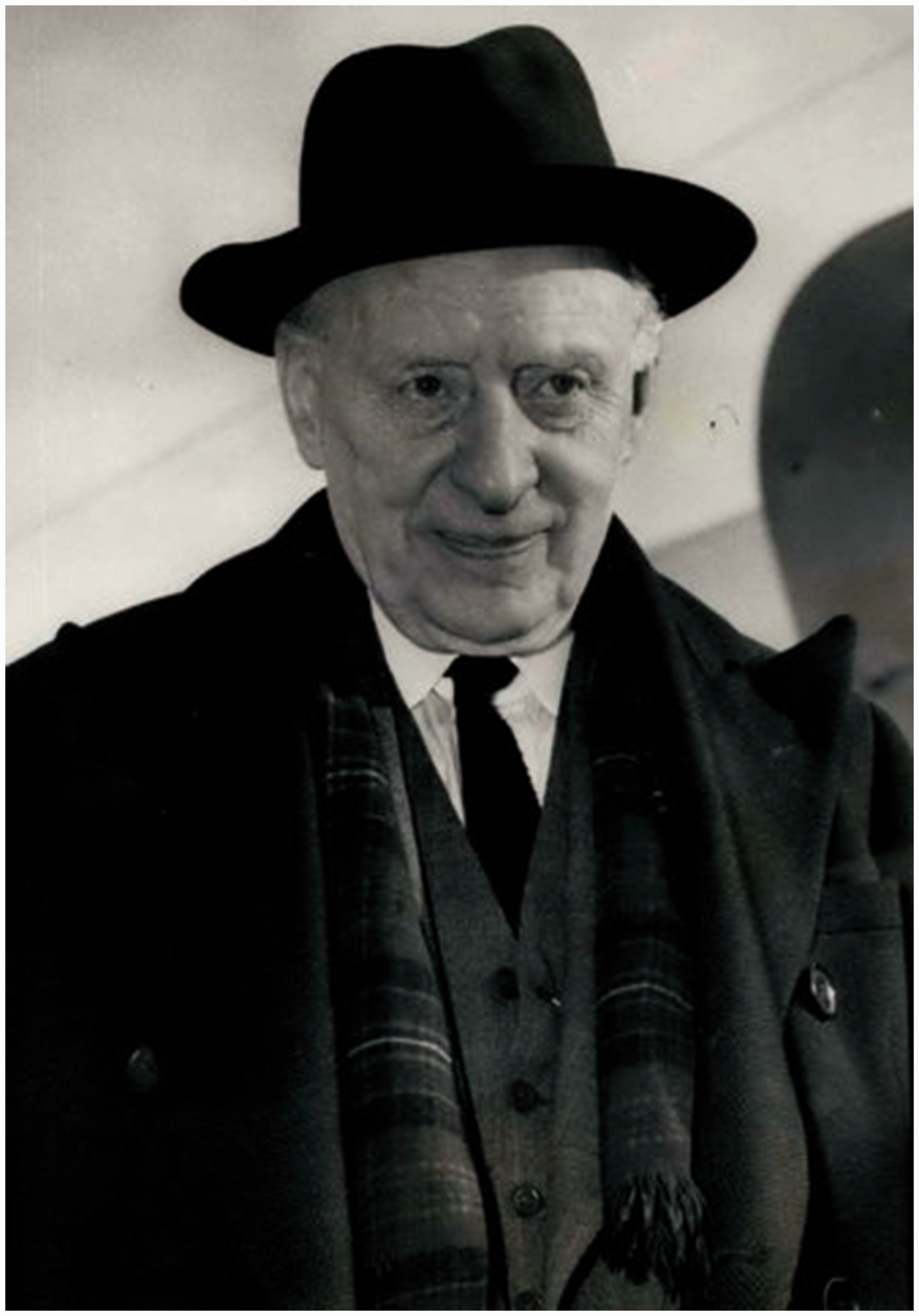
Wilson was knighted in 1938, created Baron Moran of Manton in the County of Wiltshire in 1943 and was appointed Treasurer (1938–1941) then President of the Royal College of Physicians of London (1941–1950). 44
Dr Thomas Hunt CBE (1901–1980)
Hunt (Figure 3) was educated at Magdalen College, Oxford and St Mary's Hospital Medical School, London.52–54 Hunt was appointed to the staff of St Mary's Hospital in 1930, ultimately becoming senior physician. In January 1940, Hunt joined the RAMC. As a brigadier, he was consultant in Algeria and Iraq, and with his headquarters in Baghdad, he visited most countries in the Middle East as well as India. He was appointed Senior Censor and Vice-President (1956), second Vice-President (1967) and Harveian Orator (1972) of the Royal College of Physicians. The subject of his oration was Digestive Disease: The Changing Scene.
55
He wrote the Munk's Roll entry for Moran.
44
He was awarded a CBE in 1964.
Dr Thomas C Hunt CBE.
Until 1940, Churchill often consulted Hunt about his indigestion; one day the future Prime Minister rang up asking for an appointment at 4.30 pm. Hunt was quite firm – he had another patient at that time. Churchill was nettled and chose an alternative physician. 54 Hunt was also involved in the decision, along with others, to decide whether or not Anthony Eden's health was robust enough for him to remain in office as the Prime Minister. The answer was a regretful but entirely firm ‘No’. 54
Dr Dafydd Myrddin Roberts (1906–1977)
Roberts qualified from Cardiff in 1933 and was commissioned on 7 February 1941 as Flying Officer, Medical Branch RAF Volunteer Reserve with home postings. Roberts was promoted to Flight Lieutenant before he relinquished his commission on 5 January 1943 because of ill health. 38 Gilbert 7 states that he had been invalided out of the Royal Air Force with a 90% disability pension. After practising in Dublin in the early 1950s, he moved to the Alpes Maritime, by 1953 living at Villa Sylvie, Cap Fleuri, Cap d'Ail, Monte Carlo. 38 Roberts used David rather than Dafydd professionally. Gilbert states that he practised medicine in Monte Carlo, with the permission of the French authorities on condition that he treated only British patients. 7
His first professional contact with Churchill was in 1956. Mary Soames quotes the letter of 3 March 1956 from her father to her mother: ‘Nursing a sore throat with aid of Dr Roberts who I think is a good man (I had him last time you will remember).’ The ‘last time’ refers to an earlier visit in January 1956, although there is no record of that attendance. Montague Browne 8 described Roberts as ‘conscientious and prompt’. Mary Soames 4 wrote: ‘Both WSC and CSC liked him very much; Lord Moran was contemptuous of him-and, I suspect, jealous.’ Montague Browne 8 wrote, ‘I don't think Lord Moran much liked anyone but himself so much as laying a thermometer on his August Patient, but he did not come out unless summoned and this was infrequent.’ Moran's opinion of general practitioners, as his biographer has shown, is that they were not at the same ‘level’ as consultants. 56
Roberts continued to practice in Monaco at Le Victoria and as Physician at Princess Grace Hospital until the 1970s when he returned to England. 38 He died on 28 July 1977 (six months after the death of Lord Moran) at the Queens Hospital Cirencester of bronchopneumonia, Parkinsonism and cerebrovascular disease. 38
Lady Churchill tried in vain to get Roberts some sort of official recognition, not so much for his attentions to her husband as for those to the British community. 8 Early in their relationship, Churchill expressed gratitude to Roberts by presenting him with First Editions of the History of the English Speaking Peoples: Volumes I and II at Christmas 1956; Volume III and Volume IV in March 1958.
Discussion
Churchill's recuperative holiday in France turned into a disaster! This was Churchill's fourth episode of pneumonia in his adult life, previous bouts having occurred in February 1943, 46 December 1943 47 and August 1944. 46 Churchill suffered a third episode of atrial fibrillation; two previous episodes occurred in Carthage in December 1943, 47 both in association with pneumonia.
This was, however, Churchill's first episode of obstructive jaundice, though he was to suffer a further attack in January/February 1960. Roberts was of the opinion that this was due to the antibiotic prescribed by Moran, whereas Moran believed correctly that this was due to a gall stone or infection of the bile passages. 3 Hunt was of a similar opinion to Moran and believed that the three attacks of pain followed by fever and jaundice were due to the passage of one or more small stones down the common bile duct.
An oral cholecystogram performed in 1936 by Dr H Courtney Gage (Radiologist to St Mary's Hospital, London) at the behest of Hunt had shown no gall stones and barium studies of Churchill's stomach and duodenum undertaken at the same time had revealed no ulcer. 57 Hunt was strongly of the view that neither a repeat oral cholecystogram or an intravenous cholangiogram, particularly the latter, should be performed because of the risk of an adverse event to the iodine-containing dye used for the procedure. Furthermore, the intravenous cholangiogram may not have been diagnostically helpful as Churchill was jaundiced. In addition, as surgery was not contemplated in the short term, investigation with an iodine-containing dye was not warranted at this time. These were sensible clinical decisions.
Penicillin and oxytetracycline are not known to cause obstructive jaundice and there is no evidence that erythromycin was prescribed, which can result in cholestatic hepatitis. 58 The only possibility is that erythromycin was prescribed by Roberts on 16 March 1958 but, if so, he did not mention this to Moran who investigated whether the other antibiotics could cause jaundice.
As a result of this illness, Churchill was absent from his usual seat in the House of Commons for some 13 weeks.