




Abstract
Objective
To report on the career intentions, three years after qualification, of 12 national cohorts of UK-trained doctors who qualified between 1974 and 2012, and, specifically, to compare recent UK medical graduates’ intentions to work in medicine in the UK with earlier graduates.
Design
Questionnaire surveys of cohorts of UK medical graduates defined by year of graduation.
Setting
UK.
Participants
30,272 UK medical graduates.
Main outcome measures
Stated level of intention to pursue a long-term career in medicine in the UK.
Results
The response rate was 62% (30,272/48,927). We examined responses to the question ‘Apart from temporary visits abroad, do you intend to practise medicine in the United Kingdom for the foreseeable future?' Of doctors from UK homes, 90% had specified that they would ‘definitely or probably’ practise medicine in the UK in the surveys of 1977–1986, 81% in 1996–2011 and 64% in 2015. Those who said that they would probably or definitely not practise medicine in the UK comprised 5% in 1977–1986, 8% in 1996–2011 and 15% in 2015. Most who were not definite about a future career in UK medicine indicated that they would wish to practise medicine outside the UK rather than to leave medicine.
Conclusions
The wish to remain in UK medical practice in the 2015 survey was unprecedentedly low in this unique series of 40 years of surveys.
Introduction
All healthcare systems are critically dependent on an adequate supply of doctors. High-income countries should aim to be self-sufficient in training enough doctors for their own needs. However, countries like the United States, Canada, Australia and the UK are not: in the early 2000s, about 25% of practising physicians in these countries received their basic medical training in other countries, many of them in resource-poor countries. 1 Training doctors is expensive: it is important to understand and quantify attrition from the health service in the country of training, in order to maximise value for the investment. For these reasons, a key to medical workforce planning in each country is knowledge about the future career plans and work trajectories of their medical graduates. This includes knowing about the extent of young doctors’ intentions to continue practising medicine in their own country. Furthermore, knowledge of trends in young doctors’ intentions about future practice may indicate emerging problems of commitment to and retention in their own country.
About three years after graduation in the UK, most doctors are expected to enter into specialist training in general practice or in specialties in hospital practice. Surveys of doctors’ intentions at that time can help in anticipating any trends in future intentions to continue working in the National Health Service. Our research group, the UK Medical Careers Research Group, has undertaken UK-wide multi-purpose surveys of doctors in various year-of-qualification cohorts over many years. In this paper, we report on the answers given, three years after qualification, by several successive cohorts, to the question: ‘Apart from temporary visits abroad, do you intend to practise medicine in the United Kingdom for the foreseeable future?’ Our aim in this paper is to report on whether levels of intention to work in medicine in the UK have changed in recent cohorts of UK medical graduates.
Methods
Data used for this analysis
We surveyed UK medical graduates from all UK medical schools in 1977, 1980, 1983, 1986, 1996, 1999, 2002, 2003, 2005, 2008, 2011 and 2015. The target population for each survey was all the doctors who had graduated three years previously. We used postal questionnaires until 2008 and identical web-based and postal surveys since then (giving doctors the choice of whether they preferred web or paper). Up to four reminders were sent to non-respondents. Further details of the methodology are available elsewhere.2,3 Doctors’ contact details have been provided by the General Medical Council, for all registered doctors willing to take part in research.
All survey questionnaires used included a range of open and closed questions on doctors’ career intentions, career progression, and views and attitudes. Among the questions in each survey about career intentions, aimed to aid workforce planning, we asked about choice of future specialty, future intentions about full and part time working, and we also asked Apart from temporary visits abroad, do you intend to practise medicine in the United Kingdom for the foreseeable future? The qualifying phrase about temporary visits abroad was included in recognition that it is quite common for doctors at this stage in their career to seek experience overseas. The response options, supplied by us, were: Yes-definitely, Yes-probably, Undecided, No-probably not and No-definitely not.
Responses were analysed according to cohort of qualification and year of survey.
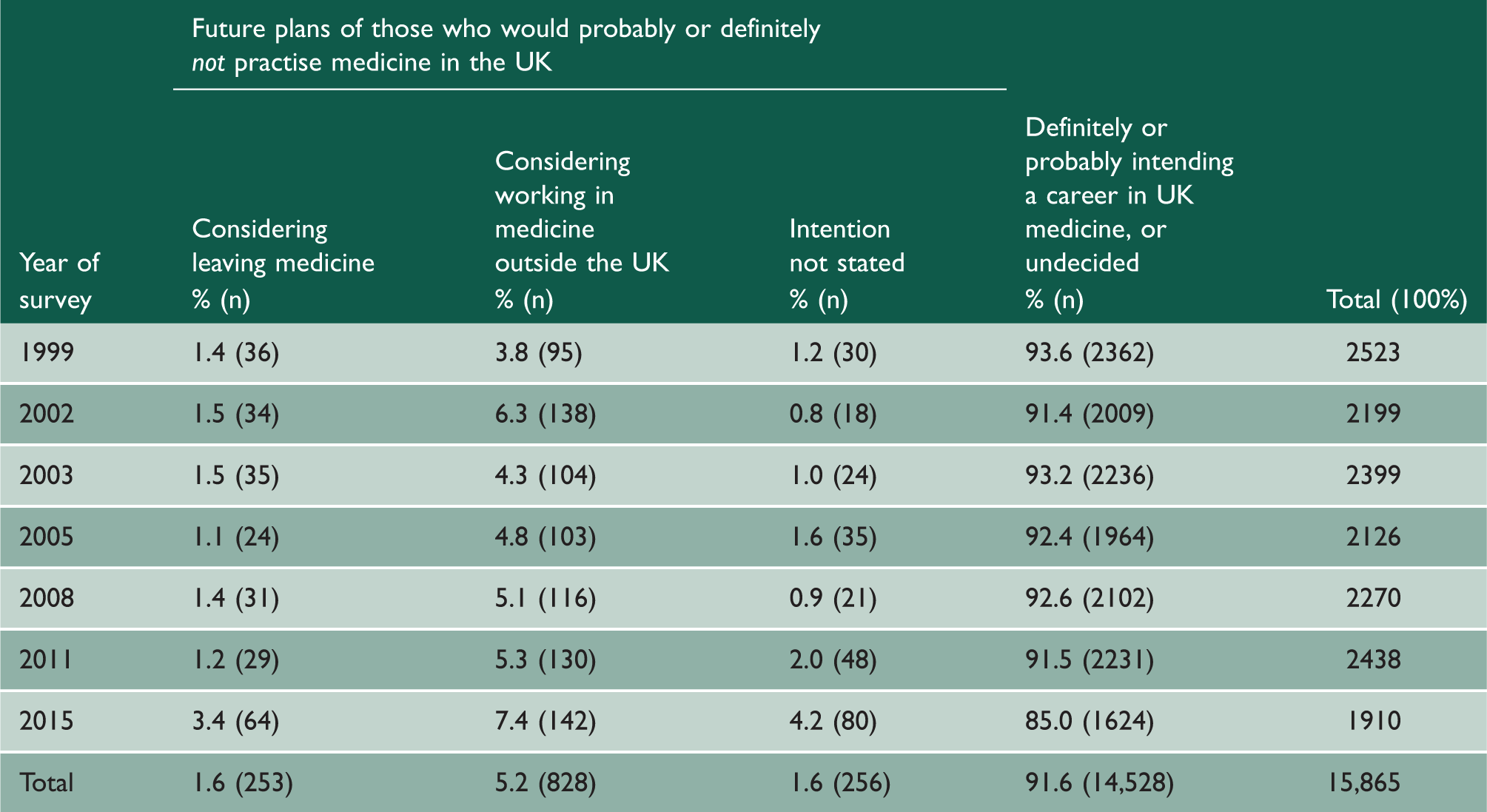
In surveys from 1999, doctors whose intention to work in UK medicine was not definite were asked three supplementary questions about their future plans: Are you considering practising medicine abroad? Are you considering leaving medicine but remaining in the UK? and Are you considering leaving medicine and leaving the UK?
Data analysis
We compared responses given by subgroups of doctors using chi-square tests and rank-based non-parametric methods as appropriate.
Results
Response
All cohorts totalled 50,505 doctors. For various reasons, some doctors were not contactable by us including those having died before the survey, having gone abroad without a forwarding address, or whose contact details are embargoed to researchers by the General Medical Council at the doctor’s request. Of a total of 48,927 contactable doctors, 62.4% (30,508) replied to the survey three years after graduation. Numbers were further reduced to 30,272 respondents who replied to the specific question about their intentions to practise in the UK and it is these data which have been used in the following analysis (see Appendix 1 in the online supplementary material). Response rates have continually declined from the early surveys to the latest.
Intentions to practise in the UK
Intentions of UK-based a UK-trained doctors, three years after graduation, to practise medicine in the UK.
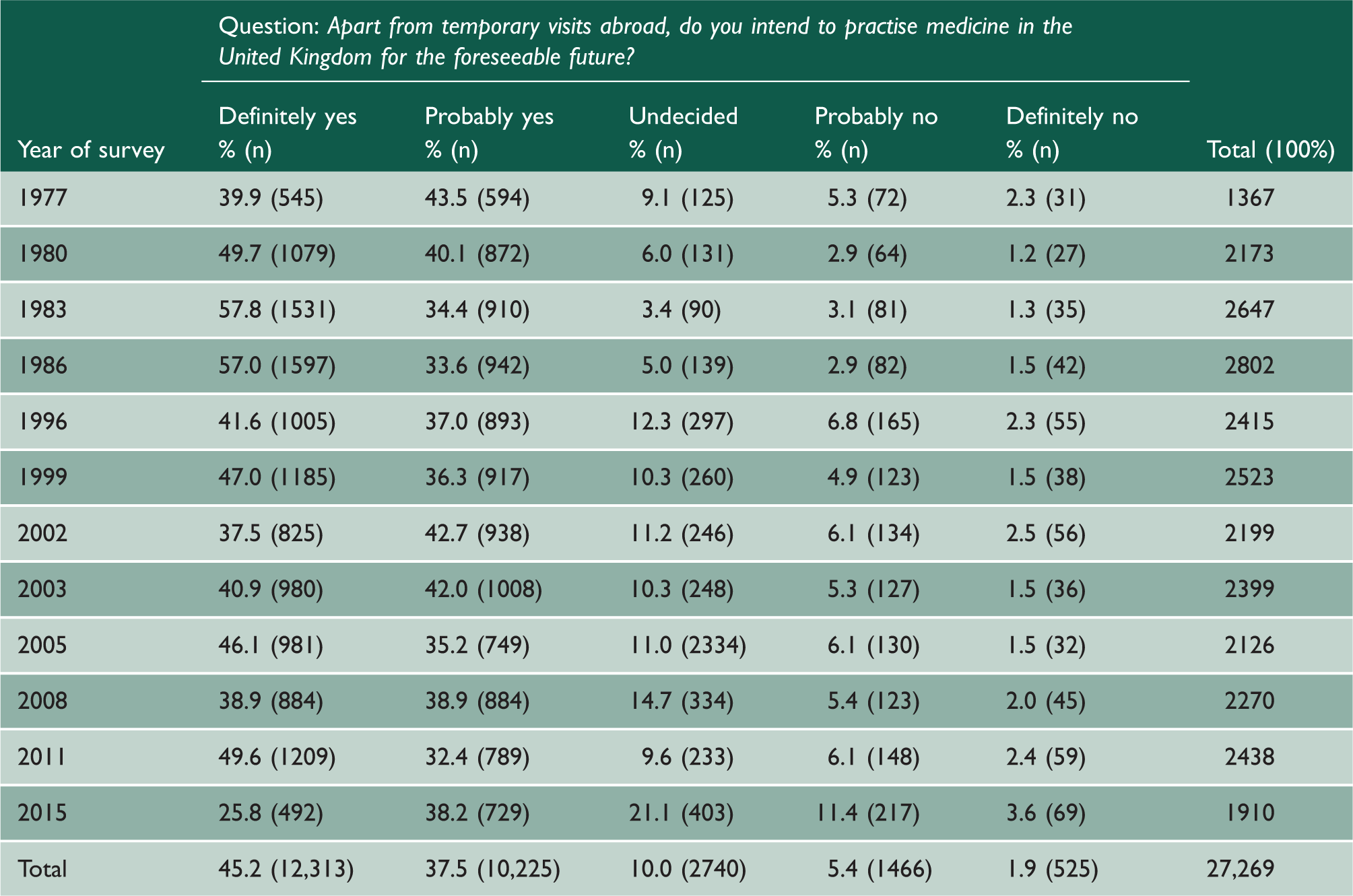
‘UK-based’ means doctors whose family home before entering medical school was in the UK.
Differences by cohort: doctors from UK homes
Doctors surveyed in the 1980s showed the highest level of intention to practise in the UK (in the range of 49.7–57.8% definitely intending to stay). Intentions to do so in surveys conducted from the 1990s through to 2011 were stable but somewhat lower (range: 37.5–49.6%, Table 1). The most recent survey, undertaken in 2015, of the graduates of 2012, showed a substantial fall, with only 25.8% (95% confidence interval: 23.9–27.8%) definitely intending to practise in the UK, compared with 49.6% (47.6–51.6%) of the 2008 graduates in 2011. The corresponding figures for those definitely or probably intending to stay in UK medicine were 63.9% (61.7–66.0%) of the 2015 survey compared with 82.0% (80.4–83.5%) of the 2011 survey. Those definitely or probably not intending to stay rose from 8.5% in 2011 (7.5–9.7%) to 15.0% in 2015 (13.5–16.7%).
Possible future plans – supplementary questions (see ‘Method’ section)
UK-trained UK-based a doctors who did not ‘definitely’ intend to practise medicine in the UK for the foreseeable future: their possible future plans showing numbers and percentages of all doctors in each cohort.
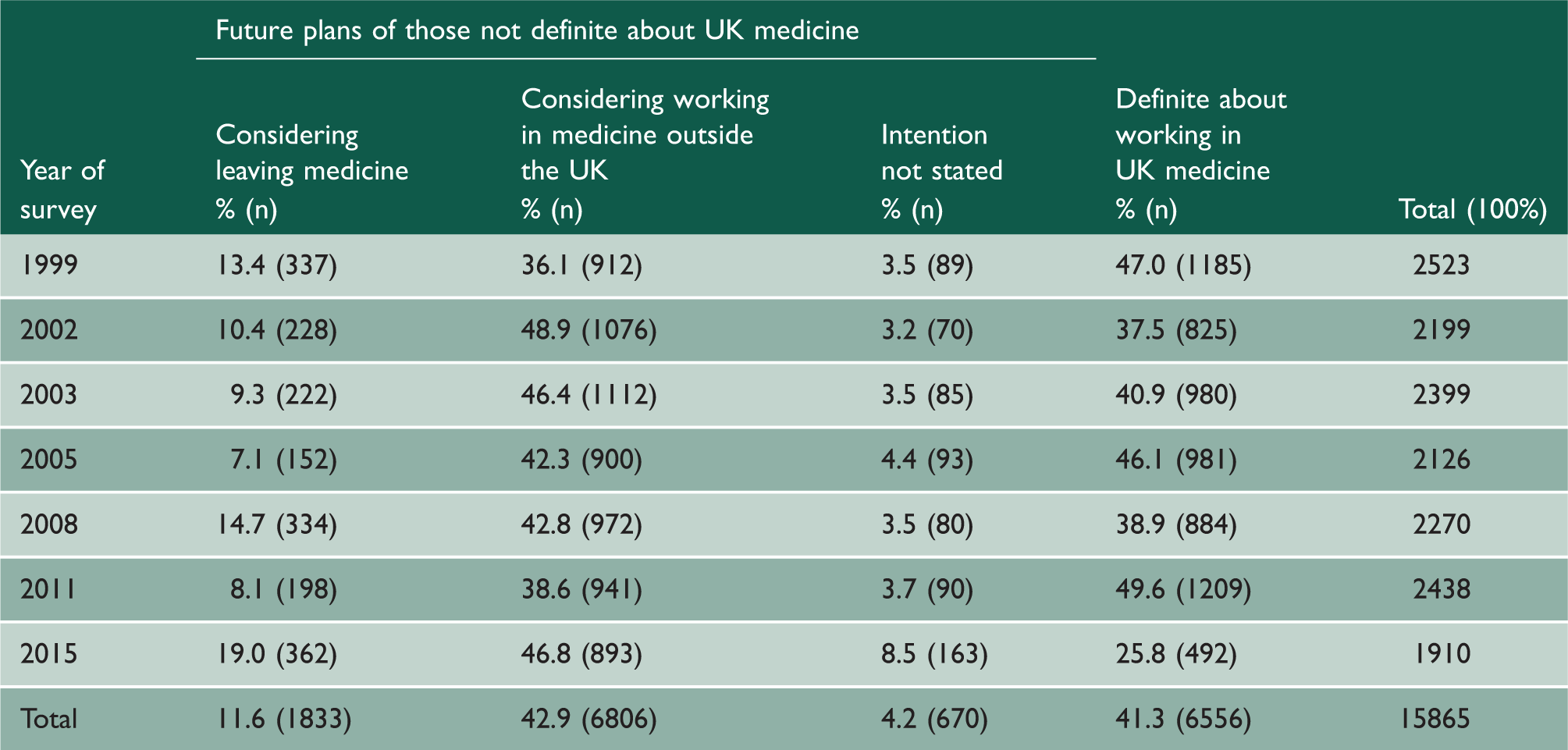
‘UK-based’ means doctors whose family home before entering medical school was in the UK.
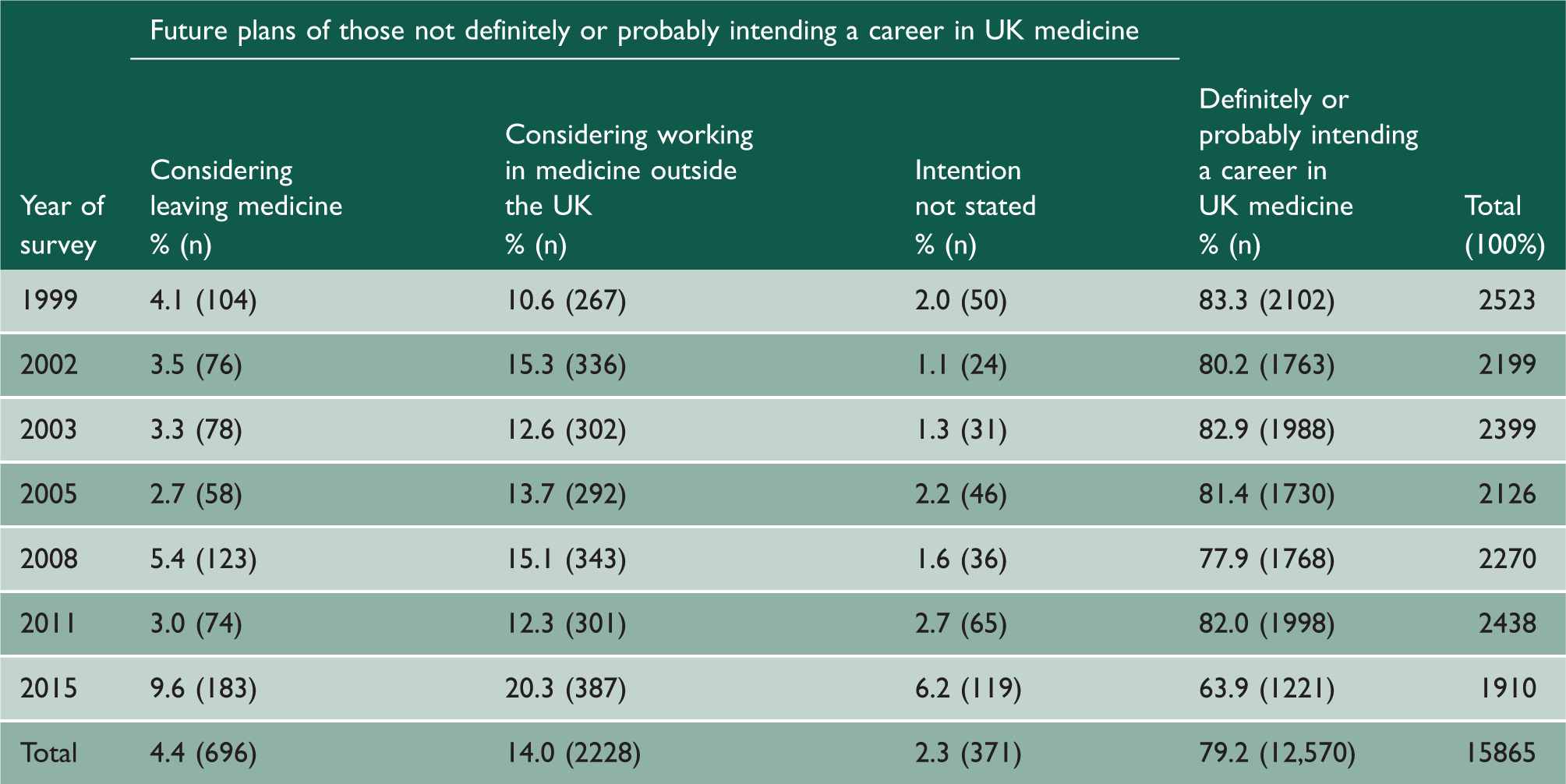
UK-trained UK-based doctors who were uncertain, or would probably or definitely not practise medicine in the UK for the foreseeable future: their possible future plans showing numbers and percentages of all doctors in each cohort.
UK-trained UK-based doctors who would definitely not practise medicine in the UK for the foreseeable future: their possible future plans showing numbers and percentages of all doctors in each cohort.
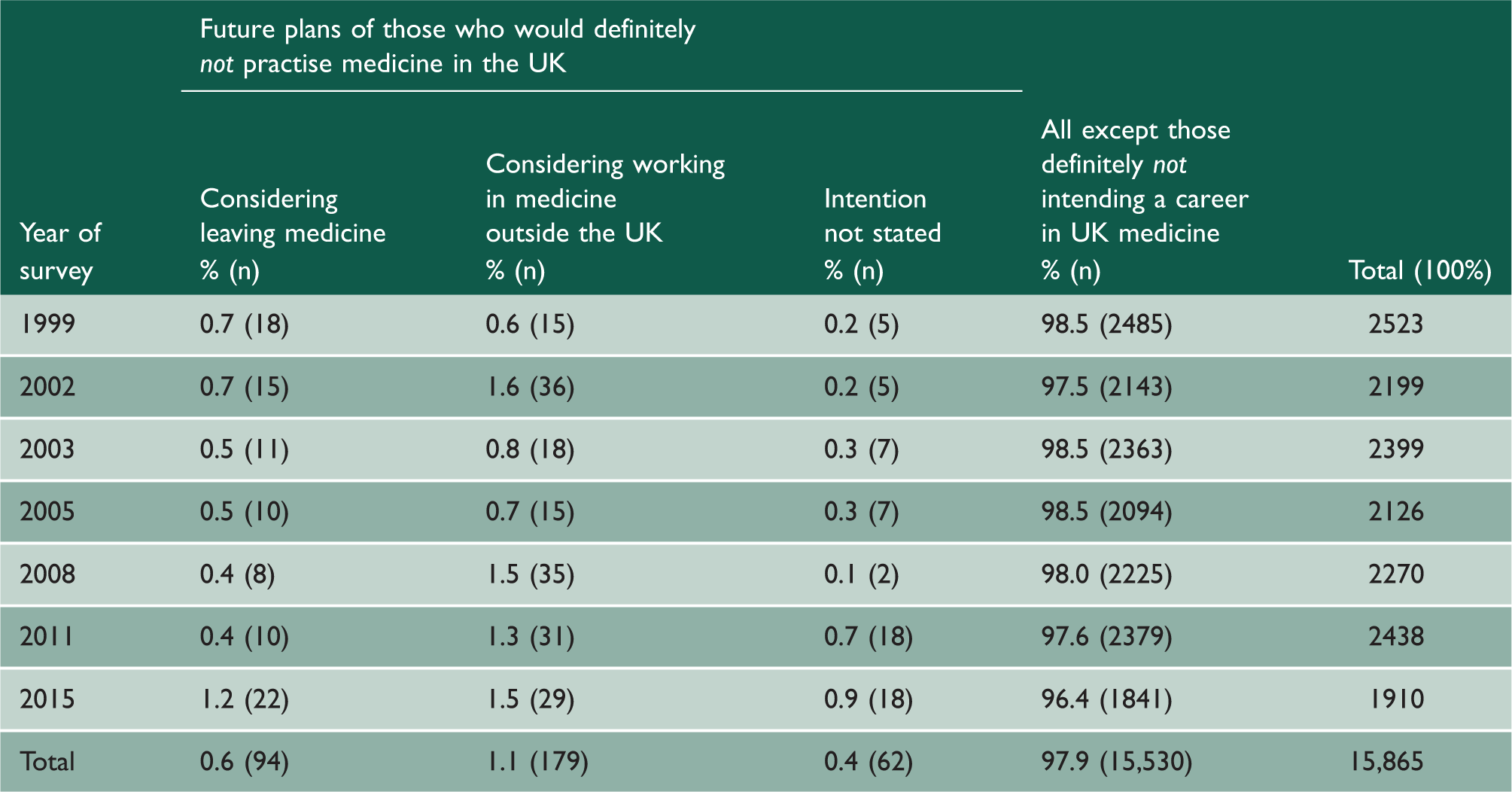
UK-trained UK-based doctors who would probably or definitely not practise medicine in the UK for the foreseeable future: their possible future plans showing numbers and percentages of all doctors in each cohort.
Intentions to work in the UK and choice of specialty: comparison of general practice with hospital specialties
The percentage of those who chose general practice stating they would definitely work in the UK was larger than the percentage who chose a hospital specialty, in each survey year group (see footnote to Appendix 3 in the online supplementary material for statistical results). When definitely and probably responses were combined, the percentage differences remained but were less marked. Comparison of the percentages who replied probably not or definitely not showed less evidence of a difference by specialty choice, particularly in the 2015 survey.
There was substantial variation between the hospital specialties (Appendix 4 in the online supplementary material), although small numbers in some cells meant it was not possible to undertake meaningful statistical testing. Those choosing a career in emergency medicine had the lowest proportion (30.8%), over all survey years, of any specialty definitely intending to stay in the UK to practise (excluding specialties with fewer than 300 respondents).
Variation of intentions by gender, country of UK family home and graduate entry status (UK residents only)
Differences in all three criteria were small (Appendix 5 in the online supplementary material). For gender, 44.1% of men and 46.1% of women were definite that they would work in UK medicine (
Discussion
Main findings
Commitment among UK-trained doctors, surveyed three years after graduation, to practising medicine in the UK long-term has declined over time and, most strikingly, fell in 2015 to a low level that is unprecedented in 40 years of our surveys. Of those who were not certain about practising medicine in the UK for the foreseeable future, a majority specified that they would stay in medicine but seek work outside the UK. Only a minority specified that they might leave medicine; but, as with the overall findings, the intentions of the doctors surveyed in 2015 gave results that are unprecedented in scale. Doctors who chose to specialise in general practice had a greater level of commitment to practising in the UK than doctors who chose other specialties. There was variation across the hospital specialties, with those choosing emergency medicine having particularly low levels of intention to stay in the UK. Unsurprisingly, doctors whose residence before medical school was outside the UK were less committed to practising medicine in the UK in the long term than were doctors from UK homes.
Compared to differences in intention by year of graduation, by intended specialty, and by place of residence, differences by gender, by UK country of origin and by graduate entry versus undergraduate entry were small.
Comparison with other studies
Our studies are, we believe, unique in tracking the intentions of UK medical graduates over a very long period. There is little else published with which to compare our findings on long-term trends except as single snapshots in time. Others have found, like us, that a smaller percentage of UK doctors who chose emergency medicine than others were definitely planning to remain in the UK to practise in the long term.4,5
Our study reports long-term intentions to pursue a career in UK medicine. Some young doctors take a short break in their postgraduate training, either to work in medicine outside the UK, or to step off the training ladder temporarily for another reason. Others may be unsure of their specialty choice and not ready to commit to a specific training programme. These considerations are not incompatible with a long-term intention to work in UK medicine. However, it is worthy of note that the UK Foundation Office, which annually conducts a census of the career destinations of UK graduates two years after they graduate, has reported successive falls in the percentage moving straight into specialist training in the UK for the last five years, from 72% in 2011 to 50% in 2016. 6 This perhaps reflects a declining level of certainty about a UK medical career evidenced in our data reported here.
We found that marginally more women doctors than men were expecting to stay and work in the UK for the long term. A survey carried out by the British Medical Association also found that greater proportions of women than men indicated their wish to work in the UK but their survey showed a greater differential between the genders. 7 Over the period of our study, the gender balance in UK medicine has changed greatly: the General Medical Council reported recently that whereas 75% of doctors aged 50 years and over were male, only 45% of medical students were male. 8 The higher the percentage of doctors who are women, the higher the percentage of doctors who are likely to stay in UK medicine. The gender shift alone is unlikely to be enough, however, to counteract the increasing proportion of doctors desiring to work abroad permanently once trained.
Interpretation and implications
It would be surprising if medical practitioners were not influenced by societal changes in recent years, which have included an increasing tendency for workers of all kinds to pursue careers outside their own country of origin. However, the marked increase in 2015 of doctors thinking of pursuing their careers elsewhere, or even giving up a medical career completely, is a concern. It seems likely that the increase is due, at least in part, to UK doctors’ increasing concerns, now well documented, about whether they feel valued in the UK, whether the National Health Service will continue to be a good working environment for doctors and about the new junior doctors’ contract.9–12 In the course of our survey, we also obtained ‘free text’ comments from many of the doctors on why they may not continue in UK medicine, if they signified that they might leave. The analysis of these comments is beyond the scope of this paper, and we report elsewhere on insights obtained.13 We do not know when decisions to leave UK medical practice were made, for example whether before starting training or whether during training. Further research could include the use of focus groups to explore junior doctors’ reasons for not wishing to remain in UK medical practice and when that decision was made.
We make our primary purpose, that of collecting good data on various aspects of doctors’ future intentions in order to reliably inform workforce planning, very clear when communicating with doctors. It is possible that, in 2015, some doctors responding to us used our survey as a ‘poll’ to express their ‘political’ views about current policy. However, at least for the majority, we doubt this.
An important issue is whether early intentions in respect of our questions about ‘the foreseeable future’ have predictive value. We know that there is a strong association between doctors’ specialty choice expressed in year three after qualification and their eventual destinations. 14 We have also previously published on the question about practising medicine in the UK ‘for the foreseeable future’. 14 We reported on doctors who qualified in the 1970s and 1980s. Of those who as juniors wrote to us that they probably or definitely intended to practise medicine in the UK for the foreseeable future, 91% eventually did so. Of those who were undecided, 78% eventually practised in the UK. Of those who, as juniors, wrote that they were probably or definitely not going to practise in the UK, 63% eventually practised in the UK. Thus, although it is common for doctors who tell us they may not practise in the UK to change their minds, it is also the case that early intentions do have predictive value. 15
In the current study and in previous studies, the majority of those who are not definitely intending to practise medicine in the UK intend to stay in medicine but elsewhere. 16 It is very uncommon for doctors to leave medicine altogether, at least in the early years after qualifying. 17 If a large percentage of the doctors in the 2015 survey do, in fact, leave medicine, this would be unprecedented in our experience.
If increasing numbers of junior doctors do leave the UK, the UK will have to recruit increasing numbers of doctors from abroad. 18 Foreign-trained staff may need extensive further training, may need to improve their English and, ultimately, may be inclined to leave again. 7 The UK Government announced in October 2016 that there would be increased funding for an additional 1500 training places at medical schools. 19 Students taking up these places would not commence their studies until the 2018–2019 academic year and hence would not become clinical service providers until 2023–2024 at the earliest.
Strengths and limitations
Our surveys are large and with a generally good response. Non-responder bias, however, is a possibility. Stated intentions do not necessarily turn into reality: however, we know from our own work, as stated above, and that of others that there is association between stated intention and subsequent action.15,20
Conclusions and implications
Commitment among UK medical graduates to practising medicine in the UK long-term has declined over recent surveys. Our 2015 results indicate the lowest level of commitment to UK medicine, and perhaps the highest level of dissatisfaction with the prospect of a career in medicine in the UK, in 40 years of our surveys. It is too soon to tell whether this decrease is a temporary response to recent developments in the UK and in the National Health Service, including concerns about junior doctors’ contractual and working arrangements and resourcing of services; or whether it presages a longer-term tendency to leave the UK after graduation in greater numbers; or indeed whether stated intentions will or will not become reality.
Footnotes
Declarations
References
Supplementary Material
Please find the following supplemental material available below.
For Open Access articles published under a Creative Commons License, all supplemental material carries the same license as the article it is associated with.
For non-Open Access articles published, all supplemental material carries a non-exclusive license, and permission requests for re-use of supplemental material or any part of supplemental material shall be sent directly to the copyright owner as specified in the copyright notice associated with the article.
