




Abstract
Objectives
To seek doctors’ views about the NHS as an employer, our surveys about doctors’ career intentions and progression, undertaken between 1999 and 2013, also asked whether the NHS was, in their view, a good ‘equal opportunities’ employer for women doctors, doctors from ethnic minority groups and doctors with disabilities.
Design and Setting
Surveys undertaken in the UK by mail and Internet.
Participants
UK medical graduates in selected graduation years between 1993 and 2012.
Main outcome measures
Respondents were asked to rate their level of agreement with three statements starting ‘The NHS is a good equal opportunities employer for…’ and ending ‘women doctors’, ‘doctors from ethnic minorities’ and ‘doctors with disabilities’.
Results
Of first-year doctors surveyed in 2013, 3.6% (78/2158) disagreed that the NHS is a good equal opportunities employer for women doctors (1.7% of the men and 4.7% of the women); 2.2% (44/1968) disagreed for doctors from ethnic minorities (0.9% of white doctors and 5.8% of non-white doctors) and 12.6% (175/1387) disagreed for doctors with disabilities. Favourable perceptions of the NHS in these respects improved substantially between 1999 and 2013; among first-year doctors of 2000–2003, combined, the corresponding percentages of disagreement were 23.5% for women doctors, 23.1% for doctors from ethnic minorities and 50.6% for doctors with disabilities.
Conclusions
Positive views about the NHS as an equal opportunities employer have increased in recent years, but the remaining gap in perception of this between women and men, and between ethnic minority and white doctors, is a concern.
Introduction
Between 1999 and 2013, as part of a series of UK-wide multi-purpose cohort studies of doctors’ careers, the UK Medical Careers Research Group (UKMCRG) sought information on doctors’ views about the NHS as an ‘equal opportunities’ employer. The NHS defines equality of opportunity to include the right to ‘a working environment (including practices on recruitment and promotion) free from unlawful discrimination on the basis of gender, race, disability, age, sexual orientation, religion, belief, gender reassignment, pregnancy and maternity or marital or civil partnership status.’ 1 All staff working within the NHS have extensive legal rights to a safe, healthy working environment where they can expect to be treated fairly and equally and without harassment or discrimination. Additionally, the NHS pledges to promote working conditions that go beyond the basic legal requirements. 2
The UKMCRG surveys included a request for doctors’ views about gender, ethnicity and disability in surveys undertaken between 1999 and 2005 and in 2013.
Our aim is to report on views between 1999 and 2005, and views in 2013, to establish whether the NHS, in the view of its junior doctors, has improved as an employer in respect of equal opportunities.
Methods
The surveys
The UKMCRG undertakes surveys of cohorts of doctors one, three and five years after qualification and at varying intervals thereafter. We use self-completed postal and web-based questionnaires. Non-respondents are sent several reminders. Our survey methods have been fully described.3,4 The questionnaires cover many issues relating to careers including specialty choice and certainty of choice, factors affecting career choice, posts undertaken and a range of attitudinal issues. To cover a wide range of topics without overloading the questionnaires, we tend to rotate the topics covered in different surveys. Questions about equal opportunities, described here, were one component in some of the surveys.
Data used for this analysis
Data for this paper were collected from doctors who qualified in 1993, 1996, 1999, 2000, 2002 and 2012. We were interested in changes in views on equality issues over time. Accordingly, the results are shown by the year in which the survey was conducted, rather than the year of doctors’ qualification. For some survey years, data came from one cohort and in other years there were two cohorts, depending on the pattern of surveys per year. Surveys were carried out in 1999, 2000, 2001, 2002, 2003, 2004, 2005 and 2013. Responses from doctors not in the NHS were disregarded for these analyses.
Questions asked
We report doctors’ responses to three statements: The NHS is a good equal opportunities employer for women doctors; The NHS is a good equal opportunities employer for doctors from ethnic minorities; and The NHS is a good equal opportunities employer for doctors with disabilities. Responses were chosen from strongly agree, agree, neither agree nor disagree, disagree and strongly disagree; and the option no opinion was also offered.
Data analysis
We investigated variation in agreement or disagreement with the statements by year when surveyed, doctors’ grade, gender and self-described ethnicity (grouped by us for this analysis into white and non-white, to avoid analyses based on small numbers). Responses were compared using chi-square tests for two-sample comparisons and the Jonckheere-Terpstra test for ordering in the median agreement scores across the years covered by the surveys.
Results
Response
Doctors contacted and responding to statements about the NHS as an equal opportunities employer, 1999–2013.
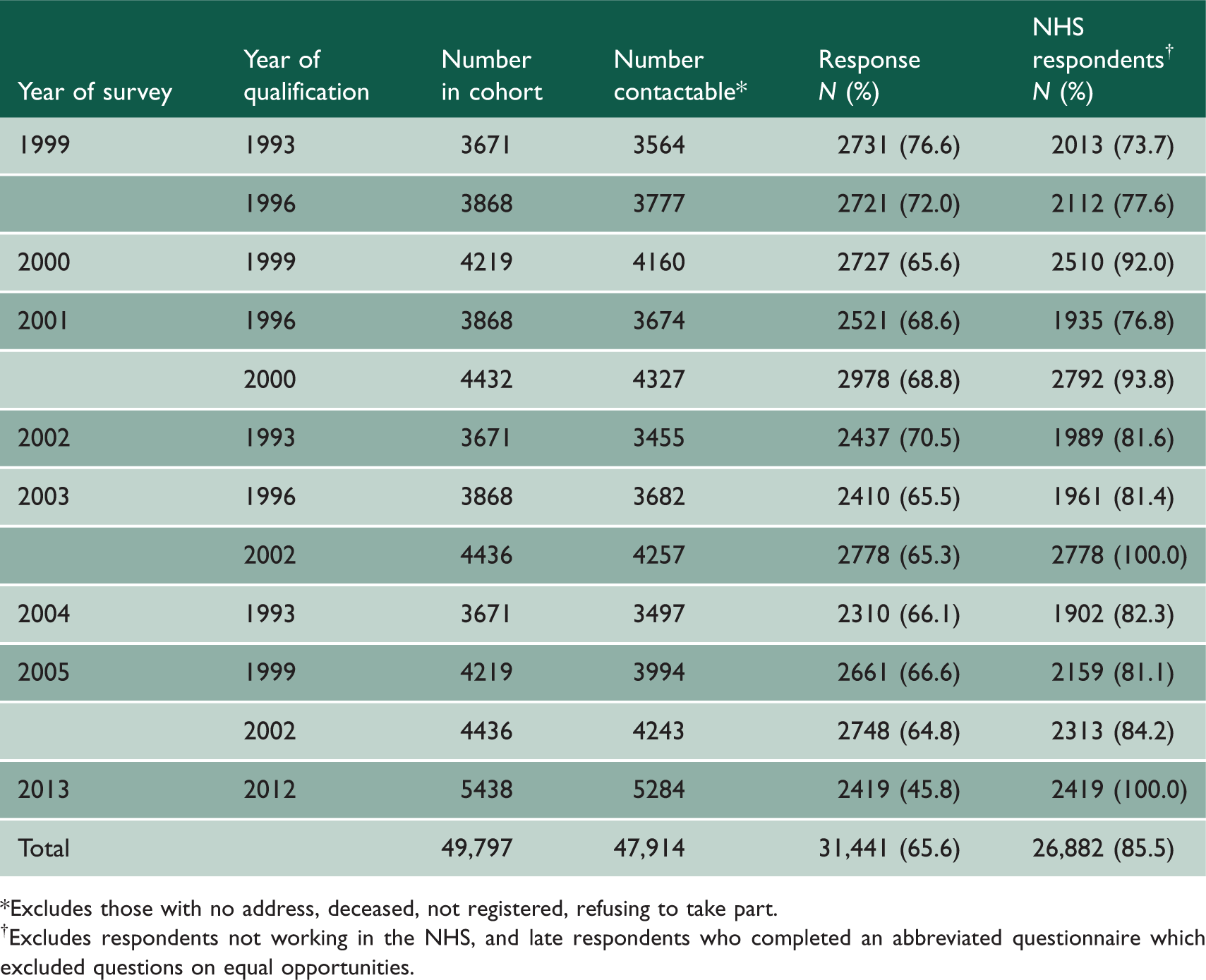
Excludes those with no address, deceased, not registered, refusing to take part.
Excludes respondents not working in the NHS, and late respondents who completed an abbreviated questionnaire which excluded questions on equal opportunities.
Trends over time
The 11 surveys to 2005 had 24,463 responses. For each statement, some respondents chose ‘no opinion’ or left the statement blank. These represented 17% (4079) of respondents for the statement about women doctors, 21% (5058) for the statement about ethnic minority doctors and 31% (7531) for the statement about doctors with disabilities. We report percentages of agreement and disagreement with the statements excluding the doctors who did not express an opinion. For ease of description in the following paragraphs, we report agreement with the statements by combining ‘strongly agree' and ‘agree' responses and disagreement by combining ‘disagree' and ‘strongly disagree' responses.
We examined the responses of doctors in their first postgraduate year separately from the responses of more senior doctors, because we reasoned that the former would be reporting their impressions of the NHS as students and as first-year doctors and the latter would be basing their opinions on more information gathered over a number of years of working experience.
The NHS is a good equal opportunities employer for women doctors
Percentage agreement with three statements about equal opportunities: doctors in their first postgraduate year surveyed between 2000 and 2013.
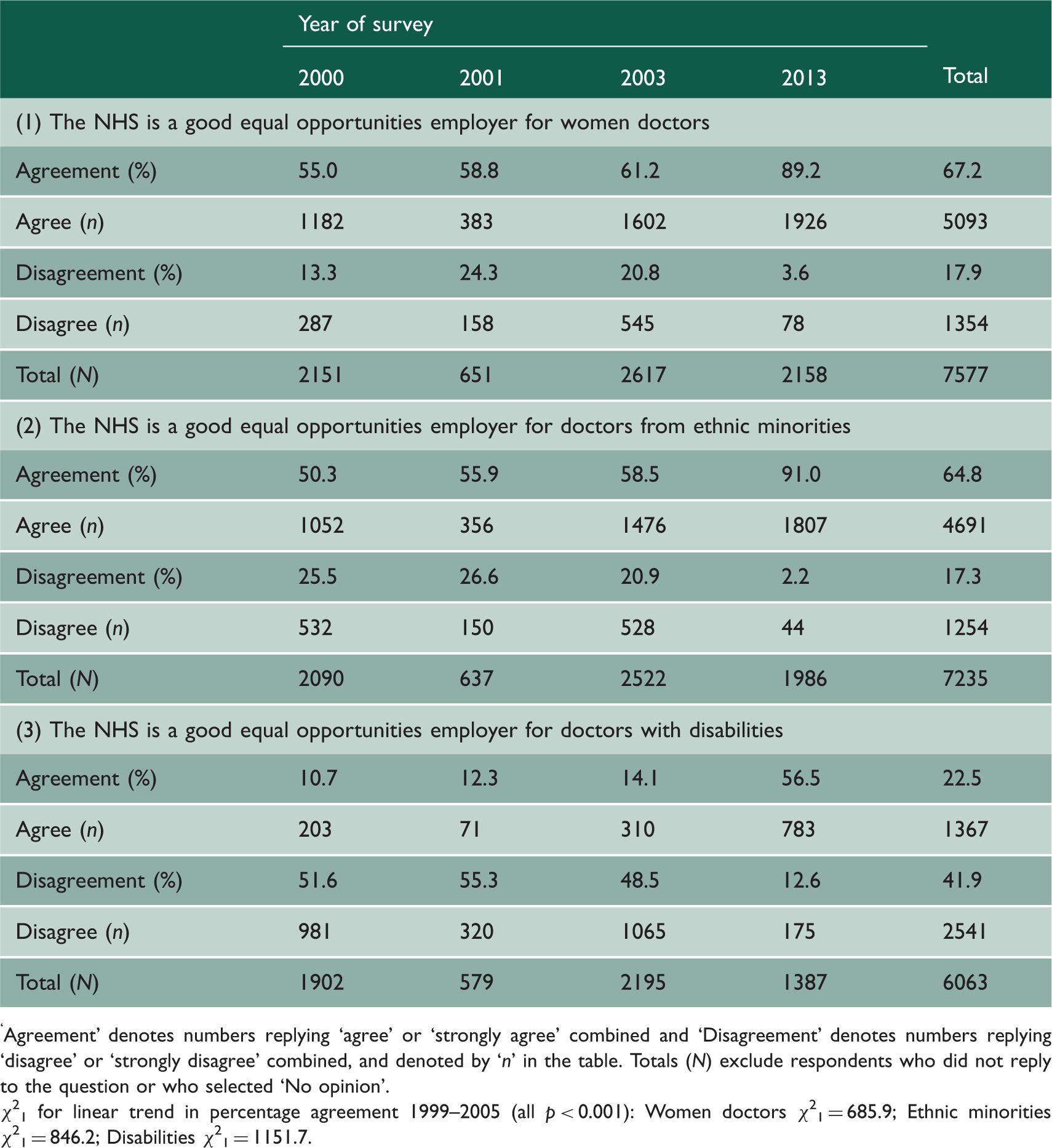
Agreement’ denotes numbers replying ‘agree’ or ‘strongly agree’ combined and ‘Disagreement’ denotes numbers replying ‘disagree’ or ‘strongly disagree’ combined, and denoted by ‘n’ in the table. Totals (N) exclude respondents who did not reply to the question or who selected ‘No opinion’.
χ21 for linear trend in percentage agreement 1999–2005 (all p < 0.001): Women doctors χ21 = 685.9; Ethnic minorities χ21 = 846.2; Disabilities χ21 = 1151.7.
The NHS is a good equal opportunities employer for doctors from ethnic minorities
Percentage agreement with three statements about equal opportunities: middle grade doctors surveyed between 1999 and 2005.
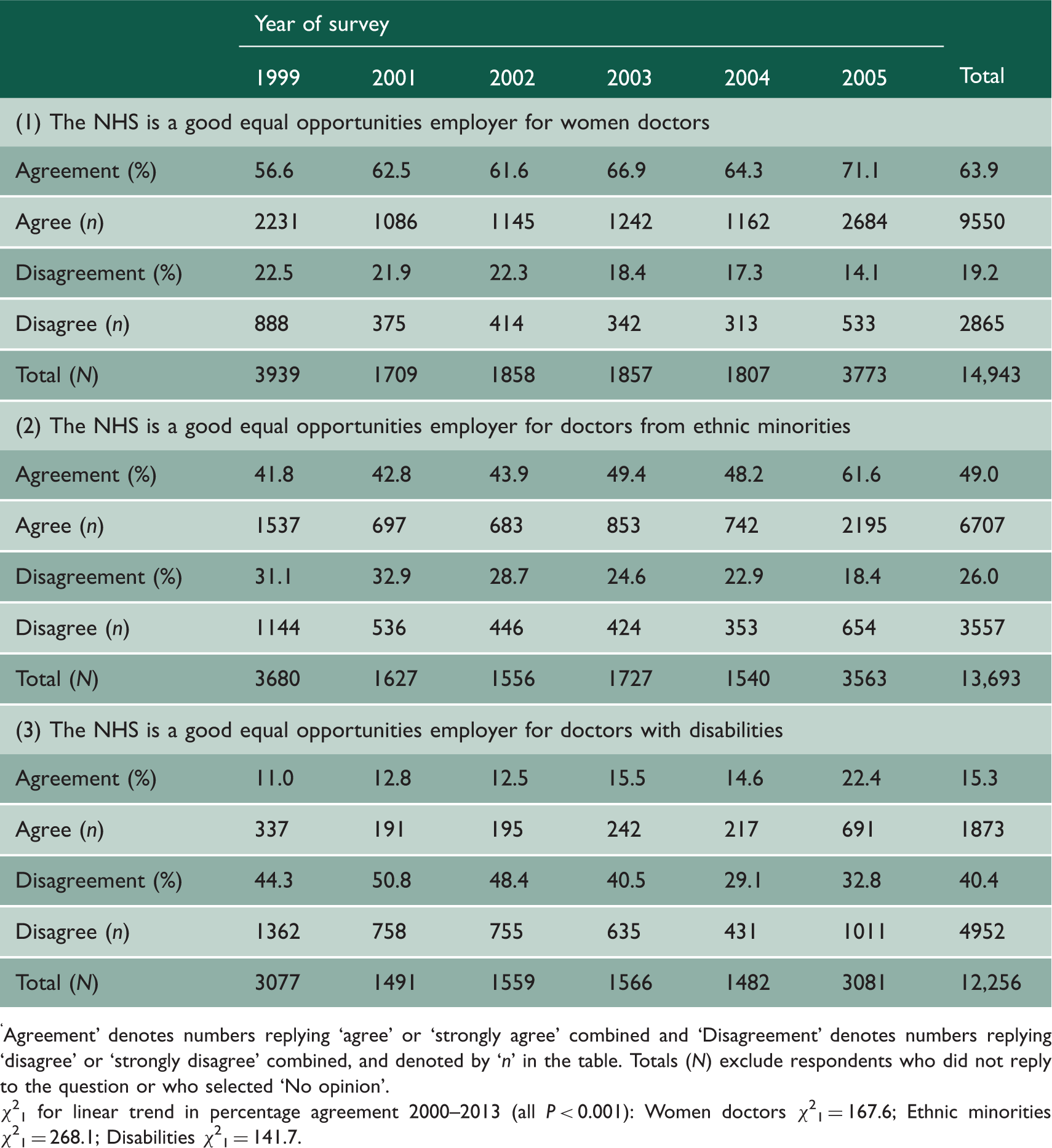
Agreement’ denotes numbers replying ‘agree’ or ‘strongly agree’ combined and ‘Disagreement’ denotes numbers replying ‘disagree’ or ‘strongly disagree’ combined, and denoted by ‘n’ in the table. Totals (N) exclude respondents who did not reply to the question or who selected ‘No opinion’.
χ21 for linear trend in percentage agreement 2000–2013 (all p < 0.001): Women doctors χ21 = 167.6; Ethnic minorities χ21 = 268.1; Disabilities χ21 = 141.7.
The NHS is a good equal opportunities employer for doctors with disabilities
Fewer doctors offered an opinion on the NHS as an equal opportunities employer for doctors with disabilities than for the other two categories. Of those house officers who did express an opinion, agreement was under 15% for each of the first three cohorts surveyed, but rose to 57% for the house officers of 2013 (Table 2). The percentages who disagreed fell from 52% in 2000 to 13% in 2013. Among middle grade doctors from 1999 to 2005 (Table 3), percentage agreement rose over time from 11% to 22%.
Detailed responses
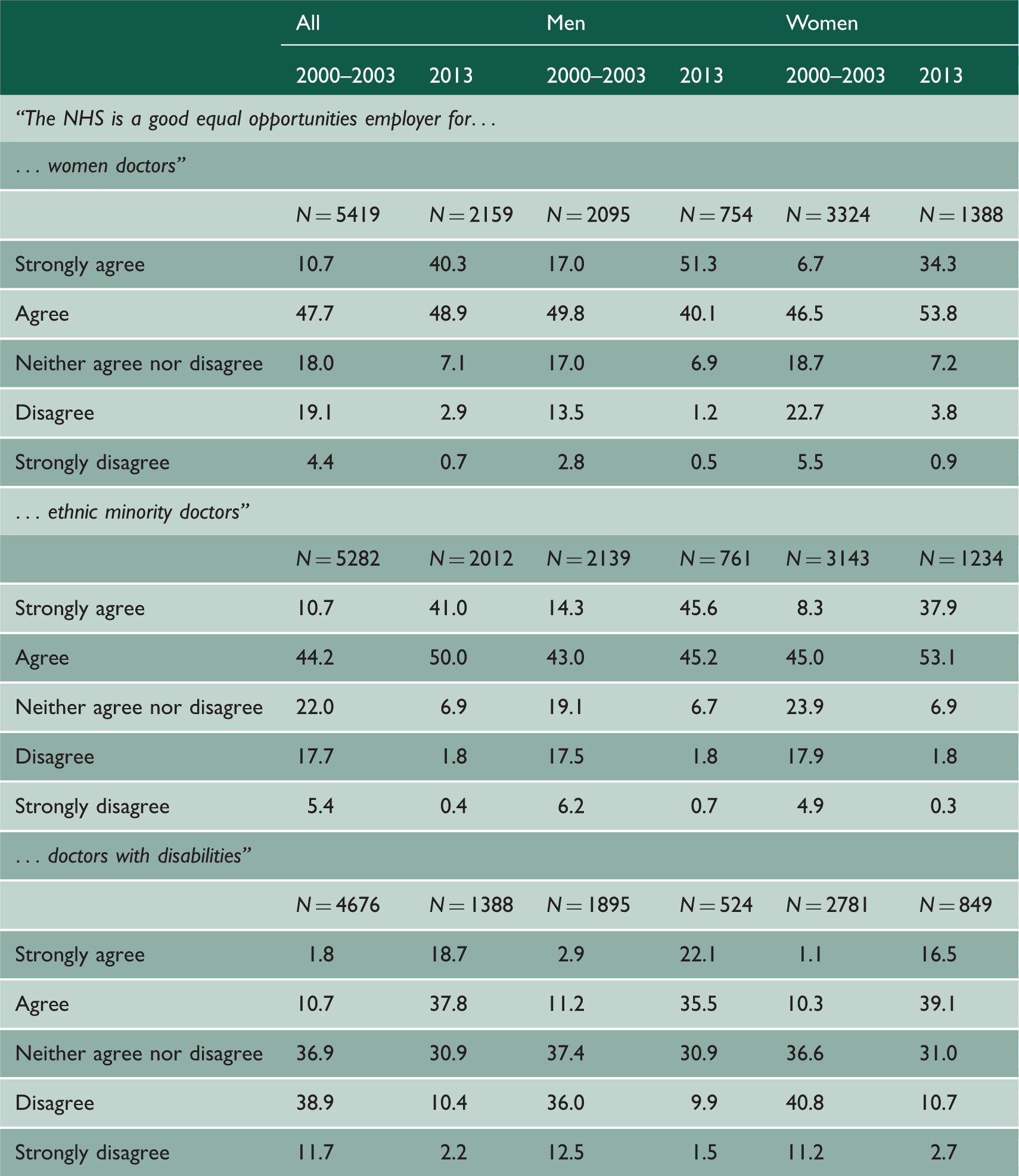
Table 4 compares the aggregated responses of house officers of 2000–2003 with those of house officers of 2013: the latter held much more positive views of the NHS as an equal opportunities employer and the change was apparent among both men and women. However, women house officers of 2013 were less positive than men about the NHS as an equal opportunities employer for women doctors.
Appendix Tables 5 to 7 show, respectively, the numbers and percentages across the five-point scale of response from strongly agree to strongly disagree in each year from 1999 to 2013, with data from surveys conducted in the same year combined together, whether or not they were from first-year doctors. Generally, a higher percentage of women doctors than men disagreed with each of the three statements (Appendix, Tables 5 and 7) and more non-white doctors than white doctors disagreed (Appendix, Table 6) although disagreement for all groups and all statements declined over time. We used the Jonckheere-Terpstra test for trend to confirm that there was a significant movement towards more positive views of the NHS as an equal opportunities employer over time across all groups, using the doctors’ responses across all five categories of response, see Appendix Tables 5 to 7 and footnotes for details.
Discussion
Main findings
There was a substantial increase in positive regard for the NHS as an equal opportunities employer over the period 1999 to 2005. Women doctors were more inclined than men doctors to have a negative view of the NHS with regard to women doctors, and non-white doctors had a more negative view than white doctors of the NHS with regard to ethnicity. We also found a ‘switch over’ effect in that women had a more negative view than men about the NHS as a good employer in respect of ethnicity, and non-white doctors had a more negative view than white doctors about the NHS as a good employer for women. Inevitably, greater attention needs to be paid to the views of women than men on gender; and the gap in perception of equal opportunities between women and men, and between ethnic minority and white doctors, is still a concern. Although trends towards more positive views were noticeable between 1999 and 2005, new data from 2013 were strikingly more positive than anything seen in those years. If the graduates of 2012 are typical of the present, the NHS is now very positively viewed as an employer by young UK medical graduates with respect to women and ethnic minority doctors. The position is less clear with regard to doctors with disabilities.
Strengths and weaknesses of the study
Views on equal opportunities for doctors in the NHS, comparing F1 doctors in 2000–2003 and 2013: percentages of respondents.
National and international context
It is likely that particular groups will tend to respond more negatively when questioned about an issue which might affect them directly. The 2012 NHS Staff Survey reported that while 90% of white staff felt their Trust provided equal opportunities for career progression and promotion, only 76% of non-white staff agreed. 5 It is interesting that the same groups also view issues affecting other distinct groups in a more negative way as is the case of women doctors in our study with regard to both doctors with disabilities and doctors from ethnic minorities. The view has been expressed that being ‘singled out’ in some way may result in greater empathy for others who are also singled out, albeit for different reasons. 6
Unlike doctors with disabilities or doctors from ethnic minorities, women are not a minority in the general population and are no longer a minority in the medical profession. Although the numbers of women graduating from medical schools now exceed men, they still encounter barriers in career progression 7 and may feel stereotyped 8 and marginalised. Though this may be so, we have shown that, after allowance is made for part-time working, women advance as rapidly as men in hospital medicine to consultant posts. 9 Women’s views of how they are treated within the NHS are of increasing importance. Interestingly, 89% of all women respondents to the 2012 NHS Staff Survey felt their organisation provided equal career opportunities compared with 85% of all men, although 92% of all medical/dental staff of either gender believed their organisation did so. 5
It has been argued that the issue of disability as it affects doctors rather than their patients is a relatively new one. 10 Most people with impairments were not born with them but acquired them as adults and, as one in five adults are believed to have an impairment, 11 some doctors can be expected to have a disability. 12 Historically, data about medical students with disabilities have been poorly collected and it is possible that this may be explained in part by the difficulty in clearly defining ‘disability’ on the one hand and a reluctance on the part of the students to own up to a non-obvious disability for fear of discrimination. 7 Interestingly, dyslexia is the disability most often declared 10 and this may reflect the direct benefit of extra time allowed when sitting exams. The 2012 NHS Staff Survey reports that 81% of disabled staff believed their Trust provided equal career opportunities compared with 89% of non-disabled staff. 5 People with impairments are now being encouraged to take a full part in as wide a range of roles within society as possible, and the medical profession is likely to have an increasingly diverse makeup of people with varying abilities. Given clinical specialisation, many people with disabilities can be accommodated within the profession without compromising their ability to deliver the necessary quality service to society. As this process is likely to continue, it is important to understand how doctors feel issues of disability among staff are treated within the NHS throughout their careers.
Many countries have moved forward in the last three or four decades from a position where obvious racial discrimination, sexual harassment and general exclusion of minority groups were common. Now it is usual for differences in attitude towards some groups of doctors, both in training and further on in their careers, to be less explicit. This is, of course, good; but in moves towards a truly equal society, there is a need to determine whether there are subtle behaviours which may cause those on the receiving end to feel excluded, marginalised and unable to reach their full potential in their workplace. 13 Studies in other countries have shown there to be a need to effect a culture change to reflect a society in which women are becoming increasingly important at a professional level, 14 in which ethnic origins are becoming more diverse and in which people with a range of disabilities are able to play a more active role.15–18
Conclusions
Foundation doctors surveyed in 2013 were much more positive in their views about the NHS as an equal opportunities employer than were their predecessors a decade earlier. Among middle grade doctors, too, there was a steady increase in positive views about the NHS as an equal opportunities employer. However, the gap in perception of this between women and men, and between ethnic minority and white doctors, is a concern. We shall revisit these issues in future surveys.