




Abstract
Objective
To describe the current status of institutional facilities and the supporting research infrastructure of surveyed health research institutions in Africa, including information on communication technologies and connectivity, library resources, and laboratory operations and resources.
Design
A structured questionnaire was used to solicit information on institutional facilities at health research institutions.
Setting
Health research institutions in 42 sub-Saharan African countries.
Participants
Key informants from 847 health research institutions.
Main outcome measures
The availability of laboratory, information and communication, and library facilities in health research institutions.
Results
Less than half of the respondent health research institutions had computer laboratories (49%), network computers (50%) and information technology support (38%). More than two-thirds (67%) had a library. Electronic subscriptions to international journals were observed to be very low, with an average of three subscriptions per institution. Almost two-thirds of the surveyed institutions (69%) reported having laboratories, about half of which (55%) were accredited nationally. Linkages and research collaborations were generally weak, particularly those with other laboratories in the Region. Challenges included financial and human resource constraints and the inability to communicate effectively with partners.
Conclusions
Health research institutions in the Region have insufficient access to essential facilities such as laboratories, libraries, computers and the Internet to generate, access and share information.
Introduction
Over the past few years, there has been a growing interest in promoting health research systems, and a consensus has been formed that stronger health research systems are key to achieving improved health outcomes globally
1
and in African countries in particular. The World Health Organization (WHO)
2
defines a health research system as: ‘… the people, institutions and activities whose primary purpose is to generate high-quality knowledge that can be used to promote, restore and/or maintain the health status of populations. It can include mechanisms adopted to encourage the utilization of research.’
This paper provides an insight, based on survey data, into the current status of institutional facilities and supporting research infrastructure of surveyed health research institutes in Africa. Along with filling the gap in published African studies on research infrastructure and institutional facilities in health research organizations, the paper provides empirical data to aid decision-making on policies and strategies to strengthen health research systems in Africa.
Methods
The methods followed to assess national health information systems are described elsewhere 3 but are summarized briefly here.
This paper analyses survey data collected from health research organizations in 42 countries in the WHO African Region. The survey used Tool 6 from the Health Research System Analysis Initiative: Methods for Collecting Benchmarks and Systems Analysis Toolkit. 4 Within the institutional survey, seven questionnaires, representing separate ‘modules’, were completed by the respondent institutions. This report draws on data from one those questionnaires: Module 6000 – Institutional facilities and field sites.
The questionnaire was designed to elicit relevant information on the status and availability of facilities and infrastructure that were identified as critical for the optimal functioning of these research organisations.
Characteristics of health research institutions in 42 sub-Saharan African countries, 2009.

*Number of respondent health institutions, out of the 847 surveyed.
The analysis in this paper is based on three variables identified as playing a critical role in enhancing the proper and optimal functioning of health research centres in Africa:
Availability of, and connectivity to, information and communication technologies (ICT) Library resources Laboratory operations and resources
Concerning the ICT variable, we asked the surveyed institutions to provide information concerning the availability of ICT infrastructure. The indicators for ICT infrastructure included computing equipment and facilities such as data storage servers, Internet access, individual staff email addresses, institutional websites, network connectivity and the availability of information technology (IT) help at the institution.
Regarding the library resource variable, we asked institutions whether they had a library and, if so, the types of library resources that were available. The library resources indicators considered were the availability of Internet access in the library and the use of online resources such as online catalogues and electronic subscriptions to journals. We also investigated the level of subscriptions to locally and regionally published journals, the availability of a reference desk and interlibrary loan facilities.
For the laboratory operations and resources variable, we investigated the availability of laboratories in the surveyed health research institutions. We further investigated if these laboratories were accredited and whether they had adequate capacities and facilities to handle infectious agents safely. We also investigated the extent to which laboratories had linkages with other laboratories within the country, regionally and globally. Finally, we identified the main obstacles hindering the effective functioning of these laboratories.
For responses to questions where institutions were asked to rank items in the questionnaire, we used weighting schemes to arrive at composite ranks. For example, where the response required ranking an item on a 1–5 scale, a weight of five was given to the first rank, four to the second rank and so on, with the fifth rank getting the least weight of one. The average of these was used to derive a composite rank of items.
We used IBM® SPSS® Statistics Version 19 statistical software to analyse the data.
Results
This section provides the results obtained from the analyses of the three key variables that were identified as critical in enhancing research capacity at African health research institutions: ICT use and connectivity, library resources, and laboratory operations and resources.
ICT use and connectivity
Availability of IT connectivity, facilities and software in health research institutions in the WHO African Region, 2009.

*Number of respondent health institutions, out of the 847 surveyed.
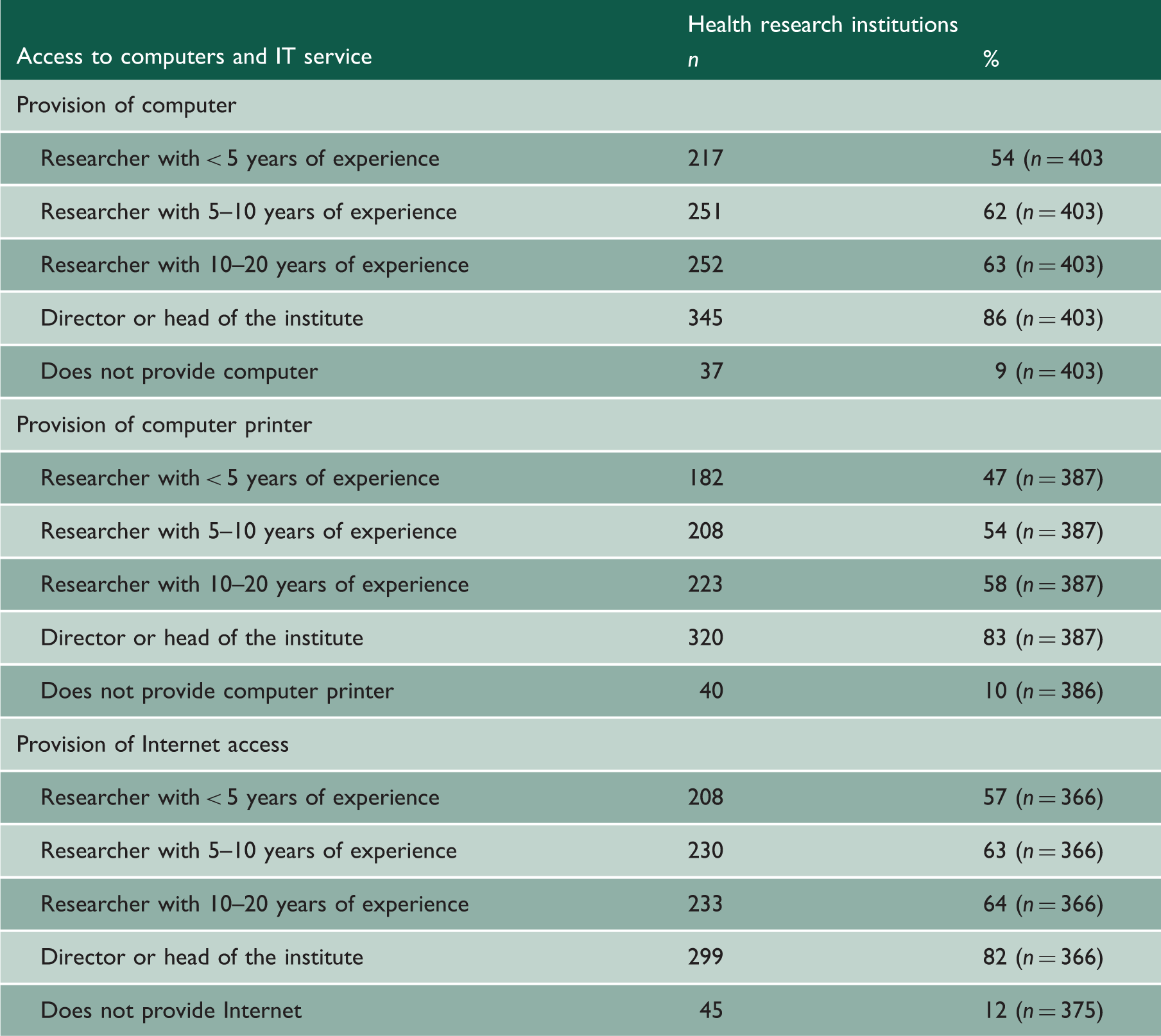
Access to computers and IT services in health research institutions in the WHO African Region, 2009.
Library resources
Availability and accessibility of library resources in health research institutions in the WHO African Region, 2009.

The data show that interlibrary loan facilities were not commonly used (18%) and that most libraries had manned reference desks (63%). There were, on average, over 7500 books in a library collection, about 30 print subscriptions and 46 scientific journal subscriptions per respondent institution (Table 4).
Laboratory operations and resources
Availability of laboratory facilities in health research institutions in the WHO African Region, 2009.

*Number of respondent health institutions, out of the 847 surveyed.
Other measures of the quality of a laboratory and its performance may be through the existence of safety procedures and codes and the availability of facilities to handle biological samples of varying risk levels. In order to understand their biosafety capacities, the surveyed institutions were asked to indicate the risk group that their laboratory could handle, varying from the lowest risk to the highest. Table 5 shows that 23% of respondent institutions indicated having laboratories attaining level 1 basic biosafety, 33% had laboratories attaining level 2 basic biosafety and 25% had laboratories attaining the highest risk group 4 for maximum containment.
Institutions were also asked to indicate the laboratory facilities available for handling the highest risk group of infectious agents. Most of the laboratories, though not all, had sterilisation equipment, protective clothing and means for safe disposal of agents (Figure 1). However, these laboratories lacked other critical facilities such as personnel safety monitoring capacity, effluent treatment capability and ante-rooms with airlock and showers.
Percentage of health research institutions with biosafety supplies or facilities that handle the highest risk group of infectious agents, WHO African Region, 2009 (n = 239).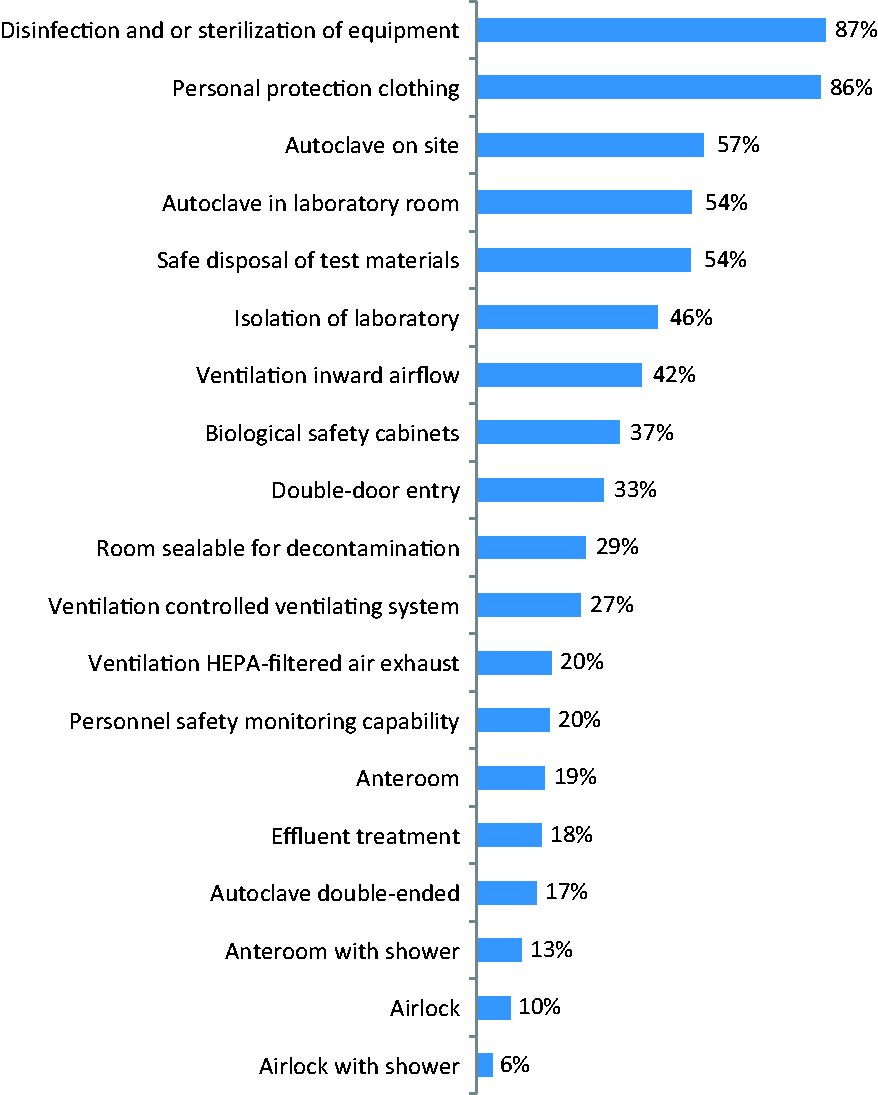
The survey identified a number of challenges affecting the institutions’ ability to function effectively, including financial constraints, human resource constraints and the inability to communicate with partners effectively (Figure 2). Financial constraints affecting laboratories were mainly those associated with the purchase and maintenance of laboratory equipment, the purchase of laboratory supplies and consumables, and operational costs. The main human resource obstacles were identified as having inadequate laboratory staff, compounded with the inability to attract and hire well-qualified laboratory staff. Other challenges included the inability to provide on-job training for staff and specimen transportation.
Main obstacles to the effective functioning of laboratories of health research institutions in the WHO African Region, 2009.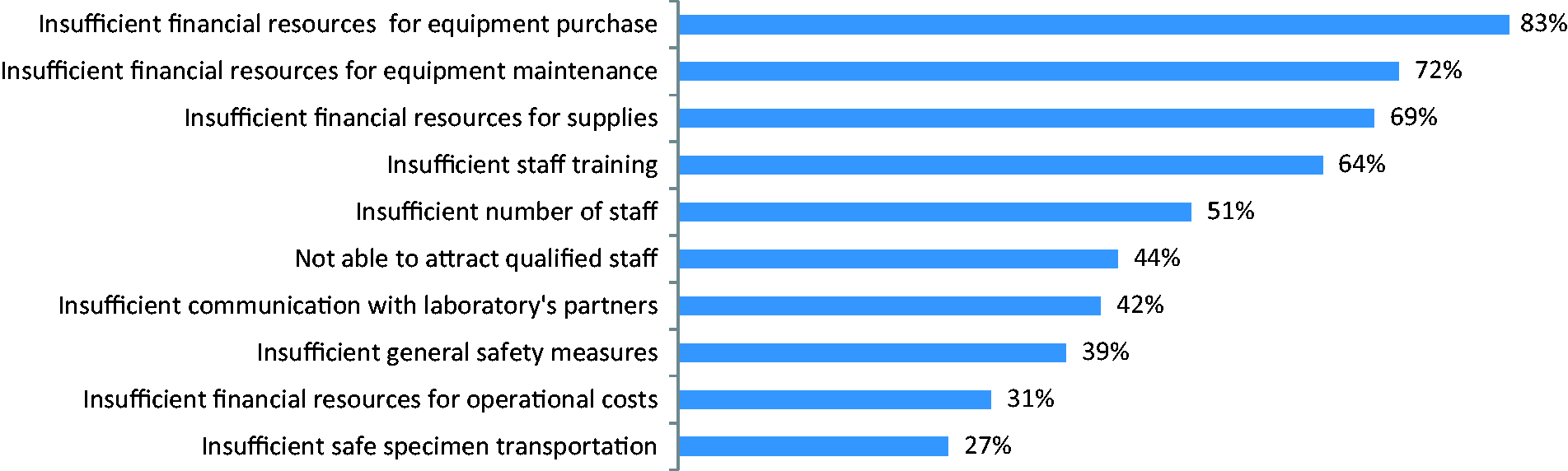
Discussion
The results presented in this paper provide an overview of the status of ICT facilities in health research institutions in the Region. We acknowledge the difficulty in making generalised conclusions based on the data presented here but argue that this paper identifies strengths and weakness in institutional infrastructure. By identifying these strengths and weaknesses, the paper highlights ‘problematic’ areas that require immediate policy intervention. The paper also provides sufficient preliminary findings that can provide a basis for future in-depth research on specific questions.
The analysis presented has a number of methodological and data limitations. The main limitation is the inability to conduct a robust comparative analysis of institutional facilities at the country level due to the lack of uniformity in the response rates and distribution of different respondent groups from each country. This is compounded by the fact that health research systems operate in contextual environments that are affected and influenced by different nation-specific factors.
The results show that a considerable proportion of health research institutions do not have basic access to ICT infrastructure, laboratories, libraries and library facilities. However, an important point that arises from this research is that the ICT connectivity problem in Africa is not just a question of ICT connectivity but also a question of the optimal use of ICT infrastructure for communication and accessing knowledge. The results are not surprising, as coverage for Internet use in the Region is low (16 per 100 inhabitants, 5 with lower rates in rural areas, compared with the cities). The quality of connection is also not adequate; very few countries have fibre-optic or satellite broadband connections. The slow connectivity may also discourage use even in situations where Internet connections are available.
There is a dearth of health research libraries in the continent. Over half of the institutions that took part in this survey did not have libraries. The majority of the institutions that did have libraries reported having access to ICT tools, but only a few had online catalogues, subscriptions to online journals or even Internet links in the library, pointing to the poor use of ICT infrastructure in library services. Several initiatives have been implemented to give researchers free online access to the full text of health research papers published in journals. HINARI (Health InterNetwork Access to Research Initiative), a partnership led by WHO involving more than 150 publisher partners is one example (see http://www.who.int/hinari/about/en/).
Among other health services, laboratory services are essential components that must be improved in order to support disease or disorder management in the Region. Several assessments of laboratories in the Region have shown the need for infrastructural and technical capacity strengthening to support HIV/AIDS programmes. The 2007 assessment showed that most African governments were developing their national strategic plans and mobilising resources for laboratory services in both the private and public sectors. The availability of trained, skilled human resources was the main challenge to improving laboratory capacity. 6
Laboratory services are essential to identify the agents involved in important public health events, including those which may cause epidemics and pandemics. 7 Functional specimen transport systems, combined with strong laboratory biorisk management measures and laboratory quality systems should be in place if laboratories are to release results in a safe, secure, timely and reliable manner. This paper shows that most laboratories operate under severe financial constraints and thus lack the capacity to deal with high levels of risks (i.e. levels 3 and 4). The capability to handle risky agents must be strengthened and enhanced in laboratories in African institutions. Linkages and research collaboration are generally weak, particularly with other laboratories in the Region, and these links should be encouraged since geographically co-located regions tend to have similar health problems.
Conclusions
The study shows that health research institutions in the Region have insufficient access to essential facilities such as laboratories, libraries, computers and the Internet to generate, access and share information. Countries should ensure that adequate financial resources are mobilised and available to improve these facilities in health research institutions.