




Abstract
Drawing on 40 interviews, this article advances understanding of how Filipino undocumented migrant domestic workers (UMDWs) in the United Kingdom (UK) and the Netherlands navigated the pandemic by undertaking a comparative analysis of their resilience strategies. Using social navigation as an analytic lens, it conceptualizes a typology of three strategies—concession, cooperation and contestation—that Filipino UMDWs engaged in at the micro-, meso-, and macro-levels to account for how they coped during the pandemic and are fighting to change their conditions. Finally, it reflects on how these strategies articulate the need for more effective migration governance for undocumented migrants post-COVID-19 and beyond.
Keywords
Introduction
This article aims to advance understanding of how Filipino undocumented migrant domestic workers (UMDWs) in the UK and the Netherlands (NL) navigated the COVID-19 pandemic by undertaking a comparative analysis of their resilience strategies. The UK and NL are major destination countries for labor migration. Like other European countries, however, the last few decades saw significant changes in their migration policies, shifting from relatively open and liberal to more selective and restrictive ones (Wagner et al., 2024). While both countries welcome specific types of migrant workers, there is a prevailing policy for unskilled or low-skilled economic migrants being unwanted and, as such, needing to be managed and deterred (Triandafyllidou and Bartolini, 2020). In both countries, we see the preferential treatment of highly talented and skilled labor migrants, such as nurses who fill in large holes in the local labor market and are provided with routes to settlement and citizenship, but the denial of the same to “low-skilled” domestic workers who also provide essential work. Their lack of a path to settlement has caused many to become undocumented.
The UK and NL make for an interesting comparative case. First, both became primary destination countries for Filipino healthcare professionals in the 1960s and 70s, and yet in more recent times, both have also become hosts to a significant number of domestic workers: In the UK through the provision of a domestic worker visa (Galam, 2020), and in NL via its au pair program which allows local families to sponsor someone for childcare services and household work (Schans et al., 2014). Second, although the hostile environment policies, which we discuss below, have features that are unique to the UK, many EU member states, including NL, have also instituted legislation to deny undocumented migrants access to employment, livelihood, housing and health care (Webber, 2019).
While only nine percent of overseas Filipino workers are in Europe (PSA, 2023), both the UK and NL host significant numbers of them, and previous studies show that many of them are undocumented. It is estimated that there are 10,000 of these undocumented workers in the UK, with the vast majority concentrated in London and working as domestic workers, carers and in other sectors of the informal economy (Galam, 2020). In NL, a recent estimate pegged the number of Filipino undocumented migrants to about 8000 (Cervantes, 2018). They live in big cities like Amsterdam, where there is a higher demand for labor, there are friends and relatives within reach, and they can easily “blend in” and not call attention to themselves (Siruno et al., 2022).
Border controls not only create a sentiment of othering (Cowan, 2021); they also have the paradoxical effect of rendering “illegal immigration” an inevitable feature of the modern nation-state (Anderson and Ruhs, 2010), in which the cheap labor of undocumented migrants contributes to the wealth and well-being of nations, yet these migrants are not provided with the means to become full members of the community. The consequences of becoming and being undocumented are severe and deadly as the COVID-19 pandemic plainly showed. How, then, did undocumented migrants navigate the COVID-19 pandemic? This question warrants attention because the pandemic exposed and exacerbated the vulnerabilities of migrant workers (McAuliffe et al., 2022). As Stevenson et al. (2024: 1) underscored, “undocumented migrants face some of the biggest challenges to accessing universal health care and are often left behind by systems that exclude and stigmatise them.”
COVID-19 in the UK and the Netherlands
Timeline and COVID-related statistics for UK and NL.
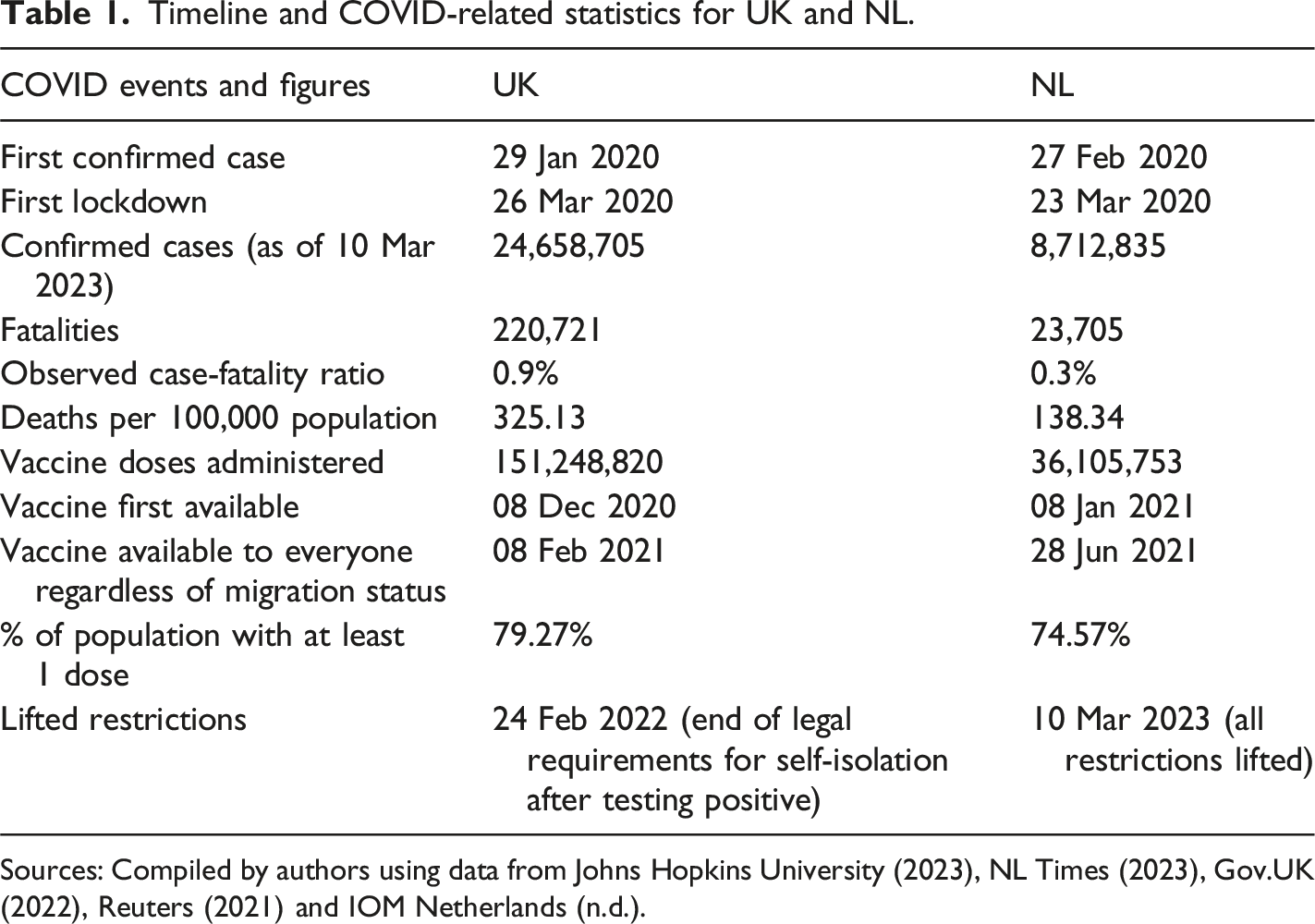
Sources: Compiled by authors using data from Johns Hopkins University (2023), NL Times (2023), Gov.UK (2022), Reuters (2021) and IOM Netherlands (n.d.).
The UK’s response to the pandemic included national lockdowns, social distancing mandates and the closure of non-essential businesses. The government introduced financial support schemes (Allis, 2021), aimed at mitigating the economic impact on workers and businesses. However, irregular migrants, due to their undocumented status and lack of legal employment, were excluded from these schemes, pushing them further into economic hardship (Fotheringham and Boswell, 2022). The UK government announced that diagnosis and treatment for COVID-19 were free and available to all regardless of immigration or residence status (Mallet-Garcia and Delvino, 2021). Assurances that no immigration checks and data sharing between vaccine providers and the Home Office were to be done in the context of vaccination (PICUM, 2021) were condemned by over 140 organizations as futile as it showed no comprehension of the fear that the hostile environment has instilled among migrants (Reynolds, 2021).
In the Netherlands, lockdown measures had a widespread impact across the entire population but disproportionately affected irregular migrants who mainly work in the informal market. Lacking economic and legal stability, these individuals were particularly vulnerable to sudden income loss and those who managed to retain employment faced heightened exposure to the virus due to their often precarious working conditions (Siruno, 2021). While regular residents and documented workers received financial assistance through various government programs, irregular migrants did not qualify for these benefits. Nevertheless, once the state of public health emergency was declared, ad-hoc protection measures and temporary inclusive practices were introduced. This included vaccinations and tests, which were available regardless of residence status (PICUM, 2021; Siruno and Siegel, 2023). Municipal governments and organizations like the Red Cross played an important role in establishing trust, extending healthcare access and providing other basic needs for irregular migrants (Delvino and Spliet, 2021).
Against this backdrop, the rest of the article is structured as follows. We first provide a conceptual framework for analyzing resilience strategies; second, we discuss our methods; third, we discuss the immigration policies of the UK and NL within which we examine those that impact specifically on (undocumented) migrant domestic workers; fourth, we conceptualize a typology of three strategies—concession, cooperation and contestation—that Filipino UMDWs deployed at the individual, societal and structural levels to account for how they coped during the pandemic and are working to change their conditions. Finally, we reflect on how these strategies articulate with the need for more effective migration governance for undocumented migrants post-COVID-19 and beyond.
A conceptual framework for analyzing resilience strategies
The notion of resilience is used in various ways across disciplines and it does not have a universally agreed-upon definition (Martin-Breen and Anderies, 2011). In this paper, we operationally define resilience as the capability to cope with, adapt to or overcome the impacts of the COVID-19 pandemic. Following this, resilience strategies are the means deployed by UMDWs to bring about and develop such a capability. This conceptualization builds on the common understanding of resilience as the capacity to face life challenges and bounce back from difficulties. We further unpack and operationalize resilience by analyzing the actions of UMDWs across three levels—micro, meso and macro. Differentiating between these three analytical levels also serves as a heuristic tool in making comparisons and identifying common or less common navigational fields between UMDWs in the UK and in NL.
We approach our analysis of resilience strategies through the lens of social navigation. Henrik Vigh (2006, 2009), writing in the context of youth soldiering and migration, defines navigation as the ways people “disentangle themselves from confining structures, plot their escape and move towards better positions” (Vigh, 2009: 419). It involves negotiating the temporal and spatial dimensions of a social environment, and is geared towards overcoming the present: A condition that is characterized by social and economic limitations, if not social death. As a concept grounded in conflict, navigation is particularly appropriate for examining how UMDWs survived the pandemic, which has triggered multiple crises not just in terms of socio-economic conditions but also access to healthcare and social protection (Angawi, 2023). These were magnified by the immigration policies of the UK and NL, and we might look at these policies as crisis situations in themselves, with or without the pandemic. Vigh writes that crisis situations compel agents to consider not only how they may move within a context or social environment, but also how this social environment moves them as they seek to realize their goals. Crisis-as-context “clarifies the extent to which action must be seen as motion within motion, and the limitations of a faulty understanding of the relationship between act, environment and plot” (Vigh, 2008: 18).
Our use of navigation therefore enables us not only to pay attention to the spatial dimensions of the actions of UMDWs. More critically, we pay attention to the scale or level (micro-, meso- and macro-) at which these actions are done or directed towards. By doing so, we focus not just on the actors with whom UMDWs act in concert with and against, but also on the relationships that are forged out of these actions. Finally, we highlight the temporal dimensions of these strategies. Our use of social navigation thus not only highlights how the UK’s and NL’s immigration policies are inextricably bound up with the pandemic, whose consequences on UMDWs they vitally shaped.
Methodology
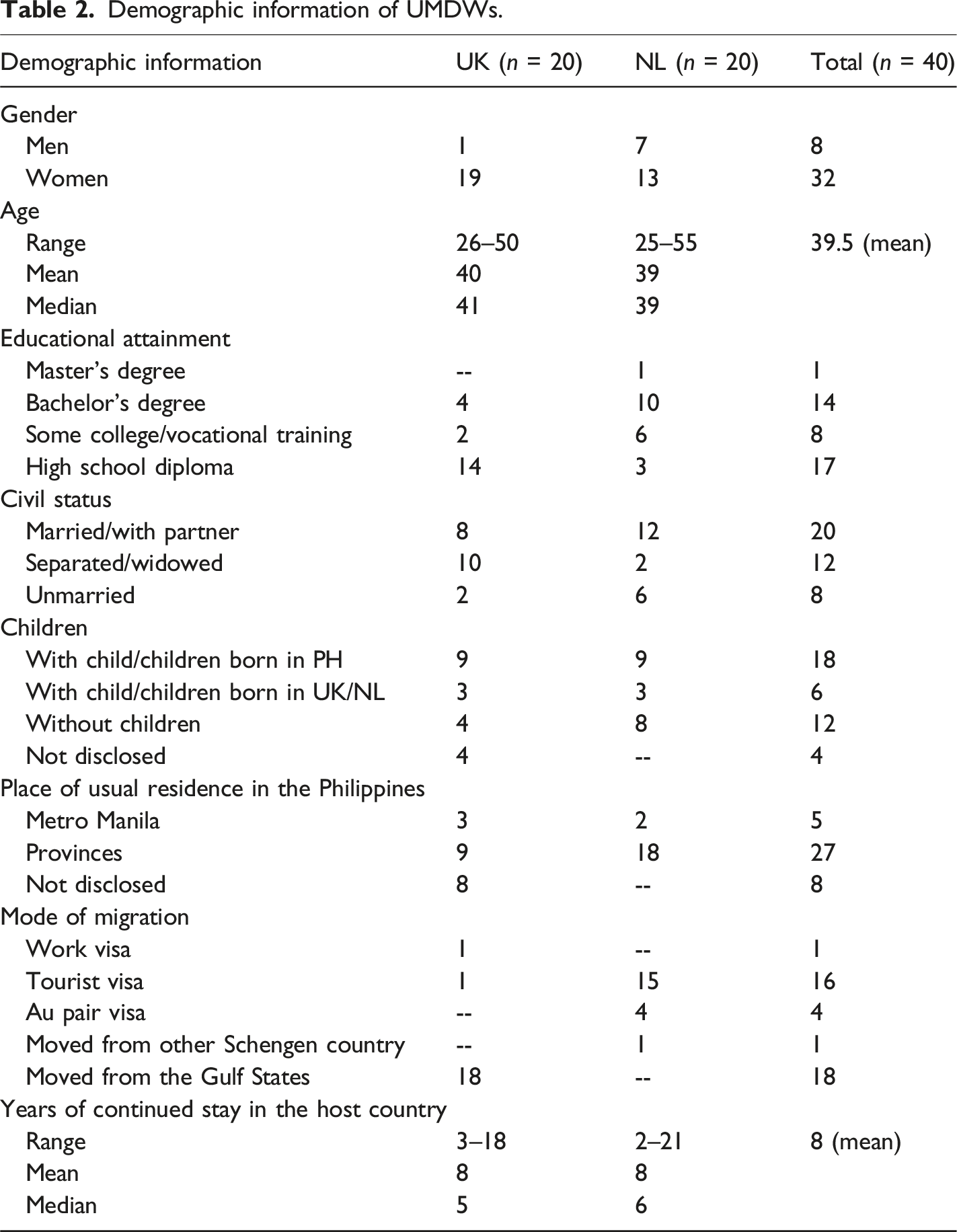
We draw our data from 40 semi-structured interviews with UMDWs, 20 in each country, conducted between December 2021 and May 2022. This period was two years into the pandemic. Most of the restrictions had been eased by then, and social and economic activities have resumed. The timing proved opportune for UMDWs to reflect on their experiences. We developed a common interview guide to allow for comparison but with flexibility built in to cover individual experiences. Some UMDWs were introduced to us by community or organization leaders who were in regular contact with them. To minimize selection bias, we approached different organizations in different locations. We also used snowball sampling as a recruitment method, despite criticism for its limited representativeness, because it helped us connect with research participants (van Meeteren, 2014). We collected additional empirical data through key informant interviews and participant observation when the authors did volunteer work and participated in events organized by migrant support groups in London, Amsterdam and The Hague. These allowed for conversations with community organizers and members, as well as supporters of the migrant community. As we employed a qualitative approach, we do not make any claims to the generalizability of our findings. However, our data offer deep insights into migrant experiences and strategies during COVID-19, which can inform further studies and contribute to the broader discourse on crises and migrations.
We followed strict ethical considerations during data collection and analysis and guaranteed the anonymity of all participants. To add another layer of security for participants, consent was obtained verbally, and they were not made to sign any documents or answer questions they were uncomfortable addressing. The interviews were conducted in Filipino. With expressed permission, interviews were audio-recorded, which were then transcribed and, together with field notes, coded and thematically analyzed. Throughout the research process, we brought our positionality to the fore. We share a common ethnic background with our participants but differ from them regarding migration experiences and trajectories. To ensure reflexivity, we organized specific moments for group reflection and self-critique, and extensively consulted the literature to guide our analysis. We use pseudonyms when quoting interview material from participants.
Demographic information of UMDWs.
The making of migrant precarity and illegality
Both the UK and NL have pursued restrictive and/or punitive policies that create and perpetuate the precariousness and illegality of undocumented migrants (York, 2018). These policies underpin what De Genova (2002: 440) has called “the legal production of migrant ‘illegality.’”
The UK hostile environment
In the last three decades or so, UK immigration policies shifted from “integration” to hostility with a focus on deterrence (Hynes, 2022). Migration management thus took a punitive approach (Griffiths and Yeo, 2021) enforced through detention, destitution, dispersal and deportation (Hynes, 2022). The UK’s hostile environment for migrants, formalized by the Immigration Act 2014 and strengthened by the Immigration Act 2016, consisted of a set of policies designed to make life intolerable for undocumented migrants by denying them access to public services and the necessities of life, namely, housing, health care, legal employment, bank accounts and driving licenses, as well as measures preventing sham marriages (Yeo, 2020). They were designed to force undocumented migrants to voluntarily leave the country (Yeo, 2020). To be sure, this voluntary departure or “self-deportation” is not voluntary; undocumented migrants are simply not given any other option at all (Gentleman, 2019).
The hostile environment has been characterized as a “state-led marginalization of immigrants” (Griffiths and Yeo, 2021: 522) and as a “policy of forced destitution” (Cowan, 2021: 81) with profound consequences not just on undocumented migrants but on British society as well. Migrants with undocumented status face destitution and homelessness as a result of forced unemployment. As a deliberate state mechanism to exclude and remove undocumented migrants from the UK, the hostile environment creates and expands internal borders and border controls in everyday life (Cowan, 2021; Griffiths and Yeo, 2021; Keenan, 2018; Yeo, 2020; Yuval-Davis et al., 2019) whose policing enlists not only non-state actors (agencies, institutions or organizations) but also private individuals. Griffiths and Yeo (2021) use “deputization” to conceptualize the devolution of responsibility to police the UK’s borders and their diffusion throughout everyday spaces. Deputization refers to the “co-opting of organizations and people as de facto immigration officers” through which “a medley of actors are made ‘street level bureaucrats’ […] responsible for enacting – and interpreting – immigration policy on the ground” (Griffiths and Yeo, 2021: 523). Conscripted into border policing are employers, civil servants dealing with benefits, local authority housing and benefits officers and social workers, private landlords, colleges and universities that have international staff and students, NHS hospital staff, bank and building society managers, the Driver and Vehicle Licensing Agency (DVLA) and marriage registrars (York, 2018). Employers and landlords face stiff fines and imprisonment if they hire or rent to individuals without authorization to be in the UK while colleges and universities face fines as employers and the withdrawal of their sponsorship license for failure to impose strict controls on international students (Webber, 2019). The deputization of border policing to private individuals demands of “UK residents to inflict considerable harm on each other, with profoundly significant consequences for individuals and broader society” (Griffiths and Yeo, 2021: 539). The hostile environment encourages and legitimizes racism and xenophobia (Griffiths and Yeo, 2021; Yeo, 2020).
The hostile environment is thus an act of bordering, which “constitutes a principal organizing mechanism in constructing, maintaining, and controlling social and political order” (Yuval-Davis et al., 2019: 5). It determines “not only who is and who is not entitled to enter the country, but also whether those who do would be allowed to stay, work, and acquire civil, political, and social rights” (Yuval-Davis et al., 2019: 5). It sustains British colonial hierarchies that are racist and racialized (El-Enany, 2020). The state-sanctioned violence committed against migrants through the web of hostile environment policies are pushing undocumented migrants into (more) dangerous and harmful situations, making them more exposed and vulnerable to exploitation (Cowan, 2021). The most affected by these measures are racialized and impoverished migrants (El-Enany, 2020; Gentleman, 2019; Griffiths and Yeo, 2021), especially those working as domestic workers.
The Netherlands’ comprehensive approach to migration
The expansion of the Dutch economy in the 1960s created a demand for low-skilled work, and irregular migrants were mostly tolerated. From 1991 onwards, however, preventing irregular migration and illegal employment has become the priority or first pillar in the Dutch comprehensive approach to migration (van der Leun and Ilies, 2010). The government suspended the issuance of tax and social insurance numbers and introduced sanctions on employers (van der Leun, 2006). Apart from the formal economy, the exclusion of irregular migrants also extended to social security, public housing, healthcare and education. However, on the basis of the Council of Europe’s mandate on the protection of basic human rights, everyone, regardless of migration status, remains entitled to medically necessary care, primary school education for children and legal aid (Cholewinski, 2005).
The “Linking Act” of 1998 is the government’s primary legislation dealing with irregular migration. It made residence status a condition for welfare and social security benefits, practically preventing undocumented migrants from accessing them (Leerkes, 2009). Illegal residence has also been criminalized and since 2012, not being in possession of a valid residence permit is a criminal offence subject to a fine, an entry ban or even forced removal (Van der Woude et al., 2014). The NL does not offer general amnesties; hence, there are no official pathways for undocumented migrants to regularize their status (van der Leun and Ilies, 2008). Practically, this means that options for regularization are limited to applying for asylum or marrying a citizen.
A government-commissioned report stated that there was a downward trend in the number of irregular migrants present in NL—from 194,000 in 1987 to between 23,000 and 58,000 in 2017 to 2018 (Government of the Netherlands, 2020). Still, stricter controls have not prevented irregular migration. This is due, in part, to the fact that enforcement primarily targets rejected asylum seekers and individuals engaged in criminality (Leerkes, 2009). There is also consistent demand for the cheap labor of irregular migrants (van der Leun and Ilies, 2010).
Migrant domestic workers in the UK
In 2022, the Home Office issued 18,533 visas for overseas domestic workers (ODW) accompanying their employers. Almost 55 percent of these visas were for domestic workers from the Philippines (Yilmaz and Emberson, 2023). Various reports (e.g., Sharp and Sedacca, 2019; Yilmaz and Emberson, 2023) have highlighted the exploitation and abuse of migrant domestic workers. They are a vulnerable group because domestic work is inherently undervalued and underpaid, and workers perform their job in the privacy of their employers’ home. They are vulnerable also because they are excluded from the protection of labor legislation (Mantouvalou, 2015a, 2015b). This gives rise to “legislative precariousness,” the “special vulnerability created by the explicit exclusion or lower degree of protection of certain categories of workers from protective laws” (Mantouvalou, 2012: 133). Immigration legislation adds further precariousness by treating migrant domestic workers as different from other migrant workers (Mantouvalou, 2012: 141). For example, domestic workers are categorized as low skilled and therefore are not part of the “best and brightest” the UK is looking to attract and provide pathways to settlement and citizenship (Gower, 2016; Mantouvalou and Sedacca, 2022). This combination of labor and immigration regimes exacerbates the vulnerability and exploitability of migrant domestic workers from “individual abuse…[by] employers to institutional exploitation” (Demetriou, 2015: 70).
Before 1998, migrant domestic workers were able to come to the UK with their employer who they were tied to; in other words, they could not change employer without losing their immigration status. They had no path to settlement so that those who escaped abusive employers became undocumented. A long campaign waged by migrant domestic workers, civil society organizations and the Transport and General Workers’ Union (now Unite the Union) led to the Labor government introducing changes in 1998. From 1998 to April 2012, the ODW visa allowed migrant domestic workers to change employers and find a new job within the same sector of domestic work without losing their immigration status. Indeed, they could apply to extend their work visa which is valid for one year with their new employer. After five continuous years of lawful employment, they could apply for settlement (Kalayaan, 2022; Mantouvalou and Sedacca, 2022). However, changes to UK immigration rules in 2012 introduced a “tied visa” system in which migrant domestic workers are allowed to be in the UK for only six months without a possibility for renewal. And should they leave their employer during this period, they could lose their immigration status and therefore risk being deported (Mantouvalou, 2015a, 2015b). This 2012 tied visa system created “an extremely vulnerable workforce that stays in the UK undocumented and fearful, trapped in ongoing cycles of exploitation” (Mantouvalou, 2015b: 44). A much higher number of migrant domestic workers with tied visas compared to those with not tied visas suffered physical abuse, not being allowed to leave the house freely, not having time off, not being paid at all and having their passports taken away from them (Kalayaan, 2022).
Academics and civil society organizations pointed out that the ODW visa was at odds with the efforts of the UK government, which adopted the Modern Slavery Act (MSA) in 2015, to tackle modern slavery as it made MDWs susceptible to human trafficking and slavery-like situations (Mantouvalou, 2015a, 2015b; Roberts, 2020). The government responded that those who experience abuse could go through the National Referral Mechanism (NRM), the UK’s framework for modern slavery victims (Gostoli, 2020). However, in the face of criticism and campaigning, the government committed to an independent review of the terms of the visa and whether it facilitated abuse (Kalayaan, 2022). The independent review recommended that ODWs be given the universal right to change employer and apply for annual extensions of their visa up to a total period of 2.5 years (Ewins, 2015: 6). The government did not accept that domestic workers should have the right to renew their visa but accepted that they needed an escape route from abuse. In April 2016, it reinstated the right to change employer but only within the 6-month validity of the domestic workers’ visa and with no extensions allowed. Finding a new employer with only a short time left on their visa is extremely difficult forcing many to go undocumented. The restrictive immigration regime of the 2012 ODW visa thus compounds the legislative precariousness of migrant domestic workers (Mantouvalou, 2015a: 337). Domestic workers fleeing abuse and exploitation are hesitant to go through the NRM to have their situation recognized as human trafficking because of the low likelihood of getting a positive decision. The burden of proving they are victims falls heavily on their shoulders. They are also rightly worried of falling into destitution because while waiting for a decision, they lose the right to work. This shows how “state laws and policies push workers into irregular status” (Mantouvalou and Sedacca, 2022).
Migrant domestic work in the Netherlands
Unlike in the UK, it is not possible to obtain a domestic worker’s visa or residence permit for the purpose of working as a cleaner or carer on a private basis, because domestic work is not a formally recognized labor sector (Marchetti, 2016). The exception comes in the form of au pairs: Supposedly cultural exchange visitors, usually women between 18 and 25 years old who live with a Dutch host family and are allowed to perform “light domestic work” in exchange for free board and lodging and an allowance of up to 340 euros (€) (US$ 384) per month (IND, 2022). They are granted a residence permit for 12 months, and while in paper, this is not a permit for domestic work, it is in practice. A study (Schans et al., 2014) commissioned by the Dutch Ministry of Security and Justice showed that about a quarter of the total number of au pairs in NL are from the Philippines, and while the motivation for the majority of them is to get to know Dutch society and culture, the host families which participated in the study point to obtaining help for childcare as the main reason for sponsoring an au pair. The study concludes that because many au pairs perform “heavier work” and exceed the agreed working hours, the au pair scheme may be interpreted as cheap labor migration. According to the Commission on Filipinos Overseas (CFO), 1,891 Filipino au pairs were deployed to NL between 2012 and 2018 (CFO, n.d.). Since the 1990s, many of them have been overstaying their permits, transitioning to irregularity and working as UMDWs (Oosterbeek-Latoza, 2007).
While the domestic sector is, in principle, regulated, domestic work in private households is often undeclared (Eurofound, 2009). This means that services are rendered and money exchanges hands outside the remit of the labor and the tax authorities. Even when this is the case, however, many undocumented migrants who could not secure formal employment join the domestic sector because it is in high demand and affords them less scrutiny from labor inspectors. It also offers relatively good pay with flexible schedules (Echeverría, 2020).
This said, UMDWs continue to face a situation of double precarity due to their insecure legal status and the absence of legal recognition as workers entitled to rights (Siruno et al., 2022). Apart from the “no-work-no-pay” arrangement, UMDWs are not eligible to receive benefits in case of illness or unemployment, and they do not accumulate pensions for retirement. In short, they cannot access formal social protection schemes like social insurance and traditional welfare safety nets. Instead, they have to improvise and rely on informal or self-help strategies. They also usually have no opportunities for skills training, further education or other forms of human capital development.
Discussion and analysis
Our data support what other studies have established about the pandemic experiences of undocumented migrants (e.g., for the UK, Galam, 2020; Parry-Davies, 2020; for NL, Siruno and Siegel, 2023; van Den Muijsenbergh et al., 2022). In the UK, Filipino UMDWs lived in cramped accommodations, making them unable to isolate themselves when they contracted the COVID-19 virus and refused to see a doctor for fear of being reported to the Home Office. Unable to work and with no access to social welfare assistance, they were left in dire financial situations, if not destitution. UMDWs in NL likewise faced economic hardships as employers terminated work arrangements. This led to significantly reduced incomes and thus, less capacity to send financial remittances (Siruno and Siegel, 2023). There have also been reports of heightened instances of racial discrimination on account of being Asian (van Den Muijsenbergh et al., 2022). Our central contribution to the scholarship on migrants’ COVID-19 experiences lies in our explication of how Filipino UMDWs navigated such experiences and developing a typology of these strategies. To analyze and examine how UMDWs navigated the pandemic, we operationalize Vigh’s (2009) concept of social navigation and identify three strategies: (1) Concession, (2) cooperation and (3) contestation. They pertain to engagements on the individual, societal and structural domains, or the micro-, meso- and macro-levels, respectively.
Micro-level resilience strategies: Concession
Our analysis of resilience strategies at the micro-level refers specifically to the individual UMDW whose values and characteristics vitally determine their capacity to cope with the pandemic despite the limited options that were at their disposal. Concession encompasses several aspects. First, there is acceptance of the fact that they were unable to work. Acceptance is demonstrated by such statements as “There is nothing we could do. We can’t go out. We couldn’t work.” Concession as yielding does not mean defeat because for UMDWs, acceptance is part of a “waiting game,” of mentally and psychologically coping with the financial difficulties that were expected to result from not being able to work. Concession entails being present but at the same time, despite the uncertainty, cultivating an optimism for the future. Second, concession involves taking the little opportunities that were available, such as a few hours of work here and there. UMDWs in London conceded to the desperation of the situation, to the impossibility of having anything better. “Better than nothing” was a common motivation. When told by their employers not to return simply because they coughed or commuted, UMDWs did not appeal to be kept employed, even if they knew that it would take them a long time before they could find a replacement job. Third, concession involves negotiation, as when Bella, 47 years old, convinced her employer to let her live in their house, reasoning that by not commuting, she would not get exposed to the virus, thereby protecting those she was caring for from being exposed as well. This meant, however, that she was susceptible to working more hours than she should but that this was a better bargain than for her to commute and get sick.
Most of the participants in NL reported being forced to stay home during the first few months of the pandemic lockdowns, which resulted in a significant reduction in incomes. They accepted that the pandemic was a shock affecting everyone in the world and went past blame by declaring one “has no choice” on the matter and “nobody wanted it to happen.” Conceding to the situation, they coped and adapted primarily by negotiating the terms of the financial remittances they sent to family members back in the Philippines. While some continued sending money by borrowing from friends or employers, or by drawing from savings, others decreased the amount they sent or temporarily stopped sending completely, but only upon consultation with the family and providing a time-bound reassurance that they would make up for the difference when things improved. UMDWs in NL also yielded—conceded—to the situation by modifying their return intentions. As the pandemic halted international travel, some of the participants postponed their planned return to the Philippines “for good.” This involuntary immobility, however, was taken in stride. “It meant I could work and save some more before I go home,” one participant shared. The general attitude demonstrated by participants is captured in this statement by Junior, 39 years old, whose wife is also a UMDW and with whom he has two children born in NL: “You just need to toughen up, face all the challenges that come your way. You know your situation, you chose it, you should accept it. Problems are part of life. You just need to be strong.”
Concession, conceding to the situation due to the paucity of options, captures how UMDWs coped during a global, yet very personal, crisis. It is a time-bound strategy deployed to address the “current” or “present” situation. It is a temporary “deal” or arrangement. Although it is meant for the here and now, it nevertheless possesses a future orientation. This is where the resilience lies. Concession affirms the migration objectives of the UDMWs as they refuse to go home and render their migration project a “failure.” Concession is thus a strategy that testifies to enduring rather than yielding to defeat. It reveals both rational calculation and emotional consideration. Ultimately, as Siruno and Siegel (2023) observed previously, COVID-19 was a stark reminder of the willingness of Filipino UMDWs to take risks and make personal sacrifices for economic gains. For UMDWs both in the UK and NL, the pandemic underscored the dedication and devotion they have for their families who are a vital part of their migratory projects.
Concession strategies are linked to both the meso- and macro-levels, as decisions made by the UMDWs, for example, the kind of risk taking they made, might be shaped by how thick their network or support system was. Indeed, many UMDWs who had gone off the radar, deliberately avoiding any contact with migrant organizations, emerged from their self-imposed “exile” from these organizations because such connections ameliorated their isolation and exclusion. This leads us to cooperation strategies.
Meso-level resilience strategies: Cooperation
Cooperation strategies bring the UMDWs out of their individual circumstances and put them in a more collective context, where their decisions and actions—such as reaching out to other migrants or migrant organizations—embed them in a group or community context. The aims of cooperation strategies are various, but they could fall under the overarching provision of ad-hoc social assistance and protection. These include providing for the basic needs of UMDWs: Food, financial assistance and other services or care (i.e., mental health, legal, information as to where to get help or what to do). More importantly, this included the organization of ways by which UMDWs could have access to the COVID-19 vaccines. As such, the actors involved are many: Other UMDWs, other migrants (co-nationals and not), churches, migrant-focused NGOs and local authorities.
In the UK, the two migrant organizations that played a central role in assisting and supporting UMDWs were Kanlungan and The Voice of Domestic Workers (VODW). Through its COVID-19 Bayanihan Project, Kanlungan provided food and grocery relief for undocumented workers and others who have No Recourse to Public Funds (NRPF). VODW provided the same assistance, including financial help. Kanlungan also assisted Filipinos with legal status or who have recourse to public funds, especially elderly ones, obtain help from their borough councils, and helped undocumented Filipinos receive the cash assistance provided by the Philippine Department of Labor and Employment (DOLE) through its DOLE-AKAP assistance program (Galam, 2020). Both organizations also organized vaccination clinics for undocumented migrants, working with borough councils and other NGOs such as Doctors of the World, which has been providing medical and other health care services to undocumented workers who—despite assurances from the UK government that their data would not be shared with the Home Office—were fearful of going to NHS vaccine providers. The desperate need for the vaccine could not erase years of hostility toward them. As we mentioned in the introduction, there is simply no bond of trust between UMDWs and the state.
Both Kanlungan and VODW obtained financial grants from local councils, grant-giving bodies and other organizations. One silver lining of the pandemic, noted the president of VODW, was that they had access to more funding during the pandemic than at any other time. Functioning as a link between undocumented migrants, a hard-to-reach population, and authorities further underlined the importance of the work they do. The pandemic also enabled them to work with many other migrant organizations and civil society organizations, hence further widening their network.
As discussed by Siruno and Siegel (2023), city or municipal authorities bear the practical responsibility for undocumented migrants in the NL. They provide a range of services, including healthcare, emergency shelter and legal assistance, which are typically channeled through civil society or non-governmental organizations (NGOs). During the pandemic, these organizations, some of them with membership mainly from the migrant community, amplified their important role in ensuring access to basic needs and services. Shelters, which were usually open only in winter, were made available; rent subsidies, in the past only an entitlement for legal residents under strict conditions, were offered by some organizations, financed in large part by municipal governments. The pandemic also prompted some organizations to start handing out cash up to € 100 (US$ 113) in addition to the usual in-kind support.
Within the Filipino migrant community in NL, there was immediate recognition that those who did not have papers would be excluded from government support. In the spirit of bayanihan (solidarity, civic unity and cooperation), different Filipino migrant organizations joined forces and formed the FILCOM-NL Alliance with the objective to collect donations and provide material support to fellow Filipinos. The Alliance eventually forged a partnership with the Red Cross and every week between May 2020 and August 2021, hundreds of undocumented migrants received grocery vouchers or food packs (Siruno and Siegel, 2023).
For some UMDWs, the support and solidarity they were shown prompted them to become more visible and involved in the community. Many joined the organizations and became volunteers themselves. Others showed their gratitude by cooking and sending the volunteers food, or offering free performances (music) or services (photography and video documentation) during the weekly gathering for ayuda (help) distribution. As Cathy, 42 years old, a once reluctant volunteer, explained: When my husband joined the distribution of ayuda, I nagged him to stop because I was really afraid that the police would show up. I told him we’re here to save and go back home, not get into trouble. But when it started, it felt good. It’s not for recognition. It feels good to be able to help those in need, to know that in case we’re in need, we could go and ask for help.
These cooperation strategies, however, can be short-term in the sense that once the urgent needs engendered by the pandemic are addressed, such collective activities may eventually fizzle out. Or they may simply lose the reason for their existence, for example, the provision of COVID-19 vaccination for UMDWs. National or local governments usually contribute funding to organizations, serving as a kind of outsourcing strategy to extend services to undocumented migrants. The financial support is, however, often limited and temporary, preventing organizations from implementing more long-term support. Another limit to the effectiveness of organizations has to do with clientelism, whereby some groups get more benefits than others due to pre-existing ties. Nevertheless, the connections built between and among undocumented migrants, their allies and other organizations are vitally critical to the work of Filipino migrant organizations advocating for change at the macro-level. Both micro- and meso-level strategies are effective in addressing situations, but concession and cooperation do not suffice when attempting to change the structures that produce the precarious conditions in the first place. We turn to strategies that aim to change these structures.
Macro-level resilience strategies: Contestation
Contestation strategies encompass collective protest, collective organization, campaigning for policy changes, direct lobbying and other forms of activism designed to change the prevailing legislative and immigration regimes that are the very sources of the suffering and illegality of UMDWs. They build and rely on solidarity. Aside from the UMDWs themselves, these strategies involve various other actors such as fellow migrants (co-nationals and not), churches and faith-based groups, migrant-focused NGOs (e.g., Kanlungan and VODW in the UK; FILMIS, MCVO, SARO Community and Filipino LGBT Europe in NL), international humanitarian organizations (e.g., Red Cross, Doctors of the World), local politicians, street-level bureaucrats, members of parliament (MPs) and unions.
In the UK, these forms of citizen activism and participation in political activities took UMDWs to the UK Parliament, the London City Hall, Home Office, streets and online spaces. Maria, 46 years old, an active member of the VODW and whose human trafficking case with the NRM has been given conclusive grounds, described her involvement in these activities: The first time I spoke was at the Commonwealth Parliamentary Association (CPA). We gave testimonies, there were three of us from VODW, before MPs, all of them. Although I’ve been going to the Parliament when there are events, the first time I spoke before MPs was at the CPA. I’ve also spoken at the Home Office, before the Modern Slavery Unit, to do with the NRM. I was worried initially if I would be able to get out of the Home Office. I did not even know that what I did was direct lobbying. I told them my experiences under the system. Testimony is powerful. I said, “your system is not for us. I am a [human trafficking] victim but you are making things more difficult, you are making us suffer even more. I cannot work. It’s true you give us financial assistance, but it is not enough.” I told even the MPs this. One MP tweeted what I said and it went viral. “Step in my shoes so you have an idea of what we are going through.”
Migrant organizations in NL, including several led by Filipino UMDWs, have also been taking the lead in campaigning for recognition and claiming substantive rights. They have formed a coalition called Platform 189 to also call for the ratification of C189. Together with the Dutch Trade Union Confederation (FNV) and the International Domestic Workers Federation (IDWF), they have organized campaign events to mobilize public support and lobby the Dutch parliament. Their efforts have yet to achieve the desired outcome, even as they themselves continue to struggle for recognition because participation numbers remain low (Günther, 2011). Chimienti and Solomos (2013) also point out that there is a tendency in mobilization strategies to give more space and prominence to the clamor of supporters rather than that of undocumented migrants themselves.
Contestation strategies build resilience because they aim to change the legislation—the source of the illegality of UMDWs—which could ultimately transform their conditions. Contestation creates a sense of having a bigger purpose, and a space where migrants are acting and active, and where those with undocumented status are empowered to act despite lacking politico-juridical recognition. The pandemic has further facilitated stronger collaboration among migrant organizations, civil society organizations, trade unions and other allies, a collaboration that is vitally necessary in pressuring governments to adopt measures to regularize undocumented migrants or significantly improve the status of and conditions for domestic workers. The task ahead is difficult especially given the kind of government in power, but they are en-couraged not only by their past successes in winning better conditions for themselves but also by the need to fight state-sanctioned exclusion and illegality.
Conclusion
We analyzed the strategies taken by UMDWs across micro-, meso- and macro-levels to unpack the navigational field on which they try to fulfill individual migration and life aspirations, build networks and support systems and forge alliances to address the root causes of their precarious conditions. In sum, concession as a resilience strategy means yielding to—but not being defeated by—the COVID-19 pandemic. Cooperation is fostering a sense of community, which is an important element in concession as it reinforces the inherent relationality of everyday lives. COVID-19 took a heavy toll on individual migrants, especially undocumented ones, and it did “take a village” motivated by care and solidarity to provide ad-hoc protection mechanisms for them, ensuring they were not left on their own to fend for themselves. Finally, truly overcoming present challenges demands addressing their root causes. Contestation strategies are directed at the state, which holds the power to change legislation, and thus the future of UMDWs for better or for worse. Together with allies and supporters, UMDWs counter the state-sanctioned creation and perpetuation of their illegality, contesting its logic to forge a better position for themselves and gain adequate recognition for their contributions to society.
The effects of the pandemic were most severe for those already in vulnerable and precarious situations before it started (Cadenas and Chavez, 2023). Filipino UMDWs in the UK and NL were already contending with precarity and illegality—conditions forced upon them by governments intent on combating irregular migration. Our findings illustrate, however, that migration status does not preclude the adoption and cultivation of resilience strategies. Indeed, it vitally shaped the strategies they took. Through concession, cooperation and contestation, UMDWs were able to “keep afloat” during the pandemic, continue pursuing their migration projects and actively strive for a transformative future. Despite what could be described as extreme challenges, they were able to navigate the pandemic and to potentially set themselves better equipped to face subsequent challenges.
Given that the pandemic was predominantly viewed through a public health lens, the British and Dutch governments adopted temporary inclusive practices such as providing access to testing and vaccinations regardless of a person’s migration status. However, more formal social protection mechanisms like sick pay or unemployment benefits remained exclusionary. As pointed out by Siruno and Siegel (2023), while some forms of welfare provision may still be in alignment with a strict migration regime (Karlsen, 2020), ad-hoc inclusive practices, particularly those disbursed through non-state actors, call attention to the challenges associated with a multilevel approach to governing irregular migration. Even though the collaboration between organizations and local authorities may have been effective at providing much-needed social assistance, such a targeted and localized approach cannot address the structural roots of the precarity that undocumented migrants face every day. These structural roots need to be addressed by the state.
Filipino UMDWs succeeded in navigating the pandemic and developing resilience strategies. Although the pandemic is now over, they continue to live and labor in hostile environments. While Filipino UMDWs in the UK and NL can deploy resilience strategies, there remains a need to address protection gaps and adopt sustainable, inclusive practices post-pandemic and beyond. As Triandafyllidou and Yeoh (2023: 7) argue, it is necessary to “create more viable and less precarious tools for human development.” The fight, therefore, for substantive rights must continue. The contestation strategies we discussed above, and the changes Filipino UMDWs are demanding and aiming to achieve through them—the recognition of domestic work as economically productive work and therefore, of their recognition as workers, and the freedom to change employer and a path to settlement—are, in the long term, the sustainable and inclusive protection policies that can only be beneficial and advantageous to both these migrants and the countries where they are currently undocumented.
Footnotes
Acknowledgments
This is a co-first authored paper with the authors contributing equally to the work. We are grateful to the research participants who generously shared their stories with us. We also appreciate the community leaders and organizers who facilitated introductions and provided additional insights. Maraming salamat po. We also thank the Editors of this Special Issue, the Editor of APMJ and the anonymous reviewers for their constructive feedback on earlier versions of this paper.

Ethical considerations
Ethics clearance was granted by the Research Ethics Committee of the School of Integrated Arts and Sciences Reception, Hiroshima University (Reception Number: 03-05, 03 August 2021).
Funding
The author(s) disclosed receipt of the following financial support for the research, authorship, and/or publication of this article: This study was supported financially by the Japan Society for the Promotion of Science (JSPS) KAKENHI Grant Number 21H00646.
Declaration of conflicting interests
The author(s) declared no potential conflicts of interest with respect to the research, authorship and/or publication of this article.
Data Availability Statement
The data cannot be made publicly available due to privacy and ethical concerns. Please contact the corresponding author for any questions.