




Abstract
In 2021, the United Arab Emirates (UAE) implemented the Green visas to celebrate the Golden Jubilee of the country. They do not change the basic principle of temporariness which represents a permanent status for all foreign workers in the country. Migration in the Gulf countries has given rise to a sort of contradictory attitude based on the tensions between exclusion and inclusion, belonging and non-belonging. This paper aims at discussing the practices of integration performed and exhibited by middle-class Pakistanis in Dubai. Everyday integration is a useful analytical tool to provide an explanation to the strategies and practices of everyday life exhibited by migrants. Indeed, the migrant experience of everyday integration of middle-class Pakistanis exemplifies how forms of belonging and integration occur even in contexts where there are no policies aimed at integrating migrants.
Introduction
In the UAE, migration governance relies on the kafāla, a sponsorship system which requires a local sponsor and is characterized by temporariness (Errichiello and Nyhagen, 2021). In 2019, the UAE authorities implemented a new system, called the Golden Visa, to grant a long-term visa to specific categories of migrants, which allows them to work, live and own the 100 percent ownership of their business insofar as some specific conditions are met (Hvidt, 2019). In 2021, this system has been expanded with the introduction of the Green visas formed of the Green Residence for freelancers and Green Residence for skilled employees; both do not require sponsors and are valid for five years. The former allows freelancers or self-employed foreigners to sponsor themselves, and it is the first of its kind in the Gulf Cooperation Council (GCC) 1 countries, whereas the latter allows foreign residents (highly skilled individuals, top students, entrepreneurs and investors) to sponsor themselves. Moreover, the Green visas allow those categories of people to extend the grace period of 30 days when their permit expires to get between 90 and 180 days to find a new job, and it also extends the sons’ age limit on parents’ residency from 18 to 25 years whereas there are no age limits for unmarried daughters (WAM, 2021a).
The new schemes maintain the basic principle of temporariness, which represents a permanent status for foreign workers 2 in the country. This approach aligns with the country’s “demographic imbalance,” meaning that migrants significantly outnumber nationals (De Bel-Air, 2018), and the characteristics of a rentier state. Indeed, policies tend to prioritize the economic dynamism, attract and retain the most talented and highly skilled foreigners rather than focusing on long-term integration, balancing national interests with the needs of accommodating and catering a diverse workforce (Thiollet, 2017). While integration as a state-led policy is not a formal part of the political agenda in the Emirates or other Gulf countries, migration in the GCC relies on the coexistence of elements of inclusion and exclusion, as well as belonging and non-belonging, and this is the result of the migration governance in the region. Nevertheless, in their everyday lives, migrants actively navigate and cultivate a sense of belonging and integration through their interactions and experiences. If integration is a state-led policy which requires measures implemented by the authorities to incorporate newcomers in the host society, everyday integration is defined as those quotidian and routine attitudes, actions and practices that people make and share with each other (Errichiello, 2023c).
Recent studies on cosmopolitanism in the Gulf cities have shed light on the existence of places and spaces of daily interactions among different foreign communities. This happens in the shopping malls, residential areas, as well as in districts and areas of Dubai (e.g., Hor Al Anz and Nasser Square) (Elsheshtawy, 2020), which, on the one hand, tend to reproduce disparities as it happens in Western cities whereby socio-economic and residential segregation tend to polarize the urban landscape (Haandrikman et al., 2021), but on the other hand, these spaces exhibit “cosmopolitan interactions and encounters, either through consumerist practices or simply taking a stroll[…] [and] show how ethnic economies and in-group consumption practices are connected to the wider urban crowd and intercultural interactions” (Thiollet and Assaf, 2021b: 158–159). Therefore, it is undeniable that everyday integration occurs in some contexts and among different foreign communities; in the Gulf cities, people exhibit and perform belonging and integration in the workplaces, shopping malls and urban areas. As AlMutawa (2024: 3) argues, Dubai’s inhabitants transform “Dubai’s spectacular places into personally important cultural sites, sites that house memories; provide places to gather, connect with one another.” Everyday integration is thus encapsulated and embodied in the routine and quotidian life of some specific categories of migrants in Dubai (Errichiello, 2023c).
This paper unravels the practices of integration performed and exhibited by middle-class Pakistanis in Dubai. I adopt the notion of everyday integration, which is based upon the inclusion-centered narrative (Vora and Koch, 2015), as an analytical tool to emphasize that, beyond the institutional frameworks and official policies, migrants exhibit integration in their everyday lives. The paper is based on field research, interviews and informal conversations with middle-class Pakistanis in Dubai in 2014 and 2015. Follow-up and new interviews were recorded during the COVID-19 pandemic between March and May 2021, and February and September 2022 via video conferencing. In total, I recorded 35 interviews with 16 men and 14 women (Errichiello, 2021, 2023a; Errichiello and Nyhagen, 2021). Consent was obtained before the interviews and anonymity was granted to all participants; the interviews were stored on my USB, and I was the only person who could get access to them via an encrypted password. Moreover, the participants had been informed of the aims of the research and of the ensuing publication. In this paper, the middle-class are those participants with an undergraduate degree (some of the participants also have a master’s degree) and work in business and finance, in managerial and supervisory roles, and other professional roles like medical doctors, dentists, IT assistants, public relation officers, and teachers with a high salary that allows some of them to sponsor their family members and eventually apply for the Golden or Green visa if they are among those categories that are eligible for it. The discussion on the Green visas was not part of the initial interviews; therefore, I did not ask questions about these new schemes, it only emerged in some follow-up conversations with some of the participants. In July and August 2023, it appeared that they were not aware of the schemes, and if they had known, it would have not affected their quotidian life in Dubai. Indeed, the new visa schemes introduced recently in the UAE do not affect the participants’ quotidian existence, insofar as some of them experienced integration in their daily life and practices before the new schemes were implemented. The migrant experience of everyday integration of the middle-class Pakistanis exemplifies how forms of belonging and integration occur beyond any state policy.
The focus on the Pakistani community is of primary importance; as Shah (2017: 111) emphasized, studies and research “on the Pakistani diaspora in the Gulf is almost nonexistent,” and she has been one of the first scholars who has produced research on Pakistanis in the Gulf (Shah, 1983). Therefore, my focus on the Pakistani community intends to fill this gap by exploring new subjectivities and stories of everyday integration via a qualitative approach (Errichiello, 2023a; Errichiello and Nyhagen, 2021).
The paper is structured as follows. In the next section, I discuss the new approach to migration developed by the UAE authorities, which intends to attribute relevance to the role of foreign workers for the fast-growing development of the country. Moreover, it focuses on exploring the openness and tolerance that the UAE authorities have expressed toward them and their cultural diversity, which is commodified and marketed as a way to attract tourists and foreign investments. The discussion of some characteristics of the Pakistani community in the UAE is necessary to better situate their presence in Dubai before discussing, in the last section, everyday integration in relation to middle-class Pakistanis where it is undeniable that highly skilled migrants experience it in their quotidian life. The UAE authorities have not introduced integration policies, but the narratives of middle-class Pakistanis encapsulate a sense of integration in their everyday life insofar as it is, and through the neoliberal lens, a matter of individual responsibility (Schinkel, 2018).
The UAE narrative on migration
Since the 2000s, the Emirati national narrative has recognized the presence of 200 different nationalities living in the Emirates and their prominent role in the development of the country. This official acknowledgment has been defined as “migrant-friendly discourse” which intends “to explain how UAE society is peaceful, diverse and multicultural, and to indicate that the country symbolizes coexistence and tolerance” (Horinuki, 2019: 105). The state authorities aim to convey a message to nationals, non-nationals and foreign partners that migrants are “an integral part of society” (Horinuki, 2019: 108), even though this inclusive narrative coexists with some labor-related concerns experienced by some categories of foreign workers, and the rare possibility to obtain Emirati citizenship, which has been recently amended to allow talents, investors and their families to acquire it under specific conditions (WAM, 2021b).
In the past decades, the Emirati authorities have worked on creating and spreading the image of a modern and tolerant country (Esfandiary, 2023) which tends to be in favor of a clear engagement of women in the public sphere but also by showing respect for cultural diversity and openness toward foreign workers who are, of course, perceived as essential to achieve self-sufficiency due to the small number of Emirati nationals. In other words, as Esfandiary (2023: 117) put it, at the beginning of the 2000s, “The UAE embarked on a campaign to improve its image and portray itself as a beacon of stability in an unstable Middle East, as well as innovative and fast-growing economic powerhouse and a reliable security partner.” As Esfandiary (2023) argues, the country’s positive image was a conditio sine qua non (an essential condition) to play a relevant role in the international arena; such a role, along with the need to implement economic development projects, goes hand in hand inevitably with the living and working conditions of foreign workers in the country. Indeed, the UAE authorities have clearly engaged with cultural diversity by exploring alternative ways and strategies to create an inclusive and tolerant environment whereby cultural diversity is both commodified and enhanced due to the geographical position and socio-economic dynamics which make the country, and especially port cities, one of the major recipients of different cultures and religions (Errichiello, 2023b).
Since the 2000s, the Emirati authorities have acknowledged foreign workers’ role in the development of the country and their importance for the country’s economic dynamism. The Dubai Strategic Plan 2015, launched in 2007, recognized the presence of many foreign workers and the fact that this “has created a multicultural environment with rich opportunities for cultural interaction and cooperation” (HH Sheikh Al Maktoum, 2007: 26). By the same token, the Abu Dhabi Economic Vision 2030, launched in 2008 by the Government of Abu Dhabi, emphasized: Abu Dhabi has attracted a large number of expatriate workers, who make up the majority of the resident population. Expatriates have brought additional diversity and dynamism to the economy and to society. As the economy continues to grow and diversify, Abu Dhabi will continue to require flexible expatriate labour, but the Emirate must take steps to attract and retain more highly skilled expatriate workers in order to move up the value chain in terms of human capital and to benefit from their expertise (The Government of Abu Dhabi, 2008: 38–39). We want the nation to draw strength from its traditions of openness, peaceful coexistence and understanding[…] The UAE is also emerging as a point of reference in the cultural sphere. Sustained interaction between Emirati and other cultures has fostered mutual understanding and enrichment (The Government of the UAE, 2011: 12).
This new approach became clear in 2019, when the UAE launched the “Year of Tolerance,” “which placed emphasis on creating a tolerant society and underlining the significance of human communication. This year’s theme greatly highlighted the country as the world capital for tolerance and reflected the UAE’s noble mission to be a communication bridge between countries and different cultures of the world by promoting coexistence and upholding the values of dialogue, respect, acceptance, kindness, and openness” (Ministry of Economy, 2019).
This resulted in the construction of the “Abrahamic Family House” which can certainly be considered as one of the most powerful and historical constructions and initiatives in support of interfaith dialogue. This space is symbolically relevant insofar as it embodies the spirit of openness and tolerance especially evident in the Gulf port cities where interactions between different religions and cultures have historically occurred, and it also emphasizes the respect for diversity and hospitality as foregrounded pillars especially in the UAE as a crossroads of different civilizations, cultures and religions (Errichiello, 2023c). 3
The new visa schemes represent a turning point in the UAE’s attitude toward foreign workers who are seen as essential for the fast-growing and economic dynamism of the country. The Emirati authorities have adopted a more tolerant and inclusive attitude in order “to promote a sense of place and territorial belonging disconnected from citizenship” (Pagès-El Karoui, 2021: 175). The new schemes are aimed at attracting highly skilled foreign workers and encouraging some of them to establish their businesses and residences in the country. These new initiatives can be seen as relevant measures supporting the UAE’s aim to assert its position in the international arena (Esfandiary, 2023) while promoting an image of openness toward foreign workers. However, such schemes do not include any provision aimed at granting foreign workers integration into Emirati society due to the temporariness characterizing their status in the country. Although such schemes are useful means to spread a sense of stability and belonging, middle-class Pakistanis exhibit and experience everyday integration irrespective of such new schemes, thus suggesting that, outside the framework of official policies, integration occurs in their quotidian life. Before discussing the aspects of everyday integration, it is however necessary to situate the presence of Pakistanis in the country.
The Pakistani community in the UAE
During 2010 to 2014, the number of Pakistani nationals living in the Gulf was estimated at 3.4 million, and the majority of them were concentrated in two countries: 1.5 million and 1.2 million Pakistanis were estimated to be living in Saudi Arabia and the UAE, respectively (Shah, 2017). In the 1970s and 1980s, unskilled workers represented the bulk of workers in the region, and since the 1990s, the percentage of unskilled Pakistani workers has remained between 40 and 50 percent (Shah, 2017).
In the UAE, the historical presence of Pakistanis relates to the presence of Baluchis, and some of them are now naturalized Emiratis and mostly employed in the UAE police forces (Jahani, 2014). The presence of Baluchi families that originated from the region of Makran, in Pakistan, dates to the 17th and 18th centuries, when the Baluchi presence was attested in Oman (Jahani, 2014). In the UAE, the number of Baluchis increased when Oman sold the Makran protectorate to Pakistan in the 1950s, and most of them migrated to the UAE to work not only as luggage porters but also in the military and police services (Davidson, 2008).
The links between the UAE and Pakistan have shaped over the centuries (Addleton, 1992; Ahmed, 1984), when many Indians, before the partition of 1947 that led to the formation of Pakistan, migrated to the Gulf region including the UAE (Onley, 2014). In 1971, the partition of the East Pakistan province, which led to the formation of Bangladesh, represented a turning point in the Pakistani policy. The then Prime Minister Zulfikar Ali Bhutto (in charge from 1973 to 1977) “made a conscious decision to embrace Middle Eastern economic and cultural [and Islamic] connections” (Nichols, 2008: 143). Indeed, Pakistan accrued its credentials as representative of the Islamic world and its belonging to the Islamic “bloc” (Addleton, 1992).
In the 1960s, unskilled and semi-skilled workers lived in the UAE. Most of the initial Pakistani migrants went to the Gulf region to work in the trading and fishery industries, the emerging oil industry, and the construction sector (Davidson, 2008). The economic boom in the 1970s pushed the UAE authorities to recruit foreign workers to implement their construction and development plans. Although the presence of Arab and South Asian workers was evident since the inception of the discovery of oil (Errichiello, 2012) in the 1970s, South and East Asian countries became among the first providers of foreign workers to the GCC countries in need of unskilled and semi-skilled workforce to implement their projects (Arnold and Shah, 1984). At the end of the 1960s, in Pakistan, many infrastructural projects that were often carried out by foreign construction companies and financed by international organizations were coming to an end (Nichols, 2008). These construction firms also moved to the Gulf region to implement infrastructural projects as a consequence of the mid-1970s oil boom and recruited experienced Pakistani workers. Migrants from Pakistan to the Gulf countries brought a wide range of skills (from unskilled to highly skilled). Pakistanis worked in every economic sector: From construction to street cleaning and shopkeeping, and from banking to the university sector. They were mostly men who migrated alone, leaving their wives and families at home, and who sent back remittances (Tsakok, 1986).
In 1971, when the UAE federation was created, Pakistan was the first country that recognized the new polity in the region by establishing its embassy (Ahmed, 1984). The links became stronger in the 1980s when the airline company of Dubai, the Emirates airline, was established with the support of Pakistan International Airlines (Davidson, 2008). In 2014, the presence of Pakistanis in the UAE was estimated at 1. 2 million (Shah, 2017). However, as Shah (2017: 113) has reported, “in the UAE, an estimated 1.3 million Pakistanis were living there in 2015.” In 2014, according to the data provided by Pakistani authorities in Dubai, there were 800,000 Pakistanis working in the country (Figure 1). Pakistanis working in the UAE.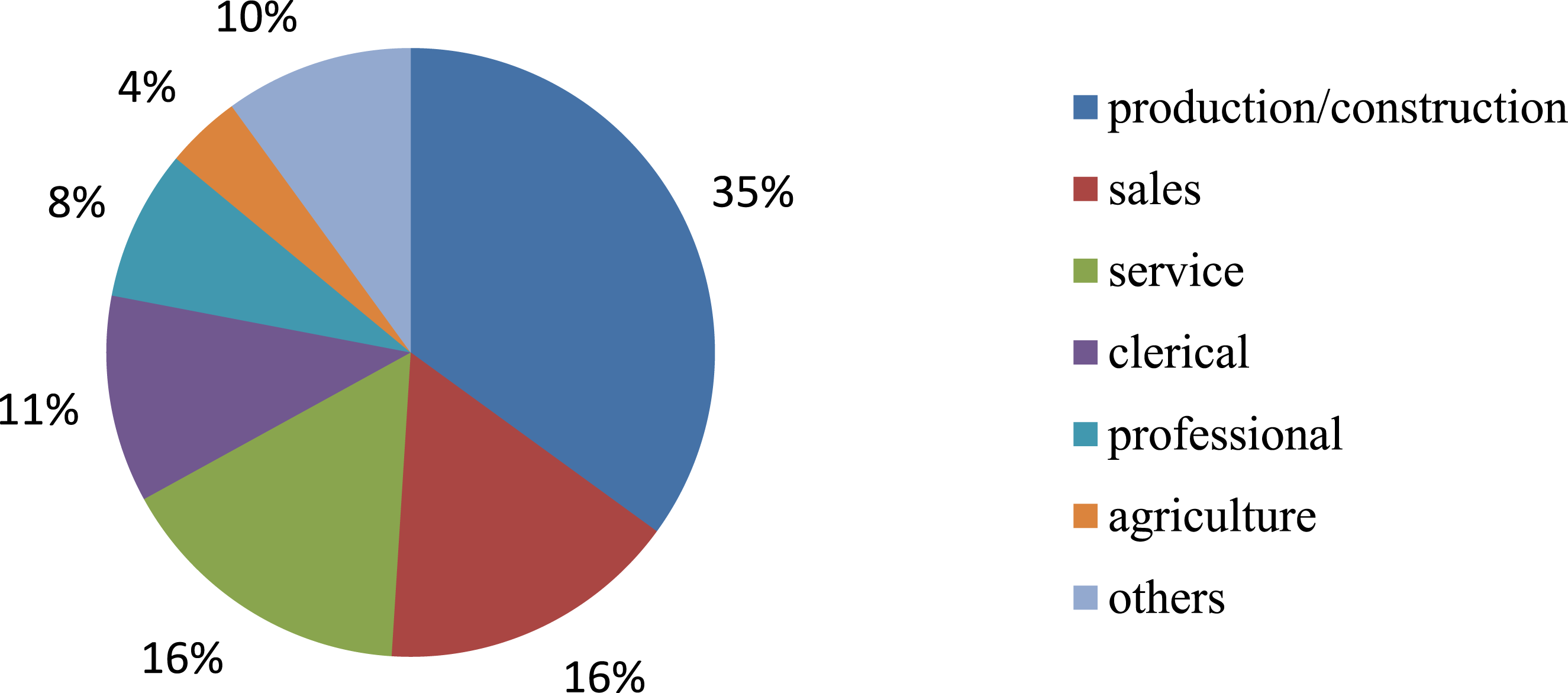
Although the data were collected a decade ago, the presence of Pakistanis in specific sectors remains almost the same. Pakistanis are mostly employed in production (35 percent), which relates to the construction sector. Recently, it has been estimated that Pakistanis residing in the UAE should be 1.6 million, and even if there were restrictions in place due to the COVID-19 pandemic, in “2022 […] the country was able to export 0.8 million workers in the Gulf region” (Farooq and Arif, 2023: 5201–5202) thus emphasizing an increasing presence of Pakistanis in the GCC countries.
While most Pakistani migrants are men who work in the male dominated construction sector, the presence of Pakistani women in the Emirati labor market is largely unknown (Shah, 2017). Since the 1970s, the Pakistani government has intentionally restricted the migration of female domestic workers to the Gulf due to women’s experiences of abuse and harassment in this specific niche of the Gulf labor market (Breeding, 2012). These restrictions have been partially removed, but based on 1979 Emigration Rules, there is a requirement that Pakistani women who are to work abroad in the domestic sector have to be aged 35 years or more (Shah, 2017). The Pakistani female migrants I interviewed in Dubai migrated as dependents (in some cases with their children) and some worked as professionals. Moreover, I also interviewed some members of the second generation who were born and/or raised in Dubai (and/or in the other Gulf cities) where they have spent most of their life, and who were also either university students or professionals.
In conclusion, as noted by Shah (2017: 132), the Gulf countries, and in particular the UAE, as the second largest GCC country in terms of destination country for most Pakistani migrants, have represented and still play a prominent role as destination countries insofar as migration is perceived as a way to alleviate “unemployment and underemployment pressures in Pakistan. Remittances continue to be a vital source of foreign exchange earnings.”
Cosmopolitanism and everyday integration
As emphasized by Thiollet (2022), ethnographic research in the Gulf cities has discussed the coexistence of cosmopolitan dynamics alongside diverse experiences of inclusion and exclusion. These studies illustrate how migrants navigate their daily lives, blending practices of belonging with moments of cultural negotiation, demonstrating both cosmopolitan behaviors and the complexities and challenges of their quotidian life (Le Renard, 2021; Vora, 2013).
While the term “cosmopolitanism” may not explicitly appear in official discourses (Thiollet and Assaf, 2021b), the remarkable superdiversity of Dubai’s urban landscape clearly reflects its cosmopolitan character. Similar to other global cities like Singapore (Molho, 2024), Dubai balances this cosmopolitanism with policies that prioritize nationals while accommodating the needs of its diverse population, especially highly skilled foreigners. For instance, initiatives such as the Golden Visa highlight a strategic, class-based approach by offering long-term residence to affluent foreign workers, demonstrating the country’s effort to attract and retain global talents, and, at the same time, such a visa tends “to prevent the settlement of lower-class immigrants (even those who have been long-term residents). Such discriminatory policies not only signal an emerging global rave for talent but are also evidence of a global class divide in residence rights” (Thiollet and Assaf, 2021a: 4). Dubai’s cosmopolitan character highlights its rich diversity, bringing together people of various nationalities, cultures, gender, generations and social classes. While class-based disparities may exist, it is equally important to acknowledge the existence of many spaces and opportunities within the city where individuals can connect and interact beyond the boundaries of state-imposed laws and regulations. These spaces can be defined as cosmopolitan canopies, meaning “settings that offer a respite from the lingering tensions of urban life and an opportunity for diverse peoples to come together. Canopies are in essence pluralistic spaces where people engage one another in a spirit of civility, or even comity and goodwill” (Anderson, 2011: XIV).
Recent studies on cosmopolitanism in the Gulf cities encourage us to look at them as more inclusive and open than they might appear. The Gulf cities are not only spaces of work and class-based structures, similar to other global cities where temporariness shapes the experiences of migrants, but they also serve as spaces where a sense of belonging and integration can flourish. In the UAE, like in other Gulf countries, there are not any policies aimed at integrating migrants. However, some of the middle-class Pakistanis I interviewed feel integrated into their everyday life in Dubai (Errichiello, 2023c). Integration is mostly conceived as “a set of normative assumptions, practices, policies, and discourses that are always embedded in specific contexts and directed to particular groups or categories of people” (Collyer et al., 2020: 2). This top-down approach can be disputed and challenged insofar as it focuses on exploring integration from a state-led perspective thus neglecting contexts where integration is not part of the political agenda. Indeed, everyday integration aims at conceptualizing integration from a bottom-up perspective which means unraveling how migrants experience integration insofar as they are routinely involved in practices and activities in multicultural spaces where different migrants share their everyday lives. This approach does not exclude the top-down or prioritize the bottom-up perspective but intends to unfold different experiences and practices of integration performed by migrants in contexts where there is not a state-led approach to integration. Indeed, everyday integration refers to those practices, discourses and experiences embedded in specific contexts (Errichiello, 2023c).
For the middle-class Pakistanis, integration is evident in those quotidian aspects of an individual’s life. Amal (23-year-old) was born in Dubai where she is now studying medicine. When she was younger, Amal did not feel integrated because she and her sister were the only South Asian students at the Emirati school. During the interview, she reflected on the challenges she faced in her everyday interactions; however, she later attended a school where most students were South Asians, which allowed her to feel a greater sense of connection with her peers. At university, Amal perceived and started developing awareness of her sense of belonging and integration: So, when it comes to medical school, there are certain discrimination toward I would say non-Emiratis […] we don't really get the opportunity for scholarship […] when I go into my internship here, only Emiratis get paid. However, any other nationality does not get paid at all. (Amal, 2022) [At] Dubai Primary School because I was the only Pakistani there, I wasn’t integrated at all. I didn’t feel included at all. I felt like an outcast and that kind of did shape a lot of my narrative until I came into Med school. So fortunately, I do have Emirati friends […] I thought they were rude and quite arrogant, but when I did start bonding with [them] on a personal level and friendship level, then I didn't find like “ohh I did standardize Emiratis as all the same all around” […] They welcome with a lot more welcoming behavior. I would say. So fortunately for me, that sense of integration, I can see it here. However, like you know, it comes from people, but I can't seem to see it and starting opportunities that are here when it comes to education or when it comes to what do we think even payment. (Amal, 2022) In fact, once I get a job as a […], I am eligible to apply for the Golden Visa and I most definitely would do so [she wishes to stay in Dubai as] all of my childhood and community is here. I am very attached and enjoy the convenience that Dubai provides […] I do feel integrated yes, because we share interests and opinions. There are certain things where I do feel a difference of course, mostly work opportunities […] it is not a hidden fact that there is a preference to hire and promote Emiratis. (Maira, 2022)
Class and social status determine the way migrants articulate their belonging and practices of integration in their everyday lives in Dubai. Rahman (38-year-old), who grew up and studied in Pakistan and afterward spent a few years in Saudi Arabia and Qatar, moved to the UAE to work for a Western company in 2014. He underlined how his lifestyle is expressed through contacts, social gatherings and events with fellow nationals, other foreigners and Emiratis. Because of his job, Rahman has a high standard of life, and he lives in a middle-class enclave. He said: It is an interesting lifestyle, there is a lot to do. You know my residence itself has a spa and clubs around, you have also most opportunities […] to explore the desert, you know there is a great beach, there is also outside the city where you can go and stay in a resort in the desert. There is also a lot of interesting people now increasingly in Dubai. I am connected with some filmmakers who will be experimenting with films, different topics, there is a comedy club close to our area [where he lives] where expats, Westerners and South Asians gather. So, there are lots of people now that are organizing which I think probably 15 years ago would not be present in Dubai at all. It was a very dry environment just to make money, but now there are more creative people actually experimenting with ideas. (Rahman, 2015)
Rahmiya (49-year-old), a Pakistani doctor who has spent more than 40 years in Dubai, describes her life in the city, and she highlights how temporary status has not impeded her to feel integrated. She has recently obtained the Golden Visa, and before getting it, she was obliged to renew her visa every two years. She said: OK, I would have liked that feeling of permanence here, but after 46 years it’s a little bit difficult to question. That is just become part of something that we live with […] it’s just our way of life renewing our visa every two years […] is just our way of life […] OK, so this is it. This is how it’s going to be, and we'll take it one day at a time. We take it two years at a time. (Rahmiya, 2021)
Ahmad’s (2017) ethnographic research emphasizes how conversion to the Islamic religion by South Asian domestic workers represents a change in their migration project
4
insofar as some of them decided to settle down in Kuwait permanently. Her research illustrates how their conversion was mostly driven by a spiritual and emotional attachment to the new context rather than a chance to overcome the social disparities existing in the country. As Ahmad (2017) has put it, being a (converted) Muslim does not erase ethno-racial and gender differences. Elsewhere, I have already explored how having a common religion is a way to express everyday integration in their quotidian life and routine (Errichiello, 2023a). Indeed, Hazeema (27-year-old), a young Pakistani doctor who moved to Dubai when she was four, expressed her appreciation for living in an Islamic country and city like Dubai, insofar as this: […] gives you the comfort to be yourself […] gives me a comfort level because I know that I can practice my religion and I can walk out in the streets wearing my hijab […] I can follow my Islamic principles and etiquette and I’m not going to be discriminated against that because the rules here give me that kind of protection and comfort and freedom. (Hazeema, 2022)
In the last few years, the UAE authorities in their national narrative have clearly included foreign workers (Horinuki, 2019). Pakistanis, like other foreign communities are, indeed, involved in the celebration of national events. Abdallah (49-year-old), a doctor who has lived in Dubai for more than 10 years, underlined the importance of links and feeling part of the Emirati context: […] We [Pakistanis] do a solidarity walk every year for the UAE national day, on the second of December, which is again first of this kind, unique solidarity activity, which is done by the Pakistani community only […] [it] is again a gesture as a community toward UAE that we are part of the society, and we celebrate the national day. (Abdallah, 2015)
The cosmopolitan character of Dubai is shown not only in its diverse ethnic restaurants and international schools but also in the everyday interactions between migrants and Emiratis. Some middle-class Pakistanis express a sense of belonging and integration in their everyday lives, through participating in cultural events and adopting lifestyles that resonate with both Emirati and Pakistani traditions. While the new visa schemes may reflect class-based distinctions and highlight differences, integration for many migrants is felt and expressed on an individual level through personal connections and shared experiences within Emirati society. The state’s narrative of openness and tolerance has positively influenced the Pakistani community, fostering stronger ties between Pakistanis and Emiratis. This is exemplified by collaborative efforts such as the establishment of the Pakistan Medical Centre (PMC), supported by Emirati authorities, which emphasizes the mutual engagement between the two communities. 6
Conclusion
In 2021, to celebrate the UAE’s Golden Jubilee, the authorities introduced new visa schemes, including the Green Visas, as part of their forward-looking initiatives. While these schemes may reflect elements of social stratification, they also enhance the appeal of Emirati cities, which continue to attract migrants drawn to the unique and affluent lifestyle the country offers. These initiatives cater to highly skilled foreigners and serve to present the country as characterized by economic dynamism and cultural diversity. Business opportunities, a cosmopolitan way of life and avenues for everyday integration are among those factors that greatly contribute to reinforcing the UAE’s position as a global hub for talent and innovation.
Recent studies on cosmopolitanism have demonstrated that forms of integration can take place in specific areas of the Gulf cities like Dubai. Everyday integration, which seems to provide an explanation for the contradictory attitude sometimes exhibited by migrants, is a useful analytical tool that can help us to better understand why some categories of foreigners decide to spend years in the Gulf cities. Indeed, the focus on middle-class Pakistanis illustrates how those who can afford that specific lifestyle can experience and perform everyday integration. From the Emirati authorities’ perspective, the new visa schemes seem to create a sort of stability and security for highly skilled foreigners. For middle-class Pakistanis who are fully aware of their temporary status, these schemes do not challenge their sense of belonging and integration that they perform and experience in their everyday life. At the same time, they can enjoy their lifestyle in the neoliberal and global Dubai, and privileges associated with their class and social status (Errichiello, 2023c).
In conclusion, in this paper, I have proposed a new approach to migration and integration, which moves beyond laws and rules implemented at a state level to accentuate the dynamic and cosmopolitan nature of the Gulf cities where some categories of migrants enjoy their life, feel a sense of belonging and integrate into their quotidian practices and experiences. It is, therefore, necessary to overcome the migration bias (Castles, 2010) to explore complexities, dynamics and strategies adopted by unskilled or low-skilled, and high-skilled migrants in their everyday life. It is easy to problematize migration in the Gulf countries as exclusionary and based on the “us versus them” dichotomy, however, it is, instead, necessary to move beyond the Western-centric approach to better situate the diversity of migrant experience in the Global South.
Footnotes
Acknowledgments
The author wishes to express gratitude to the Pakistani participants in Dubai for generously sharing their time and personal stories. The author wishes to thank the anonymous reviewers for their insightful and constructive feedback, as well as the editors of the Special Issue for their support and guidance.
Declaration of conflicting interests
The author(s) declared no potential conflicts of interest with respect to the research, authorship and/or publication of this article.
Funding
The author(s) received no financial support for the research, authorship and/or publication of this article.
Ethical statement
Consent for publication
Participants were informed about how their data would be used and published as part of the study during the informed consent process. They were clearly briefed on the study’s purpose, potential risks, and the ways their information would be handled, ensuring they understood their rights. Consent for publication was explicitly and verbally obtained. This ensured that respondents were aware of and agreed to the inclusion of their anonymized data in the study’s final publication.
