




Abstract
This article discusses relationships between temporariness and belonging among Pakistani middle-class migrants in Dubai. We explore reasons that push them to move to Dubai and how their professional position and temporary status affect their sense of belonging. Based upon unstructured interviews with 20 Pakistanis, our findings show that temporariness is problematized, but not explicitly contested, by the participants, who all expressed a strong sense of belonging to Dubai despite their lack of citizenship rights. We suggest that these findings relate to the participants’ ability to draw upon socio-economic resources and networks to enable further transnational mobility.
Introduction
The Gulf Cooperation Council (GCC) 1 countries are the destination of the largest migrant communities from Asia, such as India and Pakistan (De Bel-Air, 2018). Their migration is characterized by a temporary status which disallows migrants to settle down permanently. This article discusses the relationship between temporariness and belonging based on original qualitative research among Pakistani middle-class migrants (Errichiello, 2021), who are defined as such because of their economic, social and cultural capital in Dubai, one of the seven emirates that comprise the United Arab Emirates (UAE). Dubai can be conceptualized as a “transit lounge,” 2 signifying both the dynamic nature of the city and the fact that foreign workers’ lives are characterized by temporariness.
Temporariness, which has become one of the most debated issues in migration studies (Castles, 2006), means that migrants can work and reside in a host country only for a limited period. The temporariness and precariousness that typically characterize migrants’ status in the UAE is endorsed by government policies. Migration to the UAE is regulated by the sponsorship system (kafāla). To be employed, a migrant worker needs a sponsor who must be an Emirati citizen or a local company where the Emirati citizen owns 51 percent. Such a system determines a structure of dominance in which the employer is primarily involved in the management of migration (Longva, 1997). According to UAE labor laws, a contract must not exceed four years, after which it can be renewed by mutual agreement between the employer and employee, or the employee will have to leave the country. However, a new law also enables investors and professionals to obtain ten-year visas. Moreover, “in May 2019 the possibility of attaining permanent residency was introduced for a very select group of investors, entrepreneurs, specialized talents, researchers and outstanding students residing in the UAE” (Hvidt, 2019: 84). 3
Soon after the Second World War, Western European countries launched a temporary labor migration program, and the guest-worker system was adopted to facilitate the recruitment of foreign workers due to labor force shortages (Castles, 2006). In 1973, this system came to an end because of the oil crisis. However, the temporary migrant worker programs (TMWPs) were re-introduced in Europe in the 2000s due to neoliberal policies and globalization processes which led to a “context of flexible labor markets and a high geography mobility of the workforce, especially of low-income workers and highly skilled professionals” (Boersma, 2019: 274). This re-introduction of TMWPs has, however, raised concerns about temporary migrants’ integration in the country of destination. In particular, Samuk (2020: 62) contends that “temporary migrant workers are deliberately excluded from the scope of integration policies precisely because they are expected to stay for a limited amount of time.”
In the Asia-Pacific region, as well as in the GCC countries, migration policies routinely rely on temporariness. Singapore and Hong Kong, for example, are global cities (Sassen, 2005) which attract both low- and high-skilled migrants. Despite involving a sense of precariousness and uncertainty in everyday life, the temporary status of Asian students and white-collar worker migrants in Singapore (Gomes, 2019) and of Filipino migrants in Hong Kong (Boersma, 2019) do not prevent them from experiencing a sense of home and belonging. Our understanding of belonging is guided by Yuval-Davis’ (2006: 197) distinction between belonging as being “about emotional attachment, about feeling ‘at home,’” which denotes people’s orientations and attachments to places, locations and social categories (e.g., class, ethnicity and gender), and the politics of belonging as involving “specific political projects aimed at constructing belonging.” The latter can involve the construction of collective identities (e.g., based on ethnicity) as well as political claims-making about rights and recognition. As emphasized by Anthias (2015), belonging relates to material resources and income, which provide a sense of safety and enable societal participation. Belonging also relates to migration status (including citizenship), as legal rights may underpin notions of safety and opportunities for participation. Feelings of belonging are not necessarily tied to a fixed place or location; belonging is situational and contextual, and therefore dynamic and changeable, as argued by Anthias (2015). Moreover, feelings of belonging can invoke a range of locales where the past, the present and imagined futures are intertwined. In conditions of vulnerability, resourceful migrants can seek new opportunities for transnational mobility by deploying a “translocational positionality” (Anthias, 2015: 108), or what Gardner (2010: 89) calls “strategic transnationalism,” through utilizing transnational networks that enable their relocation and their activities to multiple countries.
The evolution of migration to the GCC countries is historically characterized by a wide range of migrants coming from different countries (Errichiello, 2012). Ethnographic research has hitherto focused especially on working class migrants, emphasizing the constraints and difficulties of their migration experience (see Gardner, 2010; Vora, 2013; Mahdavi, 2011; Kathiravelu, 2016; Ahmad, 2017). A study by Fargues et al. (2019), found that although low-income migrants in the UAE were attracted by job opportunities, public safety and a “strong rule of law,” their sojourn was characterized by precarious working and living conditions, enhanced by job and visa status insecurities. Moreover, studies of temporariness and belonging in the GCC countries have shown that these are important issues for Indian and non-Gulf Arab migrants. Pakistani migrants are only briefly mentioned in studies of South Asian migrants in the Gulf, and as such, they have largely been neglected in previous research. Very little is therefore known about how Pakistani migrants in Dubai negotiate the relationship between temporariness and belonging.
In this article, we discuss reasons that motivate Pakistani middle-class migrants to move to Dubai, and how their temporary status affects their sense of belonging. We also explore whether the material resources and social networks of Pakistani middle-class migrants enable a relatively privileged “translocational positionality” (Anthias, 2015: 108) from which it is possible to articulate a sense of belonging to Dubai despite the precariousness of the kafāla system and the lack of permanent citizens’ rights. This positionality relies on visions of alternative routes for onward migration or “homeland return” when labor contracts end and migrants face having to leave Dubai. Next, we review relevant literature on temporariness and belonging among migrants in the GCC countries. This is followed by a discussion of relevant contextual factors pertaining to Dubai and the main characteristics of the Pakistani community in the UAE, our research methods, and the analysis of our findings. The conclusion summarizes the overall contribution of our research.
Temporariness and belonging in the GCC countries
Temporariness has been debated in scholarship on the GCC countries, where migrants, despite the absence of legal rights to permanent settlement, can arguably be considered as “permanent settlers” (Ali, 2010). Their status of “permanent impermanence” (Ali, 2011: 554) is not necessarily preventing migrants from enjoying life in the Gulf countries. In his research on second-generation migrants of mainly South Asian origin and members of the middle class in Dubai, Ali (2011: 561) showed that those who had studied in Western countries opted to return to Dubai for family reasons and “a lifestyle that in many ways is better than how they would live in the West or in other Asian or Arab countries of origin.” In light of their temporary status and the near impossibility of obtaining citizenship, this sense of belonging, based on family ties and material resources, seemed to be more strongly felt than the precariousness and uncertainty of their migration experience. However, temporariness is not only an individual condition, but also a structural property that affects migrants’ sense of belonging. As Ahmad (2017: 66) contends, in relation to domestic workers in Kuwait, “temporariness does not simply reflect their being in a liminal position […] between South Asia and Kuwait. Their temporariness ensures their pivotal role in the dual production and reproduction of citizens, families, households, and ethno-national forms in South Asia and the Gulf.” In other words, South Asian domestic workers are essential to the everyday functioning of Kuwaiti households and to supporting their families in the country of origin. For them, being temporary does not mean that they view their life as strictly limited to employment and work in the country of destination, and their conversion to the Islamic religion has created a new modality of belonging (Ahmad, 2017).
Temporariness is deeply intertwined with the issue of citizenship and belonging (Ali, 2010; Gardner, 2010; Kanna, 2011; Vora, 2013). Several ethnographic studies show that citizenship, conceived of in terms of territorial belonging, is an important issue for many South Asian migrants, especially the second generation, who often perceive themselves as “second-class” citizens (Kanna, 2011; Vora, 2013). As some scholars (e.g., Akinci, 2019) argue, second-generation migrants have claimed the “right” to remain in Dubai based on their long-standing presence and contributions to the city. For Ali (2011), however, second-generation expatriates in Dubai do not perceive citizenship as an issue; they accept their temporary status as permanent, and by simultaneously possessing residency or citizenship rights in some Western countries, they exhibit a transnational behavior by studying and working abroad and spanning their life across multiple countries. Similarly, Vora’s (2013: 5) study of members of the Indian middle class and elite in Dubai revolves around the notion of belonging/non-belonging, or around the multiple “ways of thinking about what it means to be a citizen of a place.” She suggests that the Indian elite first and foremost consider themselves as Indians, and that they are not interested in political belonging to the UAE through citizenship. However, the Indian middle class would aspire to obtain Emirati citizenship, but they are “not willing to sacrifice their Indian identities or even their Indian citizenship” (Vora, 2013: 122). At the same time, they express a middle-class belonging through a consumer citizenship where they make choices and exhibit a taste for the goods and services available in Dubai despite lacking resources that would enable them to feel fully engaged in the practices of consuming the luxury life of the city. Vora (2013) contends that Indian women, who experience fewer constraints from males and family in Dubai than in India, view migration and their life in Dubai as a concrete opportunity to build their own independence.
In her survey of second-generation non-citizens in Kuwait, Shah (2017) contends that (non-Kuwaiti) Arabs, more than Asians, consider Kuwait as home, and that their sense of belonging and social integration is enhanced by a common language, long-time residence in the country, and their historical contribution to the early development of Kuwait. She also emphasizes a kind of “gendered belonging” (Shah, 2017: 156; see also Vora, 2013), as the women in her study (due to the presence of their family), reported that they were happier and more inclined to consider Kuwait as their home than the men.
The above studies have discussed the issue of temporariness and belonging among migrants in Gulf countries. However, the Pakistani community, which is the second largest community in some GCC countries (e.g., Saudi Arabia and the UAE), has largely been overlooked in the extant scholarship on migration in the Gulf region. This article is the first attempt to examine some of their experiences in the Gulf region, specifically the Pakistani middle-class migrants and their perceptions of temporariness and belonging. As such, it aims to contribute to an increased understanding of the challenges and dynamics of the Pakistani diaspora in Dubai.
Research context
In the nineteenth and twentieth centuries, Dubai’s history was characterized by extreme poverty and the presence of only a few hundred inhabitants. Between the 1950s and the 1970s, the oil economy transformed this poor and mercantile emirate into a modern and global city (Abdulla, 2006; Sassen, 2005). The emergence of Dubai as a modern city and its development made it a metropolis embedded in the neoliberal world economy characterized by a polarized social structure based on wealthy Gulf Arabs and expatriates on the one hand, and excluded and marginalized construction and domestic workers on the other (Vora, 2013). Ali (2010) has documented Dubai’s global intent relating to investments in infrastructures, the creation of a relaxed taxing environment, a massive presence of migrants, and the diffusion of a consumer culture.
After the formation of the UAE federation in 1971 and the 1973 oil boom, Dubai diversified its economy because of the lack of huge oil reserves (Davidson, 2008). The then ruler of Dubai (Rashid bin Said Al-Maktum, who ruled from 1958 to 1990) and his successors, started developing and strengthening the services and financial sectors to support the emirate. Due to a local labor and skills shortage, the Dubai authorities began recruiting foreign workers, especially from South and East Asian countries. In Dubai, the adoption and implementation of economic measures to increase and diversify the local economy was led by a far-sighted ruling family (Kanna, 2011).
Like in other Asian and Middle Eastern countries, there has been a top-down, state-led approach to the implementation of a neoliberal socio-economic order in Dubai (Ong, 2006). But unlike other contexts, such as Singapore (Jun Jie, 2014), Dubai’s neoliberalism is constructed through the simultaneous preservation and improvements of privileges and services for a few Emiratis, and the disempowerment of marginalized groups including migrants (Kathiravelu, 2016). Neoliberalism in Dubai is entrenched in the system of political power and the new middle class consisting of naturalized citizens 4 with a migration background.
Migration from Pakistan to the UAE has emerged from a complex set of social, political and economic circumstances in both countries (Errichiello, 2021). The links between the UAE and Pakistan have been shaped over time with many Indians migrating to the Gulf region before the Partition that in 1947 led to the formation of Pakistan (Ahmed, 1984). Prior to the COVID-19 pandemic, Pakistanis in the UAE numbered 1.2 million (De Bel-Air, 2018). They work in every economic sector, from construction, banking, shopkeeping and street cleaning, to the university sector. Pakistani men have mostly migrated alone, leaving their wives and families at home and sending back remittances. However, professionals (8 percent) tend to bring their family with them because of their high salary. 5 While most Pakistani migrants (35 percent) in the UAE are men who work in the male-dominated construction sector, the presence of Pakistani women in the UAE labor market is largely unknown. Since 1979, the Pakistani government has intentionally restricted the migration of female domestic workers to the Gulf due to women’s experiences of abuse and harassment (Mahdavi, 2011). A majority of Pakistani women migrants (and their children) 6 in the UAE have migrated as dependents. However, some work as professionals while others are employed in the domestic sector or are homemakers. The Pakistani women included in our research were highly educated and employed in the professional sector.
Research methods
A qualitative approach was chosen for an in-depth study of meanings and experiences of the participants who were interviewed in Dubai in October and November 2014, and in October and November 2015. Ethical clearance for the research was obtained from Loughborough University’s Ethics Committee. Informed consent was given by the research participants. The unstructured interviews lasted between one and six hours, and were conducted in English, in a variety of public and private settings (offices, cafes, and homes). The audio-recorded interviews were transcribed. The interview data have been anonymized and pseudonyms are used in this article.
Migration is considered a sensitive issue by the Emirati authorities because of the demographic imbalance wherein Emiratis are a minority in their own country (De Bel-Air, 2018). Discussions about the working and living conditions of low-wage migrants in particular could be viewed by Emirati authorities as an intrusion in national affairs (see Ali, 2010). However, as the fieldwork for this research was undertaken by a white, non-Muslim male researcher, it was easier to approach and build trusting relationships with professional Pakistani men than with women. The traditional gender division between male and female spaces in Emirati society (and in other Arab and Islamic countries) is a challenge particularly for male researchers. Gender segregation is perceived to safeguard family honor; therefore, honor and modesty are both associated with the public behavior of women (Bristol-Rhys, 2010). Thus, any meeting between the researcher and a Pakistani woman were done in public spaces (e.g., cafés and offices).
The focus of the study is middle-class Pakistani professionals in Dubai. The 20 interviewees were recruited via snowball sampling, with the first contacts referenced to recruit other participants from their acquaintances, friends and family members. The characteristics of these interviewees are summarized in Table 1. The participants’ age ranged from 20 to 70 years old. Fifteen of the interviewed migrants were men while the rest were women. As shown in Table 1, they worked in different fields. The majority of the male participants were the main breadwinners of their family units. They initially migrated alone and were joined a few years later by their wives and children.
Frequency distribution of research participants’ characteristics.
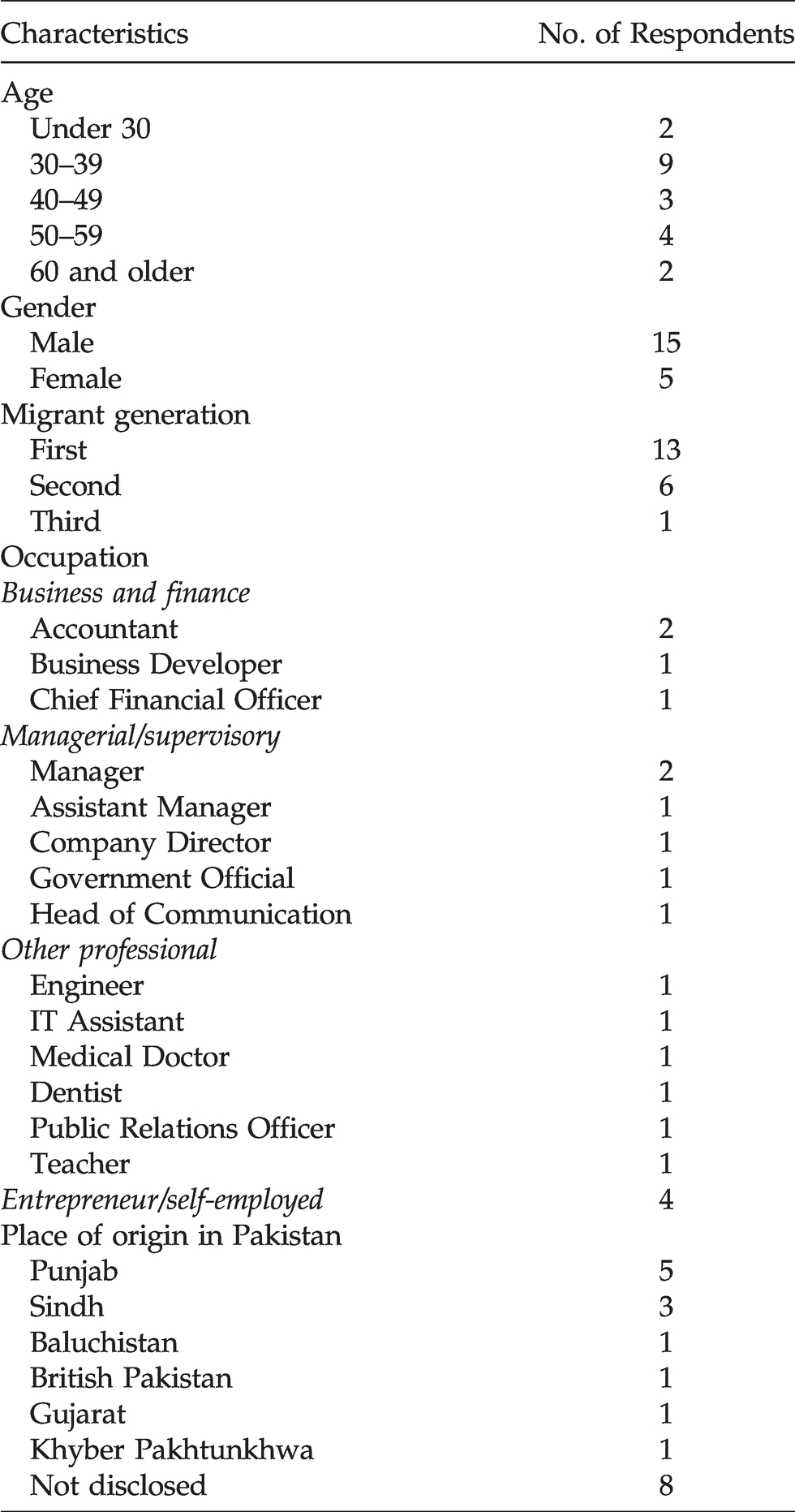
Our participants originated from different regions of Pakistan, including Punjab, Sindh and Gujarat, and they arrived in the UAE between the 1970s and 2000s. The majority of them were first generation migrants, meaning they were the first of their household to migrate to the GCC countries. We also interviewed members of the second generation encompassing those who were born and/or brought up in the Gulf countries and whose parents migrated in the 1970s and 1980s. Only one participant belonged to the third generation whose grandparents migrated to Kuwait in the 1950s to work in the oil industry, and his father was born in the Gulf country.
The Pakistani community in Dubai is diverse in terms of gender, and it is also ethnically and religiously stratified. Our participants described themselves as Sindhis, Punjabis, Baluchis, and a Mohajir (whose family migrated from India to Pakistan after the Partition in 1947). All the participants were born Muslim, with a majority being Sunni Muslims; one participant was an Ismāʿīlī Muslim, and one identified himself as an atheist. The diversity of the sample represents one of the strengths of the research as it allows an account of different subjectivities and stories. With an unstructured interview format, participants were encouraged to talk about what they thought was important in relation to their migration experience in Dubai. The 20 formal interviews, and informal conversations recorded via field notes, were analyzed via thematic analysis. Themes and patterns relating to temporariness and belonging emerged as central to the participants’ lives as migrants in Dubai.
Findings and discussion
The discussion of findings addresses two different, but closely intertwined themes that are linked to the participants’ middle-class status: the reasons that motivate their move to Dubai, and how they perceive and negotiate temporariness and belonging.
“Dubai is a transit lounge”: Middle-class professionals, culture, religion and belonging
Despite the difficulties, exploitation, hierarchies, segregation and racism discussed in extant academic literature and reports by international organizations (e.g., Human Rights Watch), and experienced by migrants in Dubai and in other Gulf cities, people continue to migrate to the UAE and other GCC countries (Gardner, 2012). The reasons that push people to migrate to Dubai are complex and cannot be reduced to economic factors. For example, in their research on highly skilled migrants in Qatar, Babar et al. (2019: 1561–1562) have emphasized that determinants of attraction differ according to nationality: “Arab migrants are most attracted by local security and stability in Qatar,” whereas “South Asians and East Asians […] prioritize the lack of taxation as the most important factor that attracted them to Qatar in the first place followed by the ability to save money.”
The notion that Dubai is “a transit lounge” was articulated by one of our participants, Rahman (38-year-old male), who grew up and studied in Pakistan. In the early 2000s, he applied for a banking job in Saudi Arabia and after working for a year there, moved to Qatar, and in 2014 decided to transfer to Dubai. He now lives with his brother, also a professional, and with his mother, in an expensive and luxurious compound which accommodates middle-class Western, Indian and Pakistani migrants. The mother wishes to return to Pakistan with her two sons should Rahman or his company decide not to renew his contract. Describing Dubai, he said: […] [Dubai] is a fun place […] it is a commercial place also […] [people] use it as a transit lounge […] So, this is like a place to come and have some fun and move away to another destination […] For the South Asian community […] they come here to save money, and most people immigrate here as a springboard to Australia and Canada because here they save enough for a few years and then they want to get the Australian and Canadian passports.
Rahman’s quote below illustrates the complexity of reasons that push people to migrate, such as a lack of political and economic stability, and religious intolerance. He stated: […] mainly because of the tax-free dollars. A lot of Pakistanis that I know come here because they are escaping instability, rising inflation back home, a deteriorating environment in many ways, in terms of religious tolerance […] my objective is to stay connected because it is close to my country, so it is like living abroad saving tax-free money and then getting close to home because it is a one-hour flight from my home city. Dubai is not [a proper] Islamic city. Dubai is more of a cosmopolitan city, with the best of East and the best of West. You see you can have many issues in Dubai, but you do not feel you are away from home. Dubai attracts you because you have freedom […] You have an Indian market in Deira, or Bur Dubai, and you know you feel you are like in a part of India or Pakistan […] But Dubai is not an easy city, in the sense that it is an expensive city […] we do preserve our Pakistani identity, we do it all time. There are different groups of people who promote cultural activities, who promote many kinds of things, which […] also projects the image of your country that you have culture, we bring different seminars, exhibitions, shows, so we have all these projects to show we have our culture and [how] we relate to our culture and identity.
As a port city, Dubai is exposed to exchanges with other cultures and people from different countries with different religions and languages. In 2000, upon getting married, Leila (36-year-old female), moved from Pakistan to Dubai. She works in business development. The UAE was the first foreign country that she visited, but she quickly adapted to her new country and social status. Reflecting on life in Dubai, Leila said: […] I feel it is a very good blend for us at least. As Muslims, it is like you can get everything without any problems, such as halāl [permissible] food and so on and we have got no issue for those things, you know. You have got a great exposure to the East and West, you have the opportunity to meet people from all over the world […] I fast, I pray, I do all these things […] we get together, obviously with the family, I have a lot of family here also, cousins, […] my daughter is extremely close to everyone and I make sure that she is.
The multi-cultural nature of Dubai is linked to its geographical position, and the proximity to the Indian sub-continent has led to the arrival of many migrants from the region. Muhammad (50-year-old male) moved to Dubai in 1975 when he was very young, because his father was working for a local company. Later, Muhammad studied in the UK, and after graduation he returned to Dubai to establish his own company. He said: […] Dubai […] is very close to Pakistan so it is very easy to go there […] So, it is very easy, it is one and a half to two hours’ flight […] It is very convenient for us because we are very close to our family and friends in Pakistan […] we still have a lot of family and friends there. So, I do go, I visit Pakistan three or four times a year for family and personal reasons.
From Leila’s quote above, it is apparent that religion also plays a role in shaping the everyday life of Pakistani migrants. Dubai preserves its Islamic identity, as evidenced by the presence of mosques throughout the city. Religion can also trigger the decision to migrate to Dubai. The religious dimension represents the Pakistani migrants’ national and religious identity, home and community life, and sustains a feeling of belonging. They are aware, however, that belonging to the umma, or global community of Muslim believers, does not challenge or subvert the existing hierarchical social structure and asymmetrical power relationships existing in the UAE (Ahmad, 2017). The relevance of religion was also emphasized by Abdallah (49-year-old male), a doctor who was born in Kuwait where his parents spent 22 years, after which his family returned to Pakistan where Abdallah graduated as a doctor. Upon graduation, Abdallah spent a few years working abroad, and, in 2009, he moved to Dubai, where he works for a private hospital. He said: It [Dubai] was close to home and culturally and religiously more acceptable […] obviously from the religious point of view it was more acceptable to be in Dubai than anywhere [else] and it was close to home, my parents are getting old, so they needed me to be close […] I think you feel closer to your religion and culture here, we have a big expat population of Pakistanis here. So, to be honest you do not feel to be out of Pakistan here. We consider the UAE as a second home; we have very strong relations with the UAE from the very day of independence. Pakistan was one the first countries to formally recognize the UAE. I think Dubai has two parallel worlds. One is that they are proud of their religion, which shows in the provisions that they have, beautiful mosques, malls in which you have prayer rooms […] They cater to somebody who wants to practice their religion, and it is prominent in that sense. In the other sense, I also feel they do not stop anybody else from practicing their religion, they respect that, at least from what I have seen […] there is a church here and these kinds of things. I think Dubai can be whatever you want it to be as long as you are not creating any problems for the society at large. […] here [in Dubai] I also feel comfortable as a Muslim. For example, wherever I go, for us even a smile or to greet somebody with as-salām, which is peace, is an act of worship. I found myself doing that all day, so it feeds my soul a little bit […] you go in the shopping center you find a prayer room. And I find generally I feel more safe, more secure, I do not feel like a minority […] in England where I was born and raised, I have never had any particular issue as well, but it is a different feeling not being a minority in terms of your faith, for example. So, when I go shopping or when I go to a restaurant to eat, I do not have to think twice, I can choose anything, everything is catered toward somebody else of the same faith as myself.
It becomes evident that several factors contribute to blended constructions of belonging to both Dubai and Pakistan. The celebration of the Pakistan Independence Day on the 14th of August is considered by the Pakistani community in Dubai as one of the most significant events to celebrate. Listening to Pakistani music, watching Pakistani films, speaking Urdu (the official language of Pakistan), displaying pictures of Pakistani leaders, and celebrating Pakistani festivals and events, serve to create strong links within the Pakistani diaspora and with the homeland. The migrants recreate a “home away from home” by displaying objects and artifacts that recall their own homeland, traditions and customs. But they also construct belonging “with” other individuals who are not necessarily Pakistani nationals, but with whom they live and work, and share experiences, constraints and practices in everyday life (Khalaf and Alkobaisi, 1999).
Unraveling the reasons that motivate Pakistani professionals to migrate means understanding that their migration is conceived of as a project (for which they mobilize their social, cultural and economic capital) and driven by a desire to construct belonging in a different locale (Errichiello, 2021). Nonetheless they continue to maintain links with their own culture, language, nation and heritage. These stories and experiences reveal how the Pakistani professional migrants’ discourse on belonging is framed within transnational, trans-local and global lenses. It is transnational because it is forged between the countries of origin, destination and beyond; it is translocational in the sense that belonging is constructed through movement between different spaces, places and contexts; and, global as well with the participants’ reference to Dubai as a meeting place between the East and the West. Our findings show that the decisions by Pakistani professionals to migrate to Dubai, and their actual sojourn in the city, involve constructions of belonging that rely on shared ethnic identities, culture and religion. Moreover, our research participants articulated a “trans-locational positionality” (Anthias, 2015: 108) that encompassed a transnational outlook on the past, the present and the future, nourished by Dubai as a global city and by transnational social networks.
Temporariness and belonging
As stated above, all migrants in the UAE are considered temporary migrants, including children of foreign workers who are born in the GCC countries. However, migrants with a good command of Arabic, and who have, among others, spent many years in the country, can apply for citizenship (Lori, 2019). Our research suggests that Pakistani middle-class professionals’ temporary status impacts on their forward planning and exit strategies; yet it does not prevent them from constructing an everyday sense of belonging in Dubai. Furthermore, their temporary status does not prevent a meaningful interaction with others within the Dubai context. Our research shows that social interactions take place with other fellow nationals, migrants and Emiratis in the workplace, as well as in the context of leisure activities.
In their ethnographic accounts, both Ali (2011) and Vora (2013) have emphasized that temporariness affects migrants’ daily lives in Dubai. Vora (2013: 89) has, however, argued that Indian elite migrants find a way to construct a sense of belonging despite the temporariness of their stay: “Dubai as a whole was a site of belonging even as it included several spaces of non-belonging,” such as the new part of the city where a sense of non-belonging is experienced especially by unskilled and semi-skilled migrants. Our research on Pakistani middle-class migrants supports Vora’s findings regarding temporariness. During our interviews, the recognition of their temporary status was one of the main elements underlined by the participants. Zia (53-year-old male), for example, said: […] the one thing that I have always put in my mind is that this is not my country. One day I have to leave this country. It is very, very clear to me. Whatever policy they pursue, they put in this place, I take it as is their right, whatever they want to do.
The research participants’ discourse on temporariness is intertwined with governmental policy and the labor market as well as their respect for the “law of the land.” Dunya (37-year-old female) had previously studied and worked in Pakistan and in the UK. She first moved to Abu Dhabi after marriage, and later to Dubai (with her husband) where she now works for an international company. Dunya underscored how temporariness affects all migrants and that their temporariness involves a considerable element of risk, potentially undermining any sense of basic security. […] You have to be mentally prepared to move to this country. I have seen most Pakistanis when they come here, they have no assets in Pakistan and suddenly when they lose everything [i.e., job], they say “Oh my god, we have to return to Pakistan, we do not have a house.” […] My dad has never actually settled down here because he always had in mind that we could go back anytime. So, we never settled down, you know we had things […] in storage because he did not want to use […] I am going into this mindset as well, I do not know how long I will be here, I do not want to buy this painting for my house, I do not want to do this.
Ismail also underscored that temporariness is generally recognized by people who decide to migrate to Dubai. Like Zia, he noted that the host country is entitled to create its own rules regarding the status of migrants, which migrants must accept: I met somebody here once, when I first came. I think he has a construction company and I think he has lived here for about thirty years. He said “I still feel like a visitor,” you know, because it is a transient place, you know, you feel like you are just passing through because there is no opportunity for anybody to become a resident […], which again, I think […] it is a privilege of the people who rule that it is their right to decide what they want […] it does not matter how long you live there, you know, you cannot become a resident. You make your own decision to come based on that; nobody forces you to come. […] a lot of my friends and family are also in this frame of mind, where they think we need something more permanent now. We are now at that point that we have seen that our fathers worked here and they had to go back [to Pakistan]. So, we are realizing okay, this is not permanent; we need to think of some options. My sister has applied for a Canadian immigration; I have some friends who recently moved to Australia, to Canada. Everyone is thinking of a permanent place.
Temporariness and middle-class status are closely related due to the different working conditions of migrants and how such conditions enable and/or constrain their migration experience. In Dubai, professionals enjoy the so-called “expat compensation packages” (Boersma, 2019: 274), which entail receiving a high salary and allowances, free housing (covering rent and bills), healthcare, free schools for children and the chance to bring along family members. Most Pakistani professionals we interviewed in Dubai work for international companies, and if they have permanent contracts, they are only required to renew their residence permit. For professionals, temporariness is also an issue insofar as their permanence in the country is affected by instability and uncertainties. However, the Pakistani professionals in our research suggested that they have a wider range of available options, going “back and forth” between Dubai and the home country, or moving to a third country which potentially can become a permanent home (as exemplified by Farida, above).
However, temporariness has not hindered our participants from enjoying a different lifestyle and the entertainments of Dubai. Some of them live in middle-class enclaves, own a house, and have their own business, thus enabling them to create a “home away from home.” A couple of years ago, after his retirement, Hamza (who was introduced earlier), decided to move to Canada to join his son and settle there as a permanent resident (Hamza, personal communication, 2 July 2018). Another option was expressed by Dunya, who noted that some professionals obtain housing in Pakistan to secure their eventual home return: Construction workers live on a day-to-day basis, but people in my category have been here for 20 years, 30 years or more, at least they have built a house or bought an apartment in Pakistan which can be a back-up plan. But most people do not have it. Dubai lures you, attracts you, the glitter, the glamor, people who come here they do not want to leave. When I lost my job here [last year], I lost my Emirates ID card. When I did not have an ID card, I could not rent a car, then I had to be on another visa, a visit visa. All complications followed and everything became difficult. It was so scary; I had to move to another country three times to get my visit visa renewed as a Pakistani.
Temporariness might inhibit different forms of social contact and interactions between migrants and the wider UAE context. Most of our participants underscored that they did not have many opportunities to interact with Emiratis, and some of them expressed concerns about the issue of discrimination experienced in some Western multinational companies in Dubai. For example, Dunya said “Westerners have very little experience, very low qualifications but just because of the passport and their nationalities, they are paid a lot higher.” Some participants, however, emphasized their good relationships with Emiratis beyond the work environment. Leila, for example, said: “I have lots of friends from all different nationalities; you will be shocked [how well] I get along with all different people. I am friends with Emiratis as well.”
Conclusion
In conclusion, for our participants, temporariness did not constrain everyday life and contacts with other migrants. Although Hvidt (2019: 88), in his study on highly skilled migrants and development in the UAE, argues that a “culture of transience is prevalent which leads to short-term thinking, less innovation and less likelihood of entrepreneurship,” our research among Pakistani professionals shows that belonging is constructed beyond legal status, formal membership and material resources, or beyond the rules and structures of the migration context. Our findings show that the interviewed Pakistani professionals are clearly affected by temporariness, in that it engages them in forward planning and exit strategies that often involve transnational networks. At the same time, however, they also express a strong sense of belonging to Dubai because of the opportunities it offers for upward social mobility and onward migration. The ethnic, cultural and religious ties they have formed in this global city also support a strong feeling of belonging.
All temporary migrants in Dubai, regardless of their occupation, must cope with the vulnerabilities and uncertainties of their insecure status. However, the migrants’ occupation and social status influence whether and how they can mitigate against such vulnerabilities by saving money and relocating. Several of our participants mentioned that they are preparing to exit Dubai in the future by purchasing property in Pakistan or moving to a third country. For middle-class migrants, such onward transnational mobility is enabled by the strategic use of social networks and ties to family and friends already living in different countries. In comparison, unskilled migrants with low salaries and poor working and living conditions cannot opt for this strategy, and their migration is instead geared toward a return to their home country (Kathiravelu, 2016).
Our findings also suggest that, despite the temporariness and consequent vulnerability that all migrants in Dubai experience due to the sponsorship system and an insecure status, Pakistani middle-class migrants can construct a sense of belonging to Dubai in their everyday life, in ways similar to the Indian migrants in Dubai studied by Vora (2013). Their emotional attachment to Dubai is strongly related to a shared ethnic identity, culture and religion among the Pakistani diaspora in Dubai. This feeling of belonging co-existed with an overall sense of temporariness as challenging everyday safety. While their emotional belonging invoked a sense of shared identity as “Pakistani” in Dubai and references to Pakistani culture and the Islamic religion, the participants did not articulate any “specific political [italics added] projects aimed at constructing belonging” (Yuval-Davis, 2006: 197), such as political claims-making related to permanent residency and citizenship rights. These findings contrast with previous studies of both Indian and non-Gulf Arab migrants, and especially second-generation migrants in Dubai, who claim their deservedness of Emirati citizenship on the basis of their “parents’ contributions to building the nation and its economic growth” (Akinci, 2019: 6). In contrast, Pakistani middle-class migrants in our study expressed an ipso facto acceptance of their temporary status, which is tied to their middle-class status and the availability of opportunities for onward transnational migration (Ali, 2011).
By focusing on Pakistani middle-class migrants in Dubai, our research has introduced new subjectivities and stories in understanding migration in the GCC. As noted, Pakistanis in the Gulf countries are sometimes discussed together with Indians, overlooking that they have a specific migration pattern that differs from that of Indians, as well as from Bangladeshis and Sri Lankans. The risk of homogenization is implicitly evident when considering Pakistanis simply as South Asian migrants. Instead, we must consider the experiences and outlooks of specific groups to fully understand the wide range of challenges that migrants experience and cope with in the GCC countries. With its focus on middle-class Pakistanis, this study has its limitations, as there are marked differences between the experiences of middle- and low-income workers. Low-wage migrants are forced to live with poor working conditions, in same cases in labor camps (construction workers); their contract may expire after a couple of years, and if it is not renewed, they must leave the country. Moreover, because of their low salary, they cannot bring their family with them. Their working and living conditions provide a migration experience that is mainly geared toward returning to the home country (Kathiravelu, 2016). Further research on Pakistani migrant communities in the Gulf region that expands our knowledge of how, for example, class, ethnicity and religion intersect with gender is needed.
Footnotes
Acknowledgments
The authors would like to thank the Pakistani research participants in Dubai for sharing their time and stories with us. We would also like to thank the anonymous reviewers.
Declaration of conflicting interests
The authors declared no potential conflicts of interest with respect to the research, authorship, and/or publication of this paper.
Funding
This research was supported by a doctoral studentship from Loughborough University, UK.
1
GCC member countries include Bahrain, Kuwait, Oman, Qatar, Saudi Arabia and the UAE.
2
This expression was used by one of our research participants.
4
To be considered a “national” with benefits and advantages in the UAE, it is insufficient to hold a UAE passport. To be considered a “national,” an individual must have the khulāṣat al-qayd, or the “family book,” which lists all members of a family, beginning with the male family head. A naturalized citizen is not a “national,” and naturalized Emiratis do not enjoy the same benefits and advantages as “pure” Emiratis. Because they do not possess the family book, naturalized Emiratis are not “eligible for government benefits such free education, land grants, housing, direct cash payments and other welfare benefits, despite acquiring UAE passports” (Ali, 2010: 137, see also Lori,  ).
).
5
Numerical data on the proportions of professionals and construction workers were provided by the Pakistani Consulate in Dubai to one of the authors in November 2014.