




Abstract
This paper uses social anchoring to emphasize the psychological dimension of foreign professionals’ access to employment in South Korea and Japan. South Korea’s “occupation-centered” employment system provides relatively easy access to migrants in high-tech fields. However, migrants outside such fields face psychological insecurity because of stringent visa regulations and limited job opportunities. In contrast, migrants in Japan’s “organization-centered” employment system have easier access to stable employment, but only if they conform to Japanese homogenizing business norms. In sum, highly skilled migrants may not foresee a promising future in either country given the elusiveness of socio-psychological security.
Keywords
Introduction
The “Uber model,” as described by Hugo, a Pakistan-Canadian business consultant in South Korea (Korea hereafter), with reference to the world-famous delivery service, highlights his perceptions about Korea’s immigration policy which considers foreign talents to be “independent contractors” who lack government support when trying to find employment in Korea. In Japan, “it is important to have been trained at a Japanese university. Then it doesn’t matter who you are,” was how Nicole, a German woman employed in a product testing company, commented on her struggles to access the Japanese labor market. In her case, she had not studied at a Japanese university and thus needed almost a year to find a job.
The interviewees of this study are the people who are the focus of ever-new migration policies. The governments expect these highly skilled foreign professionals (HSFPs) to boost innovation and fill labor market needs, and some countries have already implemented a policy to attract these HSFPs, such as the points-based preferential system in Japan (Oishi, 2021) and Brain Pool or Gold Card Programs in Korea (Kang et al., 2018). After the outbreak of COVID-19, many economically developed countries have re-emphasized their policy priority on the global competition for talent (OECD, 2022). However, in line with the abovementioned quotes, HSFPs in Korea experience difficulties in entering the labor market and finding stable employment, whereas those in Japan criticize the limited and highly structured entry channel, which primarily requires degrees from Japanese educational institutions. HSFPs in both countries face restrictive access to employment, but the specific difficulties they encounter are different.
This paper examines Korea and Japan—two emerging destinations for skilled migrants—especially migrants from Asia, the most populous region in the world. Comparing these two countries from the premise that they are “most similar cases” (Nielsen, 2016: 569), Korea and Japan experienced similar economic, demographic and social shifts (Peng, 2004), and they have implemented similarly restrictive immigration and citizenship policies, rooted in ethnonationalism (Chung, 2020). In both countries, there is a myth of ethnic homogeneity that defines each national identity over its shared bloodline (Befu, 2001; Shin and Choi, 2015). However, in the last couple of decades, rising numbers of immigrants—including skilled migrants—have challenged the restrictive migration regimes in place. It is therefore necessary to understand the process of seizing employment and—next to the structural and legal obstacles skilled migrants might encounter—how they subjectively experience these difficulties.
Recent research has criticized the notion of integration into a fixed and homogeneous society and has underlined that receiving societies themselves are heterogeneous, internally fragmented and increasingly diverse (Vertovec, 2020). Furthermore, research on migrants’ labor market integration has rarely paid attention to the psychological and emotional aspects of accessing the labor market. This has constrained the analysis of migrants’ labor market integration to structural factors, especially in the case of the presumably “frictionless mobile” HSFPs (Favell et al., 2007: 19). Contributing to such more nuanced approaches to the complexity and multifaceted nature of migrants’ incorporation processes, we use the concept of social anchoring by Grzymala-Kazlowska (2018) and contend that access to “decent” employment functions as one (of several necessary) anchor(s) in the destination country. Using the qualifier “decent,” we emphasize the importance not only of employment per se but of working conditions that provide migrants with socio-psychological security as it is both stable and commensurate with their skills and professional aspirations.
In line with the standard Organization for Economic Co-operation and Development (OECD) definition (Chaloff and Lemaître, 2009), which allows comparison on a global scale, we define HSFPs as those with tertiary degrees. Based on qualitative interview data with heterogeneous groups of migrants in Korea and Japan, we argue that the intersection of skilled migration regimes and employment systems leads to different outcomes in HSFPs’ access to employment depending on the industry and location of obtaining the university degree. That being said, the concept of social anchoring foregrounds the importance of psychological security not only for so-called “lower-skilled” migrants but also in highly skilled migrants’ employment and adds an additional layer of complexity to the interpretation of the ways HSFPs navigate local labor market structures.
Social anchoring through access to skilled employment
Research on Asian migration has an overt focus on supposedly low-skilled blue-collar industries or on policy analysis with regard to HSFPs (Kwon, 2019). Comparative studies on skilled migrants in Asia remain rare. Korea and Japan are referred to as “late comers” (Chung, 2014: 399) and as “constrained regimes” in a taxonomy of immigration regimes (Boucher and Gest, 2018: 141). However, the two countries began actively attracting HSFPs due to pressing economic and socio-demographic challenges, such as rapidly aging populations, low fertility rates and shrinking working-age populations. Over the past 20 years, the number of HSFPs in Korea has increased. According to the Immigration Control Act, HSFPs belong to the E-visa categories or hold a short-term employment visa. In 2022, there were 50,781 HSFPs in these skilled visa categories, constituting 11 percent of all foreigners with work visas in the country (KIS, 2022). “Specially designated activities” (E-7) visa holders represent approximately 46 percent of all skilled visa holders. The E-7 visa category covers 87 occupational categories in order to meet the pressing labor demands of small and medium-sized enterprises (SMEs) (MOJ and KIS, 2023). 1
In Japan, the number of HSFPs has increased considerably over the last two decades, mostly due to foreign graduates who entered the labor market after graduating from Japanese universities. The government has expanded visa categories for “skilled” migrants, but the definition thereof remains vague (Oishi, 2021). HSFPs in Japan—and in our sample—mostly have the visa “Engineer/Specialist in Humanities/International Services” (henceforth “Engineer”), with 300,045 in 2022 (ISA, 2023). 2 This visa covers various professions and allows a stay of three months to a maximum of five years, with unlimited renewal as long as employment is secured.
Despite the efforts of both governments, HSFPs struggle to access decent employment. While 32.7 percent of international students in Korea expressed their intention to work in the country after graduation (Statistics Korea and MOJ, 2020), a recent survey from the Ministry of Education of Korea (MOK) (2022) reported that only about 8.2 percent of foreign-national graduates were able to secure employment. 3 In Japan, except for the highly institutionalized recruitment system for new graduates from Japanese universities, other channels of access to regular employment barely exist. While businesses in various sectors, such as information technology (IT) and engineering, are in urgent need of foreign labor, even highly educated migrants face difficulties accessing employment (Liu-Farrer and Shire, 2021).
Integration has long been the go-to concept for understanding migrant labor market participation. The concept is often used on the European Union (EU) policy level (European Commission, n.d.) for “integrating” refugees, asylum seekers and other forced migrants into European and Western countries (Van Riemsdijk and Axelsson, 2021). However, the concept glosses over the heterogeneity of the host society, which is not just one fixed, homogeneous and unchanging group of people (Vertovec, 2020), and it conveys the idea that migrants should adapt to or seek acceptance by the host society.
In addition, “integration” has been criticized for its limited applicability to “new” emerging immigrant destination countries, such as Japan and Korea (OECD/EU, 2018), which are more restrictive in granting permanence (Vertovec, 2010). We therefore adopt Grzymala-Kazlowska’s (2018: 255) concept of social anchoring which is defined as “the process of searching for footholds that allow individuals to acquire socio-psychological stability and security and function effectively in a new or substantially changed life environment.” The concept was developed in a study of Polish migrants in the United Kingdom (UK). The mobility regime investigated in Grzymala-Kazlowska’s (2018) work allows freer mobility of people within the EU compared to Japan and Korea. Nevertheless, as the concept of (social) anchoring underlines, in both our and Grzymala-Kazlowska’s study (2018), we find that migrants seek a foothold that provides them with socio-psychological security. This is necessary to feel at ease and project a longer-term stay in the host society. Anchoring, hence, highlights the process of establishing footholds, which function as socio-psychological anchors on the path towards a longer-term stay.
Previous research elaborated on “anchoring” but mainly in European countries (Barglowski and Bonfert, 2023) or focused on the everyday life and cultural aspects of anchoring rather than on access to employment (Hof et al., 2021). In our study on two emerging skilled migration regimes in East Asia, the focus on the search for employment is especially crucial, as securing a job is one of the significant anchors that allows migrants to attain a certain level of stability in life and the possibility of longer-term staying, both in a legal, but, importantly, also in the socio-psychological sense of allowing people to develop the perspective to stay. We thus consider the search for employment and the desire to find a job according to one’s skills as one (of several) of such anchors that are necessary for HSFPs to feel secure (Grzymala-Kazlowska, 2018: 253), and thus, to imagine longer-term staying in the country of residence.
Methods and data
Socio-demographic information of interviewees.
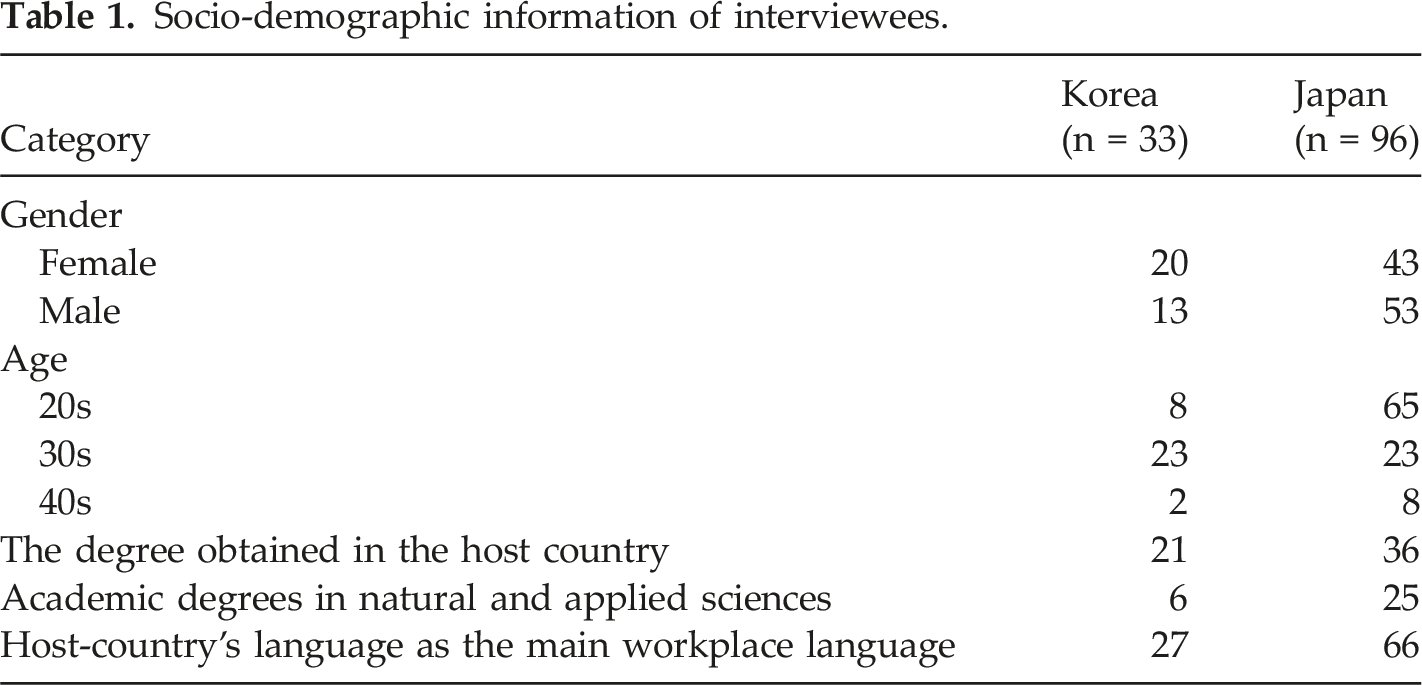
Specifically, in Korea, 33 interviews were conducted with HSFPs with an Asian background, regardless of their nationality, and who currently hold or have previously held E-7 visa or job-seeker visa. In Japan, roughly one-third of the altogether 96 interviewees were Vietnamese IT professionals, half were from European countries and the remainder came from various, mostly Asian countries. The qualitative interview data for these (ongoing) projects were obtained since 2014 in the case of one study that informed the most recent project of one of the authors and since 2021 for the three current projects. Participants were recruited through each researcher’s personal networks and social media, and diversified through snowballing from different access points. Interviews were semi-structured and conducted in English, Japanese, Korean and German.
Ethical approval was granted by the research data management officer of the home institution of one of the researchers, Goethe University Frankfurt. All names in this paper are pseudonyms. Having received oral or written informed consent after explaining the research objectives, the interviews were recorded, transcribed and analyzed using the qualitative data software MAXQDA. As we carried out part of the fieldwork during the COVID-19 period, some interviews were conducted online. Through a core focus on the migration experience of participants, the micro-sociological research questions—which covered migration motivations, job-seeking process, work experiences, social relationships and future plans—formed an entry point into migration trajectories and their relationship with the subjective experiences related to labor market entry and socio-psychological (in)security.
The data of each project was coded separately and then discussed using thematic analysis (Braun and Clarke, 2006), which allowed us to identify common patterns and themes in the analysis of qualitative data. This framework facilitates teasing out important themes from the rich interview data of the four different projects. The current paper carefully presents cases that distinctly encapsulate the underlying themes, showcasing them in the subsequent results section.
Highly skilled migrants’ access to the labor market in Korea and Japan
While skilled migrants’ decisions for choosing Korea or Japan are manifold, our data confirmed previous research on the major migration motivations of HSFPs in both countries, including cultural interest, career development and socio-economic mobility (Hof and Tseng, 2020; Kang et al., 2018). Previous studies on (skilled) migrants in both countries demonstrated ethnically differentiated experiences and, for instance, underlined that “white” migrants enjoy heightened attention, which can lead to their whiteness functioning as a form of white capital in very specific jobs like English teaching, a job niche that non-white migrants can hardly exploit regardless of their native language (Lan, 2022). Other research demonstrated another nuance within the HSFP group, that is, the experiences of self-initiated early-career migrants, who face similar legal and structural obstacles in accessing the labor market regardless of their ethnicity (Hof and Tseng, 2020; Min et al., 2020). The heterogeneity of our interview sample allows us to confirm the importance of looking at the specific group of self-initiated early-career migrants among the HSFPs and demonstrate that when focusing on access to employment, the similarities within this group outweigh the differences. However, the specificities of each country’s employment system, as well as contextually contingent approaches to the incorporation of foreign human resources, lead to different migration channels and access to the labor market in each country for HSFPs.
“You’re on your own”: Skilled migrants as independent contractors of the Korean labor market
“Occupation-centered” employment system: Differential access to the labor market depending on the occupation
The Korean labor market’s structure closely maps the need for HSFPs in Korean society. SMEs of fewer than 300 employees account for nearly 87 percent of all firms in Korea (OECD, 2017) and they face a relatively high shortage of skilled workers, particularly in the science and technology industries (MOTIE and KIAT, 2022). Despite the Korean government’s efforts to attract HSFPs (Shin et al., 2019), only 15 percent of foreign-national graduates with Korean degrees major in engineering or natural sciences (Ministry of Education of Korea, 2022). HSFPs with Korean degrees in humanities or social sciences tend to face significant barriers in accessing the Korean labor market, unlike those whose skills and professional experience lie in the high-tech industries.
One of the significant factors that prevent HSFPs from finding jobs within Korea is the stringent visa policies. The difficulties were mainly associated with obtaining the E-7 visa during the limited job search period after graduation. Due to strict legal regulations to issue the E-7 visa (Lee et al., 2020), HSFPs seeking the E-7 visa often struggle to find jobs since employers prefer to hire F-type visa holders (e.g., resident visa or Korean spouse visa) as they do not need employers’ visa sponsorship. After graduation, HSFPs searching for employment experience mounting psychological, financial and temporal pressures, particularly if employers repeatedly reject their applications due to visa-related issues. Interviewees highlighted that Korean companies are often hesitant to sponsor the E-7 visa because of the need to prepare numerous documents and the salary standards required to be met for the visa sponsorship application. April (female, global marketer), who moved from Malaysia due to her interest in Korean popular culture, recalled her stressful job-seeking period while pointing out visa sponsorship as a significant legal barrier: I got a few calls, but most of them are not willing to sponsor my visa, E-7. I had calls where the recruiter just called up, and the first question that he asked was actually which visa are you holding? Aren’t you holding an F visa? […] I said, no, I will need a sponsor for my work visa. And he was oh, I’m so sorry, we cannot sponsor you. No further questions were asked neither [regarding] my skills nor experience. They promised that they would convert our visa to an E-7. […] At first, I believed that. After three months, this other girl, she was supposed to get her E-7 visa, she couldn’t get it, and because they didn’t like her, so they just told her to leave without even trying to give her the E-7 visa. I realized something was odd. When the second foreigner who was supposed to get his E-7 visa couldn’t get it as well, I knew for sure that I wouldn’t be able to get my E-7 visa.
Alongside visa sponsorship and renewal challenges, HSFPs faced a significant barrier in accessing the Korean labor market due to the lack of information regarding employment opportunities. Recalling his repeated difficulties in securing a job over 13 years ago, Hugo (male, Pakistan-Canadian, business consultant) mentioned the lack of job opportunities as the major challenge for foreigners in Korea. Emphasizing that his viewpoint was “not just like paranoia,” he thought that he had little chance of securing employment due to “not being Korean,” a sentiment echoed by other interviewees who lamented the difficulty of finding jobs despite having earned advanced degrees in Korea. Hence, they found themselves compelled to accept jobs with conditions they deemed unfair or unsatisfactory in order to secure their visa in Korea.
HSFPs typically look for job opportunities through their connections or online platforms (Kang et al., 2018). Some interviewees mentioned that they also used the English-medium job search site LinkedIn, but they pointed out that even the very limited number of job postings in English mainly targeted Koreans who are fluent in both English and Korean. Notably, the job-seeking practices of Koreans differ from those of foreigners. According to the 2020 Graduate Occupational Mobility Survey, the prevalent approach for Korean nationals to secure employment was by successfully passing recruitment exams conducted by major corporations (35.8 percent), followed by using job search sites (23.8 percent) (Jang et al., 2022). On the other hand, HSFPs with Korean degrees tend to seek job opportunities in SMEs using their personal networks or internet searches (Min et al., 2020). The difficulties in finding employment, combined with self-reliant job-seeking practices, hinder foreign graduates from navigating the job market and accessing promising career paths in Korea.
Meanwhile, the entry process into the labor market for HSFPs in advanced science and technology industries is relatively smooth. Interviewees in IT and engineering (regardless of where they obtained the degree) reported that they encountered few or no obstacles when getting their work visas. They were even able to apply for an F-2 visa without difficulties due to relaxed visa regulations applied for these specific sectors. For instance, Gerald (male, co-founder of a start-up), who relocated from Vietnam to Korea to pursue his master’s degree in computer science with a scholarship, also received visa application assistance from a Korean company. Having obtained his PhD degree in Korea, he received a researcher visa and worked as a software developer at a big company. Soon after he obtained the F-2 visa and was eventually granted permanent residency (hereafter PR). Gerald’s case is rare, yet it illustrates some possibilities of establishing oneself in the labor market. However, it should be noted that despite his stable job and visa status, he also expressed a sense of insecurity that his visa would be terminated if he left Korea for a year and mentioned the stringent conditions of getting Korean citizenship even for him.
HSFPs often struggle to access the skilled labor market in Korea, as their educational credentials in Korea may not hold much weight unless their degree is related to high-tech sectors. These obstacles to incorporation into the labor market are partly a result of the “occupation-centered” employment approach in Korea (Liu-Farrer and Shire, 2021). HSFPs from non-science and technology industries face difficulties in finding companies that sponsor E-7 visas and feel insecure due to temporary contracts whose renewal is bound to the employer’s decision. In addition, their non-institutionalized and self-directed job-seeking practices, much like those of “independent contractors,” further limit their access to employment opportunities, which in turn, hinders them from anchoring in the host society.
On the fast lane: “Gold Card” access to the Korean labor market in technology fields
The process of entering the Korean labor market from outside the country through the government’s highly skilled migration system is relatively straightforward. In 2009, the Korean government established a platform called Contact KOREA run by the Korea Trade-Investment Promotion Agency (KOTRA) to support both Korean enterprises in finding HSFPs and to assist HSFPs in efficiently searching for job opportunities in Korea. Contact KOREA provides a comprehensive, free-of-charge service through 127 KOTRA business centers in 84 nations. Moreover, KOTRA issues E-7 visa recommendations (Gold Card) in cooperation with the Ministry of Justice to attract HSFPs in technology fields. The E-7 visa issued as a Gold Card has several benefits: A longer visa duration, preferential conditions for issuing PR, spouse’s work permit, change of job under the consent of the employer and permission for activities other than the status of the visa.
Companies demanding certain skills or professional experience can sponsor a visa, regardless of prospective employees’ Korean skills or cultural understanding. For instance, Kaity (female, Singaporean) used to work in Singapore as a business developer for about 10 years. She was able to enter the Korean labor market via the Gold Card system. Similarly, Louise (female, Taiwanese, Head-hunter executive search), an overseas marketing and sales manager in the semiconductor industry, obtained her visa smoothly. According to Louise, “The company prepared a lot of the documents for me, so I didn’t have to do much. [...] Actually, I sent all the documents to the company, and the company had an agency that applied for me.” When HSFPs search for job opportunities outside of Korea, they may find it easier to access the skilled labor market because of employers’ need for experienced foreign professionals in science and technology fields. Additionally, the government-led employment system is in place to assist Korean companies in finding and hiring foreign professionals.
Although these HSFPs were able to secure jobs relatively easily, not all tried to seek out additional anchors, such as developing close relationships with colleagues by learning the Korean language. This was because their work environment was closer to the above-described “Korean style” than the “international standard” they had expected, and they did not adapt well to the cultural and linguistic differences. For instance, Kaity had the feeling of being “left out” at her workplace due to her lack of Korean language skills and thought that her “voice” was not heard because nothing had changed despite her suggestions and feedback about the company. These feelings of exclusion and insecurity caused migrants’ dissatisfaction with their jobs and pre-empted their socio-psychological security in Korea. As a result, some began to consider returning to their home country or migrating to another destination in the near future.
“Fair” but homogenizing—security through assimilation in Japan’s organization-centered employment system
Time-intensive but relatively smooth: Access to the labor market from Japanese universities
Despite the gradual opening of the Japanese labor market to potential HSFPs, in 2020, only 28.49 percent of foreign-national graduates with degrees from Japanese universities were able to obtain a job in Japan before graduation (JASSO, 2023).
4
Resembling the HSFPs in Korea, the majority (68.89 percent) of foreign students or those holding a “designated activities” visa in Japan secured a job in SMEs,
5
and 24.58 percent were employed in large firms in 2021 (ISA, 2022a). While the number of HSFPs in large firms remains relatively small, their presence in the Japanese corporate world is growing overall (Sonoda, 2019). Phi (female, Vietnamese) works as a system engineer communicator who has a degree of finance and marketing from a Japanese private university. She first entered the labor market through the institutionalized recruitment system. Like other Japanese and foreign-national peers, she started her “job-hunting activities” in the third year of university, which included visits to prospective employers’ information sessions, submission of standardized resumes, the completion of online tests, and once all steps were passed, individual and group job interviews. Phi recalled this experience as follows: […] I wrote a lot of handwritten CVs to apply. […] I failed a lot of interviews even from the first round. […] It was very disheartening because the period of continuously failing interviews lasted almost like one or two months.
Employees are regularly transferred across departments which entails that a firm nurtures generalists who are knowledgeable of the company as a whole, and placement in a specific department is not necessarily related to employees’ educational backgrounds. Phi arrived at the Internet business division, which is irrelevant to her finance and marketing background. She guessed that her employer sent her to this division based on her experience of selling Japanese cosmetics to Vietnamese clients, which she was doing as her own side-business, as well as due to her lack of fluency in Japanese business communication skills, which foreclosed her dealing with Japanese customers. Japan’s “permanent employment” system technically offers regular workers lifetime employment and thus comes with job security and slowly increasing salaries over the years, which in turn incentivizes loyalty and commitment to the company, including frequent after-work socializing with the team and long work hours (Dasgupta, 2003). This internal labor market (Doeringer and Piore, 1971) provides relatively secure employment for those who successfully find jobs right after university. However, the gradually increasing number of Japanese who do not find such permanent jobs struggle to even enter the system and face far less secure employment conditions (Imai, 2009). 6
The company-based internal labor market also explains why job transfer is difficult and entails that foreigners who enter the Japanese labor market mid-career struggle to find stable employment. This was the case for Ingo (male), a Northern European man with working experience in his home country in logistics, which was also his major at university. Ingo had been interested in Japan and had studied the Japanese language on the side. One-and-a-half years into employment in his home country, he seized the opportunity to complete a master’s program in his field in Japan and wanted to work in Tokyo thereafter. However, he was unable to secure a job as a mid-career employee. “When you say that you have one-and-a-half years of experience in that field [...] they will still be really hesitant like ‘Yeah, well, you don’t know how our company works exactly and maybe we do it slightly differently and maybe you did something different [so] it doesn’t really count for us.’” Eventually, Ingo’s Japanese professor connected him to an HR department of a Japanese logistics company and he received a job offer as a permanent employee, which he accepted, but his work experience was not recognized and he had to undergo on-the-job-training alongside bachelor graduates who had just completed job-hunting under the described recruitment system.
Mid-career employees, at least those with few years of work experience, “lose time” and risk de-skilling in the Japanese employment system. At the same time, this system provides opportunities for foreigners without work experience such as Phi, who undergo higher education in Japan because they can follow the “standard track” of the institutionalized job-hunting system and thus have the chance to find stable, long-term employment (Liu-Farrer, 2011). They resemble their Japanese peers in that they enter established Japanese firms as regular (i.e., “lifelong”) employees or they achieve the same employment security in foreign firms in Japan. In addition, this security is accentuated for HSFPs as the stability in employment is closely linked to the stability of visa status. Moreover, like young Japanese employees in the 2010s and 2020s, many change jobs because they are not satisfied with conservative management structures, overtime work or lack of autonomy on the job (Liu-Farrer and Hof, 2018). Furthermore, many feel pressure to assimilate and hope that job change improves the situation.
Hiep (male, Vietnamese) completed degrees in Japan and now works in a Vietnamese IT firm “to have a better career” in Japan. He secured his employment via the institutionalized recruitment system and recalled his part-time job experiences as a preparation for his working life: “[Part-time work experiences are] very useful. I learned a lot, like the strong working culture in Japan, like seniority, manners, how to sit around a table based on a hierarchical order. […]” He said he “appreciated” these lessons since they helped him navigate work in a Japanese firm, but like other interviewees, he ended up changing jobs to a non-Japanese firm. Similar to Hiep’s case, after a few years of working full-time in an established Japanese firm, HSFPs are confident about their ability to obtain another regular job, and thus, the required work visa. As Paul (male), a French interviewee in renewable energies, put it, “I was looking for more stability when changing to the Japanese company, long-term wise. I also wanted to become [a permanent employee], that was the objective.” However, Paul criticized the assimilative pressure in his Japanese firm, also demonstrated by Hiep’s account above, and changed jobs again after a few months, relieved to be granted permanent employment in his current, foreign company. Paul added, though, that he only had the courage to quit the Japanese firm because his “success” of finding a regular, full-time position in a Japanese firm assured him that he had accumulated the necessary “Japanese” qualities and sufficiently “assimilated” to the Japanese corporate culture that rendered him a potential employee for other firms in the Japanese labor market.
Cases like Paul’s demonstrate that once HSFPs have earned the necessary business experience as new graduates in the Japanese labor market and have accumulated the credentials of white-collar professionals (Liu-Farrer and Hof, 2018), feelings of security set in and allow them to anchor in Japan. Foreigners with at least some experience in the Japanese educational system master the Japanese language, 7 yet also the social norms and business culture, to a degree that enables them to launch a career in the Japanese labor market as regular, that is, in many cases, permanent employees. This is crucial as it provides the migrants with a relatively stable visa. 8 This visa offers HSFPs a foothold that allows them to project a longer-term stay in Japan because having and renewing this visa is almost the only way to secure a longer-term stay in the restrictive Japanese immigration regime. The only other way of attaining a permanent status based on one’s skills (rather than marriage to a citizen) is to apply for PR, which requires at least ten years of residency or reducing this time by way of having issued a “points-based preferential immigration treatment for highly skilled foreign professionals,” whose requirements are very high (see footnote 2). Different from HSFPs in Korea, those in Japan are able to relatively easily change jobs domestically (like Paul and Hiep) which in turn allows them to plan more long-term and thus has spillover effects on their socializing practices in the host society and their attainment of further footholds in Japan. The cases demonstrate that highly educated foreigners’ incorporation into the Japanese labor market is facilitated by Japan’s corporation-centered employment system (Liu-Farrer and Shire, 2021), which requires profound socialization with Japanese norms that come close to assimilation. HSFPs end up changing jobs, often to non-Japanese corporate-style firms. The institutionalized recruitment system—seemingly fair as it allows both foreigners and Japanese to find regular employment—provides an anchor for HSFPs who are already in Japan. However, it requires at least four years of studying, thus an enormous timely (and monetary) investment and comes with assimilative pressure, which might obstruct social anchoring in Japanese society.
Narrow access to the Japanese labor market outside of the standard “school-to-work” track
As discussed, the internal labor market makes it very difficult to find full-time professional employment in Japan from outside the country. 9 Indeed, even foreigners who already reside in Japan and speak casual Japanese face huge obstacles in accessing the labor market if they did not graduate from a Japanese educational institution, as the quote at the beginning of this paper underlined. Nicole (female, German) needed one year to find her first job in a German-owned product testing firm near Tokyo. Only the spouse visa, granted through marriage to her Japanese husband, allowed her to stay in Japan while searching for a job. Once employed she exchanged her spouse visa for a work visa, thereby reclaiming her legal status as a professional independent from her husband, and suggested that it had taken her so long because she had not studied at a Japanese university. Her case confirms that whether a degree comes from a Japanese university matters the most for Japanese employers, and the origin of the degree becomes an important factor for establishing a foothold, that is, a permanent position, in Japan.
As a result of the strong demand from Japanese employers in some sectors, a migration infrastructure around private brokers has emerged, providing matching services between potential employers and foreign new graduates (Muranaka, 2022). The cited paper illustrates that certain industries like IT allow HSFPs from Vietnam to enter the Japanese labor market directly from outside the country, either as recent graduates or early-career employees. Tuan (male, Vietnamese), a graduate from a Vietnamese university and working in the IT sector, noted that “information about job and working opportunities in Japan is floating around me.” Before starting to work in Japan, a large Vietnamese recruitment firm provided him with a loan to enroll in a language school in Japan. After a year, he worked for five years as a dispatch worker for the same Vietnamese firm in Japan before co-founding an IT business with his Vietnamese colleagues. Tuan admitted that “only 30 percent of people from my batch (who were sent to Japan with him) were able to secure a job in Japan after the language training.” While explaining his access to the Japanese labor market, he acknowledged how the migration infrastructure facilitated his migration process. However, as his quote indicates, few of his peers successfully secured a job and others had to return to Vietnam with the debt of the language school tuition fee. There indeed are some structures available that support highly educated foreigners’ job placements in Japan, but compared to those who entered through the educational channel, a smooth transition from education to work from outside the country remains scarce, and migrants may be under precarious employment conditions due to the contractual arrangements typical of the migration infrastructure.
Compared to Korea, HSFPs with Japanese educational credentials seem to have relatively easier access to secure employment. Nevertheless, Japanese firms are unsuccessful in retaining HSFPs due to unattractive working conditions, such as long working hours and slow wage increases (Morita, 2018), and as Phi’s example showed, migrants decided to change companies because of the lack of (decent) quality jobs matching their skills and experiences. Moreover, the inflexibility of the employment system (Liu-Farrer et al., 2023)—the difficulty of entering as a mid-career worker (Ingo’s case) and obstacles when applying from outside the country unless via the migration infrastructure (Tuan’s case)—does not promise stable and quality employment for HSFPs in Japan, and the assimilative pressure does not allow HSFPs to feel secure.
Discussion and conclusion
This paper used social anchoring (Grzymala-Kazlowska, 2018) and, by adapting the concept to a new (non-Western) context, extended its theoretical contribution to understanding skilled migratory outcomes in restrictive migration regimes. Research has often overlooked skilled migrants because of their assumed ease of access to decent employment. Based on qualitative data of highly skilled foreign professionals (HSFPs) in Korea and Japan, we argue that access to decent employment is a focal point in establishing a foothold in the respective labor market and thereby functions as a central step towards attaining socio-psychological security. Access to decent employment not only provides financial security, but also facilitates social incorporation in the host society and allows migrants to have agency over their future perspective, including their career development and longer-term stay in the host society. This is important especially in “constrained migration regimes” such as Korea and Japan (Boucher and Gest, 2018: 5), where the attainment of long-term residence rights is highly restricted. We thus argue that access to employment per se is a crucial (albeit insufficient) aspect of anchoring that only if fulfilled enables migrants to foresee positive migration outcomes and a promising future in their current place of residence.
The analysis demonstrated that while HSFPs’ employment conditions in the two countries contrasted, the process of anchoring is likewise obstructed. In Korea, migrants in STEM fields are treated as welcome guests and much-needed workers. The occupation-centered employment system values migrants’ skills and in turn accepts the lack of language proficiency in Korean or country-specific knowledge, an implicit low expectation that migrants stay in the country long-term. On the other hand, this system might hinder HSFPs in non-STEM fields from accessing employment opportunities. Rigorous visa requirements, precarious employment status and limited career opportunities may hinder them from anchoring, and thus, in turn, may not allow them to imagine the feasibility of—or practicality of investing in—a longer-term stay.
Japan’s organization-centered employment system and the country’s gradual refinement of its skilled migration policies have opened up pathways to permanent employment for HSFPs. While it is challenging for HSFPs to enter the labor market from outside Japan, given such migrants’ assumed lack of cultural fit (Fukuoka and Chou, 2013), they are relatively able to smoothly secure permanent employment from within the country after graduating from Japanese educational institutions. The organization-centered “lifelong” employment system clearly values adaptation to Japanese norms over technical skills and thereby offers pathways to permanent employment to foreign graduates of Japanese universities. However, the overall proportion of employees in Japan who benefit from this long-established system is shrinking amidst the Japanese economy’s prolonged stagnation and demographic aging (Imai, 2009). HSFPs who do secure lifelong employment struggle with the homogenizing, assimilationist nature of the system, which leads us to conclude that ethnocentric ideals prevail in Japan and hinder HSFPs from anchoring.
As such, the two main contributions of this paper are the following. First, we used the concept of social anchoring to study emerging migration regimes, where restricted access to decent employment poses challenges for migrants to feel socio-psychological security, settle seamlessly and seek a longer-term stay in the host society. Even for those who successfully secure employment, the difficulties persist, as they encounter obstacles in establishing additional footholds within the workplace in the host society, due to the pressure to continuously renew work contracts in order to renew visas for the case of Korea, and the pressure to assimilate to the Japanese corporate culture. Combined with the difficulty and necessity of a longer-term stay to secure PR in Korea and Japan, these challenges not only affect the initial settling process but also present continued barriers to migrants’ anchoring in their host societies. With other non-traditional immigration countries in search of foreign professionals, types and directions of (labor) mobilities will become more intricate. Our analysis therefore highlights the value of incorporating a socio-psychological perspective to understanding migrants’ access to host country labor markets.
Second, the paper presents the heterogeneous migrant population of HSFPs in two emerging non-Western and non-traditional immigration countries. Korea and Japan are often lumped into the same group of “late comers” with similar demographic, social and economic backgrounds, but we found differences regarding access to employment depending on the distinct employment systems of the two countries. The findings of this study are necessarily limited given their qualitative nature and the fact that space required us to narrow our focus to the dominant visa categories for skilled migrants. That said, as the additional visa categories created for HSFPs in 2023 evidence (i.e., E-7-S visa in Korea and J-Skip and J-Find visas in Japan) (Exum, 2023; Lee, 2022), the interest in HSFPs accelerates in Korea and Japan. As our analysis demonstrated, even if the visa regulations have become more flexible, this alone will not suffice to retain migrants long-term. We conclude that more transparent and more flexible visa policies are needed in Korea and we call for both less assimilative pressure in the case of Japanese lifetime employment as well as a flexibilization of mid-term recruitment, which would allow HSFPs to smoothly access decent employment, eventually feel “anchored,” and thus, consider longer-term staying in the respective country.
Footnotes
Acknowledgments
The authors would like to thank the researchers at the Max Planck Institute for the Study of Religious and Ethnic Diversity for their constructive feedback on an earlier draft of this paper. Dr. Helena Hof is also affiliated with the University of Zurich in Switzerland, while Dr. Joohyun Justine Park is currently affiliated with Inha University in South Korea.
Author contributions
All authors contributed equally to collect, analyze and interpret data, design the structure of the paper and draft it. We have approved the submitted version.
Declaration of conflicting interests
The author(s) declared no potential conflicts of interest with respect to the research, authorship and/or publication of this article.
Funding
The author(s) disclosed receipt of the following financial support for the research, authorship and/or publication of this article: This work was supported by the Federal Ministry of Education and Research in Germany (BMBF) [01UL2003B] and by the Japan Society for the Promotion of Science [19K13890].
