




Abstract
Industrialized countries have increasingly used skill-based selective migration policies to reduce labor and skill shortages. But are these policies effective? This paper uses Japan and the United Kingdom to illustrate how immigration policy and employment, training and labor practices influence labor and skill supply. Until recently, these two countries had different migration policies and labor practices. Yet data shows similar patterns of labor and skill shortage profiles in both countries. This paper draws on empirical research to argue that such outcomes suggest that immigration policies will not alleviate labor and skill shortages unless accompanied by the transformation of employment and training practices.
Introduction
Since the late 20th century, industrialized countries have faced deepening demographic crises as a result of aging populations and low fertility rates. The intensification of moves toward a knowledge-based economy has also driven developed economies to participate in “the race for talent” (Shachar, 2006). Governments around the world have used immigration policies to lure desirable human resources and recruit foreign workers to fill labor and skill shortages. 1 Globally, 68 percent of governments identify meeting labor market demands as the underlying reason for their current immigration policy (United Nations, 2017). Labor immigration policies tend also to select individuals based on specific criteria, usually skill levels and labor market needs. However, is immigration a magic solution to labor shortages?
Some studies, mainly from European Union countries, have tried to scrutinize how labor migration can play a role in alleviating current and future labor shortages (e.g., Boswell et al., 2004). While researchers agree that immigration generally benefits the host country’s welfare system and economic growth, they also concur that “the need for labor migration cannot be expressed in terms of precise numbers of people with specific skills for a well-defined time period” (Doudeijns and Dumont, 2003: 211). This is because, as Ruhs and Anderson (2010) note, labor shortages are complicated issues. The complication has much to do with how changes in technology reshape employers’ desire for the type of skills employees should possess, how skills are defined, and how wider labor market policy, and regulatory and institutional frameworks might affect the labor immigration policy.
In this paper, we examine the experiences of two countries—Japan and the United Kingdom (UK)—whose immigration policies and labor market practices have traditionally sat at opposite ends of the spectrum, to consider what lessons can be learned about immigration’s intervention regarding labor shortages. Japan and the UK present two extreme cases because of their drastically different post-war immigration histories and labor market structures and practices. At one extreme, Japan represents an ethno-cultural outlier traditionally closed to foreign workers and with a more tightly regulated labor market reliant on a strong formalized enterprise-specific training regime to meet skill needs. The share of foreign nationals in Japan was only 2.6 percent of total employed workers by October 2021, 2 considerably lower than other developed countries. Conversely, the UK may be characterized as a country that has had a history of continued immigration with a largely unregulated labor market. It has a large and occupationally diverse immigrant population. Non-UK citizens comprised 12.0 percent (and people born outside the UK account for 18.5 percent) of those in employment in the UK in 2021. However, despite the history of different labor approaches and immigration policies, these two countries have shared similar industrial profiles of labor shortages. Investigating how such similar outcomes have been reached within two countries that possess significantly different cultures in terms of viewing migration as a policy tool to address labor shortages, we argue, contributes insights into the mechanisms that cause labor shortages, the role that immigration policy can play in addressing them, and how other social and political measures might help alleviate them.
In what follows, we discuss changing labor immigration policies in these two countries in the post-World War II era and use secondary data sources and administrative statistics to demonstrate the sectoral and occupational demands for skills. We then analyze how immigrant labor and their skills are utilized in the respective labor market. We show that Japan’s labor shortages have resulted from a restrictive labor immigration policy. Moreover, its dualistic labor market structure makes it inefficient in retaining and utilizing both high- and low-skilled immigrant workers that have entered the country. In contrast, UK employers have helped create an insufficiently trained domestic labor force by relying on a flexible immigrant labor force to meet labor demands and neglecting investment in skills training. This has resulted in a lack of readiness among workers to fulfill emerging skill requirements. Furthermore, the inadequate job quality, characterized by relatively low wages and substandard working conditions, has led to reluctance among certain UK individuals to take low-skill jobs. Meanwhile, the immigrant workforce in the UK has been polarized between casualized and low-skilled occupations and high-skill jobs. In both countries, the COVID-19 pandemic and additionally in the UK, the post-Brexit loss of immigrants, have aggravated labor shortages and prompted the governments to reconsider labor immigration policies. However, as our paper shows, immigration policy itself does not work the magic. Labor supply, at the minimum, requires the transformation of training and employment systems in both countries.
Immigration policies and labor shortages in Japan and the UK
Japan and the UK have had very different histories of immigration in the post-World War II era. While their immigration policies have not been designed solely for the sake of addressing labor shortages, the majority of immigrants have been active in the host labor market. This section compares Japan and the UK’s post-war immigration policies and immigrants’ labor market positions. It shows that despite different scopes of immigrant labor market presence, their labor shortage profiles were quite similar by the end of 2021.
Japan and the UK’s immigration policy compared
Japan’s post-World War II immigration policy is characterized by the following three developments: Practically no labor immigration from 1945 to the 1980s; selective migration prioritizing the highly skilled and restricting low-skilled labor migration from the late 1980s onward; and the loosening of restriction on manual and service migrant workers from the 2010s.
Japan did not have an official policy for importing labor in the first three decades after World War II because it had a relatively large agricultural labor reserve to supply workers to fast developing urban industries (Strausz, 2019). It ran out of rural labor reserve when the economy boomed in the 1980s, forcing the government to consider labor import. The 1989 Immigration Control and Refugee Recognition Act (ICRRA) marked the beginning of contemporary labor immigration in Japan. Concerned with what the government deemed as undesirable social consequences of guest worker programs seen in Europe, the political elites rejected the notion of importing low-skilled labor (Strausz, 2019).
Japan’s migration policy has been based on skill and ethnic descent. The 1989 ICRRA created 14 employment-based visa categories, 13 of which are designated to promote the immigration of technical, professional and business migrants (Akashi, 2010). In 2012, Japan introduced a point system and the category of “highly skilled professionals,” incentivizing qualified foreign workers to stay. Ethnic descent-based selection is reflected in the creation of a separate visa category—long-term resident—through the 1989 ICRRA. This visa is granted to the descendants of Japanese nationals (up to the third generation) and their families, legal guardians of children of Japanese nationals, or other individuals considered eligible by the Ministry of Justice (MOJ, 2020). Given a lack of official labor immigration channels, low-skilled labor entered Japan through the so-called “side doors,” that is, channels that are not designed for employment but have been used as such. These include the long-term resident visa, the technical internship and training program (TITP) and international student visas. The long-term resident visa, intended to allow co-ethnic individuals to resettle in Japan, proved attractive to both Japanese businesses and the ethnic Japanese in South America. The early 1990s saw the rapid increase of ethnic Japanese–Brazilian and Japanese–Peruvian migrants working in the manufacturing sector (Yamanaka, 1995). TITP, a designated technological transfer program for developing countries, has also been used as a major channel for importing cheap labor into Japan’s manufacturing, fishing and agricultural sectors (Kamibayashi, 2015). Finally, since 1983, the student visa has been one of the most accessible entry categories. Because a student visa permits off-campus work and can be changed to a work visa when the student finds professional employment, it became a “side door” for labor import (Liu-Farrer and Tran, 2019).
In the 2010s, depopulation and labor shortages have threatened the survival of enterprises and rural towns. Facing this demographic crisis, the Japanese government has redefined skills and created special economic zones to recruit a broader range of migrant workers while maintaining the consistency of its skill-based immigration policies (Oishi, 2020). In 2018, a new visa category “specified skilled worker (SSW)” was created to admit 14 categories 3 of “‘work-ready foreign workers who possess certain expertise and techniques” (Cabinet Office, 2018). SSW has two tiers. SSW1 represents “a middle-skilled category” which requires a minimum of three years of work experience and equivalent skills, and SSW2 is considered equivalent to high-skilled workers. By doing so, the Japanese government has broadened the definition of skilled migrants to include manual and service workers. Although this policy marks a break from Japan’s previous immigration stance that shuns the import of manual labor, SSW visas remain rigid and restrictive. First, the quota for each category, which totals 345,150 in five years, was fixed at a 2018 calculation of labor shortages in different industrial sectors. For example, the category of manufacturing workers has a total quota of 5,250 for five years. By February 2022, Japan had received 5,400 workers in this category. The Ministry of Justice (MOJ), therefore, terminated new overseas recruits in this category, allowing only resident status transfer from TITP (ISA, 2022a). Second, the government places strict control over foreign workers. Employers are obligated to report labor conditions on a quarterly basis. The workers are not allowed to bring in family or to extend their stay beyond five years, unless they succeed in attaining SSW2 status. However, SSW2 visa is open to only two of the 14 categories of workers. As of December 2022, only eight people in the category of construction were granted this status (ISA, 2022b).
In contrast to Japan’s rejection of immigration, the UK, although not a settler country, has been a country of immigration. The UK’s post-World War II immigration policy is marked by four main historical developments. The first three developments contributed to the increase of foreign migrant labor in the UK’s workforce, even if they were not motivated primarily by labor market considerations. The first is the absorption of former colonial subjects into the labor market. Until the early 1960s, the UK established a work permit system and special schemes to facilitate migration from countries which were previously part of the British Empire and the Commonwealth (Salt and Bauer, 2020). The British Nationality Act 1948 afforded citizenship to those coming from UK colonies, giving them the right to live and work in the UK. The automatic right of people of the British Commonwealth and colonies to settle in the UK ended with the Commonwealth Immigrants Act 1962 which permitted only those with UK government-issued employment vouchers to work in the UK, with an overall annual cap on the numbers. The Immigration Act 1971 replaced employment vouchers with work permits that impose restrictions on job types, tenure and qualifications. Hence, from the 1960s to the 1990s, the UK’s immigration policy was marked by increasing restriction and immigration control. After 1973, except for citizens from the European Economic Area (EEA), immigration to the UK was more regulated (Green and Skeldon, 2013).
By the 1990s, it was clear that the UK faced increasing international competition for migrant labor, particularly the highly skilled. This prompted a reversal to a more open immigration policy for non-EEA workers. However, immigration policy became increasingly complex as the UK implemented different schemes and adjusted rules in the issuance of work permits to highly skilled and skilled migrants from outside the EEA. A second development was the introduction of a points-based system (PBS) in 2008. This was aimed at managing migrant flows from outside the EEA and meeting the UK’s needs for highly skilled and skilled labor, guided by evidence-based information from the independent, non-statutory, non-departmental body Migration Advisory Committee (MAC). The MAC is a non-statutory, non-departmental government body sponsored by the Home Office that advises the UK government on migration issues. It comprises independent experts in migration (mainly from academia) who are appointed under rules relating to public appointments laid down by the Office of the Commissioner for Public Appointments.
A third concurrent development was more regional when, in 1973, the UK became a member of the then European Economic Community (EEC) until Brexit, when the UK formally left the European Union (EU) at the end of December 2020. During this period, the UK allowed EEC (and subsequently EU) citizens to freely access the UK labor market. Under the freedom of movement principle, EU citizens seeking work in the UK were eligible to take up employment in any job. There was an underlying assumption in the UK immigration policy that migrant workers from the EEA could help address labor and skill shortages in the UK and provide flexible labor in low-skilled jobs as needed by the UK domestic labor market (Gower, 2018).
A fourth development from 2021 is the post-Brexit UK immigration policy, which may be characterized as exerting control on immigration, reducing the number of arrivals and maintaining economic value. In practice, the key principles are ending free movement, equal treatment of EU and non-EU citizens, and the implementation of a revised points-based system. For skilled workers, a new tradeable points test was introduced to determine eligibility for a visa, minimum salary and skill thresholds were reduced (to cover middle- and higher level skills), and restrictions on visa numbers were lifted (McKinney et al., 2022). Post-Brexit immigration policy is also designed to encourage the immigration of the highly skilled by easing some requirements. An example is the introduction of the High Potential Individual (HPI) visa, which gives individuals who have been awarded a degree by an eligible university in the last five years permission to stay in the UK for at least two years (and three years if the qualification is at a doctoral level). A further key plank of post-Brexit immigration policy is the creation of the EU Settlement Scheme, which grants permanent residence to EU citizens living in the UK. More than six million people applied (including eligible citizens who left the UK). This policy development is the last of several changes toward selective immigration policy spanning several decades. Note that there is no formal route for low-skilled labor post-Brexit, except for a scheme for seasonal agricultural workers and specific short-term temporary visas that have been issued since 2021 to workers such as poultry workers, butchers and heavy goods vehicle (HGV) food drivers to meet labor market demand in these sectors and occupations.
In the wake of COVID-19, in 2020, the UK experienced a short-term pause in international migration and travel. The concurrence of COVID-19 and the introduction of the new post-Brexit immigration system render it difficult to assess the impact of COVID-19 and how the new immigration system will unfold in the longer term. However, in-depth qualitative interviews with employers undertaken between November 2021 and May 2022 reveal that ending the freedom of movement is seen as a greater threat for the future than COVID-19 (MAC, 2022).
The two countries have clearly moved from the opposite ends of the immigration policy spectrum and are now showing signs of policy convergence. The UK is moving toward selective immigration, with a focus on skilled workers, while Japan is now allowing certain types of manual workers to enter the country. At the same time, both countries offer selective official immigration routes for migrant workers who are not necessarily tertiary educated but who can address labor and skill shortages in middle-skilled occupations.
The persistent gap: Labor shortages and the utility of immigrant labor
Despite the different histories of labor immigration policies, the reality is that both Japan and the UK suffer labor and skill shortages. Below, we present the shortage profiles and immigrants’ positions in the national labor markets in these two countries.
Japan
With more than 28 percent of the population older than 65 and fewer than 60 percent aged between 15 and 64 years, Japan is the oldest country in the world and faces a rapidly shrinking domestic labor force (Cabinet Office, 2019). Japan’s unemployment rate dropped to 2.4 percent by the end of 2019 (Statistics Bureau of Japan, n.d.b.), and the job vacancy ratio reached 1.57—that is, for each person who was seeking a job, 1.57 jobs were available (MHLW, 2020). The situation is particularly challenging in sectors such as agriculture and construction. In 2020, the average age of agricultural workers was 67.8, and of the 1.36 million people in agriculture, 70 percent are older than 65 (MAFF, 2020). In construction, 35.2 percent of the workforce were older than 55 by 2019, with 16.4 percent older than 65 (MLIT, 2020). While the COVID-19 pandemic had negative impacts on Japan’s economy, it did not bring much relief to Japan’s labor crunch. By June 2022, the total unemployment rate remained at a very low 2.6 percent. On the other hand, 80.1 percent of the population between ages 20 and 69 were employed, leaving very little labor reserve (Statistics Bureau of Japan, 2022).
Top 10 industries reporting labor shortages of employees in 2020 and 2022, Japan.
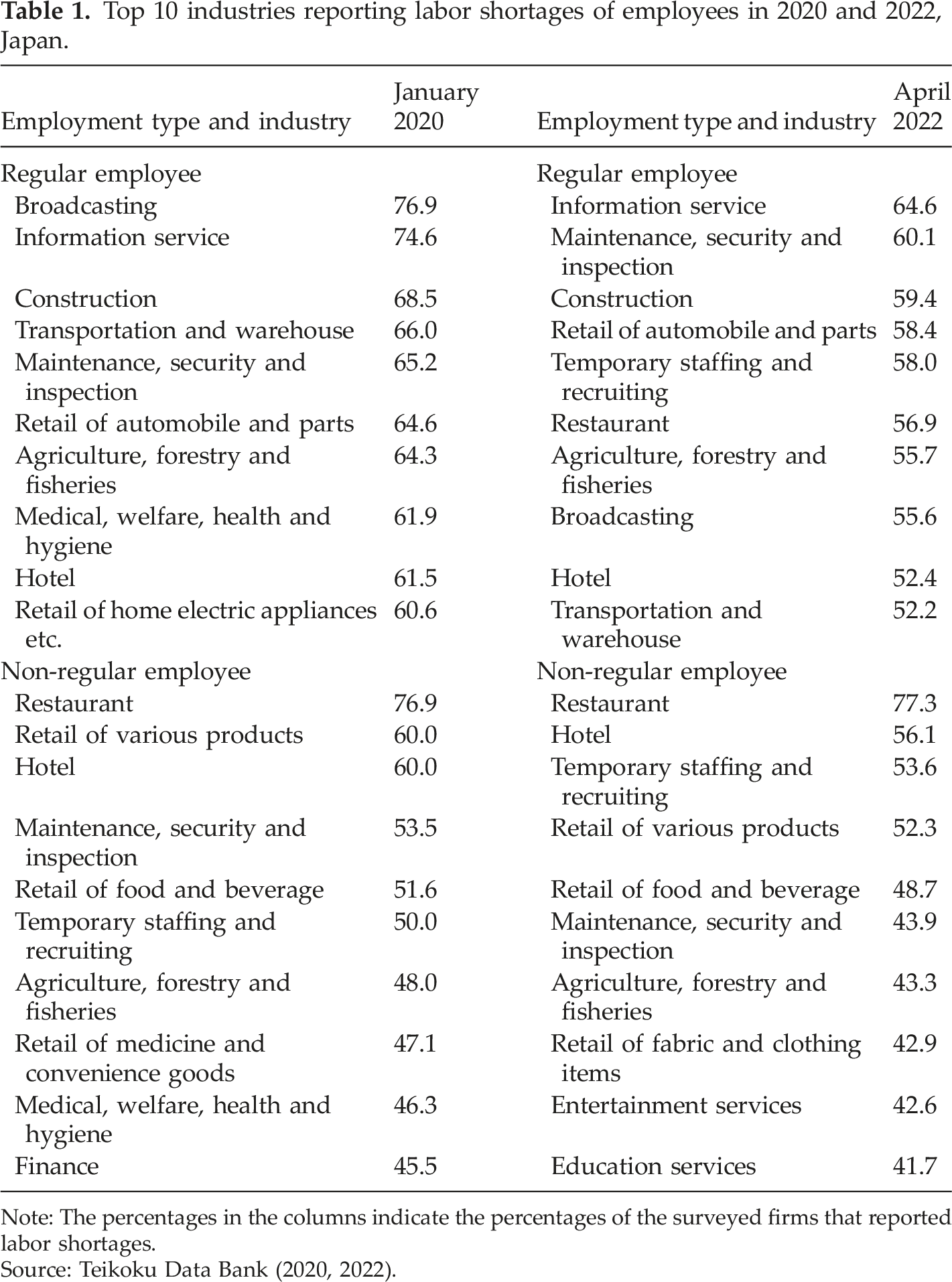
Note: The percentages in the columns indicate the percentages of the surveyed firms that reported labor shortages.
Source: Teikoku Data Bank (2020, 2022).
Distribution of foreign workers across sectors in Japan in 2021.
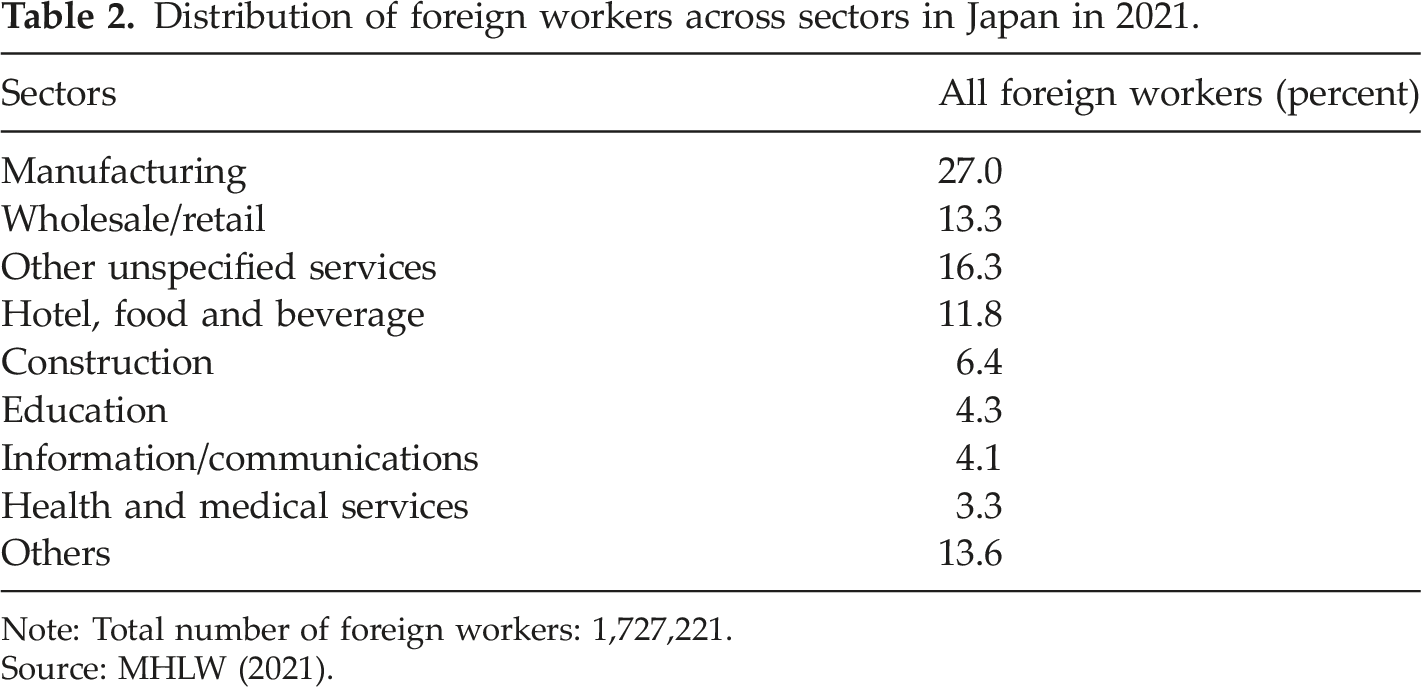
Note: Total number of foreign workers: 1,727,221.
Source: MHLW (2021).
UK
Share of foreign-born workers by industry in the UK, 2021.
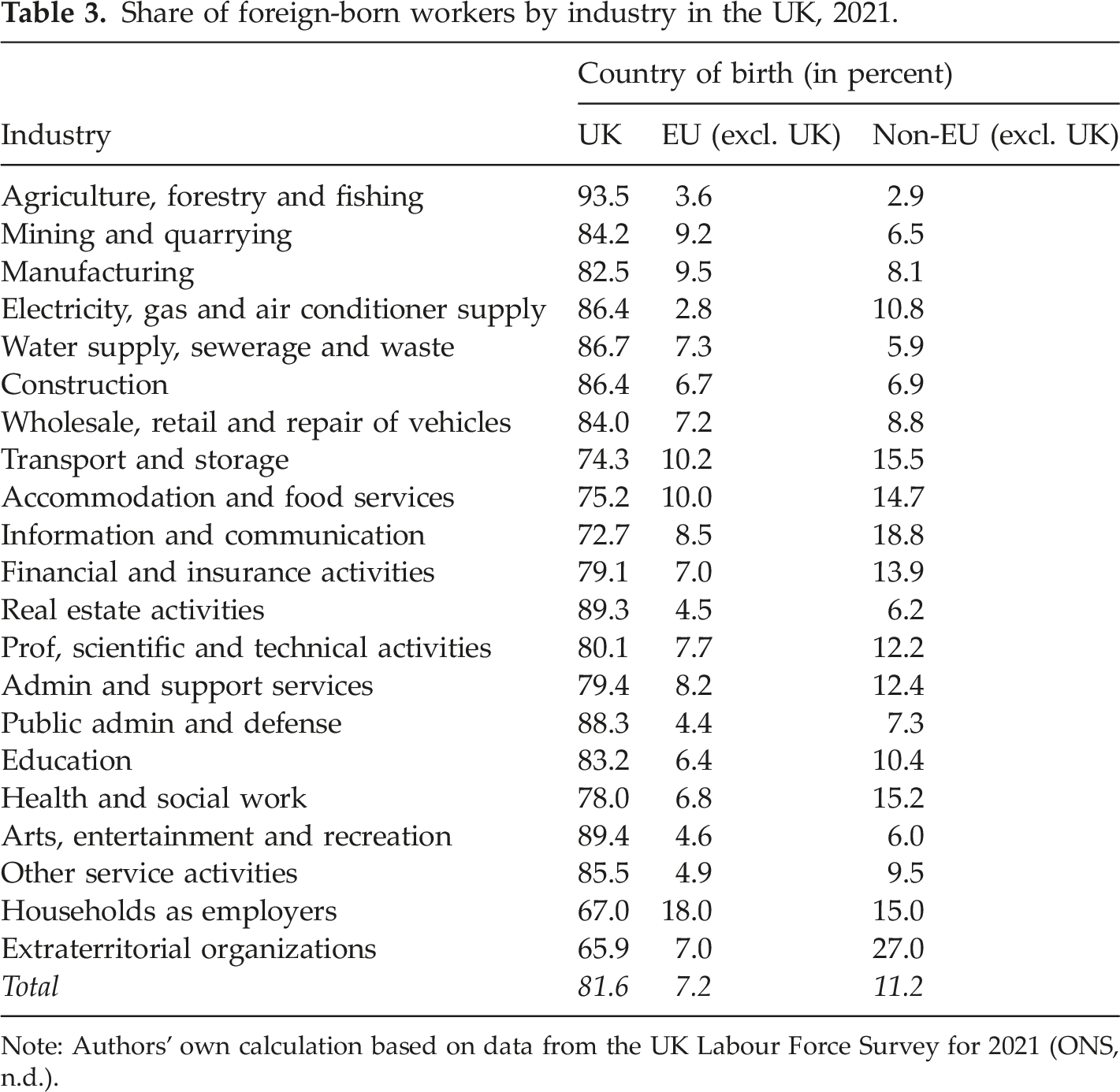
Note: Authors’ own calculation based on data from the UK Labour Force Survey for 2021 (ONS, n.d.).
Top 10 occupations with the highest shares of non-EU-born and EU-born workers in the UK, 2020.
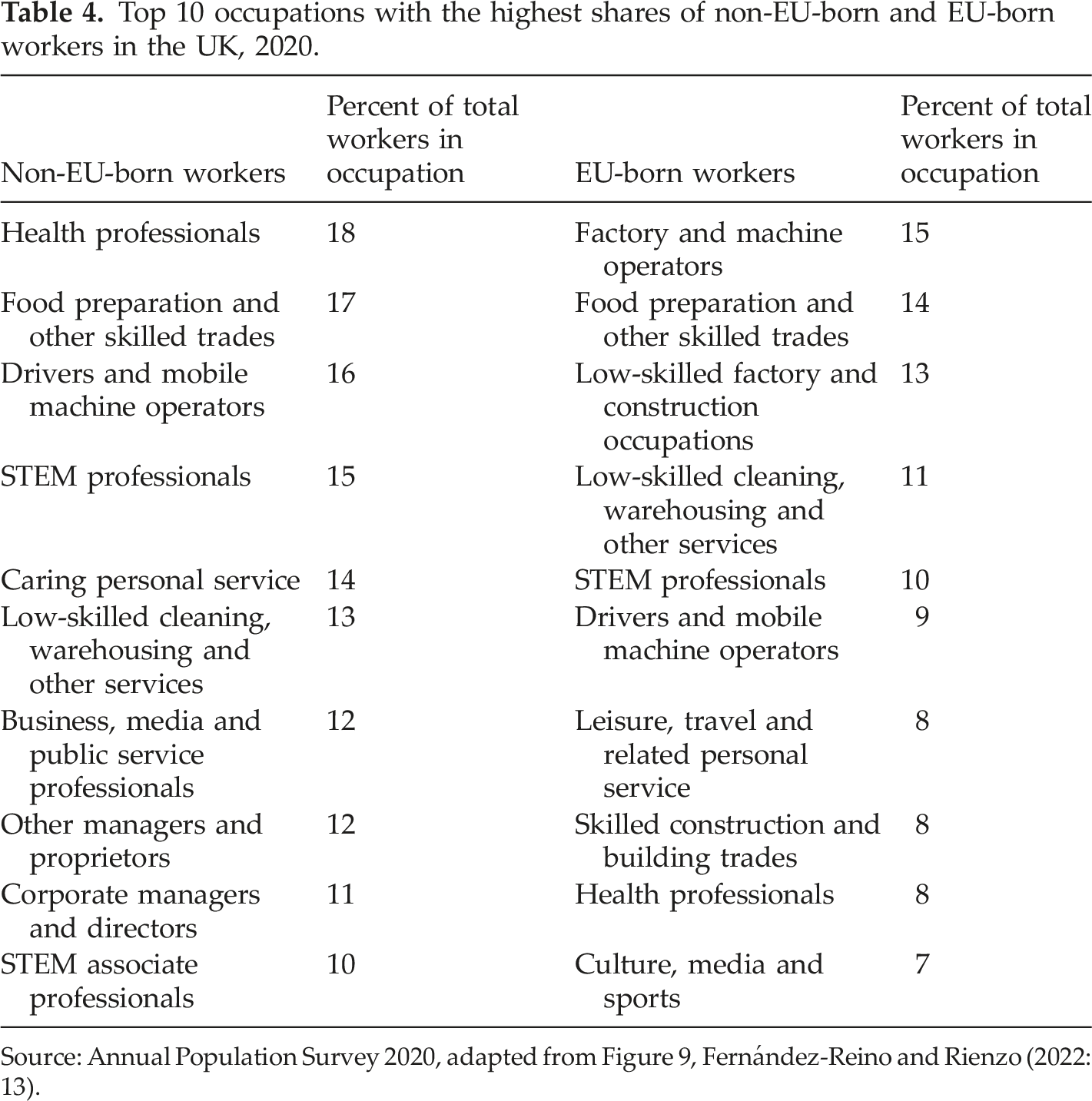
Source: Annual Population Survey 2020, adapted from Figure 9, Fernández-Reino and Rienzo (2022:13).
Understanding labor and skill shortages in Japan and the UK
While a direct comparison of the magnitude of labor and skill shortages in Japan and the UK is hampered by data limitations and definitional differences, available data indicates that, in both countries, the sectors suffering most from labor and skill shortages include construction, primary sector (e.g., agriculture and fishery), information services, transport and storage, and service industries including food and beverage. They also need both manual and technical workers. In this section, we explore labor and skill shortages in these two countries by looking more closely at the mutual influences between labor practices and immigration policy.
Japan: The double obstacles of restrictive migration policy and a rigid employment system
Generally, a country having a rapidly declining labor force resorts to labor import to supplement its labor force. However, as we have shown, Japan’s post-war immigration policy has been selective and restrictive. In this section, we argue that, on the top of such restrictive immigration policies, the rigidity of Japan’s employment and training system also prevents it from attracting and retaining foreign workers.
Japan has a dualistic labor market structure which distinguishes between regular employment and non-regular employment (Nishikawa and Dejima, 1994). Regularly employed workers are selected from new graduates from high school and universities annually. Once employed, they receive substantial enterprise-specific training, have incremental salary increases, enjoy job security, and attain upward career mobility in the firm. Non-regular workers, usually employed in positions requiring less training and more routine jobs, are traditionally used either as a buffer against economic volatility or to reduce labor costs. On average, non-regular workers earn less than half of what a regular employee does and are the first to be dismissed (Tsuzaki, 2018). Moreover, workers in non-regular employment have limited opportunity to move to regular employment. In 2007, “only 5 percent of 3.65 million non-regular male workers changed to regular jobs; a mere 2.5 percent of all 8.9 million non-regular women workers switched to regular work” (Gordon, 2017: 32). These labor market and employment characteristics, compounded with the restrictive and selective immigration policy, make meeting labor demands in both manual labor and high-tech occupations impossible.
Japan’s selective immigration policy was specifically designed to allow only skilled professionals into regular employment, and to keep the stay of manual and service workers in the country temporary. As noted above, until 2019, the employment of the latter was realized by appropriating non-employment schemes as “side doors” for labor import. In most cases, workers entering through such channels are used as temporary buffers and stop-gap solutions to labor shortages because their legal and occupational mobilities are severely restricted (Nagayoshi, 2020). The technical interns and trainees cannot change their visa status and can at most stay for three or five years, depending on the industry. The students are not eligible for full-time employment while they are enrolled. In other words, employers cannot employ these migrants as regular employees because they either have a restricted work permit, as in the case of students, or limited residence and geographic mobility, as in the case of technical interns. While it is the government’s intention to keep manual foreign workers’ stay in Japan temporary, it also does nothing to alleviate labor shortages in sectors such as construction, health and care work, and agriculture where employers need regular workers that could be trained and work in the long term.
The “Specified Skilled Worker” visa categories implemented in 2019 allow foreign workers to enter in manual and service occupations. While a meaningful step toward loosening immigration restriction, it remains an insufficient temporary guest worker program. Not only does the quota fall short of meeting the labor demand of various industries, the SSW1 visa is also fixed at five years. Except for SSW1 workers in construction and ship building, workers in the rest of the 12 industrial sectors cannot apply and test for the SSW2 visa, which allows continuing residence, but does not allow family reunification. Since most of the SSW1 workers were former technical interns who managed to convert their visa status, in effect, these workers could have been separated from their families for eight years. 5 The language and skill tests and restriction on family reunion might discourage many potential applicants. By March 2022, three years after the start of this program, only 64,730 workers were holding SSW1 visas in Japan, which is less than 20 percent of the target number. Moreover, the sectors that have the most demand for regular labor—construction, agriculture/fisheries, medical services and hotel—only have a small portion of the quota filled: 6,360 of 40,000 (15.9 percent) in construction, 8,873 of 45,500 (19.5 percent) in agriculture and fisheries combined, 7,019 of 60,000 (11.7 percent) in care work, and 124 of 22,000 (0.6 percent) in hotel services (ISA, 2022b).
Although the Japanese government welcomes the so-called “global talent,” Japan’s rigid employment systems and ethno-centric cultural expectations, as indicated below, create difficulties for foreign professionals to enter and stay in Japanese firms as regular workers. First, Japanese firms’ recruitment standards for regular employees, especially proficiency in Japanese language and cultural competency, bar foreign workers from successfully entering Japan’s corporate labor market. Job applicants in Japan are typically required to take written tests that evaluate their language and other problem-solving skills to qualify for interviews. The cultural criteria are so high even international students who graduate from Japanese universities often have difficulty (Liu-Farrer and Shire, 2020). In addition, because Japanese firms have had little experience with cultural diversity, many employers lack confidence in dealing with foreign workers and therefore avoid recruiting them (JILPT, 2013). Secondly, after entering Japanese firms as regular employees, foreign workers are expected to behave like Japanese employees and are expected to adhere to corporate Japan’s system of in-house careers (Hof and Tseng, 2020). Some feel deskilled because even though Japanese firms provide on-the-job training, the skills training offered is specific to the firms and is not necessarily transferrable to other enterprises, thereby limiting career mobility beyond the firm of employment (Tseng, 2020).
In short, Japan’s labor shortages result from the compounding effects of a neoliberal nationalist immigration policy that courts the highly skilled and guards against the less educated and low-skilled workers (Joppke, 2021), and an inflexible employment and training system that is organizationally and culturally ill-prepared to deal with immigrant workers. Although Japanese firms need regular workers in both blue-collar and professional service sectors, the former, until recently, have been brought in either through “side doors” or mostly on a temporary basis and are mostly non-regular and disposable workers while the latter are turned away by corporate Japan’s domestically oriented employment and training system.
The UK: Using what’s available rather than training what’s needed
UK employers are among the least likely employers in the EU to train workers. According to Eurostat data on continuing vocational training, over 70 percent of UK establishments would recruit workers with the required skills rather than train workers, in comparison with an EU average of around 50 percent. A comparison of selected international skills systems reveals that relative to others, the UK has been characterized traditionally by limited employer involvement in the skill development system (Taylor, 2020). Moreover, the UK has one of the lowest levels of government investment in adult training among the Organization for Economic Cooperation and Development (OECD) countries (Lyons et al., 2020). The availability of an enlarged EU labor pool encouraged this tendency. Since 2005, training spending per employee has fallen 28 percent in real terms, from GBP 2,139 to 1,530 per year, which is less than half the EU average. Over the same period, the proportion of people getting training at work has fallen by 14 percent (Evans, 2022).
A ready supply of migrant labor and the UK’s labor market characteristics before Brexit meant that UK employers had been able to adopt such a recruitment strategy. Key features of the UK labor market include its voluntarism and loose regulation enabling hiring and firing of labor, the corrective rather than directive nature of government intervention, and relatively low tax levels. These features are indicative of a liberal labor market regime, characteristic of the “Anglo-Saxon” welfare model, vis-à-vis the more regulated “Continental” European model characterized by greater collective organization and action (Hyman, 2008). As a result, it is relatively easy for migrants to enter employment in the UK. The status of English as a global language also contributes to the UK’s attractiveness as a destination for migrants. Hence, immigration policy, the labor market regime and other public policies have acted together to attract migrants and enable them to participate in the labor market relatively easily, and subsequently contributed to a growing demand for them (Anderson and Ruhs, 2012). Moreover, because the UK labor market has a more fluid structure, unlike the rigid demarcation between regular and non-regular employment that characterizes the Japanese labor market, migrants have been able to play an important role in the less-skilled as well as the more-skilled parts of the UK labor market. However, the liberal labor market regime coupled with the relative openness of the UK to immigration also means that there has been potential for labor abuse—with sectors such as car washes, agriculture, care, construction, hospitality, and warehousing and distribution centers identified as having high risk of labor exploitation (HM Government, 2019). In 2016, the UK Government appointed a Director of Labor Market Enforcement to strengthen efforts to tackle non-compliance in the labor market (e.g., not paying the national minimum wage and deliberate crimes such as modern slavery).
Research focusing on lower skilled jobs in construction and service sectors suggests that employers tended not to target migrant workers explicitly but rather to recruit them because they are available (Migration Advisory Committee, 2014). Free movement enabled the development of a business model in some firms in the UK in which EU migrant workers were used to plug vacancies in low-skilled jobs requiring limited training. Such a model may be characterized as a “low road” one from an economic development perspective, since the jobs involved are often low-paying and underutilizing migrant workers’ skills, especially where highly qualified workers fill such jobs (Anderson et al., 2006). As noted in the introduction section, the availability of a large pool of migrant workers ready to work in conditions that may be less desirable to UK workers seeking permanent jobs enabled employers to recruit them and to structure their working practices in a way that utilizes this willingness. As long as a supply of willing migrant workers is available, employers do not have to reconsider their employment practices to redesign jobs (Green, 2019). Indeed, McCollum and Findlay (2015) argue that the ready availability of a cohort of migrant labor, seen as desirable by employers, has extended flexible labor market structures toward the bottom of the labor market.
The availability of migrants to perform low-skilled roles can create path dependencies, leading to employers’ reliance on migrant workers becoming entrenched (Ruhs and Anderson, 2010). Once a workforce includes a substantial share of migrant workers, it may be difficult and/or costly for employers to alter the profile, and certain jobs within the labor market may become regarded as “migrant jobs” (Tannock, 2015). However, migration has been insufficient to meet all labor and skills needs, and continuing under-investment in training by employers over the long-term contributes to ongoing skill shortages. Furthermore, record high levels of unfilled vacancies in low- and middle-skilled occupations in the post-Brexit UK, combined with the challenges of the COVID-19 pandemic, is another indication that relying solely on migration, without any concern for retention has been a risky choice. This is particularly true when considering the fluctuations in economic cycles and the varying willingness of foreign workers to immigrate. Therefore, greater investment in training and inculcation of a lifelong learning culture is a policy imperative going forward.
On the other hand, as noted, the UK is reliant on highly skilled and skilled migrant labor to fill labor requirements in the health sector and certain STEM occupations, in particular. In the health sector, a reliance on migrant labor can be traced back to the immediate post-World War II years when the UK encouraged doctors from ex-British colonies and nurses to feed the demand for labor in the newly established National Health Service (NHS). These immigration streams continued in subsequent decades as nursing declined as a career choice among UK school leavers, leading to the active recruitment of nurses in the Philippines and India. In recent years, there has been a stronger emphasis on “home grown” recruitment through greater investment in training, including establishing new medical schools and nurse training places, and a focus on developing pathways for career progression within the healthcare sector. Despite endeavoring to decrease the reliance on migrant labor, in 2018, nurses and doctors together accounted for 52 percent of the usage by employers of the shortage occupation list (SOL). The occupational group accounting for the next single largest share of the SOL following nurses and doctors was design and development engineers, highlighting the importance of highly skilled migration to the UK in the engineering sector and STEM occupations more generally.
In summary, two aspects of the UK labor market regime and immigration policy are of particular relevance in understanding the UK experience of skill shortages. The first is employers’ predisposition to recruit rather than to invest in training encouraged by a loosely regulated labor market coupled with the availability of migrant workers until 2020. The second is the ongoing challenge of recruiting and retaining workers in jobs associated with lower level skills and an over reliance on flexible immigrant labor that is less available since Brexit.
Immigration and labor practices: Lessons from two extremes
A summary of Japan–the UK comparison.
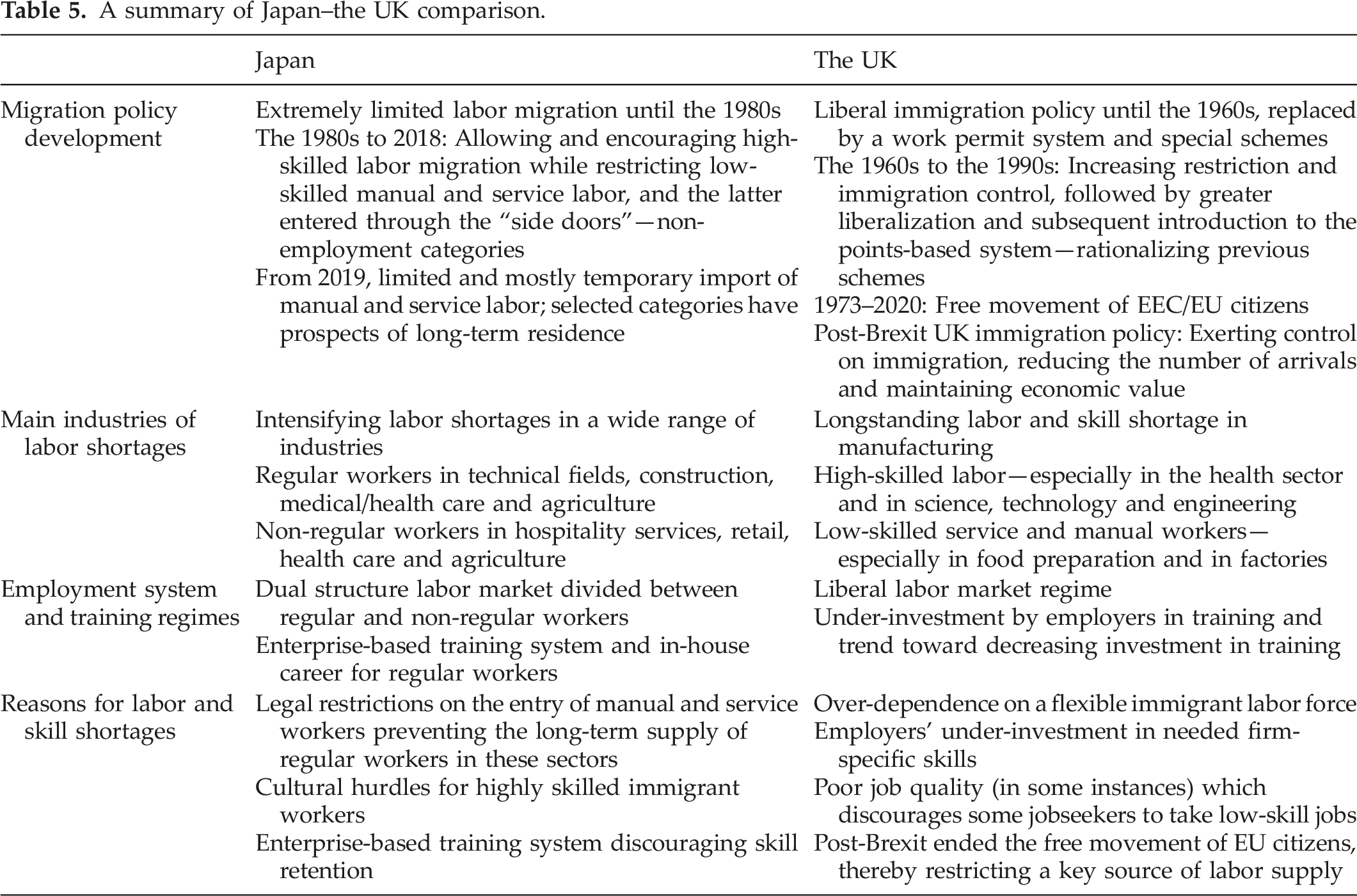
The key lesson that can be gained from these two extreme cases is that in an age of technological and demographic transformation, a country needs both measures, that is, expanding immigration and reforming training regimes, to counter skill shortages. Japan’s problem lies in its restrictive immigration policy coupled with a rigid employment and training system. Until recently, Japan allowed only skilled and credentialed professional migrants to enter on renewable employment visas. Blue-collar and service workers were channeled in through non-employment categories—the “side doors” with legal restrictions. Given Japanese firms’ employment and training practices, only the former had the chance to enter regular employment and the latter are limited to temporary employment. Although the 2018 ICRRA revision started to allow regular blue-collar workers to enter specific industries in Japan, given its recency and the small number of foreign workers that have managed to enter, the effects of this policy in addressing labor shortages are not yet palpable. On the other hand, although the skilled professionals have access to Japanese firms’ on-the-job training, the expectation to assimilate and the firm-specific orientation discourage foreign professionals from participating or remaining in corporate Japan. Changes in the demographic structure as well as labor market skills needed in a globalized economy mean that an enterprise-based training system is not suitable for alleviating skill shortages.
In contrast, the UK’s difficulties illustrate the pitfalls of a relative neglect of skills building of the labor force and dependency on flexible immigrant labor. With a relatively ready supply of migrants in the past, employers faced little pressure to redesign jobs and reform working conditions to make them more attractive to native workers. Moreover, utilizing migrant labor to fill shortages allows employers to focus less on training its workforce. When it comes to immigrant workers, relatively liberal approaches to migration in the UK in the past resulted in immigrants being employed in either low- or high-skilled occupations and sectors. Though this polarized distribution is partly due to labor market demand and technological changes, traditional policies based on “recruit rather than train” mentality and the emphasis on flexibility in the less-skilled sectors of the labor market have created a pool of largely untrained, relatively deskilled immigrant workers. Also, the restructuring of the labor force in the context of neoliberalism has resulted in a compartmentalized labor market, where some jobs became undesirable or not acceptable to some UK workers but were acceptable for some groups, such as migrant workers and students. Employers seeking to fill low-skilled jobs are amongst those most impacted by the post-Brexit immigration policy (Green et al., 2016).
Neither country’s migration policy nor employment practices had proven sustainable. The past migration policy of the UK created a backlash among the native population and culminated in Brexit, while Japan has been witnessing the worst post-war labor shortages. Consequently, recently Japan and the UK show signs of convergence in their immigration and labor policies. Japan’s “Specialized Skilled Worker (SSW)” visas delink skill from education and professional credentials, acknowledging that work in sectors formerly categorized as unskilled in fact requires skills. However, as had been noted, the scheme remains insufficient and restrictive. Under the current policy, most of the workers, even when they are employed full time and gain skills, will not be able to continue working in Japan after five years. In short, the SSW scheme is still mostly a temporary guest worker scheme. While there is discussion about expanding the SSW2 categories, the policy has not changed at the time of writing.
On the other hand, with the end of the free movement of EU nationals, the UK has implemented more selective and, to some extent, more global policies toward bringing in foreign workers. Post-Brexit immigration policy is intended “to create a high wage, high-skill, high productivity economy” through delivering “a system that works in the interests of the whole of the UK and prioritizes the skills a person has to offer, not where they come from” (HM Government, 2020). The policy, thus, does not distinguish between EU citizens and third-country nationals. By managing the overall volume of immigration, the UK government aims to encourage employers to consider investing in human capital development to attract and retain workers at all skill levels. Moreover, there is increasing recognition of the need for greater investment in training by employers, and in lifelong learning more generally, to meet future skills needs (Lyons et al., 2020). While this represents an important shift, this new policy does not address immediate labor shortages vacated by immigrant workers. With the opening of the economy in 2021, following the easing of COVID-19 restrictions and the impact of Brexit, the UK labor market tightened considerably. Among others, this was driven by record numbers of people changing jobs, the shift toward higher skilled work (Wilson et al., 2020) and, most importantly, lower labor force participation. By the summer of 2022, there were nearly 900,000 fewer people in the UK workforce than if pre-pandemic trends had continued (Institute for Employment Studies, 2022). These trends, coupled with the end of free movement of workers post-Brexit, mean that firms cannot meet labor needs through more supply as was the case previously.
Conclusion
Many developed economies are facing labor and skill shortages brought by technological innovations and demographic transformation. Countries have sought varying strategies to meet these shortages and increasingly see labor migration as a solution. This paper argues that while immigration is necessary in societies with an aging and/or shrinking labor force, immigration is not enough. The labor market structure and training regimes affect immigration’s capacity to intervene labor shortages. Japan and the UK, two cases previously polar opposites in terms of immigration and labor practices, shed light on the interactive impacts of both immigration policy and labor practices on labor shortages.
Learning from the experience of Japan and the UK, what does an optimal immigration and employment policy to address labor market needs look like? The UK experience highlights the importance of investing in skills building of both the domestic and immigrant labor force rather than placing undue reliance on expansive use of migrant workers. The Japanese experience highlights the need for a more flexible immigration policy to provide labor in the face of demographic aging and to adjust to labor market needs by opening up formal channels explicitly for labor migrants. Both the Japanese and UK experiences highlight the importance for employers to enhance job quality for all—making jobs attractive to the domestic as well as imported labor force—and to focus on developing pathways for progression in employment at all skill levels, for both the domestic workforce and labor migrants, to retain the skills they need.
Footnotes
Declaration of conflicting interests
The author(s) declared no potential conflicts of interest with respect to the research, authorship, and/or publication of this article.
Funding
The author(s) disclosed receipt of the following financial support for the research, authorship, and/or publication of this article: The open access to this paper is made possible by a publishing support grant provided by the Waseda University Institute of Asia-Pacific Studies.
