




Abstract
Low-lying atoll islands are especially threatened by anticipated sea-level rise, and migration is often mentioned as a potential response of these island societies. Further, small island states are developing population, economic and adaptation policies to plan the future. Policies, such as raising of islands or land reclamation, require a long-term vision on populations and migration. However, population and migration systems in small island settings are poorly understood. To address this deficiency requires an approach that considers changing environmental and socio-economic factors and individual migration decision-making. This article introduces the conceptual model of migration and explores migration within one small island nation, the Maldives, as an example. Agent-based simulations of internal migration from 1985–2014 are used as a basis to explore a range of potential demographic futures up to 2050. The simulations consider a set of consistent demographic, environmental, policy and international migration narratives, which describe a range of key uncertainties. The capital island Malé has experienced significant population growth over the last decades, growing from around 67,000 to 153,000 inhabitants from 2000 to 2014, and comprising about 38 percent of the national population in 2014. In all future narratives, which consider possible demographic, governance, environmental and globalization changes, the growth of Malé continues while many other islands are effectively abandoned. The analysis suggests that migration in the Maldives has a strong inertia, and radical change to the environmental and/or socio-economic drivers would be needed for existing trends to change. Findings from this study may have implications for national development and planning for climate change more widely in island nations.
Introduction
Global analyses suggest that island regions will experience the largest relative increase in flood risk due to sea-level rise in the coming century (Nicholls and Cazenave, 2010). Small island developing states (SIDS), especially low-lying atoll nations, are consistently of concern across a wide range of scenarios (Nicholls and Tol, 2006; Nicholls et al., 2018; Storlazzi et al., 2018) as mentioned in the Paris Agreement six times (UNFCCC, 2015).
The threats of climate change and sea-level rise to small islands are well established (Kelman and West, 2009; Nurse et al., 2014). Related drivers of risk include sea-level rise, storms, increasing air and sea surface temperatures, declining ocean pH (the so-called ocean acidification) and changing rainfall patterns (Nurse et al., 2014). These in turn are likely to impact the ecosystems (on which island residents depend), including coastal erosion and inundation, salinization of freshwater lenses, coral bleaching, fisheries and agriculture (Nurse et al., 2014). Impacts on these ecosystems could in turn influence various key economic sectors, such as tourism and ports/shipping, that rely on them (e.g., diving tourism and harbor infrastructure) (Kelman and West, 2009; Nurse et al., 2014).
The first Intergovernmental Panel on Climate Change (IPCC) assessment (Tegart et al., 1990) on climate change and its impacts on small islands in the late 1980s/early 1990s already suggested that sea-level rise could lead to total inundation of small low-lying islands (especially coral atolls). Migration and environmental refugees were suggested as the major potential response to inundation for small island states (Lewis, 1990; Pernetta and Sestini, 1989; Pernetta, 1992; Tegart et al., 1990). This view has been reiterated in all subsequent relevant IPCC assessments (Bijlsma et al., 1996; Masson-Delmotte et al., 2019; McCarthy et al., 2001; Mimura et al., 2007; Nurse et al., 2014; Watson et al., 1997; Zinyowera et al., 1995). Even if adaptation is considered, that is, coastal protection from sea level rise and surges, the high potential costs and difficulties for the islands (Biermann and Boas, 2010; Gemenne, 2011; Nicholls et al., 2011) suggest that migration may still be widespread.
However, there are many drivers and thresholds that play a fundamental role in the migration and the migration decision-making process (Black et al., 2011; McLeman, 2018a, 2018b; Hauer et al., 2020). People migrate for complex reasons, and often only temporary, to improve their economic situation, to be close to friends or family, for political or safety reasons or to remove themselves from environmental or other threats (Black et al., 2011).
There have been limited efforts to describe and analyze migration behavior empirically on small islands, despite the high profile of low-lying islands in the debate on impacts of climate change and sea-level rise and its potential effects on their inhabitants. Previous work has focused on migration as adaptation and institutional responses based on small-scale case studies (Farbotko et al., 2018; McNamara and Prasad, 2014; Mortreux and Barnett, 2009) and examining climate change’s influence on people’s decision to migrate (Arnall and Kothari, 2015; Kelman et al., 2019).
This article addresses this gap and introduces a new method which is applied to the Maldives as an example. This new method aims to provide an overview of historic and future migration dynamics that includes individual decision making and economic, social and environmental factors using the Maldives as a case study. The theory of planned behavior (Ajzen, 1991) and Black et al. (2011) is used to develop a new conceptual model of migration decision-making processes. This conceptual model is translated to an agent-based model (ABM) that simulates historic and future migration using narratives of future demographic, socio-economic and environmental changes using a set of consistent future narratives.
The article’s succeeding sections are structured as follows. The second section presents the study area and provides a brief description of migration systems in the Maldives. The third section discusses the conceptual background to migration. The fourth section introduces the agent-based model (ABM) that simulates migration flows in the Maldives and describes the data, model structure and validation (for details regarding model configuration, see Annex). The fifth section presents the narratives from 2015 to 2050, while the sixth and seventh analyze and discuss results. Limitations are discussed in the eighth section, and conclusions are drawn in the last.
Study area
The Republic of Maldives, at 298 km2, is the sixth-smallest sovereign state in terms of land area. It comprises 1,192 coral islands, of which 96 percent are less than 1 km2 in area. Shallow lagoons enclosed by coral reefs surround the islands with an average height of only 1.6 meters and a highest point of 2.4 meters (Maldives Bureau of Statistics, 2015a).
Church and White (2006) and Woodworth (2005) showed that sea-level rise observations in the Maldives are consistent with global trends of sea-level rise. Flooding is an issue and results from energetic swells combined with high still water levels (spring tides and surges) (Wadey et al., 2017).
In 2006, 193 islands were inhabited and 91 islands had been developed as tourist resorts. The population of the Maldives has increased from 180,088 in 1985 to 402,071 in 2014 (Maldives Bureau of Statistics, 2015a). In 2004, the Maldives was severely impacted by a tsunami, with more than 82 confirmed deaths and 26 people missing and damage and destruction on a national scale (Hermann et al., 2006). The economic damage alone is estimated at 62 percent of the Maldivian GDP (Government of the Republic of Maldives, 2005). According to the 2006 census, almost 4000 people were still displaced due to the 2004 tsunami 18 months later.
The population of the Maldives is dispersed. The capital island of Malé is the center of economic development, services, and political power, and it has grown to a population of about 153,904—including foreign residents—on an island of 1.98 km2 in 2014, resulting in a population density of 77,729 people per km2 (Maldives Bureau of Statistics, 2015a). The neighbouring islands Hulhumalé and Vilimalé have a population of 17,149 and 7,988 in 2014, respectively. Only 12 other islands have a population of over 2,500.
Previous analyses described historic migration flows in the Maldives (e.g., Speelman, 2016) and contemporary migration intentions in detail (Kelman et al., 2019; Speelman et al., 2017; Stojanov et al., 2017). These analyses investigated inhabitants’ perceptions about environmental and climatic change, economic development and migration (Arnall and Khotari, 2015; Stojanov et al., 2017; Speelman et al., 2017). Arnall and Khotari (2015) identified that environmental problems are already a cause of concern for many Maldivians. Although environmental and climatic changes are a cause for concern, other considerations (e.g., health, family, education and employment) dominate migration intentions (Speelman et al., 2017). In contrast to many small island nations in the South Pacific (Connell and Conway, 2000; Connell, 2010), international migration and remittances do not presently play an important role in migration dynamics for the Maldivian population (Speelman et al., 2017; Speelman, 2016).
Conceptual model of migration
Prior research showed that the schematic representation of the drivers of migration (Black et al., 2011) associated with the theory of planned behavior (Ajzen, 1991) are helpful theoretical frameworks to study migration (Speelman, 2016; Speelman et al., 2017; Zander et al., 2019).
Black et al. (2011) suggests five key drivers of migration flows. The five drivers of migration have similar characteristics to push-and-pull factors as defined by Lee (1966). Positive “pull” factors increase migration to a region, whereas “push” factors increase migration from a region (Lee, 1966). These factors are closely intertwined and should not be considered in isolation. 1. Demographic drivers include population size and structure, birth rates and prevalence of diseases affecting morbidity and mortality. 2. Economic drivers of migration are, for example, income and wage differentials. 3. Social drivers include factors such as family expectations and migration for educational purposes. 4. Political drivers include the effects of policies, breakdown of governance and conflict. 5. Environmental drivers include a population’s exposure to hazards and the availability of ecosystem services.
Personal characteristics are included in the framework of Black et al. (2011), but considerations of individuals and related intentions to migration and migration behavior play a minor role. The theory of planned behavior (Ajzen, 1991) can be used to supplement the framework of Black et al. (2011) to address this deficiency, as these dynamics play an important role in understanding (voluntary) migration patterns.
The theory of planned behavior (Ajzen, 1991) is based on the assumption that human beings in general behave in a rational manner and that they use available information to perform (or not perform) a certain action. The theory postulates that there are three main factors influencing intention: (1)
If these three factors are positive, a person is more likely to have a positive intention to perform the behavior. Obstacles such as habit formation and other environmental constraints can cause a person with a positive intention to refrain from performing the planned behavior. In contrast, skills, knowledge and other facilitators can have a positive effect. Implicit to the theory of planned behavior are factors influencing attitudes, norms and perceived behavioral control. These “background factors” affect the motivational beliefs as postulated in the theory, which in turn predicts intention (see Figure 1). Background factors include demographic variables such as level of education, age, marital status, personality traits and other individual differences that can influence behavior indirectly (Fishbein, 2000). Number of islands with a population under 1000 for different scenarios (2015–2050).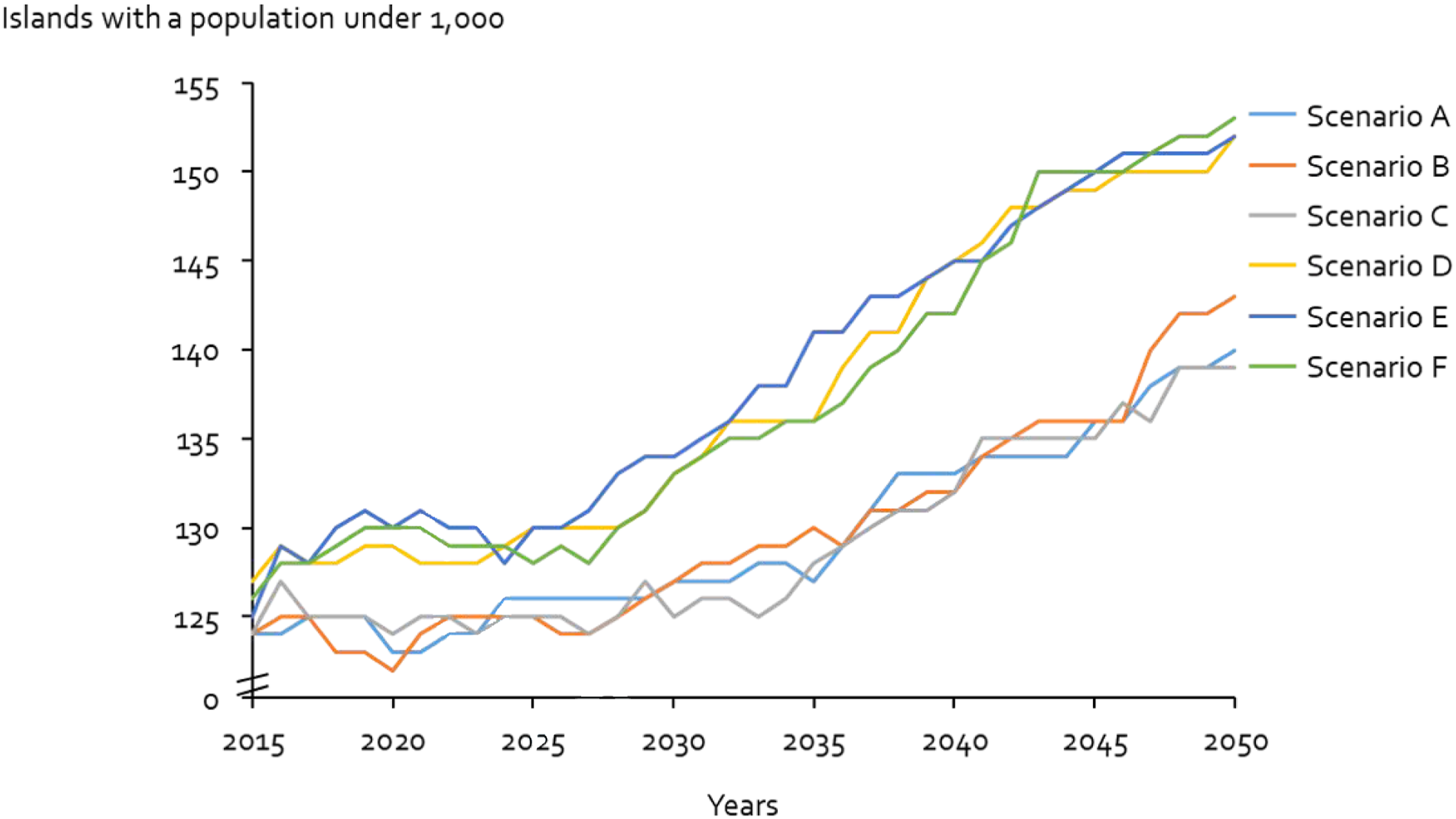
The conceptual model of migration (CMM) (see Figure 1) developed for this study combines the theory of planned behavior (Ajzen, 1991) and the factors represented in the “drivers of migration” conceptual figure of Black et al. (2011) into a single framework and builds on the work of Kniveton et al. (2012). The CMM was explicitly developed to be able to analyze historic and future migration dynamics taking into account social, economic and environmental factors (Black et al., 2011) and individual dynamics (Ajzen, 1991) that can be translated into an ABM (see next section). Such approach requires increased collection of quantitative data, adoption of appropriate modeling approaches such as agent-based modeling and greater collaboration between environmental and migration researchers (Fussell et al., 2014; Obokata et al., 2014; Piguet, 2010).
Methodology
As mentioned earlier, this study uses an agent-based model (ABM) to analyze historic demographics and explore potential future demographic pathways up to 2050. Summary dynamics are described in this section. Detailed descriptions and discussion on sensitivities of the data and algorithms used are included in the Annex.
Agent-based modeling
An ABM is a computational model simulating the actions and interactions of individual agents (Epstein, 2006). Agents interact with each other and form individual intentions (based on individual cognition) and can also respond to changes in their physical environment (e.g., drivers of migration). Agent-based methods, therefore, offer a tool to simulate emergent migration patterns as a complex adaptive system on the nexus of climate change and demography (e.g., Kniveton et al., 2012; Smith, 2014), and complex and potentially unforeseen insights can emerge through agent’s interactions (Epstein, 2006).
Previous studies have employed simulation modeling to explicitly include potential environmental influences and other structural changes to individual’s decision-making processes (Leyk et al., 2012; Nawrotzki and DeWaard, 2016; Smith, 2014). Such techniques can contribute to exploring potential future demographic pathways and provide insight into the influence of environmental and other factors upon migration flows within and between nations (Neumann and Hilderink, 2015). In coastal settings, ABM models focused mostly on the interplay between coastal processes and economics (e.g., Franck, 2009; Murray et al., 2013; Lazarus et al., 2016) or the development of socio-economic scenarios (Fontaine et al., 2015). In addition, there is a range of models exploring the links between migration and the environment (e.g., Axtell, 2002; Kniveton et al., 2011, 2012; Smith, 2014). The theoretical foundations from these models are combined with advances in knowledge about migration described in prior work on the Maldives (e.g., Speelman, 2016; Speelman et al., 2017) to develop a basis for agent decision-making in the model developed in this study.
Data
Census data from 1985, 1990, 1995, 2000, 2006 and 2014 are used as basis for the agent-based simulations. 1 Aggregated data at island level including gender, population and age structure are available at the national level for all census datasets. For the 2006 and 2014 census datasets were made available that include a full anonymized list of the Maldivian population and corresponding characteristics such as age, level of education, marital status and migration history (provided by the Maldivian Bureau of Statistics). The 2006 census dataset has been analyzed in detail by Speelman (2016) and provides a statistical basis for migration decision-making of agents in the ABM presented here. Two datasets are used for the 2014 census: (1) aggregated, island level, population data (Maldives Bureau of Statistics, 2015a); and (2) individual data (Maldives Bureau of Statistics, 2015b). Between the aggregated and individual datasets, there are slight discrepancies due to several revisions in the census. Summary tables of all census datasets are publicly available on the website of the Maldivian Bureau of Statistics (http://statisticsmaldives.gov.mv/).
Expats who (temporarily) reside in the Maldives for employment purposes are not included in the analysis. The census of 2014 estimates ∼64,000 foreign residents (Maldives Bureau of Statistics, 2015a). The foreign population is sizeable in Maldives; the dynamics and implications of the presence of foreigners in the island-state require further investigation and are not considered in this analysis. Further, the ABM uses annual nationally registered births and deaths (Ministry of Planning and Infrastructure, 2015).
In addition to the census datasets, indices for island characteristics are included, which translate into “push and pull” factors in the ABM (see Annex).
Model structure and model validation
The central process in the ABM is to estimate an agent’s intention to migrate. Migration to Malé dominates migration flows in the Maldives, and local moves within Atoll Districts also account for a large fraction of internal migration (Speelman, 2016). Based on this distinction, agents develop intentions to migrate to three potential destinations: (1) to the capital Malé, (2) within an Atoll District or (3) to another island in the Maldives. The intention to migrate is shaped by three factors: (1) the attitude of an agent towards migration to different destinations, (2) personal norms and past migration behavior of their peers and (3) the diversity of agent attitudes to migration, each based on a set of statistical attributes and simulated dynamics between agents and their environment. For each simulated time step of one year, each agent determines their intention to migrate. Migration behavior of individual agents is then implemented on the basis of probability functions. These result in a new population distribution. Birth and death rates are included in each time step based on historic data or population projections, as well as ageing of the population. Data on government relocation of individual populations to other islands are also included in the model. These steps are repeated for the duration of the simulation. Historic simulations run from 1985 to 2014. Demographic futures are simulated from 2014 to 2050.
The robustness of the model is demonstrated in detail in the Annex. Collectively, the sensitivity analyses show the ABM model dynamics are reliable and provide much better results than simple extrapolation of past trends.
Sensitivities influencing demographic futures
Six narratives for future population development in the Maldives to 2050.
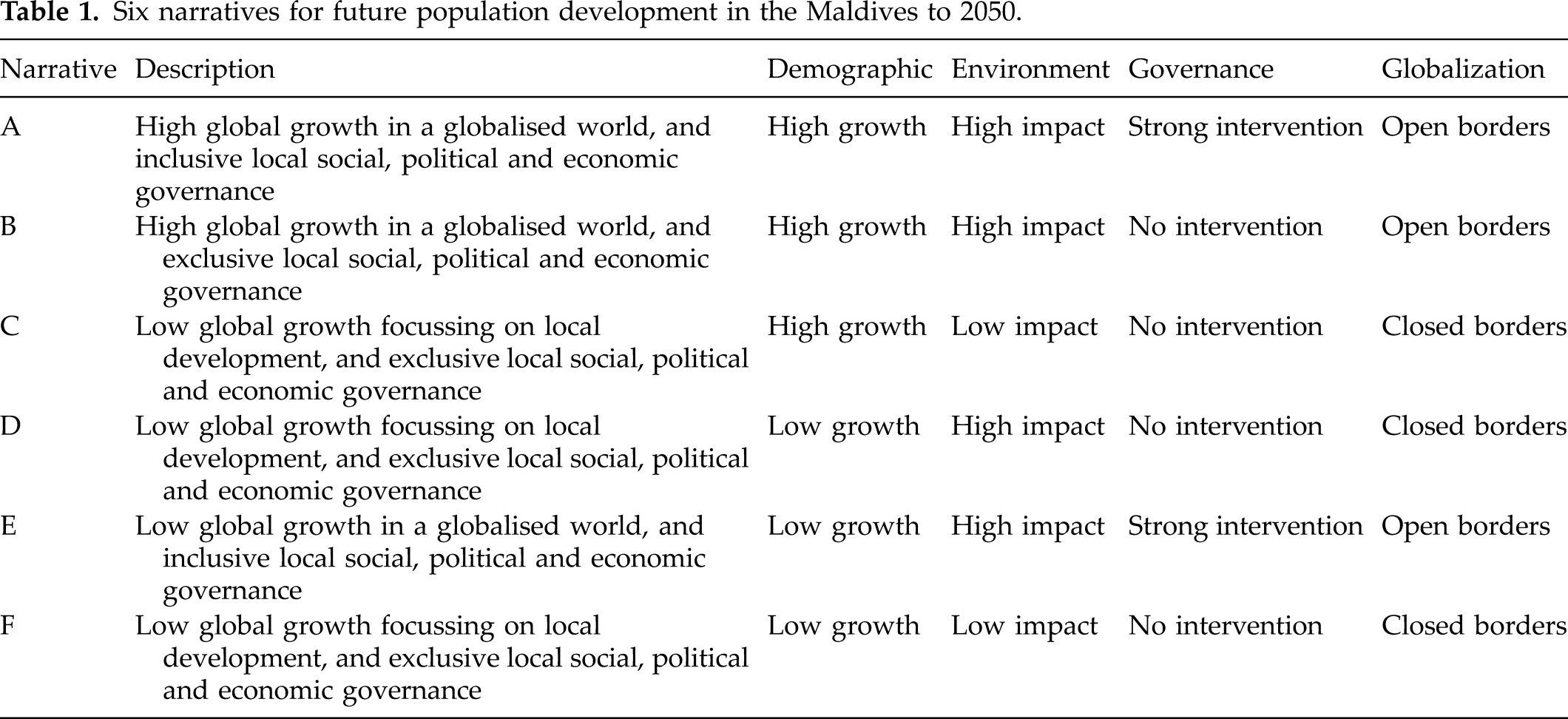
It is important to recognize that the narratives provide examples of demographic futures. These are not predictions. Their purpose is simply to propose contrasting ways in which political and economic factors would combine to influence migration (Government Office for Science, 2011). Descriptions on how these narratives are implemented in the ABM are included in the Annex.
Results
Population size of the 10 islands with highest population in 2014 for all narratives in 2050.
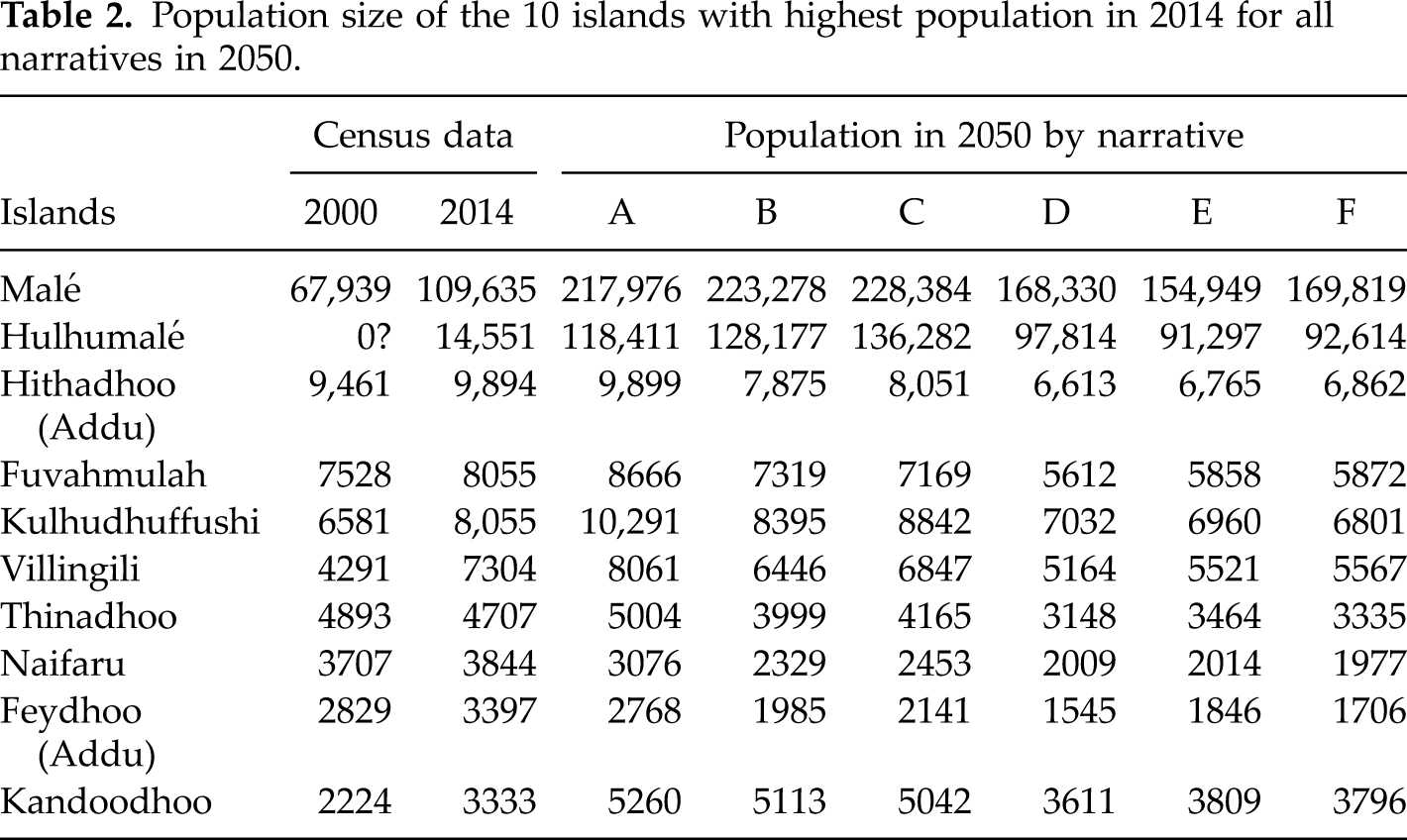
In practice, many islands will likely be abandoned if any of these narratives were realized. For example, Narrative A leads to 18 abandoned islands by 2050. Narrative E leads to 23 abandoned islands by 2050. In narrative F, there are 24 islands with a population of 50 or less in 2050, and 43 islands with a population of 100 or less. In Narrative C, there are 19 islands with a population of 50 or less, and 38 islands with a population of 100 or less. Population policies further influence migration flows. For example, fewer islands experience high rates of out-migration in Scenarios A and E as compared to the narratives with exclusive governance (B, C, D and F).
The population on relatively high-populated (top 10) islands remains stable under high-population growth narratives (see Table 2 and Figure 2) and have reducing populations in low population growth narratives. This includes Villingili, a neighbouring island of Malé, which is part of Greater Malé. Hulhumalé is more attractive than Villingili as an alternative destination to Malé for Maldivians. This effect is reinforced in the ABM by the increasing population of Hulhumalé, suggesting Hulhumalé as an alternative for Malé, than Villingili (Speelman et al., 2017). Population size of the 10 islands with highest population in 2014 for all narratives in 2050.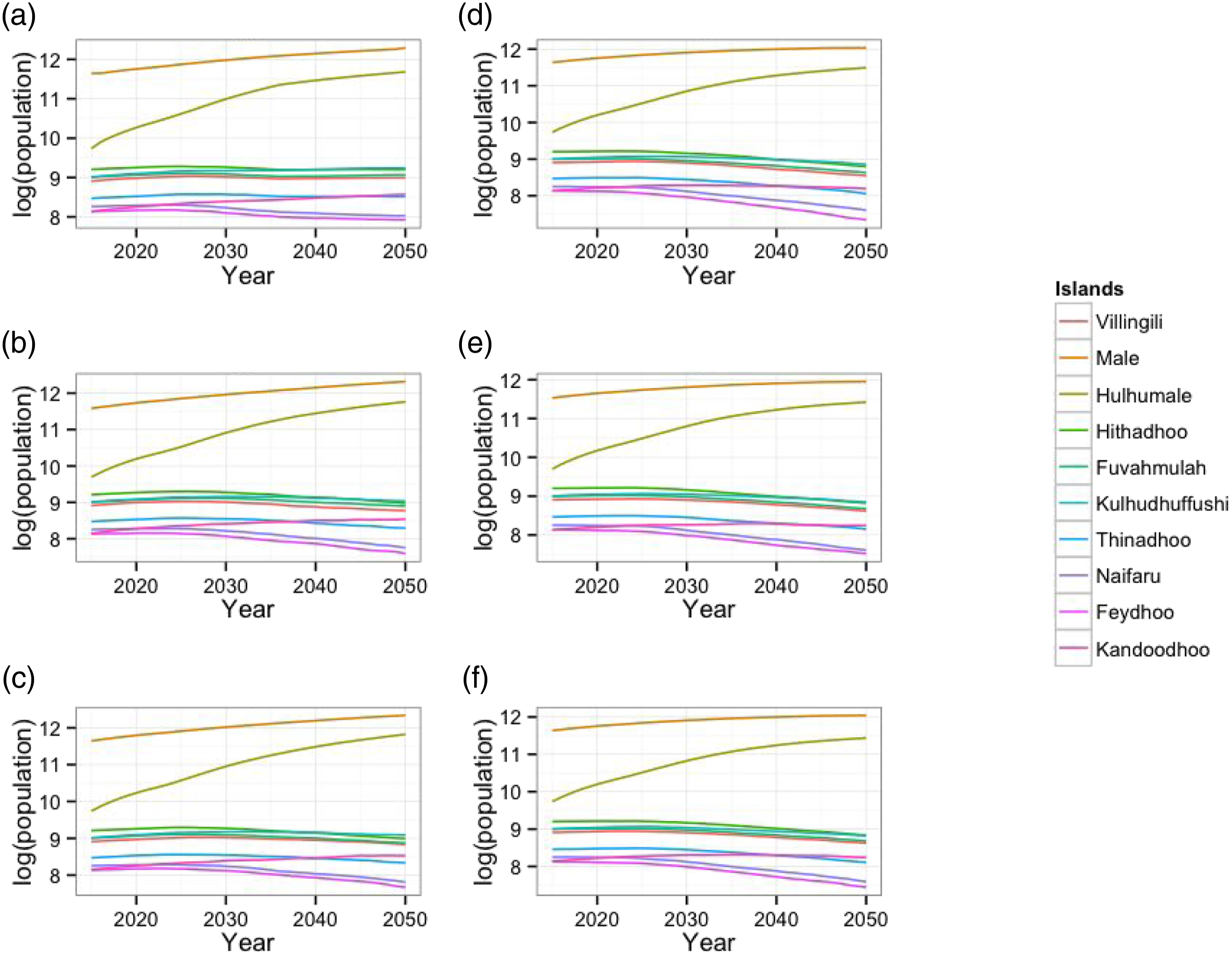
Impacts of climate change increase the size of migration flows and change migration patterns between islands. The ABM simulates environmental change on the basis of relatively small impacts on push factors of islands. This represents changes in island characteristics, such as professional opportunities, services and quality of the living environment. The results show that these dynamics are likely to result in an increase in migration flows, but these will differ by model configuration of environmental change and are highly uncertain (Figure 3). Number of migrants each year by narrative (2015–2050).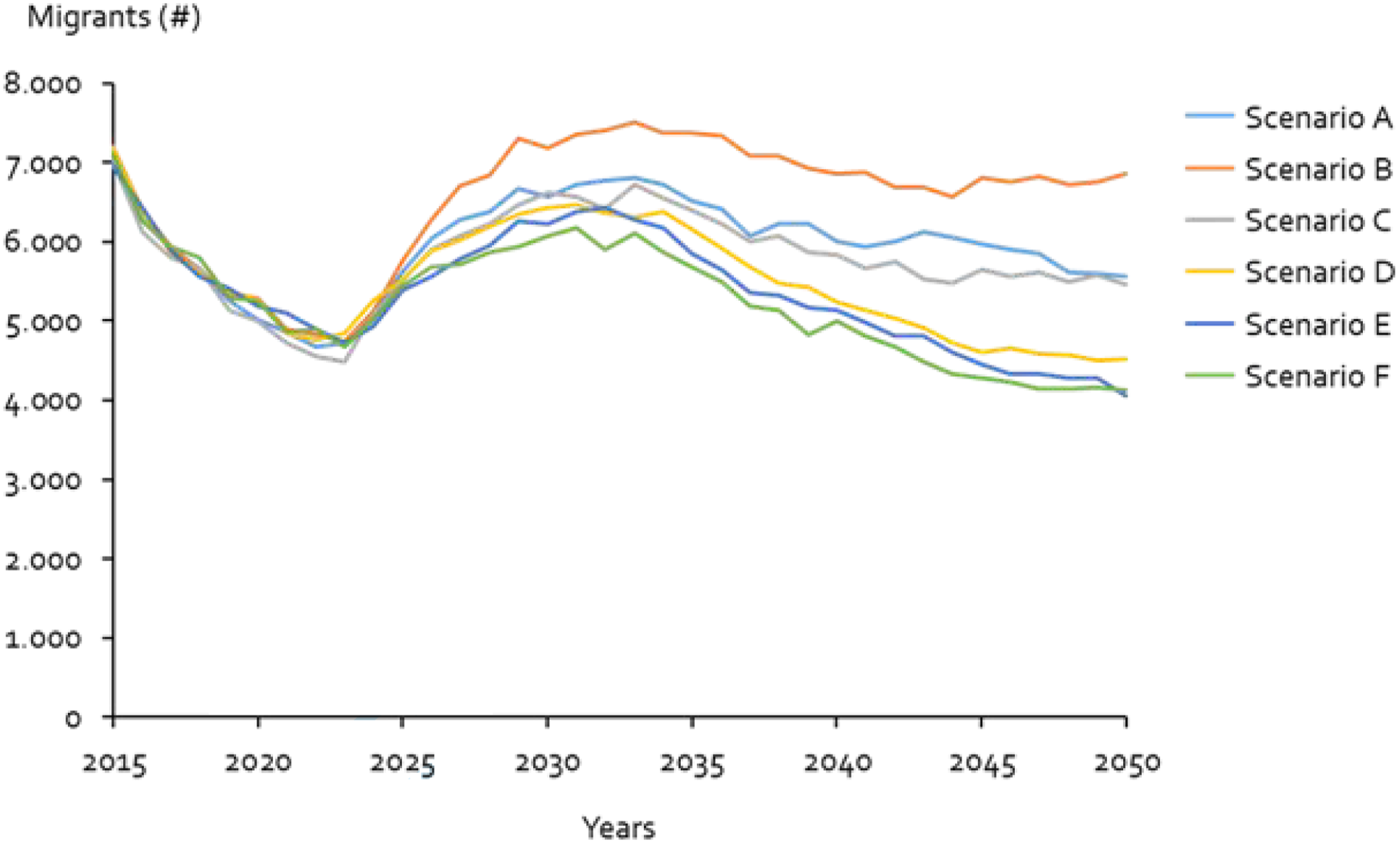
The initial decrease in migration between 2015 and 2023 is caused by a sharp decline in birth rates between 2000 and 2006. The increase in migration between 2023 and 2030 is due to slightly higher birth rates from 2006 to 2014. The sharp decline is presumably caused by increased use of contraception, improved schooling opportunities in rural areas and the political endorsement of family planning at the highest level (Naseem et al., 2004). The initial drop in fertility is the continuation of a trend started in the early 1990s, when the fertility rate was very high, at 6.4 children per woman. The stabilization and slight increase after 2004 are likely associated with the sharp drop to 1.7 children per woman that was measured in 2006. Overall, atoll islands generally have higher fertility rates compared to Malé and its environs (Maldives Bureau of Statistics, 2015a).
Lastly, young, high-educated people are most likely to move abroad and are most likely to reside in Greater Malé. Therefore, 75–85 percent of international migrants have Malé or Hulhumalé as their place of origin. Hence, international migration results in (slightly) lower population in “Greater Malé” for these scenarios (Table 2).
Conclusion
Migration in small island developing states (SIDS) is widely discussed, but mainly in the context of climate change and sea-level rise (e.g., Julca and Paddison, 2010; Kelman, 2015). However, empirical data and simulations were lacking, a gap which is addressed by this study.
This analysis shows that the Maldives has been characterized by an active migration system over the last few decades, with many islands having declining populations and a large urbanization trend around the capital Malé. There seems no reason these broad trends will not continue in the coming few decades.
Malé is already densely populated (in 2021), and the agent-based prognoses show it is unlikely that the Hulhumalé island expansion will provide any release of the population pressure on Malé. Rather, Hulhumalé will facilitate the growth of Greater Malé. As a result of high migration to Greater Malé, there are increasing numbers of low populated islands (and island abandonment) in all projections. This process is reinforced by several factors: 1. 2. 3.
These results have wider implications for studying migration in small islands and areas vulnerable to environmental change. 1. Under a hypothetical scenario of no climate change, island abandonment still appears likely in the Maldives due to other drivers. In the future, climate-induced factors might exacerbate this process. These findings show that understanding demographic futures of all island states, including climate change and island abandonment, requires a thorough understanding of the existing socio-economic context and careful consideration of potential future pathways and potential “runaway” feedback effects. The methodology used in this study can help provide the understanding of these factors. 2. Population and adaptation policies, such as raising of islands or land reclamation projects, require a long-term vision on sustainability of populations on islands, and need to consider migration dynamics. As an example, the Population Consolidation Policy programs, planned relocation and related “Safer Islands” policy program (for details, see Speelman, 2016) in the Maldives can only succeed in the long-term if they are combined with nation-wide integrative population policies. Successful population and adaptation policies require a national and holistic vision and strategic objectives on population, economic development, public services and adaptation. For example, the development of Greater Malé could have a strong influence on the success of regional programs, as large investments in Greater Malé will pull further investments and people away from other regions. With the strong inertia in migration and current investments around the capital area, both development and adaptation will focus on Malé and its environs. This could further strengthen the out-migration from more rural islands and potentially reduce future investments as risks increase. Alternatively, if regional centers and development are also desired, significant changes in economic and adaptation policies are required. These could, for example, include a larger focus on development of tourism on more rural islands, development of industry and agriculture outside Greater Malé, investments in infrastructure and public facilities such as education across the nation. 3. International migration will also have to be considered. Speelman et al. (2017) showed that Maldivians have high expectations about future international migration and young and high-educated Maldivians have high intentions to migrate internationally. However, intentions to migrate internationally are presently not realized, contrasting with the situation in Pacific Islands (Shen and Binns, 2012). Removing barriers to international migration by, for example, the development of migrant networks or changes in policies, could lead to an increase of international migrants. 4. Similar issues will exist in other SIDS, and it is important to analyze these as we support development and adaptation to climate change. For example, in the Pacific, specific determinants of migration (e.g., Connell, 2008, 2014, Guan and McElroy, 2012) and dynamics around international migration and remittances (e.g. Connell and Conway, 2000; Connell, 2010; Leeves, 2009; Shen and Gemenne, 2011) are well understood, but not as systematically studied as presented here. The methods described in this study can help policy makers to understand the interaction of policies with development scenarios.
Limitations
The limitations to this study can be categorized in three parts. 1. Firstly, the arbitrary model configuration of environmental change, international migration and policy produce a useful sensitivity analysis. There is a need for more specific formulation of the economic, social, political and environmental change. Also, the availability of relevant data would increase the reliability of the simulated output and would yield further insight into the interactions between the drivers of migration. 2. Secondly, foreigners who temporarily reside in the Maldives for employment purposes are not included in the analysis. Their numbers have grown substantially over the last few decades. This is a significant population process in the Maldives, and its implications are not well-understood. 3. Thirdly, as shown by the historic model, the size and direction of flows can be influenced due to strong developments or changes. Between 2000 and 2014, the ABM describes population change of the islands better compared to 1985–2000. This is due to strong changes in demographic patterns and a growing importance of Greater Malé and the development of tourism from the late 1980s onwards. Such “thresholds of change” can change demographic processes very quickly and are not well understood but can be explored by agent-based modeling methods.
Recommendations
Sea-level rise and climate change modify existing migration patterns rather than initiating new migration fluxes is widely hypothesized in the climate change literature (Call et al., 2017; McLeman, 2018b). Hence, existing socio-economic processes and future changes need to be carefully considered when assessing future demographic processes and their interaction with potential impacts of environmental change on coastal societies. This study introduces the conceptual model of migration (CMM) and the corresponding agent-based model (ABM) to do this. The CMM and ABM, grounded in prior migration research and extensive census data, show the potential of such analysis for exploring future migration and demographic developments and interactions with socio-economic, political and environmental change.
The results suggest there is a significant inertia in migration trends in the Maldives which makes the continued concentration of population in and around Malé and the abandonment of many other islands almost inevitable in the coming few decades. These results have profound implications for the future development of the Maldives and how they might adapt to sea-level rise and marine hazards in general. Furthermore, significant changes in economic and adaptation policies are required, including national policies towards the implementation of planned relocation and consolidation of the population within the country (Kothari, 2014).
The methods outlined here could be applied in other small island settings to better understand possible future migration behavior under a range of climate change and demographic scenarios. Such insights support the broad issues of development and adaptation planning in these vulnerable settings.
Footnotes
Acknowledgments
Many thanks to Jason Noble and James Dyke for the discussions and input in developing this research. The National Bureau of Statistics of the Maldives was cooperative throughout the process and made the databases that are used available for this study. The content is solely the responsibility of the authors and does not necessarily represent the official views of the organisations mentioned above.
Declaration of conflicting interests
The author(s) declared no potential conflicts of interest with respect to the research, authorship, and/or publication of this article.
Funding
This work is supported by an EPSRC Doctoral Training Centre grant (EP/G03690X/1).

Notes
Model validation
To assess the robustness of the ABM simulated populations from 1985–2014 and from 2000–2014 are compared to actual (census) data. Model reduction is applied to assess different components of the ABM. Sensitivity analyses are performed on dynamic modules (push and pull factors, and network size).