




Abstract
The aim of this systematic review was to gather, assess and synthesize evidence on educational interventions promoting learning and implementation of evidence-based practice in nursing education and their outcomes. Literature was sought from the Cochrane, CINAHL and PubMed databases. The data (10 articles) were analysed by applying qualitative content analysis. The analysis of the interventions produced five main categories: Theoretical foundations, Teachers and partnerships, Learning contents, Learning/teaching methods, and Learning tools. Outcomes of the evaluations were divided into three categories. A Web-based EBP learning module supplemented by help sessions, a program including the Self-Directed Learning Process for EBP Basics and a Workshop for Critical Appraisal of Literature, and an Evidence-Based Practice Project as a group work were interventions that had gained ‘excellent’ outcomes. When supporting nurse students’ learning of EBP, it is recommended to use a combination of self-directed learning and a consultation by a teacher when needed, different learning tools, as well as partnerships in planning and conducting interventions.
Keywords
Introduction
Nursing educators and administrators ask for the reformation of traditional curricula and teaching methods to accommodate the shift towards evidence-based practice (EBP) in nursing.1,2 Nursing students should base their practice on the best possible evidence available. 3
The competencies of evidence-based nursing practice depend on many factors. First, nursing students should acquire a good knowledge base and skills and a positive attitude towards evidence-based nursing. 1 This question is already relevant in nurse teacher education: Salminen, Melender and Leino-Kilpi 4 found that the weakest skills of nurse teacher students were related to teaching decision-making and giving nursing students constant encouragement to seek new information. Phillips emphasizes that finding creative and engaging ways to teach research skills and evidence-based practice in undergraduate nursing programs are essential. 5
Second, nursing students have to learn to evaluate nursing practice and ask the right questions for the search of the evidence and development of nursing care. Besides this, they have to be capable of changing the practice according to the best evidence with other health professionals. In this process, they need competent clinical supervisors in an authentic health-care setting. Unfortunately, some studies show that many staff nurses are not familiar with the terms or processes of evidence-based nursing or current research knowledge of patient care.6,7 Numminen et al. 8 explored the correspondence between nurse educators’ and managers’ assessments of novice nurses’ professional competence. One of the biggest differences concerned the use of evidence-based knowledge: the educators assessed this competency as fairly high, whereas the managers assessed it as lower. The authors suggested, for example, that the educators might have too positive a view of their students’ readiness to apply research knowledge, or that during nurses’ socialization process into their new work environment, the use of evidence-based knowledge is not supported enough.
Third, educating nursing staff to be evidence-based-oriented forges a stronger partnership between academic programs and health-care settings than previously. According to North-American researchers Alexander et al., 9 in the current healthcare reform climate, the need for vibrant academic-practice partnerships is clear. This also calls for new models of partnership. Partnerships between higher education and the workplace have traditionally been restricted to clinical practice placements and thesis work.10,11
A systematic review on educational interventions for learning EBP in nursing education has been published in Finland by Melender and Häggman-Laitila. 12 The review included 10 articles on nine educational interventions, published between the years 2000 and 2007. The educational interventions were categorized into three groups: information literacy, searching and utilizing research evidence for a clinical problem, and theoretical studies on evidence-based practice. Most of the interventions were at least somewhat effective, even though the review also included some interventions that were mainly ineffective. This systematic review aims to update knowledge on the topic.
The review
Aim
The aim of this systematic review was to gather, assess and synthesize evidence on educational interventions promoting learning and implementation of evidence-based practice in nursing education and their outcomes. The research questions were:
What kind of educational interventions have been used in order to promote the learning and implementation of evidence-based practice in nursing education? What outcomes have been achieved by using these interventions?
Search methods and outcome
Literature was sought from the Cochrane, CINAHL and PubMed databases (1 January 2008 to 26 February 2013). Search terms, results based on them, as well as inclusion and exclusion criteria are described in Figure 1. The titles, abstracts and full texts were screened by two researchers. In order to comply with the criteria, 10 articles were selected for the final analysis (Table 1). Nine interventions focused on nursing students, while in one intervention, the focus was on strengthening a curriculum by educating faculty members.
Search strategy. Educational interventions, evaluation and outcomes.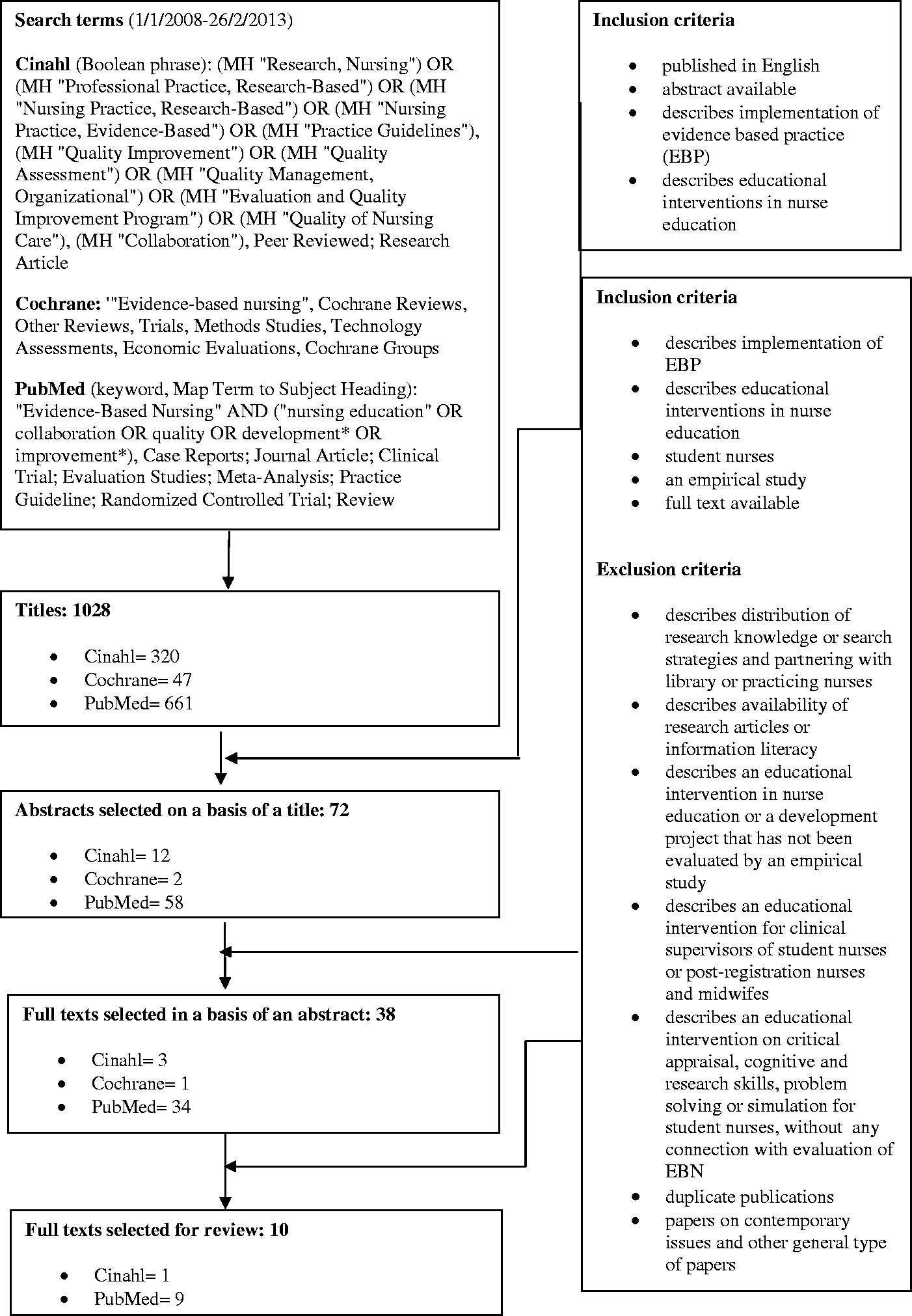

Quality appraisal
The quality of the studies was evaluated with criteria presented by Gifford et al. 13 which are design-specific quality assessment criteria for quasi-experimental (8 criteria), survey (6 criteria) and qualitative studies (11 criteria). When a methodological triangulation was involved, the quality of the paper was graded by using criteria meant for the method predominant in the study. Each criterion was given a score from 0 to 2; 0 points representing many limitations, 1 point some limitations and 2 points representing excellent quality of the criterion. The highest possible scores were 16 for quasi-experimental studies, 12 for surveys, and 22 for qualitative studies. Results of this evaluation are presented in Table 1, in association with details on study designs, authors, publication years and countries.
Data abstraction and analysis
A descriptive matrix of the full texts was drawn up and included information about the authors, publication years, countries of origin, quality grades of the studies, the interventions and participants, methods and evaluation results. The information in the data matrix was analysed by qualitative content analysis. 14
Quantitative and qualitative studies were combined in same analysis because the analysis was descriptive. Information from the data matrix was reduced and the reduced expressions were grouped into subcategories based on their similarities and differences. Only the manifest content was analysed. Abstraction was continued until the subcategories excluded each other. The process was continued to combine subcategories with similar contents to form main categories. The categories were named based on their contents. After categorizing the data, the authors returned to studying the original material, in order to specify the contents and research evidence of the categories.
Validity and ethical considerations
To ensure a systematic and extensive search process, the search was carried out with a library information specialist and by utilizing database directories. Search terms were chosen to produce a wide range of terms focused on evidence-based nursing, considering the word indexes and special features of the databases. These were reported accurately to ensure repeatability (Figure 1).
Two researchers working independently made the selection. However, the selection process and ambiguous cases were discussed together, which added to the reliability of the data. The articles were first chosen based on their titles. Due to this limitation, there is a possibility that some studies may have been left out. On the other hand, the manual search of the reference sections of the articles chosen for the review did not indicate any need for the search process to be repeated. When screening the titles, no possibly eligible publications published in any other language than English were found. Thus, it is unlikely that language or publication bias exist in the review. The review comprised articles from several journals and different cultures including also non-English-speaking countries. Using several databases also decreased the likeliness of bias in acquisition of material for the review.
Careful documentation of all relevant information about the original studies to the matrix and careful use of this information in the analysis increases the reliability of the analysis. The categories contained many observations extracted from the data. Repeatability was achieved in the analysis, and it may be assumed that constructing essential conceptual categories was successful even though the scope of data was limited. 14 The analysed articles have been listed and readers may verify the reported classifications based on them.
Instruments developed and tested earlier were used in five studies. In two studies, instruments were developed for the purposes of the present study. Validity was reinforced by using quantitative and qualitative data collection methods in six studies (Table 1).
The results of the evaluation may be distorted if the data are analysed only by observing the effective interventions or if literature only provides biased or inadequate data ignoring ineffective interventions. Ethical issues were considered in this review, because some of the papers included had also reported partly unsuccessful implementations as well as inadequate available evaluation data.
Results
Educational interventions
To describe the educational interventions, five main categories were identified: Theoretical foundations, Teachers and partnerships, Learning contents, Learning/teaching methods, and Learning tools.
Seven papers included information on the
Models related to evidence-based practice/knowledge included the ACE Star Model of Knowledge Transformation Theory, 20 the four A’s of research skills (Awareness, Appreciation, Application, Ability), 21 Rogers’ Diffusion of Innovation Model,16,18 and Iowa Model of Evidence-Based Practice. 16 Moreover, the developers of the interventions reported the use of research evidence of the topics related to the subject. 21
The subcategories describing
Facilitation of students’ learning was also enforced by partnerships, which were described with two subcategories: clinical sites and an external appraisal panel. Clinical sites meant clinical placements where the students conducted their EBP projects in their clinical placements in the guidance of their clinical preceptors16,18 or where journal clubs were implemented. 23 A panel was convened with representatives from health organizations to assess the format and content of the subject, as part of a Graduate Certificate in Health Research. 21
Learning contents and learning/teaching methods of the interventions (the numbers refer to the articles).
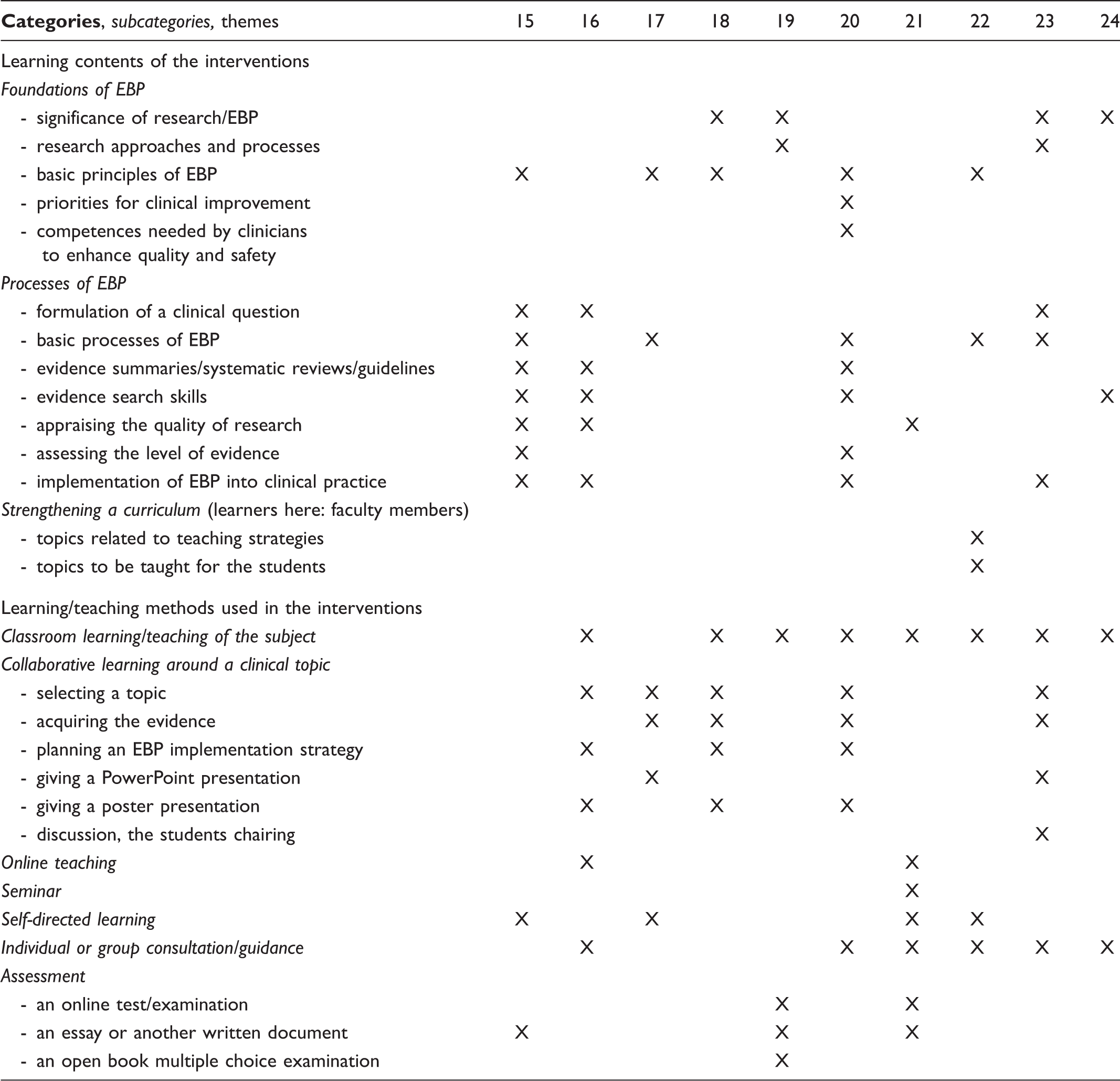
Many interventions included different
Outcomes of the interventions
The outcomes of the interventions were divided into three categories: Student achievement of learning goals, Students’ satisfaction, and Faculty’s satisfaction. The first one was prioritized, but in addition to students’ learning, it is also important to evaluate how the instructional practices work. 25 The outcomes were categorized as follows: A ‘Excellent outcomes’ (mostly positive outcomes); B ‘Partly good outcomes’ (some outcomes positive, some not); and C ‘poor outcomes’ (most of the outcomes poor) (Table 1).
Four interventions showed very good outcomes related to
Discussion
The first research question of this review dealt with finding out what kind of educational interventions have been used in order to promote the learning and implementation of evidence-based practice in nursing education. The descriptions of the interventions in original papers were diverse and sometimes superficial, and the abstraction of the categories and synthesis of the results in this review remain low.
Theoretical foundations were reported in seven papers, and some of them even reported the use of more than one theoretical framework. All interventions that were ranked ‘excellent’16,17,20 included at least one theoretical framework. Learning theories help to plan educational interventions pedagogically 26 and EBP models guide the design and implementation of approaches intended to strengthen evidence-based decision making, 27 and the use of these both can be recommended.
Many kinds of teachers and partners had been involved in the interventions. However, it was not possible to see any associations between any group of teachers and the outcomes of the evaluations. What is important for the students’ motivation and learning is that during their education, they can see examples of partnerships between the faculty and the clinical sites and are exposed to learning tasks in the clinical practice, as was apparent in two ‘partly good’ interventions18,23 and in one ‘excellent’ intervention. 16 Gray 11 states that a partnership has two aims: first, to assist students to experience the clinical reality of evidence-based practice in a non-clinical nursing course and second, to interweave evidence-based practice into the everyday reality of ‘what nurses do’. In Gray’s study, students identified the research partnership project as the course experience that most positively affected their learning. These examples present new models of partnership emphasized by MacPhee 10 and Gray. 11 Partnerships could also narrow possible gaps between expectations and reality in implementation of evidence-based practice from the perspectives of both faculties and clinical sites. 8
In one intervention, the teaching team consisted of teachers who were predominately active clinical researchers 19 and the students identified the team as one positive aspect of their learning experience. It is likely that teachers who are active researchers bring the element of deep subject knowledge to the teaching of EBP and their functions in the teaching position can be recommended.
Learning contents were reported on various levels in different papers. Although categorization was made, no associations were discovered between the contents and the outcomes of the interventions.
Learning/teaching methods were partly quite traditional. For example, the workshop method was used only in one intervention. 17 However, this intervention gained ‘excellent’ outcomes and is thus worth a recommendation. One of the two interventions that included online teaching was rated ‘excellent’ 16 and one of the four interventions that included self-directed learning was also evaluated as ‘excellent’. 17 Moreover, two ‘excellent’16,20 and four ‘partly good’21–24 interventions included consultations or guidance. It is possible that a combination of self-directed learning and a consultation by a teacher when needed could produce good learning outcomes. Supplying the students with learning tools was reported in five papers. Out of the ‘excellent’ interventions, one 17 included a large number of different learning tools and this may be one element which has enhanced its effects. As self-directed learning strategies must be taken introduced in an increasing amount in the future, the need for effective learning tools enabling effective learning also increases.
The purpose of the second research question was to find out what outcomes have been achieved by using the educational interventions. Three interventions had gained ‘excellent’ outcomes. These included a Web-based EBP learning module supplemented by help sessions, 16 a program including the Self-Directed Learning Process for EBP Basics and a Workshop for Critical Appraisal of Literature, 17 and an Evidence-Based Practice Project as a group work. 20 However, the crucial elements that made these interventions so successful were not entirely identified.
The level of evidence on the outcomes of the interventions remained quite modest. There is a need to conduct more studies on the topic, especially experimental studies that include long enough follow-up periods. In evaluating the outcomes of the interventions, it is important to use valid and tested instruments that are relevant in relation to the purpose of the intervention. Other aspects of EBP that have an impact on nursing students’ learning have also been studied insufficiently. For example, our knowledge of barriers for evidence-based nursing is strong and studies from different countries repeat the results of the same main barriers. 6 However, there is a scarcity of, for example, knowledge of effective interventions of teacher education and organizational infrastructures of health care regarding evidence-based nursing. 28
As for the limitations concerning the validity of the intervention studies promoting students’ learning, some of studies had small sample sizes from the point of view of the study design, or the article included no information about sample size. Moreover, in some studies, evaluation, such as students’ or educators’ self-assessment, was superficial (Table 1). Some respondents may have chosen to answer in a more socially acceptable way, as compared with those who did not reply. These factors may have skewed the evaluations of the interventions. Only learning results and satisfaction of the students and the faculty were examined as outcomes of the interventions, because the aim of a review is to condense information.
Conclusions
Based on the review, the following conclusions were made:
The level of evidence on the outcomes of the interventions is quite modest and more research will be needed on the outcomes of educational interventions for learning and implementing of EBP in nurse education. When reporting evaluation studies on interventions more exact descriptions of the implemented interventions will be needed. When supporting nurse students in learning and implementation of EBP, a combination of self-directed learning and a consultation of a teacher when needed, can be recommended. Different learning tools can also enhance students’ learning, and using them is recommended. Using partnerships in planning and conducting EBP study programs is recommended. More experimental studies on the topic are needed.
Footnotes
Funding
This research received no specific grant from any funding agency in the public, commercial, or not-for-profit sectors.
Conflict of interest
The authors declare that there is no conflict of interest.