




Abstract
The aim of this study was to explore the barriers experienced by doctoral nursing students during their research studies. An additional aim was to explore the strategies used to overcome these barriers. It can be a very challenging endeavour for doctoral nursing students to complete their research studies. During their research studies, doctoral students encounter various barriers that impede the progress of their studies. The study design was qualitative, and data were collected through individual interviews with seven doctoral nursing students at one university in Sweden between September and the end of November 2014. The data revealed seven themes illustrating barriers and strategies used by the doctoral nursing students to overcome these barriers: 1) difficulties in defining concepts, 2) intellectual struggles with qualitative analysis, 3) lack of control during the recruitment process, 4) missing a more research-oriented environment, 5) interruption to study focus when combining research and work, 6) lack of motivation, and 7) feeling powerless during supervision. In conclusion, this study illustrates the importance of facilitating good relationships between doctoral nursing students, their supervisors and faculty as a possible way of reducing barriers during research studies. These findings could be of help in the development of better learning environments for doctoral nursing students.
Introduction
Undertaking research studies can be challenging for doctoral nursing students, especially at those times when studies are not moving forward. Previous studies1–2 have acknowledged that doctoral students encounter both minor and major barriers to learning throughout their studies. Sometimes these barriers can lead students to end their research studies prematurely. 2 Common explanations for students ending their research studies may include insufficient support from supervisors, loss of motivation, an unsatisfactory psychosocial work environment, economic reasons, and difficulties combining research studies with family life. 2 The same difficulties are also faced by those students who continue with their research studies. 1 In addition, it is not uncommon for doctoral students to experience a great deal of stress in relation to their research studies.3–5 Furthermore, research6–7 indicates that there is a shortage of registered nurses with doctoral degrees working within academia. This shortage may pose a threat to the quality of education, as nursing faculties may lack these important academic skills.6–7 Gaining a deeper understanding about the various challenges doctoral nursing students encounter during research studies could be of help in improving the quality of research education.
The doctoral programs in Scandinavian countries, as well as internationally, differ in design. 8 In Scandinavia, there are similarities as well as substantial dissimilarities in the educational structures, lengths and contents. 8 This implies that depending on which country the doctoral students are pursuing their research studies, the barriers could be different due to the shifting requirements. Currently, there is a lack of research, especially from Scandinavian perspectives, focusing on the doctoral nursing students’ own experiences of barriers during research studies and the way in which they have tackled them. Consequently, there is a need to gain a deeper understanding about these concerns. Knowledge derived from this study could help doctoral nursing students and their supervisors to better prepare on how to deal with potential barriers; it could also illustrate for them how other doctoral students have successfully overcome these barriers. In summary, this knowledge could help to improve learning environments for doctoral nursing students.
Material and methods
Aims
The aim was to explore the barriers experienced by doctoral nursing students during their research studies. An additional aim was to explore the strategies used to overcome these barriers.
Design
A qualitative interview study 9 was chosen for this study. Data were collected from seven individual interviews 10 with doctoral students. Data analysis was inspired by the description of thematic analysis made by Morse and Fields. 11
Context
Research was carried out at a single university in Sweden between September and the end of November 2014. The academic requirements for research studies are similar at all Swedish universities 12 and are regulated under the Swedish Higher Education Act. 13 The requirements for commencing research studies involve completing a minimum of 240 credits, including at least 60 credits at master’s level. 12 Doctoral students can enrol for either a PhD degree or a licentiate degree. The licentiate degree is recognized as a pre-doctoral degree in Sweden. Both the PhD and the licentiate programme consist of two parts: thesis and course work. The PhD program requires four years’ full-time study, comprising a total of 240 credits under the European Credit Transfer and Accumulation System (ECTS). Of these, at least 120 credits should be accounted for by the thesis. The licentiate program requires two years’ full-time study, comprising a total of 120 credits. Of these, at least 60 credits should be credited to the thesis. 12
The design of the doctoral programs and the expectations regarding what students should accomplish can differ depending on the university affiliation and selected research field. The research field for the doctoral students in the current study is nursing science. Typically, PhD students in this field are required to write four scientific articles and one framework. The framework must be individually written by the doctoral students and should present the articles in their joint context. The results from the articles are discussed in regard to the current research area and utilized methodology is reflected upon in the framework. All of this work is credited to the thesis. It is also possible to write a monograph. Similar requirements apply to licentiate students. However, this is limited to two scientific articles and one framework article. Apart from taking courses and writing articles, doctoral students must also take part in regular doctoral seminars at their university. Doctoral students in this program present their manuscripts at these seminars; critical discussions follow. As a preparation for forthcoming doctoral studies the students have to participate in a compulsory introductory course at the university.
Recruitment and participants
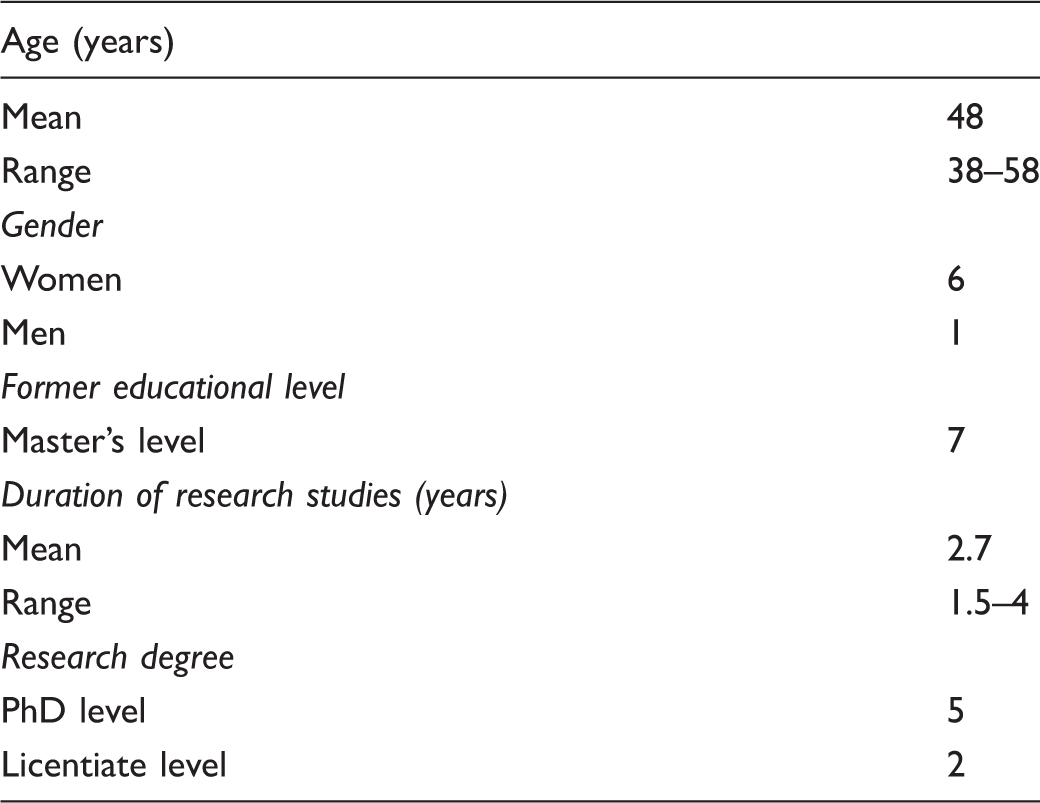
Demographic characteristics of the participants (n = 7).
Data collection
Individual interviews were conducted with the seven participants in 2014 (see Table 1). A semi-structured interview guide 10 was used to guide the interviews, and the participants were encouraged to speak freely around the questions. The semi-structured guide was sent out beforehand to the participants to give them time to reflect about possible barriers and strategies before coming to the interview. The interview guide contained a number of questions, such as: Can you remember a time when you got stuck during your research studies and were not able to progress with your studies? What did you do to get going again? Please tell me more. Probing questions were used to further deepen the interview. The interview sessions were recorded using a digital voice recorder and were transcribed verbatim. All interviews except one were conducted at the doctoral students’ workplace. The remaining interview was conducted at the doctoral student’s own home. Interview sessions were approximately 35 minutes in duration.
Data analysis
Qualitative thematic analysis 11 with an inductive approach was chosen for this study. An inductive approach signifies the researcher being exploratory, utilizing an open-ended way of reasoning, following the logic from the ground up. 15 The procedure was influenced by the description of thematic analysis by Morse and Field. 11 All interviews were listened to and the transcripts read through a number of times. This was done to get an overall understanding of the interviews; during this process, the author reflected on the interviews as a whole. As a result of this continuous iterative process seven themes emerged from the data. These seven themes reoccurred across the interview texts during continuous readings and linked substantial portions of the interviews. Differences and similarities in these themes were reflected upon by the author and when no further themes were likely to emerge, the author decided to conclude the data analysis.
Ethical considerations
According to the Swedish Ethical Review Act, this study did not require any ethical review. Nevertheless, it was conducted in compliance with the established ethical guidelines of the Declaration of Helsinki. 16 In addition to contact details, all participants received both written and verbal information about the study, its purpose, and about how the data would be treated confidentially.
Findings
The findings originate from the thematic analysis based on interview descriptions of the barriers experienced by the students during their research studies and the strategies they used to overcome them. Seven themes emerged from the data, each of which is described in what follows.
Difficulties in defining concepts
One barrier encountered by some of the students was the difficulty in defining a number of concepts, which were of central importance to their research studies. These concepts were often not clearly defined in the scientific literature. The participants explained that the more they tried to read and learn about these concepts, the more difficult and complex they became. They described how different scholars and movements within the research field had described these concepts in very different ways, making it even more confusing and difficult to understand: I worked on this concept from the beginning and I realized of course that this concept is so terribly complicated and the more I read the more confused I became. (Participant 1)
When trying to take on the challenge of understanding these concepts, the participants highlighted the importance of reflection on the meaning of these concepts with colleagues or with their supervisors. The fact that colleagues or supervisors had a different perspective or a different knowledge base was seen as helpful. Regular doctoral seminars offered a place where these kinds of reflection could take place. By having to discuss and justify their use of these difficult concepts, the participants were able to gain new perspectives, which eventually led to the concepts being clarified.
Intellectual struggles with qualitative analysis
Many of the participants experienced difficulties with the qualitative analysis. The reasons behind this were expressed as not being able to abstract the data, difficulties in handling large amounts of data, difficulty in grasping meaningful processes within the data, and difficulties in understanding how to adhere to the chosen method of qualitative data analysis. These difficulties were often linked to the intellectual process of working with qualitative analysis.
The participants expressed difficulties in arranging the qualitative data according to what belonged where, and finding a common thread within the data. Some described themselves as lacking imagination or finding it hard to grasp the meaning inherent within the data when working with interpretive data analysis: I work with qualitative studies, and you know that you should abstract the material to a higher level and not only have a descriptive level. It has been difficult to think about what this really stands for … it feels like a limitation that you may not have enough, so as to say within quotes, imagination. (Participant 2)
To overcome these barriers, the participants highlighted the importance of taking a step back from the data analysis. When the participants looked at the data from a fresh perspective, they began asking more questions about their data, such as, what does this really mean. Other strategies that were proposed included taking a walk, doing housework, or something else practical before coming back to look at the analysis again. This strategy helped participants become more perceptive by giving them a fresh perspective when looking at the data a second time. Another strategy was to discuss the data analysis with their supervisors or with other doctoral colleagues who had conducted the same type of analysis. Once again, the regular doctoral seminars provided a forum for the participants to discuss how they carried out their analyses and what they had written. Other doctoral students attending these seminars also read their manuscripts and were able to contribute valuable perspectives on the data, perspectives that could help the participants move forward. The participants also discussed the data analysis with their supervisors. Their supervisors asked them to explain how they had come up with their conclusions, and, by being asked to justify their ideas, it became clearer to the participants exactly how they had come up with their findings. The participants described their supervisors as bringing a ‘helicopter perspective’ to the data analysis. This was particularly helpful as the participants explained that they had a tendency to look at smaller issues when they were involved in data analysis, which prevented them from seeing the bigger picture.
Lack of control during the recruitment process
Some of the participants described a lack of control during the recruitment process for their own research studies. Recruitment of participants was often experienced as a time-consuming and difficult process, but was essential for the progress of their research studies. Some participants had to request help from different health personnel as these health personnel were able to screen for potential participants, where this was not always possible for the doctoral students. This situation constituted a barrier as the students were not themselves involved when the recruitment actually took place, leaving the control of the recruitment process to someone else: One needs to go through a third person to get help to identify the people you want to meet. They also become a type of gatekeeper on the road that also makes that … even if you have decided your own inclusion criteria, I have understood when following up my studies that they … they unconsciously make some form of personal screening as well. (Participant 3)
Strategies proposed by the participants included discussing these barriers with their supervisors and doctoral colleagues. Through these discussions they received advice such as changing the focus of the studies to make it easier to recruit participants. The supervisors were also knowledgeable about different ways of recruiting. They could, therefore, encourage the participants as they themselves had been in similar situations before. For example, they were able to confirm that the recruitment process often takes a long time and to allow extra time for the recruitment of participants. Another strategy proposed was to be persistent and to keep in constant contact with health personnel in charge of the recruitment to ensure being updated regarding the current state of the process.
Missing a more research-oriented environment
All the participants described how their work environment created difficulties at times. The participants wanted a workplace that was more research-oriented. Many of the participants felt that they wanted to be a part of a workplace where nursing research was more frequently discussed and where all of those employed were interested in this field. The participants felt they were employed as doctoral nursing students at a university where nursing research had not been fully incorporated into the workplace environment. Many of the participants felt isolated in their positions as doctoral nursing students. Even though they had doctoral colleagues with whom they could discuss their issues, they missed having more regular research seminars. They also described a lack of shared research activities that could bring researchers together at the university where they were employed: I miss a larger critical mass than … an environment where you can freely discuss things … an environment, a context where there are many different people that you can discuss research with. (Participant 1)
Strategies proposed by the participants mainly involved trying to establish good relationships with other doctoral nursing students. Such relationships were vital as having someone to reflect with and to share knowledge with was seen as very important. The participants viewed these relationships as allowing for give and take. Such relationships allowed for daily discussions about common research issues, and were an important way to prevent students getting bogged down in their own research studies.
Interruption to study focus when combining research and work
All the participants experienced problems balancing their research studies with their work responsibilities, which mostly involved teaching. This situation of balancing responsibilities continuously interrupted their study focus. The participants all had combined employment in which they had work responsibilities in addition to their research studies. These work responsibilities frequently took the focus of their concentration away from their research studies. The participants also felt hindered by a lack of understanding of their situation as doctoral nursing students and the challenges this created for them. They felt there was a lack of flexibility with regard to work responsibilities. They expressed that it was always their research studies which suffered as a result. The participants found it difficult to switch focus from their research studies to work and back again. They also explained that it took more energy to change focus if their work responsibilities included activities that they had not previously performed. They felt very strongly that their work activities should not be changed too frequently. It is because of the time. I must have some kind of coherent and focused time on my research. Because I have teaching activities twice a week, afterwards I have to sit down and work with my research again. I need some setup time before getting into it again. (Participant 4)
The participants used strategies such as working at evenings and weekends to get more quality time to focus coherently on their research studies. However, some participants carried out most of their work activities during the weekend so they could focus on their research studies during the week. Another strategy was to focus on their work activities more extensively during certain weeks in order to obtain more quality time for research studies at other periods. Some participants were helped by keeping to a very strict schedule and never deviating from it, no matter what.
Lack of motivation
The participants explained that lack of motivation could act as a barrier. Some participants described the importance of researching a subject area in which they had a genuine interest. They explained that when they became aware that their preferred research area was not possible, they became less motivated and even started to question continuing as doctoral students. Some participants described how they felt disappointed and sad because they were not able to research those issues they really wanted to. Motivation issues were most apparent after receiving feedback from supervisors: It can be that I look at it [comments from supervisors] and I get so disappointed and sad, and then I end up in that black hole, and wonder why am I doing this, why did I become a doctoral student, what was I thinking. I had it good, I earned good and I had just as well been able to continue with it. (Participant 4)
One proposed strategy was to relax and wait for motivation to return. Motivation issues were often short-lived. Once participants had regained energy, they were normally ready to take on their research studies again. Another strategy proposed by some of the participants was to avoid doing research at home too often, keeping research at the workplace when possible. Being at home offered many temptations to put off study, such as doing the laundry. However, the participants also felt that it could be easier to concentrate on their research at home. A few participants also suggested that taking study leave or decreasing their work time, helped restore their motivation.
Feeling powerless during supervision
The supervision process was at times experienced as a barrier by the participants. They felt powerless, and not able to move forward with their research studies because of having to wait for their supervisor’s comments. Not getting enough time for discussions with their supervisors, or situations where a supervisor had not read their material that was to be discussed, could hinder the participants’ progress. A few participants said that occasionally they had to wait a considerable length of time before getting any response about their work. The participants believed this was due to supervisors having too heavy workload or where supervisors were waiting on each other to give the first response: They wait a bit to see what the other supervisors will write, or they may not have the time to read and therefor do not want to respond with comments. I do not know if they do not want to expose themselves or why they wait, but it slows down the process when waiting for someone’s comments. (Participant 6)
Another barrier experienced by some of the participants was the feeling of not being able to take the initiative for their own work as doctoral students. The participants felt that different supervisors could come up with divergent opinions regarding their work. Some participants felt that this made it difficult to know how to continue with their research studies. When being caught in the middle between supervisors with mixed opinions regarding their work made them feel great uncertainty. This situation made it difficult to know how to proceed: You write and write and you think it is good, and some supervisors tell you that you are beginning to get the structure of this. Then another supervisor says no, you have to write like this instead. Then you start to wonder which leg you should stand on. (Participant 5)
The participants found it hard to develop any strategies to deal with this issue as they felt they were in a vulnerable situation as doctoral students. Because of this, the participants tended to avoid confronting their supervisors and instead left the situation as it was. A few participants spoke about the necessity of giving the supervisors sufficient time to read up on their work when they wanted feedback.
Discussion
One important finding was that all the participants felt that the work place environment was at least in part a barrier impeding the progress of their research studies. All were part-time students and had work responsibilities at a university other than where they conducted their research studies. They wanted to belong to a more research-oriented workplace where nursing research was fully incorporated into the organizational structure. The importance of having a work environment that facilitates learning for doctoral students has been emphasized in other studies.1–2,17 Furthermore, it is not uncommon for the work environment to be a part of the reason why doctoral students drop out. 2 Smith and Delmore 17 highlight the importance of promoting interaction between doctoral students, recommending the implementation of strong study partnerships with other doctoral students to enhance the learning process. 17 Furthermore, they suggest that developing a peer support system with other students, and creating retreats and study groups, could increase the chances of students completing their research studies. 17 The participants in the current study used similar strategies to overcome this barrier, e.g., developing relationships with other doctoral students for information exchange and reflections concerning their research.
Another difficulty experienced by some of the participants was a feeling of powerlessness during supervision. This barrier manifested itself in situations where students were either not getting enough supervision time or where they were receiving contradictory feedback from their supervisors regarding their work. These kinds of situations have also been described in previous research.18–19 Gunnarsson et al. 19 suggest that these barriers, when they are not caused by a lack of commitment from supervisors, may have different origins depending on the current progress of the doctoral student. Early disagreements between the supervisor and the doctoral student may indicate student immaturity, whereas disagreements later on may indicate that the doctoral student is now mature enough to make his or her own decisions. 19 In the current study, the findings also raise an important concern as some of the doctoral students were afraid to employ any strategies to overcome this issue. Instead they asserted there was nothing they could do to improve the situation.
The participants used a range of strategies to combat their difficulties. One strategy that they emphasized was reflection about their research issues with colleagues and other researchers, who had a different knowledge base and perspective. This opened up new ways to look at their issues, and also helped them justify their research studies, eventually leading to progress. This type of strategy involving promoting reflection regarding research issues with fellow doctoral students and researchers is also emphasized by Conn et al. 20 When constructing research environments for doctoral students, ensuring that there is a mix of students with different experiences would help facilitate a better learning environment. Another strategy highlighted by the participants was that of keeping a coherent focus on their research studies. As many doctoral students today are part-time students, combining their research studies with other work responsibilities, planning becomes even more important. The participants proposed strategies such as trying to concentrate on work activities during specific periods in order to free up time to for a coherent focus on their research studies. It is important to have strict planning, which should be organized in conjunction with supervisors and faculty. Such co-planning should emphasize opportunities for doctoral students to have sufficient time for a coherent focus on their research. The significance of careful planning is acknowledged by Dowse et al., 21 highlighting the importance of taking into account the logistical issues of data collection when planning the doctoral studies. 21 The importance of planning is also highlighted by Conn et al. 20 suggesting that planning is crucial to successfully complete a doctoral program within nursing science. The doctoral students need to keep focus on the breadth and depth of the chosen research area to avoid research studies becoming too time consuming. 20
Methodological considerations
The methodological considerations are discussed based on the concept of trustworthiness for qualitative research, as proposed by Lincoln and Guba. 22 The author is himself a doctoral student within the field of nursing science and therefore has an understanding of the context. This knowledge has influenced the research process, which can be seen as both a methodological strength and limitation. The knowledge has helped different stages of the research process as the author was already familiar with the context. However, it could also have obscured the author’s lens during the interviews and data analysis as a result of preconceptions. To address this methodological consideration, the author has been engaged as a reflexive researcher by regularly taking a step back, critically reflecting on his own perspective in relation to the data. To strengthen the credibility and dependability 22 of the research the author has tried to clearly describe the different stages of the research process, thus making it more visible to the readers. Furthermore, to allow a transparency of the thematic analysis, quotes originating from the interviews are presented within the findings. The quotes are also used to illuminate the participant’s experiences in regard to the presented themes. Another consideration is that of generalizability. 22 The specific sample in this study consisted of mainly female doctoral students recruited from only one university in Sweden. This may well limit the transferability of this research. Furthermore, an additional consideration is that of the interviews being conducted only once and at a specific time. To get richer data and to strengthen dependability, the author could have conducted repeated interviews, thus better account for the ever-changing context.
Conclusions
The findings from this study highlight the importance of facilitating good relationships between doctoral nursing students, their supervisors and faculty. Having regular interactions to address research issues is of great importance. The findings also illustrate the vulnerable situation of being a doctoral student in relation to supervision. The findings identify a feeling of powerlessness among students when faced with these barriers. These findings could help faculty, doctoral nursing students and their supervisors to identify potential barriers and ways in which other students have tried to overcome them.
Implications for education
As implied by the findings from this study, there is a need for faculty to be more aware of how the work environment influences doctoral nursing students. Faculty departments need to work toward creating a more research-friendly environment where nursing research is more fully incorporated into its organizational structure. In addition, the findings indicate that many difficulties are caused at least in part because the students need opportunities for more extensive reflection about their research during the different research processes. To facilitate this and to improve information exchange, faculty departments, supervisors and doctoral students should work toward improving their relationships. One way of dealing with this barrier would be by regularly offering various research activities that would bring students together, allowing them to discuss both their research issues and their experiences of being doctoral students. However, to address these barriers, it is essential that an integrated, open-minded and continuous feedback system should be in place, which would enable doctoral students to express their concerns freely to faculty and supervisors.
Footnotes
Funding statement
This research received no specific grant from any funding agency in the public, commercial, or not-for-profit sectors.
Conflict of interest
The author declares that there is no conflict of interest.