




Abstract
Background
One way to improve educational equity for historically marginalized student groups is to include more representation of diversity in course materials. The Open Education movement emphasizes the customizability of openly licensed material as a way to diversify course content. Given that textbook images are often the first content that students encounter, it is essential to evaluate the representation of diverse images in course materials.
Objective
The current study assessed the current level of diversity in images in both openly licensed and commercial Introductory Psychology textbooks.
Method
We coded all images (N = 1,928) from 10 Introductory Psychology textbooks (six commercial, four openly licensed) for their representation of race and gender.
Results
Women were underrepresented in textbook images compared to men, and People of Color were underrepresented compared to White people. Commercial text images included more women and POC than openly licensed texts.
Conclusion
Historically marginalized students may not see themselves depicted in Introductory Psychology textbook images, which may lead to lower engagement.
Teaching Implication
Given that images in course materials may not accurately reflect the diversity of our students, psychology teachers could address this by including diverse images and/or engaging their students in open pedagogy to increase the diversity of images presented.
Keywords
Higher education is increasingly acknowledging inequity. For example, the American Psychological Association issued a formal apology to communities of color for its role in perpetuating systemic racism and developed a Racial Equity Action Plan, which includes an educational equity dimension committed to encouraging students of color to pursue careers in psychology (Akbar et al., 2022). As part of acknowledging inequity, there has been increased attention to the low levels of gender and racial diversity in course materials across various disciplines (Looye & Sesay, 1998; Mayhew & Grunwald, 2006; Prieto, 2018).
The Open Education movement, in particular, has expanded in response to calls for increased attention to student equity in higher education. Specifically, Open Educational Resources (OER) are “learning, teaching and research materials in any format and medium that reside in the public domain or are under copyright that have been released under an open license, that permit no-cost access, re-use, re-purpose, adaptation and redistribution by others” (UNESCO, 2019, p. 5). OER adoption among higher education faculty has increased significantly over the past decade (Seaman & Seaman, 2023), resulting in savings of billions of dollars for students in textbook fees (Nyamweya, 2018).
There is some evidence that equity-focused initiatives may have effectively increased participation of historically excluded students in higher education. For example, college enrollment for People of Color (POC) has risen from 15% in the 1970s to 44% in 2021 (Education Data Initiative, 2024) and, in 2021, women earned a majority (80%) and POC earned almost half (47%) of psychology bachelor's degrees (American Psychological Association, 2021).
Diverse Course Materials Help Students
Previous research suggests that higher levels of diversity representation in course materials may positively impact historically excluded students. For example, female high school students (as identified in the study) had better comprehension of the course material when their Chemistry textbooks included counter-stereotypical images of female scientists (Good et al., 2010). Nusbaum (2020) conducted an experiment in which Introductory Psychology students used either original material from an open-source textbook or revised material from that textbook, which included more diversity. Among first-generation college students, those who used the diversity revision reported a higher sense of belonging in the class compared to those who used the original chapters (Nusbaum, 2020); a higher sense of belonging has been linked to higher final grades in Introductory Psychology courses (Yust et al., 2021). Similarly, in an upper-level psychology course, Kelly and colleagues (2022) found a positive correlation between students’ perception of the diversity in course materials (compared to other courses) and their final grades. Together, these results suggest that increasing diversity in course materials has positive effects on students’ performance in class.
OER: A Tool to Increase Equity and Representation?
Textbook affordability has been cited as a social justice issue that hinders equitable outcomes for students in higher education (Jenkins et al., 2020), and there has been an increase in calls to use OER to promote social justice (Ivory & Pashia, 2022; Lambert & Fadel, 2022). In praise of OER, Lambert (2018, p. 227) suggests that by being cost-free, OER embraces the social justice principle of redistributive justice because it involves the “allocation of material or human resources towards those who by circumstance have less (Rawls, 1971).” However, Lambert (2018) found that OER textbooks were weak in representational justice, which involves presenting information and experiences of people from underrepresented populations in their voices and perspectives. One way to further promote social justice and equity would be to increase representational justice within course materials; however, true social justice in education requires a multifaceted approach that goes beyond representation, addressing systemic barriers such as access to support services, inclusive pedagogy, and institutional policies that impact student success.
What is the Current Level of Representational Justice in Course Materials?
Although research suggests diverse course materials are beneficial for students, and there has been increased attention on improving diversity in textbooks, content analyses suggest many textbooks lack representational justice. In the 1990s, investigations into textbook representation revealed stark inequalities. For example, in Introductory Criminology textbooks, Baro and Eigenberg (1993) found men more prevalent in images (an average of 80% per book) compared to women (an average of 19% per book). In Introductory Sociology textbooks, Ferree and Hall (1990) found that men were overrepresented in images (64%) compared to women, and White people were overrepresented (79%) compared to Black people (14%) and other POC (8%).
This lack of representational justice has continued into the twenty-first century. Men were also overrepresented (81%) in images in sports journalism textbooks (Hardin et al., 2006). In college-level chemistry textbooks, only one-third of the images included women, and only 24% of the images included only women. By contrast, 70% of the images included men, and 65% contained only men (Becker & Nilsson, 2021). Similarly, King and Domin (2007) found POC depicted in college-level chemistry textbook photographs at lower levels than in both their representation in society as a whole and the science and engineering workforce.
In addition to the aforementioned disciplines, psychology textbooks have historically shown low levels of representational justice in terms of race and gender. Hogben and Waterman (1997) analyzed images in 28 Introductory Psychology textbooks and compared gender and race representation to census estimates. Their results showed women were significantly underrepresented in textbook images (42.4%) compared to census levels (51.3%), and Latinx individuals were also significantly underrepresented in textbook images compared to census levels. Collins and Hebert (2008) analyzed all images from 10 psychology textbooks and found men were overrepresented compared to women (59% versus 41%), and White people were overrepresented compared to POC (74% versus 26%). However, these content analyses were conducted before the proliferation of OER, an educational movement that seeks to make education more equitable (Clinton-Lisell et al., 2021; Richter & McPherson, 2012). The current study addresses this limitation by analyzing images in both OER and commercial Introductory Psychology textbooks.
Research suggests that OER may be a valuable tool to address social justice within Introductory Psychology courses (Nusbaum et al., 2020; Privitera, 2020). However, to our knowledge, no study has specifically examined representational justice (Lambert, 2018) within the images in Introductory Psychology OER books. Past analyses in other disciplines suggest that the representation of historically marginalized groups is not better in OER books when compared to commercial books. For example, Brandle (2020) analyzed written content presented in 11 American Government textbooks, examining the indices and full texts, and found that marginalized racial groups were significantly underrepresented in both commercial and OER materials. In their analysis of chemistry textbooks, Becker and Nilsson (2021) found that the one OER book in their sample contained the same gender disparity as the commercial texts in their analyses of images. Together, these results suggest that comparing the representation of OER and commercial books is a crucial step in promoting representational justice for all students, especially those who have been historically marginalized.
The Current Study
Given the benefits of increased diversity representations within Introductory Psychology materials, especially to historically marginalized students, the current study aimed to assess the current level of representation in both commercial and OER books. We assessed gender and racial representation in the images throughout textbooks, given that students often skim their textbooks (Gordon et al., 2022), memory for pictures tends to be better than memory for written text (Stenberg, 2006), and images are not subject to effects of reading abilities among students.
Research Questions and Hypotheses
What is the overall gender representation in images in current Introductory Psychology textbooks? Are there systematic differences in image gender representation across different topics/chapters? Are there differences in gender representation between images in OER versus commercial textbooks?
We hypothesized that there would be continued underrepresentation of women in images throughout Introductory Psychology textbooks. We predicted more representation in Development chapters (with a focus on pregnancy and mothering) and Social chapters (with a focus on stereotyping and bias). We predicted no significant difference in gender representation between OER and commercial texts.
What is the overall racial representation in images in current Introductory Psychology textbooks? Are there systematic differences in racial image representation across different topics or chapters? Are there differences in racial representation between images in OER versus commercial textbooks?
We hypothesized that there would be continued underrepresentation of POC in images throughout Introductory Psychology textbooks. We predicted more representation in Social chapters (with a focus on stereotyping and bias). We predicted no significant difference in racial representation between OER and commercial texts.
Method
Textbook Selection
The sample consisted of 10 Introductory Psychology textbooks: six from commercial publishers (requiring payment for access and subject to copyright laws) and four OER books (free access and openly licensed using Creative Commons). For the commercial books, we selected the two most recent Introductory Psychology textbooks from three major academic publishers: Cengage, Pearson, and Norton. For the OER books, we selected the four most popular publishers: OpenStax, Noba Psychology, BC Campus, and Lumen Learning. Fewer OER textbooks were selected for the sample due to the limited availability of distinct content. The complete list of textbooks is available on OSF (Biddle et al., 2024).
Image Selection
All images within the chapters of each textbook were coded for perceived gender and race. Images outside of the main chapters (e.g., prefaces and glossaries) were excluded. Images were defined as any photograph or illustration (e.g., diagrams or drawings) that included depictions of people. Images were included if any part of a human body was present (e.g., face, hand, brain, body, etc.). No linked video content from the textbooks was included. All eligible images were put in separate files and labeled with a letter; this process ensured coders were blind to whether the textbook was commercial or OER during the coding process. Our sample included 1444 images from commercial textbooks and 484 images from OER textbooks (N = 1,928 total images). To address the disproportionate sample sizes, we converted counts to percentages in analyses.
Coding Scheme for Gender
When coding for gender, it is essential to note that we measured the perceived gender of individuals in the images based on the coders’ perceptions. We operationally defined “man/boy” as “the image shows one or more people whose basic characteristics represent men/boys based on clothing, hairstyle, the presence of facial hair, physical stature, and other distinguishing characteristics” (adapted from Martínez-Bello & Martínez-Bello, 2016, pp. 183–184). We operationally defined “woman/girl” as “the image shows one or more people whose basic characteristics represent women/girls based on clothing, hairstyle, the absence of facial hair, physical stature, and other distinguishing characteristics” (adapted from Martínez-Bello & Martínez-Bello, 2016, pp.183–184). If there was no person in the image whose gender could be determined as boy/man or girl/woman, we coded image representation as “unknown.” If an image had more than 20 people, we coded image representation as “crowd.”
To capture the frequency of gender representation in textbook images, coders categorized each image as containing all men/boys, majority men/boys (minimum ratio of 2:1 men to women), all women/girls, majority women/girls (minimum ratio of 2:1 women to men), or equal representation of men/boys to women/girls with less than 2:1 ratio. The full coding scheme, along with example images, is open-access and can be found on the Open Science Framework (Biddle et al., 2024). Two research assistants coded the same 20% (n = 382) of the data and established strong interrater reliability using Cohen's kappa (κ = .813; Landis & Koch, 1977). We resolved discrepancies through discussion between coders, then split the remaining 80% of the data between the two coders.
Coding Scheme for Race
We utilized categorizations from the United States Census Bureau (2021) as a guide for operationalizing race. As with perceived gender, it is essential to note that we coded the perceived race of individuals in the images based on the coders’ perceptions. We categorized the following nine races: White (European, Caucasian, Anglo, etc.), Black (African, Caribbean, African American, etc.), Asian (Japanese, Chinese, Indian, Vietnamese, Filipino, etc.), Pacific Islander (Native Hawaiian, Micronesian, Samoan, Tongan, Maori, etc.), Alaska Native or Native American (American Indian, Alaska Native, etc.), Latino (Mexican, Salvadoran, etc.), Middle Eastern (Pakistani, Afghani, Iraqi, Saudi, etc.), and Multiracial (any one person who is a member of more than one of the other categories). We separated the Latino and Middle Eastern categories from the Census's larger White category to acknowledge that individuals of Latino and Middle Eastern backgrounds have been historically marginalized in the United States compared to those with Western European backgrounds. We use the term “Latino” instead of “Hispanic” to specify that we are coding for people of Latin American descent. “Middle Eastern” and “Latino” have been separated from “White” in other racial representation studies (e.g., Ferree & Hall, 1990; Hilliard, 2014).
We developed a presence/absence coding scheme. For each image, coders indicated whether the image had zero, one, or more than one person of each race category. People coded as Multiracial were only counted in the multiracial category. For example, an image of a Multiracial child whose racial background was perceived as Black and White was only coded as multiracial (not Black, White, and Multiracial). If there was no person in the image whose race could be determined as one of the nine categories, we coded the image as “unknown.” The complete coding scheme, along with example images, is open-access and can be found on the Open Science Framework (Biddle et al., 2024).
Our two coders were racially diverse and lived in different geographical areas of the United States with differing racial demographics. We used the percent agreement to assess the reliability between coders, evaluating the rate at which they gave the same categorizations (Bajpai et al., 2015). Research assistants coded the same 20% (n = 382) of the data and established acceptable agreement. Agreement ranged from 79.2% (for the White category) to 98.9% (for the Alaska Native or Native American category). We resolved discrepancies through discussion between coders, then split the remaining 80% of the data between the two coders.
Coding for Topics Within Textbooks
The American Psychological Association has identified five “Pillars of Psychology” topics that should be covered in Introductory Psychology courses: (1) Biological, (2) Cognition, (3) Developmental, (4) Social & Personality, and (5) Mental & Physical Health (Gurung et al., 2016). Although the modules and chapters of the textbooks we sampled cover much of the same content, there was some variability in topics and organization. We used the Five Pillars of Psychology framework to categorize the modules and chapters into the five topics mentioned above, with an additional topic of Introduction & Research Methods (which is presented as a base for the pillars in the model). We excluded twenty images from an Industrial/Organizational Psychology chapter from analyses, leaving 1,908 images used for analysis.
Results
What Gender Diversity is Present in Images in Current Introductory Psychology Textbooks?
Across images from both OER and commercial books, 31% (n = 585) depicted only men/boys, and 26% (n = 488) depicted only women/girls. For other images that included both men and women, 6% (n = 119) depicted men/boys at a 2:1 ratio or above compared to women/girls (“majority men/boys” category), and 6% (n = 108) depicted women/girls at a 2:1 ratio or above compared to men/boys (“majority women/girls” category); 18.3% (n = 349) were coded as “equally” illustrating both genders at less than a 2:1 ratio. Due to the low percentage of images in both the “majority men/boys” and “majority women/girls” categories, these categories were combined with “all men/boys” and “all women/girls,” respectively. Additionally, we removed images in which coders could not identify gender (n = 186; 10%) and/or there were more than 20 people in the image (n = 73; 4%). Thus, 1,649 total images were included for all gender analyses, 43% (n = 704) of which were “all or majority men/boys,” 36% (n = 596) were “all or majority women/girls”, and 21% (n = 349) were “equal representation.” Assuming equal proportions, significantly fewer images were coded as all or majority women/girls than all or majority men/boys (z = −3.01, p = .003, Cohen's h = −.10). While statistically significant, the effect size was small according to Cohen (1988), who considered values around .20 to be small, .50 to be medium, and .80 to be large.
Are There Systematic Differences in Gender Diversity of Images Across Different Topics?
A chi-square test revealed significant differences in gender representation in images by textbook chapter topic, χ2(10, N = 1,649) = 24.56, p = .006; Cramer's v = .09. However, the effect size was small according to Cohen (1988), who defined Cramer's v values near .10 to indicate small effects, .30 medium, and .50 large. All chapter topics except Biological and Mental Health had a higher percentage of images coded as “all or majority men/boys” than those coded as “all or majority women/girls” or as having equal representation. However, these differences were not statistically significant. Both the Mental Health and Biological chapters had similar proportions of images depicting all or a majority of men/boys, all or a majority of women/girls, and equal representation, respectively. Compared to all other chapter topics, Social chapters had the highest proportion of images depicting equal representation (27%; n = 107), while Introductory and Research Methods chapters had the lowest proportion (14%; n = 24). The difference in the proportion of images coded as equal representation between Introductory and Research Methods chapters and Social chapters was significant, χ2(1, N = 569) = 10.56, p = .001; φ = .14; see Table 1. The effect size was small according to Cohen (1988), who defined phi coefficient values of ± .10 to be small, ± .30 to be medium, and ± .50 to be large.
Gender Representation in Images by Chapter Topic Across All Textbooks (N = 1,649).
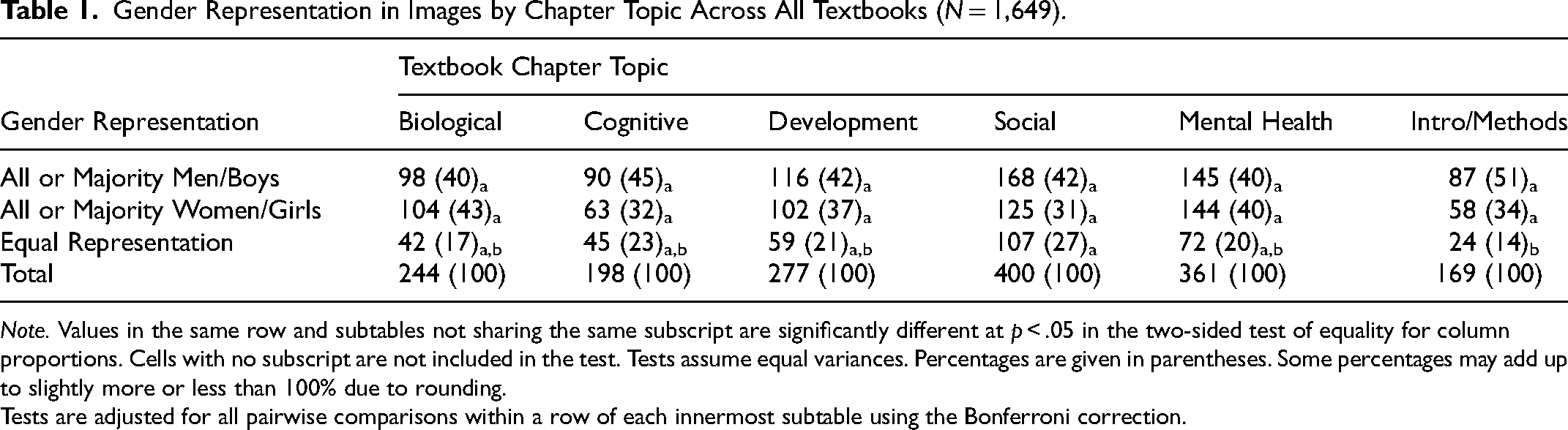
Note. Values in the same row and subtables not sharing the same subscript are significantly different at p < .05 in the two-sided test of equality for column proportions. Cells with no subscript are not included in the test. Tests assume equal variances. Percentages are given in parentheses. Some percentages may add up to slightly more or less than 100% due to rounding.
Tests are adjusted for all pairwise comparisons within a row of each innermost subtable using the Bonferroni correction.
Are There Differences in Gender Diversity of Images Between OER and Commercial Textbooks?
A chi-square test showed significant differences in gender representation by textbook type, with a small effect size, χ2(2, N = 1,649) = 14.90, p = .001; Cramer's v = .10; see Figure 1. Post-hoc analysis established that, compared to commercial books, OER textbooks had a significantly lower percentage of images depicting all or majority women/girls, χ2(1, N = 1,649) = 4.95, p = .026; φ = .06, and equal gender representation, χ2(1, N = 1,649) = 4.15, p = .042; φ = .05, with a significantly higher percentage of images depicting all or majority men/boys, χ2(1, N = 1,649) = 14.77, p < .001; φ = −.10. Despite significant differences, all effect sizes were small (Cohen, 1988). Fifty-one percent (51%; n = 192) of all OER textbook images depicted all or majority men/boys compared to 40% (n = 512) of commercial textbook images. On the other hand, 31% (n = 117) of OER textbook images depicted all or majority women/girls compared to 38% (n = 479) of commercial textbook images. Similarly, a smaller percentage of OER textbook images depicted equal representation (17%; n = 65) compared to commercial textbook images (22%; n = 284). For analyses of gender representation by chapter topic and book type, please refer to the supplemental information on OSF (Biddle et al., 2024).
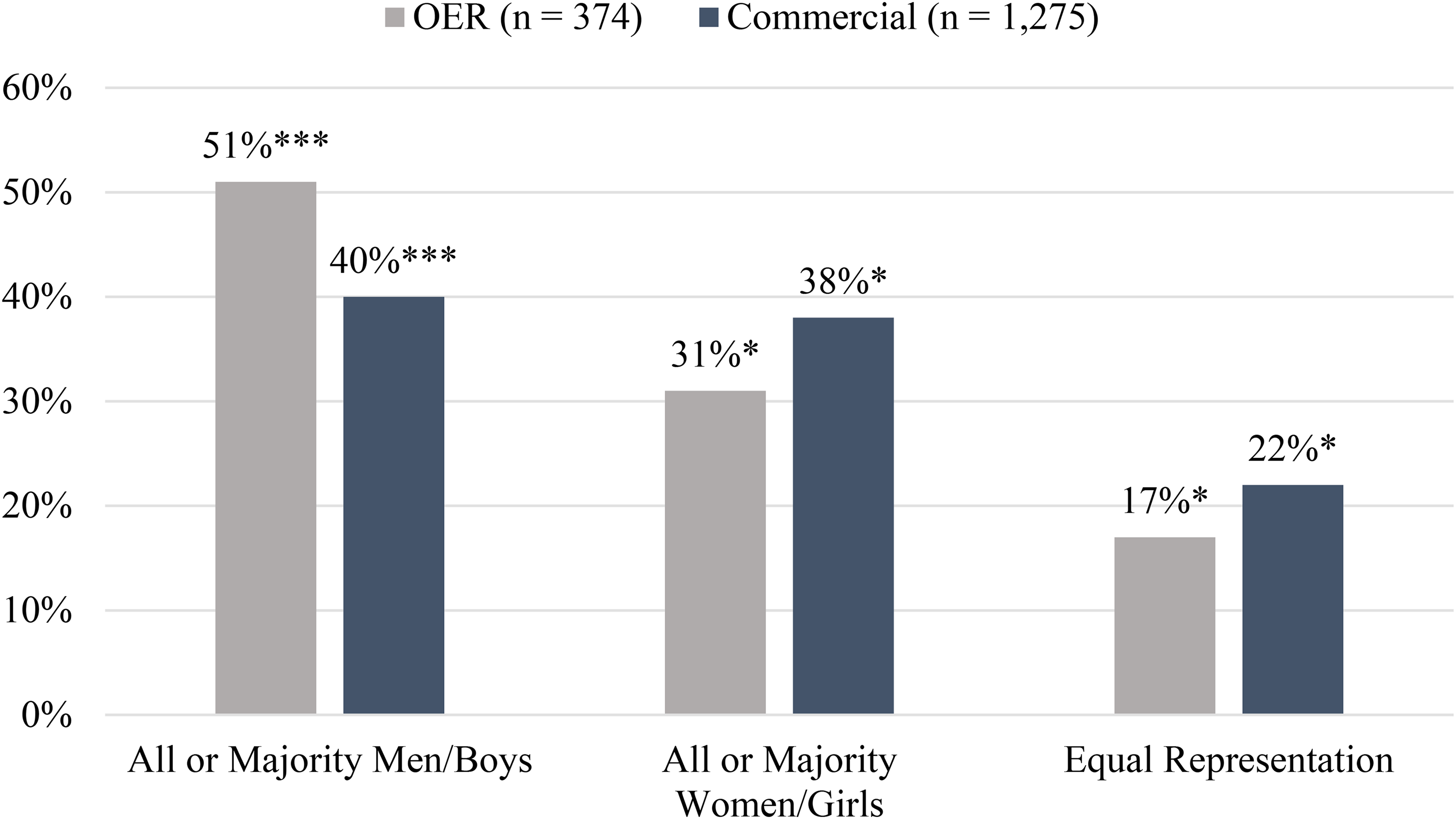
Percent of gender representation in images by textbook type (N = 1,649).
What Racial Diversity is Present in Images in Current Introductory Psychology Textbooks?
Across all textbook images (n = 1,908), 1,599 images could be coded for perceived race, while 309 images lacked sufficient information to code for race. Categories were not mutually exclusive, and the representation of at least one individual of each race in an image is as follows: White (75%; n = 1,193), Black (24%; n = 386), Asian (16%; n = 256), Multiracial (7%; n = 111), Latino (7%; n = 106), Middle Eastern (2%; n = 35), Pacific Islander (1%; n = 20), and Alaska Native or Native American (<1%; n = 11). Because the White category was over-represented, we combined everyone who was not White into a POC and ethnic minority category for the sake of further analysis (including Black, Asian, Pacific Islander, Alaska Native or Native American, Middle Eastern, Latino, and Multiracial). When collapsed, 46% of images (n = 735) depicted at least one POC, while 75% (n = 1,193) of images depicted at least one White person. Additionally, across all images, 54% of images (n = 864) depicted only White people, while 25% (n = 405) depicted only POC. Approximately 21% of images (n = 330) depicted both people identified as White and POC. The remaining analyses use these three categories.
Are There Systematic Differences in Racial Diversity of Images Across Different Topics?
A chi-square test revealed significant differences in the representation of race in images by chapter topic, with a small effect size, χ2(10, N = 1,599) = 36.48, p < .001, Cramer's v = .11; see Table 2. The majority of all images in each chapter topic, except Social chapters, were coded as having no POC. Post hoc analysis indicated that, compared to Mental Health chapters, Social chapters had a significantly lower proportion of images coded as having no POC (59% of Mental Health chapter images compared to 48% of Social chapter images), χ2(1, N = 726) = 9.31, p = .002, φ = −.11, and a significantly larger proportion of images coded as having both POC and White people (18% compared to 29%, χ2(1, N = 726) = 12.32, p < .001, φ = .13. Social chapters also had a significantly larger proportion of images with both POC and White representation (29%) compared to Developmental (18%), χ2(1, N = 691) = 11.18, p < .001, φ = .13, and Biological chapters (11%), χ2(1, N = 619) = 26.71, p < .001, φ = .21. Despite significant findings, all effect sizes were small (Cohen, 1988). While there were no significant differences in the percentage of images with only POC, Biological chapters had the highest percentage at 30%.
Images with Person of Color (POC) Representation by Textbook Chapter Topic (N = 1,599).
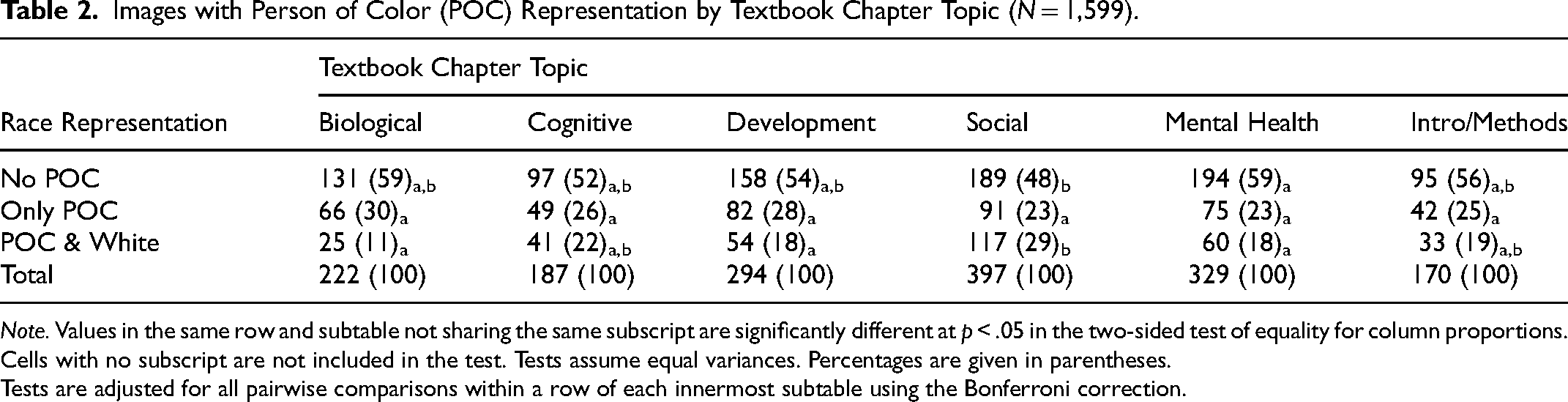
Note. Values in the same row and subtable not sharing the same subscript are significantly different at p < .05 in the two-sided test of equality for column proportions. Cells with no subscript are not included in the test. Tests assume equal variances. Percentages are given in parentheses.
Tests are adjusted for all pairwise comparisons within a row of each innermost subtable using the Bonferroni correction.
Are There Differences in Racial Diversity of Images Between OER and Commercial Textbooks?
The percentage of images depicting no POC, only POC, and both POC and White differed significantly between OER and commercial textbooks, with a small effect size, χ2(2, N = 1,599) = 37.31, p < .001, Cramer's v = .15; see Figure 2. Generally, commercial textbooks depicted more racially diverse images. Commercial textbooks had a significantly lower percentage of images depicting no POC (50%; n = 621) compared to OER textbooks (68%; n = 243), χ2(1, N = 1,599) = 37.31, p < .001, φ = −.15, and a significantly higher percentage of images depicting only POC (28%, n = 343) compared to OER textbooks 14%; n = 62, χ2(1, N = 1,599) = 15.16, p < .001, φ = .10. Commercial textbooks also had a higher proportion of images depicting both POC and White (22%; n = 279) compared to OER textbooks (14%; n = 51), χ2(1, N = 1,599) = 11.14, p = .001, φ = .08. Despite significant differences, all effect sizes were small (Cohen, 1988). For analyses of race representation by chapter topic and book type, please refer to the supplemental information on OSF (Biddle et al., 2024).
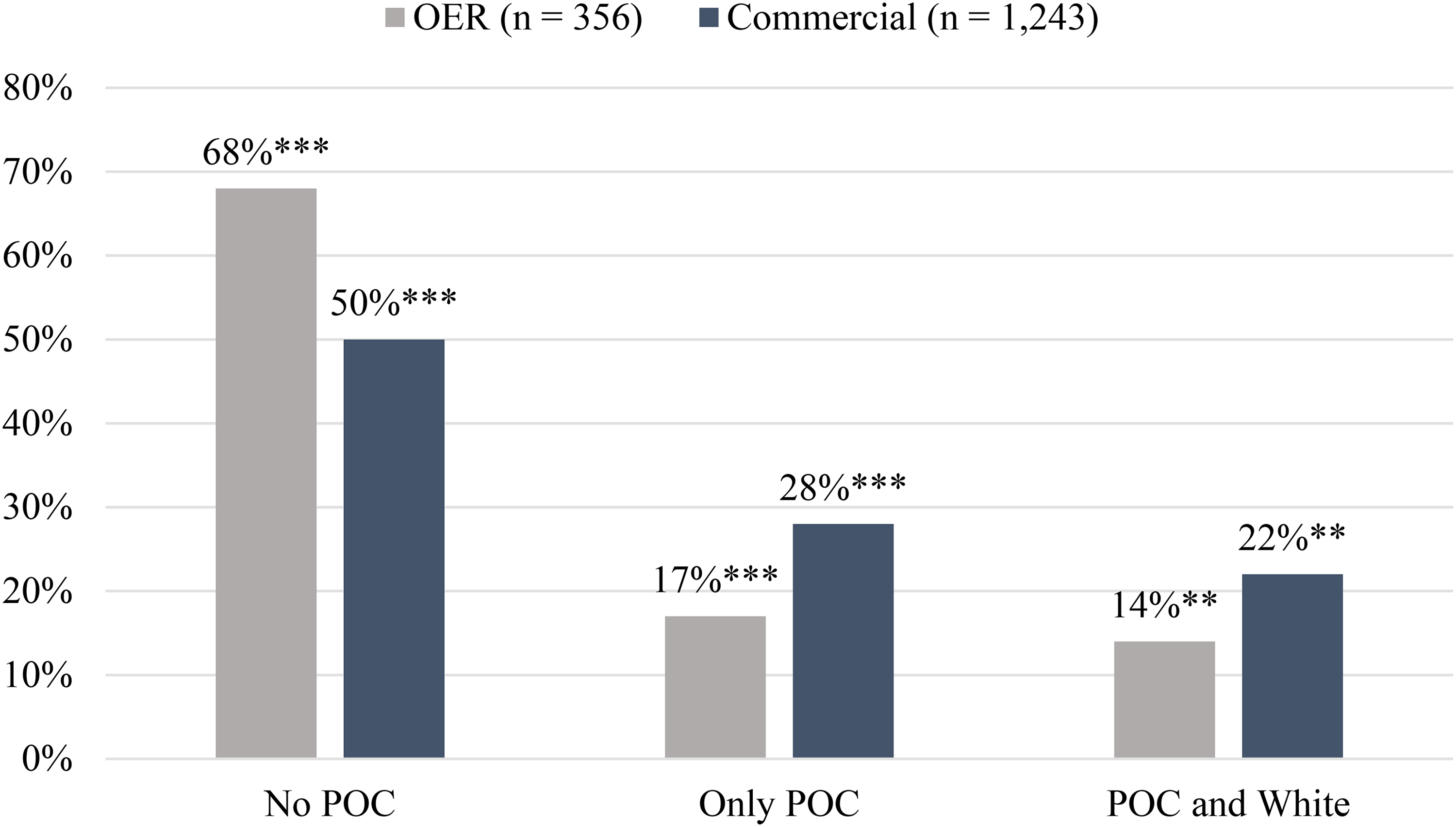
Percentage of images with people of color by textbook type (N = 1,599).
Discussion
Past research, APA (Akbar et al., 2022), and Open Education (Lambert, 2018) suggest that increasing diversity and representational justice within the course materials helps students (particularly those from historically marginalized groups) succeed in college-level psychology courses (Kelly et al., 2022; Nusbaum, 2020). However, historically marginalized groups (e.g., White women and POC) have been underrepresented in textbooks (Collins & Hebert, 2008; Hogben & Waterman, 1997), both commercial and OER (Becker & Nilsson, 2021; Brandle, 2020; King & Domin, 2007). We predicted that historically marginalized groups would continue to be underrepresented and that OER would be no better in representation than commercial texts. We predicted that representation would be better in chapters on Development and Social Psychology, as those topics generally cover more topics about women and diversity in general.
How Diverse Are the Images, Overall, in Current Introductory Psychology Textbooks?
Past content analyses of images in Introductory Psychology textbooks found approximately 42% (Hogben & Waterman, 1997) and 41% (Collins & Hebert, 2008) of images depicting women/girls. Our updated analyses found at least one woman/girl present in 57% of images (compared to 64% of images that contained at least one man/boy) across all textbooks, suggesting an improvement in representational justice relative to past analyses of textbooks. Our study contributed to the literature by introducing a coding scheme that enabled more nuanced analyses. From our data, we found that only 36% of the images depicted all or a majority of women/girls, while 43% of the images depicted all or a majority of men/boys. Equal or near-equal gender representation was found in 21% of the images. These numbers suggest that, in terms of gender representation, Introductory Psychology textbooks have improved compared to previous studies (Collins & Hebert, 2008; Hogben & Waterman, 1997), but they are still not equal, with men and boys being depicted in images overall more often than women and girls.
Concerning racial representation, White people (present in 75% of textbook images) were significantly overrepresented compared to any other racial group, supporting our hypotheses. Images depicted only two non-White racial groups in more than 10% of cases: Black (24% of images) and Asian (16%). All other racial groups were present in fewer than 10% of images. In comparison to undergraduate enrollment in Fall 2023 (National Student Clearinghouse Research Center, 2024), we found the following groups overrepresented: White (75% in our sample vs. 43% of undergraduate enrollment), Black (24% in our sample vs. 11% of undergraduate enrollment), Asian (16% in our sample vs. 6% of undergraduate enrollment), and Multiracial (7% in our sample vs. 4% of undergraduate enrollment). We found Latinos to be underrepresented (7% in our sample vs. 18% of undergraduate enrollment). Native American/Alaska Natives and Native Hawaiian/Pacific Islanders were represented at roughly the same levels in textbook images as they are in undergraduate enrollment (1%). Undergraduate enrollment for racial demographics (National Student Clearinghouse Research Center, 2024) is close to population-level statistics (United States Census Bureau, n.d.).
While it is clear that White people are overrepresented compared to their representation in population-level statistics, it is less clear what the goal should be for POC representation. Should the goal be for representation in textbooks to match representation in the undergraduate population or the population in general? Should historically underrepresented groups be overrepresented to achieve parity? Our suggestion is to err on the side of overrepresentation of POCs (relative to population statistics), given the positive effects of racial diversity on student engagement for both students of color and White students (Antonio et al., 2004; Denson & Chang, 2009; Lau, 2022). However, future research should more fully investigate the effects of racial representation in textbooks on diverse student experiences.
Are There Differences in Diverse Image Representation Between Different Topics in Introductory Psychology Textbooks?
We predicted that the Developmental and Social chapters, in general, would include the most diverse representation. However, nearly all chapters contained a higher percentage of images depicting “men/boys” compared to those depicting “women/girls” except for the Biological Psychology chapter (more women/girls) and Mental Health chapter (equal); however, these differences were not statistically significant. Similarly, all chapters (except Social) depicted more images coded as “no POC” versus “only POC” or a mix of “White & POC.” Social chapters did contain a significantly higher percentage of images with both White people and POC compared to the Biological and Mental Health chapters. Given these differences, we discuss the Social, Biological, and Mental Health chapters below. Developmental chapters are not discussed because there were no significant differences in representation.
Are There Differences in Diverse Image Representation Between OER and Commercial Introductory Psychology Textbooks?
Based on previous research, we predicted no difference in diversity representation between OER and commercial books. However, despite an outward commitment to social justice (Lambert, 2018), we found that OER books did significantly worse than commercial books at including historically marginalized people in images. In terms of gender representation, compared to images in commercial books, images in OER books were significantly less likely to depict images with all or majority women/girls (31% vs. 38% in commercial books) and less likely to depict images with equal gender representation (17% vs. 22%). These differences were particularly pronounced in the Introduction and Research Methods chapters, as well as the Developmental chapters. Given that the Introductory chapters are among the first that students encounter, we believe it is especially important to use diverse images so that students can feel a sense of belonging early in the class (Nusbaum, 2020; Yust et al., 2021).
In terms of racial representation, images in OER books were significantly more likely to include no POC at all (68%) when compared with commercial books (50%). These differences were found across nearly every chapter topic except Cognitive. As with gender representation, the stark differences in the Introduction and Research Methods chapters were particularly concerning, given students’ early access to those chapters.
Limitations
The study presents a few limitations. First, we analyzed perceptions of gender and race in images. While our coders were racially diverse and current undergraduate psychology students, future research should examine how a wider sample of Introductory Psychology students perceives these images. Second, our coding scheme was inherently binary and did not capture the full spectrum of gender or race. For race, in particular, we initially coded among many different racial groups; however, the numbers were relatively low for some groups and extremely low for other groups, and thus, for the sake of analyses, we combined them. Another reason for this binary coding was that we were attempting to compare our findings to past work that had been largely coded as binary (Baro & Eigenberg, 1993; Becker & Nilsson, 2021; Collins & Hebert, 2008; Ferree & Hall, 1990; Good et al., 2010; Hogben & Waterman, 1997). Future studies should develop a coding scheme that is more reflective of the true spectrum of gender and race.
Future Directions: Where do we go from here?
Given past work showing that OER textbooks were no better than commercial textbooks at representational justice, it was disappointing (but not surprising) to find a similar pattern in Introductory Psychology books. However, unlike commercial books, OER provides instructors with the opportunity to edit and customize images and text to make them more inclusive and representative of the students in their classes. Whereas instructors who use commercial books are stuck with what the publisher provides, instructors who use OER books can customize their images using the Creative Commons license (creativecommons.org) that allows for editing.
One reason that images in commercial books may have a better representation of historically marginalized groups is that they have a budget that allows them to use and access copyrighted images. OER, on the other hand, must use images that are openly licensed. Suppose instructors who use OER want to diversify the images in their books. In that case, we recommend several databases of openly licensed images (e.g., https://library.raritanval.edu/opened/open-media) and/or using open pedagogical practices to include their students in helping to create more diverse openly licensed images. Instructors can then import the OER text into an editable format via their learning management system or a book-writing software (e.g., Pressbooks, LibreText, Open Author) and replace images, provided the work is not licensed under a “non-derivative” Creative Commons license.
Open pedagogy refers to the practice of students producing assignments that are useful (to themselves or others) beyond the classroom (Tietjen & Asino, 2021; Witt, 2020). Recent work has demonstrated that students generally enjoy open pedagogy and report its use leading to better critical thinking skills (Clinton-Lisell, 2021) and that it can be used to promote social justice (Bali et al., 2020). For example, Biddle and Clinton-Lisell (2023) described an Introductory Psychology open pedagogy class assignment where racially diverse students submitted images related to each chapter topic as an open pedagogy assignment; students reported enjoying the assignment and understanding that it helped contribute to the diversity of images available in the textbook.
This research prompts many additional research questions for future investigation. For example, does diverse representation in images affect students’ perceptions of the course and topic? If so, how? Is the representation of diversity in images related to the representation of diversity in written text? How can educators who care about diversity and inclusivity leverage the customizability of OER to increase the diversity of photographs in Introductory Psychology? We hope to bring awareness about the imbalance of diversity representation in textbooks and encourage instructors to customize open education resources with an eye toward inclusive representation.
Footnotes
Acknowledgments
We would like to acknowledge the diligent work of the research assistants who contributed to this study: Kaylee Carvalho, Michaela DodsonDance, Samantha Dewey, Lizbeth Morales, and Maya Pillon.
Declaration of Conflicting Interests
The authors declared no potential conflicts of interest with respect to the research, authorship, and/or publication of this article.
Funding
The authors declared the following financial support for the research, authorship, and/or publication of this article: We thank the William and Flora Hewlett Foundation for supporting open access of this publication through the Open Education Research Fellowship.
