



Abstract
Background
The COVID-19 pandemic caused an unprecedented mid-semester transition to virtual learning. Instructors and students had to adapt to new ways of delivering and receiving course material.
Objective
The present investigation examined whether course format and sense of belongingness were associated with learning satisfaction during the COVID-19 pandemic, as well as racial/ethnic or gender identity differences in academic experiences during this time. The current study also explored student perceptions of instructor support, changes in workload, and changes in learning.
Method
Undergraduate students (N = 157) responded to quantitative and qualitative items regarding their academic experiences during the first semester of the pandemic in an online survey.
Results
Blended courses were associated with poorer outcomes than solely synchronous and asynchronous courses. There were no racial differences in academic experiences; however, women had more positive academic experiences than men. Greater academic and campus belongingness predicted better academic experiences. Students perceived clear, frequent instructor communication as vital to their success.
Conclusion
Students’ experiences with virtual learning varied depending on instructor and student factors.
Teaching Implications
Instructors can improve their students’ experiences with virtual learning by providing frequent, clear communication, resources on effective study and time management skills, and a sense of community.
The Coronavirus Disease of 2019 (COVID-19) pandemic necessitated a global, fundamental shift in the delivery and consumption of learning for instructors and students alike. In March 2020, over 1300 universities shifted to a predominantly online educational model to prevent the further spread of this novel virus in the United States (Smalley, 2021). With little notice, instructors shifted course material to an electronic format and made quick decisions regarding the most effective mode of delivery (e.g., synchronous or asynchronous instruction) and how best to remotely create a sense of community for students. Students adapted to new ways of learning, studying, and being assessed, often while navigating new stressors and environments (income loss, family illness, working from home, etc.).
Previous research has focused on aspects of virtual learning that best facilitate learning and satisfaction (Onyema et al., 2020). However, the COVID-19 pandemic has provided an unprecedented social context. Unlike prior virtual learning experiences, all students in the pandemic—regardless of online learning preferences, academic skills, or demographics—were required to learn virtually. The present investigation examined undergraduate students’ experiences as they abruptly transitioned from a traditional university model to an exclusively online model. Based on these findings, recommendations for instructors on how to create an engaging, accessible virtual learning environment for a variety of students are provided.
Virtual Learning
A successful online learning environment is reliant on student, instructor, and interpersonal factors. Among undergraduate students in virtual education, perceptions of instructor effectiveness and quality of learner-instructor and learner-learner interactions have been associated with student learning outcomes and overall course satisfaction (Eom & Ashill, 2016). Additionally, students’ intrinsic motivation has predicted learning outcomes but not learning satisfaction. In a study across three universities, factors related to virtual course design and content were the strongest predictors of perceived learning and satisfaction (Barbera et al., 2013). Better learning was associated with clear objectives and appropriate and relevant course content and assessments. Overall, the success of a virtual course is shaped by factors such as instructors’ effectiveness, quality of student-instructor dialogue, students’ intrinsic motivation, and virtual course design.
Some research has found no significant differences in objective learning outcomes between in-person and virtual education (Slover & Mandernach, 2018). However, others have found a notable performance gap between these modalities after accounting for selection effects (Coates et al., 2004). Online courses typically cater to students with increased self-teaching skills, responsibility, time management, and intrinsic motivation compared to what is traditionally required (Xu & Jaggars, 2014). Therefore, some argue that these student traits need to be accounted for when examining learning modality differences (Coates et al., 2004). In the recent mid-semester transition to virtual learning due to the current COVID-19 pandemic, students found themselves enrolled in online learning environments whether they would have voluntarily chosen virtual formats. As such, it is imperative to examine best practices for online instruction that allow for engaging, accessible education for all.
Course Format
Unless dictated by the university, instructors must decide between synchronous, asynchronous, or blended approaches. Blended courses include both synchronous and asynchronous elements, such as weekly virtual classes and asynchronous discussion boards (Yamagata-Lynch, 2014). Research suggests that all three approaches have benefits and limitations. In synchronous discussions, students make deeper social-emotional comments, whereas asynchronous discussions tend to be more surface-level and task-oriented (Chou, 2002; Hrastinski, 2008; Offir et al., 2008). However, synchronous courses rely heavily on functional technology. Among post-graduate dental residents, asynchronous lectures were rated as more effective; this finding was directly related to participants’ perceptions of how well the technology performed in each format (Kunin et al., 2014).
A blended approach may optimize the benefits of both formats. Previous research suggests that the simultaneous utilization of both asynchronous and synchronous elements can foster a stronger sense of community and improved learning outcomes compared to either mode alone (McInnerney & Roberts, 2004). For example, graduate students who learned in an online, immersive environment (OpenQwaq) that allowed them to chat via text, collaboratively edit documents in real time, and create small group meeting rooms endorsed a higher sense of community than graduate students in a traditional in-person course (McClannon et al., 2018). In a blended instructional technology graduate course, students reported that they appreciated both the flexibility of asynchronous assignments and the social connection formed during synchronous activities (Yamagata-Lynch, 2014). Overall, when choosing an appropriate course format, instructors must consider technology availability, flexibility, and community-building.
Demographic Differences in Virtual Learning
There may be racial differences in the effectiveness of virtual learning. The socioeconomic “digital divide,” in which students from financially disadvantaged backgrounds are unable to purchase laptops and other technological necessities, has racial underpinnings (Gorski, 2005). In a study at the K-12 level, only 3.8% of Asian parents reported that their children had inadequate technology for online learning, while 15.6% of Black parents reported inadequate resources (Friedman et al., 2021). Moreover, cultural factors may impact virtual learning. Asynchronous lectures may create advantage for students from Western cultures that promote individualized autonomy; however, learners socialized in field-dependent cultures (e.g., some Asian and Latin American communities) may struggle in more impersonal courses (Smith & Ayers, 2006). In interviews, racially marginalized students reported feeling less comfortable in online interactions and desired a greater “bond” with fellow learners (Ke & Kwak, 2013). Further, minority status is associated with more positive perceptions of instructor support, but lower general satisfaction with online education.
Gender identity may also impact online learning experiences. In some ways, online learning may be more advantageous for women, who are more likely to hold multiple roles including caregiver, mother, and/or employee (Yukselturk & Bulut, 2009). Research suggests that women tend to have more positive perceptions of online learning (Rovai & Baker, 2005), particularly regarding perceived instructor support and student interaction (Ashong & Commander, 2012). There are no significant differences between men and women, however, in self-regulatory learning abilities (e.g., use of appropriate cognitive strategies) or achievement (Yukselturk & Bulut, 2009). Little is known about how people who identify as non-binary or transgender may experience online learning.
Academic research on how demographic variables may impact online learning during the COVID-19 pandemic is in its nascence, and little is empirically known about how students may differentially experience online learning. Anecdotal evidence from mainstream media sources suggests that the pandemic is widening racial and social class gaps in both K-12 and higher education (Layne, 2020; Sreenivasan & Kane, 2021). Students from minority backgrounds report poor access to technology and reliable Internet (Layne, 2020), as well as needing to withdraw from community college to financially assist their families (Sreenivasan & Kane, 2021). More systematic, academic research is needed to capture the extent of the pandemic’s effects on students of different race and gender identity locations.
Academic and Campus Belongingness
Higher education requires more than simply digesting and reproducing knowledge. Community and perceived belongingness play a large role in student satisfaction and learning outcomes. Perceived belongingness can be fostered at both the classroom and institutional levels, through supportive interactions with instructors and other students as well as a larger sense of community. First-year law students with greater perceived institutional belongingness demonstrated greater autonomous learning, including use of independent learning strategies and study habits (Brooman & Darwent, 2014). Moreover, student belonging has been evidenced to mediate the association between supportive classroom environment perceptions and student motivation in an undergraduate sample (Zumbrunn et al., 2014). Coupled with COVID-19 social distancing guidelines, students are at risk of social isolation in both learning and social contexts (Son et al., 2020). As social connectedness is important for learning outcomes, it is critical to examine the factors that facilitate and hinder sense of community within virtual learning environments.
Belongingness and a sense of connection may be even more important in online education, especially during the current pandemic. Feelings of isolation and disconnectedness are large risk factors for decreased student engagement in online courses (Angelino et al., 2007; Rovai, 2002). However, belongingness may look differently for students enrolled in online courses. Among graduate students who viewed their online learning experience favorably, two subgroups appeared: those who placed little value on the community aspects of the online course and felt that their online interactions were superficial, and those who placed high value on the online learning community (LaPointe & Reisetter, 2008). Therefore, further research should examine the role of perceived belongingness and community in online learning.
Study Aims
The current study aimed to use a mixed-methods approach to examine undergraduate students’ experiences of the mid-semester transition to online learning during the COVID-19 pandemic. Quantitative aims were as follows: (1) to examine whether blended (i.e. courses with both synchronous and asynchronous elements) courses were associated with greater student satisfaction compared to synchronous or asynchronous courses; (2) to examine identity differences (racial/ethnic, gender) in online learning experiences during the transition; and (3) to test whether academic and campus belongingness predicted satisfaction and self-confidence in learning during the transition to online learning.
Through qualitative analyses, we hoped to understand more about how undergraduates experienced the mid-semester transition to virtual learning with regards to (4) instructor support, (5) changes to workload, and (6) changes in learning. In part, these quantitative and qualitative aims are rooted in clarifying the existing literature on optimal course formats, demographic differences in online education, and the role of belongingness. However, it is important to note that the mid-semester transition to virtual learning provided a unique circumstance in which students did not self-select into virtual learning. As more motivated, self-driven students are more likely to self-select into online learning, these types of students are overrepresented in the literature (Coates et al., 2004). The current study may be a more accurate representation of how all students experience online learning within unique social circumstances.
Method
Participants and Procedures
Participants were 157 undergraduate students at a large, urban, public university in the mid-Atlantic United States that is home to a racially diverse population (54.2% students of color; National Center for Education Statistics, 2019). Participants were enrolled in at least one psychology course during the Spring 2020 semester. Participants were either recruited via an online research participation portal (47.1%) or directly by their instructors (52.9%). Most participants received extra credit in their Summer 2020 psychology courses for participation (93.6%); ten participants volunteered without compensation. To participate, students had to be 18 years or older and had to have been enrolled in at least one course at the university during the mid-semester transition to virtual learning. After providing written consent, eligible participants were asked to complete a survey on Qualtrics, an online survey platform. Additional measures were included in the survey that are not a part of the current study.
Measures
Prior to administration of all measures, participants were encouraged that they should only consider the second half of the Spring 2020 semester after the transition to virtual learning had occurred.
Demographics
Participants were asked to report basic demographic characteristics, including age, gender identity, race/ethnicity, number of semesters at the institution, and current major. Participants selected from the following options for gender identity: man, woman, non-binary/transgender, prefer to self-describe, and prefer not to say. Students who chose to self-describe were recoded into the “non-binary/transgender” category, as all self-descriptions fit within that category. Participants could select multiple options for race/ethnicity from the following list: Asian, Black/African American, White, Hispanic/Latinx, Native American, Pacific Islander, and prefer to self-describe. Participants who chose multiple options were coded as “multiracial/multiethnic.” Those who self-described were coded as “other.” Due to small sample sizes within each category, racial/ethnic categories were recoded into “white students” and “students of color.” Participants selected their current major from the list of options presented on the institution’s website.
Student Satisfaction
Satisfaction with learning was measured by five original items (see Reid, 2022 for OSF Materials). These items were developed from other scales assessing student satisfaction with instruction or course modalities within specific fields (e.g., the use of a simulation activity within a nursing program; Jeffries & Rizzolo, 2006; Maddox & Nicholson, 2008). Participants responded to five items on a scale ranging from 1 (strongly disagree) to 5 (strongly agree). Responses across all five items were summed; thus, total scores could range from 5–25, with higher scores indicating greater student satisfaction. This scale had strong reliability in the current sample (α = 0.92).
Self-Confidence in Learning
Self-confidence in learning was measured by five original items. These items were developed from other self-confidence in learning scales within specific fields (Bell et al., 1998; Jeffries & Rizzolo, 2006). Participants responded to five items on a scale ranging from 1 (strongly disagree) to 5 (strongly agree). Responses across all five items were summed; thus, total scores could range from 5–25, with higher scores indicating greater self-confidence in learning. This scale had strong reliability in the current sample (α = 0.89).
Instructor Support
Four original items were used to assess students’ satisfaction with support provided by instructors. The COVID-19 pandemic has been associated with an increase in self-reported stress, depression, and anxiety in college students (Son et al., 2020); therefore, items were developed to assess not only academic support, but also support for students’ physical and emotional well-being. Participants responded on a scale ranging from 1 (strongly disagree) to 5 (strongly agree). All items were summed to provide a total score (range: 4–20), with greater scores indicating greater perceived support. This scale yielded good reliability in the current sample (α = .87).
Campus Belonging
The Sense of Belonging to Campus scale consists of 3 items that assess students’ perceptions of belonging to the campus community (sample item: “I feel that I am a member of the campus community”; Hurtado & Carter, 1997, p. 342). Participants responded on a scale ranging from 1 (strongly disagree) to 11 (strongly agree) and were again reminded to only consider the virtual portion of the Spring 2020 semester. All items were summed to yield a total score (range: 3–33), with greater scores indicating greater campus belongingness. In the current sample, the scale had strong reliability (α = .97).
Academic Belonging
Academic belonging was assessed using five items previously shown to yield strong reliability in an undergraduate sample (Ingram, 2012). The scale consisted of 5 items (sample item: “I felt comfortable asking an instructor for help if I did not understand course-related material”) on a scale ranging from 1 (strongly disagree) to 5 (strongly agree). Items that referred to “class discussions” were adapted to include “Zoom, live conference calls, and discussion boards.” All items were summed to yield a total score (range: 5–25), with greater scores indicating greater academic belongingness. The scale demonstrated good reliability (α = .84) in the current sample.
Course-Level Items
Students were asked to respond to items at the course-level. For each of their courses (maximum of five), students reported the course format and the average number of weekly emails/announcements received regarding the course, and perceived changes in workload. They were also asked to rate their satisfaction with instructor communication and instruction in the course.
Qualitative Items
As stated previously, the study aimed to qualitatively explore student perceptions of instructor support, changes in workload, and changes in learning. Open-ended questions were designed by the researchers to address each of these domains. Participants were not restricted with regards to response length.
Data Analysis
All quantitative analyses were conducted using SPSS version 26. All quantitative variables met assumptions of normality. To address Aim 1, a one-way MANOVA was conducted to examine the differences in satisfaction across course formats, with satisfaction with instruction, satisfaction with communication, and perceived workload change entered simultaneously as independent variables. To address Aim 2, independent t-tests were conducted. When analyzing racial/ethnic differences, race/ethnicity was coded dichotomously (white, students of color). These two groups had non-significantly different variances on variables of interest; therefore, Student’s t-test was used. Due to the small sample size of non-binary/transgender participants (n = 4), it was not feasible to include them in gender identity analyses. As a result, two categories were used, men and women; however, these groups were unequally represented in the sample and had significantly different variances on all variables of interest. Thus, Welch t-tests were used, which are more robust to unequal sample sizes and variances than the traditional Student t-tests (Ruxton, 2006). Lastly, multiple linear regressions were performed to address Aim 3, with race and/or gender identity added in the first block of the model to statistically control for any differences revealed in Aim 2. Effect sizes were interpreted using Cohen’s (1988) criteria.
Thematic analysis was used to code and interpret qualitative responses. Broadly, thematic analysis refers to a way of making sense of and analyzing patterns in a textual dataset, with the goal of developing a narrative that represents the most salient themes (Neuendorf, 2019). The first step of thematic analysis is to familiarize oneself with the data and generate initial codes that identify important features of the data (Neuendorf, 2019). Each member of the research team (five doctoral students, one assistant professor of psychology) reviewed responses to one or two open-ended survey items and assigned codes that “tagged” relevant features of the data. Next, researchers examined the codes and search for themes that represent broader patterns of meaning (Neuendorf, 2019). The research team then generated possible themes. Due to the brevity of participant responses to open-ended items, themes identified by members of the research team overlapped significantly. Once a list of themes was generated and defined, the research team again reviewed responses to each open-ended survey item, applying these themes and ensuring that they adequately represented the data. The researchers assessed the frequency of each theme and collaboratively chose direct participant quotes that best exemplified each theme. Direct quotes are considered emic terms as they provide insight to participants’ raw views of reality and are fundamental to understanding participant perspectives (Johnson & Christensen, 2016).
Results
Characteristics of the Sample
Demographic Characteristics.
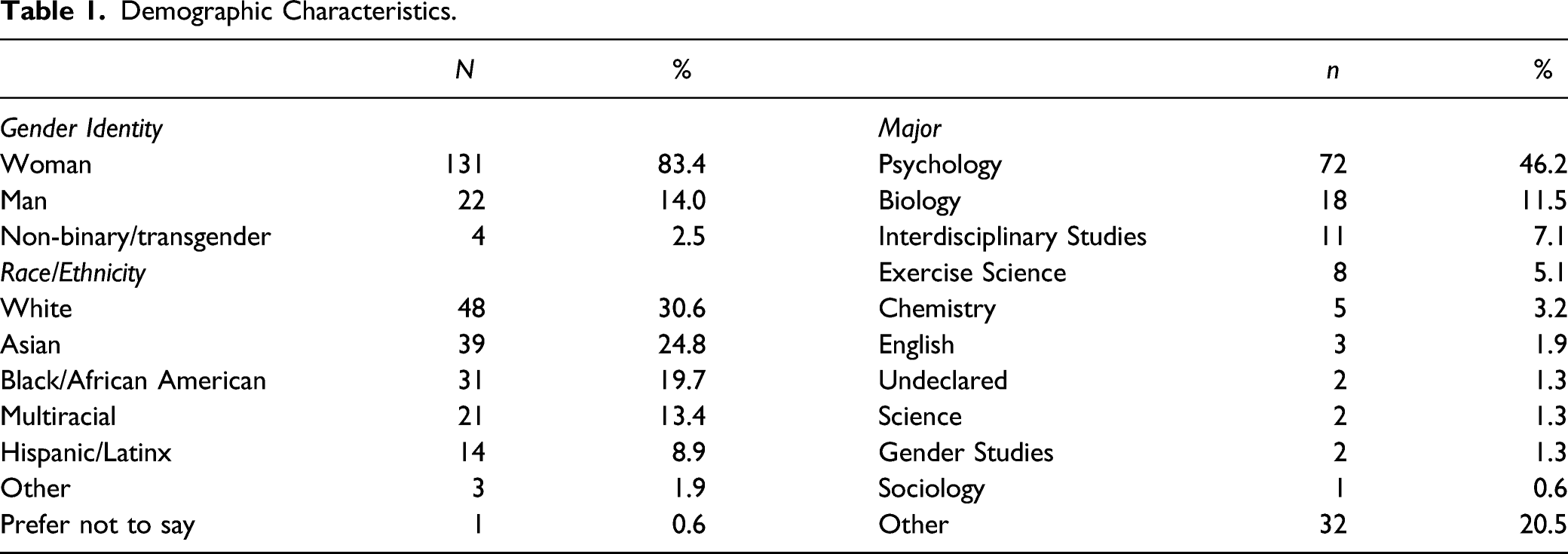
Quantitative Analyses
Aim 1: Differences in Outcomes Across Class Format
Participants were asked to report the extent to which their courses used various techniques on a scale from 1 (not at all) to 5 (almost all classwork). Recorded lectures were most widely used (M = 4.0, SD = 1.1), followed by Zoom (M = 3.3, SD = 1.4) and discussion boards (M = 3.1, SD = 1.4). At the course-level, participants reported enrollment in 694 courses in total. Of these courses, 28.4% were conducted synchronously, 51.3% were conducted asynchronously, and 20.3% used a blended approach.
The MANOVA revealed a statistically significant small effect for course format on overall satisfaction, Wilks’ Lambda = .959, F(6, 1386) = 4.86, p < .001,
Aim 2: Identity Differences in Virtual Learning
Mean (SD) Learning Outcomes by Race/Ethnicity and Gender Identity.
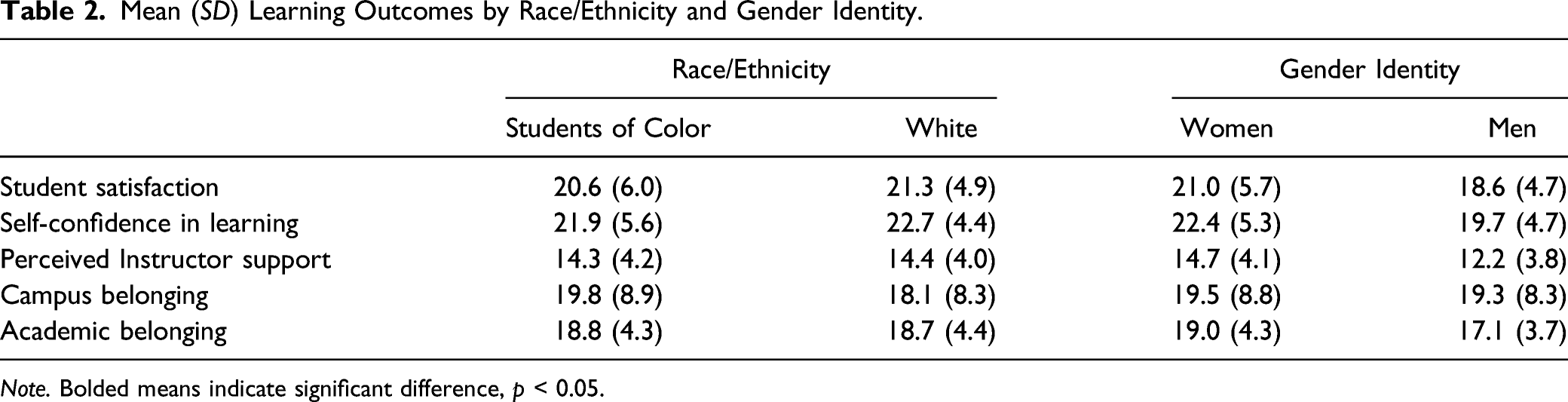
Note. Bolded means indicate significant difference, p < 0.05.
Gender identity differences: Women reported significantly greater satisfaction with learning than men, t(30.7) = −2.2, p = .04, d = 0.47, a small effect. Women also reported significantly greater self-confidence in learning, t(27.33) = −2.42, p = .23, d = 0.55, a medium effect. Regarding instructor support, women also perceived greater support than men, t(28.1) = −2.73, p = .01, d = 0.62, a medium effect. Campus belonging did not differ by gender identity, t(27.8) = −.09, p = .93, d = 0.02. However, women endorsed greater academic belongingness, t(30.0) = −2.05, p = .04, d = 0.45, a small effect.
Aim 3: Belongingness and Satisfaction and Self-Confidence in Learning
There were no racial/ethnic or gender identity differences in campus belonging; therefore, no identity covariates were added to the linear regression analysis examining the associations between campus belonging and satisfaction with and self-confidence in learning. Greater campus belonging significantly predicted higher satisfaction with learning, F(1, 151) = 17.04, p < 0.001, adjusted R2 = .10, and self-confidence in learning, F(1, 150) = 13.41, p < 0.001, adjusted R2 = .08.
Due to the known gender identity differences in academic belonging, gender identity was entered as a covariate into Block 1 of the linear regressions between academic belongingness and satisfaction with and self-confidence in learning. Greater academic belongingness predicted higher satisfaction with learning, F(2, 147) = 33.25, p < 0.00, adjusted R2 = .31, and self-confidence in learning, F(2, 146) = 35.83, p < .001, adjusted R2 = .32, after controlling for gender identity.
Qualitative Analyses
The following sections describe findings from thematic analysis of the open-ended survey items regarding student perceptions of instructor support, changes to workload, and changes in learning during the online transition.
Aim 4: Perceptions of Instructor Support
Participants mentioned the frequency and clarity of instructor communication as key to their learning and perceived support. One student wrote, “In my mind, more communication is a lot more effective than less.” Students (16.9%) also identified instructors’ responsiveness to emails as a factor for success. One student wrote that their instructors “went above and beyond to answer emails that much quicker with the format being online.” Students (20.6%) reported Zoom office hours to be a helpful form of communication, with one student writing, “The teachers and TA’s that did Zoom calls answered questions in real time and I would try to log on as much as I possibly could. I knew someone would ask a question [that] I hadn’t thought of asking, and, if I was the only one on, [the instructors/TA’s] would try to help me out in any way that they could.”
Some students also noted frustration with the frequency and responsiveness of instructor communication. The most common criticism (21.9%) referred to instructors either not responding to emails in a timely manner or at all. Three students reported receiving no communication from their instructors after the switch to virtual learning. Further, although rare, 11.3% of students indicated a perceived lack of effort by their instructors to adapt to virtual learning. One student wrote:
I had one instructor who did not even reach out to us until a few weeks into in-person classes being canceled and then when he did, he was frankly rude and not at all understanding that this class was not a priority in the midst of everything happening. His class was very lecture oriented and he did not even have recorded lectures. He just kind of gave up on the class which was disappointing because I paid an arm and a leg for it.
Another student noted that their instructor “dropped many of the remaining semester assignments. I felt as if he gave up.”
Many participants (40%) cited clear, specific communication of course expectations as critical to their success in virtual learning. One student wrote, “I really appreciated when instructors sent emails at the beginning of the week with to-dos and due dates coming up. In my mind, more communication is a lot more effective than less. It was also very helpful when instructors created open communication both ways, being receptive to feedback.” Not only was frequency of communication important, but clarity across all forms of communication contributed to student success as well. Another student wrote, “[Instructors] sent very detailed emails that were easy to understand. They also made each folder in Blackboard very clear.”
Fewer students (14.4%) reported frustration with unclear communication regarding course expectations. One student wrote, “[Instructors] would say one thing but expected another, and they would leave some things out and take points off for not including it when it was not stated in the first place.” There was particular concern around tests, with one student writing, “Some [instructors] would make things unclear such as [when] tests were, how they were set up, and how long we had to take the test.”
Although most comments regarding communication focused on academics, 19.4% of students mentioned gratitude for instructors who expressed care for students’ non-academic well-being. One student noted that their instructors “were also very understanding of the situation and provided as much assistance as they could for those who had troubles or in different time zones.” Another student wrote, “[Instructors] were willing to listen to students and provided options for people who may not [have] good Internet access. I felt they were very willing to work with students during this hard time. A lot of due dates for classes [were] extended to give students more time to work on it. It felt as if my instructors and I were working together.” For some, instructor support went beyond the classroom. One student wrote, “For me, having receptive, understanding instructors that work with students has created a renewed sense of [University] community, which has made me feel empowered to take control of my education even through this crazy adversity.”
Aim 5: Perceptions of Changes to Workload
Participants were asked to identify factors that led to changes in their workload. The most common factor (40.0%) was the addition of extra assignments. One student wrote, “There was a lot more online work. For example, Blackboard discussion posts and responding to classmates.” Another student wrote, “Many classes moved participation to weekly discussion boards and weekly papers. Before, we were expected to participate in class or answer Top Hat questions. They did not correlate in the time spent.” Others (19.4%) noted that self-teaching itself took more time, citing the need to review concepts multiple times and seek other resources to help them understand material. Others (8.6%) mentioned their decreased motivation and concentration as contributing to the perception of increased workload. For example, one student wrote “I preferred [asynchronous] classes, but due to having to make time for the class, it caused me to get easily distracted. It made a 1.5 hour class into a 4 hour class, just because I couldn’t focus that well.”
Students also identified factors that led to decreased workload. Some students (32.5%) reported that assignments were either shortened or removed. Another student noted that the flexibility of online courses helped them work more efficiently: “Prerecorded lectures allowed for me to do things on my own time, as I would usually just blindly take notes in lecture and learn it all later. I felt like I could learn everything at once now.”
Aim 6: Perceptions of Changes in Learning
Participants were asked to describe ways in which their learning had changed since the switch to virtual learning, as well as to identify factors that served as facilitators and barriers to learning. Students (16.2%) indicated that their learning did not change after transitioning to virtual learning. For those who did indicate changes in learning, several themes were commonly reported. A minority of students (18.8%) indicated experiencing a decrease in learning quality. One student wrote, “I definitely haven’t felt like I have been truly learning. It feels more like I am listening to lectures or doing the work just to complete the assignments.” Another student reported lectures felt “watered down,” stating, “even though that was what I needed at the time, I feel like I missed out on valuable information and course material.” Similarly, 21.9% of students mentioned an increase in self-teaching, with one student writing, “I had to learn more on my own, rather than being shown.” Some students (14.4%) cited difficulty understanding course material due to the inability to ask questions in real time. In order to compensate for these changes, students (20.6%) mentioned adopting new independent learning strategies including increased reading and using other online sources. One student wrote, “I got used to a different method of studying, which was by just listening to the lectures, then taking notes afterwards by looking at the PowerPoint, then studying those notes. Before I used to take notes while listening.” Another wrote that they employed different methods of studying in order to better retain information.
Other common themes across responses were time management, concentration, and motivation. Several students mentioned time management (11.9%). One student wrote, “I had to focus on my time management. There was always so much I had to do. Since most of my classes didn’t have regularly scheduled meetings, I was responsible to not get behind.” Another student “had to make sure to have certain days delegated to specific subjects, in order to make sure I was getting all the information completed for my classes.” Some students (10.6%) mentioned difficulties with concentration in their new learning environments. Students mentioned that “extremely loud and distracting family members” and household responsibilities interfered with their ability to concentrate. Others noted that they had difficulty focusing on Zoom calls and recorded lectures. A few students (6.9%) reported changes in motivation post-transition. One student wrote, “I was focusing on passing the class to graduate than to learn,” and another reported, “It was more difficult to concentrate or to be motivated to do work especially because a lot of the ‘learning’ seemed to be just to finish an assignment or take a test.” Conversely, some students found increased motivation for their schoolwork. One student wrote, “I think that I was able to force myself to get more organized and more motivated, because I knew that if I wasn’t, I wasn’t going to succeed.” Students (25%) also mentioned community and disconnection as impactful to learning. For example, one student wrote, “Loneliness. It’s hard to focus when you feel isolated.” Another stated that “not being able to sit in class surrounded by peers” impacted their ability to study.
Students identified several factors that enhanced their virtual learning. Many students (35%) reported that the flexibility of virtual learning helped them “go at [their] own pace,” with one student writing, “Being online helped me choose when I did my work more freely and it helped me find better time frames to complete my work.” Some students (18.1%) mentioned the benefit of being able to review lectures multiple times, stating that it was helpful for studying and note-taking. For some (5.6%), virtual learning had mental health benefits. One student wrote, “Social anxiety was no longer a factor in getting my work done. I wasn’t panicked about presenting my work.” Another student noted that open-note, online tests helped alleviate their test anxiety. Additionally, 3.1% of students mentioned enjoying the ability to work from a comfortable environment.
Discussion
The current study used a mixed-methods approach to explore undergraduate students’ experiences of the mid-semester transition to virtual learning due to COVID-19. The first aim of the study was to examine whether course format (i.e., synchronous, asynchronous, blended) was associated with satisfaction and self-confidence in learning. Previous research has found that blended-format courses were associated with an increased sense of community and satisfaction (McInnerney & Roberts, 2004; Yamagata-Lynch, 2014). However, in the current study, blended courses were associated with lower satisfaction with learning and instructor communication than both synchronous and asynchronous courses. However, the effect of course format was small, suggesting that other factors may have played a larger role in student satisfaction. Blended learning is complex, requiring purposeful integration of synchronous and asynchronous elements to optimize learning (Garrison & Kanuka, 2004). Due to the abruptness of the transition to virtual learning, instructors may not have been able to adequately plan the integration of these elements. Additionally, as noted in previous research, students who self-select into virtual learning typically have greater self-teaching and time management skills (Xu & Jaggars, 2014). However, during the COVID-19 pandemic, a wider variety of students were placed into virtual classes. Blended-format courses may place greater demand on those advanced skills that were present in previous, self-selecting samples, but not in the current circumstances. Indeed, students noted a greater need for self-teaching, time management, and adaptation skills.
The study also aimed to examine racial/ethnic and gender identity differences in learning satisfaction. Students who belong to minority racial/ethnic groups may be less successful in online learning due to inadequate resources and less comfort (Friedman et al., 2012; Ke & Kwak, 2013). However, no racial/ethnic differences surfaced in the current study. The relatively racially diverse campus environment of this urban, large, public institution may have created a unique context to facilitate learning and a more equitable distribution of digital resources. Like previous research, women in the sample reported higher satisfaction with learning, self-confidence in learning, and sense of community than men, with small-to-medium effect sizes (Ashong & Commander, 2012; Rovai & Baker, 2005). Future research should examine the factors that contribute to men’s lower satisfaction with virtual learning.
The third aim of the study was to examine whether academic and campus belongingness predicted satisfaction and self-confidence in learning during the transition to online learning. In concordance with previous research (Brooman & Darwent, 2014; Zumbrunn et al., 2014), academic and campus belongingness were associated with more positive learning outcomes. Interestingly, academic belongingness had a greater effect on learning outcomes than campus belongingness, suggesting that instructors bear more of the responsibility for creating a sense of community during times of all-virtual learning. Further research should be conducted on specific methods of fostering community within the virtual classroom.
The final aims were to qualitatively explore students’ perceptions of instructor support, changes in workload, and changes in learning. Like previous research on virtual learning (Barbera et al., 2013), students emphasized the importance of frequent, clear communication about course expectations. Unique to the current social context, students expressed disappointment when instructors seemed to “give up,” suggesting a desire for academic rigor despite societal stressors. Moreover, the learning experience was enhanced when instructors supported students’ well-being beyond academics, an aspect of virtual learning that has not been thoroughly explored. Students noted a perceived increase in workload, in part due to the demands of self-teaching. Prior research suggests that students who elect for virtual learning often have greater self-teaching and time management skills (Xu & Jaggars, 2014); therefore, at times when virtual learning is mandated for all, guidance on independent learning may be helpful. Lastly, although a minority, some students perceived their learning in online classes as inferior to traditional courses. A brief overview of the benefits and effectiveness of virtual learning could clarify misconceptions.
Recommendations
Following are recommendations for instructors of virtual courses during the COVID-19 pandemic. These recommendations are based on the most salient themes from students’ qualitative responses.
Communication
• Instructors should prioritize consistent, clear communication across email and LMS announcement modalities. • Instructors should frequently reach out to students (e.g., at least weekly) and create other opportunities for communication such as a discussion thread, where students can post questions to which the instructor and their classmates can respond. • It is important that students understand when they can expect responses from their instructors. For example, students could be told to expect a response within 1 business day, and that they should not expect responses after 5:00 PM or on weekends. Setting these guidelines can help frame student expectations. • Students reported appreciating communication that clearly defined course expectations. Instructors should post weekly to-do lists with all tasks that students are expected to complete (e.g., lectures to review, assignments to complete). These lists should be communicated in multiple ways (i.e., email, posted to LMS). Due dates for assignments should be posted in multiple locations (e.g., syllabus, online course calendar). • In general, more communication should be conveyed nonverbally with virtual learning. More detail may be needed to explain each assignment or LMS feature. Instructors should consider posting course instructions via multiple modalities (e.g., in the syllabus, via announcement videos, through technology tutorials). • Virtual teaching often leads to an unprecedented deluge of emails that can feel overwhelming for instructors. We suggest sorting emails into folders that indicate priority (e.g., “Follow up Today,” “Follow up Tomorrow”) and responding to these emails in order of necessity.
Learning
• Students may need to be explicitly taught skills that were not previously addressed or traditionally required. Students should be informed that virtual learning requires a greater reliance on self-teaching and time management and opportunities to learn these skills should be provided. Instructors may need to create lectures or provide resources regarding time management and effective study strategies. Resources may include productivity apps (e.g., Todoist, TickTick, Google Calendar), anti-distraction tools (e.g., Freedom, Forest), or study techniques (e.g., the Pomodoro technique, effective note-taking).
Workload
• Students perceived an increase in workload, particularly for synchronous and mixed-format courses. If assignments are shifted to accommodate a virtual format, students should be provided with rationale for this shift, including a breakdown of the time spent on the course in face-to-face format versus virtual format.
Sense of Community
• Sense of community was strongest when instructors checked in on students’ socioemotional well-being. Instructors should consider continuously validating the unprecedented and challenging factors of the COVID-19 pandemic. • A space where students can communicate (i.e., a discussion board) can help students feel more connected to others. • Recorded lectures primarily focus on PowerPoint slides and other visuals, and students often miss seeing the instructor. By posting more personalized videos at the beginning of and throughout the course, instructors can establish and maintain a more personal connection with students.
Conclusion
Limitations
The present study had several limitations. Most participants were recruited through their Summer 2020 courses. It was announced beforehand that summer courses would be conducted virtually; therefore, students who had experienced some success and willingly volunteered for virtual classes are more likely to be represented in the sample.
Moreover, the sample consisted primarily of women, Psychology majors, and students in their first 3 years of undergraduate training. Thus, our results do not reflect a truly inclusive picture of students’ experiences. Additionally, because data were collected at a single university site, our findings represent the online learning experience of a particular subset of the population. Caution must be exercised in generalizing findings to other student populations, majors, and university environments. Further, as the current study employed a cross-sectional design, there is limited understanding of students’ experiences in online learning over time.
The quantitative measures used to measure learning satisfaction, self-confidence in learning, and perceived instructor support were adapted from other measures used with college students in more traditional contexts, or within specific fields (e.g., a nursing program), due to a lack of appropriate measures. Thus, less is known about the validity of these measures within this sample and the unique social context surrounding this study. Findings should be interpreted with caution, and further research should aim to assess the psychometric properties of learning outcome scales, particularly within the context of the pandemic.
Lastly, students with pre-existing or emerging mental health concerns may have unique experiences with virtual learning. Mental health data were not collected in this study; therefore, it is unknown how depression or anxiety impacted satisfaction or belongingness.
The current study demonstrated that course format, gender identity, and perceived belongingness predicted students’ academic satisfaction during the abrupt transition to virtual learning due to the COVID-19 pandemic. Students expressed a need for clear communication from instructors, as well as instructor support for their general, non-academic well-being. Students also casted some doubt and concern on the effectiveness of online learning and the skills required for success. Instructors should consider the recommendations provided in the current study when designing online courses, particularly within the context of the COVID-19 pandemic.
Footnotes
Declaration of conflicting interests
The author(s) declared the following potential conflicts of interest with respect to the research, authorship, and/or publication of this article: The authors have no conflicts of interest to report. The authors confirm that the research presented in this article met the ethical guidelines, including adherence to the legal requirements, of the United States and received approval from the Institutional Review Board of Virginia Commonwealth University.
Funding
The author(s) received no financial support for the research, authorship, and/or publication of this article.
Data Sharing
The raw data used in this study are not openly available but are available upon request to the corresponding author. The authors confirm that all measures used in the current study are available in the OSF repository [doi:10.17605/OSF.IO/V63BN .
.