




Abstract
This article looks at the impacts of mobility on individuals and their family ties in tourist destination communities, paying attention to the individualization process among the rural, ethnic minority population in contemporary China. Based on my decade-long ethnography in Fenghuang county, Hunan province, I explore how the rapid rise of tourism-induced mobility has brought individual autonomy and collective morality under constant negotiation among previously clan-based people, and what the course and consequences of ongoing individualization are for the non-Han population in China. I argue that individuals’ greater mobility may enhance, rather than diminish, the importance of family, and that this is especially true for the rural, ethnic minority population in China. Their experience of dealing with individualization also reveals that the effect of social structure is to some extent unchanged, representing a case of “embedded individualization.”
This article looks at the impacts of mobility 1 on individuals and their family ties in tourist destination communities, paying attention to the individualization process among rural, ethnic minority populations in contemporary China. Individualization is a “concept which describes a structural, sociological transformation of social institutions and the relationship of the individual to society” (Beck and Beck-Gernsheim, 2002: 202). According to Ulrich Beck (1992: 90, 127), individualization refers to the process by which the individual has been “disembedded” from most previous all-encompassing social categories (e.g., family, kinship, gender, and class) in industrial society, indicating a categorical shift in the relationship between the individual and society.
While the individualization process is occurring globally, it does not take place without differentiation, and thus the ways in which individuals encounter and respond to this macro-sociological phenomenon are sensitive to initial conditions and are mediated by existing social structures, beliefs, values, and other actual circumstances (Beck and Grande, 2010). How individuals deal with individualization remains a vital open question in different regions of the world (Beck and Beck-Gernsheim, 2002: 5; Beck, 2007: 681; Yan, 2012: 178). Thus it is necessary to look at how the individualization processes (overt or covert) have advanced within a particular group in a specific region.
In the European context, Ulrich Beck and Elisabeth Beck-Gernsheim (2002: 3) argue that the “guidelines of modernity” act against family cohesion, as “most of the rights and entitlements to support by the welfare state are designed for individuals rather than for families.” Recent research has shown that individualization in China has its own characteristics (e.g., Hansen, 2015; Hansen and Svarverud, 2010; Yan, 2009). Comparing the Chinese case with that of Western Europe, Yunxiang Yan (2012) argues that it is important to examine the different roles of the individual in individualization and consequently the different impacts of individualization on the making of the new individual in different social settings.
In the process of individualization, mobility enables individuals’ “disembedment.” The last half century has seen a particularly rapid rise of geographical mobility, breaking up the settled communities of the past (Wilkinson and Pickett, 2009: 42). Regarding mobility’s role in facilitating disembedment, Yan (2009: 286–87) compares the Chinese model of individualization with that of Western Europe, and points out that mobility is merely one of many factors contributing to individualization in the Western European case, but plays a pivotal role in the Chinese case. Despite an increasing number of studies on China’s process of individualization (e.g., Hansen, 2015; Hansen and Svarverud, 2010; Liu 2017; Shi, 2016; Yan, 2009, 2010, 2012), there remains a relative lack of research that examines relevant issues from the lens of mobility.
While many of the social changes brought about by tourism, including mobility, have been examined from other perspectives, few studies have looked at them as part of the individualization process. In this article, I look into tourism-induced mobility and its impacts on individuals and their family ties in the process of individualization among the Miao 2 through a case study of Fenghuang 凤凰 county in Southwest China. With large-scale rural-to-urban migration and rapid modernization, Southwest China, which is home to many Chinese ethnic minorities including the Miao, provides an ideal setting for the investigation of individualization in a traditional yet highly mobile society (Guo, Chi, and Silverstein, 2012: 1118).
Challenging the misconception that individualization in China is a matter for the Han, this article focuses on the Miao, for whom the legitimacy of and opportunities for mobility have increased alongside their increasing disconnection from traditional sources of security (e.g., land, kinship reciprocity) and risk of losing access to the basic rights and resources of the new order. Against the backdrop of rapid urbanization, the breakdown of the collective production system has released them from family ties and community support and increasingly left them to rely solely on their own resources and to their individual fates in the labor market, resulting in both greater risks and greater opportunities. Fenghuang is no exception to this (see Feng, 2012a, 2017).
Fenghuang’s tourism-led neoliberal development over the past decade offers an illuminating case for reflecting on economic and sociocultural processes occurring globally (Feng, 2017). Based on my ethnography in this region spanning fourteen years (2002–2016), I explore in this article how the rapid rise of tourism-induced mobility in tourist destination communities has brought individual autonomy and collective morality under constant negotiation among a previously clan-based people, and what the course and consequences of ongoing individualization are among the non-Han population in China. I argue that individuals’ mobility may enhance, rather than diminish, the importance of family, due to the lack of “re-embedment” mechanisms (e.g., institutional support), and that this is especially true for the rural, ethnic minority populations in China. Drawing on Matt Dawson’s (2012) concept of “embedded individualization,” I note the collective nature of individualization and the resulting continued inequality in Fenghuang in order to argue that in the process of individualization individuals are not entirely removed from collective categorization. Thus Anthony Giddens’ (1991: 75) classic formulation “we are not what we are, but what we make of ourselves” is applicable only to an extent in the case of Fenghuang.
Individualization, Mobility, and Family Ties
The existence of individualization is empirically verified in numerous studies, which show that the ways in which the individual deals with individualization may vary among different societies and social groups and across gender lines (e.g., Blossfeld, Buchholz, and Hofacker, 2009; Botterill, 2014; Chang, 2014; Hansen and Pang, 2010; Yan, 2012). However, the existing studies are carried out either through quantitative approaches, which reveal patterns but not causes, or only in certain specific contexts, neglecting social and cultural and, to some extent, nonurban contexts (with a few exceptions, e.g., Hansen and Pang, 2010, Yan, 2016).
Dawson (2012: 307) points out that a lack of empirical engagement has been the main point of attack for the critics of individualization, despite the main individualization theorists’ assertion (Beck and Lau, 2005; Giddens, 1991: 2) that individualization should become a key concept for empirical research. Furthermore, Dawson (2012: 311) argues that individualization is unequal, and some (i.e., the dominant classes) may have more options available as result of their reflexivity (Plumridge and Thomson, 2003), or believe that their reflexive choices will have greater opportunity for being realized through the utilization of capital (Atkinson, 2010). Thus Dawson (2012: 313) emphasizes the distinction between “disembedded” and “embedded” individualization: “disembedded individualization means the increased empowerment of individuals above and beyond previous forms of social constraint,” while embedded individualization recognizes “the prominence of collective forms of identity and continued forms of inequality,” in which forms of stratification situate individualization.
On the other hand, empirical research on mobility, a geographical as well as a social phenomenon (Urry, 2000: 3), has largely focused on the field of transport studies or urban and European contexts (e.g., Dalkmann et al., 2008; Kesselring, 2006; Ohnmacht, Maksim, and Bergman, 2009a; Wilkerson, Khalili, and Schmid, 2013). This is despite the fact that the significance of mobility, as the basis of social participation, has increased with the extending of social relations across greater distances (Manderscheid, 2009: 45). Noel B. Salazar and Alan Smart (2011) argue for the importance of an anthropological take on mobility and the advantage of the ethnographic approach in doing so.
Based on three cases involving German freelance journalists, Sven Kesselring (2006) characterizes three types of mobility management: (1) centered mobility management, in which there is a strong relationship between geographic and social mobility and a clear focus on family, residence, and local belonging; (2) decentered mobility management, which is driven by technology, in which there is a gradual uncoupling of geographic and social mobility; and (3) virtual mobility management, in which complex virtual networks substitute for physical presence and spatial mobility. Citing Kesselring, Beck (2008: 33) points out the continued need for stability and reliability in the contexts of hypermobility and hyperactivity, and states that centered mobility management is the most effective strategy for coping with mobility constraints. He argues, “In this type people circulate around a clearly defined place of belonging. They practice an active relation to space and place without losing social and cultural contact and identity. In a certain way this exemplifies what I call a cosmopolitan identity of ‘roots with wings’” (Beck, 2008: 33)
Empirical studies (e.g., Botterill, 2014; Hansen and Pang, 2010; Yan, 2016) support Beck’s (2006, 2008) idea of “roots with wings” (that is, we need “roots” to have “wings”). Its meaning is twofold—on one hand, family ties (i.e., “roots”) enable individuals’ geographic mobility (i.e., “wings”); on the other hand, family ties help the individual face the challenges and risks brought by their mobility. Mette Halskov Hansen and Cuiming Pang (2010) draw on cases of young Chinese villagers and migrant workers, and point out their remarkable sense of personal responsibility, as well as a tendency toward discursive emphasis of the importance of family alliances, while individual autonomy vis-à-vis the family is constantly under negotiation. They conclude that young people from rural China do not simply resort to self-indulgence and a destructive loss of solidarity as a response to the process of individualization.
According to Yan’s (2016) longitudinal ethnography in the village of Xiajia in North China, in the 2010s the villagers revealed more dependence on the family as compared with his earlier findings in the same village from the 1990s, resulting in a redefinition of filial piety, the growth of intergenerational intimacy, and the emergence of descending familism. Yan (2016: 252) clarifies that this situation does not reverse the individualization trend in family and society that he had examined in his previous works (Yan, 2003, 2009: 57–182, 2010, 2012). Instead, he argues that it derives from the earlier trend toward individualization. Particularly, the lack of re-embedment mechanisms (e.g., institutional support) in China has made the family the most important mechanism by which individuals reconnect themselves and establish a sense of security after they are disembedded in the process of individualization.
In the extant research on a Chinese model of individualization (e.g., Liu, 2017; Shi, 2016; Hansen and Pang, 2010; Yan, 2016), few consider the process of individualization through the lens of mobility. Linking mobility with individualization, Katherine Botterill (2014) draws on empirical research with young Polish migrants in Scotland and Poland. She focuses on the emergence of a new kind of Polish family in transnational form and demonstrates that young Polish migrants continually negotiate the balance of familial intimacy, habit, and obligation with autonomous individual mobility across the life course. She discusses three “ruptures” to the individualization thesis that relate to the process of migration over the life course: “moving out,” “keeping in touch,” and “coming back.” She points out the central role of family in the process of individual mobility and argues that as new opportunities for migration have shaped Polish family life, the family plays ideological, affective, and practical roles in shaping and supporting young people’s mobilities. Botterill considers individual mobility as a relational process and calls for more analysis of individual mobility alongside family relations, rather than separate from it.
Research Site and Data Collection
Fenghuang county lies in the southwest corner of the Xiangxi Tujia and Miao Autonomous Prefecture in western Hunan province (Figure 1), with slightly more than half of its population (58 percent of a total population of 423,032 in 2013) being Miao (Fenghuang County Statistics Bureau, 2013). The Miao have had aspects of their culture influenced by contact with the Han (Tapp, 1989, 2000; Lee and Tapp, 2010), because of the cultural assimilation of Miao and other ethnic minorities by the dominant Han throughout Chinese history (Oakes, 1995; Schein, 1997). However, Miao culture has maintained its own characteristics.
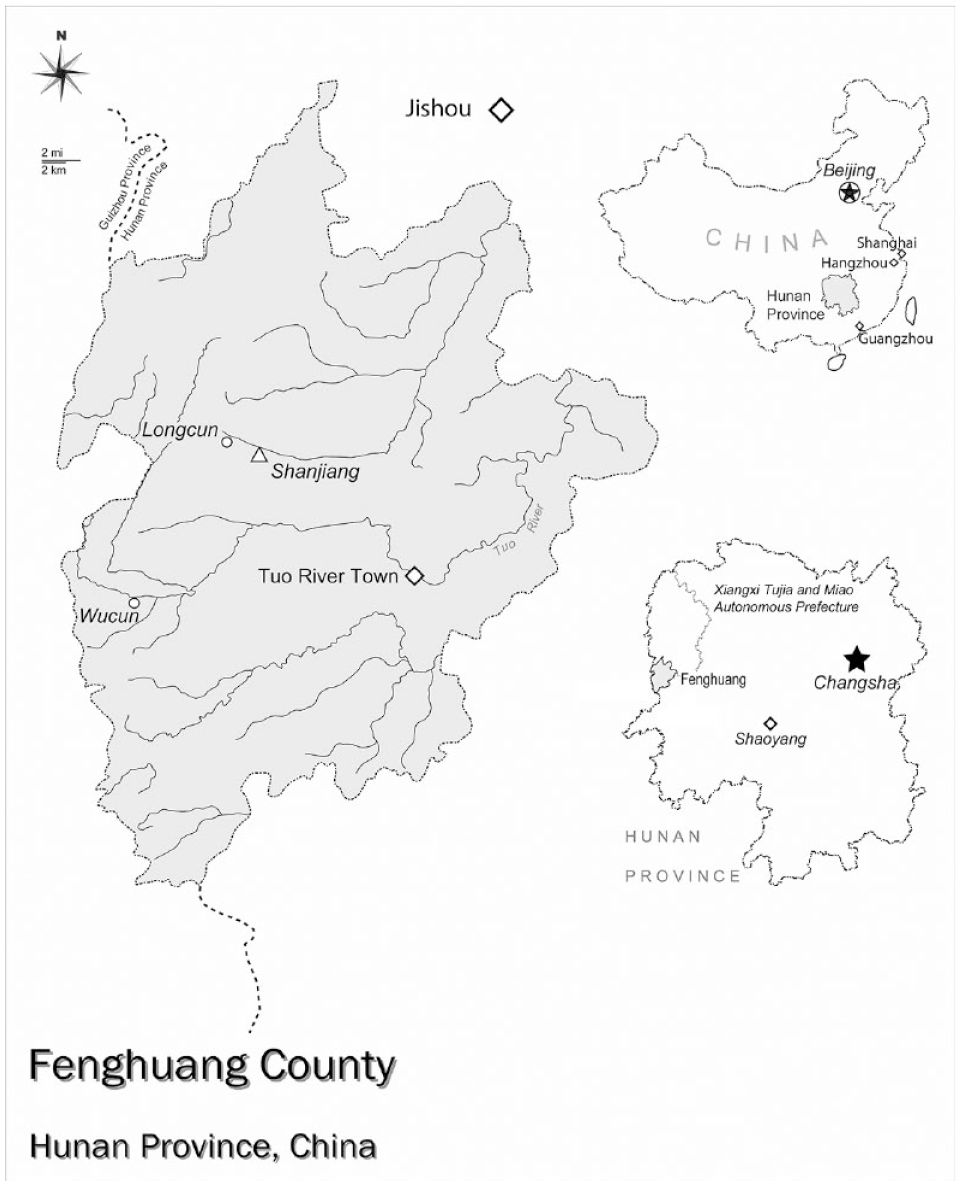
Location of Fenghuang county.
Miao society is patrilineal and patrilocal; relationships and cooperation between households are based on kinship networks among the male household heads, whose wives are not native to the village. The residents in the same Miao village (except the in-marrying women) in Fenghuang are normally related through patrilines sharing the same family name. It is the youngest adult son’s responsibility to live with and care for his parents (Shi, 2008), a custom distinctly different from the primogeniture commonly practiced among the Han. When the youngest adult son gets married, he and his wife remain living with his parents, and they receive a larger share of the patrimony as compensation for their service. Older adult sons set up their own residences in the same village, with the help of the family to build a new house, sometimes in lots adjacent to that of their parents.
Regarding the social structure of traditional Miao society, a local Miao scholar in Fenghuang once said to me, “Among the Miao, there may be the poor and rich 有贫富, but no superior and inferior 无贵贱.” Egalitarianism and respect for ritual leaders (e.g., shamans, clan heads) are their two important cultural elements (Li Tianyi, 2014: 97–99). However, the Miao egalitarian morality was often construed by local officials (Miao and Han alike) as a barrier to economic development. One Miao village cadre once said to me, “Countryside people are short-sighted, and egalitarianism is [a]
serious [problem] in our village.” As Myron Cohen (1993: 166) argues, such negative depictions of China’s peasants have been related less to their circumstances, potential, and culture and more to an elite anti-traditionalism that forms a moral claim to political privilege and power.
Being rural and ethnic, the Miao peasants bear the double burden of “backwardness,” an everyday reality they live and breathe. I once took an informant friend, her husband, and toddler son out for dinner, and we took a taxi back after dinner. After dropping them home, the taxi driver asked me how I came to know them and whether they were from either Shanjiang or Laershan (both areas with a high density of Miao). “No, they were not,” I replied, then asked, “but how do you know they are Miao?” He said, “In Fenghuang, the town people and countryside people have different accents when speaking Mandarin; even if both are from the countryside, the Miao and Han are still different.” He was wondering how I, an outside city woman, became friends with the local Miao peasants. Qiang, a Han peasant, was one of my informant friends. Whenever I misunderstood him, he often teased and said, “Why are you like those Miao, who just can’t get what people say?!”
I am a native of Hunan, and my hometown, Shaoyang, is a small city about two hundred miles away from Fenghuang. I made my first trip to Fenghuang in 2002, interested in the local Miao paper-cut handicraft. I visited Fenghuang eight times between 2005 and 2016, first for my dissertation research (Feng, 2007a, 2007b, 2008a, 2008b) and then for my continuing research that expanded upon it (Feng, 2012a, 2012b, 2013, 2015, 2016, 2017). The specific field sites mainly include Tuo River Town (the county seat and tourist center) and four rural communities (including Longcun and Wucun villages, mentioned in this article 3 ). With the incorporation of materials obtained from my previous fieldwork, my argument here is largely based on the data collected from my visit to Fenghuang in the summer of 2016, during which I split my time between Tuo River Town and Longcun village (Figure 1).
In the summer of 2016, I conducted a total of nineteen in-depth individual interviews. The interviewees, some of whom had been my long-term informants since 2005, represent various aspects of local life and tourism. Interview data were either recorded through written notes or audio recordings if permitted. Daily casual conversation, on-site observation, and local archives (including internal reports and other unpublished materials from the county government and village cadres) provide additional valuable information.
Tourism and Tourism-Induced Mobility in Fenghuang
Fenghuang was once categorized as one of China’s “national-level poverty-stricken counties” 国家级贫困县. Fenghuang Tobacco Company was the backbone of the local economy until its bankruptcy in 1997. In 2000, the gross domestic product (GDP) per capita in Fenghuang was 29 percent of the national average (China Academy of Urban Planning and Design and People’s Government of Fenghuang County, 2005). As with China’s other peripheral regions, poverty in Fenghuang remained conceptualized in official discourse as a problem of incomplete modernization, and tourism was seen as an ideal catalyst to stimulate the county’s economic growth through external investment and market integration. 4
Since 1978 (especially after Deng Xiaoping’s Southern Tour in 1992), China’s post-socialist turn toward a market economy has coincided with a parallel shift to neoliberalism, as Wing-Shing Tang (2014: 44) points out. Tang is critical of David Harvey’s application of neoliberalism to China in his coinage “neoliberalism with Chinese characteristics.” Adopting Yin-wah Chu and Alvin So’s (2010: 49) concept of “state neoliberalism” and discussion regarding the major differences in neoliberalism between China and the United States, Tang (2014: 53) argues that in China it is the Communist Party state, rather than the capitalist class, that has been the dominant agent of neoliberalism. China’s neoliberal approach has involved the fusion of local and outside capital interests and has transformed local government through the drive to attract outside capital (Walker, 2008). This process has provided the backdrop for, and in a significant sense shaped, Fenghuang’s recent tourism development. During the past decade, large-scale and capital-intensive tourism development has been aggressively promoted by the local government as a solution to the impoverished conditions in Fenghuang.
In 2001, the Fenghuang county government leased the exclusive rights to manage eight major tourist attractions for fifty years to the Yellow Dragon Cave Corporation 黄龙洞公司 (YDCC), headquartered in the provincial capital of Changsha, for the price of 830 million yuan. Five of the eight attractions are located in the Old Town 古城 of Tuo River Town. Tuo River Town is the county seat, the center of Fenghuang’s tourist attractions. It is named after the river running through the town. The Old Town features ancient city walls and gates, narrow riverside cobbled streets, weathered wood-stilted houses hanging over both sides of the river, and “jumping rocks” 跳岩 connecting one riverbank to the other.
Following the deal with the YDCC, the county government gradually leased additional tourist attractions and land to other private developers. Since 2002, Fenghuang’s tourism sector has gone through two main stages: the first concentrated on Tuo River Town (especially the Old Town area), monopolized by the YDCC, and the second encompassing the spread of tourism into rural Fenghuang through the promotion of countryside tours (mainly Miao village tours featuring ethnic culture and rural scenery), privately contracted to other tourism developers. Fenghuang’s tourism sector benefits from its geographic proximity (about a four-hour drive) to the Wulingyuan Scenic and Historic Interest Area, a UNESCO World Heritage Site and Hunan’s foremost tourist destination, which has attracted a steady flow of tourists since 1992. 5
Fenghuang’s tourism boom brought about rapid improvement of its transportation infrastructure. Economic stagnation, isolation, and reliance on inadequate modes of transport are widespread in rural China (Dalkmann et al., 2008: 251). No public transport system had existed in rural Fenghuang until recently. Longcun village had no road suitable for motor vehicles before 2002, and the villagers had relied mostly on walking, the journey taking over an hour, to get to the closest market town of Shanjiang, where they could access public transportation. No villager had migrated to cities as wage labor until the early 2000s. As reflected in the popular slogan “To get rich, build roads first” 要致富, 先修路, the transportation sector plays a crucial role in rural development, particularly development that relies on tourism. Since its tourism boom, the county government invested heavily in constructing roads and highways. Although there was no public transportation connecting Longcun to the outside, it was not uncommon for the villagers to undertake daily commutes to Shanjiang and Tuo River Town because of the availability of motorcycles, tour buses, and other motor vehicles.
Fenghuang’s tourism boom also rapidly increased its land value, and the county government has evinced a keen interest in this. Political authorities in China often employ the critique that collective ownership promotes egalitarianism and leads to unscientific and undercapitalized farming, and they therefore advocate liberal reforms to rural land rights (Sargeson, 2004: 642). In Fenghuang, the county government facilitated the influx and expansion of outside capital, which involved the requisitioning of farmland for commercial use.
As You-tien Hsing (2008: 63) has pointed out, local governments across China adopt the doctrines of rationality and efficiency embodied in capitalist land use planning, namely, that “urban planning is fundamentally about realizing the exchange value of land on the market and about allocating land in market-efficient ways.” Yan Changwen, the Fenghuang county Communist Party secretary, made the following remarks at the Fenghuang County Biannual Economic Work Meeting 全县半年经济工作会 (Yan, 2013): “If the land is in the hands of peasants, its value lies just in planting crops; if the land is in the hands of the government, through planning, investment, and construction, its value increases dramatically. It becomes a financial asset, becomes exceptionally valuable, becomes the platform for development, and becomes the carrier for urbanization.”
As with elsewhere in China, the local peasants have transferable use rights while the village collectively owns the land. When leaving to pursue nonagricultural income opportunities, villagers are often willing to transfer their use rights to private developers through long-term lease contracts. In one village on the outskirts of Tuo River Town, a collective vacation to Beijing for all of the residents was organized by the village committee and paid for with the money made from the village’s farmland transactions (land transactions in this village required written proof from the village committee, which levied a fee of 3 percent of the sale price).
In addition to improved transportation infrastructure and detachment from the land, tourism has led to greater employment opportunities. Employment presupposes mobility or willingness to move. The labor market is the driving force behind the individualization of people’s lives, and as soon as people enter the labor market, they experience mobility (Beck and Beck-Gernsheim, 2002: 32–33). Flexible, albeit fragile, employment (e.g., flextime, part-time work, short-term contracts, moonlighting) is increasing rapidly in China. In Fenghuang, tourism provides the local peasants—who have become increasingly detached from the land—with opportunities for engaging in nonagricultural income-generating activities, especially for small-scale entrepreneurial endeavors, such as providing petty commodities and services as street vendors or running shops, guesthouses, and family restaurants.
Embedded Individualization in a Local Context
In recent years, many rural communities worldwide have undergone significant change as a result of the transition to income-generating activities that are nonagricultural, including migrant wage jobs and tourism-related work. In China, increased mobility through migration and tourism has played a significant role in bringing peripheral ethnic minority areas into closer and more forceful contact with the outside world (Chio, 2011). Requiring little or no qualifications, the booming tourism industry in Fenghuang provided small-scale business and other employment opportunities to the local Miao peasants, most of whom were illiterate or had only a grade school education.
As discussed in the previous section, in Fenghuang the rapid rise of tourism-induced mobility that resulted from improved infrastructure, land requisition, and flexible employment facilitated individuals’ disembedment from their previously clan-based society. Similar to what Susanne Brandtstadter (2003: 428) observed in three villages in South China, in Fenghuang the local villagers’ attachment to land as a source of income and residence was loosened; along with this came vastly increased geographical mobility and, with families having become fully dependent on market exchange and wage labor, the emergence of a younger generation more financially independent of their parents than ever before.
Based on my longitudinal research in Fenghuang, I have witnessed the changing conditions of many local lives in the context of tourism and against the backdrop of rapid urbanization and modernization. In the following, I document the experiences of a few local Miao and their families, whom I have known since as early as 2005, to explore the subjective dimensions of individualization—their biographical changes at a microscopic level. Their stories reveal how they engage in “day-to-day decisions on how to live” (Giddens, 1991: 14), and contribute to our understanding of “how the actual, flesh-and-bone individual deals with individualization in a specific temporal and spatial context” (Yan, 2012: 179).
The New Importance of Kinship: Hai’s Family
Hai 6 was from Wucun village. 7 When I first met him in 2005, he and his family were engaged in the tourism business in Wucun. Over the years, Hai, his wife, and their three adult daughters (Dan, Yun, and Xia) and one son moved from Wucun to Tuo River Town one after another, endeavoring in various small tourism businesses. Hai and his wife ran a riverside guesthouse. Xia, their youngest daughter, moved to Tuo River Town after marrying Shun, and switched from doing tourist photography in the street to owning a riverside clothing shop. Yun, the middle daughter, then inherited Xia’s photography business, and later helped around at her parents’ guesthouse.
When I arrived in Fenghuang in the summer of 2016, Xia was in Guangzhou. We sent messages to each other on WeChat (a popular Chinese social media platform). She told me that her parents had rented a small riverside shop to sell souvenirs. She described its location, and said, “Go visit them. It has been two years, and they would love to see you. I will be back in a couple of days.” When I stopped by, Xia’s mother was in the souvenir shop, a tiny space with an annual rent of 50,000 yuan. Hai had recently had serious health problems. He had been taken to the emergency room twice within one month due to bronchitis. They had closed their guesthouse business two years before. It was too much work, and they could not afford to hire staff.
Shortly after my arrival, Hai brought his wife dinner prepared by Yun. They were living with Yun. Yun had recently bought an apartment in Tuo River Town. Yun had quit working and was staying at home to take care of her son and her parents. Yun’s apartment was in the heart of downtown, a stone’s throw away from grocery stores and a hospital. Hai told me that Yun’s husband made decent money by doing photography in Hubei province.
Hai and his wife also had bought an apartment in town. They were loaning it to their son, daughter-in-law, and daughter-in-law’s parents to live in. Their son had a full-time job at the local transportation bureau, which was perceived by Hai as “a decent job with, however, a modest salary.” The main motivation for Hai to start a guesthouse business was to eventually turn it over to his son to supplement his modest salary. Their daughter-in-law’s parents owned a house in town, which was rented for income. Their son and daughter-in-law had their own apartment, but it was under renovation. Hai told me that he and his wife preferred to live with their daughter rather than with their daughter-in-law.
Xia and her husband Shun had bought an apartment as well, where they lived together with their eight-year-old daughter and Shun’s parents. They used to live at the house of Shun’s parents, which had been recently rebuilt as a four-story home. Shun’s parents had leased it to someone with a ten-year term to run a guesthouse. When Xia was back from Guangzhou, I visited her at her store in a mid-afternoon, the least busy time on a hot summer day. No one seemed to be in the store. When I called Xia’s name, her head appeared from behind a curtain. She was taking a nap in the shady back room.
Xia took a watermelon out to treat me. Watermelon helped relieve the summer heat. Xia told me that she and Shun had bought a car. She offered to have Shun pick me up from the train station next time I came to Fenghuang. Xia’s daughter had started elementary school and was taking dance classes after school. During our conversation, her daughter’s education gradually became the central topic. Xia asked me what other skills might be useful for her daughter to learn. She told me that Yun’s son was taking an English-language class with a private tutor. Xia was not sure if it was useful, since Yun’s son’s exam results had not improved. Xia asked me about the college costs in the United States.
Xia insisted on taking me to Yun’s apartment for dinner. Yun’s apartment was about a fifteen-minute walk from Xia’s store. The apartment complex was in an old courtyard and had previously been used as the dormitory for the county grain administration. Despite the rundown appearance of the exterior, it looked decent inside, with brand-new furniture and fresh paint. When we arrived, Yun was busy cooking in the kitchen, with Dan and their cousin in the living room chatting. This was my first time meeting Dan, Hai’s oldest daughter, who had migrated to Shanghai years ago. Dan was divorced and had recently remarried. Her husband was from another city in Hunan, where they had bought an apartment. Dan and the cousin had grown up together and migrated to Shanghai together. The cousin had returned to Fenghuang earlier. They were both pregnant. Concerned with the elevated health risks of late-in-life pregnancy, Dan returned to Fenghuang where she could be taken care of by her family.
Yun cooked a whole table full of dishes. When we were about to start dinner, Hai came home. After a brief greeting, he went directly to bed. As an outgoing man, this was out of character for him. Yun went to check on him. He was not feeling well. I stayed for a while after dinner, and when I was about to leave, Yun hurried her son, a fifth grader, to show me his textbook used for the English-language class mentioned by Xia earlier. Yun too was not certain of the quality of the class. She asked her son to read a few English words to me to see if he pronounced them correctly.
Xia and Yun were invested in their children’s education. The information and advice that they both sought most from me was on this matter. Beck and Beck-Gernsheim (2002: 32–33) elaborate the three dimensions of the labor market, including education, mobility, and competition. They argue that in late modernity “individualization is a product of the labor market and manifests itself in the acquisition, proffering, and application of a variety of work skills.” Because of the increasing competitiveness of the labor market, young Chinese parents “lived with the hope that the hyperpursuit of education would confer life security over the long term” (Kuan, 2015: 209). This “educational desire” in China has spread out from more urban places to rural regions (Kipnis, 2011). While Yun’s son was getting English tutoring outside of school, Xia enrolled her daughter in dance classes. As with many rural residents elsewhere in China (Ye et al., 2013), they believed that once their children received adequate education, they would have a chance to cross the threshold and become respectable urban citizens.
Hai’s family is a case of “chain migration” (Altamirano and Hirabayashi, 1997: 13), in which one person helps other relatives or friends to resettle from a more remote community to one of a higher population, usually a town or city. This strategy is often adopted in response to a lack of institutional protection and support from the state. On one hand, adult children may fall back on the family as their safety net after they are disembedded from the traditional patterns and arrangements (e.g., reciprocity in labor and goods) in the village community where they grew up; on the other hand, the elderly parents may count on adult children for daily care, especially when ill. While Hai and his wife counted on Yun for daily care as Hai’s health deteriorated, Dan chose to return from Shanghai to her family in Fenghuang during her pregnancy. Family and kinship remain a safety net for individuals. “More dependence on the family” (Yan, 2016) and the “new importance of kinship” (Brandtstadter, 2003) seem to be the main mode of re-embedment during the individualization process in China, especially for its rural ethnic populations such as the Miao in Fenghuang.
Examining diversified intergenerational living arrangements in Guangzhou and Beijing, Shi Jinqun (2016) argues that the family has become an individual’s last resort to deal with the lack of institutional support regarding elderly care and childrearing. Wenrong Liu (2017) utilizes case studies of urban families in Shanghai to examine the phenomenon of “ken lao” 啃老, in which adult children are highly dependent on their parents on a daily basis for money and labor. Her findings suggest that the change in urban families in China has not resulted in individualization of the family in the process of individualization in China. Liu (2017: 19) argues that, for China’s urban families, the relationship between parents and adult children has become the most important tie, and is often the only support network that individuals can rely on, because of the increasing instability of marriage, lack of siblings, and underdeveloped public welfare system. In the case of Hai and his four adult children, they practiced flexible living arrangements, despite each having their own place to possibly live independently. Hai and his wife moved in with Yun, with Dan returning from Shanghai to stay with them in Yun’s apartment during her pregnancy. While Xia lived with her parents-in-law in the apartment that she and her husband bought, Hai’s son lived with his parents-in-law in Hai’s apartment since his parents-in-law’s house was rented and his own apartment was under renovation.
Looking at three villages in South China, Brandtstadter (2003) observes the loosened attachment to land as income source and residence, along with the heightened mobility of family members; the general empowerment of the younger generations; and a breakdown in hierarchical solidarity in daily interactions. Paradoxically, however, Brandtstadter also notes that since China’s economic reforms and decollectivization, kinship relations have become more valuable. Similarly, based on his research in a North China village, Yan (2009: 287) argues that the “individualization process in China does give the individual more mobility, choice, and freedom, but it does so with little institutional protection and support from the state. To seek a new safety net, or to re-embed, the Chinese individual is forced to fall back on the family and personal network of guanxi, the same point where disembedment begins.”
Through a case study in South Korea with comparative observations in Japan, Kyung-Sup Chang (2014: 38) argues that “the fundamental nature of East Asian modernity and late modernity has dictated a paradoxical process of individualization without individualism. . . . East Asians have found it inevitable to thoroughly restructure their family structures and relations as well as their individual life courses.” As Cosmo Howard (2007: 8) points out, individualization is not the retreat of social structure, but a transformation of it. During this transformation, rather than the individual living for the continuation of the family or family needs (Hsu, 1948), the family is changing to serve the needs of the individual (Liu, 2017: 3), as seen in the case of Hai’s family. The modernity of the contemporary family lies in the rising importance of the individual in family relations (Yan, 2009: xxiii).
Alone Together: Love? Yes, Marriage? No
I heard that San Ge had a girlfriend. I first met San Ge in 2011 in Longcun. Since his wife had left him ten years earlier, San Ge remained single despite the hardship of taking care of his sick mother and raising two young children. Over the years, I witnessed San Ge’s ups and downs, as he struggled to make a living in the seemingly prosperous local tourism market, starting as a farmer tied to his land, then later a migrant worker, then a tourist rental van driver, then back to being a migrant worker, soon after coming back to help with his older brother’s restaurant, later renovating his house where he opened a tourist restaurant, and most recently switching to operating a rice liquor business (see details in Feng, 2017). At that time, he was not interested in a relationship. He always said, “I can’t afford the time or money to get a wife.”
When I arrived in Tuo River Town in the summer of 2016, I looked forward to meeting his girlfriend, Xiao Hu. San Ge planned to take me to visit her the next evening when he drove to the town from Longcun. Xiao Hu ran a riverside shop selling local products including ginger candy in the Old Town. The next day, San Ge was running late. He called me on his way, “I am stuck in traffic. It is Saturday today, too many tourists, and too many cars.”
The traffic jam lasted until 10 p.m., and San Ge arrived late to Xiao Hu’s store. He worked on a wooden billboard for her store and slept at Xiao Hu’s rental apartment. The next morning, San Ge came to pick me up. He was done with grocery shopping and ready to return to the village. He was driving a new van that he had recently bought. On our way to Longcun, San Ge talked to me about Xiao Hu. She was two years younger than he was. She was a widow from Longcun. Her husband had worked as a migrant laborer at a coal mine and was killed in a mine accident, leaving her a daughter and a son. She, together with her brother, opened their riverside shop. Leased at 130,000 yuan per year, the store space was composed of three shopfronts. Xiao Hu also had a car. “Better than mine,” San Ge said. “It’s like I have two cars, and I am free to drive either.”
Two days later, I went with San Ge to visit Xiao Hu in her store. I planned to take them out for dinner. When we arrived, the riverside street was packed with tourists. Xiao Hu stood by the door, right next to two big trays of candy, serving customers. She was reluctant to take a dinner break during busy hours. San Ge suggested the next-door restaurant. He and I went first to order dishes. After the food was served, we called Xiao Hu to join us. She brought her son. She quickly ate and left to attend to her business. After dinner, San Ge and I hung out in Xiao Hu’s store (Figure 2). We stayed until Xiao Hu asked San Ge to take her son back to her rental apartment. Summer was the peak tourism season in Fenghuang, and Xiao Hu’s store was normally kept open until 1 a.m. On our way out, San Ge took a packet of cigarettes from the store counter. He gave her five yuan to pay for it. San Ge later explained that the two of them “calculate very clearly” 分得很清.
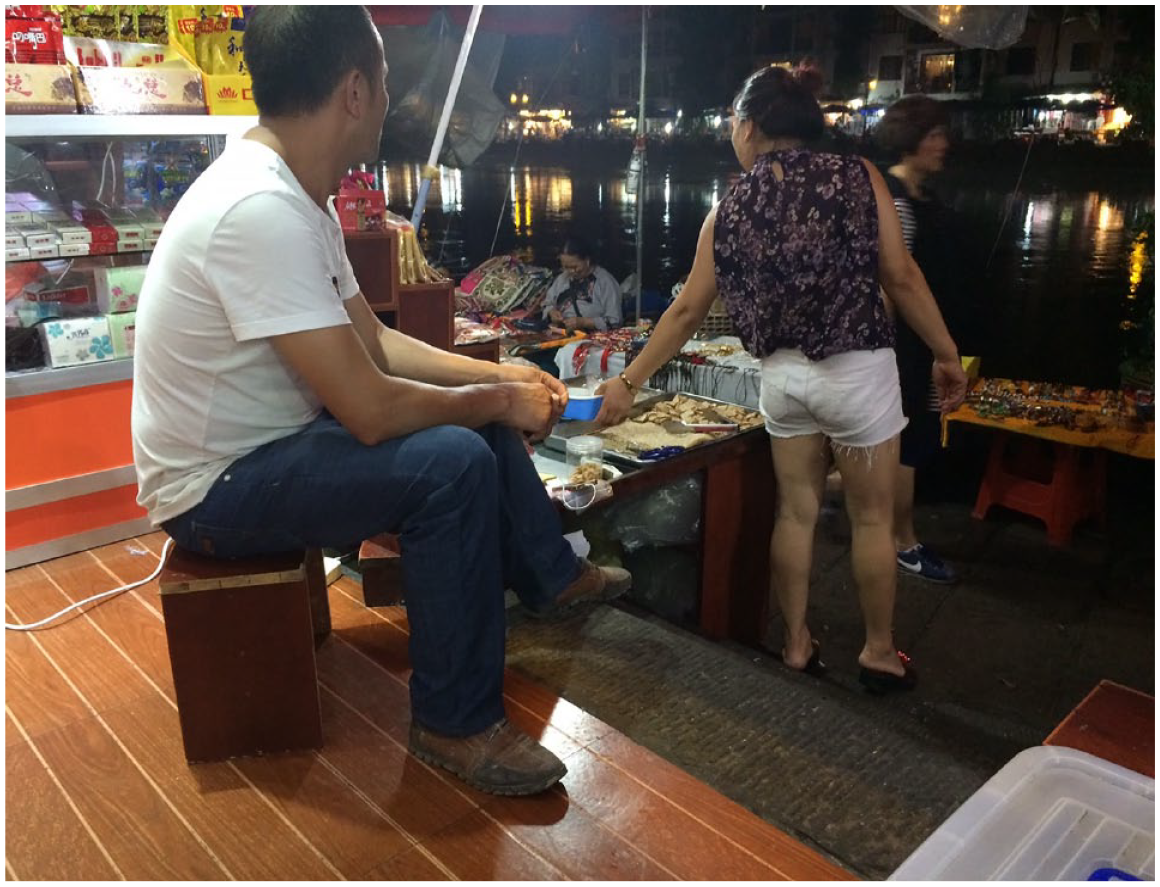
Xiao Hu standing in front of her shop to solicit tourists to buy ginger candy, offering free samples for them to taste, with San Ge sitting behind her.
The next morning, I rode with San Ge again to Longcun. I commented on him not helping around at Xiao Hu’s store last night. He said, “I used to help her, then I became too tired. When I helped her, I got less sleep. If I couldn’t get much sleep, it affected my own work the next day.” He continued, “You know. I don’t help her anymore mainly because her business is co-owned with her brother and aunt. Helping her is at the same time helping other people. Actually, I did make the wooden shelves for their store. It took me two days. If they were to hire people to do it, it may cost several thousand yuan. I did not charge them. I could have charged them and then given the money back to Xiao Hu.” I asked, “Why didn’t you tell Xiao Hu that.” “I did,” San Ge replied, “but she said, ‘why are you so stingy?’”
Before Xiao Hu moved from Longcun to Tuo River Town, she had been a rental van driver like San Ge, transporting tourists between Longcun and Shanjiang. Each rental van had a number posted in its rear window to facilitate the distribution of customers on a rotational basis. Since Xiao Hu moved to Tuo River Town, she gave her number to San Ge, and San Ge received additional customers who were supposed to be allocated to Xiao Hu. I asked, “Do you need to share with her what you made from taking her shift?” “No, I don’t,” San Ge replied.
San Ge continued to explain why he did not help around her store, saying, “She does not come up to Longcun to help me either. While I don’t help at her store, I help with the chores at her apartment, cooking, doing laundry, and sweeping the floor, so that she can rest when home.” “But she did help you sell the rice liquor you made, right?” I asked, recalling seeing those liquor jars on her store shelves. San Ge said, “No, she is not selling for me. She bought them from me at a low wholesale price to sell at her store.” He explained, “Our money is separate. My money ought to be given to my own kids. Otherwise, who can they rely on? And when I am old, I need to count on them. By the way, don’t wait for my wedding invitation. I won’t get married.”
Marriage, once a highly rigid and arranged union in preindustrial society, has become a voluntary union between two individuals in the modern world, even in remote regions and among ethnic minorities, as “in modern marriage it is their feelings for one another that links the two partners” and “the common ground is almost exclusively emotional” (Beck-Gernsheim, 2013: n.p.). In the past two decades, with the process of individualization, there has been a diminishing interest in “common share” (holding assets indivisibly) (Dalkmann et al., 2008: 260). San Ge’s business was based in Longcun, while Xiao Hu migrated to the county seat to operate a tourist shop. San Ge frequently commuted to the county seat in the evenings to deliver rice liquor to his patron restaurants and to see Xiao Hu. He stayed at Xiao Hu’s place overnight and came back to the village early the next morning. While they maintained a stable relationship, they were not interested in getting married.
San Ge and Xiao Hu’s case shows that flexible living arrangements occur not only intergenerationally (e.g., Hai’s family, as discussed earlier), but also between individuals in intimate relationships. While living separately, San Ge and Xiao Hu each prioritized their own business interests, and carefully maintained boundaries regarding personal finances. They bonded in private, but not in business. Nevertheless, their private bond provided a safety net for them to buffer, to some degree, the risks of their respective precarious small businesses. Xiao Hu gave her rental van shift in the village to San Ge, and San Ge did carpentry work for her store and helped her with domestic chores when he stayed overnight at her place. While Xiao Hu bought rice liquor from San Ge to sell at her store, she paid a low wholesale price, and San Ge had her as a reliable patron who made sales at a store in a tourist-crowded riverside street in the county seat.
San Ge carefully managed his money and did not spend it on Xiao Hu or her children. He was outspoken about wanting his money to be used on his own children, on whom he would have to depend when he was old. There is an old Chinese saying, “Bring up children (especially sons) for the purpose of being looked after in old age” 养儿防老. As Li Meng (2014: 153) observed in a village in Central China, without the support of a state-sponsored elderly care system, aging peasants grew dependent on their children to sustain everyday living. Based on her research on changing dowry and brideprice practices in South China, Helen F. Siu (1993: 183–86) discovers that because of the breakdown in hierarchical solidarity, the elder generation has started to contribute eagerly to new conjugal funds, hoping thereby to ensure intergenerational reciprocity, an emerging phenomenon elaborated on later by Yan (2016) as “descending familism.”
The “Enterprising Self”: Local Miao Officials as Entrepreneurs
Teng, a Miao individual in her thirties, was one of the youngest staff members in the county ethnic affairs bureau. She was one of my key informants and a friend since 2011. In the summer of 2016, I contacted Teng upon my arrival in Fenghuang. She did not reply until the following night. She was busy cleaning her store that Saturday. I was surprised to learn that she had opened a children’s clothing store while keeping her full-time job at the bureau. She told me that a store like this had been her dream since childhood.
The following Monday, during her lunch break, Teng and I met at a newly opened restaurant. The restaurant was opening on a trial basis. When the restaurant manager sought our feedback, Teng made several suggestions, and I was impressed with her insights. The restaurant was in the same commercial complex as her store. We visited her store after lunch. She had hired her aunt to look after the store. Teng was the accountant at the county ethnic affairs bureau, and at that time she had also taken a temporary appointment as an accountant in the county temporary demolition office. The temporary office was established to serve the Slum Upgrading Project 棚户区改造项目 initiated by the county head, and its responsibilities included land requisitioning and investment invitation.
While her attention was primarily invested in the brick-and-mortar store 实体店, Teng also did online business through WeChat (Figure 3). She traveled to Changsha, Hangzhou, and Guangzhou to attend clothing trade fairs and to replenish stock for her store. Teng’s husband, also a local official, worked at the county animal husbandry bureau. He and his relatives coinvested a total of 600,000 yuan to open a grocery store, with one branch in the Old Town and the other in the new part of town.
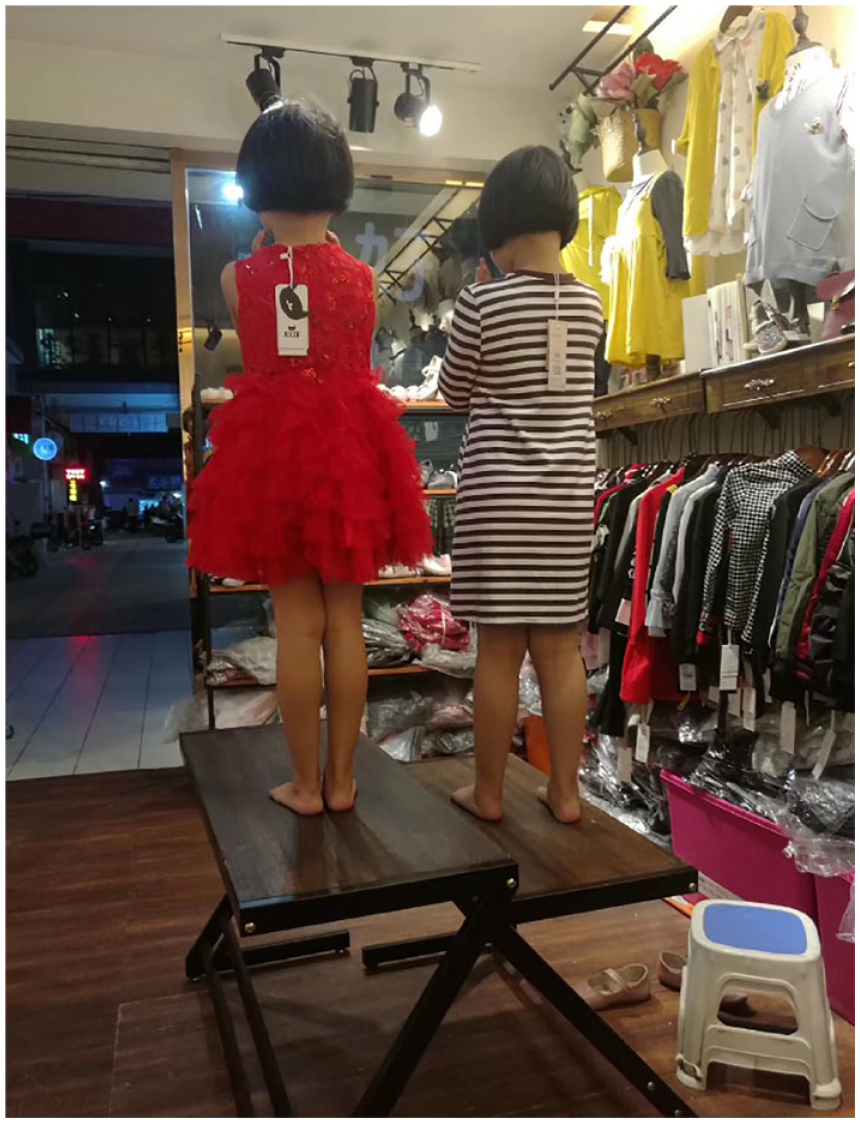
Teng has her daughter and niece model the clothes sold at her store. She frequently took pictures like this and posted them on WeChat to promote sales.
According to Teng, three of her colleagues at the county ethnic affairs bureau had their own businesses, including one in the office next to hers who sold homemade baked goods on WeChat. I asked Teng, “It seems that the businesses you and your colleagues are involved in are not directly tourism-related. Why didn’t you all start earlier?” Teng said, “On one hand, we did not have the start-up money. Our monthly salary back then was only 600 yuan, but annual rent for a shopfront was 10,000–20,000 yuan. On the other hand, in the old days those who were doing business had ‘no face’ 没有面子 [i.e., they were ashamed or embarrassed to do so], while those who were employed at a collective work unit 单位 were considered the most decent.”
As Teng’s former colleague, Ru was the deputy director of the county ethnic affairs bureau until she retired in 2010. Before her retirement, she had been my primary liaison to the local government officials during the early stages of my fieldwork in Fenghuang. Her son worked at the local hydropower station, a state-owned enterprise under the supervision of the county water conservancy bureau, where his father was a senior official. Ru’s son and his friends co-invested in a riverside bar, which I once visited with his younger sister. He maintained his full-time job at the hydropower station during the day and worked at the bar at night.
Yao was the deputy director of the county statistics bureau; he had also been a friend of mine since 2005. I visited Yao in his office during my trip in 2016. I asked him if any of his colleagues owned businesses. Yao pointed out the empty seat across his desk, saying, “There is one right there. He is not here today. He runs an internet cafe.” Yao’s colleague joined our conversation, saying, “The government is encouraging us to do business.” Yao explained that only those government officials with a rank of county head or higher were prohibited from owning private businesses. Yao had just returned from a one-month training program in Jishou, the prefectural capital. During his stay there, whenever he and his classmates discussed where to go for dinner, they did not refer to the names of the restaurants but the names of the officials who owned these restaurants.
As Yan (2012: 189) points out, Nikolas Rose (1996) provides a missing link in Beck’s theory by turning his attention to the subjective dimensions of individualization to reveal how the individual deals with individualization in Western European societies. Rose goes further to explore the subjective consequences of objective individualization—the making of the enterprising self. Yan (2012: 188–89) distinguishes between the “enterprising self” (Rose, 1996: 154) in contemporary Western societies and the “striving individual” in China, and points out that the latter has a materialistic orientation in which individual autonomy and freedom have not developed much beyond the pursuit of personal interest.
In the case of Fenghuang, the individuals portrayed here indeed showed a materialistic orientation in their pursuit of personal interest. Hai’s family had had some success in their small-scale entrepreneurial endeavors. The same was true for San Ge, who had demonstrated remarkable resilience and diligence over the years. He had recently learned to make rice liquor and was able to rely on it as his main income source. Meanwhile, he raised pigs for sale with the crop waste from his rice liquor production. And still, he maintained his rental van business to transport tourists whenever he had a moment.
Nevertheless, I argue that the “striving individuals” in China (Yan, 2012) demonstrate traits of the “enterprising self,” a characteristic of advanced liberal democracies (Rose, 1996), and that they are pursuing a life of their own that goes beyond a materialistic orientation. Teng was following her childhood dream of owning a boutique clothing store. I observed how she was thriving as an independent and confident woman with her business talent. She tirelessly devoted her limited free time to managing both the brick-and-mortar store and its online business through WeChat. She frequently traveled to clothing trade fairs in cities, and enjoyed herself at the restaurants, hotels, and coffee shops. She was in love with the way of life, not only its materialistic aspect, but also the autonomy and freedom that her job as a county government clerk had not afforded her. Teng was enjoying her life as a businesswoman, demonstrating the “ethics of enterprise” such as “competitiveness, strength, vigor, boldness, outwardness, and the urge to succeed” (Rose, 1996: 157).
Teng was not alone, as many government officials in Fenghuang had joined her in becoming small business owners. In the past, they had chosen “iron rice bowl” jobs such as those in the civil service because of their “face” 面子 and security, putting aside their true passions. In the new era, as Rose (1996: 154) states, “The enterprising self will make an enterprise of its life, seek to maximize its own human capital, project itself a future, and seek to shape itself in order to become that which it wishes to be.” The Miao officials that I encountered in Fenghuang were “striving to maximize their own advantage by inventing and promoting new projects by means of individual and local calculations of strategies and tactics, costs and benefits” (Rose, 1996: 153).
In the context of Fenghuang’s neoliberal tourism development, the self-steering capacities of individuals are being construed as vital resources for achieving private profit, public tranquility, and social progress. However, while comparing the Miao peasants’ experience of dealing with individualization with that of the Miao officials, it reveals the more or less unchanged effect of social structure. As Dawson (2012: 307) points out, individualization is unequal. The Miao officials (such as Teng) may have more options available, as a result of their reflexivity, than the Miao peasants (such as San Ge), or their reflexive choices may have a greater opportunity of being realized through the utilization of capital. Thus, the forms of stratification situate individualization, hence representing a case of embedded individualization (Dawson, 2012).
Conclusion
As Beck-Gernsheim (2013: n.p.) states, “flexibilisation and deregulation are the demands penetrating the labour market today. The traditional form of employment is losing ground, and in its place comes a whole set of the most diverse forms of employment which are more open and mobile, but at the same time more unstable, vulnerable, risky.” This is particularly true in a tourism context. Through the case of Fenghuang, I argue that individuals’ mobility, as an indicator of “precarious freedoms” (Beck and Beck-Gernsheim, 2002), may enhance, rather than diminish, the importance of family, because of the lack of reembedment mechanisms (e.g., institutional support) in China (Yan, 2016), especially for its rural, ethnic minority populations.
Scholars have previously applied concepts such as “internal colonialism” (Oakes, 1995) and “internal Orientalism” (Schein, 1997) to analyze the relationship between the Miao periphery as an ethnic tourism destination and the central Chinese state. In my previous research (e.g., Feng, 2017), I discussed the exploitative and exclusive nature of Fenghuang’s large-scale and elite-directed tourism development and explored this through the experiences of the local Miao peasants, who are at the bottom of the local social hierarchy.
The “compounded powerlessness” (Ortner, 1995: 184) of being both peasants and of ethnic minority status has affected the life possibilities of the local Miao. Thus they may have to rely more than the Han on their family and kinfolk as a safety net to deal with everyday challenges and risks. Individualization is stratified (Nollmann and Strasser, 2007), and this is particularly notable for ethnic minorities in China, such as the Miao, who cannot escape this compounded powerlessness and must take on added responsibility. Furthermore, the stratification within the Miao (e.g., Miao peasants vs. Miao officials) also affects the individual’s ability to “[act] upon itself in order to better itself” (Rose, 1996: 154).
The case of Fenghuang contributes to our general understanding of major social shifts regarding family relations in the phase of late modernity. While specifically focusing on China, it informs the broader realm of research on global issues of mobility and individualization and the social roles of families. We need “roots” to have “wings.” Family ties on one hand enable individuals’ geographic mobility, and on the other hand facilitate their handling of the challenges and risks brought by their mobility in the process of individualization. It also sheds light on how social structures become individualized instead of being swept away, as “individualized beliefs and the constraints of class structure actually cooperate in bringing about a society that appears as highly individualized on the front stage, whereas the back stage still looks much like a class society with fairly strict processes of intergenerational mobility” (Nollmann and Strasser, 2007: 94–95). Miao experiences of dealing with individualization reveal the somewhat unchanged effect of social structure, hence representing a case of embedded individualization.
Footnotes
Acknowledgements
I owe my gratitude to the people of Fenghuang, many of whom accepted me as their friend and as family over the years. Thanks for the privilege of being part of your lives. I would like to thank Kathryn Bernhardt and the anonymous reviewers’ comments on an earlier version of this article. Thanks to Mark Hill for help with the map illustration as well as his feedback on this article. A special thanks to Yunxiang Yan, whose work has long inspired me.
Declaration of Conflicting Interests
The author declared no potential conflicts of interest with respect to the research, authorship, and/or publication of this article.
Funding
The author disclosed receipt of the following financial support for the research, authorship, and/or publication of this article: Data collection was supported by the Summer Research/Creative Activities Award at Eastern Michigan University, and the writing-up was supported by the Faculty Research Fellowship at Eastern Michigan University.