




Abstract
American Christians have become increasingly polarized on issues of climate change and environmental regulation. In recent years, mainline Protestant denominations and the Roman Catholic Church have made explicit declarations of support for global climate action. Prominent Southern Baptists and other evangelical Protestants, on the other hand, have issued statements that are strikingly similar to the talking points of secular climate skeptics, and have attempted to stamp out “green” efforts within their own ranks. An analysis of resolutions and campaigns by evangelicals over the past 40 years shows that anti-environmentalism within conservative Christianity stems from fears that “stewardship” of God’s creation is drifting toward neo-pagan nature worship, and from apocalyptic beliefs about “end times” that make it pointless to worry about global warming. As the climate crisis deepens, the moral authority of Christian leaders and organizations may play a decisive role in swaying public policy toward (or away from) action to mitigate global warming.
In what is certainly the most famous essay ever written about religion and the environment, the historian Lynn White Jr. argued that medieval Judeo-Christian ideas were at “The Historical Roots of Our Ecologic Crisis” (White, 1967). Citing passages in the Bible that separate God from nature and grant humanity dominion over all, White wrote: “Especially in its Western form, Christianity is the most anthropocentric religion the world has seen.” He also opined that much, if not most, environmental degradation is directly traceable to Christianity’s radical anthropocentrism (White, 1967: 1205).
Recent research seems to confirm White’s rather bleak assessment of the relationship between Christian beliefs and environmental attitudes. University of Cincinnati political scientist Matthew B. Arbuckle and Georgetown University public policy expert David M. Konisky recently reported (forthcoming) that American Christians, as a whole, have lower levels of environmental concern than do non-Christians (Jews, people of other faiths, and nonbelievers). Arbuckle and Konisky also found, tellingly, that the higher the level of religious commitment (as measured by self-reports of religion’s personal importance, frequency of religious service attendance, and frequency of prayer), the lower the level of environmental concern. Another recent study showed, similarly, that American Christians, collectively, when considered without regard for denomination, have less environmental concern than do Americans of other faiths or those who say they are not affiliated with any institutional forms of religion (Clements et al., 2014).
But, then, how are we to make sense of declarations from the mainline Protestant faiths in the United States—Methodists, Presbyterians, Episcopalians, and Lutherans—proclaiming that God wants humans to care for creation? And what about Pope Francis’s powerful new encyclical on climate change, “Laudato Si”? Yes, some Christians do believe that humans are separate from, and superior to, nature, and that God has given humans license to multiply without limit and to dominate and exploit the rest of creation. But it is also obvious, both from their own statements and from opinion surveys (see Figure 1), that other Christians, though they have read the same Bible, have come to radically different conclusions about what God wants and expects of humans.
Climate change concern by religious affiliation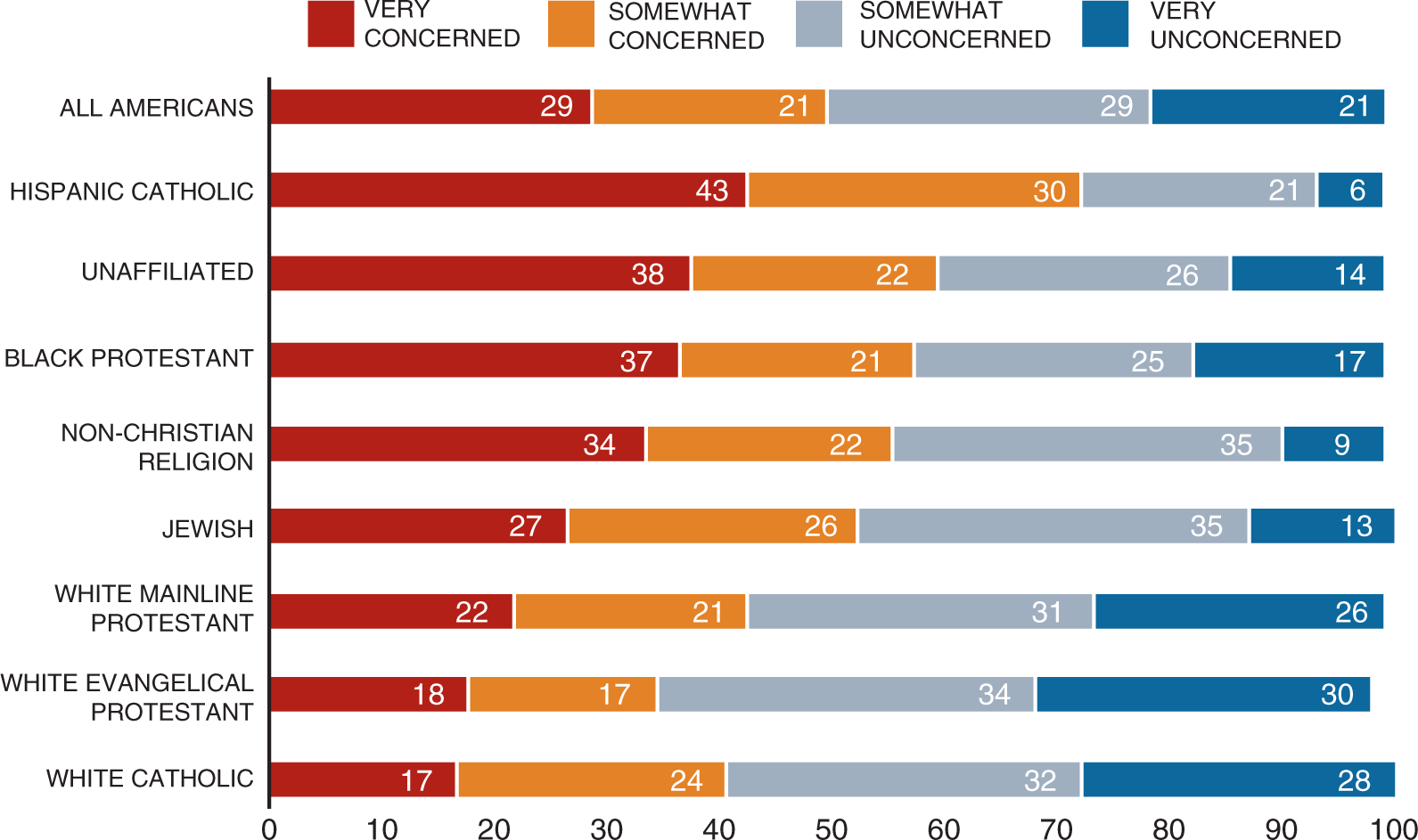
American Christians have become increasingly polarized on issues such as climate change, with the most conservative Christians—that is, Southern Baptists (America’s largest Protestant denomination) and other evangelical Protestants—expressing the most anti-environmental attitudes and attempting to suppress “green” efforts that have arisen in their own ranks. The reasons for this environmental backlash include conservatives’ suspicions that “stewardship,” improperly understood, smacks of neo-pagan-style nature worship and might even lead to anticapitalist sentiments. The backlash also depends on a reinvigorated belief in “end times” apocalypticism that makes it pointless to worry about global warming and other environmental problems.
Conservative, moderate, and liberal Christianities
It is helpful to think of Christianity not as one undifferentiated or uniform mass of believers but as an internally deeply divided community. Princeton University sociologist Robert Wuthnow argued in 1988 that to understand differences within American Christianity one needed to look beyond denominational labels and to think, instead, of three different categories of Christians: one theologically conservative, a second quite liberal, and between them a broad swath of amorphous and ill-defined moderates (Wuthnow, 1988, 1996). All three types are present in every denomination, but not to the same degree.
Recent studies show that Wuthnow’s way of conceptualizing divisions within Christianity was on the mark. Some Catholics believe climate change is real and a serious problem; other Catholics don’t. Many Methodists do, but some don’t. There are climate skeptics even within the most liberal denominations. Conversely, although a large majority of evangelicals are skeptical about climate change, between one-fourth and one-third of evangelicals aren’t (Arbuckle and Konisky, forthcoming; Barna Group, 2007; Jones et al., 2014). The proportions of conservatives, liberals, and moderates within each denomination vary significantly.
Conservative Christians, whatever “official” denomination they belong to, constitute one of the core demographic foundations for climate skepticism—or, more properly, denialism—in the United States today (Arbuckle and Konisky, forthcoming; Barna Group, 2007; Jones et al., 2014). Why? While White was right that Christianity in all its forms does, in the aggregate, suppress environmental concern, anthropocentrism doesn’t explain the obvious differences between conservative and liberal Christians on climate change. Other factors have contributed to a major shift in how American conservative Christians perceive environmental “stewardship” and weigh its importance. 1
Divorced from nature
For those not already familiar with Christian, and especially conservative Christian, metaphysical claims about the nature of God, some historical background is critical to understanding contemporary environmental debates within American Christianity. According to Hebrew Bible scholar Richard Elliott Friedman, the ancient Israelites produced the first enduring monotheism—the belief in a single god. The difference between Israelite monotheism and the pagan religions of that era was not a simply a “matter of arithmetic: one God rather than many … . Pagan religion personified [nature’s] forces, ascribed a will to them, and called them gods” (Friedman, 1995: 87). In contrast, ancient Israel, for the first time in recorded human history, conceived of a God above and beyond the now-desacralized forces of nature.
This divorce of God from nature had other ramifications. It allowed biblical writers to imagine that humans occupied a more exalted position in the natural order than the nature-based pagan religions conceived. One example is a passage from the Hebrew Bible’s book of Psalms declaring that God made humanity “a little lower than God,” with “dominion” over God’s creation, putting “all things under their feet, all sheep and oxen, and also the beasts of the field, the birds of the air, and the fish of the sea, whatever passes along the paths of the seas” (Psalm 8: 6–8, New Revised Standard Version). Another Psalm asserts: “The heavens are the Lord’s heavens, but the earth he has given to human beings” (Psalm 115: 16). Environmental historian Clarence Glacken noted that one of the key ideas in the religious and philosophical thought of Western civilization, which is derived from Christianity, is that humans, sinful though they are, nevertheless occupy “a position on earth comparable to that of God in the universe” (Glacken, 1967: 155).
Church father, missionary, and theologian Paul of Tarsus carried forward into early Christianity this Hebrew Bible concept of human superiority to, and dominion over, the rest of nonhuman nature. In his New Testament Epistle to the Romans, Paul wrote that God had abandoned pagans because they “worshiped and served the creature rather than the Creator” (Romans 1:25), thus incorporating from first-century Judaism, into movements that would eventually become early Christianity, the idea that there is an absolute separation between an external supernatural God and the natural created order, and that to venerate nature was to engage in idolatry. Crucially, this passage is one of the most cited whenever conservative Protestant Christians discuss human responsibility for the environment, and it is why the famed Protestant theologian Paul Tillich noted that, within Christianity, the term pantheist is “a ‘heresy’ label of the worst kind” (Tillich, 1951: 233).
These ideas were uncontroversial standard Christian theology across most of American Protestantism and Catholicism until the 1960s. From medieval times to the present, there have always been minor strands of mystical nature veneration within Christianity, but none had much impact on the major denominations of European or American Christianity. Lynn White had this history in mind when he wrote his seminal, controversial essay.
The first major Christian response to White came from Francis Schaeffer, a then-prominent thinker within evangelical Christianity who is still widely cited. In Pollution and the Death of Man (1970), Schaeffer acknowledged the intensifying problems of environmental pollution, but denied that these problems stemmed from Christian arrogance and anthropocentrism. He affirmed that only humans were created in “the image of God” and were therefore uniquely exalted. According to Schaeffer, however, humans only held nature in stewardship for the true Owner. When we have dominion over nature, it is not ours, either. It belongs to God, and we are to exercise our dominion over these things not as though entitled to exploit them, but as things borrowed or held in trust, which we are to use realizing that they are not ours intrinsically. [Humanity’s] dominion is under God’s dominion and under God’s Domain. (Schaeffer, 1970: 51, 70; emphasis in the original)
The United Methodist Church, for example, last year stated: “As a matter of stewardship and justice, Christians must take action now to reduce global warming pollution” (General Board of Church & Society of The United Methodist Church, 2014). More recently, Pope Francis’s encyclical called climate change “a global problem with grave implications” and stated that “our concerns for the environment [direct] us to be stewards of all creation” (Pope Francis, 2015). For liberal Christians, the call to be a better steward is urgent, unequivocal, of the highest priority, and not to be subject to negotiation or compromise. For conservative Christians, however, the commitment to stewardship has become increasingly hemmed in with certain reservations and qualifications.
Southern Baptists’ version of stewardship
The Southern Baptists’ struggle to find an acceptable definition of stewardship offers an excellent example from the conservative side. In the early 1970s, likely under the influence of Earth Day and the rise of modern environmentalism, the Southern Baptist Convention passed several resolutions on the environment. The first, passed in 1970, warned “man has created a crisis by polluting the air, poisoning the streams, and ravaging the soil” (Southern Baptist Convention, 1970). The 1974 resolution continued in a similar vein: “We have recently been made more conscious of our selfish and nearsighted use of our resources … [therefore, Christians now must] assume our individual and corporate responsibilities as faithful stewards.” The resolution “urge[d] Congress and concerned governmental agencies to take aggressive action to conserve our diminishing resources” (Southern Baptist Convention, 1974). This was a definition of “stewardship” that was practically indistinguishable from what modern environmentalists were saying: Pollution is the problem; government regulation is the answer.
By 1990, though, the tone had shifted. The resolution that year still condemned the sinfulness of the human race [that] has led to the destruction of the created order … as evidenced by the endangerment of the earth by pollution, human extravagance and wastefulness, soil depletion and erosion, and general misuse of creation
Along these same lines, the Convention’s Ethics & Religious Liberty Commission’s Policy Statement on Global Warming (Lewis, 2005) defines stewardship as lying somewhere between two extremes, “using nature without any reservations, leading to environment destruction” on the one hand, and “a pantheistic view of the world [that puts] nature at the center of the universe rather than God” on the other. Similarly, a new resolution, passed in 2006, made it crystal clear that a Christian understanding of stewardship is not the stewardship of neo-pagan environmentalists who “have completely rejected God the Father in favor of deifying ‘Mother Earth’” (Southern Baptist Convention, 2006).
Having distanced themselves theologically from what they saw as pre-Christian religion, these two documents went on to present more purely secular anti-environmental and climate denialist talking points. The Ethics & Religious Liberty Commission’s Policy Statement on Global Warming stated that “tens of thousands of scientists agree that there is no conclusive evidence for the manmade global warming theory. Records prove that climates have changed in the past without human interaction.” The statement warned that the Kyoto Protocol, if implemented, “would have disastrous effects on the economy” including job losses and increased poverty (Lewis, 2005). The 2006 Southern Baptist Convention resolution repeated climate skeptics’ favorite arguments but went even further, approvingly talking of “respecting ownership and property rights” and opposing solutions that “bar access to natural resources and unnecessarily restrict economic development.”
In less than four decades, then, the Southern Baptists moved from sounding quite sympathetic to environmentalism, including support for stronger government regulation, to equating environmentalism with neo-paganism and endorsing free enterprise. Today, the official position of Southern Baptists, and of other conservative Christians, is indistinguishable from that of secular conservatives in the climate denial movement (Oreskes and Conway, 2010).
End times
Beyond explicit policy statements, could there be something else in Christianity that suppresses environmental concern? A trailblazing study conducted in 2014 by the Public Religion Research Institute provides a clue. Almost half of all Americans attributed the severity of recent natural disasters to biblical “end times.” Among white evangelicals, that number jumped to 77 percent (Jones et al., 2014: 23).
The “end times” concept requires historical explanation. The early communities that formed after Jesus’ execution at the hands of Rome expected imminent supernatural deliverance through divine intervention. The Apostle Paul expected to see this in his lifetime. With the expected deliverance, worldly affairs would be set right by God, the righteous would be resurrected, and they would experience eternal life here on Earth. These early communities, inspired by Jesus but not yet called Christian (that would not occur until 112 CE), were incorporating the then-existing apocalyptic expectations in Judaism that had emerged around the time of the Maccabean revolt in the 160s BCE. New Testament scholar Bart Ehrman calls this horizontal dualism, because both periods occur on Earth: There is a past ruled by wickedness that is brought to a divine supernatural end, followed by an everlasting reign of divine righteousness. This dualism persisted for two centuries, but its non-occurrence eventually took a toll. Some communities began to embrace a new “vertical” model of an Earth sandwiched between heaven and hell. Life on this planet was irredeemable, and God’s ultimate triumph would occur by receiving the righteous into heaven and committing the wicked to hell. Earth became a stage on which each individual’s eternal fate, either in heaven or in hell, is determined (Ehrman, 2009: 263–264).
Both versions of the “end times”—horizontal and vertical—have persisted in evangelical to moderate forms of Christianity up to the present. In either case, our present planet is not that significant and is ultimately slated for an abrupt (and for many, imminent) end, either because it is abandoned and/or destroyed once divine judgment occurs and all people are either in heaven or hell, or because it has been miraculously transformed through divine power and become the eternal home of the righteous.
Hal Lindsey stoked America’s apocalyptic expectations with his 1970 book The Late Great Planet Earth, and Tim LaHaye and Jerry B. Jenkins re-ignited them 25 years later with the Left Behind book series (later adapted for four movies), helping to reinforce apocalypticism among conservative Christians. Within this mindset, catastrophic climate change and environmental deterioration do not effectively compete for concern with the coming cosmic drama. A recent study confirms that expectation of an imminent apocalypse among conservative American Christians is directly tied to decreased environmental concern (Barker and Bearce, 2013).
In a 2006 documentary titled “Is God Green?” journalist Bill Moyers asked theologian E. Calvin Beisner, a leading spokesman for evangelical climate change denial, if he ever worried that he might be wrong about the non-existence of global warming. Beisner said that even if global warming turns out to be real and harmful, it is of little ultimate importance, because where one is going to spend eternity should be any reasonable human’s primary concern (Casciato and Rate, 2006). Here Beisner illustrated how ancient apocalyptic expectations translate into present day polemics against environmental regulation, and how they form part of the bedrock of conservative Christian anti-environmentalism. Beisner’s understanding, and the understanding of many American evangelicals, is captured in the lyrics of a popular Protestant folk hymn written by Albert Brumley during the Great Depression: “This world is not my home. I’m just a passing through … . If heaven’s not my home, then Lord what will I do?” (Brumley, 1938).
According to a study published in 2006, one fifth of Americans believe Jesus will return in their lifetimes (Pew Research Center, 2006). Signs of this apocalyptic strain within conservative Protestantism pop up in various ways. A Baptist church near Boise, Idaho produced this bumper sticker: “Forget ‘Save the Earth’; What About Your Soul? The Earth is Going to Burn; What About You?” A Christian bookseller sold bumper stickers and t-shirts emblazoned with “Global Warming is Nothing Next to Eternal Burning.” This fatalism is captured in another gospel classic, also written by Brumley, “I’ll Fly Away,” the most recorded gospel song in American history (Kehrberg, 2010: 10).
Defeating attempts to “green” conservative Christianity
In 2004, the National Association of Evangelicals published “For the Health of the Nation: An Evangelical Call to Civic Responsibility.” The document argued that evangelicals should go beyond their traditional concerns with the “sanctity of life” (i.e. abortion) and embrace a broader agenda of creation care, peace, and human rights (National Association of Evangelicals, 2004). Two years later, an “Evangelical Call to Action” signed by 86 American Christian leaders affirmed that climate change is real, that it will have its greatest impact on the poor, and that it is Christians’ duty to respond and to do so with great urgency (Evangelical Climate Initiative, 2006). In 2008, a young Southern Baptist activist posted “A Southern Baptist Declaration on the Environment and Climate Change” on the Internet. The Earth is being “damaged by human activity… often reckless, preventable, and sinful,” it said. “Christian moral convictions and our Southern Baptist doctrines demand our environmental stewardship” (Southern Baptist Environment & Climate Initiative, 2008).
These efforts met with ferocious opposition from conservatives, both evangelicals and Southern Baptists, often working hand in hand. Beisner’s organization, then named the Interfaith Stewardship Alliance, wrote an open letter to the leadership of the National Association of Evangelicals urging that they decline to endorse the Evangelical Climate Initiative’s Call to Action (Colson et al., 2006). The letter, signed by 22 politically powerful evangelical leaders, including, notably, Richard Land, head of the Southern Baptist Convention’s Ethics & Religious Liberty Commission, worked. The evangelical association ended up declining to take a position on global warming (Cooperman, 2006).
In 2008, Land worked with Beisner on the “We Get It!” campaign, lauding a “Biblical view of stewardship, and a responsible regard for the needs of the poor” that, at the same time, rejected “ill-conceived calls for drastic action in response to poorly understood, hypothetical risks” (Strode, 2008; We Get It!, 2008). Land’s name was later prominent among those listed as endorsing the Cornwall Alliance’s December 2009 “Evangelical Declaration on Climate Change” (Cornwall Alliance, 2009b).
The Ethics & Religious Liberty Commission’s newsletter urged Southern Baptists to lobby their Congressmen to oppose cap and trade legislation (Carlson, 2009; Land, 2009a, 2009b; Stoddard, 2009). Discussing cap and trade legislation in one of his radio programs, Land called climate change a “hoax” and a “scam” (Allen, 2008).
In 2010, Beisner’s organization, renamed yet again, now the Cornwall Alliance for the Stewardship of Creation, launched its “Resisting the Green Dragon” campaign. Its flagship tool was a series of 12 half-hour lectures distributed as a boxed set of four DVDs. The promotional two-minute video on the campaign’s website is striking for its scary music, flashy graphics, and strident rhetoric. In the introduction to the lecture series, Christian radio host Janet Parshall states: In what has become one of the greatest deceptions of our day, radical environmentalism is striving to put America and the world under its destructive control. This so-called ‘Green Dragon’ is seducing your children in our classrooms and popular culture. Its lust for political power now extends to the highest global levels. And its twisted view of the world elevates nature above the needs of people, of even the poorest and the most helpless. With millions falling prey to its spiritual deception, the time is now to stand and resist. Around the world, environmentalism has become a radical movement, something we call the Green Dragon, and it is deadly. Deadly to human prosperity, deadly to human life, deadly to human freedom, and deadly to the gospel of Jesus Christ. Make no mistake about it, environmentalism is no longer your friend, it is your enemy. And the battle is not primarily political or material, it is spiritual. (Cornwall Alliance, 2010)
Future trends
The green evangelicals are still trying. The Evangelical Environmental Network sponsors an annual Global Day of Prayer and Creation Care (Gryboski, 2012). It partners with global development organizations like Plant with Purpose, Food for the Hungry, World Relief, and World Vision in order to emphasize that Christian concern for the poor requires climate action, not climate denial. In April 2014, Young Evangelicals for Climate Action organized a Day of Prayer and Action at Christian college campuses across the United States (Neuhauser, 2014).
Surveys show they haven’t made much progress. A study in 2007 found that only one third of evangelicals were concerned about global warming and investing in environmental protection (33 percent and 35 percent, respectively), far fewer than mainline Christians (59 percent and 61 percent) or atheists/agnostics (69 percent and 61 percent) (Barna Group, 2007). The 2014 Public Religion Research Institute survey (see Figure 1) showed that the situation had not changed: only 35 percent of white evangelicals said they were either “very concerned” or “somewhat concerned” about climate change, the lowest number of any of the faith groups surveyed (Jones et al., 2014).
If one wants to be optimistic about the constructive role Christians might play as the drama of climate politics in the United States unfolds, one should really look elsewhere, at mainline Christian churches and at liberal segments of the Roman Catholic Church. Protestant and liberal Catholic theologians have been developing robustly pro-environment interpretations of Christianity over the last quarter century. In contrast with conservative Christian environmentalists who remain devoted to traditional church doctrines, these liberal segments of Christian thought have accepted—sometimes explicitly—White’s suggestion that Christianity needs to reinvent itself and re-sacralize nature (Fowler, 1995). For examples, see Berry (1988); Boff (1997); Fox (1988); Hartshorne and Reese (1953); McFague (1993); and Ruether (1992).
And it’s not just individual theologian-intellectuals who are heroically reimagining the deep, true green meaning of scripture. Even a superficial look at the websites of the mainline Protestant faiths, the Vatican, and the Greek Orthodox Church, shows them speaking passionately about the beauty of creation and the urgent duty to care for it, to save it.
While these are hopeful signs, there is also a longstanding recognition that liberal policy statements from national denominational bodies frequently do not filter down to individual congregations, which often will not tolerate too much liberalism from their pastors, ministers, and priests (Vidich and Bensman, 1968: 234–235). Church conventions and liberal seminaries may be doing an excellent job promulgating the urgency for increased environmental concern; getting congregants to internalize and act on these ideas has so far proved to be a much harder lift.
Furthermore, membership in the mainline Protestant churches is declining precipitously (Kosmin and Keysar, 2009; Pew Research Center, 2015). For those who remain, our impression is that they come primarily to meet social needs, not (perhaps unlike their evangelical counterparts) to get fired up in a political echo chamber. The Pope? Although Francis’s encyclical has certainly generated a lot of buzz, it is also true that American Catholics can, and do, ignore Catholic popes when they dislike what they say. It is simply too soon to tell whether Francis’ encyclical will be different.
Nonetheless, things can change. The climate will certainly change; the science tells us that. As conditions worsen, masses of people, suddenly deeply frightened, are going to be looking for answers and leadership. Climate change is, today, already increasingly being framed as a moral issue, and organized religion still has great moral authority. Consider the role Southern Black churches played in the civil rights movement: providing community, movement infrastructure, resources, and leadership. In an analogous fashion, as the climate crisis deepens, faith communities, especially the liberal Christian denominations, could become a much-needed moral voice in national climate politics. Among evangelicals, however, it is distinctly possible that an unfolding climate apocalypse here on Earth may trigger an ever-deepening retreat into fervent hope for supernatural rescue from an increasingly unliveable planet.
Footnotes
Funding
This research received no specific grant from any funding agency in the public, commercial, or not-for-profit sectors.