




Abstract
Under the guiding principles of its nuclear policy—maintaining a minimum deterrent, asserting a no-first-use pledge, and avoiding a nuclear arms race—China is modernizing its nuclear forces to assure a limited, reliable, and effective counterattack capability that will deter a first nuclear strike. China’s nuclear modernization has been focusing on the quality rather than the quantity of its nuclear forces for the past three decades. There is no convincing evidence the country has expanded its arsenal significantly. Based on the Chinese government’s statements about its nuclear modernization efforts and available public information, the author estimates that China has a total inventory of approximately 170 nuclear warheads. This estimate is significantly lower than previous appraisals. China could well have the smallest arsenal of nuclear weapons among the five original nuclear weapons states. One factor that could cause China to increase the size of its nuclear arsenal is a US deployment of additional or more effective missile defenses.
Keywords
For the last three decades, China’s nuclear modernization has focused on increasing the survivability of its strategic land-based nuclear missiles in several ways, including the development of new solid-fueled and mobile missiles and the construction of thousands of miles of deep tunnels to shield those missiles. These measures are mainly responses to the advance of military capabilities of other countries, particularly the United States. Those advances include improvements in space surveillance systems that can locate and target Chinese missiles, the increased accuracy of long-range nuclear missiles that could attack Chinese forces, and the development of long-range conventional weapons that can be delivered with high accuracy.
Western governments and media outlets, however, have expressed growing concern about a Chinese military buildup that includes nuclear modernization and, some have claimed, an increase in the size of China’s nuclear arsenal. Increases in Chinese military funding have contributed to the debates over proposed budget reductions in US nuclear weapons modernization programs (Turner, 2011), with some observers suggesting that, while the United States and Russia reduce their arsenals in a very public way, China could secretly reach nuclear parity with those countries. Such voices were amplified when Georgetown University professor Phillip Karber released a study indicating that a 3,000-mile-long network of underground tunnels—sometimes called China’s “underground great wall”—could host as many as 3,000 nuclear weapons (Karber, 2011; Stephens, 2011; Wan, 2011).
It is difficult to make precise estimates of Chinese nuclear forces; officially, China has revealed little information about its nuclear posture. But based on China’s oft-stated, long-standing policy of maintaining only a minimum nuclear deterrent and a variety of credible Western estimates from both governmental and nongovernmental sources, China appears to have a total inventory of only about 170 nuclear warheads, including approximately 110 operationally deployed nuclear missiles (see Zhang, 2012b, for more details). Approximately 35 of those mainly land-based nuclear ballistic missiles—each carrying a single warhead that is separated from the missile under normal circumstances (PRC, 2009)—can reach the continental United States. The Chinese arsenal also contains approximately 60 warheads for its submarine-launched ballistic missiles (SLBMs) and bombers.
This number is significantly lower than previous estimates, which range from 200 to 300 Chinese nuclear warheads (CIA, 1996; Kristensen and Norris, 2011). Rather than a hidden arsenal to rival the US and Russian nuclear deterrents, China could well have the smallest cache of nuclear weapons among the five original nuclear weapon states.
Mao Zedong once said that China needs only a “little bit” of nuclear weaponry—just enough to inflict unacceptable losses on any country considering an attack. But the size of the Chinese arsenal is a direct reflection of what China’s leadership believes about that small deterrent’s survivability during a first-strike attack and about its ability to reach enemy targets thereafter. China is likely to keep only a small deterrent so long as it can do the job. Paradoxically, the current trend of US strategic efforts—particularly the deployment of missile defenses that could shoot down Chinese ballistic missiles—threatens to render the small Chinese arsenal ineffective, compelling China to build a larger nuclear force.
The aim of Chinese nuclear modernization: Reliable retaliation
Since its first nuclear explosion in 1964, China has hewed to a nuclear policy that features a minimum deterrent and a no-first-use pledge, both aimed at avoiding a costly nuclear arms race (PRC, 2011). This policy has been consistently embraced by top Chinese leaders, from Mao Zedong to the current paramount leader, Hu Jintao, who believes a small arsenal capable of counterattack should be enough to deter a nuclear strike. As Mao stated a few months after China’s first nuclear test: “We don’t wish to have too many atomic bombs ourselves. What would we do with so many? To have a few is just fine” (Mao, 1999: 407). Similarly, Deng Xiaoping once emphasized that China’s small number of nuclear weapons “is only to show that we also have what you have. If you want to destroy us, you yourself have to suffer some retaliation as well” (Deng, 1993: 44–45).
Although many experts and scholars are suspicious of China’s no-first-use pledge, China has long maintained a much smaller and simpler nuclear arsenal than other nuclear powers, and the arsenal is largely on de-alert status, with many warheads stored separately from missiles. The Second Artillery Corps, which controls China’s strategic nuclear missiles, conducts war planning and training under the assumption that the country will absorb a first nuclear blow and use its forces only to retaliate (Zhang, 2010).
Many Chinese officials and nuclear weapons experts have emphasized that China’s nuclear modernization will be conducted under the guidelines of a nuclear policy that stresses the principles of counterattack in self-defense and the avoidance of an arms race. And it should be noted that China’s force posture is dominated mainly by its nuclear strategy, not financial or technological constraints. China has, after all, made great progress in its economic development and technological base since the 1980s. Yet, it still has a very limited nuclear force, and there is no evidence that China plans on greatly enlarging that force in the near future.
Under China’s no-first-use doctrine and the principle of maintaining a “lean and effective” (jinggan youxiao) nuclear force, China initiated a nuclear modernization program in the 1980s, aiming to increase the survivability, reliability, safety, and penetrating ability of its small nuclear arsenal and, thereby, to maintain a limited but effective second-strike nuclear force. The main features of China’s nuclear modernization program, as emphasized by Professor Hu Side (2007), the former president of the Chinese Academy of Engineering (often called the Chinese Los Alamos), include the belief that it is impossible and unnecessary to accomplish China’s nuclear modernization requirements through a simple increase in the number of nuclear weapons the country possesses.
Mao Zedong once said that China should “have a little bit [of nuclear weapons], keep [the weapons] a little bit, make [the weapons] a little bit better” (or, in Chinese, “you yidian, shao yidian, hao yidian”) (Lewis and Xue, 1994: 232). This yidian (or “little bit”) policy has been followed by succeeding generations of Chinese leaders.
China’s nuclear modernization has focused on the quality rather than the quantity of its nuclear arsenal during the past three decades. Specifically, China’s nuclear modernization has sought to increase the survivability of its nuclear force by replacing older, liquid-fueled missiles with solid-fueled, mobile ballistic missiles and by constructing deep underground tunnels that can act as missile bases. It is true that since the Taiwan Strait crisis of 1996, the Second Artillery Corps has modernized and significantly increased the size of its arsenal of conventionally armed missiles (in particular, the medium-range, mobile DF-21C missiles). There has been, however, no obvious corresponding increase in nuclear warheads.
The meaning of minimum deterrent
Beijing has emphasized that it “will limit its nuclear capabilities to the minimum level required for national security” (PRC, 2011), and there is a relation between the effectiveness of the Chinese nuclear force and the minimum level of weapons it needs. In the Chinese calculus, the minimum acceptable nuclear force is one that will survive a first nuclear strike and penetrate a missile defense system to reach its designated targets. The number of the “minimum” nuclear warheads to reach target would, therefore, be relatively constant. But the total number of warheads required to support an effective nuclear force is changeable, depending on a number of factors, including estimates about the survivability and penetrating abilities of Chinese missiles. In short, to maintain effective nuclear deterrence, China will continuously modernize its nuclear forces to match the international security circumstances of the day.
China has never declared a specific number that would constitute a minimum nuclear force. Mao said that “a few atomic bombs are enough. Six are enough” (Lewis and Xue, 1994: 232). While the six warheads could not be the specific number in the mind of today’s Chinese leaders, a nuclear force of approximately 10 warheads may be enough to inflict unacceptable damages on a target country. A Federation of American Scientists and Natural Resources Defense Council study (Kristensen et al., 2006) found that the average number of fatalities per assumed attacking weapon (e.g., the DF-5A intercontinental ballistic missile with a four- to five-megaton warhead 1 ) is about 800,000 if the warheads are detonated as airbursts; the average number of casualties per weapon would be about two million. Thus, 10 DF-5As would kill about eight million people and cause casualties of 20 million. 2 It is probable that Chinese officials would consider 10 warheads that can explode over an enemy’s major cities enough to “deter” a nuclear first strike.
China’s missile modernization
Given that China has no reliable operational air-based or sea-based nuclear force, China’s nuclear modernization has focused on increasing the survivability of its land-based strategic missiles. The US Defense Department has consistently reported that China has 20 DF-5A missiles—liquid-fueled, two-stage, silo-based intercontinental ballistic missiles (ICBMs)—that can reach the continental United States (Defense Department, 2010). The DF-5A was deployed in the 1990s, and it gave China the capacity to target the continental United States. 3 The missile reportedly requires up to two hours of launch preparation. Given its silo basing and extensive fueling requirements, the DF-5A could be vulnerable to a first strike. One focus of China’s modernization program, therefore, is to replace these older, liquid-fueled ICBMs with the new, solid-fueled, road-mobile DF-31A.
In 2006, the US Defense Department reported that China had about 20 DF-5As before it started to deploy the DF-31A in 2007 (Defense Department, 2006). As the DF-31A continues to be deployed in the coming years, it is reasonable to expect that some DF-5As will be replaced. But China’s underground great wall project—initiated in 1985 and aimed at increasing the survivability of land-based missiles by shielding them in deep tunnels (Zhang, 2012a)—could motivate China not to replace all the DF-5As quickly.
According to the Defense Department, China deployed fewer than 10 DF-31As in 2008 and between 10 and 15 DF-31As in 2009; a 2011 Defense Department report did not provide the specific number deployed in 2010. In their Nuclear Notebook in the Bulletin of the Atomic Scientists, Hans Kristensen and Robert Norris (2011) of the Federation of American Scientists estimated that China had deployed 10 to 20 DF-31As by the end of 2011. It is therefore reasonable to assume China has approximately 15 DF-31As.
Based on China’s nuclear policies and on these Western reports, therefore, China could have approximately 15 DF-31As and about 20 DF-5As, for a total of 35 long-range ICBMs. As more DF-31As are deployed, it could be expected that more DF-5As would be phased out. The total number of missiles, however, should not change significantly. This number would suffice to provide a minimum deterrent—that is, about 10 warheads that could reach the United States—if one assumed that most of the missiles would survive a first strike in the tunnels of the underground great wall, and that it would take two US missile defense interceptors to shoot down an incoming Chinese ICBM. 4 China also has shorter-range missiles intended for regional deterrence, including the DF-4, a liquid-fueled, two-stage ICBM that was initially deployed in 1980 and has a range of about 5,400 kilometers (3,355 miles). It is being replaced by the new, solid-fueled, road-mobile DF-31, which has a range of more than 7,200 kilometers (4,474 miles). Based on reporting by the US Defense Department and the International Institute of Strategic Studies (IISS), it can reasonably be assumed that China has approximately 10 DF-4s and 10 DF-31s. The main target of the DF-4 during the Cold War was Moscow. Given that China and Russia have improved their relations significantly, China has no strategic reason to greatly increase the number of missiles it fields in this category.
China is phasing out its oldest missile, the DF-3A. This liquid-fueled, single-stage, medium-range missile has a range of more than 3,000 kilometers (1,864 miles) and is being replaced by the DF-21, the most important medium-range ballistic missile system in the Second Artillery Corps’s regional nuclear deterrence arsenal. According to studies by the US Defense Department and the International Institute of Strategic Studies (IISS), this author estimated that China had approximately five DF-3As in 2011. A Project 2049 Institute study indicates that, although China has deployed significant numbers of missiles in the DF-21 family, many of them carry conventional armament (Stokes, 2010). A conservative estimate would give China no more than 50 DF-21s that are nuclear capable.
A few submarines and bombers, but no tactical nuclear weapons
After about two decades of effort, the People’s Liberation Army Navy started to operate its sole Xia-class ballistic missile submarine in early 1980 (Lewis and Xue, 1994). It is equipped with 12 JL-1 (Julang-1, or “Great Wave-1”) submarine-launched ballistic missiles. But a 2011 Defense Department report notes, “The operational status of China’s single XIA-class ballistic missile submarine … remains questionable.” Kristensen and Norris reported in the Bulletin that the Xia-class has never conducted a deterrent patrol (2011). In fact, recent US Defense Department reports do not even count the JL-1 in the Chinese missile forces.
This old Xia and its JL-1s are being replaced with the second-generation, Jin-class ballistic missile submarine and the new JL-2 missile. The Jin-class sub can carry 12 JL-2 SLBMs that have a range of approximately 7,400 kilometers (4,600 miles). The deployment of the new Jin-class submarines and longer-range missiles will further secure China’s second-strike capability.
Chinese deterrence, circa 2011.
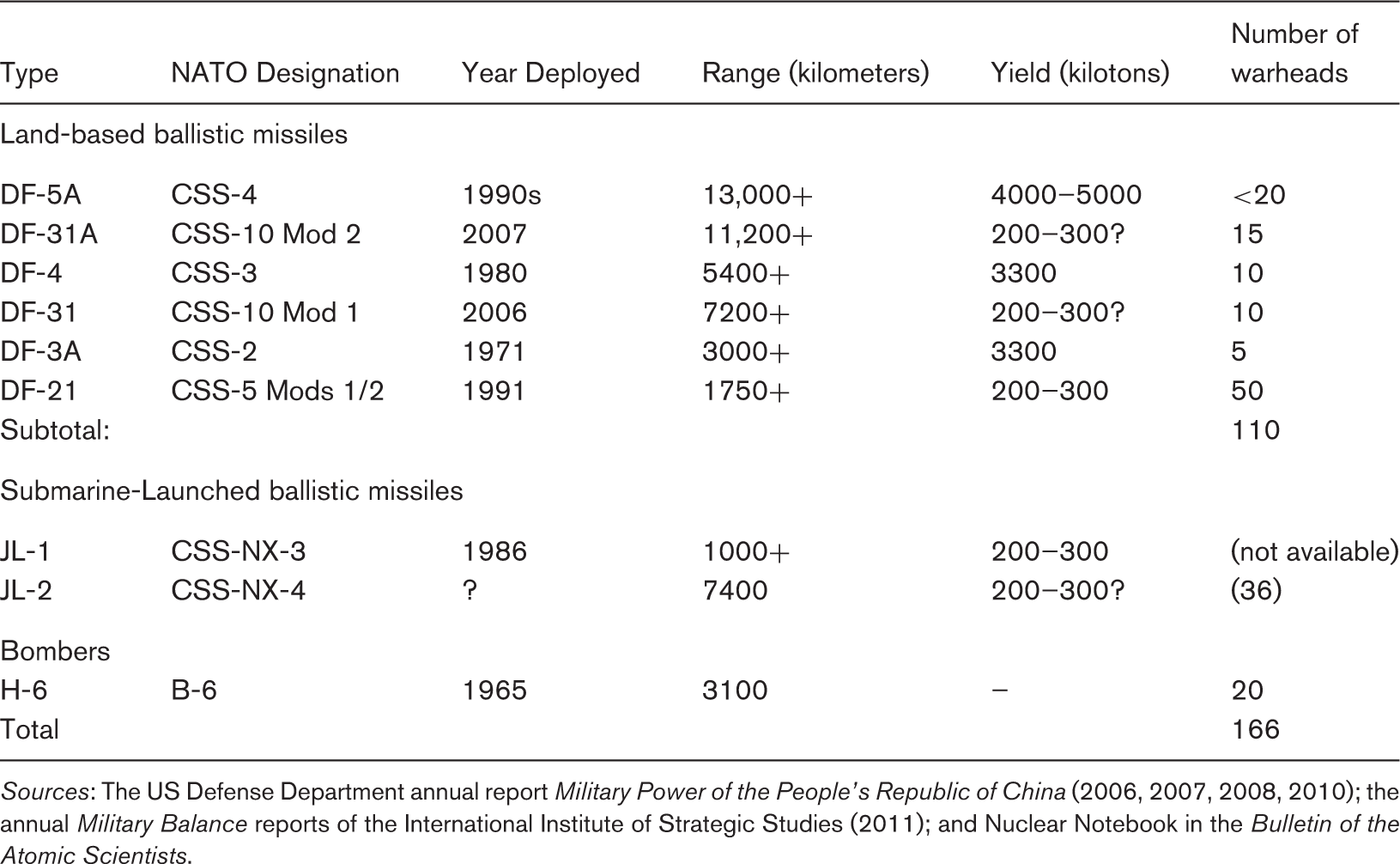
Sources: The US Defense Department annual report Military Power of the People’s Republic of China (2006, 2007, 2008, 2010); the annual Military Balance reports of the International Institute of Strategic Studies (2011); and Nuclear Notebook in the Bulletin of the Atomic Scientists.
China’s air-based nuclear force is the weakest leg of its deterrent triad. China’s aged strategic bomber force consists of about 20 Hong-6 bombers, each of which has a combat radius of approximately 3,000 kilometers (1,864 miles) and carries one bomb. They are based on the old design of the Soviet Tu-16 Badger bomber. All current publications indicate China has no operational strategic nuclear bombers, meaning the Hong-6s are not viewed as capable of reaching a target.
Given their relatively short operating range and poor ability to penetrate enemy air defenses, these bombers would be very difficult to use against strategic counter-value targets like cities. Moreover, during the Cold War, the major target of those bombers was the Soviet Union. But the current relationship between China and Russia has improved significantly. China has better relations with other neighbors, as well. There would seem to be no geopolitical rationale for expanding its air-based nuclear force.
That said, China will likely maintain a small arsenal of bombers for the near future, consistent with the country’s pursuit of “a small but inclusive” (xiao er quan) force. In 1970, Zhou Enlai emphasized that China “must build a certain number of [nuclear weapons] with a certain quality and a certain variety” (Zhou, 1998: 661). “A certain variety” of weapons meant that China would maintain a strategic nuclear triad, because Chinese leaders viewed it and continue to view it as a symbol of great-power status.
There have been rumors for many years that China has tactical nuclear weapons. In 1988, China tested a one- to five-kiloton nuclear device with an enhanced radiation yield, or a “neutron bomb.” 5 Some declassified documents from the US Central Intelligence Agency also indicate that China has pursued or possessed several types of non-strategic nuclear weapons, including cruise missiles and artillery (Norris and Kristensen, 2008). Chinese nuclear experts, however, argue that the deployment of tactical nuclear weapons is not consistent with China’s no-first-use policy. From the beginning of China’s nuclear age, Mao Zedong and following generations of leaders have viewed nuclear weapons as strategic tools to deter the use of nuclear weapons against China, not as war-fighting tools. Chinese nuclear experts have argued that the neutron bomb test was aimed at understanding its effects for defensive purposes. In practice, while it would not be difficult for China to field tactical weapons, it currently does not. 6
Trends of China’s nuclear modernization
If China did not have to worry about improvements in US missile defenses, its nuclear modernization would likely continue to focus on quality over quantity. But unless they change, US missile defense plans likely will be a major driver of Chinese nuclear modernization and, perhaps, expansion. Some Chinese officials are concerned that even a limited missile defense system could neutralize China’s small nuclear forces. China’s current arsenal of about 35 ICBMs could act as a minimum nuclear deterrent facing the US missile defense system currently deployed. If the United States were to field a more comprehensive or more operationally successful missile defense system, however, Beijing could well decide to build more nuclear warheads. Any expansion of the Chinese nuclear arsenal would still be constrained by its inventory of fissile materials, which will not support an arsenal of more than 1,000 warheads (Zhang, 2012a).
To discourage Beijing from increasing the size of its nuclear arsenal, Washington should accept mutual deterrence with Beijing, limiting its missile defenses so they do not threaten the potential effectiveness of China’s small arsenal. Meanwhile, if negotiations between Washington and Moscow proceed and those countries move forward to deeper cuts in their nuclear forces, China will likely have to reassure both capitals that it will cap its arsenal at a low level, perhaps 200 warheads. Washington’s public statements about its nuclear intentions toward Beijing will also influence China’s nuclear modernization plans. In particular, China worries that the United States could use nuclear weapons in a potential Taiwan conflict, because in its Nuclear Posture Review of 2002, the Bush administration mentioned the possibility of using nuclear weapons in the Taiwan Strait. More recently, many Chinese have worried about America’s announced intention to shift the focus of its military strategy to the Pacific and East Asian area.
The Pentagon’s new strategic defense guidance states, “It is possible that our deterrence goals can be achieved with a smaller nuclear force, which would reduce the number of nuclear weapons in our inventory as well as their role in US national security strategy” (Pentagon, 2012). The experience of the Chinese nuclear weapons program shows clearly that deterrence goals can be achieved with a small nuclear force. If the United States moves away from outdated Cold War thinking and a counterforce strategy that requires thousands of nuclear weapons, the fears of Chinese leaders could be allayed, keeping the size of the Chinese nuclear deterrent small. To encourage such a shift, China could take measures to make its nuclear programs more transparent. Increased transparency and mutual confidence-building measures would certainly contribute to a stabilized relationship between China and the United States—one that requires fewer nuclear weapons and less spending by both countries.
Footnotes
Funding
This work is partly supported by funding from the Carnegie Corporation of New York and the John D. and Catherine T. MacArthur Foundation.